




Abstract
Indian technology start-ups have flourished in the past decade in sectors such as ride-hailing, hotel-booking, and at-home personal services, which have been supported by national programs and Silicon Valley ideas of market disruption. Drawing on Miller’s foundational work on “technological consciousness,” this article demonstrates how start-up origin stories construct an ethos that is aligned with nationalist and casteist privilege, which are the closed system's principal values. Expanding northern hemispheric exclusionism, the article contributes to the interdisciplinary study of entrepreneurial, professional, and technical communication with a critical view of how globalized discourses legitimize individual entrepreneurship by strengthening and obscuring the ideological tension between casteism and meritocracy.
Targeting a growing number of consumers with access to mobile phones and inexpensive internet data, Indian technology start-ups have flourished over the past decade in sectors such as hotel-booking, ride-hailing, and at-home personal services (Mukherjee, 2019; Sharma, 2021). These start-ups have marketed themselves directly to prospective customers as well as to venture capitalists and investors by using the Silicon Valley ideas of “tech solutionism” (boyd, 2018; Haven & boyd, 2020) and “disruption” (Levina & Hasinoff, 2017). Positing “technology as a tool of empowerment and social change” (p. 489), Indian start-ups have adopted a profitable discourse that connects social, political, economic, and even ecological crises to digital technological solutions. For example, Saurabh Garg, cofounder of NoBroker, a 2014 start-up platform for buying and selling real estate without the expense of using a broker, described its conception as follows: We realized that the real estate search and discovery process was fragmented, opaque, inefficient, and full of hassles for the customer [emphasis added]. … Brokers subject customers to biases, pressures, and manipulations [emphasis added; and] we wanted to empower Indian home-seekers [emphasis added] to find a home of their choice in a hassle-free manner without paying a hefty brokerage. (Goswami & Banerjee, 2022)
An entrepreneurial origin story introduces and defines the identity, purpose, and trajectory of a start-up, or what might be referred to as its entrepreneurial ethos. This story is a strategy for helping a public or market get to know a company, organization, or entrepreneur in context. Moreover, the origin story provides organizational and cultural continuity through times of change, allowing a particular account of how an organization was started to remain constant in the market's or public's perception (Ala-Kortesmaa et al., 2022). This kind of “narrative sensemaking refers to an entrepreneur's ability to locate and adjust a taken position relative to distinct but interconnected plotlines in which the communicator and relevant organization figure as primary, secondary, and minor characters” (O'Connor, 2002, p. 37). As O’Connor noted, stories about the founding of start-ups often highlight personal motivation by emphasizing the conceptual event itself, crafting a vision of how a product or service might affect a sector or market (p. 41). For this reason, they dramatize cultural presumptions and premises in terms of a vision's rhetorical potential. Specifically in the technology market, which is expansively and globally interconnected, these origin stories are resonant across geopolitical and cultural differences, drawing from the “imaginaries” (Hockenhull & Cohn, 2021) of revolution and innovation.
In this article, we examine how entrepreneurs of technology start-ups in India generate origin stories to establish a certain kind of ethos that is aligned with ideological structures of privilege. Drawing on Miller's (1978) foundational work on technological consciousness, we find ethos to be situated “neatly between individual character as shaped by action and cultural character as determined by a complex of interacting systems, one of them being that culture's technology” (p. 229). For the start-ups we analyze, ethos functions through a mutual contingency between individual entrepreneurial initiatives and the market from which they emerge. We argue that through the logic of a “closed system,” a “circumscribed” context that has been fully “accounted for” (p. 232), Indian technology entrepreneurs sustain a highly optimistic self-legitimization, an implicit claim that a start-up and its creator possess unique solutions and necessary services that fit within a coherent vision of technological and political history. As long as the system remains closed, the relationship between the start-up and the problem it is designed to solve remains predictable and enumerable. The closure that is constructed by the origin stories seals off technological entrepreneurs and the cultural problems to which they respond from the vast historical, political, and economic complexities of both. Thus, “the technical system expands, but the explanatory system contracts” (p. 233).
We argue, however, that origin stories match entrepreneurs, their technological solutions, and cultural problems in a set of one-to-one operations that are rooted in but appear to transcend nationalist and casteist ideologies, supporting “the belief that the entire relevant world has been accounted for” (Miller, 1978, p. 232). This closed system assures the value, legitimacy, and merits of the start-up to the market and audience. This assurance may be traced to the ideological connections between entrepreneurship and Indian nationalism and casteism.
Our analysis joins the interdisciplinary study of discourses surrounding entrepreneurship and, more generally, the growing literature on rhetoric and professional and technical communication, which, according to Gogan and Belinsky's (2022) survey, has focused on professional writing practices, problem-solving, value proposition development, incubator communication, and more. 1 Given the centrality of persuasion in histories and theories of rhetoric, a considerable portion of scholarship either from within the discipline of rhetoric or that uses principles of rhetoric from other disciplines has focused on generic aspects of the “pitch” (Belinsky & Gogan, 2016; Galbraith et al., 2014; Spinuzzi et al., 2016). But as Spinuzzi (2017) stated, the complex ways in which entrepreneurship “involves rhetoric” have been investigated only “lightly and often not by name” (p. 277).
In this article, we, as an information scientist specializing in India's high-tech industry and a rhetorical scholar specializing in digital ethos, direct attention toward communicative strategies that orient entrepreneurial activities to larger circumstances. In doing so, we participate in ongoing efforts to expand northern hemispheric exclusivism and detect how transnational and global entrepreneurs might be understood as complexly shaping and shaped by an array of texts, tools, tropes, ideologies, and objects distributed across near and far-flung spaces. These spaces include regulatory policies, coworking spaces, venture capitalist groups, high-tech conferences, programming language, mobile phones, pitch decks, cultural repertoires, and national narratives. (Fraiberg, 2017, p. 355)
Fraiberg's term “national narratives” is quite central to the implications of this article, which contributes to the critical examination of how the cultural values of the global high-tech industry travel and find ways of fitting into and reinforcing ideological structures that are geographically and historically particular. For the tech industry, transnational corporate imaginaries, as Hockenhull and Cohn (2021) argued, are translated and “made local” (p. 304) through the practice and performance of “publics and socio-material configurations” (p. 317). “Hype” facilitates this localizing translation and import of a myth of “uniform progression” (p. 310). As we maintain, the high-tech start-up community, which originates in specific places such as Silicon Valley, commonly pitches itself to other publics and markets as having the ambition to change the world. This entrepreneurial ethos, Rossette-Crake (2020) suggested, “is closely linked to the start-up generation of entrepreneurs, and … finds a resonance in Anglo communication culture, as well as the now-dominant model for knowledge or information-sharing that is resulting in a reorganization of discourse communities” (p. 585). We will demonstrate that this “Anglo communication culture” celebrates individual ambition and, in line with presumptions of egalitarian meritocracy, ignores the significance of inherited privilege and that “knowledge or information-sharing” as an ideal considers only the exchange logic that applies at the top of a stratified global economy.
Our analysis indicates how the ethos of Indian start-ups is constructed with both reliance on Anglo-globalized values of entrepreneurship and reference to the nationalist and upper-caste ideologies prevalent in India. The former thrives on the perception of newness, or cutting-edge innovation, whereas the latter disguises its ancient persistence in discourses of merited success. Engaging with Deshpande's (2013) scholarship on castelessness, we show how meritocratic myths of castelessness surrounding entrepreneurship and the tech industry strengthen both the desirability of entrepreneurial ambition and the economic structures of caste itself, serving the interests of the nation and upper caste Indians.
Stories of origin are part of the infrastructural dynamics (Pihlaja, 2022) in a particular cultural site, shaped as a form of technical and professional communication (TPC) by race, class, caste, nationality, gender, and a multitude of other complex factors (Haas, 2012; Jones, 2017). This article contributes to the interdisciplinary scholarship on entrepreneurial, professional, and technical communication not by showing that start-up origin stories establish an entrepreneurial ethos with cultural resonance or emphasize a particular technological solution or even that computerized problem-solving by design reflects a closed system model of the world. Rather, we build on studies that demonstrate these realities. But the point of this article is to show that the origin stories we examine construct a credible and valuable entrepreneurial ethos by orienting problems and start-up solutions within a stable frame that functions analogously to a closed system in which entrepreneurship serves the ends of the system's principal values of nationalism and casteism. Start-up stories, then, become a discursive solution of their own in relation to the “problem” of national development and economic prosperity. Given our approach—that is, triangulating a technological consciousness, ethos, and the concept of multiple, mutually contingent closed systems—Miller's (1978) work, though it originates in a historical context different from the contemporary moment, is useful.
Moving beyond an instrumentalist approach to studying and teaching entrepreneurial discourses, we critique and broaden the general understanding of TPC. As part of the social justice turn in the field of TPC, we shift the attention from how certain discourses of entrepreneurship are effective in organizational development to a more critical look at the ideological roots and impacts of these discourses. We agree with Walton et al. (2019) that “social injustices require coalitional action, collective thinking, and a commitment to understanding difference that is not necessarily demanded by other technical communication problems” (p. 1). More specifically, we agree that “if technical communication is not intentionally, coalitionally pursuing inclusion and social justice, then it is actively reinscribing oppression” (p. 166; for a recent survey of the social justice turn in TPC and, just as important, its precursors, see, e.g., Agboka & Dorpenyo, 2022, pp. 39–42).
This article, then, participates in “the process of rupturing and challenging the political economy of knowledge production that accords certain privileges and legitimacy to certain forms of knowing while invalidating indigenous knowledges or viewpoints” (Agboka, 2014, p. 302). Doing so, Agboka (2014) stressed, “necessitates that we consider thoughtful, purposeful engagement with the research site, as an effective qualitative decolonial research requires a ‘knowingness’ of the contexts and the participants” (p. 318). The localization of TPC in the Global South, particularly surrounding digital communication technologies and the networks they sustain, must be examined in relation to postcolonial nationalism. To the extent that origin stories participate in legitimizing casteist exploitation, they reproduce historical forms of oppression within discourses of entrepreneurship. The idea that start-ups, in their formation and proliferation, serve the interests of individual initiators and larger segments of the population naturalizes the structures that benefit caste privilege and a political order in which marginalized caste communities become invisible within the global technology economy.
Literature Review
In this section, we first review scholarship focused on entrepreneurial discourses. Next, we consider how scholars have established connections between caste, technocracy, and entrepreneurship in India. Finally, we introduce Miller's (1978) critical framework of “technological consciousness,” which guided our analysis in this article.
Entrepreneurial Discourses
Within studies of entrepreneurship, a growing body of research focuses principally on the communicative and discursive practices of entrepreneurs (Hjorth & Steyaert, 2004; Larty & Hamilton, 2011). As Smith and Anderson (2004) demonstrated, entrepreneurial stories contain and endorse moral values that justify action. These stories recount “a highly individualized journey [and thus] become guideposts for the future” (Williams et al., 2016, p. 381). This communicative process involves technical, professional, and rhetorical challenges and strategies: Talking a business into existence is not easy—it requires considerable training and guidance in a range of different genres (text types), such as pitches, pitch decks, and financial and sales data. More than that, it requires a shift in identification: technology innovators must learn to think like, and think of themselves as, entrepreneurs. (Sabaj et al., 2023, p. 300)
TPC, particularly in the early stages of entrepreneurship, involves “entrepreneurs’ ability to communicate a preferred identity meaning” (Lucas et al., 2016, p. 365). This ability is leveraged persuasively to “elicit a response from an audience” and strategically to adapt as circumstances and opportunities change (Massa, 2021, p. 107). Start-up origin stories, then, are consciously rhetorical, revised continuously according to the start-up's developing value propositions, audiences, and markets.
Lounsbury and Glynn (2001) used the term “cultural entrepreneurship” in arguing that stories serve a key function in helping entrepreneurs to acquire capital and sustain dividends. In line with this argument, researchers have claimed that stories legitimize organizational intentions, provide clarity in business strategies, and situate an organization's uniqueness and value in industry (Martens et al., 2007; O'Connor, 2004). Gartner (2007) indicated how studying entrepreneurial stories can reveal a “science of the imagination,” reflecting an entrepreneur's vision for the future and plans for achievement: “Stories are never complete, in and of themselves. Stories are told in a particular context, to particular listeners” (p. 614). And more recently, Wahl-Jorgensen (2022), in a study of the origin stories of local news entrepreneurs, found that their motivations were strongly tied to normative ideologies and civic values. Thus, in establishing merit and purpose, professional communication in the storytelling format situates entrepreneurial initiatives in larger cultural structures and reaffirms the values of these structures.
Analyzing start-up pitches at a business incubator, Van Werven et al. (2019) argued that entrepreneurs often talk as if their product were already working in order to achieve greater plausibility and resonance with a target audience. Citing Hartelius and Browning (2008), they suggested that entrepreneurs are likely to succeed in their pitches by “drawing on [the audience's] cultural beliefs and attitudes” (p. 194). Daly and Davy (2016) claimed that an effective entrepreneurial pitch requires skill in rhetorical strategies and tropes as well as specific “linguistic and organizational dimensions” (p. 121). Further, Vealey and Gerding (2016) stated that acquiring funds and resources depends largely on “how entrepreneurs identify and frame problems, construct stories about these problems as pressing matters of concern, and both develop and maintain ethical relationships with their stakeholders and an increasingly diverse body of investors” (p. 421).
From a rhetorical perspective, entrepreneurial discourses reflect certain means of persuasion that are historically recurrent. As Holt and Macpherson (2010) noted, “rhetoric helps us to understand entrepreneurial sensemaking as a practice of blending and balancing interests and so instituting a mutual, and even moral, concern with creating and sustaining specific institutional forms animated by an interest in doing things better” (p. 21). They further claim that entrepreneurial stories “sustain firms whose status is articulated in ways audiences find authoritative in terms of their worldviews and interests” (p. 36). The use of such stories to articulate authority with multiple audiences is also the subject of Eryılmaz's (2016) analysis, which concludes that entrepreneurs rely on rhetoric to persuade “investors, teammates, customer/consumers, families, inner circles and suppliers” (p. 25).
Our review of this research on entrepreneurial discourse has prompted us to examine these questions: What kinds of imagination do the origin stories of Indian entrepreneurs’ reflect? What worldviews of their listeners can we glean from recurring patterns in origin stories? How might an analysis of origin stories reveal ideological structures that are at once geopolitically particular and transnationally persuasive? That is, how might Indian technology start-ups be relying on both the deep-seated cultural beliefs of nationalism and casteism and the persuasive potency of Silicon Valley myths? What futures are possible or probable for India's technology industry and labor market in entrepreneurial origin stories?
Caste, Technocracy, and Entrepreneurship in India
Caste is a system of social stratification that ascribes status based on birth. It is linked to the Hindu four-fold hierarchical system that positions the Brahmins (priests) at the top, Kshatriyas (warriors) next, Vaishyas (businesspeople, e.g., money lenders) next, and Shudras (service and artisanal workers who often perform manual labor) at the bottom. The Atishudras, formerly known as the “untouchables,” are considered to be outside this hierarchy and are the most marginalized social group. They have historically been relegated to performing tasks such as manual scavenging that are perceived as polluting to caste groups higher in the hierarchy. Although caste is linked to Hinduism, the system is also practiced across other religions in India. Caste-based hierarchies are enacted through practices such as endogamy, the relegation of social status by hereditary occupations, and rules around ritual purity and pollution (Vaid, 2014, pp. 392–393). Caste-based discriminatory customs include practicing untouchability, restricting intercaste dining and marriages, and limiting lower castes’ access to spaces and resources.
Since India's independence, the Indian constitution prohibits caste-based discrimination. Dr. B. R. Ambedkar, an anticaste thinker and chairperson of the committee to draft the Indian constitution, who was born into an oppressed caste group, considered constitutional protections against caste discrimination as central to improving the lives of hitherto marginalized Indians in a newly founded democratic society (Bhaskar, 2021). Constitutionally, caste groups are categorized into Scheduled Castes (SCs), Scheduled Tribes (STs), and Other Backward Classes (OBCs). This nomenclature corresponds to groups that have faced historical economic and social marginalization. Generally, Atishudras (or the self-identified term Dalits, which means to be oppressed) belong to the SCs, India's indigenous and tribal population belongs to the STs, and groups below the upper three varnas of Brahmins, Kshatriyas, and Vaishyas but above the Dalits belong to the OBCs. Caste groups not belonging to SCs, STs, or OBCs are considered as part of the Forward Caste, or general category, and tend to have greater social and economic status.
These categories have especially achieved salience in a postindependence India because they are linked to affirmative action (referred to as “reservation” in India). Quotas are allotted for members of SCs, STs, and OBCs in government-run educational institutions such as universities, jobs in government organizations, and electoral representation (Vaid, 2014, pp. 394–395); however, an accurate caste distribution of India's population is missing. Anticaste groups have been protesting this lack of accurate information about caste distribution, insisting that the next national census must include caste-based counts to paint a more accurate socioeconomic profile of India (Purohit, 2023). But in a 2021 survey, the Pew Research Center found that 25% of Indians identify themselves as belonging to SCs, 9% as belonging to STs, 35% as belonging to OBCs, and 30% as belonging to the general category (Jo Starr & Sahgal, 2021).
Despite hopes for a more democratic, equality-based socioeconomic life in India, caste-based inequalities continue. Marginalized caste groups report higher poverty levels (Borooah et al., 2014), lower health indexes (Raushan et al., 2022), and lower education levels (Thorat & Khan, 2023) and have lower access to information and communication technologies and the internet (Rajam et al., 2021; Tewathia et al., 2020). Substantial scholarship has shown that caste-based discrimination is prevalent in the labor market (Jodhka & Newman, 2007; Thorat & Attewell, 2007) and in access to capital and entrepreneurship (Deshpande & Sharma, 2013; Iyer et al., 2013). In a study of the relationship between caste and class, Vaid (2012) found that higher caste groups are overrepresented in the more stable white-collar categories of the professional classes, and in RNM (routine non-manual) classes as well as in farm-owning classes and large businesses. The SCs, on the other end, are not only underrepresented in all these classes but also are overrepresented in lower income, less stable, temporary employment in the manual work categories and in lower agriculture as laborers. (p. 414)
As a postcolonial nation, India has relied heavily on science and technological advancements to ensure and legitimize independence and progress (Abraham & Rajadhyaksha, 2015; Jasanoff & Kim, 2015). A key figure in discourses about this approach to advancement is the technocrat engineer, constituted for the Indian public as a visionary leader to whom the nation owes its gratitude. This figure is prototypically male and upper caste (Bassett, 2016; Subramanian, 2019; Sukumar, 2019). Philip (2015) has argued that over time, there has been a “historical shift in ideal Indian citizen-archetype, from farmer to digital entrepreneur” (p. 279), and that in the process, “participation in the digital sphere is linked to public performances of masculinity” (p. 289). The self-made entrepreneur bears witness to this digitization of the ideal citizen.
In the past decade, to explicitly and publicly encourage economic growth led by technology entrepreneurship, the Indian government launched programs such as Digital India and Startup India. These programs, intended for entrepreneurs to build businesses in line with a vision of nationalist economic expansion, emphasize digital infrastructure for improved governance. The programs have been critiqued for their vision of technological progress as a source of nationalist pride and their depoliticization of Indian social inequalities (Gurumurthy et al., 2016; Singh, 2021). Using the term “entrepreneurial citizenship” to describe a regime in which “citizens can construct markets, produce value, and do nation building all at the same time,” Irani (2019, p. 2) argued that the circumstances of such citizenship produce hierarchy, placing the figure of the entrepreneur, working in the nation's service, at the top. This hierarchy obfuscates and thus insulates from critical scrutiny India's complex social realities of caste, class, and gender. Prioritizing the development of entrepreneurship and deprioritizing deliberations about social justice crises, she stated, reinforce “middle-class and, implicitly, upper-caste political practices and sensibilities” (p. 135).
As scholars have also demonstrated, this flattening of India's social hierarchies is pernicious within the Indian information technology sector, which is dominated by upper-caste professionals. In this sector, entrepreneurial leadership discourses conflate the myths of merit-based success and a casteless industry such that the upper-caste status of the entrepreneur is both validated and suspended from critique (Fuller & Narasimhan, 2006; Kumar, 2022; Upadhya, 2007; Vaghela et al., 2022). Engaging with Vaghela et al.'s call for “more studies of caste in computing with a focus on understanding how caste operates among upper castes and how that shapes computing cultures” (p. 17), we examine here how the origin stories of India's technology entrepreneurs reinforce links between castelessness, service to the state, and technological progress.
Critical Framework: “Technological Consciousness”
In her prescient article, rhetorical scholar Miller (1978) made technological activity and cultural discourse coconstitutive. Specifically, what she called technological consciousness, in its nascency in the late 1970s, became a cultural mindset, leading to “the acceptance of means as ends and of the proliferation of these substitute ends; the relinquishment of purpose to the external world; a self-justifying objectivity; and linear, cause-and-effect reasoning” (p. 231). These ideas coalesce into the mindset that the world is a closed system in which [there is a] need to predict and control aspects of the material world [that] are being manipulated [and] leads to the belief that the entire relevant world has been accounted for. Once it has, the solving of problems is a matter of calculation, of mechanical procedure. (p. 232)
We will now examine this optimism regarding solutions, the calculation and control of circumstances and procedures, and the neglect of extra-technological critique of values with regard to start-up entrepreneurs, specifically in high-tech markets.
The Ethos of Indian Technology Start-Ups
We offer here a rhetorical analysis of the origin stories of seven Indian start-ups that position themselves as technology platforms (Gillespie, 2010) in transportation, education, software as a service (SaaS), at-home services such as plumbing, personal services such as beauty work and massage therapy, or health care: Ola Cabs, Oyo, Urban Company, RedBus, Practo, AutoFlipz, and Paytm. In various ways, the origins of these seven start-ups may be understood as rhetorically emblematic of the Indian start-up ecosystem. We assembled our corpus of origin stories from media interviews in which individual entrepreneurs reflected on their initial motivation for starting up their business, website content from “About Us” pages, press releases, a podcast, and general media coverage of the start-up ecosystem in India. Table 1 details these sources and provides examples of key tropes visible in each story.
Source of Start-Up Origin Stories.
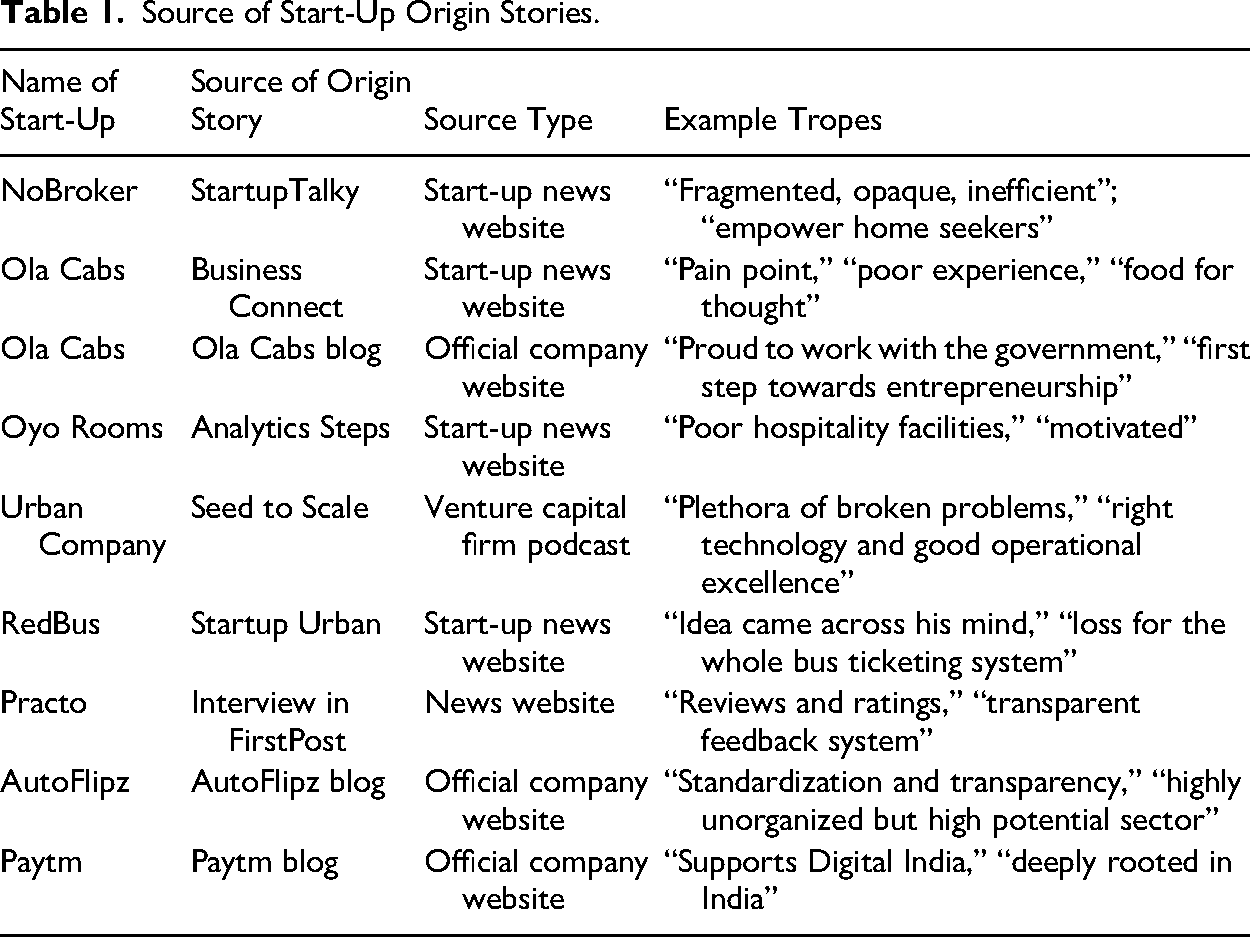
By assembling our corpus from this variety of sources, we can show how this kind of entrepreneurial discourse is diffused in a moment of rapid technological change. The diversity of sources shows how the same kinds of claims are circulated in a networked and emergent way. Throughout multiple venues and formats, the same tropes are replicated, and their circulation is part of how the ideological discourse functions. Consequently, in this study, we focus more on how entrepreneurial discourse operates, and what it represents, than on what individual sources it is found in. Studying this composite of stories through Miller's (1978) framework of technological consciousness, we approach origin stories as members of a genre, 2 a “group of discourses which share[s] substantive, stylistic, and situational characteristics …, composed of a constellation of recognizable forms bound together by an internal dynamic (Kohrs Campbell & Jamieson, 1978, pp. 20–21). Further, we consider the genre of entrepreneurial origin stories to be primarily intelligible as “social action” directed toward a motivated end (Miller, 1984).
Following a thematic analysis approach (Braun & Clarke, 2006), we used open coding to classify the data, surfacing common tropes across the start-up origin stories. Then in a second round of coding, we combined these tropes to generate four recognizable themes: ethos from merited identification, ethos from comparative advantage, ethos from professionalism, and ethos from service to the nation. In analyzing these themes, we focus especially on the construction of ethos and or as credibility, tracing these themes not only to the effective construction of kinds of ethos but to the alignment of these constructions with dominant nationalist and upper-caste values. The four themes are not conceptualized as genres that function independently or distinctly; rather, the themes function coproductively as dynamic interplay. Our critique approaches origin stories as rhetorical strategies used by entrepreneurs to persuade both corporate and nation-state audiences to accept the stories’ premises, claims, and conclusions and motivate them to invest in their start-up.
Ethos From Merited Identification
To announce their emerging start-up, entrepreneurs often do a public relations “push” through business portals that cover the start-up ecosystem. In these announcements, an ethos of legitimate prominence is persuasive. For example, YourStory, a prominent publication that covers origin stories of start-ups in India, featured headlines that associate founders with one of India's most elite educational institutions, the Indian Institutes of Technology (IIT) and Birla Institute of Technology and Science (BITS): “How These IITians Turned Their Student Project Into a Profitable Global Edtech Company” (Varshney, 2020), “How This IIT-IIM Graduate's SaaS Start-Up Is Simplifying Email Marketing” (Poojary, 2021), “These Engineers From BITS Pilani Plan to Take Your Homes Off the Energy Grid” (Kashyaap, 2015), and “This IIT Madras Alumni's Start-Up Is Making Crude Oil Out of Seaweed” (Malhotra, 2022). In each case, the headlines are written to establish the credibility of the founders. They echo and reinforce the popular belief that people who graduate from the institutions named are talented, hardworking, and otherwise exceptional. These institutions are Indian engineering colleges held in high public regard partly because of their difficult and competitive entrance examinations.
Such headlines, however, belie the caste and class privilege that allows start-up engineers to be seen as meritorious, and not recognizing that privilege in popular coverage only serves to doubly reinforce how privilege is seen as credible and meritorious. Journalistic reporting has repeatedly noted how these elite institutions fail to meet in their admissions and faculty appointments the caste-based reservations mandated by the government. As a result, these institutions are dominated by upper-caste students and faculty members. Even when students from marginalized caste groups make it to these institutions, they face discrimination and further marginalization for not being seen as “worthy” or “meritocratic” (Bansal, 2023; Paliwal, 2023; Vaitheeswaran, 2017). But, as Subramanian (2019) stated, “constitutionalism, mass examinations, and global market success have all mediated the transformation of the IITian's caste privilege into merit” (p. 20). This approach to establishing credibility, then, also references the technical competence and know-how that are required in order to build a technology platform. Thus, announcing a start-up by referencing IIT and BITS both contributes to Indian exceptionalism narratives and sustains the institutions to which upper-caste Indians presume exclusive access.
With start-up origin stories, we find that entrepreneurs try to establish a sense of familiarity and relatability with their target audiences based on a current problem. Whatever the problem might be, the rhetorical effect is an opportunity for the start-up to present itself as a solution. Founded in 2010, Ola Cabs is a prominent ride-hailing service, similar to Uber and Lyft, that operates in India. One of the key communicative strategies that Bhavish Aggarwal, cofounder and CEO of the company, used to establish the credibility of his firm was to draw attention to his college education at IIT Bombay, India's premier engineering college, and to refer to his prior work experience with Microsoft Research. This strategy ascribed to him certain capabilities, specifically the technical competence to build a functional app. Additionally, he needed to establish why, among the many engineers that could be building an app, prospective customers and investors should trust him. He retold his founding story by constantly referring to how he had directly experienced the pain point that motivated him to build this product: Ola Cabs is a byproduct of the pain-point often experienced by a traveler in India [emphasis added]. One of the co-founders of the company, Bhavish Aggarwal, while traveling to Bandipur from Bangalore was left stranded in the middle of his journey by the driver. The reason being that he was not willing to renegotiate the already discussed fare by the driver. This poor experience made him give food for thought to pioneer an effective and comfortable cab service [emphasis added]. (The Most Inspirational Success Story of OLA Cabs, 2018)
This origin story, then, describes an exceptional figure who needed only “food for thought” in order to create. Identifying as just a traveler among many, Bhavish experienced the “pain-point” caused by the driver's difficult behavior. And this experience, combined with an unattributable capacity to innovate—there is no indication that he was able to create an app based on his privileged access to education—resulted in a valuable service.
Similarly, Ritesh Agarwal, founder of Oyo Rooms, a service for booking low-budget hotel rooms, described his original motivation for starting this service through commiseration: Since Ritesh used to travel a lot, amid his trips, he stayed in different hotels. This gave him a realization about the poor hospitality facilities he got at different places [emphasis added]. This motivated him to create an accommodation system [emphasis added] where people can get the best rooms, food, staff, and other services in a given budget. (Pathak, 2021)
Both of these examples, then, appeal to trust by identifying with the reader—the notion that technology entrepreneurs are “just like you.” Start-ups become what they become because their founders have experienced firsthand the problem that they have solved through technology. Such origin stories establish that prominent entrepreneurs, having faced challenges or at least inconvenience, are motivated not only by a business opportunity but by something larger than themselves, a societal problem. They are rhetorically cast as peer leaders, more competent than those for whom they offer a solution but similarly experienced in the hassles of, in these cases, hotels and cabs. What this appeal to similarity elides, of course, are the caste differences that keep luxuries such as cabs and hotels from being a common problem to be solved. Thus, “poor hospitality” refers to an experience of caste privilege that in the story emerges only as the reason behind an individual entrepreneur's exceptional ingenuity.
The establishment of ethos through identification serves as an appeal to Indian venture capitalists. In choosing among entrepreneurs who are more or less equal in technical skill, these venture capitalists see those entrepreneurs who indicate familiarity with the problem as being committed to long-term solutions as opposed to overnight profit. This familiarity establishes trust between upper-caste technology entrepreneurs and their intended clients (i.e., urban upper-caste, upper-class customers who have also faced these problems). Interpreted through the closed system consciousness that Miller (1978) described, such stories of inspiration rarely emphasize the domain skill that technology entrepreneurs are going to “solve.” That is, it is not important that Bhavish knows anything about cab driving or that Ritesh knows anything about hotels. Those domain skills are assumed to be secondary—matters that their technology know-how will handle. In effect, these entrepreneurs are employing a techno-deterministic rhetoric that subordinates sector-specific knowledge to technical facility. This rhetoric is, as Miller (1978) noted, “the substitution of closed-system logic for open-system reason. In a low-context technology, the tool is open to the pragmatic test; success and failures are explained by reference to external cultural terms” (p. 233) or, in this case, practical experience. In a closed system, the ethos that is constructed through identification appears to resonate with the problems of everyday Indians, but in reality, it aligns with the trust measures of those with capital resources.
Ethos from Comparative Advantage
Integral to the rhetorical construction of the tech start-up ethos is the deliberate creation of distrust in existing technologies and systems. Entrepreneurs in a technical industry, similar to other types of experts, “present themselves as uniquely capable of doing that which is ‘waiting to be done’ thus correcting that which is ‘other than it should be’” (Hartelius, 2011, p. 25). This rhetorical strategy serves to integrate technical knowledge with an implied critique in which the foil of the comparison may be left unspecified, thus principally presenting the expert as generally superior. For example, the entrepreneurs of Urban Company (UC), a start-up that provides at-home services such as plumbing and electrical work and personal services such as beauty work and massage therapy, described their motivation as follows: Home services was one space that was run by word-of-mouth and referrals from friends and family [emphasis added], that included painters, carpenters, barbers etc. On a surface level, it seemed like it is what it is traditionally and this system isn’t really broken … [but] there were concerns around transparency, diligent timings, pricing, which seemed like a plethora of broken problems for the trio. With the right technology and some good operational excellence [emphasis added], they saw that this could be a really large business. (Daniel, 2020)
Although this excerpt suggests that a traditional system that relied on word-of-mouth referrals seemed to be working, it implies that the shrewdness of entrepreneurs was in fact required to discover the nature and scope of the “plethora of broken problems”—"transparency, diligent timings, pricing”—that only could be adequately addressed “with the right technology and some good operational excellence.” Far from recognizing that informal work dominates working conditions in India and shapes expectations of “professionalism” and the training resources for skill development available to workers, the founders of UC position informality as a flaw, something “broken” about the system that requires technology to address.
Scholars have argued that rather than addressing informality as a systemic issue, gig platforms have simply platformized, or organized, it, thereby fitting it for high-tech accessibility (Duvisac, 2022; Surie & Koduganti, 2016). As Tandon and Rathi (2021) stated, “within the logic of formalization that platform companies promote, the paternalism of privileged class and caste is parsed technologically in the form of the platform” (p. 52). This accessibility is integral to the ideological presumptions of the caste structure, placing labor at the instant disposal of upper-caste customers with resources. Like the UC founders, Phanindra Sama, founder of RedBus, an online service for booking bus tickets, was placed in a story of origin in which something deficient is replaced by something superior: During the Diwali break, Phanindra Sama wasn’t able to get the bus ticket for going back home. He tried to procure one ticket and he approached nine bus operators. Unfortunately, he couldn’t get a single ticket for himself [emphasis added]. Finally, he was forced to stay behind in Bangalore. RedBus's idea came across his mind through the incident [emphasis added]. He still believed that getting a ticket would’ve been possible if he’d tried a little harder and looked for a vacant seat. He started wondering if there was still a single seating left that was not booked in a bus. This was a loss for the whole bus ticketing system [emphasis added]. (Startupurban, 2021)
Phanindra's inspiration story contains the key ingredients—that he has experienced the problem himself but also that, for him, the existing system is broken in ways that negatively affect the “whole bus ticketing system.” In these and similar origin stories, entrepreneurs question the legitimacy and credibility of the status quo and invent improvements to existing systems. For them, the technology platform alone can solve all of the problems of the existing systems, and their start-up is the credible mechanism. In Miller's (1978) words, the “exteriority” of the platform becomes difficult to discern, and “we abdicate our understanding of reality to the terms of the technical system” (p. 233). Thus, the technical system, like the caste system, determines the relationships between problems, desirable action, efficacious actors, and the human experiences of technology and ordinary life.
Ethos from Professionalism
A recurring strategy in start-up origin stories, then, is to demonstrate how new organizational processes “professionalize” existing informal systems, substantially distinguishing the start-ups and their products from inferior predecessors. Much of this “professionalization” involves designing technology systems that control and limit how people interact with them through a process that Woolgar (1990) called “configuring the user” (p. 59). Further, Kelkar (2018) argued that in addition to controlling design and technology interfaces, platform entrepreneurs harness power by reshaping existing relationships into the “platform model of organization, [which is] seen as more scalable and sustainable” (p. 2642). The following excerpt is from the blog of AutoFlipz, a technology platform to help secondhand car buyers find repair services: Automobile repair and service start-up AutoFlipz on Tuesday announced the launch of a platform offering standardization and transparency [emphasis added] in the aftermarket repair shops segment. Through its platform, the company is providing customers with assured car services and repair with an aim to standardize the highly unorganized but high-potential sector [emphasis added]. Cofounder and COO, Japjot Singh[,] further said the company will provide genuine spare parts, inspections, roadside assistance, highly-equipped smart workshops, and skilled technicians, with the establishment of a certified network of authentic service providers [emphasis added]. (Jasleen, 2021)
The value proposition of Practo, a website that allows users to make bookings with medical providers, is similarly described in terms of inevitable historical and technological progress. In the following excerpt, the Practo technology is represented as a positive contributor to changing the antiquated relationship between doctors and patients: If you've been using Practo, there are a host of reviews and ratings for each solution provider [emphasis added] that one can browse through before choosing the right doctor. The transparent feedback system by patients has tons of stories out there to help, guide and make decisions [emphasis added]. Healthcare sector isn't the way it was a decade ago, anymore. There is a change in the way a patient–doctor relationship works [emphasis added]. (Khedekar, 2016)
Reinforcing the idea of transparency to appear neutral and credible, Practo suggests that it is part of the “change” in the patient–doctor relationship through its “transparent” process of aggregating customers’ ratings and reviews. This process helps patients to feel empowered in what is otherwise seen as an unequal relationship.
In both the AutoFlipz and Practo cases, “the platform environment exercises various means of disciplining the workers—the training process, the assignment of jobs, the metrics monitoring, and the customer rating process all help the platform observe its workforce through an analytical prism” (Raval & Pal, 2019, p. 9). Thus, the hitherto “informal” work arrangements can purportedly be fixed and professionalized if they can be observed through the lens of these platforms’ metrics. But what counts as professionalism, and in what way, is defined according to the expectations of the urban upper-caste customers who use the platforms (Anjali Anwar et al., 2021; Raval & Pal, 2019). 3
This proceduralism through platformization affects labor relations and work expectations (Casilli & Posada, 2019). As Raval and Pal (2019) pointed out, the processes that the platforms implement and follow enable them to suspend the human subjective experience, allowing the platforms to draw credibility by shifting the focus toward the inputs and outputs of the processes. For example, the status of a “good” doctor or technician is established through the platform's aggregated rating rather than individual experience. But in this closed system, the subjective experiences of those without access (marginalized by caste) become invisible to the platform. As Miller (1978) puts it, in the closed system, “craft has been mathematized [and p]rocedure has been bureaucratized” (p. 233). Through Miller's lens of technological consciousness, the prospect of external evaluation is eclipsed by the procedures of a technical solution that implements and validates itself inside the system.
Ethos From Service to the Nation
As we mentioned, the Indian government has launched programs such as Digital India and Startup India in order to strengthen India's economic and political prosperity via technological entrepreneurship. These programs serve as a clear signal that the government believes that “going digital” will generate national growth (Gurumurthy et al., 2016; Singh, 2021). A large number of start-ups have joined the initiatives by signing memoranda of understanding with the government or forming partnerships with state institutions.
4
This relationship benefits both the start-up and the government: the start-up gains credibility through its “official” verification and relationship with the government, and the government gains legitimacy by conveying to citizens that it actively supports and intends to expand the nation's entrepreneurial vitality. This beneficial relationship is illustrated in the following excerpt from the “Investor Relations” blog of Paytm, a digital payments start-up like Venmo that provides financial services (e.g., allowing customers and merchants to make and receive payments, open bank accounts, take loans): Another Twitter user, Vaibhav, shared a photo of a woman in Bengaluru selling corn and peanuts with a Paytm All-in-One QR code visible on her cart. Vaibhav wrote, “Paytm is now so deeply rooted in India [emphasis added]. It's the first rain in Bangalore and the lady doesn’t have to worry much about wet notes now.” … Paytm Founder and CEO Vijay Shekhar Sharma responded, “Feels truly privileged to see trust of such champions in Paytm. My respect for her and every street vendor who supports Digital India mission [emphasis added].” (How Our QR Strength Powers Merchants, 2023)
Attesting to Paytm's impact in the country, the investor relations team cites a tweet from a user, Vaibhav, who makes the argument that digital payments through Paytm have now become “deeply rooted in India.” Paytm CEO Sharma's response is quite telling; he start-up appreciates merchants who use its services and thanks them for supporting Digital India. Instead of making a reference to the company directly, Sharma recasts the customer as someone who supports national interests by participating in the government's initiatives. Thus, Sharma obscures the benefit to Paytm in order to emphasize the national discourse of progress. The company gains credibility by positioning itself as part of the larger mission of economic growth in India.
Similarly, in a press release, Ola Cabs announces its agreement with the Government of Maharashtra, a state in India, thereby demonstrating its service to government: Sandeep Divakaran, CFO, Ola Fleet Technologies said, “We are proud to work together with the Government [emphasis added] to train and provide the right skill set to thousands of men and women across Maharashtra and help them take their first step towards entrepreneurship [emphasis added]. The growth in the country's mobility sector has opened up ample opportunities and as the country's leading mobility player, we are proud to be the enabler in providing this platform to the aspiring entrepreneurs. Government's focus on economic development and employment generation will add impetus to its efforts in creating an enabling environment for the unemployed [emphasis added].” (Ola Cabs, 2018)
Deflecting attention from the benefits that Ola Cabs garners from its relationship with the Indian government, Divakaran positions the company's technology platform as contributing to the government's mission to address “economic development and employment generation.”
In India, where public trust in and deference to the state are high, the government's verification of a technology start-up shores up the credibility and others’ perceptions of the value of the start-up. In this closed system, state authorities single out high-tech start-ups to provide technological solutions for societal problems such as underemployment. Singh (2021) noted how a scheme such as Digital India “recasts empowerment as an individual issue and naturalizes the myths of meritocracy, castelessness, and genderlessness” (p. 164). In line with Singh's critique, recent scholarship highlights how Indian caste-based differences in income and education are tied into the “digital divide” (Rajam et al., 2021; Tewathia et al., 2020), making it harder for historically marginalized groups to become entrepreneurs in the digital age. The logic is discursively circular, and the claim is analogous: an individual entrepreneur is credible to the extent that he (gendered) has been granted credibility by the institutions that manifest national and caste-based greatness (such as IIT); his service to the nation (his solutions to the problems that impeded national progress) becomes evidence of his purview as an entrepreneur and of the nation's future potential (i.e., the visionary sees not only technological solutions but the wonders of a future India). And in terms of the analogy that we investigate here, the technical solutions that particular start-ups deliver to markets are geared to an economic system that defines certain problems but ignores problems associated with racism, casteism, and so on, and entrepreneurship in the technology industry is geared to the system that creates prosperity for the nation, closing off both access and critique.
Discussion
In Miller's (1978) assessment, one of the cultural threats that technological consciousness presents is the intensely optimistic presumption that as long as interpretations of problems and crises are kept within a closed system, the problems can be solved. In discourses surrounding Indian technology start-ups—whether the problem is a disrupted cab ride, a bus ticket that cannot be booked, or an incompetent doctor—the solution is a platform. The platform closes the perimeters of problem-solving: The driver is tracked and rated on an app, each bus ticket is cataloged to ensure that no seat is empty, the patient–clinician relationship is managed and monitored for experiential rating. To entrepreneurs, what can be defined as a problem can be matched with a technical solution. The start-up stories that entrepreneurs tell close the system around technologies and cultural “problems,” orienting them to the larger closed system in which entrepreneurship solves the problem of national economic development.
Miller (1978) described how closed systems are characterized by a “self-justifying objectivity” (p. 231) and how engineers convert the world's complexity into a “standard report format” (p. 235). In the origin stories we have analyzed here, engineer entrepreneurs build credibility by associating themselves and their product or service with ideals of standardization and objectivity. They make claims regarding the comparative superiority of their technological and operational processes in which the apps and platforms themselves, by standardizing and rating performance, transform imperfect habits to perfect solutions. For these entrepreneurs, it is important to show how existing systems are broken or not trustworthy and to suggest that this state of brokenness or unreliability is the norm rather than the exception. A platform or app, once it has been introduced by a start-up entrepreneur, requires little justification on how it alters an existing practice and social network, and the question of whether a problem truly existed that required a solution is moot. As a function of the Indian government's commitment to technological entrepreneurship, certain tools become necessary for progress—as though the creation of a solution produces a problem to match the specifics of its intervention.
Put another way, if the study of TPC generally defines entrepreneurship as innovative problem-solving (Rajan, 2021, p. 257), then this article contributes to the scholarship by critiquing solutions that rhetorically constitute the problems they purportedly solve. If the solution (technology platform, app, etc.) points back toward an origin story centered in a serious problem, the legitimacy of the entrepreneurial initiative supersedes the question of the nature and scope of the problem. Processes that might be described as antiquated “malfunctions” in the origin stories of Indian tech start-ups in reality and practice represent the lifeworld that millions depend on for subsistence.
The ethos of the Indian technology start-up is constructed largely through the origin story, which persuasively draws on the technocrat figure of Indian popular consciousness. Enhancing the image of this visionary leader, the entrepreneurs we have analyzed here create relatability and identification with publics and markets. They indicate how they, like their potential clients and investors, have experienced certain problems and inconveniences and offer solutions to replace what they describe as an antiquated and “informal” practice with a formal system, a system in which “habits of behavior, institutions, further technology, and ways of talking and thinking get built up around the original extension,” the platform or app (Miller, 1978, p. 229). The national programs that fund and support digital technologies as a strategy for economic development sanction this view of entrepreneurship as self-justifying.
A focus on India as a postcolonial society informs our thinking of entrepreneurial discourse as a colonizing force. Within the discourse of global tech solutionism—a discourse that may have been conceived in the context of Silicon Valley but has been exported to regions and peoples with much different histories and sociological hierarchies—India's narrative of support for the technology industry and entrepreneurship seems new, innovative, and dynamically responsive to a constantly shifting professional field. But in a sense, the origin stories we have analyzed indicate how colonialist ideology influences, even controls, what may appear forward-thinking. Without attending to how an entrepreneurial economy such as that in India deals with marginalization as an aspect of industry, the TPC field cannot fully grasp the discursive practices that maintain power and privilege throughout the Global South. India's widely circulated celebration of individual ingenuity is an example of how its TPC that combines individualism with mythologized meritocracy elides anticolonialist critique.
Fraiberg (2021a) highlighted how critical entrepreneurship studies (see, e.g., Essers et al., 2017; Tedmanson et al., 2012) have “yet to fully address how entrepreneurship is bound up in neoliberal and marketplace logics, asymmetrical relations of power, and systems of oppression” (Jones, 2017, qtd. on p. 176). Tracing the fraught conditions under which Palestinians are building a start-up ecosystem, Fraiberg (2021b) suggested that such a focus on power relations in studying entrepreneurship globally can show “contested processes [that] privilege certain users over others and raises key questions about who is being accommodated, represented, and considered in technological innovations” (p. 246). In this article, we have attended to these concerns about power and entrepreneurship by focusing on origin stories of Indian start-up entrepreneurs. Fraiberg (2021b) endorsed “a shift from a traditionally myopic or atomistic focus on individual entrepreneurs [and] a shift away from a functionalist perspective that unquestioningly assumes entrepreneurship is a desirable economic practice, alternatively theorized” (p. 220) as socioeconomic and political interactivity. Although Fraiberg's point is well taken, we do not shift entirely away from the individual specifically because the idea of individualist merit, particularly in our case studies, still constructs entrepreneurs themselves as a center of value, a locus from which value moves centrifugally toward national interests.
Haas (2012) and Jones (2017) have urged scholars to take identity and culture issues seriously while studying TPC by considering, for example, how race shapes and is shaped by entrepreneurial rhetoric. This work, directed toward social justice, aims to deconstruct “prevailing structural inequalities in relation to race, gender, and ability” and to include “marginalized peoples, practices, and epistemic traditions in TPC” (Walwema et al., 2022, p. 258). In Indian technology start-ups specifically, “justice” might mean a disentanglement of Silicon Valley norms from the geocultural particularities of certain industries and an establishment of localized sustainability: Every attempt to develop a normative ethics for TPC in the 21st century must acknowledge that the individual can only do so much, that the collective, systemic, infrastructural dynamics that both enable and constrain the network cannot likely be undone with a single action or even a series of actions by a single person at a single node in the network. (Pihlaja, 2022, p. 319)
This acknowledgment has implications for the ethos of individual entrepreneurs, including the ones we have focused on here. Like Pihlaja's (2022) study, our analysis traces the malleability or rigidity of codes and norms in TPC. Arguably, border crossing, as he framed it, might be thought of as similar to caste navigation in a way that could inform constructs such as the modern nation-state and entrepreneurial networks. At various levels, institutions and networks rely on coordination through digital communication tools and platforms (p. 297)—what we call here “closed systems.”
Echoing calls for critical perspectives and a social justice agenda, we believe there is urgency for researchers to consider how entrepreneurial narratives are influenced by and influence caste. For example, Rajan (2021) has shown how caste and community are important factors that economically underresourced grassroots entrepreneurs must contend with as they pursue their entrepreneurial ambitions. Our work closely examines the opposite end of entrepreneurship in India, critiquing origin stories of upper-caste, upper-class technology entrepreneurs. In these stories, the meritorious nature of the technology entrepreneurs, seen as desirable by other upper-caste Indians, becomes a factor that enables their entrepreneurial ambition, further reinforcing the alleged castelessness that is dominant in upper-caste Indian culture (Deshpande, 2013). We question and expand Rajan's work by focusing on entrepreneurs with structural privilege, benefiting from caste-based institutional resources, who, from outside the Indian economic and cultural ecology, may appear to be “grassroots” and whose stories depend on making appeals to identify with a consumer base. In effect, closely examining how caste and entrepreneurial discourses operate can uncover “who is being accommodated, represented, and considered in technological innovations” (Fraiberg, 2021b, p. 246).
Our approach to discursively analyzing origin stories shows that what is not being said is as important to analyze and surface as what is being said. We show how “effective” entrepreneurial strategies can camouflage themselves in larger structures of social inequality, presenting themselves as a value-neutral “good” for society. One of the implications for TPC teaching is to move beyond just instrumental discussions of effective and ineffective forms of professional communication in order to show how entrepreneurship gets enmeshed into larger social structures. If one of the objectives of a critical perspective on entrepreneurial discourse is to interrogate these structures of power, we must also note how those structures appear in various guises. In this article focused on Indian entrepreneurs, we have shown how these communicative strategies draw their credibility from upper-caste and nationalist values. As Miller (1978) stated, “this is the insidious aspect of technological consciousness—it would hold that it itself does not exist” (p. 236). In the Indian context, this insidiousness feeds into claims of castelessness and obscures how that tradition of caste, far from being a relic of the past, sustains itself by drawing on ideas of “merit” and Silicon Valley-inspired technological solutionism.
The implications of our central claim for TPC research pertain to the cultural function and ideological impact of emergent technologies. Much of the TPC literature locates technology at various stages of inception and development as a means to entrepreneurial ends and thereby defines its inventors as independent communicative agents. In the discourses we have analyzed, technology is itself a component of the ideological telos of entrepreneurship. We propose that research must connect discourses surrounding entrepreneurship to the political and economic structures that endow them with cultural meaning. The problem–solution logic of various digital apps can be only partially understood without reflecting on the problem–solution model for thinking about nationalist progress, particularly when the model marginalizes the life of local communities. And although class is a familiar concept in Western-centric perspectives on TPC, caste operates in ways that are integrated with nationalist tactics of dominance but that also historically and culturally exceed the postcolonial nation-state, rooted in premodern Indian social relations.
Conclusion
The critical view of Indian technology start-ups that we have offered here draws attention to the ways in which closed-systems thinking, by both strengthening and suppressing the ideological tension between casteism and meritocracy, legitimizes individual entrepreneurship. Put succinctly, the individual entrepreneurs in our analysis, telling their own story of innovation, obscured their caste privilege using the myth of merit. Building on Subramanian (2019) and Singh (2021), we show how by appealing to the protechnocratic impulses dominant in upper-caste Indian culture, the founding stories of start-ups define ingenuity in the terms of dominant caste groups. That is, these stories tell how technology serves the “greater good” more effectively than do other enterprises or forms of social action. And this greater good technology assures the value and credibility of the engineer–entrepreneur while notably eliding the question of how certain technologies position their users and participants. The platforms and apps translate not only data into actionable procedures but humans into variables. Rendered invisible by the prominence of the entrepreneur, the figure of the domain worker—the plumber, electrician, cab driver—has little value.
This article has contributed to studies of entrepreneurship and communication by indicating how domain labor does not register in the analogy that weaves technology solutions with narratives that reinforce dominant nationalist ideologies and caste hierarchies, especially in the ways in which the solutions are branded and sold. Domain labor is either relegated to the unseen infrastructure of the subaltern economy or reinvented and therein usurped by the infrastructures’ managers and beneficiaries. Seen through Miller's (1978) lens, “this transformation leads us to believe in technological inevitability, which in turn strengthens and validates the transformation” (p. 230). A critical view of discourses surrounding Indian technology start-ups, particularly the rhetorically powerful origin story, we conclude, must attend to the ways in which solutions create problems and formalize lived praxis into platform-manageable processes. With Miller, we were able to place the nationalist and casteist entailments of origin stories in an analogous relationship between particular technologies’ “solutions” and the persistence of traditional ways of life that, against the ambitions of Indian progressivism, may be defined as problems to be solved.
Again, in the communication of tech industry leaders, technology emerges as the solution to everyday problems and momentum for national success. At one level, the solutions that tech start-ups provide are constructed within the same closed system that constructs the solutions’ problems, locating them in the cultural habits and networks of marginalized communities in India's socioeconomic hierarchy; at another level, analogously, the closed-system thinking enfolds tech start-ups as the solution to the implicit question of how India's nationalist agendas should be more effectively pursued and realized. The solutions thinking, then, embeds itself as a good that is beyond question, a goal without the burden of oppressive consequences.
Footnotes
Acknowledgments
The authors would like to thank the peer reviewers and Amelia Acker, Nayana Kirasur, Meenakshi Yadav, and Sahil Khatkar for their feedback on drafts of this work.
Declaration of Conflicting Interests
The authors declared no potential conflicts of interest with respect to the research, authorship, and/or publication of this article.
Funding
The authors received no financial support for the research, authorship, and/or publication of this article.
