




Abstract
This study examines the effects of inductively versus deductively organized product descriptions on Chinese and Western readers. It uses a 2 × 3 experimental design with text structure (inductive versus deductive) and cultural background (Chinese living in China, Chinese living in the Netherlands, and Westerners) as independent variables and recall, reading time, and readers’ opinions as dependent variables. Participants read a product description that explained two refrigerator types and then recommended which one to purchase. The results showed that Chinese readers rated readability and persuasiveness higher when the text was structured inductively whereas Western readers rated these aspects equally high for the inductively and deductively structured text. The results suggest that culturally preferred organizing principles do not affect readers’ ability to read and understand texts but that these principles might affect their opinions about the texts.
Western user documentation differs in many aspects from Eastern Asian user documentation. Results of several content analytic studies (Barnum & Li, 2006; Carroll & Delin, 1998; Q. Li et al., 2020a; Wang & Wang, 2009; Zhu & St.Amant, 2007) have suggested differences in the content of instructions, the use of visuals, and—most dominantly—the structure of instructions. Results of the most comprehensive and most recent content analytic study, which compared Chinese and Western manuals for household products, showed that the structure of Chinese instructions is less rigid than that of Western instructions because structuring elements, such as headings, are less systematically used (Q. Li, et al., 2020a). But other studies show that users of instructions from both cultures are equally well able to use instructions with and those without systematic structuring elements (Q. Li et al., 2015; Q. Li et al., 2021).
Our study focuses on a different genre of user documentation: product descriptions. Unlike manuals, product descriptions are not used to be able to perform a task; they are used to learn more about a product (see Redish, 1989). Studies on the structure of different types of expository texts have also suggested that Eastern Asian and Western texts differ from each other with regard to their structure. Western writers seem to prefer organizing a text deductively, starting with the main topic, whereas Eastern Asian writers seem to prefer organizing a text inductively, starting with descriptions and examples followed by the main topic (Kirkpatrick & Xu, 2012; Lian, 2006; Sun, 2013).
The effects of different organizing structures on the reading process of readers with different cultural backgrounds are not clear yet although they have been investigated in a small number of studies (Chu et al., 2002; Kobayashi & Rinnert, 1996; Spyridakis & Fukuoka, 2002). Previous research about reading processes in general has indicated that prior knowledge about the way a text can be organized is helpful for readers (Afflerbach, 1990; Lorch & Lorch, 1996). We might assume, then, that Chinese readers would benefit from inductively organized product descriptions and that Western readers would benefit from deductively organized product descriptions. The research reported here aims to experimentally verify these assumptions.
First, we will review the literature that serves as the background for our research. Then after we detail our hypotheses and method for the study, we provide the results and discuss our interpretation of them.
Literature Review
Although studies show that inductive and deductive patterns can be found in Chinese and Western documents and that Chinese and Western documents are often similarly organized (Liao, 2000; J. Li, 2001), research suggests that writers’ and readers’ preferences for a specific text structure might be defined by their cultural background (Jia & Cheng, 2002; Scollon & Scollon, 2001). Several studies showed that documents in Eastern Asian countries are more often structured inductively. For example, Cheng (2005), Cheung (2010), and Xia (2007) reported that finding for Chinese texts; Hinds (1983) and Kimura (2003) reported the same for Japanese texts, and Tran (2007) did so for Vietnamese texts. All concluded that the prevalent text structure in Eastern Asia is inductive, presenting a general description at the beginning of the text and opinions and statements toward the end. In the Western world, however, the prevalent text structure is deductive. That is, the main idea is stated at the beginning of a text followed by the supporting details (Barnum & Li, 2006; Ding, 2006). And the results of a recent interview study of 20 Chinese technical communicators supported the findings of these previous studies (Q. Li et al., 2019).
Chinese writers’ preference for inductively structured texts is frequently traced back to the traditional Chinese qi-cheng-zhuan-he pattern, which was originally used to analyze poetry. This pattern has been developed into a conventional text structure, especially for expository texts, in many East Asian countries. Chu et al. (2002) explained that this pattern reflects an inductive text structure. The first part, qi, is the introduction of the text, which describes the context of the text topic and provides background information. This part is followed by a further elaboration on the text topic, cheng. The third part, zhuan, presents a different viewpoint toward the topic. And the main conclusion is presented in the last part, he.
Chinese writers’ preferences for composing text using an inductive structure seem to be strong and not limited to first-language writing. Jia and Cheng (2002) analyzed expository essays written in English by Chinese college students who participated in a writing contest. They found that the majority of the essays were inductively organized; they started with some examples and ended with the main statement. In addition to those student essays, Jia and Cheng (2002) analyzed conference abstracts written by Chinese and Anglo-American scholars. They concluded that even Chinese scholars who had been exposed to Western texts for a considerable time preferred an inductive text structure whereas Anglo-American scholars primarily preferred a deductive structure.
The literature provides various reasons related to cultural differences for writers’ preferences for an inductive versus a deductive structure. Hinds (1987) related such preferences to the idea that in Eastern Asian countries, readers are responsible for identifying the writer’s intentions whereas in Western countries, the writer is responsible for composing clear and unambiguous texts. Therefore, Eastern Asian writers give readers the opportunity to find out on their own what the main idea of the text is by not presenting their actual statement until the end of the text. But Western writers are inclined to organize their texts deductively so that their readers can immediately identify the main idea of the text. This explanation was adopted by other researchers as well (Barnum & Li, 2006; Zhu & St.Amant, 2007).
Another factor that researchers have assumed plays a role in cultural preferences for inductively versus deductively structured texts is the use of politeness as a strategy to prevent others from losing face. In their politeness theory, Brown and Levinson (1987) distinguished between two types of face: Positive face refers to a person’s need to be appreciated and negative face refers to a person’s need to act freely without constraints imposed by others. Research suggests that positive face is more valued in collectivist cultures such as in China. As a consequence, Chinese people prefer to wait to draw conclusions or take a standpoint until all the arguments and relevant information are presented, especially in the case of potentially controversial topics (Cheung, 2010; Hinkel, 1997; Liu, 2007; Oetzel et al., 2001). This preference for drawing conclusions at the end of a conversation or a text would logically result in inductively structured texts. In contrast, research suggests that in the more individualistic Western cultures, negative face is highly valued because people consider it important to be able to freely express their opinions (Ding, 2006; Scollon & Scollon, 2001; Tran, 2007; Zhu & St.Amant, 2007). This preference for negative face, then, might cause writers to deductively structure their texts by starting with the main statement that they would like to communicate.
According to theories about reading, preferences for a specific structure might affect the process of reading and understanding. This process is influenced by readers’ prior knowledge and their expectations regarding the content and structure of a text (Afflerbach, 1990; Lorch & Lorch, 1996; Spyridakis & Fukuoka, 2002). If, for example, readers are more familiar with inductively structured texts, these texts are easier for them to process than are deductively structured texts.
The assumption that readers process a text better if it is organized according to their culturally defined preference was investigated in a small number of studies. Chu et al. (2002) asked Taiwanese participants to read two English text passages (one deductively and one inductively structured) and then measured their ability to recall information immediately afterward. As expected, participants recalled more information from the inductively structured text than from the deductively structured text. Kobayashi and Rinnert (1996) investigated how readers with different cultural backgrounds evaluated inductively and deductively organized texts and found that Japanese people preferred inductively organized texts whereas native speakers of English preferred deductively organized texts. And in another cross-cultural study, Spyridakis and Fukuoka (2002) examined American and Japanese readers’ comprehension of expository text that was organized either inductively or deductively, finding that the Japanese participants recalled more information from the inductively structured text whereas the American participants recalled the same amount of information from both the inductively and the deductively structured texts. The results of these studies suggest that readers might benefit when texts are organized according to culturally defined principles.
Hypotheses
We conducted an experimental study to investigate to what extent Chinese and Western readers are affected by an inductive versus a deductive structure of an expository text. The findings of this study will contribute to those of previous technical communication studies that investigated cross-cultural effects of the organization of instructive documents (Q. Li et al., 2015; Q. Li et al., 2021). In our study, we asked participants to read a product description explaining the working principles of two different types of refrigerators so that they could form an opinion about the refrigerators’ quality. The text also included a purchasing suggestion. Based on our literature review, we formulated three pairs of hypotheses for this study. When readers can use their prior knowledge about text structure to process the text easier, they might also be able to build a stronger mental model of the text content and remember more information (Lorch & Lorch, 1996; see also Chu et al., 2002; Spyridakis & Fukuoka, 2002). These findings led to our first pair of hypotheses: Hypothesis 1a: Chinese readers remember the content of an inductively structured text better than that of a deductively structured text. Hypothesis 1b: Western readers remember the content of a deductively structured text better than that of an inductively structured text.
Further, we might expect that readers will be able to more quickly process a text that is organized according to the prevalent text structure in their culture than a text that is organized differently. When readers recognize a text’s organizational principles, the text should be easier and take less time for them to process. This expectation led to our second pair of hypotheses: Hypothesis 2a: Chinese readers process an inductively structured text faster than a deductively structured text. Hypothesis 2b: Western readers process a deductively structured text faster than an inductively structured text.
Our last pair of hypotheses relate to the results of the reading process, that is, readers’ opinions about the text. Do readers consider the text to be well structured and easy to read? Are they satisfied with the text? And are they convinced by it? Studies suggest that texts organized according to the culturally defined principles are valued higher than texts that are organized differently (e.g., Kobayashi & Rinnert, 1996); therefore, we expect that Chinese people would judge an inductively organized text more favorably and that Western people would judge a deductively organized text more favorably. Hypothesis 3a: Chinese readers have a more favorable opinion about an inductively structured text than a deductively structured text. Hypothesis 3b: Western readers have a more favorable opinion about a deductively structured text than an inductively structured text.
To control for acculturation effects, we recruited two groups of Chinese participants: (a) Chinese people who lived in China and had never been abroad and (b) Chinese people who had been living in Western Europe for some time. By comparing the results of these two groups of Chinese participants with each other and with the results of the Western participants, we could examine whether cultural influences on the participants’ reading process for differently organized texts decrease after the participants have been exposed to another culture for some time.
Method
To investigate the effects of text structure and cultural background on recall of information, reading time, and opinions about the text, we used a 2 × 3 experimental design. To manipulate the independent variable, text structure, we designed two variants of a text: an inductively structured text variant and a deductively structured one. We manipulated the second independent variable, cultural background, by recruiting three different groups of participants: Western people living in Western Europe, Chinese people living in China who had never been abroad, and Chinese people who had been living in Western Europe for at least a year. All the participants read one of the text variants and answered questions that measured their recall of the information and that asked their opinions about the structure, readability, and persuasiveness of the text and how satisfied they were with it. The study was approved by the ethical committee of the University of Twente (BCE18498).
Research Materials
The research materials for this study were two variants of an expository text, each written in two languages, about a household appliance. The text, which was composed based on information found on the Internet, was targeted at consumers who wanted more knowledge about this appliance. The text compared two types of refrigerators—air-cooled refrigerators and direct-cooled refrigerators—and recommended that readers purchase the air-cooled one for two reasons. The most important reason was that air-cooled refrigerators do not need defrosting whereas direct-cooled refrigerators must be manually defrosted several times a year. The second reason was that air-cooled refrigerators have better refrigeration effects.
Inductively and deductively organized expository text
We composed two versions of this text: an inductively organized version and a deductively organized version. Apart from some conjunctions, the inductively and the deductively organized versions had the same content; however, the order of the content differed. In the inductively organized text, arguments and causes were presented before the conclusions and effects, but in the deductively organized text, conclusions and effects were presented before the underpinning arguments and causes.
The texts were organized either inductively or deductively on the overall text, paragraph, and sentence levels. On the level of the overall text, the main difference between the inductively and deductively organized text is that the inductively organized text ended with the recommendation to purchase an air-cooled refrigerator whereas the deductively organized text started with this recommendation. The inductively organized text started, after a brief introduction, with a paragraph describing the least important advantage of an air-cooled refrigerator. Then the next paragraph described the most important advantage of it. Finally, the text ended with a brief paragraph recommending the air-cooled refrigerator. In contrast, the first paragraph of the deductively organized text, after a brief introduction, recommended that the reader purchase an air-cooled refrigerator, and then the next paragraph presented the most important argument for this recommendation. The text ended with a paragraph containing the least important argument supporting its recommendation.
On the paragraph level, the inductively organized paragraphs presenting arguments for purchasing the air-cooled refrigerator started by describing the working principles of both types of refrigerators and ended by concluding that the air-cooled refrigerator works better. But the corresponding deductively organized paragraph started by concluding that air-cooled refrigerators are better than direct-cooled refrigerators and ended by referring to the working principles of both types of refrigerators. Figures 1A and 1B show the two versions of the paragraph describing the least important argument.
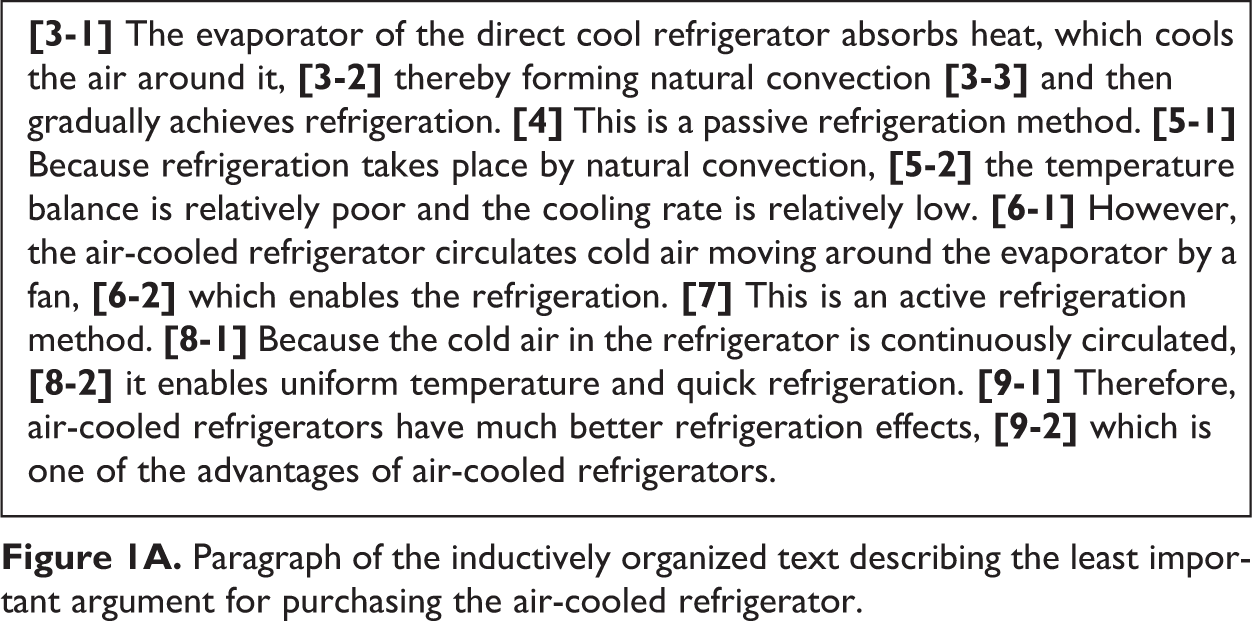
Paragraph of the inductively organized text describing the least important argument for purchasing the air-cooled refrigerator.
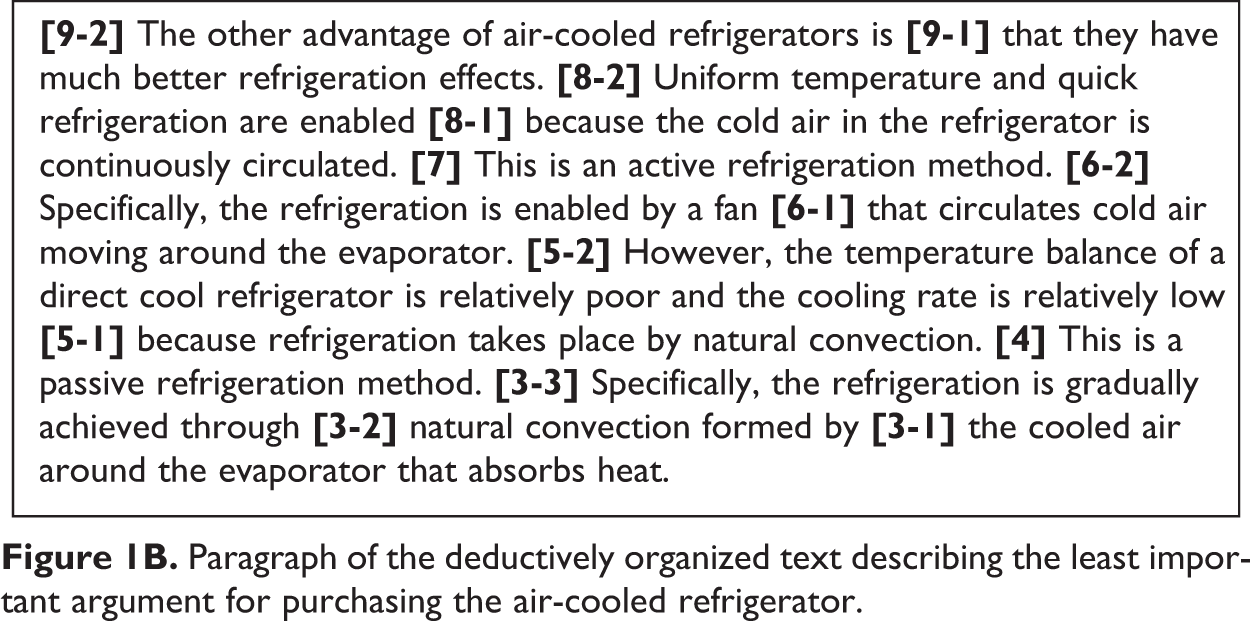
Paragraph of the deductively organized text describing the least important argument for purchasing the air-cooled refrigerator.
Finally, on the sentence level, sentences in the inductively organized text started with the cause and followed with the effect. For example, the first part of sentence number 5 in Figure 1A explains that refrigeration in direct-cooled refrigerators is caused by natural convection, and the second part of the sentence explains that the effect is a relatively poor temperature balance and a relatively low cooling rate. In the deductively organized text, causal sentences started with the effect and followed with the cause. The same sentence number 5 in Figure 1B starts with the conclusion (the effect) that the temperature balance and cooling rate are not optimal and follows with the explanation (the cause).
English and Chinese translations
Both versions of the text were written in English and in Chinese. To ensure that the content and structure of the English and Chinese versions were equal, we conducted a back-translation procedure. First, we designed the English deductive version of the text. This text was proofread and edited by native English editors. Then we used this text to design the inductively organized text by restructuring the content. Next, Li, who is a native speaker of Chinese, translated the edited version of the English deductively organized text into Chinese. This text was edited by native Chinese editors, and then Li restructured the edited version to the Chinese inductive version. This Chinese inductively organized text was then back-translated by a professional Chinese–English translator. Finally, we compared the translated text to the English inductively organized text that was designed previously. We found that both texts were comparable in content, structure, and writing style.
The two English versions of the text are similar in length: The inductively organized text is 354 words whereas the deductively organized text is 348 words. The two Chinese versions of the text are also similar in length: The inductively organized text is 563 characters whereas the deductively organized text is 574 characters.
Measurements
To measure the effects of the text structure and participants’ cultural background, we measured the participants’ ability to recall information, the time it took them to read the text, and their opinions about the text. The questionnaire contained both recall and opinion questions and was initially designed in English. This English version was then proofread and edited by native English editors. After that, Li translated the questionnaire into Chinese. This Chinese version was then translated back into English by two professional translators. A comparison of the original and the back-translated English questionnaire showed that the two versions were comparable.
Recall of information
To test if participants could remember the content of the text, we devised eight questions with four multiple-choice alternatives. For example, “What is an important advantage of the air-cooled refrigerator? A. Higher capacity B. No need to defrost manually C. Longer preservation period for fresh food D. No specific advantages.” Participants’ recall scores consisted of the total number of correct answers, ranging from 0 to 8.
Opinions about the text
We measured participants’ opinions about the text with 32 statements. Participants rated each statement on a 5-point Likert scale (from strongly disagree to strongly agree). With these statements, we measured participants’ ratings on five different aspects of text quality: structure, professionalism, readability, affective satisfaction, and persuasiveness.
Participants’ opinions about the text’s structure were measured with eight statements, and their opinion on the text’s professional quality was measured with six items. We had used scales in a previous experiment on culturally adapted user documentation (Q. Li et al., 2015). To measure participants’ view on the text’s readability, we selected items from two commonly known scales to test perceived usability: the Software Usability Scale (SUS), developed by Brooke (1996; see also Lewis & Sauro, 2009), and the Instructional Materials Motivation Survey, developed by Keller (2010). To measure participants’ views on the text’s affective satisfaction, we used statements based on Venkatesh et al. (2003). And to measure the persuasiveness, we used five self-constructed items.
To test the questionnaire’s validity (see Table 1), we conducted a factor analysis. The analysis showed that neither the structure nor the professionalism questions formed valid scales; however, nine items of these two scales formed a valid and reliable construct together (Cronbach’s α = .91). Since these items were all related to how well the text is organized, we labeled this new scale as “structure.” The results of our factor analysis showed that the other scales were valid although some items had to be removed because they did not load onto one of the four factors. Our final readability scale consisted of six statements (Cronbach’s α = .84), the affective satisfaction scale consisted of five statements (Cronbach’s α = .82), and the persuasiveness scale consisted of four statements (Cronbach’s α = .81).
Factor Analysis of the Scale Items Measuring Four Factors of Text Quality.
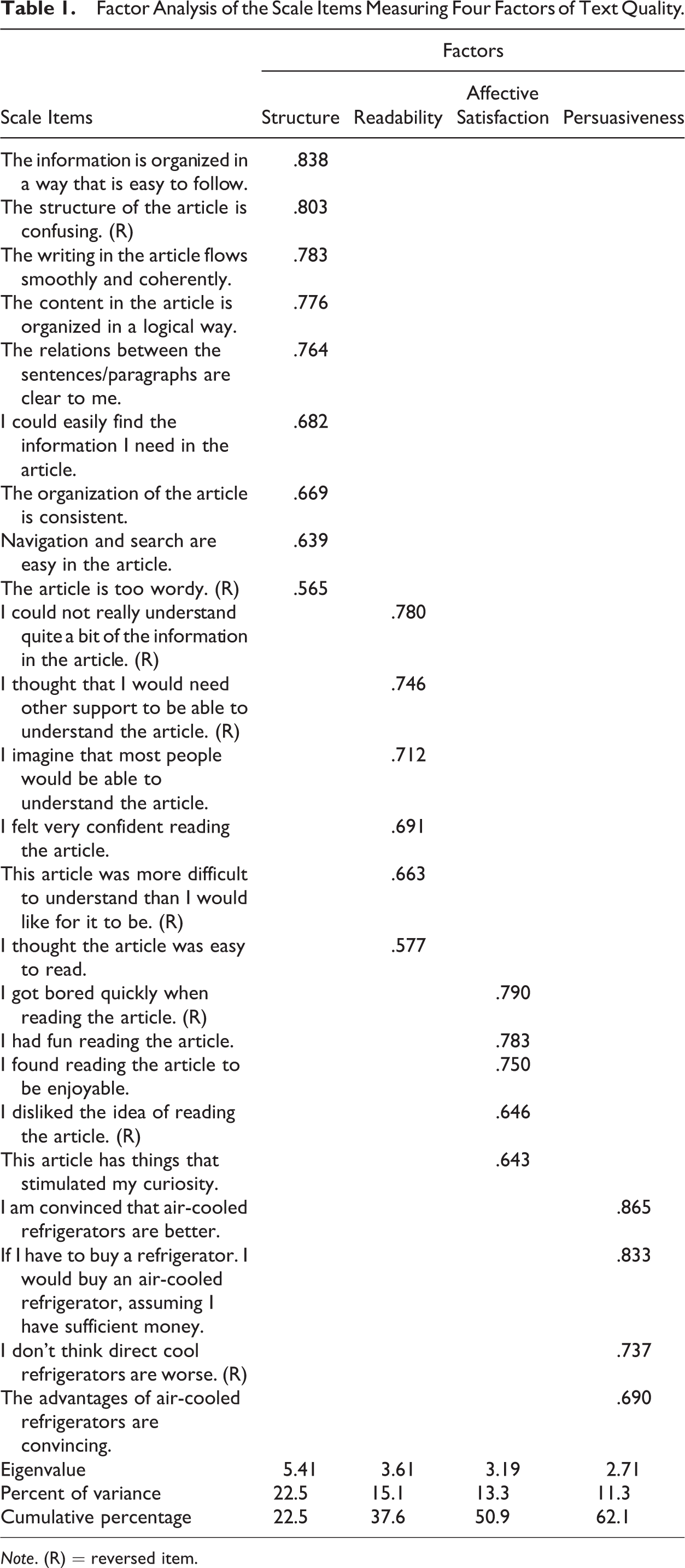
Note. (R) = reversed item.
Participants
We recruited two of our three groups of participants at a Dutch university: the Western participants and the Chinese participants who had been living abroad for some time. The group of Western participants included 49 university students from Western Europe and Northern America. Being students in the Netherlands in English-taught programs, they were all fluent in English. The group of Chinese participants who had been living abroad included 55 Chinese students who were currently living in the Netherlands. These students had lived in Western countries for at least one year (on average, 2.2 years). They spoke Chinese (Mandarin) as their native language. We recruited our third group of participants, Chinese people living in China who had never been abroad, at a Chinese university. This group included 54 students who were native speakers of Chinese (Mandarin). All participants (N = 158) were rewarded with course credits or a small financial compensation (5 euros or an equivalent) for their participation.
Table 2 provides an overview of the participants’ demographic characteristics. The participants’ gender was balanced: 82 (52%) female versus 76 (48%) male. About half of the participants (53%) were students in a technical program. Participants indicated that their prior knowledge of how refrigerators function was limited. Their mean score was 1.93 (SD = .87) on a five-point scale. The experimental groups did not differ significantly in those three categories. Participants were between 18 and 35 years of age (M = 23.55, SD = 3.24). An analysis of variance showed a significant difference in age between the groups, F (2,152) = 12.38, p < .001, with a large effect size (η2 = .14). Post hoc comparisons using the LSD (Least Significant Difference) test indicated that the mean age of Chinese participants in the Netherlands (M = 25.19, SD =.42) was significantly higher than that of Chinese participants in China (M = 22.35, SD = .42) and Western participants (M = 23.12, SD = .44). The age of Chinese participants in China and Western participants did not differ significantly. To investigate the possible influence of these age differences, we investigated the relationship between age and all dependent variables using Pearson product–moment correlation coefficients. We found small, nonsignificant correlations between age and all dependent variables (r-values ranged from -.13 to .09). Because age did not seem to affect the scores on the dependent variables, we did not include it as a covariate in our analyses of variance to test the hypotheses.
Demographic Characteristics of the Participants.
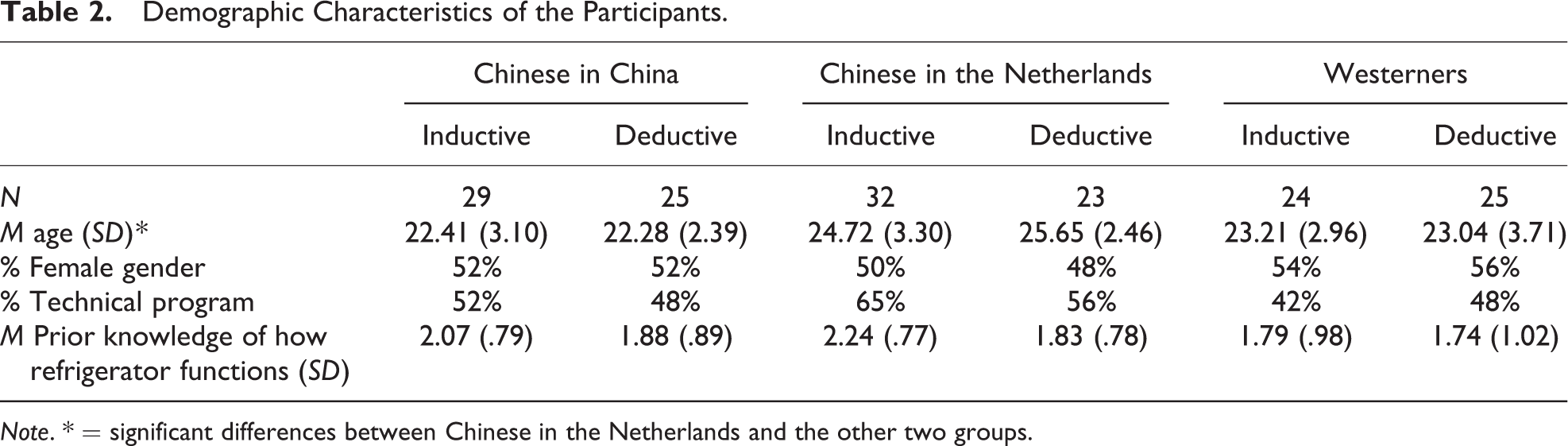
Note. * = significant differences between Chinese in the Netherlands and the other two groups.
Procedure
We conducted our experiment in 15-minute sessions. This experiment was part of a larger study that consisted of three separate experiments (Q. Li et al., 2020b; Q. Li et al., 2021). All three experiments investigated the effects of cultural differences on reading and using textual and visual user documentation for consumer products and software. The sessions were held in a quiet room with a laptop that was used by all participants, either at the Dutch university or the Chinese university. Li was the test administrator in both countries.
Participants started the experiment by reading and signing an informed consent form and then reading an introduction to the experiment on the laptop. The introduction asked them to imagine that their old refrigerator was broken, that they were searching for information about what new refrigerator they should buy, and that they stumbled on the (experimental) text. The participants were instructed to read the text as they would usually do and then answer some questions about its content afterward. When participants indicated that they had read the introduction, they clicked on a button and one of the versions of the experimental text appeared on the screen. They were randomly assigned to either the inductively organized text or the deductively organized one. The time that participants needed to read the text was measured. After they finished reading the text, they answered the recall questions and the opinion questions, respectively, followed by two questions about their previous knowledge about the functioning of refrigerators. While answering these questions, participants did not have access to the text. All questions were answered online using the laptop.
Results
We report the results of this experiment in three subsections: recall of information, reading time, and opinions about the text. We analyzed the data using analysis of variance, with cultural background and text structure as independent variables.
Recall of Information
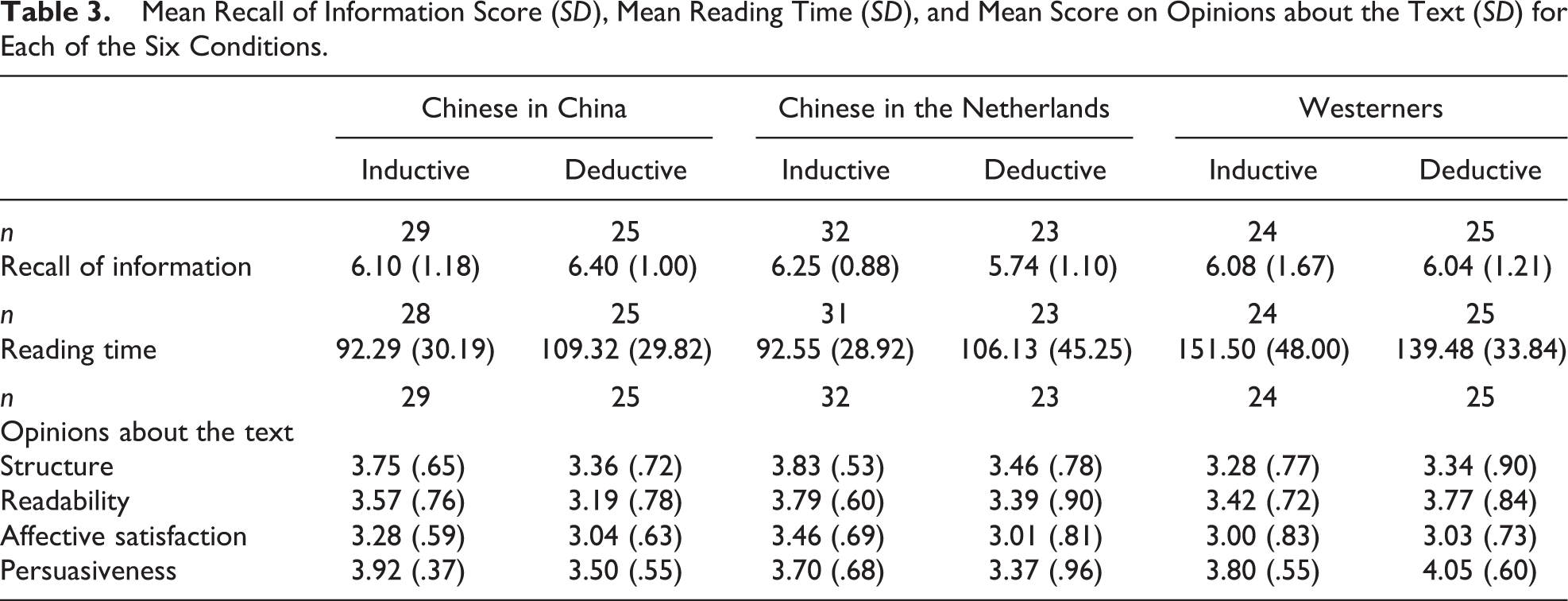
Table 3 shows that participants in all six conditions correctly recalled about six out of eight questions about the text content. A two-way analysis of variance for recall showed no main effects of participants’ cultural background and of text structure and no interaction effect, so our first pair of hypotheses must be rejected.
Mean Recall of Information Score (SD), Mean Reading Time (SD), and Mean Score on Opinions about the Text (SD) for Each of the Six Conditions.
Reading Time
A two-way analysis of variance for the reading times of the six groups of participants showed a statistically significant main effect of cultural background with a large effect size: F (2,150) = 26.36, p < .001, partial η2 = .26. Westerners, who read the text written in English, needed more time to read the text than did both groups of Chinese participants, who read the text written in Chinese. No effect of text structure on reading time and no interaction effect was found, so our second pair of hypotheses must also be rejected.
Opinions About the Text
To test if participants’ cultural background and text structure have an effect on the four variables related to their opinions about the text, we conducted four two-way analyses of variance. We conducted multiple analyses instead of one multivariate analysis of variance because the scale items in the four constructs seemed to measure concepts that were considerably different from each other. Items in the structure scale, for example, asked for a direct judgment of text characteristics whereas items in the persuasiveness scale asked about participants’ attitudes as a result of processing the information (see Table 1).
Structure
Text structure had an effect on participants’ appreciation for the structure of the text with a small to medium effect size: F (1,152) = 4.15, p = .04, partial η2 = .03. Overall, participants valued the structure of the inductively structured text higher (M = 3.64, SD = 0.68) than the structure of the deductively structured text (M = 3.38, SD = 0.79). Participants’ cultural background did not result in statistically different opinions about text structure although a tendency toward an effect was found: F (2,152) = 2.93, p = .06. No interaction effect between text structure and cultural background was found.
Readability
Our findings on participants’ opinions about the readability of the text supported our third pair of hypotheses. No main effects of text structure and cultural background were found, but the analysis of variance showed an interaction effect between the two variables with a small to medium effect size: F (2,152) = 3.88, p = .02, partial η2 = .05. A pairwise comparison showed no significant difference between the scores of Western participants who read the inductively structured text and Western participants who read the deductively structured text. But for both Chinese groups, pairwise comparisons showed a tendency toward an effect (p = .06 for Chinese people living in the Netherlands; p = .07 for Chinese people living in China). The average scores of both groups of Chinese participants who read the inductively organized text were higher than those of Chinese participants who read the deductively structured text. This interaction effect aligns with our third pair of hypotheses although we must be careful when interpreting this effect because the pairwise comparisons did not show significant differences. The mean scores of the participant groups are graphed in Figure 2.
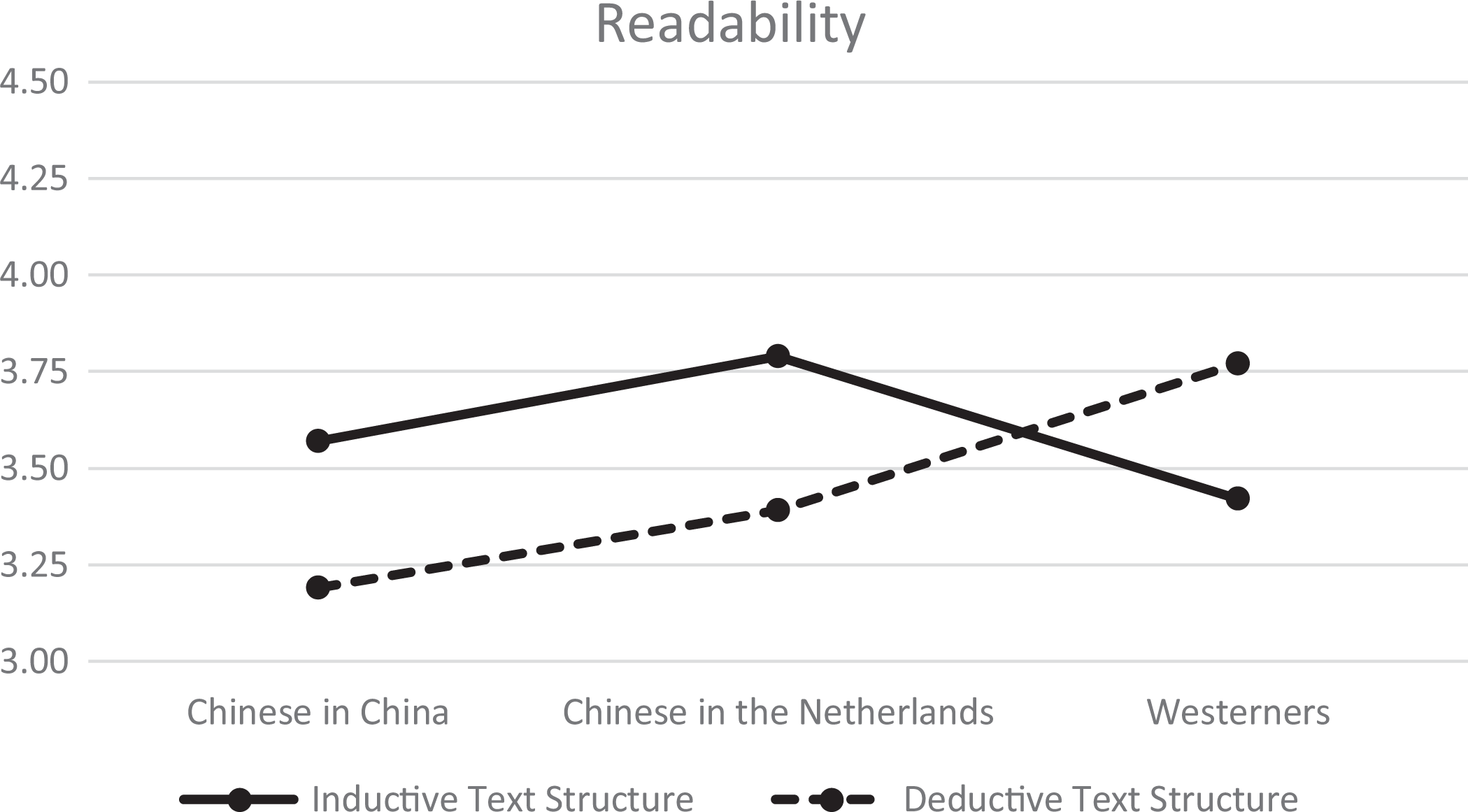
Mean scores for readability of the six participant groups.
Affective satisfaction
An analysis of variance yielded no main effect of participants’ cultural background [F (2,152) = 1.21, p = .30] on their affective satisfaction. But a tendency toward an effect was found [F (1,152) = 3.63, p = .06] in regard to text structure. No interaction effect was found.
Persuasiveness
The last analysis of variance yielded no main effect of text structure on participants’ perception of the persuasiveness of the text, but the analysis did yield a main effect with a medium effect size of participants’ cultural background: F (2,152) = 4.82, p = .01, partial η2 = .06. Pairwise comparisons showed that the average scores of Western participants were statistically higher than those of Chinese participants living in the Netherlands (p = .002), so Western participants considered the text to be more convincing than did Chinese participants in the Netherlands. We found a small to medium interaction effect between text structure and cultural background: F (2,152) = 4.15, p = .02, = .05, partial η2 = .05. A pairwise comparison showed no significant difference between the scores of Western participants who read the inductively structured text and Western participants who read the deductively structured text. But a pairwise comparison of the group of Chinese participants who lived in China showed that the participants who read the inductively structured text rated the persuasiveness significantly higher than did those who read the deductively structured text (p = .02). A third pairwise comparison showed a tendency toward an effect for Chinese people who lived in the Netherlands (p = .06); the average scores of the participants who read the inductively structured text were higher than those of participants who read the deductively structured text. This interaction effect aligns with our third pair of hypotheses. The mean scores of the participant groups are graphed in Figure 3.
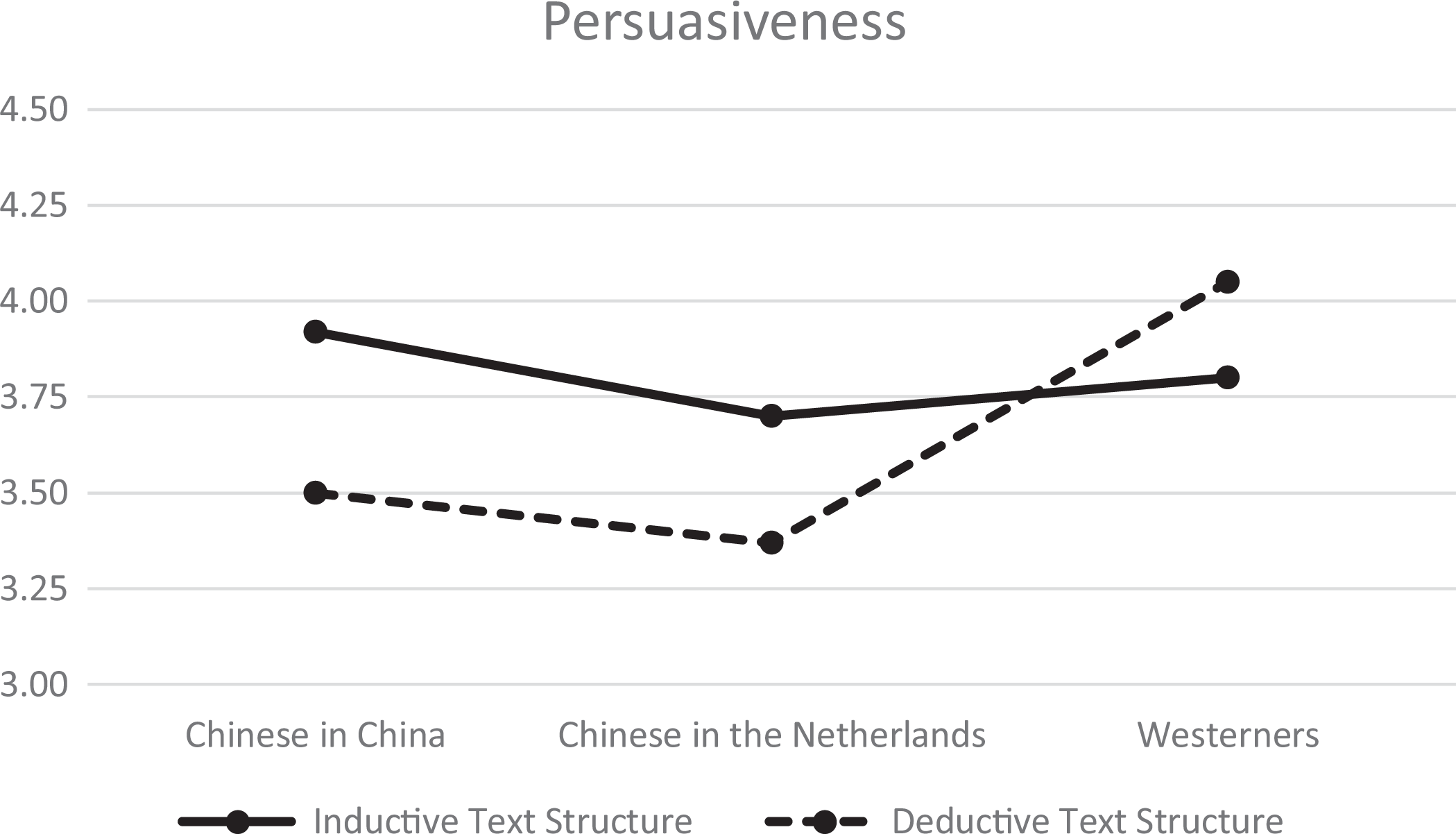
Mean scores for persuasiveness of the six participant groups.
Discussion
This study investigated the effects of inductively and deductively structured product descriptions on Chinese and Western participants’ ability to recall text content, time needed to read the text, and opinions about the text. In accordance with reading theories proposing that readers use relevant background information about text structure when processing a text (Afflerbach, 1990; Lorch & Lorch, 1996; Spyridakis & Fukuoka, 2002), we expected that the inductively structured version of the text would be more beneficial for the Chinese participants and that the deductively structured text would be more beneficial for the Western participants. But our results show a different pattern. The way the product description was organized had less profound effects on readers than what we had expected.
Thus, we must reject our first and second pair of hypotheses regarding the amount of information participants can recall and the time they need to process a text because we did not find any interaction effects between participants’ cultural background and text structure. But contrary to our expectations, we found a main effect of cultural background: Chinese participants needed less time to read the Chinese versions of the texts than the Western participants needed to read the English versions of the text, regardless of whether they were inductively or deductively structured. This difference might be attributed to the different writing systems. The basic units of Chinese texts are characters whereas the basic units of English texts are alphabetic words. Chinese texts are assumed to have a higher density, a shorter average word length, and, because of the use of characters, no spaces between words (X. Li et al., 2011). As a result, the Chinese versions of the text take less space on the screen than do the English versions if the same font size is used in both languages, which might increase the time needed to read the English versions (Feng, 2004).
The absence of an interaction effect implies that the performance of Chinese or Western readers is not affected by whether text content is organized inductively or deductively. This lack of effect might be attributed to the existence of either pattern in both cultures (Jia & Cheng, 2002; Scollon & Scollon, 2001). Because readers are likely familiar with both structures, they might have no difficulties processing either inductively or deductively organized texts. Another possible explanation might be that readers can adapt to less familiar text structures without much effort. This explanation would align with the results of our previous studies (Q. Li et al., 2015, 2021) in which we tested the effects of structuring elements such as a table of contents and headings in software manuals with Chinese and Western users. Although we expected that Western users would rely more on these elements than Chinese users would—and eye-tracking data proved that Western users did pay more attention to these elements—we found no differences in task performance and user satisfaction. The results of our present study, then, suggest that readers are flexible, not only when reading a text to be able to do a task but also when reading a text to form an opinion. Without much effort, they are able to process texts that are not organized according to the prevalent structure, with outcomes similar to those from processing a text that is organized according to the prevalent principles in their culture.
Regarding participants’ opinions about the text, the results show some support for our third pair of hypotheses. Although no interaction effects were found for participants’ evaluation of the text structure and their affective satisfaction, their evaluation of the readability and the persuasiveness of the text differed as expected. Regarding readability, Chinese participants’ ratings of the inductively structured version of the text were higher than their ratings of the deductively structured version. But Western participants’ ratings of the readability of the deductively structured text version did not differ significantly from their ratings of the inductively structured version. Previously, Tao et al. (2011) indicated that perceived readability of documents improves when these documents are organized according to the culture’s prevalent structuring principles. The results of our study confirm their results, but only for Chinese people.
The ratings for the persuasiveness of the text showed a similar pattern as the ratings for readability. Chinese participants considered the inductively structured text to be more convincing whereas Western participants considered both texts as equally convincing. These findings support studies that suggest that Chinese and Western people’s beliefs on what is plausible and what is implausible differ and that strategies applied to persuade Chinese people should be different from those used to persuade Western people (Cheung, 2010; St.Amant, 2005; Wolfe et al., 2018). In Chinese high context society, where consensus is highly praised, the delayed demonstration of a proposal, as in an inductively structured text, supposedly shows the author’s humility and respect for readers’ ability to generate their own points of view. Furthermore, with an inductively structured text, the author builds a context that can gradually influence readers’ judgment so that the agreement seems to be naturally reached by both sides. In contrast, a more direct expression of the author’s point of view at the beginning of a text (deductive structure) seems to be more valued in Western, low context cultures, where explicitness is preferred. But the results of this study do not confirm that assumption.
We found no interaction effects with regard to participants’ opinion of the structure of the text and their affective satisfaction with it. We did, however, find a main effect of structure on their opinion of the structure. Overall, participants rated the inductively structured text higher than the deductively structured one. But this finding is difficult to interpret. The participants’ satisfaction with the text was not affected at all by the manipulations. Apparently, both Chinese and Western readers find both structures acceptable. Although text structure affected their opinion on the text’s persuasiveness, their general satisfaction with the text was about the same.
Implications and Suggestions for Future Research
Results of our previous studies (Q. Li et al., 2015, 2021) showed that organizing user instructions according to either principles that are prevalent in Chinese culture or principles prevalent in Western culture does not have an effect on factors related to the primary goal of these documents: to help people perform the described tasks. That is, task performance was not affected by the user instructions’ structure. The user documentation in the current study did not consist of action-oriented information; rather, it contained explanatory information that informed readers about the advantages of two different types of a product with the goal of helping them make an informed decision on which would be the best product. The primary goal of such expository documents could be described as helping readers to process and comprehend the text content within a reasonable time span. As in our previous studies, we found no effects of organizing principles on factors related to the primary goals of the document.
For technical communicators, the results of this study imply that localizing a document so that its structural elements are organized according to culturally defined principles might not be important when the primary goal is to design the document so that it is usable and easy to comprehend. But the results of the readers’ opinions about the text suggest that localizing structural elements might be more important when a document aims at further-reaching goals, such as providing a good user experience or influencing readers’ opinions. It seems beneficial, then, to organize a document according to culturally defined organizing principles when the target group’s opinions are important.
Whether a document meets further-reaching goals than that of text comprehension could also be influenced by readers’ expectations about the genre of the text. The basic assumption of this study was that in general, Chinese people are used to inductively structured texts and Western people are used to deductively structured texts and therefore expect texts to be organized as such. But readers might have different expectations about not only the text structure but the purpose of a text. Research has shown that documents belonging to the same text genre might be used for different purposes in different cultures. The results of our previous studies, for example, suggest that user instructions might be used for different purposes in China than in the Western world: In the Western world, user instructions merely aim at supporting the usability of products whereas in China, they are also aimed at improving the users’ experience with products (Q. Li et al., 2019, 2020b). Other studies have also shown that the characteristics and purposes of business communication (letters and annual reports) differ between cultures (De Groot et al., 2006; St.Amant, 2006; Tebeaux, 1999).
The text genre of product descriptions that we have investigated here might also have different characteristics and purposes in different cultures, and readers might have specific expectations regarding these documents beyond the general expectation that their structural elements are organized according to culturally defined principles. To shed more light on specific requirements regarding the localization of such documents, future research should take into account the specific purposes of this genre and the different cultural expectations that readers have for it.
Another goal of this study was to investigate possible acculturation effects. That is, we wanted to examine how persistent readers’ preferences were for culturally defined organizing principles. Therefore, we used the two groups of Chinese participants: Chinese living in China and Chinese who had been living for at least a year in Western countries. In all, we found only a few significant differences between all three participant groups. When looking at the interaction effects, we can clearly see that the ratings of Chinese people living in China and of Chinese people living in the Netherlands show the same pattern whereas the ratings of Western people show a different pattern. This finding that the mean scores of both groups of Chinese participants did not differ from each other suggests that once readers are familiar with the common text structure used in their culture, they do not easily change their preference for this structure, even when living in another culture for a length of time and being exposed to texts that are organized according to that culture’s principles. This finding supports the finding of an earlier study that writers are persistent in their preference for a structure (Jia & Cheng, 2002). For researchers, this finding implies that they can carry out cross-cultural research without needing to ask participants who live in their own country where they were born and bred.
Limitations
Some limitations should be taken into account when interpreting the results of this study. To be able to measure the effects of inductively and deductively structured texts on users from different cultures, texts had to be created that only differed from each other with regard to text structure. Otherwise, we could not have made the inference that the structure caused the differences found. In other words, we needed to use literal translations of the text that might have resulted in texts that seem somewhat artificial. Even if participants read a text that was structured according to their own cultural preferences, they might not have felt that the text they read was a typical example of a product description produced in their culture. But their answers to the items concerning their opinion on the questions about the readers’ opinions about the text indicate that the participants considered neither of the text versions as unnatural.
The relatively short length of the text might have been a second limitation. Although the text provided us with multiple opportunities to organize the content either inductively or deductively, possible differences between the two structuring principles might have been more prominent if the text would have been longer. And it might have been more difficult for participants to adapt to a less familiar structure if they would have had to read a longer text. Future research could replicate this study with longer and possibly more complex documents.
Two other limitations relate to the characteristics of the participants. First, not all of the Western participants were native speakers of English whereas all of the Chinese participants were native speakers of Chinese (Mandarin), which could have affected the results on reading time because it would most likely take more time for readers to process a text that is not written in their native language (Kang, 2014). The Western participants, as students in an English-taught study program, were all fluent in English, but those students who were not native English speakers might have taken more time reading an English text than they would a text in their native language.
Second, the participants in this study were relatively young, and they all either were university students or had recently graduated from the university, so they were likely to be experienced readers of multiple text genres. Therefore, they were probably more familiar with different text structures and consequently better able to adapt to different text structures than were people with less education or experience in reading. Both young and highly educated people and older people who are less skilled in reading belong to the target group of the product description that we used in this study, a factor that should be taken into account in future studies.
Conclusion
Although previous literature has indicated differently, Chinese and Western readers seem to be equally able to process inductively and deductively organized expository texts; they are able to recall the same amount of information. But their opinions about inductively and deductively structured texts differ to some extent. Overall, and in line with previous studies, Chinese readers seem to have more positive opinions about inductively structured texts whereas Western readers seem to have no clear preference for deductively or inductively structured texts. The results of this study call for further research investigating the effects of different aspects of text structure on readers from different cultures with varying educational levels and varying levels of experience reading.
Footnotes
Declaration of Conflicting Interests
The authors declared no potential conflicts of interest with respect to the research, authorship, and/or publication of this article.
Funding
The authors disclosed receipt of the following financial support for the research, authorship, and/or publication of this article: We gratefully acknowledge the financial support from the China Scholarship Council (CSC, File No. 201506010301), which has sponsored Qian Li’s PhD study at the University of Twente.
