




Abstract
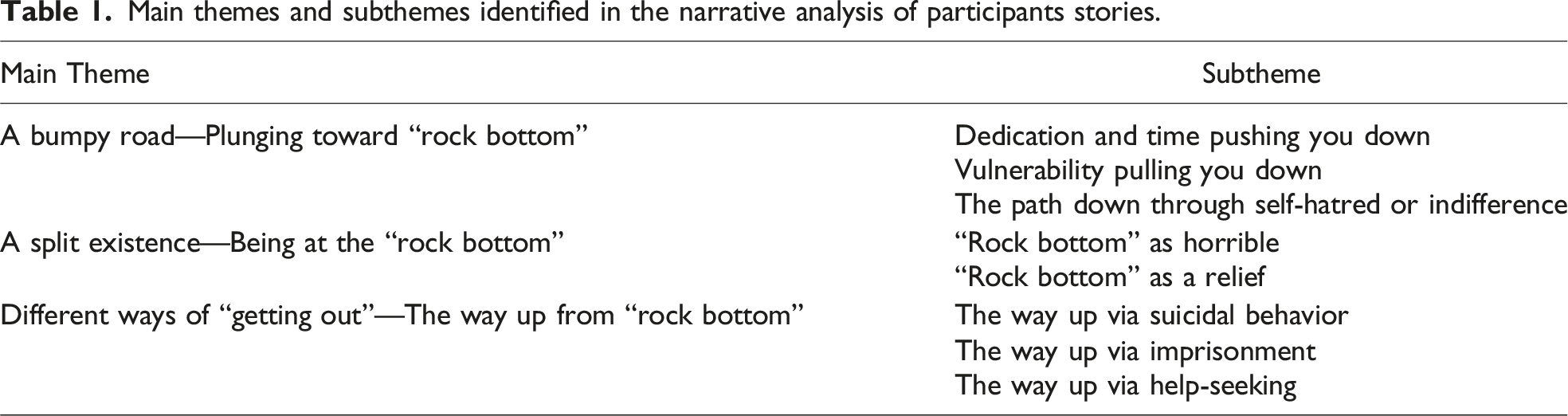
This study explores narratives about gambling problems and experiences of “rock bottom” through interviews with ten participants. The analysis generated three main themes. In A bumpy road—Plunging toward “rock bottom,” participants described hitting “rock bottom” as something to avoid or being dragged there by self-hatred or dedication. In A split existence—Being at the “rock bottom,” the experience of the bottom was seen as either the worst suffering or a relief. In Different ways of “getting out”—The way up from “rock bottom,” getting out involved diverse processes like suicidal behavior, imprisonment, or seeking help. The results suggest that understanding “rock bottom” narratives can help identify risk factors and processes related to gambling, enabling practitioners in supporting individuals on their journey.
Introduction
In the last decades, gambling disorder, defined as a “persistent and recurrent problematic gambling behavior leading to clinically significant impairment or distress” (American Psychiatric Association, 2013), has been shown to be associated with negative social, health, and financial consequences (Hodgins et al., 2011). While the results of hundreds of prevalence studies are not entirely conclusive (Abbott, 2020), the point prevalence has been estimated to range between 0.1% and 5.8%, and lifetime prevalence between 0.7% and 6.5%. Given its wide range and often devastating consequences, gambling disorder represents a pressing public health challenge (Calado & Griffiths, 2016). Not only do problems with gambling erode individual well-being but also place a significant strain on families, communities, and healthcare systems (Dowling et al., 2021). A better understanding of recovery and, in turn, how to intervene when gambling has developed into a disorder is of utmost importance (Hodgins et al., 2011).
However, two important challenges in relation to recovery from gambling problems can be identified in research. First, while gambling disorder shares several characteristics with drug and alcohol use disorders (Grant & Chamberlain, 2020; Leeman & Potenza, 2012), it is still uncertain to what extent findings, theories, and interventions can be transferable from the substance or alcohol use disorder to gambling disorder (Koski-Jannes, 1999; Slutske, 2006). Second, most studies on the recovery of gambling problems are conducted based on quantitative assumptions, using a priori definitions of recovery (Mansueto et al., 2024). Qualitative studies exploring the lived experiences of recovery from gambling problems remain relatively scarce, although recent work has begun to address this gap by highlighting how individuals perceive and engage with different forms of support (Penfold & Ogden, 2022).
In this study, we address these two challenges by using the insights provided by qualitative research on addiction generally, to qualitatively explore the experiential and contextual dimensions of gambling-related harm and recovery. Encouraged by other scholars in the topic area (e.g., Canali and colleagues, 2021; Reith & Dobbie, 2012), we specifically draw on narrative understandings of recovery where the figure of “rock bottom” is used as a sensitizing concept (Bowen, 2019). Below, we outline previous studies in the area as well as our theoretical perspectives.
Research on Recovery From Gambling Disorders
In recent years, recovery has become an increasingly central theme in addiction research (Pickering, 2020). A growing number of quantitative studies have aimed to map recovery trajectories, identify predictors of positive outcomes, and evaluate the effectiveness of various interventions. Findings suggest that recovery is often a non-linear process influenced by a range of psychosocial and structural factors (Kelly et al., 2018). Within the field of gambling research, there has also been a rise in quantitative studies exploring recovery patterns, particularly among individuals with co-occurring substance use disorders (Armoon et al., 2025). At the same time, several scholars have pointed out that many quantitative studies lack a clear definition of what constitutes recovery, which complicates comparisons and interpretations of findings (Mansueto et al., 2024).
Research indicates that gambling disorder and substance use disorders frequently co-occur, exhibit similar clinical symptoms, and share some genetic and physiological characteristics (Grant & Chamberlain, 2020). Furthermore, several treatment strategies that have shown promise for gambling problems have also been effective for substance use disorders (Grant & Chamberlain, 2020).
Existing quantitative studies have been criticized for not clearly defining recovery (Mansueto et al., 2024). One term used in relation to addiction is “spontaneous remission” (Walters, 2000). However, the term has been challenged by Mulford (1988) who writes that spontaneous remission is a “euphemism for our ignorance of the forces at work” (p. 330). In contrast, Sobell et al. (2001) suggest the term self-change. Self-change has an active tone and witness about a shift toward agency. In a recent scoping review, Mansueto et al. (2024) examined how recovery from gambling disorder has been conceptualized across different types of studies. Their analysis revealed that while quantitative research often defines recovery in terms of abstinence or symptom reduction, qualitative studies highlight a broader and more nuanced understanding. Through a meta-synthesis of qualitative findings, the authors identified four recurring themes that characterize recovery experiences: Insight, empowerment and commitment, well-being enhancement, and reconsideration of relapses. These findings underscore the need for more integrative and person-centered approaches to understanding recovery.
Nuske and Hing (2013, p. 41) emphasize that while existing research demonstrates “that people can change” in relation to gambling problems, it often fails to explain “how people change.” Pickering et al. (2020) conclude that the lack of previous qualitative studies focusing on individuals’ own experiences risks missing valuable information about the underlying processes surrounding individuals’ gambling problems. This highlights a need for deeper insight into how individuals with gambling problems perceive and relate to their situation prior to initiating change. Such knowledge could offer valuable guidance for both the development of effective interventions and for supporting those directly affected (Suurvali et al., 2010). These concerns echo long-standing critiques within the broader addiction literature (Simpson & Bluthenthal, 2020), from which the gambling field can draw important lessons.
Understanding Recovery From a Narrative Perspective
Narrative theory focuses on individuals’ personal stories and experiences, which are central to understanding the complex and often emotional journeys that individuals with gambling problems undergo. By analyzing these narratives, we can gain deeper insights into their experiences and the factors influencing their recovery. As Crossley (2000) highlights, narrative psychology allows us to understand how individuals construct meaning from their experiences, which is crucial in studies of gambling recovery. Understanding how people interpret and integrate their experiences into their lives provides valuable information about the recovery process. This methodology allows us to capture the rich, detailed experiences of the participants, providing deeper insights into their journeys and the complexities of “rock bottom.” By focusing on the narratives, we aim to highlight the personal factors that shape the experiences, offering a more nuanced understanding of the transformative potential of “rock bottom.”
Qualitative research has greatly advanced our understanding of substance and behavioral addictions. A key objective in conducting qualitative research is to comprehend the pathways of addiction, encompassing its initiation, progression, maintenance, and eventual cessation or recovery (Simpson & Bluthenthal, 2020). The aim of narrative analysis is to keep stories intact to preserve and examine the wealth of detailed information they contain while simultaneously considering the overall context of the personal experience (Simpson & Bluthenthal, 2020).
According to Nuske and Hing (2013), using narrative analysis to understand experiences of gambling can open a window to a more complex understanding of these problems. Gambling problems are not an isolated phenomenon but are linked to personal, social, and cultural aspects of life, and formulating an understanding of the recovery process requires a comprehensive approach that considers all these factors. By integrating these factors, we can develop more holistic and effective strategies to support individuals in their recovery processes.
An example of how narrative theory has enhanced our understanding of gambling problems is the study by Reith and Dobbie (2012), which also aims to broaden knowledge on recovery and addiction in general. Reith and Dobbie (2012) argue that recovery can take various forms, but common to all is a changed perception of time and a stronger sense of empowerment and authenticity as individuals strive toward a future where they feel they have more control. Canali and colleagues (2021) emphasize that narrative studies are useful in identifying key aspects of gambling disorder that could be targeted for treatment. As others have suggested (Pickering et al., 2020), the importance of designing accurate person-centered and effective interventions cannot be underestimated, and for clinical work to optimize the benefit in relation to what patients need right then and there, these interventions need to be grounded in knowledge based on the narratives of those affected.
Using “Rock Bottom” as a Figure to Explore Recovery
Narrative theory emphasizes the significance of “key events,” “turning points,” or what Crossley (2000) refers to as “nadir experiences.” Building on this perspective, numerous studies on addiction have explored the most challenging moments in individuals’ lives—those episodes that often precede or accompany profound personal change (e.g., McIntosh & McKeganey, 2000). A particularly prominent narrative motif in this context is the idea of hitting “rock bottom” (Kirouac et al., 2015). According to Kirouac and Witkiewitz (2017), the term was first introduced in a 1965 paper on alcohol use and is generally understood as “an accumulation of substance-related consequences and an individual’s realization of such an accumulation” (Kirouac et al., 2015). This is aligned with the focus of Alcoholics Anonymous where several negative events, for example, “hitting rock bottom,” are seen as a necessary step in recovery (Kirouac et al., 2015).
This understanding is echoed in the research literature, where “rock bottom” has been described as a mechanism in change processes and has been used when looking at both substance use disorder (e.g., Patton & Best, 2022) and alcohol use disorder (e.g., Kirouac et al., 2015). In relation to substances, experiencing a “rock bottom” has been highlighted as a key explanation for positive change in recovery (McIntosh & McKeganey, 2001). This type of change has been described as when someone with addiction problems “has reached a point in his or her drug-using career beyond which she or he is not prepared to go” (McIntosh & McKeganey, 2001, p. 48). Further, it is understood to be “the stage at which the individual feels he or she must either give up drugs or go under” (McIntosh & McKeganey, 2001, p. 53). However, while “rock bottom” has been understood as a useful concept in the general addiction literature, some scholars still call for more exploration of the phenomenon (Kemp, 2013; Kirouac & Witkiewitz, 2017). For example, Kemp (2013, p. 107) asks if there is “more to rock-bottom than the simple notion that things have to get very bad before people make changes?”. This implies that a continuous exploration of “rock bottom” is still important to addiction research in general.
In this study, we employ “rock bottom” as a sensitizing concept (Bowen, 2019). This means that “rock bottom” serves as a guiding idea to help us interpret and understand the participants’ experiences without imposing rigid definitions or expectations. By using it in this way, we strive to remain open to the nuances and complexities of the participants’ narratives.
In some research specifically focusing on gambling disorder, the figure of “rock bottom” has also been identified. For instance, Itäpuisto (2019) found that individuals who described themselves as taking personal responsibility for seeking help often framed their turning point in terms of hitting “rock bottom,” an experience marked by a sense of crisis and the realization that change was necessary. However, prior studies suggest that there might be different processes of recovery from gambling problems compared to other addictions due to the specific psychological, social, and physical consequences of this addictive behavior (Koski-Jannes, 1999). For example, alcohol use disorder might lead, after worsening consequences, to a point where it is a question of recovery or death (Kirouac et al., 2015). Although gambling-related problems can have far-reaching negative consequences and may be linked to criminal behavior, relationship problems, and suicide (Moreira et al., 2023), it is not evident that this critical juncture, where it is a matter of recovery or death, appears the same in gambling problems as it does in alcohol or substance abuse. This means that the question remains, if the experiences and functions of “rock bottom” in relation to gambling disorder are experienced in similar or different ways compared to in other forms of addiction. This also supports Kemp’s (2013) question if there is more to rock bottom than what we already know. If so, a better nuanced understanding can help us understand what we need to do to support a person who is struggling to stay off their “rock bottom” or who is already at their bottom (cf. Canali et al., 2021).
With this background, we examine the recovery process from the individual’s own standpoint and highlight the narratives which individuals with lived experiences of gambling problems provide of the process of moving down, touching, and eventually moving up from “rock bottom.” The research questions are: How do individuals with lived experiences of gambling problems describe their journeys in relation to “rock bottom”? and How do these narratives support or challenge the “rock bottom” hypothesis in the context of gambling recovery?
Method
This article is part of a larger project that focuses on experiences related to gambling problems.
Ethics
The study was carried out in accordance with the ethical principles in the Declaration of Helsinki (World Medical Association, 2013) and was approved by the regional ethical review board in Lund (No. 2019-01454).
Before the interviews were conducted, participants were informed about the study, about confidentiality, and that they could withdraw their participation at any time without giving a reason. The anonymity of the participants was ensured by the interviewing researcher anonymizing all data before the other researchers accessed the data. In this process, the participants were given a number that was later used when presenting the results.
Procedure
Participants were recruited through the national mutual support groups: National Association of Gambling Addicts (in Swedish Spelberoendes riksförbund) and Gamblers Anonymous. The societies shared information about the study in support meetings and on their social media platform. Interested persons were encouraged to contact the first author for more information or if they had any questions. The first author, who conducted the interviews, previously worked in addiction care as a clinical psychologist in training. Currently, she is employed both as a specialist psychologist and as a doctoral candidate.
Thirteen persons contacted the first author, and ten participated in an interview. The three others stated personal or logistic reasons for not taking part in an interview. The ten persons who participated also filled out a NODS (National Opinion Research Center DSM-IV Screen for Gambling Problems) questionnaire to make sure their gambling experiences were clinically relevant (Wickwire et al., 2008). Total scores on NODS can range from 0 to 10. Higher scores indicate more serious gambling problems (Wickwire et al., 2008).
Out of the ten participants, eight were men and two women. The scores on NODS varied between 8 and 10 (Mdnscore = 10), and the age varied between 35 and 67 years (Mdnage = 46). The participants lived in different parts of Sweden, they were all parents, and most of them were currently employed. They were in different stages of recovery. The age range and the participants’ different stages of recovery provided valuable variability in the sample. By accounting for these different perspectives, our analysis acknowledges the dynamic nature of recovery and the complex ways in which individuals conceptualize “rock bottom.” For example, individuals in the early stages of recovery might describe recent and vivid experiences that focus on immediate challenges and the initial steps toward recovery. Those in a more mid-recovery may reflect on “rock bottom” as a turning point that is now part of their past. Their stories might emphasize ongoing struggles and the strategies they employ to maintain progress. Participants in a more long-term recovery might view “rock bottom” as a distant memory, providing insights into how their understanding of this concept has evolved over time.
Semi-structured interviews were conducted via a digital platform. The interview guide used consisted of questions regarding the participants’ general life and living situation, experiences of control, and their gambling history, including perceptions of what could have facilitated their recovery. One example from the interview guide is: “When you think about the last time you experienced a loss of control (please refer to any examples the person has given), what emotions and thoughts were associated with that situation? Negative? Positive? Both?” The idea of “rock bottom” did not guide the design of the study or the interview questions but rather emerged during the analytical process. Initially, our focus was on exploring experiences of control and loss of control in relation to gambling. As we engaged more deeply with the data, distinct narrative patterns began to take shape. Over time, we noticed that several participants described moments of crisis or turning points that shared common features—experiences that we came to understand as “rock bottom.”
The interviews were conducted by the first author. The transcription of the interviews was partially done by the first author, while professional transcribers completed the remaining transcriptions.
After the interview, the audio recording from the conversation was saved and later transcribed verbatim. The interviews lasted between 51 and 95 minutes (Mdntime = 74 minutes). Before the interview, the participant signed an informed consent.
Analysis
In our analysis, we adopted Murray’s (2003) conceptualization of narrative, emphasizing its most notable feature: Providing a clear and logical explanation of an event that has occurred or is expected to occur. The data were very rich, and in this article our approach was grounded in the narrative psychology assumption that listening to individuals’ stories reveals insights into their psychological and social realities (Crossley, 2000). We also posited that analysis is an interpretative, active process requiring the interpreter to closely engage with the narratives (Crossley, 2000).
When the interviews were transcribed, each participant’s story was summarized from a narrative perspective. The interviews were coded using the software NVivo 14, and the codes were used to find common traits in personal narratives. The coding was conducted by the first author. The focus was on individual case stories first before comparing them. The analysis of the transcripts was carried out collaboratively by the entire author group.
The concept of “rock bottom” can be experienced and interpreted differently by individuals. This openness makes it particularly useful in a qualitative context, where the aim is to understand participants’ subjective experiences of crisis, turning points, and change. By using “rock bottom” as a sensitizing concept, we were able to identify and analyze narratives of personal limits, experiences of loss or vulnerability, and how these relate to motivation for change and recovery.
This approach enabled a deeper understanding of how participants themselves construct meaning around their experiences rather than imposing a predefined interpretation of what “rock bottom” entails. In this way, the concept helps capture the complexity and variation that characterize people’s life stories in relation to addiction and recovery.
The analysis focused on “key events,” and especially what Crossley calls “nadir experiences,” that is, a low or the worst moment in the participant’s life, and on turning points, that is, an episode where the individual experiences significant change (Crossley, 2000). This was made with the basis in the steps suggested by Crossley drawing on the theory formulated by McAdams (1985). The analysis was thus guided by the narrative psychological steps such as familiarizing and reading the texts, identifying important concepts, narrative tones, as well as themes and imagery (Crossley, 2000). The next step in the analysis consisted in creating a coherent story before writing up the research report (Crossley, 2000). Even though Crossley’s steps are formulated for individual cases, and not for finding commonalties between people, we found using the steps helpful as a guiding map through the process of analyzing the data. During the analysis process, one thought that we kept in mind was the circumstance stressed by Squire et al. (2008), that representations may vary over time, and that one phenomenon may yield different stories, even from the same person.
Results
In the narratives of gambling, participants described a point where it felt like it could not get any worse, a sense of plunging toward and hitting “rock bottom.” For those with severe gambling problems, the bottom can be interpreted as a constant companion, as a possible risk and a catastrophe. While some characterized their relationship to “rock bottom” as marked by terrible anxiety, others described it as defined by calmness and tranquility. Relating to “rock bottom” was described as a standing on a crest to a steep sloping hill and sensing a disaster that lurks beyond the field of vision. However, at the lower end of the hill, “rock bottom” would mean the end of the road and a place of no return where “it all would be over” (1). Being able to stay on the crest without slipping down the hill required participants to perform complicated balancing acts that often involved keeping secrets and finding quick money, with the overhanging understanding that a small mistake could be the gust of wind that easily could be the push to send the person down the hill.
The experience of balancing on the crest, trying to avoid plunging down to where it would only get worse, meant that participants’ engagement in relation to work and children was substantially affected. Participants shared memories of particularly shameful situations, such as one participant who stated that “The worst thing I have to tell you about is the time I went down [to the supermarket] and stole two apples for my children’s field day” (9). These stories were evident among all participants, also those who had not hit, based on the experiences articulated in their own narratives, the most brutal state of “rock bottom.” The descriptions of “rock bottom” highlight the most extreme state of difficulty and misery when it comes to gambling. It signals the place or state of a person who has reached the lowest point of their life in terms of gambling problems, financial difficulties, and psychological stress.
Main themes and subthemes identified in the narrative analysis of participants stories.
A Bumpy Road—Plunging Toward “Rock Bottom”
The participants described several paths into gambling problems, and their narratives show that there are several paths down to hitting “rock bottom.” Going all the way down to the bottom could require several ingredients such as vulnerability, dedication, and availability of time.
Dedication and Time Pushing You Down
Putting all the available time into gambling required participants to be stubborn and persevere on their path down. Plunging toward “rock bottom” could largely be about the increased time spent on gambling, about an increased level of tolerance, or about the search for the big win.
Several participants said they did not sleep: “It has certainly cost a lot mentally, those nights when you didn’t get any sleep and so on. But the stubbornness has also been there … it will work, and it does work!” (2). In addition to not sleeping, many participants stopped eating: “Yes, lunch was not a priority. I didn’t eat anything. A cup of coffee and a cigarette” (2). Even going to the toilet was hard according to some: “I just wanted to be with my phone. On the toilet” (2). As such, “all time awake is just thinking about gambling” (5). Gambling thus filled their entire existence: “So it was constant. From morning to evening” (10). The availability of gambling came to dissolve all routines and boundaries in life: And because it is available all the time. At night, I couldn’t sleep. Because I wasn’t active during the day, I didn’t get tired. You lay there and couldn’t sleep. So, it was easy to start gambling and then it never ended. (6)
This also gave many a warped sense of time: “If you look at it from the outside …, look at the score, you might imagine that you’ve been sitting for an hour—you’ve been sitting for four hours” (9). If gambling was given enough time, the solution in the form of a big win would come: “As long as I stay here long enough, it will be good. Then I will feel good and then it will be good as well. So that’s also why you can disappear for hours” (9). Several participants said that it was impossible to stop gambling, because they did not know what to do with all the time they had access to: “It just feels like what am I supposed to do, it’s so boring, so monotonous, there’s basically nothing happening” (3).
The stories of dedication, time shaped around gambling, and long-term exposure to gambling show that it takes a certain kind of commitment to start the journey to “rock bottom.”
Vulnerability Pulling You Down
For some, hitting “rock bottom” in gambling seemed to be more related to their perceptions of different kinds of vulnerabilities within themselves. Gambling had taken a course where they did not or could not intervene to stop or change the ongoing process. Some said that they were affected by circumstances in childhood or the present, some were affected by personal attitudes, and for others it started when they were exposed to gambling without being able to behave in a constructive way.
The path to “rock bottom” could be marked by a longer period of heightened sensitivity and exposure to gambling, while for others it came like a lightning bolt. One participant described a rapid process of winning a gambling competition that they participated in with their colleagues: “It escalated quickly” (9). The win was the beginning of a quick journey along the road to the bottom.
Other participants referred to more theoretically expected vulnerabilities, such as having addiction problems in the family: “But I have a history of addiction in my family” (9). Several individuals described themselves as being particularly prone to developing an addiction. They believed that their gambling habits stemmed from a desire to avoid harming their bodies. Many of them had a strong interest in sports and enjoyed being physically active. While alcohol and drugs would have affected their sports performance negatively, they reflected that gambling could be combined with sports. One participant described how their challenges began already in childhood, growing up in an environment where their parents gave in to their resistance and did not teach them the value of money. My parents were too nice to me. I mean, I kind of ran them over. I kind of didn’t let them raise me. Teach me things. I knew everything best. So, they never got that chance to teach me the value of a bill. The value of money. (1)
For others, gambling was described as a form of coping with a problematic situation. One participant explained how the worry of a child with mental health problems had been gnawing at them for so many years that they eventually turned to gambling as escapism. When things started getting problematic, their stubborn attitude that the problems “must be possible to solve” (2) just perpetuated the problems. Another participant shared a similar experience, describing how caring for a sick child and having a partner on parental leave led to a cycle of rapid online speculation and a sharp rise in gambling. Similarly, a participant living with a pain condition said that sick leave eventually led to a very difficult life of suffering and gambling: My back was very sore so I couldn’t walk at all. So, I simply laid home. So, in the end I was taken off social security benefits [… and] I had to take all my savings to live at all […] I thought that I could start [gambling], as I had little to do at the time, and it is easily accessible on the internet, I played roulette on the internet. I thought that I could get back some of the money I lost on the other things. And I’ve won huge amounts, so I could have lived three lives. But then you get too far there, […] you can hardly stop. […] if you miss a spin, maybe it was the spin you could have won on. So, you could spin for a day at a time. That was often the case for me.
The availability of time, as the participant mentioned above, was also mentioned by others. Another participant described how a separation resulted in child-free weeks that gave “much more time” (5) for gambling, and the “stakes increased all the time to the extent that I lost control” (5).
The participants’ stories show that it is important to look at many different aspects of vulnerability, and that it can express itself in many complex ways even before gambling is a problem.
The Path Down via Self-Hatred or Indifference
“Rock bottom” was described as something many participants dreaded, but some also characterized it as enticing, as driving themselves down was in line with their self-hatred or indifference. One participant experienced “such hatred for this person who is really me” (1). This participant described how the bottom could be something they were consciously moving toward in a self-destructive way: Let’s say I have 100 000. And I gamble away 20 000. Then I start to hate myself for gambling away the 20 000. Then. Then I want to hurt myself. I’ll gamble away the other 80 000 too. Just to hurt myself. It’s so sick. It’s so … it’s really sick. I’ve gambled away like this … 20 000 but I want to break myself. When I’m already broken. (1)
Just as the path to “rock bottom” could be lined with self-hatred, it could also be a ride down because of indifference. One participant explained that they felt that “Life is bullshit anyway, so I guess we’ll just keep going here” (8). As an indifferent observer, these participants just watched life get “worse and worse and worse” (1). Several described that this meant that things stopped to matter, and they just went with the fall: When indifference sets in again, when it comes—when it feels like we’ve reached a limit where it doesn’t matter, then we might as well continue. If it comes, it comes; if it doesn’t, it’s all the same. (8)
Some also said that they did not surely know where their “rock bottom” would be, or how they would know if they would recognize their final exit out of there. One participant reflected, “But everyone has choices. So, you [people] say that you should hit your bottom. What if you don’t know where the bottom is” (9).
The stories show an experience where there was only one way down, like being on a roller coaster the second after the carriage has tipped over the edge, and there is only one way down, a breathtaking, fast-paced, and terrifying fall. The bottom could have a pull and drag individuals down via self-destructiveness or indifference; a fall could evoke horror but could also be driven by a will to actually break themselves.
A Split Existence—Being at the “Rock Bottom”
Having described the different paths to “rock bottom,” we will now explore the participants’ experiences of being at “rock bottom.” The path to “rock bottom” was lined with shame, secrecy, and guilt, just as life at “rock bottom.” This state was characterized by nothing other than gambling, and participants said they were stuck in “a vicious circle. […] [of] new loans, new games, new games, new loans” (2). Others described the bottom as the point when they had “lost everything else” (10).
“Rock Bottom” as Horrible
Being at “rock bottom” was associated with “such terrible anxiety. You’re just dripping with sweat. You don’t have the energy to do anything” (6) other than gambling for days on end, without winning anything. In this state, most described that gambling had taken over life completely: “When it was at its worst, […] I was gambling a …well, what can you say? Ten hours a day, if that’s enough” (8). As such, gambling had become “compulsive” (7): I know I gambled […] without even looking at the screen and stuff. I had auto spin in my pocket during the whole working day and so on. So, there was none of this entertainment value left. And then it was … well, somewhere a desperate quest to make a profit, make up for debts and so on. But there was no pleasure. (7)
As such, “rock bottom” was a very dark place: “well, [it is] like you […] stand inside a lit room and turn off the lights […] that’s probably the best explanation” (4). Several participants talked about this “rock bottom”–experience as being without any kicks or pleasure, just a sense of trying to restore what has been lost and terrible anxiety. This led many to have suicidal thoughts, wished to make or even made suicide attempts: “When it was at its worst […] well, you know, I wanted to kill myself. I didn’t want to live … It was much worse” (10). For some, this was a result of the understanding “that you can’t handle it” (9). Many described a sense of hopelessness: “You should always restore your finances. That’s always the idea. That plus you have terrible anxiety. You have poor finances plus, well, when it’s at its worst it’s simply anxiety” (6). From having experienced some kind of glow on the way down to the bottom, there was now only emptiness, compulsiveness, and anxiety: “because there’s no more gas, you know” (9).
“Rock Bottom” as a Relief
While almost everyone talked about rock bottom as horrible, some also said it provided some relief when “it can’t get any worse” (9): [It was] complete despair, of course, when you lost control—when you knew it was all over. But at the same time, it was nice. The times you’ve gambled away all your money. Because [you knew]: “Right, now I can’t get into this shit anymore, because there’s no more gasoline.” So, there’s also a paradox in the whole thing, that it was most peaceful when everything was over. […] you just have to be a gambler to understand, but… (9)
Several talked about how exhausting all resources meant an external stop to gambling, which was good: “In the end, I didn’t get any more loans. There is a barrier somewhere. It comes to an end. Fortunately” (2). Some also realized they had to stop to survive: “You gamble everything you have. So, you have no money left for food” (6).
The stories of hitting “rock bottom” thus also contained elements of relief and the realization that things could not get any worse. Either it stopped or it got better. But it couldn’t get any worse.
Different Ways of “Getting Out”—The Way Up From “Rock Bottom”
With an understanding of what it can mean to be at “rock bottom,” we move on to discuss different paths of recovery. Some participants believed that you needed to hit “rock bottom” in order to turn things around: “I think you have to go to the bottom unfortunately” (2). At “rock bottom,” many felt there was no hope: “I didn’t know that it was possible to straighten up and put life back together. But it was” (10). Just like the way down to “rock bottom” was different, so was the way up. For some, a suicidal attempt became a turning point. Others got help via imprisonment or sought professional help.
The Way Up via Suicidal Behavior
While several talked about “rock bottom” as a place with suicidal thoughts, two participants had attempted suicide and talked about it as a turning point: “Yes, it was a turning point. I scared myself. But it could have gone another way too, but it didn’t. I made it” (2). Many talked about becoming afraid of themselves, and realizing what kind of person they had become and that this was not the person they wanted and needed to be: I ended up in this spiral, which for me was a downward spiral that made things worse and worse. I left, I fled to the extent that I left goodbye letters, and I tried to kill myself at another time to get away, and that’s not taking responsibility for my children. But it’s because, emotionally and mentally, you just feel really fucking bad, and as I said earlier, there’s a lot of shame and guilt that … You’ve pretended to be a strong, strong-willed person, knowledgeable, etcetera, etcetera., and then suddenly you’re weak because you do things … do things that are not good, that are shameful, that create guilt. (5)
These kinds of realizations led several participants to seek help. Getting help became a way of choosing life over death.
The Way Up via Imprisonment
Several participants described how change became inevitable when they were imprisoned for the crimes they had committed. One participant described how they committed a crime and then reported it to the police. This was after having previously been close to taking their own life on several occasions, leaving suicide notes, and making a suicide attempt without being able to change their situation: And my journey ended with me committing a crime against the company I was working for, committing fraud, and that was the end, and I was so terribly tired of it all, and I went and reported myself to the police. From that day on, I decided that my life would be different. (5)
Breaking the secrecy around gambling was an important factor in breaking the cycle. Some participants said that being arrested forced them to be open about their gambling problems: “I had to be transparent, because I was arrested. So, there was no question about it. People wouldn’t know where I was otherwise” (9). Another participant, who had hit “rock bottom,” also described how finally being convicted was a turning point: “Yes, I have been convicted of some economic crime. Linked to companies. And that is a consequence of my gambling (10).
In retrospect, these experiences served as deterrent examples that could keep future gambling at bay. One of these participants said: The difference today is that […] Whatever happens, I won’t go that way. Because then I know it will end badly. I will start where I left off. I won’t start carefully […] I don’t want that. […] I rarely think about gambling. [Gambling]’s not really an option anymore. (9)
While “rock bottom” was a deterrent example, relating to how bad life actually was at that point was hard: “It is difficult to imagine it again. How it was. It’s not so long ago. But still, it’s so very distant” (2).
Committing a crime and getting caught seemed to work both as an internal and external stop for both gambling and the existence of “rock bottom.”
The Way Up via Help-Seeking
Some participants described that life at “rock bottom” was so unbearable that it was impossible to continue as they were doing. At this point, several participants sought professional help: “When it was at its worst for me then, and it was quite late in life, I went and wanted help myself” (6). Some described this as making an active choice: “You realize that you have to do something now, otherwise it won’t work. You are on the street. Then you also have to make a choice” (2). To be able to seek help, participants had to have some kind of hope or belief that something else was possible. One participant said that they thought “‘It’s better that I die, so everyone around me doesn’t have to suffer’ … But that’s not what I really wanted” (10).
Even though participants then described wanting help, the window for seeking help was also described as very small. This meant that it was important to take advantage of the opening as soon as it was available: What finally happened […] was that I got such a small, small window when I felt that I had to deal with this. […] then I sent a text message to my mom, in which I wrote in two or three sentences only, that I have lost a lot of money and need help. And somewhere, right after that […] I regretted it a little, “Damn. Now I have to … Now it’s out.” But that was also what made me send the text message. Because then I couldn’t come later and say: “No, I was just joking.” She would never have bought that. […] I’ve had that feeling several times, that now I have to solve this. But that window, when I feel strong, is so incredibly short. It can be a matter of seconds, a few minutes if you’re lucky. And then I think it’s very important to … well when you get that temporary strength … Then you must do something. (7)
The participant came clean to their partner and was surprised they were not abandoned, something they had been convinced would happen. The situation also became more real and concrete, as the debts unraveled and would not go away through “a big win coming up” (7).
For another participant, the search for help was opened by the fact that the participant was caught by a family member with their gambling, and the concealment of gambling, which had been central to their problems, came to an end when the person ended up at the enforcement agency: “The feeling I had at the time was that I could have done anything to keep my salary, that’s not really good to think about either, but they went in and seized my salary and then everything came to the surface here at home.” (4)
When it was not possible to keep it a secret, this participant sought help together with their partner; both professional help and participation in peer-support groups helped to change their life situation and to quit gambling. The participants’ stories tell the importance of timing in offering help and that breaking the secrecy of gambling might be an important factor in change. The narratives indicate that reaching “rock bottom” can lead to a deeper realization of the severity of one’s gambling-related problems. Participants often recognized the value of being open about their problems as a crucial step in managing and verbalizing them. This openness and articulation were seen as essential components in their journey of recovery.
Discussion
This study examined how individuals with lived experiences of gambling problems describe their journey through the different phases in relation to “rock bottom,” and how these narratives support or challenge the “rock bottom” hypothesis in the context of gambling recovery. The results show that “rock bottom” experiences hold a potential when it comes to both formulating preventive measures and treatment arrangements as well as in processes covering different types of self-change. “Rock bottom” experiences can be used in the development of treatment interventions where the individual can be helped to anchor their experiences of hitting “rock bottom” as a critical and meaningful turning point toward recovery. Articulating a “rock bottom” experience can serve as a preventive measure, helping to keep such an experience at bay. By expressing and acknowledging this potential low point, individuals can prevent it from becoming a lived reality. Even in cases where “rock bottom” has already been experienced, the act of articulating and verbalizing the experience can be a crucial step in preventing relapse. When clinicians encounter someone currently at “rock bottom,” it is essential to recognize the brief and small windows of opportunity for change mentioned by our participants. Additionally, clinicians must be aware of the risks, such as suicidal behavior, that can be associated with the “rock bottom” experience. It is also important for clinicians to understand that a person at “rock bottom” may experience a sense of calm and relief. However, this should not be mistaken for the absence of the risks associated with being at “rock bottom.”
The results also show that the path down to the bottom can take different routes, and that important steps include dedication and time spent on gambling, vulnerability, and self-hatred or indifference. Clarifying an individual’s drive toward a “rock bottom” experience can illuminate and make sense of behaviors and patterns. This process might enable the individual to sort and mentalize around a “rock bottom” experience, which is traditionally positioned in opposition to utilitarian or rational reasoning (McIntosh & McKeganey, 2001). By articulating behaviors and more or less unconscious drives, the individual can be empowered to take control over their development and gambling behavior. By clearly discussing the concept of “rock bottom” in relation to gambling problems, we can enhance our understanding of addiction development. This approach may contribute to identifying risks, investigating possible barriers to seeking treatment, as well as deepen our understanding of motivation for seeking help.
The existence at “rock bottom” is described as a split experience, where it can be characterized as both horror and a relief. The way up from “rock bottom” can take different turns, including suicidal behavior, imprisonment, or help-seeking. The participants’ stories and the analysis we conducted confirm that the “rock bottom” hypothesis is a meaningful concept for understanding the path to, the experience of, and the way up from “rock bottom.” However, paradoxical experiences of the state itself emerge, where it can be perceived as both highly anxiety-inducing and, paradoxically, a relief in knowing it cannot get worse. Although contradictory, this may enhance the understanding of the self-destructiveness that participants described could precede the crash to “rock bottom.” Regardless, this paradoxical nature of “rock bottom” is something that needs further exploration in research.
Kemp (2013) writes in relation to “rock bottom” experiences that: “The fact is that some individuals get into recovery before disaster strikes, while others die before things get very bad. While there are also those who undergo crises and are unaffected” (p. 107). This might very well be the case, but the narratives in this study show that the participants’ experiences in relation to “rock bottom” were dangerous (suicidal ideation and suicide attempts), loaded with transformative potential (help-seeking behavior), and life changing (committing crimes and deprivation of freedom). The concept of “rock bottom” and its transformative potential is complex and multifaceted. While our analysis highlights its universally transformative nature, we recognize that “rock bottom” can also have a destructive and dangerous character. In the narratives provided by the participants, it appears that the severity of experiences, such as suicide attempts, significantly strengthened their motivation to keep the reality of “rock bottom” at a distance. This suggests that while “rock bottom” can be a catalyst for recovery, it can also involve ongoing difficulties and a more complex recovery process. Ongoing challenges even after hitting “rock bottom” highlight the need for a nuanced understanding of the concept.
The importance of assessing where an individual is located in relation to their personal “rock bottom” in relation to gambling problems cannot be overestimated. “Rock bottom” experiences have previously been highlighted in relation to substance use disorders (Patton & Best, 2022) and alcohol use disorders (Kirouac et al., 2015). An important difference between substance use and gambling is that gambling is not criminalized, a fact that might possibly be crucial for social stressors.
The narratives about the way down to the bottom in relation to gambling show great individual differences in cognitive and emotional attitude to the bottom, even though it is possible that the behavior would look just the same for an observer. This difference between, for example, pulling down from a perceived vulnerability or inability as opposed to self-hatred should differ in what kind of treatment intervention is adequate and relevant to the individual. At the same time, this highlights the former suggested view of recovery as a process rather than a reaction to a specific situation (Sobell et al., 2001). The cognitive appraisal of the situation (Sobell et al., 2001) and the importance of the individual perception of different life domains (Yeh et al., 2008) underpinning the process of reaching “rock bottom” has previously been shown in relation to alcohol use disorder as well as substance use disorder.
This study’s participants describe powerful processes when they talk about “rock bottom” experiences. The fright, horror, and agony associated with the survival of a suicide attempt highlight that the perceptions of the processes surrounding “rock bottom” experiences are too dynamic and too powerful to be referred to as spontaneous remission. Rather, those experiences must be acknowledged as a bearing possible component of what might be described as a self-driven personal epistemological shift. This seems to be in line with the earlier-mentioned choice of terminology by Sobell et al. (2001) that suggests the term self-change instead of more passive terminology such as “spontaneous remission” criticized by, for example, Mulford (1988). The narratives also reveal that “rock bottom,” previously highlighted as an example of spontaneous remission (Vasiliadis & Thomas, 2018), is more complex than simply being part of either a formal or informal recovery process. “Rock bottom” can very well be an integral part of a process that is both informal and formal in nature. This suggests that the concept of spontaneous remission may not only be flawed due to its oversight of the individual’s own agency but also because it is embedded in an overly binary theoretical construction of recovery as either formal or informal. The narrative analysis of Nuske and Hing (2013) shows that an integrated approach with both self-help strategies and professional help seems significant in recovery. The study of Nuske and Hing (2013) also emphasized the importance of telling one’s narrative.
We argue that individuals with gambling problems might be in a “gambling-specific” situation in which the theoretical chance of continuing to gamble might result in one last big win that then would make the recovery process smoother. This cognitive twist specific for gambling recovery together with the narratives of a short timeframe for help-seeking behavior highlights the importance of availability of interventions to encourage recovery from gambling. We acknowledge the unique aspect of gambling addiction, where the hope for one last big win can significantly alter the proximity to “rock bottom” by potentially repairing financial, psychological, and relational damages. This theoretical possibility is specific to gambling, as it offers a chance for a dramatic change that is not present in the same way in alcohol or substance use. The role of hope tied to the elusive “big win” might shape the participant’s recovery journey and interact with other psychological and emotional factors. While it can sometimes serve as a source of motivation, it can also hinder recovery by perpetuating the cycle of gambling. Understanding this dual nature is crucial for comprehending the complexities of the forces at work in relation to a “rock bottom” in gambling.
Hanninen and Koski-Jannes (1999) write about the AA recovery narrative where the individual must hit “rock bottom” and admit their helplessness in relation to alcohol in order to be able to recover. The bottom is portrayed as a process where problems culminate and where it becomes as hard to quit drinking as to continue. More than one participant narrated that help-seeking behavior was directed to a close relative and that the process of confession of the severity of their problems to someone else fulfilled a perpetuation function. This emphasizes the value and importance of fast, flexible interventions and points out that one focus when formulating interventions and treatment might be to involve close relatives already in the phase where the affected person reaches out for help, whether it is before, during, or after hitting rock bottom.
This study shows that the concept of “rock bottom” is not only meaningful in retrospect but, similar to a study by Pulford et al. (2009), indicates that “rock bottom” can serve a function where help-seeking or behavior change is about proactively keeping an imaginary “rock bottom” at bay. While it is not possible to influence an individual’s life circumstances to the point where they hit their “rock bottom,” a discussion focusing on real or potential consequences could amplify the negativity of those factors (Cunningham et al., 1994). A meaningful therapeutic intervention for an individual with gambling problems would involve making visible and articulating the specific, and perhaps subjective, driving forces that lead them toward hitting “rock bottom,” as well as formulating their own individual “rock bottom” in specific terms.
Patton and Best (2022) note that “turning points only make sense as a retrospective interpretation of lived and living experience” (p. 363). While we agree with Patton and Best that suffering and recovery processes must be understood within a broader context than the purely personal, we argue that “rock bottom,” as a conceptual and not-yet-lived experience, can also carry meaning. In our analysis, “rock bottom” emerged not only as a retrospective narrative device but also as a forward-looking construct that participants related to as a potential or anticipated threshold. This suggests that “rock bottom” may serve as a meaningful concept in therapeutic and intervention contexts, helping individuals and practitioners to articulate and navigate critical moments in the recovery process.
The possibility that help-seeking may result from a desire to prevent major problems is formulated by Pulford et al. (2009) and suggests that hitting “rock bottom” may not be a prerequisite for action. The possibility of working preventively from a “rock bottom” scenario with individuals experiencing gambling problems can open new treatment opportunities. By challenging the notion that actually hitting “rock bottom” is necessary for change, we can unlock the potential for transformation before reaching that critical point. By concretizing and expressing the individual “rock bottom” experience before it occurs, or at least before it happens again, we can prevent what would otherwise happen. By projecting into the future, the lived experience of “rock bottom” can become redundant, while its potential for change is harnessed.
Our answer then to the above-mentioned question formulated by Kemp (2013) if there is “more to rock-bottom than the simple notion that things have to get very bad before people make changes?” (p. 107) is that experiences associated with hitting “rock bottom” are multilayered and indeed very complex. There seems to be diverse routes to “rock bottom,” different experiences of the existence at “rock bottom,” and different ways up from “rock bottom.” There also seems to be gambling-specific features in the experiences of “hitting rock bottom,” such as being driven by a search for the big win, that apparently differ from “rock bottom” experiences related to substance and alcohol use disorders.
Limitations
This study has several limitations. Only ten participants were interviewed, and the results must be seen as cautiously transferable outside of this sample. The sample was recruited via peer-support groups, and the participation in these groups may have strengthened the participants’ narratives in a certain direction, highlighting the importance of conducting similar analyses on other types of groups. We acknowledge that recruiting participants via peer-support groups may introduce selection bias, potentially affecting the diversity of the narratives. The supportive peer environment could indeed influence the experiences shared. Participants outside of these groups might have different perspectives, which is an important consideration for future research.
The sample consisted of a majority of male participants, and only two participants were female. This was due to recruitment challenges. This may risk reproducing the imbalance that exists in research where focus tends to be on men.
Future Research Directions
The narratives told in this study show that “rock bottom” experiences may play an important part when it comes to support individuals in their recovery from gambling problems. The different approaches and attitudes toward the individual “rock bottom” highlight the importance of attending to the personal processes involved in recovery. Even though recovery has many different meanings and research operationalizing the concept is far from reaching a consensus, this study suggests that we need to stay open for the subjectivity when it comes to perceptions and understandings of a difficult life situation. Outreach support, preventive measures, and treatment must be characterized by flexibility and promptness to facilitate person-centered and effective interventions for gambling problems.
No doubt these narratives tell us that “hitting rock” bottom may be a powerful and costly experience; more research is needed to understand how the perception of the individual can be helpful in prevention and treatment before the individual actually hits their “rock bottom.”
Footnotes
Author Contributions
E.G., T.L., and A.H. designed the study. E.G. did the interviews and wrote up a preliminary analysis with the help of T.L. This analysis was critically reviewed by A.H. and B.H. E.G. drafted the article and T.L., A.H., and B.H. revised it critically for important intellectual content. All authors approved the version to be published and have participated sufficiently in the work to take public responsibility for appropriate portions of the content.
Declaration of Conflicting Interests
The author(s) declared the following potential conflicts of interest with respect to the research, authorship, and/or publication of this article: The first three authors declare that there is no conflict of interest. The last author has direct research funding from AB Svenska Spel, which is the state-owned gambling operator of Sweden, from the research council from Svenska Spel, and from the research council of Systembolaget AB, which is the state-owned alcohol monopol of Sweden. None of these organizations have had any role in, or influence on, the present research or the interpretations of the present results.
Funding
The author(s) received no financial support for the research, authorship, and/or publication of this article.
