



Abstract
While various pedagogical approaches have been developed, there is little understanding of which are best for postgraduate research studies. This is particularly salient for a complex and evolving methodology such as hermeneutic phenomenology. We undertook a hermeneutic phenomenology study to capture participants’ lived experiences and meanings of attending a hermeneutic phenomenology methodology course (in person and/or online). An open invitation was issued to participants who had previously attended a hermeneutic phenomenology methodology course. Participants were invited to provide a crafted narrative (using text, poems, artwork, and/or photos) and to indicate whether they would be willing to take part in a follow-up interview. Data analysis was undertaken collaboratively, and philosophical notions and wider theories were used to illuminate meanings. Thirteen participants provided data using text, poems, or photographs. Data analysis revealed four experiential qualities: “Attuning to a learning space” that describes the facilitators’ comportment and attunement; “Learning-with-others” highlights the value of being-with other learners; “Revealing new ways of knowing” surfaced through the notions of quickening and hearkening; and finally, “Transformation in thinking” describes how attending the course had changed how participants perceive themselves and others as new understandings brought them to the edge of their knowing to glimpse new horizons. These four qualities coalesced into the phenomenon “emancipatory learning.” The study foregrounds the significance of a reflexive and immersive pedagogy that emphasizes how dialogue, participation, reflexivity, and collaboration can enable participants to attune to learning “how to learn” hermeneutic phenomenological research.
Keywords
Background
Over the last century, there has been a wealth of investment in pedagogical approaches—to understand how best to facilitate learning and teaching. Pedagogical approaches are grounded in educational theories, such as the constructivist approach that emphasizes active engagement, collaboration, and critical thinking (Piaget, 1977); behavioral theories that consider how external stimuli invokes behavioral change; cognitive theories that study information processes such as memory and problem-solving (Anderson, 2013); experiential learning which considers use of experience and reflection (Kolb, 2014); social learning that emphasizes the role of social influences in learning (Bandura, 1985); and the humanist approach which considers how to influence growth and self-actualization (Rogers, 1969). While all these theories have advantages and challenges—what is important is that whatever pedagogical approaches are used, they align to the learning outcomes and learner needs.
While these theories have been widely applied to different education contexts, there is little understanding of pedagogical approaches to postgraduate studies. This is particularly salient for a more complex and evolving methodology such as hermeneutic phenomenology (Crowther & Thomson, 2022a). Hermeneutic phenomenology is a philosophical approach that combines hermeneutics (the theory and methodology of interpretation) and phenomenology (the structures of lived accounts) to explore and understand the lived experiences of individuals. This work is situated in a philosophical worldview of self and world being inexplicably connected. It draws on philosophical underpinnings to interpret the meanings of participants’ experiences situated within their broader historical and cultural context. This genre of graduate research requires approaches to learning and teaching that perhaps extend beyond what is commonly used in other methodological approaches. Smythe and Spence (2020a) foregrounded postgraduates’ lived experiences of working with data when doing hermeneutic phenomenology research. They found that applying hermeneutic phenomenology understanding to a research project requires more than reading and following a process or ontic (specific, factual, concrete) aspects. Smythe and Spence contend that “There is an openness to the phenomenological hermeneutic way that is beyond a logical, step by step ‘do this and then do that’ approach” (p. 2). This echoes the work of others who have reported on how hermeneutic phenomenology demands so much more from the researcher (Crowther & Thomson, 2020, 2022a; Dibley et al., 2020).
The topics of investigation in hermeneutic phenomenology studies are often personal and sensitive lived experiences of phenomenon: these experiences can be dramatic, confronting, life-altering, and profoundly upsetting. Students new to this methodology often find their initial exposure to this interpretive genre of research difficult and personally demanding (Crowther & Thomson, 2022b). They frequently speak of their unsettledness as they grapple with the unbounded and non-formulaic nature of this form of human inquiry (Crowther & Thomson, 2022a; Spence, 2017). Singer provides an apt metaphor: Beginning to reason is like stepping onto an escalator that leads upward and out of sight. Once we take the first step, the distance to be travelled is independent of our will and we cannot know in advance where we shall end. (Singer, 2011, p. 88)
Moreover, reading the philosophical underpinnings of hermeneutic phenomenology, particularly the works of Martin Heidegger, can be both disconcerting and awe-inspiring (Smythe & Spence, 2012; Smythe & Spence, 2020b). Students refer to these works as dense and impenetrable with philosophical notions that are contrary to academic norms (Smythe & Spence, 2020a; Spence, 2017). Steiner (1991) describes an experiential approach to reading Heidegger’s texts: “We are to be slowed down, bewildered, and barred in our reading so that we may be driven deep” (p. 8).
Reading philosophical texts requires a dwelling-in that is more than reading technically in a defined process for acquiring information. Philosophical reading requires self-discovery and an openness to a call to thinking that requires an internal dialogue with the texts and gentle forbearance. Yet, this process is bewildering due to the myriad approaches of hermeneutic phenomenology, and a plethora of philosophers propagating the tradition (Van Manen, 2014), particularly when they hold different worldviews and attitudes (Dowling, 2011).
All aspects of doing hermeneutic phenomenology methodology can be at odds with what is considered the standard “way” for postgraduate research scholarship. For example, it involves a different approach to reviewing the literature (Crowther et al., 2014; Smythe & Spence, 2012) and how data is gathered (Crowther & Thomson, 2022a; Dibley et al., 2020). Neophyte researchers can feel overwhelmed by pages of lived experience transcripts when confronted by multiple ways to analyze the data (Crowther et al., 2017; Dibley et al., 2020). Smythe and Spence (2020a) acknowledge the often-overwhelming feelings that arise when confronting and embracing hermeneutic phenomenology data analysis: To embrace phenomenological hermeneutics is to recognize that the insights one seeks lie “hidden” in the telling of an experience and the interpretation of another’s meaning…The way cannot easily be taught or learnt from reading. The way can only be lived, courageously stepping onto the path into the unknown … to “become” oneself in a way that is attuned to the nature of the journey. It is to accept that one is always “still-arriving”; that the mystery will be beyond one’s grasp. (p. 8)
Hermeneutic phenomenology involves the art of synthesizing the participant’s voices with wider philosophical and theoretical literature. Furthermore, as reflexivity is at the core of hermeneutic phenomenology studies, the researcher’s voice needs to be presented (Saevi, 2013). This requires a radical reflexivity and revealing of how one’s own preunderstandings are central to the ontological project (Barrett-Rodger et al., 2022; Crowther et al., 2017; Spence, 2017). Saevi (2013) argues that a depth of phenomenological awareness and attitude is essential for the phenomenological researcher to write scholarly prose. The new phenomenological researcher therefore needs to learn how to illuminate who they are in the research while producing a depth of written text that enables the reader to have a felt sense of the phenomenon being foregrounded (Caelli, 2001). Consequently, achieving methodological congruence is no easy endeavor, as it requires appropriate supervisory guidance which is not always forthcoming (Crowther & Thomson, 2022b; Spence, 2017).
The use of hermeneutic phenomenology philosophy to inform research has been criticized (Paley, 2016), and what comprises hermeneutic phenomenology research has been hotly debated (Smith, 2018; Van Manen, 2017). Furthermore, there is the unpleasant knowledge of Heidegger’s associations with the Nazi party and the plethora of polemic opinions (Randall & Richardson, 2021; Sharpe, 2024; Wolin, 2023). The path to doing hermeneutic phenomenology research is not an easy one. It requires appreciation of a philosophical heritage, socio-political concerns, a unique style of language, and a different way of thinking and doing research. This begs the following questions: “How to enter this contestable space in a sustainable supported and safe way?” “What is the optimal way to proceed?”
In this article, we report on a hermeneutic phenomenology study that explores, through participant’ stories, poetry, and photographs, the lived experiences of attending a hermeneutic phenomenology methodology course. While the original course was provided face to face, the COVID-19 pandemic necessitated a move to online teaching. Online and face-to-face teaching present unique barriers and facilitators. Facilitators include issues such as flexibility, accessibility, and direct interaction, and barriers include technological issues and lack of personal connection (Kaqinari, 2023). Here, our aim was not necessarily about the mode of delivery but rather to highlight how participants traverse the learning and socialization into a complex postgraduate methodology course and to provide transferable pedagogical learnings for other methodological teaching opportunities.
Methodology
Positionality and Overview of the Hermeneutic Methodology Courses
Both facilitators (authors) are immersed in hermeneutic phenomenological research in postgraduate supervision, writing, primary research, Heideggerian reading groups, and workshop facilitation. They both attended a hermeneutic methodology course in the United States while undertaking their doctoral studies. These US course experiences germinated the idea to provide a UK-based course. The course was initially provided face to face from 2016 and subsequently moved online because of the COVID-19 pandemic. The annual course has continued to be provided online due to the positive feedback, reduced costs for participants, and opportunities for a more international and eclectic audience. The course has developed from the facilitators’ own reflections on what would be useful, the underpinning philosophy, and ongoing annual feedback from course participants. Currently the course is run over two online sessions per week for four weeks (eight sessions in total). The participants access a series of pre-recorded sessions (recorded by the facilitators), with each session being between ∼30 and 45 minutes duration, and a repository of related literature which provide introductions to the philosophical underpinnings and methodological processes. The pre-recorded sessions and key texts are released on a weekly basis to help provide incremental building blocks to the learning. Each week, the online sessions (three hours duration each) start by reading poetry and then offer opportunities for participants to ask questions about the recordings. The online sessions involve working in small and large group guided activities that are aligned with the weekly released content. A transcript of a lived experience of going to a dentist is a key learning tool that is used across several activities including engaging in reflexive processes; crafting stories; and interpreting the data using philosophical notions. Guest speakers are invited (generally one each week) to present; these speakers include prominent hermeneutic phenomenology scholars and those who offer methodological innovation (such as use of poetry with young people; Livermore, 2022). All participants are encouraged to present (e.g., on initial research ideas, methodological or ethical concerns, sharing data, or interpretations) for peer reflection and feedback. Course participants are from a variety of health, social, and educational professional backgrounds, many are doctoral students, and others are supervisors who are keen to learn more; most have not previously encountered hermeneutic phenomenology readings, writing, and thinking.
Recruitment and Data Collection
An advert was disseminated to previous participants via a central email platform (set up by the co-facilitators to advertise further courses, relevant publications, etc.). The intention was to recruit 10–20 past participants from the total participants who have attended (n = ∼180). Those who responded to the advert were sent a participant information sheet and asked to complete an online consent form before receiving further instructions. Once participants had completed the online consent form, they were sent instructions that invited them to write a crafted narrative about their experiences of attending the course(s) with some guiding foci (see Box 1).
As the authors and the participants had a previous relationship, and both authors were highly invested in the outcome of the evaluation, the potential for coercion in this study was high. To mitigate this, all correspondence, collection of data, and follow-up interviews (if desired) were undertaken by a colleague who was not involved in course delivery. All participants received a generic invitation, and there were no direct solicitations. Participants were also asked to only share non-identifiable information.
Box 1: Guiding foci for participants
• The journey from doing the course, to reading, to thinking, and to writing • The meaning of participating with others in the course(s) • Entering the interpretive paradigm and taking interpretive leaps • Coming to discern the argument for doing this genre of research • The ongoing influence within scholarly work and lives • Any ideas about how else thinking/learning could be enhanced on the course.
Participants were advised that there was no wordage or style dictated—for example, the narrative could be provided in prose, poetry, artwork/drawings, or photos uploaded to a Microsoft Form. All participants were offered the opportunity to take part in an online follow-up interview to discuss their narratives in more depth, but none chose this option.
Data Analysis
The crafted stories were analyzed through an interpretive process that seeks to arrive at fresh thinking (Smythe, 2011; Smythe et al., 2008). This involved both authors reading through the data independently and documenting key notions and thoughts that emerged. This process was then repeated on a collaborative basis where each of the authors shared their own interpretations and engaged in dialogue to capture what was meaningful to the experience of attending the hermeneutic phenomenology course(s). This two-fold process was designed as a reflexive process of eliciting independent understanding based on the authors’ presuppositions, and prior to generating a shared understanding of what was presented in the data. This process also involved discussing and identifying philosophical hermeneutic phenomenological notions to deepen the interpretive analysis (Crowther & Thomson, 2020a). As hermeneutic phenomenology scholars, who embrace all variants of human experiences, and have a fundamental commitment to ensuring a positive learning experience, the authors were open to hearing all different types of feedback. An independent colleague (who provided the participant–study interface for the study) and a critical friend were also asked to review the paper to provide a “phenomenological nod” for the interpretations generated.
Findings
Thirteen participants provided a crafted narrative. The findings revealed four key qualities of the emergent phenomenon through participant’ stories, poems, and photographs: “Attuning to a learning space” describes the facilitators’ comportment and attunement; “Learning-with-others” highlights the value of being-with others in the learning space; “Revealing new ways of knowing” draws on philosophical concepts of quickening and hearkening; and “Transformation in thinking” describes how attending the course had changed how participants perceive themselves and others. Figure 1 shows these four emergent qualities and the phenomenon “Emancipatory Learning.” Participants’ data and philosophical insights are used to describe the four qualities; the phenomenon is considered in the Discussion section. Phenomenon and emergent constitutive qualities.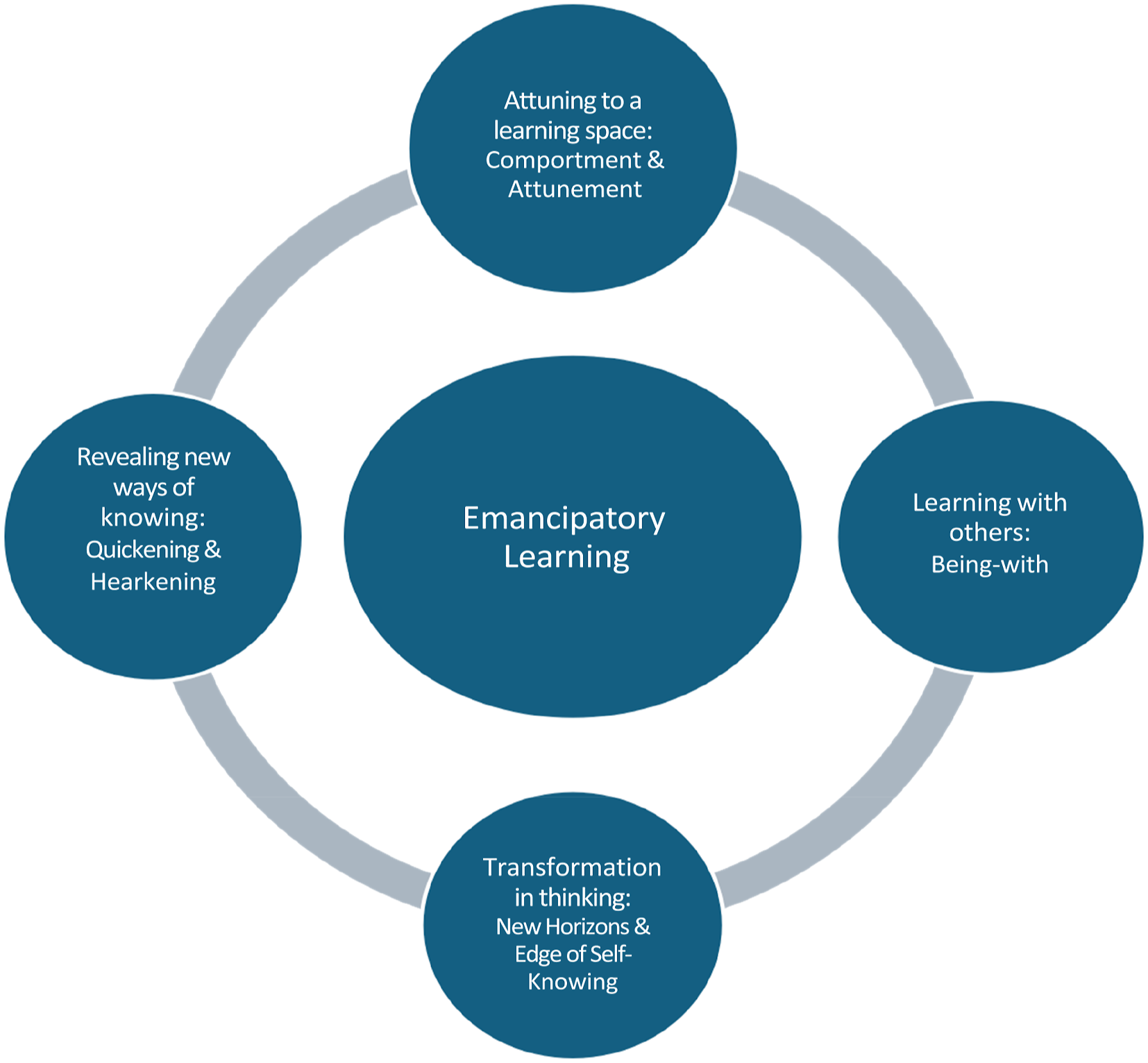
Attuning to a Learning Space
Comportment concerns how humans (or what Heidegger would refer to as Daseins) relate to other entities (other humans and objects) and our life worlds. It is our primary mode of engagement that involves intellectual understanding, moods, emotions, and practical involvement (Heidegger, 1927/1962). Closely related to comportment is Heidegger’s notion of attunement (Befindlichkeit); one of the four basic existentials or structures of Dasein. According to Heidegger, Dasein is always attuned (Heidegger, 1927/1962). Attunement does not relate to subjective-based emotions or moods; rather, it is a shared ontological existential quality that reveals the world and Dasein by shaping the entire experience of Being. For Heidegger, moods in the psychological sense of feelings and emotions manifest our ontological attunement, which is how we find ourselves faring—how we self-find ourselves in the situation into which we are thrown.
On the course, the participants engage with the world of the course and others through shared moods. Shared moods are resonantly attuning to each other because attunement has a contagious shared quality (Smith, 1981). Heidegger describes: [Moods/attunements] are not something merely at hand. They themselves are precisely a fundamental manner and fundamental way of Being, indeed of being-there, and this always directly includes being with one another. (Heidegger, 1995, p. 67)
Participants who shared their stories of attending a hermeneutic phenomenology course reported how the facilitators’ comportment of being “supportive,” “encouraging,” “nurturing,” and “inspirational” created a shared attunement within the learning space: After entering the building and going up a flight of stairs, I went down a long narrow hallway. I took a right turn and saw the two professors. I was met with a warm and welcoming greeting, immediately I felt at ease.
While the participant above reflects how an attunement of calm and ease was created in a face-to-face environment, those who attended the online course also provided similar reflections: “There was a cosy feeling to the online meetings that I hadn’t experienced before in other virtual settings.” Another participant stated: We were welcomed by name, it was always a friendly environment from the get-go—not a silence suddenly broken with “OK, I think we’ll make a start …” like every other online thing. Connections were made during the course both times, even though it was online. I think that was due to the skill and personalities of the professors who seemed properly interested in what we were thinking and encouraged interaction.
These insights reflect how congenially attuned facilitators are revealed as a welcoming comportment that invokes a sense of invitation, safety, and acceptance into this learning space. Opening this space through this quality of comportment enabled possibilities for learners to project forward into their postgraduate studies.
Comportment is inherently tied to concern: how Dasein comports itself is always an expression of concern for its Being and the world (Heidegger, 1927). During the course, the facilitators’ demonstration of concern for the learning and the participants was inherently and profoundly felt. One reflected on how such an approach was wholly unique and unexpected: “Course facilitators were incredibly nurturing, believing, affirming—gosh we can spend a lifetime just seeking even a moment of this.” This participant’s powerful reflection spoke of how the facilitators provided something not experienced before. There is something haunting glimpsed in this disclosure, something absent and out of reach about their life and contemporary academia where being affirmed, believed, and nurtured is perhaps not forthcoming, leaving a trace of yearning in their postgraduate experience. The facilitators’ comportment appeared to touch them on a deep and experiential level to meet their fundamental needs of being heard, seen, and understood with another participant expressing how terms such as “facilitate” and “support” do “not do justice to the experience.”
Comportment is considered to involve a kind of listening or attentiveness to Being, which is foundational for any genuine understanding or encounter with the world. While the knowledge and experience of the facilitators was highlighted, “The professors clearly had great depth of understanding and experience of hermeneutic phenomenology,” participants reflected on how it was the facilitators’ attentiveness to hermeneutic phenomenology that helped them to attune to their own research endeavors: I was grateful for the chance to take space to learn and for instructors whose dedication and belief in phenomenology reaffirmed my own calling to do this research.
What was implied through this feedback is that rather than objectifying the teacher–student relationship in a didactic mode of teaching that privileges calculative thinking, the facilitators’ immersion in hermeneutic phenomenology provided a way of relating which enabled participants to attune to reflexive relational learning—by “reaffirming” their “calling” for hermeneutic contemplative thinking. This gestures to what Heidegger called a “letting learn,” a pedagogical approach that enables learning to happen: Teaching is more difficult than learning because what teaching calls for is this: to let learn. The real teacher, in fact, lets nothing else be learned than—learning. (Heidegger, 1968, p. 15)
The facilitators’ comportment created a shared attunement in which “letting learn” opened possibilities through teacher–student dialogue. Likewise, this shared mood opened a learning situation of co-learning with others on the course(s).
Learning With Others
Heidegger considers “being-with” (Mitsein) to be a basic and primordial characteristic of our existence. Dasein is inherently social and relational as even when alone, we always exist in a world with others. This is because how we comprehend our life worlds is inherently shaped by shared practices and meanings: our world is a shared world. Our existence—our way of Being—is essentially influenced by our social interactions and relationships. As Heidegger writes: By “Others” we do not mean everyone else but me—those over against whom the “I” stands out. They are rather those from whom, for the most part, one does not distinguish oneself—those among whom one is too… By reason of this with-like Being-in-the-world, the world is always the one that I share with Others. (Heidegger, 1927/1962, pp. 154–155)
Being-with others on the course, particularly within the online community, required fortitude and conviction to carve out a space away from family and commitments: Each evening of the course I would arrange myself to be free from family stuff, settle in some other room with the computer and then see the friendly faces appear on screen, all different accents.
Participants reported a “real” felt connection with other learners on the course from around the world, irrespective of whether they met face to face or within an online space: For an incredibly heterogenous, eclectic bunch of humans [together in the online platform] from across the world, connection and compassion was real.
Another reflected: Not only did the course and symposiums give me confidence and tools to support my research, I also made personal connections with other post graduate researchers in similar situations—balancing work and research, one of which I have stayed in touch with since we met at the course in 2017. This has been a really valuable source of peer support.
These insights perhaps unsurprisingly reflect how similar life situations and reassurance of hearing from those also “grappling with their research projects” created a shared humanity and deep and long-lasting relationships: I also didn’t know anyone else using it so had limited opportunity to talk about practicalities or check out understanding within a peer group. When I attended the course, I was amazed to find someone else living in the same area as me even at the same university with one of the same supervisors (who was doing a PhD), and we connected straightaway.
Being-with others is significant, although the participant above speaks of those on the course they are also thinking of their shared world with others, such as university colleagues, and supervisors.
Online teaching can encompass challenges for learners due to feeling isolated and unmotivated (Ali, 2020). During the hermeneutic phenomenology course, participants expressed how the shared commitment to be present and learn, from individuals “all over the world,” reinforced and strengthened their personal conviction: Being together with people in other places who were also making the effort to deepen understanding about hermeneutic phenomenology, made these meetings more important somehow. There was a man on screen from somewhere in South America or something, and he was always up in the middle of (his) night, hunched over the computer screen in lamplight. There was a woman in Germany too, every time. I’ve been on online meetings before, but this felt as if more of an effort was made by all of us to keep turning up, over several weeks, and fully participate. We liked it.
In line with Heidegger’s relational ontology, the findings illustrated how the hermeneutic phenomenology course facilitated being-with through emphasizing responsibility, care, and community. Others pointed to how these connections were forged via the pedagogical approach adopted. The diverse ways of connecting (through asynchronous communications via online discussion boards, pre-recorded discussions, guest speakers, synchronous large group discussions, and small group activities) provided participants with different ways of being-with that facilitated confidence and learning: I was worried about speaking in the group. I felt much more comfortable in the smaller breakout groups (4–5 folk). I felt I could talk and feel heard, and the discussion flowed freely.
Perhaps speaking up was less intimidating in a smaller group and therefore felt safer? Yet, what announces itself here is how the immersive and reflexive activities facilitated learning and being-with within an easeful attunement, providing, as the following story announces, a “cocoon,” of openness and discovery: Fellow attendees were definitely sharing personal circumstances that were influencing their interpretations. That level of openness doesn’t often happen in online groups that I’ve seen. We were sharing a little of ourselves and this added to the group dynamic and the learning about hermeneutic phenomenology. For example, we were asked to comment on a narrative and sharing our interpretations with each other did reveal the influence of our different past experiences on how we interpreted the situation. Hearing a range of interpretations based in a range of personal/social/cultural contexts was a good way to help understand “thrownness.” I think participating with others in the course was critical to its success in terms of deepening my understanding of hermeneutic phenomenology, and how it needs to be talked through with others. This open inquiry within a cocoon of knowledge and support was invaluable.
Another participant reported: From the course, I not only saw the deepest passion, creativity, and purpose I’ve had the privilege to witness from the supervisors but also from fellow students and presenters, at very different points in their journey, showing up ready to reveal in all their vulnerability.
These insights demonstrate the participant’s genuine concern for each other on the course as human beings in the context of their lives and individual projects. Learning and thinking together in dialogue with other participants nurtured their own personal development, as Heidegger (1927/1962) contends: “Knowing oneself is grounded in being-with” (p. 161). During the hermeneutic phenomenology course, the variety of backgrounds and experiences of the different participants provided a “richness” that “brought the methodology to life and demonstrated its value when addressing research questions around lived experience.” In this way, hermeneutic phenomenology is not simply learnt but “lived” through learning in a dialectic and relational way, as illustrated by a participant poem where being-with shows itself as the possibility of empathy. We begin Sharing and wondering Laughing and crying Learning Questioning Living How do we do it How can we know How can we help each other to know No ending Moving forward together Together
The findings align with Heidegger’s views of solicitude (Fürsorge) about how Dasein cares for others in two main ways. The first is caring for others by “leaping in” and taking over their concerns—indicative of an authoritative teacher-centered approach of imparting knowledge for the participant to absorb. The second is “leaping ahead”—helping others to take care of themselves to reach their potential. One participant provided a clear distinction of their supervisors “leaping in” by “advising” them to consider hermeneutic phenomenology but without “further detailed discussion of the methodology”—an encounter that left them feeling “at sea.” In converse, when they joined the course, being-with was experienced as “leaping ahead” as: “I felt so grateful to have found a community with expert guides into the methodology, and interest and discussion about Heidegger.”
The shared attunement and being-with others enabled participants to respond to their projects through new ways of knowing.
Revealing New Ways of Knowing
Quickening speaks to an awakening to newness, a speeding up in knowing, an aha, a flutter of understanding, a stirring, a flash of insight when we notice an event anew, akin to a moment of vision, an “Augenblick” (Heidegger, 1927/1962, p. 376). To be quickened is like a light of knowing that is gesturing to a way ahead associated with a self-release into a right relation of the mind with the other. Within the research space, quickening is a certain mode of Being in which the unknown becomes revealed through interaction and a receptive attentiveness to existence (Guyer, 2013). This participant described moments of quickening: [the course] doesn’t hide behind anything; I love the honesty and transparency it brings even though it’s a bit scary at times to be so visible. I have recalled parts of the course again as they became relevant to my research. Loved the links to poetry and the reading of a poem at the start of each workshop. So many ways of seeing and experiencing the world. It opens so many new possibilities of Being. For example, the notes that I made during the course about using poems and poetic inquiry came to the fore again as I recently began to interpret my interviews. As I reviewed the interview recordings and made notes, I had expected to then try and craft a story for each interview. Unexpectedly, I started to write poems for each interview instead (I’ve never written poetry before), and this seemed to flow from my understanding or experience of each interviewees’ story. It surprised me. … it feels exciting.
This participant had attended two courses and seems to have become habituated into a way of thinking and dwelling in the uncertainty that is hermeneutic phenomenology through these emancipatory moments of quickening. They spoke of being awoken to something always there but out of reach. Learning on the course therefore provided an invitation to new seeing and fresh understandings and being surprised and delighted in how creativity emerged. For them, the journey of learning had been motivating and transformative. Their changing mode of listening speaks to how listening in certain ways opens and attunes listening within and beyond the auditory sensation—to hearkening.
Hearkening is about what we hear when listening to what is disclosed. For example, it is not about the detail of each sound, note, or word (although they are important in some cases); rather, it is a listening that hears inhered feelings and meanings. Hearkening speaks of the referential totality of sounds in our world: the open listening to a poem, an orchestra playing Bach, or a group of children playing. In such listening, we come to understand what is meaningful for us in that listening. Heidegger calls this quality of listening, hearkening, a hearing that understands what is being listened to: Mortals hear the thunder of the heavens, the rustling of woods, the gurgling of fountains, the ringing of plucked strings, the rumbling of motors, the noises of the city - only and only so far as they always already in some way belong to them and yet do not belong to them. (Heidegger, 1975, pp. 65–66)
This occurred on the course as participants listen, even when not understanding all the details, with a renewed openness to what comes from more than pure sensory input and everyday thinking. A participant shares how listening and re-listening in a certain way (hearkening) to a session brought key learning: One part that really struck me was the interview session led by [guest speakers]. I have gone back actually and watched a number of times since. In part I wanted to understand and learn more about the conducting of interviews in a hermeneutic phenomenology style, and how this might differ/alter from other interview approaches. Grasping aspects through and around the hermeneutics component (how something happened) and the phenomenology component (what happened) was key learning for me.
Another participant described the significant learning that occurs through this quality of listening to others on the course: Listening to other researchers who had completed their research using phenomenology was really positive. I was pleased that I understood the concepts they were referencing, so felt increasingly confident that I was starting to “get it.”
Another reflected: Even the “listening” seemed more intentional than usual for a training course, because the chat was always active after people spoke or proposed an idea. We just seemed to be a team; we were all seekers.
This intentional quality of listening as a group was welcomed and helpful, and in their hearkening, they became a team of “seekers.” Another participant spoke about the impact of others hearkening to their work: The comments I received after my presentation were very affirming, and I was pleased that inclusion of some participant’ stories [from their own study] evoked emotional responses—the phenomenological nod—I was hoping for!
Although the details of what was heard in the feedback are important, it is the hearkening of the situation that evoked evident joy and growing confidence.
Hearkening is critical for everyone and a crucial quality of listening for the hermeneutic phenomenology student when confronted with new and baffling philosophical terms. Participants learnt to listen by hearkening, which helped them grasp in a pathic way prior to an intellectual knowing. This quality of listening helped them learn without stumbling on philosophical detail as they navigated their way into new understandings. That is, they could come to understand what they do not understand in those hearkening moments. This is akin to peering out of the confines of self-critique, beliefs, assumptions, and discipline-specific languaging and realizing “I now understand that I do not know that.” Heidegger says: It is on the basis of this potentiality for hearing, which is existentially primary, that anything like hearkening [Horchen] becomes possible. Hearkening is phenomenologically still more primordial than what is defined “in the first instance” as “hearing” in psychology - the hearing of tones and the perception of sounds. Hearkening also has the kind of being of the hearing which understands. (Heidegger, 2017)
When participants attune to hearkening, this reveals new ways in thinking and discovering new ways to respond and know their projects. This was evocatively described in one participant poem: The moments in nature, in peace, in silence, in chaos. I look more than I’ve ever looked. I see more than I’ve ever seen. I pause more than I’ve EVER paused. I hear more than I have ever heard. I feel more than I have ever felt. But I know there is more looking, seeing, pausing, hearing, and feeling to be had – I’m only just getting started. Isn’t that exciting? And scary.
In the poem, we can see how hearkening gathers and opens to the quickening that stirs. Heidegger in his 1944 lecture on the philosopher, Heraclitus, describes hearkening as a gathering in relation to the call of conscience (Frings, 1991). The letting learning happen provides a space for participants to bring forth their call (“educare” in Latin), thus letting them learn how to be (Heidegger et al., 2000). By participants learning to respond to this call, a new way of knowing and a transformation in thinking is made possible.
Transformation in Thinking
There is a tangible yet unspoken sense of transformative thinking as participants pass through the course(s). Participants found philosophical notions/ideas that enabled them to achieve rich analysis and to take interpretive leaps when working with data that helped them reveal far more about their topic. However, on a more transcendental level, participants reflected on a greater self-knowing than they had anticipated through demonstrable changes in the way they understand themselves and their life worlds: Hermeneutic phenomenology is influencing how I show up—sometimes, I feel more sure of my purpose, “everything leads to this.” I feel I show up differently in interactions, more accountable and aware of my biases, less focused on chasing accolades and ego but knowing I do not know, I am learning, always the student.
As reflected in the participant’s words above, this transformation is not a fixed state but represents an evolving and ongoing process of learning from a new starting position for new discovery. One participant articulates their own journey to new horizons of understanding in thinking: If anyone had said to me a few years ago that I would produce a PhD thesis using hermeneutic phenomenology—I would have thought that they were bonkers! … I think I only gained the ability to articulate my understanding after 6 years of trying. I do think that because a PhD is a “Doctor of Philosophy”—my qualification feels justified because of the hard gained knowledge and understanding about the different branches of phenomenology, and the choices I made. I know that I have achieved philosophical thought that I wouldn’t have considered myself capable of before.
The resoluteness of their hard-won understanding comes through as the everydayness of life, and studies outside the course environment challenged their confidence: On reflection, and looking back at my notebooks, I felt that when I was on the course, all of it made sense whilst I was in the room with the faciltators and the attendees. Then as soon as I returned to my everyday reality, and discussions with my supervisors, I felt that the knowledge and my confidence to articulate and defend my choices and decisions was slipping through my fingers. However, I stuck with it; now I think I could dare describe myself as a hermeneutic phenomenological researcher sometimes!
The participant then shared the final words of their thesis journey: Completing this research has opened my eyes to new understandings about the experiences of everyday life for participants, whilst also impelling me to acknowledge and question the subconscious bias that I inevitably carry with me. I acknowledged that my pre-understandings were inevitable. … the research process highlighted new understandings and prompted my thinking to significantly move in unexpected directions.
There is a sense of resoluteness and self-assuredness in the story as they experience being taken to the edge of their own self-knowing. The two courses they attended appear to have helped them start a journey of thinking and learning that led to growth and transformation. Their story gestures to a move toward more reflexive thinking and opening of a new worldview that finds them in a place they did not expect.
In Figure 2, three photos are presented by a participant side by side with simple titles for each one. The images came without further interpretation, and the additional interpretive text has been added by the authors. They depict a transformation in a worldview and an unfolding experience in which what was already always there shows itself in unexpected ways by the simple act of noticing different perspectives. This speaks to a slowing down, getting closer, and a pathic thinking approach. The three named photos.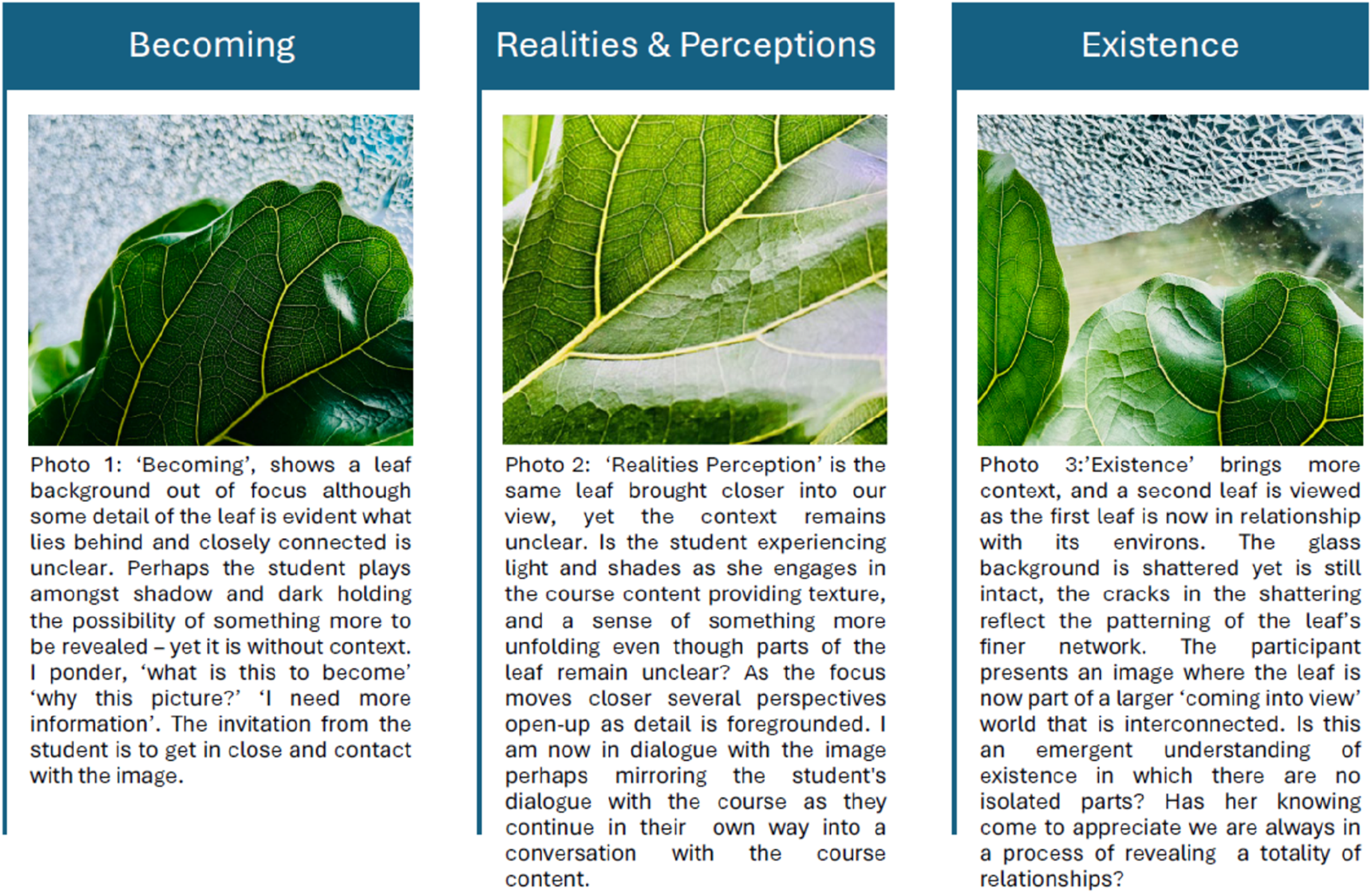
The images gift something ungraspable and even fracturing about the participant’s change of knowing. This speaks to a learnt genre of thinking that comes with dwelling in hermeneutic phenomenology, a dynamic process, highlighted by another participant who says, “My commitment to hermeneutic phenomenology has only grown deeper over time as I learn more.” Another participant described how learning hermeneutic phenomenology has been life changing through their transformation in thinking: Moving forward I can see the uniqueness of each individual when approaching challenges in life, my understanding has reinforced the value of each individual person. An understanding of hermeneutic phenomenology has been life changing because it has enabled me to look at Heidegger’s philosophy and see its richness when approaching nursing practice and I can see value of being led by the data rather than a theory or hypothesis.
Learning how to think was a concern for Heidegger. He stated that thinking cannot be reduced to a word or definition; thinking he contended is to be experienced: Only the leap into the river tells us what is swimming. The question “what is thinking?” can never be answered by proposing a definition or the concept thinking, and then diligently explaining what is contained in that definition. (Heidegger, 1968, p. 21)
Instead, Heidegger urges us to be free of all technological descriptions of what it is to think and instead to appreciate that thinking is always on the way.
Discussion
In this study, we report on a hermeneutic phenomenological study of participants’ lived experiences of attending a hermeneutic phenomenology methodology course. The findings revealed how the facilitators’ comportment in helping to create a shared attunement was key to facilitating a learning experience of openness and discovery, reflecting David Giles’ research on relational education (Giles, 2018). As Heidegger (1927/1962) contends, how we comport is our Being, that is, how we are is what we are. Likewise, how participants came to be attuned reveals how they comport and how they are faring and self-find in the interactions with the course and others. Being-with others, a fundamental facet of our existence, was perceived as crucial by the participants. Their insights were also not just about being with other learners but rather how a deep connection was formed due to the reflexive and collaborative pedagogical approach. Participants also referred to how they adopted new ways of listening (hearkening) leading to moments of quickening when new understandings emerged and the call of conscience about what matters in their studies was brought to their thinking. The transformation in thinking spoke to how they found themselves on the edge of their self-knowing and experienced glimpses beyond the horizons of their current understanding. Attending the course appears to have initiated a journey of thinking and learning that has led them to growth and transformation of thinking by freeing them to see a new worldview.
The phenomenon to emerge from the data was “emancipatory learning.” The findings point to how the comportment of the facilitators, the being-with others, the hearkening and quickening, and transformation of thinking depict an emancipatory process which empowered participants to critically examine themselves, their research, and their life worlds. Etymological meanings of emancipation include to set free from restraint and control, an experience of deliverance, to be released, to become unshackled, and to no longer be enslaved by the status quo that often entails struggle. We contend that passing through this struggle is a threshold experience, likened to a liminal phase of passing from the dark into light. The movement is one of empowerment that requires sustained engagement and reflexivity leading to the potential for permanent change in a student’s worldview (Meyer & Land, 2006).
Emancipatory learning is aligned with Heidegger’s critique of “Bildung.” This is where a transformation in understanding does not take place through engaging with a world of beings (or what Heidegger would view as a nihilistic process of “enframing” where information is levied out regardless) but rather through an ontological encounter with the Being of being (Thomson, 2001). The course was underpinned by dialogue, participation, and collaboration, rather than a didactic teacher–learner relationship, where the facilitators and participants worked in a symbiotic and co-constructed manner. The participants’ awakening to Heidegger’s fundamental ontology and reflexive processes that questioned their emotional, moral, and intellectual development set them on a path of “self-giving” and personal empowerment and emancipation. Participants described how the learning helped unshackle them from the dictates of traditional approaches and gifted transferable knowledge that expanded horizons of understanding and non-transferable knowing into contemplative thinking that profoundly challenged their views about self and world. Participants’ involvement in the course provided a “freeing” that nurtured openness, discovery, and feeling understood among peers and facilitators. The engagement and learnings on the course with others stimulated a praxis of reflection and action: participants were now enabled to express these new insights within their research practices and to transform others by encouraging others to engage in hermeneutic phenomenological learning.
Like other authors (e.g., Dibley et al., 2020; Saevi, 2013; Smythe & Spence, 2020a; Smythe & Spence, 2020b; Spence, 2017), participants frequently highlighted how engaging in a hermeneutic phenomenological study was complex and challenging. This is a common experience of entering the thinking of hermeneutic phenomenology and has been reported in a recent anthology of 11 completed hermeneutic phenomenology studies (Crowther & Thomson, 2022a). In this anthology, the chapter authors, like participants in this study, describe how they struggled initially with grasping only glimpses of understanding when reading philosophical writings and the nervousness of leaping into interpretive analysis of data. However, despite these trials, engagement in the course was considered to have facilitated an emancipatory transformation process that eased this struggle. This change was not so much a stepwise process but a lived through experience, an event, a moment, or moments, that led them to a threshold where they encountered surprising insights about themselves and being a researcher in the academic world.
Bishop et al. (2022) explored the relationship between a postgraduate teaching approach and the development of a critical pedagogy. They found that while the critical approach was associated with improved outcomes, participants experienced a “pedagogical shock” and an initial reluctance to engage in active and reflexive teaching methods. We found similar insights in terms of how the emancipatory processes of engaging in the course literally “shook” how participants saw themselves and their life worlds. However, rather than met with reluctance, participants took up the challenge to look closely and honestly at their own judgments and presuppositions. This turning to the ontological can be disorienting, Thomson (2001) describes this as: …ontological education teaches students to question the very ontological presuppositions which guide research, thereby opening a space for understanding the being of the entities they study otherwise than in enframing’s ontologically reductive terms. (p. 261).
While hermeneutic phenomenology is not an easy process, participants described how they leant into the perplexity of unknowing, being unsure, and learning patience in knowing that the unexpected will bubble up in their inscape of thinking. This involves, according to Heidegger, recognition that the modern academy has fractured into many specialisms and dispersed knowledge blurring the referential totality of existence that is at the heart of doing hermeneutic phenomenology: Today only the technical organization of universities and faculties consolidates this multiplicity of dispersed disciplines, only through practical and instrumental goals do they maintain any meaning. The rootedness of the sciences in their essential ground has dried up and died. (Heidegger, 1998, pp. 82–83)
The course helped participants see the poverty of knowing that can arise in a natural or everyday attitude within their discipline-specific discourses. As participants adopted an ontological attitude, an unmediated knowing emerged where beliefs, assumptions, and theories were acknowledged and questioned. They came to realize that they could not get to where they wanted to go, remaining in the confines of the status quo, both in terms of their current studies and their future aspirations. Consequently, greater realization of the self and their own internal hindrances surfaced fresh knowing in moments of quickening when their thinking reached beyond their existing boundaries of understanding. When we consider how some participants are challenged by a lack of peer support or supervisory expertise into this way of thinking, we are reminded of Heidegger’s ontological education and paideia: Plato seeks to show that the essence of paideia does not consist in merely pouring knowledge into the unprepared soul as if it were a container held out empty and waiting. On the contrary, real education lays hold of the soul itself and transforms it in its entirety by first of all leading us to the place of our essential being and accustoming us to it. (Heidegger, 1998, p. 217)
Etymologically, paideia, the root of pedagogy, means “civilization,” “culture,” “development,” “tradition,” “literature,” and “education.” This indicates that learning and teaching is more than transmission of information. This way of learning requires a reflexive stance on who learners and teachers “are.” As Thomson (2001) states: The goal of this educational odyssey is simple but literally revolutionary: to bring us full circle back to ourselves, first by turning us away from the world in which we are most immediately immersed, then by turning us back to this world in a more reflexive way. (p. 254)
As Heidegger reminds us, it is only by getting in the water and swimming do you experience swimming. It is only by learning to think anew that participants become emancipated and drawn into noticing how meaningfully rich human experience is, in ways far more than they previously considered. In the light of this knowing, they can pursue their hermeneutic phenomenological postgraduate studies with confidence, purpose, and empowerment.
The participants’ stories convey how the facilitators’ comportment modelled the hermeneutic phenomenological way. This reflects a congruence between teaching hermeneutic phenomenology and how they were already immersed and orientated to this approach in their scholarship. Conceivably, this course would have been very different if it had been teaching a critical and/or highly structured methodology. Likewise, the students’ learning is not assessed as part of an accredited course. This provided a freedom to focus on how to learn, a luxury in the current university system where thinking deeply could be construed as a subversive activity (Rolfe, 2013). The course is woven together by an engaged dialogue with each person in their own learning that focuses on “letting learn.” To let learn is an emancipatory self-finding in which a learner discovers their own way forward without pre-fixed expectations of what will be learnt and examined. Could such letting-learn work in situations where there is assessment? We suspect this may change the style of teaching because learning would become enframed in reductive ways, lessening the openness to the present moment of a learning dialogue. However, despite these reservations, our study offers transferable learning for postgraduate pedagogy by highlighting the importance of the comportment of the teachers and how they attune and show up for participants on methodology courses. Offering a range of opportunities for learners to be with one another, and comport to one another, helps develop confidence and facilitates meaningful connections and important peer support to sustain one another in their research endeavors. While an appreciation and understanding of hermeneutic phenomenology philosophical underpinnings (taught through more classic pre-recordings and associated literature) was important, for quickening and transformation of thinking to occur, the reflexive and immersive pedagogical approach was crucial for emancipatory learning and to gain insights into the wonder of human existence.
Author’s Reflections
This reflexive and immersive approach extended into doing this study. As initiators of this study and course facilitators, we remained deeply engaged and reflexive throughout data analysis and discussion. We were humbled by the richness of the anonymized data and moved by the overwhelmingly positive narratives. Acknowledging this potential bias, we stayed open to perspectives that may not have been shared. What began as an evaluation evolved into a transformative journey, revealing the emancipatory nature of learning—not just for participants but also for us. This process has reshaped our understanding of pedagogy, refining our approach to teaching, course delivery, and supervision.
This study is the first to provide insights into the pedagogical approach of a postgraduate hermeneutic phenomenology methodology course. By gathering participants’ lived accounts, a rich tapestry of narratives, poems, and photos, and the use of Heideggerian concepts were able to illuminate the how and what was important and meaningful for learners in the process of discovery and transformation. While the sample size may be considered small, it was sufficient for a hermeneutic phenomenology study (Smythe, 2011). Notwithstanding limitations, the findings offer new perspectives into a creative, immersive, relational pedagogical approach with transferable learning for other methodological learning opportunities.
Footnotes
Acknowledgments
To the participants who gifted their stories, poems, and artwork for this study. To Professor Liz Smythe who provided a critical review of the article prior to submission. To all colleagues and students who have joined in this dialogue in myriad ways over the years.
Author Contributions
Both authors have made substantial contributions to the design and process of the study. Both authors have contributed equally to the writing of this article and have proofread and agreed to the version submitted. Each author takes responsibility for all the content of this article.
Declaration of Conflicting Interests
The author(s) declared no potential conflicts of interest with respect to the research, authorship, and/or publication of this article.
Funding
The author(s) received no financial support for the research, authorship, and/or publication of this article.
