



Abstract
There is a well-established and growing literature on engaging and working with communities throughout the research process. Co-design and collaborative research are becoming common practice among researchers and increasingly a funding incentive and institutional commitment. Research methodologies have been created to formalize these processes and guide both new and experienced researchers wishing to engage in such research. However, gaps around process remain within the literature and research teams are often left to design their own techniques and protocols. Participant Emotional Resiliency Check-ins (PERCs), a term and research technique designed by the authors, aim to facilitate timely participant reflection on their emotional resiliency and to direct their participation in sensitive research accordingly. This research technique takes a strength-based and trauma-informed approach and most importantly is conducted by a peer worker. In this paper, we outline the PERC technique and identify its key features. We also share our considerations and learnings for other research teams wanting to engage in collaborative, sensitive research.
Introduction
In health research, a shift toward co-design or collaborative design is in line with a much wider shift toward patient-centered healthcare (Burkett, 2012). At a funding and institutional level, collaborative research processes may be one way to deliver and improve patient-centered care. Health research funding opportunities and incentives globally have encouraged community collaboration and involvement in research (Russo et al., 2024). In the United States, Minkler et al. (2003) note the growing number of funding bodies and sizable funding opportunities for collaborative research. In Australia, some research schemes set out community involvement as a requirement of certain funding grants (Russo et al., 2024). To meet this growing demand and interest in co-design, methodologies have been created to formalize processes of community engagement and collaboration to guide both new and experienced researchers wishing to engage in such research. However, gaps around process remain within the literature and research teams are often left to design their own techniques and protocols (Hoekstra et al., 2020; Horowitz et al., 2009).
Participant Emotional Resiliency Check-ins (PERCs), a term and research technique designed by the authors, aim to facilitate participant reflection on their emotional resiliency in a timely manner and to direct their participation in sensitive research accordingly. This research technique takes a strength-based and trauma-informed approach and most importantly is conducted by a peer worker. We outline a step-by-step process that was followed as part of the authors’ qualitative research, as well as key features that make this a meaningful step in the research process. We also briefly share and explore considerations and learnings for future implementation and adaptations. As a preliminary research technique, this paper aims to add to the growing literature of co-design and act as a launch point for other research teams wanting to engage in collaborative, sensitive research.
Rationale for PERCs
Co-design is often traced back to participatory design which increased in popularity in Scandinavia and North America in the 1990s (Smith et al., 2017). These research methodologies were motivated by democratic principles and aimed to engage consumers throughout the research process, not only at its conclusion (Javanparast et al., 2022; Smith et al., 2017). As participatory design gained traction across disciplines, it is worth noting that such research aims and methods were long standing priorities and practices within indigenous methodologies and feminist research (Eady & Stringer, n.d.; Korsmeyer, 2022). Nevertheless, the recent push for consumer and community engagement in funding incentives and institutional expectations has encouraged the proliferation and formalization of collaborative research processes (Horowitz et al., 2009).
In this paper, we offer a research technique which is underpinned by tenets of indigenous methodologies. Tenets of relevance, ownership, and equity in partnership factored into the research design and process (Namaste, 2009). As a collaborative endeavor between the authors (MS and JS), equity in partnership was a guiding tenet in the co-creation of PERCs. The idea for PERCs was initially proposed to the advisory group in which the second author (JS) was a member. Following group discussion and feedback, PERCs were reframed to be peer-led and the research protocol amended. Both authors then worked through the underlying rationale and feasibility of such a check-in to co-create PERCs as a formal research technique. The authors also relied on active, decolonizing practices set out by Thambinathan and Kinsella (2021). The practice of “reciprocity and respect for self-determination” calls for a shift in focus away from research objectives to the well-being of participants (Thambinathan & Kinsella, 2021). PERCs as a research technique encourages research teams to put their objectives to the side and re-prioritize participants’ decision-making and well-being throughout the course of research participation. Similarly, taking self-determination seriously means participants decide when they feel comfortable to contribute to research and maintain the agency to change their minds.
Pre-interview time has been identified within the literature as valuable and useful for both participant and researcher. Rogers et al. (2021) have discussed the importance of pre-interview telephone conservations with parents and older children for the purposes of confirming participation, organizing logistics (location of interview, presence of parent), and accommodations for the child during the interview process. Other teams have engaged adult participants in screening conversations prior to research participation to confirm eligibility, discuss mental health, and ask questions, though explicit questions are not detailed (Alessi & Kahn, 2023). Groves (2022) and colleagues have identified the importance of “emotional and empathetic pre-interview work” necessary to engage socially marginalized groups in qualitative research. The authors discuss the amount of work needed to facilitate and accommodate the various circumstances that affected participants’ ability to engage in research, that is, burn out, changes in mental and physical health, death of a pet, and storm damage causing power loss (Groves, 2022).
Within our own research cohort of young people (age 18–22) who interacted with gender services as minors across Australia, we were aware of the potential for elevated distress in our participants. A national Australian survey of transgender and gender diverse (TGD) young people aged 14–25 found that three in four of their participants had been diagnosed with depression and/or anxiety (Strauss et al., 2020). While engaging participants in discussion about previous interaction with gender services, we also took into consideration the higher rates of medical trauma and traumatic stress within the healthcare setting for TGD young people (Ramos, 2021). Importantly, we could not ignore the current political context surrounding such research, where damaging political rhetoric and rapid policy changes can impact TGD young people on a daily basis (G. Miller, 2024). However, TGD people are not passive within these statistics or context (McGowan et al., 2024). In fact, McGowan et al. (2024) have shown how LGBTQA+ young people use connection, creativity, and agency within their own lives and communities to support their health and well-being. The authors’ findings reflect “young people’s capacity to understand, and reflect on, their own wellbeing needs and to take action” when faced with challenges (McGowan et al., 2024).
We aimed to proactively engage with pre-interview time and designed what we term Participant Emotional Resiliency Check-ins (PERCs). This pre-interview check-in aims to facilitate participant reflection on their emotional resiliency in a timely manner and to direct their research participation accordingly. As Vincent (2018) states, engaging TGD individuals in research is a request for both “intellectual and emotional labour.” It was therefore necessary to acknowledge participants’ emotional resilience, the capacity to “regulate the intensity of negative emotions [experienced] in the presence of adverse events,” and the ways stressful events may cause such resilience to fluctuate (Bernard & Pires, 2006). Given the wider context and reality for TGD young people today, we sought to acknowledge the various ways an individual’s emotional resilience or “bandwidth” to participate in sensitive research may be affected and to support participants in directing their own research engagement following this self-reflection.
PERCs take a trauma-informed and strength-based approach—this technique aims to avoid re-traumatization and reduce any additional distress caused by engaging in sensitive research while facilitating choice and focusing on participants’ resilience (Byrne et al., 2021). Hillier et al. (2020) describes how trans youth “make choices and assert control over certain life decisions” as a form of resilience. Providing participants with control and agency over their own participation helps to foster resilience, particularly when discussing events that may have been distressing or traumatic (Byrne et al., 2021; Levenson, 2017). Thus we aimed not only to mitigate potential distress caused by research engagement but also to create the conditions for resilience construction (Alessi & Kahn, 2023). Engaging peer work in PERCs is essential in this aim to strengthen resilience. Kia et al. (2023) have reported that TGD people experience “greater vulnerability and authenticity” when engaging with peers. Additionally, peer engagement has been shown to promote resilience in TGD people (Bariola et al., 2015; Kia et al., 2023). Peer work within PERCs may therefore encourage a more genuine check-in experience while bolstering participants’ resiliency prior to research engagement.
To our knowledge, this is the first time a pre-interview check-in which aims to acknowledge participants’ life circumstances and emotional resilience has been formally described in the literature. We see wide applicability of PERCs to other areas of research, particularly for researchers wanting to engage in collaborative and sensitive research. Emotional resilience and resilience more broadly are widely applicable concepts that can be tailored to particular participant populations. PERCs facilitate choice around how and when participants engage with sensitive research while recognizing the challenges they may face within and beyond the research context.
Positionality and Process
PERCs stems from the collaborative work conducted by both authors as part of the first author’s PhD research focusing on access to gender care for minors. The first author (MS) is a mixed race, queer, cisgender woman. In relation to the research in which PERCs were designed and conducted, MS occupies an outside researcher position. The second author (JS) is a white, queer, disabled, neurodivergent, and transgender woman.
As a member of the project’s advisory group, JS brought both lived experience and vocational expertise to project discussion and feedback (McKercher, 2021, p. 11). As a young person with experiences relevant to the participants we were aiming to interview, JS provided feedback on the project design, recruitment materials, and helped pilot and further refine interview questions. JS is also trained in trauma-informed care and emotional resilience frameworks through the ongoing completion of a vocational certificate. Holding both relevant lived experience and specific project insight, JS was well placed to join the research team and take up the peer worker role. Both authors met to discuss the scope of the role before co-creating and designing PERCs. JS completed the relevant project specific training (Mental Health First Aid, REDCap training) before performing PERCs for all participants.
Both authors hold current Mental Health First Aid certificates. The research team also had access to mental health support through the university’s student and staff psychological services. These services are available to support the research team debrief and look after their own mental health, particularly important following instances of participant distress.
Using PERCs
Our first step was to identify a peer worker to co-create and conduct participant check-ins. For our participant cohort, interacting with a peer of a similar age who had experience accessing gender care as a minor was important. While identification of a peer worker occurred somewhat organically in our context, we hesitate to suggest strict criteria or qualifications for the peer worker role in other research settings. Instead, we encourage research teams to think critically and collaboratively about who is best placed to act as a peer in relation to their participant cohort.
Steps for Conducting PERCs.
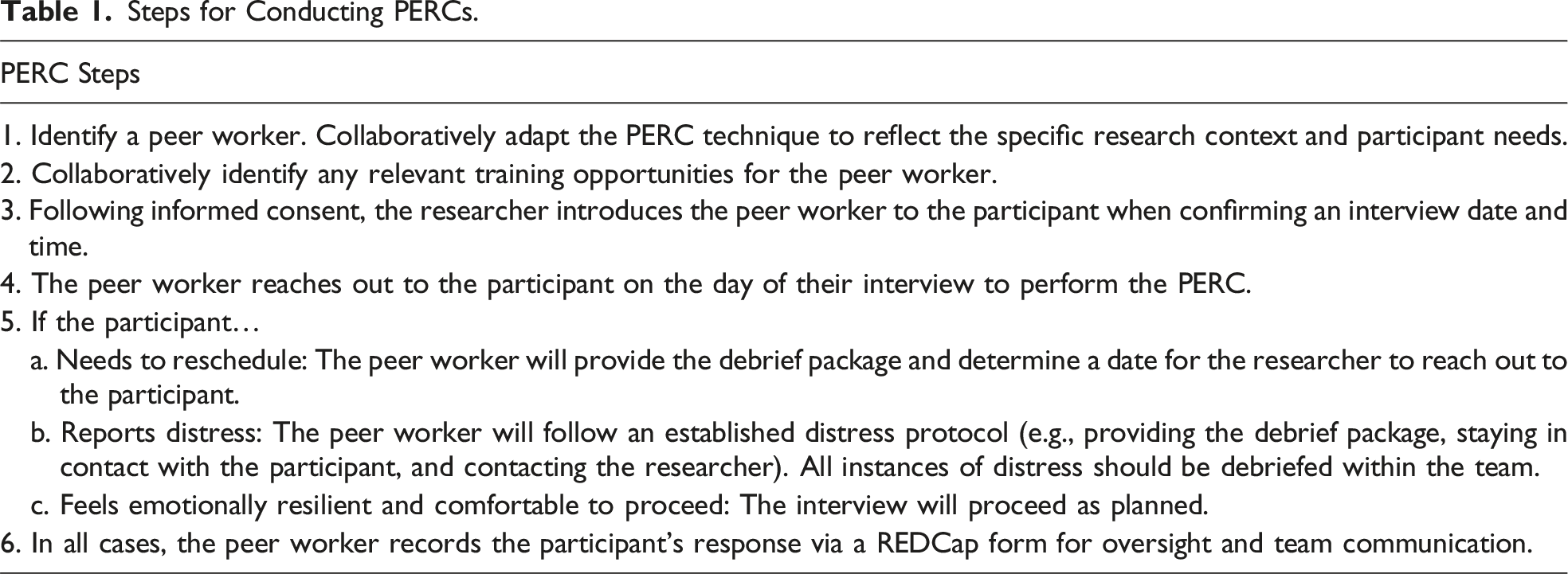
On the day of the scheduled interview, the peer worker initiated contact with the participant via their preferred communication method, checking in on their emotional well-being and resilience. After a brief introduction, the peer worker encouraged participants to be in a quiet, confidential space for the interview and asked three baseline questions, which served as a foundation for the check-in: 1. How are you feeling today? 2. Are you feeling emotionally resilient today and comfortable participating in an interview? 3. Would you prefer to reschedule your interview to another day?
The peer worker had flexibility to adapt these questions as needed, depending on the participant’s individual needs, while ensuring that the core purpose of assessing emotional resilience was maintained. After receiving the participant’s response, the peer worker documented the participant’s reported resilience and readiness to proceed, providing this information to the researcher via a REDCap form. In cases where the participant requested additional information (clarification regarding interview time or Zoom link) or did not engage with the check-in, the peer worker responded accordingly (sending a follow-up, notifying the researcher).
If the participant opts to reschedule the interview, the peer worker provides the debrief package which includes information for mental health support services and encourages participants to engage in activities that support their mental health (journaling, taking a walk, calling a friend, etc.). The peer worker will determine with the participant an appropriate time for the researcher to reach out and reschedule their interview. Should the participant disclose current distress, the peer worker will follow an established distress protocol, including notifying the researcher and maintaining contact with the participant until appropriate support options are provided. If the participant is comfortable to proceed with their interview, the peer worker documents the check-in and the scheduled interview proceeds as planned. Following the completion of each interview, the researcher will send the debrief package and feedback form to the participant.
Key Features of PERCs
This research technique can be adapted and used in other research settings to serve particular participant population needs in the research context. However, there are a few key features which underpin this current technique and would need to be retained to facilitate a meaningful check-in.
Peer-Led Process
Having a peer undertake PERCs helps to facilitate participant honesty and agency. Within a trauma-informed approach, we were conscious of participants feeling they needed to appease the researcher or continue with a research process they felt uncomfortable with (Levenson, 2017). Though the peer worker is part of the research team, their lived experience and age (particularly for youth peer work) may help to reduce these power dynamics and encourage participant agency and decision-making throughout the research process (Fava et al., 2020). The peer worker is also able to support and advocate for the participant if needed (Byrne et al., 2021). For example, if the participant decided to postpone and reschedule their interview, the peer worker would inform the researcher and help facilitate these changes so that the participant does not have to do this.
Timeliness of Check-Ins
Timing of a PERC is essential to ensure the check-in is relevant. Asking participants to confirm emotional resilience and participation too far in advance to their interview undermines the purpose of the check-in. Participants should be contacted by the peer worker on the day of their interview for their reflection to be current and practical. In our own research, interviews were scheduled no earlier than midday to allow for sufficient time for the PERC to be conducted. PERCs are separate from interviews but utilize the pre-interview time within standard research processes. Within our own research, JS contacted participants by phone or email prior to their online interview. For in-person interviews, a call or email prior to a participant’s arrival may help facilitate a more meaningful check-in.
Acknowledgment of External Factors and Context
One of the motivations behind PERCs was to acknowledge and recognize the external factors and context in which participants engage in research (Tuhiwai Smtih, 2021). As previously mentioned, our participant cohort has a higher prevalence of poor mental health and is facing increasingly distressing policy change and politicization. PERCs aim to acknowledge these various forms of distress and allow participants to decide how and when they would like to engage in research. However, this feature extends beyond our participant cohort and serves as a reminder that participants are people with busy and complicated lives beyond the research context—fluctuation in emotional resilience is a consideration that extends to all.
Participant-Led Engagement
In a similar process to gaining consent, the decision to participate in research should be a continuous process that promotes self-determination (Thambinathan & Kinsella, 2021). PERCs facilitate decision-making and participation according to participants’ emotional resilience on a given day. As McGowan et al. (2024) state, LGBTQA+ young people have the “capacity to know what they need in order to fare well, provided they are afforded the space and support to do this.” PERCs set aside meaningful time for participants to direct their own research engagement and are supported through this process by a peer worker. Additionally, within research projects on sensitive subject matter, it is important that participants feel they have the resiliency and agency to engage in research at a point, and to an extent, that they are comfortable with.
Learnings
Over the course of our research project, we have identified points of tension and areas for improvement in the implementation of PERCs. Here, we highlight some of the considerations and practical learnings around implementing this check-in.
Avoiding Paternalism
Happell et al. (2019) highlight the tension between mental health researchers regarding consumers as vulnerable and in need of safeguarding, while consumer researchers believe such concerns were unnecessarily cautious, misplaced, and condescending (particularly when consumers assessed themselves as capable). This tension represents a broader theme of the paternalism inherent in the research process in order to achieve informed consent (F. G. Miller & Wertheimer, 2007) and to limit both legal and ethical liabilities (The Lancet Psychiatry, 2022). One participant remarked to the researcher that the check-in process felt like speaking to their mum, showing how even a peer-led process can still be perceived as infantilizing. Future implementations of PERCs should consider how messages delivered by a peer may still be viewed as clinical by nature, which could lead not only to participants being less trusting of the peer worker’s authenticity but may also be distressing and isolating for the peer worker.
Integration of Peer Worker Into the Research Team
It is important that the peer work role is well defined to avoid role “creep” and allow the peer worker to stay within the bounds of facilitating resilience without entering into a therapeutic relationship (Coordinare, 2021). Similarly, research teams should also be cautious of extending paternalism to the peer worker delivering the check-in. Returning to the tenet of equity in partnership, the peer worker must be a trusted member of the research team and supported through capacity building and supervision, rather than perceived as more vulnerable than researchers.
Dignity of Risk
It is important that the incorporation of PERCs into the research process does not limit participants’ dignity of risk, an “individuals’ right to make their own decisions, to participate in a broad range of desired activities, even if those activities have risk, and to expose themselves to potential consequences or learning opportunities” (Chicoine & Kirschner, 2022). Peer support should recognize how distress is an important element of a dynamic and recovery-oriented practice and should focus on building resilience and coping strategies to deal with any potential consequences of participation.
Pre-Existing Relationships
It is possible that peer workers and research participants may know each other outside of the professional context through community networks and spaces. Pre-existing relationships was a consideration in our context, particularly with JS’s previous involvement in TGD health consumer advisory groups. Pre-existing relationships may complicate the peer support process, such as concerns about the confidentiality of shared information or biases in the support provided. Research teams should discuss these issues openly at the outset of research collaboration.
Follow-Up
Importantly, PERCs are a proactive measure and occur before an interview commences. Following the completion of interviews, our research team did not conduct a follow-up, peer-led check-in. Instead, participants were given a debrief package which included resources and mental health support services which they could choose to contact as needed. In deciding to maintain a single, pre-interview check-in, we were conscious of the limits of our research project and peer work in this setting. Particularly surrounding the peer worker’s duty of care to participants, we wanted to ensure there were clear limits on this duty following the conclusion of research participation. Depending on the sensitivity of the research and resources available to the research team, other teams may want to consider offering psychological or counselling services for follow-up care.
Increasing Communication Opportunities With the Research Team
PERCs may also facilitate increased communication between the research team and the participant. For example, one of our participants reached out to JS following their PERC as they could not find their interview confirmation email and Zoom link. Similarly, another participant initially reported having a slight headache at the time of their PERC but was happy to participate in their interview later that day. This information was reported by JS and shared with MS, following the steps set out in the PERC technique. An hour before their interview, the participant reached out to MS stating their symptoms had progressed and they would no longer be able to participate and needed to reschedule. PERCs therefore provides participants with an additional contact on the research team through the peer worker while also opening up channels of communication prior to research engagement which may encourage participants to reach out or get back in touch with the research team if circumstances change.
Participant Feedback
We also sought feedback from participants regarding PERCs. Most participants’ feedback was brief, but largely positive, stating check-ins were “super easy” and “reassuring.” One participant stated that the PERC was “unusual, but greatly beneficial in preparing and connecting beforehand.” Even though this participant seemed to appreciate the preparatory effect of the check-in and reports a positive experience, PERCs may still elicit various emotions and responses from participants. Research teams should be prepared to be flexible and adapt their processes as needed.
Variance in Communication: Evaluating Distress Versus Disinterest During PERCs
There was a noticeable difference in communication styles observed in participants’ email responses to PERCs. Some young people relied on “textese” while others composed formal and lengthy replies (Kemp, 2019). A similar phenomenon is commonly observed in undergraduate students by academic staff, showing the impact of mobile phones and texting on adolescent’s communication styles (Konuk, 2021). Responses to the PERC should be encouraged to be in the young person’s preferred level of engagement, and replies by the peer worker should attempt to mirror not only their level of formality but also the level of complexity of their disclosures. For example, if a young person shows little interest in the resilience check-in, the peer worker should not attempt to coerce them into opening up, rather recognize that the young person is comfortable not utilizing the process and instead remind them of the available resources if needed. However, variances in communication, particularly limited responses, may also be an indication of distress. Research teams should ensure that resources and mental health supports are available to participants in addition to PERCs.
Check-In Modality
Asynchronous communication may empower participants to be more aware of their emotions and resilience by providing time for reflection and allow people who are often “shy” in synchronous or face-to-face communication to be more confident to speak up (James & Busher, 2024). When given a set of interview questions all at once, researchers have observed that study participants often give shorter and more surface level answers (CohenMiller et al., 2020). This is an important consideration when conducting PERCs over the phone or in person. We suggest that check-ins conducted via email begin with a single open-ended question designed to encourage more in-depth and descriptive responses, with follow-up questions used as needed (Dahlin, 2021). Multiple touchpoints may also allow for changes in communication to be observed, helping to differentiate disinterest and distress.
Distress May Still Arise
It is possible that even with the PERC, participants may still experience distress. This does not mean that the PERC has failed. PERCs remain a participant-led decision around participation. As previously mentioned, participants should be given the dignity of risk and should not be shielded from all experiences of distress. Check-ins facilitate reflection and encourage participants to pre-emptively think about their resilience on a given day and strategies they may rely on if distress does occur. Research teams should still prepare for the possibility of distress within their research protocols and provide participants with appropriate resources and support. This includes consideration around the resources available to support members of the research team (psychological support, peer support, etc.).
Priming for Reflective Discussion
Finally, PERCs may prime participants to engage in reflection prior to their interview in two ways. Firstly, in the context of sensitive research, PERCs may sensitize participants to disclosure or conversation they may find distressing and may encourage participants to skip questions or limit their responses in line with these feelings. On the other hand, engaging in reflective thinking prior to participation may encourage deeper reflection and engagement in the interview. Nardon et al. (2021) argue a pre-interview activity allows participants “to think more about the topic and their own goals for participating” in research. PERCs may therefore prime participants in different yet positive ways.
Conclusion
Here, we have described the research technique we designed and implemented in our own qualitative research. We believe PERCs are applicable and would be useful in other sensitive research settings. We encourage other researchers and peer workers to work in collaboration to adapt this technique to reflect their particular participant population needs, while retaining the key elements of the check-in. Going forward, further research should be conducted into the impact of PERCs on participants’ experience and the research process more broadly. For example, further feedback should be sought from participants regarding their experiences of PERCs and its impact on distress and resilience. Similarly, future research into the potential priming aspects of PERCs on the depth and quality of interviews would provide further insight into this research technique.
Footnotes
Acknowledgments
The authors would like to thank Professor Lynn Gillam, Professor Simona Giordano, Dr. Ken Pang, and Dr. Fae Garland for their insight and feedback on this paper.
Author Contributions
The authors confirm contribution to the paper as follows: method conception and design: MS and JS; draft manuscript preparation: MS and JS. Both authors reviewed and approved the final version of the manuscript.
Declaration of Conflicting Interest
The author(s) declared no potential conflicts of interest with respect to the research, authorship, and/or publication of this article.
Funding
The author(s) disclosed receipt of the following financial support for the research, authorship, and/or publication of this article: Meaghan Storey was supported by the Cookson Scholars program. Jessica Sutherland was supported by the University of Melbourne.
Correction (May 2025):
This article has been updated with minor textual corrections since its original publication.
