




Abstract
Since its origin in the ethnography of education by Noblit and Hare in 1988, meta-ethnography has been molded between its qualitative research heritage as an interpretative synthesizing method and an increasing influence from systematic reviews. The eMERGe reporting guidance was introduced in 2019 to help improve the reporting of meta-ethnographies; however, the impact of this is not yet fully known, and the trustworthiness of meta-ethnographies has been challenged. Therefore, the aim of this study is to illuminate representations of meta-ethnography in the method literature in relation to the original publication by Noblit and Hare in 1988 and overviews on qualitative synthesizing methods. This meta-method study is based on published methodological research that focuses on descriptions of meta-ethnography. Using an overarching metaphor of meta-ethnography being in limbo in the jungle of misguided paths, three representations are illuminated. Meta-ethnography seems to be removed from its qualitative interpretive original tradition due to the recent impact of systematic quantitative reviews. Researchers’ uncritical use of references has created a terminological mismatch risking misunderstanding and distortion in descriptions and suggested implementation. To strengthen future research, an in-depth understanding of meta-ethnography, its assumptions, and its characteristics, an interpretive application is needed. In addition, maintaining a critical attitude to secondary method references that deviate from the original interpretative epistemology and implementation is also required.
Introduction
This method study follows a line of critical studies on qualitative synthesizing methods (Bondas & Hall, 2007a, 2007b; Booth, 2019; Britten et al., 2017; Brookfield et al., 2019; Cunningham et al., 2019; France, Cunningham, et al., 2019; France, Uny, et al., 2019; France et al., 2014; Greenhalgh et al., 2018; Malterud, 2019; Thorne, 2015, 2017a, 2017b, 2019, 2024; Thorne et al., 2004). The focus is on meta-ethnography (ME), 35 years after its origins, as developed by Noblit and Hare (1988). There are no revised versions of the original publication by Noblit and Hare, but publications on ME have been presented as commentaries, guides, overviews, and worked examples. The scene is thus open for misunderstandings and even distortions.
Meta-Ethnography According to the Original Publication by Noblit and Hare (1988).
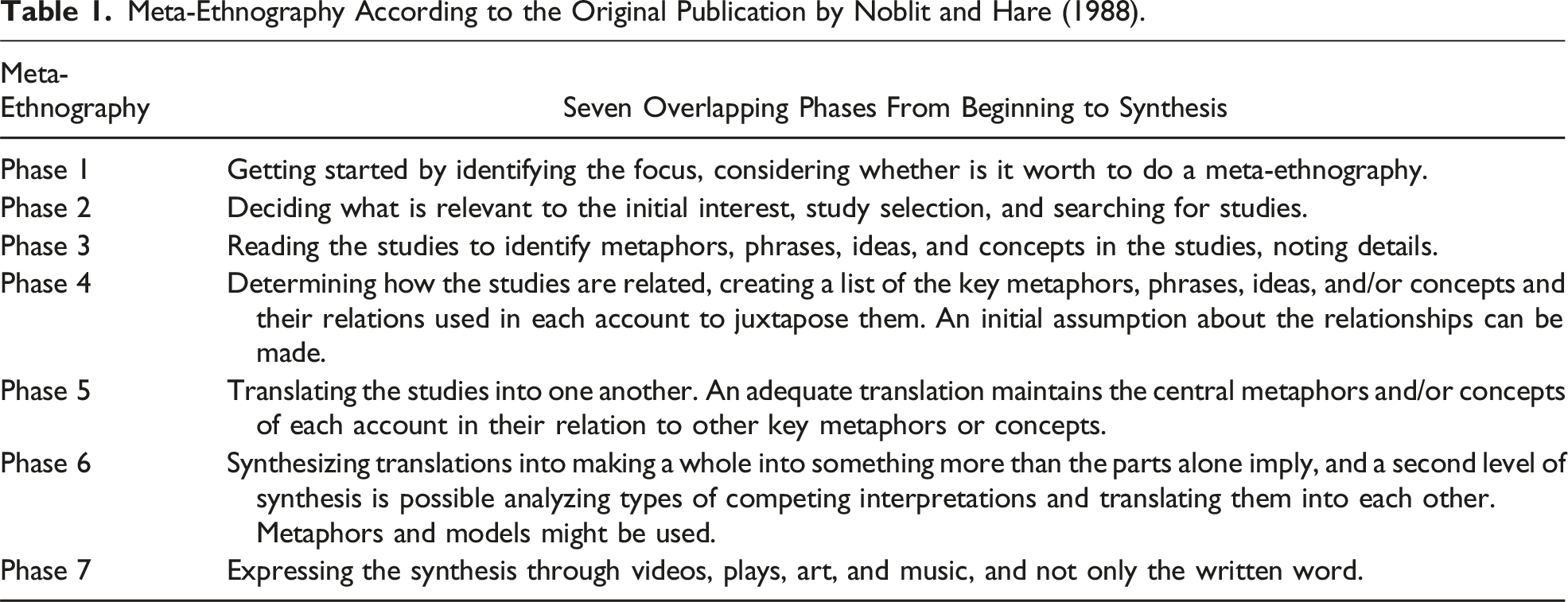
In 2019, the eMERGe reporting guidance was launched (France, Cunningham, et al., 2019) to help clarify and enable reporting, and ultimately assist researchers who are conducting ME. The guidance is based on a research program (France et al., 2015; France et al., 2016; France, Cunningham, et al., 2019; France, Uny, et al., 2019). The eMERGe guidance is organized by the seven phases of ME, asking authors to describe their processes and to justify the choices they have made. The guidance includes a table that summarizes the 19 reporting criteria, indicating where each criterion might be reported in a publication, and includes explanatory notes and possible extensions (Cunningham et al., 2019; France, Cunningham, et al., 2019); however, there are no evaluations of the use of this detailed guidance. There is the risk of doing everything according to eMERGe’s guidance, while still missing the core idea of ME as an advanced interpretative qualitative synthesis method (Noblit & Hare, 1988).
Background
Recent years have witnessed an increased impact of the systematic review (SR) tradition in both methodological and empirical ME studies. There seems to be a lack of understanding of the various theoretical, epistemological, and methodological approaches as well as theory construction in qualitative research and qualitative interpretive synthesis, which is needed for ME. There are meta-ethnographies (MEs) that seem based on misunderstood implementations derived from the SR tradition that can confuse and limit the potential of MEs (France, Cunningham, et al., 2019; France, Uny, et al., 2019; Thorne et al., 2004). This problematic implementation has been dubbed “meta-jeopardy” (Sandelowski, 2006, p. 10), “metasoup” (Thorne et al., 2004, p. 1347), and “metamadness” (Thorne et al., 2004, p. 1357), indicating the concern. A critical discussion has been continued over the years by several researchers (Bondas & Hall, 2007a, 2007b; Britten et al., 2017; France et al., 2014; Greenhalgh et al., 2018; Malterud, 2019; Thorne, 2009, 2015, 2017a, 2017b, 2019, 2024).
This study, part of a research program on ME, is the result of concern for the direction of not only ME but also the qualitative research that it relies on as a raison d’etre. My motive for conducting qualitative research is based in an ethical responsibility, citing Denzin (2017, p. 15) “that speaks to the human dignity, the suffering, the hopes, the dreams, the lives gained, and the lives lost by the people we study.” My first choice of method in the 90s was, therefore, phenomenology, learning to argue for the meaning and importance of studying lived experiences using qualitative research. This was in the period named the “first paradigm war” (Denzin, 2008, 2017) in the dominance of not only positivism, but a time characterized by conflicts between different qualitative epistemologies in my disciplinary heritage (Bondas, 2013). Doing phenomenological research (Bondas, 2002; Bondas & Eriksson, 2001; Bondas-Salonen, 1998) allowed for years of balance until qualitative methods were once again sidestepped and downgraded in the evidence-based care movement. In the Childbearing Qualitative Research Network (BfiN, n.d), we raised the questions of the value and importance of qualitative research in health care. I have witnessed the changes within qualitative research, the publication of increasingly “rapid” content or thematic analysis designs, often named “interview study” or “focus group study” based on data collection and separating the analysis, as well as the lack of arguments for the choices and the absence of descriptions in the research designs. At the same time, there has been a decrease in robust hermeneutic, phenomenological, grounded theory, and ethnography research publications. The same topics have often been studied repeatedly with scarce reference to previous similar studies, claiming the knowledge to be new. Previous published findings by other researchers were often missing (Bondas, 2013; Holmberg, 2025).
I was intrigued early by the possibilities of synthesizing qualitative research (Estabrooks et al., 1994; Jensen & Allen, 1996; Paterson et al., 2001; Sandelowski & Barroso, 2002, 2003, 2007; Schreiber et al., 1997; Thorne et al., 2004) while participating in the qualitative health research conferences organized by the International Institute for Qualitative Methodology at the University of Alberta, in Edmonton, Alberta, Canada (https://www.ualberta.ca/international-institute-for-qualitative-methodology). The vision was that the methods for synthesis would forward understanding and theory generation, more reflective research, a deeper understanding, and cross-disciplinary research collaboration in exploring new research questions, in addition to qualitative method development. However, when focusing on ME because of its interpretative, creative, yet systematic approach, I have encountered methodological dilemmas and misunderstandings in referee processes, both for my own published MEs, as well as when reviewing ME studies. In relation to the increased number of ME overviews and studies, it is important to analyze how the methodology has been described and implemented. The goal is to increase awareness of method slurring and the use of misunderstood method references in ME that endanger the validity of MEs.
Aim
The aim of this research is, therefore, to illuminate representations of the ME in the methodological literature, in relation to the original publication by Noblit and Hare (1988) and publications on qualitative synthesizing methods, to help clarify and strengthen future meta-ethnographic research.
Method
A meta-method including analysis and synthesis (Zhao, 1991) was chosen as an interpretive, comparative, and critical research design.
Meta-Method
Meta-method is a systematic critical review technique for studying methods, according to Zhao (1991), based on sociology. Although this may be part of a meta-study (Paterson et al., 2001; Zhao, 1991), here it is implemented as a stand-alone method, dealing solely with method studies. Meta-method may assist in determining the way ME is understood and interpreted as well as its methodological features (Zhao, 1991). Reflexivity is an essential element of any meta-method effort, reflecting upon the processes involved in previous studies in terms of positioning where they were and where they are going in relation to ME. The descriptions, the methodological presuppositions, explanations, and arguments (if any) in secondary presentations of ME have been explored and analyzed in relation to the classical pioneering work of Noblit and Hare (1988) and overviews of qualitative synthesizing studies.
Literature Search and Criteria
The inclusion criteria included peer reviewed method publications published in English, describing ME after 1988. Empirical MEs were excluded in this part of the research program. The primary focus was on ME method studies in health sciences in relation to the original publication on ME by Noblit and Hare from 1988 and the meta-synthesis and qualitative evidence synthesis literature (Supplemental File 1). I planned the search together with a specialist librarian (Kari Hølland at University of Stavanger), who performed the database searches while I conducted the manual searches. Based on the systematic search protocol for the entire research project, searches were performed in the following databases: BNI, CINAHL, Embase, Epistemonikos, Medline, Scopus, and Web of Science. We used variations of the search words “meta-ethnography,” “meta-synthesis,” “qualitative evidence synthesis,” and “Noblit and Hare,” including truncations, extensions, synonyms, and related terms (Supplemental File 2). Boolean operators were used to combine the terms and truncations to include differences in the use of the words and types of “berry picking” (Bates, 1989) in strategic searches, reference and citation searches of the included publications, and author searches, in addition to the database searches. The database searches were performed in July, and manual searches were completed in December 2023.
Analysis and Synthesis
I started the meta-method (Zhao, 1991) readings in alphabetical order from the database searches with a reflective mind, continuing to add publications from the manual searches. In the second reading of the analysis, I marked passages in the text, jotting down reflections. In the third reading, the preliminary meaning units that addressed the aim of the study were extracted and coded. In the final reading, I clustered the codes into themes. The metaphoric naming of the themes was checked for relevance and meaning, going back to the studies and checking the literal meaning of the metaphor during the research process. The synthesis was created through interpretation during the research process in a back-and-forth process, and finally checked against the data.
Findings
Meta-Ethnography in Limbo in the Jungle of Misguided Paths.
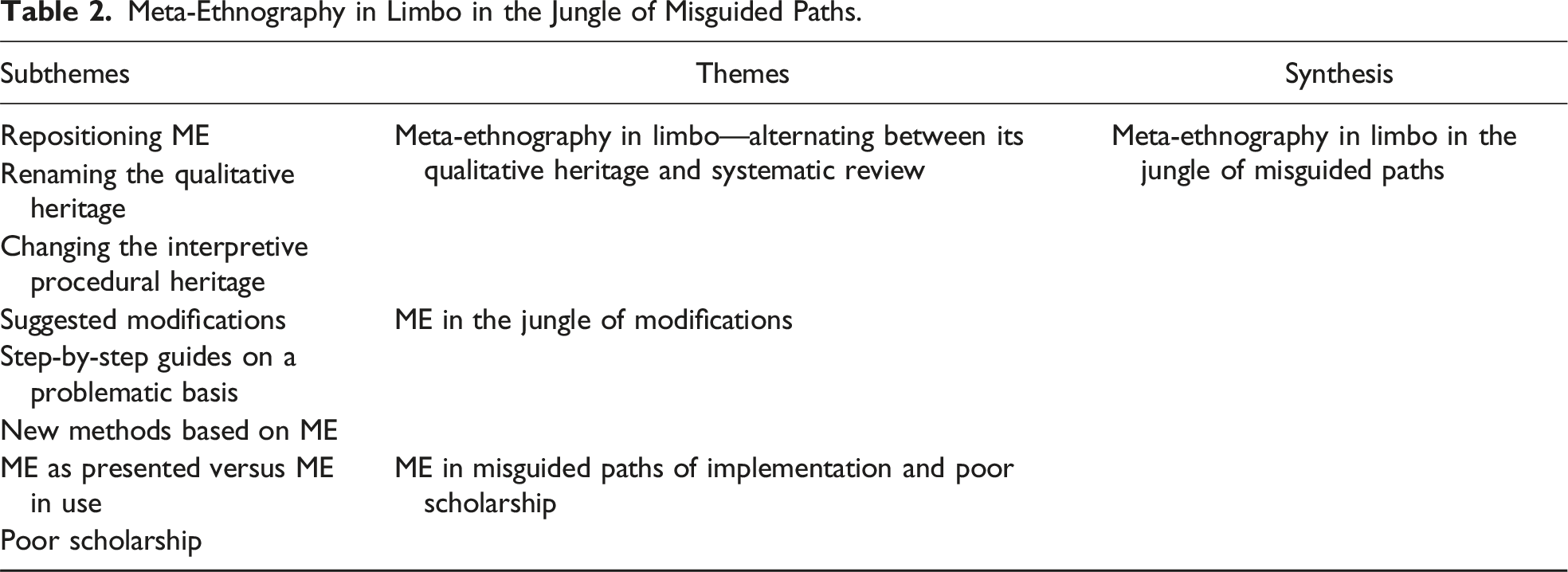
Meta-Ethnography in Limbo—Alternating Between Its Qualitative Heritage and Systematic Review
ME seems to be placed in limbo between its qualitative heritage and the SR tradition indicated by the repositioning, the renaming of the interpretive heritage, and the changing of the interpretative procedural heritage.
Repositioning ME
The early concern in health sciences was that qualitative research would lose its character if qualitative studies were synthesized (Sandelowski, 2006). There is a new parallel apprehension for the MS approach including ME, which is that it is at risk of losing its qualitative interpretative heritage, since it has been repositioned as an SR in recent years (Thorne, 2015, 2017a, 2019). Early on, the pioneer developers of qualitative MS (including ME) expressed their concern of studies that are nothing more than reviews “gone wild,” tarnishing the entire reputation of qualitative MS studies (Thorne et al., 2004). Nonetheless, there is a tendency in published ME research to move ME into limbo in favor of reviews that are positioned not as interpretive qualitative research but as SRs in the tradition of Cochrane and JBI reviews (Thorne, 2019). This is seen when characteristics of aggregative reviews are shown in several method studies, along with guides and published studies that are counterproductive to qualitative research (Thorne, 2017a). Likewise, Britten et al. (2017) draw on a “McDonaldization” to show the standardization, control, and efficiency discourse by agreeing on the need to move beyond naïve superficial descriptions toward thoughtful analysis, theory, and explanation. Booth (2001) previously critiqued institutionalized “quantitativism,” in which criteria from systematic quantitative reviews determined the quality of all reviews. There is a turn toward the Cochrane tradition and the introduction of qualitative evidence synthesis (QES), focused on evidence-based practice, health technology assessment, and pragmatics (Flemming & Noyes, 2021; Flemming et al., 2019; Lewin et al., 2018). QES was primarily recommended for complex evidence-to-decision frameworks, guidelines, complex interventions, and recommendations. ME is included as one of the QES methods, which must be in opposition to Noblit and Hare (1988), who asserted, “It (ME) is much more than a review” (p. 9).
Gough et al. (2012) emphasized value contributions, enlightenment, and purposive searches, with the findings as emergent concepts. This view of qualitative synthesis approaches is opposite to the notion of bias, relying on checklists and instrumental pragmatic aims put forth in SRs. Fundamental epistemological assumptions may lie deeper than the procedures explaining the apparent contradictions and dilemmas when SR thinking invades an interpretative ME. Thorne (2009) suggests that it might be a question of how scholars from the applied fields view theory as a way of solving real-world problems, while academic scientists see these problems as possibilities for theorizing and creating new scholarly knowledge for health care. Scholarly knowledge interests cannot be replaced with the interests of policy (Thorne et al., 2004).
Renaming the Interpretive Heritage
There is concern about the recent Cochrane move to rename meta-synthesis as qualitative evidence synthesis, potentially moving MS in a direction that is technical, superficial, and lacking theoretical depth (Thorne, 2017a). Synthesis as “meta” indicates transformation at a higher level. The reflective, existential, cultural, and ethical knowledge may be overshadowed and disregarded in the hierarchy of evidence. The pragmatic interest for rapid evidence shifts the focus away from wisdom in scholarship and knowledge. Britten et al. (2017) view “metasynthesis” as a tautology, in that synthesis either is or is not; however, they do not discuss their own reduction when using “evidence synthesis” connected to practice. They suggest using QES based on the Cochrane Group to include all types of synthesis methods. QES has its roots in the evidence-based medicine tradition, with its focus on policy decisions and guidelines for care. Booth (2019) parallels Britten et al. (2017) by suggesting QES instead of MS or qualitative SRs signaling the potential for a wider range of evidence, such as online bulletin boards and interviews. The value of QES reviews for clinical trials, such as acceptance, feasibility, and implementation, is aimed at the refinement of future interventions. QES would then supplement data about what works with evidence regarding what is taking place and was early described as a complement to intervention studies, but not for stand-alone evidence (Noyes et al., 2018). This is not in line with ME, thereby possibly reducing ME. The first Cochrane QES was published in 2013 (Booth, 2016). Qualitative MS terminology has a longer tradition (Paterson et al., 2001; Thorne, 2024; Thorne et al., 2004), and time will tell what constructs persist. The terminology in use shows the variation, and a majority are still in favor of MS (Supplemental File 1). There is a need for maintaining the existence of the interpretative stand-alone MS, such as ME for critical and reflective knowledge development.
Changing the Interpretive Procedural Heritage
Originally, ME had no claim to an SR heritage (Noblit & Hare, 1988), such as using standards and formats that have been developed and promoted by the Cochrane Collaboration for qualitative evidence synthesis (Noyes et al., 2018). The rigid standardization based on a priori decisions, checklists, and rules from the quantitative SR tradition, which is not in line with qualitative research, continues to thrive. This is apparent in secondary method representations and published MEs. Sensitivity belongs to the qualitative paradigm, as ME treats research questions as negotiable and emerging (Noblit & Hare, 1988). Visible procedural changes on the impact of the SR tradition in recent MEs are inserting SRs into the title, as if it were not trusted to only use ME.
Booth (2019) discusses the dual heritage, which indicates a diversity in drawing upon various cultures, which is a research tradition of both qualitative research and SRs. According to Booth, quality assessment is the procedural “tectonic pressure point,” in which the dual heritages come into juxtaposition. The impact of SRs on recent MEs is seen in abandoning the purposeful searches in favor of exhaustive searches and the use of quality appraisal instruments, which came into practice after the original publication in 1988. A priori protocols and rigid criteria could pose threats to fruitful ME studies that require iterative back-and-forth interpretative research processes (Noblit & Hare, 1988).
The SR tradition has also inspired ME studies to rate the study quality, and then, for the most part, ignored the ratings. Ratings do not belong in ME; they would simply consider whether the ME did or did not have anything valuable to offer to the synthesis (Noblit & Hare, 1988). Edwards et al. (2000) likewise assess the message or “signal,” balancing methodological quality against the weight of its message, rather than rejecting studies. The emergence of journals with rapid and unclear referee processes makes an argument for quality appraisals. However, the evaluation of quality is still in its infancy, as the question of exclusion based on quality has not been solved. Descriptive nuancing might be found, even in a study showing method incongruence. “Noise,” such as mislabeled methods and methodological incongruencies, can be accepted if the studies include interesting and substantial “signal” findings (Edwards et al., 2000). Any truly flawed studies should not have been published in the first place and can, therefore, be bypassed as irrelevant to the ME inquiry.
Dixon-Woods et al. (2007) found that checklists on quality produced no more agreement than expert judgment. After using checklists in their study, Toye et al. (2013) did not necessarily recommend their use for assessing quality. Majid and Vanstone (2018), echoed by Munthe-Kaas et al. (2019), found more than 100 appraisal tools for qualitative research, thus reflecting a lack of consensus on quality evaluation. Few authors described how their tool was developed or why a new tool was needed. The risk for underrating or overrating study quality could have consequences for inclusion and exclusion, and eventually for the synthesis. There is no consensus between qualitative synthesis authors on the inclusion of a methodologically weak rated study (Majid & Vanstone, 2018; Munthe-Kaas et al., 2019). Sandelowski and Barroso (2002) argued for consideration of the meaningfulness, aesthetics, and rhetoric of a study, rather than a rigid application of standards and criteria when discussing quality and inclusion. As early as 2001, Barbour asked if checklists in qualitative research represented a case of the tail wagging the dog. This means that the researcher’s substantial and methodological knowledge and reflexivity cannot be disregarded in quality appraisals.
Another example of tools from the SR tradition is an instrument called GRADE-CERQual, which stands for “confidence in the evidence from reviews of qualitative research” (Lewin et al., 2018). The ME findings, such as metaphors and models, are not meant nor are they appropriate for grading. A recent study by Wainwright et al. (2023) shows that the implementation of GRADE-CERQual has created problems. The tool seems more suitable for syntheses with descriptive findings (Lewin et al., 2018). Concerns were raised by Noblit (2019), one of the original developers, about this recent focus on the grading of findings as well as instrument development for various phases of the ME research process. Likewise, Hannes and Macaitis (2012) addressed the uncritical mixing of elements from SRs in their overview of ME studies, and Malterud (2019) even warned of the impact of standards, formats, and procedures from the SRs, thereby changing the interpretive heritage of ME.
Meta-Ethnography in the Jungle of Modifications
Modifications, step-by-step guides on a problematic basis, and new methods based on ME are suggested changes that seem to move ME into a jungle of modifications.
Suggested Modifications
Modifications to ME have emerged in the methodological, theoretical, and empirical studies, confusing and limiting ME. In 2014, Toye and colleagues suggested a modification for large numbers of included studies, in an exemplary study using 77 reports using patient and public representatives, clinicians, and policymakers in an advisory group. In a 2018 study by Pilkington, ME was used as a method of analyzing primary datasets of cases, which suggests an extensive modification, but not intended for ME. A dialogic analysis was added in a researcher-centered ME approach that would not necessarily seek synthesis but a proliferation of meaning (Sherman et al., 2021). Rapid ME studies done in a few weeks have emerged during recent years according to a scoping review by Campbell et al. (2019). For the discipline of sports and exercise psychology, Soundy and Henegan (2022) and Soundy (2024) suggest a social constructivist ME modification to changes based on their critique of Noblit and Hare (1988) for its linear phases. Nevertheless, this linearity does not occur in the original writings of Noblit and Hare (1988), which describe the seven phases as overlapping and parallel, as well as including a back-and-forth movement. Soundy (2024) emphasizes methodological self-consciousness, which is nothing new for ME. Through an iterative grounded theory process using explanation and testing, their modification omits the most central characteristics of ME, namely, the translations. One could argue that modifications are no problem if researchers state what they are doing. However, if the need for modifications seems to abandon or distort the original characteristics of ME, then the method choice would need to be rethought rather than initiating major modifications.
Step-by-Step Guides on a Problematic Basis
A much-cited literature review study by Sattar et al. (2021) based on an unsystematic search is suggested as a “step-by-step” guide for ME. Sattar and colleagues used as an example their first and only published ME, which they described as a “systematic review” in addition to a “meta-ethnographic synthesis” (Sattar et al., 2020). Their suggested guide for ME began with a faulty referral to the original ME by Noblit and Hare, stating its year of publication as 1998 instead of 1988, and described stages and steps instead of phases. These are mistakes that might be regarded as minor errors, but should not occur in a study that is suggested as guidance for ME. The guide was created because the authors thought that there was a lack of a “step-by step-guide,” and then noted, “It is a flexible guide, which researchers can utilize and adapt the stages” (Sattar et al., 2021, p. 12). “Phase” is the methodological concept used by Noblit and Hare (1988). Introducing synthesis as “expert judgments” and “pooling findings” (Sattar et al., 2021, p. 2), in addition to the inclusion of mixed methods and quantitative studies may create misunderstandings, completely altering the ME. They recommended “at least some quality appraisal” (Sattar et al., 2021, p. 4). Their example included several actors’ perspectives, not typical for an ME. They scored studies using one of the critical appraisal checklists, CASP (2020) (https://www.casp-uk.net), even though this was not a part of the instrument’s procedures or ME. In Phases 4 and 5, the categorizing and clustering suggested by Sattar et al. (2021) were not part of the original method; likewise, they used NVivo suggesting an altered type of synthesis not based on translations. In Phase 4, an assumption of the relationship between the included studies is missing. Confusion is added when Sattar et al. (2021) exemplified ME, using groups and reducing themes to categories. The risk of altering the method seems evident. The study has been cited since 2021 by more than 100 publications according to the Web of Science in May 2024 (Supplemental File 1).
Another guide intended for ME beginners is a recent publication by Luong et al. (2023). Misinterpretations may mislead novice ME researchers. Examples include the translation done as early coding and thematization in Phase 4, with the synthesis identifying concepts, gaps, overlaps, and silences. It is not made clear what silences could mean in a synthesis. There is reason to believe that the misunderstandings and distortions will be brought forth in future studies, thereby creating confusion and frustration for the researcher who attempts to use guides, such as Sattar et al. (2021) and Luong et al. (2023) alongside the original primary references.
Morse (2006) discussed the problem when a method is consciously or unconsciously tweaked, altered, adjusted, and published under the guise of the developer’s method, although the findings do not resemble the method. The method is sometimes modified and removed from the original developers, with another researcher’s name inserted. Morse asked method developers to be respectful and accurate in the presentation of the original developer, because once it is published, it may take on a life of its own, and may become a laissez-faire approach that is careless, sloppy, and represents poor science. As an example from a reference as late as 2016, ME as a type of meta-synthesis is described as a method for reviewing quantitative studies (Mohammed et al., 2016). It was later corrected in an erratum, but still exists, and therefore, might be read in its original faulty version.
New Methods Based on ME
ME has also been used in several other qualitative synthesis methods, such as critical interpretative synthesis (CIS) and thematic synthesis (TS). CIS reviews (Dixon-Woods et al., 2006), an adaptation of ME, use grounded theory analysis and SR processes, examining how the literature, which could also include quantitative data, problematizes a particular phenomenon to an overarching synthesizing argument. The typical ME characteristic of reciprocal translation is omitted; instead, CIS uses theoretical categories to be generated from the available evidence and scrutinized during the process. In an overview of 77 CIS reviews published between 2006 and 2018, Depraetere et al. (2021) worried about the flexibility in CIS that may hamper its implementation and exacerbate concerns about trustworthiness.
Three stages characterize TS based on techniques commonly described as thematic analysis (Thomas & Harden, 2008), using line-by-line coding, descriptive themes, and analytic themes, comparing the last stage to meta-ethnographic synthesis. TS is in line with informing policy and practice, while explaining that ME is recommended when a body of literature is explored in and of itself, with broader or emergent questions (Thomas & Harden, 2008). There is a difference in using ME as a base for “new” methods, such as CIS and TS, or saying that these methods represent the new ME (cf. Brookfield et al., 2019).
Meta-Ethnography in Misguided Paths of Implementation
There seems to be a difference in how ME is presented versus how ME is used, and an emergence of poor scholarship shows a distorted ME in misguided paths of implementation.
ME as Presented versus ME in Use
Recently, ME has become a choice for research teams, some with scarce experience of the complexities in its implementation. Novice researchers may be an asset to the team, but ME as an advanced qualitative method also needs varied epistemological, methodological, and theoretical knowledge. MS and ME in the pioneering works (Noblit & Hare, 1988; Paterson et al., 2001; Sandelowski & Barroso, 2007; Thorne et al., 2004) were regarded as demanding qualitative methods requiring both knowledge and experience. The possible method slurring and the frequent use of secondary and even tertiary references as method references, even from other methods, create risk for misunderstandings in application. The overview by Lee et al. (2015) shows the differences brought forward by different popular worked examples, with all of them multiplying these variations and possibilities for misunderstanding when used as secondary or tertiary references. ME is described as a black box of what is claimed to be used as a synthesis approach and what is done (Hannes & Macaitis, 2012). They also noted that the boundaries have become blurred between various synthesis methods.
Melendez et al. (2015) emphasize the importance of references and descriptions indicating how the ME study was conducted. This is a problem if “anything goes” is justified by secondary references and describing what has been done, when misunderstanding may be repeated twice or even more times. The validity of the study will suffer, as will the overall trust in using a method in which anything goes. There are continuing problems in the implementation of ME, such as bypassing the critical translation phase (Cunningham et al., 2019). There are aggregative and/or unclear research processes in published ME studies. Some studies fail to make clear inclusion criteria and incomplete analysis and synthesis, with few offering a synthesis. The lack of consideration of chronology or temporality has also been discussed (Thorne, 2017b), in addition to Noblit and Hare’s (1988) contextual, cultural, and language aspects (Bondas & Hall, 2007a, 2007b).
It is not sufficient to use the logic that there are no previous MEs; this would result in an endless repetition of (boring) research studies, in which every method would be tried out on a topic. A gap or deficit in previous research, or possible errors or contradictions or a lack of synthesis (Sandelowski & Barroso, 2002) might form the beginning of an ME. Alvesson and Kärreman (2007) add the mystery and reflection that is relevant for an ME. We can witness numerous similar MEs on a topic, which indicate that researchers had not done a literature search for previous synthesis studies. Arguments for the choice of ME are important as in any other study.
Poor Scholarship in ME Studies
The rationale in the health science method studies on ME has expressed a need for directions because of poor and varied reporting. Many of the method studies in health sciences on ME describe the procedures, albeit in numerous ways (Atkins et al., 2008; Britten et al., 2002; Brookfield et al., 2019; Cahill et al., 2018; Campbell et al., 2003, 2011; Doyle, 2003; Lee et al., 2015; Sattar et al., 2021). However, others focus on aspects such as updating (France et al., 2016; Germeni et al., 2021), analysis and synthesis (France et al., 2014), quality appraisal (Toye et al., 2013), or handling large volumes of primary studies (Toye et al., 2014). Several of the health science studies have been extensively cited as shown in Web of Science (Supplemental File 1). There are critics of studies that seem to put forth a new round of naïve descriptions showing validity flaws and lacking explicit perspectives, as well as lacking theory development, moving to the verge of something quite different (Bondas & Hall, 2007a, 2007b; France, Uny, et al., 2019; Thorne, 2017b). Meta-ethnographic studies have made evident some of the matters that concern the epistemological understanding and application of qualitative research methods. The problems have continued in ME studies by replicating the naïve descriptive categorizations from the original studies. Several researchers go as far as to say that the problem derives from a much deeper problem concerning poor scholarship (Britten et al., 2017; France, Uny, et al., 2019).
Studies are sometimes claimed as MEs, although they lack the characteristic seven phases, and especially the synthesis and metaphors (Bondas & Hall, 2007a; France, Cunningham, et al., 2019, France, Uny, et al., 2019; Thorne et al., 2004). The use of metaphors and the understanding of metaphors in an ME have created challenges, as they are truly interpretative. Metaphors are a crucial connecting part of an ME (Noblit & Hare, 1988) that offer exciting opportunities and the potential for an open reflective and creative perspective to communicate meaning. A metaphor is a term or phrase that is not literally applicable. Metaphors may challenge and clarify unwritten and uncommunicated assumptions and values that help shape culture and practice (Lakoff & Johnson, 1980). Using metaphors offers the ability to move beyond the findings of included studies in an ME and deepen the knowledge. By using the similarities and differences between metaphors and experiences, complex phenomena can become more comprehensible. Metaphors may encapsulate information in a concept or sentence (Wiklund, 2010). The prefix “meta” takes one beyond the original idea to a transcendent conceptual understanding, allowing comprehension by examining something from a completely different perspective. Lakoff and Johnson (1980) suggest that we use a process of “mapping” while capturing possibly disconnected information and crystallizing it into a meaningful set of ideas and relationships. Beck (2022) shows in a secondary analysis how women describe postpartum depression in metaphors, with as many as eleven, thereby providing rich insights into lived experiences. Metaphors can take us into what really matters but can also miss the point and lead one astray and, therefore, fail to notice the findings. Metaphors may thus be restrictive by limiting new perspectives instead of constructive by opening new perspectives, and should not be introduced too early (Wiklund, 2010). Working with metaphors could be assisted by exploring the meaning in literature, and then returning to the data and findings to see whether it is still representative. ME method studies after Noblit and Hare (1988) have been rather silent on metaphors in ME.
Discussion
Based on an overarching metaphor of ME being in a state of limbo in the jungle of misguided paths, three representations show that the present use of ME seems to be in an uncertain state between its qualitative interpretive original tradition and the recent impact of SRs in a world dominated by technical approaches to qualitative knowledge synthesis. Several modifications have been made to ME, and changes have been suggested or misunderstood in these implementations. Consequently, there is a risk that ME will lose its distinctive character by being distanced from its interpretative heritage by understanding it as an SR, instead of as a qualitative interpretative synthesis method. Limbo occurs in times of change. A change has occurred and been imposed on ME in an era of health science research, emphasizing pragmatic policy and practice and standardization, while disregarding the awareness of disciplinary knowledge, and not acknowledging the nature and heritage of ME as an interpretative yet systematic qualitative MS with its own characteristics and conditions. An uncertainty shows in the methodological terminology by proposing standards and checklists, guidance, new constructs, and added content to existing concepts, while some of the guidance studies seem to not be based on a thorough reading of the original ME (Noblit & Hare, 1988). The well-planned ME needs to prioritize time for reading and anticipating the complexity through knowledge and reflection, and planning for the possibilities in international multi-language cross-disciplinary ME teams.
The metaphor of a jungle implies how the researchers can get lost in modifications. It is not possible to know why and how some of the apparent misunderstandings have emerged. Using several guides that have been misunderstood puts the researcher at risk for disorientation. The various worked examples and guides may be helpful, but at the same time contribute to the blurring of ME that might lead one astray. The main priorities are to avoid dangers, which in this case might risk the validity of the ME study, using methodological concepts not in line with the ME in use.
The knowledge of experiences of nursing care, health and suffering, vulnerabilities, and cultural meanings cannot be reduced to standardized evidence and policies, and is, therefore, not only a question of evidence but also a question of new knowledge that helps us to understand the world from different perspectives. Metaphor use is an analytic strategy that offers possibilities to engage with the human being and existence that is at the core of ME, making it unique as an MS approach. Delving into linguists and philosophers such as Ricoeur (1977), White (1996), and Lakoff and Johnson (1980) will be helpful for opening the understanding of metaphors and their importance and use in an ME. It is also important to understand the wider use of the metaphor concept in an ME by Noblit and Hare (1988) as phrases, concepts, and ideas. The word “metaphor” includes the meta-prefix as ME and MS do, taking one beyond the original idea to a deeper and reflective understanding, and changing perspectives. Visual models may be used to indicate the analogous, refutational, or lines-of-arguments synthesis. The difference from the SR tradition shows in the reflective critical attitude in noting relationships between the studies, not only similarities but also inconsistencies or tensions between the studies. The synthesis should be consistent, parsimonious, elegant, fruitful, and useful for understanding, and thus more than a review in its knowledge generation (Noblit & Hare, 1988).
ME can overcome paradigmatic clinches and normative theoretical adherence. Citing classical Merton (1941/1996, p. 39) from a different paradigm, “how thought-collective clans engage in announcing their own claims to sound knowledge while denouncing the claims of others denying that there is truth in the ideas advanced by cognitively opposed collectives.” Merton continues by describing the cognitive conflict and ensuing cognitive segregation. Becoming self-conforming stereotypes, leading to claims that having been misunderstood and misrepresented led to the other rival thought-collectives no longer trying to understand the other, may turn into full-fledged segregation (Merton, 1941/1996). Denzin (2008, 2017) discusses the paradigm wars, which will not serve the development of methods and in this study, ME. There will never be one single truth but offering a dialogue and possible awareness instead of segregation and clan-creation. There are risks for scientific development when clans attempt to take the privilege of the normative dictating of research issues.
We live in a global world with a rapid technological development in health care. Focusing on the caring and dignity of the human being, quality and safety of nursing care is of utmost importance. The human and economic resources are continually being challenged. Sustainability in research will be advanced by furthering the use of integrating and synthesizing qualitative research. Even more important is to avoid creating unnecessary suffering related to care for the patient and his or her close relations, an important motive for using the knowledge when creating a reflective and caring health care. Noblit and Hare (1988) wisely showed that it is not to predict, but “anticipate” what might be involved in analogous situations, hence helping us to understand how things might connect and interact, significantly enhancing the human discourse.
Strength and Limitations
The idea for the study was created as part of a research project in ME, after noting the variations in referring to ME and the theoretical and reflexive perspectives that were in use or absent. This method study is based on a systematic librarian-assisted search for literature on ME and literature on the discussion and positioning of ME. There is always the possibility that publications have been omitted, and the exclusion of non-English studies is a limitation.
The choice of meta-method (Zhao, 1991) allowed a reflective, critical, and interpretative analysis, and synthesis using metaphors, while striving for openness and transparency in choices and arguments (Angen, 2000; Malterud, 2001). The research diary, an iterative research process, and continuous dialogues with ME research colleagues have strengthened the study, enhancing awareness of research ethics and preconceptions. The risk of “methodolatry” (Chamberlain, 2000) as chasing purity of method has been a critical companion in the research process.
Conclusions
Based on an overarching metaphor of ME being in a limbo state in the jungle of misguided paths, three representations of ME illuminate the present challenges. The use of ME seems to be in an uncertain state between its qualitative interpretive original tradition, and the recent impact of SRs. Several modifications relying on secondary and even tertiary references create a terminological mismatch risking misunderstandings and distortion in descriptions and implementation. Changes in the search processes and quality appraisal of the original ME are reasonable imports in the digital era of open access and an increase in qualitative studies. To strengthen future meta-ethnographic research, the qualitative heritage needs to maintain a strong argumentation concerning all the choices in the ME research process, notably in the in-depth reading, the analysis of relationships, the translation, and the synthesis. It might seem like “throwing stones in a glass house” and thus self-evident to conclude that researchers choosing ME need to acquire an in-depth knowledge and understanding of the method, its assumptions, and characteristic application, as well as maintain a critical attitude to method references that deviate from the original interpretative epistemology and implementation. The return to a more conventional qualitative use of ME is, therefore, recommended so as not to lose its qualitative heritage as an interpretative, reflective, creative, and critical qualitative synthesis approach.
Supplemental Material
Supplemental Material - Representations of Meta-Ethnography: In Limbo in the Jungle of Misguided Paths?
Supplemental Material for Representations of Meta-Ethnography: In Limbo in the Jungle of Misguided Paths? by Terese Elisabet Bondas in Qualitative Health Research
Supplemental Material
Supplemental Material - Representations of Meta-Ethnography: In Limbo in the Jungle of Misguided Paths?
Supplemental Material for Representations of Meta-Ethnography: In Limbo in the Jungle of Misguided Paths? by Terese Elisabet Bondas in Qualitative Health Research
Footnotes
Acknowledgments
I am grateful for the thoughtful comments and encouragement from the anonymous reviewers. Professor Bente Dahl, University of South-Eastern Norway, for comments on a previous version fof this study.
Declaration of Conflicting Interests
The author(s) declared no potential conflicts of interest with respect to the research, authorship, and/or publication of this article.
Funding
The author(s) received no financial support for the research, authorship, and/or publication of this article.
Ethical Statement

Supplemental Material
Supplemental material for this article isavailable online.
References
Supplementary Material
Please find the following supplemental material available below.
For Open Access articles published under a Creative Commons License, all supplemental material carries the same license as the article it is associated with.
For non-Open Access articles published, all supplemental material carries a non-exclusive license, and permission requests for re-use of supplemental material or any part of supplemental material shall be sent directly to the copyright owner as specified in the copyright notice associated with the article.
