




Abstract
While the early mental health of girls and boys is similar, as children age, girls tend to report worse mental health than boys. Explanations for these gendered disparities remain elusive. This study seeks to understand the social context in which mental health experiences are shaped. Utilizing a qualitative, constructivist approach to grounded theory, we conducted virtual semi-structured interviews with young people between ages 11 and 17 years (n = 20). Our major finding was that girls in particular experience incongruence between expectations about gender equality and everyday experiences of stereotypes, barriers, and discrimination. Girls reported pressures to satisfy multiple gender norms, such as traditional ideals about being feminine (kind and physically attractive) and modern ideas about being high achieving and “smarter than boys.” Findings suggest that young people are unequipped to navigate the incongruence between the expectation that they live in a gender-equal world and their experiences of gender-based constraints, nor do they appear to have the skills to critically identify the structural patterns that undergird their experiences. Explanations for gendered disparities in mental health may be related to the underlying context of discrimination, and both traditional and emerging gendered norms, barriers, and constraints. Finally, we highlight the responsibility of adults to facilitate child development in ways that are responsive to the changing faces of gender discrimination, which readily adapts to social discourse in new and subtle ways.
Introduction
During early childhood, the mental health of girls and boys is similar. Yet, as children become adolescents, girls tend to report worse mental health than boys (Freeman & Luu, 2011; Patalay & Demkowicz, 2023). Illustratively, in Canada, adolescent girls report significantly lower scores describing their psychosomatic health and experience significantly higher prevalence levels of depressive symptoms and diagnosed mental illnesses (McIsaac et al., 2021). While these gendered disparities are well documented, explanations remain elusive.
Canada prides itself on being a leader in gender equality and has endorsed international documents that prioritize a broad commitment to the health of girls, women, and non-binary people (UN Commission on Human Rights, 1990; UN General Assembly, 2015). Yet, the gender gap in mental health between girls and boys in Canada is much higher than it is in many countries that have made less progress toward a national commitment to gender equality (Campbell et al., 2021). Our study hoped to gain insights into why—in a country that is recognized as having made substantial progress on gender equality such as Canada—girls continue to be disadvantaged in terms of their mental health status (Campbell et al., 2021; McIsaac et al., 2021; Wadge et al., 2024).
Background
While “gender cannot be easily defined” (Connell, 1985, p. 261), its influence is pervasive. Not to be conflated with biological sex, gender is one aspect of an individual’s internal sense of identity as well as a complex social construct that is shaped by social norms, socialization processes, expressions, and behaviors (Canadian Institute of Health Research, 2023).
With the onset of puberty, outward indications of sexual maturity can propel young people into a new engagement with the adult world (Greene & Patton, 2020). This involves deeper encounters with gendered social–cultural norms, including the explicit and implicit social rules that dictate how people are expected to behave and express themselves (described by Judith Butler (1988, 1999) as “doing gender”), and shape how young people see themselves (West & Zimmerman, 1987). For example, one Canadian study indicates that girls are pressured to perform “appropriate” femininity (Steeves, 2015), while a study from Scotland suggests that girls have increased worries about appearance, weight, and educational expectations (West & Sweeting, 2003). In a study from the United States, boys were shown to “do gender” by participating in things like “shoving” each other around (Oransky & Marecek, 2009). These gender norms, roles, and relationships are context specific and shift over time to meet the changing demands of what is culturally “appropriate” (Lorber, 1994) for girls, boys, and gender-diverse individuals.
Gendered patterns are also apparent in mental health experiences globally. A cross-national investigation of adolescents in 73 countries concluded that the gender gap in mental health is ubiquitous across cultures, with girls consistently reporting worse mental health than boys. Provocatively, this gap is larger in more gender-equal countries (Campbell et al., 2021). In other research beyond our Canadian context, girls report increased anxiety and self-harm (Wang & Yen, 2017), higher levels of depression and anger symptoms (Asgeirsdottir & Sigfusdottir, 2015), and a heightened sensitivity to stressful life events, particularly when they involve “interpersonal stressors” (Oldehinkel & Bouma, 2011) when compared with boys. For boys, a different set of challenges appear to be present. Along with engaging more often in risk-taking behaviors and being more at risk for completed suicide (Canetto, 2015; Wang & Yen, 2017), they appear to avoid displaying emotional or physical pain or expressing hurt or concern for others (Oransky & Marecek, 2009).
Mental health help-seeking behaviors are also perceived to be gendered. Qualitative research out of Scotland by MacLean and colleagues (2010, 2013) highlights the reluctance that all children have in seeking help for psychological symptoms. Challenging the misconception that this kind of reporting is easy for girls, which may lead to adults underestimating the seriousness of symptoms that girls report (MacLean et al., 2010), their research suggests that boys are even less likely than girls to report mental health concerns. This may be due to fear of “breaking the rules” of expected behaviors that are characterized by strength and stoicism, qualities that are perceived as core to masculine identities (MacLean et al., 2010, 2013).
Emergent research around the health experiences of transgender youth suggests that, when compared with their cisgender peers, transgender youth have increased risks of depression, self-harm, eating disorders, and suicidal ideation, both in Canada (Hawke et al., 2021; Veale et al., 2017) and globally (Connolly et al., 2016; Eisenberg et al., 2017). These gendered differences continue into adulthood, with Canadian research suggesting that women and men (Denton et al., 2004; Hankivsky, 2006) and international research reporting that transgender/gender nonconforming adults (Henry et al., 2021; Kattari et al., 2020) experience different vulnerabilities to the social forces that shape mental health.
Current Study and Rationale
Evidence that these gendered differences exist is strong, but less is understood about why they are experienced. This study examines the social context in which these disparities in outcomes emerge, asking: “How do young peoples’ perceptions of the gendered expectations, norms, and constraints they encounter shape their everyday lives?” We seek to provide essential contextual information as to how such gendered disparities in mental health are shaped and contribute to a more nuanced understanding about gendered disparities in mental health experiences. In turn, findings could inform intervention and health promotion strategies that are attentive to young people’s lived experiences and the broad social contexts and norms that shape their lives.
Methods
Our research was guided by a qualitative, constructivist approach to grounded theory (Charmaz, 2014, 2021). As cisgender women of different ages and at different career stages, we (VM, VS, KAP, JM, and SW) are aware that we have lived through different cultural expectations and norms respecting gender and accordingly were attentive to our own experiences in relation to our topic. MM, a cisgender man who is a quantitative researcher on our mixed methods team, also provided critical comments and insights throughout.
Sampling and Recruitment
We used a theoretical sampling approach that was informed by our sensitivity to the literature (Bowen, 2019; Charmaz, 2014), and we purposefully recruited early participants by self-identified gender. As emergent analysis raised questions, suggested relationships, and highlighted gaps in the existing data, we selected subsequent participants to explain variations and inform emergent categories. Participants were recruited via email invitations to leaders at community-based organizations (e.g., youth community centers, not-for-profit sport organizations) and with a targeted social media campaign through Brock University’s Institute for Lifespan Development Research. Inclusion criteria were that participants lived in Canada, were between 11 and 17 years old, and were able to speak and understand English.
Generating Data
One researcher (KAP) conducted virtual semi-structured interviews over Zoom between April and November 2021. Interviews explored multiple dimensions of the participants’ lives in relation to how they experience and navigate gendered expectations, norms, opportunities, and constraints and how these experiences relate to their mental health. In keeping with our methodological approach, questions evolved and became more focused as the initial analysis progressed and categories emerged. Our goal was to place our conversations about gender within the context of each participant’s everyday life. We began by asking participants to tell us a story about the everyday challenges and opportunities in their own life. Using their own story as a starting place, we asked them to share the kinds of strategies they had used to cope and the strengths they had brought to the situation. Only after this did we ask specifically about gender, with prompts related to expectations, norms, opportunities, and barriers. We then asked participants to revisit the initial story they had told us and to reflect on the role that gender had played in shaping that story. Our holistic approach was intentional because we did not want to break up the participants’ lives into things that were and were not gender. Prompts were used throughout to foster in-depth sharing and uncover nuances in participant responses. Interviews took approximately 60 minutes and were audio-recorded and then professionally transcribed.
Analysis
Through a constant comparison process, we (VM, VS, and KAP) compared all new data with emerging analytical categories. As themes and categories emerged, previous transcripts were revisited. We then used focused coding to synthesize, organize, and explain larger sections of data and analyzed these codes in relation to the literature and theory. We iteratively repeated this process until we determined we had reached theoretical saturation (Charmaz, 2014)—the point at which gathering more data about a theoretical category was not yielding further insights about the emerging grounded theory. Engaging in critical conversations as a team helped us to clarify our thinking, resolve any disagreements and discrepancies that arose throughout analysis, and identify findings that most clearly reflected the experiences of our participants.
Establishing Rigor
Rigor was enhanced by triangulating between coders and data sources, maintaining a clear audit trail, looking for exceptions and contradictions in data, and engaging in reflexivity throughout the study.
Ethical Considerations
Ethical approval was attained from Queen’s University (EPID-668-19) and Brock University (19-099-Michaelson) in 2019 and the University of Ottawa (S-12-19-5329) in 2020. Informed consent to participate in the study was obtained from all parents or legal guardian(s), and assent was provided by all participants. To resist depersonalizing our data, children’s names were replaced with pseudonyms chosen from online indexes of common baby names in the year of the participant’s birth that were congruent with the participant’s self-identified cultural background (Clark et al., 2017).
Results
Characteristics of Study Population
Participant Demographics.
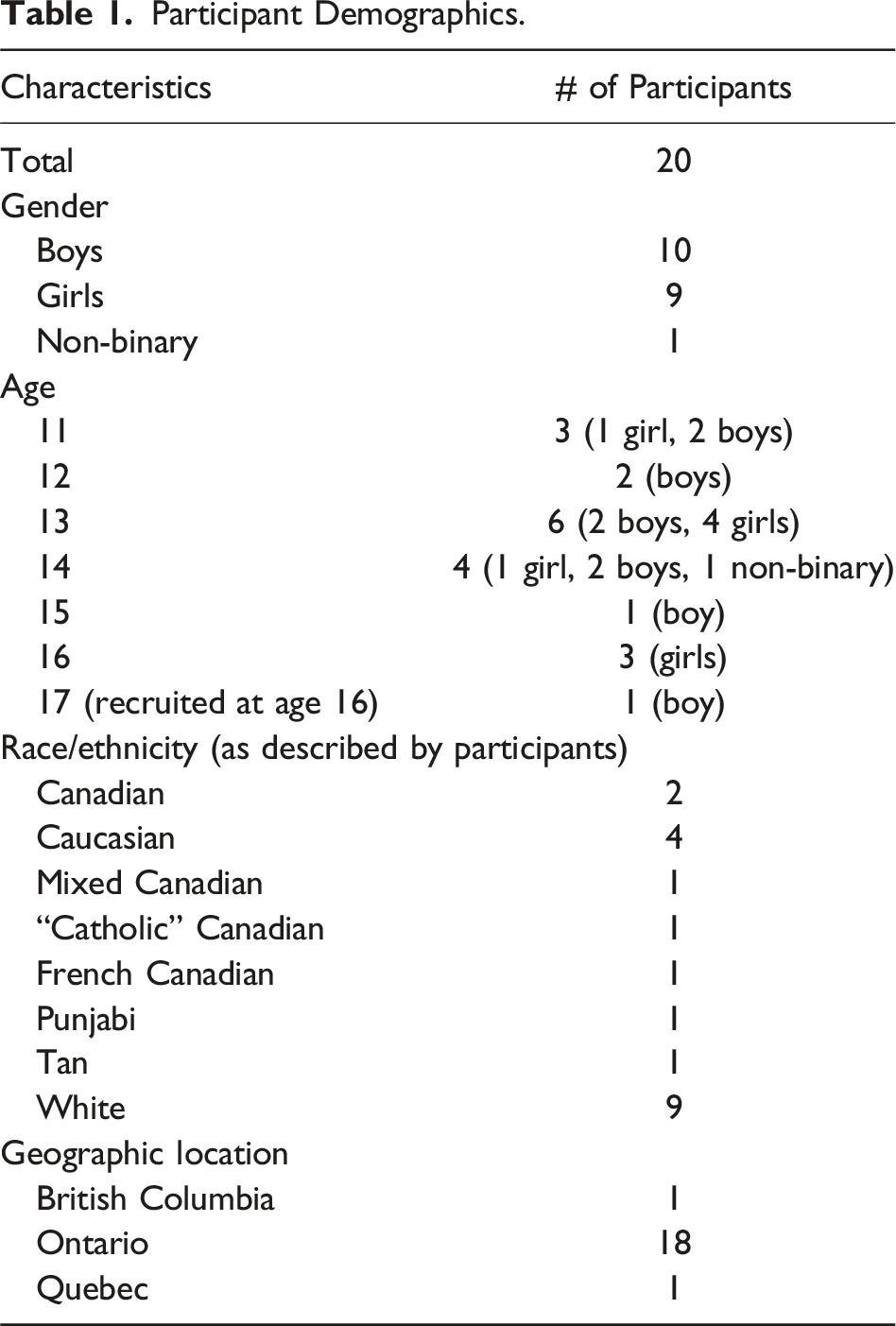
Young People’s Experiences of Gender: A Story of Incongruent Expectations and Experiences
The overarching theme that emerged from our analysis was the incongruence between expectations about gender equality and everyday experiences of stereotypes, barriers, and discrimination. Most participants described growing up in a world where “everyone is pretty equal” regardless of gender (Theme 1); however, all participants described experiences of gender inequality in their daily lives (Theme 2). Figure 1 depicts the themes and sub-themes that describe this incongruency. The incongruence between expectations and experiences of gender equality. Note. The expectations and experiences of the non-binary participant did not align with the expectations of a gender equality depicted in Theme 1, and thus their experience is depicted in a shaded oval to distinguish it.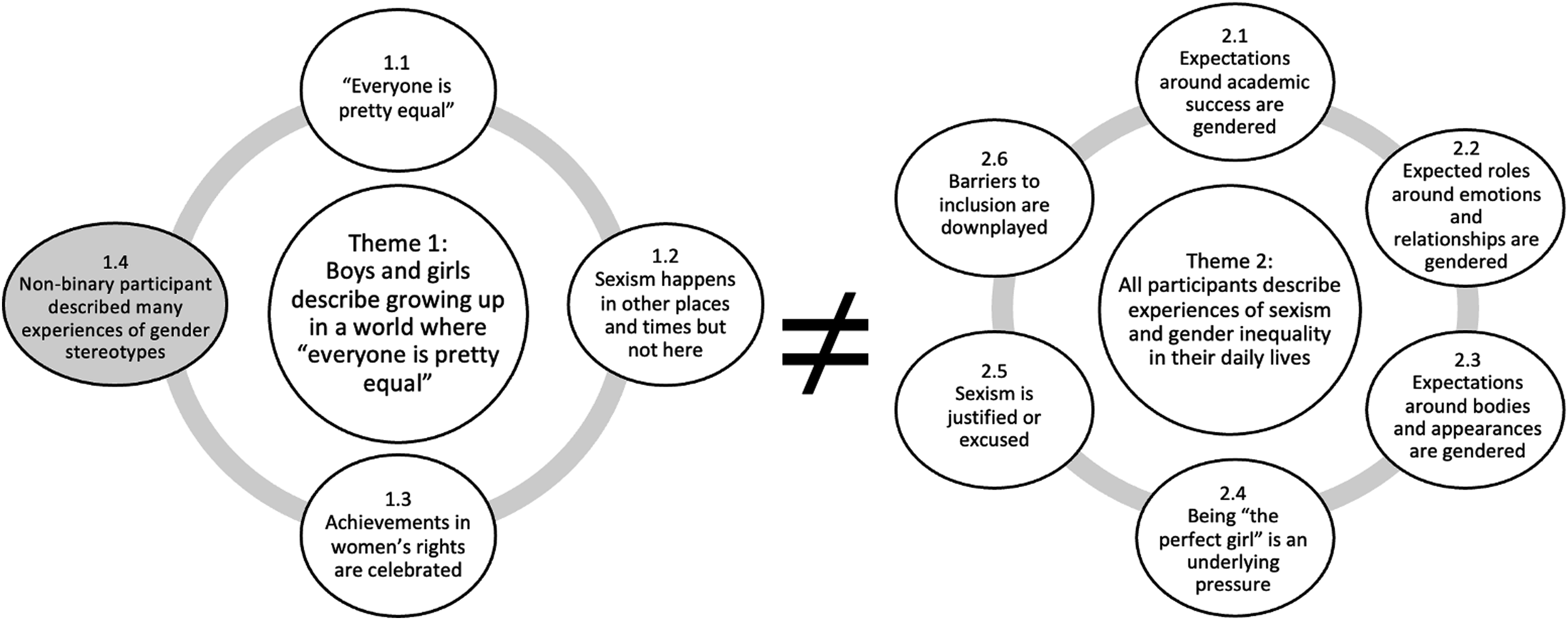
Interestingly, while the sentiments expressed in Theme 1 were consistently expressed by boys and girls, although not by the non-binary participant, the categories that underlie Theme 2 varied by gender in important ways.
Theme 1: Most Participants Describe Growing Up in a World Where “Everyone Is Pretty Equal”
“Everyone Is Pretty Equal”
Most participants described how “everyone is pretty equal” (Alison, 14 G). Ashley (13 G) said that there is “not really” anything that restricts her because she is a girl. Faith (13 G) shared her experience of reading something about how girls and boys react differently because of their gender but said she “didn’t agree with that…You should treat them all the same, no matter what.” Spencer (13 B) told us that people “definitely expect certain things out of me, but not because of my gender” and Laura (13 G) reflected that “it’s not like the 1950s. I am not told to stay in kitchen all day and cook.” Kevin (12 B) described not experiencing gendered expectations at home with his siblings, explaining that “we all do the same chores and the same things. They expect the same things from us and there is no difference.” He continued: At school I don’t think there is much of a difference… I guess if you behave then I don’t think there is anything with the gender side of things…with our school and my teachers that I have had, I think they have been very neutral on the side of things, same with my coaches.
James (12 B) shared a story about an experience that had required strong coping skills, and we asked if he thought being a boy had shaped how he was expected to cope. He said “I don’t think that was the expectation. I don’t think there really was an expectation, that was just myself.”
In contrast, Alex (14 NB) reported that their non-binary gender attracted specific stereotypical social expectations. For example, Alex said “People can have a stereotype that non-binary people…listen to a certain group or band. They like or do certain things. There is something about liking frogs, that is a bit of a stereotype for non-binary people.”
“I Don’t Think Sexism Happens Around Here” “It Isn’t Really Present in Today’s World”
When boys and girls did talk about gender inequality directly, it was removed from their own experiences, often by geography. Laura (13 G) shared: I feel like third world countries expect more from girl…For example, a lot of Africa, a lot of the women stay home, and the men go to work and the women just have more and more kids. And that is what they are told to do… Even look at Malala Yousafzai, she got shot because she wanted to go to school. And if a boy did that, he would never have been shot.
Alison (14 G) said “I don’t know exactly which cultures, but I know some think the women have to do the cleaning and the cooking.” She continued, saying that “nowadays” and “for people around here” things are different. Haley (16 G) had “heard things in the news like, women were getting paid less for doing the same job or things like that” but had no examples from her own life. Cole (11 B) stated that in Canada, there is no sexism, but “say in Africa or something, yes. I don’t know if that’s now, but they let boys go to school and girls have to do the work.” He expanded, noting that sexism could happen here, “but it’s really against the law.” While Austin (14 B) reported that he had not personally experienced gender expectations, he thought other youth might have had this experience. He quickly qualified this, saying: “but I don’t think really any around here or at least at school.”
Other youth talked about gender inequality as something that only happened in the past. Spencer (13 B) told us “it was different for your grandparents and there was gender stuff… And even for your parents. So, then they just grew up like that and they didn’t know any different.” Kevin (12 B) talked about how a while ago, girls didn’t have much rights and they had to do these things. And they would have to marry a man and have to follow rules [for] girls. And I feel like some religions could stay with that and make their daughters do this and that.
Anya (16 G) told us that in India, her “great, great-grandmother was married at 13 a long time ago… but it isn’t really present in today’s world.”
“Oh Yeah Girl Boss. Let’s Go!” (Achievements in Women and Girls Are Celebrated)
While both boys and girls articulated similar expectations of equality in their own lives, it was primarily the girls who spoke about changes that are occurring in the world. Anya (16 G) shared that she “feels like the world has been evolving” from a time when “women’s rights were not a thing.” Laura (13 G) said “I have been reading the statistics and apparently there are more girls graduating from university then boys. And so that saying ‘girls will rule the world’ is coming true.” Sierra (16 G) described how people might tell girls they cannot do things at school, or they will not be cool, but “I think that is a bunch of bull crap. The girls can do whatever they want because everyone is like, oh yeah girl boss. Let’s go!” Aiden (14 B) was the one boy who talked about Canada’s progress on gender issues, even though he thinks that his gender is still favored. He spoke glowingly about American Vice President Kamala Harris saying, “amazing person and the first Black VP, which is very, very cool.” Other than this comment, the boys were notably silent about the changes that have happened in the world around girl’s and women’s empowerment.
“There Are Stereotypes About Non-Binary People and Expectations About What Non-Binary People Should Be”
Alex (14 NB) was the only participant who immediately said yes when we asked if they experience gender norms and expectations in their life. They explained: You know for girls/boys… there are certain stereotypes that usually are with birth genders… There are stereotypes about non-binary people and expectations about what non-binary people should be… And making up a stereotype like is very hurtful to a lot of non-binary people that is not what all of us are, especially me when I was trying to figure myself out.
Theme 2: All Participants Describe Experiences of Gender Inequality in Their Daily Lives
Even with the common conviction that we live in a world where “everyone is pretty equal,” all participants shared their own experiences of gender inequality in their everyday lives.
Expectations Around Academic Success Are Gendered
While all participants talked about expectations, abilities, and pressures of academic success, the girls tended to use language that was centered around gendered expectations and assumptions. Sierra (16 G) described how “people assume that I am good at school because I am a girl,” and Alison (14 G) explained that teachers expect girls to be “smarter” than boys. Nicole (13 G) provided this example: Pretend if I answered a question wrong or something or got something wrong then they would be like, “oh I thought you would get that.” And then maybe when a boy comes up then they would be like, “oh that was good. I am surprised.”
Sierra (16 G) didn’t appreciate these gendered stereotypes: “some people are like, well you’re a girl so it’s easy for you. And I am like, ‘mmm. Okay’.”
When the boys talked about academic success, they talked less about expectations and more about abilities. Nicholas (17 B) noted that boys are “better in certain areas in school like math. Boys having higher averages than girls and stuff like that.” He told a story about a math contest. He said: A lot of the times they preselect boys instead of girls. So, there is a majority of boys. And it’s not necessarily their fault, they pick the boys and girls with the best grades. And a lot of the time it is the boys, so I sort of feel pressure from the other boys that I need to perform well to make it seem like we are better.
Beyond academic achievement, Cole (11 B) reported gendered expectations in his school context, saying “so, let’s say you get in trouble, the teachers say, the girls haven’t done anything wrong.”
Though Alex (14 NB) also described stress around academic success, they did not explicitly connect this stress to gendered expectations: School has been stressful. A lot of my self-worth when I was in school was based off my grades because I tend to do quite well. And so, people were like, oh my gosh… I can’t believe you got this mark. I can’t believe that I got better than you…. And so especially at my school, everything was very grade related. So that was stressful.
Expected Roles Around Emotions and Relationships Are Gendered
Boys and girls reported gendered experiences around their emotions and their relationships, but they talked about them differently. Sierra (16 G) said she “doesn’t like not being able to help people… I am the happiest when the people around me are happy… if someone else is not having a good time, then I am not having a good time.” She described a misunderstanding within her friend group that got really stressful because “me being the one who tries to resolve all of it myself, I feel like if things are not going good then it’s my fault.” The language that Nicholas (17 B) used was pointedly different than what we heard from the girls. He told us he finds it “weird” to have to “manage his sister and mom.” He continued: Sometimes when it is that time of the month and their periods come on and they are the same week, so it can be a lot to handle between them. And so, me and my dad try to separate them to not create conflict.
While experiences of male gendered expectations around emotions were not reported by any of the boys, they were noted by two of the girls and the one non-binary participant. Alex (14 NB) explained that “men have to be very tough and they show no emotion and they are supposed to like dirty and rough things.” Ashley (13 G) said: There is a big man thing where some people think that boys should be this big tough muscular man or person that doesn’t cry that much or barely gets emotional. But the reality is boys are human like us and they have feelings and emotions.
Haley’s (16 G) comment was similar: Even for boys… not crying or not being emotional is a thing, which is sad. I feel like we are starting to get rid of that thought. But still, it’s like, oh you have to be tough and stuff like that for boys. And when they show an emotional side it’s like, oh my god they are not robots.
Expectations Around Bodies and Appearances Are Gendered
Girls reported internal pressures about their own appearance. Laura (13 G) told us she feels embarrassed when she “doesn’t look good in public”; even though “these people are strangers, and she is probably never going to see them again,” she still cares what other people think about her appearance. Elizabeth (13 G) talked extensively about the pressures to follow fashion trends with her friends. She laughed when she said: “It is weird because we all look the exact same because everything is this trend basically. I can’t even explain it. We all wear the exact same clothes and stuff. It’s weird.”
Alex (14 NB) lamented external stereotypes, saying: People can have a stereotype that non-binary people are skinny, assigned female at birth, have short hair… There is another thing where it’s like all non-binary should be androgenous. And that is 100% not true. Non-binary people don’t have to look androgynous. They can dress however they want, just like men and women…For me I like to look androgenous, but there are some non-binary people who like to look masculine or feminine or whatever. They just dress as they want.
Alex also reported getting bullied at school for the way they look and repeated their comment that stereotypes “can be very hurtful.”
James (12 B) explained that being feminine is “wearing make-up and dresses and stuff like that.” Nathan (15 B) said: “Guys don’t really wear make-up and nail polish and they won’t wear skirts and dresses, that is a girl thing too. I think guys just don’t really care.” Sierra (16 G) noted that when a guy breaks gender stereotypes in clothing, all the girls hype him up, but the guys are like, “no”… I can wear jeans and sweatpants and be fine. But if you saw a guy going around in fish nets or whatever, they would be bullied to the end of eternity.
In contrast to the girls, who tended to talk about attractiveness and beauty, several boys talked about their bodies in terms of size and strength. For example, Cole (11 B) explained that “guys are bigger, and girls are skinnier.” Spencer (13 B) shared his experience of growing more slowly than his peers, so when hockey started, he “was pretty short and everyone else was like growing. So, then they were bigger and stronger and faster. But I was not and I felt sad because I wasn’t as good.”
Alex (14 NB) and Elizabeth (13 G) talked about uncomfortable experiences in relation to their bodies. Alex said “Whenever I meet new people, they can be confused sometimes about my gender. I feel like I look pretty androgenous.” Alex was uncomfortable “whenever people are trying to figure out their gender without asking” because “the way they are trying to figure me out is by looking at me.” Elizabeth (13 G) talked about how even though she “loves volleyball so much, it has become this thing where every girl has to wear spandex shorts.” She described being told that the reason she had a guy coach was because she was on a team of girls. “And I didn’t understand that and I still don’t understand that,” she said: Just because you have a guy coach doesn’t mean that he is looking at teen girls. That is just disgusting and it’s not right… So, people think that just because you are a girl that all guys are like, “oh that girl is so pretty.”
The Underlying Pressure of Being “the Perfect Girl”
The sub-theme “the perfect girl” is interrelated with the other sub-themes. We report it separately to draw attention to how the sub-themes work together to put internal and external pressure on girls in particular. A similar theme around “the perfect boy” was not present in the data. Elizabeth (13 G) said: I feel like I need to be the perfect daughter. I am who I am, and I like it. But there are some out there, where as hard as I try, I just can’t live up to the expectation of being the perfect girl.
The word “perfect” continued throughout her interview. She said: Well, I think that everyone is perfect. But people say there is a perfect girl. I mean people are like, oh yeah you have to wear perfect bikinis and have to wear skirts and skinny skirts and all this stuff. You have to have make this ice-cap. Oh my gosh you have to do this; this is a trend. You have to do this. Or else you are not going to be the actual expectation of the girl that is supposed to be out there in 2021, I guess.
Such expectations of traditional femininity, particularly around beauty and “niceness,” were juxtaposed against pressures to be better than boys. Teachers in particular expect girls to be “more mature” (Alison 14 G) and “smarter” or “more kind” (Nicole 13 G) than boys. Nicholas (17 B) reinforced that “usually, girls have the maternal instincts and are usually or stereotypically better with kids then men.” Anya (16 G) explained how pressures to get married are “not really present in today’s world…” but “the part that girls need to know how to run a household” has carried through.
Gender Discrimination Is Justified, Minimized, or Excused
Sometimes, participants would tell a story about gender discrimination yet simultaneously explain why it was not discrimination. Illustratively, Zachary (11 B) explained that there is “not really” sexism while simultaneously noting that “with running though boys are usually faster than the girls. So, if there is a girl that passes me, my coach will be like, you should have pushed more.” Aidan (14 B) said that during school sports, it is more common for “most males to be picked over females” to form teams yet defended this difference as not related to gender discrimination but being “because all the boys are buddy-buddy in our class.” In Haley’s (16 G) workplace, “there is a guy there who has the same job as me…” When people in the store asked to talk with the manager, “he will come down…and I feel like they listen to him more.” She was visibly upset that people in the store appear to prefer talking to men over women, yet defended it, saying that it is “maybe just older people…older men who are stuck in the 60s.” She explained: It’s like, why won’t you listen to me? I am telling you the exact same thing. So, I guess it’s a little frustrating. But then I think, they grew up like that. So, I guess I am kind of understanding about it, but it’s still frustrating. I am telling you the same thing but you are not listening to me.
In our field notes, we noted the difference between Haley’s plea of “why won’t you listen to me?” and Connor’s (16 B) experience at school when he said, “I don’t have much to say, but when I do, the teachers are always listening to me.”
Barriers to Inclusion Are Downplayed
Many participants described barriers to inclusion around sports, and these barriers were often downplayed. Kevin (12 B) said that “at sports its very neutral and no one finds it different if you are a girl.” Ashley (13 G) described how people think that basketball is for boys and ballet and dance is for girls. But girls can still play basketball and boys can still do dance or whatever they want. There is no rule that lets them or blocks them or stops them from doing what they are interested in. There was like 50 guys on the team and one girl who had to end the season. And so it was like, oh only guys can join. It’s all guys now. And even though I didn’t want to, I wanted to join and be like ‘watch me join’ kind of thing.
This contrasts with Aidan’s (14 B) comment that “nothing that I would want to do would restrict me because I am a male.” For girls, the decisions about where to participate were less about rules and more about social expectations. Illustratively, Sierra (16 G) told us: We don’t have a cheer team, but we have a team that helps pumps up, it’s a positivity squad… And that is entirely of girls. And that is not cool thing for guys to do. And it’s not that they can’t join, it’s just that it’s not cool or it’s not seen as a manly thing.
Sierra (16 G) also told a story about expectations around participating in “heavy work.” We had some heavy boxes and we were with one of my guy friends… And he was like, ‘come on, you carry the heavy boxes.’ And I was like, ‘hello, I go to cross fit. I dead lift 200 pounds. I can carry heavy stuff too’. And he was like, oh no he can carry it…Just because he’s a male doesn’t mean…ugh when some people are like, let all the men do the heavy lifting. I can do heavy lifting. Let me do it. Sometimes people are like, ‘let the guys do the heavy work. You are getting off of work. You are doing less work, that should be good’. But for Sierra, gendered expectations around not being able to do things are impactful:
It doesn’t make me feel good about myself if I am not even getting the chance to be able to do the heavy work. It puts me off a little. It is lesser than it was. And there is nothing huge that I can’t join because I am a girl, but it is the little things that people say sometimes that are insensitive.
Laura (13 G) shared insights into why political leadership is often gendered. She explained that boys and girls should be socialized differently, saying: I think if you taught the boys to be nicer and not be, like, I am better than you and blah, blah, blah. And you should stay home and cook. No, that does not happen anymore and shouldn’t happen anymore. I think if we taught the boys to be better and we taught the girls to try better, then I think we would be really good.
Laura went on to explain that in Canada, we have always elected male Prime Ministers, and that a woman should try and run like Hilary Clinton did in the US. “I know she didn’t win but it’s a good thing that she tried. I don’t think a lot of people have the guts to try.” She noted Clinton was “very smart” and her husband’s former presidency gave her “one step up from what everyone else got.” She continued, “I don’t think a lot of people have the guts to try as well. So, if we taught that in school, like trying, I think that would be better.” The barrier to advancement, as Laura saw it, is that in our “male-dominated system,” women “don’t have the mindset” that they can advance “and no one has taught them that they can.” When the interviewer told Laura that we did have a female Prime Minister at one time, Laura appeared delighted, yet surprised. She said: We did? I didn’t know that… that is sad because no one has said anything to me about that. We don’t talk about it as much. So, I think if we talked about it more and made everyone feel comfortable in stating something like that, then it would be better.
Discussion
The consistent yet contradictory message we heard from the boys and girls in our study demonstrate an expectation and vision of gender equality that clashed with young peoples’ everyday experiences of barriers, stereotypes, and other forms of gender discrimination. The incongruence between these two themes was striking because what our girl participants especially told us about gendered expectations was inconsistent with the stories they shared from their lives. Our findings suggest that explanations for gendered disparities in mental health may be related to the underlying context of discrimination, implicating both traditional and emerging gendered norms, barriers, and constraints.
Theoretically, this study aligns with the “multiple stressors” hypothesis. As early as 1975, Nathanson suggested that the reason women report poorer health than men can be partially attributed to how the social roles they are assigned are more stressful and more complex (Nathanson, 1975). In 2003, West and Sweeting reached similar conclusions, noting that increases in psychological distresses in 15-year-old girls could be explained by the combination of elevated educational expectations combined with more traditional pressures related to personal identities and maintaining a normative feminine appearance which would in turn negatively impact mental health (West & Sweeting, 2003). Nearly 50 years after Nathanson’s initial observations, the girls in our study reported remarkably similar experiences of having to navigate “multiple stresses” that required having to succeed by both traditional feminine social roles and more modern expectations around things like education and leadership. The contributions our study makes theoretically are to draw attention to the “incongruence around expectations” that may be key to contemporary experiences of the multiple stressors hypothesis. Not only do girls continue to be burdened by the stress of the multiple roles they are expected to fill, they also have to fill these dual roles with the added pressure of (out) performing boys in traditionally male activities.
The Disproportionate Pressures that Come With Incongruence
For the most part, gender equality remained unproblematized for our boy participants. For example, although our participants unanimously agreed that boys and girls were equal, the boys reported a comfortable sense of men’s superiority in things like math and sports. From their viewpoint, unequal outcomes in these spheres were not rooted in gendered constraints but were the result of happenstance. In this way, boys could believe in equality as an accepted and uncontested fact while still enjoying a sense of male superiority.
In contrast, the girl participants reported a variety of pressures associated with the gap between their expectations of equality and their lived experiences of barriers and constraints. Although they too believed that boys and girls were equal, the pressure they felt to satisfy multiple gender norms around femininity—including traditional ideals about being kind, maternal, and physically attractive and modern ideas about being high achieving and “smarter than boys”—created a double burden that may impact mental health in negative ways.
All participants talked about anxieties associated with living up to highly gendered norms about bodies. However, this “appearance anxiety” (Moradi & Huang, 2008; Zimmer-Gembeck et al., 2018) was much more prominent in girls than in boys, with girls reporting anxiety that their bodies and appearance are constantly being evaluated. Although the girls felt that this was a pressure shared by boys, the boys for the most part said, “guys don’t care.” If any of the boys were concerned, it was only Spencer (13 B) who acknowledged pressure to live up to male norms around strength by voicing that he felt “sad” that he was not as “big, strong, or fast” as his peers. Interestingly, the clarity of the “rules” (Maclean et al., 2010) that dictate what is acceptable behavior for boys in conforming to ideals of what it means to be masculine was not acknowledged by any of the boys. However, they were noted by Sierra (16 G) when she said: “If you saw a guy going around in fish nets or whatever, they would be bullied to the end of eternity.” We resist any assumptions that boys do not care about ridicule or bullying around appearance and think it may be more likely that they are lacking language to talk about this concern. They also may be “doing gender” (Butler, 1999) during their interview by “self-censoring” (Maclean et al., 2010) about the repercussions of breaking masculine codes of appearance during the interview.
Our findings suggest that at the same time as they have been taught that girls and boys are equal, girls feel they are expected to be “smarter,” “stronger,” “kinder,” “more maternal,” and “more mature” while also succeeding at school. The “er” is important, as girls speak about equality as outcompeting boys, rather than the ability to express internally driven desires or identities in ways that make sense to them. For girls, both external and internal pressures were very strong. It was not always clear if the girls were experiencing these pressures internally, externally, or both simultaneously. Although the boys in our study appeared to face similar pressures around academic success, they did not identify facing parallel pressures to also be caring and kind. They also reported less pressure to have to try hard to “win” the competition with girls, especially in sports, where it was taken for granted that boys are “better than” girls. Here again, the pressures to succeed were harder for girls to negotiate.
The gendered nature of this incongruence between the rhetoric and the experience of equality relates back to research in adult populations highlighting the “double burden,” or “multiple stressors” of balancing vocational leadership and traditional female responsibilities (Campbell et al., 2021). When girls and women face pressures from having to succeed at both (more traditional) feminine ideals and (more contemporary) educational and professional ideals, they may be “doubly disadvantaged” in terms of the stress they experience (Petersen et al., 1991; West & Sweeting, 2003). While in more gender-equal countries, women have entered traditionally male-dominated areas of employment, men have not entered female-dominated areas of employment to the same extent, nor do they do equal amounts of domestic work (England & Folbre, 2005; Garcia & Tomlinson, 2021).
However, the incongruence in our data also resonates strongly with Ringrose’s reflection that the “wildly celebratory” representation of “the successful girl—girl power, girls having it all—discourses where girls are heralded as the new ‘global winners’” is also “deeply anxiety ridden” (Ringrose, 2007). Rather than freeing girls from the pressure to meet traditional gender norms of behavior, it merely adds to the anxiety of also having to meet the colliding demands of neoliberal measures of gendered success (Campbell et al., 2021). From this perspective, the systemic barriers girls face leave them to enact equality by, in Laura’s words, just “trying harder.” The confusion and stress of this incongruence may be especially prominent during adolescence, when tools and language to identify and address gender discrimination have not necessarily been developed, yet one is given a vision of gender equality in which anything is possible. Elizabeth’s phrase “the perfect girl” is a salient descriptor as it encapsulates the pressures to succeed both in the modern world—where anything is possible—and also in traditional female roles of caring, kindness, and maternal dimensions of life and appearance.
The gendered expectations and norms that shape the underlying contexts in which young people live have potential damaging implications for the mental health experiences of all the children in our study. For example, pressures around traditional beauty norms put girls more at risk of developing eating disorders (Izydorczyk & Sitnik-Warchulska, 2018) and low self-esteem (Furnham et al., 2002). Pressures to adhere to traditional feminine ideals have negative mental health implications and disadvantage girls in comparison with boys (e.g., Landstedt, Asplunch & Gådin, 2009).
Our findings compel us to ask why it is that girls in particular appear to perceive their social environments as “gender neutral,” even to the point that Laura (13 G) told us that “the saying ‘girls will rule the world’ is coming true,” while also describing experiences counter to that notion. One explanation may be that girls are socialized early on to be “people pleasers,” meaning that they tend to prioritize the thoughts, emotions, and experiences of others over themselves to avoid potential negative consequences of disrupting social relationships and expectations (George, 2016; Letendre, 2007; Radovanovic et al., 2024). When girls are told by society broadly (including parents, teachers, social media influencers, and peers) that they live in a world that is characterized by equality, they may be reluctant to challenge or even to recognize that this is counter to their everyday experiences—a cognitive and experiential discordance that was never identified explicitly by any of the study participants. Whether or not they are explicitly recognized, the mental health implications of this incongruence are potentially very strong. For girls and women, when expectations of equality are not congruent with actual experiences of equality, the frustration with not being able to achieve their goals is especially amplified when they look to boys and men who do not have the same barriers. This highlights the inequalities that they are experiencing and contributes to lower mental health and life satisfaction among girls and women (Campbell et al., 2021). These experiences of incongruence accordingly provide important contextual information as to why girls in Canada continue to be disadvantaged in terms of their mental health status and trajectories compared with boys.
We noted that a similar incongruence between expectations and experience was not articulated by the boys. It may be that boys do experience internal struggles as they navigate the expectations that come with the contradictory “cultural scripts” (Rice et al., 2021) that they have inherited. These also pose challenges to their health and development including lower self-esteem and psychological adjustment, substance misuse, violence and aggression (Chu 2014; Pearson, 2023; Way et al., 2014). Resistance to an expected “stoicism” around emotions also comes with a heightened risk of suicidal ideation and death by suicide (King et al., 2020). One explanation for this is that the boys may not have been comfortable enough in a short, one-off interview with an interviewer who identified as a cisgender woman to get beyond “performing gender” and to unpack the nuances of their gendered experiences more deeply (Jachyra et al., 2014). Another explanation may be that even with the risks that these dominant narratives around masculinity pose for boys’ mental health, they still “confer power and status to boys and young men” (Rice et al., 2021, p 1). This makes them especially difficult to resist and to disrupt. Yet even without comparatively salient experiences of incongruence, for boys, gendered expectations and norms still shape mental health experiences. For example, the gendered pattern of silence from boys around emotion was striking. Rather than suggesting lack of interest in the emotional dimensions of life, this silence may reflect the pressure to conform to gender expectations, which is itself so strong that these boys potentially felt less freedom to express vulnerability to appear weak during the interview.
Interestingly, the experiences of the non-binary participant were more congruent, suggesting less conflict between expectations and reality. We do not celebrate it as positive that this participant expected and experienced gender stereotypes, but we do observe the heightened consistency between awareness, expectations, and experiences. While research demonstrates that non-binary young people have poor mental health outcomes compared with their cisgender peers (Chew et al., 2020), explanations for this may be different from the incongruence that we have observed in these data.
While we applaud all children’s experiences of and commitment to gender equality, our findings are troubling in that the reported aspirations and recognition of gender equality are so incongruent with everyday lived experiences for boys and girls. Sexist norms and stereotypes are not disappearing; they are simply shifting to “accommodate subtler and modernized forms of sexism” (Gomes et al., 2022) that potentially make it difficult for young people to recognize unfairness. Our findings suggest that in this sample of young people, more traditional forms of gender discrimination (such as stereotypes around household chores) seem to have disappeared, making modern forms of gender discrimination difficult to recognize, especially when girls encountered them in an environment that is perceived to contain strong expectations of gender equality. In this way, it is possible to deny the existence of discrimination against girls and women but at the same time still maintain a paternalistic view that sustains gendered expectations and norms.
Lack of Productive Language or Skills to Identify and Address Barriers, Stereotypes, and Other Forms of Gender Discrimination
Overall, our findings suggest that young people find themselves unequipped to navigate the incongruence they are experiencing between the expectation that they live in a gender-equal world and their many experiences of gender-based constraints. Further, they do not appear to be equipped with critical skills to identify the structural patterns that undergird their experiences.
Part of this may reflect the interaction of two factors. First, educators have put in significant effort over the past 40 years to develop curricula geared specifically to girls’ needs, which has resulted in closing the gender gap in educational outcomes to the extent that girls now tend to outperform boys in school (Anderson et al., 2014). In addition, although the female athlete in particular remains a contested notion, girls and women have increasing access to sports and other spheres of activity that were previously closed to them (Pavlidis, 2020). The fact that girls and women have made substantial progress in the quest for equality may make it more difficult to identify gendered constraints, either as constraints or as gendered.
Second, our participants echo the popular discourse of girl power—girls can do anything they want to do and have no constraints. As Gonick et al. (2009) suggest, this discourse has become both a marketing tool and a way to brand girlhood; each works to paradoxically both displace and refix the gender binary in ways that imbricate growing gender equality with the resurgence of stereotypical notions, particularly of female beauty and body image. The resulting terrain is accordingly embedded with contradictory demands on girls to both exercise agency and accommodate others, masking the continuing effect of constraints by (over)celebrating the power of girls to (re)invent themselves.
To illustrate this, we draw attention back to several salient stories reported in our results. Nathan told us that “Girls could be in the [soccer] league,” but “there just weren’t that many.” There was no reflection on what might be stopping girls’ participation or of the gendered nature of many sport activities. A similar theme emerged in Nicholas’ description of a math contest. He said “a lot of the times they preselect boys instead of girls. So, there is a majority of boys. And it’s not necessarily their fault, they pick the boys and girls with the best grades.” Nicholas does not appear to have tools to consider the educational cultures or structures that created the differences in the first place. Laura’s story about barriers to political participation and leadership is also relevant here as she recognized the role of individuals (needing the “guts to try”) but failed to consider the structural and historical barriers for advancement. In Laura’s story, the rise of a female Prime Minister came down to “trying harder” rather than dismantling structural barriers around gender.
When boys and girls did talk about gendered differences, they often talked about them in different ways. For boys, gendered differences were justifiable or related to personal preferences (“girls could be in the league” if they wanted to). Girls were more likely to make excuses for the person who was being sexist. Here, we think back to Haley’s justification of the gender discrimination she identified in her workplace: “It’s just older people… older men who are stuck in the 60s.” This is troubling on both accounts because if they are unable to identify and name gender discrimination, they are also unable to address it. Further, if young people continue to believe that gender discrimination does not happen “around here,” they have no opportunity to build skills in thinking critically about gender inequality or to engage meaningfully with the gender inequalities that they experience in their own lives.
The frustration with and resistance to gendered norms from older female and non-binary participants was noteworthy. For example, Alex (14 NB) consistently challenged stereotypes around how non-binary people should look, telling us the stereotypes are “100% not true. Non-binary people don’t have to look androgynous. They can dress however they want, just like men and women.” Sierra and Haley (both 16) also expressed dissatisfaction with the status quo. Sierra, who used strong phrases like “girl boss” and named gendered stereotypes as “a bunch of bull crap,” described wanting to push back on the gendered football culture at her school. Even though she was not interested in football, she said “I wanted to join and be like ‘watch me join’.” When Haley shared the story about customers at work wanting to talk with the male employee instead of her, her frustration was visceral. She said: “It’s like, why won’t you listen to me? I am telling you the exact same thing.” These three older youth in our study appeared to be developing skills in critical analysis. It may be that they have had longer for cognitive and emotional development that enables them to better identify and resist gendered social norms.
Practical Application of This Study
Our study findings have practical value in terms of providing insights into how gendered expectations, stereotypes, assumptions, and barriers continue to shape the experiences of all children. Adults (including parents, educators, mentors, and social influencers) have the opportunity and responsibility to be active disruptors of the harmful gender norms that constrain the landscape of childhood and to develop a world that helps children navigate the unfortunate present reality of persistent gender discrimination. This includes being role models and providing children with constructive language and opportunities to confront gendered privilege and power (Rice et al., 2021; Wilson et al., 2022) and to identify and talk about their experiences in honest, meaningful, and developmentally sensitive ways.
Our findings compel us to ask questions about adult responsibility to facilitate child development in ways that are responsive to the changing faces of gender discrimination, which readily adapts to social discourse, with new and subtle variants ready and waiting to replace the old. As Canada makes commitments to move toward a more equitable world, naming the “myth of gender equality” and concretely addressing harmful gendered social norms that continue to shape and constrain the lives of Canadian children would be an excellent goal. A further goal would be to help young people develop the tools to identify and then challenge these inequalities to move toward the gender-equal world that many of them appear to desire and expect.
While these applications would be beneficial for all children, when our findings are considered in light of other research on gendered disparities in mental health, we suggest action to shift harmful gendered norms could be especially beneficial to girls and non-binary youth. Yet, a more equal society is best for everyone, and people of all genders must be included.
Strengths and Limitations
Our study contributes to emergent theory about the incongruence between expectations of equality and lived experiences of gender discrimination, and features children as capable and insightful informants of their own experiences with the right to express their views on matters that concern their lives (UN Commission on Human Rights, 1990). It provides important insights into the complex and incongruent relationship between children and gendered expectations and norms. Our open-ended qualitative approach enabled us to invite children to offer perspectives that challenge our own assumptions and promote a critical and nuanced understanding of contemporary experiences. The mental health of adolescents remains a critical health priority, and the relevance of our study is timely. These findings can inform prevention initiatives and health policy to address the root causes of health inequalities by working to illuminate and transform harmful gender norms, roles, and relations so that all young people can achieve equality and have the opportunity to realize their full potential.
In this paper, our analysis is limited to gender and age. We have not considered other intersecting dynamics such as race and socio-economic circumstances, which are well-known to generate, amplify, and temper experiences of discrimination.
Conclusions
In this study, we highlight the voices and perspectives of young Canadians and draw attention to the incongruent experience—or clash—between expectations and reality that is experienced by Canadian young people in ways that are especially challenging for girls. We add evidence to the theoretical idea that the mismatch between the gender equality that is expected and articulated and the everyday experiences of gender discrimination, combined with the lack of productive skills and language to talk about these experiences, is creating a precarious balancing act for girls in particular. This “myth of equality” creates a powerful clash between these incongruent stressors, which seem to be greater and more powerful in countries that are perceived to have made greater progress toward gender equality (Campbell et al., 2021). Despite progress on gender equality, gender discrimination is more deeply and subtly woven into the fabric of Canadian society than many would like to admit. Our findings provide important context for the complexity of gender disparities in mental health experienced by Canadian youth. Even though Canada may pride itself on movements toward gender equality, the subtlety of how inequalities and discrimination operates remains persistent and insidious.
Our research draws attention to gender as a constraining factor for both boys and girls, yet that is incongruous with the vision that many of them hold for a gender-equal world. While this is true for all young people, the results appear to be especially deleterious for girls. Girls appear to be navigating an impossible landscape where they can be anything and do anything. Yet, they need to do this while also succeeding within traditional confines, appearances, and roles. More research is needed to further explore this disconnect between expectations and experiences and to examine the link, if any, between it and poor mental health outcomes for young people.
Footnotes
Acknowledgements
We acknowledge our grant writing group, who provided important context to our study based on our larger mixed methods study on gender inequalities in adolescent health. Our group includes the following investigators: Brock University: V Michaelson and W Pickett; University of Ottawa: V Steeves; Queen’s University: N King, C Davison, and S Phillips; University of Western Ontario: A Vafaei; and University of Prince Edward Island: MA McIsaac.
Author Contributions
V Michaelson: conceptualization, study design, coding and analysis, original draft, writing—review and editing, critical engagement, and funding acquisition. KA Pilato: study design, data collection, coding and analysis, review and editing, and critical engagement. J Murray: study design, data collection, coding and analysis, review and editing, and critical engagement. MA McIsaac: review and editing, critical engagement, and funding acquisition. S Wadge: review and editing. V Steeves: conceptualization, study design, coding and analysis, writing—review and editing, critical engagement, and funding acquisition.
Declaration of Conflicting Interests
The author(s) declared no potential conflicts of interest with respect to the research, authorship, and/or publication of this article.
Funding
The author(s) disclosed receipt of the following financial support for the research, authorship, and/or publication of this article: The current research was done in conjunction with a Canadian Institute of Health Research grant (grant number: DC0190GP) held by two authors on this paper.
