




Abstract
parkrun is a free, weekly organized mass participation physical activity event providing a remarkable example of at-scale dissemination, with over 1 million participants and 150,000 volunteers in Australia. This qualitative study draws on stakeholders’ experiences to explore how parkrun succeeded with its dissemination and sustainability in Australia. Maximum variation and snowball sampling methods were used to select interviewees representing three parkrun stakeholder groups: parkrun Australia employees; volunteer organizers (event directors and ambassadors); and local external stakeholders (e.g., running clubs and landowners). Semi-structured interviews were conducted with 67 adult stakeholders in two phases (February–May and August–October 2023). We conducted a reflexive thematic analysis of interview data to explore contextual factors and mechanisms of parkrun growth and sustainability. We identify four themes to explain the growth and sustainability of parkrun in Australia: “Belief in an essential parkrun” comprises varied but overlapping ideas of what parkrun is fundamentally about; “Fluidity of movement” reflects the way individuals move freely in and out of the parkrun model, between roles and events; “Organizational and individual evolution” describes individuals’ engagement journey and how the organization adapted with growth; and “Shared custodianship” reflects the dispersed leadership and shared responsibility across time, place, and people. These themes illustrate elements of the parkrun model that create broad buy-in, foster stakeholder commitment and longevity, and maximize resources for enhanced reach, dissemination, and sustainability. Our findings contribute practice-based evidence that may inform scale-up and sustainment of similar public health interventions.
Introduction
Effective and sustainable population-level initiatives are needed to address physical inactivity as a public health priority (WHO, 2018, 2024). Physical inactivity is one of the leading risk factors contributing to the disease burden in Australia (AIHW, 2017) and globally (Lee et al., 2012), resulting in significant costs to the community, health system, and economy (AIHW, 2017; Ding et al., 2016). Increased population-level physical activity (PA) levels may significantly reduce the disease burden (AIHW, 2017), making effective PA interventions that can be implemented at scale and sustained essential for population benefit (WHO, 2018).
Deciding where to best invest for population-level impact on PA has proved challenging. Relatively few PA interventions demonstrating efficacy in small and controlled settings successfully translate to real-world conditions, and those that do have reduced impact at scale (scale-up penalty) or fail to embed within systems for sustained public health impact (Lane et al., 2021; Reis et al., 2016).
Current research on implementation of PA interventions at scale is limited. A review of sustainable public health programs found that only 7% were PA programs and only half of these were implemented at a large scale (≥100 sites) (Schell et al., 2013). A recent bibliometric review of PA literature reported a small and declining proportion of studies on scale-up and dissemination (Lee et al., 2021). Frameworks for assessing scalability, dissemination, and sustainability largely presume a traditional flow of knowledge from research to practice and do not incorporate natural scaling-up processes from organically disseminated interventions (Reis et al., 2016). Conducting research on initiatives already implemented at scale may contribute practice-based knowledge to advance PA translational research (Reis et al., 2016).
parkrun is an example of an organically disseminating social PA initiative driven by community demand, successful in its spread and sustainment (parkrun, 2023), and demonstrating improved social and PA outcomes (Grunseit et al., 2020). parkrun is a free, 5 km timed weekly walk or run held on a Saturday morning in a public open space (e.g., park or trail) at a fixed time (parkrun, 2024a). The World Health Organization cited parkrun as an exemplar that engages whole communities in regular and enjoyable PA experiences in local public spaces (WHO, 2018). Originating as a single time trial event in London in 2004, parkrun grew to more than 2200 events across five continents (22 countries) and over 8 million registrants by 2023 (parkrun, 2023). In Australia, parkrun launched in 2011 and grew to 490 events and over 1 million unique participants by mid-2024 (parkrun, 2024a). parkrun’s dissemination at scale reflects a less common pathway from development to dissemination without initial efficacy or formal real-world testing (Indig et al., 2017).
parkrun events are run by volunteer teams: an event director (ED) (or co-EDs) assumes overall responsibility for the event; run directors (RDs) each take responsibility for the event on a specific day; and multiple other event day volunteer roles are filled on a week-to-week basis (e.g., timekeeper and tailwalker) (parkrun, 2024b). Event teams are supported by a network of volunteer ambassadors and a small team of central administrative parkrun employees. Funding for staff, equipment (e.g., flags), and other infrastructure (e.g., information technology platforms) is largely sourced from commercial sponsorships (Fullagar et al., 2020; parkrun, 2023) and the sale of parkrun branded merchandise.
Despite the significant public health potential of parkrun as an accessible, effective, and sustainable initiative already delivered at scale, much of the research to date has focused on individual-level impacts and mechanisms for participation (Grunseit et al., 2020) or volunteering (Haake et al., 2022; Mitchell, 2023; Renfree & West, 2021). How parkrun has achieved such widespread dissemination and sustainability remains unexplored (Grunseit et al., 2020). This study draws on the experiences of parkrun stakeholders in Australia, to explore the system-level features, mechanisms, and contextual factors that have enhanced its dissemination and sustainability.
Methodology
We conducted an exploratory qualitative study using a reflexive thematic analysis approach (Braun & Clarke, 2023; Braun et al., 2022), comprising semi-structured interviews with parkrun employees, volunteers, and external stakeholders in Australia. Our methodology reflects an interpretivist approach, acknowledging there are multiple social realities related to the dissemination and sustainability of parkrun, and our findings are produced through an interaction between our interviewees’ stated perceptions and experiences and our own (Hanson et al., 2019). Semi-structured interviews were used to elicit participants’ parkrun experiences in their own words and allow for exploration of known scalability and sustainability concepts while still retaining sufficient flexibility for exploring novel concepts (Braun & Clarke, 2022). Interviews were conducted in two phases (Phase 1 February–May 2023; Phase 2 August–October 2023) to facilitate iterative analysis and elaboration and testing of identified themes. This study was approved by the University of Technology Human Research Ethics Committee (approval number ETH22-7558).
Sample Selection
Target Groups and Sampling Methods.
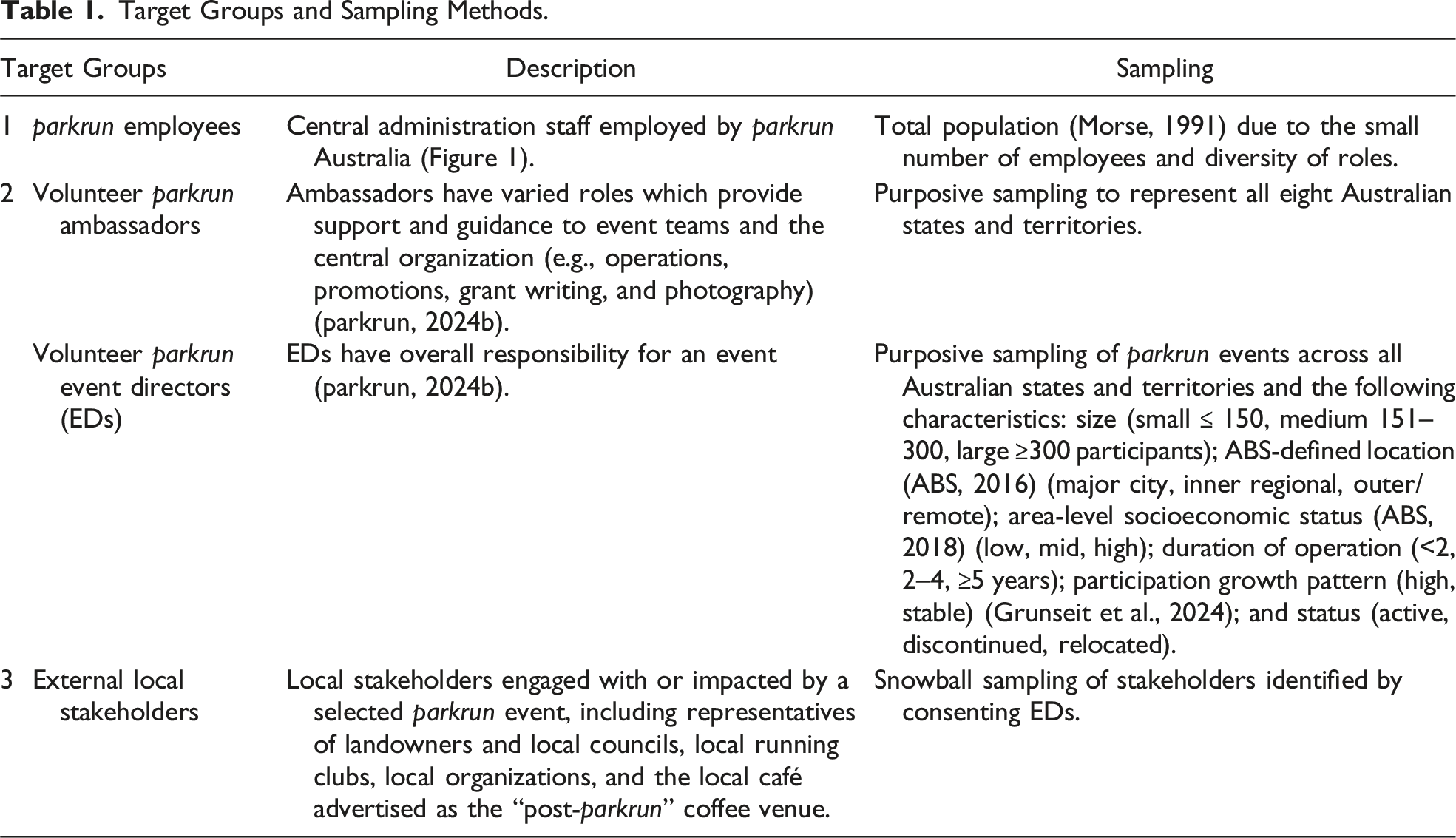
Informed by preliminary analysis of Phase 1 interview data, Phase 2 recruitment included groups 2 and 3 participants from an additional two parkrun sites identified through a related parkrun study (unpublished), to further develop candidate themes.
Recruitment
Members of the target groups ≥18 years old with sufficient English to comprehend the participant information and consent form and participate in the interview were eligible to participate. Invitations comprising a participant information sheet and Qualtrics consent form were emailed to eligible potential interviewees (groups 1 and 2) by the parkrun Australia representative (Phase 1) or the first author (Phase 2). Up to three fortnightly follow-up email invitations or telephone calls were made to non-responders. Potential group 3 interviewees (identified during interviews with EDs) were invited by the ED or first author (by ED preference). Consenting participants used an online booking system to nominate a preferred time and interview mode and provided verbal consent prior to the interview.
Data Collection
One-on-one (or pairs where co-EDs preferred) semi-structured interviews were conducted either in person in a meeting room at parkrun Australia head office (12 parkrun employees and one ED), a public meeting place (one parkrun employee and one ED), or via videoconference (Zoom or Microsoft Teams, n = 48). One external stakeholder opted for a written response. Three experienced qualitative researchers conducted interviews (LC, JP, and AG); all have participated in parkrun. LC and AG have backgrounds in public health research and evaluation and JP in health services and policy evaluation. AG conducted parkrun research previously. Interviews were audio-recorded using a digital voice recorder or the videoconferencing software. An external transcription company transcribed interviews; LC checked a subsample (n = 14) for accuracy and corrected any other transcription errors in the process of data immersion and analysis.
Interview Guide
Interview guides were informed by concepts covered in current population health scale-up and sustainability frameworks (Milat et al., 2016; Reis et al., 2016; Schell et al., 2013) and quantitative research on contextual factors influencing parkrun growth in Australia (Grunseit et al., 2024). parkrun employee and ambassador interviews explored perspectives and experiences of parkrun dissemination, sustainability, partnerships, sponsorship, and operational implementation policies. ED interviews explored how parkrun events were established, maintained, and promoted; the local context and how this affects volunteer and participant engagement, and the management and delivery of events; and perceptions of parkrun dissemination and sustainability in Australia. Where interviewees were both ambassadors and EDs, interviewers used both guides. Local key stakeholder interviews explored perceptions of parkrun, how and why they engaged, and impacts on their organization and community.
Analysis
Interview data were analyzed inductively using NVivo qualitative analysis data software version 12 (Lumivero, 2017). We followed a collaborative and iterative process for development of the coding framework and themes, to generate a credible and dependable interpretation of the data (Hanson et al., 2019). Our process drew on not only our interviews but also on the researchers’ knowledge and experiences of parkrun and the scalability and sustainability literature. AG and LC listened to interviews by other researchers during data collection (to refine questioning) and for data immersion. After listening to interviews and reading a sample of transcripts, LC developed a draft coding framework, and then discussed and refined codes and their definitions with AG and VC. LC coded all interview transcripts at the semantic level and then generated candidate themes with AG. Themes were developed using a combination of deductive and inductive reasoning. Deductive reasoning aligned with the overall research questions and the analysts’ (LC and AG) knowledge of parkrun literature and scale-up and sustainability frameworks (Milat et al., 2016; Reis et al., 2016; Schell et al., 2013). Candidate themes went through several iterations of revision and refinement. AG and LC mapped connections between themes before discussing final themes with study co-authors to interrogate links or differences with existing theoretical concepts around scalability and sustainability. LC coded and analyzed the remaining Phase 2 interview transcripts adding new insights.
Findings
Characteristics of parkrun Sites (n = 37) Represented by Sample of Volunteers and External Stakeholders.
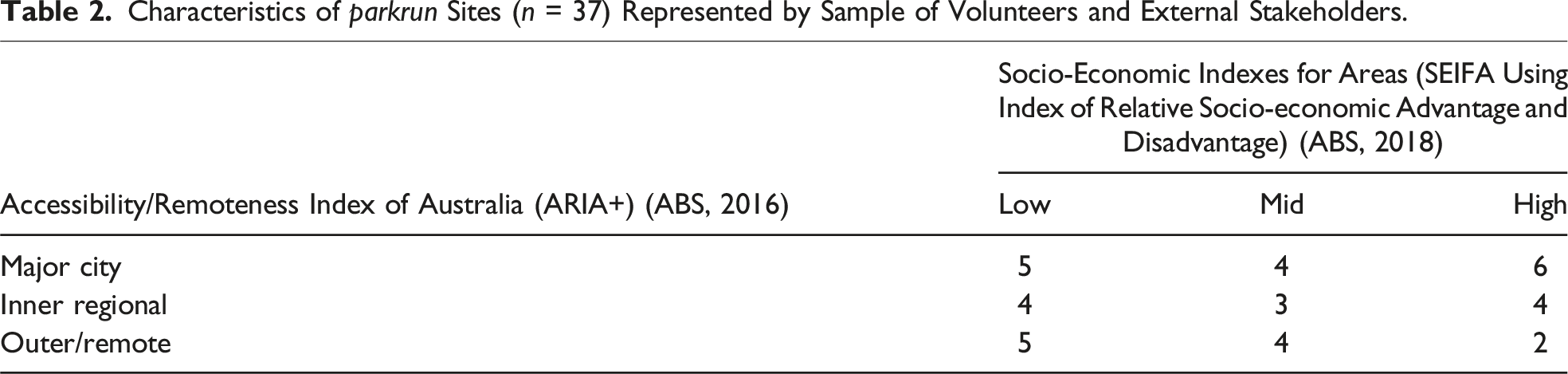
Figure 1 depicts the administrative structure of parkrun’s Asia Pacific region at the time of this study, derived from interview data and verified by a parkrun Australia representative. The employee structure generally mirrors parkrun’s global senior leadership team (parkrun Global, 2024). parkrun Australia organizational structure.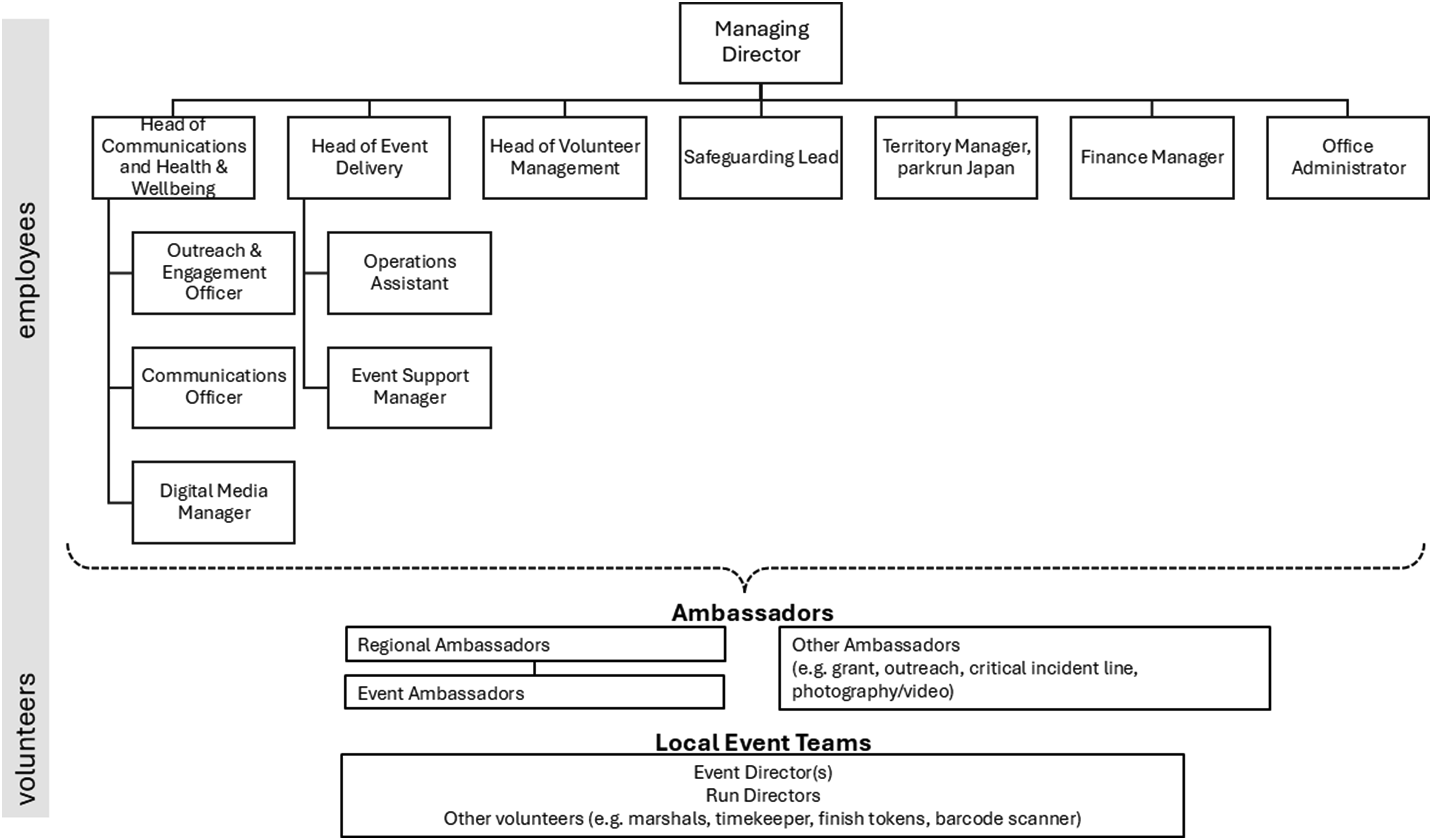
Themes—Overview
We generated four overarching themes to explain the dissemination and sustainability of parkrun in Australia. In brief, these were a belief in an essential parkrun; fluidity of movement; organizational and individual evolution; and shared custodianship. The themes and how we envisage they relate to one another are shown and described in Figure 2. Thematic overview.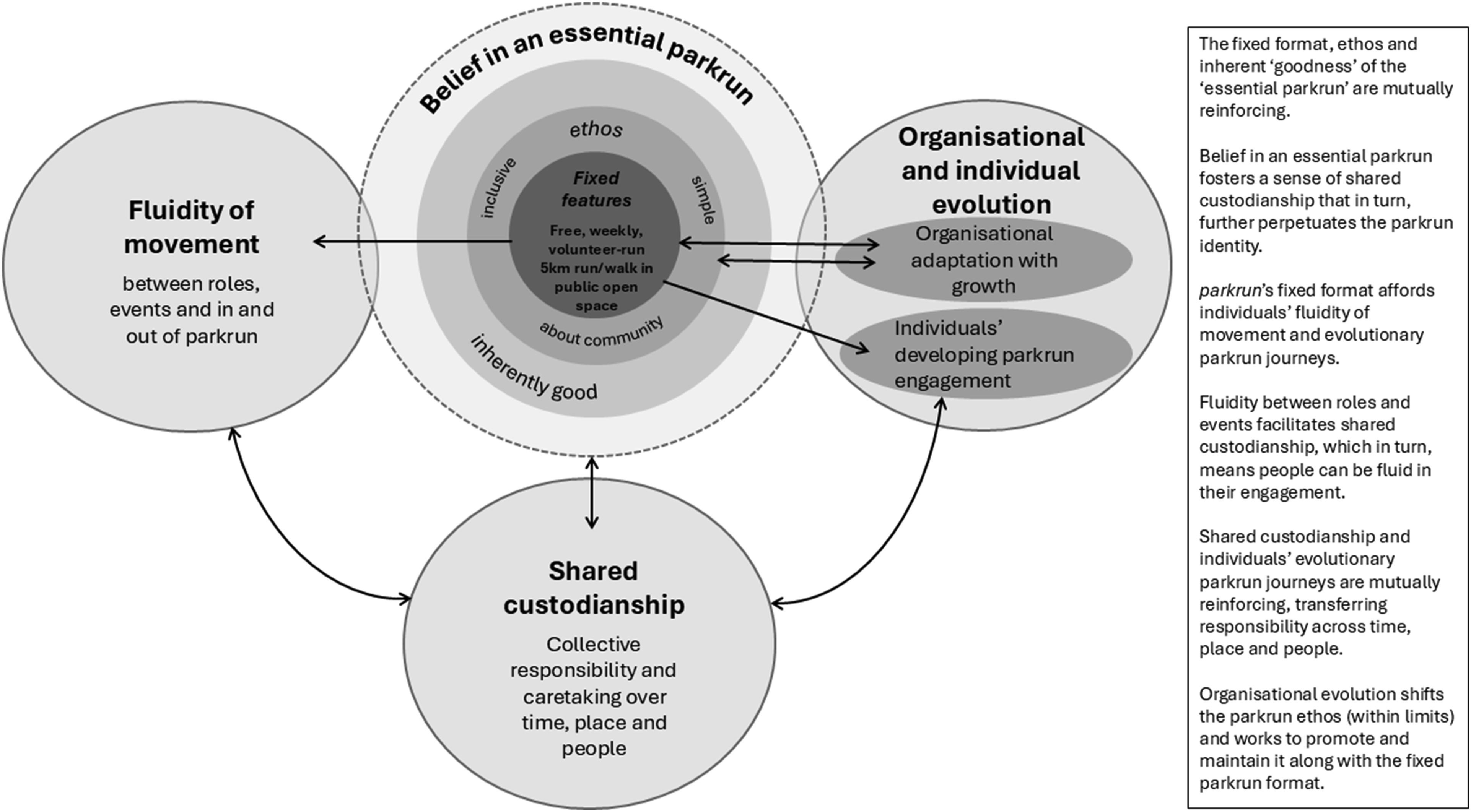
Belief in an Essential parkrun
“Belief in an essential parkrun” was central to interviewees’ explanations for the dissemination and sustainability of parkrun in Australia. At this theme’s core, stakeholders (employees, volunteers, and organizations) believe that there are certain immutable features of what makes parkrun “parkrun,” and people and practices are measured against this concept as either being consistent with or antithetical to it.
The Essence of parkrun
The essence of parkrun seemed to be a combination of fixed features (e.g., event format and operation) and parkrun ethos. At the concrete level, our interviewees talked about parkrun being a free, timed 5 km walk or run held at a fixed time on a Saturday morning in a local public open space and open to people of any age or PA level. These aspects were described in terms of offering a much-valued consistency across all parkruns globally. It is the same everywhere you go, essentially, as long as you know where an event is you can turn up, you can take part, that’s it, and you always know it’s a 5k event, as long as you’ve got your barcode you’re good. I think that to me that is the basis of the success of it. And it’s free obviously … (ED 1)
The standardized operational format not only gave a familiar experience to runners and walkers but also supported the volunteering required to sustain parkrun operations. I knew the process, my daughter knew the process, we knew everything. It was exactly the same. So that’s what I like. (ED 2)
What parkrun is, however, goes beyond the fixed format to what our interviewees believed to be a definable and recognizable ethos. “Ethos” is defined as the distinguishing character, sentiment, moral nature, or guiding beliefs of a person, group, or institution (Merriam-Webster, n.d.). Components of the parkrun ethos included simplicity, inclusivity, and being about (for and from) community. And that is literally in our strategy, simple, safe, sustainable, and we say free forever, and genuinely of course it will be, we would never ever change. (Employee 1) That is what parkrun is about—it’s not about the fast people, it’s about everyone being included regardless of fitness level. (Employee 2) parkrun is a community initiative, by definition, it’s not about an individual, it is about a community. (Employee 3)
The importance of maintaining the essential parkrun was evident in the way implicit boundaries are actively policed at a range of levels across operations. Very occasionally we’ve had—within the team that we’ve had to sort of guide people. If they’re getting a little astray—a little bit away from the parkrun way of thinking. (Ambassador (& ED) 1)
For example, employees, ambassadors, and EDs advised event teams to keep tasks uncomplicated. At the organization level, increased governance and corporatization were viewed as both necessary in the face of rapid growth and a threat to maintaining the simple and “about community” parkrun ethos. To some degree, this misalignment was split along the lines of short- and long-term volunteers or participants; for the latter, these aspects were turning parkrun into something other than the parkrun they had bought into (e.g., fewer rules and more local agency). Either way, simplicity is seen as a principle vital to defend. I actually like the fact that they [parkrun] are really, sometimes strict with how things run. They have to be, because if you vary things at all, then suddenly it loses its magic. (ED 3) I just don’t want parkrun to lose its origin … it was a free community event, and simple event. I think for me that was what it was all about, it was how I met people, it’s how I’ve [sic] still friends with those people that I met 10 years ago. (ED 1)
Similarly, the vision of inclusivity was consciously reproduced at the local level through messaging language and tone, prioritizing images of volunteers and non-elite looking runners. An example of the parkrun philosophy or the parkrun thinking—so just being careful about the way that we post [on Facebook] … it is about volunteer, walk, jog, run … never putting emphasis on time or how fast … making sure that there’s always very inclusive language. (Ambassador (& ED) 2)
Active preservation of the community aspect of parkrun ethos was also apparent, with departures regarded by some interviewees as threatening parkrun sustainability. For example, a sponsor-funded initiative to establish 40 new events in 40 weeks and a well-intentioned effort to enhance inclusivity by establishing a parkrun in an Aboriginal community had bypassed community investment, which led to some parkruns not being sustained: If you don’t have the buy-in from the community in trying to fund an event, they don’t have the ownership, they don’t have the blood, sweat and tears that’s put into those multiple conversations, trying to get funding, that it’s easier to walk away from. and When you go into an Indigenous community, you can’t go in and think you can put something there. They need to have buy-in … We didn’t have buy-in from the elders, we didn’t have buy-in from the local community. (Employee 4)
Although these elements (fixed format, simplicity, inclusivity, and about community) were all consistently mentioned as essential to the parkrun concept, their order of importance and prioritization in operational decision making were partly contested. In some cases, this was revealed in the debate on whether at its heart, it is a PA or social event: It is a social intervention masquerading as a 5-kilometre running event. (Employee 1)
In others, new initiatives sometimes revealed tensions between which essential element should be privileged. For example, many parkruns celebrated special events as fostering inclusiveness (such as International Women’s Day, Clean Up Australia Day, and Pride Week), but some volunteers felt they may compromise parkrun’s simplicity. A lot of people might not agree with what those charities represent and that might discourage them from going to parkrun. So it’s trying to keep parkrun still simple and just as a run in the park without getting too politically involved with other things. (Ambassador 3)
Yet, diversity in what people believed to be the essential parkrun seemed to afford broad appeal and facilitate commitment to the concept rather than undermine it. Although bounded, the multiplicity and elasticity of meaning allowed people to identify or align with parkrun over the long term. It’s purely and simply what you choose to get out of it and that’s really strong. (Ambassador 4)
Parkrun as Essentially Good
Overlaying the combined essence of fixed format and ethos was the conviction that parkrun was inherently “good.” Our interviewees demonstrated this by citing positive impacts they had personally experienced or witnessed. It’s so good for every aspect of a human from physical health to mental health, to community wellbeing. (ED 4) It’s just the most amazing concept … like I said it’s changed my life, and that’s no exaggeration, and I know it’s done the same for so many people. It just builds communities and gets people healthy. (External stakeholder (running club) 1)
“Goodness” could sometimes trump some challenges volunteers faced in running their events, inspiring loyalty to the concept. As exhausted as I feel about it, that’s why I won’t let it go unless I know I can hand the reigns to someone that’s not going to give up on it … it is a really good community event … at the end of the day that’s why I keep on hanging onto it. (ED 5)
As with the parkrun ethos, considerable effort is expended promoting parkrun as beneficial through communications (e.g., “Start your story” campaign, websites, and blogs) and policing where its reputation for good might be threatened (e.g., monitoring and mitigating safety risks; vetting new event applications; and safeguarding).
The parkrun ethos and reputation for good is valuable in securing investment both from participants and external organizations, as well as appeasing antagonistic stakeholders (e.g., community members and local businesses) who might threaten event operation. There was a whole range of things that it fitted into our strategic plan. So from that point of view, it was pretty easy to support it, and that’s where the funding was no issue because it ticked a number of boxes. (External stakeholder (council) 2) Once we … tell them that we run a free community event for people to connect with everyone, create connectivity in the community, and also provide free options for fitness, I think that they probably feel as though their complaints are really a little bit overdramatized. (ED 6)
This theme shows that the parkrun concept draws in resources for reach and dissemination, as well as fostering stakeholder commitment and longevity both internally and externally through a combination of allowing people to make it their own but still having a recognizable and desirable essence.
Fluidity of Movement
A second overarching theme that explains the dissemination and sustainability of parkrun in Australia is fluidity. Fluidity captures how the parkrun model allows people to move in and out of parkrun, between events and social groups, as well as between walker/runner and volunteer roles.
Fluidity in and out of parkrun
Growth in parkrun is the result of continuing attendance of existing participants and the inflow of new participants. Our interviewees’ stories illustrated multiple parkrun entry points as a runner, walker, or volunteer make it readily permeable for those coming to it for the first time. Once people join, the weekly and continuous format without commitment allows parkrunners to develop their own attendance pattern. For example, EDs reflected their event and volunteer numbers fluctuated by season, with lower numbers in winter partly because of weather but also other sports commitments. So over winter, when the kids have their sports, Saturday morning sports, soccer and whatever else they play, the numbers definitely drop off. (ED 7)
Many of our interviewees reflected they were “hooked” from the start, but some noted their initial parkrun engagement was sporadic or had halted, before they participated more regularly. Fluidity in and out of the model also extended to volunteers, as EDs temporarily disengaged and re-engaged to accommodate personal needs. Fluidity appears to foster people’s long-term engagement by allowing their participation to fluctuate according to changing needs, competing interests, and demands. I had some issues outside of parkrun, family issues and that, and just needed to step back a bit … So he [co-ED] took over for a while, and then same thing—he had family stuff that he needed to attend to so I’ve jumped back in just to help out … (ED 8)
Fluidity Between Roles
The concept of fluidity is also illustrated in parkrunners’ ability to move easily between parkrun roles in two main ways. First, there is fluidity in the movement between walker/runner and volunteer. Our interviewees explained that most people participate in parkrun initially as a runner/walker and subsequently some (but not all) volunteer. Initiation is supported by multiple entry-level volunteer roles that are easy to carry out and opt in and out of, and typically leads to regular volunteering. That’s how a lot of volunteers have come into it—through tailwalking, or marshalling, because they know the course that they want to do. It’s an easy role, you just need to smile a bit. (Ambassador 5)
Our interviewees noted roles that combine walking/running with volunteering (e.g., parkwalker and first-timer briefing) could engage those more reluctant to “give up” their run or walk to experience volunteering.
Second, fluidity emerged in terms of the movement between a range of event day volunteer roles, affording variety week to week. Ambassadors and EDs can also adopt these roles for their enjoyment or to support events as needed. Some [Ambassadors] are event directors, some are volunteer co-ordinators, others will parkwalk or tailwalk, or scan, whatever needs doing. Some of them will do first timers welcome because they’re perfect for that, so it is just really what they enjoy doing. (Employee 1)
Fluidity appears to support people’s long-term engagement and parkrun sustainability by offering varied opportunities for engagement (e.g., volunteering when injured), which then enhances variety of experience and benefits gained from both volunteering and running/walking and can reduce volunteer burden. We’ve got it worked out so, roughly, every eight weeks, it’s your turn to be the Run Director. And as much as possible outside of that, you’re free to go to other parkruns or volunteer or run—whatever you want to do. (ED 9)
Fluidity Between Events
Fluidity also manifested in the way individuals can move freely in and out of parkrun events, as their own needs or circumstances change, or to “find the right fit” in parkrun. Individuals could select an event according to physical (size, location, course type, and terrain) and sociocultural (atmosphere, volunteer team culture, social activities, and networks) attributes. That’s the best part, if you think it is boring, go to another parkrun because it’s the same distance, it just doesn’t matter. And who knows? You might find your people … (ED 2)
Fluidity between events can support parkrun dissemination, by allowing existing parkrunners to establish a new event in another location. However, according to employees and some volunteers, these new events largely draw non-parkrunners from the surrounding community, rather than existing parkrunners from nearby events, because of the strong social ties parkrunners make with their home parkrun. What happens is you get new people from that new area coming to that parkrun, but people don’t suddenly redistribute because they have loyalty … so if a new one opens even five kilometres away, it won’t necessarily mean that everyone will jump ship because it’s a community that you’re building. (Ambassador 6)
Allowing movement between events has also spawned “parkrun tourism” (Sharman et al., 2019), where people participate in a parkrun other than their home parkrun to gain variety while retaining the familiarity generated by its consistent format. Although not all aspire to “parkrun tourism,” many actively sought out events further afield and even planned holidays around events of interest. parkrun tourism can stimulate social connection beyond individuals’ home event and ongoing commitment to the broader parkrun concept. I fell in love with parkrun tourism, which is my main big motivator—I love visiting other parkruns. (Ambassador 5)
EDs from smaller regional events expressed positive perceptions of tourists increasing event numbers and adding interest for regulars. But EDs from larger events, typically popular coastal holiday locations, expressed more negative perceptions arising from an increased burden on volunteers and added safety risks that could jeopardize community and landowner relationships.
Organizational and Individual Evolution
Our third theme that may explain the successful dissemination and sustainability of parkrun in Australia is “Organizational and individual evolution,” capturing how the organization responded at the philosophical, governance, and operational levels to the increasing number and size of events, and how individuals related to their local event and the concept of parkrun over time.
Organizational Evolution
Many employees and volunteers described a shift in recent years in global parkrun’s mission and principles from a 5 km timed running event to a more inclusive social event. Largely informed by internal surveys uncovering barriers to participation, coupled with externally generated evidence of impact, parkrun placed a greater emphasis on promoting inclusivity for broader reach and benefit, including more vulnerable and typically less active groups (e.g., culturally and linguistically diverse populations, refugees, and veterans). It was a time trial event for runners and then once it started expanding, it slowly turned into a community thing … over time our ideologies and the ethos of parkrun changed. (Employee 5)
Inclusivity was promoted through the global parkwalk initiative and a repositioning of volunteering as an equally beneficial form of parkrun engagement, to broaden appeal and encourage volunteering. That is, many of our interviewees were working toward shifting perceptions of volunteering from being an operational necessity endured for the greater good to an opportunity to receive social and well-being benefits. People get the same, if not more, happiness and healthiness, being healthier by volunteering. So we try and promote volunteering in that way, but there’s a lot of people that came into parkrun when we did see it as a necessary evil. (Employee 4)
These strategies may enhance event sustainability by drawing in a broader range of people into parkrun, affording a larger pool from which to recruit volunteers. It also enhances volunteer resources by providing engagement opportunities for those not interested in running or walking and for injured parkrunners. New ambassadors and EDs were onboarded with the revised vision aimed at increasing sustainability. We try and bring everybody with us, but it’s a point in time where events starting after that, that’s the way they’re trained. (Employee 6)
Evolution was also revealed in the way the organization responded to its increasing size with changes to governance and operations (e.g., strategies to increase event operational support, diversify revenue sources, improve financial management processes, and secure partnerships and sponsorship). We need the level of investment and sponsorship that we have to keep, not just the lights on, but also extend our impact as far as it can … and also ensure that parkrun remains free. (Employee 6)
The (volunteer) ambassador program appears critical to managing parkrun dissemination through enhanced operational efficiency and philosophical consistency. Employees also welcomed the organization’s first 5-year global strategy, anticipating greater flexibility in how regions operationalize parkrun principles locally, while maintaining consistency in the outward-facing model.
Individual Evolution
Individual evolution links closely to the fluidity theme, but we conceive it as a forward movement or progression in parkrun engagement rather than the lateral movement between parkrun roles and events. Our interviewees’ parkrun journeys reflected how individuals’ perceptions, drivers, and level of engagement with parkrun often evolved over time with accumulated experience, capabilities, and social connections. Whatever their first reason for joining, many reported finding other aspects they stay for, including friendships, new skills, giving back to their community, or new physical activities. I thought, okay, I’ll volunteer … and from the moment that I did that my whole experience changed because then I just really felt it suddenly opened up and I had a completely different feeling about it, like being really part of the community and started to get to know lots of people, got more immersed and more involved. (Ambassador (& ED) 2)
Our interviews also showed how individuals’ parkrun engagement evolved because of gamification. Initial participation in a single 5 km event evolved into ongoing personal projects to achieve faster times, participation, and volunteering milestones, as well as other participation challenges through the (unofficial) “5K” app (https://www.parkrunner.app/). For example, the alphabet challenge involves completing events commencing with each letter of the alphabet. Now we have people going and doing all those challenges in other areas. So they’re traveling to other ones. And then now there’s a volunteer one, so people are doing volunteering for that so they can get up to some challenge on that app. (Ambassador (& ED) 7)
By allowing individuals’ parkrun journey to evolve over time, the parkrun model enhances participants’ engagement and fosters long-term commitment, harnessing internal resources for delivery and sustainment.
Shared Custodianship
A final theme that explains the dissemination and sustainability of parkrun in Australia is shared custodianship, which conceives of parkrun’s operation and continuation as shared across time, place, and people.
Collective Responsibility
Our interviewees perceived their roles as being part of something larger, where individual volunteers and employees are not only responsible for tasks locally but also to maintain the larger parkrun phenomenon, contributing a small but necessary part of the global parkrun effort with far-reaching impact. Every now and then, we’ll get a visit from the event ambassador or—and it gives you that feeling, right we are part of something bigger. (ED 9)
The conceptualization of parkrun as good or positive (as noted in Belief in an essential parkrun) was key here, in that people derived a sense of pride in being one part of a movement for good. What I do outside work contributes to thousands of people [region removed] getting fit and healthy every weekend. And there’s very few of my colleagues that can actually say that they have a volunteer role in the community that does that. (Ambassador 6)
Collective responsibility was also reflected in the devolution of responsibility from central administration to ambassador, ED, and other volunteer roles. Our interviewees indicated that the devolved model entrusted volunteers not only to deliver the standardized operational format but also to reproduce the intangible aspects (ethos and reputation) in good faith. What everyone is doing is working towards something that we are all passionate about, and which is enabling this opportunity for more and more people. (Employee 4)
Collective responsibility and distributed value were reinforced by a perceived lack of hierarchy in event teams; shared and equal event leadership was highly valued. Rank, by contrast, was viewed as negative and fostering exclusivity in opposition to the essential parkrun ethos and threatening the supply of volunteers. So it’s not a hierarchy as in, we’re more important, but I guess it’s just different roles and responsibilities. (ED 10)
Recognition of the value of a devolved and distributed workload approach has recently been enshrined in pre-requisites for new parkrun set-up; aspiring EDs must demonstrate that they have a network from the outset.
Collective responsibility appears to contribute to sustainability of parkrun through fostering volunteers’ authentic buy-in and commitment through enhanced role satisfaction and mitigation of potential burnout.
Caretakers Not Owners
A sense of caretaking rather than ownership of events was another dimension of shared custodianship. For instance, EDs were largely described by our interviewees as taking carriage of an event for a period and then another would take it on and sustain the event beyond their tenure. They [EDs] understand that they’re the custodians of events, but the idea of the event will be there forever and we’ll eventually pass it on. (Ambassador 5)
Temporary caretaking was also reflected in the way event teams refreshed through volunteer succession to sustain the event beyond individuals. Event teams would actively seek new members, train existing members into new roles, and build their knowledge and capability. We should be completely replaceable if we want the event to live on. Yeah, so building a good culture, training up people and having that, I guess, succession plan from the Event Directors to the Run Directors to the core volunteers. (ED 11)
EDs who were perceived as exhibiting possessiveness or tight control over an event or reluctant to allow RDs to assume greater responsibility were viewed negatively as this went against the principle of custodianship rather than ownership. So it’s not about their own thing, it’s about this parkrun event which is an important thing that some EDs don’t understand. It’s not their event personally, it’s a parkrun event. (Ambassador 5)
Negative connotations of ownership also extended to major sponsors’ parkrun promotion and equipment branding. When I see the ads and hear the ads, I think here they [major sponsor] are claiming this amazing initiative as their own. It’s not theirs. (ED 7)
Together, collective responsibility and caretaking, rather than ownership, foster a sense of shared purpose and pride in parkrun’s achievement, promoting employee and volunteer commitment to event and organizational sustainment. parkrun benefits from shared custodianship by reducing the load on any one or few individual(s) to avoid burnout.
Discussion
Our study contributes much needed practice-based evidence on the system-level features, contextual factors, and mechanisms underpinning successful dissemination and sustainability of parkrun in Australia (Grunseit et al., 2020). Drawing on experiences of 67 key parkrun stakeholders in Australia, our findings revealed four interwoven themes that illuminate important factors for dissemination success and sustainment, namely, a “belief in an essential parkrun” comprising fixed features and ethos; fluidity in movement afforded by the model; organizational and individual evolution; and shared custodianship of events and the broader parkrun phenomenon. These features of the parkrun model support replication across varied contexts, draw people into parkrun, sustain their interest, and harness resources for dissemination and sustainability.
We found a belief in an essential parkrun comprising fixed features, a recognizable ethos, and a clear positioning of the parkrun concept as good. Despite variation in which aspects of ethos were seen as most essential to preserve or valuable, consistent with previous findings (Bowness et al., 2020), the significance to parkrun sustainability and dissemination was clear and seemed to be three-fold. First, on a practical level, being free and offering a range of challenge (from walker to elite runner to volunteer) fosters broad appeal to potential participants. Further, the essential parkrun is seen as easily replicable and recognizable, and so can be disseminated to new locations and recruit new volunteers. Hence, the model fosters a steady inflow of people walking or running and fulfilling the roles required to run events. Second, on a more philosophical level, participants invest in and identify with parkrun so continue to support it to function and promote it externally. Third, the community-driven, inclusivity, and force for good aspects of parkrun appeal to external organizations from which resources may be leveraged. The consistent fixed format and production and promotion of a desirable and recognizable ethos make parkrun simultaneously describable and something which can be mutually beneficial to participants, sponsors, and partners.
Belief in an essential parkrun resonates with the construct of organizational identification, conceptualized as individuals’ sense of solidarity with an organization that can account for their agency, action, and commitment (Albert et al., 2000; Wegner et al., 2021). Having a multifaceted organizational identity can enhance its appeal and significance across time, place, and people (Wegner et al., 2021). The strong but flexible attachment to the parkrun concept appears to support sustainability, by helping the organization build a socially cohesive community, or an “organic solidarity” (Bowness et al., 2020; Mitchell, 2023) willing to promote the concept further and guard against deviations from its essence. Importantly, parkrun’s permeability and broad appeal may avoid potential pitfalls of cohesive groups such as rigid boundaries and exclusivity. Organizational identification appears particularly relevant to dissemination and sustainment of bottom-up, organically disseminating initiatives, warranting their consideration in scalability and sustainability frameworks.
The “tight–loose–tight” approach to innovation also appears relevant to features of parkrun dissemination and sustainability. The approach acknowledges the complexity within systems in which at-scale dissemination occurs (Dickens, 2016) and has been applied in other population health initiatives (Conte et al., 2017; Cranney et al., 2023). Using a reverse hourglass analogy, the “tight–loose–tight” framework involves a minimal number of clear specifications to achieve a specific goal (tight), requires “letting go of the reins” by providing flexibility for creativity and innovation in how individuals and teams reach this goal (loose), and ensures accountability by monitoring whether the goal is achieved (tight).
First, in parkrun, there are clear, core operational elements that events must comply with representing the “tight” component (fixed format, safeguarding, maintaining safety). Less tangibly, certain principles, namely, simplicity, inclusivity, and community-focused, were embedded in employees’ and volunteers’ practices and communications. Second, in terms of the “loose” component of the approach, the parkrun model offers some flexibility outside of these specifications for local contextual adaptations (e.g., course type and event culture), devolving event management to local teams. The simplicity and consistency of parkrun’s format allows many events to function with relatively minimal direct oversight from the central administration. The “loose” approach works over time and place because the concrete specifications and the less tangible elements (e.g., reproducing parkrun ethos) are mutually supportive and there is collective and distributed responsibility. This more contemporary socialized leadership approach is shared, relational, and may foster multiple stakeholders’ commitment to purpose and value (Whyte et al., 2022).
Third, the bookending “tight” component is reflected in both formal and informal monitoring. Analysis of registration and participation data, participant surveys, and externally driven research (parkrun, 2023) provided evidence of parkrun’s reach, engagement, and impact (Grunseit et al., 2020; Haake et al., 2022; Quirk et al., 2021), to leverage external structural support (e.g., funding and sponsorship). We also found an informal surveillance by volunteers and participants, engendering an authentic commitment to sustaining the broader parkrun concept by maintaining its concrete and recognizable features, ethos, and reputation. True to the tight–loose–tight model (Dickens, 2016) and complex systems theory (Hawe et al., 2009), adherence is to principles and function rather than simple fidelity to delivering predetermined intervention components. parkrun appears to have harnessed the power of a distributed informal surveillance system whereby peer monitoring occurs against pre-established ideals and norms (Leclercq-Vandelannoitte, 2022).
Our findings reaffirm our understanding of some key principles for successful at-scale dissemination and sustainability of population health interventions. For instance, principles of organizational learning and adaptation are recommended for enhanced dissemination and sustainability (Milat et al., 2016; Schell et al., 2013). Our analysis shows that parkrun growth as described by our Australian interviewees required balancing of the perceived “essential” elements of parkrun with remaining viable. Consequently, parkrun underwent an iterative process of internal reflection and adaptation through governance, policy, strategy, partnerships, and operations without substantially changing the participant experience to manage its rapid growth.
Our analysis also extends how monitoring and evaluation processes recommended for scaling up and sustainability of population health interventions may be operationalized (Milat et al., 2016; Schell et al., 2013). In contrast to the formal way these processes are conceptualized in scaling-up and sustainability frameworks, parkrun has a devolved responsibility model that fosters strong organizational identification and acts as an informal means by which adherence to the fixed format and “feel” essential to the parkrun model is monitored and promoted.
The parkrun dissemination experience also illustrated how an initiative can scale organically and remain sustainable by mobilizing a large voluntary workforce from within, in contrast to the more common researcher-led, purposeful, and centrally driven grafting approach to dissemination assumed in previous scalability and sustainability frameworks (Milat et al., 2016; Reis et al., 2016; Schell et al., 2013). Our research showed how parkrun’s blurring of the traditional division between the service provider and recipient as well as collective responsibility facilitated organizational capacity to expand by integrating a dynamic but sustained pool of willing labor into the initiative. Organizational identity and socialized responsibility may prove useful principles not only to the scalability and sustainability of organic, community-driven initiatives but also to PA and population health initiatives more broadly.
Consistent with previous research, we found parkrun is understood by stakeholders as “naturally inclusive,” due to its accessibility, underlying ethos, multiple entry points, and distinctly social nature that emphasizes participation over performance (Fullagar et al., 2020; Grunseit et al., 2020; Sharman et al., 2019). Yet, other research has demonstrated that in practice, inequities exist in geographical access (Smith et al., 2022) and lower participation of socioeconomically disadvantaged groups (Smith et al., 2021) and ethnic minorities (Smith et al., 2020). Continued parkrun efforts to prioritize inclusivity are warranted, which may contribute to a more equitable outcome in future dissemination. However, this may not be without challenges, as our analysis demonstrated greater equity cannot simply be addressed by setting up new parkrun events in areas of greatest need. The recognizable community-driven principle of parkrun may be at odds with the drive for equity and where compromised events may be unsustainable. Also, concomitant provision of contiguous green space in low-socioeconomic areas is needed (Grunseit et al., 2024), reiterating the call for more equitable distribution of quality public open space for population health benefit (Astell-Burt et al., 2014; Mushangwe et al., 2021). Equity of access and fairness are key to scaling interventions for population impact and warrant consideration in future scalability frameworks to avoid reinforcing existing inequities (Corôa et al., 2023).
Strengths and Limitations
Ours is the first study to examine the parkrun model’s system-level features, contextual factors, and mechanisms that explain how parkrun has achieved widespread dissemination and sustainability. We believe our findings are potentially transferable (Hanson et al., 2019) across varied contexts, as we have drawn on the perspectives and experiences of multiple key informants working across different levels of parkrun in a variety of localities. Moreover, the evolutionary changes described in the parkrun Australia organization are likely to apply more widely given the consistency of the parkrun model across countries; however, we acknowledge the extent of this will somewhat depend on stage of dissemination and the cultural, environmental, and political contexts. Our results may be skewed to more positive experiences of parkrun, as our participants may have been more passionate about parkrun than those who declined an interview. Only one ED interviewed was no longer serving, and EDs for discontinued events declined to participate. However, our interviewees were able to reflect on prior-serving EDs and discontinued or relocated events. The requirement for sufficient English may have precluded some potential interviewees from consenting. However, it is likely that most, if not all, of this population would have had English-speaking skills sufficient for interview given the demands of the roles they occupy. The inclusion of external parkrun stakeholders at the local level is also unprecedented, albeit a small proportion of those invited. A broader perspective of external stakeholders including national sponsors and partners would be valuable.
Conclusion
parkrun is an effective social PA intervention demonstrating important lessons for the public health field in sustained at-scale dissemination. As an organically disseminating and volunteer-led initiative, it shows how concepts such as ethos, devolved responsibility, and custodianship may be important elements in dissemination and sustainability not previously considered in work on intervention scale-up and sustainment. It also highlights monitoring to support adherence to intervention principles is not always formal or data-driven but may be informal and socially driven. Future research could explore how the organic model of parkrun compares with more traditional, centrally driven initiatives in terms of principles for scale-up and sustainment to contribute knowledge about how PA interventions may be best configured for population impact.
Footnotes
Acknowledgments
We gratefully acknowledge the contributions of parkrun Australia staff to sample selection and recruitment and the parkrun Global Research Board for approving this research. We thank all participants who generously shared their time and parkrun experiences and Dr. Jenny Plumb for conducting interviews.
Declaration of Conflicting Interests
The author(s) declared no potential conflicts of interest with respect to the research, authorship, and/or publication of this article.
Funding
The author(s) disclosed receipt of the following financial support for the research, authorship, and/or publication of this article: This research was supported by the National Health and Medical Research Council Ideas Grant (2021/GNT2012418). Verity Cleland is supported by a National Heart Foundation of Australia Future Leader Fellowship (2021–2024, ID104892).
