




Abstract
Making sense of the social world is an intricate process heavily influenced by cultural elements. Gambling is a prevalent leisure-time activity characterized by risk-taking conduct. While some individuals who engage in it do so without experiencing any harm, others will develop gambling problems. Judaism tends to perceive gambling negatively since it contradicts fundamental Jewish principles. The current study focuses on the Jewish Ultra-Orthodox community in Israel which is characterized as a cultural enclave with minimal interaction with the secular world. Hence, it provides a unique and novel socio-cultural context to inquire how individuals with gambling disorder (GD) from this community make sense of gambling. Following constructivist grounded theory guidelines, 22 Ultra-Orthodox men with GD were interviewed using a purposeful sampling design. Sixteen Rabbis were also interviewed, illuminating the socio-cultural context of Halachic regulations and norms regarding gambling in this community. An abductive analysis of the data, interwoven with Bourdieu’s concept of habitus, yielded an overarching theme that we dub as “sense for gambling,” encompassing matrices of Ultra-Orthodox external (e.g., a conservative cultural structure with numerous prohibitions and life marked by poverty) and internal (e.g., feelings of loneliness, dissatisfaction, and deviance) dispositions imprinted onto the body, creating diverse embodied reactions (emotional and sensory) to gambling, and leading to developing GD. We recommend placing the body, as the locus of internalized dispositions, at the core of examination when researching pathways to GD. We propose that this intricate interplay between external and internal dispositions shapes the decision-making regarding gambling, thus mitigating individual responsibility for GD.
Introduction
Individuals are constantly engaged in making sense of their world (Sewell, 2005). They navigate gaps and inconsistencies (Boltanski & Thévenot, 2006), construct intelligible reasoning for how things are framed together (Fiss & Hirsch, 2005), and make choices accordingly (Weick 1995). Gambling, once a moral concern (Cosgrave & Klassen, 2001), has evolved into a mainstream leisure activity marked by risk-taking behavior (Casey, 2008). Ample studies inquired regarding individuals’ choices to gamble (Sleczka et al., 2022; Spångberg et al., 2022; Wardle, 2019) and specifically asked about pathways to developing gambling disorder (GD) (Mestre-Bach et al., 2022; Nower et al., 2022). However, a notable gap exists in comprehending how individuals with GD make sense of their choice to gamble (Canali et al., 2021; Lopez-Gonzalez et al., 2020).
In Judaism, gambling is generally viewed negatively (Benjamin et al., 2016) due to its contrast with core Jewish values like hard labor and modest living (Copans & Olitzky, 2009). The Jewish Ultra-Orthodox community in Israel is a conservative and rigid manifestation of Judaism, forming a cultural enclave (Sivan, 1995) with limited engagement with the secular world (Almond et al., 2011), making it an intriguing and novel social and cultural field to explore how individuals from this community with GD make sense of gambling. The current study followed the constructivist grounded theory guidelines (Charmaz, 2014) in addressing this research objective.
Theoretical Framework
Sense-Making of Gambling Among Individuals With Gambling Disorder
Individuals make sense of their world. They cognitively and symbolically understand, explain to themselves and others, and navigate the complexities of their social and cultural world, considering structural factors, their personal history, and preferences (Goffman, 1959). To accomplish it, they categorize ideas, perceptions, and objects (Durkheim, 1995), interpret their social world (Garfinkel, 1967), position themselves in relation to others (Lamont, 1992), give weight to moral considerations (Kleinman, 2006), choose between different lines of actions (Swidler, 1986), and justify their choices (Boltanski & Thévenot, 2006).
Gambling constitutes a legitimate leisure-time activity in the contemporary secular Western world (Casey, 2008), reflecting an ethical change from moral beliefs that advocate for hard labor, diligence, and a spartan lifestyle (Cosgrave & Klassen, 2001) into a consumer society (Bauman, 2004) characterized by increased risk-taking behaviors (Giddens, 2006). However, superfluous and excessive involvement in gambling is considered a pathological activity in the fields of healthcare, education, and therapy in many Western countries (Gavriel-Fried & Ronen, 2015).
The American Psychiatric Association defined gambling disorder (GD) as the first behavioral addiction in the DSM-5 (APA, 2013). It is considered an addictive disorder alongside other recognized addictions, for example, alcohol and drugs (Yau & Potenza, 2015). Individuals with pathological gambling experience diminished control over their gambling behaviors (Nower et al., 2020), thus harming themselves (Potenza et al., 2019) and their significant others (Riley et al., 2018). Their excessive involvement with gambling is perceived as deviant, and they are stigmatized as “problematic gamblers” (Andrà et al., 2022).
Diverse studies show that when individuals make sense of gambling, they claim that it is a fabric of their everyday life (Wardle, 2019) and rationalize it as a form of a profession (Istrate, 2011) and as a method of gaining money and achieving social mobility (Casey, 2020). They argue that it involves a combination of socio-cultural influences, attitudes, and perceptions toward gambling (Spångberg et al., 2022) and describe it as an activity driven by individual urges for self-gratification, thrill-seeking, need for excitement, etc. (Sleczka et al., 2022). These intricate logics to engage with gambling are even more complex when exploring paths leading to the development of GD (Kurilla, 2021; Nower et al., 2022). Pathways models to GD argue that developing GD is a process involving a combination of multiple risk factors, for example, personal traits (Allami et al., 2017; Mestre-Bach et al., 2022), levels of social support, self-control, and life satisfaction (Hearn et al., 2021) that interact and together produce diverse plausible pathways to developing GD (Excell et al., 2022).
However, to the best of our knowledge, only a handful of recent studies focused on how individuals with GD make sense of gambling (Canali et al., 2021), specifically, considering the complex relation between external constraints they experience in their everyday lives, for example, access to financial resources (Heiskanen, 2017), and government policies like legalization of electronic gambling machines (Miller et al., 2018), in combination with their internal motivations to gamble (Lopez-Gonzalez et al., 2020).
An Intricate Encounter Between Gambling and the Jewish Ultra-Orthodox Community in Israel
Generally, when the social world is familiar to individuals through socialization, they tend to act like “fish in water” (Bourdieu & Wacquant, 1992, p. 127). However, when individuals come across a field with which they are not acquainted, the resulting disjunctures can generate change and transformation since individuals are creative and can invent a myriad of unpredictable practices to navigate and make sense of their unfamiliar social world (Bourdieu, 1990).
The Ultra-Orthodox community is a closed religious and conservative group (Friedman, 1991) that relatively segregates itself from the outside world (Almond et al., 2011). Ultra-Orthodox men and women express their belonging to this community through their dress code, hairstyle, dietary preferences, gestures, and whole body movements (Heilman, 1992). To preserve their unique way of life amid challenges from the secular world, the Ultra-Orthodox community reinforces its religious identity through increased religious studies and the establishment of religious schools and institutions (Cohen, 1999), while concurrently strengthening their commitment to the spiritual, social, and cultural guidance of Ultra-Orthodox Rabbis (Brown & Leon, 2017). These religious leaders legitimize the community’s social order by dominating the religious knowledge, imposing it on its members, and providing them with justification for the community’s social and cultural order (Bourdieu, 1987).
The Ultra-Orthodox community in Israel stands at the heart of this study, comprising 12.6% of Israeli society (Malach et al., 2020). It is composed of a diverse tapestry of sects and groups, with two main subdivisions: Ashkenazi (Lithuanian and Hasidic) of European lineage and Sephardi with Middle Eastern or North African roots. Each subgroup maintains unique customs, affiliations with respective Rabbis, and distinct religious practices (Leon, 2016). Nevertheless, all these groups form together a cultural enclave in Israel (Sivan, 1995) with fixed social, cultural, educational, technological, geographic, and ideological boundaries (Golan & Fehl, 2020) that isolate its members and limit their engagement with the secular and modernized Western world (Almond et al., 2011). Thus, their social world comprises limited external options (Heilman, 1992). The men are encouraged to dedicate all their time to studying the Jewish texts, for example, the Hebrew Bible (Torah), the Babylonian Talmud, and Rabbinic literature (Finkelman, 2011), and the women are socialized to fulfill their religious devotion by caring for their households and its numerous children (Teman & Ivry, 2021).
Globally, monotheistic religions view gambling negatively, but within the specific context of Judaism, there is no universally accepted stance (Benjamin et al., 2016). Judaism emphasizes a modest life, productive work, and security, which often clash with the risks and uncertainties associated with gambling, posing challenges for Jewish communities (Copans & Olitzky, 2009). However, Jewish traditions do include games of chance, like the dreidel game during Hanukkah, introducing an element of gambling into the festivities (Steinberg, 2007). Consequently, while gambling is a common recreational activity during Jewish holidays, like in other religions, excessive gambling is generally disapproved of due to its perceived violation of Jewish religious norms and beliefs (Kumar et al., 2011).
The Current Study
The Ultra-Orthodox community in Israel provides a unique social setting for examining how individuals with GD make sense of modern gambling practices and navigate through this social field, which deviates from accepted forms of gambling within Judaism and is somewhat unfamiliar to them, breaching the context of their close-knit social and cultural enclave.
Following the dearth of empirical research addressing how individuals with GD make sense of gambling, especially within the closed and conservative Jewish Ultra-Orthodox community in Israel, and the pivotal role of Rabbis within this community, the current study aimed to explore a broad research question: How do Ultra-Orthodox men with GD make sense of gambling that breached the boundaries of the Jewish Ultra-Orthodox enclave in Israel, and how do Rabbis perceive gambling problems within this community?
Method
This study is part of a broader research project that delves into the phenomenon of addiction to gambling among Jewish Ultra-Orthodox men in Israel. To the best of our knowledge, this marks the first exploration of this subject within this field, leading us to employ a constructivist grounded theory (CGT) approach. CGT was chosen due to its interpretive and exploratory nature, and its emphasis on theory-building derived from the data (Charmaz, 2014). Furthermore, CGT allowed us to abductively interpret the participants’ narratives and consider various theories to illuminate our findings (Reichertz, 2019), making it well-suited for this novel research.
Upon receiving ethical approval from the Institutional Review Board at Tel-Aviv University, we initiated the data collection process for the current research segment, which unfolded in two distinct phases. The first phase involved field mapping, conducted from November 2021 to March 2022, which included observations of gambling behaviors in Ultra-Orthodox localities in Israel, interviews with nine key informants (Rabinow, 2007) including mental health specialists assisting men with GD in this community during their recovery process, and participation in Gamblers Anonymous meetings in which Ultra-Orthodox men attended. Participant observations during these meetings were intentionally not recorded to respect the confidentiality and rules of these meetings.
The second phase consisted of interviews with 16 Rabbis, conducted from December 2021 to May 2022, and interviews with 22 Ultra-Orthodox men with GD, spanning from December 2021 to August 2022 using a purposeful sampling design (Sandelowski, 1995) to capture the rich tapestry of Jewish Ultra-Orthodox groups. The men varied in age and family backgrounds, with some having active gambling problems while others were in recovery. However, all men grew up within the Jewish Ultra-Orthodox community in Israel and met the minimum criteria for GD according to the DSM-5 (Potenza et al., 2019). The Rabbis also represented a mosaic of Jewish Ultra-Orthodox sects, each with varying religious statuses and distinct community roles. Notwithstanding this diversity, a fundamental consistency prevailed—all the Rabbis possessed a deep understanding of Rabbinic Halacha and occupied positions of religious authority.
The interviews began by obtaining the interviewees’ consent and were recorded and then transcribed verbatim. In addition to this, we wrote field notes after each interview to assist in directing the analyses. The interviews with the men typically lasted for about an hour, while the interviews with the Rabbis ranged between 20 minutes to an hour. During the interviews, the men were initially presented with a broad question: “Could you share your experience as a Jewish Ultra-Orthodox man who developed a gambling disorder?” Subsequently, more focused questions were posed, which varied based on the evolving data analysis and the responses provided by the interviewees. For example, when the category of “Jewish Ultra-Orthodox dispositions” emerged, we specifically asked the men “what is the role of the Ultra-Orthodox community in your path to developing addiction to gambling?”. The Rabbis were also presented with a broad question: “what do you know about gambling in your community?”, followed by more focused questions.
Data Analysis
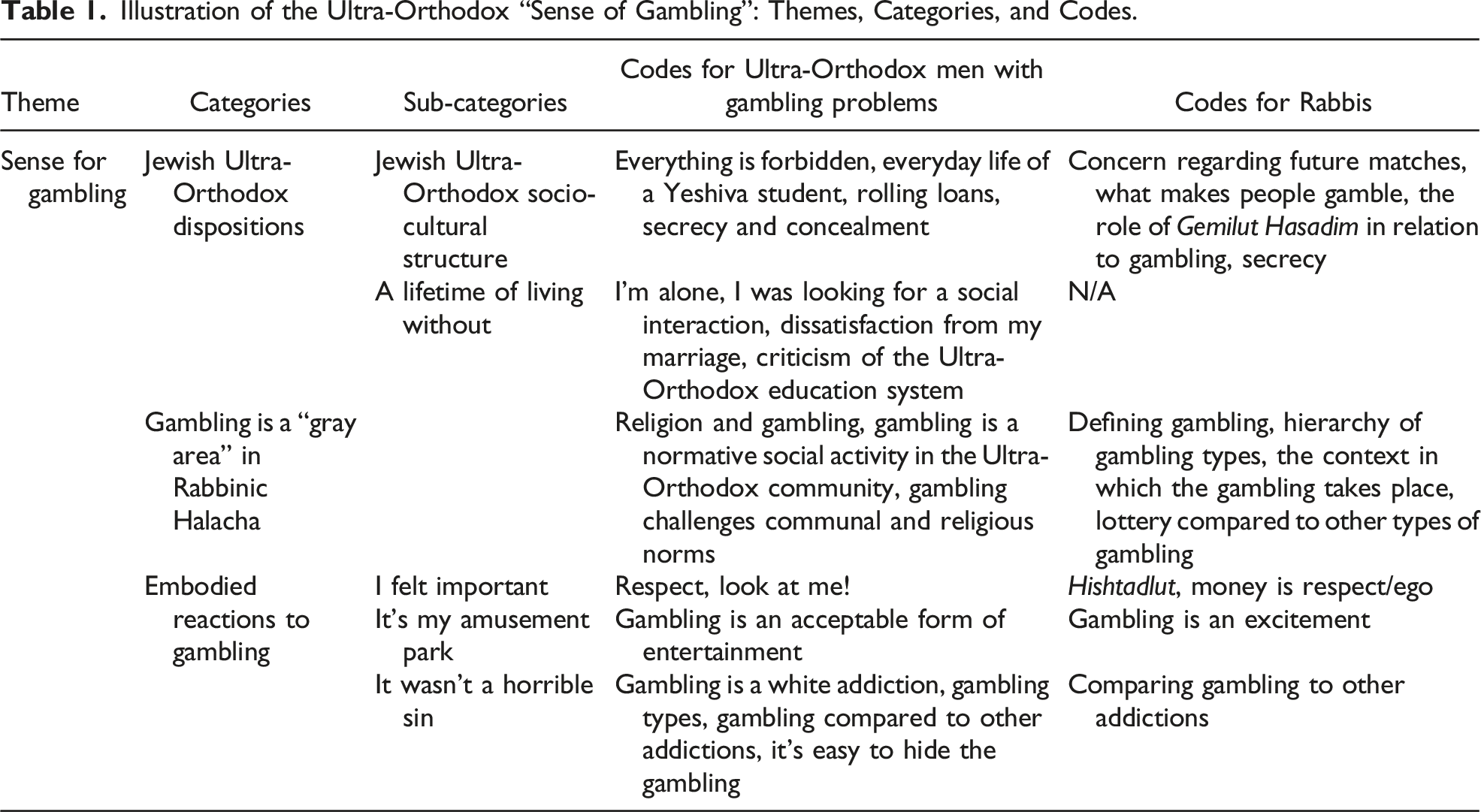
Following CGT guidelines (Charmaz, 2014), we conducted simultaneous data collection and analysis. During our research team meetings, we openly coded transcriptions of six interviews (three with men and three with Rabbis). Each line was meticulously coded, accompanied by memos to deepen our shared data comprehension. For instance, the code “rolling loans” was clarified in a memo as “Gemilut Hasadim [the bestowal of loving-kindness] as a source for obtaining funds for gambling.” This interpretation encapsulated the men’s descriptions of how the Ultra-Orthodox community’s structure contributed to their development of GD. Similarly, the code “the role of Gemilut Hasadim in relation to gambling” for the Rabbis was elucidated in a memo as “Gemilut Hasadim as a source of interest-free loans that facilitated gamblers in managing their debts.”
Illustration of the Ultra-Orthodox “Sense of Gambling”: Themes, Categories, and Codes.
Trustworthiness of the Analysis
By following the guidelines of CGT, researchers aim for methodological rigor. The quality of such research can be evaluated based on four core criteria: credibility, originality, resonance, and usefulness (Charmaz & Thornberg, 2021). Credibility was ensured through rigorous techniques such as team coding, memoing, data triangulation, and subsequent discussions with our informants regarding our interpretations, thus fostering transparency in methods and analysis. The originality of our work was achieved by advancing our understanding of pathways to GD by emphasizing the role of the body as the locus of structural and individual embodied dispositions in developing addiction. Our findings resonated with the complexity of how Ultra-Orthodox men with GD make sense of their experiences with gambling. The utility of this research lies in its potential to enhance future therapeutic practices for individuals within closed and conservative communities that will be tailored to the intricate needs of these individuals while also paving the way for new directions in future research.
Findings
Merleau-Ponty’s phenomenological perspective emphasizes that socio-cultural influences and innate traits shape human experiences, motivations, perceptions, and interpretations over time. These elements are imprinted onto the human body, affecting how individuals engage with the world (Merleau-Ponty, 2004). Bourdieu’s habitus framework extends this notion by underlining the role of the body and its sensory experiences in the process of sense-making. Habitus represents deeply ingrained dispositions and societal norms inscribed into individuals’ physical being, significantly influencing their perspective on life and the surrounding social reality (Bourdieu, 1990).
The findings of the current study emerged into three main categories revolving around the Ultra-Orthodox habitus: Jewish Ultra-Orthodox dispositions, gambling is a “gray area” in Rabbinic Halacha, and embodied reactions to gambling. The interplay of Jewish Ultra-Orthodox external and internal dispositions imprinted onto the men’s bodies created a complex matrix of sensory and emotional reactions to gambling, which is considered a “gray area” within Rabbinic Halacha, ultimately influencing the development of GD among them. As will be described below, these findings highlight the intricate relationship between the body, structural influences, individual histories, personal preferences, and sense-making in the context of gambling behaviors among this social group.
Jewish Ultra-Orthodox Dispositions
The Ultra-Orthodox men struggling with GD exhibited a complex interplay of Ultra-Orthodox dispositions, both external and internal, which shed light on the profound influence of their socio-cultural context on their behaviors, emotions, and reactions to gambling. The men described external dispositions deriving from a conservative and closed social structure in which almost everything is forbidden. They added that Jewish Ultra-Orthodox individuals live in poverty and are required to rely upon loans rolling, and they described it as a socio-cultural context in which everyone is socialized to a life of secrecy and concealment of everything that might be considered even slightly deviant. The men also highlighted their internal dispositions, which included feelings of loneliness, dissatisfaction, a pervasive sense of inadequacy, and an awareness of their own deviance within the community. These emotional and cognitive aspects emerged from their unique individual histories and personal experiences, representing a more nuanced layer of their habitus.
Jewish Ultra-Orthodox Socio-Cultural Structure
The Ultra-Orthodox men with GD and the Rabbis discussed the Jewish Ultra-Orthodox doxa, that is, the values, norms, and forms of conduct (Bourdieu, 1991) lying at the heart of the Ultra-Orthodox community’s culture. They addressed the closed, narrow, and restricted religious structure in which almost everything outside the community is forbidden. One of the men shared, “My family is very conservative […] no place for anything outside the Ultra-Orthodox community” (#10, age 30, married+2, recovered). One of the Rabbis stated, “The Ultra-Orthodox sector, even today, is hermetically closed” (#Rabbi N. 2, community Rabbi, lower status).
Studies show that individuals in this community are not allowed to deviate from this closed and conservative enclave (Sivan, 1995). For example, one of the men said, “Inside the closed community everything not related to praying, working, or shopping, anything that deviates, it doesn’t exist, it has no place. There is a pattern, and you must follow it” (#15, age 36, married+3, recovered). Another elaborated, “[In] the Ultra-Orthodox community, you are not allowed to deviate. Whichever is acceptable according to the Jewish Halacha is what you can do and anything outside of it is deviant” (#7, age 37, married+6, not recovered).
Moreover, in line with the literature on poverty in the Ultra-Orthodox community (Buchbinder et al., 2015), both the men and the Rabbis talked about the frugal everyday life of a Yeshiva (a Jewish Hall of study) student. One of the men described it: When I got married, I received a stipend from the state [for my studies in the Yeshiva] of 400 NIS. My wife just received her diploma as a kindergarten teacher and didn’t have a job, so we lived off 400 NIS per month (around 110 USD). (#4, age 29, married+3, not recovered)
The Rabbis addressed it as well: “There is a problem among the Ultra-Orthodox community […] the need for money is immanent” (#Rabbi N. 8, Av Beit Din, functioning as chief of justice, high status).
The men and the Rabbis discussed taking loans and rolling them as a popular social method for coping with this stressful everyday life reality. They explained that the ability to receive loans and roll them is based on two core Jewish social virtues: mutual aiding and trust, stating, “There is something unique in the Ultra-Orthodox community, [the value of] Gemilut Hasadim” (#19, age 45, married+5, recovered). And “it’s easier to get money due to trust […] in other Ultra-Orthodox people” (#17, age 39, married+2, recovered).
One of the Rabbis added: In the Ultra-Orthodox community there is a better access to money and credit than in the general population, because a religious man has the bank and credit cards, but he also has [loans from] Gemilut Hasadim. You can lend money without interest, and sometimes, without any guarantees as well. (#Rabbi N. 1, community Rabbi, lower status)
Furthermore, similarly to other depictions of this phenomenon (Levkovich et al., 2021), the Ultra-Orthodox men and the Rabbis pointed to the socialization of Ultra-Orthodox people to an everyday life of secrecy. For example, one of the men said, “I learned from an early age that if there is a secret at home, it’s a secret in the Yeshiva as well. You cannot tell it to anyone” (#15, age 36, married+3, recovered). Another disclosed a traumatic history of silence: “I couldn’t bring friends home because my father used to abuse my mother, and I was told not to disclose it to anyone. We grew up concealing everything” (#19, age 45, married+5, recovered).
The Rabbis conveyed a similar message: “The Ultra-Orthodox people have many reasons to conceal things. Usually everything is kept outside of the public’s eye” (#Rabbi N. 16, Admor, high status).
A Lifetime of Living Without …
Similar to the narrative of Ultra-Orthodox men with a substance use disorder in the past (Itzhaki-Braun & Gavriel-Fried, 2022), the Ultra-Orthodox men with GD in this study described individual histories of loneliness, dissatisfaction, and feelings of incompatibility, and deviance. They depicted a lonely childhood without the protection, attention, and love they needed from their parents and educators. One of them described it: “My father was a very strict man. I couldn’t speak with him at all” (#7, age 37, married+6, not recovered). Another man added, “I was lacking attention. My mother had many children […] she really couldn’t pay attention to every single one of us separately. I could see that I simply didn’t have a place of my own” (#18, age 40, married+4, recovered).
One of the men disclosed his attempts to receive any form of attention: “My parents do not know how to be compassionate […] so if I didn’t receive [attention] positively, I gained it negatively, I was always being thrown out of school” (#8, age 43, divorced+3, recovered). Another man discussed his disappointment from his educators: “Educators should lend an attentive ear, personal, discreet, so [students] can come and share things, [students] are usually embarrassed to share their problems” (#13, age 49, married+8, not recovered).
Furthermore, some of the Ultra-Orthodox men expressed their dissatisfaction with their spouses, complaining about the Jewish matchmaking decided for them. One of them said, “Let’s say about my wife, she didn’t really provide me with what I needed from her” (#11, age 26, divorced+1, recovered). Another vocalized his wishes to end the marriage, saying, “I need love, companionship, I don’t have it. I married a good woman, but I always wish for her to go, or for me to go, it’s not good for me to be at home” (#22, age 37, married+3, recovered).
Moreover, the Ultra-Orthodox men felt they did not meet the parental, social, and educational demands from them. They felt inadequate, even though they worked hard and did their best, saying: I used to be a good student, but my mother was a very demanding woman […] when I was six, she was shocked that I didn’t know the sum of angles in a triangle, and at ten years old when I didn’t know the meaning of binary, so I stopped trying. (#9, age 40, single, not recovered)
Even further, they were labelled as a disgrace to their families. One of them disclosed: When I was twelve years old, my father took all my belongings and threw them out of the house, saying: you are a disgrace to the family. We are not prepared for you to be here and embarrass us […] I will lose my job for having a rotten son, gambling, going to the movies. (#19, age 45, married+5, recovered)
Gambling Is a “Gray Area” in Rabbinic Halacha
Interestingly, both the Jewish Ultra-Orthodox men with GD and the Rabbis depicted gambling as “a matter out of place” (Douglas, 1966): something that cannot be socially and culturally defined and categorized clearly. They claimed that gambling is neither forbidden nor permitted. It might be considered a social action that is religiously forbidden. However, since it’s unclear which gambling types are specifically forbidden according to Rabbinic Halacha, overall, gambling has become a common practice among the Ultra-Orthodox community.
One of the men explained, “Rabbinic Halacha says that those who play the dice [gamble] are forbidden from giving testimony [in a Jewish court] since they are not reliable and cannot be trusted” (#9, age 40, single, not recovered). However, the men felt that it’s not a clear cut. They deliberated on the legitimacy of gambling by making distinctions between different types, emphasizing that gambling activities conflicting with Shabbat are considered forbidden, while lottery-based gambling was deemed acceptable: Toto/Winner [regulated sports betting in Israel] is [religiously] problematic because games are taking place during Shabbat. Lottery on the other hand is permitted […] I can tell you I saw head of Yeshivas sending lottery tickets, but you won’t see any Rabbis playing at a casino. (#4, age 29, married+3, not recovered)
Moreover, the men specifically said that Ultra-Orthodox Rabbis did not openly condemn gambling: “If gambling lottery was religiously improper you would not have seen so many of it in the Ultra-Orthodox community. When there is a store for non-cosher meat, the Rabbis know full well how to fight it” (#16, age 40, married+4, recovered).
The Rabbis illustrated a similar understanding of gambling. They explained that: “In Rabbinic Halacha [gambling] is considered Asmactha [a conditional commitment], something you must not do, it’s a robbery and one has to fight it” (#Rabbi N. 4, Av Beit Din, functioning as chief of justice, very high status). However, other Rabbis said that “if it’s lottery, then it is permitted” (#Rabbi N. 12, educational figure, medium status).
Embodied Reactions to Gambling
Emotional reactions and sensory experiences are integral components of the habitus framework. They encompass feelings and bodily responses that profoundly shape individuals’ attitudes and behaviors, also influencing their preferences and choices, often within the confines of their socio-cultural context and personal dispositions (Bourdieu, 1995).
The Ultra-Orthodox men with GD displayed intricate embodied reactions to gambling, shaped by the interplay of emotional reactions and sensory encounters. These elements provide insight into what motivated their gambling behaviors. The men claimed that the attainment of money through gambling evoked emotions of importance and respect, providing a stark contrast to their usual experiences of loneliness and inadequacy. Their emotional responses, such as feeling valued and the center of attention, were significant drivers of their gambling behavior. Additionally, they perceived gambling as a comparatively minor sin, allowing them to engage in gambling without heavy moral burdens. The men also characterized the allure of gambling, which acted as a sensory escape within a socio-cultural context where almost everything else was forbidden. For them, gambling provided a unique sensory engagement, akin to an amusement park, in an otherwise restrictive environment.
I Felt Respected
The Ultra-Orthodox men with GD felt that gambling was an obvious choice for an Ultra-Orthodox man to achieve wealth and the community’s respect, in an everyday life of poverty, saying, “If I will be rich, then I will be loved, I will be respected, they will want me” (#7, age 37, married+6, not recovered). Another man added, “[The Ultra-Orthodox community] values the studying of Torah as the number one priority […] it’s more respectable, however, a man who has money is also respected among the Ultra-Orthodox community” (#11, age 26, divorced+1, recovered).
One of the men recounted his experiences after his initial winning: I won [a large sum of money]. Everyone around me was amazed saying good for you, wow, you became rich, it became public knowledge that I have money. It was very flattering, people came to me, respected me, I felt important, at the synagogue I was invited to do Aliyah [calling of a Jewish man up to the synagogue’s platform designated for formal Torah reading] it’s prestigious. (#16, age 40, married+4, recovered)
The Rabbis, in contrast to the men, thought it was idle chatter. One of the Rabbis argued, “It’s rubbish […] whoever buys 100 lottery tickets per week […] he is going to lose all his money” (#Rabbi N. 4, Av Beit Din, functioning as chief of justice, very high status).
It Wasn’t a Horrible Sin
The Ultra-Orthodox men with GD believed gambling was not a particularly grievous sin, especially when it was so prevalent in their surroundings. This perspective helped them alleviate the feelings of a moral burden associated with gambling. One of the men elaborated: The experience of an Ultra-Orthodox man is that drugs and alcohol are hard to come by. Gambling on the other hand is everywhere. Lottery, scratch cards, you can find it at the center of each of the Ultra-Orthodox cities, basically everywhere. (#16, age 40, married+4, recovered)
Hence, they clarified that gambling is the least severe addiction: “Compared to all other addictions, drugs, sex, and alcohol, gambling among the Ultra-Orthodox community is a ‘white addiction’, it’s passable, everything else is more severe. It’s the whitest addiction” (#18, age 40, married+4, recovered). Another man added that it is easily concealed: “From the outside, you cannot see that a man is gambling […] it’s not like being drunk and stinking of alcohol” (#9, age 40, single, not recovered). Therefore, if they wanted to act out, to rebel, they gambled, as the least horrible option available for them. One of the men said: I felt so uncomfortable going to my parents and staying with them. In this stressful place with my father, with my entire extended family [and I had to] because my wife just broke her ankle, and we went to live there in Jerusalem for a while. And then I got to know the slot machines. (#6, age 34, divorced+3, recovered)
The Rabbis compared gambling to other addictions and characterized it similarly: “With drugs, men lost their houses […] with [gambling] your home is not demolished. But drugs and alcohol, oh WOW” (#Rabbi N. 2, community Rabbi, lower status).
It’s My Amusement Park
The Ultra-Orthodox men with GD sensed that gambling is a socially acceptable and exhilarating source of amusement and gratification, serving as a remedy for their sensations of being marginalized, lonely, and inadequate. One of the men explained: Ultra-Orthodox people engage from an early age into adulthood in studying the Torah. It’s a world full of excitement. You are constantly contesting [one another’s understanding of the texts] and the competition is very hard, you don’t have any other form for regulating your excitement. Once you stop studying [going to the Yeshiva] for whichever reason, you search the excitement, and if you still want to remain within mainstream society [you turn to gambling]. (#17, age 39, married+2, recovered)
Another man recounted: When me and my wife went abroad, I asked her to allocate 300 Euro for the casino. [She answered] are you for real? So, I told her […] like you are going to amusement parks, spending 100 Euro on rides and other attractions, think of it [gambling in a casino] as my amusement park, it’s my way of doing some fun. (#4, age 29, married+3, not recovered)
The Ultra-Orthodox Rabbis also related to gambling as a form of entertainment and pleasure. However, they warned against it, saying: [Gambling] is an easy way to gain money, or a form of pleasing friends. At the end it’s exciting. It allows you an escape. It gives you pleasure, compensating for a lot of other deficits, but then you succumb to this addiction. (#Rabbi N. 5, community Rabbi, lower status)
Discussion
This article illustrated the interplay of socio-cultural factors, internal dispositions, and embodied reactions, both emotional responses and sensory experiences that influenced Ultra-Orthodox men’s engagement with gambling. For example, the men felt that achieving wealth and gaining the community’s desired respect through gambling was a “taken-for-granted” action given a collective structure of life in poverty and normative rolling loans practices, interacting with personal feelings of incompetency and deviance. Furthermore, doing fun through gambling was a reasonable choice for the men given limited options for pleasurable activities in the Ultra-Orthodox community and personal dissatisfaction with their lives. The Ultra-Orthodox Rabbis echoed the men’s understanding of the Ultra-Orthodox doxa and the Rabbinic Halacha relation toward gambling as a “gray area” that might initiate different (and perhaps unexpected and unwelcome) embodied reactions. However, they considered the men’s justifications for gambling as rubbish.
The abductive analysis taken in this article yielded pivotal theoretical insights. First, according to Bourdieu (1995), the body is the central point where socio-cultural structures and individual histories intersect. He argued that individuals’ dispositions represent the embodiment of socialization into various behavior patterns, giving rise to “taken-for-granted” inclinations that guide their daily practices and reactions without scrutiny as if these dispositions were inherently natural to the body. When the Ultra-Orthodox men with GD made sense of gambling, they reflected upon their “taken-for-granted” inclinations toward gambling, deeply embedded within matrices of dispositions imprinted on their bodies. This process illustrated how their complex individual external and internal dispositions interacted as they navigated the world of gambling, which breached the confines of their cultural enclave. This interaction resulted in a diverse range of emotional responses and sensory experiences. Following Bourdieu’s framework, we refer to this pathway to GD as “sense for gambling.” This term encapsulates both the understanding of and engagement with gambling, and the bodily and sensory experience of gambling, thus suggesting that the body should be a focal point of inquiry when studying pathways to GD. In doing so, this approach enhances our understanding of why certain individuals may be more prone to developing gambling problems, presenting a novel perspective that complements the existing research on pathways to GD (e.g., Nower et al., 2022) by encouraging a more holistic approach that takes into account not only cognitive and emotional factors but also sensory and bodily experiences, broadening the scope of inquiry on pathways to GD.
Recently, Gordon and Reith (2019) suggested incorporating practice theory in the study of problem gambling, claiming that practice theory has the potential to augment our understanding of problem gambling as resulting not just from individual psychological aspects or structural opportunities and constraints but rather it also depends on bodily inclinations and individual agency. In focusing on embodied reactions to gambling, this research forms a step in this direction.
Second, agency is a slippery and elusive concept with diverse definitions (Emirbayer & Mische, 1998; Hitlin & Elder, 2007). Generally, it is considered the individuals’ ability to exert their will (Rapport, 2014) and choose within an “ecology of choice” that shapes the sense of options available to the social agents (Illouz, 2012). Bourdieu (1990) argued that social agents make unpredictable choices when navigating a social world that is unfamiliar to them, as illustrated in the current study regarding Ultra-Orthodox men and the gambling field. Studies delve into the discussion of responsibility for GD, shedding light on the individual-level perception of responsibility felt by those with GD toward their gambling problems. This discourse frequently characterizes GD as an addiction that corrodes the self-control of those affected, consequently accentuating the individuals’ responsibility for their disease (Samuelsson & Cisneros Örnberg, 2022). On the macro level, researchers address the gambling industry’s duty to promote and maintain responsible gambling (Forsström & Cisneros Örnberg, 2019) and the state’s role in regulating gambling (Rossow & Hansen, 2016). The current study suggests that researchers should explore how individual choices, shaped by both socio-cultural contexts and internal dispositions, interact to influence social agents, leading to unpredictable choices in the realm of gambling. This conceptualization of responsibility for GD might enhance our comprehension of the collective responsibility for GD and mitigate feelings of guilt and shame that individuals with GD struggle with daily (Miller & Thomas, 2017).
Limitations
This study was situated in a specific socio-cultural context, the Ultra-Orthodox community in Israel. Future studies should probe the “sense for gambling” conceptualization in other communities. Additionally, the unique nature of this social context prompts the query of how recovery is achievable within such a closed and conservative community. Future research should comprehensively examine the recovery process among Ultra-Orthodox individuals with GD, considering this study’s findings regarding the intricate pathways to GD in this community.
Clinical Implications
Individuals in the Ultra-Orthodox community with GD face unique challenges, for example, the need to preserve secrecy regarding their disease. Hence, therapists should collaborate with community leaders in raising awareness of GD and provide specific interventions tailored for individuals from this community. Therapists should consider the unique and complex paths to GD among Ultra-Orthodox individuals and cultivate a precise therapy accordingly.
Conclusion
This study delved into the complex interplay of socio-cultural elements, internal dispositions, and embodied reactions leading to the development of GD among Ultra-Orthodox men. It coined the concept of “sense for gambling” and offered significant empirical insights, being the first to explore the lived experiences of Ultra-Orthodox men with GD and their choices to gamble.
Footnotes
Declaration of Conflicting Interests
The author(s) declared no potential conflicts of interest with respect to the research, authorship, and/or publication of this article.
Funding
The author(s) disclosed receipt of the following financial support for the research, authorship, and/or publication of this article: This work was supported by the Mifal Hapais (Israeli National Lottery) Independent Academic Research Fund.
