




Abstract
Individuals abstaining from alcohol consumption frequently find themselves in contexts encouraging consumption, with limited alternative social interaction opportunities. Conscious clubbing events exclude alcohol and drugs, possibly providing valuable social connections, but little is known about event benefits. Twelve conscious clubbing event attendees and facilitators aged 25–55 from across Europe participated in semi-structured photo-elicitation interviews, which were analysed using thematic analysis. Findings suggested that conscious clubbing appears to enhance health, healing and growth, aiding recovery from substance dependency and trauma. Positioned as a modern ritual, symbolic and ritualistic preparations and experiences promoted storytelling and self-discovery. Connecting through synchronised but unchoreographed movement, participants engaged in powerful journeys and transformative experiences detached from life constraints. Inclusive digital and face-to-face conscious clubbing communities provided a sense of meaning and belonging away from substance use pressures and harms, particularly for those marginalised within society. Findings provide important and in-depth insights, including novel harm prevention implications. Future work should consider participatory barriers, event sustainability and misconceptions to increase event availability and participation.
Keywords
Introduction
An increasing proportion of the global population now identify as non-drinkers (Banister et al., 2019), many of whom seek social experiences without drinking pressures (Davies et al., 2019). Non-drinkers often find themselves within normative heavy drinking contexts, or labelled as unsocial, with limited alternative and meaningful peer engagement opportunities (Banister et al., 2019; Jacobs Conroy & Parke, 2018). The ubiquity of alcohol in social occasions means non-drinkers feel stigmatised, with many adopting strategies, including pretending to drink (Conroy & de Visser, 2014). This can lead to ‘defaulting’ to drinking within social contexts (Herring et al., 2014).
Current health campaigns fail to account for various drinking practices and the meaning of alcohol contexts. Many drinkers view drinking as a pleasurable part of their social lives (Hutton, 2012) and understanding the rhetorical dynamics involved as non-drinkers negotiate drinks offers highlights challenges they face in managing their alcohol position (Conroy & de Visser, 2014; Piacentini et al., 2012). While most work focuses on individual determinants, a growing body of research illustrates how alcogenic environments strongly promote or encourage drinking opportunities (Hill, Foxcroft, & Pilling, 2018; Hill, Pilling, & Foxcroft, 2018; Marteau et al., 2020). As these behaviours belong in broader domains of social practice and performances (Blue et al., 2016), in-depth, qualitative research is required to understand these dynamics.
Conscious Clubbing
Currently, limited alternative social opportunities exist for those wanting to reduce or not consume alcohol. However, over the last decade, ‘conscious clubbing’, ‘conscious dance’ and ‘sober rave’ events have emerged across Europe. Such events (including Morning Gloryville, Wild Chocolate Club, Club Soda, Soberistas, Five Rhythms and Biodanza, for example) could provide lost social pleasures often found within pubs, clubs or raves, but without alcohol consumption pressures (Brown et al., 2020; Davies et al., 2019). Despite being substance free, little is known about potential benefits and events remain limited in availability compared to mainstream alcohol events.
Connecting Through Dance
Dancing with others provides a sense of community and belonging, fostering connection and co-operation (Launay et al., 2016; Reddish et al., 2013; St John, 2006). Dance gatherings are important for health and wellbeing, but engagement opportunities have reduced as mainstream dance cultures have become individualised, commercialised and less community-focused (Christensen et al., 2017; Davies et al., 2019). As participants connect through dance, they disband life’s social structures, experiencing joy, healing and bonding, while momentarily loosing themselves in collective group experiences (Ehrenreich, 2006; Salamone, 2004). Participants can reach peak levels of human growth by becoming part of these wider social movements (Haidt et al., 2008). On returning to normal life, with usual rules and order, dance participants feel revitalised through having participated in new experiences and meaning.
Dancing provides many health benefits, including improvements in wellbeing, body image and reduced symptoms of anxiety and depression (Connolly et al., 2011). Electric Dance Music (EDM) participants often describe transcendence and flow experiences, with self-expression enhanced through pre-event rituals and associated artefacts (Csikzentmihaly, 1990; Goulding et al., 2002). Engaging with these joyfully detached but inter-subjectively embodied dance experiences allows participants to explore and express new identities (Goulding et al., 2002; Layland et al., 2019; Solberg & Jensenius, 2016).
As music plays a key role in social, emotional and identity development (Miranda, 2013), alongside a wealth of dancing benefits, alcohol-free conscious clubbing events could provide a credible alternative to traditional drinking-focused clubbing, but without alcohol or drugs. While a small number of studies suggest conscious dance may increase wellbeing, mindfulness and coping (e.g. Laird et al., 2021), limited research focuses specifically on experiences and benefits of conscious clubbing.
Rationale
Non-drinkers continually find themselves within alcogenic environments which strongly encourage consumption. Conscious clubbing events could provide similar social opportunities within pubs, nightclubs and raves, but without substance access or non-drinker stigmatisation. As an alternative social environment, such contexts could provide dance-related health benefits, with pleasurable and meaningful social connections. This is one of few studies seeking to explore in-depth conscious clubbing experiences and potential benefits.
Study Aims
The current research aimed to understand: (1) What are the experiences of conscious clubbing for participants? (2) What benefits might conscious clubbing provide?
Method
Design
Semi-structured photo-elicitation interviews (e.g. Silver, 2013) were used to understand in-depth conscious clubbing experiences. Participants were asked to provide a photograph and/ or event artefact to prompt in-depth and meaningful interview reflections. All participants provided photographs, with some also sharing items of clothing, crowns and decorative batons.
Participants and Data Collection
Twelve conscious clubbing event participants and facilitators were recruited using social media and snowball sampling. Conscious clubbing event organisers throughout Europe (including, for example, facilitators from Sweden, and the United Kingdom, among other countries) were asked to share study information with event attendees and those interested in participating contacted the research team. Participants included 6 females, 5 males and 1 non-binary participant aged 25–55. Seven participants reported previous drug or alcohol dependency and current abstinence, with many no longer frequenting pubs, bars, nightclubs or raves. Other participants reported consuming alcohol and/or drugs and still frequented alcogenic environments when not attending conscious clubbing events. Six participants were event facilitators who also participated in events and 6 were conscious clubbing event attendees. Once all 12 participants had completed interviews, data collection was concluded as researchers felt a data saturation point had been reached. Participants in later interviews repeated previously discussed topics and further data was not thought to necessarily gather new insights.
Materials and Procedure
Semi-structured interview schedules (see Appendix 1) focused on event attendance motivations, experiences and evaluations, with additional follow-up prompts. These were structured around activities prior, during and after conscious clubbing events, to provide in-depth experience reflections and benefit insights. Event facilitators were asked to predominantly consider participation experiences, but also facilitation insights. After obtaining written consent, interviews were conducted between July 2018 and June 2019, either online (Skype) or over the telephone and recorded using a Dictaphone. Participants were asked interview questions in an open and flexible manner, with additional questions guided by participant responses. After interview completion, participants were debriefed and thanked for participating. Full ethical approval was obtained from Birmingham City University’s Research Ethics Committee (076/17) and all data were anonymised, with pseudonyms used throughout to maintain confidentiality. Due to the sensitive topics, participants could skip questions or take a break at any time and were signposted to support organisations relevant to their geographic location. Due to ethical issues, data underpinning this publication cannot be made openly available. However, further information about the data and conditions for access are available from the University of Northampton Research Explorer at http://doi.org/10.24339/459d2343-3cee-4242-962b-2d42195f0a5c.
Data Analysis
Interviews ranged from 60 to 90 minutes, were transcribed and analysed using thematic analysis. Thematic analysis was particularly relevant for providing rich, in-depth insights into conscious clubbing experiences through the identification of recurring similarities and differences within transcribed interviews (Braun & Clarke, 2006). By coding and structuring data from event participants and facilitators, this flexible method allowed researchers to understand subjective information about conscious clubbing experiences and benefits. Both the photo-elicitation artefacts and interview schedule questions prompted initial responses to be built upon, allowing researchers to stay close to the data and provide inductively generated themes (Terry et al., 2017).
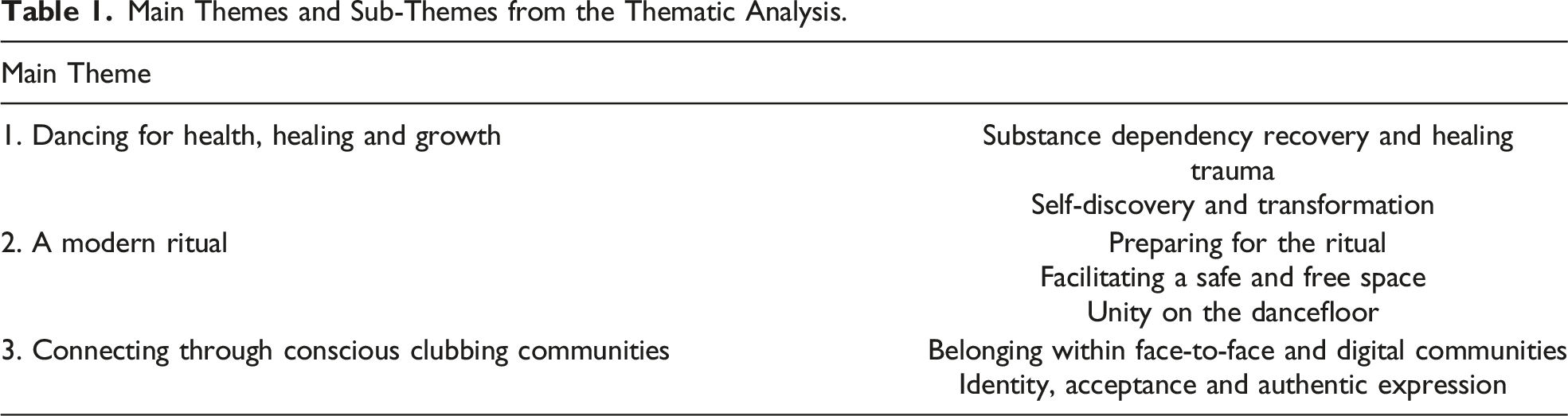
Each of the six steps outlined by Braun and Clarke (2006, 2019) were followed by authors 1–3 when analysing the data. Initially, all transcripts were read several times as researchers immersed themselves within the data, marking down initial reflections. Researchers then identified and coded important smaller interview segments within all interviews, highlighting similarities and differences in participant perspectives. These were then organised, with proposed themes identified. Researchers then met to conduct cross-coding, whereby differences in descriptive coding structures were discussed, with a consensus reached. Researchers then worked together on final theme names, as well as defining descriptions and interpretations to produce the final coding structure. The final analysis involved three superordinate themes, with distinctions and similarities within each moved down the hierarchy into a larger set of subordinate themes.
Reflexivity
Study findings were informed by reflexive insights from the research team who had a broad expertise in psychology, public health, prevention and embodiment. Some had participated in conscious clubbing previously, while others had not. It was important that researchers made sense of their own experiences and were aware of potential influences or expectations. Researchers ensured to develop a reflexive attitude (e.g. Shaw, 2010) throughout the research process, considering their own impact on the data and analysis, as well as personal interests. This was particularly important during data collection and interpretation phases, where the varied research team expertise and experiences were used to enhance the research process.
Results
Main Themes and Sub-Themes from the Thematic Analysis.
Dancing for Health, Healing and Growth
Conscious clubbing events appeared to provide many health benefits, while aiding participants’ substance dependence recovery, healing trauma, promoting self-discovery and transformation.
Substance Dependency Recovery and Healing Trauma
Many participants embraced early rave cultures as the first place they belonged. While many wished to continue raving and craved previous recreational drug highs, they were aware of detrimental health impacts: “I realise now that it’s not possible to feel that ecstatic…that much love and connection, it was drug induced. When you go up that high, you have to come down. I was going out on a Thursday, getting back on a Monday...I really crashed and burned. I was in quite a bad state.” (Elisa, Facilitator and Attendee)
Participants discussed delaying changing maladaptive substance-dependent behaviours as craved highs were not achievable through other means. Participants shared many negative sober living perceptions, as they ‘didn’t know anybody who had quit and were happy’.
These participants took an uncompromising approach to their alcohol and drug recovery. As alcohol was viewed as a social lubricant, often combined with other substances, participants self-excluded from pubs, bars and nightclubs, which they felt encouraged substance taking and excess. Isolating too from others frequenting these venues, many felt alone with limited social support structures. Conscious clubbing allowed participants to safely frequent similar venues with others without fears of relapse, regaining a monumental part of their lives: “Standing in a room completely sober, on a Sunday morning with people just doing whatever they wanted….it is almost equitable to the feeling of taking an ecstasy tablet…and so much better because it is natural…I couldn’t and I wouldn’t ever go back to taking drugs now….I don’t need to do that to feel like I need to be part of something…Because I know I can get to that place without it really.” (Jess, Facilitator and Attendee)
Conscious clubbing did not just replace substance induced highs, but enabled participants to reach more profound peak moments ‘without having all of these other intoxicants in the mix’. In doing so, events allowed participants to ‘never take a break from raving’ and were lifechanging, as they provided a means to nostalgically re-live youth without long-lasting hangovers from harmful, addictive substances: “I was heading towards fairly dramatic personal disaster…knew I had to quit...but good, bad, happy, sad, drink was the answer...I kind of thought that sober living was going to be this dull, joyless purgatory shit…but I’ve learned more about myself since I’ve stopped drinking…it’s been mind-blowing…I’m not going to go out and get shit-faced and then can’t function for a week afterwards…love being able to get up early in the morning to do mad shit I really enjoy.” (Rosa, Attendee)
Many participants were anxious, self-conscious and inhibited when attending their first conscious clubbing event, as such feelings were usually masked by alcohol or drugs. However, they soon realised they ‘had the courage to step through the door…and begin to dance’. Events allowed them to recognise how substances numbed feelings, providing an illusion of escape, but issues were ‘still there and you’ve not faced it’. Conscious clubbing instead allowed them to work through issues, as one explained: ‘2 hours on the dancefloor had turned tears of despair into tears of joy’. Portrayed as therapy and enhancing healing processes, conscious clubbing was both thrilling and terrifying as participants comprehended traumatic experiences, overcame body dysmorphia and dealt with grief on the dancefloor: “After my Dad died I was obviously in quite a low place…So I just dropped into the dance…I just asked ‘show me what I need to do’. Because I felt really, really heavy. And as soon as I did that…my Dad came into my heart….it was profound and it was amazing. That sort of thing, it happens for people every single time…So shocked to discover in this connecting with my body, memories of all sorts of things that would come up. And I had to heal them and let them go.” (Elisa, Facilitator and Attendee)
Many had tried counselling and other support, but explained conscious clubbing had ‘done more work in the last 2 years than 6 years talking therapies’, providing ‘other options than pain and suffering’. Facilitators described observing these powerful moments: “I danced with a lady who connected some of the work around hips and pelvis with a miscarriage she’d had…it was a very deep, deep dance into the grief and the loss, very profound...Another woman had a knee operation and told she wouldn’t be able to do anything again. She was celebrating dancing on her knee in a room where she didn’t have to do anything that she couldn’t do.” (Jess, Facilitator and Attendee)
Self-discovery and Transformation
Conscious clubbing events appeared to change the way participants saw themselves, while allowing them to identify with similar others: “I’ve learned that I have endless capacity for fun. These kinds of events really tap into that sense of fun and enjoyment…You are sort of on a little bit of a floaty cloud. I feel absolutely fired up and buzzing and full of endorphins after one of these…it’s the gift that doesn’t stop giving.” (Rosa, Attendee)
On the dancefloor, participants solved life’s problems, realising they were more capable, confident and braver than previously thought. Positioned as a journey or quest, dancing involved storytelling, or travelling from beginning, middle to end. Such rites of passage allowed participants to explore themselves on a deeper, ‘totally transformational’ level: “So, you start from where you are, you go on this great mystery…you gather some treasure and then you bring that back…it’s like we’re going into explore something, heal something, awaken something, and a lot of people have very, very deep profound transformational experiences during the party.” (Jadyn, Facilitator and Attendee)
Conscious clubbing benefits transcended events themselves. One participant described having an ‘ecstatic orgasmic birth…totally down to the dance...because it enabled me to move how I needed to move and to trust my body’. Due to this, participants felt events could be particularly valuable for young people, by aiding key life transitions, or tackling normative perceptions of substance-focused social activities: “That very famous, Faithless song God is a DJ? ‘This is my church; this is where I heal my hurts’. It’s become my download, I go there and I dump anything that is not working out for me and I try and dance it off…I go out feeling like I’ve left it there…Let’s get these people while they’re still developing [to attend] so that we can save them some years…they might be able to choose an alternative path and meet alternative people who are doing life differently.” (Jess, Facilitator and Attendee)
This first theme highlighted the importance of conscious clubbing for health, healing and growth. Events were positioned as central to the harm-avoidance process, profoundly impacting participants’ substance dependence recovery and wider lives. Instead of being excluded, labelled or stigmatised by their alcohol or drug status, events provided key social opportunities, often lost during recovery, as participants re-lived nostalgic past-raving experiences in safe, substance-free environments. Transformational events provided space to dance with grief and trauma, promoting health, personal growth and self-discovery, which could be particularly beneficial for young people during key life transitions.
A Modern Ritual
Conscious clubbing was positioned by participants as a modern ritual, with specific preparations, space requirements and processes guided by unity on the dancefloor.
Preparing for the Ritual
Preparations were ritualised, symbolic and deeply spiritual, with event DJs or facilitators situated centrally on altar-like stages. Events were presented as performances and key to self-expression, requiring advance planning. Clothing appeared symbolic of conscious clubbing identification, involving elaborate themed costumes, or freeing oneself from clothing constraints and wearing as little as possible: “That’s the kind of thing that really put me off regular clubbing, very hetero-normative…it’s all about…your skirt barely covers your arse and you’ve got to have heels that are about 14 miles high…Whereas [at these events]…nobody is trying to strut around like peacocks…that’s not what it’s about.” (Rosa, Attendee)
Conscious clubbing provided accepting and non-judgemental spaces, as ‘anything goes and no one is judged’, with glitter a key artefact. However, participants identified participatory and accessibility barriers as events were geographically separate, requiring public transport access or car parking availability. Identifying suitable venues and ensuring sustainability posed challenges for facilitators. The lack of alcohol revenue meant high entry fees were necessary to cover costs. Facilitators often ran events with limited reward or payment, wanting only to share positive experiences with others. While participants acknowledged conscious clubbing was cheaper than pubs and nightclubs (as non-alcoholic drink availability was limited or expensive: ‘£7.50 for…a virgin cocktail…for a fruit juice?’ or ‘£4.50 for one tiny bottle of water’), many suggested the entry fee discouraged attendance: “So many businesses rely on the money made from alcohol…there’s a limited amount of [these] events unless you’ve got a reasonably high entry fee…most nightclubs will let you in for nothing because they’re going to make that money on the bar…You never earn enough money to pay everybody…It’s hard to find somewhere that’s affordable…people who will go out to a club because it’s free but then drink £40 of alcohol…they’d be horrified at the idea of a £15 door fee.” (Alex, Facilitator and Attendee)
Event locations were problematic for attendees seeking to avoid alcogenic environments for their recovery. For example, night-time inner-city conscious clubbing events were often situated within the typical alcohol nightlife economy. Instead, events taking place at different times of the day, such as early in the morning, helped break previous routines or habits: “You’re generally queuing up…everyone walking past on their way to work or whatever…is looking like ‘what’s going on over there’…people start up conversations with you why are you dressed as a big like sparkly thing on a Saturday morning.” (Alex, Facilitator and Attendee)
However, it took time for participants to initially change their normative conceptions of time and associated behaviours: “I was a bit put off by the early morning start…Because as a drinker I couldn’t function before 11 in the morning…usually you would associate people clubbing at 8 or 9 in the morning is that they would be going from the night before…but I was up, I was out of bed…having a banging time…usually people are commuting…and generally having a fairly shit time…whereas I was beaming my face off, having an excellent time at a sober rave…I’d had a cup of tea, felt great and was still dancing my socks off.” (Rosa, Attendee)
Facilitating a Safe and Free Space
Conscious clubbing contexts were incredibly important for participants. Typical pubs, bars and nightclubs were seen as unpleasant, unsafe, promoting consumption and excess. Within clean and accepting conscious clubbing venues, participants could let go and be themselves: “I can’t see the point of going dancing [in a typical nightclub] when literally that involves sidestepping and shuffling and just trying not to get knocked over…maybe if you’ve had a few drinks…you’re tolerant…whereas when you’re sober I don’t want someone sweaty pressed against my face.” (Alex, Facilitator and Attendee)
Unlike traditional clubbing, conscious clubbing involved many activities other than drinking which allowed participants to shape their own experiences: “There tends to be people selling power balls or juices and all kinds of nice stuff, health aligned sort of stuff. So I tend to wander in, get glitters, chat to mates, have a bit of a dance…there was a great big ball pit…vintage clothing stalls…like attending a festival…never had a massage but I might in the future.” (Rosa, Attendee)
While many liked these alternative opportunities, others wanted to focus only on the dance. As one explained: ‘There’s all this kind of stuff about aligning your chakras. I don’t even know what they are, so I’m not really sure that I want them aligned!’ Others felt that conscious clubbing events were too contrived, so still attended pubs, bars and nightclubs: “It shouldn’t be that the places where drugs and alcohol are rife tend to make more natural clubbing environments, but the sober raves for me so far haven’t been that effective.” (Ania, Attendee)
Event facilitation was incredibly important and conscious clubbing spaces had to be carefully constructed, managed and prepared. While laser lights, chill-out areas and high-quality sound systems exceeded attendee expectations, safety was most important due to the potential vulnerabilities of the modern ritual process. Therefore, ‘creating containers…where people can feel safe to express themselves’ was most important: “Being held in a process, very carefully by the facilitator, means that there is just the right level of freedom to just stomp and dance…there’s enough safety to feel that whatever comes up for you…to bring out this spiritual, caring, inclusive, holding space, respecting everybody’s bodies and their abilities.” (Elisa, Facilitator and Attendee)
Beyond physical risks of dancing with eyes closed (with facilitators on ‘cushion duty’), not holding the space, or being brought back and grounded after an event was seen as the biggest risk. Participants positioned conscious clubbing spaces as sacred and described the joy but vulnerability of letting go. In doing so, participants put ultimate trust in facilitators, as they felt powerless, suggestible and easily influenced during those ecstatic moments. Negative conscious clubbing experiences were rare, often involving ‘running out of glitter’ or ‘over-commercialised’ events, but some participants shared such experiences: “Some teachers are much better than others at holding a space…sometimes the space is not held. There’s a fine line between it being a really safe environment to explore yourself…but that power can very easily pop into the dark side. You might do things that you wouldn’t necessarily do. And sometimes that’s a really good thing, but I also speak to a lot of young girls and they’ve had experiences where they’ve felt like they couldn’t say no to maybe a long hug or just someone dancing in their space all the time.” (Elisa, Facilitator and Attendee)
Unity on the Dancefloor
Participants spoke in depth about moving from individual dancing experiences, to becoming connected and unified with the group. Synchrony and coordination were a common shared feature of these modern rituals, prompted by unchoreographed movement and ‘no conscious thought’. By moving in rhythmic solidarity, participants described extending beyond themselves, through a process of transcendence: “People come in in a very individuated state. And then gradually the inter-connectedness occurs, the openness….at the end of the event - it’s an experience of euphoria. Because everybody collectively has opened themselves up, connected energetically. They have moved or expressed themselves beyond their comfort zones, apprehensions and they have grown.” (Mike, Facilitator and Attendee)
These profound experiences were driven by music, which matched bodily rhythms or pulses. Participants preferred event music to be layered or polyrhythmic, picking a layer to move to. Facilitators provided in-depth observations of how dancers, eyes closed and led by musical rhythms, became one by enacting movements coordinated in synchrony: “Everybody was just hands in the air, having an absolutely fantastic time. And to be able to share that with a room full of people who were on the same plane as you…the thing that is driving you all at that moment is your enjoyment of the company and the music and the experience that you are all sharing, rather than whatever you’ve ingested…look at ancient civilizations who still do this kind of thing…there’s something very primeval about a repetitive rhythm.” (Jadyn, Facilitator and Attendee)
During events, attendees disbanded usual social structures and restraints to be themselves. Participants described the intermediate transitional, or liminal stage during the rite of passage, whereby ‘anything and everything’ could happen, in great depth. Participants described dropping inside their bodies, similarly to previous substance-induced highs, but now using breath and rhythm to do so. Talking through these moments, participants described adopting animalistic (e.g. stomping, thumping and shouting), or innocent (e.g. playful, gentle and no inhibition) movements. This often led to a sense of timelessness and full absorption as participants described becoming embedded and embodied within a spiritual realm. At this point, participants described becoming connected to a higher level of consciousness, whereby ‘you’re able to do anything’. These peak experiences were incredibly rewarding, ‘really quite delicious’, ‘food for the soul’ and ‘like an orgasm’. However, they were not easy to reach, even for experienced attendees: “You have to stop thinking…forget what other people are doing… and that is so hard. I think the ecstasy point [is] where you don’t even realise that you have moved…you open your eyes and you are somewhere completely different in the room and you didn’t realise you’d gone there, because you thought you were still. Those are magic moments.” (Jess, Facilitator and Attendee)
This second theme illustrated how conscious clubbing was an integral modern ritual within participants’ lives, providing great meaning, purpose and requiring dedicated clothing and artefacts. Dancers became one as they sought euphoric, substance-free and flow-like states which transcended time and space. However, spaces had to be held, facilitated and participants grounded. Peak experiences were characterised by layered music, with pleasurable, synchronous but unchoreographed movement. For some, cost or location impracticalities impeded event accessibility and participation, particularly when events were situated within the existing nightlife economy.
Connecting through Conscious Clubbing Communities
Connecting through digital and face-to-face conscious clubbing communities created a sense of belonging. Attendees felt accepted and able to authentically express themselves and their identities within these inclusive spaces.
Belonging within Digital and Face-to-Face Communities
Participants viewed the wider conscious clubbing community as a family or tribe after connecting with them through dance. Events ‘put the social back into life for non-drinkers’, overcoming the isolation often felt during recovery: “It feels like I’m not alone. I feel connected with the tribe, with the family…We’ve spent so long feeling like we’re alone…being told we’re on our own or we have to do everything ourselves, and on the dancefloor in those spaces you’re not yourself, you’re everyone and everything. And the tribe…they support me.” (Luis, Facilitator and Attendee)
Events promoted valuable connections with lifelong friends, which participants compared to previous less authentic friendships when alcohol or drugs were involved: “It’s like you can be much more honest in your experience because if you connect to someone for example, there’s always a doubt in your mind whether it was a real connection or whether it was influenced by alcohol or some other substance.” (Jadyn, Facilitator and Attendee).
However, experiences were incredibly personalised and not all participants attended events with others: “I’m actually more free if I just go completely on my own because, if I go and there are other people that I’ve taken with me, I’m constantly like looking out for them…it’s much better for me if I go by myself…I’m like I want you to love it…but it sometimes can ruin it for me because…if they’re looking like they’re not enjoying, then I can’t enjoy it as much.” (Ania, Attendee)
Most events took place face to face, with some online within recent years. Similar to traditional raves, digital platforms (e.g. Facebook, Instagram, Twitter and WhatsApp) were essential for promoting events, sharing information and maintaining a sense of community. However, facilitators discussed promotion challenges: “If I’m running it I have to post in a million different Facebook groups and try and figure out how to get people through the door.” (Jess, Facilitator and Attendee)
Facilitators also faced challenges when wanting to set expectations and norms about what these ‘dry events’ would entail: “On Facebook they sometimes block your advertising if you mention the word alcohol or drugs so…I’ve not been able to use those words to describe it…and then someone who was coming said ‘well what if people show up and they’re drinking?’ so…I thought I’m going to make this clean and clear… that’s what’s expected in this space.” (Jadyn, Facilitator and Attendee)
Identity, Acceptance and Authentic Expression
As a modern ritual, conscious clubbing was used by participants to escape societal constraints, authentically expressing themselves more freely than within general society. Many felt marginalised due to their non-drinking status or for who they were: “I’m quite a loud and expressive person and being able to just have a space to do that where it’s ok…I always feel like maybe I’m too loud for society, too loud for the street, too loud for a venue. And going to those places I was allowed to be completely free.” (Luis, Facilitator and Attendee)
Importantly, this sense of community enhanced creative expression, particularly for those excluded from age-restricted clubbing cultures or drag events: “We run a monthly craft club which is for like drag and festival wear as well where all guests and speakers come in to teach like cosmetics or how to make headpieces, because I know a lot of under 18s that can’t get into club scene…they’re still interested in that like drag scene…it’s a way of them getting involved.” (Alex, Facilitator and Attendee)
Conscious clubbing misconceptions were viewed as impeding event participation, despite the diversity of event attendees, from ‘raving 70-year-olds’ to ‘babies wearing ear defenders’. Participants strongly rejected normative conceptions of conscious clubbing attendees: “A friend of mine said that she thought it was for hippy, dippy types. But I mean I’m not, certainly not a hippy, dippy type. I eat meat and I don’t meditate.” (Rosa, Attendee)
This third theme highlighted how conscious clubbing provides a much-required opportunity for authentic expression, forging long-lasting, meaningful social connections. Many participants felt marginalised and isolated within society but were welcomed and accepted into these inclusive communities. Similar to traditional raves, digital platforms were key promotion and communication drivers. However, facilitators faced continued recruitment challenges and event misconceptions impeded participation and engagement.
Discussion
This study provides some of the first in-depth insights into the experiences of conscious clubbing and potential benefits. Positioned by many participants as key to their substance dependence recovery, inclusive and accepting conscious clubbing events appeared to provide pleasurable and transformational healing experiences, away from usual alcohol pressures, stigmatisation and labelling (e.g. Conroy & de Visser, 2014; Herring et al., 2014; Jacobs et al., 2018). Through conscious clubbing dance, attendees spoke of becoming embodied and once again inhabiting or connecting to their body and its rhythms. Conscious clubbing therefore provides potential therapeutic interventions, valuable healing opportunities and could be particularly important for trauma victims, as previous research suggests (Van der Kolk, 2015). Many participants actively avoided alcogenic contexts, which left them isolated from social support structures. Such contexts were seen to encourage substance use or relapse, which supports previous research (Hill et al., 2018, 2018; Marteau et al., 2020).
Conscious clubbing events appear to involve similar social practices to traditional alcohol or EDM events (Blue et al., 2016; Hutton, 2012). Despite events and participants being physically distant across Europe, digital platforms drove communication, maintaining community connections, much like traditional rave cultures. This further supports the idea of dance events leading to the development of meaningful relationships, a sense of community, connectedness and belonging (Ehrenreich, 2006; Launay et al., 2016; Reddish et al., 2013; Salamone, 2004; St John, 2006), supporting our previous work in this area (Brown et al., 2020). Conscious clubbing therefore not only provides an alternative socialising experience but, by being grounded in meaning-making and authentic expression, promotes identity development and belonging, particularly for those who may feel isolated or marginalised within their everyday lives.
Similar to dancing, conscious clubbing appears to provide far-reaching health and wellbeing benefits, extending far beyond events themselves (Connolly et al., 2011; Haidt et al., 2008). Positioned as a modern ritual, conscious clubbing fosters a sense of spirituality and community. Event participants appear to experience a higher level of solidarity or communitas (Turner et al., 2017), becoming lost within liminal and transformational social dance movements as they collectively transferred through phases of pleasurable ritual journeys (Ehrenreich, 2006; Salamone, 2004). In-line with Haidt’s et al.’s (2008) hive-hypothesis phenomenon, as participants temporarily disbanded usual social structures, they appeared to reach optimum levels of human growth and transformation on the dance floor. On returning to their structured lives, many felt revitalised with a new sense of meaning.
Clothing and event rituals were profoundly symbolic and appeared key in preparing for the communita. This allowed attendees to reach a temporary state of enjoyment, while expressing new identities (Goulding et al., 2002). Participants spoke of transcending time and space in a deeply enjoyable and creative journey. This involved a process of complete personal embodiment and grounding, while uniting and connecting to others. Events were characterised by layered music and dancing movement, in order to reach euphoric flow-like states (e.g. Csikzentmihaly, 1990).
Implications and Limitations
Combining dancing benefits (e.g. Goulding et al., 2002; Solberg & Jensenius, 2016) with increased social interaction opportunities means conscious clubbing provides a wealth of health promotion implications. However, such events could also be key for health risk prevention, particularly given the global rising number of non-drinkers (Banister et al., 2019). Conscious clubbing appears to disrupt usual alcohol consumption opportunities within rave and clubbing sub-cultures and could provide an alternative and novel prevention approach for those wishing to abstain or reduce their alcohol consumption (Brown et al., 2020; Davies et al., 2019). For example, such events could be embedded into University Welcome Weeks, or into workplace employee programmes. This work also aligns with contemporary behaviour change work which focuses on contextual-based determinants and limiting opportunities to consume alcohol, rather than relying on individuals to instigate behaviour change (Hill et al., 2018, 2018; Marteau et al., 2020). Future work should also address participatory issues, facilitation challenges and identified event misconceptions.
While no age exclusion criteria were applied to the current study, participants were all aged over 25. Participants also included attendees and facilitators of these events, with most reporting previous drug or alcohol dependency issues and current abstinence. Therefore, while it is possible this represents typical event attendees, more work should consider the views of younger individuals or those not captured by the current study. For example, in our previous research, we found that young adults do hold positive attitudes towards conscious clubbing, but more work is required to unpack attitudes of non-attending, higher alcohol consumers who believe these events are ‘not for them’ (Brown et al., 2020; Davies et al., 2019). This is important given that participants felt such events may be particularly valuable for younger adults seeking social bonding during key life transitions.
Conclusion
Conscious clubbing appears to provide a range of benefits, while providing key social opportunities, away from substance misuse pressures or harms. Symbolic event preparations and powerful, transformative in-event experiences appeared to transcend events themselves, impacting the wider lives of attendees who positioned events as a modern ritual. Connecting through inclusive dance and digital communities, attendees developed a deep sense of meaning, belonging and authentic expression, particularly if marginalised within wider society. As one of the first studies in this area, findings provide in-depth insights with potentially important and novel harm prevention implications. Future work to explore these meaningful experiences in and of themselves is strongly recommended, including addressing participatory barriers and event misconceptions.
Footnotes
Declaration of Conflicting Interests
The author(s) declared no potential conflicts of interest with respect to the research, authorship, and/or publication of this article.
Funding
The author(s) received no financial support for the research, authorship, and/or publication of this article.

(Following agreement to participate and written informed consent, describe study and process again to participants. Check if they have any other questions before beginning)
• Can you describe this item/ photograph to us? (Show online if participant wishes to) • Why is this item important/ meaningful to you? Why did you want to share this? • Are there any specific memories or experiences that your item brings to mind?
• How did you become aware of conscious clubbing? • What attracted you to these types of events? (Prompt: Why do you choose to participate in these events?) • What about the event keeps you coming back? (Prompt: Is your intention to continue attending such events? Why/ why not?)
• How often do you attend these events? • How do they fit in with your normal schedule/ lifestyle? (Prompt: How fits with your daily life or relationships?) • Do you attend other types of clubbing? Why/ why not? • When you attend an event, who do you go with? • How do you get there? (Prompt: What transport do you use? When/ how?) • How do you feel before the events?
• Can you describe your experience at a conscious clubbing event? • What do you do at these events? (Prompt: What about the music/dancing/ other activities?) • Could you take us through a typical time? From entering to leaving? • What do these events or spaces mean to you personally? (Prompt: For example, have you learnt anything new about yourself whilst attending these events?)
• How do you feel after the event? (Prompt: Emotionally? Physically? Spiritually?) • What do you like about these events? What do you dislike about these events? • What are your thoughts about the no-alcohol/ drugs policy? • What do you think about the group/people who attend?
Would you like to comment on anything else about your experience of participating in a conscious clubbing event? Anything not covered or mentioned?