




Abstract
Providing palliative care can be both challenging and rewarding. It involves emotionally demanding work and yet research shows that burnout is lower than in other fields of health care. Spontaneous expressions of gratitude from patients and family members are not uncommon and are highly valued. This study explored the experience of Spanish palliative professionals who received expressions of gratitude from their patients and families. A phenomenological approach was used to better understand the role of receiving gratitude in participants’ lives. Interviews were transcribed verbatim and a phenomenological approach to analysis was undertaken using macro-thematic and micro-thematic reflection. Two team members independently engaged in this reflection with an inductive approach. The analysis was shared and discussed at periodic meetings to identify the key themes and sub-themes of the gratitude experience. Ten palliative professionals were interviewed. Participants engaged in a process of recognizing, internalizing, and treasuring the expressions of gratitude which they then used for reflection and growth. These expressions were a powerful and deeply meaningful resource that the palliative professionals revisited over time. Receiving expressions of gratitude invited a stronger sense of the value of one’s self and one’s work that was motivational and protective, particularly during challenging times.
Keywords
Palliative care professionals describe their work as challenging but, simultaneously, rewarding (Collier, 2019). Working in palliative care involves facing suffering that encompasses physical, psychosocial, and spiritual dimensions (World Health Organization, 2018). It might be expected that constant exposure to deep human suffering would leave palliative professionals vulnerable to fatigue, stress, job burnout, or even work absenteeism (Beng et al., 2015; Koh et al., 2015; Zambrano et al., 2014). Indeed, there is concern about the risk of emotional exhaustion and burnout due to the highly demanding nature of the work (Sinclair, 2011; Slocum-Gori et al., 2011). Several studies document the incidence of burnout in palliative care as being between 25% (Lissandre et al., 2008; Martins Pereira et al., 2011) and 62% (Kamal et al., 2016). However, studies also show that there is less burnout in palliative care compared to other health services (Martínez et al., 2009; Peters et al., 2012).
The relationship between patient–family and professional underpins all palliative care (Donoso et al., 2015). This relational connection is key when considering the impact of both the challenges and rewards of caring for terminally ill patients and their families (Sapeta et al., 2021). In this relational context, spontaneous expressions of gratitude arise that merit further exploration (Day et al., 2020).
There has been recent burgeoning of interest and research regarding gratitude. “Though there have been significant advances and surprising findings in the science of gratitude, the general theme has not really changed: gratitude appears to be one of the most important facets of the good life” (Watkins & McCurrach, 2021, p. 1). A recent selective review suggests that theories of gratitude fall into three categories: the nature of gratitude, what causes gratitude and how gratitude enhances wellbeing (Watkins & Bell, 2017). Following Watkins & McCurrach (2021) we view the nature of gratitude as the emotion people experience when they affirm that something good has happened and they recognize that the benefit arose because of the actions of someone else. “Gratitude enhances well-being because it increases the ‘signal strength’ of who and what is beneficial in one’s life” (Watkins & McCurrach, 2021, p. 2).
More specifically, there is evidence that giving thanks or “practicing gratitude” can be beneficial for patients with advanced disease, resulting in an improved sense of quality of life and protection against psychosocial distress (Althaus et al., 2018). Some studies also suggest that practicing gratitude helps to reduce burnout (Chan, 2011; Lanham et al., 2012), and stress (Krause, 2006; Tsui Pui, 2009; Wood et al., 2008), improves mood, self-esteem and sense of happiness (Borgueta, 2012; Lee, 2017). However, these studies are not specific to palliative care.
In contrast, research regarding the effects of receiving gratitude is more limited. There is evidence that expressions of gratitude occur frequently, and in many forms, in palliative care (Aparicio et al., 2017, 2019b; Centeno et al., 2010). Receiving gratitude generates positive emotions and motivates the recipient to act pro-socially towards their benefactor (Tsang, 2006). Thus, receiving gratitude strengthens relationships by promoting and enhancing relational bonds (Algoe et al., 2010; Algoe et al., 2008). Gratitude increases one’s sense of being valued socially and thus encourages continued efforts to help others (Grant & Gino, 2010). There is a gap in other possible effects of receiving gratitude apart from the social approach. However, the evidence suggests that expressions of gratitude may have a role in mediating stress among palliative care professionals (Aparicio et al., 2019b).
In the field of palliative care, it has been found that health professionals who receive expressions of gratitude, value and preserve them (Aparicio et al., 2017, 2019a; Centeno et al., 2010). Over three quarters of respondents to a national survey conducted in Spain reported that documents of gratitude were usually displayed for all team members and kept for a time (Aparicio et al., 2019a). The manifestations of gratitude made them feel satisfied, motivated and proud of their work. A majority even reported that receiving gratitude became a source of support at times of professional difficulty (Aparicio et al., 2019a). This further suggests that receiving expressions of gratitude may have additional effects beyond those currently identified in the literature. No study that we are aware of has systematically analyzed the role of receiving gratitude in the lives of palliative care professionals. This study addresses the gap and contributes to understanding the role that receiving unsolicited gratitude can have in managing the risks and rewards of caring for terminally ill patients as well as their families. The objective of the study was to understand the experience of palliative care professionals when they receive expressions of gratitude from patients and relatives.
Method
The study being reported is the second phase of a larger mixed-method investigation of gratitude within palliative care (Aparicio et al., 2019a). For the purposes of this research, gratitude was operationally defined as a feeling of thankfulness that arises when one recognizes something positive or helpful has happened as a result of someone else’s actions (Emmons & McCullough, 2003; Roberts, 2004; Watkins & McCurrach, 2021). Gratitude can be expressed and received in health care relationships.
The first phase was a national survey of Spanish palliative care professionals (Aparicio et al., 2019a). The second phase was a phenomenological study (Adams & Van Manen, 2017; Van Manen, 2017) with palliative care professionals from Phase One who indicated willingness to participate in further studying the experience of receiving gratitude from patients and families. The study was based on the theoretical and practical vision of Van Manen’s (2014) phenomenological methodology that is an evolution of hermeneutics. Van Manen (2014) terms this the phenomenology of practice, which is of practice and for practice. The ultimate aim of a phenomenology of practice is to promote a certain reflexivity and tact in the practice of professions and everyday lived experience (Van Manen, 2014). This distinguishes his approach as supporting practice disciplines and practice change rather than simply being about ideas.
Sampling Strategy
Sixty-seven professionals (36% of those surveyed) expressed their willingness to continue collaborating. Sampling for Phase Two was purposeful to enable maximum variability among participants (Fortin, 2009; Hicks, 2006; Kelley et al., 2003). A total of 19 possible key informants were contacted and 10 agreed to participate.
Data Collection
The Interview Guide (Supplemental Material) was piloted with two palliative professionals who did not participate in the study; further refinement was not deemed necessary and the data collected from these pilot interviews were not included as data for analysis. Interviews were conducted between December 2018 and July 2019. All but one of the interviews, which was done by telephone, occurred by video and all were audio-recorded. Analysis proceeded simultaneously with data collection, which stopped when the collected experiences provided rich and sufficient material such that the saturation point was reached. This was understood as a point in which the findings were insightful enough and a clearer understanding of the experience would not be found through further discussion with participants (Laverty, 2003).
Data Analysis
Interviews were transcribed verbatim and a phenomenological approach to analysis was undertaken using macro-thematic and micro-thematic reflection (Van Manen, 2014). After careful reading of each text, two team members independently engaged in macro-thematic reflection that resulted in one or more critical statements regarding the fundamental meaning of the transcript. Using this approach, the team answered the following questions (Errasti, 2015; Van Manen, 2007, 2014): What does this text say about the meaning of receiving gratitude? Which judgmental statement or statements might embody the fundamental meaning or the main idea behind this account? (Errasti, 2015; Van Manen, 2003, 2014). Then micro-thematic reflection was undertaken on two levels (Errasti, 2015; Errasti-Ibarrondo et al., 2018). Firstly, using a selective approach, the text was read a number of times, considering which statement or statements were especially important or revealing about the experience being described. Those that revealed a key thematic aspect of the phenomenon were highlighted. Secondly, using a detailed line-by-line inductive approach, each statement or group of statements identified through the selective approach was reviewed individually. While reflecting on what that statement or group of statements revealed about the experience of receiving gratitude, themes and sub-themes were inductively elaborated by consensus. The independent analysis of two researchers and systematic and periodic discussions through the analysis process enhanced trustworthiness of the data analysis. If discrepancies arose we went back to the original data to be as faithful as possible. Likewise, the discussion of the preliminary findings while showing the evidence helped promoted trustworthiness. The authors’ backgrounds include palliative clinicians and academic experts in qualitative and palliative research.
Ethical Aspects
The Research Ethics Committee at the University of Navarra approved this project (Identification number: 2016.071). Oral and written information was given to participants about the study implications, ethical aspects and the possibility of dropping out whenever they wish. They signed informed consent prior to the interview and consent to publish the findings. Fictional names are used to protect participant identities.
Findings
Participant Characteristics.
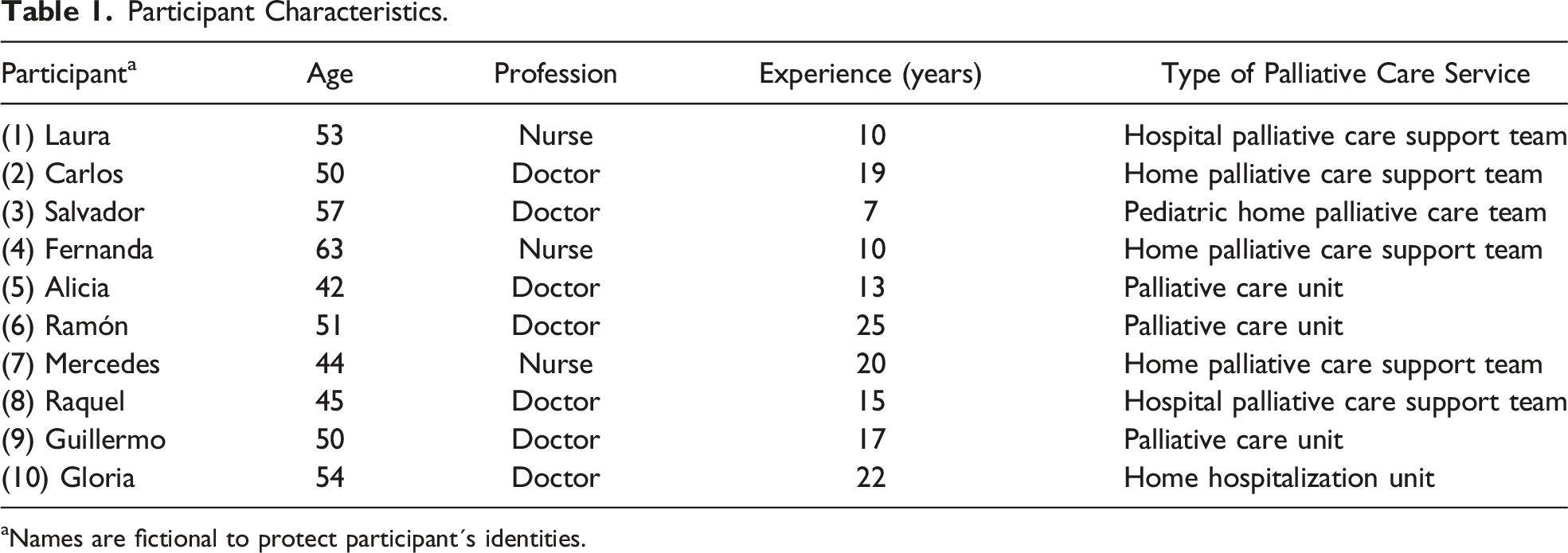
aNames are fictional to protect participant´s identities.
Themes of the Experience of the Palliative Care Professionals Who Received Patient–Family Gratitude.
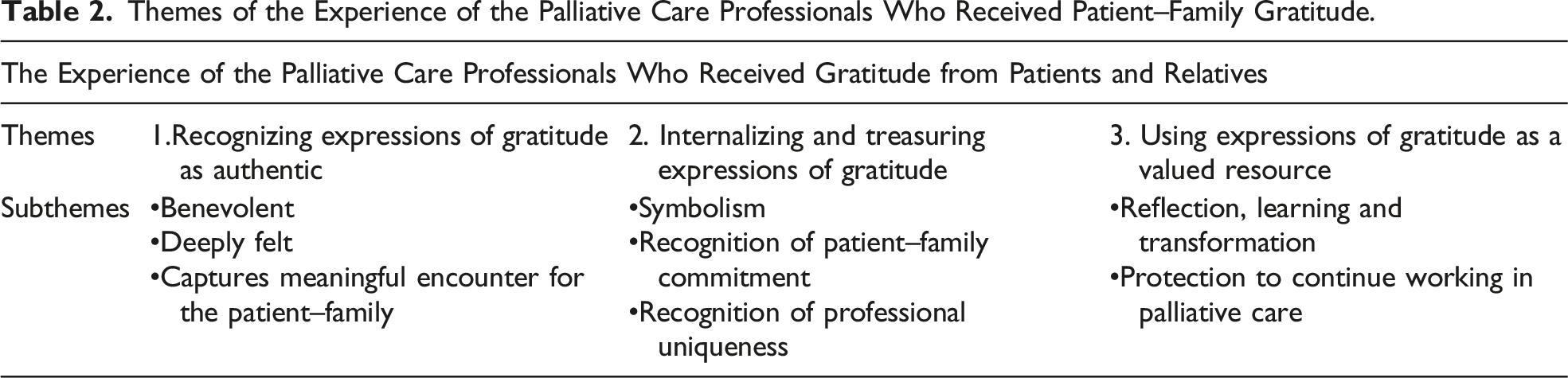
Recognizing expressions of gratitude as authentic
Participants identified aspects of expressions of gratitude that enabled them to distinguish their authenticity: benevolent, deeply felt, and capturing meaningful encounters for the patient–family, which will be discussed as sub-themes.
The expression is benevolent
Participants acknowledged all the expressions of gratitude they received but mentioned that in order to be accepted, the motivation must be perceived as benevolent, representing good will or kindly feelings with no secondary intentions. Gloria conveyed this clearly: There are times when they give you a disproportionate gift, like this time they were precious silver-footed glasses.… I almost felt like he was buying me.
This was an expression of “apparent” rather than “real” gratitude that generated doubt and discomfort, and the professional did not accept it. True benevolence is acknowledged as fundamental to expressions of gratitude (Roberts, 2004).
The manifestation is deeply felt
All participants mentioned that “not all the expressions of gratitude are equal” and to be significant they needed to be deeply felt and sincere
Alicia captures that these deeply felt manifestations can reach the heart. The family of a patient wrote a very emotional letter in the newspaper; full of gratitude. The content of that letter was intense, with such a special gratitude that it would have invaded the heart of anyone reading it. It is amazing that a person who has suffered such a significant loss can express such beautiful words of “the precious task of caring for people at this special time in life.”
Clearly one of the most powerful aspects of these unexpected expressions of gratitude was the context of suffering and loss in which they were expressed. Participants were acutely aware of the vulnerability of the patients and family members who conveyed heartfelt thoughts in times of duress when time and energy were precious.
The gratitude captures meaningful encounters for the patient–family
All of the participants explained that the manifestations of gratitude captured meaningful, highly valued encounters for the patients and families. What was unexpected and surprising to the participants was that these encounters were sometimes very brief; while others reflected long-standing relationships as was the case for Mercedes. He was a very old man, 96 years old, who lived with his son and his wife, with whom I got along very well…. A very nice bond was created…. In fact, I went on vacation and he was very, very sick and he waited for me [before he died].… Later, when I visited her after his death, his wife told me that: “During all this year you have been with us and I wanted to make you a good gift.”
There were also brief interactions that generated expressions of gratitude. These expressions, unexpected and even apparently “not proportionate” to the work that the professional believed they did, acquired a special value when seen from the perspective of the patient–family. As Guillermo explained: There was a patient at home that when we visited him for the first time we found him in an end-of-life situation, practically in agony. You go, you support, situate family, administer medication, in just 48 hours…. Then you receive a huge thank you.
Guillermo recounted the surprise of receiving the immense gratitude of the family, of a patient of whom he does not remember many details and for whom he does not feel he did anything special. This echo other participants’ such as Fernanda who says “I’m reluctant to be told thank you…. Because I think that’s what I had to do.” Still, this gratitude acquired value for them because they perceived that the relief of suffering was vitally important to that family or patient; and accepted it.
In summary, participants explained that in order for them to recognize an authentic expression of gratitude it needed to be perceived as deeply felt by the patient or family, without secondary intentions or strings attached, and as capturing the importance of the interaction to the family or patient. Once recognized as authentic, there are aspects of the expressions of gratitude that enabled participants to deeply value these expressions.
Internalizing and treasuring expressions of gratitude
Three sub-themes that enable internalizing and treasuring the expressions of gratitude will be discussed: symbolism, recognition of patient–family commitment and recognition of professional uniqueness.
Symbolism
Participants acknowledged all the expressions of gratitude they received: “Nobody becomes bitter by a candy and the manifestations of gratitude received are acknowledged.” However, not all expressions of gratitude had the same value. Participants emphasized aspects that enabled internalizing and treasuring particular expressions of gratitude that held deep meaning for them.
The symbolism attributed to expressions of gratitude influenced the value awarded to them. Participants emphasized that many expressions have no material value, “such as a smile when a patient never smiles, a look, words, hugs, or expressions of no economic value such as words written on a postcard.” However, these non-material expressions generated intense emotions for the professional, as shown in the following case: No, it is not paid with money your dedication to this and getting this feedback. That is priceless! In that sense.... obtaining that gratitude from people is precious. It is like the greatest gratification you can feel in a profession, and I am telling you this excited and about to cry (Alicia).
These expressions became part of them as Ramón says: The patients, some you keep in your head…. Those patients stay with you forever. Then there are gratitude displays that are in the memory. I remember, for example, a patient who had a room very close to my office. That patient, every day, within his routine, while he was able to walk…. came in the morning and said good morning to me…. I will never forget that patient. It is a gift made in the form of greetings, just that, while he could. When he could no longer come, I would go to the room to say good morning to him. There are other gifts that are intangible…. Because an intangible is a gift of immense value.
Recognition of patient–family commitment
Participants recognized the commitment of time, energy, and caring on the part of patients and their families when transmitting gratitude at an extremely vulnerable time, which generated deep emotion and meaning. The effort, planning, and intent that underpinned these expressions was cherished. For example, Laura explained in detail how a patient left everything planned for after her death: So the patient’s husband came to give it to us (a bracelet for each). It was something very, very emotional, beautiful; both things at a time. She thanked us when we cared for her many times. But this at the end it’s like: Wow! Making her husband to come later, to come back to us to say thanks in this way!... It is impressive that before she died, she had it prepared.… That is something that has incalculable value. It’s something you do not ever forget.... There are things that you don’t expect. You value them a lot.… Because of what it meant for them.
Participants also highlighted the efforts made by grieving family members to convey their gratitude. They referred to the sadness and loss of family members to emphasize the significance of receiving gratitude in the difficult time of bereavement. I am surprised, in a pleasant sense, that people have the capacity, rather than crying, when you go to see them, they say: “Thank you for helping me.” This is what surprises me (Fernanda).
Recognition of professional uniqueness
Recognition of one’s uniqueness was also vividly transmitted by participants as an aspect of gratitude that enabled internalizing and treasuring the communication. Participants recounted feeling truly seen and appreciated when they received personalized expressions of gratitude that “hit the spot.” The expressions could be as simple as a few lemons freshly picked before the medical visit or as complex as a piece of music composed and performed by the patient. Ramón explained how, after the death of a patient, he received a video recorded by the patient sharing her testimony of how palliative care professionals helped her. Maybe that woman observed me during the time I was her doctor, and realized how we enjoy teaching those who come.… How we try to show what palliative care is…. It was like: “I’m going to help you by giving you a tool so you can use it.”…. Maybe that’s why it impacted me so much: because it hit the spot.
Ramón added that he kept the recording and uses it at his lectures. Participants commonly transmitted that they treasure the displays of gratitude forever.
In summary, participants first needed to recognize the expression of gratitude as authentic in order to receive it. This was followed by a process of meaning-making that focused on recognizing the symbolic nature of the expression, seeing the commitment of patient and family, and experiencing their own uniqueness as seen through the eyes of the patient, which enabled internalizing the expression. At the same time, they repeatedly and emphatically affirmed that they were not working to receive gratitude, nor expecting to receive it. Indeed, one of the features that is evident in many of the quotes is that the expressions of gratitude were unexpected. The participants not only internalized the expressions of gratitude, they treasured them over time as can be seen in their vivid recollections, which enabled them to use the expressions as valuable resources.
Using Expressions of Gratitude as a Valued Resource
Two sub-themes will be discussed: reflection, learning and transformation; and, protection to continue working in palliative care.
Reflection, learning, and transformation
Internalized expressions of gratitude had an effect on the palliative care professionals who participated in the study. Participants commented that these expressions promoted reflection and learning, both professionally and personally. The spontaneous and unexpected expressions of gratitude invited them to reflect on their performance, which raised questions about what was done that the patient and family found so helpful and initiated a search for answers. It is always a time to say, “What happened here?” or “How have we managed this?” You think about why they have thanked you or why not, why it has been so. What did they want to tell me with all this? (Laura)
The expressions of gratitude provided an opportunity to consider what matters to patients and families as well as ways to provide care that truly meets their needs. Further, gratitude was a source of recognition, reinforcement and validation of one’s worth and contribution. Some professionals reported that during their education they had not learned about palliative care. Their training focused on “saving lives, curing, and healing” and that providing palliative care required a new perspective as well as approach. The expressions of gratitude were a confirmation of the value of their contribution despite being “limited or vulnerable” professionals. The assessment by patients and family members was more important for professionals than any other quality measures. Quality control is done by the patients themselves, it is the person with whom you directly relate, the one who receives your care, it is the patient or the family member, and that is the one who is saying to you: “OK, adequate care, well done.”…. It helps you to think on who we are as professionals…. We are very vulnerable and very fragile, and they really, the patients are who make us stronger, those who are shaping us (Ramon).
Participants also referred to more personal learning: learning the power of accepting gratitude. They reflected on the important interpersonal nature of gratitude and their own essential humanness as well as vulnerability. Guillermo explained it this way: Don’t reject. Do not take away the possibility of the patient or family to thank you in the way they want or can thank you. Sometimes (not accepting) it’s like putting yourself on top: “No, I don’t need.” I believe that there is a certain level of reflection on the asymmetry in the relationship, and a tone of humility also of accepting what the other wants to give you.… We all need that, at some point, what we do is recognized…. We have this need. We can recognize it or not. I think it is good to recognize it, because it repositions you in that you are also a vulnerable, fragile human being.
Participants reflected on the expressions of gratitude and the context in which it was offered, which led them to be thankful as well. It is said that gratitude generates gratitude (Begg, 1994). As Laura explained: “You are growing in your personal values…. You learn to give thanks.” The importance of reciprocity in the caring relationship was emphasized by Guillermo in response to a bereaved family member’s expression of gratitude: You tell them: “Thank you for coming, because this little time that you have come here, it is not wasting time for us. On the contrary you are helping us, you are helping us to continue doing, to know that our work makes sense.” And you also return to them what their gratitude means to us…. “I am grateful that you have come after your hard experiences of pain.” I thank him for sharing [patient’s] life, his story, for telling me what he feels, for having had the confidence to give it to me. I also thank him for telling me that I have been important in his life, and that I will always be part of his family.
Expressions of gratitude were transformative: participants reflected, changed, learned, and grew as they experienced their work making a meaningful difference in families’ lives. As Gloria remarked: “For me, a patient’s expressions of gratitude give meaning to my work, so it becomes rewarding for me.” When these expressions acquired such profound meaning, they became unforgettable memories. Participants vividly recalled them as if they were received a few hours or days ago, even if they were many years old. There is one that, for example, I have very present, that a mother told me of a child who, at the age of 7, died.… She told me that they often tell you that the happiest moment in the life of a person is childbirth…. However, when a child dies it is the most terrible moment. Then she would say to me: “Look, I, however, do not remember the face or the name of the midwife who assisted me, and I will never forget your face and your name.” That is a phrase that I have engraved with fire…. Those things are unforgettable. (Salvador)
The transformative nature of these unforgettable memories was poignantly explained by Fernanda. I take it with me; you carry it on your skin, which is the largest organ we have. You are wearing it. You wear it, and you learn, and you pass it on…. I suppose you will remember your whole life. That is why we have memory.
Another example: “Will they be medals of merit that I have won? I always wear them wherever I go. They are experiences that you live and forge your own life…” (Laura).
Protection to continue working in palliative care
Participants felt protected by the gratitude received from patients and families. They unanimously emphasized that experiences of gratitude are a source of motivation and encouragement to continue. Gratitude provided energy in times of exhaustion, satisfaction in times of despair, took weight off their shoulders, and in these ways was an aid to maintaining professional wellbeing. Professionals described it as: “an injection of energy, an injection of courage, like vitamins, like a push, it gives you strength, it fills you a lot, it raises my self-esteem, it makes you proud.” One of the participants remarked that after receiving gratitude he had so much vital energy that he could fight dragons.
While participants recognized that they are emotionally exposed to suffering and are vulnerable, they found that expressions of gratitude were protective. Ramón expressed it eloquently with a metaphor: Why aren’t we burned [burned out]?…. The gratitude, somehow, is our fireproof suit.… We do not have a fireproof suit to get into those fires, but we have something that does the same effect as the fireproof suit, it is that you come out of the fire and are protected by all the people who have thanked you for entering the fire in their house. So that makes us burn less, it’s our protection against that fire, and that allows you to work. That is the energy it gives us. Keeping us alive, what it makes that we stay alive at work…. It is as if we have been a bit touched personally, and the family comes to heal you, they come to recover you.
Expressions of gratitude that were recognized, internalized, and treasured were powerful and transformative resources in everyday life for the palliative professionals who participated in the study; offering them comfort and protection from the duress of the work they were committed to offering.
Discussion
The aim of this study was to understand the experience of palliative care professionals when they received expressions of gratitude from patients and relatives. We found that participants engaged in a process of accepting the expressions as authentic, internalizing and treasuring the expressions, and then using the expressions to reflect, change and grow as palliative professionals. The professionals were transformed and experienced the gratitude as protective—inviting them to continue in the challenging work of providing care to people with terminal illness and their families.
Practicing gratitude in everyday life is receiving increased research attention because of its positive personal effects. In contrast, this research focused on receiving gratitude in palliative care. Expressions of gratitude are not unique to palliative care (Aparicio, Centeno, Robinson, & Arantzamendi, 2019). However, this study found that the meaning expressions of gratitude from patients and family members have for palliative health professionals is profound and goes beyond what is currently reported.
The conceptualization of gratitude in the literature entails that it must be sincere, authentic and benevolent (Roberts, 2004). Participants agreed with this, however, they also highlighted another idea; that the manifestations of gratitude captured meaningful encounters and were transmitted as heartfelt thanks. This makes sense if we understand that gratitude is deeply interpersonal (Emmons & Crumpler, 2000) and in this case occurred in the context of a caring relationship (Day et al., 2020) characterized by extreme vulnerability related to end-of-life. The palliative professionals emphasized that expressions of gratitude were both unexpected and profoundly meaningful, particularly because they were offered from a place of loss, grief and suffering. These expressions touched the participants deeply.
The meaning given to received expressions of gratitude has not been elaborated in the literature. However, there is evidence that professionals value the expressions of gratitude they receive (Aparicio et al., 2017; Arantzamendi & Centeno, 2017; Begg, 1994; Martins Pereira & Hernández-Marrero, 2016; Romanzini & Bock, 2010) and the attributed value is not related to the way gratitude is expressed (Aparicio et al., 2019a). Simple “thank you” cards were displayed on units and wards with pride and, expressions that were personalized, where the professionals felt uniquely seen and recognized as individuals, held particularly deep value.
Participants reported that receiving gratitude required work on their part. They needed to discern that it was authentic, and then internalize it as legitimately belonging to them before making sense of the meaning it had. Sometimes accepting involved personally acknowledging one’s own humanness and vulnerability. Receiving the expressions of gratitude involved much more than an emotional response as reported by some authors (Fredrickson, 2004; McCullough et al., 2008). The deeply meaningful, yet unexpected recognition of their work, entailed processing and treasuring the feedback from their most important evaluators. This professional perspective is aligned with the previously reported patient–family perspective of what expressing gratitude means to them (Sweeney et al., 2020). For patients and family members, expressing gratitude is the way to recognize extraordinary care, the synergy of the human connection and the thankfulness that transcends the moment (Sweeney et al., 2020)
Following the process of recognizing, internalizing, and treasuring expressions of gratitude came opportunities for the participants to reflect and learn by calling on their memories. A recent literature review supports this idea that expressions of gratitude can become a resource that professionals reflect upon (Aparicio et al., 2019a). Participants conveyed that reflection enabled personal and professional learning, which reinforces the idea that receiving gratitude is far more than an emotional response. Receiving gratitude encourages and promotes doing what one does (Tsang, 2006) and contributes to finding deep meaning in one’s work. It invited health professionals to focus on what their patients and families value, and on providing the care that makes a positive difference. As other authors have identified (Begg, 1994; Jones, 2004; Martin, 2008), receiving gratitude is an opportunity for professional development. This study suggests that for some professionals it is important not only to learn to accept but to learn to convey to family members that their gratitude is important and return it to them. Gratitude generates gratitude (Begg, 1994). It would be interesting to know how family members experience this and how it influences the health care relationship, since some authors suggest that the relationship is strengthened (Howells & Cumming, 2012).
Received gratitude can be transformative for the palliative care professional, strengthening the self. Participants experienced strong emotions, which created memories that lasted. This is in line with research that shows the memory-enhancing effects of strong emotions (McGaugh, 2003; Tyng et al., 2017). It could be that receiving gratitude is a re-occurring process, as professionals recall and relive these experiences that endure over time. Interestingly, practicing (giving) gratitude has been shown to have large positive effects (i.e., increased happiness and decreased depression), for internet recruited participants at 1 month and a tendency toward better scores than a control group at 6 months (Seligman et al., 2005). The findings of this study suggest a similar long-lasting effect of receiving gratitude that is generated as professionals re-visit it and further integrate it as a part of who they are. This is in line with the idea that memory is the consequence of learning from experience and is the glue of our personal existence (McGaugh, 2003). Remembering emotionally significant events has an enormous adaptative value. Moreover, memories of successful experiences help create future successes (McGaugh, 2003). Perhaps even more significant, is the protective effect reported by the participants of this study.
The study suggests several mechanisms regarding the protective role of receiving gratitude that are supported by the work of others. Expressions of gratitude help to give meaning to the work carried out through explicit recognition (Barnes et al., 2015; Lefton, 2012; Sweeney, 2017). Meaningful recognition is one of the elements associated with healthy work environments (American Association of Critical-Care Nurses, 2005). This could explain the results of a survey in which palliative care professionals reported that receiving gratitude increased job satisfaction, was a source of support and encouragement to continue in palliative care, and reduced burnout (Aparicio et al., 2019a). However, participants’ narratives suggest that the influence of receiving gratitude goes beyond creating a healthy work environment. Encountering deep professional meaning has been identified as a positive coping strategy that entails finding job satisfaction, growing professionally, having a sense of achievement and meaning of the work performed and feeling that the health care provided makes a difference (Sapeta et al., 2021). These are all aspects of the experience reported by the participants.
Sapeta et al. (2021) further identified “self-transforming coping.” This entails activities in which the professional evolves by accepting their personal and professional limits. According to the participants, processing gratitude entails recognizing one’s own vulnerability and the contribution of patients and families within the collaborative relationship that is palliative care. This recognition of limits is reminiscent of the transformative concept of the wounded healer (Fisher, 1996). Kearney et al. (2009) stated that self-care is not so much about managing stress, harm and limitations but finding ways to remember and stay engaged at the workplace with the wholeness that already exists. The participants explained that receiving gratitude and the process they engaged in to recognize, internalize, treasure and revisit the gratitude through reflection and learning was protective. It enabled them to remain engaged in care in a challenging environment as whole persons. In this way, perhaps the process of truly receiving gratitude can be conceptualized as a form of self-care. Gratitude may be a promising focus for interventions in health care due to its positive effect on the giver (Althaus et al., 2018) and receiver.
Limitations
The professionals interviewed are doctors and nurses, and perhaps those who most value expressions of gratitude were the most likely to participate in this study. It would be interesting to include other professional profiles in future research. How gratitude is expressed and received may be influenced by culture and should be considered when considering these Spanish findings.
Future Research
It would be interesting for future research to validate the correlation effects of gratitude with quantitative approaches and to explore the process that seems to exist in the management of experiences of gratitude. Given the relational nature of both palliative care and gratitude, it would be interesting to have the perspective of the patients and family members.
Implications for Practice
Personal recognition has been identified as a quality of a healthy workplace (Lefton, 2012). This study found that receiving gratitude can be a highly valued resource that motivates professionals to continue their work with patients at the end of life. This suggests that finding ways to publicly recognize individuals who offer excellent care would be life and organizationally enhancing. There are organizations, such as the Diseases Attacking the Immune System (DAISY) Foundation, which emerged at the initiative of a family moved by the care they received, that have pioneered this approach. The Foundation uses a model of public recognition to acknowledge excellent care. DAISY Awards provide an effective vehicle that invites patients, family members, and colleagues to express gratitude by nominating an exceptional nurse for an award (Lefton, 2012). Considering the results of our study, ideas like this to actively solicit recognition through expressions of gratitude could be applied within palliative care.
Conclusion
Palliative professionals who received spontaneous expressions of gratitude from patients and families engaged in a process of recognizing, internalizing, treasuring and using the gratitude to reflect and grow. The process was profoundly meaningful for the participants. These findings enhance understanding of the effect of receiving gratitude at a time when practicing, or giving gratitude, is a burgeoning area of research. Receiving expressions of gratitude can have long-term positive effects including a stronger sense of the value of one’s self and one’s work that is motivational and protective, particularly during challenging times.
Supplemental Material
Supplemental Material—Palliative Professionals’ Experiences of Receiving Gratitude: A Transformative and Protective Resource
Supplemental Material for Palliative Professionals’ Experiences of Receiving Gratitude: A Transformative and Protective Resource by Maria Aparicio Carlos Centeno Cortés, Carole A. Robinson, and María Arantzamendi Solabarrieta in Qualitative Health Research
Footnotes
Acknowledgments
The authors wish to give their sincere thanks to all the palliative care professionals who participated in the interviews, as their contribution was essential for this research.
Author Contribution
All the authors meet the conditions of all of these points: All of them made a substantial contribution to the concept or design of the work; or acquisition, analysis or interpretation of data. All of them drafted the article or revised it critically for important intellectual content. All of them approved the version to be published. All of them have participated sufficiently in the work to take public responsibility for appropriate portions of the content.
Declaration of Conflicting Interests
The author(s) declared no potential conflicts of interest with respect to the research, authorship, and/or publication of this article.
Funding
The author(s) disclosed receipt of the following financial support for the research, authorship, and/or publication of this article: This article has received funding for open access from the Institute for Culture and Society. Institute for Culture and Society (Internal call for research projects 2020). University of Navarra

Supplemental Material
Supplemental material for this article is available online.
Author Biographies
References
Supplementary Material
Please find the following supplemental material available below.
For Open Access articles published under a Creative Commons License, all supplemental material carries the same license as the article it is associated with.
For non-Open Access articles published, all supplemental material carries a non-exclusive license, and permission requests for re-use of supplemental material or any part of supplemental material shall be sent directly to the copyright owner as specified in the copyright notice associated with the article.
