




Abstract
In this study, we aimed to identify processes that enabled the involvement of a person with complex speech and motor disorders and the parent of a young person with these disorders as co-researchers in a U.K. research project. Semi-structured individual and focus group interviews explored participants’ experiences and perceptions of public involvement (PI). Sixteen participants were recruited, with representation from (a) the interdisciplinary project team; (b) academics engaged in discrete project activities; (c) individuals providing organizational and operational project support; and (d) the project’s two advisory groups. Data were analyzed using Framework Analysis. Five themes were generated: (a) the challenge of defining the co-researcher role; (b) power relations in PI; (c) resources used to enable PI; (d) perceived benefits of PI; and (e) facilitators of successful PI. Our findings provide new evidence about how inclusive research teams can support people with complex speech and motor disorders to contribute meaningfully to co-produced research.
Keywords
Introduction
The active involvement of health care users and members of the public at all stages of the research process is increasingly promoted within applied health research at an international level (Gillard et al., 2012; Staniszewska et al., 2018). In the United Kingdom, the National Institute for Health Research (NIHR, 2018) requires all publicly funded health research to incorporate “public involvement” (PI) and has published benchmarks to facilitate the delivery of high-quality PI. PI is promoted for ethical, democratic, and epistemological reasons and has been associated with research that is more relevant, accessible, and impactful (Dovey-Pearce et al., 2019).
In reality, the degree and nature of user involvement in research exists on a continuum. At one end of the continuum, PI tends to be researcher-led and characterized by passive user consultation; at the other end, users take more active roles in conceptualizing and delivering what has been termed user-controlled research (Read & Maslin-Prothero, 2011). Along the continuum, collaborative approaches involve individuals in traditional or academic research roles working to varying degrees in more equitable partnerships with members of the public in “co-researcher” roles to “co-produce” research (Green, 2016). Currently, PI is often characterized by its somewhat perfunctory or consultative nature (Ocloo & Matthews, 2016); the public is less often involved in co-production of research during conceptualization, delivery, and dissemination stages (Beckett et al., 2018).
The umbrella term “inclusive research” (IR) is used to describe approaches that seek to establish equitable collaborations between researchers and members of the public with disability, and create research processes and outcomes that are accessible, meaningful, and beneficial to society and particularly to people with disability (Schwartz et al., 2020). IR encompasses participatory health research (PHR) methodologies, including Participatory Action Research (Koch & Kralik, 2006). A major focus of IR in the research literature has been the involvement of people with intellectual disability in research (Nind, 2017; Walmsley & Johnson, 2003). In recent years, IR approaches have been applied to qualitative studies involving people with cognitive and communication disabilities secondary to mental health conditions (Gillard et al., 2012), dementia (Clarke et al., 2018), and stroke (McMenamin et al., 2015).
There is less evidence relating to the use of IR approaches to involve people with complex speech and motor disorders or parents of children with these disorders (Moulam et al., 2020; Shen et al., 2017). Complex speech and motor disorders affect people’s abilities to produce intelligible speech, move their limbs, walk, and manipulate objects; they are associated with developmental conditions such as cerebral palsy, intellectual disability, and autism, or acquired conditions, including stroke, amyotrophic lateral sclerosis (ALS), and multiple sclerosis. Complex speech and motor disorders may co-occur with language impairments, sensory and perceptual challenges (specifically hearing and vision), and cognitive impairments.
Individuals with complex speech disorders may not be able to use natural speech to communicate. Instead, they may need or use augmentative and alternative communication (AAC) methods. AAC is an umbrella term that encompasses different verbal and nonverbal methods that are used to supplement or replace speech and language (Beukelman & Mirenda, 2005). An estimated 0.5% of the U.K. population require AAC (Enderby et al., 2013). AAC can include sign systems, use of gesture and facial expression, and different types of communication aid; these range from individualized paper communication charts to high-tech electronic aids that include speech generating devices and/or computerized visual linguistic or symbol displays. People with complex speech and motor disorders who are unable to use their upper limbs or fingers may use eye gaze systems or other movements (e.g., of facial muscles, head, or lower limb) to operate switches and access AAC systems indirectly.
The rigorous evaluation of PI has been proposed as a method of creating new knowledge for researchers and the public about the practicalities and potential impacts of user involvement (Beckett et al., 2018; Read & Maslin-Prothero, 2011; Staley & Barron, 2019). Here, we report a post hoc evaluation of PI within the I-ASC project: “Identifying appropriate symbol communication aids for children who are non-speaking: enhancing clinical decision making” (Murray et al., 2020). I-ASC was funded by the NIHR (14/70/153) and aimed to improve clinical decision making in relation to the provision of symbol communication aids for children who have complex speech disorder and, often, concomitant motor disorder. I-ASC included adults with complex speech and motor disorders who are AAC users and their family members as PI co-researchers and as project advisors. These two groups have traditionally been perceived to be difficult to involve in research (Bartlett et al., 2017; Condon et al., 2019). We use the term co-researchers to refer to service users who were actively engaged in the day-to-day activities of I-ASC from the start of the project until the PI evaluation study. In contrast, we use the term researchers to refer to paid academic researchers or research practitioners engaged in the day-to-day activities and/or in specific tasks throughout I-ASC. We use the term project advisors to refer to service users, practitioners, or professionals who were actively engaged in specific activities as members of I-ASC’s two advisory groups.
In this article, we report a qualitative investigation of the contributions made by two co-researchers who were part of the interdisciplinary project team. The co-researchers had personal experience of living with complex speech and motor disorders: one was an adult AAC user and the other was the parent of a young adult AAC user. We recognized that analysis of their PI contributions could provide a unique opportunity for multidisciplinary health and education researchers and practitioners to understand how to achieve meaningful PI when working with people with significant speech, communication, and physical disabilities. In addition, we considered that the outputs of this evaluation could also support individuals with these types of disabilities to understand how they might contribute to IR in a range of PI roles.
Our research objectives were to (a) identify processes that supported PI across all aspects of co-production within the research process; (b) identify processes that enabled a co-researcher with complex speech and motor disorders to make meaningful contributions; and (c) appraise the resources required for, and benefits associated with, this type of PI.
Method
This qualitative study formed part of a retrospective, mixed methods evaluation of PI during I-ASC, as reported in Murray et al. (2020). The evaluation included an economic analysis of the costs and benefits of PI, informed by data collected during this qualitative study and using a resource utilization questionnaire and a review of proposed and actual budgetary spend. The qualitative study adopted a PHR methodology (McMenamin & Pound, 2019) that was underpinned by a social constructionist epistemology (Searle, 1995). Consistent with this methodology, one of the I-ASC co-researchers identified the rationale for completing the evaluation and both were involved in its design. We selected semi-structured individual and focus group interviews as data collection methods, to enable the exploration of rich and complex data relating to participants’ experiences and perceptions of PI activity (Braun & Clarke, 2013). Participants had all been involved in the main project in different roles; therefore, participants represented a wide range of perspectives, experience, and knowledge. Ethical approval was obtained from the U.K. Health Research Authority (North West–Preston Research Ethics Committee 16/NW/0165).
Recruitment and Sampling Strategy
Purposive sampling was used to recruit participants from four groups of people involved in I-ASC: (a) the interdisciplinary team of researchers and co-researchers involved in the project design, delivery, and dissemination; (b) other researchers engaged in discrete I-ASC work packages; (c) individuals who supported the project from an organizational and operational perspective; (d) members of I-ASC’s two advisory groups who represented all stakeholder groups in the research. Participants across all groups were already identified and knew each other professionally due to their involvement in I-ASC. All participants provided written informed consent.
Participants
In total, 16 participants were recruited across the four groups, as shown in Table 1. Participants included 11 who identified as female and five who identified as male. One co-researcher (Group 1) and one project advisor (Group 4) had complex speech and motor disorders and were AAC users. One co-researcher (Group 1) and one project advisor (Group 4) were parents of young people with complex speech and motor disorders who were AAC users. Nine participants had professional experience of working with people with communication disabilities associated with complex speech disorder.
Participant Groups, Number of Participants, and Roles.
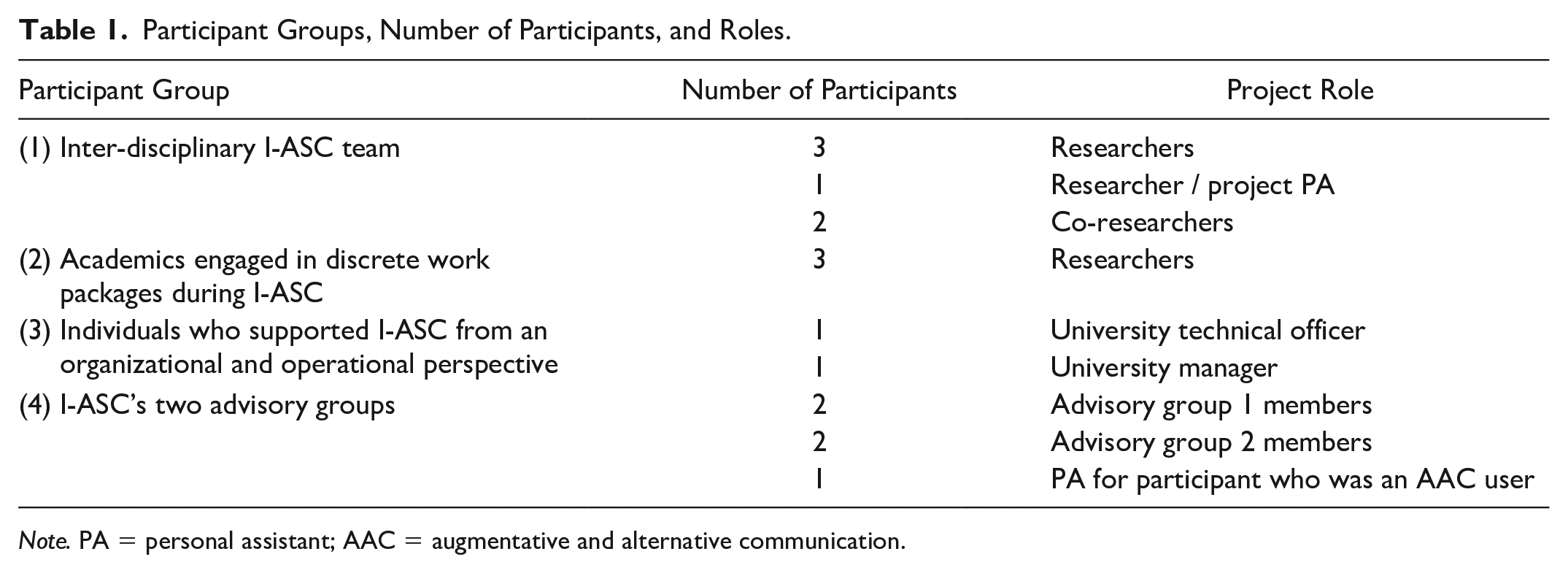
Note. PA = personal assistant; AAC = augmentative and alternative communication.
Researcher Positionality
The I-ASC chief investigator and two co-researchers designed the PI evaluation study and developed the data collection materials. A male speech and language therapist and postdoctoral researcher was primarily responsible for data collection and analysis. He did not identify as having any disabilities. This researcher was trained in, and had experience of, qualitative research methods but had no prior experience of PI evaluation. He was employed at the university where I-ASC had been based but had not been involved in the project previously. He had a professional relationship with six of the 16 evaluation study participants; this included the I-ASC chief investigator who was his line manager. The researcher received methodological support during this study from two senior researchers from the same university who led the PI evaluation but had not been involved previously in I-ASC.
Interview Guides and Data Collection Procedures
All participants completed an individual interview, and those in Group 1 (the interdisciplinary I-ASC team, n = 6) also took part in a single focus group. We used a focus group method in addition to individual interviews for this participant group as we believed this method would enable us to explore common as well as divergent perspectives within the I-ASC team (Morgan, 1997) and might generate unexpected data due to the nature of participant interactions and group dynamics (Kitzinger, 2006). Individual interviews lasting from 25 to 100 minutes were conducted face-to-face in person in a familiar university setting (n = 9) or online using Skype (n = 7). The focus group lasted 90 minutes and took place on university premises with one participant joining via Skype. The focus group was completed after the individual interviews to give participants the opportunity to provide their individual views, and so that the focus group method could be used to explore and expand upon the findings of the interviews. Focus group participants were asked to maintain confidentiality outside the group by not discussing the content of the group interview with anyone, including the other participants. For all interviews and the focus group, data were audio recorded digitally and the researcher took field notes.
Two interview topic guides were created: one for interviews relating to each individual’s experience of PI for those in the first three groups (see Supplemental File A), and one for members of the project’s two advisory groups (see Supplemental File B). The topic guides were informed by a review of the published literature and guidance relating to PI (Moulam et al., 2020) and personal experiences. The topic guide used for the focus group was the same as that used for the Group 4 individual interviews. During the interviews, the researcher asked questions using the topic guides but allowed discussions to develop freely, to generate rich data (Mason, 2002).
Communication support was provided to the two participants who were AAC users to facilitate their participation in the interviews. Prior to data collection, the interview topic guides were sent to these two participants, who were invited to prepare their responses to interview questions in advance and pre-program their electronic communication aids with their answers. One participant prepared written responses to questions and emailed these to the researcher before their individual interview. The researcher read these responses aloud to the participant during the interview and checked whether they wished to revise their response or add any supplementary information. During the interviews, both AAC users responded to questions primarily by spontaneously producing utterances via their communication aid. At times, they would also use single word spoken responses (which had severely reduced intelligibility) or nonverbal responses (e.g., facial expression or gesture).
During the interviews, both AAC users received communication and personal support from their personal assistants (PAs), who were both also participants in the study. One PA was appointed through the main project to support an AAC user during project-related activities and had an additional role as a project researcher. The second AAC user employed their PA. The PAs offered the following types of communication support: They repeated or reformulated individual questions or responses made by other participants (in the case of the focus group) using accessible language, to support participants’ understanding; they alerted the researcher and other participants (in the case of the focus group) when an AAC user wished to respond; and they clarified participants’ intended meanings if the responses they produced using their communication aids, verbally or nonverbally, were not immediately clear.
Analysis
Individual interview and focus group data were de-identified and transcribed verbatim into separate Microsoft Word files, which were imported to QSR NVivo 10 software for storage, retrieval, and analysis. Data were analyzed thematically, using Framework Analysis (Ritchie & Spencer, 1994). The Framework approach was selected because we wished to generate codes and themes both deductively from the study objectives, prior literature (Moulam et al., 2020) and policy documents (e.g., NIHR, 2018), and inductively, from open data coding. Furthermore, Framework analysis has been demonstrated to enable rigorous, timely data analysis within health services research (Kiernan & Hill, 2018; Pope et al., 2006) and provide a transparent, systematic process of data summarisation and synthesis (Gale et al., 2013).
Analysis involved the iterative, five-stage process described by Ritchie and Spencer (2002). During an initial data familiarization stage, the transcriptions and field notes were reviewed in NVivo and annotated with reflections about potential codes and themes. Next, an initial thematic framework was created, based on these emergent codes and themes and the study objectives, interview guides, literature review (Moulam et al., 2020), and policy documents (e.g., NIHR, 2018). This initial framework was applied to one transcription from each participant group to refine existing themes and identify new ones inductively from the raw data. To ensure rigor, this stage of analysis was triangulated by asking a trained researcher not previously involved in I-ASC or the PI evaluation to independently code the same transcripts. The two coders discussed their interpretations of the data and any potential amendments that needed to be made to the coding of the transcripts to agree a working thematic framework. Minor disagreements were resolved through discussion.
The third indexing stage involved systematic application of the analytical framework to the entire data set in NVivo. At the next stage, data were summarized and synthesized across participants for each emerging core theme within a separate chart called a Framework Matrix. The final analytic stage involved reviewing the framework matrices to identify and map associations within and between themes and subthemes and finalize the thematic framework. The findings were then described and interpreted in relation to the study objectives. The final thematic framework was reviewed by the two PI evaluation project leads and any areas of ambiguity were clarified. Reflections, queries, discussions, and decisions were documented to create an audit trail for the data collection and analysis processes.
Results
Five themes were generated through the process of deductive and inductive coding of individual interview and focus group data: (a) the challenge of defining the co-researcher role; (b) power relations in PI; (c) resources used to enable PI; (d) perceived benefits of PI; and (e) facilitators of successful PI. Below we present each of these themes and illustrate them with sections of raw data.
“What Is the Job Spec?”: The Challenge of Defining the Co-Researcher Role
The data suggest that the co-researcher role on I-ASC was multifaceted, dynamic and, at times, difficult to define. Participants indicated that co-researcher inclusion was planned “right from the start to the finish of the project” and that the I-ASC chief investigator discussed the potential scope of the co-researcher role with researchers and co-researchers at the beginning of the project. The co-researcher role clearly developed from these initial conceptualizations, in response to the needs of the project and depending on the time, skills, and experience the co-researchers were able to provide. Notably, the co-researcher who was a parent brought many professional skills that were utilized within the project and was able to contribute more time to the project than initially anticipated: Basically, different things happened which have allowed (the chief investigator) to use me more than perhaps would’ve been anticipated right at the start. And I guess that’s been that (they) can draw on skill sets that are not just my lived experience.
Participants appeared to conceptualize the co-researcher role as incorporating both the traditional “user as representative” aspects of PI but also more novel “user as co-producer” elements. It was evident that participants who were researchers on I-ASC valued both aspects: “Having them there, very evident and very involved, not just people who we were reporting to, I think that worked well.” Co-researchers on I-ASC were involved in diverse co-production activities: participation in initial discussions with the chief investigator to conceptualize the study; contribution to the study design and development of the funding application; design of participant recruitment materials; data collection and analysis; and leading dissemination and impact activities. The co-researcher who uses AAC was involved in “interviewing people, doing presentations regarding the project . . . work on the website and social media.” Participants suggested that it might not be feasible to expect individuals with complex speech and motor disorders to fulfill these co-production aspects of the co-researcher role in other projects. They emphasized that the nature and extent of these co-researcher contributions should neither be perceived as commonplace within PI, nor expected in future projects involving people with these types of disabilities.
Participants expressed different views on what is achievable and desirable in terms of the breadth of the co-researcher role. One participant, a researcher on I-ASC, described the co-researcher as “an independent researcher in training, if that’s what they want to be.” Another participant, who had been a project advisor, was more cautious about the co-production aspects of the role: . . . where will the co-producer’s responsibilities fall? I see no value in, say, research design beyond formulating the question. The technical aspects of research design, our data analysis, our skills, it just takes a long time to acquire, you know. I don’t see why everybody has to bring that to the table.
Participants noted the diverse “skill and experience sets required” to engage in certain co-production aspects, for example, experience of team working and the ability to learn and use research methods. They recognized that many AAC users may not have such skills and abilities but may have “a different but incredibly important expertise to contribute.” Participants also suggested that it may be difficult to make certain research activities accessible to co-researchers who have different cognitive and communicative abilities: “we can’t have that conversation at a different level in a sense because it’s about discussing the data and interpreting it and so, it’s hard to differentiate that.”
Some participants felt that although the I-ASC co-researchers possessed skill sets that enabled them to fulfill a co-production role, this meant that their lived experience was perhaps less representative of the wider population of AAC users and their families. While participants recognized that two co-researchers could not be representative of the “wider spread of opinions, perspectives, realities in terms of how people live,” they expressed concern that they came “from a group of very high achieving, very able users, and (the) project was really looking at a much bigger cohort of people with different challenges and abilities.” This apparent tension between the dual aspects of the co-researcher role (representative versus co-producer) was perceived as a challenge by participants.
“We Wanted You as Equal Partners”: Power Relations in PI
This theme provides information about the status of the co-researchers and their relationships with researchers within the I-ASC team. Participants across all groups commented that the co-researchers were well integrated within the research team and fully included in project activities, in a way that was described as “genuine, rather than tokenistic.” Participants who were researchers and university staff supporting the project perceived the co-researchers to be working “at an equal level” to researchers in the team. One participant commented, “they brought different skills and talents to the team as anyone else on the team did . . . I don’t see them necessarily as wildly different to any other team members.” The co-researchers suggested they were treated as equal members of the team: “(the chief investigator) always made it clear to me anyway right from the very beginning that we were an equal and essential part of the team.”
In contrast with these data, some participants in researcher roles suggested the co-researchers held more powerful roles in the team at times and reported finding this challenging. One participant commented, “There was a sense that the co-researchers were there to hold us to account, and I’m not sure if that was helpful to be honest.” Other participants suggested that researchers did not feel empowered to disagree with co-researchers during team discussions: “I think there was sense that everyone was equal but then I think some of the researchers felt maybe we couldn’t always challenge (the co-researchers).” This appeared to inhibit discussion, which impacted team decision-making processes: “you kind of had to give up the argument in a way, where I think if it was another researcher who didn’t have that lived experience, maybe it would have been argued out a bit more.” Interestingly, participants who were researchers who made these types of comments relating to perceived power imbalances during their individual interviews did not raise the same issues during the focus group.
These data suggest that the co-researcher perspective was not only valued but privileged in team discussions; there was recognition from participants in researcher roles that this sometimes conflicted with the need to deliver the funded project within the planned timescales: “do I really want to hear what they’ve got to say, what’s the impact on the research objectives and aims?.” One of the co-researchers recognized that their responses could be challenging and might serve to disrupt traditional power relations between health care professionals and users, but saw this as an important part of the co-researcher role: I am absolutely aware it makes other people uncomfortable, because it is a challenge and it’s all about that, I guess it’s that power balance between being an expert in your own field and not being used to being challenged because you do feel you’re an expert in your own field . . . So it’s a bit like the doctor-patient relationship, isn’t it? The doctors aren’t used to being challenged . . .
The data also suggest that structural barriers challenged researchers to employ and reward the co-researchers on an equitable basis and that this affected the nature of relationships within the project team. Research funding policies and university employment arrangements prevented the co-researchers from being paid on an equal basis to the researchers. For example, the co-researchers were involved in preparing the project funding application, but their time was not funded. A focus group participant who had been a researcher commented, . . . you (the co-researchers) were completely volunteering your input there. Whereas everybody else around the table was in a salaried position where developing research bids is part of their job description expectation. So that actually made the relationship different. Even though we wanted you as equal partners, actually, we weren’t able to have you as equal partners in terms of reimbursement at that point.
When the project had been funded, it was not possible for the university to pay the two co-researchers on an equal basis for their involvement. The co-researcher who was a parent could be employed and paid by the university as a contractor, but this was not possible for the AAC user, as it would have jeopardized their entitlement to statutory disability benefits. Participants felt strongly that current arrangements for reimbursing co-researchers and other PI contributors represent systemic barriers to ethical PI and should be reviewed urgently: We really, really haven’t got it right for involving people who are involved in the benefit system at all, for adequately paying for their involvement in research . . . unless you can do that, there isn’t an honest and ethical way of involving people from a financial perspective.
The co-researchers’ lack of parity in terms of their employment status impacted on the team’s ability to include the co-researcher who was an AAC user in certain activities. For example, the co-researcher could not collect data from National Health Service (NHS) patients because this required specific research governance approvals, which could only be granted to an employee: “because (they) weren’t paid, (they) couldn’t get a passport, the NHS passport, and then (they) couldn’t do the NHS interview. So it limited (their) role right down across the project.” The team spent considerable time trying to resolve this challenge, but discontinued because “it was just appallingly insulting and unethical from (the co-researcher’s) point of view to keep going because all it was doing was highlighting their difference and their inequality in the team.”
Participants observed other differences in individual levels of integration and involvement between the two co-researchers. They indicated that although the co-researcher who was an AAC user was a “very strong and effective (team) member,” they appeared less integrated and involved than the co-researcher who was a parent and did not have a disability. A participant who had been a project advisor commented, I felt that the parent was operating independently and was . . . helping to generate the ideas and play a full part in the reporting process for example, whereas I felt that (the AAC user’s) participation was very much guided and influenced by other members of the team.
Participants appeared to attribute these differences to the co-researchers’ varying experiences of working in teams. A participant who was a researcher described the parent as “familiar with being involved in research projects,” whereas for the AAC user, “the experience of being involved in a research project was newer and more challenging.” Participants identified contrasting ways in which the co-researchers contributed and communicated within team discussions. The co-researcher who was a parent was described as “an assertive communicator in a very positive way,” whereas the AAC user was described as a more “passive” communicator, who may not always have felt empowered to ask for support to understand unfamiliar research concepts. One participant suggested that adult AAC users may be more likely to adopt passive roles as co-researchers because they have been “used to being kind of consulted rather than being a very active participant.” Other participants attributed individual differences in integration and contribution to the co-researchers’ differing speech abilities. A participant who was a researcher on the project commented, “(the co-researcher who is a parent) I would say, has had a much more overt integration in the team in that they can speak at the same rates as you or I.”
Despite this lack of parity, both co-researchers described their involvement in I-ASC as a positive and empowering experience. They reported that their involvement enabled them to use existing professional skills and experience, engage in meaningful occupation, and learn new things: “being on this project as a co-researcher has been a huge learning curve for me in plenty of aspects.” This had benefited their “self-belief, self-esteem, confidence” and helped them “to feel valued.” In contrast to these data, participants who were researchers expressed concern that the co-researcher who is an AAC user may have sometimes felt disempowered by other people’s responses to their involvement. For example, one participant commented that the co-researcher’s long-term support staff appeared to obstruct their participation in project meetings: (The support staff) were clearly conveying a message to (the AAC user) that (they were) the token disabled person around the room and (the AAC user) really wasn’t there to contribute anything and it was a waste of their time to have to come and sit during the day whilst (the AAC user) was in this meeting.
Generally, participants across different groups suggested that the involvement of the AAC user in data collection and dissemination created a “very powerful and very important” message about the capabilities of people with complex speech and motor disorders and provided an empowering role model to other AAC users, family members, and the people who work with them. For example, one participant indicated that the experience of observing the co-researcher who uses AAC in the interviewer role may have challenged the assumptions of staff at a college of further education about the range of potential occupational opportunities available to young AAC users: I think they thought, “oh, that means that, potentially, any of our service users who attend . . . students who attend the college could be someone who could be involved in university or could be doing interviews.” That is brilliant.
“It Needs an Awful Lot of Time”: Resources Used to Enable PI
Participant interviews suggested that significant time and financial resources were required to involve the co-researchers meaningfully in I-ASC. Considerable staff time from within and outside the core project team was spent trying to obtain employment contracts and research passports for both co-researchers. Researcher time was also used to train co-researchers in research methods and to understand team communication methods. In particular, participants spoke at length about the resources required to make the co-researcher role accessible to the AAC user: “accommodating the needs of somebody who has significant physical impairments as well as communication impairments adds exponential amounts of time”; “it makes a difference to every aspect of your planning. It’s physical accessibility, transport accessibility, the mealtime accessibility, the interaction accessibility, the fatigue demands.” A university manager described a process of purchasing accessible furniture, changing access to office space, and developing a personal evacuation plan for the co-researcher, based on specialist health and safety advice. Participants appeared surprised that these types of adjustments were necessary in a relatively new building that had been designed to be fully accessible to people with physical disabilities.
Some participants considered that the type of personal support required to enable the AAC user to participate during project meetings was significantly different from the personalized care and communication support usually provided by this individual’s personal assistants (PAs). This necessitated increased resources in terms of training. A participant who was a member of an I-ASC advisory group commented, I think that clearly, the communication aid user was hugely supported in everything that (they were) doing . . . I was very aware of the resources that were required to allow (them) to contribute, to allow (them) to participate, and these resources I could see were high, both in terms of the availability of an assistant all the time but also must have been high in relation to the finance . . .
The team spent “hours and hours and hours of work and training” to enable students to work in paid roles as PAs but was unable to secure consistent support. A participant questioned whether students “were maybe overwhelmed a bit by the level of task they were being asked to do,” which underlines the specialist and demanding nature of the support potentially required by co-researchers with communication and physical disabilities. In the end, the chief investigator recruited support from a member of the core project team who had a unique skill set: They understood the nature of the project, shared the IR values underpinning the research, had professional experience of working with people with communication disabilities, and were able and willing to provide personal support.
Participants also identified that some researchers who were less familiar with working with people with complex speech and motor disorders needed training and support to collaborate effectively with the co-researcher who uses AAC within meetings. At a basic level, researchers needed to understand that they needed to give the AAC user sufficient time to program their communication aid to respond to questions. Participants also identified the broader implications of enabling an individual with complex speech and motor disorders to participate meaningfully within a team: The timing of meetings. The social space. The potential for social interactions, it has to be modified. So, both within the formal meeting and in the informal contexts, having somebody with multiple impairments changes the dynamic, the time constraints.
Participants commented on several “hidden costs” of PI. As described previously, the co-researchers volunteered their time to contribute to the project funding application at the project planning stage. During project delivery, an underestimation of the funding required to support delivery of PI resulted in the chief investigator using unfunded time to manage some PI elements and needing to secure additional funding to enable enhanced co-researcher input when the project required this. In addition, participants indicated that the financial reward received by co-researchers may not have been commensurate with the level of professional skill and experience they used to inform their contributions to the project: I think (one of the co-researchers) brought phenomenal skills in terms of dissemination I think which kind of came from outside of (their) lived experience. (They have) a marketing background and I think (they) really brought a suite of skills that we wouldn’t have had in the project in terms of research translation . . .
“More Gains Than Losses”: Perceived Benefits of PI
Most participants were able to identify a range of important individual, project, and societal benefits that they attributed to PI. At an individual level, participants who were researchers indicated that their awareness of the lived experience of AAC users and their families had increased as a result of working with the co-researchers. One participant reported feeling “much more attuned to how at variance priorities might be between professionals whether they’re researchers or practitioners and the people that we’re there actually to serve.” Another participant with no prior experience of working with people with complex speech and motor disorders reported, “it’s taught me quite a lot, especially just seeing (the co-researcher), who’s the user of AAC, and talking to (them).” Participants also reported benefiting from witnessing the positive value of PI and from new learning about how to involve the public in both clinical service development and research (e.g., in terms of how to recruit and support co-researchers with specific needs): I have previously in different jobs thought, “Oh, it’s going to be so difficult. And it’s going to take a long time.” Yes, it has taken extra time. But I do think it’s really valuable and I think I would always now, if there’s opportunities, strive for involving someone who uses AAC in other projects or (clinical) work . . . . . . it’s probably inspired me to do more of that within our service outside of research, which we are doing. So we got a member of staff that’s now an honorary member of staff. He’s someone that uses AAC.
Participants who were researchers reported finding working with co-researchers rewarding. They suggested that the involvement of the co-researchers led to improvements in team communication processes, which benefited everyone: “we’ve all had to learn about being much clearer with our communication and what’s expected of other people.” They also suggested that the involvement of the co-researchers enabled researchers to feel grounded and focused on the aims of the project: “it helped keep it in line with the original objective.” One participant suggested that co-researchers’ contributions to discussions about dissemination enabled the team to be more ambitious about the way they conceptualized and communicated their research findings: “it gave the project team a bit more braveness in being able to do it, I think.”
The data suggest that the involvement of the co-researchers enhanced the research process and its outputs. Participants identified methodological insights that originated from the co-researchers’ unique perspectives. They argued that actively involving co-researchers, particularly a person with a complex speech and motor disorder, in data collection improved the feasibility of participant recruitment and engagement, and the quantity and quality of data accessed: I think the sense that there were co-researchers involved in this project enabled buy-in and interest from people who otherwise mightn’t think about research projects as really being for them. . . . . having a person who uses AAC in the team as part of the data collection piece made a significant difference to the planning of what was logistically possible, what could be asked . . . questions that maybe could be asked by (them) that couldn’t be asked by others as easily . . .
Participants who were researchers believed that clinical resources co-designed with the co-researchers as project outputs would be more “useful and practical” due to their contributions. They also commented that publications and other dissemination outputs would be more accessible and engaging due to co-researchers’ feedback on their content: “it’s definitely helped frame how we’ve reported the results, which is really important.” Participants associated these contributions to the design and dissemination of outputs with potential improvements in knowledge translation and the clinical implementation of the project findings. They suggested co-produced project outputs had greater “face validity” which, they argued, increased the credibility, “power,” and “authority” of these outputs in the eyes of research consumers, and the likely impact of the research: So this project, from where I’m sitting, really did appear to be more authentic and really to be harnessing a range of views, and that should give it credence with end users. It should give it credence with, you know, like commissioners.
In contrast to these data, a minority of participants reported that they found it difficult to identify concrete benefits attributable to involving the co-researchers in co-production activities: “I think the jury’s out on that.” These participants suggested that benefits may become apparent in the long term, following implementation of the project findings.
“Finding the Right Support,” “Recognition as Equals”: Facilitators of Successful PI
Participants used their experience on I-ASC to suggest ways in which PI might be facilitated in other projects. They identified that research teams need to engage in comprehensive planning of individual projects to achieve successful PI. Participants suggested it was important to plan for co-researchers to be involved throughout the entire lifetime of a project, to enable them to contribute meaningfully: “it’s having that broad base of knowledge from the start of the project right through.” Participants’ comments indicate that researchers and funders need to be more realistic about the time, funding, and other resources (e.g., accessible environments) required to enable people with disabilities to participate; researchers need to be able to incorporate flexibility into project timelines to enable individual environmental adaptations and equipment to be secured as and when they are required. Participants highlighted the benefits of planning support for co-researchers with complex speech disorders that is personalized, high quality, consistent yet flexible: “the really important point is finding the right support person for someone with such a marked communication disability.”
Participants described ways in which local and national policy could be adjusted to improve access to co-researcher and other PI roles, particularly for people with complex speech and motor disorders. They indicated that research professionals need support to develop a clear vision of what the co-researcher role can encompass but understand that individual role descriptions will depend on the aims and objectives of specific projects. This would require a more developed conceptualization of the co-researcher role within research infrastructure, in terms of potential operational definitions for the role and its employment status. Participants emphasized the need for the public to be able to access employed research roles on an equitable basis at all stages of research. Participants suggested that research funders should explicitly encourage and enable full costing for PI roles and provide superior guidance about how to cost salaries and design job descriptions in funding application processes: NIHR might argue “Oh, we expected it to be costed,” but when it’s not in the sort of fine-grained infrastructure that they provide, then it will more likely feel like a cost pressure rather than something that’s essential.
Participants also suggested that research bodies could facilitate PI by providing practical support with co-researcher recruitment. They identified that, currently, co-researcher recruitment can be challenging and often relies on personal contacts and involvement of “the usual suspects,” individuals with prior experience of PI. This can limit the representativeness of co-researchers. One participant who was a co-researcher suggested that the development of a database for people who are interested in PI by bodies such as the NIHR would be beneficial. Similarly, another participant suggested that an agency should be set up to offer “off-the-shelf training” for co-researchers and practical support for research teams, for example, “how you navigate the NHS Passport.” A participant who was a university manager emphasized the value in understanding local processes (e.g., human resources) relating to the identification and recruitment of co-researchers, to “pre-empt those challenges and barriers and start those initial conversations earlier.”
Participants commented that researchers in traditional roles need to support co-researchers to understand the range of available involvement options and the nature of the co-researcher role. A participant suggested this could be achieved by “making the stages of the research process more explicit and allowing people to see examples that relate to each of those explicit stages,” through “a menu that is accessible and explicit, as an introduction to getting involved.” At the same time, researchers “need to establish an environment in which people can be very upfront about what their needs are and what their strengths are.” This would enable researchers and co-researchers to engage in informed, shared decision making about “buy-in or opt out of particular roles and activities.” Participants suggested that co-researchers should have access to the same development opportunities as researchers in traditional roles: flexible working options (e.g., the opportunity to work from home), training in research methodology, and mentorship. A participant who was a project advisor speculated whether a national “mentorship programme” could be developed for co-researchers.
The data suggest that research leaders need to create a team ethos that facilitates PI. Participants indicated that an “asset-based,” inclusive approach to project management can facilitate co-researcher participation; a participant who was a university manager explained: “It’s about the value, the recognition as equals. The fact we’ve looked at (the co-researchers’) individual needs and built it in, not made it a problem.” Participants recommended that all members of a research team should try to understand each other’s backgrounds, project roles, and expectations, to facilitate successful team working and navigate potential power dynamics: “try to get to know your colleagues and value and understand what they’re bringing to the project.” This could be achieved by planning to spend social time together, especially in the early stages of a project: “having time to have some open discussions about people’s viewpoints, their philosophies of where they’re coming from.” Other participants highlighted the importance of open, inclusive, and respectful communication within project teams. A participant who was a co-researcher commented, “be open-minded . . . don’t be apprehensive or even defensive, if your own viewpoint particularly your professional viewpoint or way of working is challenged.” A participant who was a researcher suggested that this open-mindedness should extend to decision making about methodology: “being willing to be a bit less purist about the way that you do something because it might have unexpected benefits.” Participants identified that teams should anticipate how they will manage challenging conversations between researchers and co-researchers, which may arise when individual perspectives appear to conflict.
The results also emphasize the importance of understanding and supporting co-researchers’ individual communication needs to facilitate their involvement. Participants’ responses suggest this would not only apply to people with communication disabilities; researchers are likely to need to adjust their communication style to make research terminology accessible to co-researchers, to achieve a shared understanding of goals and processes. Furthermore, individuals may have specific needs relating to literacy: “there’s lots of people for whom literacy or at least reading complicated charts and documents, it’s not an easy thing to do.”
Several participants identified practical approaches to making communication more accessible to co-researchers with complex speech and motor disorders during research activities. In terms of planning team meetings, participants identified a need to provide advance information about future discussions to enable AAC users to prepare and program responses; furthermore, meetings and breaks should be scheduled to manage fatigue levels, support personal care needs, and facilitate communication. Written summaries of matters discussed during meetings should be sent to co-researchers to support them to understand and retain project information.
During meetings, participants emphasized the need to provide specialist communication support through PAs. The nature of this support would depend on individual needs but is likely to include checking regularly whether a co-researcher understands “the content of the meeting and the discussion” and any specific terminology used. Co-researchers with communication disabilities may not request this type of support in a group setting; a participant explained that during I-ASC, the co-researcher’s PA “has very subtly been able to explain things that she was spotting he wasn’t getting that we wouldn’t have spotted in a whole meeting, or he wouldn’t have wanted to draw attention to himself.” Communication support is also likely to include checking whether a co-researcher wishes to respond or ask questions and reminding colleagues to adjust the timings of interactions to give the co-researcher sufficient time to prepare an utterance on their communication aid to respond. It would be equally important to plan support for other members of the research team to work confidently with co-researchers with disabilities; the whole research team would benefit from training to learn practical ways to plan and conduct meetings to support someone who uses AAC to have sufficient time to process information and communicate.
Discussion
Through this study, we have extended the evidence base relating to approaches to conducting IR with people who have disabilities (e.g., Clarke et al., 2018; Schwartz et al., 2020) and the parents of children living with health conditions (e.g., Shen et al., 2017). In addition, we have reported important novel findings about the practicalities, challenges, and benefits of involving people with complex speech and motor disorders who use AAC and their family members in research. Although this group is increasingly involved in the development of assistive technology and AAC devices using participatory design methodologies (Hamidi et al., 2015; Ibrahim et al., 2020), their involvement in research is less common (Moulam et al., 2020). While some individuals who use AAC are known to be lead or co-investigators in both AAC and other research fields, there is little research evaluating their experience as co-investigators or specifically focused on any barriers and facilitators to their involvement and how this affects project outcomes.
Our findings suggest that involving these groups in meaningful PI at all stages of research is possible. All participants in this study clearly espoused the democratic and emancipatory values of IR and public involvement (Green, 2016; Watchman et al., 2020). In terms of team membership, researchers, research support staff, and project advisors appeared to perceive the co-researchers to have equal status to researchers. The co-researchers were enabled to participate at all stages of the research process and appeared to be well integrated within the project team; they were not merely consulted but contributed actively to diverse co-production activities, suggesting their participation was not tokenistic. The co-researcher perspective appeared to be valued and privileged during team decision-making processes. This contrasts with the commonly reported trend for professional experience to “overpower” lived experience in IR and PI, due to differing perceptions of what constitutes expertise (Clarke et al., 2018; Green, 2016; Staley & Barron, 2019). Participants indicated that the significant resources required to include a co-researcher with a severe communication and physical disability was justified for ethical, democratic, and epistemological reasons, and that this type of PI afforded a range of individual, research, and societal benefits.
Participants were able to identify several structural, policy, and cultural barriers that made it difficult for the co-researchers to access research roles, participate in research activity, and be rewarded financially for their contributions on an equitable basis with the researchers, and with each other. These findings are consistent with existing evidence relating to challenges observed in engaging parents in co-researcher roles (Shen et al., 2017). They also complement evidence that relates to other populations considered to be vulnerable and difficult to access, for example, people living with dementia (Clarke et al., 2018) and people with intellectual disabilities (Schwartz et al., 2020). These barriers clearly impacted to a greater extent on the physically disabled co-researcher’s involvement opportunities; participants noted that the challenges of involving the AAC user equitably were greater than those associated with involving the parent.
Therefore, we agree with other commentators (Ocloo & Matthews, 2016) that current research infrastructure and policy mechanisms do not enable people with disabilities to inhabit the co-researcher role on an equal basis and research teams lack practical guidance to support them to achieve equitable involvement for this group. We suggest that the co-researcher role needs greater recognition and status at national policy level to increase access for diverse groups of people. Although the NIHR (2018), a major U.K. research funder, has recently set out good practice standards for PI, the results of this study indicate that these standards are difficult to operationalize and do not support researchers to overcome structural and policy barriers; this is because the standards lack specificity and do not include guidance relating to how to make PI inclusive of people with significant or multiple disabilities. Furthermore, existing PI and co-production guidance and frameworks do not appear to facilitate the inclusion of marginalized groups, for example, children, or adults with significant cognitive and communication disabilities (Clarke et al., 2018; Greenhalgh et al., 2019; Pandya-Wood et al., 2017). This may explain why representatives of these groups tend to be involved in studies primarily as consultants rather than co-producers or co-researchers (Beckett et al., 2018).
Our data indicate that the co-researcher role is complex and may be difficult to define clearly in guidance or policy frameworks, due to its potentially multidimensional and fluid nature. As a result, such frameworks may best serve to operate as guiding principles for inclusive PI. We agree with others (e.g., Dovey-Pearce et al., 2019) that more reflexive and agile approaches to involving members of the public with and without disabilities may be beneficial. These approaches need to take account of individual abilities, interests, levels of empowerment, and support needs; they should enable research teams to deal with emergent challenges and opportunities during projects. Data provided by a minority of participants in our study lead us to question the feasibility and potential benefit of expecting all PI representatives to inhabit the “user as representative” and “user as co-producer” aspects of the co-researcher role. Participants’ comments suggest that these dual aspects may, in fact, compete with each other: Individuals with existing skill sets that enable them to be co-producers may be less representative of more diverse populations (Brett et al., 2012). Similarly, training members of the public to develop research skills risks “professionalizing” them and limiting the authenticity of their PI contributions (Schwartz et al., 2020; Thompson et al., 2012). Teams need to consider these possibilities when co-designing involvement opportunities with members of the public.
We have identified a number of practical ways that communication and physical access can be supported for people with complex speech and motor disorders. We have used these findings to develop an online toolkit (https://iasc.mmu.ac.uk/public-involvement/) to suggest how to achieve meaningful PI for those with significant speech, communication, and physical disability of all ages. The toolkit includes guidance to support funders, policy makers, and researchers to develop IR protocols and describe/explain prospective PI roles. We have created indicators of cost parameters that researchers could use to inform future applications for funding to enable meaningful PI for this population (see Supplemental File C). The toolkit complements other accessibility guidance developed to support researchers to involve other groups in IR (e.g., Frankena et al., 2019).
Limitations and Future Research
In this study, the nature of existing relationships within the participant group and the postdoctoral researcher’s professional relationship with many participants may have meant that social desirability bias affected participant responses. Although the researcher was operating independently to the research team, his relationship with the I-ASC chief investigator, who co-designed the PI evaluation, may have influenced the process of data collection and analysis. The participant sample was relatively small, including only two people with complex speech and motor disorders and two parents, and focused on the contributions of the two co-researchers. This did not allow us to explore a range of perspectives from these two populations or to investigate phenomena relating to intersectional aspects of identity, such as ethnicity, gender, sexuality, or class that might have influenced their experience in the research team (Abrams et al., 2020). Future investigations could usefully adopt an intersectional approach to generate more nuanced understandings of the co-researcher experience and the nature of power relations underpinning co-produced research. Furthermore, the use of ethnographic methodologies employing observational methods could generate deeper understandings of cultural practices within IR teams.
Conclusion
In this study, we explored the involvement and contributions of two co-researchers with lived experience of complex speech and motor disorders within a large interdisciplinary health services research project. Our research has generated novel findings about how PI and co-production of research might be made accessible to, and inclusive of, a population that traditionally has been perceived to be vulnerable, marginalized, and difficult to involve. Our findings suggest that successful PI involving this population is possible but presents unique challenges and requires significant resources. Structural, policy, and cultural barriers may affect people with complex speech and motor disorders and parents differentially and threaten parity within research teams. Current policy and guidance frameworks may not support research teams to overcome these challenges or to access sufficient funding to involve people with this severity of communication and physical disability, either meaningfully or equitably.
The findings of this research suggest practical ways to enable greater access to the co-researcher role for people with complex speech and motor disorders in future IR. This new evidence can be used to complement existing ethical, democratic, and epistemological justifications for IR and PI more generally. It is evident that reflexive and agile approaches to working with co-researchers would potentially enable research teams to deal with emergent challenges and opportunities. The online toolkit created on the basis of our findings offers useful insights into how to plan, fund, and support meaningful contributions from this group and from other people with complex and multiple disabilities. Through this study, we have also extended the evidence base relating to the various benefits that the involvement of people with disabilities can provide, at an individual, project and societal level.
Supplemental Material
sj-docx-1-qhr-10.1177_1049732321994791 – Supplemental material for Making Public Involvement in Research More Inclusive of People With Complex Speech and Motor Disorders: The I-ASC Project
Supplemental material, sj-docx-1-qhr-10.1177_1049732321994791 for Making Public Involvement in Research More Inclusive of People With Complex Speech and Motor Disorders: The I-ASC Project by Mark Jayes, Liz Moulam, Stuart Meredith, Helen Whittle, Yvonne Lynch, Juliet Goldbart, Simon Judge, Edward Webb, David Meads, Bronwyn Hemsley and Janice Murray in Qualitative Health Research
Supplemental Material
sj-docx-2-qhr-10.1177_1049732321994791 – Supplemental material for Making Public Involvement in Research More Inclusive of People With Complex Speech and Motor Disorders: The I-ASC Project
Supplemental material, sj-docx-2-qhr-10.1177_1049732321994791 for Making Public Involvement in Research More Inclusive of People With Complex Speech and Motor Disorders: The I-ASC Project by Mark Jayes, Liz Moulam, Stuart Meredith, Helen Whittle, Yvonne Lynch, Juliet Goldbart, Simon Judge, Edward Webb, David Meads, Bronwyn Hemsley and Janice Murray in Qualitative Health Research
Supplemental Material
sj-docx-3-qhr-10.1177_1049732321994791 – Supplemental material for Making Public Involvement in Research More Inclusive of People With Complex Speech and Motor Disorders: The I-ASC Project
Supplemental material, sj-docx-3-qhr-10.1177_1049732321994791 for Making Public Involvement in Research More Inclusive of People With Complex Speech and Motor Disorders: The I-ASC Project by Mark Jayes, Liz Moulam, Stuart Meredith, Helen Whittle, Yvonne Lynch, Juliet Goldbart, Simon Judge, Edward Webb, David Meads, Bronwyn Hemsley and Janice Murray in Qualitative Health Research
Footnotes
Acknowledgements
The authors acknowledge the contributions of Professor Susan Powell and Professor Francis Fatoye, who provided general methodological support to Mark Jayes during this study, and Dr. Christina Sotiropoulou Drosopoulou, who provided support with data analysis.
Authors’ Note
Yvonne Lynch is now affiliated with Trinity College Dublin, University of Dublin, Dublin, Ireland.
Declaration of Conflicting Interests
The authors declared no potential conflicts of interest with respect to the research, authorship, and/or publication of this article.
Funding
The authors disclosed receipt of the following financial support for the research, authorship, and/or publication of this article: This work was supported by the National Institute for Health Research Health Services and Delivery Research Program (NIHR HS&DR Project: 14/70/153—Identifying appropriate symbol communication aids for children who are non-speaking: enhancing clinical decision making). The views and opinions expressed therein are those of the authors and do not necessarily reflect those of the HS&DR Program, NIHR, NHS, or the Department of Health.

Supplemental Material
Author Biographies
References
Supplementary Material
Please find the following supplemental material available below.
For Open Access articles published under a Creative Commons License, all supplemental material carries the same license as the article it is associated with.
For non-Open Access articles published, all supplemental material carries a non-exclusive license, and permission requests for re-use of supplemental material or any part of supplemental material shall be sent directly to the copyright owner as specified in the copyright notice associated with the article.
