



Abstract
The families of people diagnosed with dementia are commonly first-in-line caregivers. This can have a considerable effect on their lives, health, and relationships. However, few studies have focused on the children in such families. Therefore, the aim of this study was to describe how children, in their own narratives, construct themselves as subjects growing up and caring for a parent with dementia. The study applies discourse analysis. The findings show three subject positions: parent to your parent(s), orphan with parents, and time traveler stuck in time. There is a need to support these children, both as children and as young adults. More knowledge is necessary regarding the kind of support they might want or need. For health care professionals, it is important to know that it might not always be easy to ask for information or support as a child caring for a sick parent.
Introduction
Dementia is one of the most common and severe public health challenges in our societies. The World Health Organization (WHO; 2017) has estimated that more than 50 billion people are diagnosed with dementia and that around 10 million are reported every year. Dementia has a physical, psychological, social, and economic impact on people and affects their ability to perform everyday activities (WHO, 2017). Loss of memory and language, disorientation, depression, and aggressiveness are some of the most common consequences of dementia. When the severity of the illness increases, the person with dementia requires more supervision (Cerejeira, Lagarto, & Mukaetova-Ladinska, 2012). Caring for a person diagnosed with dementia can have positive effects; the families can adapt and experience growth based on their lived experiences (Cabote, Bramble, & McCann, 2015). The fact that a person has dementia affects his or her families, friends, communities, and society (Ask et al., 2014; Cabote et al., 2015; Johannessen, Helvik, Engedal, & Thorsen, 2017; WHO, 2017).
Previous research about children’s lived experiences and stories about having a parent diagnosed with dementia shows that these children need to be flexible and at the same time create specific routines (Kindell, Sage, Wilkinson, & Keady, 2014). Children’s narratives about their experiences can include words such as battle and phrases such as being parents to their sick parent (Johannessen et al., 2017). They can experience various degrees of effects on their mental and physical health (Hutchinson, Roberts, & Kurrle, 2014), for example, emotional trauma such as grief and loss (Hutchinson, Roberts, Kurrle, & Daly, 2014; Rosenthal Gelman & Greer, 2011). They might also experience guilt, shame, or embarrassment in different social environments. These children can encounter difficulties that develop in their own lives and perform well at school, at work, or in other close relationships (Allen, Oyebode, & Allen, 2009; Barca, Thorsen, Engedal, Haugen, & Johannessen, 2014; Kjällman-Alm, Norbergh, & Hellzen, 2013; Rosenthal Gelman, & Greer, 2011).
Children’s lived experiences and stories about having a parent with dementia are a relatively limited area of research (Hall & Sikes, 2017; Hutchinson, Roberts, Kurrle, & Daly, 2014; Johannessen, Engedal, & Thorsen, 2015; Kindell et al., 2014; Rosenthal Gelman & Greer, 2011). There is a need for more research on how these children in these families can express themselves in a narrative context (Hall & Sikes, 2017). Studying bloggers with this experience contribute to addressing this particular group of family members. It will hopefully contribute to an increased knowledge about how and what kind of subject is understood as possible or meaningful for these children to occupy, as well as what kind of challenges they might have to address in the short or long term. Therefore, the aim of the study was to describe how children growing up with a parent diagnosed with dementia can construct themselves as subjects.
Theoretical Framework
The ontological point of departure in the theoretical framework is that the truth about reality is not considered as something preexisting, approachable, or reachable. Human beings are viewed as acting subjects within one of several possible constructions of reality discourses (Foucault, 1971/1993, 1973/2003). The epistemological perspective is that the world and language are socially constructed and that it is not possible to present a neutral or true picture of reality. Discourses regulate what expressions are accepted or not in a certain situation and context. Discourses are typically formed as knowledge is valued, organized, and established as truth or rejected, and to study discourses is to be part of their construction (Foucault, 1973/2003). In this way, language is regarded as a tool in our ongoing constructions of ourselves and the world and determines what is possible or not possible to say, do, and feel (Foucault, 1973/2003; Potter, 1996; Willig, 2008). Our physical world, individuals, and power are constructed through language (Foucault, 1973/2003; Howarth, 2007; Potter, 1996; Rose, 1999). Language is an act that shows how realities are staged and invested with value and content. Language is a social practice because it makes something, delimits, stages, performs, or reproduces actions and thoughts. In that way, it also governs what we see as important, unimportant, true, false, right, or wrong. Language governs what we talk about and how we talk about it (Hall, 2001; Potter, 1996; Rose, 1999).
Method
There is a twofold methodological focus: Discourses are constructed in the use of language, and discourses construct and establish versions of reality (Foucault, 1973/2003; Potter, 2004; Rose, 1999). The discursive psychological approach focuses on how texts and talk can be rhetorically organized in a social interaction and how to identify what categories and discourses are produced and reproduced in a given context (Potter, 1996, 2004). In this study, categorization is used based on the fact that discourse analysis is action oriented, situated, and constructed (Potter, 2004). The state of being a parent or a child is a socially constructed category and can be regarded as true, negotiated, or rejected in relation to different discourses. Socially constructed categories are situated in a context, culture, time, and place, which determine what is possible or not possible to say, do, and feel (Foucault, 1973/2003; Rose, 1999). These kinds of social categories (e.g., the category of parent or child) are commonly regarded as something “natural” and are, therefore, often taken for granted. In this approach, categories are regarded as products of discourses and form the starting point for an analytic discursive perspective. Categories can entitle people to certain actions and knowledge and sanction a certain legitimacy and credibility (Potter, 1996). Categorization is part of the social order and rhetorical resources in our construction of relationships. In our daily life, it is a resource to understand, negotiate, and sanction an identity (Potter, 2004; Potter & Wetherell, 2001).
As a rhetorical resource, categorization has an argumentative function. The analytical focus is on how people can construct themselves as subjects by occupying subject positions that are negotiated in a certain situation and context (Billig, 2001; Edley, 2001; Potter, 1996, 2004). One or more person categories and their categorized actions constitute a subject position, which is a concept of identity and self that is made possible through language. A subject position is constructed and enabled by what the individual regards as most meaningful, logical, and suitable (Billig, 1987/1996; Hall, 2001). The self is “made” in interaction with others, and different subjects become relevant through specific ways of using language and the discursive and rhetorical contexts (Billig, 1987/1996, 2001; Edley, 2001; Potter, 1996, 2004).
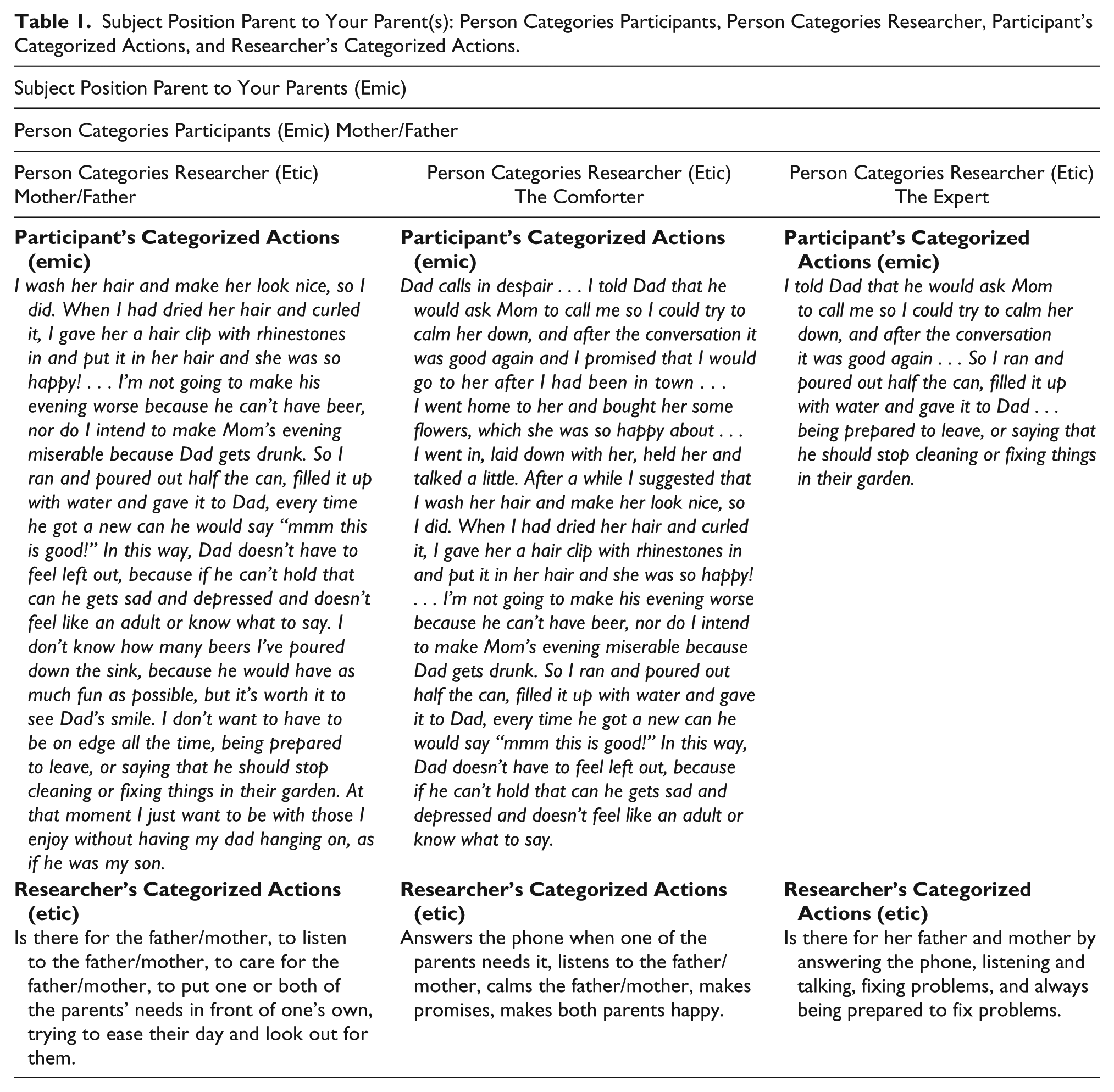
In this study, the focus is on how the children of parents diagnosed with dementia can use categorization in their blogs to organize, systematize, and make their conceptions of themselves and their reality possible and meaningful. This is done to create a common understanding of themselves as subjects and their subject positions. The explicit person categories (e.g., parent), the categorized actions that are manifested in the texts (e.g., wash), and the analytically formulated person categories (e.g., comforter or expert) and categorized actions (e.g., calm or fix problems) are abstracted into analytically formed subject positions (e.g., parent; see Table 1).
Subject Position Parent to Your Parent(s): Person Categories Participants, Person Categories Researcher, Participant’s Categorized Actions, and Researcher’s Categorized Actions.
Another concept in a rhetorical perspective is the use of ideological dilemma (Billig, 1988, 2001). By distinguishing cognitively constructed intellectual ideologies from lived ideologies, the latter are considered to be constructed based on perceptions, values, and language within a specific social context. Examples of ideological dilemmas are caution versus risk taking or a firm attitude versus mercy, which are valued based on the prevailing logic. Discourses can be regarded as practical ideologies in that their function becomes visible when they make sensible experiences meaningful. These reason-based discursive practices are ideological in the sense that they support certain thought structures or systems of ideas. The ideological dilemma can be described as different, competing meaning-creating versions of what are considered common sense in the same situation or action. The dilemma shows that a common understanding of what is common sense should not be taken for granted (Billig, 2001). In this study, the ideological dilemmas show the difficulties in handling a challenging life situation: being a parent to your parent(s) (Table 1), being an orphan with parents (Table 2), and being a time traveler stuck in time (Table 3).
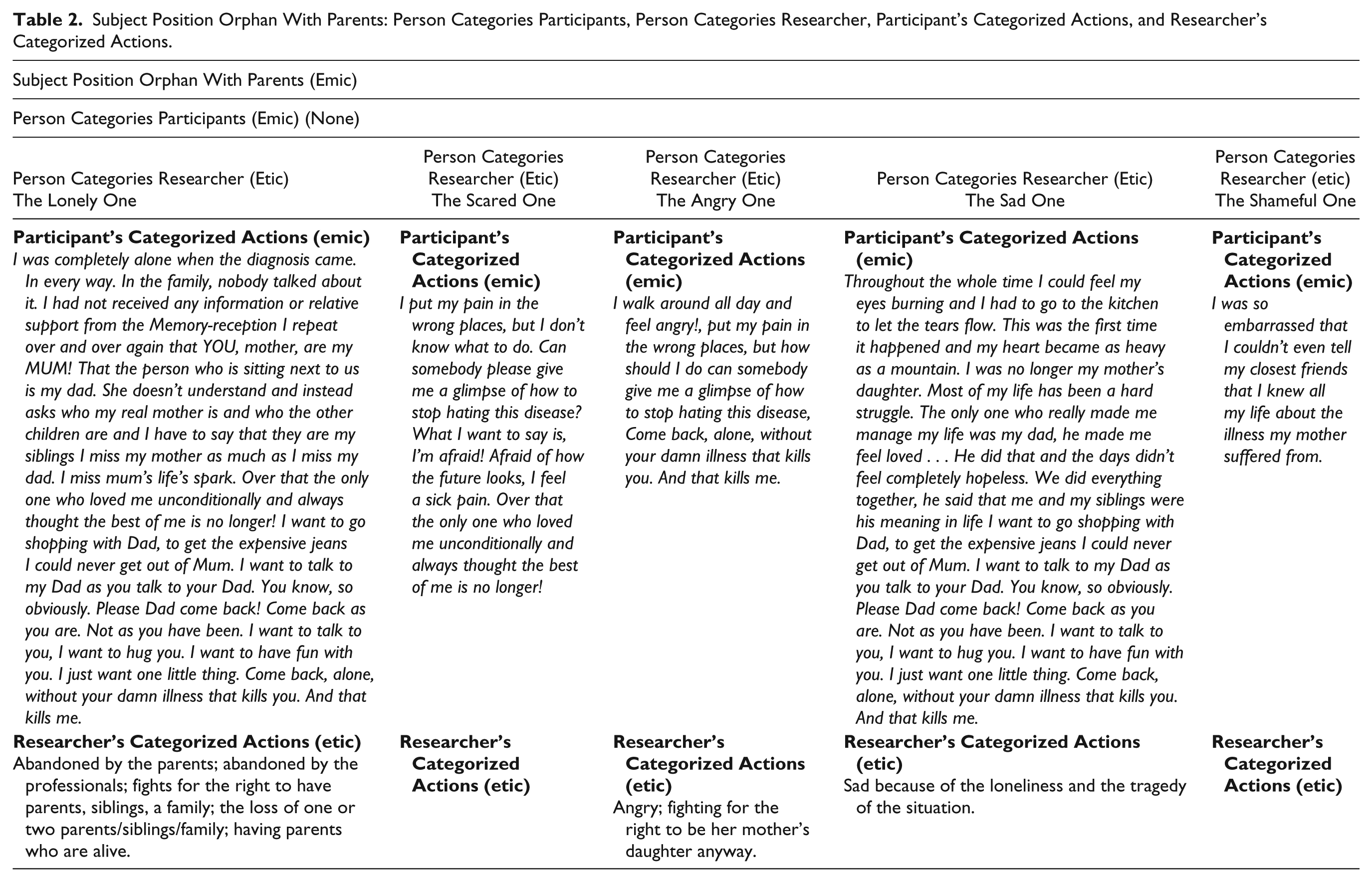
Subject Position Orphan With Parents: Person Categories Participants, Person Categories Researcher, Participant’s Categorized Actions, and Researcher’s Categorized Actions.
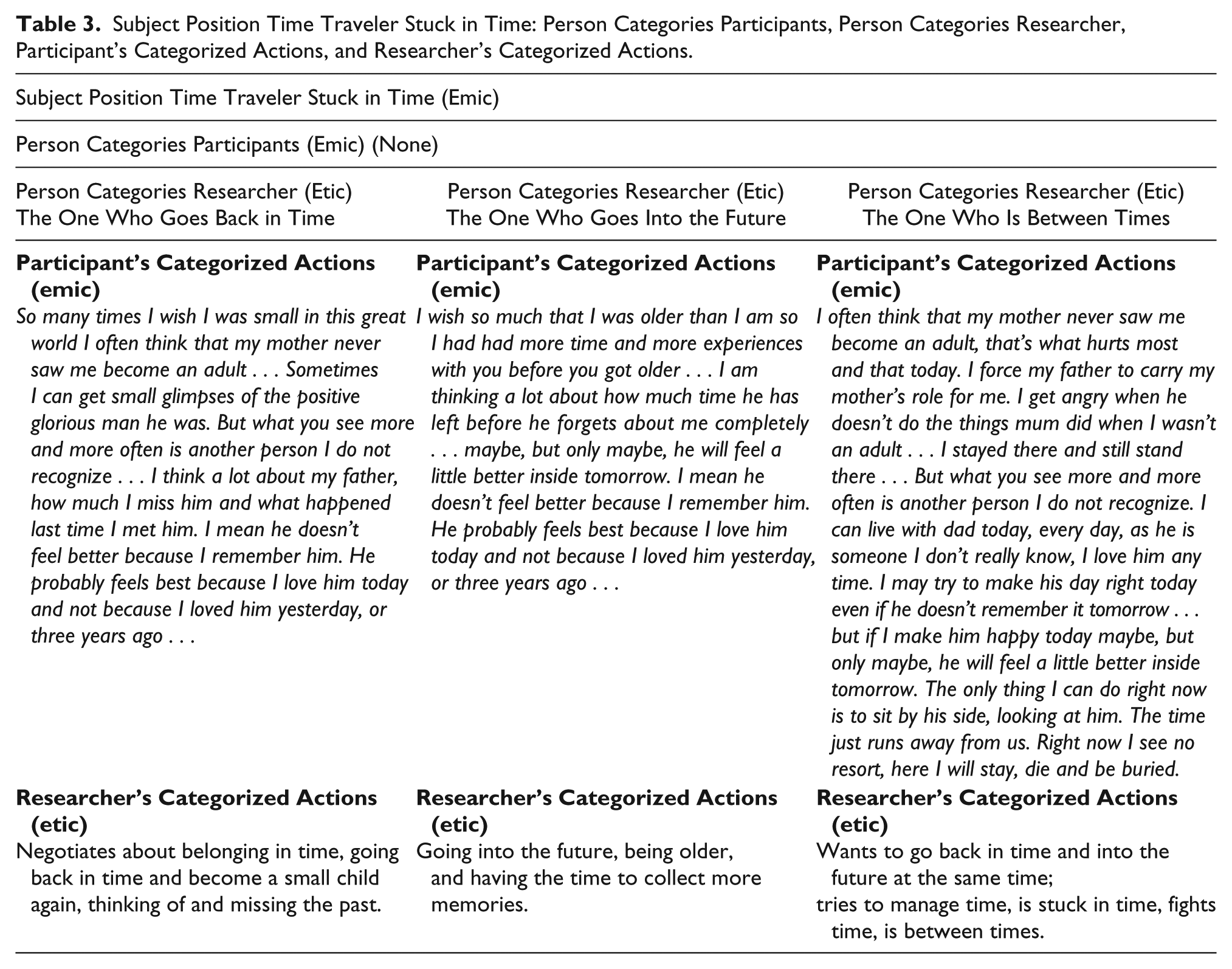
Subject Position Time Traveler Stuck in Time: Person Categories Participants, Person Categories Researcher, Participant’s Categorized Actions, and Researcher’s Categorized Actions.
Setting and Data Collection
The use of blogs for data collection is in line with common qualitative research, and blogs have an increasing importance in people’s everyday lives; blogs are commonly used in the construction of physical, emotional, and/or social identities (Kurtz, Trainer, Beresford, Wutich, & Brewis, 2017). Most blogs include descriptions and reflections and offer texts and the possibility to interpret and analyze social processes over time (Hookway, 2008; Wilson, Kenny, & Dickson-Swift, 2015).
The blogs in this study were initially accessed via the Google search engine (Kurtz et al., 2017), and the first inclusion criterion was that the blogs had to be written in Swedish by a single author who had grown up/lived with a parent diagnosed with dementia before the age of 25 (WHO defines youth as 15–25 years of age). This resulted in 23 blogs over a period of 10 years. The blogs that did not fulfill this criterion were omitted. In all, 12 blogs were reviewed based on the criterion that the time period had to be from the start of the blog until the blogger wrote about the death of his or her parent. Based on that criterion, six blogs were reviewed. The last inclusion criteria were that they had to be published or have told about their story or their blogs in at least one or more places online, aside from their own blog (e.g., news media articles or posts on other websites, for example, relatives or associations related to dementia). This is because an ethical consideration is that it might indicate that they, more than others, might want to go public with their experiences. Three blogs that were included based on variations in gender, ethnicity, and family settings were posted over 6 to 9 years until the end of 2017. At first, all the posts of each blog were included, which amounted to 371 posts. As no comments were permitted in the blogs, none were included. To try to protect the bloggers from being easily identified, this section and the presentation of the results do not describe their true gender or family setting (or ethnicity).
Analysis
There is no single way of conducting discourse analysis or using the analytic tools developed in, for example, discursive psychology; it is a “craft that can be developed with different degrees of skills . . . / . . . successful analyses of discourse will typically build on prior analytic studies” (Potter, 2004, pp. 616–617). However, it is common for the analysis to focus on variations, details, rhetoric, accountability, or what might be at stake or of interest. The analysis process begins with the collection of data (Potter, 2004); the researcher is also an acting subject within one out of several possible constructions of reality/discourse (Foucault, 1971/1993, 1973/2003).
The inclusion criterion of data to analyze in the three selected blogs was that the text, in an explicit way, had to in some way describe something about the author in relation to his or her sick parent. All other posts or text were omitted (e.g., posts that focused on relatives, friends, schoolwork, or jobs). First, the manifested person categories and categorized actions were identified in the text. Second, the person categories and categorized actions that were not explicit in the text were identified and abstracted into the researcher’s person categories and categorized actions. This was followed by all person categories and all categorized actions being organized into separate groups based on their common features and content (Edley, 2001; Leudar, Marsland, & Nekvapil, 2004; Lövenmark, Summer Meranius, & Marmstål Hammar, 2018; Reynolds & Wetherell, 2003; Seymour-Smith, Wetherell, & Phoenix, 2002). Thereafter, the person categories were combined with the categorized actions that in some way supported each other and were abstracted into the subject positions (Billig, 1987/1996, 2001; Edley, 2001; Hall, 2001; Lövenmark et al., 2018; Reynolds & Wetherell, 2003; Seymour-Smith et al., 2002).
Based on the analytic tool ideological dilemmas (Billig, 2001), the next part of the analysis process was to determine whether and how there were any clashes within or between any of the subject positions. If so, the subject positions were formulated so that they covered and represented the identified ideological dilemmas. The empirical examples in this article illustrate how these bloggers use language to negotiate their belonging to different subject positions and to express the difficulties of their lived ideological dilemmas. The subject positions make the person categories and actions possible, understandable, and meaningful, and the ideological dilemmas show the difficulties in handling a challenging life situation: being a parent to your parent(s) (Table 1), being an orphan with parents (Table 2), and being a time traveler stuck in time (Table 3). The results and Tables 1 to 3 show empirical examples of what and how categorized actions and person categories build the three identified subject positions and their ideological dilemmas in the collected data. In the results, every described subject position includes an empirical example from each blog. All the person categories and categorized actions for each subject position appeared at the beginning, middle, and end of each blog.
The analysis highlights the different ways in which the children talk about themselves as having a parent diagnosed with dementia and how they negotiate, show, and occupy a subject position as a parent, orphan, or time traveler. The results show, for example, that father/mother is the only person category that these children explicitly create and that the subject positions supporting the categorized actions (e.g., comforting, helping, telling, listening, and solving problems) are used for the, in the context and situation, construction of a meaningful, suitable, and logical subject position. The storylines of everyday conversations and interactions with their families (parents and siblings), partners, and other people (e.g., friends, caregivers) provide a position from which to speak and thereby facilitate the positioning of others as characters with roles and rights. Who the children can be depends on the positions that are made available through their language and interactions. The analysis shows which subject positions the children negotiate, take for granted, or are possible in their particular situations and contexts.
Reflexivity and Ethical Considerations
Reflexivity is to take into consideration how and what kind of knowledge researchers create (Potter, 1996). To study discourses and use discourse analysis is to construct the place from which data are collected. To interpret and give other people’s words and stories meaning can be considered to be related to validity, ethics, and power (Potter, 1996; Schegloff, 1997; Wetherell, 1999). The use of the terms etic and emic describes a reflexive attitude against the construction of data, the context that can be regarded as “real” for the participants, and the context constructed by the researcher (Headland, Pike, & Harris, 1990; Pike, 1993; Silverman, 1993). Etic is a term for the researcher’s construction in terms of imposing meaning and context. The use of etic in this study is presented as person categories, categorized actions, subject positions, and ideological dilemmas by the researcher (Tables 1–3). Emic is a term regarding the attitude in the analytic process. It is to establish how and what is expressed and how it can be understood in a situated reality and context (Headland et al., 1990; Pike, 1993; Silverman, 1993). The use of emic in this study has already partly been presented in the theoretical framework and methodology. It is also made visible in the results through the examples from the bloggers’ use of person categories and of categorized actions (Tables 1–3). Etic and emic can exist at the same time and can be presented as a uniform interpretation (emic) of several actions and varying views (etic) about these actions (Pike, 1993). In this study, the uniform interpretations of etic and emic are presented as subject positions and their ideological dilemmas.
Even if blogs are publicly available, ethical considerations have to be made (Association for Internet Researchers [AOIR] Ethics Committee, 2012; Kurtz et al., 2017; Wilson et al., 2015). These have been considered according to the Swedish Research Council (2017) and Declaration of Helsinki (World Medical Association [WMA], 2013). The inclusion criterion that the bloggers had to be published or have talked about their story or their blogs in one or more places online aside from their blogs could lower the risk of harm regarding not wanting to be known publicly. Because the bloggers’ real names, gender, and age are not used in this study, and the original Swedish blogs have been translated into English, tracking the bloggers’ texts online should be difficult. An ethical exclusion criterion could have been blogs published within restricted access forums or if the authors explicitly expressed that they did not want to be cited or included warning messages that they did not want the content to be reproduced elsewhere. In contrast, the included bloggers explicitly expressed their wish to inform and, if possible, help others by writing about their experiences and publishing them online. Even if informed consent is not regarded as required (AOIR Ethics Committee, 2012; Kurtz et al., 2017), it was tried to be fulfilled. One of the bloggers gave informed consent; the two others did not have current contact information available on their blogs.
These children, as bloggers, might want to be perceived in a certain way in their construction of their identities. The use of etic and emic (Headland et al., 1990; Pike, 1993; Silverman, 1993) contributes to transparency regarding the possible interpretation presented in the results. There is a need to research social media in its own context as a common part of our lives today, especially young people’s lives and their constant managing and construction of identities. There is also a need to contribute to the improvement of these children’s health and health equity, and one way of doing this is to use blogs (Wilson et al., 2015). However, there has to be an ongoing discussion about the complex ethical considerations, for example, identity constructions, anonymity versus copyright, and benefit versus harm in using blogs in research (AOIR Ethics Committee, 2012; Kurtz et al., 2017).
Even though this study is limited in terms of the number of blogs consulted, the amount of data is solid. Credibility is regarded as sufficient when the collection, analysis, and presentation of data have been reviewed by a senior researcher in the same theoretical and methodological field of research. In the “Method” section, the method and analysis are described as transparent and easy to follow. The tables show the analytical process and how examples from collected data support identified subject positions and ideological dilemmas. In that way, dependability is fulfilled. Conformability is provided in the blog extracts. Transferability is fulfilled through transparent and detailed description of empirical examples from collected data and the discussion of the results (Guba & Lincoln, 1989).
Results
The situations and contexts described in the blogs govern and are governed by the stories the authors can and want to tell about themselves and possible ways to negotiate their identities. Their stories are made possible and logical in relation to various regulating discourses that are generally taken for granted in interactions with presumptive readers. With their stories, they both reproduce and challenge established discourses about families, parents, parenting, childhood, and how to grow up and become young adults.
The results show that growing up, living with, and caring for a parent who has been diagnosed with dementia mean that children might inhabit a specific and new world and perform new roles (subject positions) both inside and outside their families. A common theme over time through the blogs in this study is love and longing for their parent(s) and therefore a constant shift between three subject positions to manage their own and their family’s daily life together with their sick parent and a healthy parent. The subject positions they describe are those of being a parent, an orphan, and a time traveler. Circumstances forced them to grow up quickly and develop skills both from and within different subject positions in the moment, striving and hoping for the future and at the same time dealing with and carrying a lot of grief. They have had to responsively return to the subject position that is necessary or possible in a given situation or context.
Their blogs show their journeys from being a child in a household to being a young adult leaving home, all of which are described as special and challenging. With time, they managed to develop some of the necessary skills to cope with living with a parent diagnosed with dementia. Their stories tell about their experiences of losses, fears, and challenges: the loss of childhood, of a “normal” life and hope, and of both parents (their sick parent and the other parent struggling to care for his or her spouse), as well as a fear for the future and a desire for a life of their own. At the same time, they gradually create a life for themselves, deal with grief, and try to maintain a positive view of life and their own future.
Being a Parent to Your Parent(s)
The subject position of being a parent to your parent(s) is presented in the following empirical example. This individual had just finished work when her father called her: . . . Dad calls in despair . . . Mum had gathered her stuff and would and wanted to go because “at home you couldn’t be for there were lots of unknown people and someone lay in her bed,” she was upset and didn’t feel good . . . I told Dad that he would ask Mom to call me so I could try to calm her down, and after the conversation it was good again and I promised that I would go to her after I had been in town . . . I went home to her and bought her some flowers, which she was so happy about . . . // . . . I went in, laid down with her, held her and talked a little. After a while I suggested that I wash her hair and make her look nice, so I did. When I had dried her hair and curled it, I gave her a hair clip with rhinestones in and put it in her hair and she was so happy!
She creates her belonging to the subject position of parent to her parent(s) with the characteristic actions of the comforter who listens to and offers help in several ways. She is also the comforter because she calms her despairing father and calms her mother by talking to her on the phone and promising them both to call later, which makes both parents happier. She is also the comforter when she buys flowers and makes her mother happy. She belongs to the categories of comforter and mother/father when she lays down with and holds her mother, talks to her, and makes her look nice by washing, drying, curling, and putting a clip in her hair. She is a parent to her parents by putting her parents’ needs before her own and trying to ease her parents’ daily lives. The subject position as parent to her parent(s) also consists of being the expert by being there for her father and mother by listening, telling, and fixing the problem.
Another empirical example of the subject position of parent to parent(s) is extracted from the time when this individual lived with his parents: I’m not going to make his evening worse because he can’t have beer, nor do I intend to make Mom’s evening miserable because Dad gets drunk. So I ran and poured out half the can, filled it up with water and gave it to Dad, every time he got a new can he would say “mmm this is good!” In this way, Dad doesn’t have to feel left out, because if he can’t hold that can he gets sad and depressed and doesn’t feel like an adult or know what to say. I don’t know how many beers I’ve poured down the sink, because he would have as much fun as possible, but it’s worth it to see Dad’s smile.
This individual is also the comforter as well as mother/father when he makes his parents happy by enabling his father to have some beer but not too much. He is the expert who can prevent his father from getting too drunk by filling the can with water as many times as necessary. Parents help and support their children by comforting them and, if possible, preventing them from getting into trouble or being sad, as well as enabling and allowing them to be children. He does the same thing in his subject position as parent to his parent(s) when supporting and comforting his mother and at the same time comforting his father by preventing his father from feeling sad or depressed or getting too drunk. At the same time, he helps his father to feel like an adult and be included and happy when he is able to join the party and have some beer.
In the third empirical example that illustrates the subject position as parent to your parent(s), this individual tries to cope with school and her own life and at the same time care for her sick father. She uses the categorized person as parent in the subject position parent to your parent(s) in an explicit way when telling the story about her father wanting to go with her to visit her friends one evening and how it made her feel like she was accompanied by a son: He calls several times a day to say that I have to pick him up and we’ll go and visit my friends . . . // . . . would it be a problem if he came along? Not really, but at that moment I don’t want to have to be on edge all the time, being prepared to leave, or saying that he should stop cleaning or fixing things in their garden. At that moment I just want to be with those I enjoy without having my dad hanging on, as if he was my son.
She describes the categorized actions associated with being a parent to your parent(s) when having to care for your parent and act like a mother or father when visiting friends. She describes it as always being on edge because she has to look out for him. She is also an expert who always has to be prepared to fix something, sometimes by stopping him from doing things and sometimes by giving up and going home.
Being an Orphan With Parents
This empirical example includes the description of belonging to the subject position of orphan with parents and being lonely, sad, and ashamed: I was completely alone when the diagnosis came. In every way. In the family, nobody talked about it. I had not received any information or relative support from the Memory-reception. I was so embarrassed that I couldn’t even tell my closest friends that I knew all my life about the illness my mother suffered from.
In her subject position as an orphan with parents, she feels completely lonely, despite having a healthy father. She is an orphan because her mother’s sickness does not exist when no one talks about it. Not even the professional caregivers prepared her for the facts of the diagnosis in any way. She is also the shameful one when she is too ashamed about the situation to even talk to friends she has known all her life. Her belonging to the subject position as an orphan with parents is even more obvious when her mother no longer recognizes her: I repeat over and over again that YOU, mother, are my MUM! That the person who is sitting next to us is my dad. She doesn’t understand and instead asks who my real mother is and who the other children are, and I have to say that they are my siblings. She answers me by saying something to the effect that she can’t get it together and it’s strange. Throughout the whole time I could feel my eyes burning and I had to go to the kitchen to let the tears flow. This was the first time it happened, and my heart became as heavy as a mountain. I was no longer my mother’s daughter.
When she knows, but does not want to accept, that her mother does not recognize her anymore, she still fights for the right to be her mother’s daughter. As she struggles with the subject position as an orphan with parents, she also wants her mother to grasp the fact that she has a husband, that he is her father, that they belong to the same family, and that she has siblings. She does not want her mother to see how sad she is, so she escapes to the kitchen to let out all the tears that have built up inside. The sadness she feels is as heavy as a mountain. She has lost her mother.
The example below describes belonging to the subject position of orphan with parents by using the person category of the lonely and sad one. This individual is also a very angry and scared child: I miss my mother as much as I miss my dad. I miss mum’s life’s spark. I walk around all day and feel angry! Most of my life has been a hard struggle. The only one who really made me manage my life was my dad, he made me feel loved. He did that, and the days didn’t feel completely hopeless. We did everything together, he said that me and my siblings were his meaning in life . . . // . . . I put my pain in the wrong places, but I don’t know what to do. Can somebody please give me a glimpse of how to stop hating this disease? What I want to say is, I’m afraid! Afraid of how the future looks, I feel a sick pain. Over that the only one who loved me unconditionally and always thought the best of me is no longer!
As an orphan with parents, he is the lonely one and sad one when he misses his mother as much as he misses his father, even though they are both still alive. He misses the way his mother was when his father was not ill. He is the angry one when he is angry about life and is the sad one when he expresses that his father is lost in the sickness. He is the lonely and the sad one because his father was the only one who helped him get through each day, did things together with him, and gave him hope and love. He is the scared and the lonely one because his father no longer exists.
As an orphan with parents, this individual is the sad and lonely one when missing out on the things other children can do with their parents, such as shopping, talking, hugging, and having fun: I want to go shopping with Dad, to get the expensive jeans I could never get out of Mum. I want to talk to my Dad as you talk to your Dad. You know, so obviously. Please Dad come back! Come back as you are. Not as you have been. I want to talk to you, I want to hug you. I want to have fun with you. I just want one little thing. Come back, alone, without your damn illness that kills you. And that kills me.
She is the lonely one, the sad one, and the angry one who wants the father she lost to come back. She wants him to come back without the illness. She does not want to have to be in the subject position of an orphan with parents, exhibited as the sad and the angry one not wanting her father to be killed by the illness, an illness that is killing her too.
Being a Time Traveler Stuck in Time
As a time traveler stuck in time, this individual goes back in time and into the future to negotiate her belonging in time in relation to her mother and her illness: So many times, I wish I was small in this great world. So many times, I just want to crawl up in her arms and feel the mother’s love . . . // . . . I wish so much that I was older than I am, so I had had more time and more experiences with you before you got older. . . //. . . I often think that my mother never saw me become an adult, that’s what hurts most and that today I force my father to carry my mother’s role for me. I get angry when he doesn’t do the things mum did when I wasn’t an adult . . . I stayed there and still stand there . . .
Sometimes she wants to be able to go back in time and become a very small child who can crawl up into her mother’s arms and feel her love. She laments the fact that her mother did not know her as an adult. At the same time, she wishes she could travel into the future so she could be older and have more memories of her mother. She is a time traveler stuck in time, trying to manage time by forcing her father to act like her mother did with her. When he does not do that, she gets angry and acknowledges that she is between times and has stopped growing. She also goes back in time and is stuck in time, stating that she stayed there and still stands there.
The example below shows the time traveler stuck in time when he is between times, fights time, and negotiates his and his father’s belonging in time: Sometimes I can get small glimpses of the positive glorious man he was. But what you see more and more often is another person I do not recognize. I think a lot about my father, how much I miss him and what happened last time I met him. I am thinking a lot about how much time he has left before he forgets about me completely . . .
When he goes back in time, he can see glimpses of the man his father once was. When he sees a person he does not recognize, he is between times and goes into the future because he cannot meet the father he knows, who will never be the same again. He is also a time traveler stuck in time when he is between times and struggling to think about the past and how much he misses his father. At the same time, he is in the future and thinking about the time when his father will no longer remember him at all.
The subject position of a time traveler stuck in time is described by an individual living with a father who does not recognize her anymore: I can live with dad today, every day, as he is someone I don’t really know, I love him any time. I may try to make his day right today even if he doesn’t remember it tomorrow . . . but if I make him happy today maybe, but only maybe, he will feel a little better inside tomorrow. I mean he doesn’t feel better because I remember him. He probably feels best because I love him today and not because I loved him yesterday, or three years ago . . . The only thing I can do right now is to sit by his side, looking at him. The time just runs away from us. Right now, I see no resort, here I will stay, die and be buried.
She is the time traveler stuck in time when she is between times, living a daily life with her father, and, most of the time, she does not know him as he used to be. At the same time, she goes back in time and into the future when her father is someone she does not really know. She will love him anyway, as he was, is, and will become. Every day, she wants to make her father feel as good as possible, even if her father does not remember it the next day; it is sufficient for her to feel good in the moment. As the one who is stuck in time, she can be a time traveler because it is not her memories of her father that help her but the love she gives him today. She is also stuck in time when she describes sitting by her father’s side and looking at him. There is nothing else she can do, even if she, as the one who is between times, wants to manage time; she knows she cannot. Time runs away from them, and she is the time traveler stuck in time, trying to manage time by being the one who goes into the future and the one who is between times when she states that she will never leave the place she is in: “here I will stay, die and be buried.”
Discussion
This study describes possible subject positions children can construct in terms of their belonging when growing up and becoming young adults living with and caring for their parent diagnosed with dementia. They express being the ones who, as well as their healthy parent, become a parent to their sick mother or father. However, they are doubly affected by becoming a parent to both of their parents in the effort to support and keep them both as healthy as possible for as long as possible. This double parenthood constructs them as orphans with parents. As orphans with parents, they long to go back in time and to go into the future, but, instead, they end up as time travelers stuck in time.
Which stories these children can tell and how they construct identities for themselves depend on the positions that are made available through their language and interactions (Foucault, 1973/2003; Potter, 1996; Rose, 1999) in an online environment. This shows the creation of, negotiation of, and need for several person categories and subject positions in these children’s ongoing making of identity (Edley, 2001). Their own situated and contextual place of telling their stories is also an interaction with potential readers, where they are regarded as persons to inform and interact with. In that way, these bloggers, actual readers, and researchers interpreting their texts are co-producers of discourses. This is how discourses about being a child caring for a parent diagnosed with dementia can be reproduced, sanctioned, negotiated, and resisted.
The categories of parent, orphan, and time traveler can be occupied based on a common understanding of discourses (Foucault, 1971/1993, 1973/2003) that governs how we talk about, think about, and act upon different person categories, categorized actions, and subject positions (Billig, 2001; Edley, 2001; Potter, 1996, 2004). Discourses become visible when they can make sensible experiences meaningful (Billig, 2001). The possible dilemmas (Billig, 2001) are a result of tensions and difficulties in coping with or handling different categories and subject positions and, in that way, handling different established discourses. In one way, they are children in a “natural” way, without the need to state the fact that they belong to that category. However, in their stories about daily life, their categorized actions show how they negotiate the belonging to and occupy a person category that demands different and sometimes opposite categorized actions (e.g., parenting). Therefore, they construct a belonging to subject positions that not only reproduces discourses but at the same time challenges dominant discourses about children, childhood, parents, parenting, life as a process, and where and how to belong in a broad perspective of life in a certain situation and context.
The subject position as parent to your parent(s) can be occupied based on a common understanding of the discourses about how it is to be a child or a parent. The result shows the dilemma between being a child in relation to one’s parents and at the same time occupying the subject position of parent to one’s parents. Both willingly and with some restraint, they can take care of their sick parent and at the same time give both their parents the love, comfort, and care needed. The subject position of being an orphan with parents can be occupied based on a common understanding of the discourses about how it is to be a child with or without parents. The result shows the dilemma between being a child who, in the physical realm, from an outsider perspective, has two parents but in the lived experience must manage the loss of both parents and the loss of a “normal” family and childhood. They grieve the loss of being and acting as a child and in that position receive love and care from their parent(s). The subject position of an orphan with parents also makes it impossible, at least in the beginning, for these children to easily get or ask for support from outside the family (e.g., friends or professionals). The subject position of being a time traveler stuck in time can be occupied based on a common understanding of the discourses about childhood and growing up and becoming a young adult. The result shows the dilemma of being a child and a young adult at the same time, in a specific process in life and in a specific time and place. They try to accept that they cannot stop time, have more time with their sick parent, or make time fly. They want to cope with the circumstances that challenge the “ordinary” family/teenage life and be in the moment, and at the same time, they want to be somewhere else. This might be to get hold of a piece of the lost parent, comfort, love, or hope or be able to accept the moment in life or get some rest. The lack of “positive” subject positions is a result of the aim and method of the study and does not imply that there are no positive experiences regarding (cf. Cabote et al., 2015) personal experiences and identity when caring for a parent diagnosed with dementia.
These results are important in several ways. First, it fills a research gap by contributing knowledge about the experiences and narratives of children whose parents are diagnosed with dementia (Hall & Sikes, 2017; Johannessen et al., 2015). Second, the use of discourse analysis contributes knowledge about these children’s possible, meaningful, and logical subject positions and the ideological dilemmas they can face, as well as how they, in their stories, can produce, reproduce, and challenge different discourses. As there are almost 10 million people every year diagnosed with dementia (WHO, 2017), and because dementia affects the quality of life of the whole family over a long period of time (Cabote et al., 2015; Johannessen et al., 2017), there is a need to highlight these results and also the need for more research. For example, what kind of support would be helpful for a child struggling with being a parent to his or her parents, an orphan with parent, or a time traveler stuck in time?
The results are in line with previous research showing that these children can express their struggle in terms of battles and becoming parents to their parents (Johannessen et al., 2015). However, the results also show that these children become parents to both their parents and, therefore, unwillingly become orphans who still, for all intents and purposes, have parents. The results strengthen previous research by showing that children caring for a parent diagnosed with dementia can experience shame and feel embarrassed in different social environments and that it is often difficult for them to build up a life of their own (Allen et al., 2009; Barca et al., 2014; Kjällman et al., 2013; Rosenthal Gelman & Greer, 2011).
Previous research about children’s experiences of growing up caring for a parent who is sick in some other way than dementia also supports the findings of this study. They too can feel the loss of childhood, be lonely, grieve, and struggle to create a life for themselves while being a parent to their sick parent (Buchwald, Delmar, & Schantz-Laursen, 2012; Dam, Joensen, & Hall, 2017; Harstone & Grant, 2012; Melcher, Sandell, & Henriksson, 2015).
This study supports Kindell et al. (2014), who argued for children’s need for accessible information about diagnoses, other people’s experiences, what to expect, and how others have tried to manage caring for a parent diagnosed with dementia. The lack of information and support from both family and professionals was also highlighted in previous research describing when children care for a sick parent. It has been argued to be an important area to understand and develop (Dam et al., 2017; Harstone & Grant, 2012; Melcher et al., 2015). There is a need to not settle for the current standard of practice and the view that these children are highly competent and mature. The children themselves should be given the opportunity to state what their needs are and what kind of support they would like to receive (Dam et al., 2017; Harstone & Grant, 2012; Melcher et al., 2015). Health care professionals can experience that it is difficult and takes a lot of time to support children with sick parents (Fearnley & Boland, 2016). Health care professionals lack guidelines and routines for interaction with children as relatives, which also supports the findings in this study and previous research (Knutsson, Enskär, Andersson-Gäre, & Golsäter, 2016; Melcher et al., 2015).
Conclusion
More knowledge is necessary about the kinds of challenges that these children face and the kind of support they might want or need. How does this fit into a society that is already experiencing increased mental illness among children and young adults? Are these children part of this group or not, and are they facing challenges in other ways, too? We also need to know more about how these children may or may not be able to develop their own relationships outside their families to understand and support them in early life. There is a need to support these children, both as children and as young adults, and to know how to support them as individuals. For health care professionals, it is important to know that it might not always be easy to ask for information or support as a child caring for a sick parent. The fact that they might be regarded as at least having one healthy parent needs to be understood from the perspective of the possibility that might may feel like an orphan anyway.
Footnotes
Declaration of Conflicting Interests
The author declared no potential conflicts of interest with respect to the research, authorship, and/or publication of this article.
Funding
The author disclosed receipt of the following financial support for the research, authorship, and/or publication of this article: The author received no financial support for the research or authorship, but received financial support from Malardalen University Library, Sweden regarding the open acess publication of this article.
