




Abstract
Using a constructivist grounded theory approach, we explored the development of father identity among boys involved in the juvenile justice system. Youth were recruited from a juvenile detention center and school district in a northern California county with a high teen birth rate. The participants were expecting a child or parenting an infant and had been arrested, incarcerated, or had committed a crime. We collected data through observations and individual interviews. Using constant comparative and dimensional analysis, we found that expectant adolescent fathers hoped for a boy and envisioned their central role as father to be making their son a man. This article contributes to greater understanding of father identity development for youth involved in the justice system. We suggest that teen parenting policies and programs include interventions sensitized by gender, accounting for the influence masculine ideals of manhood have on the development of father identity and the father–child relationship.
Keywords
Teen parenthood is prevalent among youth involved in the justice system. Youth detention facilities and probation rolls in the United States are populated by young men and women from economically disadvantaged families and communities with high incarceration rates, primarily those inhabited by people of color. Communities from which men are frequently imprisoned are also communities in which teenage fatherhood occurs (Nurse, 2002; Shelton, 2000). The sons of teen fathers are incarcerated in greater numbers, about 2.7 times more often than are the boys of older parents (Grogger, 2008). Additionally, teen fathers are 1.8 times more likely to have a son who has a child in adolescence (Sipsma, Biello, Cole-Lewis, & Kershaw, 2010).
Research is needed that provides program and policy direction to reduce teenage paternity and/or increase teen father parenting strategies that prevent an intergenerational cycle of violence (Bijleveld & Wijkman, 2009; Conger, Neppl, Kim, & Scaramella, 2003; Thornberry, Freeman-Gallant, & Lovegrove, 2009). Preventing a young teen from continued criminal behavior saves between $2.6 and $5.5 million over his lifetime (Cohen & Piquero, 2009). It is critical, therefore, to examine the context in which adolescent fatherhood occurs and its intersection with youth incarceration. It is also important to study how youth develop an identity and associated role as parent. An investigation of the process by which teen fathers grow into a parental role might suggest whether and how aggressive or antisocial youth socially transmit violent and risky behaviors from parent to child.
Youth 1 involved in the justice system experience reinforcement of cultural ideals about manhood prevalent among aggressive boys and young men (Abrams, Anderson-Nathe, & Aguilar, 2008; Nurse, 2002). Many detention facilities are built of steel and concrete and lack warm, soft, or comfortable features; some are overcrowded. Housing violent youth with other violent youth in such a setting can lead to a behavioral strategy known as prisonization (Clemmer, 1940). Prisonization is seen when individuals placed in a correctional setting adapt to the prison culture and endorse a prison code of conduct. The code is enacted when men harden themselves against emotions, display hypervigilence, flatten their affective expressions, and exhibit a willingness to use violence if provoked (Nurse). The prisonization phenomenon is similar to the performance of the traditional hypermasculine male. Many expectant and new teen fathers develop an identity as a father in the context of gendered correctional institutions in which highly masculine attitudes and behaviors are prominent.
For youth involved in the justice system, father identity develops in concert with the development of other identities. Alternate identities are constructed with consideration of ethnic or racial grouping, social class status, criminal arrest history, gang involvement, and more. Gender is the most prominent influence on identity development and is deeply affected by social and cultural influences (West & Zimmerman, 1987). Sociocultural construction of male gender identity is influenced by ideals of manhood, what Connell (2005) termed hegemonic masculinity. Supervision and control of boys through juvenile justice structures in the context of incarcerated and impoverished communities influence hegemonic masculine attitudes, beliefs, and behaviors. The model of the hypermasculine man and the features of prisonization are similar, yet they are incompatible with some of the characteristics of a caring father, such as warmth, sensitivity, and attentiveness.
Our study aim was to conceptualize about father identity development for youth involved in the justice system. We intended to identify factors that influence the acceptance or rejection of a teen father identity for boys who were expecting a child or parenting an infant. We found several salient processes that contributed to father identity development; one prominent process was strongly influenced by gender. This process involved acknowledging or anticipating fatherhood, envisioning a future child, and considering what role a young father might take as a parent. In envisioning their future child and considering their paternal involvement, youth in this study anticipated having a son and “being there” as a father. We suggest that teen fathers hope for a boy, believe it is their job to prepare a son for possible future dangers, anticipate barriers to father involvement, and envision their primary role as a father to be making a son into a man.
Literature Review
Few researchers have investigated teen fathers’ gender preferences, or their involvement with a child dependent on whether or not the child is a boy. The vast majority of data about teens have been gathered from young adult fathers or samples of men of various ages (Coley, 2001). Rhein and associates (1997) examined adolescent fathers’ participation in the care of their children. Almost half the fathers reported that the gender of their child influenced their degree of participation in parenting: Fathers reported that they spent more time with sons than they did with daughters.
Lundberg, McLanahan, and Rose (2007) found that among the children of unmarried fathers, boys were about 20% more likely to be given their father’s last name at birth than were girls. At 1 year, boys were more likely to have married parents and to regularly have contact with their fathers than were girls. The likelihood of marriage to the biological father showed the most remarkable difference by virtue of child gender: the odds of the mother of a son marrying the father of her child were 1.59 times greater than the odds of the mother of a daughter marrying the father of the baby (Lundberg & Rose, 2003). The increased incidence of marriage among biological parents of boys might be attributable to the father’s attitude about marriage to the mother of his child if that child is a son, to the mother’s beliefs about the importance of marriage to the father of a son, or both.
Other researchers have also reported increased involvement and a greater range of father participation in the care of children when fathers have sons. The difference in paternal involvement dependent on gender has been found to be greater among poor and working-class fathers than among middle-class fathers (Bronte-Tinkew, Carrano, & Guzman, 2006; Dahl & Moretti, 2008; National Institute of Child Health and Human Development Early Childcare Research Network, 2000; Roopnarine, Fouts, Lamb, & Lewis-Elligan, 2005; Stattin & Klackenberg-Larsson, 1991; Yeung, Sandberg, Davis-Kean, & Hofferth, 2001). Some researchers, however, have described conflicting evidence regarding gender preference, finding that father involvement was not greater among fathers of boys (Coley & Hernandez, 2006; Farrie, Lee, & Fagan, 2011).
Researchers have analyzed data from the Fragile Families and Child Wellbeing Study, a cohort study of 5,000 children of economically disadvantaged families, and indicated that fathers who did not live with their child and were not married to the child’s mother were more likely to describe the coparenting relationship as supportive when their child was a boy (Bronte-Tinkew & Horowitz, 2010; McLanahan et al., 2003). Perhaps fathers with sons have increased confidence in their paternal role; this confidence could mediate any negative views of the relationship with the mother of the child. It might be that fathers are more invested in ensuring that the relationship with the mother of the child is a positive one when they are coparenting a son.
Much of the information about fathers’ experiences of parenting has not been gathered from fathers themselves; more often it has been gathered from the mother of the child (Coley, 2001). To address this limitation we interviewed and observed youth with justice system involvement who identified themselves as expecting a child or parenting an infant. We found that empirical data about adolescent parenthood rarely included the perspective of becoming a father in the context of involvement in the justice system. Our aim was to describe how teens transition to fatherhood and accept or reject a father identity and role in the context of incarceration and supervision by the juvenile justice system.
Method
Design
We used a constructivist grounded theory research design. In contrast to traditional grounded theory methods that researchers use to explain a phenomenon as a basic social process (Strauss & Corbin, 1994), we sought to explain the full range of variation about the processes and structures that describe adolescent fatherhood identity development in the context of the juvenile justice system, including commonalities and differences (Clarke, 2005). Researchers using a constructivist approach suppose that conceptual understandings of a social event are limited by virtue of time, place, position, action, and interaction. Additionally, they believe that the participants’ contributions and the researchers’ interpretations are both constructed and partial views of the phenomenon under investigation, and both are important. Knowledge generation is always perspectival, viewpoints are always situated, and enhanced reflexivity allows for embracing researcher presence and influence without privileging or discounting the researcher’s interpretations (Clarke). This method guided us to ask about and analyze the actions of the study participants and to consider multiple meanings when interpreting their actions (Charmaz, 2006).
Participants
The study recruitment process and interview protocol were approved by the university institutional review board; because a number of the research participants were incarcerated minors, a full committee, with a prisoner advocate representative, reviewed the study. Study participants were recruited during a 3-year period of time from a detention center and a school district in a northern California county with a high teen birth rate. Boys involved in the justice system were recruited because researchers have identified that there are more teen parents among justice-involved youth than there are among the general population, and because there is a dearth of research about the impact of correctional experiences on teen father identity development (Nurse, 2002; Shelton, 2000).
Youth who were expecting a child or parenting an infant under 6 months of age and were either incarcerated, supervised by juvenile probation, had been arrested, or had admitted to committing a crime were interviewed in detention, at school, or in the community. We were assisted by detention and school staff to recruit participants. The informed consent procedure included reading the document aloud, emphasizing that no positive or negative consequences would occur because of participation or nonparticipation, and informing youth that any disclosures would be kept confidential. We told participants, however, that staff would be informed if the youth reported suicidal or homicidal thoughts or if we suspected abuse of the participant or of his child. We referred a participant to available counseling services in both settings if he wished to talk about any emotional difficulties.
Consistent with grounded theory methods, we initially recruited boys who were interested in talking about their experience of fatherhood. In the interest of theoretically sampling to describe the range of variation in the development of a father identity, we sought out youth who were reluctant to talk about fatherhood, as well (Glaser, 1978). Boys who were excited about being a father were more likely to volunteer for the study; it was challenging, however, to recruit youth who did not have an interest in establishing or maintaining a relationship with their child.
Data Collection
Boys were interviewed by the first author in a private room in the detention facility or school or in a setting of their choice in the community. The first author, Kate Shade, is a White, midlife woman who worked with teen-parent families, school-aged youth, and young men and women in the juvenile justice system as a community health nurse for more than 15 years. As a woman, Shade had not personally experienced adolescent fatherhood, incarceration, gang involvement, and many of the other experiences the youth talked about. In some cases, the boys expressed appreciation for her knowledge of the community and their families; other participants clearly felt the need to “school” her about gang and criminal behavior, disbelieving that she might have knowledge of these activities.
Given the interview topics, the gender difference between Shade and the participants, and the dissimilar cultural backgrounds, reflexivity was an essential element of the data collection and analytic processes (Hutchinson, Marsiglio, & Cohan, 2002). Shade attended to reflexivity during the interview by noting when she had an emotional reaction to the participant and pausing to explore that reaction. In some cases, the response was simply noted and more fully explored during analysis; in other cases, it was used to prompt her to gather more data about the participant’s perspective, often through story or anecdotal narrative (van Manen, 1990). We also explored personal biases through memo writing and analytic discussion. During analysis, we highlighted our ethical reactions to the participant narratives to explore how our moral judgments might cause us to minimize, maximize, or overlook various perspectives (Fine, 1994).
Shade also conducted observations of three units in the detention center during recreation time to gather data about young men’s social interactions with each other, with staff, and with support persons they telephoned during their free time. She interacted with youth during three observations that were each 2 hours in length. Participant interviews were guided by a semistructured protocol which evolved as data analysis proceeded (Charmaz, 2006). Many of the interview questions were sensitive and asked about witnessing or participating in violence, experiencing abuse or neglect, and coping with emotional difficulties or psychiatric illnesses. For this reason, we began each interview with questions about teen fathers in general, progressed to questions about the participant’s own experiences, and ended with dialogue about how the youth had experienced the interview in preparation for his return to the detention or school milieu. The participants were informed that they did not have to answer a question and that they could stop the interview at any time. Interviews were ended at 2 hours, although several participants requested more time. At the conclusion of each interview, boys were given a $15 gift card to a local retail store as compensation for their time. The interviews were audiotaped and transcribed verbatim.
In both settings, we found that second and sometimes third interviews were helpful in gathering data about criminal or violent behaviors, child abuse, sexual abuse, and other socially unpleasant topics. Second interviews were more difficult to arrange when youth were recruited in the detention setting; when the young men were released they were often difficult to reach for followup. At the beginning of each second or third interview, the participant was given a copy of his interview transcript (a procedure we decided to implement after the first participant requested a copy). The transcripts ranged in length from 7 to 41 pages of single-spaced text, with an average length of 25 pages. Several participants referred to their transcripts as “my book.”
Data Analysis
Following each interview, Shade made notes about the general content and process of the interview as well as any observations of actions or interactions that occurred before, during, or after the interview itself. Data collection occurred simultaneously with data analysis (Strauss & Corbin, 1994). Often, concept development was undertaken in collaboration with the participant during the interview itself. This coanalysis was especially useful during a second or third interview, when the participant was asked to refer back to experiences he had described previously, and was asked to theorize about the meanings of his actions or interactions (Charmaz, 2006). Coanalysis was also facilitated when Shade shared generalities about what other study participants had said and asked for the youth’s perspective. For example, while gathering information about the hope for a boy, she asked an 18-year-old young man about his response to the question, “Would you rather have a boy or a girl?” He had said that he did not care about the gender of his child. When asked, “Why do you think so many of the young men in this study say they want a boy?” he quickly responded: “Because [they] think they are all bad [badass, meaning tough or powerful]. They want the baby to be like . . . them, exactly like them. I don’t know. I want my baby to be more than me.”
Shade reviewed interview transcripts and field notes from observations, wrote memos on conceptual advances and analytic decisions, and initially coded the data line by line using gerunds to ensure the analysis focused on the actions present in the participant’s narrative (Glaser, 1978). The second author (Susan Kools) coded selected interviews and observations and reviewed the analytic process at multiple points throughout the journey. Shade met with the coauthors and graduate student colleagues in two discussion groups to share analytic strategies and exchange reflexive developments. Data analysis was aided with the use of a qualitative software program, NVivo 8 (QSR International, 2008).
We used constant comparative analysis of the interviews, field notes, and observations, and identified similarities, differences, and prominent themes within and across the data. Following an expansive open-coding process, the codes were clustered into more focused codes, and then configured and reconfigured to create axial codes. Our axial coding identified relationships between categories and subcategories. The axial coding process aided us in describing conditions, actions or interactions, and consequences, and integrating the code list to provide a holistic but abstract view of the analytic findings (Strauss & Corbin, 1990).
The last level of coding, theoretical coding, served to further abstract the focused codes and categories. In vivo codes were linked to conceptual codes and then conceptual codes were organized to provide a coherent analysis of what the participants said they did and what they actually did (Charmaz, 2006). We worked to ensure the theoretical codes were closely linked to the focused codes, thus grounded in the data (Glaser & Strauss, 1967). Theoretical codes most closely related to the study aims were auditioned as varied perspectives on the data to determine relative salience. We used an explanatory matrix to further structure the conceptual process and to identify the dimensions of each theoretical perspective. The explanatory matrix appears in Figure 1. The dimensions—specifically the context, conditions, processes, and consequences—were used to move the analytic material from conceptual code to rich explanation (Kools, McCarthy, Durham, & Robrecht, 1996).
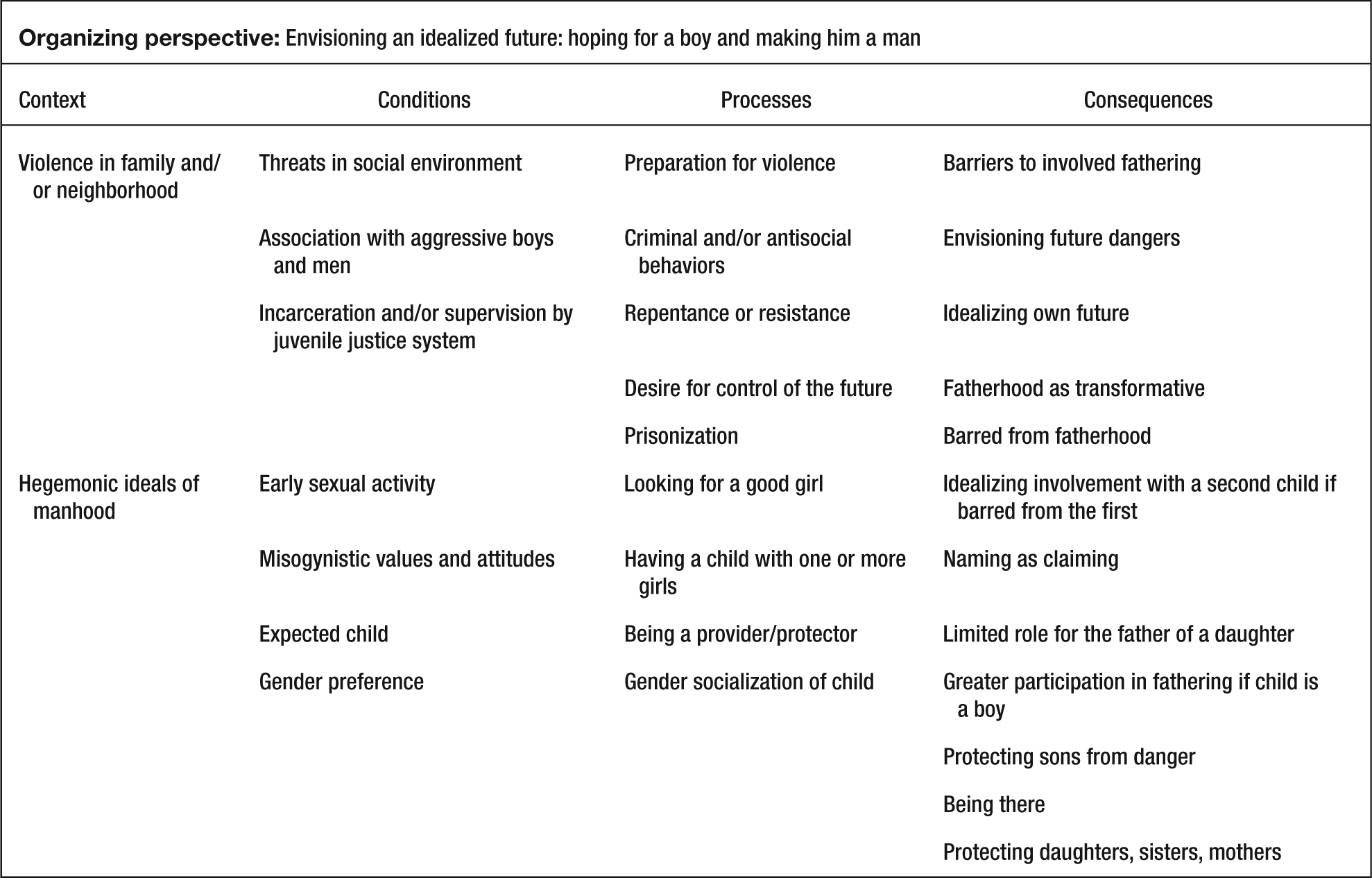
The explanatory matrix
We completed theoretical sampling when we were able to fully describe the conceptual categories related to father identity development in the context of incarceration or justice system supervision. We examined the theoretical findings to identify whether we had sufficient data to offer thick analysis (Charmaz, 2006). Thick analysis borrows from the term “thick description,” which was initially used by Geertz (1973) to prompt social scientists to describe the multiple interpretive perspectives on cultural contexts of social experiences. Rather than relying on saturation of categories, we deemed we had sufficient data when our analysis yielded a comprehensive conceptual understanding of the social phenomenon under investigation (Charmaz, 2006; Thorne, 2011). We offer the findings of this study as a theoretical depiction of the influence of masculinity on father identity development, the range of teen father involvement, and the facilitators and barriers that promote or prevent a father–child relationship.
Limitations
Our analysis was limited because we could not follow youth over time to examine how the participants’ envisioned futures were or were not realized. We also found that they often described intersecting identity statuses. Influences such as age, race or ethnicity, social class, type of crime, gang affiliation, schooling, immigration status, mental health and illness, family constellation, out-of-home placement history, and court jurisdiction impacted the developmental identity work of the young men we interviewed (Shade, Kools, Weiss, & Pinderhughes, 2011). Although we believe data adequacy and interpretive sufficiency were achieved, the pragmatic issues inherent in a time-limited study prevented us from continuing theoretical sampling relative to these multiple perspectives. The sample was limited in size and some perspectives were not well represented; additionally, our goal was not to provide an exhaustive conceptual understanding of the differences between groups. We acknowledge that, as in postmodern conceptions of grounded theory, our interpretations are not conclusive, but rather are situated in a particular time and context, and are ever-emergent (Clarke, 2005). For the purposes of this article, we present the findings related to the theoretical construct of masculinity and its representation in the gendered aspirations and intentions of adolescent fathers.
Findings
Nineteen study participants ranged in age from 16 to 19 years. Ten participants were expecting a child at the time of first interview and 12 already had a child; 7 reported they were responsible for two or more pregnancies. Youth described their racial or ethnic group in their own words. The majority self-identified as Latino; the second largest group described themselves in terms of mixed racial or ethnic identity. Ninety-five percent of the participants identified themselves as non-White. Twelve youth were interviewed in detention and 7 in the community. Some of the participants reported criminal activities, which ranged from petty theft and drug sales to auto theft and attempted murder.
Our analysis identified several salient themes that influenced how youth in the justice system negotiated an identity as father. One was the envisioned hope for a boy and the often idealized view of the influence a father could have in making his son into a man. In this section, we describe how expectant fathers defined their future as a father in relation to their hopes for a male child. Second, we discuss the idealized visions boys had for a son, the role young men perceived, and the barriers they foresaw as they constructed alternate images of involved fathering. Finally, we identify how teen fathers envisioned parenting their son to help him prepare to navigate the dangerous terrain they believed their child would face in the future.
Hoping for a Boy
Naming as claiming
The youth in this study described their hope for a son as an ideal, accepting the fact that they might have a daughter instead. The first activity they envisioned was naming their child. Many wanted to name the child after themselves; some wanted to name their son after someone of significance. One father told the story of finding his baby brother dead, apparently from sudden infant death syndrome, when the participant was 5 years old. The young man named his son after his baby brother. One 17-year-old was parenting a 2-year-old girl with his 25-year-old girlfriend. He said that he thought he was ready for a child when he was 13 years old, but he did not meet the woman who would be the mother of his baby until he was 14 and she was 21. Despite being happy when, at 15, he had a daughter, he initially wanted a son. At the time of the interview, the couple was expecting another child:
I am going to name him after me, if it is a boy. I want to name him after me. I let her pick the girl’s name and I pick the boy’s name. I always wanted to pick a boy’s name. My whole life I always had a boy’s name picked out. I never really focused on a girl’s name because I never really wanted a girl. I mean, I did, but I did not want a girl first. That way, he would grow up and he would be able to watch after her.
For participants who already had a boy, being denied the opportunity to name the child was a painful reminder of the barriers to knowing and influencing their son. An 18-year-old, “White, Black, Mexican, and Native American” young man said that his mother had moved him “out of the ‘hood [neighborhood]” in an attempt to reduce his criminal activities and return him to school. The detention staff person described the youth as heartbroken about not having contact with his son, who was born 1 month prior to our interview, removed from the mother of the baby, and placed in foster care. Reportedly, he asked every adult in the institution whether he or she could help the participant get custody of his son. His first statement during the interview was, “See, I want to get custody of my son.” He went on to say,
[The mother] . . . she named my son. Before, when we thought it was a daughter, she was going to name the daughter. But then we found out it was going to be a son. . . . I’m supposed to name my son.
Not naming his child was an early loss associated with fathering a son he could not be with.
Participating in fathering if the child is a boy
Two youth were resolute about having a boy and suggested that they would not participate in childrearing if their child was a girl. One was a 16-year-old being tried as an adult and threatened with a lengthy prison sentence for attempted murder. He began the interview by asking if he would “get in trouble” for something he had done. He described the events before his incarceration and told of living with a 19-year-old woman and her 2-year-old son. The participant called the woman “a random girl” and said she was one of several girls he had “run through.” This young woman, however, became pregnant, which was unacceptable to the youth. He admitted that he “beat her up.” “She’s not having it. She’s not having no baby. I’m gonna [going to] tell you that. She’s not having it. No baby. No. I can tell you. She’s smarter than that.”
The quoted participant also talked about a girl his age who he thought was sophisticated and pretty—not like the “street” girls he ran through, girls he called “little ‘hood rats.” When he thought about this girl, he thought she could be the one he would have a baby with, the one he would “wife up,” and have as his “main girl.” Several of the study participants reported that they would prefer to have a baby with a “good girl” and, in part, defined a good girl as someone who would give them a son. Most of the youth we interviewed hoped for a boy and fantasized about the type of young man their child would become.
Fathering a girl was not preferred but acceptable to some youth
Of the 19 youth interviewed, all but 3 said they preferred a son. Those who did not specifically want a boy were not eager to have a girl; they found either gender acceptable. One participant was the most reserved, reticent youth we interviewed. He had impregnated a neighbor girl during a party, but was not interested in a relationship with her. He was indifferent about the gender of his unborn because he was determined to have nothing to do with the child. During a follow-up call he said, “They say I’m having another baby.” He was not planning to have contact with that child, either. A married 18-year-old man would not agree to an interview without his 17-year-old wife present. He hesitated when asked about his preference for a boy or girl, initially agreed when his wife reported they wanted a girl, and then said, “Sometimes I want a boy, sometimes a girl. . . . I want a baby to play baseball and other sports.”
The other participant who was noncommittal about his preference was a 16-year-old boy who described his 14-year-old girlfriend as his “best friend,” and began the interview by proudly displaying a recent tattoo on his forearm of the girl’s name. When asked about the gender of his child, he said, “Oh, gender, uh, not really. I don’t really care ’cause, either what it is, I’m gonna love it. Boy or girl, it don’t matter.” He said he pictured a boy as “a little me” and a girl as “a little her.” Neither of these youth expressed a desire for a daughter as unequivocally as most participants voiced their desire for a son.
Envisioning an Idealized Future
Idealizing their own future before fathering
Study participants envisioned an idealized future for their children, but they had difficulty outlining how to achieve the ideal. One young man described the need to have his own idealized future before fathering:
I wanna [want to] have a kid eventually. I wanna wait [though], ’cause my dad’s been having kids since he was like 15. . . . My mom and dad were never together. My kid’s not having that, I’ll tell you that. I’m gonna go to college. I’m gonna do everything I can so that I can better myself, and I’m not having kids for a while until I’m, I guess, financially, mentally, physically, everything ready. I want the house, the car, everything. I want to be really ready to have a kid with a woman that I love, that I want to marry, that I want to live with for the rest of my life. Like that.
The participant went on to describe a celebrity lifestyle he hoped to create for his future children, preferably two boys or a boy and a girl. “If I had two girls I’d probably really go crazy,” he laughed. This young man envisioned his potential future, the two boys or the boy and the girl he would father, and the advantages he would offer these children. His thinking evidenced the adolescent phenomenon of invincibility in his belief that he would have greater power and control than he had in custody. The negative consequences his peers experienced “wouldn’t happen to me.” His imagined adulthood was unlikely, given the possibility that he would be tried as an adult and sent to prison. Participants talked about delaying fatherhood until the idealized future was achieved, or of distancing themselves from their child until they were no longer involved in criminal or dangerous activities.
Idealizing involvement with a second child when barred from contact with the first
Another participant already had one child at the time of interview, a 9-month-old daughter he was unable to see. The mother of the child ended their relationship and would not allow him contact with the baby after she found out he had gotten another girl pregnant. Not unlike other participants who were expecting a second child, this young man believed he could be a better father to the unborn baby. He envisioned having a son, maintaining a good relationship with the mother of that baby, and being a presence in his child’s life. Of his imagined future child, he said,
[I want to] be a dad. Be there when he needs a talk. Talk to him. He’d be like, “Dad, I got worries. I got a baseball game. Can you make it?” And I’m going to promise him that I’m going to take the day off to make it. I don’t care if I get in trouble. “I promise you, son.” I want to be the world’s best dad. That’s all. Something I’m not to my daughter.
Fatherhood as transformative
A 17-year-old described himself as “of the streets,” someone used to selling drugs on the street corner. His mother was a bank robber and was sent to prison when the participant was 13. His adolescence was spent “running from placements”; he alternated between living on the streets, going to foster care facilities, and being locked up. As we frequently heard from youth, this young man thought having a son would force him “to slow down, start changing my ways.” He needed to be a role model for a boy. The participant planned to turn 18, leave the foster care system, and “start over with no felonies or nothing.” He thought he could go to school, get a real estate license, and make $70,000 in his first year:
I always wanted [real estate] to be my thing. . . . I want to have houses around the world, where I could just leave California and go somewhere and go have business: “That’s me. That’s my house right here.”
He imagined all this would be possible if he were partnered with a good girl, had a son, and started his new life with a clean record.
Participants hoped for involvement with a good girl and appreciated a girlfriend who was perceived as “being there,” defined as loyal and trustworthy. The right girl was also envisioned as capable of transforming the youth’s life in the same way a child might. Girlfriends were described as motivators to change for young men who wanted to reduce their criminal activities, gang involvement, or their drug use. The mother of the baby was sometimes described as someone capable of controlling the youth’s behavior. Several participants talked about avoiding dangerous situations, evading potential altercations, and making wise decisions based on what the mother of the baby said.
A limited role for the father of a daughter
In the previous narratives, we offered evidence of the idealized future the teen fathers described for a son. In contrast, the participants rarely talked about their imagined daughter’s future but, if they did, the vision of fathering a daughter was limited in detail. When a daughter was anticipated, the only role the youth saw for themselves was fending off boys or dangerous predators that might hurt a girl. One participant’s parents abused drugs and were frequently imprisoned. His grandfather, a police officer, and his grandmother, a factory worker, had a home, money, and plentiful food. They took care of the grandchildren when the parents were not present. One of the youth’s cousins, however, accused her grandfather of sexually abusing her: “She started to say he raped her, and he just got fed up with it and I guess he went somewhere and just, boom! He shot himself.” This 16-year-old, one of the few youth who was noncommittal about wanting a boy or girl, anticipated being protective of a daughter:
[I’ll] just [have to] make sure nothing happens, ’cause females are the main ones that’s always getting raped and, just, whatever. When they’re like, they’re like teens. And, like, that’s stupid. I don’t know why people do that to them. I watch the news, I know. “Oh, this child got raped in the woods,” you know.
The youth in this study believed girls needed fathers or older brothers to protect them. Boys needed no protection; they needed to be capable of defending themselves.
Fathering differently than they were fathered
Many of the participants reported that the future they wanted for their son was the experience of being fathered that they never had. An 18-year-old had impregnated a 20-year-old friend and admitted to becoming excited about the pregnancy after he found out the unborn was a boy. The participant talked about his troubled relationship with his father, and reported that he hoped he could parent differently with his own son. He was 5 years old when his mother ended the marital relationship because his father spent the family’s money on drugs and alcohol. The youth’s father refused, however, to leave the household and spent his days and nights camped out on the front porch of the family home. Every morning, leaving the house to go to school, the boy had to step over his father, asleep on the doormat. Eventually, the father moved from his mother’s home.
In his early adolescence, this young man agreed to live with his father for a while because he was not getting along with his stepfather. He learned to use drugs, he reported, during the time with his father. He said,
I got used to doing a lot of drugs. It was just . . . a ritual; that’s what we do. . . . A regular family watches TV. We sit around in the circle, watch TV, and do drugs together! That’s what the family does.
He asked to be returned to his mother’s home, but she said he needed to remain with his father for the school year. The youth insisted on returning to her household after a Thanksgiving holiday spent with his father:
The thing that really pushed me over the edge, not wanting to live with my dad, really, like, seeing how unstable he was, was when I was 13, like, at Thanksgiving. He flipped out and had one of his little episodes. He wanted me to come outside and talk to him, but I was too scared to go outside and talk to him and, I was like, “No, I don’t want to go outside and talk to you.” Maybe a half hour later, my aunt comes in and tells me, “You have to go outside and talk to your dad or he’s going to light himself on fire.” I’m like, “What? How am I supposed to respond to that?” I didn’t want to go outside. But, maybe ten minutes later, I go out to the door and look outside and my dad is pouring gasoline on himself and holding the lighter and saying, “Come outside and talk to me, son. Come outside or else I’m just going to end it.” I’m standing in the door and, like, “Are you serious?” I was like, “No.” And, like, that was it for me. I wanted to go back to my mom.
This painful father–son relationship fueled the youth’s dreams for his son:
I don’t want to be like my dad. . . . The fact that I had to step over my dad when I was a kid. Watching him almost set fire to himself. . . . No kid should go through that. . . . That’s going to be a neverending cycle ’cause, if I’m going to be like that to my kid, who’s to say he’s not going to do that to his child. I want to stop that cycle somewhere.
The majority of the youth in this study talked about their fathers as unavailable, abusive, or unknown. They did not want to repeat their (respective) father’s offenses.
Another participant was a 16-year-old gang member who had been in the care of foster families, in several group homes, and incarcerated “too many times” to count. He described the negative effects of growing up with a father who was known in the community. His father was “gang affiliated,” the young man said, and, “He ran, literally, he controlled fourteen to fifteen blocks; he was very high ranking.” At age 3, the participant was at home when his father’s rivals drove by and shot at the house; at age 6, his father and partners were drunk and held the boy down (as he screamed) to carve their gang moniker in his arm. A few months prior to our interview, this young man cradled his brother in his arms as he lay dying in the street; the brother was shot in the head when he and the participant were running from rival gang members. The young man dreamed of a future for his son that would be nothing like his own childhood. On behalf of his hoped-for boy, he said, “I gotta [have got to] start looking for a house, you know. Save up money. Buy a car. . . . Start going to school again. Stop messing up.”
Idealizing their future sons
Fantasizing about the future, youth described their sons as hypermasculine and self-reliant. The participants said they planned to raise athletes such as boxers and football players, and they envisioned sons who were fighters, capable of defending themselves and protecting their families. They referenced hegemonic masculine images in the media to describe the ultimate protector. An expectant father was the only participant who said he wanted his child to be a geek, a nerd, a “square.” This youth fantasized about his future child:
I want him to be a square. I want him to be the kid with the glasses and the pocket protector who gets straight As. “Ah, teacher’s pet! Teacher’s pet!” ’Cause, those kids seem to grow up to have good jobs, great-paying jobs. They seem to be a lot more happier than the kids who use drugs, who end up working at McDonald’s. I want him to be that kid. I wish I was that kid.
A square was not an acceptable image for other youth we interviewed. One gang-involved youth said about his hoped-for future son, “My son, you know, he’ll be a soldier. I don’t want him to be a gang banger [gang member]. He’s going to be a soldier. He’s not going to be a little, squinty-looking nerd boy.” Other youth also referred to their hoped-for sons as soldiers. The fathers felt the need to prepare their boy for the inevitability of battle, to grow up quickly, and to be a man.
Barriers to involved fathering
The youth in this sample were aware of the barriers they needed to overcome to achieve the life they envisioned for their son. They spoke of wanting their son to know of the streets but not be of the streets (Anderson, 1999). One young man defined this ideal when he said,
I tell you one thing: My kids will be smart, and they’ll be just as street smart as the book smart. But that don’t mean that they need to know the streets as in the gang life, being in jail, and all that stuff.
Knowledge of the streets, some boys presumed, would be enough to prevent a child from going to the streets.
One participant was 12 years old when he had his first girlfriend, who was 16. He ended the relationship with that girl when someone 1 year older than he was expressed interest in him; she was the girl he eventually got pregnant. He was 17 when interviewed, and she was 18 and planning to attend college. The youth’s goal was to be released from detention to a group home near her college. “I just gotta stop running the streets,” he said. “Staying out of trouble and getting a job” was the way this young man could be a role model for a child, and the best way to prevent his son from ever knowing about life in the streets.
Making the Son Into a Man
Envisioning future dangers
The youth frequently referred to arming their sons to defend themselves. It was not always clear what the participants thought might happen to their children, but the sense of unease and distrust permeated every interview. One youth thought young boys needed to be prepared to fend off bullies before they began school. “Can’t be no punk,” he warned. A punk was someone who appeared vulnerable, someone who could be “punked” or attacked. Participants worried about dangers in school, in the streets, and in contacts with police and correctional staff.
Participants envisioned keeping their sons out of the justice system by assisting them with their homework, helping them stay in school, telling them not to use drugs or drink alcohol excessively, and encouraging their involvement with peers who did not get in trouble. Our observations of youth in detention confirmed what many of the participants said about the dangers associated with incarceration. There was evidence of a multitude of social missteps that could bring on violence from the other detained boys. Young men who made eye contact with a rival gang member, who spoke about being transformed by incarceration, who disobeyed the code by “snitching” (turning someone in to law enforcement) or showing weakness, and who sat at the wrong table during mealtime were often targeted for violence. Likewise, youth who were obviously invested in a girl and committed to their relationship risked being harassed, threatened, or attacked.
There was a power structure in the detention facility that advantaged the most traditionally masculine youth and those who had learned the system. The more powerful youth bartered for or manipulated to achieve extra privileges. Those who were younger, had not been locked up before, or looked or behaved in a feminine manner were marginalized or taken advantage of by other youth. Though many of the men and women who supervised the youth were obviously caring, supportive, and helpful, warm or empathetic interventions were incompatible with the structure of the institution. Overseeing potentially aggressive and manipulative young men mandated that the staff convey authority and control over the youth at all times. Detention, for the youth in this study, was another environment in which they had to protect themselves from harm.
Parenting strategies to protect sons from danger
Young men recounted stories of their own preparations to ward off dangers and how they learned from older men and boys to take on hypermasculine behaviors. These experiences frequently happened when they were school aged, but some of the youth described this socialization process occurring during their preschool years. The youth were taught how to use weapons, primarily handguns, and to prepare for, endure, or triumph during physical fights. They were schooled about hegemonic masculine images of men by the media, as well. The participants spoke about the central characters in movies that depicted the dangers of gang involvement, prostitution, drug sales, and the transportation and sale of weapons. These media representations of “real” men were held up by the youth as influential characters and as performers who invoked images of their own life experiences.
One youth said he was prepared by his older brothers to defend himself against attack at home or in the streets. He said his education began before he could remember. He was equipped before school entry to defend against any perceived insult. He had learned to “one-up” someone, defined as responding to an aggressive act with a more aggressive one. As a young child, he was frequently suspended from school for fighting:
“If you do me wrong, if you push me”—this, this is my dad talking—“Somebody talks shit to you, push him. Somebody pushes you, you hit him. Somebody hits you, you beat their ass.” It’s, it’s just, you one-up every, if somebody wrongs you, you one-up wronging them. And that’s what I learned.
The participant described his hoped-for boy as someone who would be strong enough to ward off dangers, as he was, at a very young age:
My son’s gonna be in little hard kick boxing, all that, wrestling, and all. He’s gonna do it all. Everything. He’s gonna walk the deadly walk. He’s going to be, like, six years old and a black belt [martial arts expert]. He’s gonna be something.
Although the dangers to future sons were pervasive, some youth envisioned danger for their sons based on the gang and criminal activities they themselves had participated in.
One young man was prepared to teach his son to resist gang involvement. He reported that he had seen infants who were already being dressed in gang colors. Although the youth in school were prohibited from wearing gang colors, mothers, he said, were bringing infants and toddlers to the school child care center dressed in the local gang clothing. “I don’t want him growing up before he is a baby,” he said. Preparing a son to handle the inevitable pressure to affiliate with gang members was a common theme among participant interviews.
One youth wanted to prepare his son to resist gang involvement, but he recounted how impossible that might be. The mother of his baby, he said, was a “wannabe” [want to be] gang member who had texted him before he was arrested that their baby was already throwing up gang signs. The girl he “really loved” and intended to get pregnant also had family members who were in a gang. The young man’s father was a high-ranking gang official who had tried to keep his son from being gang affiliated, but was not successful. “[My dad] got involved in the wrong things, and he has some faults he is trying to replace,” the participant said. “[But he] has [gang] codes he has to follow.” The participant said he became involved in his father’s gang after older men offered him respect in the form of free food, transportation, and protection from rival gang youth. “You’re Bruno’s son, aren’t you?” he said he was frequently asked.
After his release from detention, the young man intended to move away. If he could not move far, he said he would change his phone number and stay around the house as a strategy to lose his gang connections. He hoped this would protect his son from involvement. As he envisioned the future, however, he thought it unlikely he could control his son’s affiliations:
He will be around it, ’cause of his family. . . . His family won’t encourage him to do that, [but] he might see his family and want to get involved. . . . I heard a lot about my dad when I was growing up. I kinda wanted to be like my dad.
Gang association, criminal activity, illegal employment, and poor relationships with the mother of the child were described as barriers to father–son contact and the degree of influence that participants hoped for in the future.
Being there
One youth described the consequences of “hustling,” defined as selling drugs on the street corner and competing with other small-time drug distributors. As a result of hustling, he was hypervigilant when he was in the community; he said he feared being shot at while driving with his little brother. He also attempted to keep his family’s whereabouts secret and he admonished the mother of his unborn child if she went out of the house alone. The participant described his desire to be a father, in contrast to a dad:
A dad, he’s like one of those that just pop out every now and then. That’s like one of them, like, “Where your dad at?” “I don’t know.” You don’t really know ’em, you just know of ’em. Your father’s somebody you know, somebody you can speak about, like, “Yeah, me and my dad, me and my dad did this.”
A father, as the young man described, offered a constant presence, a sense of safety, and security. This youth hoped to be a father rather than a dad to his son, but he had significant worries about “enemies, hatred, [and] revenge. No matter what I do, I’m still trapped in the cycle of the streets.” He feared rivals might find his son and his son’s mother and hurt them in retaliation for the youth’s past offenses. Though he wanted contact with his child, he said his son might be better off if he kept a distance from him.
Protecting daughters, sisters, and mothers
The imagined threats to their children that the youth in this sample described were based on the real threats they themselves had experienced. They feared their son would be bullied or harassed, would bully others, fail in school, become gang involved, run the streets, get locked up, and be exposed to or experience violence. They feared daughters would get pregnant or be raped, or would fall victim to the predatory boys the young men believed they would have to deal with if they were involved in raising a girl. Many of the participants wanted a boy first and then a girl; they thought it necessary that a girl have an older brother to protect and defend her if her father was not around.
Sometimes the youth said that they expected a son to protect a girl or a woman from danger within the family as well as in the community. A 16-year-old who was parenting a daughter said, “A brother [should] be on [his sister, not letting her] have a boyfriend.” It was said a boy also needed to protect his mother: “[Our dad] just left a year and a half ago and my mom decided to have a boyfriend. My little brother tells him, ‘Man, I’m going to kill you when I get older.’” The youth’s 8-year-old brother was required to watch over his mother and guard against potentially dangerous men because the participant and his father were not available to fulfill the protector role.
Discussion
Gender pervades social processes at every level. There is no stronger influence in forming an individual or social identity than that of gender. As West and Zimmerman (1987) wrote, “Gender activities emerge from and bolster claims to membership in a sex category” (p. 127). Our analysis of the processes involved in identity development among male youth in the justice system revealed the substantial impact of hegemonic masculinity and the importance of asserting one’s maleness.
Hegemonic masculinity is the revered image of what it means to be a man, an ideal influenced by social, structural, and cultural dimensions. It influences boys and men to enact acceptably masculine behaviors given the mores of particular social settings. As such, masculine behavior is culturally constructed. The images of manhood vary based on the social group in which they are found (Connell, 2005). The findings of this research strengthen what quantitative researchers have suggested: the endorsement of traditional gender roles and positive beliefs about a hegemonic masculine ideal have been associated with involvement in teen pregnancy, particularly among Latino youth (Goodyear, Newcomb, & Allison, 2000). The hypermasculine persona of someone who is capable of violence and can protect others from harm is a model for poor, primarily Black and Latino youth who identify as street youth, and for men involved in the justice system (Anderson, 1999; Nurse, 2002).
For the teen fathers we interviewed, gender and father identity construction were heavily influenced by their culturally favored ideals of manhood. Gang and street culture affected identity development, as did popular media representations of “the badass” (Katz, 1988). The youth in this study referenced movies such as Scarface (Bregman & De Palma, 1983), Menace II Society (Scott & Hughes, 1993), Hustle & Flow (Singleton & Brewer, 2005), and Belly (Bigwood & Williams, 1998) as they related their lives to Hollywood’s version of the dangerous lifestyle. Their visions of an involved father often conflicted with the “badass” images of manhood.
Loss and grief were apparent in all the youths’ interviews. The development of an identity as a teen father was influenced not only by gender, but by traumatic life events and threats to self-respect, property, and person. Abusive, neglectful, and absent fathers were described as the cause of many of the participants’ painful childhood experiences. Poor father–son relationships contributed significantly to the participants’ motivation for being a positive person in their son’s life. Poor father–son relationships also offered models of disengagement.
In thinking of the future for their son, the threats the young men had experienced were prominent as they contemplated preparing their own boy to defend against possible dangers. Youth spoke of the need for their son to be streetwise, smart, athletic, strong, and socially connected to people he could rely on if the need to retaliate for an offensive act arose. In raising a boy with these qualities, they hoped to ensure their son would display hegemonic masculine behaviors and not be marginalized by his peers because of actions or appearances that were ostensibly feminine (Connell & Messerschmidt, 2005). The youth in this study recounted how important it was during their own childhoods to avoid being called a “punk,” “pussy,” “square,” “squinty-looking nerd boy,” “sissy,” “sucker,” “snitch” or, the worst, “gay.”
There was something about the birth of a son and the naming of the child that allowed young men caught up in the criminal justice system to stake their claim, to establish a connection with their baby when they could not be, at the moment, a presence in the child’s life. Youth often described being barred from fatherhood through the control and supervision of the child welfare and juvenile justice systems. As research with adult fathers suggests, teens might be unable to establish a relationship with their child because of the barriers the mother of the child or her family erect (Roy & Dyson, 2005). Sometimes, the youths’ past offenses and gang social networks prevented them from anticipating a future in which they could actively raise their child.
Older fathers in prison have been described as distancing themselves from their children as a good parenting strategy (Arditti, Smock, & Parkman, 2005). As some of the participants in this study described, protecting their son from danger might require limiting the amount of father–son contact. Youth who described themselves as heavily gang involved or able to make a significant income from street drug sales were more likely to fear harm to their child and to consider distancing themselves as a protective mechanism. Although many of the youth saw fatherhood as transformative, providing them with an opportunity to change for the better so as to have a positive influence on their child, few could imagine how to overcome the obstacles to involvement they faced.
Youth were impacted by poverty and described the consequential destruction of family life that occurs with unemployment, incarceration, untreated trauma, psychiatric illness, and substance abuse. Many participants talked about homelessness, chaotic and unstable living arrangements, and exposure to extreme violence in their families and in the community. Prominent in their discussions about the future was the pull of the streets, the financial opportunities offered by drug and weapon sales, or theft and burglary. Illegal work was not compatible with involved fatherhood because the threat of imprisonment and violent altercations with rival street vendors tainted the money that could be earned illegally. The youth in this study described the risks of illegal work and sought strategies to ensure their partners and children would not be affected by their reputations or their histories of violent and criminal activities.
The youth we interviewed talked about moving or being moved by their mothers or grandmothers out of gang-infested neighborhoods and communities in the hope of protecting themselves and their children from retaliatory violence. Sometimes, for economic reasons, they ended up “back in the ghetto.” None of the youth believed that a former victim or rival gang member with a score to settle would not be able to reach them in a new location. One participant suggested the only place he might be able to escape to was North Dakota: “I bet they have gangs there too, though,” he lamented. Participants felt the need to escape gang influences to be a good father, but they were at a loss as to how to do that. They referenced the need to get shot or stabbed to legitimately get out of a gang, but even then, they doubted they would really be free of the gang’s influence. They indicated they might be required to reject their immediate and extended family members to end their gang involvement.
Instead of leaving their respective gang, the youth talked of “slowing down,” “locking down,” or “staying around the house.” Some saw the “baby’s mama” as capable of influencing them to reduce their activities in the streets by “getting on” them. Laub and Sampson (2003) described this phenomenon in their analysis of men’s desistence from crime over the life course. The mothers of their babies might motivate criminal and gang-involved fathers to end their associations and change their life courses. Young women could do this by offering young men a new start, monitoring their behaviors, providing activities at home that competed with activities in the streets (Gadsden, Wortham, & Turner, 2003), presenting new social networks and social support, and answering the attraction of a street identity with an identity as a family man (Laub & Sampson). The magnetism of the streets and the belief that social violence was inescapable required the young fathers in this study to prepare themselves and their sons to be capable of defending themselves and their family, wherever they might be.
Conclusion
Social policy, supportive services, and intervention programs in the United States have been directed at teen parents, economically disadvantaged fathers, and low-income families for at least 25 years. Programs have offered support for teen mothers to graduate from high school and enter the workforce, but the quality of the education offered pregnant and parenting girls has been inconsistent (Smithbattle, 2006), and teen fathers have rarely been included in such programs. Interventions have been designed to increase father involvement among economically disadvantaged families, with mixed results (Knox, Cowan, Cowan, & Bildner, 2011). There have been uneven efforts to reduce the teen birth rate in the United States through sex education and low- or no-cost birth control, but births to adolescents in this country continue to increase at a consistently higher rate than any other developed nation (Yang & Gaydos, 2010).
Various policing and sentencing procedures have been instituted to reduce incarceration rates in low-income communities, but the United States is more likely to imprison offenders than any other country in the world (Raphael, 2011). Economic and social policies since the 1980s have targeted welfare recipients to move them into the workforce; however, there have been significant reductions in the legal labor market for young, economically disadvantaged men, especially those with a criminal record (Sum, Ishwar, McLaughlin, & Palma, 2009). Taken together, the social and economic policies of the last three decades have done little to assist low-income, teenage mothers and fathers and their children.
The findings presented in this article have several implications for policy and program development. Youth who father children as adolescents are likely to be found in youth detention facilities and among young men supervised by probation (Nurse, 2002; Shelton, 2000). Father-involvement and family-support interventions should be offered to youth in the juvenile justice system. Policies also need to be adapted to accommodate contact with children and family members when youth are detained.
Given that hegemonic masculinity permeates relationships in jails and prisons, policies and programs for incarcerated youth must account for the influence of gender in assessing problem behavior and imposing penalties. Correctional personnel who reinforce hypermasculine conduct likely serve to increase rather than decrease antisocial behaviors among youth (Abrams et al., 2008). Young men in schools and detention facilities need opportunities to learn about and discuss gender differences, gender roles, and gendered social and cultural behaviors and expectations. They need to see and practice different social models of manhood. Education and counseling interventions might encourage boys to challenge hegemonic images of masculinity and assist them to explore alternate identities of a real man.
During interviews with youth in detention, all but one participant expressed appreciation that they were offered an opportunity to talk about fatherhood and what it meant to them. Many youth said things such as, “I’ve never told anyone this before,” and “I’ve never thought about this before.” Despite their problematic histories and, for some, continued illegal activities, the youth were eager to talk about their positive intentions for involvement with their children. We recommend training juvenile justice professionals to counsel young men about sexual relationships and parenting. Interventions implemented in juvenile facilities and probation programs sensitized by the influence of hegemonic masculine ideals could improve the milieu in such settings and staff–youth relationships.
Last, parenting education and support need to be offered to teen fathers in addition to teen mothers. Parent intervention programs that address the impact of masculinity on father identity and the development of the father role might help to reduce the intergenerational social transmission of aggression and violence from father to son. We found that young men desired a son and hoped to influence him to become a real man. Often, the youth viewed a real man as aggressive and potentially violent, capable of protecting himself and others; however, the participants also saw a real man as academically successful and able to work to provide for his family. Social policies and programs are needed that offer significant academic support to teen fathers, to assist them to be successful in school. Additional work-preparedness funding is also necessary: teen fathers want to make financial contributions to the family. Fathers who are educated and employed present positive role models and the prosocial aspects of hegemonic masculinity for their sons to emulate.
Footnotes
Declaration of Conflicting Interests
The authors declared no potential conflicts of interest with respect to the research, authorship, and/or publication of this article.
Funding
The authors disclosed receipt of the following financial support for the research, authorship, and/or publication of this article: The first author received funding from the International Society of Psychiatric-Mental Health Nurses, a Deloras Jones RN Scholarship, and the University of California–San Francisco’s Graduate Dean’s Health Sciences Fellowship and Century Club Award.
Notes
Author Biographies