




Abstract
Being one of the focal points in the field of parenting studies, parental psychological control (PC) is a subject of intense debate. It is conceived as dysfunctional parenting that encompasses different manipulation tactics, such as invalidation, constraining self-expression, love withdrawal, shaming, or guilt induction (Barber et al., 2012). Characterized by coercion, manipulation, intrusion into the child's inner world, and disrespect for individuality, parental PC violates children's self-identities and the satisfaction of their psychological needs (Soenens & Vansteenkiste, 2010). Schaefer (1965) initially proposed this concept of PC, stating that PC tactics “do not permit the child to develop as an individual apart from the parent” (p. 555). In line with these notions, parental PC has been consistently associated with maladjustments (e.g., low self-esteem, low life satisfaction, and more mental health issues) among Western samples of children and adolescents (Pinquart, 2017a, 2017b).
Many forms of PC (e.g., domineering control, shaming, and guilt induction) are more commonly employed by Chinese parents than by their Western counterparts (Sze, 2016; Wang et al., 2007). However, findings are more equivocal regarding the effect of parental PC on child and adolescent development in Chinese samples. While some studies replicated Western findings showing negative impacts (Shek, 2006; Yao et al., 2022), others failed to do so (Shek & Zhu, 2019; Zhu & Shek, 2020). Moreover, several cross-cultural studies failed to identify the detrimental impacts of parental PC on children's development in Asian countries, including China (Olsen et al., 2002; Rudy & Halgunseth, 2005).
The inconsistent findings in Chinese contexts may be attributed to the use of unidimensional measures covering only certain aspects of PC tactics, which may not fully capture the distinctive functions of diverse dimensions of PC (Fang et al., 2022; Zhu et al., 2023). In particular, despite the multifaceted nature emphasized in parental PC's definitions, many Chinese studies assessed it using global measures translated or adapted from Western scales (Shek, 2006; Yu et al., 2021; Zhu & Shek, 2020). These global measures usually excluded essential PC elements such as shaming and guilt induction that are commonly adopted by Chinese parents, leading to insufficient conceptual coverage of PC in Chinese contexts. Even though some studies adopted a multidimensional measurement tool (Wang et al., 2007; Yao et al., 2022), they have used different dimensions to construct a global PC index, assuming similar functions for all selected dimensions. For example, the three dimensions (i.e., authority assertion, guilt induction, and love withdrawal) tapped by Wang et al.’s (2007) PC scale have been used to index a latent PC factor in different studies (He et al., 2019). Such an undifferentiated approach to parental PC may be problematic in Chinese contexts, as different PC dimensions may have different implications. For example, love withdrawal has shown contrasting impacts with guilt induction on Chinese adolescents (Cheah et al., 2019; Yu et al., 2019). It is possible that some forms of PC (e.g., personal attack) are detrimental across cultures as they indicate parental hostility and rejection, while other forms, such as guilt induction, may be less harmful in Chinese cultures as they are arguably culture-normative socialization strategies that are well-intended rather than out of rejection and hostility (Ng & Wang, 2019; Scharf & Goldner, 2018).
In view of the lack of multidimensional conceptualization of parental PC in measurement, Zhu et al. (2023) explored Chinese adolescents’ perceptions of their parents’ PC and developed and validated a Chinese Parental Psychological Control Scale (CPPCS). The CPPCS consists of three psychometrically related yet distinct dimensions: “relational induction” (12 items related to guilt induction and shared shame), “social comparison shame” (six items on comparing the child unfavorably to others), and “harsh PC” (12 items on personal attack, invalidation, domineering control, constraining verbal expression, and love withdrawal). Both the maternal and paternal subscales of CPPCS displayed good psychometric properties (e.g., average factor loadings above 0.70 and composite reliability above 0.85), and the three-dimensional structure was invariant across adolescent gender and grades. Moreover, the authors’ preliminary analyses revealed that the strongest cross-sectional predictor of negative developmental outcomes (e.g., low self-esteem and high depression) was harsh PC, followed by social comparison shame, whereas relational induction showed positive associations with adolescent self-esteem and life satisfaction (Zhu et al., 2023).
The validated CPPCS has full coverage of essential forms of parental PC, serving as a well-grounded, comprehensive multidimensional assessment tool for a differentiated approach to parental PC in Chinese settings. However, it remains unknown whether the scale and its factor structure are reliable and valid across different informants (e.g., adolescents, mothers, and fathers) and over time. The establishment of the scale’s measurement invariance across informants and over time is a prerequisite to using it in studies involving multiple informants and longitudinal designs.
Measurement Invariance Across Informants
Many authors have emphasized the importance of using multiple informants in developmental and family studies (e.g., De Los Reyes et al., 2015; Nelemans et al., 2016). According to these scholars, parents and children may possess distinct perspectives on the same construct, such as adolescent behavior or parental practice. Both perspectives can offer valuable insights for a more comprehensive understanding of the construct being studied (de Haan et al., 2018; De Los Reyes et al., 2015). Thus, multi-informant designs involving both parents and children have become the gold standard because they represent examined constructs and mechanisms in a well-balanced manner (De Los Reyes & Ohannessian, 2016). When investigating parental influence from the perspectives of both parents and adolescents, it is important to determine whether they conceptualize parenting dimensions in the same way. In other words, examining measurement invariance across informants is crucial. However, most studies that used reports of parenting from both adolescents and parents failed to check measurement invariance (e.g., Bleys et al., 2016; Cai & Tu, 2020), assuming that all informants share the same conceptualization of parenting dimensions (e.g., PC), which may result in invalid findings.
First, adolescents and their parents usually hold divergent viewpoints on parenting practices, with the former generally having more negative perceptions than the latter (Hou et al., 2020; Vrolijk et al., 2023). Scholars have increasingly argued that such parent–adolescent discrepancy is not mere measurement error but instead reflects key dynamics in parent–child relationships that cannot be captured by individual reports (Ingoglia et al., 2021; Leung et al., 2016; Vrolijk et al., 2023). Researchers also advocated that parent–adolescent discrepancies in reports of parenting have meaningful implications for adolescent adaptation (Dimler et al., 2017; Ingoglia et al., 2021). To yield valid findings regarding this emerging issue, it is important to establish measurement equivalence across parents and children, ensuring that the same underlying constructs are measured and compared (De Los Reyes & Ohannessian, 2016). As Meade et al. (2005) suggested, the comparison of differences in variables is meaningful only if the measurement is satisfied; otherwise, it may lead to a wrong conclusion (Sharma et al., 2012). Nevertheless, limited studies have done so when addressing research questions related to parent–adolescent discrepancy in reporting parenting (e.g., Hou et al., 2018; Mastrotheodoros et al., 2019).
Second, previous research has revealed father–mother differences. In general, mothers engage in significantly more interactions and daily caregiving with children and exhibit more support, warmth, responsiveness, consistency, and responsibility toward children compared with fathers (Dou et al., 2020; Mastrotheodoros et al., 2019). Some findings demonstrated similar maternal and paternal influences on children's development (Davidov & Grusec, 2006; Hunter et al., 2015), while others revealed stronger impacts of one parent than the other (Hoeve et al., 2011; Lansford et al., 2014). Given the inconclusive findings and the underrepresentation of fathers in the parenting literature (Endendijk et al., 2016), it is important to investigate and compare the roles of fathers and mothers separately rather than integrating them as parental influences. To do so, a prerequisite is to establish measurement invariance in parenting measures between fathers and mothers. However, such practices have been lacking in the existing literature.
It is especially relevant to examine the measurement invariance of the CPPCS across informants. First, given the great need for a differentiated approach to parental PC as a multidimensional construct, multi-informant designs are methodologically preferred to delineate more balanced findings and shed light on parent–adolescent discrepancies. To our best knowledge, no studies have explored parent–adolescent discrepancy in multidimensional parental PC and its implications for adolescent development. Second, paternal and maternal differences in PC remain inconclusive, calling for more research involving both parents. Specifically, some research reported equivalent levels of maternal and paternal PC (e.g., Fu & Zhang, 2020), while others observed higher levels of PC among one parent compared to the other (Luebbe et al., 2014; Yu et al., 2021; Zhu & Shek, 2021a). In some studies, only maternal but not paternal PC displayed significant positive predictions on children's maladjustment (Fu & Zhang, 2020; Luebbe et al., 2014; Shek et al., 2019). However, other studies showed that the predictive effect of fathers’ PC was similar to, or even greater than, mothers’ (Lansford et al., 2014; Wang et al., 2016; Yu et al., 2021). It is possible that the global measures used in these studies failed to capture nuanced father–mother differences in subdimensions of PC (Gargurevich & Soenens, 2016). Thus, by establishing its measurement invariance across informants, the CPPCS can be meaningfully employed to resolve the current inconsistent findings by taking into account the multidimensionality of parental PC.
Measurement Invariance Over Time
Establishing measurement invariance over time is of utmost importance when utilizing parenting measures (e.g., CPPCS) in longitudinal studies, due to the dynamic nature of adolescent development and the potential changes in parenting practices that occur during this period. Adolescence is characterized by advancements in cognitive and psychosocial capacities (e.g., critical thinking and the expansion of social relationships) and an increasing need for autonomy (Smetana & Rote, 2019). Adolescents’ beliefs about the legitimacy of parental control also change, expecting parents to gradually relinquish part of their authority and transform hierarchical parent–child relationships into more egalitarian ones (Smetana & Rote, 2019). Meanwhile, developmental changes among adolescents often coincide with midlife transitions experienced by parents, which may jointly lead to changes in parenting practices and parent–child interactions (Steinberg & Silk, 2002). While some parents may be responsive to adolescents’ changing needs, becoming less controlling and more autonomy supportive (Zhu & Shek, 2021b), others may not optimally recognize and respond to these needs. Particularly in the Chinese context, parents might even reinforce the strictness of supervision because they want to monitor the social relationships of their adolescent children or prevent rule-breaking behaviors (Lansford, 2022; Steinberg & Morris, 2001). As a result, adolescents often perceive stability in parenting (Van Heel, et al., 2019b; Wang et al., 2007) or even increased control and decreased autonomy support (Vrolijk et al., 2023). Despite these dynamics, empirical examinations of parenting development over time and its implications for adolescent development remain scarce (Van Heel, et al., 2019a; Zhu & Shek, 2021b).
When examining these topics, a fundamental requirement is to establish measurement invariance of the parenting measures (e.g., CPPCS) across time (i.e., longitudinal measurement invariance), which refers to the stability of a construct's factor structure over time. Unfortunately, it has been largely overlooked in the existing literature. For example, among the few exceptions that pertain to changes in parental factors, longitudinal measurement invariance was not established (Leung, 2020; Zhu & Shek, 2021b). While measurement invariance across groups (e.g., boys versus girls) and informants (e.g., parents versus children) ensure meaningful cross-group and cross-informant comparisons, longitudinal measurement invariance ensures that the same construct is consistently assessed across time, providing a solid basis for cross-temporal investigations. As Hoyle and Smith (1994) pointed out, the comparison across time points without longitudinal invariance measurement is a classic example of “comparing apples and oranges” (p. 433). In other words, longitudinal research is valuable for facilitating a better and unambiguous understanding of developmental stability or change only if “the invariance holds longitudinally” (Millsap, 2011, p. 5). Therefore, it is necessary to examine the longitudinal invariance of CPPCS before using it to detect changes in Chinese parents’ PC across time and how the changes are associated with adolescent adjustment.
The Present Study
To address the knowledge gaps mentioned above, the present study attempted to further validate the aforementioned CPPCS by investigating two research questions. These are: (a) whether the established three-dimensional structure of the CPPCS remains invariant across informants, including mothers, fathers, and adolescents; and (b) whether the scale demonstrates longitudinal invariance over time. After testing the measurement invariance across informants and over time, the present study also aimed to investigate the concurrent and longitudinal predictions of each dimension of PC reported by parents and adolescents on adolescent developmental outcomes.
Method
Participants and Procedures
The study protocol was reviewed by the Institutional Review Board at the corresponding author's university, and ethical approval (HSEARS20220427002) was obtained before launching the study.
Three secondary schools in Chinese Mainland were invited and consented to participate in the present study using a purposive sampling strategy. With school principals’ endorsement and consent, in each participating school, a designated teacher received online training on collecting parental consent and data from the research team. The teachers then helped invite a few classes in Grades 7–10 to join the study in their respective schools. Students in Grades 11 and 12 were not included because they had a relatively tighter study schedule and schools wished not to disturb them. Head teachers of the invited classes also received online training from the research team before they helped collect parent consent and administered questionnaires. Parent consent was obtained via a parent letter delivered by schools. According to the schools’ feedback, all parents provided consent for their children's participation in the study.
Adolescent questionnaires were administered by the head teachers in their respective classrooms. Before each wave of data collection, students were well informed about the purpose of the survey as well as the principles of voluntary participation, confidentiality, and the right to withdraw from the study at any time without facing any negative consequences. They were also instructed to respond to all questionnaire items honestly based on their own perceptions and without discussing any questions with classmates. After signing the consent form, paper questionnaires were distributed to students, who were given sufficient time to complete them.
Parents received questionnaires and standardized written instructions in a sealed envelope taken home by their adolescent children. The instructions included principles of voluntary participation, confidentiality, and the right to withdraw from the study at any time without facing any negative consequences. Parents were also instructed to respond to all questionnaire items honestly based on their own perceptions and without discussing any questions with their spouses or children. Adolescents returned the completed parent questionnaires in sealed envelopes to their head teachers, who would pass both parent and student questionnaires to the designated teacher in the school. All questionnaires were delivered by designated teachers to the research team.
Parent and student data were collected in two waves with a 6-month time interval. Two attention check questions (e.g., “Please choose strongly agree”), which have been commonly employed in previous research (Zhou et al., 2024), were incorporated in the questionnaires to ensure the data quality. Parents and adolescents who did not correctly answer the check questions were treated as invalid cases, thus being excluded from the final analyses. In the present study, the valid response rates across informants and waves ranged between 87.11% and 95.85%.
In total, 1,632 adolescents and their parents were invited to participate in the present study. A total of 1,470 and 1,542 adolescents completed the questionnaire at Wave 1 and Wave 2, respectively, indicating response rates over 90%. Some adolescents were absent from data collection because of sick leave, personal issues, or participation in other school activities. After removing respondents who failed the two attention check questions, 1,409 adolescents (46.73% female, mean age = 13.87 ± 1.18 years) provided valid data at Wave 1. Among them, 592 (42.02%), 351 (24.91%), 150 (10.65%), and 316 (22.43%) were from Grades 7–10, respectively. At Wave 2, valid responses were provided by 1,424 adolescents (48.14% female, mean age = 14.27 ± 1.18 years), among whom 621 (43.61%), 380 (26.69%), 134 (9.41%), and 289 (20.29%) were from students in Grades 7–10, respectively. In addition, 1,108 adolescents had valid responses in both waves.
For parent data, after removing invalid responses, a total of 969 mothers (mean age = 39.49 ± 4.99 years) and 839 fathers (mean age = 42.03 ± 5.64 years) provided valid responses at Wave 1, whereas 1,107 mothers (mean age = 40.08 ± 4.15 years) and 933 fathers (mean age = 42.96 ± 5.57 years) provided valid responses at Wave 2. Furthermore, 697 mothers and 545 fathers had valid responses across the two waves.
For matched adolescent and parent data, at Wave 1, a total of 828 cases had matched adolescent and mother responses, 701 had matched adolescent and father responses, and 631 had matched mother and father responses. At Wave 2, a total of 931 cases had matched adolescent and mother responses, 773 had matched adolescent and father responses, and 687 had matched mother and father responses. All available valid data were utilized in formal analyses.
Measures
Demographic variables including adolescents’ date of birth, gender, school, grade, and class number were included in parent and adolescent questionnaires to form a unique code to facilitate data matching and analysis. This approach has worked well for data matching in previous longitudinal studies (Zhu & Shek, 2021b). Other key measures included parental PC reported by both adolescents and parents and adolescent self-reporting developmental outcomes, including both positive (self-esteem and life satisfaction) and negative (emotional distress) indicators.
Parental PC
The validated CPPCS mentioned earlier was used to measure parental PC in the present study. The adolescent-report version of the scale showed good psychometric properties in a previous validation study (Zhu et al., 2023). Both paternal and maternal subscales consisted of three dimensions, including relational induction (12 items, e.g., “My father/mother tells me that they sacrifice much for me”), social comparison shame (six items, e.g., “When I misbehave, my father/mother tells me that I am not as good as other children”), and harsh PC (12 items, e.g., “My father/mother insists that I do things their way”). The adolescent participants in this study responded to maternal and paternal subscales separately on a 6-point scale (1 = “never” to 6 = “always”). Parents also reported their own PC toward the adolescent children by completing a parent version of CPPCS in which wording was adapted to fit the parental perspective. A sample item in the parent version reading “I insist that my child do things my way” was adapted from “My father/mother insists that I do things their way” in the adolescent version. Such an adaption has been commonly used in studies collecting data from parents (Fung & Lau, 2012; Leung et al., 2016). A 6-point rating scale (1 = “never” to 6 = “always”) was also employed in the parent version of CPPCS.
Self-Esteem
Five positively worded items in the Chinese version of the Rosenberg Self-Esteem Scale (RSES) were adopted in the present study to measure adolescent self-esteem. The original RSES has 10 items with five reversely worded. Previous studies suggested retaining the five positively worded items (e.g., “I feel that I’m as good as other kids”) for better reliability in Chinese contexts (Sze, 2016). A 5-point reporting scale (1 = “strongly disagree” to 5 = “strongly agree”) was used. These five items demonstrated good reliability at both waves (αs = 0.92 and 0.93) in the present study.
Life Satisfaction
Adolescents’ life satisfaction was measured by the Chinese Satisfaction with Life Scale, which includes five items assessing participants’ subjective appraisals of their overall quality of life (e.g., “The conditions of my life are excellent”). A 7-point scale (1 = “strongly disagree” to 7 = “strongly agree”) was applied. The scale showed adequate reliability in Chinese adolescents in previous research (Zhu & Shek, 2020) and the present study (α = 0.86 at Wave 1 and α = 0.89 at Wave 2).
Emotional Distress
Adolescents’ emotional distress was measured by the Chinese version of Depression Anxiety and Stress Scale-21. This scale has been validated among Chinese adolescents (Ho et al., 2022). It assessed three types of emotional distress, including depression (seven items, e.g., “I felt downhearted and blue”), anxiety (seven items, e.g., “I felt I was close to panic”), and stress (seven items, e.g., “I found it difficult to relax”) symptoms in the past week on a 4-point reporting scale (0 = “never” to 3 = “almost always”). In the present study, the three subscales demonstrated adequate reliability in both waves (depression: αs = 0.90 and 0.89; anxiety: αs = 0.87 and 0.87; stress: αs = 0.89 and 0.89).
Data Analyses
Data analyses were performed using Mplus 8.5 software. Measurement invariances across informants and over time were examined using confirmatory factor analyses (CFAs) with invariance tests. Predictive effects of PC dimensions on adolescent developmental outcomes were tested using structural equation modeling (SEM). The spherical and kurtosis distributions of responses on all questionnaire times were examined before formal analyses, and the results yielded normal distributions (|skewness| < 2.0 and |kurtosis| < 7.0). Thus, the maximum likelihood estimation method was used in CFA (Finney & DiStefano, 2006). The “full-information maximum likelihood estimation” incorporated in Mplus was adopted to handle missing values in variables by making full use of all available data.
To begin, the three-dimensional model of the adolescent version of CPPCS was first examined and its invariance across gender and grade in order to replicate the findings of previous validation research (Zhu et al., 2023).
Measurement invariance across informants was then tested in terms of three dyads (mother–adolescent, father–adolescent, and mother–father) at each assessment occasion (i.e., Wave 1 and Wave 2) separately. Similarly, measurement invariance across the two waves was tested for each informant (i.e., adolescents, fathers, and mothers) separately. Following previous practices (Svetina et al., 2020; Zhu et al., 2021), invariance across informants or overtime was tested sequentially, including (a) configural invariance (free estimation across informants or time points), (b) metric invariance (equal factor loadings), and (c) scalar invariance (equal factor loadings plus equal item intercepts). Changes in comparative fit index (CFI) and root-mean-square error of approximation (RMSEA) (i.e., ΔCFI < 0.01 and ΔRMSEA < 0.015) were used to indicate model invariance (Chen, 2007; Cheung & Rensvold, 2002). It is noted that full scalar invariance is a very stringent requirement and difficult to meet. Thus, if full scalar invariance is not achieved, partial scalar invariance with at least two indicators per factor being equivalent in item intercept is also acceptable (Van Heel, et al., 2019a).
In testing the predictive effects of individual dimensions of paternal and maternal PC on adolescents’ developmental outcomes, adolescent-perceived paternal and maternal PC and mother-reported and father-reported PC were included in four separate models, while adolescent developmental outcome measures were included simultaneously in each model. Both concurrent and longitudinal predictions were tested. Commonly used indices and criteria (comparative fit index or CFI and Tucker-Lewis index or TLI ≥0.90, RMSEA and standardized root-mean-squared residual error ≤0.08) were adopted to reflect adequate model fit in SEM in the present study.
Results
As shown in Table 1, the previously established three-dimensional structure of both paternal and maternal subscales in the adolescent version of the CPPCS held in the present study has full scalar invariance across gender groups and grade levels at both waves.
Measurement Invariance Tests Across Gender and Grade among Adolescents at Each Wave for the Adolescent-Report Version of the Scale.
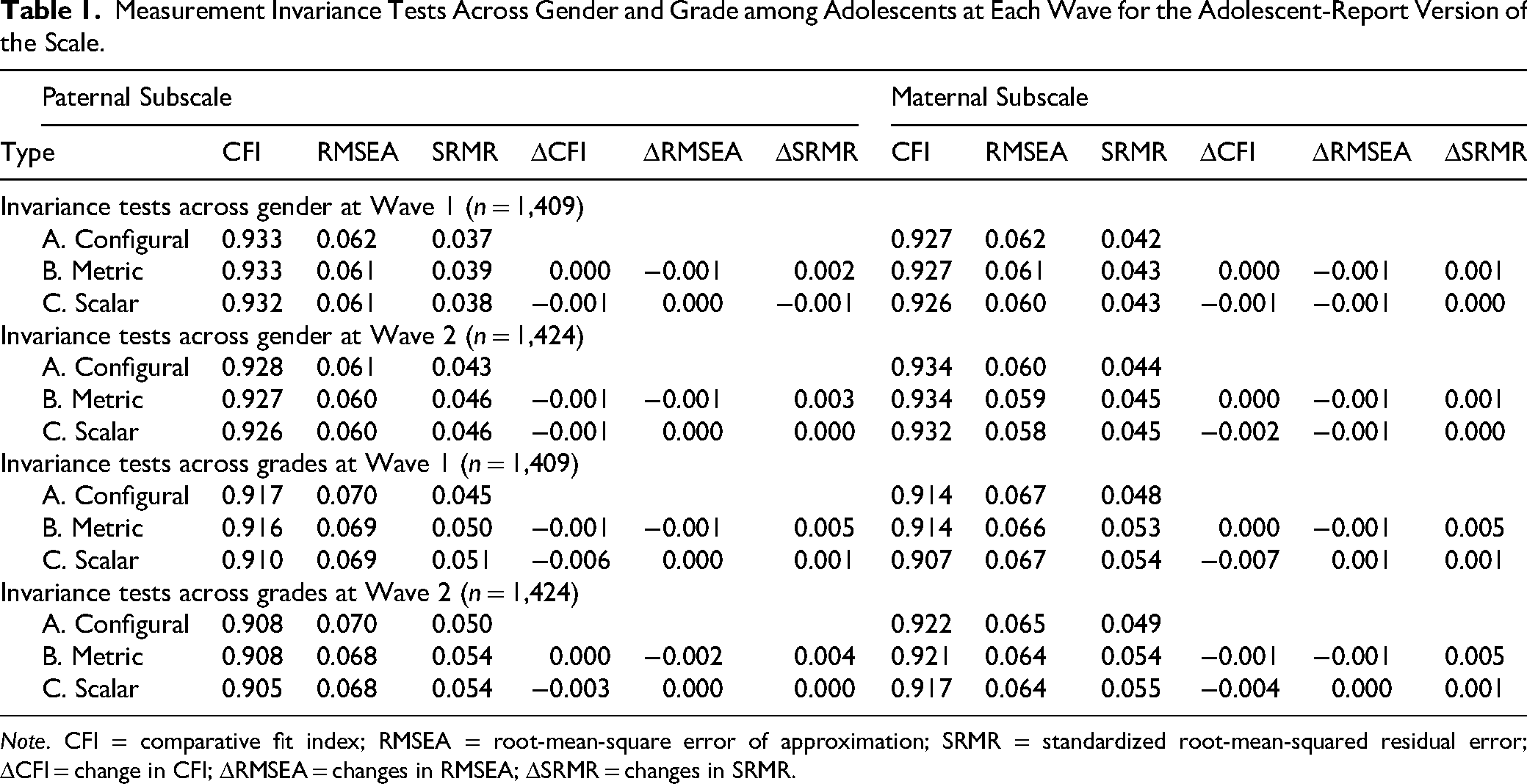
Note. CFI = comparative fit index; RMSEA = root-mean-square error of approximation; SRMR = standardized root-mean-squared residual error; ΔCFI = change in CFI; ΔRMSEA = changes in RMSEA; ΔSRMR = changes in SRMR.
To assess whether comparisons in CPPCS scores across informants are allowed, measurement invariance analyses were conducted between informant dyads at each time point. The results are presented in Table 2. Concerning the father–mother dyad, full scalar invariance was found at both time points, indicating that the comparison of parental PC between fathers and mothers is meaningful. Although full scalar invariance was unattainable in the adolescent–father dyad and the adolescent–mother dyad, partial scalar invariance was established for both dyads by freeing item intercepts of four items in the relational induction dimension. The results suggested that the general concept and underlying dimensions of parental PC are invariant. Taken together, in the analyses across informants, at least partial scalar invariance was established, making it acceptable to compare parental PC reported by adolescents and their parents.
Measurement Invariance Tests Across Informants at Each Wave.
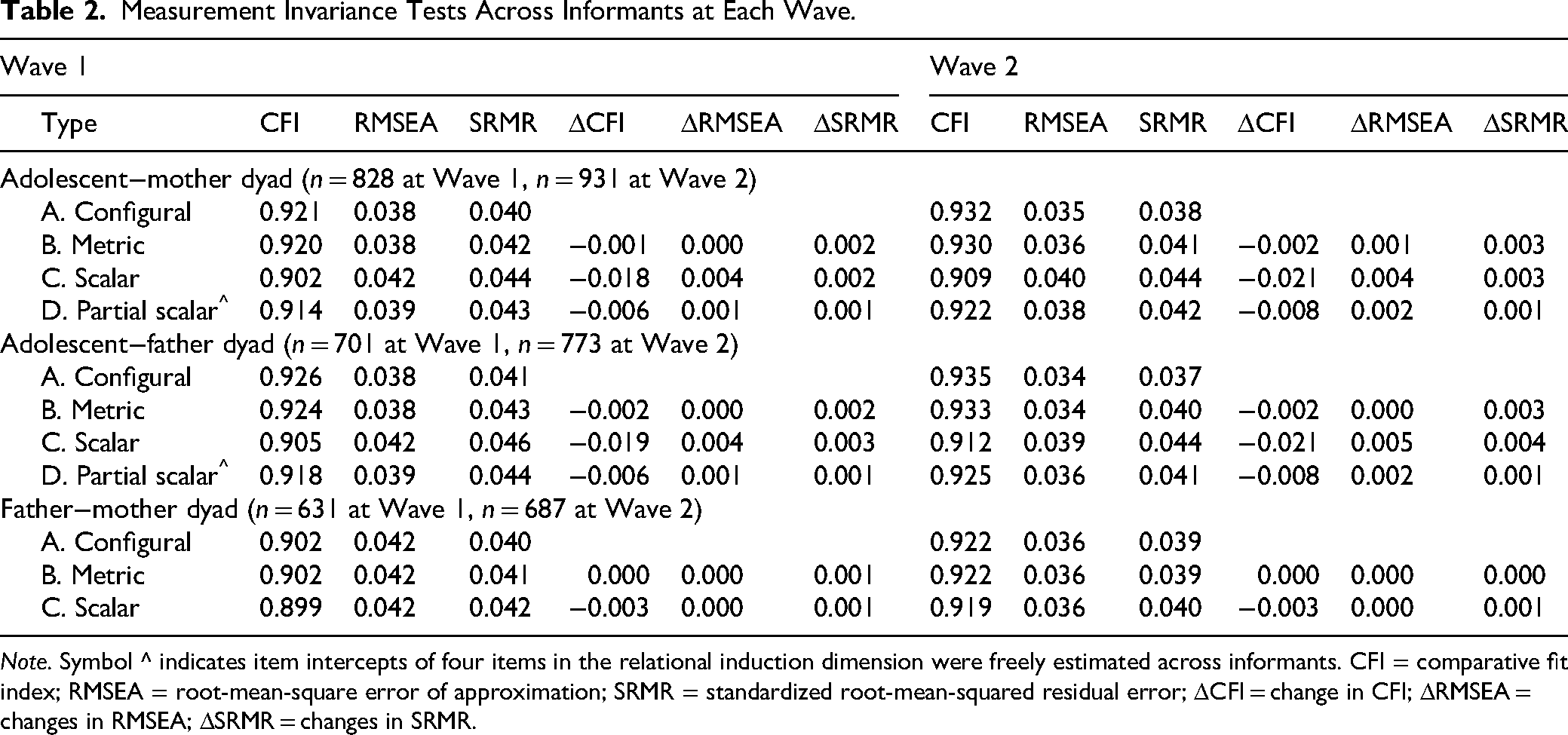
Note. Symbol ^ indicates item intercepts of four items in the relational induction dimension were freely estimated across informants. CFI = comparative fit index; RMSEA = root-mean-square error of approximation; SRMR = standardized root-mean-squared residual error; ΔCFI = change in CFI; ΔRMSEA = changes in RMSEA; ΔSRMR = changes in SRMR.
To assess whether comparisons across time are allowed, measurement invariance analyses were conducted across the two waves for each informant. As shown in Table 3, full scalar invariance held for adolescent-reporting maternal and paternal PC, mother-reporting own PC, and father-reporting PC over time, indicating that it is meaningful to compare parental PC control scores and investigate changes in parental PC over time.
Measurement Invariance Tests Over Time among Different Informants.
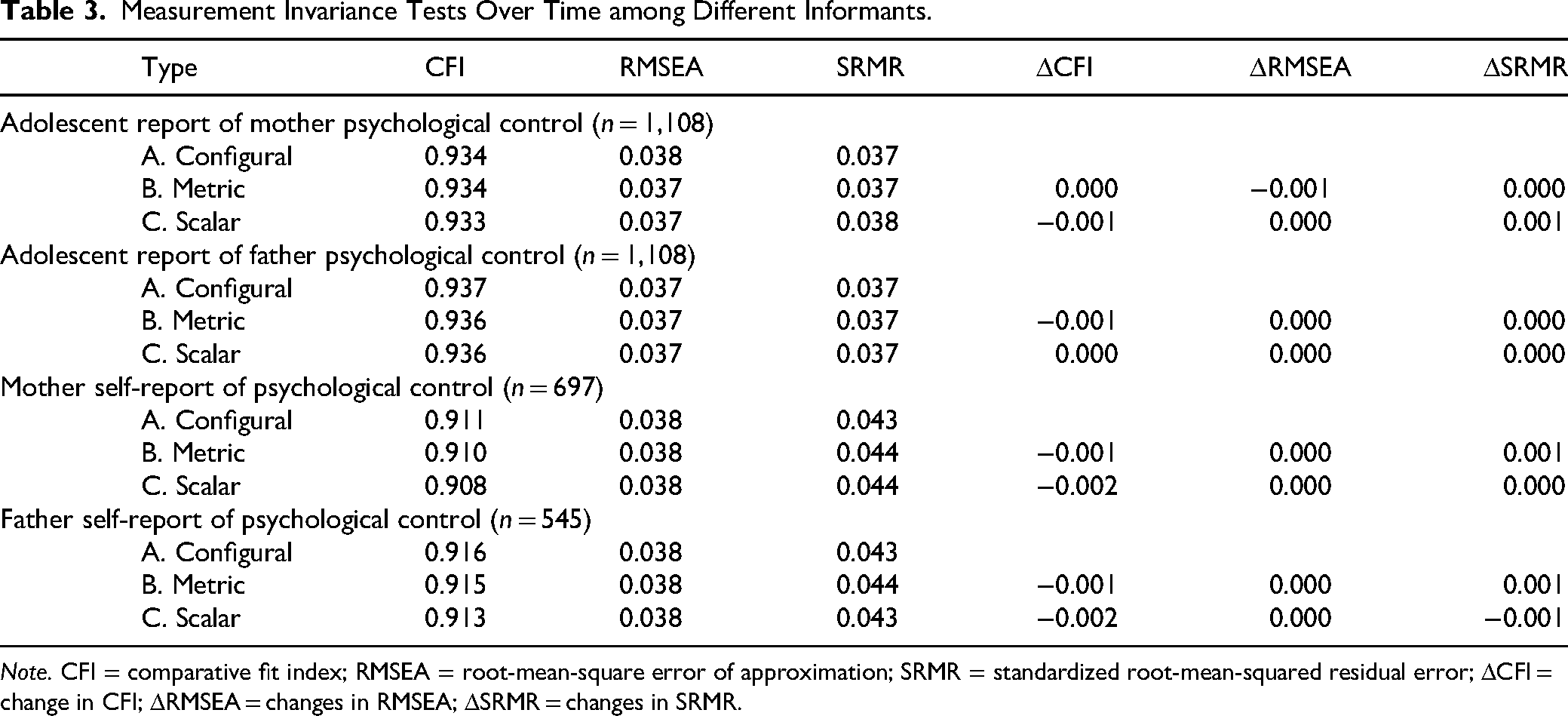
Note. CFI = comparative fit index; RMSEA = root-mean-square error of approximation; SRMR = standardized root-mean-squared residual error; ΔCFI = change in CFI; ΔRMSEA = changes in RMSEA; ΔSRMR = changes in SRMR.
The reliability, mean scores, standard deviations, and correlations among dimensions of parental PC per informant and per time point are presented in Table 4. The results revealed good internal consistency across all measures, with high Cronbach's α values (0.90–0.95) and moderate to high mean interitem correlation (0.44–0.77). The three dimensions of each parent's PC reported by the same informant were highly correlated with each other (rs = 0.63–0.81, ps < 0.001). Correlations between adolescent-report and mother-report of maternal PC dimensions were low to moderate (rs = 0.21–0.40, ps < 0.001). Low to moderate (0.16–0.31, ps < 0.001) correlations were also observed between adolescent-report and father-report of paternal PC dimensions.
Reliability of the CPPCS Scale and Correlations among Factors at the Two Waves.
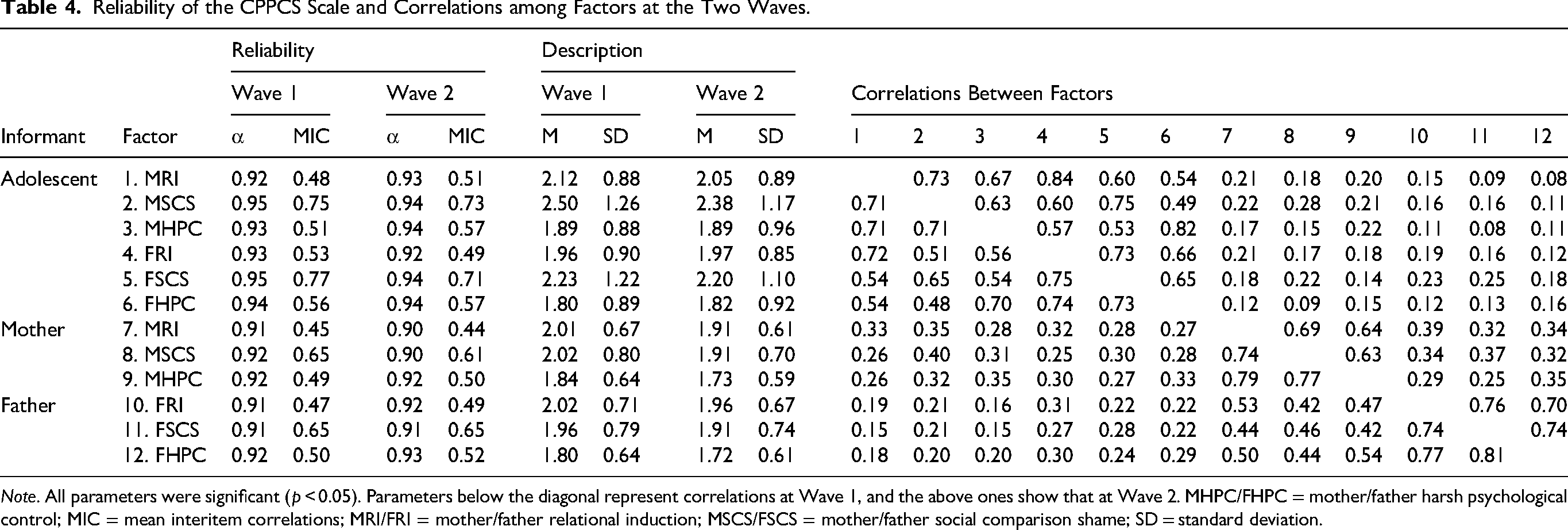
Note. All parameters were significant (p < 0.05). Parameters below the diagonal represent correlations at Wave 1, and the above ones show that at Wave 2. MHPC/FHPC = mother/father harsh psychological control; MIC = mean interitem correlations; MRI/FRI = mother/father relational induction; MSCS/FSCS = mother/father social comparison shame; SD = standard deviation.
Differentiated predictions of PC dimensions on adolescents’ developmental outcome indicators were found in the present study (see Table 5). Specifically, adolescent-reported higher parental harsh PC consistently predicted lower self-esteem, lower life satisfaction, and higher emotional distress in Wave 1, Wave 2, and longitudinal models. Adolescent-reported social comparison shame also showed significant negative predictions on self-esteem and life satisfaction in concurrent and longitudinal models. In contrast, adolescent-reported relational induction tended not to be a significant predictor of self-esteem or life satisfaction in different models; it even showed positive predictions on the two outcome indicators in Wave 1. Nevertheless, adolescent-reported relational induction was also associated with more emotional distress mainly in Wave 2.
Predictions of Individual Dimensions of Psychological Control on Adolescent Developmental Outcomes.
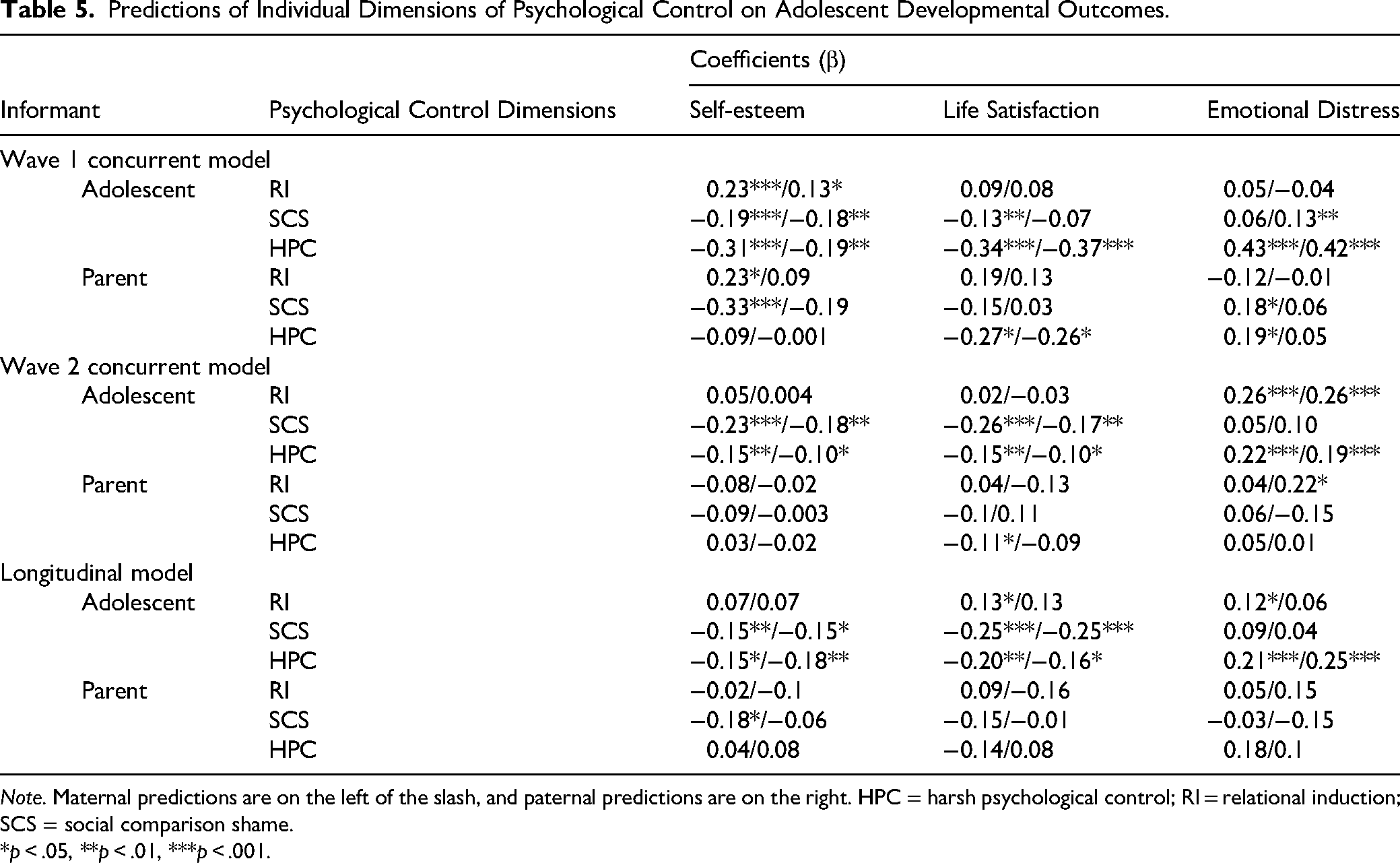
Note. Maternal predictions are on the left of the slash, and paternal predictions are on the right. HPC = harsh psychological control; RI = relational induction; SCS = social comparison shame.
*p < .05, **p < .01, ***p < .001.
In general, social comparison shame and harsh PC were more likely to predict unfavorable outcomes such as low self-esteem, low life satisfaction, and more emotional distress than relational induction. Furthermore, in comparison to adolescent reports, parent self-reports of PC displayed weaker predictive effects on adolescent outcomes. Specifically, mother self-reports of HPC and SCS were associated with lower self-esteem, lower life satisfaction, and higher emotional distress in Wave 1, while other dimensions or father self-reports showed very limited predictions on adolescent outcomes.
Discussion and Applications to Practice
Collecting data from both adolescents from Grades 7 to 10 and their parents, the present 6-month longitudinal study examined structure invariance across informants (adolescents and parents) and over time (six months) of a three-dimensional indigenous CPPCS. The results supported the measurement invariance across informants and over time with adequate psychometric properties. After establishing the scale's measurement invariance, parental self-reported and adolescent perceived PC dimensions were also explored for their concurrent and longitudinal predictive effects on adolescent developmental outcome measures, including self-esteem, life satisfaction, and emotional distress. The results supported differentiated functions of parental PC dimensions in Chinese contexts as well as differences between adolescent and parent reports.
In line with the previous validation study (Zhu et al., 2023), the present findings demonstrated that the three-dimensional structure in the adolescent-report version of CPPCS, namely “relational induction,” “social comparison shame,” and “harsh PC,” was valid and invariant across adolescent gender groups and grade levels. In addition, the three dimensions were intercorrelated and showed good internal consistency in both the paternal and maternal subscales. The finding provides additional empirical support for the multidimensional nature of parental PC and reinforces the need for differentiated approaches to detect potential distinctions between different dimensions (Fang et al., 2022; Sze, 2016; Yu et al., 2015; Zhu et al., 2023). Meanwhile, adolescents, regardless of their gender and grade, tend to interpret their parents’ psychologically controlling behaviors within a similar framework. Thus, the CPPCS can serve as a robust assessment tool for investigating how individual PC dimensions may be differentially associated with adolescent development and whether the association varies depending on adolescent gender and grade.
The present study expanded the scope of previous validation research by demonstrating that the three-dimensional model in the CPPCS was largely equivalent among adolescents, mothers, and fathers. This finding established the scale's measurement invariance across informants. It implies that adolescents and parents construct parental PC in a similar way, and thus the measures of each parental PC dimension are comparable between different dyads in the family. As multi-informant design has been advocated as a gold standard to represent both adolescent and parent perspectives (De Los Reyes & Ohannessian, 2016), the presenting finding supports a reliable use of CPPCS in multi-informant design to provide a more balanced understanding of multidimensional parental PC and its impact on adolescent development in Chinese contexts. This contribution adds essential value to the existing literature, as many previous studies utilized data collected from parents and children without establishing parenting measures’ structural invariance across informants (e.g., Bleys et al., 2016; Cai & Tu, 2020).
Furthermore, there is an increasing emphasis on parent–adolescent discrepancy in perceiving parenting as a legitimate concept that goes beyond measurement errors but reflects family functioning (e.g., communication and conflict) and parent–child relationship qualities (Ingoglia et al., 2021; Vrolijk et al., 2023). To provide further insights into this emerging field, the equivalence of parenting measures between parents and adolescents is a prerequisite. Otherwise, differences in item interpretation or response styles across informants may confound the results, leading to inaccurate comparisons and conclusions. As Chen (2008) stated, without evidence for scalar invariance, latent mean differences between family members can refer to either valid group differences or measurement artifacts and therefore cannot be reliably compared. As such, the measurement invariance between parents and adolescents of the CPPCS in this study allows researchers to assess the degree of parent–adolescent (dis)agreement on perceiving parental PC and its implications in adolescent development.
The measurement equivalence in CPPCS between fathers and mothers serves as an important basis for father–mother comparisons regarding their PC behaviors and associated impacts on adolescent development. Despite previous studies on both father–mother differences in their parenting practices and their impacts on child development, findings have been far from conclusive (Dou et al., 2020; Hunter et al., 2015; Lansford et al., 2014; Zhou et al., 2024; Zhu & Shek, 2021b). Thus, it is of great importance to investigate paternal and maternal factors separately and compare their influences. To respond effectively to such a call, one methodological issue to be addressed is how to build measurement invariance between fathers and mothers. As such, the current study also represents a pioneering effort that ensures meaningful comparisons between Chinese fathers and mothers in their PC.
Going beyond invariance tests across informants, the present study also examined the longitudinal invariance of the CPPCS for each informant. The attainment of full scalar invariance over time suggests that the way to construct parental PC remains stable within each informant group, allowing for longitudinal analyses and the exploration of developmental trajectories. This is essential given the developmental changes in adolescence, which may lead to variations in parenting strategies and parental influences (Smetana & Rote, 2019). While previous studies have attempted to document such possible changes regarding different parenting dimensions, including PC, the findings remain equivocal (Wang et al., 2007; Zhu & Shek, 2021b). The extant mixed findings may be partially attributable to the methodological issue that most previous research failed to ensure the same parental construct had been consistently assessed over time by establishing longitudinal measurement invariance (Leung, 2020; Zhu & Shek, 2021b). Therefore, the present finding of the longitudinal invariance of the CPPCS makes cross-temporal comparisons of Chinese parents’ PC valid and meaningful.
The present study also utilized the validated CPPCS to explore how adolescent-perceived and parents’ self-reported PC were concurrently and longitudinally associated with adolescent developmental outcomes, including self-esteem, life satisfaction, and emotional distress. Overall speaking, adolescent reports of PC showed more salient predictions, which echoes previous observations (Hou et al., 2018; Loeb et al., 2021). Although the shared variance between parental PC and developmental outcomes might be inflated by adolescent reports of both constructs, evidence has suggested that the relatively stronger association between adolescent-reported parenting and their outcomes is not merely because of common method variance (Valdes et al., 2016). Rather, the results may indicate that it is how adolescents perceive parental behaviors (e.g., parental PC) that shapes the way they adjust and develop (Kaniušonytė et al., 2021). Furthermore, adolescents tend to report higher levels of PC in comparison to their parents, which, on the one hand, is in line with previous findings (Korelitz & Garber, 2016), and on the other hand, may make the adolescent report of parental PC have greater variance and thus be more easily linked to developmental outcomes. The potential parent–adolescent discrepancies in the present study reiterate the need for more research efforts in identifying the source, pattern, and consequence of such divergence.
Regarding the effects of adolescent-perceived PC dimensions, compared to “relational induction,” the other two dimensions of “social comparison shame” and “harsh PC” showed stronger negative predictions on adolescents’ developmental outcomes. The results support the proposition that antagonistic forms of PC have a more detrimental impact on adolescent development, while relational induction that involves inducing remorse and shared shame might have a more benign effect in Chinese contexts (Chen et al., 2016; Zhu et al., 2023). It is common for Chinese parents to employ relational induction as a means of directing their children's focus toward the consequences of their misbehavior on the repute and honor of the parents or family. This practice aids children in the development of empathy toward their parents and understanding the perspectives, emotions, and thoughts of others (Fung & Lau, 2012; Yu et al., 2019). In a collectivist social environment like China, this kind of parenting strategy may represent a deliberate approach to accomplishing socialization objectives that are likely to be culturally embraced and thus less invasive (Fang et al., 2022; Yu et al., 2019). Nevertheless, the predictive effects of PC dimensions also varied depending on developmental outcome measures. More longitudinal research across a longer time span is needed to verify the differentiated functions of PC dimensions concerning more developmental outcome indicators.
Taken together, the present study has important theoretical implications for family and adolescent research. First, the present findings provide additional empirical support for the multidimensional nature of parental PC, especially the culture-specific conceptualizations and functions of the subdimensions in Chinese contexts. The relatively less detrimental effects of relational induction on adolescent development in comparison to the other two dimensions in the present study suggest that different dimensions are likely to have different meanings and functions in Chinese contexts. Different from Western cultures where PC generally represents a dysfunctional parenting practice that undermines children's psychological world and identities, Chinese cultures and social values may see some forms of PC, such as the relational induction dimension, as a well-intended socialization technique that helps children internalize cultural norms and fit in as a part of society (Ng & Wang, 2019; Scharf & Goldner, 2018). This theoretical contribution reiterates the importance of investigating unique functions of individual dimensions of parental PC rather than using a global or unidimensional conceptualization (Fang et al., 2022; Sze, 2016; Yu et al., 2015; Zhu et al., 2023). By identifying and assessing three distinct dimensions of PC (i.e., relational induction, social comparison shame, and harsh PC), the CPPCS offers a comprehensive and nuanced understanding of parental PC in Chinese settings. This multidimensional perspective allows researchers and practitioners to gain insights into the specific mechanisms and effects of different PC tactics on adolescent outcomes.
Second, the validated scale, with its invariance across informants and over time, serves as a useful tool that can be meaningfully used in future studies investigating Chinese parents’ usage of different forms of PC, its antecedents, and impacts on children's and adolescents’ development through both parental and child perspectives and longitudinal designs. The present findings emphasize the need for using multiple informants in studying parental influence and adolescent development, as parents and adolescents may have different perspectives on parenting practices. By establishing measurement equivalence, researchers can compare and integrate the viewpoints of both parents and adolescents, leading to a more comprehensive understanding of the parent–child relationship and its impact on adolescent well-being.
The present findings also have important practical implications for social work interventions and services. Validated measurement tools are very important in social work practice, particularly for identifying areas (e.g., parenting practice) that need social work interventions or services as well as for assessing the effectiveness of social work practice. Specifically, the identification of detrimental forms of parental PC will enable social workers and family practitioners to design appropriate parent education programs and family support services to assist parents in improving their parenting practices, which will ultimately improve adolescents’ developmental outcomes. Rather than treating PC as an umbrella term for dysfunctional parenting, social work interventions in Chinese contexts can focus on detrimental forms of PC and their effects on adolescents. In addition, understanding the differential effects of PC dimensions allows practitioners to tailor interventions based on specific needs and challenges faced by Chinese adolescents. For instance, interventions can focus on reducing harsh PC while promoting positive aspects of relational induction to enhance adolescent self-esteem and life satisfaction. Particularly, in the field of Social Work, the validated CPPCS can serve as a valuable assessment tool for professionals working with Chinese families and adolescents. It provides a standardized measure to identify and assess parental PC, enabling social workers to identify families at risk and develop targeted interventions. By addressing the multidimensional nature of parental PC, social workers can help parents engage in more positive and supportive parenting practices, promoting healthy parent–child relationships and positive adolescent outcomes.
While this study provides valuable insights, several limitations should be acknowledged. First, the data were collected from adolescents and their parents in three schools, limiting the generalizability of the findings. In particular, only Chinese adolescents in a limited number of cities in mainland China were involved. Future research could include more diverse and representative adolescent samples to enhance external validity. For example, adolescents in more schools in different regions in Mainland China and other Chinese communities (e.g., Hong Kong) can be recruited. Future research can also expand the existing research scope by examining the CPPCS across different cultural groups including both Chinese and non-Chinese adolescents. In addition, the present study validated the CPPCS among adolescents. Whether the scale can be applied to other populations (e.g., children and emerging adults) remains unknown. Future research can expand the study scope by involving other age groups.
Second, longitudinal invariance and the longitudinal predictive effects of individual PC dimensions were tested using two waves of data with a 6-month interval. While this kind of “short-term” longitudinal research is not uncommon in youth research and family studies (Voulgaridou & Kokkinos, 2020), it is also necessary to test measurement invariance and longitudinal effects of parental PC on adolescent development over longer periods with more waves of data. In addition, regarding the longitudinal effects of parental PC dimensions, the present study represents an explorative attempt with only age and gender being controlled, more control variables (e.g., socioeconomic status and the social environment) should be considered in future studies to enhance the robustness of the findings.
Third, although adolescents and parents were instructed to respond to all questionnaire items honestly based on their own perceptions and without discussing any questions with others, we were not able to completely rule out the potential bias caused by social desirability. Future research can benefit from incorporating a measure of social desirability in the questionnaire and treating it as a control variable in formal analyses.
Fourth, the CPPCS is a 30-item scale including maternal and paternal subscales, resulting in a total of 60 items in the adolescent version. Developing a shortened version of the CPPCS can help reduce adolescent participants’ burden and improve data quality. Given the medium to high interitem correlations (0.44–0.77) within each dimension, a few items with the highest factor loadings in each dimension can be selected to form an abbreviated version that retains the strong psychometric properties of the full-length scale but will be more concise (Zhu et al., 2024). Future studies need to validate the shortened CPPCS.
Despite the limitations, our study establishes a multidimensional framework for future research on parental PC. This study contributes to the literature on parental PC by examining the measurement invariance and reliability of CPPCS across informants and over time. The findings support the scale's validity and reliability. Additionally, the three PC dimensions have a high level of stability across adolescents, fathers, and mothers as well as over time, allowing for reliable conclusions regarding cross-informant and cross-temporal comparisons. Thus, the present validation study provides researchers and practitioners with a valuable tool for assessing parental PC in different settings (e.g., multi-informant designs and longitudinal follow-ups). This study also contributes meaningfully to the literature on the relationships between parental PC dimensions and adolescents’ developmental outcomes and sheds light on the discrepancies between parents and adolescents. The preliminary findings further underscore the importance of differentiated approaches to PC for Chinese parents, with both adolescents’ and parents’ perspectives taken into consideration.
Footnotes

Ethical Approval
Ethical approval was obtained from the Institutional Review Board at the corresponding author's affiliated university (HSEARS20220427002). It was confirmed that the research complied with ethical standards and was performed in accordance with relevant guidelines/regulations.
Informed Consent
Informed consent was gained from participating schools and all adult participants, and their participation is entirely voluntary. For adolescent participants under 18 years old from secondary schools, their parental consents were obtained via a parent letter delivered by schools, and all parents provided consent for their children's participation in the study. Adolescents also provided informed written consent before they responded to questionnaires. The personal data from all participants have been anonymized.
Author Contributions
XZ: conceptualization, methodology, formal analysis, writing—original draft, writing—review and editing, supervision, funding acquisition. DD: writing—review and editing. XW: writing—original draft, writing—review and editing. YZ: writing—original draft. All authors read and approved the final manuscript.
Funding
The authors disclosed receipt of the following financial support for the research, authorship, and/or publication of this article: The work described in this paper was partially supported by a grant from the Research Grants Council, University Grants Committee of the Hong Kong Special Administrative Region, China (Project No. PolyU 25609723).
Declaration of Conflicting Interests
The authors declared no potential conflicts of interest with respect to the research, authorship, and/or publication of this article.
Data Availability
Data will be made available from the corresponding author on request.