




Abstract
Keywords
The composition of the labor force worldwide has changed dramatically over the last few decades. For example, in the United States, maternal employment has increased over the last 40 years, especially among mothers with children under the age of 6. In 2015, 64% of mothers with children under 6 were in the labor force compared with 39% in 1975 (U.S. Bureau of Labor Statistics, 2009, 2016). Increasing numbers of parents are engaging in dual-earner lifestyles, where both parents in the family work and share family caregiving, and routinely take on some family responsibilities.
While employed parents experienced role conflict and stress associated with balancing the requirements of parenthood with those of employees, the role conflict and stress were likely to be more acute in dual-earner couples (Repetti & Wood, 1997; Williams & Alliger, 1994). Research suggested that dual-earner couples experienced different demands to those in single-earner households (Gupta & Jenkins, 1985). Dual-earner families experienced greater time pressures and conflicts balancing work and family responsibilities (Bianchi, 2011). Dual-earner families reported not spending enough time with their children and their spouses, having too little time for themselves, and always feeling rushed (Bianchi et al., 2006; Galinsky et al., 2011). Working parents with young children were especially vulnerable to these time conflicts because childcare demands and pressure to work long hours to secure financial resources increased simultaneously (Erickson et al., 2010).
Research showed that working parents and dual-earner families experienced high stress. Work–life conflicts were associated with higher levels of stress, increased levels of anxiety and depression, and fatigue, which were indicators of poor health and impaired well-being (Allen et al., 2000). Milkie et al. (2019) found that almost half of the employed mothers and fathers reported sleep problems, anger, and psychological distress, and felt as if their time with children was not enough. Humphrey et al. (2006) also found that dual-income families reported higher relationship stress.
Such psychological stress was found to be associated with ineffective parenting. For example, psychologically distressed parents were more likely to use permissive or authoritarian parenting strategies (Fung et al., 2013), and were less engaged with their children (Ostberg & Hagekull, 2000). Parenting stress could make optimal parenting more difficult and negatively affect child development (Pesonen et al., 2008), and might affect the family's atmosphere and contribute to parenting dysfunction.
Negative parenting practices were also positively associated with children's externalizing and internalizing problems. Dual-income families where parents who were less overloaded (too much work and too little time) were more able to closely monitor their children than those who were more overloaded (Crouter & Manke, 1997). Child behavior problems are associated with inadequate parental monitoring. Maternal emotion coaching was found to be a partial mediator of family stress and child emotion regulation (Ellis et al., 2014). In a study on dual-earner families with children aged 3 to 5 years, parent overreaction to children's behavior was found to be the mediator between family-related/work stress and child behavior problems (Schneewind et al., 2012). The rate and intensity of disruptive behaviors increased significantly as the coercive responses were reinforced in the parent–child relationship (Hosokawa & Katsura, 2021). Dual-income families have also been found to report more child behavior problems. A recent survey of working parents in the United Kingdom (N = 721) from a range of occupational groups showed that 40% of parents reported clinically significant levels of disruptive child behavior problems.
However, in the abovementioned survey of working parents in the United Kingdom, only a small minority (2%) had participated in any kind of parenting program (Sanders et al., 2011). Parents consistently reported time and scheduling factors as primary reasons for not enrolling, attending, or completing parenting interventions (Heinrichs et al., 2005; Spoth & Redmond, 1993).
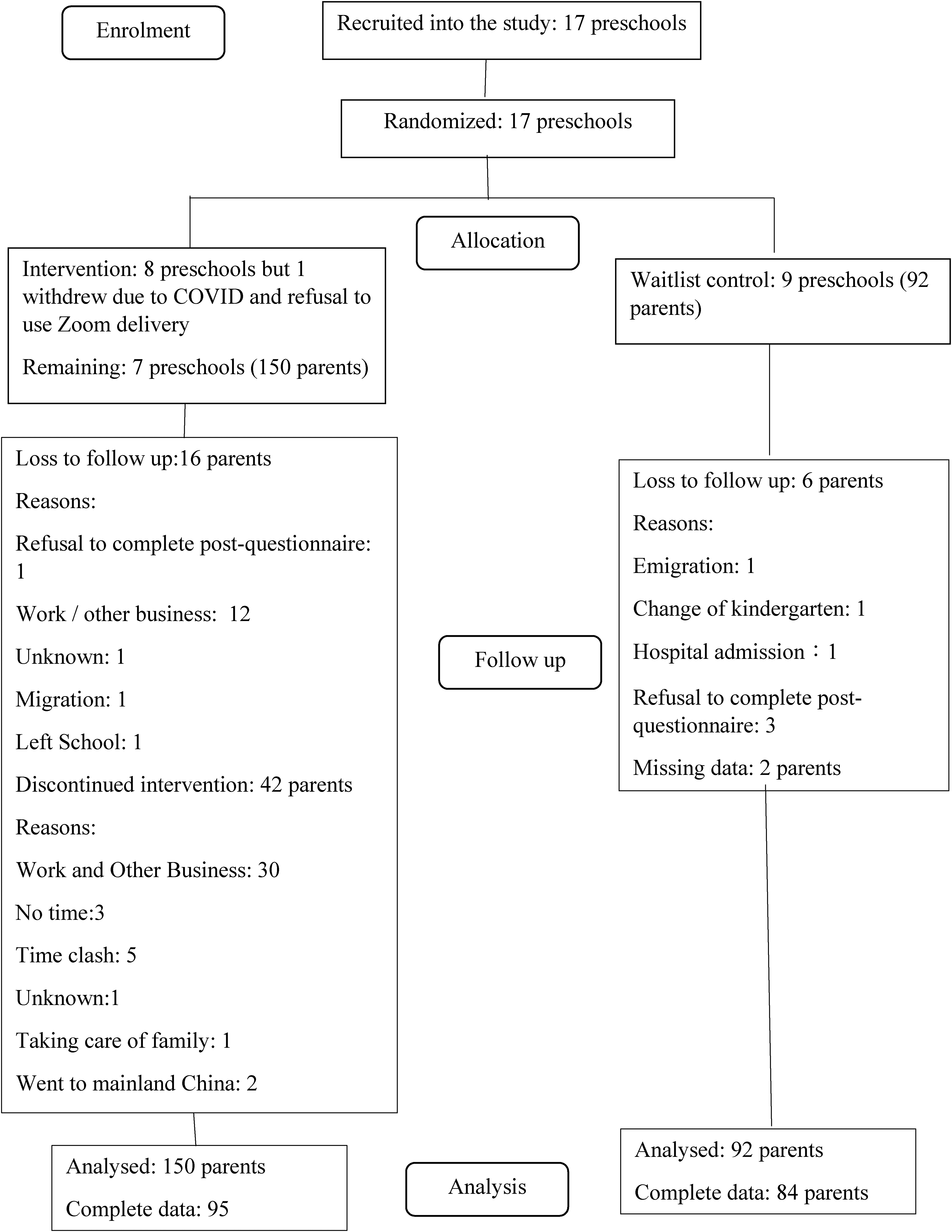
Flow of Participants Through the Study.
The Hong Kong Situation
In Hong Kong, the proportion of females in the workforce has increased from 37% to 45% from 1997 to 2018, and females account for 91% of the growth in labor force. For women with children aged 14 years or under, the workforce participation rate is 56.6% (Research Office, Legislative Council Secretariat, 2019). Local statistics showed that there were 48.1% and 49.9% of families (with children under 9 year old) where both father and mother were in the labor force in 2006 and 2011, respectively (Census and Statistics Department, 2006, 2011).
In terms of working hours, 43.8% of respondents said that they worked for 41–50 h per week on average; 20.0% worked 51–60 h. Among them, fathers were more likely to work over 50 h per week on average, whereas mothers were more likely to work less than 40 h per week on average (The Committee on Home-School Cooperation, 2005).
In a local survey, 58.2% of the parents said they have struggled with supporting their children and work responsibilities (The Democratic Alliance for the Betterment and Progress of Hong Kong, 2019). In another survey, through multiple stage sampling of about 1,000 parents of children attending preschools from six regions, it was found that parents reported great or very great stress in relation to their children's discipline (49.5%) and themselves being a good parent (47.4%; Family Life Education, The Boys’ and Girls’ Clubs Association of Hong Kong, 2000). Parents with high parental stress were more depressed and anxious (Kwong & Wong, 2000). Almost 80% of the parents have scolded their children; over 40% reported they had used corporal punishment and 15% used violence to manage children's behavior problems (New Life Psychiatric Rehabilitation Association, 2019).
However, in a local study, 50.5% of the respondents said that they did not know who or what kinds of organizations could help them improve their current parent–child relationship. Parents also expressed that although services were available in the community, they often found it difficult to access such services without adequate information or appropriate referrals (Lau & Ho, 2018).
Development of a Parent Training Program for Working Parents in Hong Kong
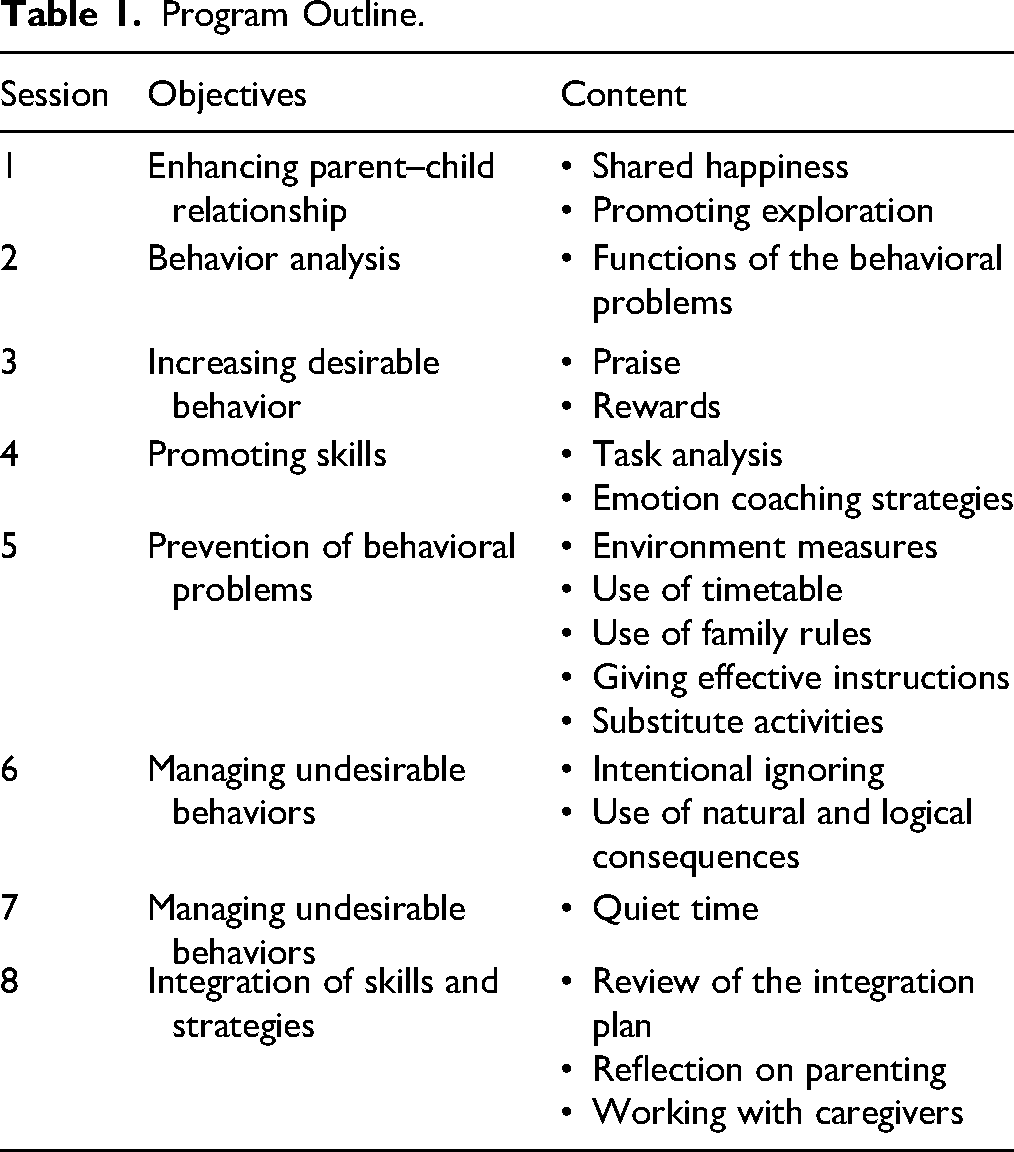
While there are some parenting programs in Hong Kong with research base on their effectiveness, such as Parent-Child Interaction Therapy (Leung et al., 2009), Hands-On Parent Empowerment Program-20 (Leung, Tsang & Kwan, 2017) and Triple P-Positive Parenting Program (Leung et al., 2003b), these programs are not specifically designed for working parents. The Happy Parenting: Round-the-Clock Parenting Program (HPRCP; Leung et al., 2020) in Macau was designed for parents on shift work. It was developed by a team in Hong Kong which consisted of educational psychologists and a social worker. With the support of the employer, this program was offered to employees during their work hours in their offices. The program was based on local research-based parenting programs with a social learning approach (e.g., Leung et al., 2017) and literature on emotion coaching. There were eight sessions in the program covering strategies to enhance parent–child relationship, strategies to increase appropriate behaviors, strategies to manage misbehaviors, as well as emotion coaching strategies. In addition, there were special tips for working parents such as talking to their children on the phone during work breaks and working together with caregivers.
While workplace-based parenting program is a convenient arrangement for working parents, this is probably more viable for large organizations with large number of employees. For small-medium size employers, it may not be easy or practicable to organize a program suitable for their limited number of employees with children in different age groups. Other alternatives need to be explored.
Schools are suitable places for the delivery of parent training programs. Schools can easily access parents and parents can access schools easily (Gross & Grady, 2002). While there might be a stigma about seeking help in social services organizations, there is little stigma associated with attending activities sponsored by schools. There is no need for referral and the information can be easily communicated to parents through school notices. There is also research to show that home–school collaboration to establish goals and shared responsibilities on child learning and well-being could produce better outcomes (Sanders et al., 2021). According to the 2016 bi-census, 92.5% of children aged 3 to 5 years are attending preschools (Census and Statistics Department, 2017). This suggests that it will be easy to reach most parents through preschools.
In 2019, the Pilot Scheme on Social Work Service for Pre-Primary Institutions (PPI) was launched by the Hong Kong Government, with 57 teams serving 725 preschools (Social Welfare Department, 2023). The scope of services includes provision of counselling and referral services for families and children in need, parent education services, activities to promote family relationships, parent and teacher consultations, and crisis management. As the social workers are stationed in preschools, they can help to identify and encourage parents to participate in parenting programs, and follow-up further issues with parents after the parenting program. They can also work with both teachers and parents of children with behavior problems. This provides the context for the launch of a universal preschool-based parent training program for working parents. Consistent with the principles of prevention and early intervention, providing a parenting program for parents of preschool children is likely to be more strategic than providing intervention at a later stage of development (Webster-Stratton & Taylor, 2001). With around 50% of families being dual-earner families, there is a need for a program that can address the needs of these families.
This study aimed to evaluate the effectiveness of a preschool-based parent training program for working parents with preschool children, delivered by preschool-based social workers, using a parallel cluster randomized controlled trial design. The program took reference from the HPRCP (Leung et al., 2020). Apart from behavior management and emotion coaching, special tips were designed for working parents to enable them to practice their newly learnt strategies with their children such as making use of online communication devices to talk to their children (e.g., Facetime or Zoom). Other tips included collaboration with caregivers who looked after the children while the parents were at work, encouraging parents to come up with a consistent behavioral management plan for children's behaviors, or a reward system to reinforce children's positive behaviors, especially when parents were at work. The hypotheses were:
There would be a greater decrease in parenting stress and use of ineffective parenting practices and a greater increase in use of emotion coaching strategies (primary outcomes) postintervention in the intervention group than in the control group. There would be a greater decrease in child behavior problems (secondary outcomes) postintervention in the intervention group than in the control group.
Method
Design and Setting
This study adopted a parallel cluster randomized controlled trial design with preschools as units of randomization. A cluster design was used to avoid contamination. The program was delivered in preschool settings. There was no blinding.
Participants
A total of 17 preschools were recruited with nine allocated to the control group and eight to the intervention group. One intervention preschool withdrew because of the COVID-19 situation and issues about social distance. The participants included 242 parents of children attending 16 preschools, with 150 (seven preschools) in the intervention group and 92 (nine preschools) in the waitlist control group. The inclusion criteria were: (a) parents of a child with normal development attending the participating preschools; (b) parents were living with their children in Hong Kong; (c) parents were able to read Chinese; and (d) parents were working. Parents with children with confirmed developmental disabilities were excluded. This was because a parent training program for these parents would need an additional focus on understanding and dealing with the children's disabilities, as well as addressing the parents’ concerns about their children's disabilities, resulting in a program with more sessions and a somewhat different focus. The duration and content of such a program might not fit the busy schedules of working parents with children with typical development. All preschools received social work service from a nongovernmental organization under the government-funded Pilot Scheme on Social Work Service for PPI.
Among the mother participants (n = 194), 137 (70.6%) were working either full-time or part-time. Among the father participants with data on employment (n = 43), 40 (93.0%) were working either full-time or part-time. Overall, among participants with data on parent employment, 74.8% of parents were working either full-time or part-time. There were 164 families (68.9%) where both parents were working (intervention group: 103, 70.5%; control group: 61, 66.3%). There were no significant differences between the intervention and control groups in terms of parent employment status. There was one “other” participant where employment status was unknown and one father participant with no data on employment status.
For sample size, assuming a medium effect size, the sample size required is 128 (α = .05, power = 0.80). With a cluster design and to account for intracluster correlation, the sample size was adjusted for design effect using the formula 1 + (n−1) ρ where ρ is the intracluster correlation and n is the average cluster size. With an average cluster size of 15 and an average intracluster correlation of .011, the adjusted sample size is 148. The current sample size of 242 was considered adequate. In the 2020/21 academic year, there were 152,287 students enrolled in Hong Kong local preschools (Education Bureau, 2021).
Materials
Participants were requested to complete a set of questionnaires twice. The questionnaires included: Eyberg Child Behavior Inventory (ECBI; Eyberg & Ross, 1978)—this is a 36-item questionnaire which consists of two scales. The Intensity scale is a measure of the frequency of child problem behaviors on a 7-point scale. The Problem scale is a measure of parent concern about a problem behavior and is scored as 1 or 0. High scores indicate high frequency of child problem behavior and parent concern. The Chinese version of the questionnaire was validated by Leung et al. (2003a). The clinical cut-off points of ECBI-intensity and ECBI-Problem are 131 and 15 respectively.
Parenting Stress Index (Abidin, 1990)—this is a 36-item scale rated on a 7-point scale. There are three subscales. Parental Distress measures parents’ experience of distress. Parent–child dysfunctional interaction measures negative parent–child relationship as perceived by parents. Difficult child assesses behavior problems of children. A total score is obtained by summing up the scores of all items. High scores indicate high parenting stress. The scale has been validated for use with Hong Kong Chinese parents by Lam (1999) but there is no published clinical cut-off point.
Parenting Scale (PS; Arnold et al., 1993)—this is a 30-item questionnaire measuring dysfunctional parenting practices. It consists of three subscales, Laxness, Over-reactivity, and Verbosity. Each item consists of one effective and one ineffective parenting practice at each end, rated on a 7-point scale. A high score indicates higher endorsement of ineffective parenting practices. The Chinese version was validated by Chan (2017) but there is no published clinical cut-off point.
Emotion-Related Parenting Styles (ERPS; Paterson et al., 2012)—this is a 20-item scale which consists of four factors, with five items in each factor, (a) emotion coaching parenting style (EC), (b) parental rejection of negative emotion (PR), (c) parental acceptance of negative emotion (PA), and (d) feelings of uncertainty/ineffectiveness in emotion socialization (UI). High scores indicate high endorsement of the particular factor. The Chinese version was validated by Au (2017) but there are no published clinical cut-off points.
Demographic information—participants were requested to provide information on their gender, age, education level, occupation, monthly family income, etc.
Procedures
Upon securing the consent of preschools to participate, the participating preschools were randomized into intervention and waitlist control groups by the first author using a random number table. The preschools recruited parents to participate in the parenting program and consent forms were sent to the parents for their completion.
Participants in the intervention preschools completed the preintervention questionnaires prior to the commencement of the parenting program, and then completed the postintervention questionnaires upon completion of the parenting program. Participants in the waitlist control preschools completed the questionnaires twice at the same interval as the intervention group participants. The facilitators assisted in data collection for the intervention group participants while the control group data was collected by the preschool-based social worker in the respective preschools. An assistant from the non-governmental organization providing PPI social work service was responsible for data entry. Recruitment commenced in March 2021 and data collection was completed in August 2021.
The parenting program was delivered by the preschool-based social workers under the Pilot Scheme on Social Work Service for PPI. While the intervention preschool parents were receiving the intervention, routine service was offered to waitlist control preschools. The parents in the waitlist control preschools were free to attend other parent training organized by outside bodies.
This study was approved by the Institutional Review Board of The Hong Kong Polytechnic University. This study was registered with the ISRCTN registry (39415).
Data Analysis
Analysis was by intention-to-treat. This is a method for data analysis in prospective randomized trials where all randomized participants are included in data analysis and analyzed according to their original group assignment, whether they have completed the treatment or not. With this method, accurate (unbiased) conclusions on the effectiveness of an intervention can be drawn (McCoy, 2017). Little's MCAR test result was nonsignificant, χ2(73) = 58.90, p = .884. Data analysis was conducted using STATA 15. Multiple imputation (5 times) was used to estimate missing data. The main data analysis method was mixed effects regression, with group status as independent variable, postintervention outcome measures as dependent variables, baseline difference and respective preintervention outcome measures as covariates, and preschool as random factor.
The Intervention
The program consisted of eight weekly sessions, each lasting for 2 h. For the delivery hours, in two preschools, the program was delivered during weekdays when children were attending classes. In four preschools, the program was delivered during weekends. In one preschool, the program was delivered after work via zoom. The topics included behavior management strategies to equip parents with the skills and strategies to manage child behavior. To complement the behavior-focused component, the program also included emotion coaching strategies (e.g., paying attention to children's emotion, reflection, labelling and showing empathy to children's emotion) to enhance parental emotional responsiveness to their children to develop the children's emotional competence (Havighurst et al., 2010). Each session consisted of mini-lectures, group discussion, and role play to practice the skills taught. Parents were given homework to practice the skills taught with their children. In three preschools, the program was delivered face-to-face in preschools. In two preschools, the program was delivered online (zoom) and in two preschools, the program was delivered in hybrid mode (zoom and face-to-face). The program was delivered by registered social workers based in preschools under the Pilot Scheme of Social Work Service for PPI. The details of the program are in Table 1. A facilitator manual with lecture notes, powerpoint slides, and a parent manual with notes for parents, and homework activities was developed.
Program Outline.
Facilitators were expected to adhere to the manual in program delivery. All facilitators had to attend a 1.5-day train-the-trainer program delivered by an educational psychologist and a master trainer (social worker). They had to pass a multiple-choice quiz and trial teaching (2–5 powerpoint slides in one of the sessions) before program delivery.
Results
Among the intervention group participants, 16 were lost to follow-up (attended two to four sessions only) due to personal and work reasons and 42 discontinued the intervention (attended only the first session and completed the preintervention questionnaire), including three who completed both pre and postintervention questionnaire after discontinuation, with 95 participants with complete pre and post data. For the control group, six participants were lost to follow-up (one due to emigration, one due to change of preschool, one due to hospital admission and three refusals to complete postintervention questionnaire due to personal reasons) and two missing data, with 84 participants with complete pre and post data. Please see Figure 1 for the flow of participants through the study.
There were no significant differences in demographic characteristics and preintervention scores between father and mother participants. There were no significant baseline differences between the intervention and control groups in demographic characteristics and preintervention scores except preintervention ECBI-problem (t = 2.63, p = .009), child sex, χ2(1) = 4.07, p = .044, OR = 1.71, and preschool mode, χ2(1) = 32.48, p < .001, OR = 5.14. Intervention participants reported higher pre-intervention ECBI-problem scores than control group participants. There was a higher percentage of girls (n = 82, 54.7%) in the intervention group and a higher percentage of boys (n = 54, 58.7%) in the control group. There was a higher percentage of intervention group children attending half-day preschools (n = 118, 80.8%) than control group children (n = 41, 45.1%). These variables with baseline differences were included as covariates in the mixed effects regression analysis. The preintervention and postintervention scores of the participants are in Table 2.
Preintervention and Postintervention Scores of Participants.
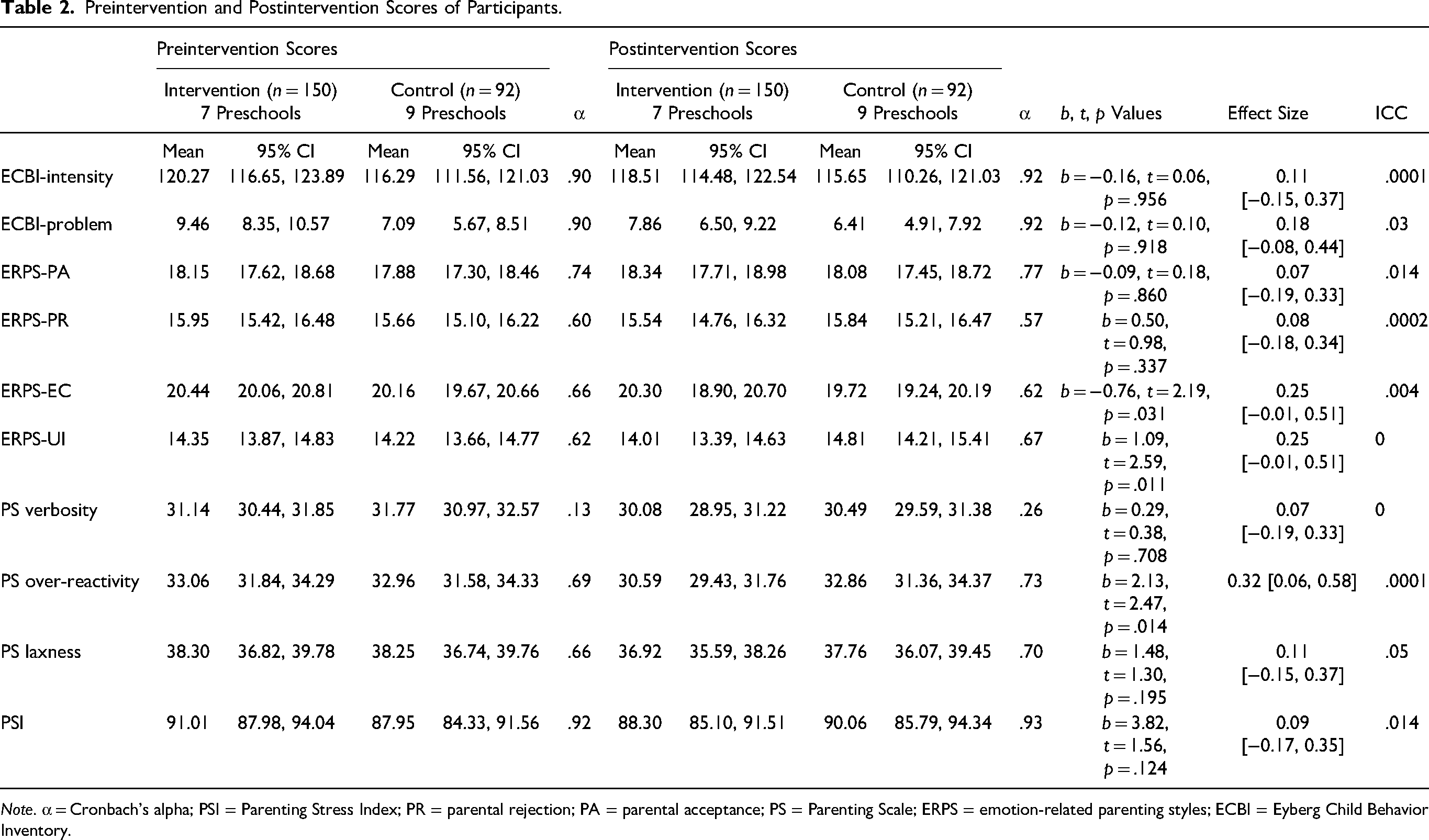
Note. α = Cronbach's alpha; PSI = Parenting Stress Index; PR = parental rejection; PA = parental acceptance; PS = Parenting Scale; ERPS = emotion-related parenting styles; ECBI = Eyberg Child Behavior Inventory.
Regarding Hypothesis 1 on greater decrease in parenting stress and use of ineffective parenting practices and a greater increase in use of emotion coaching strategies, mixed effects regression results were not significant for parenting stress. For parenting practices, mixed effects regression results were significant for PS overreactivity. The results, however, were not significant for PS verbosity and PS laxness. Intervention group participants reported lower postintervention PS overreactivity scores than control group participants. For emotion coaching, the results were significant for ERPS feelings of uncertainty/ineffectiveness in emotion socialization, and ERPS emotion coaching, but not significant for ERPS parent acceptance of negative emotions and ERPS parent rejection of negative emotions. Intervention group participants reported lower scores on ERPS feelings of uncertainty/ineffectiveness in emotion socialization and higher scores on ERPS emotion coaching than control group participants postintervention. Hypothesis 1 was partially supported.
For Hypothesis 2 on decrease in child behavior problems, the results were not significant for ECBI-intensity and ECBI-problem. Using the clinical cut-off status as dependent variable, mixed effects logistic regression results were not significant for ECBI-intensity, OR = 0.77, t = 0.54, p = .591, and ECBI-problem, OR = 0.52, t = 1.05, p = .293. Hypothesis 2 was not supported.
Discussion
Hypothesis 1 on decrease in ineffective parenting practices and parenting stress and increase in use of emotion coaching strategies was partially supported. There was a decrease in parent overreactivity postintervention among intervention group participants. Parent overreaction to children's behavior was found to be the mediator between family-related/work stress and child behavior problems (Schneewind et al., 2012) and the reduction in overreactivity was in the right direction. For emotion coaching strategies, at postintervention, intervention participants reported lower scores on feelings of uncertainty/ineffectiveness in emotion socialization and higher scores on emotion coaching, compared with control group participants. As the parents have learnt about the importance of accepting children's emotions and emotion coaching strategies to deal with their children's emotion, they were likely to feel more confident in emotion socialization of their children, and thus they reported lower scores on feelings of uncertainty/ineffectiveness in emotion socialization. Mother's emotion coaching was a mediator between family risk and child emotional regulation (Ellis et al., 2014) and the improvement in parental emotion coaching was in the right direction. The results are different from the HPRCP results (Leung et al., 2020) where there was no change in emotion coaching. One possible explanation was that the preschool-based social workers were more familiar with the children's abilities and background, and they were able to give specific and related examples to demonstrate emotion coaching skills and participants might find it easier to grasp the strategies. There was no significant difference in parenting stress between the intervention and control groups postintervention. The preintervention scores of both intervention and control group participants were similar to the mean parenting stress score of Hong Kong parents in the ECBI validation study (Leung et al., 2003a). Being a universal program, the participants might not have experienced high parenting stress.
Hypothesis 2 on reduction in child behavior problems was not supported. There was no significant difference between the intervention and control groups postintervention. There are some possible explanations. First, as the participating parents were mainly working parents, they might only be able to spend time with their children after work and might have to rely on other caregivers to look after their children and manage their behavior. Though the program has provided tips for parents to work with caregivers, the program input might not be sufficient to enable the parents to effectively work with caregivers to use the strategies taught in the program. Second, the preintervention scores of the target children were below the clinical cut-off point on ECBI (Leung et al., 2003a), suggesting that the behavior problems of the target children might not be serious enough to warrant professional intervention. As a preschool-based program, this was delivered as a universal program for all parents. The program was offered to all eligible parents in participating preschools and there was no specific requirement on problem behavior level of the target children. Should the program be limited to parents with children with behavior problems above the ECBI clinical cut-off point, the results might have been significant.
The launch of the Pilot Scheme on Social Work Service for PPI provides a useful platform for preschool-based parent training. A school-based social worker is readily available for program delivery. It is easier to gain the trust and acceptance of parents with a school-based professional than services provided by professionals from social services outside the school. Follow-up of parents who might require extra support is also viable within this context. With the involvement of schools, it will be easier to achieve population level benefit for children (Sanders et al., 2021).
There are some limitations in this study. First, though the program was designed for working parents, there were participants who were not working at the time of program participation. Due to the pandemic, the employment status of some participants has changed since recruitment. Some unemployed parents were included in the study as they had just lost their jobs after recruitment. There were also parents who were underemployed because of the pandemic. Future studies should confirm the employment status of parents before program commencement. Second, due to the pandemic, the program was delivered using different modalities and the impact of different delivery modes could not be measured due to the small cluster number and sample size which did not take delivery modes into consideration. Future studies should be conducted with larger sample size and cluster number to compare the effectiveness of face-to-face and internet-based delivery of parent training programs. Third, a fair number of participants had dropped out of the program due to the long commitment time and schedule. Due to school suspension, some sessions were postponed to a later time which might have clashed with participants’ own schedules. Future programs should aim to deliver the program in a timely fashion with no postponement so as not to upset the schedules of parents. Fourth, due to school closure during the pandemic, the interval between sessions was unstable (e.g., 3–4 weeks apart). It might affect participants’ consolidation/mastery of skills. Future programs should be delivered along a regular schedule to reinforce parents’ consolidation of skills. Fifth, conducting the program online might make it harder for participants to try out the skills with each other in role play. They might need more hands-on practice in order to fully grasp the strategies and internalize them for practical use. Techniques such as “breakout rooms” could be used to allow parents to work in small groups to role play and practice the skills in future internet-based programs. Sixth, we did not conduct a follow-up study on maintenance of program effects. Future studies should collect follow-up data to examine maintenance of program effect. Finally, though the facilitators were required to undergo training and pass written and practical tests before program delivery, there was no onsite supervision or fidelity checklists (self-completed or peer-completed) to ensure program integrity. Future studies should include onsite supervision and fidelity checklist for self or peer evaluation.
Despite these limitations, this study provided important implications for social work practice. It demonstrates that PPI-based social work service provides a good platform to connect with working parents and allow follow-up work within schools. The present findings highlight the importance of program accessibility. Working parents might find it easier to access parenting programs in their children's schools without the need and effort to find available programs in the community or to go through referral procedures. Targeting schools as an engagement strategy also provides an easily accessible location. As the school-based social worker has to work within the school context, the parenting program content is likely to be consistent with the practices of the school, and this can ensure that both schools and families are using consistent strategies in the management of the children, fostering home-school cooperation (Sanders et al., 2021). Program delivery by school-based social workers is also a key factor for effective service delivery to working parents, as follow up of parents who require extra support becomes easier and possible within this context. The school-based social workers can also work together with schools in establishing a mechanism for referral of parents who might need support and a range of services with different levels of intensity to provide the most suitable service to parents who may need different types of support. To cater for working parents, collaboration with schools is needed to provide venues and logistic support (including childcare) for parents to attend the parenting program or other parent support services outside school hours.
This study provided some promising research on the effectiveness of a parent training program for working parents. The delivery of the program by preschool-based social workers is a promising strategy to provide easy access to parents to attend parent training programs.
Footnotes
Declaration of Conflicting Interests
The authors declared no potential conflicts of interest with respect to the research, authorship, and/or publication of this article.
Funding
The authors disclosed receipt of the following financial support for the research, authorship, and/or publication of this article. This work was supported by the Partnership Fund for the Disadvantaged.
