




Abstract
Researchers dedicated to deliver knowledge that aim to support practice in social work face at least two challenges: (1) research must reflect evidence and (2) relevance (Petersén & Olsson, 2015). This means that one needs to explain the results through causal analysis, and seek to understand the content and processes of intervention through inquiring the meaning and action within (Kurki, 2006). While decision-makers and customers are usually interested in knowledge about effects and results – what works – professionals in social work benefit from knowing also about the processes behind the results – the way(s) to the final objective, which can indicate why something works. Today's knowledge discourse is dominated by David Hume's conception of causation. In Enquiry Concerning Human Understanding, Hume (1888) gives two different definitions of causality, one about the relations to an object: 1. We may define a cause to be an object precedent and contiguous to another, and where all the objects resembling the former are placed in like relations of precedency and contiguity to those objects, that resemble the latter. (p. 169)
And one about how these relations are united: 2. A cause is an object precedent and contiguous to another, and so united with it, that the idea of the one determines the mind to form the idea of the other, and the impression of the one to form a more lively idea of the other. (p. 170)
Hume himself expresses reservations about the adequacy of either definition and in the same Enquiry he explicitly confesses that “it is impossible to give any just definition of cause, except what is drawn from something extraneous and foreign to it” (1888, p. 76). Hume's definition(s) are further elaborated in Kurki (2006), interpreting the following assumptions about Hume's empiricist tradition as it is expressed above. Hume's understanding of causal relations is, according to Kurki (2006), tied to regularities of observable patterns, seen as regularity-deterministic and refers to “moving” causes that “push and pull” – that is, so-called efficient causes. As stated by Hume, causal analysis deals with finding associations between patterns of regularities and given certain regularities have been observed in the past we can make statements about when A then B in future analysis. Only observable events and things can be the basis of knowledge, and so causality according to Hume has been reduced to a relation of observables.
In the present contribution, we will deal with the controversies of only using Hume's ideas of causality when trying to produce knowledge in social work. We will claim that Hume's idea of causality has a narrow view on causality and cannot be used to get a notion about why things work Aristotle's idea of causality, on the other hand, gives us an opportunity to reflect upon a more expanded view on causality. The classical Greek scholars connect motivation, decision-making practices to changing character dispositions, bodily desires, and emotions. Aristotle recognized that to understand how things work and change occurs, the most relevant causes of change ought to be isolated and examined: “We do not think we understand something until we have grasped the why of it (the primary cause of it)” (Lear, 1988, p. 26). Aristotle's reasoning goes far beyond our common understanding of causality (Strode, 1977). His definition saw the concept as an explanatory factor and that there are four forms in which the cause is cited: the material cause, the formal cause, the efficient cause, and the final cause. In this article, we will use these four forms of causality to deal with the challenge social work researchers meet – to deliver research that reflect both evidence and relevance.
The aim of this article is to question the narrow view on causality that Hume presents by arguing for Aristotle's broader view on causality as an alternative strategy for social work research. The article proceeds in several steps. We have recently described causality by Hume. Then we will problematize it further and present Aristotle's four forms of causality in detail and argue for its relevance. We then test these forms on a real case – an intervention called Me & My Family – and conclude the article with a discussion of a broader understanding of the notion of cause.
Causality
Developments and Problematizations of Hume's Notion of Causality
Several scholars have, with departure in Hume, expanded the notion of causality. One of them is John Mackie who introduced the INUS-conditions (1965). INUS is short for Insufficient but Necessary part of a complex of conditions which is Unnecessary but Sufficient. This means that a cause may not always be the only condition to bring about effect, but needs other conditions that together cause effect. Thus, one individual condition may be insufficient but is still a necessary part of a complex of INUS-conditions to produce effect. In studies of society, the idea of INUS-conditions seems reasonable, as it is difficult to find any examples of causes relating to only one condition (Sandahl & Pettersson, 2016). The tendency to reduce explanations for a phenomenon to one single cause is called reductionism. Yet, in social work most researchers and professionals underline the importance of an eclectic view upon social problems, which in this case means to acknowledge different perspectives on what causes effects. Further, in social work, one needs to understand how and why effects arise, as the means are central for the goal. The process of reaching the goal (effect) is meaningful, both for the probability to reach and maintain it, and for ethically and moral reasons.
Research in line with the Humean understanding are often associated with positivism and randomized controlled trials (RCTs) or other experimental designs (Gemma, 2018; Leeuw, 2010). Kurki (2006) points out that Hume's view on causality has been dominant, not just in the natural sciences, but also in the social sciences (social work included). Though being social scientists and using qualitative as well as quantitative methods we still are adamant that only careful observations of regularities can give us and adequate understanding of human action and society. However, despite Hume's dominance on the field, his ideas have been questioned, and so have its proclaimers’ arguments that experiments are the best way to uncover effects when it comes to explaining human behaviour (Blom & Morén, 2010; Bunge, 1997; Kazi, 2003; Pawson, 2013; Weber, 1949). Edmund Husserl (1970) underlines such arguments when claiming that the use of positivistic science to uncover human thinking has perverted human experience. Additionally, Nietzsche (1969) has also attacked positivism by problematizing how it claims to provide knowledge lacking active and interpreting forces. Another strong mass of critics of the Humean understanding of causation are scientific realists. They argue that to accept Hume's ideas is to reduce causal laws into being one and the same as constant conjunction of events, which leaves it impossible to explain how the influence of causal mechanisms is exerted (Corry et al., 2019).
A large body of scholars and social work professionals are claiming that RCTs, associated with finding out about causality, are not the best design for gaining knowledge about the effects in social work (Cook & Payne, 2002; Gray et al., 2009; Howe, 2004). Many of them find that experimental studies are of less relevance, as they usually have low external validity and can therefore not be generalized into other contexts (Kazi, 2003; Pawson, 2013), Further, such designs tend to reduce the complexity of social problems and social work activities into measurable variables (Simons, 2004) and give them a stronger medical angle (Oscarsson, 2009). In social work, the empiricist view of causation is further accentuated by the evidence-based movement that has come to permeate the field (Gray et al., 2009). Evidence-based practice (EBP) was, and still is, intimately associated with an epistemological assumption of positivism and producing scientific evidence that provides universal truths, which is further manifested through the evidence hierarchy with RCTs as the “gold standard” (Chen & Garbe, 2011; Evans, 2003). Over time and with the expansion to different fields, however, the narrow perspective on EBP has shifted. For instance, Rubin and Bellamy (2012) claim that from a social work viewpoint, different kinds of research questions address other kinds of evidence hierarchy than the original one. They have discovered that much of the EBP literature tends to focus on questions about effectiveness, while other more explorative questions would place qualitative approaches on the top of the hierarchy. These ideas are further supported by Webb's (2001) early work on EBP, as he argues the EBP hierarchy to be inappropriate to the social and emotional problems dealt with in social work. In all, these are just examples of how an increasing number of scholars are advocating an evidence perspective where context, individuals’ and professionals’ experiences and preferences, and experts are taken into account (Satterfield et al., 2009). This reasoning relates to how numerous critics have pointed out the lack of other forms of causality than the one related to the “gold standard” and stressed the fact of its missing relevance to practical social work. Arjas (2001, p. 59), for instance, is suggesting a “need for causal explanations of social phenomena to be grounded ultimately in accounts of the action and interaction of individuals” and Phuddephat and Prus (2007, p. 268) claim that “humans are not passive mediums through which social forces work, they have the ability to enter into the causal processes themselves as agents of change in their own right.” In all, current discussions on how to understand causality suggest that research in social work needs a broad variation on the concept to take its complexity into consideration (Dollinger, 2021; Hedström & Ylikoski, 2010; Phuddephat & Prus, 2007).
Aristotle's Four Forms of Causality
Long before Hume, and all the other scholars who criticized and expanded his conceptualization of causality, Aristotle presented his account of “four causes.” These four forms may be summarized as follows:
The Material Cause
The matter, or “that out of which a thing comes to be…” (Lear, 1988, p. 28), is the material cause. It can be compared to the bricks or wood that are needed to build a house. From a social welfare perspective, it can be understood as the provided elements of an intervention, the elements out of which the programme will come to be: resources and premises, the supervisors, the components, and underlying hypothesis of what is needed to form the programme.
The Formal Cause
The form, or “the form specified as such” or “the logos of essence” or “the what it is to be” (Lear, 1988, p. 28), points to the constructed nature of causal propositions (Puddephat & Prus, 2007). Building a house entails designing it and putting the material together to form it. The programme theory of an intervention is a map on how to put together human actions, relation building within a theoretical frame and how the materials are put together to bring about change.
The Efficient Cause
The primary source of change is called the efficient cause (Lear, 1988, p. 29), and it is the cause which makes something happen. The builder, the carpenter, or the bricklayer is the efficient cause according to Aristotle. In the context of a delivered intervention in social work, this might be understood as the intervention itself, with all the interactions and loops that bring about change. This cause contains Hume's view of causality, but extends it to also include the necessity of the people that bring the change come true. The professionals and the service users are equivalent to carpenters and bricklayers, and also the service users in co-creation of human change. They are all the agents, the ones that make it happen.
The Final Cause
The final cause emphasized by Aristotle is “for the sake of it” (Lear, 1988, p.35); that is, the purpose of it all. For instance, the reason for building a house might be to get shelter. In social welfare intervention terms, it can be understood as what the intervention aims to achieve or improve. It could be to improve health or to be alcohol- or drug-free; it might also be to be empowered and take control.
Aristotle's four forms of causality are highly relevant in social welfare research. They allow us to interpret causality in a way where the cause can be seen not only as existing antecedently but also as existing with the effects. In Puddephatt and Prus’ (2007) view, this enables us to conceptualize causal relations as processes, occurring through processes in all four forms. They offer a nuanced understanding of causal analysis that can be more useful for studies of society than Hume's theory, as social scientists have hardly been able to establish any laws of nature corresponding to those in the natural sciences. According to Berliner (2002), this probably depends on how social science is affected by its context, and therefore we need to turn to theories – such as Aristotle's – that can take human action, choice, and cultural and social context into account. Also, Mackie's (1965) research about the INUS-condition is reminiscent of Aristotle's account of four causes, as they take several collaborating causes into account. These causes “cause” in different ways, but are still dependent on each other. By using a variety of different kinds of causal factors, we become allowed to ask open and plural questions about change or things (Kurki, 2006). In the evaluation of interventions in social welfare, a broader and deeper understanding of the notion of cause can have vital implications for how we think and conduct causal analysis. In the next part of the article, we will test these ideas on a real case.
Methods
The Case of Me & My Family
Me & My Family is a non-institutional treatment programme offered to families in which one or both parents suffer from an alcohol or drug addiction. Children of parents with substance abuse problems are at high risk of developing emotional problems, substance abuse, and poor school results (Carnbonneau et al., 1998; Christensen et al., 2000; Elkins et al., 2004; Forrester & Harwin, 2011; Harter, 2000; Niccols et al., 2012; Velleman et al., 2005; Velleman & Orford, 1999). In a systematic review of 13 articles, Niccols et al. (2012) note that integrated treatment shows better outcomes than individual treatment when it comes to children's emotional health and behaviour.
The program Me & My family is offered by ten different social service units in Mid-Sweden. It is a program that was developed in practice within one of the participating social service units. The research project takes place within the social services, collecting data for an effect study as well interviews to capture “ the why of it.” The primary purpose of the programme is to improve communication about how addiction affects the whole family and especially the conditions for a healthy childhood. The underlying theory is that by improving communication, and making the children communicate their feelings about the consequences of having a parent abusing alcohol or drugs, or both, adults will be motivated to change their behaviour. Although the program Me & My family takes the perspective of the child, it is also crucial to have knowledge about how addiction affects the parents’ brain, psychological health and behaviour. (Lyrberg, 2018). Exclusion criteria include parents with an active mental illness, heavy drug addiction, or ongoing violence in the family. Although the programme is voluntarily and the participants are recruited from other voluntary programmes within the same community, one cannot disregard parents’ feelings about being forced into the programme, and what that means in regards of the context and outcome of the programme. Further, exclusion criteria may not be known prior to the start of the programme, and may not become clear until the programme is up and running. In those cases, parents are offered additional social or health services before continuing the programme.
Me & My Family targets, just like many other interventions in social work (Healy, 2005), network- or solution-focused methods, and further takes a humanistic and existential perspective. The programme is a complex intervention, according to Rogers’ (2008) criteria, assuming interaction within families, among adults and children, as well as among professionals, not to mention adults and children affected by and interacting with outside networks during the intervention and follow-up times.
From an ecological perspective, the view on substance abuse is that parents’ abuse affects all family members and not just the individual parent (Ramstedt, 2022). It implies that as human beings and society members, we have the power and freedom to make our own choices about life. Further, the perspective of alcohol and drug use is part of a bio-, psycho-, social- and multi-perspective on what constitutes abuse. This entails narratives that reflect cognitive processes, all of which will form a hypothesis about what creates human change; this perspective also presupposes that various generic mechanisms take place. The process is illustrated in Figure 1.

The process of Me & My Family (Lyrberg, 2018).
A manual offers instructions for each session, with several predetermined alternative tutorials for the supervisors to choose from depending on the situation and purpose. Each session is conducted by two supervisors, one with an expertise in children and one with an expertise in adult alcohol and drug abuse.
To deliver the intervention Me & My Family, a minimum professional level – an academic degree – is assumed. Further, the delivery of the programme demands experience of working with the target groups and a willingness to work cross-sectionally. Skills about relational building and how to achieve a calm and secure environment allowing children to express their feelings about being neglected are crucial and important prerequisites for bringing about change.
The professionals have participated in a thorough three-day workshop where the different parts of the programme are presented, and the professionals are trained. Further, the professionals are all supervised by researchers once a month to discuss upcoming issues related to families participating in the intervention. Booster days have been offered twice a year to establish interaction between participating sites and for feedback on results and upcoming mutual issues. Issues from supervisions and booster days are documented. Managers are invited to participate repeatedly in supervisions and booster days to facilitate the implementation of the intervention and to build structures to identify families needing support.
Results
Me & My Family in the Light of Causality
How would Hume have understood the ongoing processes in the programme? To Hume the observables are the essence, the input and the output of a programme, supporting the hypothesis that the intervention itself is the only condition for change: The input is the intervention, the output the effects of the programme Me & My Family. The design of the ongoing evaluation of Me & My family is a traditional RCT. The participants are randomized to intervention or to waiting list for three months, during which time the families on waiting list can be exposed to ordinary interventions within the social services. Effects are measured by changes in alcohol and drug habits according to Audit/DUDIT, changes in motivation to change drug/alcohol habits according to VAS scale, changes in mental health according to SDQ (children) and HADS (adults) questionnaires and Family Climate (children and adults). From a Humean positivistic perspective, it is possible to scrutinize and analyse the observables, the effects, as for instance, educational level and years of experience of the professionals, and relate these variables to effects. In an effect study, those kinds of analyses are common and might be carried out for several relevant variables and, to some extent, open the black box of what prerequisites are needed to achieve positive effects.
If we move on to an Aristotelian view of causality, however, there are more help to us opening the black box. From his perspective the outcome relies on the material, the formal architecture and the professionals delivering the programme as well as the participating families. In the case of Me & My family this is worked out by scrutinizing how the programme is constructed and the agents that facilitate change, in line with the importance of context and mechanisms to open up the black box (Pawson, 2013; Scriven, 1991). If Aristotle were to understand the why of the intervention, Table 1 may represent how he would understand the processes behind the observable:
Causality in the Programme Theory of “Me & My Family” Based on Aristotle's Four Forms of Causality
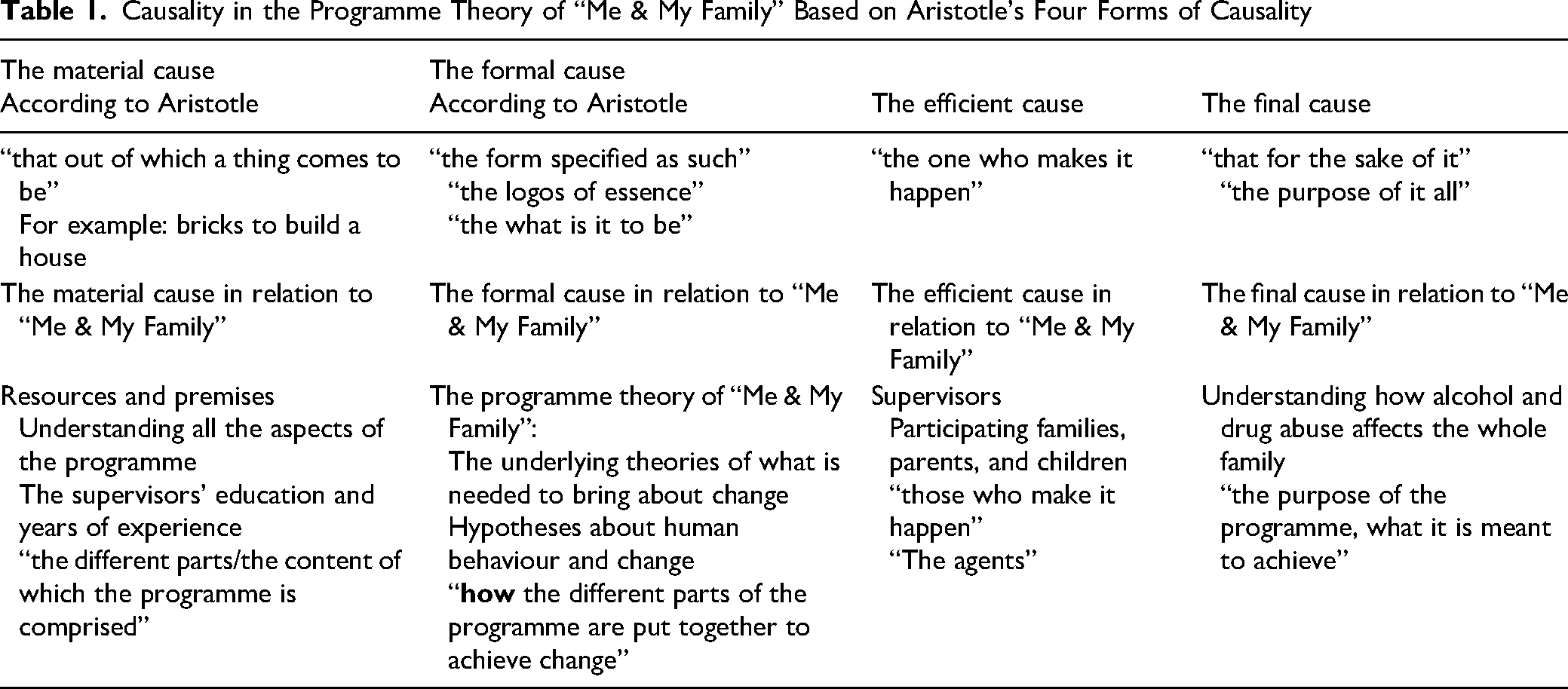
In Table 1, it seems that the four forms in which causality is cited, according to Aristotle, exclude each other. In reality, the four forms are intertwined and continuously open the black box. Conceptualizing causality is seen as process within the four forms of causality, which highlights and accentuates the intertwine. What is the material cause of Me & My Family? Obviously, “the bricks” that Aristotle mentions in intervention terms can be understood as the perspectives on which the programme is established: the humanistic perspective, the family system perspective that a mental problem or addiction affects not only the person with a problem, but all his/her family and other kin. Other prerequisites include professionals with skills such as education, years of experience and the ability to connect and build social relations. Building social relations can be understood as processes among programme participants and professionals which also intertwine with the efficient cause and make the programme work or not. The process can be understood as a continuing interaction between family members, between professionals and between family and professionals. The link between the formal cause and the efficient cause is multifaceted; all of the above-mentioned participants make it happen, or not. If they are willing to, have the courage to, have the skills and motivation to act and to interact, the programme might lead to a change for the family – the final cause according to Aristotle.
The formal cause – in house building, the form, or architecture – might be understood as the formal design of the programme, how the different parts are put together, or the programme theory of the intervention. The programme theory of the intervention Me & My Family can be interpreted as a design, how the different pieces are put together to form a programme frame. The formal form of causality, which by Aristotle is exemplified as poor material or unskilled carpenters, can in our example be compared with unskilled professionals or families not matching the criteria.
The programme is non-confrontational, meaning that it starts out with an education section on how addiction affects a person's brain and mental health. The purpose is to make the addiction problem communicable and start a communication process in the participating families. The professionals work pairwise, one with a specialization in children and families, one with a specialization in drug addiction, to be able to mirror several perspectives. The environment in which the programme takes place aims to be warm and welcoming, allowing the participants to feel safe to express any feelings. Communication is an essential part of the programme and is thus facilitated in multiple ways, by playing, drawing, and homework. But what if the communication process is disrupted in either way? – what if the pairwise specialization is disrupted by only one professional present? From an Aristotelian view, this might interfere with the communication process.
The formal cause links to the final cause, which can be expressed as – through training in communication in safe environments – improvement in the family situation and the mental health of participating children and adults. Further, the programme will cause a positive change in motivation for reduced alcohol/drug consumption by adult family members.
The programme Me & My Family relies on earlier research and theories on how to deal with families with addiction issues. A programme theory consists of several theories within the programme theory according to Walker and Avant (2005): grand theories, which are underlying theories with a broad scope (like in our case finding families at risk in an early stage will prevent more severe problems), middle-range theories, which are theories that are scientifically testable (in our case whether a programme for communication will bring about a positive change in alcohol or drug use) and finally programme theories attending prescription for actions to achieve a goal. This is also similar to what Rogers (2008) points out when referring to complex programme theories.
An RCT design will, as best, be able to answer some of the final causes, anticipating that the effects are caused by the programme, but will be of less relevance to professionals who want answers to why and how the change came to be. If the purpose is to open up the black box, we find the Humean understanding of causality insufficient, and instead we try to expand the discussion by using Aristotle's four forms of causality. Viewing causality as processes both within the four forms, and as a whole, we list a number of advantages that we could identify:
The material cause and the correlation to the final cause (the purpose): The quality of the material cause plays a role in the final cause. Like the quality of concrete plays a role in house building, the supervisors’ skills and education play a role in enhancing the final goals of the intervention. The formal cause and the correlation to the final cause: The programme theory underscores the expected outcomes and makes them visible for evaluation. A programme theory that can point towards all the boxes involved in a complex programme, including expected human change, will serve as a helpful map in guiding the evaluation of the outcomes and in identifying missing elements when analysing the finale outcomes. The efficient cause and the correlation to the final cause: This form makes it clear that professionals and service users play a mutual role in enhancing outcomes. It correlates with research findings showing that a sizable proportion of the outcomes of an intervention depends on the relationship between professionals and service users.
Discussion and Application to Practice
Our starting point in this article is to affirm that researchers who want to deliver knowledge of practical relevance in social work need to explain the results of an intervention through causal analysis and seek to understand its content and processes as well. We regard this as a central feature of inquiry in social work. That is why Aristotle's four forms of causality, interpreting causality as processes within the four forms of causality, are better suited for application to the development of causal explanations. They give researchers the possibility to take the contextual historicism of social phenomena into consideration and gives us knowledge beyond what an effect study can give us.
Traditionally, an effect evaluation of a programme such as Me & My Family would be limited to answering such questions as “does it work?,” while other questions would remain unanswered, or other important aspects would be unexplored. However, by applying the material, the formal, the efficient and the final causes according to Aristotle, we would come close to an understanding of the programme that is better suited and more nuanced. Material causes of Me & My Family may give explanations for which things come to be (Kurki, 2006). “Things” are in this case the premises and resources of the programme. To evaluate with material causes in mind, one can apply a programme theoretical approach, taking human, economic and organizational resources and premises for implementation of the programme into account. These may not be considered typical “pushing and pulling” causes, but they are of great importance for the final outcome. The content of the material cause in Me & My Family is also an example of how closely intertwined different causes are with each other. Human resources, for instance, is a part of the material cause. One needs professionals to work with the programme. These professionals are in turn holding characteristics that can be considered as both material and efficient causes, such as experience. We know from recent research (Avby et al., 2017; Petersén & Olsson, 2015) that experienced social workers develop practical knowledge, which they use in their professional practice. It can be used both when facing an individual, when one must be present in a unique situation and show sensitivity to what one does not know (Bornemark, 2018), and when one applies research knowledge to inform, conduct, and improve work (Nutley et al., 2007). These characteristics are of utmost importance for the final outcome of an intervention, as they say something about how the intervention is implemented. Nevertheless, in research designs built upon the Humean notion of causality, such aspects are not taken into account in understanding the outcome.
Formal causes are usually understood as the idea of a thing that shapes or defines matter. Aristotle consequently saw formal causes containing relations between the different pieces of a drawing. In social work, this way of viewing causality should almost be mandatory, as the field of social work encompasses many broad and complex issues in society. That makes the field of governance imprecise and there are several different formal and informal laws, rules, principles, values and norms to take into account as a social worker. Further, the complexity of the field often requires the engagement and cooperation of several professions. Social workers themselves can also take different roles, as a listener, an advocate, an authority, or an adviser (Adams, 2009). Taken together, all these aspects of social work target formal causes, and as such, they define and structure social relations. Therefore, the idea of a thing – like the programme theory of Me & My Family – can help us understand constraining and enabling causes when it comes to the causal role of the pieces that part of the context is built of. Neither material nor formal causes can be used to precede effects. Instead, they can be regarded as “constitutive” causes. Such a perspective on causality allows us to admit the existence and causality of constraining and enabling conditions of social life and can help us examine the outcome of an intervention on a deeper level.
The efficient cause addresses those who make things happen, change something or make something move. These agents are a necessary part of the overall understanding of causality; however, they alone cannot explain anything, but their existence and actions are embedded in a causal social environment consisting of Aristotle's remaining causes (Kurki, 2006). Aristotle underlines the importance of acknowledging agents in causal analysis by relating the efficient cause to the other causes. For example, the final cause, which aims to explain the purpose of it all, is necessary to motivate agents in working towards the goals of the intervention. In the case of Me & My Family, the goals are to improve family members’ health, and the communication and emotional climate in the family. When informing about or implementing the intervention, one refers to the final cause to make the agents act efficiently in line with the purpose.
This article has contemplated Hume's notion of causality in social work research and rethought it from an Aristotelean perspective. Researchers in social work should seek to gain as good understanding as possible of what is affecting the outcome. As already stated, social workers need and are eager to get knowledge about not only whether the intervention worked, but also why it worked. Only when they have both the what and why of the intervention social workers will be able to develop and adjust their work considering both the intervention's evidence and relevance. Unfortunately there are not many RCT:s found in a social work context and the reasons for this might be several; apart from a lack of relevance for social workers, professionals are not used to collect research data within their practice and are not encouraged to do so by their managers, participants often make themselves invisible when follow-up data is about to be collected and professionals lack abilities to analyse and apply data into practice.
Conclusions
We have in this article called the common Humean understanding of causality into question and found it inadequate for understanding complex interventions in social work, if one wants to find out not only what works, but also why it works. To engage practitioners in research practice we will have to add a “why” dimension to the “what” dimension of the effect study. An answer on the “what” dimension will not provide the practitioner with guidance on how to act in specific cases with specific individuals (Blom & Morén, 2010; Oscarsson, 2009). Instead, one needs to reflect upon what aspects of causality one wants to receive knowledge about, and whether it is realistic to capture these causes within a scientific study. In social work, this also means that we must revise how we talk about and understand the concept of evidence. The common view of evidence is closely related to the experimental design and how it can provide causality. However, several scholars in social work have criticized associating evidence to a particular design, claiming that this relationship prevents a nuanced dialogue of how to best achieve relevant knowledge from evaluations (Gray et al., 2009). Our suggestion is therefore to reconceptualize causality with the help of Aristotle's ideas of material, formal, efficient, and final causes and seeing causality as processes within these four forms. Then we can evaluate and make use of knowledge from interventions in social work in a way that allows us to be open to using different methods and different ways of viewing knowledge. Such a pluralistic and pragmatic attitude is of relevance when working in such a complex and dynamic field as social work.
Footnotes
Acknowledgements
We would like to express our great appreciation to Associate Professor Björn Johansson, Örebro University, for his thoughtful comments on earlier drafts of this article.
Declaration of Conflicting Interests
The authors declared no potential conflicts of interest with respect to the research, authorship, and/or publication of this article.
Funding
The authors received no financial support for the research, authorship, and/or publication of this article.
