




Abstract
Keywords
Social work has a commitment to promote and achieve social justice (Council of Social Work Education [CSWE], 2015) and there is consensus that social justice is a core value and mission underpinning all levels of micro, mezzo, and macro services. However, defining social justice and determining what constitutes key domains of social justice-oriented practice and education have been topics of debate among social work scholars (O’Brien, 2011; Reisch, 2002) and professional organizations (e.g., National Association of Social Workers [NASW]). For example, in addressing the issue of poverty, Craig (2002) defines social justice as “a framework of political objectives, pursued through social, economic, environmental, and political policies, based on an acceptance of difference and diversity” (p. 671, italics added), whereas other scholars underline other essential dimensions such as, racial justice (Wagaman, Odera, & Fraser, 2019), equity and fairness (O’Brien, 2011), distributary justice (Miller, 1999), and epistemic justice (Lee, Greenblatt, Hu, Johnstone, & Kourgiantakis, in press; Johnstone & Lee, 2021). Due to “the wide range of social conditions that fall under the social justice or human rights umbrella, NASW has identified a set number of issues on which to focus” (NASW, 2022, para. 1). These include five social justice priorities such as voting rights, criminal justice/juvenile justice, environmental justice, immigration, and economic justice. The American Academy of Social Work and Social Welfare (2022) (AASWSW) launched the “Grand Challenges for Social Work” in 2016 and among the 13 Grand Challenges identified, five are categorized under “Just Society” such as, eliminate racism, promote smart decarceration, build financial capability and assets for all, reduce extreme economic inequality, and achieve equal opportunity and justice (AASWSW, 2022).
While actively addressing priorities and challenges of social justice, critical scholars re-orient our attention to social work history and present where the social work profession has been complicit in working with different levels of government and institutions to execute and maintain inhumane, socially unjust policies and practices (Blackstock, 2009; Wahab, 2020). Furthermore, a pervasive dominance of neoliberalism has had a detrimental impact on the social work profession and contributed to more measurable, cost-efficient, and outcome-focused services rather than training social workers to address systemic inequity and diversity in social work programs and practice settings (Fenton & Smith, 2019; Sheppard, Charles, Rees, Wheeler, & Williams, 2018; Whittaker & Reimer, 2017). Rather than assuming social justice values are implicitly embedded in social work education, a landscape where the profession has had ongoing tensions (i.e., professional positionality between complicity and resistance to social injustice and fostering effective neoliberal workers vs. social justice-oriented workers), we need to prioritize social justice training that is more impactful and transformative for the next generation of social workers.
The Educational Policy and Accreditation Standards (EPAS: CSWE, 2015) adopted a competency-based education framework in 2008. Social work competence refers to “the ability to integrate and apply social work knowledge, values, and skills to practice situations in a purposeful, intentional, and professional manner to promote human and community well-being” (p.6). There are nine social work competencies listed in EPAS and noteworthy is Competency 2: Engaging Diversity and Difference in Practice. This is the third competency in the 2022 draft of EPAS and the revised competency newly adds racial justice into social, economic, and environmental justice (CSWE, 2022). Competency 2 states that social work students need to learn to “engage anti-racism, diversity, equity, and inclusion in practice” (p.5). This competency urges social workers to apply self-awareness of personal biases and values not to influence the work with diverse clients; understand and communicate the importance of diversity and difference in shaping life experiences; and respect and engage clients as experts of their own experiences. Therefore, it would be critical to enhance social justice competencies across all aspects—awareness, knowledge, and skills (AKS) in the social work curriculum.
The Canadian Association for Social Work Education Standards for Accreditation (2014) also requires all accredited social work programs to have a diversity and social justice focus across all curricula. However, in addition to “what-to teach” for social justice amidst changing priorities, teaching “how-to” promote the embodiment of social justice has been an ongoing pedagogical challenge in social work education (Asakura, Strumm, Todd, & Varghese, 2019; Mehrotra, Hudson, & Self, 2019; Lee, Bogo, Tsang, 2020). Nonetheless, scholars have attempted to translate social justice values and principles into teachable curricula using traditional and innovative teaching methods. Having more information about lessons learned from social work educators’ teaching experiences would be invaluable information for current social work programs that deeply care about social justice education and training. This premise provides important rationale to map the literature on these teaching methods to inform social work educators and researchers. Our scoping review was guided by the following research questions: (1) What are the teaching methods used to enhance social justice-oriented practice in graduate social work students? and (2) how are the teaching methods evaluated? This scoping review focuses specifically on the following areas: (1) domain of social justice (e.g., race, ethicality, human rights, sexual and gender orientation, ageism, disability, etc.), (2) location of social justice training in the curriculum (e.g., required or elective), (3) types of curriculum (e.g., course-based, admission requirement, independent training, etc.), (4) sites of social justice training (e.g., classroom, community, and/or online space), and (5) targets of social justice competencies (i.e., awareness, knowledge, skills: AKS). It would be also critical to examine how each teaching method is evaluated and what we can learn from this educational research.
Method
Following Arksey and O’Malley’s (2005) scoping review framework, we developed a comprehensive search strategy. To increase transparency and reporting methods, we followed the PRISMA-ScR and PRISMA-S checklist guidelines for this review (Rethlefsen et al., 2021; Tricco et al., 2018). Our research team included two social work faculty members, five doctoral students, and one social science librarian.
Identifying Relevant Studies
Guided by our main research questions, one team member (JL) who is a librarian, developed a preliminary search strategy in APA PsycInfo (Ovid) in consultation with the rest of the team. This was validated against a predetermined test set of eleven articles that would match the inclusion criteria to determine if it accurately captured desirable literature. The librarian then had the preliminary strategy peer-reviewed by a librarian colleague who was not on the research team using the Peer Review of Electronic Search Strategies framework (McGowan et al., 2016). Once complete, the librarian translated the syntax and controlled vocabulary into the five other databases: Social Services Abstracts (ProQuest), Sociological Abstracts (ProQuest), ERIC (ProQuest), CINAHL (EBSCO), and Education Source (EBSCO). Each of these is available as an appendix. A date limit of 2001 and a language limit to English were applied. Search results were downloaded on January 24, 2020. No supplementary study identification strategies were used.
Study Inclusion and Exclusion Criteria
Studies were included for this review if they met the following criteria: (1) focused on social justice training in social work education, (2) reported teaching methods or activities used to teach social justice, (2) presented empirical studies published in and after 2001, (3) focused on graduate-level social work students as the training recipient, and (4) written in English. The search for social justice training was expansive including both the term “social just” and the following: race/ethnicity, immigration/refugee status, religion/spirituality, sexual orientation, gender identity/expression, social class, mental or physical abilities, and age. Studies were excluded if they focused on training delivered in social work field education or if they did not identify the exact teaching methods in the article.
Screening Process
We used a web-based systematic review screening tool, Covidence (https://www.covidence.org), to remove duplicate results and to facilitate organization and screening. Detailed screening guidelines were developed and used for both first- and second-level screenings. Guidelines for both levels of screening are available upon request. Five doctoral students acted as research assistants for this review and were trained at a half-day university-led workshop on systematic screening, charting, synthesis, and reporting. In the first-level screening, we developed a manual of abstract screening guidelines based on study inclusion criteria. The research assistants used the guidelines to independently review 15 studies and screen them for eligibility criteria and this was followed by a meeting with the entire research team to discuss screening disagreements and revise or clarify guidelines in the screening manual. After this exercise, the research assistants screened all of the remaining studies on Covidence. Each article was assigned to two students for independent review. Of the total number of studies identified for screening (n = 5953 studies), screeners had discrepant results for 598 studies and to resolve the discrepancies and arrive at consensus, we involved a third research team member (EL). Through the abstract screening process, we excluded 5495 studies, resulting in a total of 458 particles for full-text screening.
For the second-level full-text screening, two doctoral students (RH & AG) and two faculty members (EL& TK) from the research team participated in the screening. A full-text screening guideline manual was developed, and the two doctoral students used it to screen 50 studies independently and then met with the faculty members to discuss disagreements and improve the screening guidelines. The two students then used the refined manual to review another set of 50 studies and consulted with the faculty members for a second time. After the two rounds of screening exercise, the two students reviewed all the remaining studies independently. Of the total 458 studies, we had disagreement with 73 studies and had a third screener (EL) resolve the conflicts again. We excluded 423 studies, resulting in a sample of 35 studies that met eligibility criteria and were included in the scoping review. Figure 1 shows a flowchart of the search and screening process. PRISMA Flowchart of the search and screening process.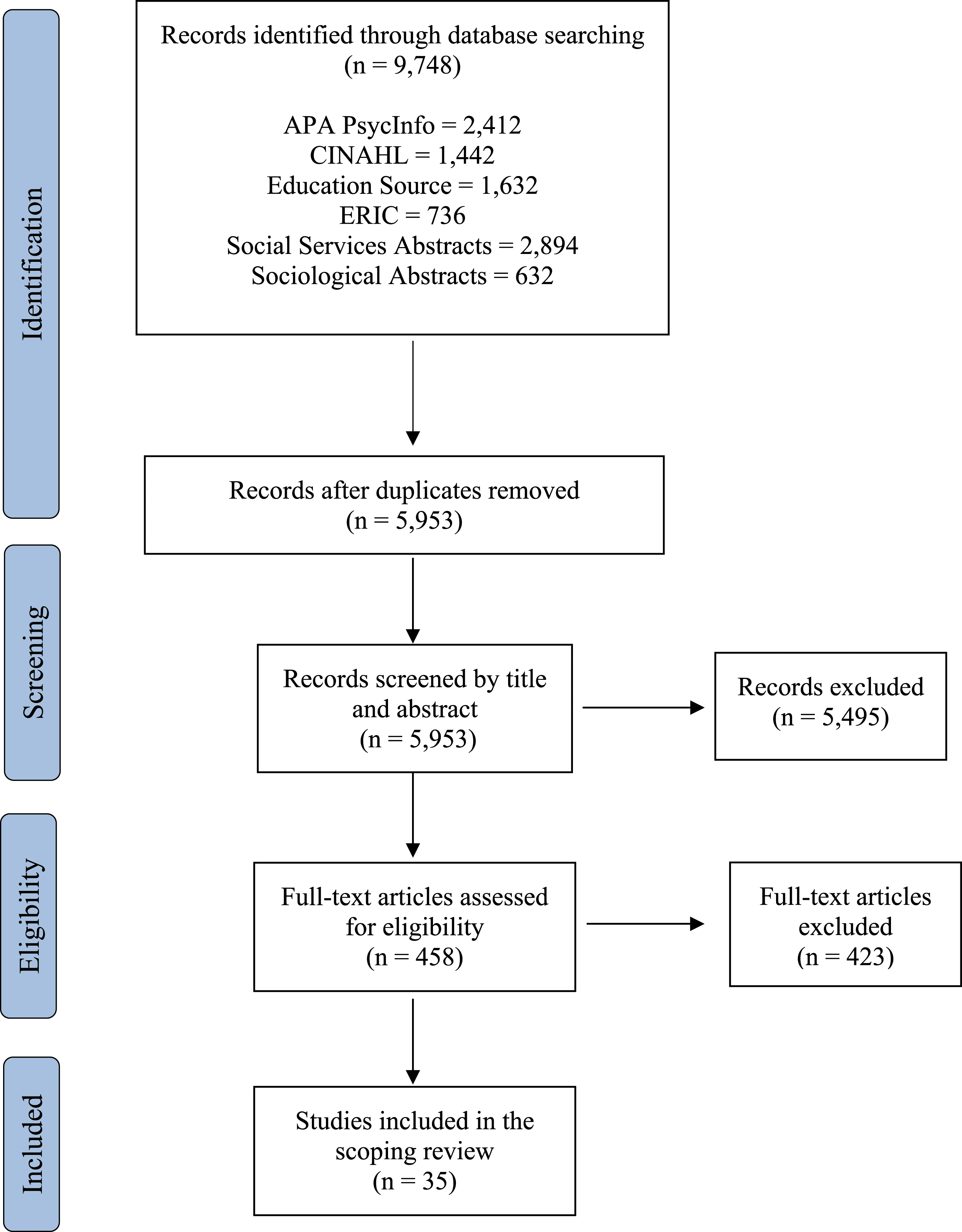
Charting the Results
Charting the results for a scoping review refers to the process of extracting relevant information from the studies and data extracted should align with the main objectives of the review (Peters et al., 2015). For the present review, we developed a charting form and included information that captures the main characteristics of all selected studies and information relevant for our research questions. Charting categories include (1) year of publication, (2) study location, study design and methods, (3) domains of social justice, (4) teaching methods, (5) conceptual frameworks or theories supporting selected teaching methods, (6) components of competencies (i.e., awareness, knowledge, and/or skills), (7) site of teaching (e.g., classroom, community, field sites, or abroad), type of teaching (e.g., required or elective course-based, (8) one-time workshop, independent project), and (9) teaching evaluation methods. Two doctoral students and one faculty member used the charting form to extract data from all selected studies. Throughout the charting process, the research team members met to discuss and cross-check the accuracy of the charting.
Results
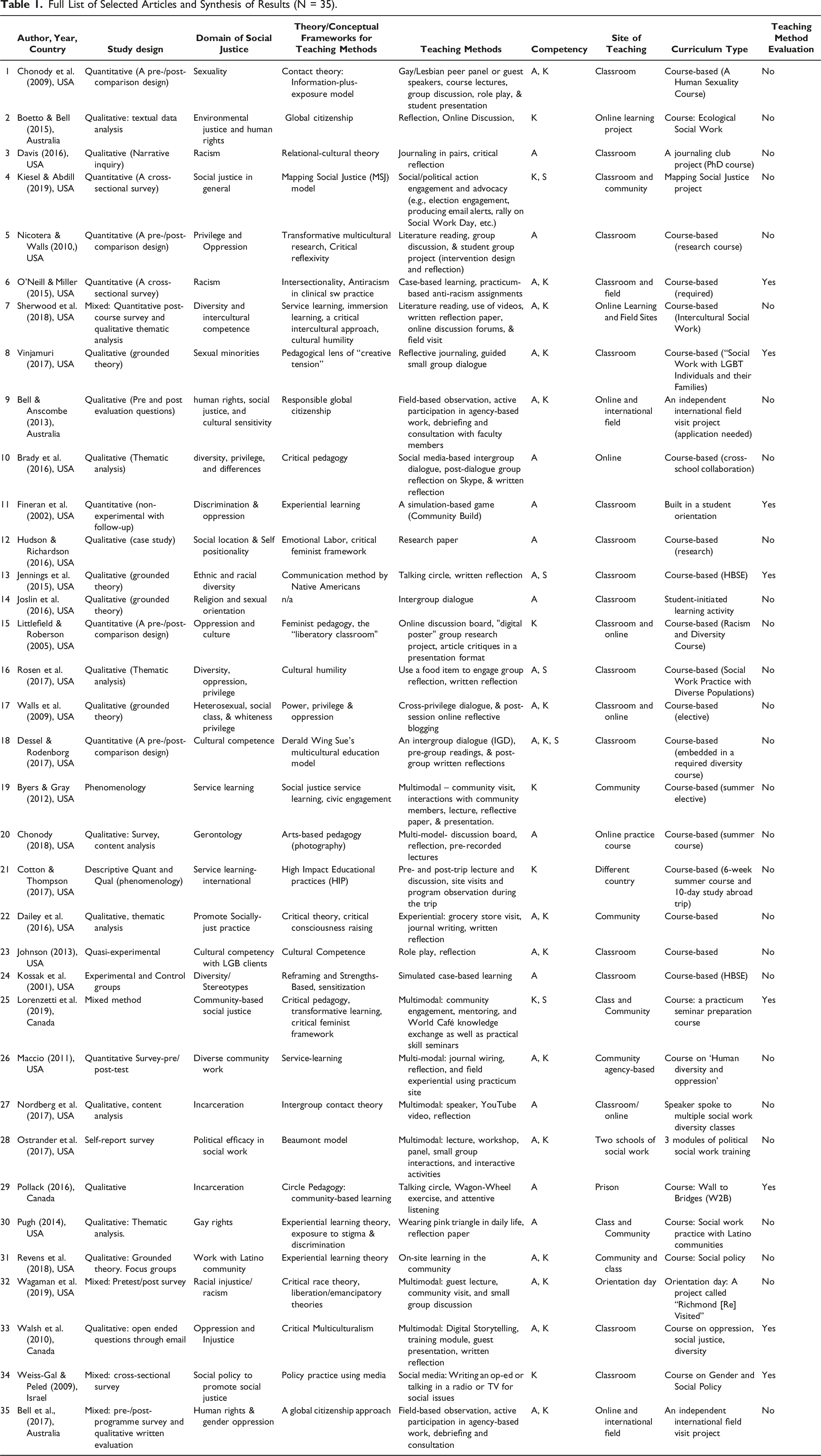
The findings are organized into three sections: (1) overall study characteristics, (2) details of teaching methods, and (3) evaluation of teaching methods. Table 1 summarizes the findings of the included studies (N = 35).
Study Characteristics
The studies include publication dates from January 2001 to January 2020 and more than half of the studies have been published since 2016 (n = 19, 54%). In terms of type of publication, 34 are peer-reviewed journal articles and one is a doctoral thesis. The majority of the studies (n = 28, 80%) were published in the United States, with the remaining studies published in Canada (n = 3, 8.6%), Australia (n = 3, 8.6%) and Israel (n = 1, 2.9%). Seventeen studies (48.6%) used qualitative methods, twelve (34.3%) of studies used quantitative methods and six (17.1%) used mixed methods. In terms of learners of training, 82.9% of the studies were focused on MSW students as the social justice training recipients; one study involved doctoral students only (Davis, 2016); and five studies had a blend of learners including BSW, MSW, and/or PhD programs (Bell & Anscombe, 2013; Boetto & Bell; 2015; Chonody, Siebert, & Rutledge, 2009; Cotton & Thompson, 2017; Wagaman et al., 2019).
The aims and areas of focus of these studies were diverse. Thirteen studies (37%) focused on human rights, diversity, racism, injustice, and/or oppression; eight studies (22.9%) focused on social justice action, service-learning, and community practice; six studies (17.1%) focused on sexual and gender minority populations, four (11.4%) focused on special populations including the Latino community, older adults, and incarcerated populations, and four (11.4%) focused on self-positionality, cultural competence, cultural humility, and intercultural competence. The site of teaching was in the classroom for 14 studies (40%); in the local community or international setting for eight studies (22.9%); in more than one setting (i.e., online/community, classroom/community, classroom/online) for eight studies (22.9%); and three studies (8.6%) were entirely online. Twenty-four studies (66.7%) reported on course-based teaching while eight (22.9%) reported independent projects (i.e., independent field visit, journal club, learning activities, workshops/lectures, orientation day, and student initiative). Of the course-based teachings, six studies noted the course as “required,” three as “elective,” two as “voluntary-based” and the rest did not identify. Types of courses reported in 24 studies course-based teaching include two Human Behaviors and Social Environment courses (HBSE: Jennings et al., 2015; Kossak et al., 2001), two research courses (Hudson & Richardson, 2016; Nicotera & Walls, 2010), one direct practice course (Rosen, McCall, & Goodkind, 2017), two policy courses (Revens, Reynolds, Suclupe, Rifkin, & Pierce, 2018; Weiss-Gal & Peled, 2007), and the rest were special topic courses (e.g., human sexuality, oppression, policy advocacy and community engagement, etc.).
Teaching Methods
Full List of Selected Articles and Synthesis of Results (N = 35).
Intergroup Dialogue
Guided by intergroup contact theory, IGD is a “multicultural and social justice education pedagogy” (Dessel et al., 2017, p. 225) that invites groups with different social identities or locations to come into dialogue to foster mutual understanding and empathy of each group’s experiences and to foster awareness of inequity, intergroup relationship building and collaboration for social action (Joslin, Dessel, & Woodford, 2016). Four studies (11%) described the use of intergroup dialogue (IGD), including IGD activities conducted both in-person (Dessel & Rodenborg, 2017; Joslin et al., 2016; Walls et al., 2009) and in virtual formats (Brady, Sawyer, & Crawford Herrera, 2016). To facilitate learning about religious and sexual identities, Joslin et al. (2016) introduced a student-led IGD through which in-person weekly meetings were conducted among students identified as heterosexual-Christians, Christian-LGB, and non-Christian LGB. They noted that despite the binary view between homosexuality and Christianity, in the first IGD class, the third Christian-LGB group was formed by students, which contributed to ongoing rich dialogue throughout the course. In the study by Walls et al. (2009), to foster understanding of heterosexual privilege, weekly cross-privilege dialogue was hosted among students throughout a semester, and blogging was also used for students to post written reflections to stimulate intergroup dialogue. A pitfall of IGD has been noted as being onerous for marginalized group members who are positioned to educate their experiences of marginalization to privileged group members. Therefore, Walls et al. highlighted “consciously foregrounding a privileged identity” (p. 292) integrated into IGD to address this pitfall.
In a requited social work diversity course, an IGD component was integrated in the course to improve students’ awareness, knowledge, and skills (AKS) related to cultural competence (Dessel & Rodenborg, 2017). Throughout the year, seven separate IGD sessions (2 hours per session) were conducted, each of which was followed by written reflection exercises. Although they aimed to address all AKS, they also found that students reported “a significant increase on the micro and macro skills measure of motivation to bridge differences but not on comfort communicating with people of other groups; scores actually went down on this measure” (p. 234), highlighting that IGD itself was not sufficient to reduce discomfort of bridging differences.
Despite the significance of engaging dialogue on differences and diversity in social work practice (CSWE, 2015) and creating various intergroup dialogues, a pedagogical challenge in many schools is that most students share more similarities than differences in terms of various social locations that create “intergroup experiences for students in academic settings that are primarily homogenous” (Brady et al., 2016, p. 389). To address this challenge, Brady et al. (2016) used an intergroup dialogue project through social media and technology between two schools, a historically Black college and a predominantly White institute; through the project, students joined intra- and intergroup (cross-racial) dialogue activities via Twitter and conducted post-dialogue reflective discussion using Skype. With this innovative teaching approach in place, they also found further challenges and considerations for using social media for IGD such as how to address varying levels of digital literacy and comfort among students, and how to balance the process of building trust between two groups of students who do not have previous relationships, while facilitating them to engage in intergroup dialogue work and reflection.
Online Asynchronized Discussion Board
Four studies (11%) discussed the use of an online discussion board as a way to engage students in after-class discussion or post-online module completion, with variations from student-initiated to instructor-monitored-but-not-engaged to instructors-engaged in the discussion (Boetto & Bell, 2015; Chonody, 2018; Littlefield & Roberson, 2005; Sherwood et al., 2018). Boetto and Bell (2015) described an online learning project on ecological social work in which students were asked to post reflections asynchronously after each workshop and engage in dialogue with peers through their posted responses. Students responded to questions related to a particular theme discussed during the synchronous workshop. Workshops were in six sessions covering a range of issues related to environmental justice and global human rights. In the Intercultural Social Work course in Sherwood et al. (2018), students used online discussion forums to respond to instructor-created reflective questions upon completing each online module.
In a course on racism and diversity in Littlefield and Roberson (2005), a student-led online discussion board was used to build community and student leadership beyond the classroom interaction: Students were able to initiate discussion topics and have dialogue with one another and course instructors monitored student participation but did not comment on the discussion board. The authors reported both rewarding and challenging aspects of the asynchronized discussion board as a pedagogical tool. For example, students noted the benefits of the online discussion format such as having time to process others’ comments before responding to the dialogue which reduced their anxiety “that might otherwise have prevented the students from participating in class interactions” (p. 199). They also found challenges around the domination of one student (i.e., an older white male) with more frequent and longer comments that compromise others’ engagement for multi-directional interactions. They highlighted that even in the online and asynchronized spaces it is important for instructors to be hyperattentive to power dynamics in students’ participation. In a 6-week asynchronous online course on practice with older adults, students used the discussion board to critically engage with the concept of aging and cultural meanings (Chonody, 2018). The instructor asked each student to post a photo that represents “aging” and reflect on what this image means culturally and personally; students were also given an opportunity to review all photos posted by their peers to explore patterns and cultural meanings. The author found that using the photo activity helped students change their attitudes related to older adults. In summary, regardless of the level of instructor involvement, using online asynchronized discussion board across these studies is noted as engaging students for critical reflections on various diversity factors between the classes.
Use of Simulated Vignettes and Role-Play
Three studies (8%) used simulated vignettes and role play activities to engage students for diversity training. To help students understand social injustice and oppression, a simulation-based game “Community Build” was developed and implemented at an MSW student orientation (Fineran, Bolen, Urban-Keary, & Zimmerman, 2002). In the simulation, students were divided into different groups, and they were each given a different number of resources to build their “community” in terms of the income level (i.e., low, middle, and high) and were treated differently by a number of authority figures (e.g., police officers and housing authorities) played by faculty members. Students were also allowed to move around and observe other “communities” that had been built and reflected on what they observed. They found that compared to the students who did not participate in the game, the game participants demonstrated more personal responsibility for social issues and more power to change them. Interestingly, they also found that non-participants showed higher scores regarding their personal ability to communicate on issues of multiple isms than participants. The authors interpreted that playing the game may provide a learning space to reflect on other students’ beliefs and to foster insight into the challenges of addressing various social issues in a public space. In Johnson’s (2013) study, a role play exercise was developed to enhance students’ competence of working with LGB clients. Five students were invited to role play a scene where one student introduced a lesbian friend to others. After completing the role play, students reflected the role play experience. To enhance students’ understanding of stereotyping and its impacts, in a HBSE course, students were given written vignettes that describe a group project and an assigned peer that they each partner with on the project (Kossak & Johnson, 2001). All vignettes were the same except that the assigned student partner’s ethnic background differed, including African American, Asian American, Hispanic American, Italian American, and Jewish American. Students were asked to write phrases that came to mind when they thought about the fictitious partner. Then the instructor facilitated a reflective discussion about stereotyping and then their earlier written responses. They concluded that this pedagogical method of the critical reflection using a fictional simulated vignette could be a means to facilitate active learning “to kindle awareness of stereotyping behavior and the consequences of such behavior” (p. 206).
Student Group Work and Presentation using Various Pedagogical Tools
Four studies (11%) discussed the use of student group work and presentation to engage students in learning social justice issues (Littlefield & Roberson, 2005; Nicotera & Walls, 2010; Rosen et al., 2017; Walsh, Shier, Sitter, & Sieppert, 2010). Digital storytelling blends creative writing, oral history, and art therapy into a first-person narrative video to foster community participation, collaboration, professional development, and participatory research. In a course on diversity and power relations, students worked in groups to create a video using digital storytelling and develop a training module (Walsh et al., 2010). Walsh et al. (2010) highlighted the importance of digital storytelling as a transformative process for students and its powerful impacts on students’ overall learning about issues related to diversity or oppression in the course, by creating “an opportunity to reflect on life experiences, our perceptions, and find deep connections with the subject matter” (p. 11). In another course on diversity and oppression, students worked in groups, and each group chose an issue related to oppression and discrimination and made a digital poster on Blackboard about the issue and possible policy and practice recommendations (Littlefield & Roberson, 2005). Students rated other groups’ posters and provided feedback to deepen each other’s reflections. The authors used these technology-supported teaching strategies to facilitate student-peer and student-instructor interactions. This pedagogical approach to promote multiple interactions is critical for diversity courses where “students often censor themselves for fear of revealing prejudice or ignorance or offending the instructor, especially when the instructor is of a different race,” and to curtail the reification of societal power dynamics in the classroom such as “privileged students being more vocal and having their viewpoints validated more often than students of historically oppressed groups” (p. 188).
In one course, Disrupting Power and Privilege in Research and Practice, an activity was described aimed at improving students’ ability to critically appraise and consume research. Students were assigned into groups, and each group first presented their findings to the class and provided reflections on a research article (Nicotera & Walls, 2010). Reflection questions were about assumptions made about participants, values presented throughout the research paper, and researchers’ positionality and privileges. Students then used the research findings to develop an intervention; and students finally reflected on how research was translated into practice and how the intervention designed based on research findings might be adhering to or departing from social work ethics. The authors note that focusing students’ critical thinking skills on issues of power and positionality, as well as interrogating the unstated privileged assumptions embedded within that research, deepen students’ understanding about the socio-structural construction of our professional knowledge and debunk students’ beliefs of a bias-free social scientific knowledge base. In another diversity course to promote cultural humility, students were each invited to bring in a food item to the classroom and present to the class how this “shaped an important life experience.” After describing the food item, students were encouraged to engage other students to ask questions and learn about the presenter’s life experiences (Rosen et al., 2017, p. 292). Before the presentation, the presenter conducted a written assignment responding to questions such as “why did you choose this food?” (p. 292). Students are reminded that the food is solely a means to initiate a dialogue (e.g., mac-and-cheese by a female student who was a single mother and critical reflection on poverty). The activity allowed students to draw on their own experiences to engage in dialogue and engage in critical thinking about diversity, oppression, and privilege and provided them with an opportunity to practice communication skills, reflective listening, and asking meaningful questions.
Written Reflection and Experiential Learning
Written reflection was another learning method incorporated in teaching social justice-related topics, discussed in eight studies (22.9%). In six studies, written reflection was employed as a one-time assignment, such as a final reflection paper (Brady et al., 2016; Cotton & Thompson, 2017; Jennings et al., 2015; Maccio, 2011; Nordberg, Praetorius, McCoy, Mitschke, & Henderson, 2017; Pugh, 2014). Two of these studies reported that the written reflection assignment followed experiential learning. For example, the talking circle approach is based on Indigenous ways of teaching and learning to enhance inclusive empathic understanding among group members using a culturally grounded framework. Instead of responding to others’ views immediately, students wait until their turn to share own reflections, which creates a space to embody active listening and reflection as well as respect for others. Upon the completion of a talking circle event, students were invited to continue the exploration of personal experiences with culture, identities, and diversity by conducting additional written reflections (Jennings et al., 2015). The authors found that students felt safe and connected to peers emotionally and intellectually in the circle while learning about each other’s ethnic heritage and struggles. Pugh (2014) described an experiential exercise of wearing a pink triangle button for 1 day to raise self-awareness of attitudes or internalized bias toward sexual and gender minority groups. After the exercise, students were expected to write a reflection paper based on their experience of the day.
Two studies discussed the use of reflective journaling as an ongoing assignment throughout the semester (Davis, 2016; Vinjamuri, 2017). Davis (2016) described a reflective journaling activity among doctoral student peers in an Antiracism Project. The journaling exercise aimed to promote self-awareness of racism and facilitate authentic dialogue about racism among students. Specifically, students paired up to exchange their journaling (i.e., two pairs of Black and White students, one pair of two White students). Each pair of students had flexibility to decide what they want to write about. For example, one pair grappled with “the relative risks they each experienced in being authentic in their lives and framed their decisions as effects of racism and White privilege” (p. 369). The project took place throughout a semester, and students also met for six sessions to discuss antiracism literature, share experiences related to racism, and provide support to one another. Davis reports that authenticity, empathy, and mutuality present in this intra/inter-racial relational space served as a space for revisiting self in terms of personal experiences around racism. In an elective course, Social Work with Lesbian, Gay, Bisexual, and Transgender Individuals and Their Families, students learned to deconstruct heteronormativity and they were required to complete weekly reflective journaling on course readings, personal reflections and experiences, and raise questions for small group and class discussion (Vinjamuri, 2017). The author notes that using both individual reflective journaling and having a group discussion from different viewpoints allowed students to learn about themselves and become comfortable with their discomfort in understanding LGBT people.
Community-Engaged Learning
In 15 studies (42.9%), students’ learning about social justice issues incorporated engaging communities and stakeholders. Six studies included field trips to local communities or community agencies (Dailey, Washington, & Havig, 2016; Sherwood et al., 2018; Revens, et al., 2018) or international sites (Bell & Anscombe, 2013; Bell, Moorhead, & Boetto, 2015; Cotton & Thompson, 2017). For example, Dailey et al. (2016) reported on an experiential learning activity which involved local grocery store visits to enhance students’ understanding of social justice. Specifically, students were asked to visit two stores from the same chain located in two neighborhoods. One of the locations was in a neighborhood with predominately White residents and a median household income three times higher than another neighborhood consisting of mostly African American residents. After the visits, students journaled their reflections and shopping experiences and shared with their peers in class. The authors note that “by taking part in a relatively mundane activity (i.e., grocery shopping) in two very different settings,” students had first-hand experiences of “the ways in which social inequities are experienced in even the most seemingly innocuous settings” (p. 53) through a social justice lens. In a social work practice course designed to improve students’ knowledge, values, and practice skills with Latino communities, students visited a community-based agency for on-site learning (Revens et al., 2018). Specifically, students engaged with directors and staff in the agency learning culturally sensitive approaches and designing interventions addressing the needs identified by Latino community members. The authors highlight the university-community collaboration through this experiential learning to prepare students to serve and advocate for the communities during and after their study.
In the aforementioned Intercultural Social Work course (Sherwood et al., 2018), students directly interacted with diverse communities over an intensive travel experience along with the visit to Hull House. The authors found that after the diverse community visit, students were acutely aware of how little they know about people unlike themselves, which locate them in a position of cultural humility and promote a new desire to learn and respect. Cotton and Thompson (2017) report the implementation of high impact educational practices (HIPs)—a set of educational practices on student engagement and success—for diversity/global learning for social work students by structuring a 6-week summer program including a 10-day study-abroad trip to Guatemala. Given the pre- and post-assessment on students’ knowledge and skills for conducting service-learning projects, the authors reported a positive change in the area of students’ perceived competencies. In Bell and Anscombe (2013), students in BSW and MSW programs were offered an opportunity for an international field visit from Australia to India for 2 weeks. Students spent the first week visiting and observing community-based development programs; during the second week, students played a more active role by working in local organizations (e.g., visiting remote tribal villages with mobile health vans to document health profiles). Bell et al., (2015) described the same program to India but added that students completed post-program written reflections.
Another five studies invited community-based guest speakers to their classes (e.g., community members or social workers) as a teaching method or teaching project (Chonody et al., 2009; Nordberg et al., 2017; Ostrander, Lane, McClendon, Hayes, & Smith, 2017; Wagaman et al., 2019; Walsh et al., 2010). For instance, in a political social work training project, political social workers with experience of running political campaigns were invited as guest speakers to lead training modules in two schools of social work (Ostrander et al., 2017). The authors found that this curriculum increased students’ political efficacy and future political engagement. In a class on human sexuality, Chonody et al. (2009) found that having a gay/lesbian peer panel or guest speaker is ideal to facilitate the connection between people with lived experiences and students and this reduces anti-gay bias among students. In a social work diversity class, a guest speaker who had been incarcerated was invited to decrease students’ misconceptions and prejudice against people involved with the criminal justice systems. The guest speaker shared personal stories of incarceration, release, and perspectives on the death penalty (Nordberg et al., 2017). After the guest speaker lecture, students completed a written reflection using guided questions prepared by course instructors with questions on students’ perceptions of incarcerated individuals before and after the lecture. They reflected on oppression and the impact of the guest lecture on future practice. The authors found that using an intergroup contact approach whereby voices of the oppressed (e.g., criminal justice involved clients) are brought directly to the classroom, is a useful pedagogical method to confront student prejudices and creates a space for critical self-reflection. In the day-long orientation to promote racial justice training, the guest speaker from the local organizers of the Movement for Black Lives provided a historical context of the government-sanctioned process of rejecting financial services and mortgage loans based on the racial make-up and their impact on the current food injustice and other social injustices in racialized communities (Wagaman et al., 2019). After the guest lecture, training participants and community members visited community sites (i.e., a slave burial ground/slave jail sites or other community-based garden/programs that were razed under the early urban renewal displacing residents), followed by structured small group discussion with intentional debriefing of the guest lecture and the site visits and to deepen dialogues about race and racism.
Two studies built the model of service-learning into their courses (Byers & Gray, 2012; Maccio, 2011). The model of service-learning underscores bridging the split between academics and the real world and increasing students’ civic engagement and experiential learning, combined with its reflection, discussion, and dissemination to class and/or communities. For example, Byers and Gray (2012) described a social justice service-learning course, Community Asset Assessment, in which students conducted a series of community-based activities in collaboration with local community members (i.e., documenting neglected properties for removal or cleaning-up) and presented to the agency about their potential uses as recommendations. Using MSW students’ field education or volunteer agencies as service-learning sites in a course, Human Diversity and Oppression, Maccio (2011) shared two important insights. First, having students submit a service-learning project plan that would be implemented in the designated site before beginning their work could improve their service-learning experience due to increased preparation and instructor feedback. Second, by linking the service-learning experiences provided within their field education unexpectedly limited some students’ exposure to the community beyond the field setting due to the focused project.
Lastly, for the remaining two studies, Lorenzetti et al. (2019) described a student-social worker mentorship initiative—Journey Guides—as a pedagogical tool to foster social justice learning. Students in a specialization of international and community development were intentionally matched with community-based social workers based on students’ personal and professional goals. Students and their mentors met at least three times throughout the semester to guide students involved in community-based social justice initiatives. Mentors were invited for class presentations. This initiative allowed students to not only learn about community-based social justice practice but also foster relationships with community practitioners. Pollack’s (2016) study described a Walls to Bridges (W2B) Project, as integrated into an MSW Diversity course, which was conducted in correctional settings, including both university students and incarcerated students. The author reports that using a Talking Circle approach in class discussions and reflection created a space to discuss and explore issues such as diversity, marginalization, oppression, and privilege both academically and experientially; fostered a sense of connection and community across perceived differences (e.g., incarceration); and cultivated future social action intentions in both the criminal justice and the wider community.
Social Action-Oriented Learning
Three studies (8%) introduced social justice learning initiatives that allow students to take actions participating in social or political advocacy work (Kiesel & Abdill, 2019; Ostrander et al., 2017; Weiss-Gal & Peled, 2007). In a course, Gender and Social Policy, a “Media Project” was incorporated through which students each chose an interested social issue (e.g., service access challenges for people with disabilities) and then either wrote an op-ed newspaper article for publication or spoke on television/radio (Weiss-Gal & Peled, 2007). The authors reported that this project increased students’ personal and professional empowerment and their competency of promoting social issues in the media toward making social actions. In the study by Ostrander et al. (2017), in the last module among the three-module of political social work training, students were provided an opportunity to plan their own political work in the next 5 years and began to take initial steps toward their political goals. To provide clinical social work students an opportunity to engage in political advocacy, a project named Mapping Social Justice (MSJ) was developed to allow students to engage directly in advocacy work during the 2016 US presidential election (Kiesel & Abdill, 2019). The MSJ team sent out information alerts via email and social media to students covering a wide range of social justice issues and local events. The team also hosted a “postcard party” in which students came and created postcard messages to legislators to build their advocacy skill. Alerted information was intentionally created based on student residential districts, field placements, and clients served, to promote student engagement with communities in social actions. It is worth noting that the MSJ team was the dedicated research, teaching and action project team including research assistants who made possible to promote intentional planning, ongoing content updates, and delivery.
Evaluation of Teaching Methods
The included studies primarily measured participant knowledge, awareness, perceived competency, and changed understanding of issues related to social justice. In the majority of the studies (N = 27, 77.1%), evaluation was not reported for assessing the effectiveness of particular teaching methods but used to explore students’ overall experience with a particular course or training project within which certain teaching methods were built. For example, for the foundation year research course discussed in Nicotera and Walls’s (2010) study, pre- and post-assessments were conducted to understand students’ abilities to appraise research. In Ostrander’s (2017) study that focused on a graduate training on political social work, a series of teaching methods, such as lectures and community panels, were adopted; instead of assessing the effectiveness of each method, the author used efficacy measures, such as an internal efficacy scale, to assess students’ efficacy levels before and after taking the training.
In eight studies (22.9%), the empirical data were used to assess specific teaching methods (e.g., the guest speaker component in a course). In the Policy course in which a Media Project was incorporated, Weiss-Gal and Peled (2007) used a five-point Likert scale statement to capture participants’ appraisal of the media project, such as “the Media Project increased my ability to use the media in my professional work in future” (p.376). Among questions asked by Walsh et al. (2010) was a question about specific aspects of the described teaching method: “How do the individual components (readings, self-reflection, guest speakers, digital storytelling workshop, group work, and others) contribute to your learning?” (p. 4). Similarly, O’Neill and Miller (2015) included a qualitative question in their evaluation process that focused on the teaching method by asking students “to describe aspects of the course’s design, content, or method of instruction including attention to social oppression and human diversity that facilitated the student’s learning” (p. 169). Vinjamuri (2017) included evaluation of two aspects of the study’s teaching method, specifically reflective journaling and small group dialogue. Participants in Pollack’s (2016) study described the impact of specific aspects of the teaching method including use of the “Wagon Wheel” (p. 512) exercise that was described as important in addressing stereotypes, “the circle pedagogy” (p. 513) described as having an “equalizing effect” (p. 513) on participants, and the role of the instructor as being “facilitative rather than authoritative” (p. 514) during the implementation of the teaching method. Jennings (2015) used open-ended qualitative questions to explore students’ experience and perspectives regarding the talking circle method used in the course. To assess the outcomes of a simulation exercise, Fineran et al. (2002) used a student survey to compare students’ sense of responsibility to promote social change among those who attended the exercise and those did not attend. Last, Lorenzetti et al. (2019) had participants evaluate specific aspects of the described experiential learning model.
Discussion and Applications to Practice
Our systematic scoping review yielded 35 empirical studies on teaching methods in social justice education for graduate social work students. Using the findings of this review, we now critically synthesize and elaborate on two areas: The first relates to benefits and challenges of implementing the identified teaching methods, and the second is focused on current gaps and future implications for training, research, and practice to enhance social justice competencies in graduate social work education. We close by discussing the limitations of the current review.
Across the identified teaching methods, the most dominant theme found was the use of a real or simulated “experiential learning” to increase students’ direct and/or indirect exposure to diverse lived experiences and to have students critically reflect on their privileges and biases through teaching methods such as IGD, talking circle, inter-/intra-group journal writing, online discussion boards, guest speakers, simulated vignettes, role plays, community-engaged activities on site, and simulated online community building gaming. Identified pedagogical challenges of these teaching methods that focus on fostering experiential learning include: (1) the onerous nature of experiential learning for marginalized group members, agencies, and communities that are positioned to educate privileged groups (Walls et al., 2009); (2) the reification of power dynamics (e.g., privileged groups occupying the learning space and their viewpoints validated more than students of oppressed groups) while sharing diverse lived experiences (Littlefield & Roberson, 2005); and (3) the underrepresentation of diversity among students that limit opportunities of their exposure to diverse lived experiences (Brady et al., 2016).
To address these challenges, the included studies provide the following recommendations: First, rather than placing the burden on marginalized students and communities, any experiential learning to increase students’ exposure to diverse lived experiences of marginalization and oppression should be simultaneously accompanied by discussing and/or intentionally foregrounding a privileged identity of students under examination (Walls et al., 2009). The second pedagogical recommendation is for instructors to pay attention to not only the content, but also the process of experiential learning to observe and intervene during power dynamics that manifest when participants are sharing lived experiences and interactions both online and in-person, as well as both asynchronized and synchronized interactions within online space (Littlefield & Roberson, 2005). Fostering multi-directional interactions and engaging meaningful learning do not organically occur when culturally diverse groups converse and interact. Rather, explicit efforts to foster a process of respectful learning and clarifying how to structure and institutionalize this process should be in place. The final recommendation is to expand the learning opportunities beyond the classroom, such as incorporating community-based learning and field observation; these opportunities can accommodate the diverse learning needs among students. The included studies highlight the importance of students’ ongoing critical reflection of social justice matters in their life and in various communities. In-between classes or in special projects, students are encouraged to continue engaging and interacting with their peers (through online asynchronized discussion boards) and with clients and various communities (through practicum or community projects). This line of recommendations highlights that social justice teaching and learning is beyond academic spheres toward students’ life transformative learning and actions. Especially for the enhanced community engagement for diversity training (e.g., inviting guest lecturers, visiting service sites, and conducting collaborative projects), our finding underlines the ongoing university-community partnership and trusting relationship is key rather than individual instructor’s temporal initiatives (Laurenzetti et al., 2019; Ostrander et al., 2017; Pollack, 2016; Ravens et al., 2018).
Given our findings, we identified three gaps in the current social justice teaching approaches in social work pedagogy: (1) centering social justice–related courses and projects in the MSW curriculum; (2) balancing areas of social justice competencies by strengthening students’ skills building; and (3) addressing students’ affective domain during social justice training.
Among the included studies, only six studies (16%) identified that the course on social justice was “required.” It should be noted that our scoping review only included empirical studies and it is thus possible that social justice-oriented courses are pervasively taught in MSW and PhD programs and there has been limited empirical research on this topic. Nevertheless, it is also telling that, despite social justice being a principal value of social work, there has been limited pedagogical research on how to teach social justice. Many researchers have argued that social work students tend to show less critical thinking after obtaining their social work degrees (Fenton & Smith, 2019; Sheppard et al., 2018; Whittaker & Reimer, 2017). These studies reject the taken-for-granted position wherein faculty members often assume that it is not necessary to cover social justice in their courses as it is covered in all courses and across the program. They highlight the importance of explicitly considering how to teach and incorporate social justice values and actions in the social work curriculum. Furthermore, it is worth noting that there are limited studies (n = 8) that evaluate specifical social justice “teaching methods” even though all included studies were empirical studies. In addition to a global evaluation of social justice course/project as a whole, it would be fruitful to explore what teaching methods strengthen which areas of competencies (i.e., AKS) of students in future research.
Despite the emphasis of AKS to enhance social justice competencies of students (CSWE, 2015), our findings show that predominant focus on targeting awareness and knowledge yet limited skill-building—5 out of 35 studies (14.3%) are coded as targeting skill-building of students in fostering social justice. This is clearly in contrast to awareness (N = 26: 74.3%) and knowledge (N = 22: 62.9%). Several studies claim that they target all aspects of competencies (i.e., AKS) and yet there was limited information on the component of skill. For example, O’Neill and Miller (2015) note that they aim to “demonstrate beginning practice skills in identifying, critically assessing, and effectively addressing the issue of race and racism” (p. 174) and yet provided limited details on “how-to” build beginning practice skills. Cotton and Thompson (2017) note several occasions that service-learning approaches help students apply their knowledge and skills in real-world settings yet few explanations of skill-building.
Being aware of one’s privileges and biases and critically reflecting on them instead of imposing them to clients (A) as well as educating oneself about critical perspectives and how to combat oppression, racism, and inequity (K) are imperative in social justice work and hence should be seen as critical components of social justice training. Social work education scholars critique a pervasive pedagogical assumption that knowledge acquisition and self-reflection on social justice and cultural competence will automatically lead to embodied practice. They urge the development of new educational tools to enhance skill-building to promote social justice and diversity in social work education (Asakura et al., 2019; Mehrotra et al., 2019; Sayre & Sar, 2015). It is thus critical to promote the balanced enhancement in all aspects of social justice competence. Furthermore, it would be important to note the types of skills highlighted in the included studies. For example, “general” skills around advocacy (e.g., political engagement, networking skill development such as sending postcards to political parties, engaging political campaign/elected officials) or engagement such as listening skills in communication (e.g., talking circle and other presentations), rather than “specific” skills to address diversity and power dynamics. We believe both types of skills building are important to enhance social justice competence for social work students.
Several studies on social justice and cultural competence note that even practitioners who are skilled in addressing clients’ distress become frozen and immobilized in their use of general practice skills that they have learned: Practitioners’ concerns around not-knowing “how to” address culturally relevant conversations and systemic inequity, and subsequent anxiety around being politically incorrect have them often immobilized at the very moment they are trying to engage with diverse clients (Lee & Horvath, 2013). Subsequently, they may withdraw from learning and carrying out socially just and culturally competent practices (Lee & Kealy, 2018). Creating the educational space for social work students to use general practice skills they have learned to adequately apply to enhance social justice competence is in great need. At the same time, it would be critical to further enhance social justice-related “specific” skills around how to address broaching differences and power dynamics in cross-cultural interactions to promote social justice. For example, a black client came back to the community mental health agency for her recurring depression. When the client asks a non-black social worker about their view of Black Lives Matter, what and how the social worker would respond? How-to address complex layers, to name a few as below, indeed need practice and deeper reflection in social justice training: (1) whether the client feels safe enough to begin a working relationship with the social worker who is not sharing similar lived experiences around racism and may be limited to understand the client’s experiences; (2) whether the social worker is able to convey his/her/their understanding around systemic racism to the client while not dismissing, over-stepping or equalizing the oppressions the client has experienced; and (3) whether the client and social worker join to share the psychological pain due to racism and its impact on the client while not falling into a trap of hopelessness, which may exacerbate the client’s depression. Creating educational spaces and developing training curricula to address these lingering questions are needed and can provide students with opportunities to consider various scenarios and practice social justice-related skills to troubleshoot and reflect on cross-cultural interactions and other social actions.
The last is the challenge and gap around “how-to” address students’ affective responses during social justice training. Several included studies (Dessel & Rodenborg, 2017; Littlefield & Roberson; 2005; Vinjamuri, 2017) note that the content of a social justice–related course/project elicited students’ strong emotional responses such as anxiety, discomfort, pain, and guilt, “even when nonconfrontational approaches are used” (Littlefield & Roberson; 2005, p, 188). Pedagogical strategies for teaching about diversity, oppression, and privilege inevitably have students’ values and beliefs critically challenged. Realizing many aspects of their values and norms have been unquestioned, students may experience a range of emotions. Dessel and Rodenborg (2017) found that, after the intergroup dialogue, students reported a significant increase in their “motivation” to learn skills to bridge differences after the course yet little change in their level of comfort communicating with people of other groups. They highlighted that enhancing students’ competencies in ASK was not sufficient to address students’ discomfort of bridging differences. Therefore, this affective experience becomes central in the social justice learning process.
Scholars seem to agree on the importance of safety in students’ learning process. Although social justice education demands creating a transformative learning space where instructors should let go of the idea that it needs to be harmonious and less emotion-provoking for the classroom to be safe, it does not mean that we are not fostering a safe respectful space conducive for learning and growth (hooks, 1994; Vinjamuri, 2017). However, rather than ignoring and pushing down affective experiences not to emerge during social justice education, several studies highlight ways to address them such as, acknowledging discomfort, understanding roots of discomfort or other emotional experiences (e.g., critical reflection on taken-for-granted values and privileges), and learn from the affective experiences to engage with others in affective and meaningful levels. For example, Littlefield and Roberson (2005) note that using asynchronized discussion boards is a useful pedagogical strategy to modulate students’ intense anxiety because they can have some time to process others’ comments before they react and respond. Vinjamuri (2017) also note that students need to feel grounded first before they take a risk expanding beyond their comfort zone which can be cultivated through individual reflection and working in community with others.
It is important to note that this scoping review was completed before the outbreak of the COVID19 pandemic. Therefore, it is unknown if the findings are relevant to the current academic environment post-COVID. We acknowledge that since the onset of the pandemic, the medium of teaching has been vastly challenged and re-contextualized and we needed to use technology and online space for social justice training. We also think that there might be some transferrable learning from this scoping review to social justice teaching during and post pandemic. For example, although our review was done before the outbreak of COVID, it is noteworthy to observe active use of technology and online space for social justice education for various pedagogical methods such as augmenting multiple interactions and modulating students’ emotional reactions through online discussion boards (Littlefield & Roberson; 2005; Dessel & Rodenborg, 2017); and increasing social advocacy actions through social media alerts (Ostrander et al., 2017). It will be fruitful to brainstorm ways to meaningfully transfer other identified teaching methods into online formats such as e-simulation, online IGD and talking circle, to expand the scope of social justice teaching methods post-COVID.
In closing, the current scoping review focuses on pedagogical teaching methods which should be considered as a site to promote social justice and embody social justice-oriented education and practice in social work. Social justice-oriented teaching is often taken for granted in social work education and research. The current review highlights much untapped terrains for social work scholars to center the foundational social work value in educating the next generation of social workers and how to deeply investigate our pedagogical approaches toward enhancing social justice values. The identified teaching methods could provide a good starting base to advance future inquiry.
Footnotes
Acknowledgments
We acknowledge the support given by Kai Zhizhong, Vivian Leung, and Olive Lyons for this research project.
Declaration Of Conflicting Interests
The authors declared no potential conflicts of interest with respect to the research, authorship, and/or publication of this article.
Funding
The authors disclosed receipt of the following financial support for the research, authorship, and/or publication of this article: This study is supported by Social Science and Humanities Research Council of Canada (PI: Eunjung Lee, Grant # 435-2020-0153).

Appendix
Electronic Search Strategy for All Six Databases
Database 1: APA PsycINFO (Ovid) 1. Social workers/ 2. Social casework/ 3. Social work*.tw. 4. Casework*.tw. 5. Case work*.tw. 6. Or/1–5 [social work] 7. Teaching/ 8. Graduate Education/ 9. College Students/ 10. Teaching Methods/ 11. Educational Programs/ 12. Curriculum/ 13. Multicultural Education/ 14. Course work*.tw. 15. Coursework*.tw. 16. Curricul*.tw. 17. Educat*.tw. 18. Instruct*.tw. 19. Learn*.tw. 20. Student?tw. 21. Teach*.tw. 22. Train*.tw. 23. Undergrad*.tw. 24. Graduat*.tw. 25. Master.tw. 26. Bachelor.tw. 27. PhD.tw. 28. DPhil.tw. 29. Doctoral.tw. 30. Post doctora*.tw. 31. Post doc?tw. 32. Or/7-31 [education] 33. Social Work Education/ 34. BSW.tw. 35. MSW.tw. 36. DSW.tw. 37. Or/33-36 38. 6 and 32 39. 37 or 38 [all social work education] 40. Social Justice/ 41. Marginalization/ 42. Oppression/ 43. Prejudice/ 44. Social Discrimination/ 45. Stigma/ 46. Social justice.tw. 47. antioppress*.tw. 48. Bias.tw. 49. Disadvantaged.tw. 50. Discriminat*.tw. 51. Excluded.tw. 52. Exclusion*.tw. 53. Hegemon*.tw. 54. Inequalit*.tw. 55. Inequit*.tw. 56. Intoleran*.tw. 57. Marginal*.tw. 58. Microaggress*.tw. 59. Minority stress.tw. 60. Oppress*.tw. 61. Prejudic*.tw. 62. Privilege?tw. 63. Stigma.tw. 64. System* violen*.tw. 65. Underprivileged.tw. 66. Or/40-65 [social justice, general] 67. Racism/ 68. “Racial and Ethnic Relations”/ 69. “Race and Ethnic Discrimination”/ 70. Ethnocentrism/ 71. Racis*.tw. 72. Raciali*.tw. 73. Ethnocentri*.tw. 74. Or/67-73 [racism] 75. Decoloni*.tw. 76. Xenophobi?tw. 77. 75 or 76 [Immigration and refugee status] 78. AntiSemitism/ 79. Religious Prejudices/ 80. antisemit*.tw. 81. anti semit*.tw. 82. Islamophobi?tw. 83. Sectarian*.tw. 84. Or/78-83 [Religion and spirituality] 85. “Homosexuality (Attitudes Toward)”/ 86. Biphobi?tw. 87. Heteronormativ*.tw. 88. Heterosexis?tw. 89. Homonegativ*.tw. 90. Homophobi?tw. 91. Queerphobi?tw. 92. Or/85-91 [Sexual orientation] 93. Gender Equality/ 94. Gender Gap/ 95. Sex Discrimination/ 96. “Transgender (Attitudes Toward)”/ 97. Cisgenderis?tw. 98. Cissexis?tw. 99. Misandr*.tw. 100. Misogyn*.tw. 101. Sexis?tw. 102. Transphobi?tw. 103. Or/93-102 [Gender identity or expression] 104. Classis*.tw. [Social class] 105. Disability Discrimination/ 106. ableis?tw. 107. Disablis?tw. 108. Or/105-107 [Mental or physical abilities] 109. Age Discrimination/ 110. ageis?tw. 111. agis?tw. 112. Or/109-111 [Age] 113. 74 or 77 or 84 or 92 or 103 or 104 or 108 or 112 [NASW components of social justice] 114. 66 or 113 [All social justice] 115. 39 and 114 116. Limit 115 to (English language and yr = “2001 -Current”)