



Abstract
Keywords
In a recent podcast (Dubner, 2020), Patricia Chamberlain, one of the developers of the research-supported intervention (RSI) Treatment Foster Care-Oregon® (TFC-O®), described some of her early experience with implementing the program across 15 different US sites. Despite positive outcomes that derived from TFC-O® in previous clinical trials, she realized that when using the intervention in real world service settings for the first time, “we, (the program developers) didn’t have the know-how of how to put this thing down in the real world. And it blew up. The three systems, child welfare, juvenile justice, and mental health, all put some money in the pot to fund this implementation. I was completely delighted. I thought, oh, this is going to be great, because we have all the relevant systems buying into this. Well, what happened was, when we tried to implement, we ran into tremendous barriers, because if we satisfied the policies and procedures of one system, we were at odds with the policies and procedures in the other system.”
The implementation problem described in this quote has been widely acknowledged as a general challenge faced by practitioners and organizational leaders when selecting RSIs, that is, programs, practices, or policies “that have been previously evaluated using acceptable standards of scientific evidence and found to yield generally positive outcomes” (Thyer, Babcock, & Tutweiler, 2017, p. 86) for use in real world social and human services. This is reflected in the emergence of implementation science, a field of inquiry focused on examining and understanding how to best enable the uptake of evidence into general usage in human services (Bauer, Damschroder, Hagedorn, Smith, & Kilbourne, 2015). Among others, this discipline has helped developers and users of RSIs to more systematically consider how to identify and respond to implementation problems and how to enhance the implementability of interventions. As a consequence, an increasing range of resources has been made available to RSI users, including manuals, training curricula or fidelity standards, describing how program practitioners, supervisors, and organizational or system leaders should optimally apply, administer, and/or disseminate an intervention to increase the likelihood for it to achieve desired results for children, families, or communities. Simultaneously, active implementation support has become a frequently used approach to enable and strengthen implementation processes by regularly guiding and assisting service providers in their use of an RSI and in troubleshooting challenges emerging from its implementation. Active implementation support is at the center of this article.
In utilizing implementation support, individuals and organizations collaborate with consultants, coaches, technical assistance providers, or others whose explicit role is to support the implementation, sustainment, and scaling of RSIs for the benefit of their designated target populations. These implementation support roles can be located internally or externally to a human or social service organization or system. We have previously pointed to the broad range of labels used to characterize implementation support roles, and the considerable overlap and similarities in how their key functions have been defined (Albers, Metz, & Burke, 2020) and suggested for this diverse terminology to be unified under the label “implementation support practitioner” (ISP). We also described this role and the way in which it may help to enable change in real world social and human services in the form of a preliminary program logic, which has informed the conduct of a systematic, integrative review focused on the diverse literature on implementation support roles. The aim of this review was to refine the program logic and to detail how ISPs may make a difference to the contexts in which they work and to the implementation of RSIs. A prerequisite of describing how ISPs may bring about change was a synthesis of the competencies—the what—ISPs bring to their work. This included a synthesis of skills (i.e., the application of implementation strategies), knowledge, and attitudes of ISPs as reported in the literature. The findings that emerged from this inquiry have been reported elsewhere (Albers, Metz, Burke, Bührmann, et al., 2020).
This article presents additional results from the integrative review, focused on how the competencies of ISPs may make a difference to the ways in which service providers and other stakeholders implement RSIs.
Mechanisms of Change in Implementation Support
In raising this how-question, the focus is on the potential Mechanisms of Change (MoCs) that may be at play in the interaction between ISPs on the one hand and their stakeholders on the other. In the field of implementation science, MoCs have been defined as “a process or event through which an implementation strategy operates to affect one or more implementation outcomes” (Lewis et al., 2020, p. 2). Within the context of implementation support, they describe how the work of ISPs may lead to behavioral changes in the individuals, organizations, and systems they support. That is, how do implementation strategies applied by ISPs lead to change, but also how do ISPs’ characteristics (e.g., attitudes) influence change practice, and how do contextual determinants influence ISPs’ efforts to bring about such change.
Within psychotherapy and clinical social work, debates about MoCs have existed for a long time, centered primarily on questions about the elements in clinical interventions that may cause changes in client outcomes (Bitan & Abayed, 2020; Black & Chung, 2014; Frey et al., 2020; Hill, 1965; Karno, 1965; Kazdin, 2007; Thyer, 2007; Weersing & Weisz, 2002). Only recently has a similar debate begun to emerge in the field of implementation science. Here, the focus is on implementation strategies, that is, “the methods or techniques used to enhance the adoption, implementation, and sustainability of a clinical program or practice” (Proctor, Powel, & McMillen, 2013, p. 2) and the ways in which their use may cause changes in implementation outcomes such as RSI acceptability, adoption, fidelity, or reach (Proctor et al., 2010). By examining this relationship more closely, the goal is to enable better “determinant-strategy matching” (Lewis et al., 2020, p. 3). That is, to build stronger evidence on the effectiveness of implementation strategies in targeting specific barriers to an implementation, be they related to the RSI itself, involved stakeholders, the settings they work in or any other part of the process of RSI implementation.
Utilizing implementation support is one such strategy. It is a multifaceted strategy, enacted by ISPs, who, based on a unique combination of knowledge, skills, and attitudes, develop, apply, and tailor their support activities to the needs of stakeholders and the contextual conditions within which they operate (Albers, Metz, & Burke, 2020). Few empirical studies exist that aim to enhance our understanding of how the efforts of ISPs working in human and social services may enable change in the behavior of the individuals, organizations, or systems they support. Results from an interview-based study conducted among 50 practitioners of cognitive-behavioral therapy to illicit perspectives on the effective aspects of consultation following training (Beidas et al., 2013), suggest for three mechanisms to enable effective consultation: The consultants’ responsiveness to therapists’ needs; and the degree to which the consultant helps therapists to (a) feel connected, both with the consultant and with colleagues, and (b) experience authentic interactions based on actual case work. In a randomized controlled trial (Williams, Glisson, Hemmelgarn, & Green, 2017), the Availability, Responsiveness, and Continuity (ARC) organizational intervention was tested to understand whether and how it may increase practitioners’ adoption and use of RSIs in 14 children’s mental health agencies. The study showed a significant increase in RSI use in the ARC condition at 12-months follow-up. The key mechanisms driving this change were the improvements in the organizational culture, which could be achieved through the support provided by the ARC specialist and contributed to a change in practitioners’ intentions to use the RSI. However, the study did not explain how this ARC specialist role successfully facilitated the cultural changes in the organizations they supported. Finally, a theoretical study related to community services led to the development of the Longitudinal Education for Advancing Practice (LEAP) model (McLeod et al., 2018), describing why consultation may enable RSI-focused learning in practitioners. Next to cognitive- and skill-based mechanisms it also highlights the trainee–consultant alliance as a mechanism that may motivate those supported by an ISP to engage in learning activities. These three examples alone illustrate the complexity of capturing the essence of MoCs, as they unfold in implementation support when provided in social and human services. They suggest that changes in the attitudes and behaviors of those supported may depend on multiple mechanisms unfolding at multiple levels, simultaneously and/or in an undefined order. They also reflect that our knowledge about ISP-related MoCs is both limited and typically linked to specific ISP roles or interventions.
With these gaps and challenges as its starting point, the aim of this project was (a) to identify and describe MoCs suggested by the ISP literature as unfolding between ISPs and their stakeholders and (b) to describe the conditions under which these MoCs may enable changes in the ways in which ISP stakeholders promote, select, and use RSIs.
Method
The methods applied to conduct this study have been reported previously (Albers, Bührmann, Driessen, Bartley, & Varsi, 2020; Albers, Metz, Burke, Bührmann, et al., 2020). In short, a systematic, integrative review was chosen as its key method because it allows for the inclusion of quantitative as well as qualitative study designs and has been characterized as being particularly suitable for theory development (Kastner, Antony, Soobiah, Straus, & Tricco, 2016; Tricco et al., 2016). The review process was structured using a 5-step framework including (1) problem identification, (2) literature search, (3) data evaluation, (4) data analysis, and (5) data presentation (Whittemore & Knafl, 2005). Findings were synthesized narratively based on thematic analysis (Braun, Clarke, Hayfield, & Terry, 2019; Braun & Clarke, 2014; Vaismoradi, Turunen, & Bondas, 2013).
As part of step (1) in the integrative review process, outlined above, a gap in the knowledge about MoCs was identified making it difficult to explain how the implementation support provided by ISPs may be effective in promoting changes in the behavior of individuals, organizations, and systems operating in human and social services. Defining this problem as one of “human and social services” was intentional. Implementation, the uptake of evidence in routine service settings, is a universal challenge faced by many different stakeholders operating in, for example, health, mental health, social welfare, criminal justice, education, and other human services. Knowledge about implementation support gained in, for example, physical health care, can therefore be of value in social work settings, and vice versa. This explains, why this review builds on a wide range of studies, conducted in all of the aforementioned sectors.
Step (2) and (3) have been reported in detail previously as part of a study report (Albers, Metz, Burke, et al., 2020) and an Electronic Results Addendum (Albers et al., 2020). Taken together, these documents provide a full overview of the rationale behind choosing the systematic integrative review method for this study; the literature search strategies applied; the flow of studies through multiple rounds of screening; inclusion and exclusion criteria applied; and the approach taken to assess the quality of included studies. They also describe how tasks were distributed across the members of the research team—comprising the lead author and four research assistants—and how the quality of each step involved in conducting the review was assured.
The following paragraphs of this section therefore focus on step (4), data analysis, as it relates to MoC-specific knowledge included in eligible studies. We first present the theoretical frameworks used to guide this part of the review and to create a shared understanding of MoCs, their coding and analysis among the members of our research team. We then describe how these frameworks were applied during coding and data extraction, followed by an overview of how data were analyzed.
Theoretical Framework
Multiple conceptual studies exist aimed at defining, detailing, and delineating the MoC concept as it applies to implementation processes (Dalkin, Greenhalgh, Jones, Cunningham, & Lhussier, 2015; Lacouture, Breton, Guichard, & Ridde, 2015; Lewis et al., 2018; Shaw et al., 2018). Their goal is to create a shared understanding of MoCs’ basic components and boundaries and to enable their assessment as part of implementation studies. One such conceptual study is that by Dalkin et al. (2015), who explored MoCs from a realist point of view and at the individual level of human reasoning. This perspective was deemed to be particularly helpful for this review, since the work of ISPs unfolds mostly in the form of interactions with individual human and social service providers, and with organizational and system decisionmakers. Following Dalkin’s framework, a MoC can be separated into two constituent components, one labelled “resources” and the other “reasoning,” as outlined in Figure 1. An extended framework for coding elements of mechanisms of change. Note. This figure is adapted from its original version and licensed under a creative commons generic license (CC BY 4.0 OA). It is attributed to Dalkin et al. (2015).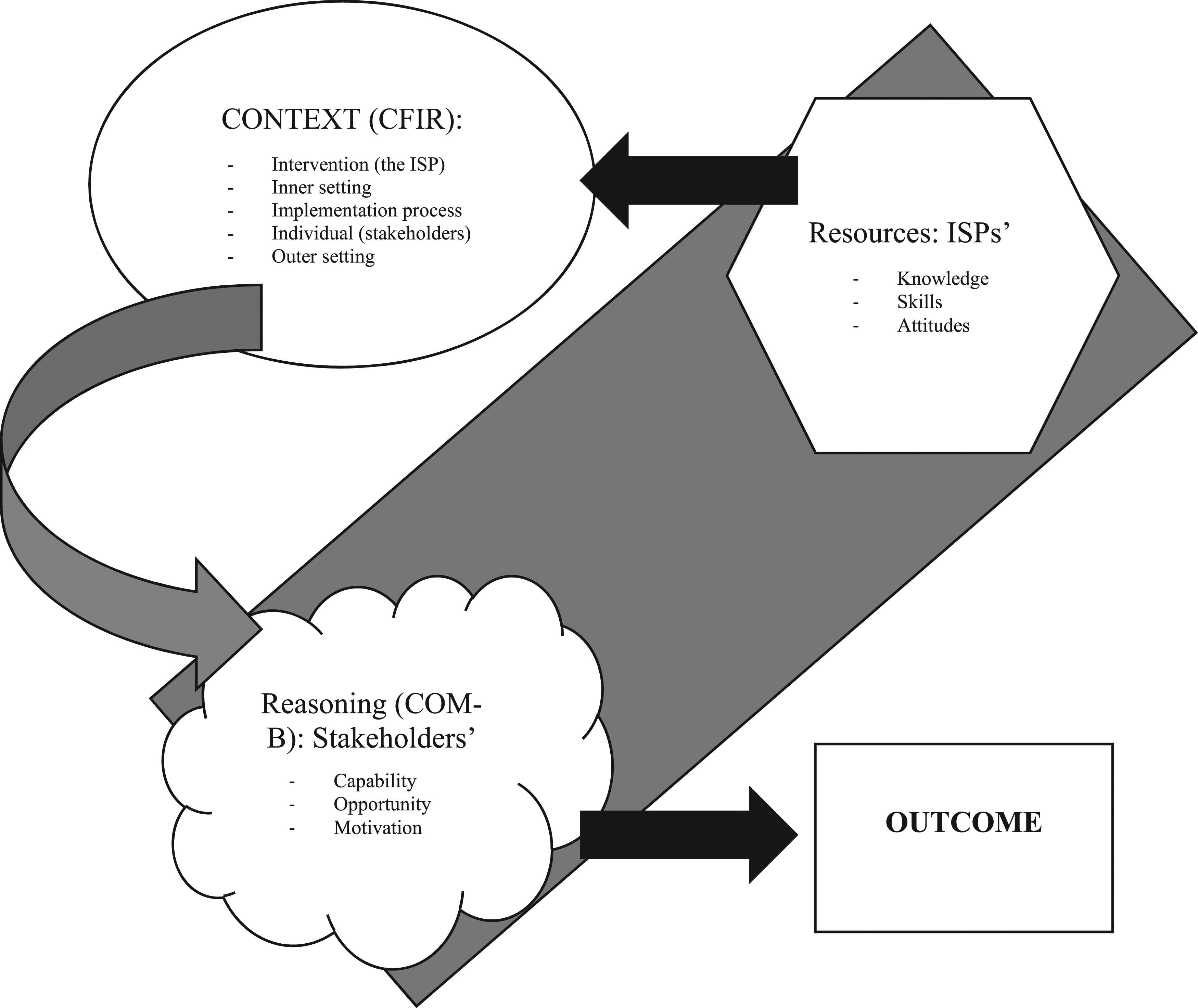
Resources represent the characteristics of the implementation support intervention that is introduced in a given context to facilitate change, and reasoning stands for the ways in which stakeholders to the intended change respond to this intervention. The resource-reasoning interaction is a central part of the previously developed ISP program logic (Albers, Metz, & Burke, 2020). The ISP represents a resource, that is, a unique combination of knowledge, skills, and attitudes, that is linked to or embedded within an organization or system to facilitate change. The ways in which practitioners and organizational leaders respond to the offer an ISP represents—in the form of, for example, respect, an openness to collaborate and learn, or a lack thereof—represents reasoning. Importantly, the nature of this interaction, will be influenced by its surrounding context.
In our review of eligible publications, we used this understanding to identify textual information about how different stakeholders reacted to ISP services, and about potential contextual influences on their reactions. To fully operationalize this understanding for analytical purposes, two frameworks were utilized.
In anticipating that a variety of different types of reasoning would be described in the included literature, the Capability-Opportunity-Motivation-Behavior (COM-B) framework (Michie, van Stralen, & West, 2011), due to its documented comprehensiveness and coherence, was used to categorize this textual information. It describes capability, opportunity, and motivation as three pre-conditions of individual behavior change. In the context of this review, these pre-conditions were viewed as potential types of responses to ISP work, with capability representing information about changes in the physical, cognitive, or psychological abilities of individuals supported by ISPs; and opportunity the changes in the physical, social, and cultural environment that were prompted or triggered through the efforts of an ISP. Similarly, the COM-B allowed for classifying information about increased or decreased motivation in stakeholders collaborating with an ISP.
To operationalize the contextual influences on the ways in which stakeholders respond to an ISP, we utilized the Consolidated Framework for Implementation Research—CFIR (Damschroder et al., 2009), which has been instrumental to categorizing and understanding the determinants of implementing RSIs in human and social services. The CFIR describes five contextual domains, the intervention itself, the individuals involved in its implementation, the inner and outer setting, and the process of the implementation, each of which contain detailed constructs anticipated to either promote or hamper an implementation effort. For example, structural characteristics together with the networks and communication at play in organizations or systems, and their climate and culture are factors that constitute the inner setting of the CFIR. The framework has been used extensively to describe and analyze implementation study contexts (Kirk et al., 2016), and to support the conduct of systematic reviews in a diverse range of human and social service sectors (Li, Jeffs, Barwick, & Stevens, 2018; Means et al., 2020; Pellerin, Lamontagne, Viau‐Guay, & Poulin, 2019; Weiner et al., 2020), demonstrating its robustness as analytical tool.
Data Analysis
Thematic Analysis (ThAn) (Braun & Clarke, 2006, 2012, 2020) was used to capture patterns and themes across all textual data describing the different MoC components in included studies. While characterized as a flexible method for the analysis of qualitative data, as part of which different activities may overlap or occur in parallel, ThAn differs between six distinct processes including (1) data familiarization; (2) systematic data coding; (3) theme development; (4) review; (5) consolidation; and (6) reporting. For this review, the first familiarization with data occurred as part of the literature screening processes. All other ThAn processes are described in the following.
Data coding
For the first round of systematic coding, all included studies were uploaded to dedoose, an online qualitative data analysis platform. This round of coding involved purely deductive coding guided by pre-defined, framework-informed codes used to identify information of interest. The focus was on the semantic level of texts, that is, the direct linguistic meaning of words. A coding scheme, utilizing the above frameworks, functioned as a guide describing each coding category (i.e., resource = ISP knowledge, attitude, or skill; reasoning = capability, opportunity, motivation; context = intervention, individual, inner setting, outer setting, implementation process) and providing examples of information that would belong under these categories. The coding scheme was tested by three research team members on a sample of five studies, and results discussed for further improvement of the scheme. It was then used with all studies, each of which was coded by one research team member. 42% of these were double coded by a second member of the research team, with any conflicts solved by the lead author. The lead author also quality assured the coding of the remaining 58% of studies, based on a review of all text excerpts during data analysis, and a re-coding of these as necessary. Weekly calls with all research team members were used to discuss any issues emerging from this and other data coding activities.
For the second round of coding, text excerpts from all studies were exported from dedoose by coding category, generating six excel spreadsheets. One contained the raw coding data for the MoC components resource and response, whereas the remaining spreadsheets included the coding data for each of the five CFIR domains. The lead author reviewed each of these spreadsheets in detail to ensure that text excerpts were uniformly and correctly coded. If necessary, text excerpts were cross checked with their full texts to inform re-coding decisions. These decisions were then brought back to the research team for discussion. Coding examples for each of the categories that are at the center of this article (reasoning and different context domains) are included in an additional Electronic Results Addendum (Albers, Bührmann, Driessen, Bartley, & Varsi, 2021) linked to this article.
Theme development, review, and consolidation
For the generation of themes, all text excerpts for a single identified MoC were reviewed and compared with each other, leading to the development of initial broader ideas present in the data material for each of these components. These ideas were then reviewed and revised in a second step of theme development, focused on their cross-MoC comparison and refinement and the interpretation of how different themes may be interlinked as part of a MoC dynamic. The conclusion of this process was the development of an integrated narrative that provides a detailed description of how different MoCs may show in routine service settings, and how they may influence each other. This narrative is presented in the following, representing the reporting phase of ThAn.
Results
Data on stakeholder responses to and the contextual influences on ISP efforts could be extracted from 78 out of the 109 publications that were included in this review. To provide a full overview of these 78 publications, an additional Electronic Results Addendum (ERA 2) was developed including multiple tables that summarize the key characteristics of publications and the type of data that could be extracted for this analysis (Albers et al., 2021).
The overwhelming majority of these presented findings from the US (n = 46) and Canada (n = 16), whereas European countries (n = 12) and the Australasian region (n = 2) were less represented. One further publication covered multiple international locations, and another did not include geographical indicators. The information contained in publications built on either qualitative (n = 30), quantitative (n = 25) or mixed methods designs (n = 23), and related to primarily health (n = 55), followed by social welfare (n = 14) and educational (n = 7) service settings. One publication referred to a mix of different service settings and one to criminal justice. The four most prominent ISP roles in focus of eligible publications were facilitators (n = 17), consultants (n = 14), knowledge brokers (n = 13), and TA providers (n = 10). Coaches were at the center of seven publications, and the remaining 17 publications examined a range of other roles.
Stakeholder Responses to ISPs
Data on how stakeholders responded to the knowledge, skills, or attitudes of ISPs could be extracted from 50 publications. The vast majority of these text excerpts (67%) presented ISPs’ use of strategies (i.e., skills) as the trigger for responses from their stakeholders. Further, 26% of excerpts described attitudes and/or a combination of strategy use plus attitudes as the reason for such reaction. Only few excerpts (4%) focused on ISP knowledge as a factor that activates responses in those supported by an ISP, and further 3% did not specify the exact ISP characteristic that brought about the stakeholder response.
The publications including these excerpts described changes in stakeholders’ capability (n=22), opportunity (n=25), and motivation (n=14) as generated by ISPs’ efforts. Figure 2 summarizes the essence of findings explaining why and how stakeholders may respond to the offering of ISPs. In the following, the details of these findings will be outlined, presented in the order with which they appear in Figure 2. Implementation support practitioner mechanisms of change.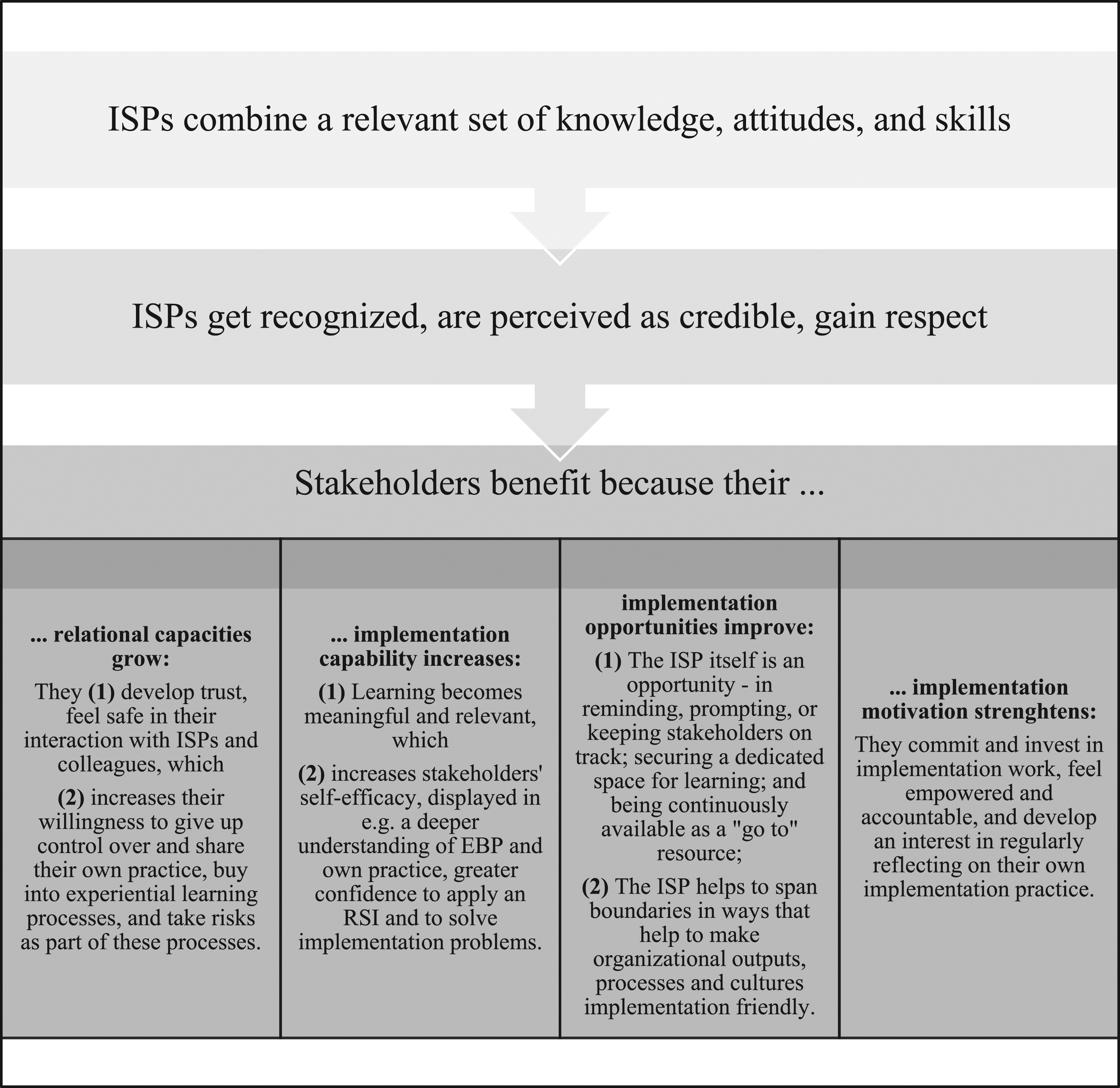
Relational responses
Of particular presence in the literature and extracted from 24 studies were text excerpts describing stakeholders’ relational responses to the efforts of ISPs. These responses center on the topic of trust and the development and/or strengthening of relationships, which could not be identified clearly as an element of any of the three COM-B domains. Given their noticeable presence in the literature, these responses were therefore analyzed separately.
Across the publications describing stakeholders’ relational responses to the efforts of ISPs, typical labels used to describe these responses were stakeholders developing trust (Akin, 2016; Bidassie, Williams, Woodward-Hagg, Matthias, & Damush, 2015; Duffy et al., 2012; Dusenbury et al., 2010; Kaasalainen et al., 2015; Olson, McCarthy, Perkins, & Borden, 2018; Rushovich, Bartley, Steward, & Bright, 2015; Williams, Burton, & Rycroft-Malone, 2013; Yazejian et al., 2019), or experiencing a sense of safety in the interaction with the ISP (Akin, 2016; Anyon, Nicotera, & Veeh, 2016; Barac, Kimber, Johnson, & Barwick, 2018; Duffy et al., 2012; Shernoff, Lakind, Frazier, & Jakobsons, 2015; Tierney, Kislov, R., & Deaton, 2014). Their development was described as emerging from skilled strategy use lending credibility to ISPs’ expertise (Barac et al., 2018), knowledge use helping ISPs to gain “respect and recognition among their colleagues” (Aasekjaer, Waehle, Ciliska, Nordtvedt, & Hjälmhult, 2016, p. 37), and attitudes when, for example, perceived as a sign of respect for the stakeholders whom ISPs worked with (Beidas et al., 2013).
Studies reported that for stakeholders experiencing this trust and sense of safety, it became easier to share details about their own clinical or educational practice (Bidassie et al., 2015), and to buy into and experiment with new approaches to this practice (Akin, 2016; Anyon et al., 2016; Duffy et al., 2012). This became possible because stakeholders felt that they were not being judged or evaluated negatively (Shernoff et al., 2015) and therefore could give up a part of their control (Hurlburt et al., 2014), both in their relationship to ISPs and in their relationships with other stakeholders also involved in the implementation support (Beidas et al., 2013; Gustafson et al., 2013; Rosen et al., 2012; Rushovich et al., 2015). Both of these types of relationships were described as requiring a sense of safety for stakeholders to share experience and engage in joint learning and hence highlighted as points of attention for ISPs’ work.
Few studies included descriptions of negative relational responses from stakeholders and indicated that a lack of familiarity with local contexts and difficulties with validating stakeholders’ experience could lead to decreased trust toward the ISP (Shernoff et al., 2015).
Capability
In examining how ISPs did contribute to the building of knowledge and skills in their stakeholders, two insights could be gained from the literature: Firstly, ISPs helped to make stakeholders’ learning meaningful, and secondly, they built their stakeholders’ self-efficacy, that is, their confidence in being able to exercise relevant implementation behaviors.
In building on both the aforementioned trust (relational response) and the dedicated space for reflection (opportunity), ISPs’ strategy use was described as making learning particularly meaningful (Williams et al., 2013), because it helped stakeholders to view both the ISP and their own colleagues as allies in a learning process (Barac et al., 2018; Beidas et al., 2013), in which they could engage with an open mind. This open mind showed in stakeholders engaging in identifying their own learning needs (Akin, 2016), absorbing new knowledge, even if this knowledge meant challenging their own beliefs (Calo et al., 2018) and changing perspectives (Shernoff et al., 2015; Worton et al., 2018), and by experimenting with new techniques and behaviors (Anyon et al., 2016; Barac et al., 2018).
Such meaningful learning helped to develop stakeholders’ self-efficacy, displayed in a deeper understanding of evidence-based practice (Aasekjaer et al., 2016) and of one’s own specific practice area (Anaby et al., 2015; Brown et al., 2018b; Kristensen & Hounsgaard, 2013); more clarity on the intervention (Akin, 2016) and greater confidence to apply this intervention (Hodge, Turner, Sanders, & Forster, 2017; Leeman, Myers, Grant, Wangen, & Queen, 2017; Rosella et al., 2018; Shernoff et al., 2015); the generation of “applicable and doable” (Akin, 2016, p. 165) ideas for practice; and an improved individual capacity to solve problems that occurred as part of the implementation process (Bradshaw, Pas, Goldweber, Rosenberg, & Leaf, 2012; Calo et al., 2018; McCullough et al., 2017). A single study (Gunderson et al., 2018) involved ISPs who displayed an unprofessional attitude, decreasing the perceived self-efficacy with which their stakeholders applied the RSI in focus of the study.
Opportunity
With opportunity referring to all “factors that lie outside the individual” (Michie et al., 2011, p. 4), which make it possible for stakeholders to develop and show behavior supportive of implementation, publications were screened for information describing how ISPs contributed to creating such opportunities. Two types of opportunities could be identified, with the most prominent being the ISP itself, followed by opportunities to change organizational norms.
A broad range of studies presented the ISP role as an opportunity for enabling implementation behavior, because it represents an explicit and often additional layer of support legitimate to be used by stakeholders when needed. As this resource, ISPs were described as creating opportunities by reminding or prompting their stakeholders of intended changes and thereby keeping them on track with the planned implementation process in an often busy and complex environment with multiple competing demands (Anyon et al., 2016; Barac et al., 2018; Chinman, McCarthy, Hannah, Byrne, & Smelson, 2017; Holtrop, Baumann, Arnold, & Torres, 2008; Kristensen & Hounsgaard, 2013; Rushovich et al., 2015). regularly securing “a dedicated, carved out space” (Barac et al., 2018, p. 13) for stakeholders to reflect on their implementation process; this was made possible through the regular provision of implementation data, or the scheduling of support sessions and activities as required (Barac et al., 2018; Brunette et al., 2008; Cameron, Russell, Rivard, Darrah, & Palisano, 2011; Kousgaard & Thorsen, 2012; Shernoff et al., 2015; Worton et al., 2018); and ensuring they are continuously available as a go to person for stakeholders in need of advice on different aspects of the implementation process (Bidassie et al., 2015; Duffy et al., 2012; Hurlburt et al., 2014; Mackenzie et al., 2011; Shernoff et al., 2015; Williams et al., 2013), including barriers not foreseen at the commencement of an implementation (Anyon et al., 2016; Barac et al., 2018). At a more pragmatic level, being this go to person could also imply, for example, sourcing evidence or collecting additional data, both of which were presented as saving stakeholders’ time (Cameron et al., 2011; Mackenzie et al., 2011).
A second group of studies included descriptions of opportunities for changing implementation behavior being created at the organizational level. In some studies, this could be reflected in the development of new organizational policies (Acolet et al., 2011), action or work plans (Brunette et al., 2008; Rosella et al., 2018), or annual reports (Rosella et al., 2018), with ISPs being described as supporting their development through the provision of data and intervention expertise. Other studies described broader ambitions to change entire organizational cultures and climates, presenting the ISP as the lynchpin of often complex implementation support interventions aimed at promoting this culture change (Glisson, Hemmelgarn, Green, & Williams, 2013; Hurlburt et al., 2014; Saldana & Chamberlain, 2012; Williams et al., 2017). A key characteristic of these interventions was to focus on the ISP as boundary spanner or linking agent who can “pull disparate strands of information and people together” (Waterman et al., 2015, p. 7), assumed to enable collaboration among diverse stakeholders (Saldana & Chamberlain, 2012) and to “create proficient organizational cultures” (Williams et al., 2017, p. 2).
Motivation
Motivation refers to both reflective and automatic processes in individuals that “energize and direct” (Michie et al., 2011, p. 4) their implementation behavior. In summarizing how ISPs used different strategies to enable reflection among their stakeholders, for example, through consultation/facilitation or audit and feedback, this aspect of motivation has been covered elsewhere (Albers, Metz, Burke, Bührmann, et al., 2020). The focus here is therefore on descriptions in the literature presenting automatic aspects of motivational processes occurring in stakeholders and the ways in which ISPs may contribute to these.
Firstly, at a general level, ISPs’ strategy use and attitudes were described as helping to boost morale in stakeholders (Brunette et al., 2008), and to motivate them to (a) take action in unanticipated ways (Brown et al., 2018b), (b) invest in the implementation process (Duffy et al., 2012), and (c) stay enthusiastic about (Kousgaard & Thorsen, 2012) and committed and loyal to this process over time (Waterman et al., 2015). Secondly, and more specifically, a positive and validating ISP attitude was described as helping to empower and thereby motivate stakeholders (Akin, 2016; Anaby, Korner-Bitensky, Law, & Cormier, 2015), among others because this positivity was perceived as markedly different from what stakeholders were used to in their daily work routines. However, positivity, when perceived as being unauthentic, could also demotivate stakeholders (Akin, 2016). Finally, ISP strategy use, with a focus on consultation/facilitation, was presented as strengthening stakeholders’ sense of responsibility and accountability for their practice (Akin, 2016; Barac et al., 2018; Meropol et al., 2014), helping them to stay engaged in the implementation.
Contextual Influences on the Work of ISPs
Contextual Factors Affecting ISP Work by CFIR Domain.
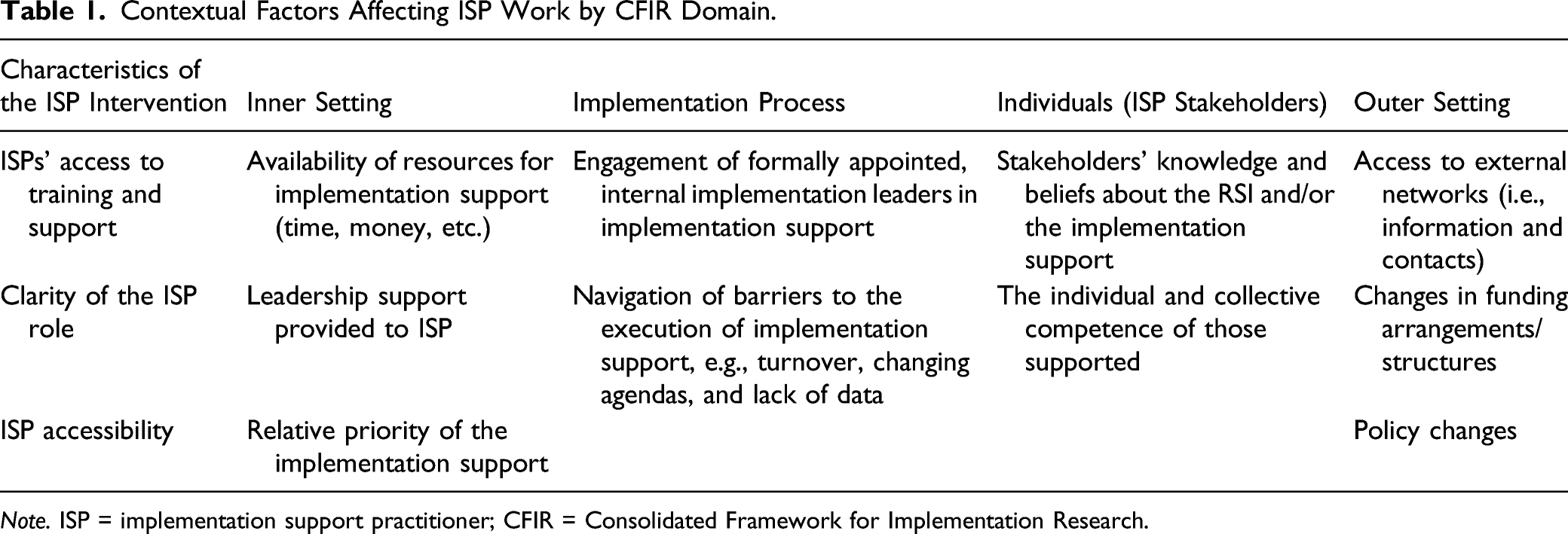
Note. ISP = implementation support practitioner; CFIR = Consolidated Framework for Implementation Research.
Intervention characteristics
The domain with greatest presence in the literature (n=43) was intervention characteristics. While this CFIR domain typically is used to identify the characteristics of clinical or therapeutic interventions that function as determinants to their implementation, in the context of this review it refers to the ISP role as an implementation intervention. Three key features of this role were particularly visible in the literature as influencing the quality of ISP efforts. These include the ISP’s access to training/support, the clarity, and the accessibility of the ISP role.
ISPs’ access to training and supervision provided by others to support the ISP in their work was described in 33 studies and could exist as formal structures, represented by, for example, a research team (Anaby et al., 2015; Lessard et al., 2016; Rivard et al., 2010; Russell et al., 2010), supervisor (Chew, Armstrong, & Martin, 2013; Dickinson et al., 2014), lead coach (Gunderson et al., 2018), manager (Graaf et al., 2017), or an intervention and/or implementation expert (Chinman et al., 2017). While the details of this support were not always described, studies indicated that its aims centered around problem-solving (Funderburk et al., 2015; Olson et al., 2018; Rivard et al., 2010), that is, helping ISPs remove barriers to providing implementation support, and quality assurance, that is, ensuring that the implementation support provided met pre-defined standards (Elnitsky et al., 2015; Funderburk et al., 2015; Sanetti, Williamson, Long, & Kratochwill, 2018; Shernoff et al., 2015). However, support could also have a more basic function of updating ISPs on information and knowledge they required as part of their work, related to, for example, the intervention to be implemented (Rivard et al., 2010; Russell et al., 2010; Waterman et al., 2015). For some studies, ISP support structures were formalized even further by being integrated into the ISP intervention. This occurred, for example, by establishing two-layered implementation support structures consisting of, for example, an external facilitator, taking the outside support role otherwise assigned to, for example, principal investigators, and an internal facilitator providing implementation support within organizations or systems they themselves were part of (McCullough et al., 2017; Rosen et al., 2012). Another study described the use of knowledge brokers together with an additional “broker to the brokers” (Rivard et al., 2010, p. 1583). Other studies presented implementation teaming structures as a way to build capacity for supporting ISPs. In these structures, multiple ISPs formed a team with complementary types of competencies potentially increasing the quality of the implementation support provided (Quanbeck et al., 2018; Rosella et al., 2018). Furthermore, teaming structures were presented as less vulnerable to competency loss in the case of ISP turnover (Chaffin et al., 2016).
In addition to these formal support structures, multiple studies described informal support as a common feature of ISP interventions, typically organized within peer-to-peer structures through which ISPs connected with each other, both face-to-face and remotely, for mutual exchange and support. Its purpose was described as exchanging knowledge (Rivard et al., 2010), enabling shared learning (Chew et al., 2013), promoting cross-ISP collaboration (Russell et al., 2010; Shernoff et al., 2015), and also providing social support in cases where implementation support work was highly individualized (Chew et al., 2013; Dogherty, Harrison, Baker, & Graham, 2012; Graaf, McBeath, Lwin, Holmes, & Austin, 2017).
A further 18 studies contained information about ISP role clarity as a factor that potentially can influence the quality of the support that ISPs are able to offer others.
This literature reflected that with the ISP often being introduced as a new role in organizations or systems, it had the potential to challenge existing chains of command or power structures, both when established internally or externally. Stakeholders to an implementation support process may therefore face a lack of security when entering into this process, making it pertinent to create clear expectations around the role and responsibilities of an ISP. Studies indicated that this applied to both ISPs and those supported.
For ISPs, role clarity was described as a pre-condition for developing a sense of direction (Chew et al., 2013; Rushovich et al., 2015), a professional identity (Chew et al., 2013) and authority (Gerrish et al., 2012) and for navigating demands. These demands could be workload or responsibility related. ISPs requested role clarity to avoid work overload, emerging partly from specific ISP responsibilities that competed with other work obligations (Chaffin et al., 2016; Gerrish et al., 2012; Gunderson et al., 2018), partly from stakeholders’ expectations that ISPs would do—and not only support—their work (Duffy et al., 2012; Waterman et al., 2015), and partly from support requests coming from a wider group of stakeholders than originally anticipated to be supported by ISPs (Rivard et al., 2010).
Simultaneously, role clarity was required to create clear expectations around ISPs’ authority among those whom they supported. For example, ISPs could be responsible for not only assisting in but also evaluating the work of their stakeholders, necessitating the definition of the scope of this evaluative function and an acknowledgement of the imbalance of power it may create (Gunderson et al., 2018; Olson et al., 2018). In another study, the influence of internal facilitators was seen to suffer from a lack of formal authority that made it difficult for them to stand up “to peers, over whom one does not have official power” (McCullough et al., 2017, p. 1020). Further two studies described that ISPs struggled to be taken seriously by their stakeholders, in one case because they were not in a formal leadership role (Sanetti, Fallon, & Collier-Meek, 2013), and in a second study “due to tensions regarding professional autonomy” between nurses and medical professions (Gerrish et al., 2012, p. 12). Further studies pointed to the ISPs’ position as a source of distrust in that external requests for data and information coming from ISPs, who did not belong to the service system they supported, were met with suspicion by stakeholders (Waterman et al., 2015).
Finally, 15 studies contained descriptions of ISP accessibility as a factor potentially affecting the mechanisms of implementation support. In these studies, accessibility referred to both an ISP’s physical presence in the context that received implementation support and the degree to which an ISP was perceived as readily available when support needs emerged. Providing implementation support from a distance was at times presented as a barrier because it did not align with the preferences of those supported (Calo et al., 2018) or made educating others more difficult (Bidassie et al., 2015). Other studies described how being more present as an ISP could lead to (a) more frequent contacts with those supported (Duffy et al., 2012; Gerrish et al., 2012; Gunderson et al., 2018; Leathers, Spielfogel, Blakey, Christian, & Atkins, 2016), (b) greater familiarity with local routines or norms (Kirchner et al., 2014), (c) better opportunities for ISPs to offer assistance (Leathers et al., 2016; Sanetti et al., 2013), and (d) establishing professional credibility (Gerrish et al., 2012)—factors viewed as potentially contributing to building closer, collaborative relationships between ISPs and those supported.
Inner setting
Of the CFIR constructs contained in the inner setting of an implementation, resource availability, leadership engagement, and the relative priority assigned to the role of the ISP were the three determinants that had the strongest presence in the literature.
Twenty-four publications presented the resources available to utilize implementation support in the form of time, money, or other means as a key determinant of implementation support. This included organizational behaviors such as organizing schedules or workloads in ways that allowed staff to attend ISP-run support sessions (Bidassie et al., 2015; Dogherty, Harrison, Graham, Vandyk, & Keeping‐Burke, 2013; Gerrish et al., 2012; Graaf et al., 2017; Holtrop et al., 2008; Kauth et al., 2010; Kinley et al., 2014; Mold, Aspy, & Nagykaldi, 2008; Rivard et al., 2010; Rosen et al., 2012; Shernoff et al., 2015); providing administrative assistance to integrate implementation support in daily routines (Leathers et al., 2016; Waterman et al., 2015); acquiring resources, such as IT support or library access, crucial to the provision of implementation support (Gerrish et al., 2012); recruiting staff to implementation support initiatives (Tierney et al., 2014); or procuring and allocating funds to ISP positions (Cameron et al., 2011; Kristensen & Hounsgaard, 2013; Russell et al., 2010; Zijpp et al., 2016).
Leadership engagement, that is, leaders’ and managers’ commitment to and involvement in the implementation support emerged as the second key determinant, presented in 16 studies. On the negative side, “poor leadership” (Waterman et al., 2015, p. 9), leadership turnover (Rushovich et al., 2015), a lack of leadership support (Dogherty et al., 2013), and conflicts between ISPs and leaders (Zijpp et al., 2016) were described as barriers to providing implementation support. On the other hand, implementation expectations voiced clearly by leaders (Gerrish et al., 2012; Russell et al., 2010), together with active and visible leadership support provided to the ISP (Holtrop et al., 2008; Leathers et al., 2016; McCullough et al., 2017; Mitchell et al., 2004; Rivard et al., 2010) were characterized as positive facilitators for offering and utilizing implementation support.
Closely linked to this leadership engagement was the relative priority which stakeholders assigned to the implementation support provided. It describes to what degree the role and work of ISPs were viewed as important to prioritize and emerged as a determinant based on descriptions contained in 10 studies. The degree to which an ISP role was prioritized could be reflected positively in, for example, an overall organizational commitment to this role (Anaby et al., 2015; Williams et al., 2013) and negatively in a lack of a clear strategy for utilizing the implementation support (Chew et al., 2013). Continuously reiterating the reasons for engaging in implementation support (Zijpp et al., 2016), aligning this engagement with an organization’s values (Cameron et al., 2011), protecting it against competing organizational needs (Duffy et al., 2012; Dusenbury et al., 2010) and ensuring to communicate its implications to all relevant stakeholders (Jacobson, Johnson, Deyo, Alagoz, & Quanbeck, 2019) were described as further indicators of this prioritization or a lack thereof.
Process
Across the literature reviewed, descriptions of contextual process factors affecting the work of ISPs referred primarily to the engagement of formally appointed internal implementation leaders.
Fifteen studies outlined how engaging these leaders could enhance or hamper ISP work. For example, when responsibilities for the dissemination of a clinical protocol between managers and knowledge brokers were not clearly defined, its integration in practice showed to be more difficult (Aasekjaer et al., 2016). Similarly, principals could turn out to be an inadequate main contact point for knowledge brokers because they functioned as gatekeepers for the use of knowledge brokering in schools (Brown et al., 2018b). In another study, a strained collaboration between ISPs and leaders contributed to confusion and delays in an implementation process involving consultants (Brunette et al., 2008), and a study of TA providers reported that working with leaders “too high up the chain of command” (Duffy et al., 2012, p. 381) made it difficult to create buy-in for changes at the right leadership level and thereby to work directly with frontline staff. Furthermore, leadership turnover could necessitate for ISPs to fully re-build such buy-in, making it more complicated to continue with other implementation support activities during such transition (Rushovich et al., 2015; Zijpp et al., 2016).
On the positive side, studies described the role of a constructive collaboration between ISPs and formal implementation leaders as helping to reinforce the importance of the implementation support locally (Gerrish et al., 2012; Gunderson et al., 2018), to integrate this support more broadly in an organization (Shernoff et al., 2015), and to generate buy-in to implementing changes among practice staff, thereby helping implementers to stay focused on change efforts (Mader et al., 2016). As such, these results link back to the inner setting factor leadership engagement and provide greater detail on how this support may affect the role and work of ISPs.
Other process factors described in publications (n = 11) as affecting the provision of implementation support fall under the “executing” construct of the CFIR describing to what degree an implementation was carried out according to plan. Central barriers identified were changing or diverging ideas about the implementation among the stakeholders who received support, leading to tensions among them (Hurlburt et al., 2014) and necessitating extra effort from ISPs (Waterman et al., 2015); staff turnover creating “a ‘vacuum’ of information” (Rushovich et al., 2015, p. 371) among new recruits, which ISPs had to fill; implementers not using recommended tools making it more difficult for ISPs to advocate for and track an implementation (Jacobson et al., 2019); a lack of readily available data to use for implementation support (Bidassie et al., 2015); complexities in the technical setup (video, internet) preventing implementation support to be delivered as intended (Funderburk et al., 2015); and organizational resource constraints leading to staff being removed from an implementation support effort before its finalization (Aasekjaer et al., 2016).
Fewer studies presented facilitators to the execution of implementation support efforts. One study highlighted that, as implementers gain experience with receiving implementation support, this increased capacity made it possible for ISPs to address a larger number of higher order, rather than just basic, concerns, thereby growing local implementation capacity over time (Dogherty et al., 2012). A study of facilitators suggested that ISPs utilizing the supports available to them may have greater ability to provide implementation support as planned (McCullough et al., 2017), whereas a study of TA providers pointed to constructive collaboration between ISPs and data and evaluation experts as a facilitator to increasing stakeholders’ understanding of data use as part of implementation support (Rushovich et al., 2015).
Individuals
The process of providing implementation support establishes a relationship between individuals, each of whom contributes to this relationship. The work of ISPs can thus be assumed to also be influenced by those whom they support. Twenty-four studies described stakeholder characteristics potentially affecting the way in which implementation support can be delivered and utilized. The CFIR constructs individuals’ knowledge of and belief in the intervention together with other personal attributes were the two constructs with greatest presence in the literature.
Information about individuals’ knowledge and beliefs were contained in 15 studies and presented as relating to both the clinical/educational intervention that was the focus of the implementation support and this support itself. An example of the former was contained in a study of non-specified ISPs who had attended an education in evidence-based practice and hereafter worked to support their colleagues in taking up the principles of EBP in their daily routines. The fact that managers had participated in the same education, made it easier for these leaders to support the work of the ISPs (Aasekjaer et al., 2016). Oppositely, a study of facilitators working to support the implementation of guidelines (Dogherty et al., 2013), described that when working with stakeholders who strongly opposed this guideline, “tainted relations” (p. 135) among stakeholders characterized large parts of the implementation. Further studies reported similar dynamics in leveraging implementation support, with stakeholders who doubted the benefit of following an evidence-based approach to human service practice, making it more difficult to provide support (Dusenbury et al., 2010; Waterman et al., 2015), and stakeholders curious about and open to this approach, making it easier (Anaby et al., 2015). Additionally, individuals’ knowledge and belief about the implementation support itself was presented as affecting its provision. One study of knowledge brokers highlighted that administrators were first willing to promote this brokering when presented with evidence demonstrating its efficacy (Cameron et al., 2011), while another study described how beliefs about implementation support could transpire in more subtle ways: Because “doctors [did not] like to be coached” (Jacobson et al., 2019, p. 4), it was decided to exchange the coaching terms with consultant/consulting.
Other personal attributes was the second CFIR construct that could be identified in the literature (n = 11) as influencing the work of ISPs, with the competence of individuals supported emerging as the predominant factor. Studies described this competence in a range of ways.
At the most basic level, it was indicated that implementation support, for example, when developed for clinicians but then also provided to administrative support staff, could be misdirected at a particular professional group, which therefore perceived it as not suitable (Tierney et al., 2014). Other studies highlighted that the skills of those supported could affect the influence of that support. For example, a study of consultation described how the lack of skills in a local change team in analyzing and conceptualizing its own workflows and applying other quality improvement methods required consultants to adjust their support to meet more fundamental needs present in the team (Jacobson et al., 2019), diminishing opportunities to address higher-order concerns. In another study of technical assistance, increases in stakeholders’ general EBP awareness were measured to be largest among those who already met practice quality standards in their field (Brownson et al., 2007).
Furthermore, studies presented implementation support as being easier to provide when ISPs were surrounded by the right mix of competencies, displayed in, for example, individuals’ understanding of implementation and improvement processes (Gunderson et al., 2018; Jacobson et al., 2019), but also in the multidisciplinary composition of stakeholder groups receiving support—because this mix of competencies enabled ISPs to, for example, gain a better understanding of the context they supported (Jacobson et al., 2019); build wider acceptance of the implementation in focus and the support provided (Dogherty et al., 2012; Gerrish et al., 2012); or, when the right formal authority was represented in a stakeholder group, prepare decisions that were necessary for progressing an implementation (Brownson et al., 2007; Jacobson et al., 2019).
Outer setting
Of the constructs contained in the outer setting domain of the CFIR, cosmopolitanism and external policies and incentives showed to be most present in the literature reviewed. Both were described as an influence on the work of ISPs in 10 and 11 studies, respectively.
Cosmopolitanism describes the degree to which the implementing system is externally networked, with connections to other entities assumed to promote an implementation (Damschroder et al., 2009). In transferring this thinking to the work of ISPs, information was identified in the literature about how these connections may influence implementation support.
Some studies indicated that connections to and involvement of other organizations could strengthen or expand implementation support, for example, when ISPs held strong relationships to RSI developers making it possible, or even mandatory, to involve these when navigating implementation barriers (Saldana & Chamberlain, 2012); when connections made it possible to gain access to contacts, information, and resources needed to deliver implementation support (Waterman et al., 2015); when the interaction with other entities led to further strengthening the professional quality reflected in the local implementation effort (Kristensen & Hounsgaard, 2013); or when the endorsement of other entities helped to increase implementation support demand and momentum (Brown et al., 2018b; Tierney et al., 2014). Studies also contained descriptions of negative consequences of cosmopolitanism for the work of ISPs. One study pointed to the pressure ISPs may experience when they, next to supporting inner setting stakeholders, also get involved with outer setting organizations in efforts to “span inner and outer contexts” (Gunderson et al., 2018, p. 3) of an implementation. This was described as particularly challenging for ISPs who work with multiple organizations in geographically diverse areas (Gerrish et al., 2012), potentially increasing the number of outer setting stakeholders relevant to consider as part of the implementation support to an unmanageable level.
For the construct of external policies and incentives, studies presented especially funding bodies and structures as influencing the work of ISPs. Budget cuts or limitations in funding could add to pressures experienced by ISP stakeholders and thereby limit the funding available for implementation support (Brown et al., 2018a; Dusenbury et al., 2010) or lead to differing opinions about which entities should fund this support (Cameron et al., 2011). Publications on multi-agency implementation teams reported that a willingness among multiple and diverse actors to contribute to shared ISP funding arrangements could be complicated to establish (Chaffin et al., 2016), for example, when these arrangements were difficult to align with specific outer context reporting requirements (Gunderson et al., 2018). Furthermore, tight implementation timeframes set by funders could require rapid start-ups of initiatives, thereby reducing the time available to assess and plan for stakeholders’ implementation support needs (Rushovich et al., 2015).
Policies emanating from the outer context were another factor influencing the work of ISPs in that they, on the one hand, could increase stakeholders’ interest in joining an implementation initiative and its inherent implementation support (Kirchner et al., 2014; Tierney et al., 2014) and, on the other hand, create anxiety among stakeholders if, for example, policies were in conflict with the goals of an implementation effort (Tierney et al., 2014), or a new policy required changes to this effort and therefore decreased or increased support from the ISP (Jacobson et al., 2019).
Discussion and Applications to Practice
The findings from this integrative review suggest that implementation support practitioners, through the intentional use of their knowledge, skills, and attitudes, may enable implementation behavior in the individuals, organizations, and systems they support. This occurs by installing trust in and among stakeholders and utilizing this trust to promote meaningful and relevant learning; providing ongoing opportunities for learning, reflection, and support; helping to span boundaries in ways that support implementation; and positively motivating stakeholders.
To what degree these mechanisms can successfully unfold, will depend on the contexts in which ISPs operate. Among the particularly crucial contextual factors defining ISPs’ room for maneuver is the setup of the ISP role itself, including ISPs’ access to training and support, the clarity of their position description and responsibilities and their accessibility for stakeholders. Resources, leadership support, and the relative priority assigned to the ISP role and its function are central inner setting factors affecting ISPs’ work, whereas external networks, funding, and policy structures are the main factors reported to have a bearing on ISPs from the outer setting. Among process factors, it is especially the engagement of formally appointed implementation leaders and the attention paid to removing and/or navigating barriers for providing and maintaining implementation support, such as stakeholder turnover, changing priorities, or a lack of data, that can affect the efforts of ISPs. These efforts are also influenced by the characteristics and attributes of ISPs’ stakeholders, namely their knowledge and beliefs about the intervention to be implemented and about the implementation support provided, and their individual as well as collective competence.
It is clear from these findings that integrating implementation support roles as a resource for individuals, organizations, and systems working toward implementing research-supported interventions and establishing evidence-based practice in social and human services, represents an additional layer of potential implementation challenges that require separate attention.
For organizations operating in the social and human service sector wanting to strengthen their use of RSIs in routine practice and therefore collaborating with ISPs—or establishing own ISP roles—it is important to understand that hiring an ISP in itself will not solve the implementation challenges the organization might experience. Deciding to work with an ISP, be this a single or multiple either internal or external roles, creates a two-way street, a relationship requiring give-and-take from all actors involved in the implementation support work. While ISPs will need to bring their knowledge, skills, and attitudes to bear in ways that are tailored to the conditions of their local contexts, organizations will need to consider how they can help to shape these contexts in ways conducive to fully utilizing the opportunities that ISPs represent.
The support from organizational and system leaders appears to be of particular importance to ISPs and confirms findings from the wider literature describing leadership as a contextual enabler of, for example, quality improvement collaboratives (Zamboni, Baker, Tyagi, Schellenberg, Hill, & Hanson, 2020), or the work of change agents (McCormack et al., 2013). One possible explanation for the importance of this leadership may be the boundary spanning character of the ISP position. As discussed elsewhere (Kislov, Hodgson, & Boaden, 2016, 2017), taking such a position implies facing tensions, because in promoting the uptake of research findings, ISPs need to navigate diverse stakeholder knowledge, beliefs, expectations, and interests, and steadily changing organizational priorities. In doing so, they may be perceived as menacing or threatening, for example, if they appear to oppose current knowledge and beliefs and question professional norms and standards as well as the routines and quality of services as usual. As a consequence, they may be met with resistance and, in light of mounting stakeholder pressure or demanding organizational complexities, be at risk of compromising on the standards of evidence-based practice and quality implementation that are the reason for them to be hired in the first place. Organizational and system implementation leaders have the authority and resources to help prevent and/or balance such potential tension and to set the stage for how ISP positions are framed, prioritized, and utilized (Aarons, Ehrhart, Farahnak, & Sklar, 2014; Fenwick, Brimhall, Hurlburt, & Aarons, 2019; Rogers, De Brún, Birken, Davies, & McAuliffe, 2020). This includes full discretion in deciding whether to meet specific ISP needs for, for example, flexibility, risk taking, or swift decision-making under uncertain conditions.
Equal attention will be required from organizational leaders when defining the scope of ISP roles, which, in promoting implementation practice change, depend on a clearly defined description of their core function and responsibilities. In the absence of such clarity, ISPs would be at risk of facing misconceptions of their role among the stakeholders they work to support (Riordan, McGrath, Dinneen, Kearney, & McHugh, 2019), potentially reducing their ability to build the trusting and constructive work relationships that enable them to facilitate learning. Furthermore, embedding ISPs—and with them a focus on implementation practice—into the established structures, routines, and domains that connect different professions, for example, social workers, psychologists, or educators, as well as different organizational roles, for example, supervisors, middle managers, or administrative personnel, has the potential for causing friction. Organizational members may perceive the introduction of an ISP role and the need to attend to implementation practice as an unnecessary addition to existing work portfolios, an effort to threaten their autonomy and influence in the organization or to question the quality of their work (Hamilton et al., 2015; Powell & Davies, 2012; Reay, Goodrick, & Hinings, 2016). As a result, they may be unwilling to enter into a collaboration with the ISP or engage only hesitantly. Experience with embedding new organizational roles in human service settings reflects that multiple questions need to be considered as part of this process. These include how to link the new role with current organizational structures and priorities, how to reallocate existing and new tasks, or how to alter working relationships. In doing so, it has shown to be insufficient to focus on the new role alone. Rather, an adaptive team or group perspective should be taken also involving those members of the organization that will be linked to and collaborate with the new role (Carter et al., 2010). Further aspects of clarifying the ISP role and responsibilities are to identify the resources and infrastructure needed for it to function and operate as intended and to be sustained in the long-term. Defining the scope of ISP roles in this way may require a bi-directional, collaborative, and adaptive learning process that involves ISPs, organizational and system leaders, and staff members directly affected by the implementation support.
With trusting relationships having been identified as a central ingredient of the mechanism that connects the work of ISPs with individual and organizational behavior change, it will also be crucial for organizations and agencies establishing or utilizing ISP roles to attend to more than just the quality of the technical aspects of the implementation support work that is provided to different individuals and groups (i.e., the skilled use of implementation knowledge and strategies in combination with appropriate attitudes). The quality of the relationships among the stakeholders involved in this support is an equally important focus and may explain why perfectly offered implementation support at times remains unsuccessful. In the literature, relationships among staff in health and human service agencies have been described as social capital (DiCicco-Bloom et al., 2007) that, over time, will emerge from interactions occurring among different stakeholders (Lanham et al., 2009) and can influence service as well as patient and client outcomes (DiCicco-Bloom & DiCicco-Bloom, 2016; Leykum, Lanham, Pugh, et al., 2014; McAllister et al., 2014). Hence, in order to embed ISP roles within existing organizations and systems, it will be insufficient to just focus on the clarity of ISP position descriptions or the detail of their further professional development. It will be equally important to support and monitor the quality of the interactions that either connect ISPs to their key stakeholders or connect these stakeholders with each other. The communication connecting different stakeholders and enabling shared sensemaking and learning has been used as a key indicator of such interaction in different studies (Finley et al., 2013; Funderburk, Levandowski, Wittink, & Pigeon, 2018; Leykum, Lanham, Provost, et al., 2014; Mundt et al., 2016), suggesting that communication regularity and relevance as well as the degree of mutual respect and recognition it reflects can both represent and influence the quality of existing relationships in an organization. Aligning communication structures, routines, and cultures in ways that are supportive of efforts to integrate ISPs in human and social service organizations should therefore be a central point of attention.
This review has further implications for research in social work practice. Research on the mechanisms of change (MoCs) for implementation strategies is in its early stages. In a recent systematic review of 46 empirical implementation studies (Lewis et al., 2020), multiple models for conceptualizing and testing MoCs together with a range of methodological and measurement issues were identified in the literature, reflecting the need to build and enhance this area of implementation science. This applies, in particular, to implementation support in relation to RSIs delivered or administered by social workers and/or in social welfare contexts, where only few MoC studies have been conducted (e.g., (Aarons, Sommerfeld, & Walrath-Greene, 2009; Engell, Kirkøen, Aarons, & Hagen, 2020; Motamedi et al., 2021; Williams et al., 2017, 2018), and even fewer focus on the role of ISPs (Williams et al., 2017). Internationally, it has long been debated how to best enhance the uptake of evidence-based practice as a decision-making model that can be used by social work professionals in a broad range of social and human service organizations (Finne, 2020; Gambrill, 1999; Grady et al., 2018; McNeece & Thyer, 2004; Taube & Bördlein, 2020; Webb, 2001; Wike et al., 2014; Zwet, Beneken genaamd Kolmergenaamd, Schalk, & Van Regenmortel, 2019). With this uptake remaining to be slow and traditional training provided through educational institutions being only one factor in building the implementation capacity of social workers, ISPs represent an additional pathway toward enabling evidence-based practice in social and human service organizations. It is important to understand the mechanisms through which this role may be successful in these complex organizations, which are generally operating in competitive environments of ever-changing policy expectations, legislative requirements, and funding levels (Bunger, Choi, MacDowell, & Gregoire, 2021; Collins-Camargo, Chuang, McBeath, & Mak, 2019) and often times are characterized by risk-averse organizational cultures (Brown, 2010; Carey, 2014; Fenton, 2013; Masson & Parton, 2020). For internal or external ISPs to establish trust in and among staff working in this setting, a state in which “one individual is willing to be vulnerable to another individual” (Lanham et al., 2009, p. 460) in order to enable learning, professional development and—over time—quality implementation of RSIs, can seem an impossible task. However, in a survey-based study of 34 ISPs working for 16 different intermediary organizations in eight different countries, ISPs highlighted trusting relationships as central to successful implementation support and pointed to close linkages between an ISPs ability to utilize a set of skills on the one hand and to build trusting relationships on the other (Metz et al., 2021). For research focused on social and human services, this raises questions such as Are the ISP mechanisms of change identified through this review present and at work in these settings or do they take different forms and shapes? How can ISP competencies be built and maintained in these settings in ways that activate key mechanisms of change? How can ISP mechanisms of change be actively nurtured and supported by human and social service organizations to establish evidence-based practice cultures?
Moreover, the findings presented in this review suggest for ISPs, in representing a multifaceted implementation strategy, to influence multiple determinants at the level of the supported individual, group, and organization. It was not possible to establish a clear chronology between these determinants or to connect them to clearly defined implementation outcomes. As such, Figure 2 suggests a generic mechanism of change that should be tested in greater detail through rigorous studies. Of interest would be, for example, to examine the potentially recursive interactions that link the different aspects of the MoC presented in Figure 2, to measure how the use of particular implementation strategies may help to activate these different aspects of the MoC, or to test whether they are genuine to the ISP role or can be activated in other ways in an individual or organization. In doing so, it will be critical to not focus on the knowledge, skills, and attitudes of ISPs and implementers alone and to also examine the quality of relationships and interactions linking and connecting these stakeholders with each other.
Finally, we highly recommend maintaining the integrative lens that has informed this review in future ISP research, and to build this research on insights derived from the broadest possible range of studies. The many different terms that refer to highly similar ISP roles used in the field of health, human, and social services remain an unnecessary barrier in investigating and understanding this role for the benefit of practice. It represents the kind of jangle fallacy that also exists for other central concepts in implementation science (Miake-Lye, Delevan, Ganz, Mittman, & Finley, 2020; Miech et al., 2018) and which has been associated with unnecessary research waste. By minimizing this waste in the future, it will be easier to build a more solid ISP evidence base increasing the likeliness of ISPs being used effectively in human and social service practice.
This review has some limitations. The final sample of eligible publications included in this review were all written in English and only reported studies conducted in high-income countries. The transferability of the presented findings to, for example, low- and middle-income countries may therefore be limited and future research benefit from systematically examining the use of ISPs in these and other settings, among others based on articles published in a broader range of languages than those used for this review. Furthermore, despite best efforts to source as many studies of different ISP roles as possible, the substantial variation in role terms characterizing the literature on ISPs across multiple human service sectors makes it likely that articles were missed that could have met our inclusion criteria. Finally, users of this review should be aware of the commonly acknowledged challenge that implementation studies may not always build on standard criteria for quality reporting of findings. While such standards exist (Pinnock et al, 2017a, 2017b), their widespread use is still pending and insufficient reporting of, for example, implementation interventions or contextual factors, remains a persistent issue (Vale et al., 2020; Wilson et al., 2017) that also may characterize the studies included in this review. Hence, the findings presented here reflect what was reported in included studies and may therefore be incomplete.
The success of implementation support practitioners in supporting others in adopting, implementing, and sustaining the use of research-supported interventions, depends on complex and reciprocal mechanisms of change unfolding in the relationships and interactions between ISPs and their stakeholders. Using their unique combination of knowledge, skills, and attitudes to build these relationships should be a central focus point for ISPs because trusting relationships are a necessary foundation for motivating stakeholders, enabling implementation learning and behavior. This work will only succeed if the conditions under which ISPs are linked to or integrated within organizations and systems are supportive of ISPs and create the necessary room for them to be the conduits and change agents they are supposed to be. In this sense, ISPs represent an implementation challenge in the same ways as RSIs do and require dedicated resources, support, and attention from leaders and decisionmakers operating in social and human services.
Footnotes
Declaration of Conflicting Interests
The author(s) declared no potential conflicts of interest with respect to the research, authorship, and/or publication of this article.
Funding
The author(s) received no financial support for the research, authorship, and/or publication of this article.
