




Abstract
Leidos, Inc. is a large government science and technology company. When a Leidos employee lost his son to an opioid overdose, he wrote an impassioned email to the CEO, asking him to take action related to the growing societal problem of opioid use disorders. The CEO understood and accepted this important call to action. Leidos’ subsequent efforts included supporting employees and families, as well as community outreach, eventually broadening to include mental health and well-being. This paper outlines the company’s efforts to combat opioid use disorders, understanding that they sit within a larger total worker health umbrella inclusive of mental health and well-being. The hope is that this ongoing journey and its exemplars are helpful for other organizations seeking to make an impact for their employees and society.
Keywords
Introduction
Leidos is a Fortune 500® government technology company with more than 42,000 employees. Leidos’ Federal government work primarily addresses science and technology issues in the health, energy, defense, intelligence, and homeland security sectors. One example of the application of Leidos technology is the use of its detection capability to identify drugs and explosives that may enter the country in packages and cargo through airports and borders. The company’s work force consists primarily of white-collar employees, with a small percentage of blue-collar and manufacturing employees, including some who are union members. The catalyst for the company’s involvement in helping to prevent opioid use disorders (OUDs) a was an employee, John Hindman, who lost his son to an opioid overdose in September 2016. In February 2017, Mr. Hindman wrote an impassioned email to Leidos Chairman and CEO, Roger Krone, sharing his family’s loss and his knowledge of others experiencing similar tragedy. He asked Mr. Krone and Leidos to become involved with efforts to address the opioid epidemic. Mr. Krone accepted the challenge for Leidos to take action and, after a brief period of intense internal research, analysis, and deliberation, the company began planning its opioid awareness and prevention campaign. After sharing Mr. Hindman’s story of the loss of his son, many Leidos employees came forward and shared similar OUD experiences. These realizations provided additional impetus for Leidos to identify actionable items to address the opioid concern both in the workplace and in the broader community.
As soon as Leidos committed to this course of action, the company reached out to Mr. Hindman to apprise him of the decision through Leidos Communications Director Melissa Dueñas (one of the authors of this article). After introductions, Ms. Dueñas relayed this message, You did something that typically doesn’t happen in corporate America; you got through to the leadership of a major company. Before we go any further, Roger asked me to share his exact words with you: “You broke me down. We’re in, we’re all in.”
The spirit of that simple yet profound commitment has guided Leidos throughout its opioid campaign, which formally launched in August 2017.
While initially focused on supporting employees and their families, the movement grew to collaborate with external organizations and companies. The campaign attracted considerable external attention, which steadily broadened the array of organizations that Leidos engaged with to address this national crisis. Among them was the A&E Network, which, in October 2018, for their television series Addiction Unplugged, filmed an episode entitled, “Leidos: A Father’s Request,” focused on the good that can come when corporate management respectfully works with employees who bring up challenging concerns that are affecting the organization in less than obvious ways. In many workplace settings, employees are concerned about possible retribution from management for raising sensitive workplace issues. Substance use concerns are difficult to discuss with management and often pose real retribution concerns due to discriminatory attitudes and practices toward people with this disorder.
1
Management support in the form of open workplace communication is an essential step to reduce the stigma associated with substance use so that management and employees can work toward a recovery supportive workplace. In addition to Mr. Hindman, Leidos’ activities grew to include a number of other employees who had lost a loved one to an opioid overdose and who were compelled to take action to help others, as listed below.
Shortly after the tragic passing of her son in March 2015, Leidos employee Roxanne Wood
b
helped establish an organization in Montgomery County, Maryland, that goes by the acronym SOUL—Surviving Our Ultimate Loss. SOUL provides a caring forum for women coping with the combination of grief, guilt, and embarrassment associated with the pervasive societal stigma attached to addiction, and in parallel, fights for the lives of children, with the goal that no parent should bury a child because of addiction. In 2018, Leidos funded the production of a film by Wahl St. Productions, “The Circle of Addiction: A Different Kind of Tears.”
c
Leidos employee, James Scarpone, who lost a son to an opioid overdose, introduced Leidos to James Wahlberg, who produced the film. A recovering gambling addict, former Leidos employee, Christopher Shinabery
d
is helping recovering addicts by buying homes in the Roanoke and Winchester, Virginia areas, and turning them into Oxford House
e
recovery homes. These are democratically run, self-supporting, drug-free homes for those working toward recovery from alcohol or drug addiction. Mr. Shinabery introduced Leidos to Oxford House.
Leidos has an Environmental Health and Safety (EHS) staff who, as the result of professional conferences and working groups, are well-informed about occupational and environmental risks posed by opioids and illicit street opioids. A concerted effort was needed to gather different disciplines including EHS, corporate social responsibility (CSR), benefits, communications, and human resources to ensure a sufficient knowledge base in order for Leidos to develop coherent messaging and action with regard to OUD.
From 2017 through 2019, the company’s OUD efforts focused on community-oriented and occupational/environmental health awareness and prevention efforts as well as select recovery-focused initiatives. In 2018, Leidos implemented initiatives to address workplace opioid concerns and to benefit employees. Beyond creating a safe environment for employees to have often uncomfortable discussions on substance use and/or mental health (i.e., help reduce the related stigma), the company adjusted its benefit programs to protect employees covered under Leidos-sponsored medical insurance from opioid overprescription. These initiatives became a part of a larger effort in 2020 to address employee well-being and substance use concerns as part of a broader mental health and well-being campaign.
As evidenced by the aforementioned examples, the opioid crisis challenges business leaders to take action for their employees and the communities in which they operate. Additionally, it is in a company’s best interest to preserve a healthy and engaged work force, while at the same time minimizing healthcare cost burdens that can impact the bottom line. According to the National Safety Council Substance Use Cost Calculator for Employers, 2 substance use disorders (SUDs) could cost a scientific services company similar in size to Leidos approximately $45 to $50 million per year. On the other hand, the same company can offset approximately half this amount per year when adequate recovery services are offered to employees.
The following sections discuss the original Leidos opioid awareness and prevention campaign and the subsequent expansion of efforts to include mental health and well-being initiatives. The evolution of these efforts demonstrates how positive action stemming from personal loss can help to positively change the culture of a private-sector company.
Part 1: Enhanced CSR: Leidos Initiatives to Combat the Opioid Crisis
CSR encompasses the investment and engagement that a company returns to its various stakeholders, including the communities where it operates. While often well-intentioned, these activities can at times be too closely tied to company sales or marketing initiatives, giving a company’s effort the feel of a public relations campaign, as opposed to a true community initiative. When this occurs, employees and other stakeholders may not appreciate the sincerity of these efforts and see them as self-serving. 3
Leidos’ evolving philosophy is a systems approach that includes environmental, social (including CSR) and governance efforts to address care for the well-being of the company, customers, employees, and all people. The ultimate goal of this approach is intergenerational well-being, defined as fulfilling the basic need for energy, food, water, health, education, opportunity, community, and security. Leidos’ systems approach to well-being is characterized by five primary components: natural, human, social, manufactured, and financial. 4 We align our CSR campaigns within this framework. In August 2019, Leidos signed the Business Roundtable’s Statement on the Purpose of a Corporation. 5 The signing was a recommitment to deliver value to our customers and to invest in our employees, deal fairly and ethically with our suppliers, support the communities where we live and work and generate long-term value for our shareholders. All of these stakeholders are important to intergenerational well-being and fit well with our CSR vision and goals.
From its origins in the personal crisis of members of our employee community to the strong support from its Chairman and CEO, the Leidos case points to a CSR program exhibiting a commitment to address a social crisis. Leidos’ decision to focus on OUD, as well as mental health and well-being, stems from dedication to intergenerational well-being and a public-facing Business Roundtable social purpose commitment to our stakeholders.
The Leidos CEO Pledge
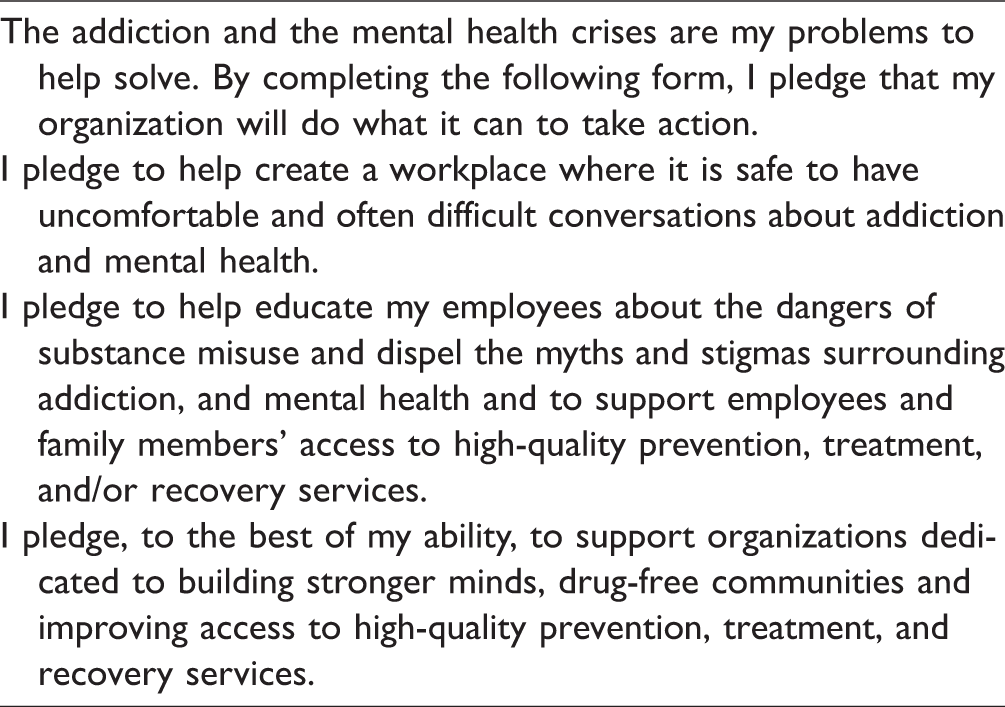
In 2019, Leidos Chairman and CEO Roger Krone launched the Leidos CEO Pledge f (Box 1). The pledge encourages leaders to set the tone within their organization, creating and nurturing work environments that are safe for conversations about addiction, to educate employees about the potential dangers of opioids, and to support nonprofit organizations focused on addiction destigmatization, prevention, and recovery. The goal of the pledge is to create a coalition g primarily composed of companies and some industry associations and nonprofit organizations that embrace these values and can partner to help build actionable solutions that focus on education, and prevention, treatment, and recovery resources. These companies share information and best practices and brainstorm solutions, potentially benefiting millions of employees. In turn, involved individuals utilize their networks and share information with their family, friends, and community organizations, helping reduce the stigma surrounding opioid addiction. The goal is shared actions across sectors that make a positive and lasting impact. To date, CEOs from more than 150 organizations have signed the Pledge.
Most recently, in May 2021, Leidos announced a partnership with The Milken Institute Center for Public Health to help further promote the CEO Pledge. Core to the new relationship is a Collaborative Action Group created to reach more employees and communities, especially in light of how the COVID-19 pandemic has exacerbated substance use and harmed mental health and well-being globally.
Leidos’ Workplace Opioid Initiatives
Leidos employee assistance program
The National Institute for Occupational Safety and Health (NIOSH) reports that nearly 9 percent of employed adults (approximately 13.6 million workers) have current alcohol or illicit drug use disorders and a similar number (approximately 13.4 million workers) report that they have recovered from an SUD. Workplaces are an important place to support American employees and their family members who have opioid or other SUDs. 6
In 2018, the Department of Health and Human Services Substance Abuse and Mental Health Services Administration reported that just under half of adults self-reporting SUD also indicated suffering from mental illness in the preceding year. 7 Ideally, workplaces could provide individual, family, and community support to help improve the well-being of workers. Leidos and its employee assistance program (EAP) partner have worked closely on methods to prevent substance use and reduce stigma so that employees and/or their family members are more likely to seek help. The Leidos EAP is administered by an established professional consulting firm and assists employees and their families with free services and referrals to outside resources. Professional counseling for stress, depression, anxiety, chemical dependency, crisis situations, or other personal or family challenges is also available through the EAP. Stigma-reducing efforts include protecting confidentiality (EAP contacts by employees are completely confidential and internal company communications reviews to correct negative, stigmatizing language around addiction and mental health.
Injury and stress prevention
While genetic factors, stress, environmental, and social factors may contribute to an individual’s vulnerability to OUD, NIOSH and the National Institute of Environmental Health Sciences also indicate that work-related injury, pain, and stress are all pathways to opioid use, misuse, and addiction. Studies in Washington and Massachusetts8,9 examined the link between workplace injuries, opioid prescriptions, potential for OUD, and opioid overdose fatalities by industry. In these studies, opioid fatalities were associated with the overprescription of opioids in injury-prone industries that include construction, farming, fishing, and mining.
In light of these data, Leidos’ programs focus on primary prevention measures that include ergonomics training and evaluations to reduce injury frequency and resulting pain that are among the factors that contribute to the potential for OUD. 10 The company has an ergonomics program that includes work station evaluations and employee training to help employees maintain ergonomically correct work stations as well as proper procedures related to lifting and other required physical activities. Ergonomics is included as part of each new employee’s safety orientation. Workplace ergonomics plays a role in preventing work-related musculoskeletal disorders that might lead to an OUD.
At Leidos, there is a recognition that life stressors can make it hard for employees to focus on work and enjoy free time. In fact, not having a healthy work–life balance, feelings of isolation, anxiety about safety, and employee concern over things like finances can exacerbate physical and mental health issues. In addition to mental health consulting services through the EAP, employees can access telemedicine mental health services on the Leidos Mental Health page for mental stress issues. Leidos also provides a holistic well-being platform (Virgin Pulse) to encourage our employees to practice healthy lifestyle habits. Many of the well-being offerings are directed at both physical and mental health.
Opioid management
Average daily morphine equivalent dose, period of use, and prior or current SUD are among the myriad of factors associated with an increased likelihood of developing an OUD. 11 Opioid prescription patterns differ among healthcare providers and education is critical to proper choices regarding patient pain management. For example, primary care physicians and dentists write the most opioid prescriptions among healthcare providers, 15 percent and 12 percent, respectively of those in the United States, 12 yet both groups report insufficient training in prescribing opioids.13,14 Leidos reviewed aggregate data for worker opioid prescriptions to better understand our own situation. With this information, the company then identified and implemented practices to better address worker medical and dental opioid prescriptions concerns.
Medical Opioids Management
In July 2018, as part of a pilot effort, Leidos enrolled the Advanced Opioid Management (AOM) program offered by Express Scripts (ESI) (a pharmacy benefit management organization). This program is available to ∼60 percent of Leidos’ U.S. employees (approximately 38,000 members, including enrolled family members) who have prescription coverage. In conjunction with ESI and the Centers for Disease Control and Prevention Prescribing Opioids for Chronic Pain (outside of active cancer treatment, palliative care, and end-of-life care), Leidos enacted safe, evidence-based prescribing practices for pain management.
The ESI AOM pilot program proved a success in helping protect employees and their dependents from overprescribing practices while implementing safe, evidence-based prescribing practices for pain management. Through the program, Leidos implemented “Enhanced Prior Authorization” on long-acting opioid prescriptions and a seven-day supply limit for short-acting opioids. The goal is to encourage medical plan members to minimize the use of opioids and provide information about alternatives for pain management.
As provided in Figure 1, the Leidos AOM program has resulted in appreciable reductions in several areas relevant to minimizing the potential for employees and their dependents to develop an OUD. Within the first year of the AOM program, there was a dramatic reduction in the number of employees/dependents on opioid medication for more than seven days, greater than 50 percent reduction in average opioid first-time prescription quantity dispensed, and a major shift from the longer acting opioids (greater concern for potential development of OUD) to short-acting opioids.
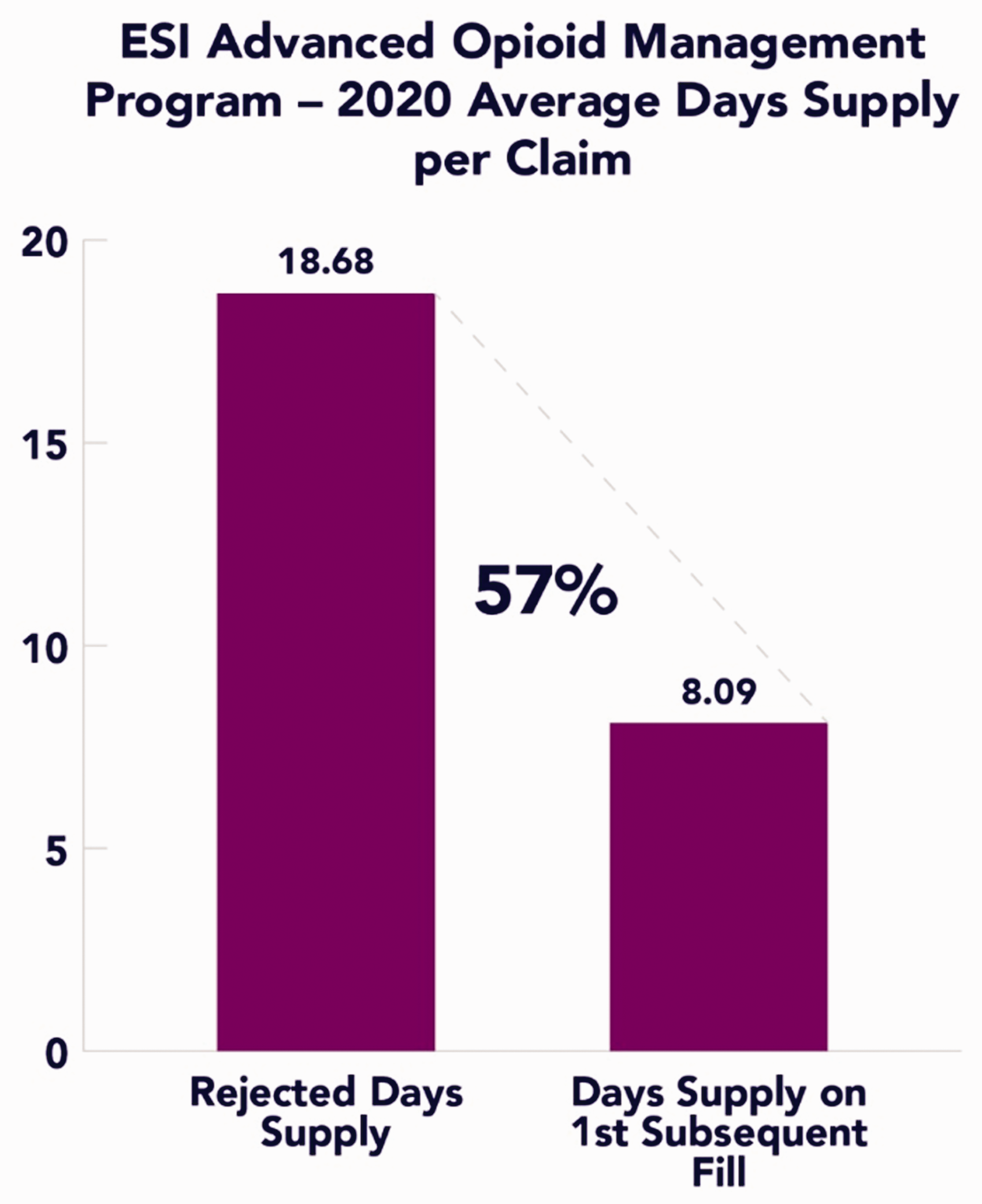
ESI Advanced Opioid Management program—2020 average days supply per claim.
The goal for members is that they receive opioids and opioid adjuvant therapies only when truly necessary. In the 2020 ESI AOM Annual Report prepared for Leidos, the average day supply per claim for first-time short-acting opioids was reduced by 57 percent compared to the prior year. In addition, 70 percent of patients prescribed a long-acting opioid as initial therapy was redirected to a safer, short-acting opioid (Figure 2). When looking at average days’ supply per claim, patients’ prescriptions were reduced from an 18.38-day to 8-day average supply due to the AOM program. This decrease in initial prescription supply and duration further reduces the likelihood of an employee developing an OUD. 15
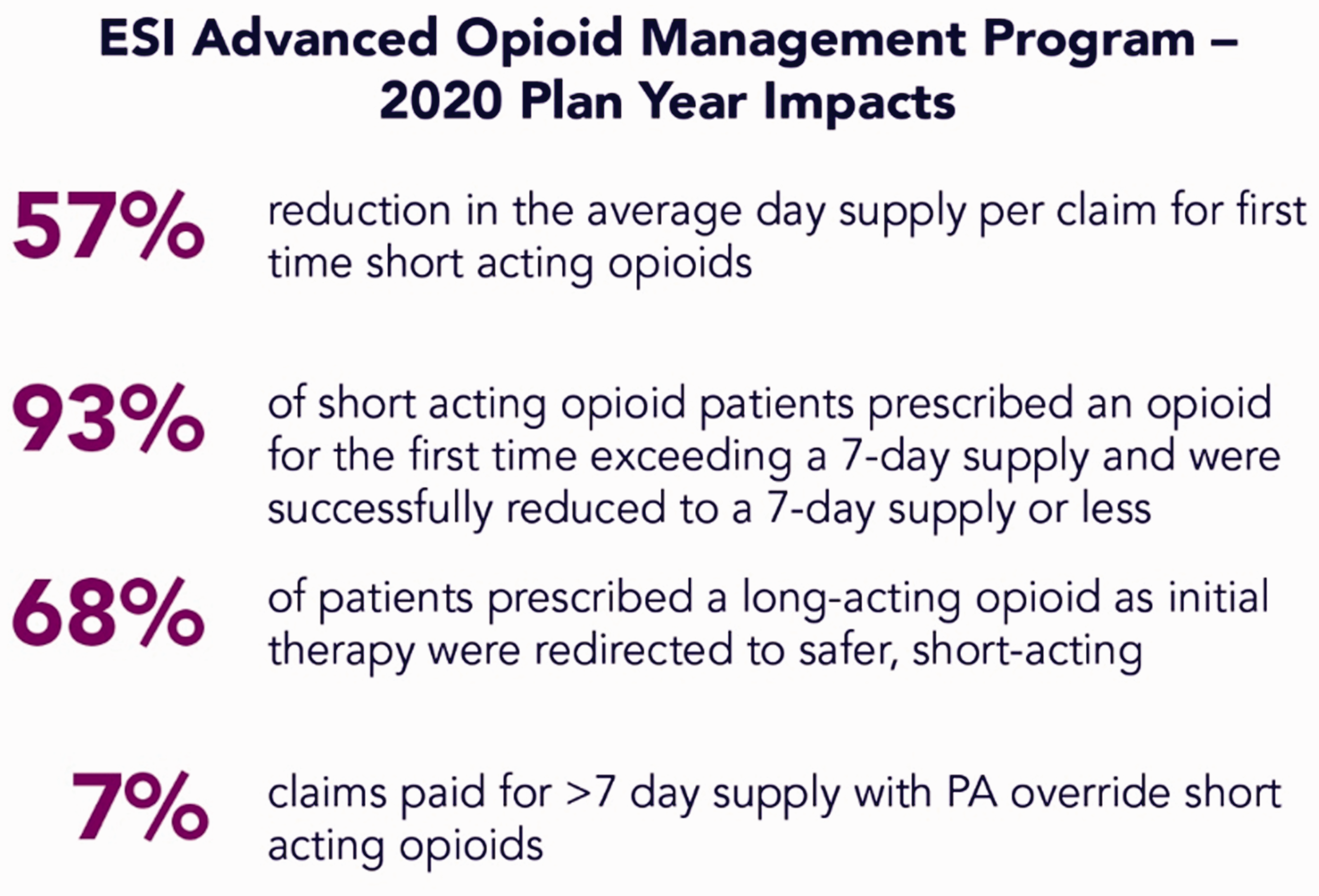
ESI Advanced Opioid Management program—2020 plan year impacts.
Additionally, ESI is educating members and providers. In the 2020 Plan Year, ESI delivered 2,335 member education letters for members filling a first-time opioid prescription and 601 drug disposal pouches for opioid and other drugs that may increase the likelihood of opioid overdose due to sedative action, i.e., opioid potentiators such as benzodiazepines. 16 ESI also sent 404 alerts to providers that include timely information which better ensures therapy is safe and helps providers identify members who may benefit from an opioid reversal agent, such as naloxone, that acts as an opioid antagonist by reversing the life-threatening effects of an opioid overdose. 17 These alerts also identify potential patient misuse, including seeking multiple prescribers and pharmacies.
Dental Opioids Management
Recent studies show that nonopioid pain medications provide equivalent pain relief for acute pain relief for many dental procedures, 18 yet more than one in ten opioid prescriptions in the United States are written by dentists. Of these prescriptions, between 25 percent and 50 percent are overprescribed in adults. Additionally, dental opioid overprescription plays a particular role in an increased likelihood that an adolescent or young adult will develop an OUD. 12 In response to these data, Leidos partnered with Delta Dental (a dental insurance provider) on their initiative to reduce opioid prescriptions for dental procedures. Approximately 64 percent of Leidos U.S.-based employees are enrolled in Delta Dental coverage and, as part of this initiative, Delta Dental will report on dentist opioid prescription practices, member opioid use, potentially problematic prescription practices. This information allows Delta Dental to reach out to dentists and members to provide targeted opioid educational information, promote Delta Dental’s Prescription Drug Monitoring Program, outreach to providers identified as opioid prescribing outliers and continuous monitoring of those who are overprescribing.
Leidos Community Opioid Work
Substance Abuse and Mental Health Services Administration 19 reports that 63 percent of Americans with OUD are employed full or part time. Leidos understands that community outreach also benefits the families of their employees as well as employees in other workplaces. This recognition, along with Leidos’ CSR goals to support the communities where the company operates, further supports the company’s anti-opioid efforts. Leidos is partnered with nonprofits and other organizations, advocating for policy measures to address the opioid crisis and, as a science and technology science company, applies health science and data analytics expertise to address specific opioid-related issues. In the community, Leidos is actively involved with a number of nonprofit organizations, including the Community Anti-Drug Coalitions of America (CADCA), the Chris Atwood Foundation (CAAF), and the U.S. Chamber of Commerce Foundation, among others. Some of the work of Leidos and its partners are described below (for additional detail and information on other partnerships, see Leidos “Battling the Opioid Epidemic.” h )
Leidos Partnerships
CADCA: Leidos has a multifaceted partnership with CADCA i that began at the start of our opioid campaign in 2017, with the collaboration focused on supporting CADCA’s mission to build drug-free communities. The scope of the partnership focuses on youth leadership training and community awareness safe disposal events.
In 2018, Leidos, CADCA, and its community partners used Maryland National Guard trucks to distribute roughly 100,000 commercially available Deterra® drug deactivation pouches from the U.S. Army Aberdeen Proving Ground to first responders who may encounter potent opioids in their law enforcement and overdose responses, educators, and others throughout the state of Maryland. These pouches keep unwanted prescription and over-the-counter drugs out of the wrong hands and prevent environmental contamination. Drug disposal pouches render opioids and many other harmful drugs unusable and eliminate the concern for unintended future use. This method is also more environmentally appropriate than alternatives such as disposal in a toilet. The drug deactivation pouches neutralize the active ingredient in medications after the addition of water (Peer-reviewed studies validate that the drug disposal pouches neutralize more than 99 percent of opioid content in a 28-day period [94 percent in one day]). 20
The CAF j . In 2017, Leidos formed a partnership with the CAF to help counter SUD in Northern Virginia. In August 2017, Leidos joined Virginia state politicians and federal law enforcement officials at CAF’s first public opioid reversal and training event in Virginia, where volunteers handed out naloxone kits. From 2018 to 2020, Leidos continued to support CAF by helping to raise funds and support additional naloxone training and distribution events.
In April 2021, Leidos and the Baltimore Ravens, with support from the CAF and Safeway, Inc. partnered to support Oxford House drug-free recovery homes in Baltimore City, nearby Maryland counties, and in Sussex County, Delaware. The collaboration focuses on providing funds and materials to aid new residents in their recovery and to provide safe and stable housing options.
U.S. Chamber of Commerce Foundation: The U.S. Chamber of Commerce Foundation created Sharing Solutions, k an interactive website, to highlight work force resources and innovative solutions to the opioid crisis, and to facilitate exchange of ideas. Leidos has been actively engaged in this national initiative since 2019. As part of the 2021–2022 virtual national tour, the foundation will add state-specific opioid-related content to the online resource hub. Resources from Leidos are posted on the Sharing Solutions web site.
Public–Private Initiatives
In October 2018, Leidos Chairman Krone, attended the signing of the, “Substance Use-Disorder Prevention that Promotes Opioid Recovery and Treatment for Patients and Communities Act,” or SUPPORT for Patients and Communities Act at the White House, committing his support with other private industry executives to help end the opioid epidemic. In attendance were members of Congress and leaders from twenty other participating companies. Leidos big data and data analytics platform successfully used as tool.
Leidos’ has contributed its’ data science expertise and Collaborative Advanced Analytics and Data Sharing (CAADS™) platform to provide reliable data to inform actions. In 2014, there was an outbreak in human immunodeficiency virus and hepatitis C cases in a small rural county in Indiana. 21 The Centers for Disease Control and Prevention, supported by the Leidos team, used machine learning to examine the correlation between needle sharing, sexual contact, and the contraction of human immunodeficiency virus. Machine learning tools also predicted unexpected variables, which allowed the team to assess a person’s risk profile quickly. These insights further confirmed the correlation between needle sharing, sexual partners, and human immunodeficiency virus/hepatitis C with data proving that sexual contact played an enormous role in the onward transmission of what was primarily an injection drug-driven outbreak. The data analysis performed by the Centers for Disease Control and Prevention helped establish that 90 percent of the infected population was injecting Opana ER. In 2017, the US Food and Drug Administration (FDA) issued a request to remove Opana ER from the marketplace and the manufacturer agreed.
Part 2: Learning Along the Way
Leidos’ Total Worker Health Initiatives
As a large corporation, Leidos had many of the elements of a total worker health program in place prior to NIOSH’s formalization of the Total Worker Health® (TWH) program in 2016. 22 As Leidos’ efforts expanded into the psychosocial space subsequent to 2018, there was a realization that many of Leidos’ past and current efforts also aligned with additional NIOSH “Total Worker Health Priority Areas and Emerging Issues” 23 as provided in 2020. OUD/SUD, worker well-being, and mental health were among the emerging issues identified by NIOSH. Prior to 2021, similarities between Leidos’ total worker health-related efforts and the NIOSH Total Worker Health® program occurred more as the result of serendipity than design. More recently, Leidos has inquired about NIOSH’s Total Worker Health® Affiliate Program but eligibility is currently limited to nonprofits, labor organizations, and government agencies. Leidos initiated communications with NIOSH TWH personnel and continues to review NIOSH online resources and exchange TWH-related information.
As indicated, the company now works to address not just opioid addiction, but also some of the broader TWH concepts including mental health and well-being. Leidos also began to focus on anxiety, depression, and COVID-19-related impacts, as well as antisuicide efforts, especially related to veterans and the emerging vulnerable population of healthcare workers.
Painful Lessons
In the introduction of this article, the authors referenced “ … a brief period of intense internal research, analysis, and deliberation … ” that preceded the decision by Chairman Krone to accept the challenge for Leidos to take action. The information gathered during that period proved shocking and painfully revelatory. The women and men involved in that effort … mothers and fathers, brothers and sisters, aunts and uncles, sons and daughters … were taken aback by their newly found, immediate knowledge of the enormity of the opioid epidemic. This raw emotion became their lodestar as they lent receptive ears, caring hearts, creative minds, and willful souls to the task of identifying what Leidos might do internally in support of its employees, and externally in support of society.
The three greatest obstacles to the campaign (and part of what, in fact, Leidos was trying to overcome with the campaign and component efforts) were the lack of knowledge on the current and future impacts of substance use in the workplace (specifically within the Leidos industry space, but in all industries and sectors), the stigma surrounding opioid use, and the resources and recommendations available to companies to effect positive change. Initially, the journey was one of learning, followed by taking specific, targeted internal and external actions to demonstrate a commitment to maintaining a healthy workplace (e.g. changes to prescription benefit plans) as well as supporting prevention and recovery efforts in the communities where Leidos and its employees live and work. These were collaborative efforts with a number of dedicated nonprofits, federal, state, and local, governments and other partners.
Overcoming this initial obstacle was paramount to achieving overall goals, especially as it relates to coalition building with others in industry and other sectors. In sum, it required more than a year of concerted Leidos-only efforts to build trust and demonstrate commitment and leadership before challenging others to collaborate and/or share their experiences and lessons learned.
Were there bumps in the road … moments of doubt? Most assuredly, as Leidos was indeed “learning while doing.” However, true to the derivation of our corporate name from the word “ka
Concluding Remarks
People are at the center of all organizations. Fostering a culture that educates and supports employees relative to opioid addiction and their overall mental health and well-being, as well as the communities in which they live and work, makes good business sense and good social sense. A mind affected by opioid addiction or other mental health disorders neither reaches nor functions at its full capability—innovation, engagement, and productivity inevitably suffer. To grow and sustain a capable work force to carry our world into the future, companies must invest in worker training that includes primary prevention programs to minimize workplace injuries and education about the dangers of opioid addiction and other SUDs, set the tone within the company walls to end stigma around mental health, and support nonprofit organizations working to make progress in the community. Each organization can make a difference and play a role in combatting the opioid epidemic.
In summary, Leidos contends that:
Everyone can do something—all companies can start an initiative, even with limited resources. CEO engagement increases the effectiveness of an initiative within a company, and displays a “green light” for open dialogue on tough topics often left to linger in the shadows. By supporting research, and forging collaborative relationships with community organizations and other stakeholders, companies can help elevate the conversation on opioid addiction and mental health and develop new solutions to address challenges like the opioid epidemic. Each company, as well as the broader business community, should work toward a shared ambition of improving the mental health of its employees to preserve a healthy and engaged work force, and responsibly govern bottom line-costs related to SUDs and mental health conditions.
Box 1. The Leidos CEO Pledge.
Footnotes
Notes
Acknowledgments
The authors would like to acknowledge and thank Roger Krone, Chairman and CEO, Leidos, for his ongoing commitment to tackling the opioid epidemic and mental health challenges globally, both within the industry sector and society as a whole.
Declaration of Conflicting Interests
The author(s) declared the following potential conflicts of interest with respect to the research, authorship, and/or publication of this article: The authors are employees of Leidos, Inc. in its EHS (PH), policy analysis (JH), communications (MD), corporate responsibility (MC), and benefits (HM) groups.
Funding
The author(s) disclosed receipt of the following financial support for the research, authorship, and/or publication of this article: The work was funded by Leidos but did include some volunteer time.
