




Abstract
Background
Effective training in traffic incident response is vital for urban law enforcement cadets, particularly for managing complex, high-pressure scenarios at busy intersections. Traditional instructional methods, including lectures, paper exercises, and drills, often fail to replicate the urgency, variability, and procedural complexity of real incidents. This gap may leave cadets underprepared for field deployment.
Intervention
The Dubai Police Academy utilizes a gamified simulation model developed by the Virtual Technology Center to train cadets in real-time decision-making, traffic management, and procedural compliance under the UAE traffic code. The simulation integrated serious gaming elements, branching narrative scenarios, and real-time performance feedback within a 3D virtual environment. The training was delivered across a 10-week semester, with cadets completing a series of structured simulation sessions embedded within the practical component of the Traffic Studies course.
Methods
A pilot feasibility study was conducted with 32 final year cadets. Trainees completed baseline, practice, and evaluation scenarios involving dynamic traffic accidents. Data were collected from performance logs, instructor observations, and pre- and post-training surveys. The simulation emphasized experiential learning in immersive, feedback-driven scenarios and deliberate practice, using real-time feedback and adaptive consequences.
Results
The cadets demonstrated statistically significant improvements in decision-making accuracy (+17.4%), procedural compliance (+28.9%), and documentation quality (+16.8%). The survey data indicated increased confidence and perceived realism. Training was rated as relevant, engaging, and suitable for integration into the regular curriculum.
Conclusion
This study illustrates the pedagogical and operational value of gamified simulations for police training. By embedding legal accuracy and realistic complexity into a structured feedback loop, the simulation effectively bridged the gap between theory and practice. The findings support the broader adoption of immersive training tools in public safety education and offer a replicable framework for law enforcement agencies worldwide.
Keywords
Introduction
Managing traffic accidents at urban intersections is a core competency of modern law enforcement. These incidents are dynamic and high-pressure, requiring officers to quickly assess the scene, ensure safety, assist victims, manage traffic flow, enforce legal procedures, and coordinate emergency services. Traditional training approaches, including lectures, paper-based exercises, and field drills, often fail to replicate the urgency and complexity of real incidents (Nepelski, 2019). This disconnection may leave police cadets underprepared for effective field performance.
To address this training gap, the Dubai Police Academy implemented a gamified simulation developed by the Virtual Technology Center. The simulation offers scenario-based training based on UAE traffic law and policing protocols. It enables cadets to practice procedural tasks, such as issuing diversion orders, documenting incidents, and managing emergency responses in a high-fidelity, interactive environment. The system employs advanced video game technologies to recreate realistic virtual incidents, allowing cadets to develop their skills through guided, learning-by-doing experiences in a safe, repeatable setting (Alrazooqi, 2023).
The model emphasizes both legal accuracy and real-time decision making under pressure. As Arabic is the primary language of instruction at the Dubai Police Academy, the simulation was developed with a fully localized Arabic interface to support cultural immersion and enhance instructional accessibility.
Globally, serious games have gained prominence as effective tools for training law-enforcement officers. Initially used for tactical skills such as firearms handling or vehicle pursuits, simulation-based platforms now target broader competencies, including de-escalation, communication, and procedural fluency (See & Davies, 2024; Bosse & Gerritsen, 2016). Unlike passive learning methods, serious games immerse learners in interactive environments that support repetition, feedback, and performance monitoring, which are key components of effective training in high-stake contexts.
Through its Virtual Technology Center, Dubai Police have actively implemented simulation-based training initiatives in recent years. This included 3D modules for crime scene investigation, hostage negotiation, and traffic incident response. Previous simulation projects implemented by the center (BinSubaih et al., 2006, 2009) have focused on traffic accident investigations and laid the groundwork for ongoing advancements in cadet-focused training systems. Recent evaluations have shown that high-fidelity simulations significantly improve police performance, particularly among novice officers (Voigt & Zinner, 2023). A distinctive feature of the Dubai model is its procedural fidelity, in which scenario decisions align with UAE legal protocols, supporting knowledge transfer and operational accuracy.
This study presents the design, implementation, and evaluation of traffic incident simulation framed by experiential learning theory (Kolb, 1984) and deliberate practice (Ericsson, 2008). The simulation design reflects Kolb’s experiential learning cycle, adapted to immersive, high-stakes scenarios that promote learner agency and structured reflection, in line with recent applications of the model to higher education (Kolb & Kolb, 2017).
A mixed-methods pilot feasibility study involving 32 police cadets was conducted to assess whether the simulation improved decision-making accuracy, procedural compliance, and self-reported confidence. This instructional model reflects best practices in simulation pedagogy, emphasizing repetition, feedback, and structured reflection as the key drivers of skill development (Salas et al., 2009). The findings offer insights for instructional design in policing and have broader implications for simulation-based training across the emergency and public safety domains.
Background
Simulation in Law Enforcement Training
Over the past two decades, the use of serious games in professional education has expanded beyond military and aviation training to diverse civilian domains, including law enforcement (Akhgar et al., 2019) . Serious games integrate game mechanics with instructional objectives to create learner-centered environments that support skill acquisition through interactive decision making and real-time feedback. Compared to traditional instructional methods, such as lectures or paper-based exercises, simulations foster higher engagement and procedural fluency, which are essential in complex, high-stakes contexts, such as policing (De Gloria et al., 2014).
In policing, early simulation tools primarily address technical competencies, such as firearms judgment and vehicle operation. These applications are typically delivered using shoot/dont-shoot scenarios or basic driving modules. As simulation technology matured, its use expanded to encompass cognitive and procedural skills. One early example was the 3D traffic accident investigation simulation used by the Dubai Police, which enabled officers to analyze virtual crash scenes, collect evidence, and follow proper reporting procedures. Officers trained with the simulation outperformed those who received conventional instruction, highlighting the potential of serious games to enhance training effectiveness in law enforcement (BinSubaih et al., 2006).
Scenario-Based Learning and Procedural Fidelity
In recent years, research has focused on increasing the realism, variability, and transferability of simulation-based training. A systematic review by See and Davies (2024) documented a growing trend toward high-fidelity simulations that replicate real-world complexity in domains such as crisis de-escalation, tactical communication, and use of force decision-making. Virtual reality platforms, such as VirTra and MILO, are now used extensively by police agencies to simulate high-risk encounters. These platforms expose trainees to both routine and complex operational challenges in immersive environments, with dynamic consequences. Empirical studies have reported improvements in trainee confidence, preparedness, and situational awareness (Alshehhi et al., 2024). According to Wallentine (2021), officers who complete simulation training often demonstrate increased confidence in their field decision making. This outcome is closely linked to reduced use of force incidents and improved public safety performance.
Scenario-based learning continues to be a central strategy in law enforcement. Traditionally delivered through live role-plays and controlled field simulations, these methods allow trainees to practice managing incidents, such as traffic accidents, domestic disturbances, and felony stops. However, live exercises are costly, time-consuming, and difficult to standardize across different trainees and contexts. Digital simulations offer a scalable alternative that can reproduce a wide range of high-risk and high-stress scenarios with consistent instructional delivery (Caserman et al., 2018; Peeters et al., 2015). Many systems employ AI-driven virtual characters, branching narratives, and adaptive consequences to challenge users to make realistic decisions and respond to evolving situations.
These simulation designs are increasingly grounded in experiential learning theory (Kolb, 1984), which emphasizes iterative experience, reflection, conceptual understanding, and active experimentation in the learning process. Effective simulations are structured around a learning loop in which trainees make decisions, observe outcomes, reflect on performance, and improve subsequent attempts. Many platforms include replay functions and automated performance tracking aligned with Kolb’s learning cycle (Capuano & King, 2015; Peeters et al., 2015). In one example, failure to redirect traffic or summon medical support may trigger secondary accidents within the simulation, prompting learners to re-evaluate their procedural timing and priorities. This experiential model, widely applied in aviation and medicine, is becoming increasingly relevant to policing, where officers must manage complex, high-risk situations under pressure (Benda et al., 2020; Zhu et al., 2024).
Recent adaptations of Kolb’s model have extended its application to immersive technology-based environments, such as serious games and virtual simulations. Kolb and Kolb (2017) emphasized that digital experiential learning should preserve the structure of the cycle while also enhancing realism, learner autonomy, and contextual fidelity. In policing and related domains, simulations following these principles support active engagement, structured reflection, and immediate feedback. These conditions are critical for developing decision-making skills in complex, high-stake settings. Although direct applications of Kolb and Kolb (2017) in law enforcement are limited, studies on disaster training and healthcare education demonstrate that experiential designs can improve learner performance in environments that demand procedural accuracy and adaptive thinking (Bahaziq et al., 2023; Mitsuhara et al., 2019; Rholdon, Lemoine, Templet, & Stueben, 2020a, 2020b). These findings support the use of revised experiential learning models designed to improve operational readiness and legal compliance in police training simulations.
Gamification and Learner Motivation
Gamification, defined as the use of elements such as scoring, levels, and leaderboards, has emerged as a complementary strategy in simulation-based training. In policing contexts, gamification can improve learner engagement, focus, and retention, particularly among digital-native cadets (Alvear et al., 2020; Schöbel et al., 2022). Studies show that when implemented effectively, gamified simulations help trainees internalize both procedural knowledge and time-sensitive decision-making while maintaining cognitive load at levels similar to real-world stress conditions (Baah et al., 2024; Nair & Mathew, 2021). In the Dubai Police simulation, cadets received automated feedback and performance scores based on legal compliance, decision timing, and scene management accuracy. This feedback loop encourages mastery learning and supports self-assessments. However, the literature also warns that poorly designed gamification can reward speed over accuracy, or foster competition over cooperation. Instructional designers are advised to align game mechanics with educational goals, particularly those related to lawful conduct and decision quality (Gąsiorek, 2023; Schöbel et al., 2022).
Research Gaps and Study Purpose
Despite these advances, gaps remain in the empirical evaluation of simulation-based training, particularly in law enforcement contexts that require procedural fidelity. Much of the research has focused on tactical or communication-based training, with less emphasis on simulations that integrate legally accurate protocols and administrative procedures. This gap in empirical evaluation underscores the need for research that prioritizes legal and procedural fidelity in simulation-based police training, particularly for novice cadets. Integrating country-specific legal standards and replicating the high-stress environments of field operations is essential for ensuring training relevance and effectiveness. As Boembeke et al. (2022) emphasize, simulation scenarios often lack the depth needed to fully prepare trainees for the complex interplay of cognitive, legal, and procedural demands encountered in real-world policing. Addressing this oversight is crucial, as early-stage training forms the foundation of professional judgment and legal compliance in the field. Without such rigor, a simulation may fall short of its potential to reduce operational errors and improve public safety outcomes.
To address this gap, this study evaluates a gamified simulation model developed by the Virtual Technology Center and implemented at the Dubai Police Academy. The simulation focused on traffic incident response and incorporated branching narratives, procedural task execution, and real-time feedback based on UAE traffic law. Grounded in experiential learning and deliberate practice (Ericsson, 2008), this study investigated how simulation-based training affects decision-making accuracy, procedural compliance, and self-confidence among police cadets.
Methodology
Simulation Model Design
The simulation was developed as a 3D interactive serious game, placing cadets in the role of first-responding traffic officers at the scene of a road accident. The development followed an iterative, user-centered design approach involving technical developers and subject matter experts from Dubai Police Academy. The simulation was built using a cross-platform development framework capable of rendering realistic urban environments and simulating complex interactions such as vehicle collisions, crowd behavior, and environmental hazards. The architecture supports deployment on PCs and multiple operating systems, including tablets and mobile platforms. Realistic environments and interaction dynamics are considered critical for user immersion and the transfer of learning in simulation-based training (Rehman & Huang, 2019; Zhou & Yang, 2022).
Grounded in experiential learning theory, the simulation aimed to provide cadets with authentic experience, structured reflection, and active experimentation in line with the experiential cycle (Kolb, 1984) and its application to immersive, technology-enhanced environments (Baah et al., 2024; Kolb & Kolb, 2017). The learning objectives were to ensure that cadets could (1) secure and manage a traffic accident scene, (2) apply UAE traffic laws and police procedures, (3) coordinate effectively with emergency services, and (4) accurately document the incident.
Scenarios follow a branching narrative structure, with multiple decision points and outcomes. Each session began with a briefing, such as “Two-car collision at Sheikh Zayed & 5th Street intersection”, followed by entry into a virtual scene. Decisions, such as whether to call an ambulance or initiate traffic control, influenced the scenario evolution. Errors or delays trigger in-simulation consequences resulting in worsening injuries and traffic build-up, reinforcing procedural accuracy, and real-time responsiveness (Caserman et al., 2023; Sharma, 2020).
Scenario content was developed in collaboration with Dubai Police subject matter experts based on the UAE Federal Traffic Law and internal standard operating procedures. The knowledge acquisition phase includes Standard Operating Procedures (SOP) reviews, expert interviews, and case studies of common cadet errors. Scenarios ranged from minor daytime collisions to multivehicle nighttime incidents. Logic programming allows the simulation to prompt or penalize cadets for protocol deviations such as delayed ambulance calls or improper evidence collection (Uddin et al., 2020; Verplanck, 2020).
Game Mechanics and Interface
The simulation was operated from a first-person perspective, with cadets using a keyboard and a mouse or built in game controller. Core features included a dialogue system for virtual interviews, an inventory of scene tools such as cones, radio communication with dispatch, and dynamic event timing to simulate real-world pressure.
As shown in Figure 1, the interface presents cadets with a realistic urban traffic scenario, in which they interact with scene elements, navigate procedural tasks, and manage unfolding events. The inclusion of Arabic User Interface and localized environmental features supports procedural fidelity and cultural immersion, consistent with best practices in user-centered virtual environments (Alsuwaidi & Almazrooei, 2025). Dubai police traffic incident simulation user interface.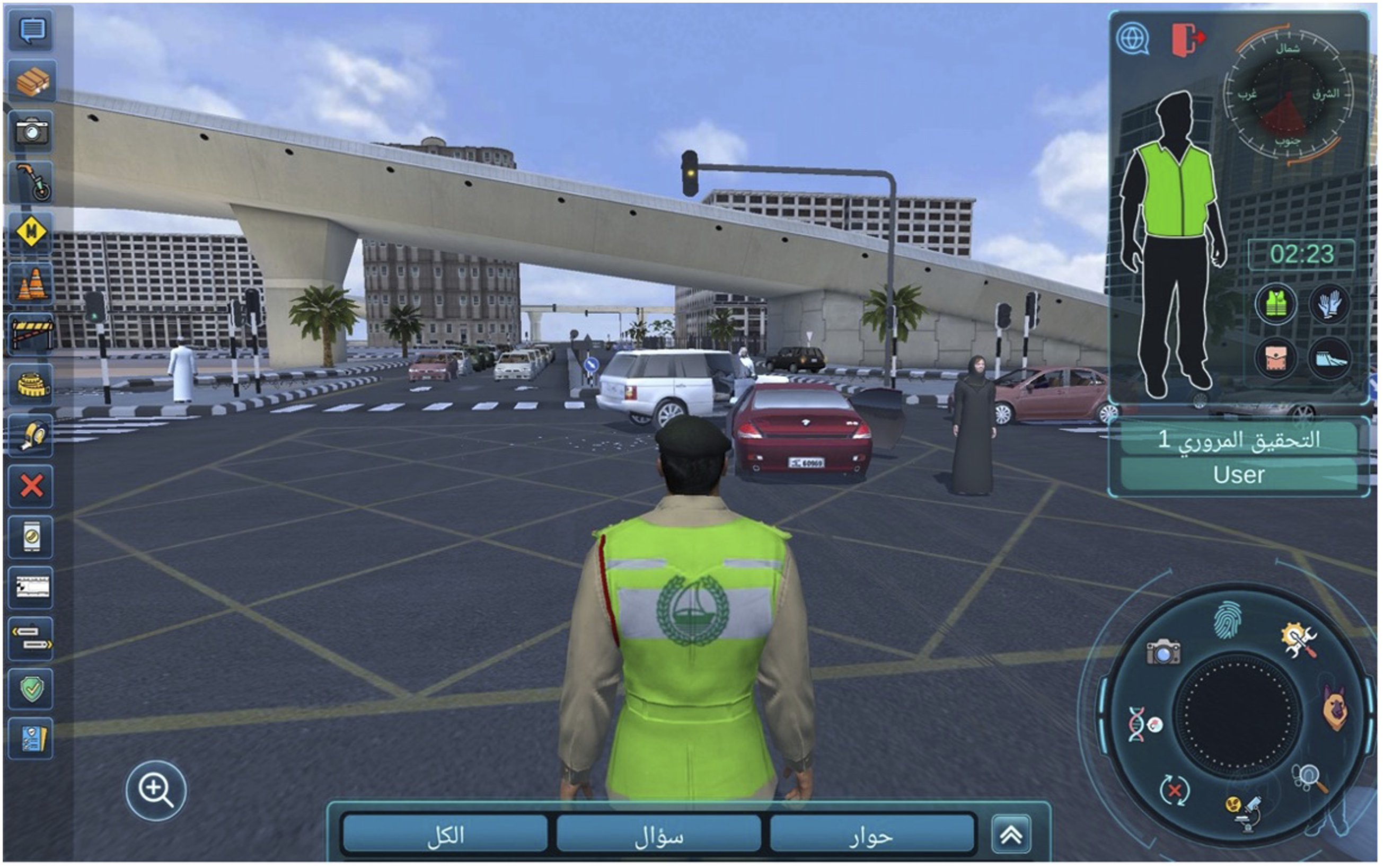
The cadet actions were continuously logged and evaluated against expert-defined protocols. Correct decisions were rewarded with points; errors or omissions resulted in deduction. Post-session feedback included a performance summary with numerical scores and comments. Replay functions allow cadets to reflect on their actions and improve them iteratively (Toukiloglou & Xinogalos, 2023).
Scenarios incorporate variability such as weather, vehicle types, and time of day, to encourage adaptive learning and discourage memorization. Cadets are allowed to repeat scenarios to improve their performance (Bergeron, 2008). These features reflect the core principles of experiential learning in digital environments, where immediate feedback and repeated performance cycles help to translate procedural knowledge into field-ready competence (Kolb & Kolb, 2017).
Figure 2 presents a high-risk simulation scenario involving a fire, damaged vehicles, and public bystanders. This example demonstrates how environmental complexity and time pressure increase cognitive demands, requiring cadets to prioritize safety, communication, and evidence collection while maintaining procedural accuracy. Example of high-risk simulation scenario.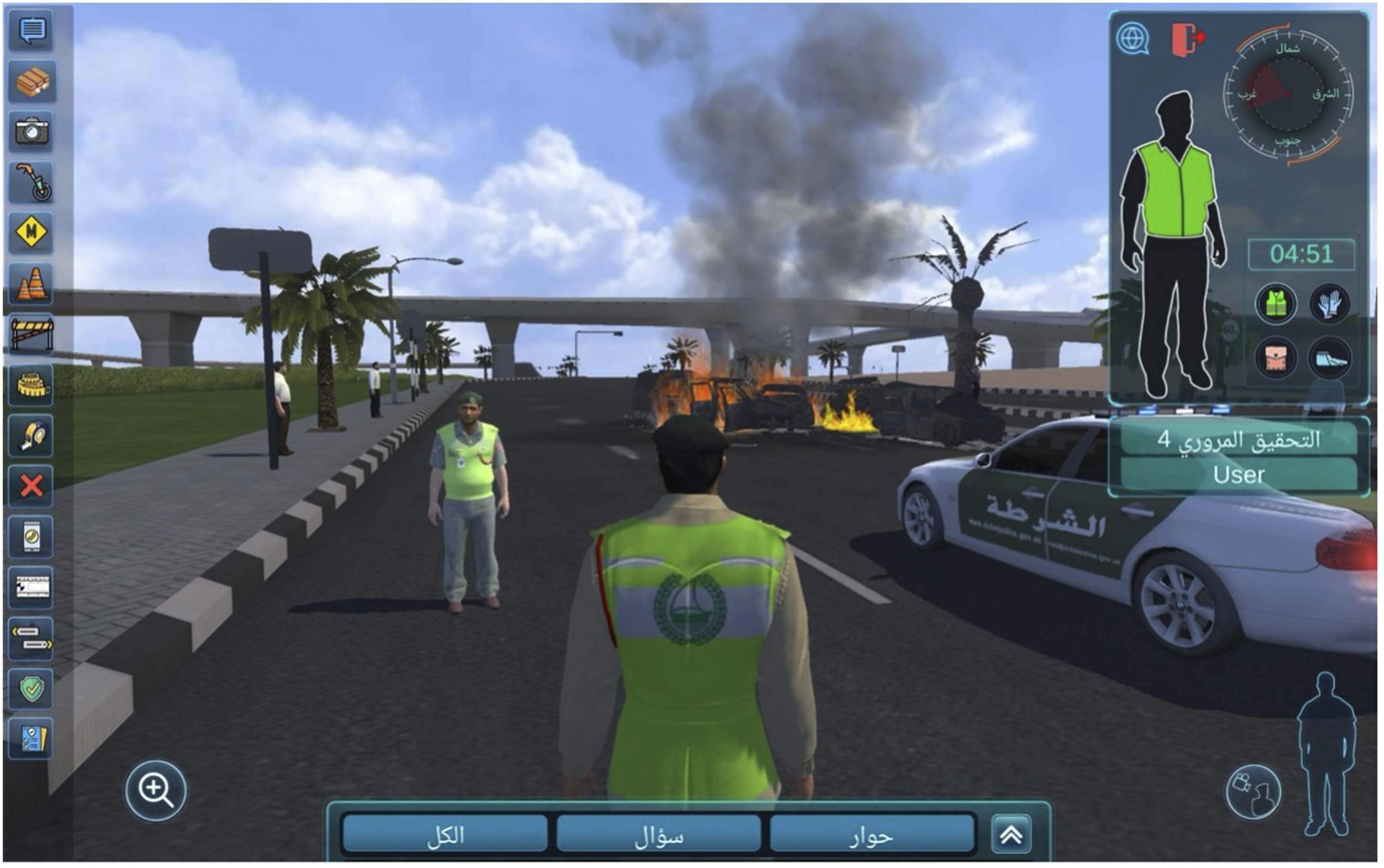
Integration of Legal Protocols
Legal accuracy is the core design requirement. A senior legal advisor reviewed all scenario scripts to ensure alignment with UAE Federal Traffic Law. The simulation includes virtual procedures for accident severity classification and documentation. Cadets completed in-game reports using the official Dubai Police format, including drop-downs and free-text fields to log vehicle data, license numbers, and violation causes. Procedural missteps include prematurely moving vehicles, triggered score penalties, and real-time warnings. By embedding accurate legal workflows, the simulation reinforced procedural compliance and supported the transfer of learning to the field (Alshehhi et al., 2024).
Training Implementation
The simulation was piloted with 32 undergraduate students enrolled in the Bachelor of Science in Security and Criminology program, with a concentration in Traffic Studies, at the Dubai Police Academy. All participants had previously completed foundational classroom instruction on accident response. Participation in the study was voluntary, and informed consent was obtained from all cadets prior to their involvement. The data collected were anonymized, and participation had no impact on students’ academic performance or course grades. Ethical approval for the study was granted by the Dubai Police Academy Scientific and Ethics Committee.
Each cadet completed three simulation sessions: 1. Baseline Session: A scenario was completed without feedback to establish the pre-training performance. 2. Training Sessions: Two feedback-enabled scenarios with optional retries. 3. Final Evaluation: A new scenario of comparable difficulty was used to assess the impact of training.
Each scenario followed a distinct narrative structure and varied in complexity and environmental conditions. All cadets began with the same baseline scenario (Figure 1), followed by two differentiated training simulations and a final evaluation scenario (Figure 2). In total, cadets were exposed to four unique scenarios during the training sequence.
The training model was grounded in Kolb’s experiential learning cycle and Ericsson’s deliberate practice framework (Ericsson, 2008; Kolb, 1984). In line with recent adaptations of experiential learning to digital instructional contexts (Kolb & Kolb, 2017), the sessions emphasized learner-driven interaction, immediate feedback, and reflective iteration to promote procedural fluency (Beinicke & Muff, 2019; Stevens-Adams et al., 2010).
Performance metrics included: • Decision accuracy • Procedural compliance • Time efficiency
Instructor observation forms complement system data and capture behaviors such as confidence, communication, and situational awareness (O’Neill et al., 2018).
Survey Instrument
Following the final scenario, cadets completed a post-training survey. The ten Likert-scale items were designed to assess key learning domains, including legal accuracy, confidence, realism, and decision prioritization. The items were adapted from validated simulation evaluation instruments (O’Neill et al., 2018; Tufts et al., 2021) and reviewed by Dubai Police experts to ensure contextual relevance. The survey was delivered in Modern Standard Arabic. Items were translated from English using a forward-backward translation process and reviewed by bilingual instructors to ensure clarity and conceptual equivalence.
A 5-point scale was used (1 = Strongly Disagree, 5 = Strongly Agree). Two open-ended items captured the participants’ perceptions of the challenges and the training’s overall instructional value. Appendix A provides the complete survey and its alignment with the learning objectives.
Responses to the open-ended items were analyzed using a basic thematic analysis. All comments were reviewed and manually coded by the lead researcher who grouped recurring ideas and phrases into emergent categories. The process was inductive and aimed to identify shared perceptions across participants while acknowledging the limitations of the small qualitative dataset.
Data Analysis
To evaluate the training impact, both performance metrics and participant feedback were analyzed using a mixed-methods approach. Quantitative performance scores from the simulation were compared using paired-sample t-tests (α = 0.05) and effect sizes were calculated using Cohen’s d to determine the magnitude of change. To analyze self-assessment responses, Wilcoxon signed-rank tests were applied given the ordinal nature of the Likert scale. Descriptive statistics summarized all survey responses, and open-ended feedback was thematically coded to identify patterns in cadet perceptions and reported challenges (Vatral et al., 2022; Zayapragassarazan et al., 2023).
This combination of system logs, instructor observations, and subjective feedback provided a comprehensive picture of how simulation influenced decision-making, procedural compliance, and learner confidence (Attoe et al., 2017; Davies & Heysmand, 2019).
Results
Performance Improvement
The evaluation showed substantial improvements in the cadets’ ability to manage traffic incident scenarios following simulation-based training. Table 1 summarizes the mean performance scores across 32 cadets before and after the intervention. • Decision-making accuracy improved from 72.3% to 89.7% (+17.4 percentage points), reflecting better responses to branching decision points under pressure. • Procedural compliance increased from 65.1% to 94.0% (+28.9), indicating stronger adherence to legal and operational steps. • Report documentation quality increased from 68.4% to 85.2% (+16.8), showing improved completeness and clarity in incident reporting. • The overall performance score, a composite index, increased from 70.0% to 90.5% (+20.5). Cadet Performance Metrics before and after Simulation Training. Note. “Pre-Training” refers to baseline scenario performance; “Post-Training” reflects final evaluation after simulation use. All improvements are statistically significant at p < .01.
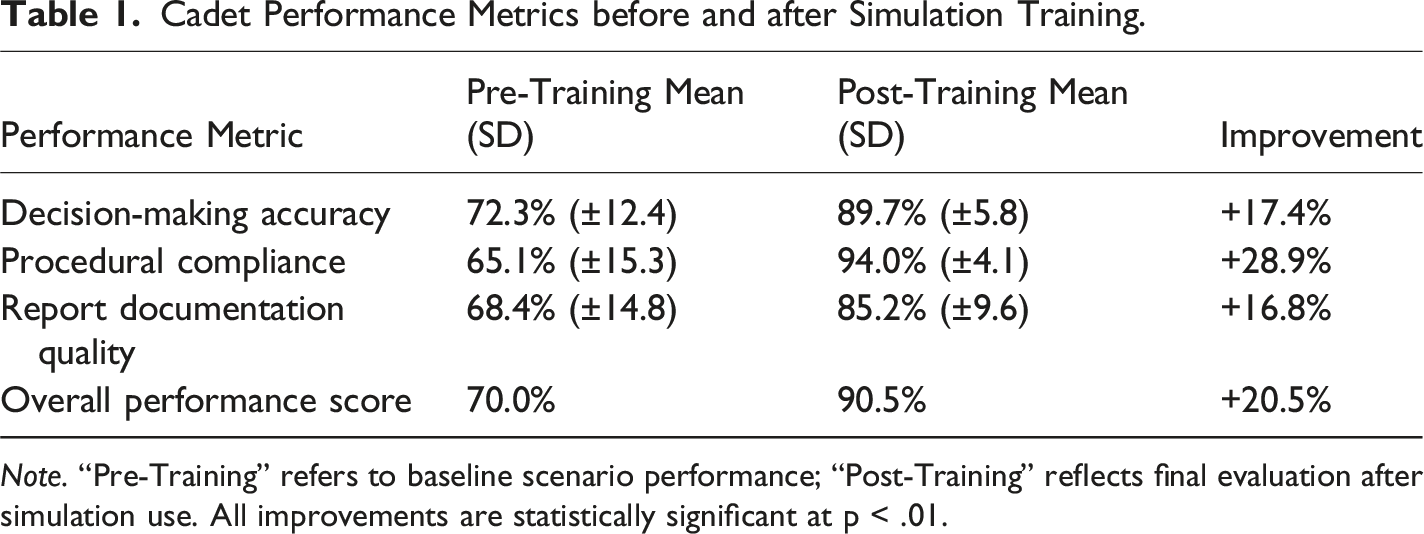
All the improvements were statistically significant. Paired-sample t-tests showed a strong significance (p < .001 for accuracy and compliance; p = .002 for reporting). The effect sizes were large (Cohen’s d > 1.0), indicating statistical and practical significance. Notably, all cadets improved; the largest gains were among those with lower baseline scores, consistent with the findings that novices benefit substantially from structured simulation training (Beinicke & Muff, 2019).
The most pronounced gain occurred in procedural compliance, suggesting that cadets internalized the correct sequence of actions such as securing the scene, collecting evidence, and completing reports. During the debriefs, cadets reported developing mental checklists reinforced by simulation feedback loops. Instructors’ observations corroborated these improvements. Cadets who initially focused on a single task, later demonstrated the ability to manage multiple tasks simultaneously, such as coordinating medical assistance while managing traffic flows. These behavioral changes were also reflected in the simulation log data and confirmed through structured instructor assessments (See & Davies, 2024).
Survey Results and Trainee Perceptions
Trainee Self-Ratings and Perceptions (Likert Scale 1–5).
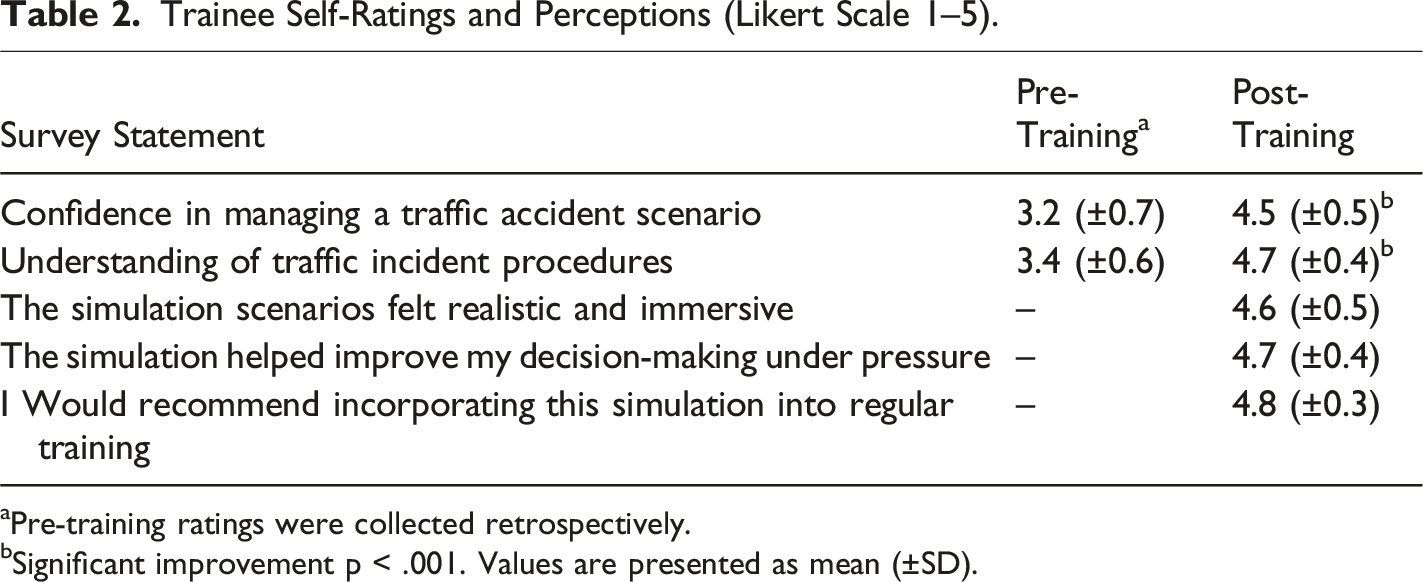
aPre-training ratings were collected retrospectively.
bSignificant improvement p < .001. Values are presented as mean (±SD).
As the pre-training ratings were collected retrospectively, they may be subject to the 'hello -goodbye’ effect (Salkind, 2006), where participants’ recalled perceptions of their baseline skills are influenced by their post-training experience, potentially inflating perceived improvement.
Responses to the two open-ended items were analyzed using a basic thematic analysis. Three recurring themes emerged across cadet feedback. 1. Realism and immersion 2. Development of structured response strategies 3. Value of safe-failure learning
Cadets described the simulation as lifelike, relevant, and reflective of real field challenges. Many highlighted that the experience helped them internalize a “mental playbook” to respond to future incidents. One participant wrote, “Initially I was unsure what to do first. Now, I feel I have a clear game plan if this happens in real life.
Others valued the ability to make mistakes in a safe environment, noting that, “The game let me make mistakes and learn from them.
Trainees also offered constructive suggestions, including requests for expanded scenario types (e.g., pedestrian accidents), optional tutorials, and more flexible AI dialogue. These recommendations were recorded for future iterations (Choudhary & Jalan, 2022).
Instructor feedback was aligned with trainees’ perceptions. Trainers observed unusually high levels of focus and engagement even during peer observation. Some cadets voluntarily repeated the scenarios to improve their scores, suggesting sustained motivation. Instructors also reported that cadet decisions closely aligned with real-world procedural expectations. For example, when one cadet prematurely moved a vehicle, the simulation flagged the action, prompting group discussion, and reinforcing the proper field protocol.
Discussion
Bridging the Gap Between Theory and Practice
This pilot study provides preliminary evidence that gamified simulation training may enhance procedural readiness among police cadets in localized traffic scenarios. The observed improvement in decision-making accuracy, procedural compliance, and confidence underscores the effectiveness of simulations in addressing the persistent gap between classroom instruction and operational performance (Alshehhi et al., 2024; Xue et al., 2021). Traditional police training often emphasizes memorization and written assessments, which may leave cadets ill-equipped to manage the pace, pressure, and complexity of actual field scenarios (Kienitz et al., 2024).
Our findings align with recent research on serious games as experiential tools that shift learning from “what to know” toward “how to act.” This approach fosters immersion, reflection, and practical competence (Facchino et al., 2025). Many cadets in our study initially expressed uncertainty about protocol application, despite prior instruction. However, after repeated simulation exposure, they demonstrated improved procedural fluency under time pressure, supporting the argument that action-oriented feedback-rich training enhances operational readiness.
Procedural Compliance and Experiential Learning
The nearly 30-percentage-point gain in procedural compliance highlights the capacity of the simulation to instill the sequential execution of police protocols. Real-world traffic incidents do not permit instructional pauses or repeated trials, yet the simulation environment allows for both, offering implicit feedback through simulated consequences, such as victim deterioration or scene escalation. This feedback loop promotes learning through reflection and adaptation, which are core components of Kolb’s experiential learning cycle (Kolb, 1984). Recent extensions of the model emphasize the importance of immersive, realistic training environments that support learner agency and contextual fidelity, which are features that are central to the simulation’s instructional design (Kolb & Kolb, 2017). These results also reinforce recent findings that repetition and real-time error correction improve protocol retention in public safety education (Calandra et al., 2022; Rholdon et al., 2020a, 2020b).
The cadets remained highly engaged throughout the training, further validating the model’s instructional design. Simulation-based learning has been shown to sustain attention and motivation by placing learners in dynamic decision-driven scenarios that mirror field complexity (Alshehhi et al., 2024; Toukiloglou & Xinogalos, 2023). In this study, repeated exposure to realistic, high-pressure situations encouraged cadets to internalize procedural sequences while developing decision-making flexibility. Their observed gains reflect not only technical skill acquisition but also enhanced cognitive readiness, defined as the ability to apply structured judgment under evolving conditions,a critical competency in law enforcement training (See & Davies, 2024).
Confidence and Field Readiness
Increased cadet confidence, as measured by both quantitative self-ratings and open-ended feedback, was especially significant. Confidence is not merely an affective outcome; it directly shapes performance under stressful conditions. Simulation-based training has been shown to improve confidence by reinforcing procedural memory and reducing hesitation in critical situations (Lambert et al., 2023; Tufts et al., 2021). Cadets in this study reported a transition from initial uncertainty to having a structured “mental script” for field responses. This internalization may improve decision speed, reduce procedural errors, and enhance public safety.
Engagement and Learning Culture
The gamified elements of the simulation contributed to a self-sustaining learning environment. Cadets voluntarily repeat scenarios to improve their scores and share strategies with their peers. This form of peer-driven engagement is uncommon in traditional training and demonstrates the potential of gamification to increase time-on-task and deepen learning (Rajagopal et al., 2020; Toukiloglou & Xinogalos, 2023). Crucially, scoring and competitive elements were aligned with procedural accuracy rather than speed, ensuring that engagement enhanced instructional goals, rather than diverting attention from them.
Protocol Fidelity and Instructional Alignment
Importantly, the realism of the simulation did not compromise the procedural integrity. The co-design process involves close collaboration between simulation developers, legal experts, and police trainers. As a result, the scenarios accurately reflected the UAE traffic law and Dubai Police protocols. Instructors confirmed that cadet performance in simulations aligned closely with field expectations, and feedback on procedural errors (e.g., moving a vehicle prematurely) mirrored real-world training discussions. This instructional fidelity not only enhanced the transfer of learning but also fostered instructor trust, which is a key factor in the institutional acceptance of new training tools (Boembeke et al., 2022; See & Davies, 2024).
Study Limitations and Directions for Future Work
This study had several limitations that warrant consideration. First, the sample was relatively small (n = 32) and was drawn from a single cohort of final-year cadets at the Dubai Police Academy. Although the findings were both statistically and practically informative and valuable, their broader generalizability may be limited. Future research with larger and more diverse samples, including cadets from multiple academies or jurisdictions, would help to establish external validity. Additionally, the evaluation relied on a single-group pre-/post-design without a control group. Although the improvements were substantial and supported by qualitative evidence, this design limits the ability to draw causal inferences. Randomized controlled trials or matched-group comparisons can provide stronger empirical grounding. This pilot study is best interpreted as a feasibility evaluation, rather than a definitive test of intervention efficacy. This study also relied on self-reported measures, including retrospective pre-training ratings, which may have introduced recall bias or inflated perceptions of improvement. Incorporating real-time pre- and post-assessments and behavioral data can enhance measurement validity.
Further limitations include the absence of a long-term follow-up or field-based performance tracking. Although simulation logs and instructor feedback provide valuable insight, the persistence and transfer of gains to operational contexts remain untested. Future studies should explore longitudinal outcomes and on-the-job applications. Finally, the simulation was built around the UAE’s traffic law and procedures. While this fidelity enhances instructional relevance for the target cohort, it may limit transferability to other legal or cultural settings. Moreover, as the simulation and survey instruments were delivered in Arabic, future work should examine how language-specific training environments affect transferability to multilingual or international policing contexts. Future adaptations should explore how simulation frameworks can be localized without compromising pedagogical intent.
Conclusion
This study explored how simulation-based training can enhance police cadets’ preparedness in managing traffic incidents by providing an immersive, scenario-driven environment that connects theoretical instruction with operational reality. Cadets trained with gamified simulations demonstrated notable gains in procedural accuracy, situational awareness, and confidence compared with baseline performance. In addition to a technical intervention, the simulation offered a structured space to exercise judgment, receive feedback, and reflect on decisions under pressure. These conditions replicate the key elements of field complexity and support experiential learning processes.
The instructional value of this approach lies in its integration of legal fidelity, real-time feedback, and structured repetition, which reflects the principles of experiential learning (Kolb, 1984; Kolb & Kolb, 2017) and deliberate practice (Ericsson, 2008). These elements foster procedural fluency and cognitive readiness, thus supporting both competence and confidence. Furthermore, the in-house development of the simulation within the Dubai Police illustrates how institutions can build scalable, context-specific training tools aligned with national standards and operational needs.
While limited in scope and duration, this study contributes to the growing body of evidence supporting simulation-based methods in law enforcement education. Future research should investigate the long-term retention, field performance, and transferability across domains. As policing becomes more complex, learning environments that combine realism, learner autonomy, and structured reflection will be essential to preparing officers who can respond decisively, lawfully, and with sound judgment.
Footnotes
Declaration of Conflicting Interests
The authors declared no potential conflicts of interest with respect to the research, authorship, and/or publication of this article.
Funding
The authors received no financial support for the research, authorship, and/or publication of this article.
Informed Consent
All participants were enrolled cadets at the Dubai Police Academy who voluntarily participated in the simulation-based training study. Written informed consent was obtained from all participants prior to their involvement in the research. Participants were fully informed of the study’s purpose, procedures, potential risks, and confidentiality safeguards, and they were advised of their right to withdraw at any time without penalty. The study protocol, including participant consent procedures, was reviewed and approved by the Dubai Police Academy Scientific Committee. No waiver of consent was requested or granted.
