




Abstract
Background
Video games are highly popular among young people worldwide and have been shown to help develop skills that are crucial for career planning, such as problem-solving, strategic thinking, and collaboration. These skills align with the future skills framework, which highlights essential life and career skills, learning and innovation skills, and ICT skills that can be fostered through gaming.
Methods
This cross-sectional study investigates the role of video games in fostering future skills relevant to career planning among Swiss secondary students (N = 265). We conducted quantitative content analysis within the future skills framework, paired with structural equation modeling (SEM), to determine whether students could identify skills acquired through gaming, which reflective abilities are needed, and how these might apply to career planning.
Results
Male students were more likely to report engaging in video gaming (b = .27, p < .001). Video gaming positively influenced both the number (b = 1.31, p < .001) and variety (b = .78, p < .001) of skills identified by students that could be coded within the future skills framework. SEM analysis demonstrated that criticality had a positive effect on the frequency of identified skills coded as future skills (b = .42, p < .05), whereas self-reflection negatively impacted this frequency (b = −.33, p < .05). Additionally, the frequency of future skills identified significantly influenced the perceived learning transfer to career planning (b = .12, p < .001).
Conclusion
The study underscores the importance of video games as informal learning environments that cultivate future skills essential for career planning. Integrating gaming experiences into career planning can support the development of adaptable, innovative, and forward-thinking skills. Encouraging an open, critical mindset enhances the transferability of gaming skills to real-life career contexts.
Keywords
Theoretical Background
Introduction
In the contemporary world, which is undergoing rapid change (Bauman, 2007), undertaking career planning can be incredibly challenging for young people. To successfully navigate this demanding process, adolescents should, therefore, draw on a range of resources (Hirschi, 2012). The development and utilization of resources can serve as a crucial vehicle for reducing the stress associated with challenges in life (Hobfoll et al., 2018), such as career planning. According to Hirschi’s (2012) integrative framework, the four key career resources are identity, social, psychological, and human capital resources. Transferable skills are a crucial component of human capital resources. Therefore, teachers, counselors, and parents now and then invite adolescents to reflect on skills in extracurricular activities, like arts or scouting groups (Rochat & Bodoira, 2016). However, adults seldom ask adolescents to reflect on the skills they develop in video games (Rochat & Armengol, 2020). This is somewhat surprising: While most adolescents play video games in most countries (Entertainment Software Association, 2022; Külling et al., 2022), the skills they acquire in video games are often overlooked in career planning. It is important to give video games more consideration, as they hold significant potential for career planning. For example, it has been shown that video games activate skills that can be very useful for challenges in the real world, ranging from cognitive (e.g., attention) to complex problem-solving skills (Adachi & Willoughby, 2013; Bediou et al., 2023; Dindar, 2018). Furthermore, when confronted with failure, players are strongly driven to keep trying to succeed, maintaining a “relentless optimism” mindset (McGonigal et al., 2012) about achieving their goals, which is also important in career planning and is required throughout life. In this context, it seems worthwhile to compare the skills of adolescents engaged in gaming and a competency set relevant to career planning.
The twenty-first-century skills framework (P21, 2019), or the future skills framework, appears to offer a promising approach to this issue. Firstly, future skills are critical to learners’ personal and professional success in a globally and digitally networked world and add to an individual’s employability (Rakowska & De Juana-Espinosa, 2021). Secondly, several studies have indicated that there is potential for video games to contribute to the development of future skills (e.g., Contreras-Espinosa & Eguia-Gomez, 2022; Hewett et al., 2020). Therefore, we will adapt this framework for this study to categorize the skills young people use in games. Firstly, we explore whether adolescents recognize the skills they develop while playing commercial video games and other games when prompted to reflect on their gameplay. Furthermore, we examine which skills adolescents identify and whether these can be classified as future skills. Additionally, we investigate whether specific reflection abilities are required to identify these skills. A key question is whether adolescents perceive gaming skills as beneficial for their career planning. The outlook section will discuss strategies to make these skills more accessible and explore their potential role in career planning.
Gamifying the Challenge Career Planning
In education, there are already many different approaches to integrating and facilitating learning and reflection processes through video games: Gamification is used to foster learners’ engagement and motivation by using gaming elements to construct educational settings (Deterding et al., 2011), like in vocational education (Jayalath & Esichaikul, 2020). Furthermore, video games designed specifically to promote learning, known as serious games, have been developed for career planning. To illustrate, the Swiss game https://like2be (Keller et al., 2023) is designed to offer players, assuming the role of job service employees, a diverse perspective on a range of job profiles. In addition, the German game Serena Supergreen (Spangenberger et al., 2022) features a female avatar who serves as a role model for pursuing careers in science, technology, engineering, and mathematics (STEM). However, little attention has been paid to commercial video games and how they can be used for career planning through digital game-based learning.
Digital Game-Based Learning and Skills for Career Planning
Digital game-based learning does not necessarily involve playing games in the conventional sense; instead, it refers to applying learning experiences derived from gaming for educational processes (Prensky, 2003). This connection is particularly relevant because stories and storytelling are central to video games (Juul, 2005). While career planning itself is not a game, current career theories stress the importance of articulating one’s career decisions and pathways through narration (Savickas, 2012). When working with adolescent video gamers, the metaphor of “career life as a game” (Rochat & Borgen, 2023) can serve as a gateway to the lifeworld of young people and be a powerful tool to foster this type of narration. This approach also helps uncover valuable insights into how specific skills used in video games can be applied to career planning (Rochat & Armengol, 2020).
Thereby, it is essential to consider that commercial video games may vary in many aspects, as in the genre, such as fantasy, sci-fi, supernatural, crime, war and fighting, science, travel, and transportation (Reyes-de-Cózar et al., 2022). Therefore, the activities are very different for the gamer, like constructing cities, fighting foes, seeking to save the world, or aiming to win a race. Furthermore, on the surface, goals or missions in video games might differ in many ways from the “real-world mission” career planning. In essence, however, the completion of challenges in commercial video games necessitates using similar skills as those required for career planning. This is because many commercial video games address contemporary societal issues and provide an opportunity to learn how to navigate real-world challenges effectively (Lux & Budke, 2023). To illustrate, in video games, players need to … • be curious to discover new, unknown worlds and try out different avatars (McGonigal et al., 2012). This aligns with the requirements of career planning, which encourages adolescents to consider various career options and alternative pathways from an early age and to engage with different professional roles until they identify one that aligns with their long-term aspirations (Hall et al., 2018; Lent et al., 2017). • build guilds or teams and play with other people in the game (Greitemeyer et al., 2012). This is analogous to career planning, in which adolescents must establish a network and begin to collaborate with others. This may entail, for instance, organizing internships or work experience days with the assistance of social networks (Hirschi, 2012). • develop enough confidence to overcome challenges and adapt to new quests (Adachi & Willoughby, 2013). Similarly, career planning often requires a degree of self-efficacy, flexibility, and adaptability, as not all planned career paths can be realized (Krumboltz & Levin, 2010). • find and critically integrate information from different sources (e.g., Twitch or Wikis) to accomplish a mission and reach the goal (McGonigal et al., 2012). In the context of career planning, adolescents are required to engage in critical thinking in order to integrate information from a range of sources in order to achieve their career objectives (Driesel-Lange et al., 2010).
Only recently have studies commenced to examine the extent to which the skills utilized in commercial video games can also be advantageous for career planning. For example, the findings of the study by Wallinheimo et al. (2023) suggest that different professions may favor specific types of games that help develop valuable soft skills, such as problem-solving, spatial skills, and leadership, which are relevant to their career roles. Specifically, the study highlights that gaming experiences can enhance employability by fostering skills that are transferable to real-world professional contexts. Another study by Kraus et al. (2021) found that frequent video gamers develop cognitive skills like opportunity recognition, which are essential for entrepreneurship. It also revealed that gaming intensity, especially in specific genres like shooting games, enhances skills such as risk-taking, proactiveness, and innovativeness, making video games a valuable tool for cultivating entrepreneurial abilities.
Regardless of the game genre, it is beneficial to consider the use of transferable skills (Nägele & Stalder, 2017) in games especially. In this study, the concept of future skills (P21, 2019) was selected for further analysis.
Future Skills in Commercial Video Games
The concept of future skills is frequently emphasized in game-based learning literature. It has been demonstrated that gamers actively utilize and cultivate these skills during gameplay (Qian & Clark, 2016). Therefore, it makes sense to think of gaming experiences as informal learning (Johnson & Majewska, 2022) where future skills can be applied and developed.
The future skills framework incorporates life and career skills (flexibility and adaptability, initiative and self-direction, leadership, and responsibility), learning and innovation skills (critical thinking, communication, collaboration, and creativity), and information, media, and technology skills and aims at empowering young people to assert in an increasingly digital world (P21, 2019). The framework is used by many schools worldwide to prepare their students for the digitalized and globalized labor market (DiBenedetto, 2018). As highlighted by the OECD (2018), in a world facing uncertainties, the role of education is crucial in determining whether individuals will be able to overcome challenges or be overwhelmed by them. Accordingly, cultivating future skills is regarded increasingly as a core objective of the learning process at schools.
In career planning, future skills can assist young individuals, particularly at the initial stages of their professional development. These skills are sought to enhance employability and facilitate the establishment of sustainable careers (Rakowska & De Juana-Espinosa, 2021). The emphasis on the importance of future skills for career planning is undoubtedly valuable, and the gaming world is a helpful resource for this purpose. However, it is essential to acknowledge that video games can be a controversial topic due to reservations held by adults and the potential for adverse outcomes, including increasing of aggression and depression (e.g., Delhove & Greitemeyer, 2023; Männikkö et al., 2020). It is, therefore, important to underscore that a substantial body of empirical evidence demonstrates that future skills are being utilized while gaming and that these skills can be of enormous value for real-life contexts, like career planning.
For example, Annetta et al. (2010) found that playing a teacher-created video game for high school biology students helped them develop future skills, including digital literacy, inventive thinking, and effective communication. These skills were observed through students’ interactions with teachers, discussions with peers, and their engagement with the game, demonstrating that video games can effectively enhance essential cognitive and collaborative abilities. Another study found that different types of video games are associated with developing specific future skills (Yılmaz et al., 2022). For example, action games are linked to improved problem-solving and spatial skills, role-playing games enhance communication and empathy, and strategy games foster critical thinking and decision-making. The study by McCreery et al. (2011) found that playing Massively Multiplayer Online Games (MMOGs) like “World of Warcraft” helps players develop essential future skills, including problem-solving, communication, and collaboration. These skills are particularly enhanced as players navigate complex virtual environments, interact with other players, and engage in cooperative tasks that require high levels of social interaction and strategic planning. Hewett et al. (2020) discovered that playing Minecraft significantly enhances critical future skills, including problem-solving, creativity, communication, and collaboration. These skills were especially apparent as students navigated 3D virtual environments, worked together on tasks, and addressed complex challenges that demanded innovative thinking. Chen and Wu (2021) found that digital role-playing games significantly enhance students’ critical thinking skills, particularly assumption identification and argument evaluation, and learning motivation through interactive, contextual problem-solving activities. The study by Qian and Clark (2016) reviewed 137 papers and found that game-based learning positively impacts the development of future skills, particularly critical thinking, collaboration, and creativity. These skills were most effectively developed when the games incorporated specific design elements, such as role-playing, exploration, and cooperation, actively engaging the players.
An interesting aspect of games and future skills is the concept of project-based learning in combination with gamification or game-based learning (GPBL). With gamification, game elements such as rewards, challenges, and feedback are applied to make project-based learning (PBL) more engaging and effective. Through game-based learning, on the other hand, games are integrated as content or requires learners to design their own (educational) games. The use of video games as tools or as the foundation for projects creates authentic, learner-centered experiences that lead to deeper engagement and enhanced skill acquisition: A systematic review shows that GPBL fosters meta-cognitive and self-regulated learning skills, such as independence or perseverance, as well as all areas of future skills, from media literacy to social skills (Huang et al., 2023). Recent research increasingly highlights the benefits of game design, particularly in terms of acquiring future-relevant skills. Research found that students who designed their own games within an educational context demonstrated significant improvements in academic achievement, attitudes toward learning, and engagement with computer-assisted teaching (Kabak, 2021). Additionally, game design approaches support the development of social and emotional skills, leading to empathy, respect, and effective communication, which are essential for teamwork (Weixelbraun, 2024). Rapid, collaborative game creation within a set timeframe formats, so-called game jams, provide opportunities for interdisciplinary learning, practical skill development, and the enhancement of social competencies like teamwork and communication (Aurava & Sormunen, 2023).
To sum up, video games and digital game-based learning are effective methods for the informal learning of future skills. While applying these skills is relatively straightforward, recognizing and transferring them to other contexts, such as career planning, is more complex. Therefore, it is crucial to identify the reflective abilities necessary for this process.
Self-Reflection and Criticality for Effective Learning Transfer
Informal learning refers to the continuous acquisition of knowledge, skills, attitudes, and insights through daily experiences and interactions with one’s surroundings (Coombs & Ahmed, 1974). It is a lifelong process outside formal, structured educational settings, where learning arises as a by-product of other experiences (Johnson & Majewska, 2022). It has been shown that commercial video games also provide informal learning situations by providing strong emotional experiences and positive feelings for players (McGonigal et al., 2012). In addition, gaming environments offer adolescents a safe space to manage negative emotions, such as frustration, while developing social skills like teamwork and cooperation, allowing them to explore various tasks and roles beyond their student identity (Granic et al., 2014).
While adolescents draw from various experiences, including sports and traditional board or card games, the use of video games increases significantly after the age of 13 (Pronova BKK, 2023). Typically, male adolescents engage in video gaming more than their female counterparts (Külling et al., 2022; Yılmaz et al., 2022). However, research suggests that this difference may be influenced by cultural framing, societal expectations, and self-reporting biases: Female gamers often underreport their gaming activities, particularly in casual genres like mobile and puzzle games, which are frequently associated with less skill-intensive play and are not traditionally aligned with the ‘hardcore gamer’ identity (Eklund, 2015; Yao & Rhodes, 2023). “Women are the ‘others’ in digital gaming, resulting in an image of female casual gamers and male hardcore gamers” (Eklund, 2015, p. 18). These stereotypes not only exclude female gamers from the mainstream but also impact their self-evaluation and gaming identity, perpetuating their underrepresentation. Therefore, it is crucial to consider the experiences that adolescents gain from playing traditional games and sports as well, as these constitute relevant informal learning environments. The key challenge, thereby, is to ensure that adolescents are aware of the skills they develop through these gaming experiences and to facilitate their understanding of how these skills can be relevant to their career planning. Such awareness is not an inherent quality; rather, adolescents must possess well-developed self-reflection abilities and a critical mindset.
The capacity for self-reflection and cognitive flexibility is particularly important during the adolescent years, not only in the context of general career planning but also when engaging in the unconventional process of linking gaming experiences to career skills. Adolescents should be encouraged to deeply reflect on their experiences, emotions, and thoughts (Silvia, 2021) and adopt a critical mindset that enables them to question their assumptions and remain open to new ideas (Cox, 2017). These reflective and critical abilities are essential prerequisites for effectively identifying and transferring skills acquired through gaming into career planning. This interconnection between self-reflection, criticality, and the transfer of skills is critical in demonstrating the value of gaming as a tool for the informal learning of future skills that can be applied to career planning.
Intervention
This paper is embedded in a longitudinal study from 2021 to 2025 on digital support of young people in career orientation in cooperation with the institute of Applied Psychology of the University of Applied Sciences and Arts Northwestern Switzerland and the University of Teacher Education Bern. An online tool, digibe, was developed to reflect on career planning as part of the intervention-based study, which fosters digital guidance in the career choice process. We use the data from the reflection task, where students are invited to use a video game metaphor for their career planning.
First, students had to name their favorite traditional sports or video games. Second, they were asked an open question about the skills needed in these games. Third, they were invited to reflect on whether they could use these skills in their career planning. These three tasks were embedded in a module allowing students to reflect on career planning utilizing a video game metaphor. In addition, students were repeatedly asked to assess the status quo of their career planning using various items. For this study, self-reflection and criticality (Cox, 2017; Silvia, 2021) were taken from this status questionnaire.
Methods
This cross-sectional study, using Structural Equation Modeling (SEM), examined the pathways linking 1. Do adolescents apply gaming skills that can be coded using the future skills framework? 2. What reflective abilities are necessary for the application of these skills in gaming? 3. How does identifying future skills impact the learning transfer to career planning?
Hypotheses and Conceptual Model
Based on the theory, the following hypotheses, shown in Figure 1, emerge. Conceptual model.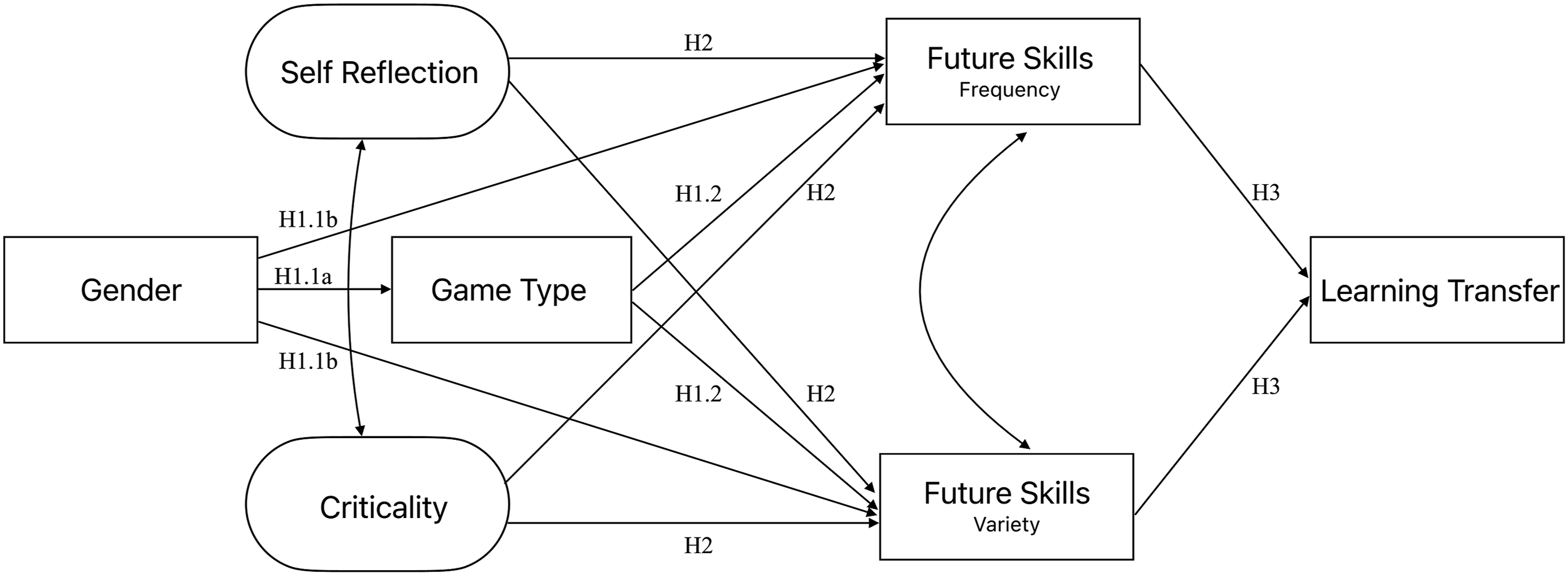
Gender and Gaming
Given that male adolescents are more likely to report to engage in gaming activities, and that future skills are predominantly utilized in video games, it can be posited that gender also influences the game type, as well as the number and variability of future skills observed in gaming contexts (Külling et al., 2022; Qian & Clark, 2016). We therefore hypothesize:
Gender (male) has a positive effect on game type (video game).
Gender (male) positively affects the amount and variety of coded future skills in gaming.
Video Gamers and Future Skills
To determine the relevance of gaming skills in career planning, we ask if adolescents can name skills, they use in video games and whether these skills can be categorized according to the future skills framework (P21, 2019). As video games are often more realistic than traditional board games, in the sense of mimicking real-world situations such as building towns or struggling with strategic quests (Lux & Budke, 2023), we hypothesize:
The game type (video game) positively affects the number and variety of coded future skills in gaming.
Reflection as an Enabler of Naming Skills
To recognize the skills utilized in informal learning environments like the gaming world, one must have the capacity for reflection, such as criticality, to even consider the possibility that valuable skills can be acquired through gaming (Cox, 2017). Moreover, self-reflection is a crucial element, enabling individuals to engage in introspective analysis of their actions, emotions, and thoughts (Silvia, 2021). We hypothesize:
Criticality and self-reflection positively affect the number and variety of coded future skills.
Future Skills and Learning Transfer
We expect that students naming skills coded as future skills also see the potential to re-use these skills in career planning. This is because future skills are regarded as transferable skills that can be effectively applied in a range of situations, including career planning (Rakowska & De Juana-Espinosa, 2021). We hypothesize:
The number and the variety of coded future skills positively affect a positive learning transfer to career planning.
Sample
The data for this study originates from digibe, a longitudinal study investigating the potential of digital guidance in adolescents’ career planning. Schools from the German-speaking region of Switzerland at the lower secondary level were chosen for the study, as career planning is particularly important during this phase of education. The decision to focus on this region was also based on the predominant language, German, as the researchers are German-speaking, which facilitated collaboration with the schools and the data analysis process. Efforts were made to include a diverse range of schools across the region to minimize selection bias and ensure a representative sample. Schools were primarily recruited online between May and September 2021.
As part of the intervention study, students used a specially developed online tool to complete various tasks designed to foster reflection on their career planning. This paper focuses on a sub-sample, 265 students, who worked on and completed the gaming-related reflection task, “Skills in games, skills in career planning.” No additional selection criteria were applied. At the time of processing, all participating students were enrolled at the lower secondary level, i.e., between 9th and 11th grade.
Data Collection
The data were collected at three measurement points as part of the digibe intervention study conducted in a school context from September 2021 to June 2023. • Measurement 1: A questionnaire was administered to collect baseline information, including the gender of the participants. • Measurement 2: A questionnaire was conducted immediately prior to the reflection task to assess criticality, self-reflection, and additional variables pertinent to the intervention study. • Measurement 3: Students completed the reflection task titled “Skills in games, skills in career planning”, where they provided open-ended responses about their gaming experiences, the skills they identified, and the applicability of these skills to career planning.
The timing of measurement 2 and measurement 3 varied, as teachers had the flexibility to decide when to administer the questionnaire (measurement 2) and the reflection task (measurement 3). As a result, the duration between completing the reflection task “Skills in games, skills in career planning” (measurement 3) and the preceding questionnaire (measurement 2) varied for each participant. Based on the time each task was completed, we calculated the duration between measurement 2 and measurement 3.
Instruments
In general, the coding of responses to the open-ended questions regarding favorite game (Game Type), five skills used while playing (Future Skills Number/Variety), and whether these skills are relevant for career planning (Learning Transfer) was conducted both inductively and deductively using quantitative content analysis. Each category in the schema was labeled and numbered, accompanied by a definition, examples, and coding guidelines for clarity. Anchor examples, which vividly illustrated category meanings, were also included. Subsequently, we conducted coder training based on the category schema, incorporating initial trial coding. The schema underwent revisions until a satisfactory level of agreement was achieved. We used MAXQDA (VERBI, 2023) for data analysis. Then, we assessed the reliability of the coding. A second coder independently coded a sample of response texts, and the reliability measure of Cohen’s Kappa (Landis & Koch, 1977) was calculated to evaluate coding quality.
Finally, the coding results, represented by one code per response, were added directly to the survey data and used variables (Self-Reflection, Criticality, Gender). The combined dataset was then analyzed to conclude from the coded information. All analyses were run with JASP 0.18.1 (2023) and the R package lavaan (Rosseel, 2012).
Gender
Gender data was collected through a survey (measurement 1), offering the options of male, female, or diverse. In the broader intervention study, with over 2,800 participants, only a very small percentage selected the “diverse” option. To enable consistent analysis, these cases were adjusted using teacher-provided class lists, resulting in binary gender categories for this sample. This approach facilitated consistent data processing, while accepting the limitations in accurately capturing the complexity of gender diversity. Of the sample, 57% are male students (N = 151), and 43% are female students (N = 114).
Self-Reflection and Criticality
Reflection was measured by self-reflection and criticality (Cox, 2017; Silvia, 2021). The measures are taken of the questionnaire immediately prior to the game-related reflection task (measurement 2). Self-reflection was measured with four items, e.g., “I always take time during the career choice process to become aware of my feelings,” on a scale from 1 “does not apply at all” to 5 “applies very much,” N = 263 (M = 3.32, SD = .97, Cronbach’s α = .89). Criticality was measured with three items, e.g., “In career planning, I am open to questioning my beliefs,” on a scale from 1, “does not apply at all” to 5, “applies very much,” N = 263 (M = 3.61, SD = .82, Cronbach’s α = .82). Of the 265 participants, 263 provided data on self-reflection and criticality. The complete information maximum likelihood (FIML) procedure was used to deal with missing data, which leads to a more reliable and less biased estimation than other methods (Schafer & Graham, 2002).
Game Type
Responses to the open-ended question on favorite games (measurement 3), specifically “Think about it: Which game do you particularly enjoy? Write it down – it doesn’t matter if it’s a computer game, a card game, a smartphone game, or something else.”, was inductively coded based on quantitative content analysis (Früh, 2015; Mayring, 2016) into the categories of video games, sports, traditional board or card games. For further analyses on the answers on the open-ended question on favorite games, we created the code “Game Type” and assigned the students to two groups, namely video gamers (N = 147) and nonvideo gamers (N = 118). Video gamers mentioned playing video games only (e.g., Grand Theft Auto V, Minecraft, Clash Royale), or in combination with sports (e.g., I enjoy playing soccer in real life, but I also like playing FIFA; Occasionally, I also play GTA or Shadow Fight) or together with traditional card or board games (e.g., Chess, Ludo, Minecraft, Assassin’s Creed). Nonvideo gamers are stating none of them or only sports (e.g., Tennis), or only traditional board or card games (e.g., City, Country, River), or a combination of both (e.g., Chess, Soccer, Exit, Monopoly). Two raters coded 40% of the answers independently, and the interrater reliability was very good, with a Cohen’s Kappa 0.99.
Future Skills
The open-ended responses to the question “Name five skills or abilities you need to play [favorite game/s] and that you are good at.” (measurement 3) were analyzed using deductive coding within a framework of quantitative content analysis (Früh, 2015; Mayring, 2016). For coding, we decided to use the future skills framework, namely ICT skills (information, communication, technology), learning and innovation skills (creativity & innovation, critical thinking, and problem-solving, communication, and collaboration), life and career skills (social and cross-cultural, initiative and self-direction, flexibility, and adaptability). Two raters coded 40% of the answers independently, and the interrater reliability was very good, with a Cohen’s Kappa 0.88.
Learning Transfer
Responses to the open-ended question “Can you also use the gaming skills you mentioned for career planning?” (measurement 3) were coded for the variable “Learning Transfer”. The answers were inductively coded into two categories: “Yes” (e.g., I think yes, because one should always remain calm and kind, be a team player, and often think things through carefully.) and “No” (e.g., I don’t think so.), for reducing complexity, and facilitating group comparisons. Two raters coded 40% of the answers independently, and the interrater reliability was very good, with Cohen’s Kappa 0.96.
Statistical Analyses
We analyzed the data using descriptive and correlational analyses, chi-square tests, and structural equation modeling (SEM) with JASP (2023).
First, descriptive statistics were used to summarize the demographic distribution of the sample and provide an overview of key variables, including Gender, Game Type, Self-Reflection, Criticality, Future Skills Sum/Variety, and Learning Transfer. This step established baseline insights, including means, standard deviations, and frequency distributions, necessary for subsequent analyses. To assess relationships among the variables, zero-order correlations were calculated and analyzed.
Secondly, to examine associations between categorical variables, such as Gender and Game Type (e.g., Video Gamer versus Traditional Board Gamer), chi-square tests were conducted, following the guidelines provided by Field (2013). This analysis helped identify significant gendered patterns in game preferences and their potential implications for skill development.
Third, the hypotheses were tested using structural equation modeling (SEM) to examine complex pathways among all variables. SEM facilitated the simultaneous testing of multiple interrelated hypotheses, incorporating both observed variables (e.g., Game Type) and latent constructs (e.g., Criticality). The duration between measurement 2 and measurement 3 was included as a variable in the SEM to account for potential effects. However, as no significant results were observed, it was subsequently removed from the analyses. SEM is a preferred method for examining path models with latent constructs in the field of social sciences (Civelek, 2018). To assess model fit, we considered the comparative fit index (CFI), Tucker–Lewis index (TLI), and root mean square error of approximation (RMSEA). CFI and TLI values above 0.90 and RMSEA values below 0.08 indicate acceptable fit, while values above 0.95 and below 0.06 represent good fit (Hu & Bentler, 1998). Our model included latent variables such as search for self-reflection and criticality. We conducted latent-variable structural path analyses using maximum likelihood estimation (Maydeu-Olivares, 2017). Missing values were imputed using the Full Information Maximum Likelihood (FIML) method to ensure more accurate and less biased estimates in the analysis (Schafer & Graham, 2002).
Results
Descriptive Statistic
Descriptive Statistics and Correlations Among Variables.
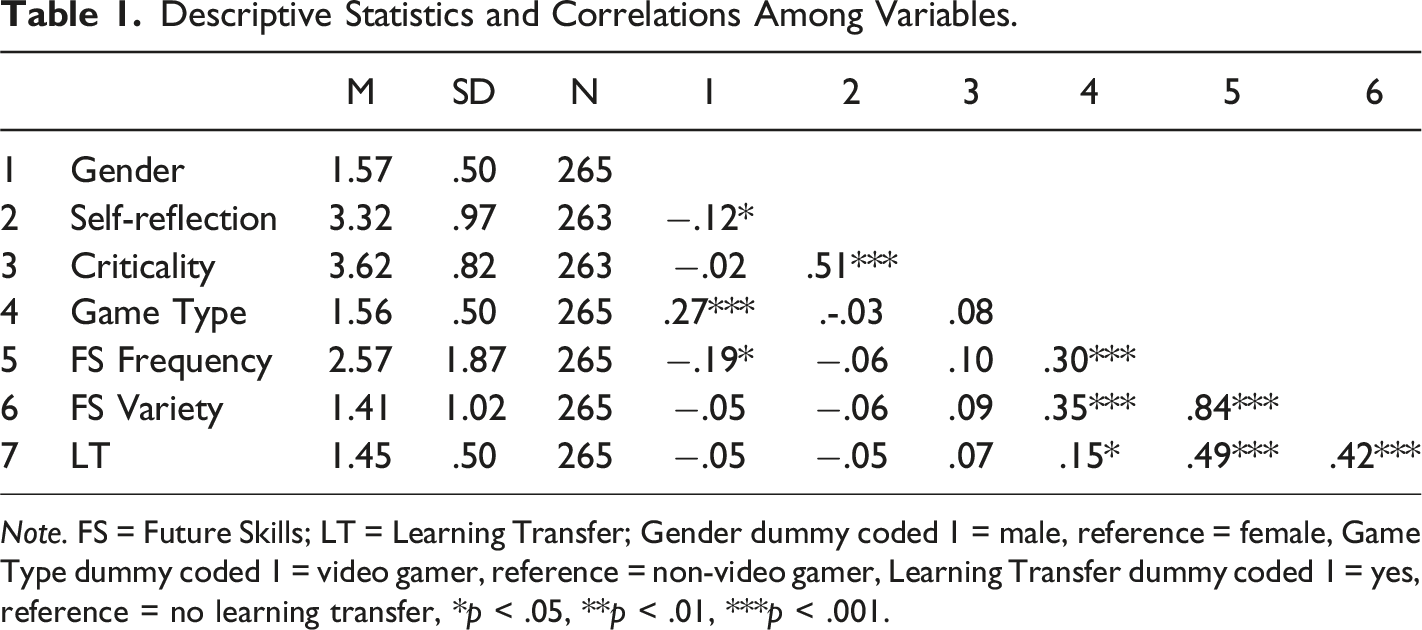
Note. FS = Future Skills; LT = Learning Transfer; Gender dummy coded 1 = male, reference = female, Game Type dummy coded 1 = video gamer, reference = non-video gamer, Learning Transfer dummy coded 1 = yes, reference = no learning transfer, *p < .05, **p < .01, ***p < .001.
Gender was dummy coded, with 1 representing males and 0 representing females. Game Type was dummy coded, with 1 representing video gamers and 0 representing non-video gamers. Learning Transfer (LT) was also dummy coded, with 1 indicating the presence of learning transfer and 0 indicating no learning transfer.
Gender was significantly correlated with Game Type (r = .27, p < .001), suggesting that males were more likely to be video gamers. There was a small negative correlation between Gender and Self-Reflection (r = −.12, p < .05), indicating that females reported slightly higher levels of self-reflection. Criticality was positively correlated with Self-Reflection (r = .51, p < .001), showing that those with higher levels of critical thinking also tended to engage in more self-reflection.
Regarding Future Skills (FS), FS Frequency was negatively correlated with Gender (r = −.19, p < .05), meaning females reported using these skills more frequently than males. FS Frequency was also positively correlated with Game Type (r = .30, p < .001) and FS Variety (r = .84, p < .001), indicating that video gamers reported using a greater variety and frequency of future skills.
Learning Transfer (LT) was positively correlated with FS Frequency (r = .49, p < .001) and FS Variety (r = .42, p < .001), suggesting that the more frequently and varied the skills used in gaming, the more likely participants were to report a transfer of these skills to real-life contexts. No high correlations (i.e., >.60) were present, except between FS Frequency and FR Variety (r = 84), indicating that multicollinearity is unlikely to bias our results.
Game Type and Gender
Of the 265 participants, 82% (N = 218) named a favorite game, while 18% (N = 48) did not explicitly mention a favorite game. For stating a favorite game, no gender difference could be found, χ2(1) = 1,72, p = .19. The games the students named were coded in the categories of traditional board or card games, e.g., Chess, Uno, or Monopoly; sports, e.g., soccer, tennis, or volleyball; and video games, e.g., Fortnite, Minecraft, or FIFA; additionally non-codable answers, e.g., a lot, there are several games that I like, I don’t have a favorite game. Of students who named favorite games (N = 218), 42% (N = 103) exclusively mentioned video games, while 32% (N = 70) cited sports or traditional games, or a combination of the two. The remaining 21% (N = 45) mentioned a mix of video games and other game types.
Female students, χ2(6) = 44.23, p < .001, mention more favorite games from the realm of traditional board and card games (adj. res = 4.74), sports (adj. res = 2.04), or a combination of both (adj. res = 2.22). At the same time, male students predominantly name video games (adj. res = 4.27) or a combination of video games and sports (adj. res = 2.79).
Future Skills
We looked at the students’ responses to the question of which skills they use during a game. Of the 265 participants, 77% (N = 204) named one to five skills they used in the games, e.g., planning, team play, programming; 23% (N = 61) did mention terms that we coded as “no skills,” e.g., luck, money, nothing. In general, most students mentioned many skills, 4 or 5, and only a few mentioned between 1 and 3 skills.
Out of the sample (N = 265), we found that 73% (N = 194) stated 680 skills, which can be categorized by the future skill framework, e.g. perseverance, logical thinking, motivation, 4% (N = 10) named 163 other skills, e.g. vehicle maintenance, shooting, jumping. 37% (N = 98) named two or more future skills while gaming, 36% (N = 96) of the students stated at least one. Of the students who named future skills (N = 194), 30% (N = 59) named ICT skills, 77% (N = 150) learning and innovation skills, and 85% (N = 164) life and career skills. Examining the most frequently mentioned subcategories by the students who stated future skills (N = 194), it becomes apparent that in the category of learning and innovation skills, 42% (N = 108) named critical thinking skills, e.g., concentration, accuracy, networked thinking, and in the category of life and career skills, 65% (N = 126) students stated initiative and self-direction skills, e.g., game strategy, orientation, much overview.
Hypotheses Testing
The model presented in Figure 2 has shown a good fit, χ2(44, N = 265) = 56.08, p = .11, CFI = .99, RMSEA = .03, SRMR = .04 (Cohen, 1988). There is a correlation between the frequency and variety of future skills and criticality and self-reflection. Path model. Note. N = 263 - 265, missing values imputed with the FIML method; standardized estimates; Gender dummy coded 1 = male, reference = female; Game Type dummy coded 1 = video gamer, reference = non-video gamer; Learning Transfer dummy coded 1 = yes, reference = no learning transfer; *p < .05, **p < .01, ***p < .001.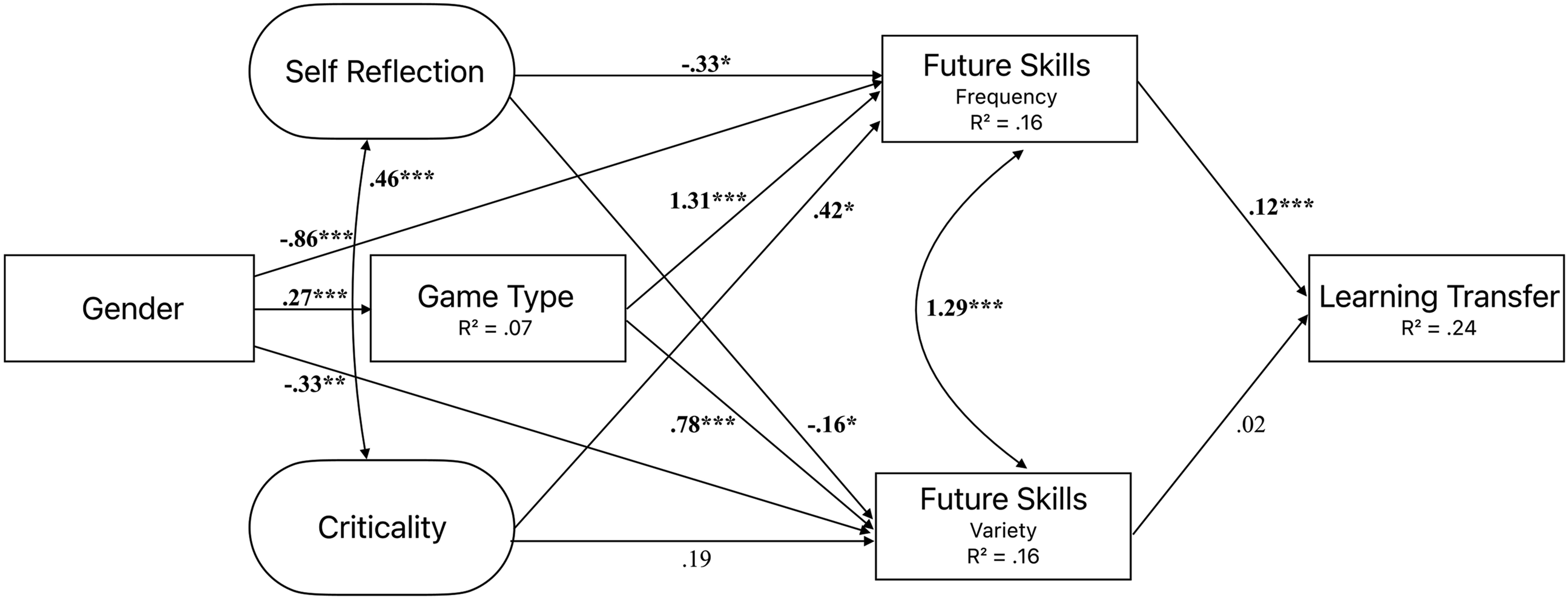
As expected, playing video games is predicted by being male. The unstandardized path weight from under to game type was b = .27, p < .001. Hypothesis 1.1.a confirmed. We hypothesized that being male predicts the number of future skills named and their variety. Being male does not predict the number of future skills named (b = −.86, p < .001) nor the variety (b = −.33, p < .01). Being female predicts the number and variety of future skills named. Hypothesis 1.1.b is not confirmed. As assumed, the game type (video gamer) positively affects the number of future skills named (b = 1.31, p < .001) and the variety (b = 0.78, p < .001). Hypothesis 1.2 is confirmed.
We hypothesized that the number and variety of future skills depend on self-reflection and criticality. We found a significant positive effect of criticality on the frequency of future skills named (b = .42, p < .05), but not on the variety of skills named (b = .19, p = .07). Still, against our expectation, self-reflection has a negative effect on the frequency (b = −.33, p < .05), and variety (b = −.16, p < .05), of future skills mentioned. Hypothesis 2 is only partially confirmed.
We hypothesized that the learning transfer depends both on the number and variety of future skills named. However, we found that naming a high number of future skills has a positive effect on stating a learning transfer (b = .12, p < .001). The variety of future skills named has no such effect (b = .02, p = .62). Hypothesis 3 is only partially confirmed.
Discussion
This study enhances our understanding of how gaming can support adolescents’ career planning by recognizing their gaming skills. Generally, we noted a gendered pattern in game preferences: Male students report engaging more in video or sports games, while female students indicate a preference for traditional board or card games. In this study, the gender variable was presented in binary format, reflecting adjustments made during data collection. The low percentage of diverse responses (less than 1%) observed across the broader intervention study suggests that such responses may be influenced by the context of career planning, which is still strongly shaped by gender stereotypes. These stereotypes may lead students to align themselves with a binary category, adapting their responses to the situation without necessarily fully expressing their actual gender identity. Furthermore, societal stereotypes and self-perception often shape gaming behaviors, with women underreporting gaming activity, especially in casual genres, due to cultural associations that marginalize them as ‘non-gamers’ (Eklund, 2015; Yao & Rhodes, 2023). However, our observation aligns with research trends, indicating distinct gaming behavior reporting among genders (Külling et al., 2022; Yılmaz et al., 2022).
In the context of gaming skills, one thing is very apparent: Young people can name skills they use and develop in video games even without predefined response options. The only instruction needed to give the adolescents is to start reflecting and allowing them time to write down the skills developed in video games, as in career counseling sessions where the game metaphor is used (Rochat & Armengol, 2020). This insight is critical as it highlights gaming as a recreational activity and a conduit for developing skills relevant to career planning. As future skills are known in schools as critical preparatory skills for today’s job market (DiBenedetto, 2018), the coding was done based on the future skills framework in this paper. The data was then analyzed using a structural equation model demonstrating a robust fit, confirming the reliability of our findings.
In general, it was found that adolescents who play video games tend to identify a higher frequency (b = 1.31, p < .001) and variety of future skills (b = 0.78, p < .001). The skills highlighted by these adolescents are particularly strong in areas such as ICT, critical thinking, initiative and self-direction. This finding reinforces that video gaming, often grounded in real-life scenarios, serves as a valuable informal learning environment for cultivating essential skills in today’s rapidly changing digital world. It is interesting, that the effect of gender on the frequency and variety of future skills identified is mediated by game type. Specifically, being male is associated with a higher likelihood of engaging in video gaming (b = .27, p < .001), which in turn is associated with a higher frequency and variety of future skills.
Our study sheds also light on the roles of criticality and self-reflection for recognizing and transfer skills used in games. We found that a higher level of criticality positively affects the number of future skills identified (b = .42, p < .05), while self-reflection appears to have a negative impact. This distinction suggests that the type of reflection is key: Critical, outward-looking reflection aids in recognizing future skills, whereas introspective self-reflection may limit this ability. This could be because highly self-reflective adolescents are mainly oriented toward their feelings and thoughts and are less onward or future-oriented in their reflection. The result highlight, if young people are ready to reflect critically on their career planning and are willing to use the experiences in the gaming world for that process, they can uncover some hidden resources that can be useful for it.
We also found a positive effect between recognizing future skills and perceiving their applicability in career planning. The learning transfer is positively influenced, especially by stating a high number of future skills. The effect of game type “video game” on learning transfer is mediated by the frequency of future skills. Video gaming is associated with a higher frequency of future skills (b = 1.31, p < .001), which in turn positively affects learning transfer (b = .12, p < .001). This highlights the importance of encouraging adolescents to connect their leisure activities, such as gaming, with their career planning.
Limitations and Suggestions for Further Future Research
The study did not consider the genre of video games, which can significantly impact the skills acquired. However, we expect some of the effects to be even stronger if we take the type of game into account. Investigating different game genres and approaches to acquiring different skills would be worthwhile.
Furthermore, the study is limited by its reliance solely on the students’ self-reported data. As such, whether these skills are genuinely developed during gaming remains unclear. Additionally, the study solely inquired about the transfer of learning without collecting empirical data. Further studies are needed to determine such a transfer. Future research could provide deeper insights by incorporating qualitative methods or more extended observation periods.
It might be interesting to examine the reflection component further and conduct additional empirical studies to explore which reflection skills are necessary to identify gaming skills and make them applicable to other areas. The negative effect of self-reflection, in particular, is complex for us to explain and warrants further investigation.
Conclusion
In summary, our findings suggest a need to use the positive role of video games in career planning. As educators and career counselors, we should recognize the potential of informal learning through video games and encourage adolescents to reflect on their gaming experiences concerning career planning. By merely asking young people about the games they play, they can articulate the skills they use during gaming. In particular, male video game players and adolescents, who are still open to questions their ideas and views in career planning, seem to be particularly attracted to such a gamified intervention.
Our findings reveal that adolescents who engage in video gaming are more likely to identify a broader range and a greater number of future skills, particularly in critical areas such as ICT, critical thinking, initiative, and self-direction. This underscores the role of video games as a powerful informal learning environment, capable of developing essential skills needed in today’s fast-paced digital world. These insights challenge the traditional view that underestimates video games’ educational value, positioning them as a valuable tool for skill development in modern education and career planning.
Footnotes
Author Contributions
Author 1: Conceptualized the study, designed the methodology, and conducted data collection and analysis. Author 2: Supervised the data analysis, contributed to the interpretation of results, and drafted the manuscript. Author 3: Contributed to the literature review and provided critical revisions to the manuscript. All authors reviewed and approved the final version of the manuscript.
Declaration of Conflicting Interest
The author(s) declared no potential conflicts of interest with respect to the research, authorship, and/or publication of this article.
Funding
The author(s) disclosed receipt of the following financial support for the research, authorship, and/or publication of this article: The State Secretariat of Education, Research, and Innovation (SERI) substantially finances the project. The SERI does not constitute an endorsement of the ontents, which only reflect the authors’ views. Additionally, the SERI cannot be held responsible for any use that may be made of the information contained therein.
Ethical Statement
Consent to Participate
Participant involvement is based on the provision of fully informed consent. In adherence to an open data policy, the data collected will be made accessible via FORS upon the project’s completion in 2027.

Data Availability Statement
In line with our open data policy, the collected data will be made publicly available on Swissubase upon the project's completion.