




Abstract
Background
This study explores what pre-service teachers identify as uncertainties within two climate board games and to what aspects of reality they relate these uncertainties, if at all. Should games be suitable resources for teaching topics related to climate change uncertainty, I expect pre-service teachers to (a) identify uncertainties within climate board games, and (b) relate these uncertainties to reality.
Intervention
To explore whether and how pre-service teachers identify and relate in-game uncertainties to reality, pre-service teachers played and discussed two climate board games (Another Future and CATAN: Oil Springs Scenario).
Methods
A content analysis of pre-service teachers’ audio-recorded discussions about the games was conducted. First, a conventional content analysis indicated the uncertainties that they identified. Second, further analysis showed how the pre-service teachers related these uncertainties to reality.
Results
This study indicates that pre-service teachers identify various uncertainties from two different board games, including the occurrence/impact of catastrophes and the behaviour of players, who can ruin the game. In most cases, the pre-service teachers link these uncertainties to reality. Pre-service teachers discuss, for example, political dilemmas and interests, climate justice issues, challenges of and adaptation to possible catastrophes, and the significance of environmental activism.
Discussion
The research findings are discussed in relation to existing literature on uncertainty in climate change games. Teacher educators and teachers using games for education about climate change uncertainties are recommended to encourage dialogues about these uncertainties, use or take into account context, and consider games as tools for learning to live with climate change uncertainty.
Background
Representations of uncertainty are unavoidable in climate change education. Anthropogenic climate change (e.g., Crowley, 2000; IPCC, 2021) is a complex issue with consequences impacting lives and livelihoods across the globe (e.g., Vicedo-Cabrera et al., 2021) and a large anticipatory dimension. The issue pertains to our expectations and imaginaries of what the future may entail (Pahl et al., 2014). This implies that people may have uncertainty about, for example, how and when extreme weather events could impact them. As such, many questions may be asked when it comes to the topic of climate change. What will the weather be like in 10 years from now? How will climate change impact communities? What is the best way to mitigate climate change? Who should act, when and how? With regards to climate change, uncertainties can be encountered in decision-making processes surrounding climate change, in science (e.g., climate modelling) and in projections of the mitigation and adaptation behaviour of people (Hall, 2010; Moure et al., 2023).
Because of the complexity and uncertainty associated with climate change and the different perspectives on the issue and its solutions, climate change has been characterised as a wicked problem (e.g., Head, 2008; Levin et al., 2012). The term wicked problems was originally used by Rittel and Webber (1973) in the context of planning, in a contrast to the definable, separable, and solvable problems in engineering and natural sciences. As societal problems, wicked problems are challenging to separate from other problems, and do not have simple, singular definitions and true, risk-free solutions (Rittel & Webber, 1973). Although the term wicked problems appears to have been conceptually stretched to apply to many problems (Peters & Tarpey, 2019), it may draw attention to the uncertain aspects of climate change. As uncertainty is inherent to the issue, climate change education necessarily deals with uncertainty (Kirby & Webb, 2021; Morton et al., 2011; Stevenson et al., 2017). One may wonder how to represent that which is, to some extent, unknown, unsure, unpredictable, and uncertain. This study explores games as resources for discussing climate change uncertainties in education.
Uncertainty
People’s perception of uncertainty has been dependent on time and tradition. Around 1900, optimism about scientific progress prevailed, and science was seen as a means to uncover the truth (Peat, 2002). During the twentieth century, this perception transitioned from certainty to uncertainty (Peat, 2002) and, not coincidentally, from positivism to postmodernism (Schick, 2000). Uncertainty became acknowledged as an integral part of science (Peat, 2002). At the start of the 21st century, people would see risks (“the anticipation of catastrophe”) everywhere and regard uncertainty as “a basic condition of human knowledge and existence” according to risk theorist Ulrich Beck (2009, p. 292). Beck distinguishes between risk and uncertainty, a distinction traceable to Knight’s definition of risk as situations in which probabilities can be known and of uncertainty as situations in which they cannot (Dhami & Mandel, 2022; Knight, 1921). Other authors adopt a broader approach, in which uncertainty is considered as present in all situations in which something is not sure (e.g., Dhami & Mandel, 2022). This is closer to the definition of uncertainty in the dictionary as “a situation in which something is not known, or something that is not known or certain” (Cambridge Online Dictionary, n.d.). In this study, uncertainty is understood in this broad sense.
Uncertainty in Education
Representations of uncertainty in climate science may be in the form of probabilities, storylines, and scenarios, and both textually and visually. However, these representations may not always be properly transferred to and interpreted within educational contexts. The issue, cause and/or impacts of climate change may be portrayed as overly uncertain in, for example, textbooks (Busch, 2021; Román & Busch, 2016) and children’s books (Colston & Thomas, 2019), which seems to impact the degree of certainty that children and students associate with climate change (Busch, 2021). Students might also be more aware of some uncertainties than others. For example, high school students in a German study were, probably due to educational activities, well-aware of uncertainties due to limitations in climate models, but less of other climate change uncertainties (Schauss & Sprenger, 2021). Furthermore, climate change and associated uncertainty can bring about emotions such as anxiety, yet another important aspect of climate change for teachers and students to consider in “learning to live-with climate change” (Verlie, 2019, p. 751). Uncertainty has affective, ontological, epistemological, and interpretative dimensions, involving corresponding challenges (Dewulf & Biesbroek, 2018; Hall, 2010).
These challenges indicate the urgent need to consider uncertainty in climate change education. Teachers and teacher educators may find themselves balancing between safety and risk while striving to properly convey the nature and challenges of climate change. This balancing act resonates with Biesta’s (2015, 2021) discussion of schools as both safe spaces where students could try things out and spaces where teacher and student could be put at stake, at risk, confronted with themselves and the other in this world. Much in line with Caracciolo (2019, 2022) in his discussion of climate fiction, then, schools could be seen as a place where one gets the chance to play around with the idea of uncertainty. Games, suggested to be suitable resources for exploring what if (Duke, 1974a; van Schaik, 2023), may here provide an opportunity.
Uncertainty in Games
The use of games in education is often referred to as Game Based Learning (GBL) or Game Based Teaching (GBT), and its purposes can be versatile. Games designed with purposes beyond entertainment in mind are called serious games (Abt, 1970; Djaouti et al., 2011), but other games can also be used in education (Martinez et al., 2022). The games can be of various types, such as digital, board, card, and role-playing games. Besides disciplinary considerations, one’s perspective on learning may affect what aspects of games are deemed valuable for educational purposes. For example, cognitive approaches may emphasize the possibilities for the construction of mental models, whereas sociocultural approaches could assert the opportunities for social interaction (Plass et al., 2015). Consequently, scholars indicate an array of different characteristics of games that may contribute to learning. Pointing to the possibility of experiential learning (Kolb, 1984), various scholars have described the feedback cycle that would stimulate players to try out actions within the game, see whether they work and try again if necessary (e.g., Garris et al., 2002, p. 445; Gee, 2003, p. 90; Juul, 2013, p. 60). Others have, for example, studied gameplay engagement (see Abdul Jabbar & Felicia, 2015) or identified the representative quality of different (board) games, which has been suggested to contribute to the exploration and consideration of various real-life challenges, including climate change (e.g., Chang, 2019; Fjællingsdal & Klöckner, 2020).
Games may provide useful and engaging opportunities for discussing uncertainty in climate change education. Although people may prefer to avoid uncertainty in reality, games (and simulations) typically offer a relatively safe space to explore it (Costikyan, 2013; Duke, 1974b; Duke & Geurts, 2004). This may be helpful when dealing with complex problems (Dörner, 1989/1996; Duke & Geurts, 2004). Uncertainty motivates gameplay (Costikyan, 2013; Kumari et al., 2019), and links with underlying motivational factors as curiosity and achievement have been suggested (Kumari et al., 2019). A player may, for example, be curious about new content or narrative or feel agency in decision-making. Uncertainties can typically be related to the game itself, including its content and configuration, to the player(s) and their interactions, and to the outcome of the game (Kumari et al., 2019).
Whereas films and books typically portray one line of events, games can play out differently from time to time, perhaps giving more opportunities to explore and reflect upon uncertainties. Each playthrough could be seen as a distinct representation of the issue (see Figure 1) (Pötzsch & Šisler, 2019). For example, the game Future Delta offers multiple endings, different future scenarios, to the game depending on the actions that the player takes, for example one with floating homes (Schroth et al., 2014). As such, the player is motivated to play the game again and uncover other scenarios (Schroth et al., 2014), exploring uncertainty regarding climate change measures and the future. Games, including board games and digital games, may cover a range of different climate change-related uncertainties (e.g., Caracciolo, 2022; van Beek et al., 2022; van Pelt et al., 2015; van Schaik, 2023). Climate change games and their representations and interpretations in the context of climate change as an issue and discourse. Adapted from Pötzsch and Šisler (2019). The original version is focused on historical rather than climate change games. As climate change is a contemporary rather than a historical issue, I have drawn an extra arrow from ‘climate change discourse’ to ‘climate change issue,’ to indicate that changes in the climate change discourse may influence the climate change issue itself.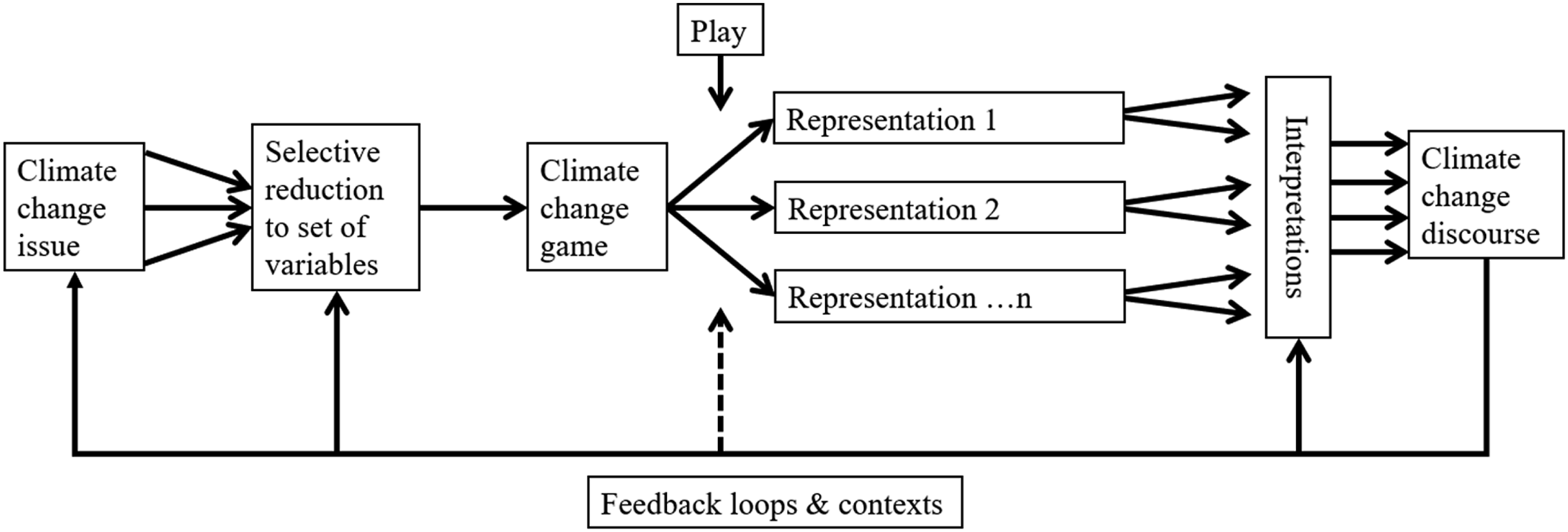
From a dialogic view on education, which maintains that meaning making occurs through dialogue, the meanings of games are flexible (Arnseth et al., 2018). This implies that games may not only yield different representations, but also different interpretations of the same representation (Pötzsch & Šisler, 2019), see Figure 1. Although climate change-related uncertainties have been identified for some games, the teachers and students that play the games may thus not identify these uncertainties as such or have different perspectives on these uncertainties. This may offer opportunities for dialogue (Arnseth et al., 2018). This study focuses on reflection, where students, teachers and pre-service students can share their interpretations of in-game experiences and their relation to learning goals and reality. This is an important dimension to consider for dialogic game-oriented teaching and learning (Arnseth et al., 2018). As pre-service teachers have a dual role as both students and prospective teachers that may use games in their future teaching, this study focuses on the uncertainties that they identify from games and how they relate these to reality. Consequently, the study’s focus on pre-service teachers’ talk about games was inspired by dialogic theory, but the study’s approach can be seen as pragmatic, focusing on the range of content rather than dialogical qualities of the pre-service teachers’ talk. Working with two different climate change board games, this study explores two research questions: 1. What uncertainties do pre-service teachers identify from climate board games? 2. How (if at all) do they relate these uncertainties to reality?
Intervention
The study concerns an intervention conducted with pre-service teachers who are studying to become teachers in primary and/or lower secondary school, in continuation referred to as students or pre-service teachers. They were enrolled in a science education course at a teacher education institution in Norway in 2021. The pre-service teachers played two board games: Another Future (Andthen, 2020; see Harris, 2020) and the Oil Springs Scenario (Assadourian & Hansen, 2011) of CATAN (Teuber, 1995) which is referred to as CATAN: Oil Springs Scenario from now on. These games are introduced in the following sections. Considering the COVID-pandemic and class management, the 40 students in the intervention were divided into two classes, just as during the rest of the semester. Each of these classes had one gameplay session per game. The gameplay sessions lasted about 2 hours. The students were asked to discuss a set of questions during and after gameplay (see Supplementary 1), as indicated in Figure 2. Together with my colleague (Gunnveig Toft Bjørndal), I took care of research and class management, which included a brief introduction to the games, the distribution of the questions, time management and helping the students in case of questions during gameplay. Not all pre-service teachers attended both sessions. Group composition therefore differed from time to time. The games were played by 8 groups of 4 students. Occasionally, a teacher educator joined the groups to ensure that there were enough players. Overview of the gameplay sessions, during which pre-service teachers played (gameplay) and discussed (discussion) games. One session was attributed to one game and lasted for 2 hours. *CATAN: Oil Springs Scenario took longer than Another Future. Most groups only played CATAN: Oil Springs Scenario once. Consequently, the 2nd and 3rd instance of discussion were combined. This study focuses on the discussion part of the gameplay sessions only.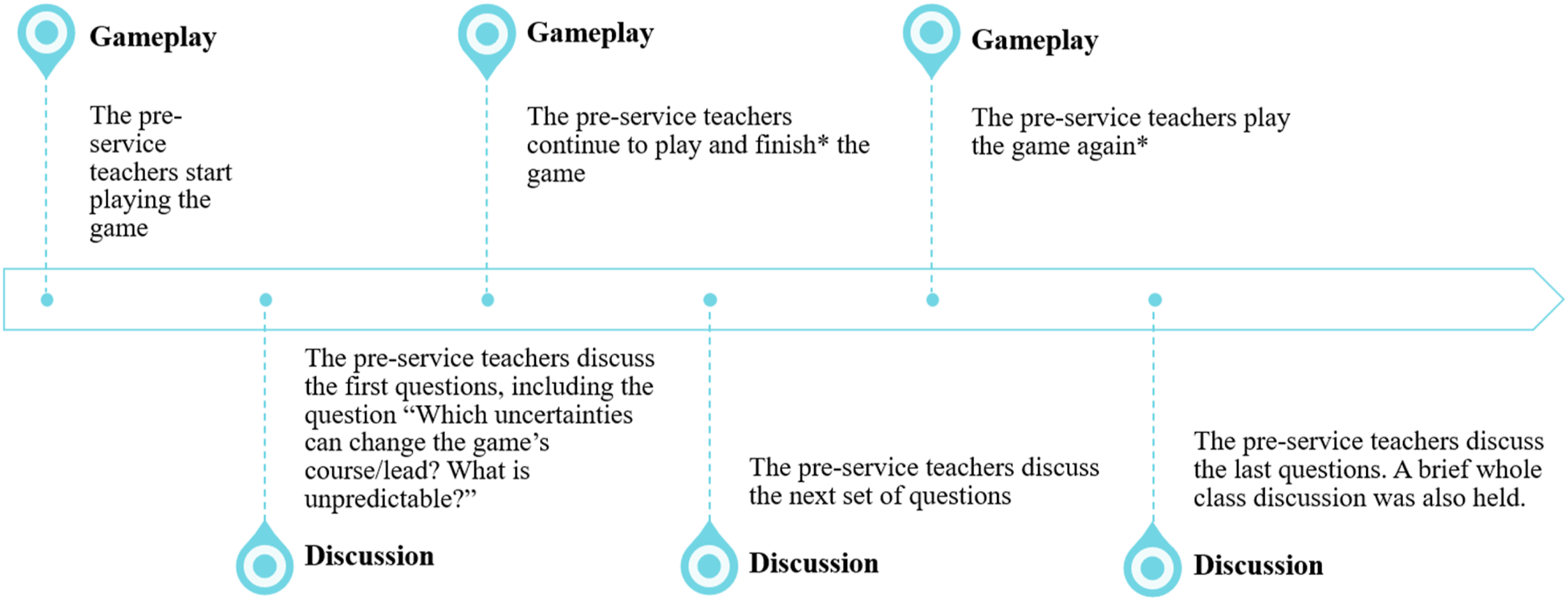
Another Future (Andthen, 2020; see Harris, 2020) is a board game in which the four players of the game each play a different character. These characters have different views on the climate crisis and how to address it. These are basically technofix and green growth perspectives and their opposites. In the game, players can implement different measures, favoured by different characters. By implementing the measures, they shape the future. The question is whether this future is agreeable to all, whether one of the perspectives is dominant and wins or whether the players fail to address the climate crisis due to disagreement. The game also features events triggered when a player implements a measure that only benefits one of the characters. These events, such as landslide and wildfire, interrupt the course of the game, for example by putting measures out of play. In the game, players may replace measures that have previously been chosen, depending on whether this new measure fits in. The texts in Another Future were translated to Norwegian and somewhat simplified. The game and its development are described in more detail by Harris (2020). Another Future has been suggested to cover various climate change-related uncertainties with a focus on the challenges of collaboration (van Schaik, 2023), but the extent to which these are identified and discussed in teacher education has not yet been analysed.
CATAN: Oil Springs Scenario (Assadourian & Hansen, 2011; Teuber, 1995) is a board game that can be played with 3 to 4 players. The board is an island and the players build roads, towns, and cities to gain points. They need resources to do so. The island is full of different resources and the players can retrieve these when they have a town or a city adjacent to this resource and the two dice (from 1 to 6) indicate that this resource can be retrieved. Some resources are statistically more abundant than others. When 7 is thrown, all players with more than 7 resource cards lose half of their resources. The player that threw 7 moves the position of the so-called robber, which blocks a resource, and draws a resource card from an affected player. The game features development cards, including knight cards and cards to build roads or get points. Knight cards can be used to move the robber to another position and draw a resource card from an affected player. In this scenario of the game, oil is one of the resources. Oil is advantageous, as it may be exchanged for two other resources or contribute to a metropolis. However, oil use has consequences and may lead to pollution, disabling a resource’s extraction, and climate change, risking the flooding of coastal towns and cities. A player wins when having collected a certain number of points. However, if oil has been used too frequently and several catastrophes have impacted the isle, all lose as the isle is destroyed by sea level rise. Previous studies on CATAN: Oil Springs Scenario document the game’s potential for environmental communication and learning about sustainability (e.g., Chappin et al., 2017; Fjællingsdal & Klöckner, 2020), but do not appear to explicitly ask participants to identify uncertainties from the game.
Methods
This qualitative research explored what uncertainties pre-service teachers identified from climate board games and how they related these to reality, based on the intervention described in the previous section. The intervention was part of a larger research project called “SPILLUBU: the exploratory use of games in education for sustainable development” (see Supplementary 2), conducted together with my colleague, Gunnveig Toft Bjørndal. The students were informed (in Norwegian) of the research project SPILLUBU and its goals, including to “explore how the use of games in education could illuminate uncertainties that are also present in questions relating to climate change and sustainable development.” Among others, the project entailed playing, discussing, and developing games related to climate change, while exploring how these games could potentially be used as educational resources. The students were informed that their contributions would be anonymised and that they did not need to give their consent if they did not want to. Their written consent to take audio recordings was explicitly asked for. The project was conducted in accordance with the guidelines from the Norwegian Agency for Shared Services in Education and Research (SIKT- http://sikt.no). 37 pre-service teachers consented to participate.
Board games were used in this study because they are accessible and can easily be played in groups. Two different board games were chosen to be able to explore between-game variation in uncertainty identification. Both games are connected to climate change and were thought to provide the students with meaningful perspectives. I was familiar with both games before the study was conducted.
The complete gameplay sessions were recorded. 16 audio recordings (corresponding to 8 groups) for Another Future and 14 audio recordings (corresponding to 7 groups) for CATAN: Oil Springs Scenario were collected. All recordings were listened to by my colleague and myself, and initial notes were made as familiarisation with the data material. Two types of audio data were obtained: (1) audio recordings of student talk during gameplay, and (2) audio recordings of students’ discussions. In this study, I focus on the latter (see Figure 2).
The sequences during which the students discussed the questions were transcribed and translated from Norwegian to English. The most relevant question for this study was “Which uncertainties can change the game’s course/lead? What is unpredictable?,” in the first set of questions that the students discussed. This question was phrased based on the premise that there are uncertainties in games (e.g., the outcome is not known) and that players thus necessarily encounter these uncertainties (see the section “Uncertainty in games”), allowing the players to potentially identify these uncertainties in order to answer the first research question. To see which uncertainties the pre-service teachers identified, I conducted a conventional qualitative content analysis (Hsieh & Shannon, 2005) of the replies. The uncertainties were first marked, after which initial codes were formed. Subsequently, uncertainties that resembled each other were grouped together into common codes. The analysis resulted in overarching categories of uncertainty that the participants identified. The uncertainties in the games perceived by the students were understood to fall into five main categories: events/catastrophes, the possibility to ruin the game, dice, oil use, and the robber/knight. These categories of uncertainty served as starting point for answering research question two by analysing how the pre-service teachers related these to reality in the complete group discussions. As a result, this study indicates what climate change-related uncertainties pre-service teachers identify from climate board games.
Results
This section presents the results for the two research questions, first regarding the uncertainties that the pre-service teachers identify, and then how these uncertainties are related to reality. For each question, I first show the results for Another Future and then for CATAN: Oil Springs Scenario. The results section briefly presents more implicitly identified uncertainties, which students discussed in relation to other discussion questions.
What Uncertainties Do Pre-Service Teachers Identify From Climate Board Games?
For both Another Future and CATAN: Oil Springs Scenario, I present a table with the responses that the question “Which uncertainties can change the game’s course/lead? What is unpredictable?” yielded. These results are described in condensed form.
Another Future
The replies of the 8 groups of pre-service teachers to the question “Which uncertainties can change the game's course/lead? What is unpredictable?” for the board game Another Future (Andthen, 2020; see Harris, 2020).
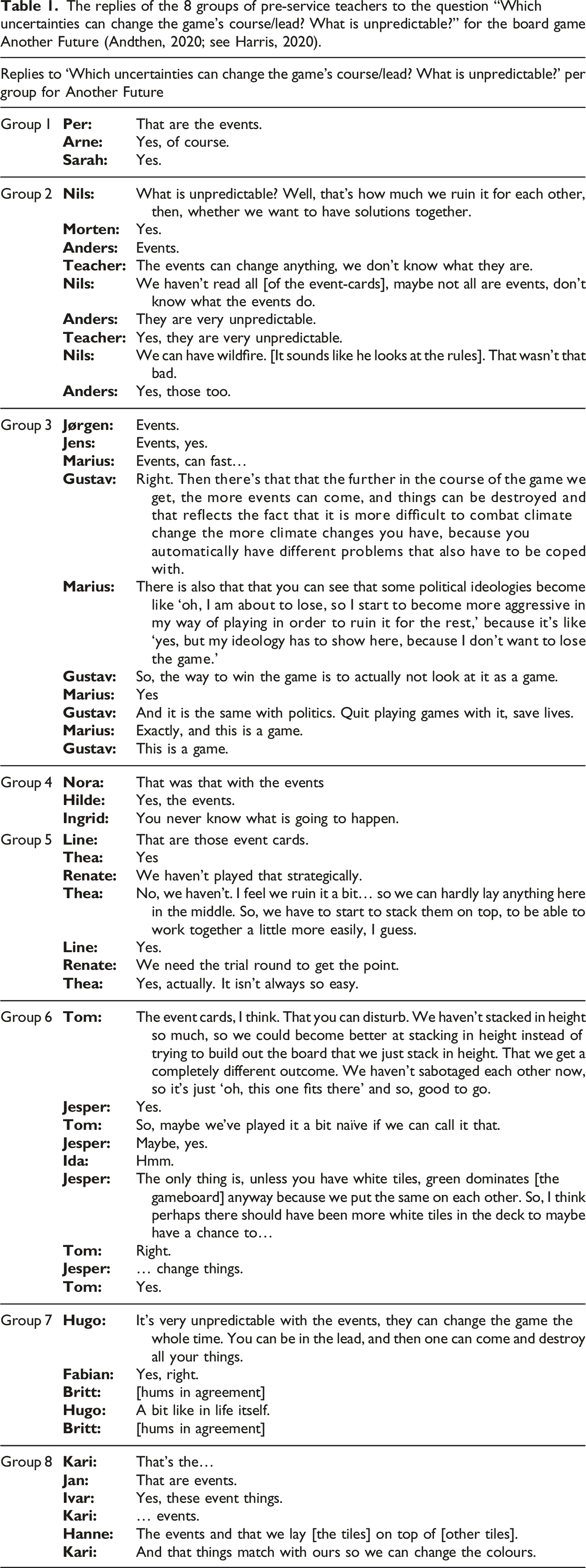
All 8 groups identified “events” as a moment of uncertainty for Another Future. Some groups’ answers to this question were short (see Group 1 and 4 in Table 1). Others briefly elaborated by relating the unpredictability of events to reality (see Group 3 and Group 7). Besides the uncertainty surrounding events, most groups (5 of 8) also identified uncertainty regarding the players’ behaviour. The groups (Group 2, 3, 5, 6 and 8) recognised that they could change the course of the game by laying the tiles on top of each other, possibly ruining the game for each other in the case that previously made points disappear. Two of the groups that mentioned this possibility to ruin the others’ game (see Group 5 and 6) indicated that they had not used the possibility to strategically challenge each other much. Group 2 framed this uncertainty surrounding collaboration more positively, as the question of whether the players wanted to solve things together. Collaboration is also referred to in Group 5, but not necessarily as an uncertainty. Other than events and the possibility to ruin the game for each other or want to have solutions together, no other uncertainties (e.g., what tile you will draw or choose to use) are mentioned.
CATAN: Oil Springs Scenario
The replies of the 7 groups of pre-service teachers to the question “Which uncertainties can change the game’s course/lead? What is unpredictable?” for the board game CATAN: Oil Springs Scenario (Assadourian & Hansen, 2011; Teuber, 1995).
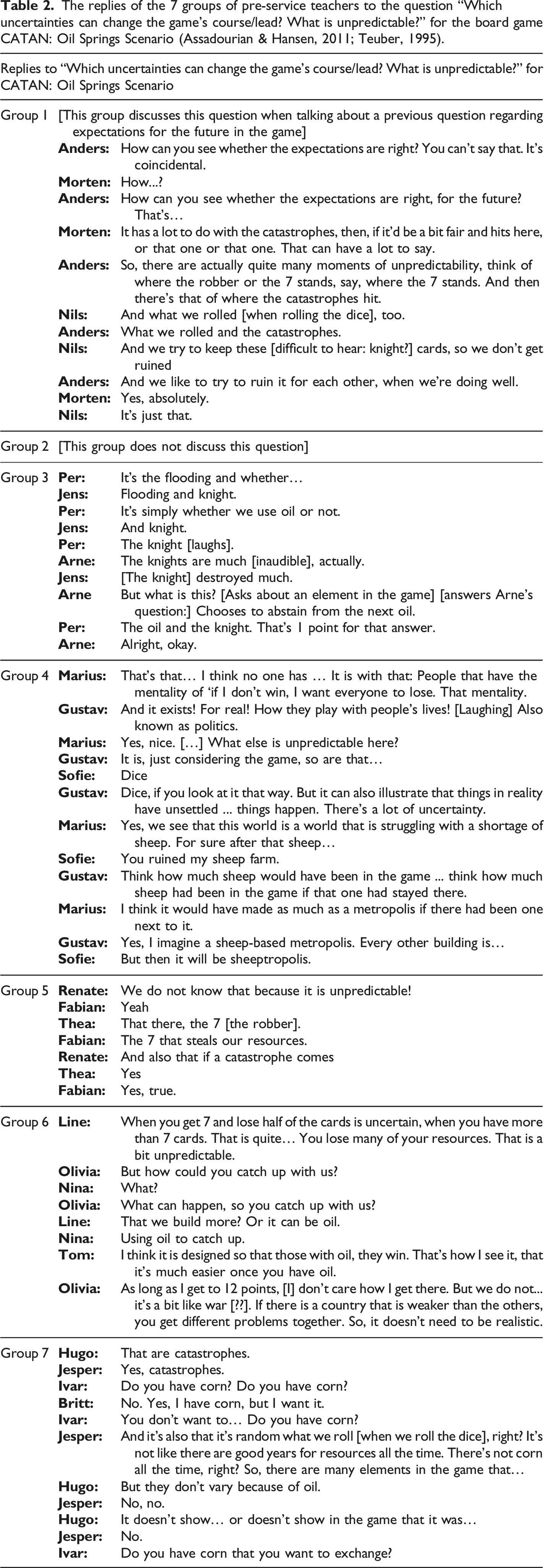
Five main uncertainties are mentioned: (a) the catastrophes (e.g., flooding) and where they hit, which can have consequences for resource availability (Group 1, 3, 4, 5, 7); (b) the result of rolling the dice, which is linked to the availability of resources (Group 1, 4, 7); (c) the use of oil, depending on whether one gets oil and whether they choose to use it (Group 3, 6); (d) the desire to win and/or ruin for others (Group 1, 4); and (e) casting 7 activates the robber, which could result in losing resources and a reduced chance to get a certain resource through a blockade (Group 1, 5, 6). A related uncertainty is the possibility for players to use the ridder cards (Group 3). Rephrasing these uncertainties into the same kind of words used for Another Future, the students again identify events (catastrophes) and the actions of players wanting to win or ruin it for others (use of oil, desire to win or ruin for others, using the ridder cards). In addition, they recognise the dice as source of uncertainty, having consequences for resource availability and the robber.
How do Pre-Service Teachers Relate the Uncertainties They Identify in Games to Contemporary Reality With Climate Change?
This section indicates how pre-service teachers related the uncertainties identified in the first section of the results to reality. First, the results for Another Future and then the results for CATAN: Oil Springs Scenario are presented.
Another Future
Events as representation of real-life catastrophes
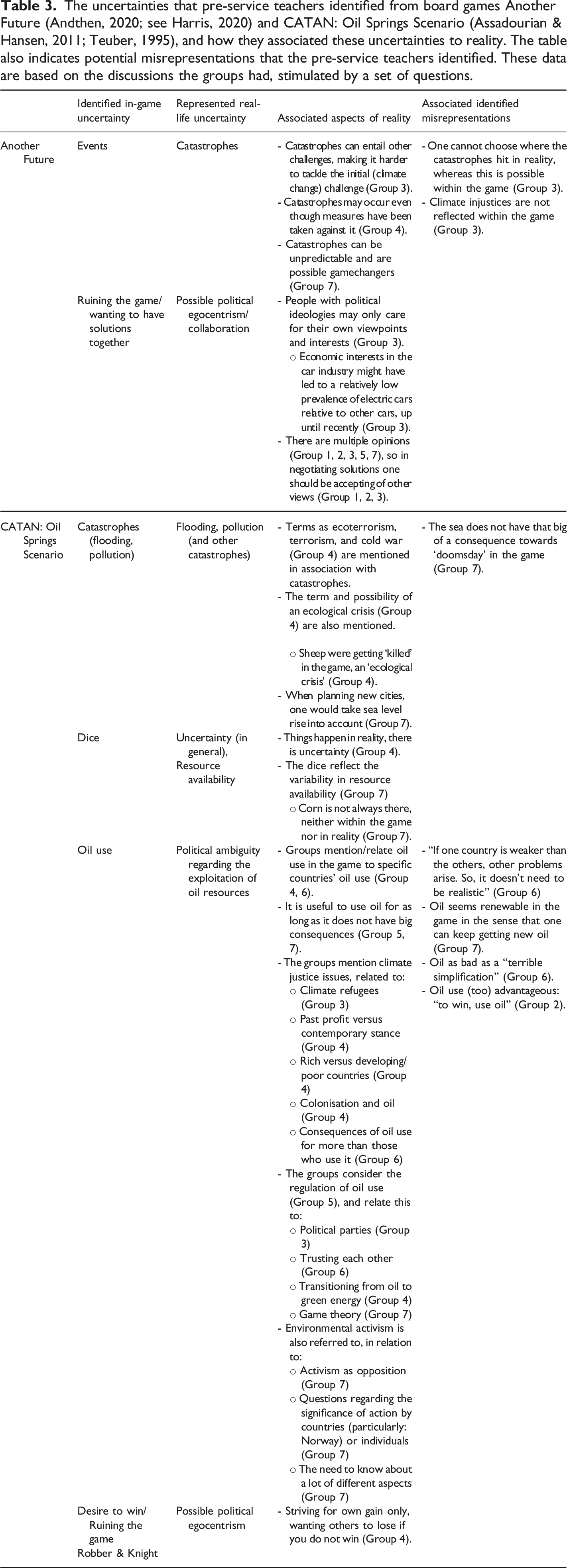
In three groups (Group 3, 4, and 7), the extent to which the events in the game are related to reality is briefly discussed. They indicate that events can be destructive in reality (Group 3, 4, 7), even despite the implementation of many solutions (Group 4). The unpredictable, game changing, and destructive qualities of events are thus as “[a] bit like in life itself” (Hugo, Group 7). In one group, a pre-service teacher points out how events can bring along other problems to tackle, making it even more challenging to address climate change (Gustav, Group 3). However, Group 3 criticises that the game unrealistically (a) allows a player that triggers an event to “play God”, deciding where the events hit, and (b) distributes events rather evenly across the players, not reflecting climate injustices for the poor.
Ruining the game/wanting to have solutions together as representation of possible political egocentrism/collaboration
Group 3 relates the uncertainty associated with the possibility of ruining the game for others to the attempts of “political ideologies” to push for their own goals. They recognise that playing in your own interests might not be helpful both within the game and in reality, referring to the car industry. Two students (Marius, Gustav) build on each other’s comments, establishing that technology to produce electric cars has been around for a while and criticising the economic interests that favoured the production of non-electric cars, pointing out “interests for humanity and the world.” Other groups, too, stress that accepting others’ views is important in negotiating solutions (Group 1, 2, 3). The presence of different opinions was identified by several groups (Group 1, 2, 3, 5, 7). Themes as cooperation (Group 3, 4), politics, democracy, political parties, and their behaviour (Group 2, 5, 7, 8), and the multitude of solutions (Group 7) were taken up here.
CATAN: Oil Springs Scenario
Catastrophes (flooding and pollution) as representations of catastrophes
When discussing the question of what problem the game wants to address, several groups connect the use of oil to environmental consequences (Group 3, 4, 5, 7). These consequences spur Group 7 to deliberate the possibilities of cooperation (see Option to use oil as representation of political ambiguity regarding the exploitation of oil resources). Group 4 reflects over their collective loss of the game, using phrases as “ecoterrorism”, “terrorism” and “cold war.” The students in this group repeatedly mention how they encountered a lack of sheep due to catastrophes. Here, too, they use a term from outside the game by referring to the destruction of sheep resources as an ecological crisis. In Group 7, the students mention how the game illustrates that one would not plan a new city in an area threatened by sea level rise. One aspect of the game that they do criticise here, however, is that the catastrophe invoked by sea level rise does not count towards doomsday (whilst pollution destroying resources does count), although it is unclear how they relate this doomsday to reality.
Dice as representation of resource availability
The dice are seen as representations of the variability in resource availability. As one student of Group 7 mentions during the discussion, held at a time in the game where the group struggles with a lack of corn resources: “And it’s also that it’s random what we roll [when we roll the dice], right? It’s not like there are good years for resources all the time. There’s not corn all the time, right?” In Group 4, one student (Gustav) refers initially to the dice as purely part of the game mechanics. However, Gustav immediately follows up this remark by pondering what it can illustrate. This student seems to imply that the dice may stand for the uncertainty that is around in the real world, that “things happen.” Marius, also in this group, agrees with this view and remarks that the world in their game lacks sheep as resource, which evolves in a discussion about this (see Catastrophes).
Option to use oil as representation of political ambiguity regarding the exploitation of oil resources
The use of oil gives players a head start (Group 4, 6), which some of the groups reflect on in relation to its real-life counterpart. Students in Group 6 refer to specific countries when discussing how the game represented reality. The pre-service teachers of Group 4 recognise that the use of oil gave some of the players a head start: “Like we, in Norway, in the West, have earned shamefully much on oil and exploitation and such, and now I [as player of the game that had a head start] am like ‘but now, guys, now we have to become environmentally friendly.’” In Group 4, they refer to the inequality in past profits from oil, to development countries, and to oil colonies, and seem to associate certain players’ performances to that of specific countries. This relates to climate justice, a theme also brought up by a student in Group 3 who suggests that the people pumping up oil do not think about exposed, poor people that may become climate refugees as a consequence. For other groups, the possibility that catastrophes can be triggered through using oil inspires them to discuss the attempts to limit oil use in reality. As oil use has consequences (e.g., Group 7) for more than just the people using the oil (Group 6), the idea of regulation is prompted in Group 5 and Group 7. Hugo in Group 7 suggests that a kind of agreement may need to be established within the game in which they would choose to abstain from using oil every fifth round, and refers to OPEC, the Organization of the Petroleum Exporting Countries, while doing so. Group 7 also points to game theory: “If no one gives in it goes… [badly]." Other ways in which the use of oil is related to reality by the groups are through discussing whether environmental activism by individuals and by a country as Norway is of any use (Group 7, 6), by referring to global environmental consciousness and trust (Group 6), and by seeing the resources as representations of energy resources (Group 4). In the latter case, the game would showcase the transition from oil to green energy, in the game represented by the other resources such as sheep, tree and clay.
Several points of critique of these representations are addressed. A pre-service teacher in Group 6 (Olivia) recognises how inequality in the power of countries may inflict other problems, which leads this pre-service teacher to conclude that the game would not always be realistic. The pre-service teacher does not elaborate on this comment, but perhaps they meant to say that the game does not sufficiently portray the other problems involved. Olivia also criticises that the game would probably leave children with the impression that oil is bad, which they find to be a “terrible simplification.” In Group 2, on the other hand, one student deems oil to be too advantageous in the game. However, this comment is countered by a group member, who points out that the use of oil does have consequences. Lastly, one group (Group 7) criticises the apparent renewability of oil in the game in terms of its retrievability, not of its consequences.
Desire to win/Ruining the game as representation of possible political egoism
The possibility to ruin the game has been discussed mostly in terms of oil and catastrophes, so as such, most of the results linked to the desire to win or ruin the game for others have been presented in previous sections. These results relate, for example, to the students’ discussions on regulation of oil use, as these serve to limit the chances of others ‘ruining the game’ by triggering catastrophes. In Group 4, the group that faced its share of ecological crises and destruction (see Catastrophes), the fact that someone mentioned that it was possible to ruin the game for others invoked one of the players to do so, as they were losing. They relate this to “that mentality of ‘if I don’t win, I want everyone to lose’” as Marius (Group 4) calls it. Gustav responds: “And it exists! For real! How they play with people’s lives! [laughing] Also known as politics.”
The robber and the knight
Though both the occurrence and impact of the robber and the knight are uncertain, and some (Group 1, 3, 5, 6) have explicitly identified one or both sources of uncertainty in the game, none of the groups seem to explicitly relate these uncertainties to reality during the discussions.
The uncertainties that pre-service teachers identified from board games Another Future (Andthen, 2020; see Harris, 2020) and CATAN: Oil Springs Scenario (Assadourian & Hansen, 2011; Teuber, 1995), and how they associated these uncertainties to reality. The table also indicates potential misrepresentations that the pre-service teachers identified. These data are based on the discussions the groups had, stimulated by a set of questions.
Other uncertainties
Both with regards to Another Future and CATAN: Oil Springs Scenario, the pre-service students discussed more uncertainties and ambiguities than those that they explicitly identified as an uncertainty.
For Another Future, some questioned the extent to which the characters in the game would disagree with each other in reality: “I don’t think those that work with technology have anything against planting trees if that can contribute to the climate solution” (Group 2). In addition, the previously mentioned discussion on electric cars in Group 3 prompted one student to ask their fellow students the following: “What time did that start, in a way, the climate anxiety, I was about to say?” Group 3 also wonders whether the developers of the game have made a biased game. This question arises when they reflect on how the available measures tended to favour one of the characters, which appears to have happened to several groups presumably because they did not shuffle the tiles. Yet, the uncertainty about what tiles (measures) one will draw or decide to use is not discussed more than this, despite being repetitive elements of uncertainty within the game.
Besides earlier presented the uncertainties for CATAN: Oil Springs Scenario, students also touch upon uncertainties when it comes to concurrence about getting “more and more and more when it comes to land and resources” (Group 5), which Group 5 finds to reflect reality, having cooperation to get things done (in general) (Group 3), the points one can get in the game for having long roads but that may also be lost (Group 6), and that those with more resources have more possibilities (Group 2). An uncertainty within the game that the pre-service teachers did not refer to was the uncertainty that can be associated with the drawing of cards when the knight or robber is activated in the game, or when players purchase development cards.
Discussion
Just as probabilities, storylines, and scenarios do in climate science, games might offer helpful representations of uncertainty for climate change education. This study centres on the questions of (1) what uncertainties pre-service teachers identify from climate board games, and (2) how the pre-service teachers relate these uncertainties to reality.
Identified Uncertainties
The pre-service teachers identified various uncertainties within both games. For Another Future, events and the possibility to collaborate or ruin the game for others were mentioned. For CATAN: Oil Springs Scenario, similar uncertainties were identified, with the addition of the uncertainties of the dice, oil, robber, and knight in the game. The pre-service teachers identified more uncertainties for CATAN: Oil Springs Scenario than for Another Future. This may be explained in several ways: (a) Another Future might contain fewer uncertainties, (b) the pre-service teachers might only have mentioned the most evident uncertainties, (c) the pre-service teachers have indicated that they preferred CATAN: Oil Springs Scenario: they might have been more immersed and, consequently, better at recognising the uncertainties they encountered.
The identified uncertainties mirror some of the five factors that affect players’ experiences of uncertainty in games (Power et al., 2019, p. 1038): (a) decision-making uncertainty (e.g., ruining the game; using oil), (b) collection of information to reduce uncertainty, (c) uncertainty in taking action, (d) uncertainty in problem solving processes, and (e) external factors of uncertainty such as unpredictability (e.g., dice; events). The pre-service teachers’ identification of these uncertainties may therefore not be unexpected. Both decision-making uncertainty and external factors of uncertainty seem, to some extent, to be characterizable by some “irreducible unpredictability” (Dewulf & Biesbroek, 2018, p. 447), and thus ontological in nature. More epistemic processes such as information collection and problem solving were not mentioned.
That students identified several ontological uncertainties may be explained by the way in which the question about uncertainty was phrased. Referring to unpredictability has likely affected the students to think more of ontological uncertainty than epistemic (knowledge) uncertainty (for an explanation of these categories, see Dewulf & Biesbroek, 2018). Games might be well-suited to represent ontological uncertainties, having recognisable mechanics that introduce randomness, chance, and luck (Johnson, 2019). The pre-service teachers’ identification of ontological uncertainties in the games might also reflect a larger trend in contemporary fiction. Literary studies indicate that “contemporary fiction resonates strongly with such [ontological] real-world uncertainty and attempts to come to terms with it” (Ameel & Caracciolo, 2021, p. 313).
Uncertainty in Games and Reality
One of the pre-service teachers mentioned that the sudden and disruptive character of events in Another Future was “[a] bit like in life itself” (Hugo, Group 7). This comment is an example of the students’ reflections that compared uncertainties in the two games (e.g., the events in Another Future) to uncertainties in real-life, as shown in Table 3. The link between contemporary, real-world uncertainties and representations of uncertainty in climate fiction appears to be evident to them, but also brought forward several discussions on how realistically the games portrayed these uncertainties. This signifies that the representations of uncertainties in the games that were identified by the pre-service teachers were clear enough to consider the connection between the fiction and reality. Climate justice issues were discussed, for example when discussing Norway’s oil exploitation and climate refugees. Political dilemmas and interests were brought forward, linking in-game views or interests to that of certain industries, political parties, or countries. Challenges of and adaptation to possible catastrophes and the significance of environmental activism were also topics in relation to which pre-service teachers connected the game and reality. The pre-service teachers also point out some misrepresentations, limitations of the representations in the game. Teacher educators and educators should encourage such (critical) contemplation of representations of climate change, climate change uncertainty and other associated aspects of reality. Many of links between game and reality were made by the same pre-service teachers (e.g., Hugo, Gustav) and groups, which points to the vital role of teacher educators and teachers in stimulating reflection over uncertainties when using games in the classroom, whether in group discussions or in whole class settings, encouraging contributions from other students, too.
The process of interpretation is important to consider in education. The explorative nature of this study allowed for the pre-service teachers to come with their own thoughts about how the game conveys climate change, including its uncertainties. Though other approaches have documented learning effects on climate change uncertainty particularly for simulation games, for example on possible tipping points (van Beek et al., 2022) and the differences between uncertainty due to natural fluctuations and human-induced climate change in water management (van Pelt et al., 2015), this study has found that pre-service teachers addressed a wide range of topics related to climate change uncertainty in response to questions regarding board games. Perhaps coloured by the Norwegian national elections being held some days prior to the game sessions, politics was a recurrent theme in the pre-service teachers’ discussions. One pre-service teacher related the issue to their own experience in being engaged with environmental issues, whereas others used terms as ‘ecological crises’ to relate game and reality to each other. These results, and the variances in what aspects of reality are mentioned by different groups, point to the importance of context for interpretation of climate change uncertainty within games. In this study, the pre-service teachers had only received a minimal introduction to the games and their themes, while teachers and teacher educators may adjust the educational programme prior to and after gameplay as they see fit.
Several educational outcomes of gameplay, for example regarding knowledge about climate change and/or engagement with the issue, have previously been analysed (Galeote et al., 2021). Other studies have studied whether playing games can prompt pro-environmental behaviour (de Salas et al., 2022). Instead of asking whether the pro-environmental attitude, behaviour and knowledge possibly resulting from gameplay compensate for having played the game, one might tentatively consider whether these outcomes are the most relevant. Perhaps the most interesting potential of games for education is their “capacity to model uncertainty and therefore color and deepen the reader’s [here: player’s] acceptance of the fundamental ambivalence of our climate future” (Caracciolo, 2019, pp. 68–69, on narrative's role). Experientially and affectively engaging players with uncertainty, games reflect climate change uncertainty (Caracciolo, 2022), which pre-service teachers can identify and discuss, as this study has shown.
Implications for Teacher Education
In their future profession, pre-service teachers will live the question of what it means to educate in a changing world. In Norway, alike elsewhere, school curricula have undergone changes to respond to contemporary challenges. The broad interdisciplinary topics Health and life skills, Democracy and citizenship and Sustainable development have been given a central place in the curriculum, so pupils can become more competent in dealing with these topics, and “shall gain insight into challenges and dilemmas in these topics” (Utdanningsdirektoratet, 2020a). Climate change is recognised in this curriculum as one of the “greatest environmental threats in the world” (Utdanningsdirektoratet, 2020b). As climate change has consequences for people’s survival and livelihoods, it can be described as an existential threat that relates to each interdisciplinary topic. Norwegian teachers should thus be able to dive into the challenges and dilemmas that climate change and associated issues entail, and one may argue that uncertainty is one of the elements at the heart of these. This study has shown that games may be used as educational resources to take up such challenges and dilemmas, as pre-service teachers could identify various uncertainties from two climate change board games. This implies that teacher educators could draw upon the possibility to let pre-service teachers reflect on climate change-related uncertainty using representations in games, possibly making uncertainties more tangible. The pre-service teachers may be encouraged to discuss to what extent these representations of uncertainty are realistic. Both as students and as future teachers, the pre-service teachers could potentially use these representations to discuss issues relating to climate justice, political dilemmas and interests, challenges of and adaptation to possible catastrophes, and the significance of environmental activism. Such issues are central to discuss in “learning to live-with” (Verlie, 2019, p. 751), including responding to, the climate crisis. Educational institutions are vital in the negotiation of meaning in resources as games in light of climate uncertainty (after Caracciolo, 2022, p. 189). In educating future teachers, teacher education could therefore consider the use of games as a starting point for or deepening of nuanced dialogues surrounding the complexities of the world we live in today.
Limitations and Suggestions for Further Research
This study moves beyond representation and looks at what uncertainties pre-service teachers identify. This study reflects what climate change-related uncertainties may be mentioned in meaning-making processes surrounding climate change board games, but it could also be interesting to delve into an analysis of how students develop their interpretations. Inspired by design-based research, my colleague and I have taken the criticism from the students in this study into consideration for the next instance of this intervention, focusing on Another Future and aiming to let them discuss measures in the game together. As the formulation of the questions formed a limitation to this study’s findings, the discussion questions were rephrased to deal with (a) uncertainty in games, more broadly and explicitly, and (b) how these uncertainties relate to reality. Through the link between uncertainty in games and the need for addressing climate change uncertainty in education, future research may, for example, explore the types of uncertainties that pre-service teachers talk about during gameplay, the differences in uncertainty-related affordances of several games for climate change education, the ways in which climate change uncertainty in games is talked about by both teachers and students and the use of games for associated learning outcomes for students of all levels.
Educators and educational researchers are urged to discuss which, how and for what purposes climate change-related uncertainties could – and maybe should – be addressed in educational settings. This will likely be context-dependent, considering the importance of personally relevant climate change education (CoSpaces Edu, n.d.; Monroe et al., 2019; Microsoft Office, n.d.). The uncertainties that their pre-service teachers (and other students) express may form a starting point for educators (see Sezen-Barrie et al., 2020), possibly inspired by playing games or other tasks. Nevertheless, it will be important to talk about uncertainty regarding personal and others’ actions in face of climate change, as well as uncertainty regarding how the future will be like. Besides allowing for acknowledging possible climate anxiety (e.g., Clayton, 2020; Whitmarsh et al., 2022), which indicates that the topic needs to be treated with care, such a focus may contribute to the development of anticipatory competence (Gardiner & Rieckmann, 2015; Wiek et al., 2011). In relation to climate change and other sustainability issues, this refers to the ability to analyse, shape and comprehend possible futures (Wiek et al., 2011). For example, one might explore how climate change could impact the community of the pre-service teachers (or other students) depending on the different changes that can be made this year.
Conclusion
Pre-service teachers could, when prompted, identify several uncertainties from two climate change board games. In discussing the game, they relate most of these uncertainties to reality. This suggests that climate change board games might have potential as educational resources for addressing climate change-related uncertainty. Not all pre-service teachers and thus not all students, might be aware of the uncertainties that they encounter in the game, so presumably, teacher educators and teachers need to teach and guide their students to explore and discuss climate change-related uncertainties.
Supplemental Material
Supplemental Material - In-Game Uncertainties and Climate Change Challenges as Identified by Pre-Service Teachers
Supplemental Material for In-Game Uncertainties and Climate Change Challenges as Identified by Pre-Service Teachers by Fiona van Schaik in Simulation & Gaming
Footnotes
Acknowledgements
The author would like to thank Gunnveig Toft Bjørndal, Frode Skarstein, Espen Lunde, Atle Skaftun, Line Johanne Barkved, Ingvild Skumlien Furuseth, Gunvald van Schaik, Paolo Scarbocci and student assistents at the DDV, and the editor, anonymous referees and production team of this journal for their time, effort and helpful contributions to the development of this article and/or the SPILLUBU project on which it is based. I would also like to thank the pre-service teachers for their participation. Thank you very much.
Declaration of Conflicting Interests
The author declared no potential conflicts of interest with respect to the research, authorship, and/or publication of this article.
Funding
The author received no financial support for the research, authorship, and/or publication of this article.

Supplemental Material
Supplemental material for this article is available online.
Author Biography
References
Supplementary Material
Please find the following supplemental material available below.
For Open Access articles published under a Creative Commons License, all supplemental material carries the same license as the article it is associated with.
For non-Open Access articles published, all supplemental material carries a non-exclusive license, and permission requests for re-use of supplemental material or any part of supplemental material shall be sent directly to the copyright owner as specified in the copyright notice associated with the article.
