



Abstract
Introduction
Player experience is the interaction between individual qualities and game attributes. It is becoming a popular topic to understand why individuals are interested in different video games. The current literature offers a range of different scales that measure similar player experience factors but often lack published validity analysis. The Player Experience Index is an empirically validated measure based on the means-end theory. The current study used this measure to analyse player experience factors and enjoyment among single-player shooter, single-player role-playing, massively multiplayer online shooter, and massively multiplayer online role-playing video games.
Methods
Analyses were based on a sample of 145 participants who completed an online survey.
Results
Results indicated that player experience factors were related to enjoyment, with differing results based on video game genre. It was also found that greater levels of enjoyment were reported by participants who preferred single-player mode of play compared to massively multiplayer online play mode, and participants who preferred single-player role-playing games indicated greater levels of enjoyment than the other three groups.
Discussion
While there was an uneven and small sample size for each video game category, the findings of this exploratory study highlight that further research is warranted. Future research should consider analysing the player experience for currently available and marketed video games to better understand how player experience influences enjoyment in the rapidly evolving gaming industry and its role in gaming design.
Data suggest that approximately two-thirds of Americans (Mage = 31; Entertainment Software Association, 2021) and Australians (Mage = 34; Brand et al., 2019), and half of Europeans (Mage = 31.3; Interactive Software Federation of Europe, 2021) play video games. In 2022, there were 3.03 billion video game players worldwide (Clement, 2022a) and by 2027 video gaming market revenues are projected to reach 298.20 billion U.S. dollars globally (Clement, 2022b). Video games have established their position amid older forms of entertainment such as movies and television, as immersive and enthralling experiences (Pasqualotto et al., 2022). While a low percentage of gamers may be classified as problem gamers or have a gaming addiction (Andre et al., 2020), gamers can experience benefits such as increased social well-being (Raith et al., 2021). Further, video games offer entertaining and engaging experiences that may stimulate learning (Pasqualotto et al., 2022). This paper will add to the research on the positive perspective of gaming and emotion by investigating player experience and enjoyment.
Player experience has been conceptualised as the interaction between psychological, behavioural, and physiological components (Wiemeyer et al., 2016) and is an important component in gaming research (Denisova et al., 2016). Johnson et al. (2018) noted that one issue in research to date has been the limited validation of player experience questionnaires. The authors of the Player Experience Inventory (PXI; Vanden Abeele et al., 2020) have addressed this point by undertaking empirical validation as part of the development of the measure. The PXI was based on the means-end chain theory whereby functional consequences (experiences during gameplay) and psychosocial consequences (cognitive and emotional experiences during and after gameplay) are assessed (Vanden Abeele et al., 2016; Vanden Abeele et al., 2020). As the PXI is a relatively new measure, further research is needed to determine its utility in assessing player experience.
Another issue is the difficulty in evaluating player experience based on video game categorisation. Video games have evolved and become more complex (Kuo et al., 2017) with a vast range of gameplay, themes, and mode of play influencing video game genres (Apperley, 2006; Arsenault, 2009). This has resulted in variability in the video game genres used in player experience research. For example, von der Heiden et al.’s (2019) study had four genres: action, role-playing game (RPG), strategy, and simulation. Yet Johnson et al. (2015) examined seven genres, which included action RPG as a separate category to RPG, along with an additional action-adventure genre.
Furthermore, the increased interactivity and dynamic storylines of video games (Arsenault, 2009; Kuo et al., 2017), means that even making a distinction between RPG and shooter can be difficult, as a game can incorporate both styles of gameplay. While genres are used as a means to provide a taxonomy, it is important to note that the genres and video games within each genre are not homogeneous groups (Arsenault, 2009). As such, the aim is to not work towards a universal consensus on video game genres, but an understanding that genres are imprecise (Arsenault, 2009).
As concluded by Mekler et al. (2014), another key issue is the lack of research investigating which player experience factors impact video game enjoyment. Enjoyment is defined as the positive experiences as a result of gameplay (Mekler et al., 2014) and is one of the key reasons for playing video games (von der Heiden et al., 2019). In their systematic review, player experience factors such as challenge and sense of control were found to contribute to enjoyment; however, Mekler et al. (2014) argued that further research was needed, especially on the psychological components of player experience. The PXI (Vanden Abeele et al., 2020) as a measure of player experience may be especially useful, as it includes psychosocial factors.
Our study aimed to analyse the relationships between player experience factors and enjoyment and whether there were any differences between enjoyment and video game categories. Due to the limited research investigating player experience (as measured by the PXI) and enjoyment, this study was exploratory in nature. The research questions were: Which player experience factors are related to enjoyment? and Does enjoyment differ depending on video game genre? As we anticipate that mode of play (single-player versus massively multiplayer online [MMO]) and video game genres (shooter versus RPG) could influence results, separate analyses were conducted for both research questions. These broad genres were chosen in acknowledgement of the complexity of video game categorisation.
Methods
Participants and Procedure
Sociodemographic Characteristics by Game Genre (N = 145).
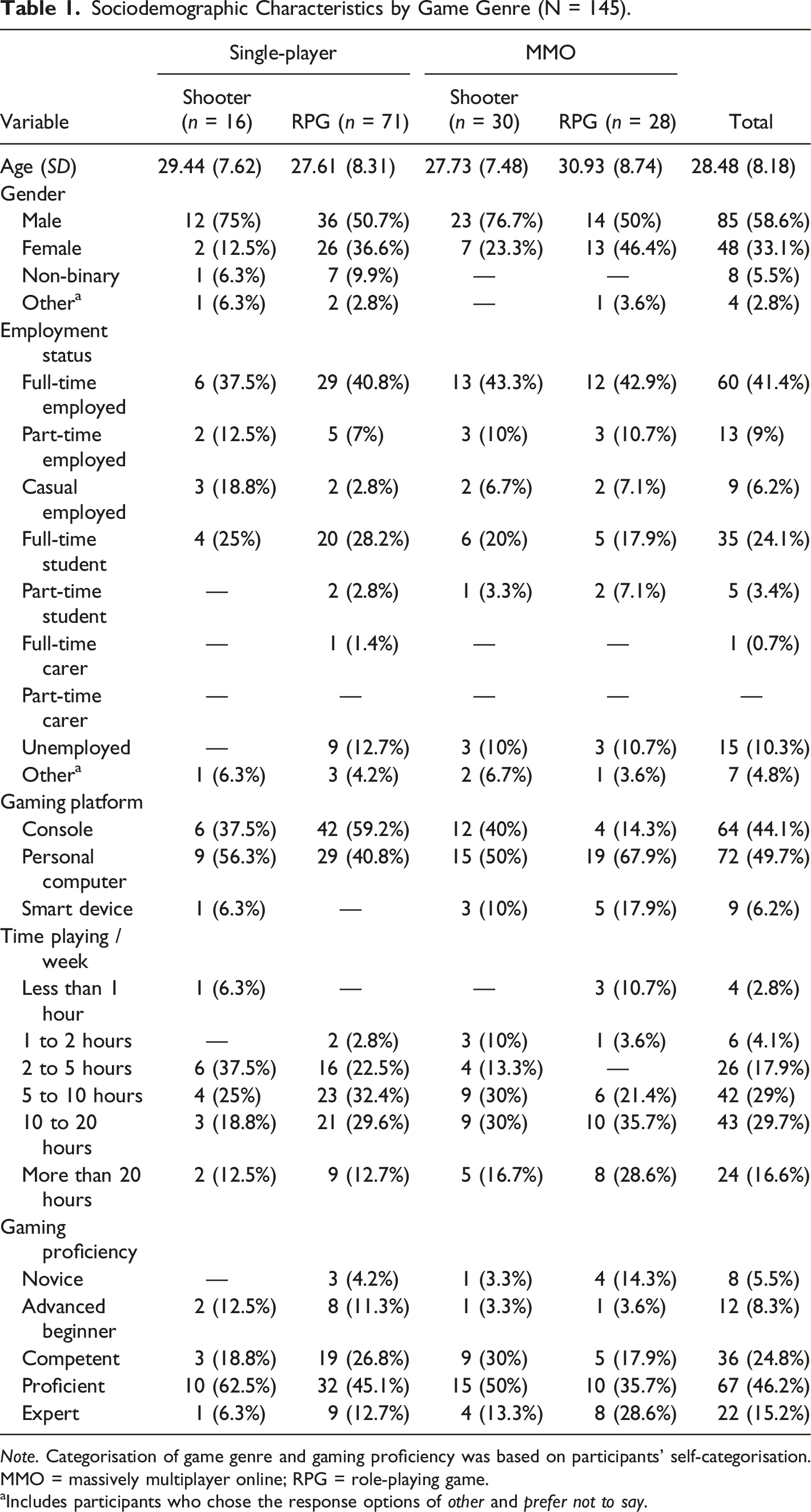
Note. Categorisation of game genre and gaming proficiency was based on participants’ self-categorisation. MMO = massively multiplayer online; RPG = role-playing game.
aIncludes participants who chose the response options of other and prefer not to say.
Following approval from a university ethics committee, participants were recruited using a snowball technique through advertisements on social media, online forums, and chatrooms. Consent was obtained prior to the commencement of the online survey via tick box. Participants were required to be aged 18 years or older, had within the past month played a shooter game, RPG, an MMO shooter, or an MMO RPG, and able to recall their gaming experience. Each video game category was defined to clarify video game genres.
Measures
The online survey consisted of socio-demographic questions and items assessing player experience and enjoyment. Player experience was measured using the Player Experience Inventory (PXI; Vanden Abeele et al., 2020). This scale has 30 items, with 10 subscales and assessed two levels of player experience: functional (ease of control, progress feedback, audiovisual appeal, clarity of goals, challenge), and psychosocial (mastery, curiosity, immersion, autonomy, meaning). To measure enjoyment, an additional three items as recommended by Vanden Abeele et al. (2020) were also included in the survey. All items were scored on a 7-point Likert scale, ranging from -3 (strongly disagree) to 3 (strongly agree). Total player experience subscale scores and enjoyment were calculated by averaging the items.
Results
Research Question 1: Which Player Experience Factors are Related to Enjoyment?
Spearman’s Correlations for PXI Factors with Enjoyment, by Either Mode of Play or Game Genre.
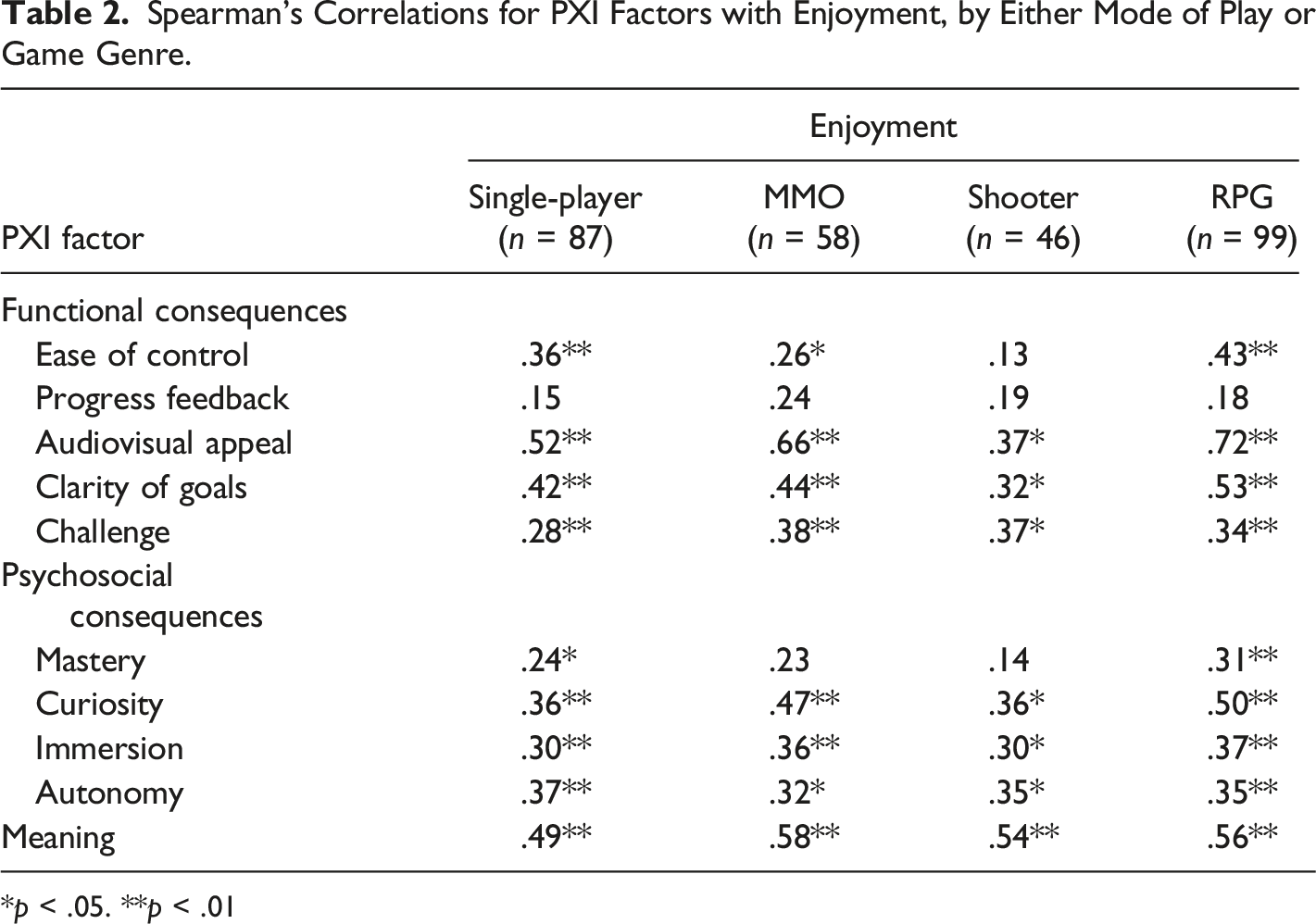
*p < .05. **p < .01
Spearman’s Correlations for PXI Factors with Enjoyment, by Both Mode of Play and Game Genre.
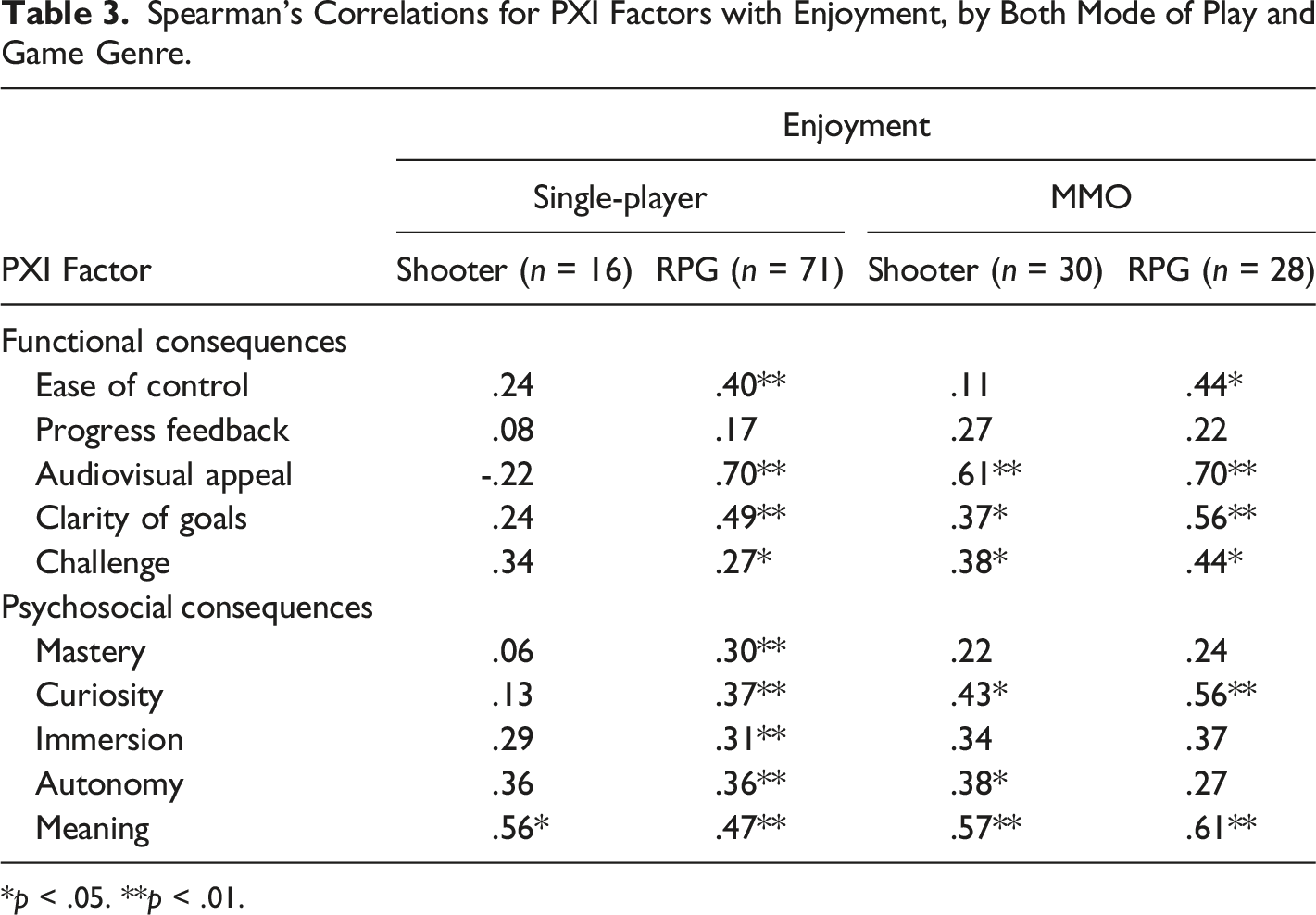
*p < .05. **p < .01.
Research Question 2: Does Enjoyment Differ Depending on Video Game Genre?
Firstly, we investigated if enjoyment differed based on mode of play or game genre, respectively. While the sample sizes for the groups were > 40, violations of both the normality and homogeneity of variance assumption, meant that the Mann-Whitney U test (a non-parametric test) was required (Bonferroni adjusted alpha level was used).
A Mann-Whitney U test indicated that the enjoyment levels of single-players (Mean Rank = 80.87, n = 87) were significantly higher than MMO participants (Mean Rank = 61.19, n = 58), U = 1,838.00, z = -3.04 (corrected for ties), p = .002, two-tailed. By Cohen’s (1988) standards, this effect can be described as medium (r = .25). There was no significant difference in enjoyment levels of participants who played shooter games (Mean Rank = 65.17, n = 46) versus RPG players (Mean Rank = 76.64, n = 99), U = 1,917.00, z = -1.68 (corrected for ties), p = .093.
Means, Standard Deviations, 95% Confidence Intervals, and Mean Rank Values for Enjoyment Across Video Game Genres.
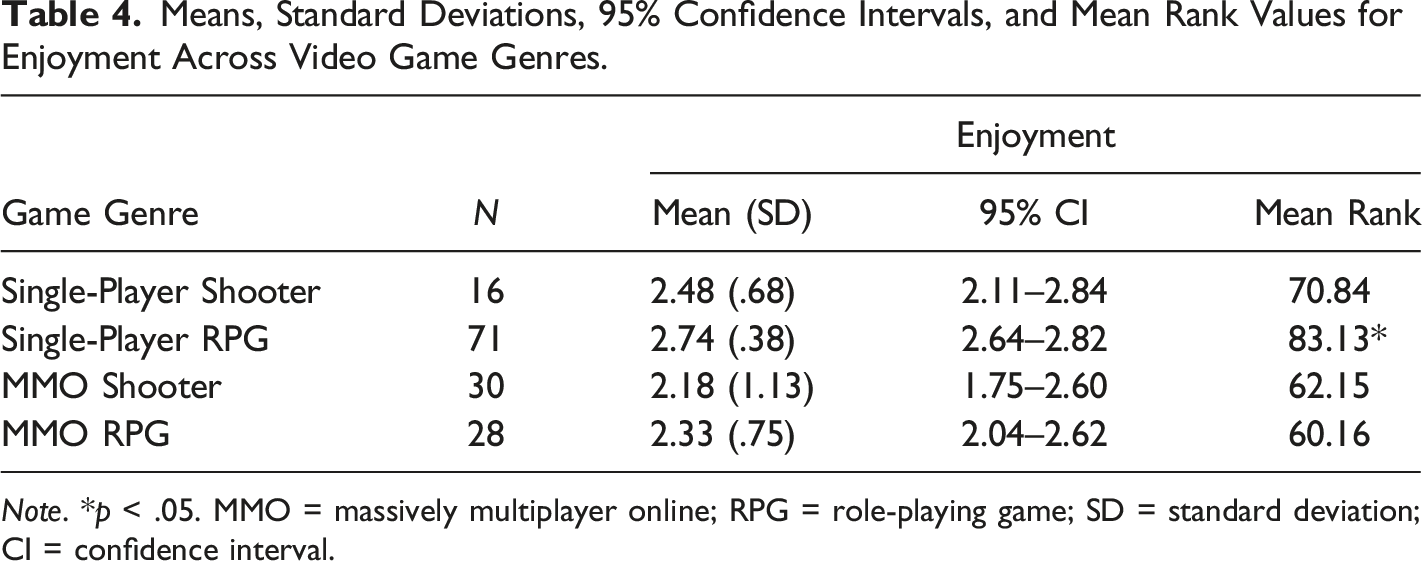
Note. *p < .05. MMO = massively multiplayer online; RPG = role-playing game; SD = standard deviation; CI = confidence interval.
Discussion
Our exploratory study aimed to investigate player experience factors and enjoyment. The first research question looked at the relationships between player experience factors and enjoyment. The broader pattern of results will be the focus of discussion as consideration of every possible relationship may be less meaningful.
In the analyses which explored mode of play and game genre separately, we found that three of the five functional consequences were significant, positive correlations with enjoyment (i.e., audiovisual appeal, clarity of goals, challenge). Four of the five psychosocial consequences (curiosity, immersion, autonomy, meaning) were also significant, positive correlations. These results indicate that a number of player experience factors contribute to enjoyment and add to the gap in the literature identified by Mekler et al. (2014) with regard to psychological factors. Progress feedback was the only factor which was not correlated with enjoyment. This may be due to either other functional aspects of the game are more important when it comes to enjoyment, or that progress feedback contributes to some other reason for playing video games.
The correlations based on the four specific video game categories indicated that for those who preferred single-player shooter games, meaning was the only player experience factor that positively correlated with enjoyment. This may be due to the low sample size in this genre. Contrastingly, nine of the ten player experience factors were significant, positive correlations with enjoyment for those participants who preferred single-player RPGs.
The second research question explored whether enjoyment differed between video game categories. Results indicated that enjoyment levels were significantly greater for participants who preferred single-player games than those who preferred MMO games. This finding is supported by self-determination theory (SDT; Ryan & Deci, 2000), as specifically the competence and autonomy needs may be better addressed when playing as a single-player, leading to greater levels of enjoyment (Przybylski et al., 2010). No significant difference was found in enjoyment levels for those who preferred shooter games versus those who preferred RPGs. This result indicates that both genres were comparable in levels of enjoyment and as participants indicated their preferred genre, it is not surprising to find that participants chose the game they enjoyed. The analysis investigating four video game genres identified there was a significant difference in enjoyment, with the single-player RPG group demonstrating greater levels of enjoyment than the MMO RPG. Caution is needed in the interpretation of this result, as the MMO RPG category did have a smaller sample size, though SDT does provide a context for this finding as previously discussed.
Despite the preliminary nature of the results, potential implications may be considered. First, the more enjoyable nature of single-player RPGs may encourage further game development in this area across platforms (e.g., PC, console, mobile) to satisfy users and increase sales revenue. Second, given the significant correlations between various functional (ease of control, progress feedback, audiovisual appeal, clarity of goals, challenge) and psychosocial (mastery, curiosity, immersion, autonomy, meaning) consequences and enjoyment, these may be harnessed more broadly to evoke enjoyment in non-gamers to develop professional skill development via serious simulation games (e.g., nursing; Glover & Bodzin, 2020, 2021) in a digital environment with less stress (Haerling, 2018). Finally, game elements such as visual and sound aesthetics, and the dynamics and mechanics of a game can markedly influence player experience (de Mattos, 2020; Junior & Silva, 2021; Zubek, 2020). This is consistent with the present study’s findings that enjoyment was notably correlated with several of the player experience constructs such as ease of control, audiovisual appeal, feedback, clarity of goals, curiosity, and meaning. Consequently, ensuring these constructs inform game design and, importantly, testing their effect on players via user experience research methods (e.g., A/B testing, playtesting, heuristic evaluation, PXI) throughout the game development process is important (Drachen et al., 2018; International Games Developer Association, n.d), given different players find different games enjoyable, and players may enjoy the same game as another player but for different reasons (Zubek, 2020).
While this exploratory study did have a small sample size, unequal groups, and the potential for self-report bias (e.g., gaming proficiency), player experience was assessed using an empirically validated measure that considered both functional and psychosocial factors. Furthermore, the generalisability of the results is limited (e.g., 51% of participants reported a preference for single-player RPGs), encouraging replication of the findings in larger samples with consideration of a more rigorous methodology for categorising video game genres. While noting that video game genres are complex and heterogenous groups (Arsenault, 2009), future research is needed. For instance, variables captured by the PXI may not account for technological advancements in video games, possibly warranting a revised measure. It is also noteworthy that this study investigated enjoyment as a hedonic experience and research is needed to explore other emotions, such as awe (Gaggioli et al., 2016) and player experience (Triberti et al., 2017), as well as eudaimonic states such as appreciation (Possler et al., 2020); along with how player experience factors impact on other outcomes, such as for distraction, relaxation, or social connection (von der Heiden et al., 2019).
Footnotes
Declaration of Conflicting Interests
The author(s) declared no potential conflicts of interest with respect to the research, authorship, and/or publication of this article.
Funding
The author(s) received no financial support for the research, authorship, and/or publication of this article.
