



Abstract
Introduction
Existing research has focused on sex and gender to explain video games playing motivations and enjoyment. This study investigated gender traits and sexual orientation to further explain why people play games and what leads to gaming enjoyment.
Methods
Participants (N = 198) answered questions on gender traits (positive/negative feminity/masculinity), gaming motivations, enjoyment, sexual orientation (32.0% of the sample belonged to the lesbian, gay, and bisexual community, later LGB community), and demographics.
Results
Only certain gender traits are linked to specific gaming motivations. Negative masculinity increased competence and relatedness while negative femininity decreased autonomy. Similar results were found for sexual orientation. LGB people showed less competence and intuitive control motivations. Additionally, LGB people spent more time playing video games than non-LGB people. They reported playing puzzles more as well. No other differences were found for game genre selection.
Discussion
The lack of differences based on sexual orientation and gender traits shows that video games offer an environment for everybody and thus have the potential to bring people together.
Video games achieved the highest global revenue of selected entertainment industry sector in 2019, overtaking box office and music industry with more than 100 billion dollars (IFPI, 2020). However, the fact that players invest large amounts of money and time in different kinds of video games is not entirely new. Online games have been one of the most popular media products and have become the most popular form of entertainment for all kinds of people (Buckley & Anderson, 2006; Vorderer et al., 2006). Recently, more women have gained visibility in the field as players and designers alike. There are persistent differences in gaming experiences for female and male players as shown by media controversies like Gamergate affair (Dewey, 2014). Thus, while gaming might be growing more popular in general, people with different identities experience gaming differently.
Existing literature on video games has often focused on sex and gender differences of players and their impact on different in-game behaviors, gaming habits, or problematic gaming effects (Fuster et al., 2014; Pawlikowski & Brand, 2011; Yee, 2006). One particular perspective in this research strand is that players of different sex and gender tend to attach various meanings to the games, which lead to different playing motivations and behaviors (Ghuman & Griffiths, 2012; Greenberg et al., 2010; Jansz et al., 2010; Kneer et al., 2019). For example, men seem to play games more in general and exhibit problematic gaming behavior more frequently (Kneer & Rieger, 2015), whereas women play games for social reasons more often (Poels et al., 2012). Although researchers in games studies did justify that gender is related to different gaming patterns (Jansz et al., 2010; Yee, 2017), most studies overgeneralize this finding by overlooking the effect of personal traits (Kneer et al., 2019). In Quick and Atkinson’s (2014) research, the results support the idea that gaming habits differ among gamers with different personalities. Still, the focus on gender and personality can be combined. Diamond (2002) argued that gender identity is a highly individualized set of attitudes and behaviors, influenced not only by biological sex but also other factors such as social learning and personal experiences. Measuring gender in research still poses challenges. For instance, Fraser (2018) considered multiple single-item or double-item approaches to assessing gender, sex, and transsexual identity. Still such approach categorizes every individual into singular identity, which does not capture an actual diversity of people’s identification. Thus, to account better for individual differences in gaming, it is important to look at sets of gender-related traits instead of a simple identification as male or female. Some scholars already took the same approach and further emphasized the effect of gender-related traits (Kneer et al., 2019; Ogletree & Drake, 2007). They suggested that gender-related traits have more significant influence on playing motivations and gaming problems than biological sex. Therefore, instead of biological sex or single-item gender identification, we examine gender-related traits as predictors of individual’s gaming behaviors and motivations.
To encourage more nuanced scholarly attention to individual differences in gaming experiences, we also advocate for the inclusion of sexual orientation. Like gender-related traits, sexual orientation is a significant aspect of one’s identity and thus might explain some differences in video game use. Even though some studies addressed the divergence between biological sex and gender-related attributes, hardly any research focused on the role of sexual orientation from a quantitative perspective. Indeed, a lot of contemporary literature in game studies overlooked the role and experiences of lesbian, gay, and bisexual people (later referred to as LGB people). In particular, Shaw and Friesem (2016) summarized that research so far “discovered that existing research has only scratched the surface” of queerness in video games and ask that “LGBTQ game studies must consider representation much more expansively than it has done already” (p. 3886). This, of course, is not solely a matter of game studies: For example, Ciszek (2018) calls out for more queer perspectives in organizations and PR, and Chan (2017) calls for more queer, intersectional, interdisciplinary, and balanced research for the whole field of communication research.
The current study goes a first step to include the perspective of different gender traits and sexual identities in examining video games experiences. Particularly, we investigated how different gaming motivations link to gender traits from the perspective of psychological needs. Moreover, we explored differences between LGB and non-LGB players in their gaming motivations. Lastly, we looked at how gender traits and sexual orientation relates to video games enjoyment.
Theoretical Background
Gender Identity and Sexual Orientation
Research found that individual gender is strongly related to behaviors, preferences, and motivations to use all kinds of media products and has even greater ability to predict these actions than biological sex (Dibben, 2002; Jansz, 2000; Kneer et al., 2019). Koestner and Aube (1995) claimed that while gender identity is constructed on a social level rather than being determined by biological sex, individuals can develop this identity in somehow diverse and random ways. Gender identity can account for complexity and diversity of personal behaviors in different media scenarios including social media, music, and games (Bamman et al., 2014; Dibben, 2002; Kneer et al., 2019).
The assessment of gender identity is a complex task and, as argued, should include individual characteristics and personality traits (Kneer et al., 2019; Ogletree & Drake, 2007). While a precise definition of masculinity and femininity is still missing, scholars in gender studies developed different approaches to assess these socially constructed notions (Bem, 1974; Berger & Krahé, 2013; Deaux & Major, 1987). The framework of how masculinity and femininity are categorized and measured closely connects to the impact of gender identity on media consumption and motivation. Already 50 years ago, Bem’s (1974) Sex-Role Inventory (BSRI) model proposed a continuum measurement of gender identity, expressed as particular personality traits, rather than the bipolar distribution of masculinity–femininity. Since then, many other approaches were proposed. For example, Kachel et al. (2016) created a traditional masculinity and femininity scale, which measures the extent to which participants identify with gender roles. Furthermore, McGuire et al. (2019) validated a genderqueer identity scale, which focuses on the extent to which survey respondents challenge gender binary in their lives. However, to explain gender differences in entertainment media use, one can look at personality traits that could be related to expressions of masculinity and femininity (Reich, 2021). Aforementioned BSRI only included desirable attributes of masculinity and femininity. In contrast, Berger and Krahé (2013) combined BSRI with the up-to-date ratings of both desirability and typicality. They introduced a more comprehensive measure of gender identity, the Positive–Negative Sex-Role Inventory (PN-SRI). Berger and Krahé (2013) argued that gender identity encompasses both negative and positive aspects that could successfully explain gender differences in various behaviors and attitudes. Four categories of gender identity are identified in the PN-SRI model: positive masculinity, including characteristics such as practical and solution-focused; negative masculinity, including characteristics such as arrogant and harsh; positive femininity, including characteristics such as loving, empathic, and passionate; and negative femininity, including characteristics such as self-doubting, oversensitive, and naïve. This approach guarantees that each individual is described on multiple dimensions rather than classified into one identity. Therefore, due to its comprehensive nature, focus on personality, and complex description of each individual, we believe that PN-SRI is the most appropriate measurement for this study.
With the increasing attention on gender identity, scholarly attention slowly turns to sexual minorities as well, thus setting new directions of study. So far, few studies have focused on the online gaming pattern for LGB people per se, but some scholars did reveal that media choices can be distinct for LGB people (Dhoest et al., 2015; Ng, 2013). Although sexual orientation and gender identity are separate constructs, researchers should pay particular attention to both constructs in studies that explore differences in media use. As Diamond and Butterworth (2008) claim, the consideration of the juncture of sexual orientation and gender identity allows for new experiences that cannot be explained by either of the conceptions alone. An intersectional approach is particularly helpful to explore the overlapping meanings between gender identity and LGB identification (Bosse & Chiodo, 2016; Chan, 2017).
Impact on Gaming Motivations and Enjoyment
Multiple scholars studied what actually drives players to play video games (Bartle, 2004; Ryan et al., 2006; Yee, 2006). Yee (2006) developed an empirically grounded player motivation model, which identified three main motives in online game playing: achievement, social, and immersion. Arguably, these motivations are closely related to individuals’ biological sex. For instance, in some studies, men showed predominantly achievement, control, and manipulation motives, while women indicated social and immersion motives with higher scores in the seeking of relationship, socialization, and escapism (Jansz et al., 2010; Yee, 2006). However, as Kneer et al. (2019) showed, these motivations are also predicted by gender-related personality traits.
These initial findings show the potential to examine the relation between gender identity and gaming motivation in a more nuanced way. Still, we advocate for a more comprehensive outlook on gaming motivations since the typology model of Yee (2006) only focused on behavioral classification. Following Rigby (2004), we propose to pay closer attention to the motivations derived from the interactions between gaming experiences and players’ psychological needs. This approach focuses on how satisfaction of psychological needs could facilitate player’s experiences in games (Allen & Anderson, 2018; Neys et al., 2014; Tyack & Mekler, 2020; Uysal &Yildirim, 2016).
Self-determination theory (SDT) is often used to explain behaviors stemming from psychological needs, including gaming motivations. SDT describes the natural processes of self-motivation, healthy psychological development, and well-being (Ryan & Deci, 2000). To demonstrate players’ “inherent growth tendencies and innate psychological needs” (Ryan & Deci, 2000, p. 1), Ryan et al. (2006) investigated how different motivations for playing video games relate to SDT. They identified three intrinsic needs: the needs for competence, relatedness, and autonomy, which stem from the natural propensities for social development, integration, and well-being (Ryan & Deci, 2000). Ryan et al. (2006) specified three overarching aspects of the basic needs in the context of video games. Autonomy refers to the personal interest and willingness to take action. Activities or conditions that boost a sense of choice, control, or freedom in games could facilitate perceived autonomy (Deci et al., 1999). Competence is related to the psychological need of challenges and feelings of accomplishment. Several factors enhance individuals’ experience of competence, such as the chances to gain new skills or abilities, to be optimally challenged, or to successfully finish a task (Ryan et al., 2006). Relatedness is the psychological need for social interaction and feelings of connection with other real players (Ryan et al., 2006). Video games establish a virtual world where such social connections can be built effectively.
Autonomy is about experiencing freedom within games concerning decision making and acting. As suggested by SDT, when players feel controlled or overwhelmed during an activity, the sense of autonomy is diminished (Ryan et al., 2006). Based on personality profiles, Graham and Gosling’s (2013) found that independence motivation, a proxy for autonomy motivation, is associated with trait openness. Both positive and negative masculine traits are connected to a sense of openness and individuality, either through seeking solutions or through an arrogant, overinflated sense of self-belief in one’s actions. In contrast, positive femininity stresses interdependence with other people, thus diminishing a sense of individual importance, while negative femininity implies lack of belief in one’s choices and decisions. LGB people often suffer discrimination, which increases psychological distress and lowers self-esteem (Seelman et al., 2017). Lower sense of self-belief could be associated with lower autonomy motivation, and vice versa. Therefore, we assumed that:
Autonomy motivation increases with (a) positive masculinity and (b) negative masculinity while it decreases with (c) identifying as an LGB person and (d) positive femininity and (e) negative femininity. Different studies have pointed out that men score significantly higher in seeking challenges and the feeling of achievement, which are proxies for competence (Carlisle et al., 2019; Jansz et al., 2010). However, this effect could differ between people with positive and negative masculinity traits. Since competence motivation relates to the dominant side of personalities, people motivated by it, could enjoy gaming environments that suppress others. Therefore, we expect that arrogant, self-centered people are more likely to be motivated by competence. In contrast, we assume that people who are solution-oriented, emphatic, or those with lower self-confidence are less likely to show competence motivation. Thus, this study predicted that:
Competence motivation increases with (a) negative masculinity and decreases with (b) identifying as an LGB person, (c) positive masculinity, (d) positive femininity, and (e) negative femininity. Besides seeking autonomy and competence, players also game to socialize and establish connections. Park et al. (2011) found that women tend to be motivated by relationship-building in game playing more than men. Other researchers found that males have unexpected higher scores on social interaction than females (Carlisle et al., 2019; Jansz et al., 2010). The conflicting results not only suggest that biological gender may not be the best variable to predict social motivation but also indicate that different aspects of both masculinity and femininity could lead to relatedness motivation. Elling and Janssens (2009) found that gay men seek social contacts in sports more than straight men, which shows an increased need for community building among LGB people. Moreover, people who have personalities exhibiting social skills, for example, showing emotions, empathy, or compassion, are more likely to socialize or build relationships in video games context. In addition, solution-seeking individuals could attach a great value to teamwork, and tactics of winning, thus seeking some social connections in gaming. In contrast, those who are not sure of themselves or arrogant could be less likely to feel the need to connect to others. Based on these assumptions, we predicted that:
Relatedness motivation increases with (a) identifying as an LGB person, (b) positive masculinity, and (c) positive femininity and decreases with (d) negative masculinity, and (e) negative femininity. SDT also identified two contextual factors as presence and intuitive controls, which act as the extrinsic motivations stemming from different psychological needs than described above (Ryan & Deci, 2000). Lombard and Ditton (1997) defined presence as a state when media users behave as those the medium is not there anymore. In this context, presence centers on the immersive experience of players’ connection to the game world and characters (Ryan et al., 2006). Intuitive controls consider how players are satisfied with the game controls and how much they can rely on own intuition rather than training to control a game (Ryan et al., 2006). Kneer et al. (2019) indicated that negative feminine attributes significantly predicted immersion as gaming motivation. The self-doubt and anxiety side of personality makes players want to escape from reality and immerse in the game world. Moreover, Ong et al. (2020) argued that leisure activities can provide a way for LGB individuals to temporarily escape from real life and create an environment to build and experience different identities. Therefore, we pose that LGB people and people with high negative femininity are more likely to seek escapism from the real world, thus, are supposed to show higher presence gaming motivation. Since we found to relevant research that could connect presence and other gender personality traits, we decided not to hypothesize about these relations but still examine them in the analysis. The intuitive controls were found to be somewhat related to the motivation of competence (Ryan et al., 2006). People who are competitive and eager for achievement would take intuitive operations in game seriously since it will impact how they control the game. Therefore, for intuitive motivation, we pose similar hypotheses as for competence motivation. Considering from these perspectives, we argue that:
Presence increases with (a) identifying as an LGB community and (b) negative femininity.
Intuitive control increases with (a) negative masculinity and decreases with (b) identifying as LGB person, (c) positive masculinity, (d) positive femininity, and (e) negative femininity. Besides motivations, we also study gaming enjoyment to discover possible individual differences between people of different sexual orientations and gender personality traits. The investigation of enjoyment next to motivations is pertinent since pleasure associated with gaming can be experienced more or less strongly depending on gaming motivations and experiencing pleasure can affect particular gaming motivations (Jansz et al., 2010; Possler et al., 2020; Rieger et al., 2014; Wu & Liu, 2007). Experimental studies have shown that games with characteristics that fulfill autonomy, competence, and relatedness as intrinsic needs lead to higher enjoyment of the game (Reer & Krämer, 2020; Reinecke et al., 2012; Tamborini et al., 2010). We expect that presence and intuitive controls gaming motivation also increase game enjoyment since these allow players to connect more with the game and thus reach greater gaming satisfaction. While gaming motivations and their link to gaming enjoyment are well researched, the contribution of sexual orientation needs more focus. This lack of quantitative research is particularly surprising as many theoretical arguments have been made on video games being particularly queer within the last decade (see, for instance, Pugh, 2018; Ruberg, 2018, 2019). Summarizing her work bridging video games and queer theory, Ruberg (2019) argued that “[q]ueerness and video games share a common ethos: the longing to imagine alternative ways of being and to make space within structures of power for resistance through play” (p. 1). When gaming players can decide what to do and test out realities beyond normativity. Thus, queer people may find particular enjoyment in playing games as they could seek experimentation alternate realities and life beyond norms. Lastly, we found no pertinent research or theories linking different gender personality traits to gaming enjoyment; therefore, we decided not to hypothesize about these relations but still examine them in the analysis. Thus, we arrived at the following hypotheses:
Enjoyment increases with (a) belonging to the LGB community, (b) autonomy, (c) competence, (d) relatedness, (e) presence, and (f) intuitive control.
Methods
Measurements
Gender Identity
Gender identity scale from Berger and Krahé’s (2013) PN-SRI was used to measure the gender-related personal characteristics, including positive and negative attributes. Participants were asked to rate themselves on 20 items with answer options on a 5-point Likert scale (1 = not at all, 5 = totally describes me). Four subscales were ultimately identified including positive masculinity (Cronbach’s α = 0.85), positive femininity (Cronbach’s α = 0.83), negative femininity (Cronbach’s α = 0.77), and negative masculinity (Cronbach’s α = 0.72).
Sexual Orientation
Participants were asked how they identified their sexual orientation (1 = heterosexual, 2 = homosexual, 3 = bisexual, 4 = others, 5 = prefer not to say). For the analysis, the variable was recoded into a binary variable (0 = non-LGB people, 1 = LGB people).
Gaming Motivation
Based on Ryan et al.’s (2006) scale in SDT, gaming motivation was measured via nine items on a 5-point scale (1 = not agree at all, 5 = totally agree). This included autonomy (Cronbach’s α = 0.79, e.g., I did things in the game because they interested me), competence (Cronbach’s α = 0.85, e.g., I enjoyed the challenges I met in games), and relatedness (Cronbach’s α = 0.90, e.g., I found the relationships I formed in games fulfilling). In addition, two contextual motivations of presence (Cronbach’s α = 0.74, e.g., I experienced feelings as deeply in the game as I have in real life) and intuitive controls (Cronbach’s α= .66, e.g., The interface of a game would affect my gaming experience) were measured based one individual’s experience with the games themselves (4 items from Ryan et al.’s, 2006, on a 5-point Likert scale, 1 = not agree at all to 5 = totally agree).
Enjoyment
Enjoyment (Cronbach’s α = 0.85, e.g., I found playing video games entertaining) was measured by asking participants about their pleasure derived from playing video games (3 items from Oliver & Raney’s, 2011) and were assessed via a 5-point Likert scale (1 = not agree at all to 5 = totally agree).
Demographics
Participants were asked questions about their nationality, age, and level of education, and gender identification. In addition, participants were asked to self-report the approximate hours they spent on different types of video games per week. They were also able to choose the games they play from a range of nine different genres of video games: Action/adventure, Sports, Role-Playing Games, Strategy, Simulation, Puzzle, Shooter, Racing, and Fighting (Lemmens & Hendriks, 2016). Finally, the participants were asked if they had close contacts with LGB people in their daily life (1 = No, I do not have any LGB friends, 2 = Yes, I have close contacts(s) to LGB people).
Procedure
Before starting the survey, participants were informed about the nature of the survey. This information included that the research was about personality and gaming habits, the duration it will take and that participation is voluntarily. In addition, participants were informed that all data will be collected anonymous and used for academic purposes only and they were asked if they are at age (18 years or older), if they agree to these terms and want to continue. In case they disagreed with the terms mentioned, they were sent immediately to the end of the survey. Participants that agreed first filled in the questions about their gender identity followed by questions concerning game genres they usually play, their gaming motivations, and enjoyment. The final part of the survey addressed their sexual orientation, as well as demographical questions about their nationality, age, level of education, and gender identification. In total, the survey took approximately 8 minutes.
Sample
A total number of N = 209 participated in the study. In terms of sexual orientation, 32.0% of the sample identified themselves as homosexual, bisexual, or others (LGB people, N = 36 homosexuals, N = 22 bisexuals), and 62.7% identified as heterosexual (non-LGB people). 1 However, 71.3% of the participants did have close or friends contacts with LGB people while 28.7% of them did not. Moreover, while not using single-item gender in our hypotheses testing, we collected this demographic data to understand our sample better and found that female participants constituted 56.0% of the sample, 1.4% of the participants identified as non-binary or third gender, and 3.8% preferred not to disclose their gender. The average age of the whole sample was 24.99 (SD = 4.24) ranging from 18 to 55. Participants had diverse culture background with a total of 14 different nationalities: most common nationalities were Chinese (76.6%), followed by Dutch (9.1%), German (7.2%), French (1.4%), and Italian (1.4%). Most of the participant had high educational level with graduate or professional degree (37.8%) or bachelor’s degree (34.4%).
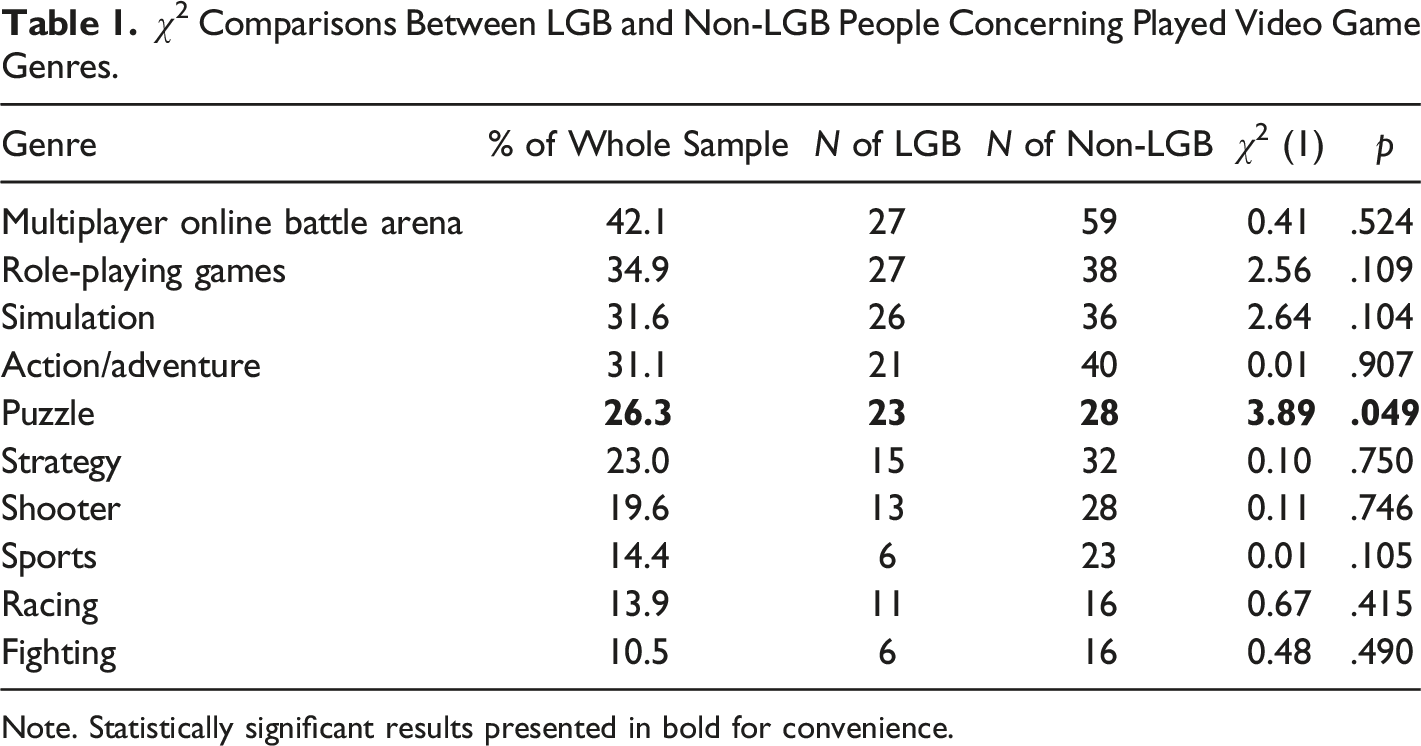
χ2 Comparisons Between LGB and Non-LGB People Concerning Played Video Game Genres.
Note. Statistically significant results presented in bold for convenience.
Results
Sexual Orientation, Gender Identity, and Intrinsic Gaming Motivations
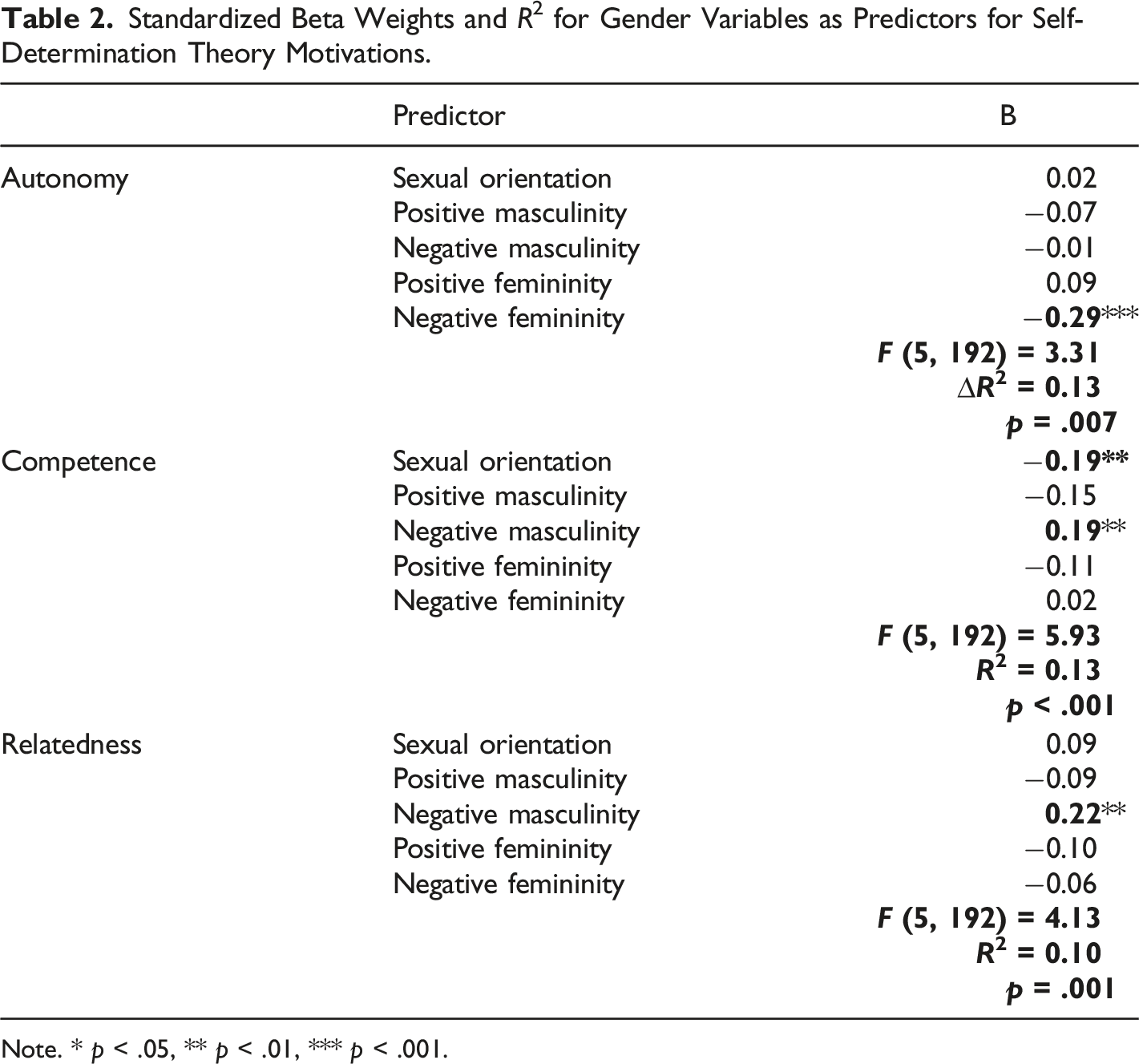
Standardized Beta Weights and R2 for Gender Variables as Predictors for Self-Determination Theory Motivations.
Note. * p < .05, ** p < .01, *** p < .001.
Autonomy
The results showed that negative femininity (=H1e) was a significant, negative predictor of autonomy as a gaming motivation. While positive masculinity (≠H1a), negative masculinity (≠H1b), sexual orientation (identifying as an LGB person) (≠H1c), and positive femininity (≠H1d) were insignificant predictors.
Competence
The results showed that negative masculinity was a significant positive predictor (= H2a), while sexual orientation (identifying as an LGB person) was a significant negative predictor (= H2b) of competence. Positive masculinity (≠H2c), positive femininity (≠H2d), and negative femininity (≠H2e) were insignificant predictors.
Relatedness
The results showed that negative masculinity was a significant positive predictor (≠H3d) of relatedness, which was contrary to our expectations. Sexual orientation (identifying as an LGB person) (≠H3a), positive masculinity (≠H3b), positive femininity (≠H3c), and negative femininity (≠H3e) were insignificant predictors.
Sexual Orientation, Gender Identity, and Contextual Motivation
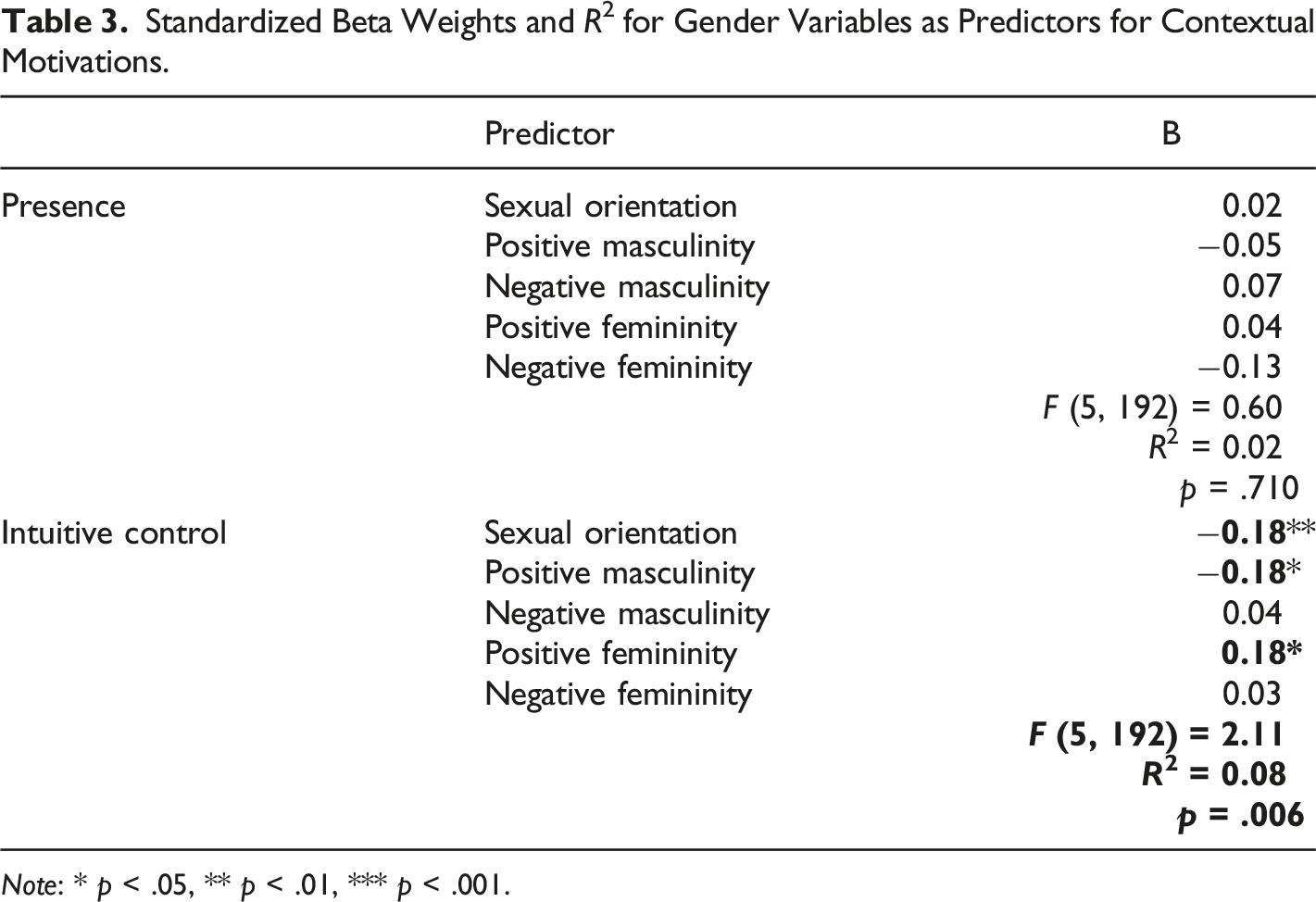
Standardized Beta Weights and R2 for Gender Variables as Predictors for Contextual Motivations.
Note: * p < .05, ** p < .01, *** p < .001.
Presence
The results showed that neither sexual orienatation (identifying as LGB person) (≠ H4a) nor negative femininity (≠ H4b) were significant predictors of presence gaming motivation.
Intuitive Control
The results showed that sexual orientation (identifying as an LGB person) (=H5b) and positive masculinity (=H5c) were significant negative predictors of the intuitive control gaming motivation. Contrary to our assumptions, positive femininity was found to be a positive significant predictor (≠H5d) of the intuitive control. Neither negative masculinity (≠H5a) nor negative femininity (≠H5e) was found to be significant.
Sexual Orientation, Gender Identity, Intrinsic and Contextual Gaming Motivations, and Gaming Enjoyment
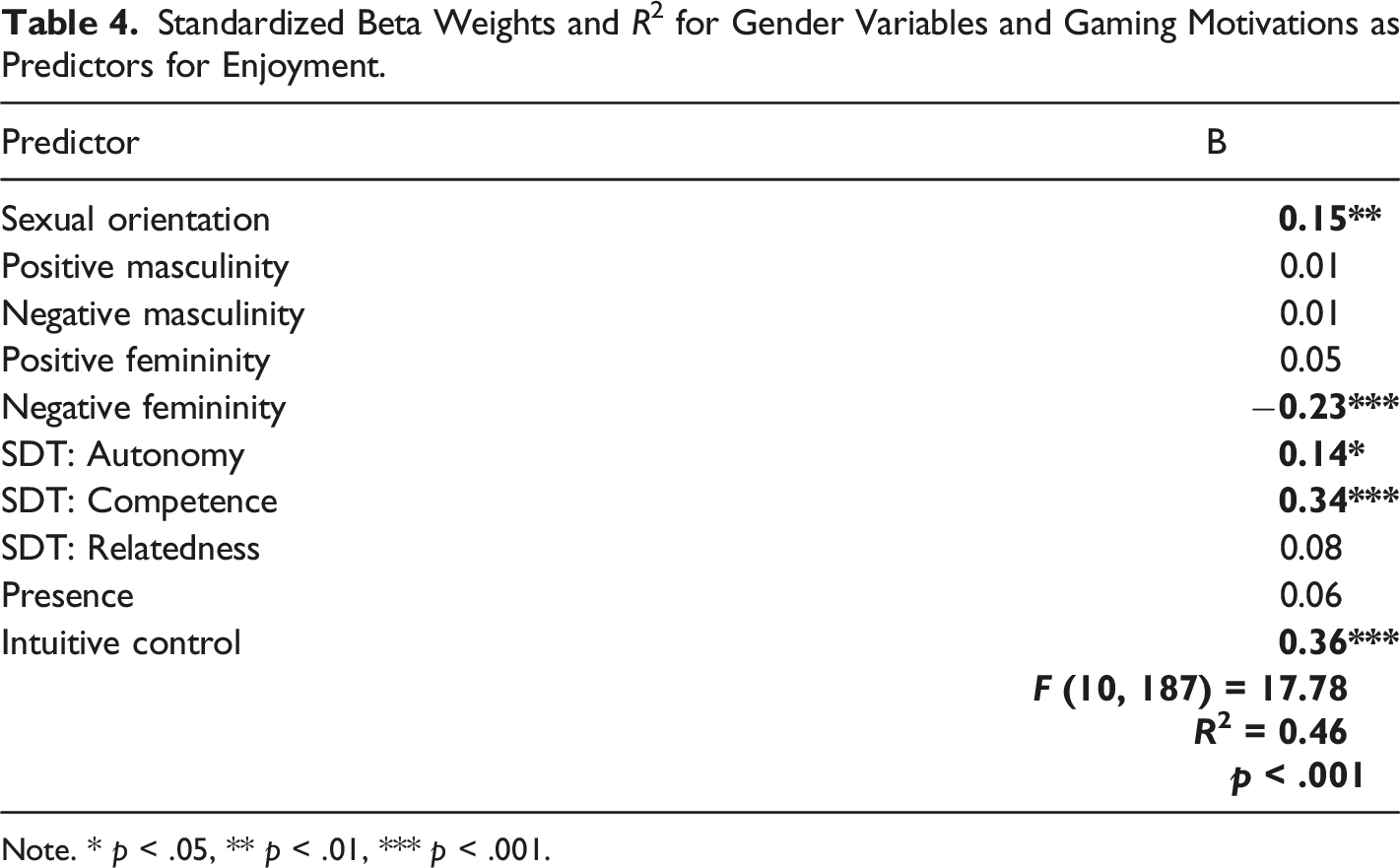
Standardized Beta Weights and R2 for Gender Variables and Gaming Motivations as Predictors for Enjoyment.
Note. * p < .05, ** p < .01, *** p < .001.
The results showed that sexual orientation (identifying as an LGB person) was found to be a significant positive predictor (=H6a) and negative femininity was found to be a significant negative predictor of gaming enjoyment. None of the other examined gender traits reached significance. Autonomy (=H6b), competence (=H6c), and intuitive control (=H6f) were positive significant predictors of enjoyment. Neither relatedness (≠ H6d) nor presence (≠ H6e) was found to be significant predictors of gaming enjoyment.
Discussion
This study investigated whether gender identity, understood as personality traits, and sexual orientation relate to gaming motivations and how these could further predict gaming enjoyment. Specifically, we wanted to contribute to gaming studies by examining gaming behaviors and motivations of LGB people. To this end, we conducted a survey and asked a diverse sample (32.0% LGB) from 14 nationalities for their gaming motives.
Our first goal was to investigate how gender traits and sexual orientation connected to intrinsic and extrinsic, in other words, contextual, gaming motivations. Our results for sexual orientation showed that identifying as an LGB person leads to lower competence motivation (= H2b) and less intuitive control motivation (= H5b). These results indicate that LGB people might not be seeking competition in games, so perhaps winning or proving oneself better than others is of lesser importance for queer players compared to straight players. Moreover, LGB players appear to be less motivated to play games intuitively and they are more open to exploring different gaming realities with its own rules. These results are in line with Ruberg’s (2019) arguments who pointed out that games could be an arena for LGB people to engage in play and experimentation that does not follow intuitive assumptions that drive real world. Contrary to our expectations, sexual orientation showed no impact on relatedness nor presence. While interpretation of non-significant effects should be cautious, we propose that gaming is not a source of community for all LGB players. Even though Elling and Janssens (2009) found out that LGB participants were likely to engage with other ingroup members in sports organizations, our results suggest that these differences did not exist in online gaming scenario. Perhaps real-life sports are more inclusive than video games that could provide more of a solitary refuge from real world and a chance to explore the world in a non-intuitive and non-competitive manner for the LGB players.
Our additional findings point out that there are no systemic differences in genres of games played by LGB and non-LGB players, which suggests that different games can be enjoyable to all players but for different reasons. Only difference we found was that puzzle games were more popular about LGB players, which could be connected to the interest in problem-solving, seeking creative solutions to problems, and experimentation as suggested in Ruberg’s research (2019).
In terms of masculinity, positive masculinity was found to have negative impact on intuitive control (= H5c) but was not found to impact any other gaming motivation. This is not surprising as people with positive masculinity traits tend to seek solutions, which might go in line with following less intuitive games and seeking more challenging virtual worlds. Negative masculinity had as expected positive impact on competence (= H2a). This finding is in line with Kneer et al.’s (2019) results, that negative masculine attributes are linked to achievement. Video games provide a perfect virtual scenario where players are able to gain rewards, as long as they put enough time and efforts in it (Bartle, 2004). The most interesting result was found for negative masculinity having positive influence on relatedness (≠ H3d). Negative masculinity describes attributes such as self-satisfied, hasty, and boastful, or in other words, toxic masculinity (Grieve et al., 2019). This may lead to some difficulties in establishing relationships in real life which in turn leads to a higher motivation to socialize through online environments (Cole & Hooley, 2013). In combination with the finding that negative masculinity was related to competence, individuals with negative masculine traits seem to value teamwork and tactics to win the game and were thus, more likely to join communities and teams in virtual world (Elling & Janssens, 2009). In line with this discussion, other studies indicated that males are more likely to be driven by interaction building and socializing in video games than females (Carlisle et al., 2019; Jansz et al., 2010). The rewards in games could be regarded as sign of accomplishment, or even some kind of glory and victory. In light of this, players with negative masculine traits (e.g., competitive, self-satisfied, and boastful) could easily pursue the challenges and achievements in video games.
In terms of femininity, we found that positive femininity increased intuitive control which was against our assumption (≠ H5d). This might mean that intuitive control in gaming is more important for emotional, sensitive people who could expect games to work similar to the real world and be upset when games are not intuitive enough. However, more research in the area is needed to confirm our findings.
For negative femininity, we found as expected a negative influence on autonomy (= H1e). Negative femininity traits such as being oversensitive, dependent, and self-doubting could easily lead to the similar feelings of being overwhelmed when pursuing an activity with too many choices of possible action, which in turn explains a lower autonomy motivation for gaming. In addition, and differently than expected, neither positive femininity nor negative femininity was connected to relatedness. This contradicts findings of Park et al. (2011) who claimed that females tend to be motivated by social connection in video games. Perhaps our finding could be explained by a large proportion of Chinese people who might enjoy stronger social connections due to collectivist cultural orientation (Hofstede et al., 2010).
Furthermore, we analyzed how sexual orientation and gender traits together with gaming motivations impact enjoyment of video games. Concerning gaming motivations, we found that autonomy (= H6b), competence (= H6c), and intuitive control (= H6f) were linked positively to game enjoyment as found in previous work (Reer & Krämer, 2020; Reinecke et al., 2012; Tamborini et al., 2010). While this result is not surprising, it underlines again the importance of particular motivation to play games in bringing satisfaction for players. However, we did not find any influence of presence or relatedness on enjoyment, which was interesting. In line with our assumptions and theoretical work on queer video games (e.g., Ruberg, 2019), sexual orientation was related to enjoyment. LGB persons showed higher enjoyment with games than non-LGB persons (= H6a). Elling and Janssens (2009) demonstrated that many LGB people enjoy sports, which challenges the stereotypical view that sporting involvement is exclusively dominated by heterosexual people. This study also called for more attention on e-sports as there is an interrelationship of video games, sport, and communication technologies (Hutchins, 2008). However, our results should be interpreted with caution since it is possible that the effect of sexual orientation on enjoyment was inflated by the negative correlations with intuitive control and competence. Still, in absence of ample literature on sexual orientation and gaming effects, we decided to report and discuss this finding, but we acknowledge that more research in the area is needed to confirm our results.
For gender traits, we found that negative femininity led to lower enjoyment, which is in line with lower gaming enjoyment among women (Fang & Zhao, 2010). It appears, though, that only people with negative feminine traits such as self-doubt and anxiety experience less gaming enjoyment, perhaps due to lack of belief in success.
Limitations
This study has several limitations. First, due to the cross-sectional survey, we cannot draw causal relationships. For this purpose, future studies should use a longitudinal design, to see whether initial gaming motivations predict future enjoyment. Moreover, it is also possible that some of the gaming experiences and motivation could have an effect on gender personality traits and make individuals more self-secure and thus exhibit less negative femininity. Research needs to uncover how gender identity impacts gaming motivation and enjoyment over time.
Second, we did not focus on specific game genres. Studies have justified that different genre of games connect to different gaming behaviors and even to different gender preferences (Lemmens & Hendriks, 2016; Yee, 2006). Thus, more work should check relations between gender personality, sexual orientation, gaming motivations, and enjoyment for specific genres of video games. The majority of our sample (42.1%) indicated playing online combat battle teams, which might explain the surprising connection of negative masculine traits and relatedness. Gaming motivations are clearly linked to different game genres, and thus, the influence of gender traits and sexual orientation might also differ between genres. Future research should take genre comparisons into account to further analyze the relationship between players’ characteristics and gaming motivations and enjoyment. Moreover, more research should confirm whether LGB and non-LGB people enjoy the same games.
Third limitation stems from our focus on gaming enjoyment, which includes only a hedonic entertainment (e.g., bringing fun) aspect but not the eudaimonic entertainment aspect (i.e., bringing a reflection on life) (Oliver & Raney, 2011). In fact, eudaimonic entertainment is linked to meaningful content and a deeper reflection on the topic (Daneels et al., 2021; Oliver & Bartsch, 2010). While some studies in entertainment psychology have shown that video games are able to provide entertainment gratification beyond hedonism (Oliver et al., 2016), the influence of gender attributes and sexual orientation on eudaimonic entertainment remains unclear. Future studies should include eudaimonic entertainment to investigate how minorities and different personalities experience eudaimonic entertainment in games.
The fourth and last limitation refers to sample diversity, both in terms of culture and gender identities. As Wagner et al. (2014) suggested, different culture and language groups may behave variously and attach different meanings semantically. A cultural bias was thus inevitable and need to be considered for its impact on the reliability and validity of the results. Although bias caused by lack of representativeness was difficult to avoid, the final sample still reached higher internationality and diversity than many studies with a total of 14 nationalities (2/3 being from non-Western cultures). This sample enabled us to test theories in non-western context; however, it also means that our novel findings might not be generalizable to western cultures.
Moreover, while we collected data from many people who identify as women, men, or LGB community members, our study did not measure transgender identification among our participants and that we had one group for LGB without analyzing lesbian, gay, and bisexual people specifically in the results section. This was due to the fact that those specific subsamples are too small for statistical analysis but such limitation certainly needs to be addressed by future studies. Due to survey length and focus of this paper, we decided to focus only on gender personality traits and sexual orientation. However, it is possible that transgender people have entirely different experiences and motivations to play games.
Conclusion
Despite the above limitations and rejected hypotheses, our results show that some of the gaming motivations and gaming enjoyment are connected to the players’ characteristics that go beyond mere sex or single-item gender identification. We conclude our study by providing the following main insights: (1) Sexual orientation is associated with some gaming motivations such as competence and intuitive control but not with all of them. (2) LGB people could enjoy video games more than non-LGB persons. (3) Certain gender traits are linked to specific gaming motivations—negatively as well as positively. (4) The mixed results of the impact of gender traits and sexual orientation for gaming motivations and enjoyment show that video games offer an environment for everybody. These general findings come with insights for researchers and game designers as well. We found that LGB people play more hours than non-LGB people and that both, LGB and non-LGB people like to play a variety of game genres as the descriptive data shows. Thus, game designers could pay greater attention to including diverse characters within the plots of their games. Such inclusion could strengthen the enjoyments of games even more for the minority players but also for the majority of players. Moreover, LGB players seem to play less for competition and intuitive reasons and play more puzzle games, which suggests that more cooperative games and games focusing on exploration and problem-solving could be developed and marketed towards LGB community. While gaming can be enjoyed by everyone, irrespective of sexual orientation, more diverse options catered to particular LGB communities could help diversify the gamer community further. Moreover, diverse representation in game plots can possibly improve diversity attitudes of non-LGB players. Notably, a lot of evidence for these effects comes from television studies (Żerebecki et al., 2021), yet similar theories can be applied to games. We hope that our findings inspire other researchers to examine gender identity in a more nuanced way and study the specific experiences and motivations of LGB players. We also recommend other researchers measuring gender identity in different ways described in this article, for instance using multiple items (Fraser, 2018), exploring self-reports on traditional masculinity and femininity roles (Kachel et al., 2016), studying genderqueer identification (McGuire et al., 2019), or focusing on personality traits and gender (Berger & Krahé, 2013) like we did. While we took one of the first steps in inclusion of diverse people in game studies research, many more are needed.
Footnotes
Declaration of Conflicting Interests
The author(s) declared no potential conflicts of interest with respect to the research, authorship, and/or publication of this article.
Funding
The author(s) received no financial support for the research, authorship, and/or publication of this article.
