



Abstract
Background
In recent years, interest in digital games has grown significantly and at the same time a range of games in 2D and 3D has been created. While 2D games cannot give depth to objects, 3D games creates spatial depth. The growth of the gaming industry has raised concerns among some psychologists. There is still much controversy about positive or negative effects of these games on cognitive performance. Executive functions are a set of cognitive abilities that play a decisive role in one’s purposeful behavior. The present study aims to investigate the effect of 2D and 3D video games on some of these functions—flexibility, inhibition, and continuous attention—in male students aged 18–26 years.
Method
Forty-five male students at Persian Gulf University participated in the study. They were matched based on intelligence score and experience of playing video games. The participants were divided into three groups of 15 (two experimental groups and one control group). Participants in the two experimental groups played 2D and 3D video games over 20 sessions. They completed the Wisconsin Card Sorting Test, continuous performance test, Stroop test, and Raven intelligence test.
Results
Data were analyzed via covariance and the results showed that playing 2D and 3D video games positively and significantly affects inhibition and playing 3D games has a significant positive effect on flexibility.
Conclusion
Based on our findings, we discuss the different effects of 2D and 3D video games, in line with the study’s theoretical framework, and give suggestions for future studies.
Background
Today, video games are an important part of the lives of many people. In 2013, the video game industry in the United States earned $21.53 billion, and more than 1.2 billion people worldwide are reported to play video games (Entertainment Software Association, 2015). According to the biannual Open View report, one-third of Iran’s population buys video games, with an average age of 19 years (Digital Games Research Center, 2017).
The rapid growth of the gaming industry has raised concerns, especially among psychologists and researchers, about the impact of video games on the skills and abilities of the individuals who play them. Numerous studies have examined the effects of video games on cognitive and behavioral skills. Although most of these studies have addressed the negative effects of video games (Okdie et al., 2014), in recent years research has sought to examine the effects of these games—especially action games—on cognitive skills, including executive functions (Blacker & Curby, 2013; Cain et al., 2012; Chisholm & Kingstone, 2012; Green & Bavelier, 2012; Mayer et al., 2019; McDermott et al., 2014; Okdie et al., 2014). Therefore, the present study focused on the effect of action video games on executive functions.
Executive functions refer to a category of cognition, which includes working memory, cognitive flexibility, inhibitory control, and sustained attention. EFs serve our ability to respond flexibly and adaptively to changes in the environment in the pursuit of long-term goals (Munakata et al., 2012). Executive functions play an important role in our everyday life, allowing us to focus attention on specific tasks, to engage in successful problem solving, and to plan for the future. Executive functions demonstrate variable developmental and aging profiles (Best, & Miller, 2010) The relationship between executive functions and various behavioral, cognitive, social, and communicative aspects has been studied in various studies, and deficiencies in them can have devastating effects (Davis & Burns, 2001; Strayhorn, 2002; Zelazo et al., 2014). The components of executive functions to be addressed in this study are continuous attention, cognitive flexibility, and cognitive inhibition. Continuous attention refers to the ability to maintain a stable behavioral response during repetitive and continuous activity (Evans, 2003). Cognitive flexibility is the ability to switch cognitive strategies to change environmental feedback, which requires planning, organized searching, and the ability to use environmental feedback to change cognitive motivation (Ortega et al., 2013). Cognitive inhibition involves the process of preventing unrelated information from entering working memory (Nigg, 2000).
Different Effects of Video Games on Executive Functions
Some researchers believe that playing video games as complex technological and social phenomena can incur negative because it keeps the individual from playing creative games, teaches wrong beliefs and behaviors, and takes away the opportunity to develop better motor skills (Anderson et al., 2004; Hamlen, 2009). However, some research has highlighted the positive effects of these games. For example, Dye et al. (2009) concluded in their study that video games are associated with positive outcomes such as increased response accuracy and attention skills. Video games also improve visual processes such as visualization and spatial ability, to enhance cognitive performance through more efficient information processing and integration (Barlett et al., 2009).
Action video games have high-speed and fast-motion programs that require planning, re-evaluation, and focused attention (Bediou et al., 2018). On the whole these studies have shown that those who play action games have attention control, spatial ability, working memory, and executive functions that are superior to those of people who have not experienced such games (Blacker & Curby, 2013; Cain et al., 2012; Castel et al., 2005; Chisholm & Kingstone, 2012; Green & Bavelier, 2003, 2006a, 2007, 2012; Mayer et al., 2019; McDermott et al., 2014). However, some studies did not report such results (Irons et al., 2011; Murphy & Spencer, 2009) and some have even concluded that playing such games can limit attention control (Kronenberger et al., 2005; Swing et al., 2010).
Further evidence of the advantages of action video games has been obtained from a recent meta-analysis by Bediou et al. (2018), who found that people who played an action video game for at least eight hours scored better on tests of perceptual attention and spatial ability than those who did not. Sala et al. (2018) showed that playing action video games had little effect on perceptual attention skills with little effect or a negative effect on other cognitive skills such as executive functions, memory, and reasoning abilities. Therefore, it is not yet clear what role video games play in the development of cognitive skills, especially among young people.
Types of Video Games
There are several genres of video games available including action, adventure, bat and ball, educational, massive multiple online role-playing, maze, platformer, puzzle, racing, real-time strategy, role-playing, shooter and first-person shooter, and sport (Felicia, 2009). Of course, there are games that combine two or more different styles, such as action adventure or action shooter. Action video games have a unique set of features including high speed (in terms of speed of moving objects and the gamer performing motor reactions under severe time constraints); a high degree of perceptual, motor, and planning load (performing several activities simultaneously, with many possible goals that require re-evaluation and many movement programs that need to be implemented quickly); an emphasis on focusing attention on a specific goal; division of attention (monitoring the whole field of view); and a high degree of confusion and disorder (e.g., targets are scattered among many irrelevant items) (Bediou et al., 2018). Given that executive functions include focused attention, impulse inhibition, and flexibility, all of which seem to be necessary for action games (given the characteristics of action games mentioned above), in the present study we focused on the effect of action games on executive functions.
In addition, video games have changed in terms of the structure and type of experience provided to the player. As Yim et al. (2012) state, digital games nowadays are changing from 2D to 3D. While 2D games cannot give depth to objects, 3D technology creates spatial depth by using stereoscopic displays, so objects appear closer to the player and seem touchable. For this reason, these games are also called stereoscopic 3D games (Roettl & Terlutter, 2018). One study found that stereoscopic 3D technology improved the quality of students’ learning experiences and created more life-like training simulations (UCSF, 2012). It provides useful information about the spatial location, size, shape, and orientation of 3D objects (IJsselsteijn et al., 2001). Bennett et al. (2010) showed that stereoscopic 3D cues allow for a richer memory experience in virtual environments. So, 3D games, using advanced artificial intelligence and realistic physical engines, provide a simulation environment that reacts to players’ actions in a highly realistic manner (Felicia, 2009). In comparison, Head-Mounted-Display Virtual Reality (HMD-VR) games depict an environment that is closer to the real world and deliver stronger feeling of being in the world or in the moment. In VR games, the player is sheltered from the outside world but in Augmented Reality (AR) games the player is not (Triberti et al., 2016). In this research, we compare 2D and 3D games.
Following the success of the movie Avatar in 2009, many new media products (such as movies, 3D TVs, and games) began producing 3D images widely (Schild et al., 2012). Sony, Nintendo, and Nvidia game consoles also provided 3D gaming experiences for their users, and this type of game became popular (Schild et al., 2012). Some studies have shown that the experience of playing and the interaction between the game and the player is greater in 3D (Clemenson & Stark, 2015). However, it is not yet clear whether 3D viewing actually provides significant added value for players. Also, the negative effects of playing 3D video games are not well known. Studies have shown that vision disorders such as eye pain, eye fatigue, and blurred vision are more common with these types of games (Hoffman et al., 2008). Clemenson & Stark (2015) reported that video game players who have a particular interest in complex 3D games perform better in memory recognition tasks, since exploring the 3D virtual environment may affect hippocampal-related behaviors. Also, Loup-Escande et al. (2017) conducted a study in which they showed that students using stereoscopic displays were more successful in learning tasks and showed better quality of comprehension, fluency, and immersion than those using nonstereoscopic displays. In this regard, the present study focuses on the role of executive functions, specifically continuous attention, cognitive flexibility, and cognitive inhibition. Parts of the frontal cortex and areas of the prefrontal cortex play a role in these executive functions (McCloskey et al., 2008). In addition, research has shown different effects of 3D virtual environments on the prefrontal cortex and related structures (Clemenson & Stark, 2015; Green & Bavelier, 2006a; Bennett et al., 2010).
Due to differences in findings about the effects of different types of video games on cognitive activities (including executive functions), the present study focused on research gaps to investigate the effect of action video games on the executive functions mentioned, and compare the effect of 2D and 3D games on executive functions. Specifically, the study aims to investigate the effect of action video games on the executive functions of male students aged 18–26 years. Also, in light of the advancement of technology and the change of games from 2D to 3D along with the potential effects on cognitive performance, we aim to answer the following question: Are there any differences between 2D and 3D action video games in terms of the effects they have on executive functions (continuous attention, inhibition, and flexibility)?
Methods
This is a quasi-experimental study with a pre-test/post-test design, consisting of two experimental groups and a control group.
Sample
Mean (M), and standard deviation (SD) of age and Number of participations (N).

Instruments
Video Game Questionnaire
Participants were given a researcher-made video game questionnaire, which evaluated their gaming experience (video/computer games and mobile or tablet games), amount of time played, and different game styles played. This questionnaire was used to match the participants in terms of video game history.
Raven Intelligence Test
In order to control the intelligence variable, the three groups were matched in terms of intelligence, using Raven’s Progressive Matrices. To measure cognitive intelligence, the Raven advanced software test (John & Njckols, 1962) was used (12 introductory questions and 36 main questions). Bors & Vigneau (2005) investigated the reliability of re-testing Raven’s Progressive Matrices on three different occasions. The scores were 18/51 the first time, 20/45 the second time, and 21/85 the third time, which indicates high re-test reliability. Anastasi (1982) evaluated the validity of this test from the correlation between the scores of the Raven test and the scores of verbal and practical tests of intelligence (between 0.40 and 0.70), which indicates the optimal validity of this test.
Wisconsin Card Sorting Test
A computer version of the Wisconsin test was used to measure cognitive flexibility skills (Berg, 1948), by measuring a complex range of executive actions including planning, organizing, abstract reasoning, concept formation, and cognitive flexibility (Lezak et al., 2004). Four cards with different shapes, colors, and numbers are shown. For example, one card may show two green triangles and the other four blue circles. Another 60 cards appear at the bottom of a Manitou screen according to an invisible rule, and after each card is displayed, the participant must decide which main card it will be placed under (sorting by number, color, and shape). However, the invisible law changes at each turn, and the participant must change their previous strategy in favor of a new law. The number of performance errors or errors created after a rule change is an indicator of cognitive flexibility. A study by Axelrod et al. (1992) reported that in this test the score between and within scores was 0.92 and 0.94, respectively. Lezak et al. (2004) reported the validity of this test to measure cognitive deficits following brain injury as above 0.86. The reliability of this test based on the coefficient of agreement of the evaluators in Strauss et al. (2006) study was 0.83.
Stroop Test
The software version of the Stroop test was used to measure cognitive inhibition. The Stroop test is one of the most widely used tests to measure response inhibition (Chan et al., 2006). The Stroop Color and Word Test was first developed in 1935 by Ridley Stroop to measure selective attention and cognitive flexibility. It shows the name of a color written in a color that is different from the meaning of the word (e.g., the word “yellow” is shown in red type). The subject must recognize the color of the word regardless of its meaning and should suppress their initial urge to read the meaning of the word, responding only to the color of the word. In this test, scores related to accuracy (number of correct responses) and reaction time are indicators of cognitive inhibition. Research on this test has shown reliability and validity in adults (MacLeod, 1991). The validity of this test has been reported through re-testing in the range of 0.80–0.91 (Lezak et al., 2004).
Continuous Performance Test
The continuous performance test was used to measure continuous attention (Conners & Staff, 2000; Homack & Riccio, 2004). The test was developed by Rosvold et al. (1956). Numbers appear at regular intervals and two stimuli are identified as target stimuli. The participant must press the corresponding key on the computer keyboard as soon as possible after seeing the desired numbers. The target stimuli are relatively sparse and the latency is relatively short. The variables measured in this test are omission error, presentation error, correct answer, and reaction time. The omission error is the impulsivity index, the presentation error is the attention deficit index, and the number of correct responses is the continuous attention index (Corkum & Siegel, 1993). This test is used to measure attentional errors in a wide range of mental disorders (Riccio et al., 2001). While confirming the evidence for the validity and reliability of the continuous performance test, Riccio et al. (2002) reported that the test was used in 342 independent studies between 1966 and 1999. Corkum & Siegel (1993) reported a high rate of re-test reliability after reviewing studies using continuous performance testing. Research findings have shown that the continuous performance test can differentiate well between different subjects, including individuals with attention deficit hyperactivity disorder and normal individuals. This confirms the validity of this test.
Intervention Program
In this study, two versions of the Uncharted video game were used to investigate the effects of 2D and 3D video games. Uncharted is the name of a series of action adventure video games made by Naughty Dog and published by Sony Interactive Entertainment for PlayStation consoles. The main series of games follows Nathan Drake, a treasure hunter who travels across the world to uncover various historical mysteries. It consists of four parts: Uncharted: Drake’s Fortune, Uncharted 2: Among Thieves, Uncharted 3: Drake’s Deception, and Uncharted 4: A Thief’s End. In this experiment, two of these—Uncharted: Drake’s Fortune in 2D and Uncharted 3: Drake’s Deception in 3D—were used (Sony Interactive Entertainment Inc., 2017).
Research Protocol
First, all 45 students took Raven’s Progressive Matrix test and completed the video game questionnaire. Then, all of these students were divided into triple subgroups based on their intelligence and video game experience scores. In the next step, each of the members of these triple subgroups was randomly assigned to an experimental group of 1,2 and control. In this way, the groups became equal in terms of intelligence and computer game experience. So, the whole sample was randomly divided into three groups of 15 people each: 3D game group (group 1), 2D game group (group 2), and no game group (control group). Three participants (one in each group) could not complete the experiment and were excluded from the study. Group 1 played Uncharted 3: Drake’s Deception in 3D and group 2 played Uncharted: Drake’s Fortune in 2D, while the control group was not exposed to any game, groups were pre-tested and tested again three days after the end of the experiment. It is worth mentioning that both Uncharted and Uncharted 3 are action adventure games and are quite similar in terms of genre, stages, and tasks (Sony Interactive Entertainment Inc., 2017). The only difference in the way they are presented to the gamer is that Uncharted is 2D and Uncharted 3 is 3D. Both games were played on a PlayStation 3 game console on a high-quality 72-inch LG LED TV screen. Participants in groups 1 and 2 entered the same test site individually for four weeks (except Thursdays and Fridays) and played for 20 min each day. Due to the fact that in previous studies, the game time was approximately 20–30 min (Clemenson & Stark, 2015, Buelow et al., 2015), the playing time for the participants in groups 1 and 2 in each session was set for 20 minutes. Also, since the executive functions of interest in the present study all take time to change (Gilbert & Burgess, 2008), the games were played for at least four weeks. An experimenter was present during the sessions to ensure that participants played for the same length of time throughout. In order to ensure the same conditions in 2D and 3D games, video game performance (rank, number of stages, and number of achievements) for each participant was recorded by the PlayStation 3 console.
Results
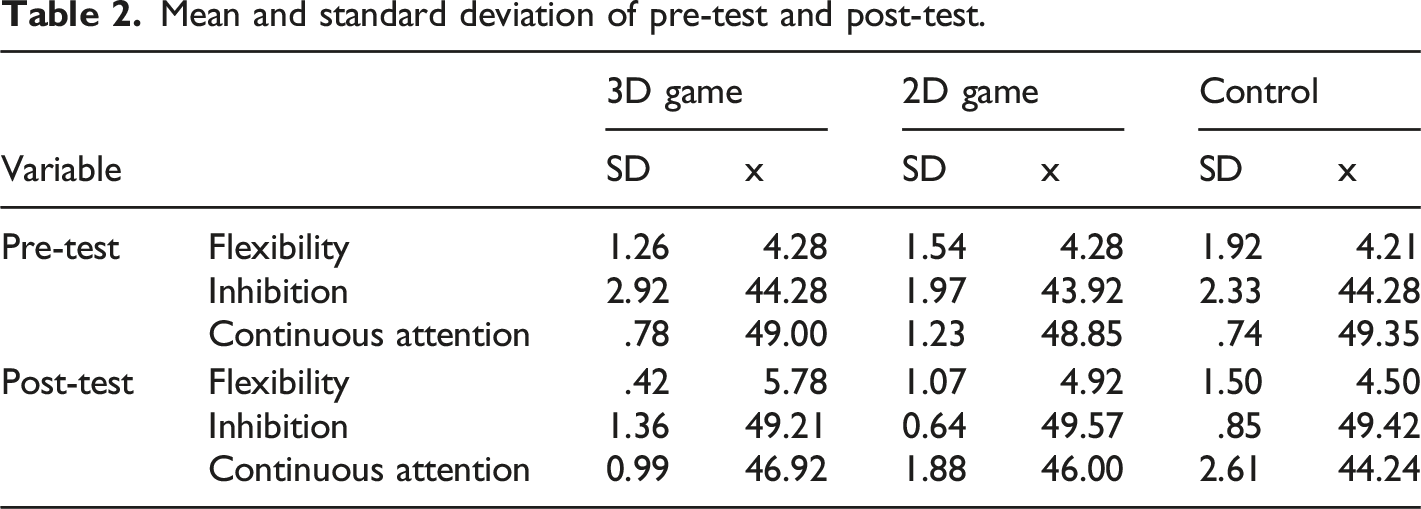
Mean and standard deviation of pre-test and post-test.
Period t-test for explore within-group changes.
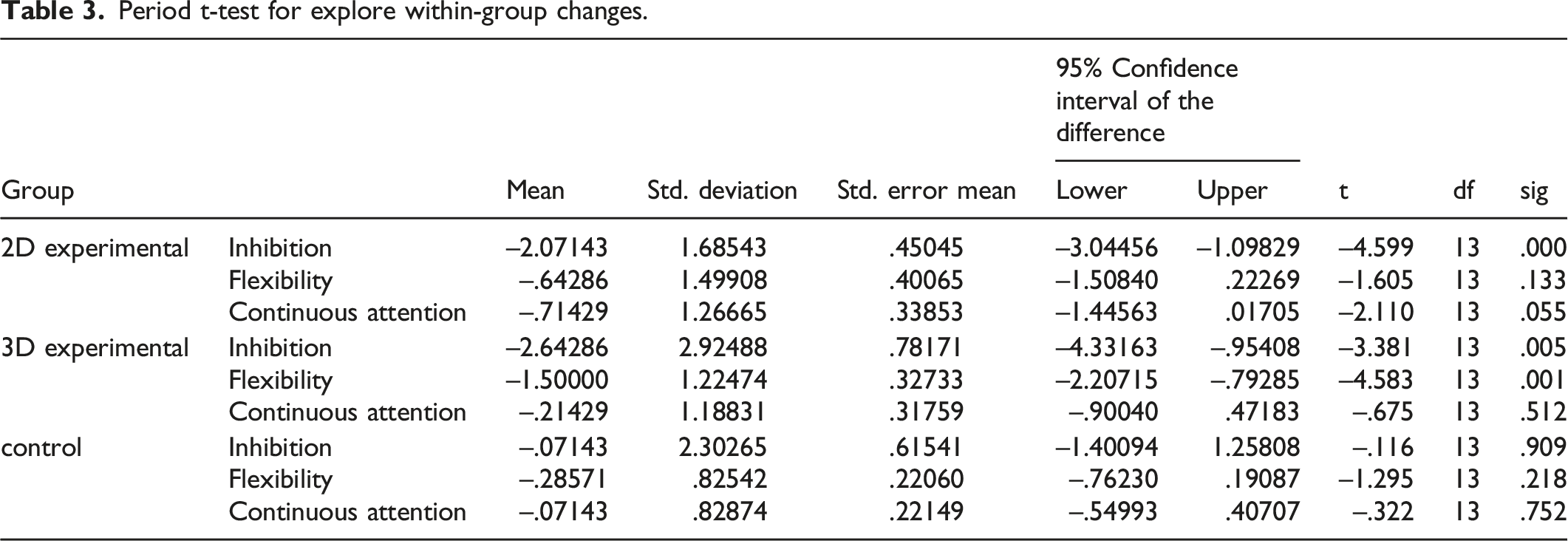
Table 3 shows that there are significant within 2D excremental group changes in inhibition and continuous attention. There are significant within 3D excremental group changes in flexibility and inhibition. But there are not significant within control group changes.
Results of one-way analysis of covariance in relation to flexibility, inhibition, and continuous attention.
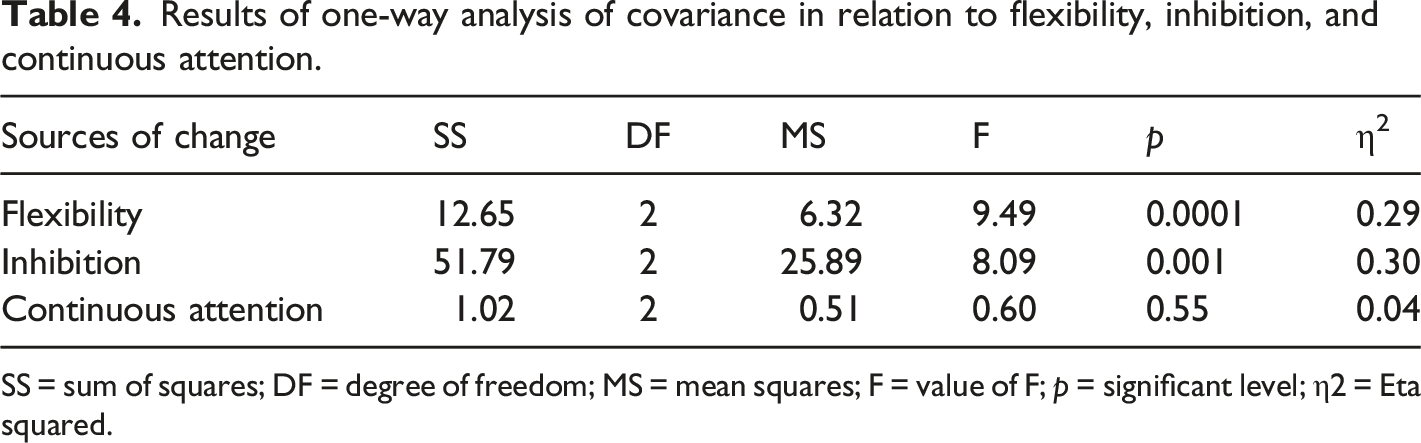
SS = sum of squares; DF = degree of freedom; MS = mean squares; F = value of F; p = significant level; η2 = Eta squared.
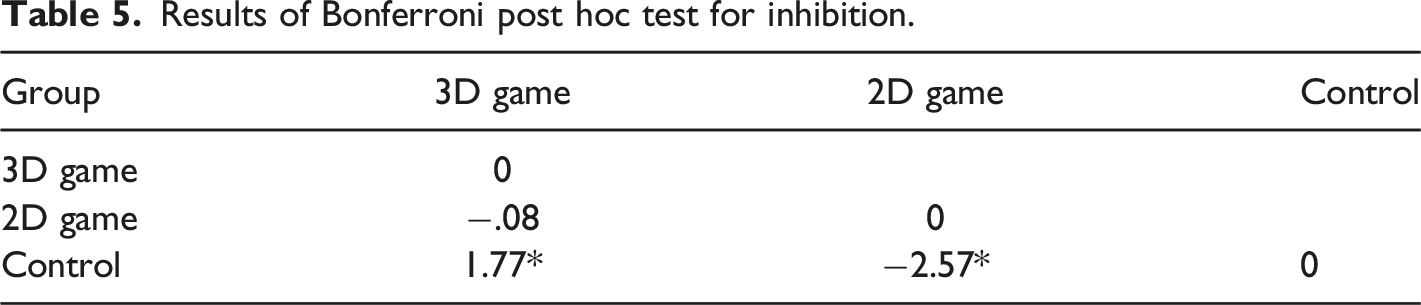
Results of Bonferroni post hoc test for inhibition.
Results of Bonferroni post hoc test for flexibility.
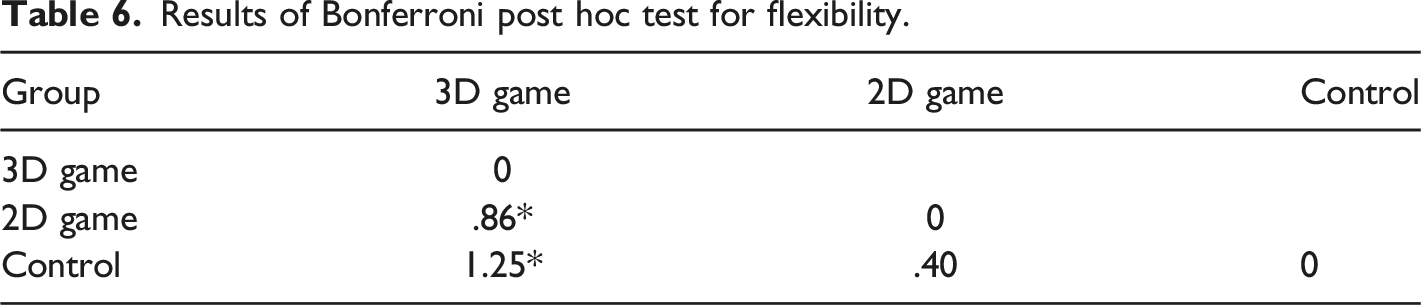
Table 6 shows that the control group is significantly different in terms of flexibility only from the 3D game group. According to Table 2, the 3D game group has more flexibility than the control group. There is also a significant difference between 2D and 3D play in terms of flexibility. According to the descriptive statistics presented in Table 2, the 2D game group shows less flexibility than the 3D game group.
Discussion
In the present study, we aim to answer this question: Are there any differences between 2D and 3D action video games in terms of the effects they have on executive functions (continuous attention, inhibition, and flexibility)?
The results showed that playing an action video game (Uncharted) significantly improved inhibition (in the 2D and 3D game groups) and cognitive flexibility (in the 3D game group only) compared with the control group. In terms of continuous attention, we did not find a significant effect. According to the results of the present study, playing 2D and 3D action games reduces inhibition, which is one of the executive functions associated with the ability to inhibit or stop dominant and automated responses if needed. To explain this effect, it is necessary to pay attention to the nature of action games. These differ from other game styles (e.g., strategic or role-playing) in terms of game speed; motor, cognitive, and perceptual responses; and attention span. In addition, in these games, the player must constantly be aware of events in the game in terms of the situation—“Where is the enemy most likely to appear?”—and in terms of time—“When is the enemy most likely to appear?” (Green & Bavelier, 2012). Finally, players receive constant feedback based on the accuracy of their predictions. Action video games lead to more effective positioning of a goal, which can exist alone or amid scattered and confusing information (Buckley et al., 2010). Therefore, gamers develop a strengthened ability to not respond to distracting information. In this regard, Chisholm et al. (2010) posited that players of action games use better execution strategies to reduce distractions. Also, Mishra et al. (2011) showed in their research that action game gamers are more effective at suppressing irrelevant and misleading information.
In addition, the results of this study showed that 3D games significantly improve cognitive flexibility, which is the ability of the mind to change rapidly from one task to another and to think about multiple concepts simultaneously. Regarding the effect of these games on flexibility, it is necessary to understand that gamers must learn to adapt to an ever-changing environment and employ the most appropriate method to complete each step (Green & Bavelier, 2012). Therefore, they pursue flexibility strategies (Kramer et al., 1995). According to the results of our research, only 3D games lead to improved flexibility. These results are in line with the research of Clemenson & Stark (2015), who asked participants to play video games for 30 min a day for two weeks (one group played 3D games and the other group played 2D games). Their results showed that participants who played 3D games performed 12% better in a memory performance test. Clemenson & Stark (2015) argue that 3D games have some advantages over 2D games. For example, 3D games contain more information and have more space to discover. Also, such games are more motivating.
So, research on the differences between 2D and 3D games showed that 3D games have a greater effect on cognitive flexibility. Actually, the sequence of 3D images is generally preferred over non-3D images. Depth perception in 3D images is greater than in 2D images, while sharpness of image sequences in 3D is equal to or less than that in 2D images (Schild et al., 2012). In addition, animations are perceived faster on 3D screens, which have more power in providing information about the spatial position, size, and shape of objects and lead to more searching in the game process (Schild et al., 2012). Also, virtual scenes and video clips on the 3D screen lead to a better understanding of the scene, and highlighted images are generally perceived more naturally, leading to a better viewing experience (Seuntiëns et al., 2005). Therefore, 3D games have a greater ability to improve cognitive flexibility. However, the present study had some limitations, including the fact that the time spent playing by the participants was limited and controlled. Also, this study was performed on male students only and gender differences were not considered. In addition, although all participants were examined in one space, inevitable environmental factors (such as environmental congestion) that may affect individuals’ performances during the intervention were not controlled. Another limitation of the present study was that it was a small experimental study so results should be generalized with care.
Conclusion
In general, despite previous inconsistencies in the findings about positive or negative effects of video games, in the present study, the negative effect of action video games was not observed in any of the executive functions of interest (continuous attention, flexibility, and inhibition); the difference in executive functions between the groups was not negative. Therefore, it should be said that, although video games were not originally designed for cognitive purposes, the present study shows that video games, especially 3D action video games, can improve executive functions. The positive effects of video games on male students aged 18–26 is one of the important findings of the present study, which can help us create a perspective based on life stages in human development. One of the limitations of the present study was the limited number of samples that should be used with caution in generalizing the results. In addition, due to the growth of new technologies, the different and positive effects found in this study of 3D games compared with 2D games brings the promise of better use of new technologies in the near future. Therefore, further research is needed to determine the optimal amount of play and time interval between games to create positive effects. In addition, more research is necessary on the sustainability of game effects. And most importantly, the present study shows that playing 3D video games can have different effects on cognitive functions. Therefore, considering the continuous development of technology and the availability of VR and AR games, comparing the impact of playing 3D, VR, and AR video games on cognitive performance, including executive functions, is recommended.
Footnotes
Declaration of Conflicting Interests
The author(s) declared no potential conflicts of interest with respect to the research, authorship, and/or publication of this article.
Funding
The author(s) received no financial support for the research, authorship, and/or publication of this article.
Data Availability Statement
The data that support the findings of this study are available from the corresponding author upon reasonable request.
