




Abstract
Background.
Building on previous studies on racism and whiteness in video games, this article investigates how
Aims.
The aim is to contribute to our understanding how dominant ideologies are expressed through simulation and gaming in a deck building context and how games similar to ASCENSION: DAWN OF CHAMPIONS (henceforth A: DOC) perpetuate racism and coloniality through gameplay design. This is part of an ongoing game studies effort to critique white supremacist and imperial structures in games.
Method.
In this article, I conduct a first-person close reading of A: DOC as an emblematic case study for contemporary deck building design. Using critical whiteness theory, I pay special attention to the gameplay design of the four Champion characters Nairi, Kor, Sadranis, and Dhartha in order to demonstrate the interplay of ludic, racial, and social performative elements in the construction of playful identities.
Analysis.
The deck building principles of A: DOC provides a racial pedagogical arena which creates affective links between gameplay and white supremacist values. In coupling digital deck building mechanics with stereotypical fantasy characters, the game invites players to take the roles of fantasy tourists and thereby become implicit in white supremacist play. Even though the characters Nairi, Kor, Sadranis and Dhartha are leaders of different genders and races, their “diversity” is established via popular racial cybertypes like the white female diversity advocate, the technologically advanced white male emperor, the aggressive Black male, and the Asian male exotic Oriental.
Keywords
Background
As media both modelling and shaping culture, games and simulations are embedded in a set of societal and cultural values whether their creators intend it or not (Flanagan 2009, Gray 2012). From a decolonial and critical whiteness perspective, games are part of a wider ideological framework of whiteness (Murray 2018), which rather than an ethnic category, refers to structures and practices which directly or indirectly benefit white people (Lorde 1984/2007, Ahmed 2004a, Wekker 2016, Dyer 1997, Frankenberg 1993). As a norm in society, structural whiteness has been theorised in terms of its invisibility to those it advantages (Dyer 1997), while being blatantly visible to those it oppresses (Ahmed 2004a, Wekker 2016). The power of whiteness resides in its ability to hide its pervasiveness in societal value systems, infrastructures, technologies, and private entertainment which people use and enjoy. This affects game culture in at least two ways. First, as an ideology, whiteness permeates all levels of in-game expression (Leonard 2003), including simulations of the world (Mukherjee 2018), the representation of characters (Chan 2005, Dietrich 2013, Vossen 2020), aesthetics and gameplay mechanics (Breger 2008), and pleasures offered by them (Harrer/Pichlmair 2015). Secondly, it affects how people, including players, designers and researchers perceive game worlds and make assumptions about games as white-owned spaces (Gray 2012). In short, whiteness is an ideological baseline, a condition which structurally benefits all white people who come to design, play or appear in games, and who through our collective unawareness of our benefits participate in the collective oppression of non-white people (Lorde 1984/2007, Ahmed 2004a).
One of the ways in which video games and simulations maintain whiteness as a norm is through the representation of white characters as default avatars and gaming heroes (Children Now 2002, Leonard 2006, Dietrich 2013, Passmore et al. 2017). David Leonard has argued that videogames can be regarded as racial projects whose products, processes, and practices maintain the hegemonic racial order (Leonard 2003). Video games have been discussed in the historical context of minstrelsy as facilitators of “high-tech blackface” (Marriott 1999) and “yellowface” (Sze-Fai Shiu 2006), which allow players to adopt marginalized identities as imagined from a white point of view. According to game scholar Kishonna Gray (2012), such appropriations of racial identities can be understood as a form of “cybertyping”, a term coined by internet scholar Lisa Nakamura in her study Cybertypes (2002). The term cybertyping invokes associations to stereotyping and fabrication while considering the fluidity of cyberspace as a new condition for identity performances. According to Nakamura, digital space has “reformatted” racism through computer-human interfaces and their “dynamics and economics of access” (Nakamura 2002, 3, also see Nakamura 2008). For example, many games allow players to access the world through customised avatars, which is a way of remediating stereotypical assumptions about minorities.
Besides the visual representation, game scholars have observed how imperialist agendas of whiteness are perpetuated through the performative of gameplay. Colonial hierarchies persist in game spaces which position the assumed white player in the role of the explorer, conqueror, or civiliser (Breger 2008, Mukherjee 2018, Lammes/Smale 2018, Harrer 2018) in charge of an undefined, unowned territory ready to be taken (López López et al. 2019). Mukherjee (2018) has discussed the impact of such imperial tropes on video game audiences in India and their position as “subaltern” players. They are on the receiving end of the neoliberalist-colonialist production machine which Dyer-Witheford and de Peuter have referred to as “games of empire” (2009).
Keeping in mind the bigger picture of gaming as part of a global capitalist-colonialist complex, white imperialist features pervade practically all ludic entertainment products, including those most enthusiastically praised by educators, fans, and critics. For example, Minecraft (Persson, 2009), a game adopted in diverse pedagogic settings due to its ‘empowering’ sandbox world, explicitly models the physical violence of territorial expansion as a pleasurable activity (Dooghan 2016, López López et al. 2019). This is directly expressed via Minecraft’s progression system which rewards invasive player choices, such as killing creatures, extracting limited natural resources from the ground, and building settlements.
Overall, these studies contextualise gaming as racial pedagogical zones which encourage players to learn about racial identity (Nakamura 2008, 29; Anderson et al 2017, 1; Kafai et al. 2010). Players enter games with preexisting ideas about identity, and simultaneously receive cybertypical offers which confirm and legitimise normative whiteness (Dietrich 2013, Bonilla-Silva et al. 2006) to the detriment of non-white participants in gaming culture (Gray 2012, Vossen 2020).
Lisa Nakamura coins the term “identity tourism” to describe appropriations of racial identities in virtual spaces (Nakamura 2002). She writes that “(t)ourism is a particularly apt metaphor for describing the activity of racial identity appropriation in cyberspace” (Nakamura 2002, 40), because it captures aspects of movement, recreation, and exoticism often associated with digital spaces. For the purpose of this study, the concept of identity tourism is useful, since it encapsulates the promise of digital culture that, at least temporarily, users can let go of their real-world identities and take on a new role. In Nakamura's words, players take a “vacation from fixed identities and locales” and perform this vacation as a pleasurable, recreational crossing of cultural boundaries (Nakamura 2002, 42).
By acknowledging what types of identities are appropriated for tourism, fantasy tourism registers multiple layers of oppression. For example, Nakamura argues that identity tourists owning Asian female avatars in LAMBDAMOO (Curtis, 1991) cross boundaries of race and gender at once, enforcing several oppressive myths. This indicates who has access to this kind of recreational identity play. Nakamura notes that identity tourism disadvantages experiences which do not conform to familiar stereotypes.
Overall, the mainstream white male identity tourist finds in digital gaming a “phantasmatic policed imperial space” where “great quests” can be enacted (Nakamura 2002, 41). Due to the colonial roots of this practice, no explicit intentions are required. Imperial entitlement in the form of playful identity appropriation can proceed unconsciously and unbeknownst to designers and players.
This article explores how identity tourism may occur in deck building games, and more specifically, how such touristic offers are made by seemingly rational-strategic deckbuilding mechanics. Rather than apolitical spaces where cybertyping does not matter, I argue that fantasy strategy games, and deck building games more specifically, are potential imperial pedagogical zones. For instance, in the field of analog game studies, prior critical work has engaged with questions around how abstract game rules in tabletop gaming both simplify and glorify colonial histories (Robinson 2014). More particularly, researchers have critiqued the prevalent combination of partial histories and economy-based mechanics in colonial themed board games which produces a “colonial fantasy” sold to family audiences (Foasberg 2016, LaPensée 2016). In addition to whitewashing history, this puts players of color in a precarious social position where their in-game performance might not align with their personal values or lived experience (Johnson 2016). It may also prompt white players to interrogate their complicity by creating critical mods such as First Nations of Catan (Loring-Albright 2015). Furthermore, Indigenous games creator and researcher Elisabeth LaPensée emphasizes the potential of critical board game design to model alternative pedagogical zones that use “culturally responsive gameplay”, which is “drawn from and that uplifts the cultures involved” instead of proliferating mechanics of symbolic colonial violence (2016, np.).
Although this article engages with deck building games in its digital form, analog game studies provides a critical point of departure, given that in contemporary game culture, the digital and the analog are intricately connected (Trammell 2019). If board games today “can only be understood and defined by and through an oppositional-yet-contingent relationship to digital media” (ibid, np), the opposite applies as well. In the case of A:DOC (Gary et al., 2015), the digital game is a direct adaptation of the original tabletop version, so what makes it an attractive object for study is its hybrid positioning as a tabletop game whose rules are electronically enforced. This means that its central deckbuilding rituals, buying, culling, and circulation of cards, are automated in a way which engages one or more players in subtly racialized processes of cybertyping.
Secondly, rather than invented by the players, deck building more generally models identity formation through optimal survival strategies. While Nakamura observes that Asian women avatars in LAMBDAMOO spring from the imagination of a particular user, games like A: DOC provide the stereotypes which players must realise in order to find the most optimal survival strategies. The racialised “vacation package” players receive can still be unpacked in terms of a rehearsal of imperialist values: Internalising the values of a particular card, while not required to win, enhances one’s strategic advantage.
Methodology
I conducted a close reading of the digital A: DOC game in various social settings against friends and computer enemies, ranging from two to four players. Close reading is a technique borrowed from literary and cultural studies in which a detailed investigation, deconstruction, and analysis of a media text is performed (Bizzocchi and Tanenbaum 2011). Applied to games, this method offers two benefits: First, as described by Bizzocchi and Tanenbaum, the aim of close readings is to “excavate previously hidden qualities of a media artifact” (2011, 1). This speaks to the research objective of identifying white supremacist norms (Young 2012; Young 2015; Bonilla-Silva et al. 2006) which tend to be cultivated unconsciously, below the surface of design intentions and player experiences. Secondly, in a game analysis context, close readings have been described as instruments well suited to explore the relation between ludic design features and the pleasures and affective experiences evoked by them (ibid, also see Smethurst/Craps 2015, Harrer 2013, Harrer/Pichlmair 2015). In the context of critical whiteness studies, my intention with this approach is to explore a link between the design of gameplay performances in A: DOC and what it might mean for an assumedly white player body.
My close analysis is situated within a “privilege of partial perspective” (Haraway 1988) via feminist objectivity. This means that scientific rigour is maintained by acknowledging the positionality and limitations of the critical lens I bring to the analysis. In making sense of the game, I do so from a first-person position (Lepselter 1999) as a (anonymised for review) with my respective affective involvement during play (Sundén 2012). My own affective relationship to A: DOC can be characterised in terms of a cultural barrier or “cultural inaccessibility” (Vossen 2018), since it did not align to my personal pleasure preferences. This positions my reading as an outsider’s approach which complements earlier affectively positively charged ASCENSION research (e.g. Nealen 2013). A second limitation concerns hands-on interaction with technology and the play situation, which has been usefully discussed in terms of an affective arrangement, or dispositive by Spiel and Gerling (2019). For this study, I experienced the dispositive of A: DOC’s mobile version in two distinct ways, in a local multiplayer setting with my partner on train journeys, and in a solitary environment against computer opponents. These two settings provide a context for my reading of A: DOC and the ways I made sense of the game.
Analysis
A: DOC is a fantasy deck building game developed by the US Stoneblade Entertainment studio and is available as both digital and physical formats. For this analysis, I played the Android version of the 2015 expansion DAWN OF CHAMPIONS. As a competitive game, the goal of A: DOC is to amass Honour points by investing in a well-rounded deck, cycling through a deck of acquired cards, and slaying monsters. When entering a new game, the players start with the same collection of ten cards in a draw pile, five of which are drawn each turn in order to purchase or defeat cards from a row of cards displayed face-up. Unlike other deck building games like Dominion, which have been critiqued for their ‘multiplayer solitaire’ dynamics (Nealen 2013), this centre row introduces a social interaction element because players can anticipate or even interfere with each other’s plans. Due to the competitive gameplay, there is an interest in acquiring cards favouring one’s own deck, while preventing other players from following through with their optimal purchase. This means there is an interest in monitoring each other’s actions, acquisitions and strategies, and mutually learning what can be considered more or less beneficial moves in different situations. This is especially important in the context of the DAWN OF CHAMPIONS expansion, since the Champions come with different winning strategies.
This distinguishes the game from other deck building games in two central ways. First, unlike in MAGIC: THE GATHERING’s character construction (e.g. Krobová/Švelch 2016) where players start with a custom deck which is known beforehand, A: DOC’s deck emerges organically from each individual session. Although across several play sessions, players are likely to have seen all the cards, the centre row delimits and randomises which cards are available for purchase in any one turn. Secondly, this means that unlike in games like DOMINION, players do not have the freedom to consider all cards for purchase.
Overall, what characterises A: DOC is its integration of the deck building aspect in the core gameplay system, which invites up to four players to create a collection of playable cards during the game. Nealen (2013) has appropriately compared this to the process of building an engine, which gives players strategic and tactical possibilities through “careful deck manipulation” (2013, 3). A similar way of describing A: DOC’s core deck building mechanics is as identity formation along the lines of Judith Butler’s notion of performativity (Butler 1990). According to Butler, identity formation is a process of repetitive performances which define, refine and maintain a sense of self. As emphasised by Sarah Ahmed, “it is through the repetition of norms that worlds materialise, and that ‘boundary, fixity and surface’ are produced” (Ahmed 2004b: 12). Ahmed suggests that this is how emotions matter for politics, because through repeated performances we learn to “feel our way” through given norms. I argue that A: DOC’s principles of building, cycling and adjusting a deck of cards simulates this process of social identity formation.
First, A: DOC makes the players “feel their way” into gameplay by investing in an advantageous collection of cards. While investments are framed as voluntary and individual, the game system still regulates what cards become available through the centre row. This creates a distance between player and gaming materials, which has been described as a requirement for player identification (Shaw 2013). Unlike the common assumption that videogames foster identification through interactivity, Shaw found that in order to identify with a game character or avatar, players need to see this character as separate from themselves (Shaw 2013: 358). The DOC expansion introduces such characters in the form of four Champions Nairi, Sadranis, Dhartha, and Kor, which function as assigned human avatars with a predetermined range of possible actions (Kolko 2006).
Each Champion is established as the leader of one of four factions which represent different energies and claims to power. Nairi, the white female Wild Queen leads the green Lifebound faction, which is nature-themed and peaceful. Lifebound cards derive power from earning Honour Points non-violently, and so-called “unite” combos which can be triggered by playing several Lifebound cards in a single turn. Sadranis, the black male Dark Savant is the leader of the Void faction, which is characterised as a destructive, nihilistic element. It focuses on the ability to “banish” cards, making them disappear from the deck, thereby making it more effective. The Enlightened element is spearheaded by the Asian male mentor figure Dhartha and associated with transforming and expediting the existing deck. Finally, the white male Champion Kor leads the Mechana faction which thematically invokes industrialisation and advanced technology.
The addition of Champion cards affects the base game in two important ways. First, while the base game already divides the game world in four classes with distinct abilities, the Champions add a face and name to these abilities. Secondly, while the base game encourages investment in a balanced deck across factions, DOC pushes investment in a single faction, using three related game design strategies; the assignment of a Champion, the Reputation Point system, and the rewards for growing one’s Champion.
At the beginning of each game, a Champion is assigned to each player. While the card game comes with the option to choose one's Champion, assignment in the digital version is always random. The Champion cards are displayed in the screen centre, and one of them moves to the bottom of the active player's screen. The player has to engage with this externally imposed identity for the rest of the game but collaborates on the creation of a character “that is able to inhabit a particular world” (Kolko 2006: 185). This is done by honing the Champions’ predefined abilities by purchasing and using Hero cards strategically. In this way, the Champion character is a product of the interaction between the game designer’s embedded values and players’ efforts to recognize and reify them. This makes the Champions a tool for embodiment, identity, and social life (Taylor 2003: 33), since broader social frameworks are applied in the way the Champion’s abilities are fixed via concrete bodies.
The power of Champions can grow through Reputation Points which are collected by acquiring a card or slaying a monster of the Champion's faction, or by paying two Runes. Whenever a Reputation Points is acquired, the Champion card makes a quick appearance, moving from its permanent spot on the bottom left to the screen centre. On an affective level, this enhances the presence of the Champion, reifies the purpose of acquiring Reputation Points, and signifies the impact a player has on their Champion, growing them towards a Reputation threshold which unlocks one of two rewards.
The reward for reaching the first Reputation threshold is a Champion hero card which is added to the deck. In the context of identity formation, it is worthwhile looking at this moment in more detail. Reaching the Reputation threshold triggers a second-long animation in which the hero card materialises by slowly unrolling a scroll.
After appearing like this, the card travels towards the player deck. This cut sequence communicates the reward effect in two meaningful ways. First, it demonstrates how the continued investment in the same faction has allowed a player to materialise a Champion identity. Secondly, the Champion is their Champion, providing their performative potential to the player.
The second reward is unlocked when all Reputation Points are collected, and the Rally effect is initiated. This reward allows the player to acquire or defeat the next card to appear in the centre row if both cards match the Champion’s faction. This increases the attractiveness of purchasing cards of one’s own faction in two ways. First, one might receive a card which might otherwise not be affordable. This evokes feelings of hope for a better future in which one will have made the most of one’s assigned identity.
Altogether, the three Champion mechanics of assignment, reputation and threshold rewards model identity formation along racial lines through the Champions’ different bodies. While the four factions are not strictly segregated according to race or gender, their mechanics and visual-narrative design divide the Champions into cybertypes (Nakamura 2002) consistent with white supremacist tropes (e.g. Young 2015). In the following section, I discuss the construction of each Champion, based on a reading of their gameplay mechanics, visual and narrative design. I consider information contained on each character’s Champion and Hero cards and discuss implications for in-game dynamics, the game’s referential function to existing tropes, and its culmination in specific offers for identity tourism targeting mainstream players.
Nairi
Nairi, the Lifebound Champion, is represented as a young white woman in a forest environment. The flavour text on the Champion card (Figure 1) frames her as a teacher of druids, an association which is visually reinforced by nature themed cards in the Lifebound faction (Emissary of Dawn, Moonveil Clique, or Muse of Rebirth) which can be purchased to acquire Reputation Points (RP) for Nairi. Nairi’s hero card materialises after gaining three RP. When played, it produces one Honour Point and draws one card, and this effect doubles if Nairi is played in the same round as another Lifebound character. This function is called Unite, exclusive to Lifebound cards, and classifies Nairi’s leadership style in three ways different from other Champions. First, Nairi does not directly provide resources (Runes or Power Points) which allow players to acquire or defeat cards. Rather, she produces a ‘passive’ Honour point by just appearing, repeating the patriarchal formula that women should be looked at rather than act (Berger 1978/2008). Secondly, Nairi’s heroic passivity is emphasised by the ritual of drawing of a card, which feels like inviting someone else to act on her behalf. Since we do not know which card will be drawn, Nairi is not able to decide who to ask. However, thirdly, we hope that it will be a representative of her own faction, since this would empower Nairi to yield double her impact. Unite is a powerful mechanic to characterise Nairi as a Champion who thrives in a collective, but by extension, relies on others to reach her full potential. Since none of the other male Champions share this pattern, A: DOC casts this as exclusively female trait.
Nairi’s Champion and Hero cards. Source: Eric Sabee, Anton Kagounkin Magdalina, David Wyatt, Justin Gerard
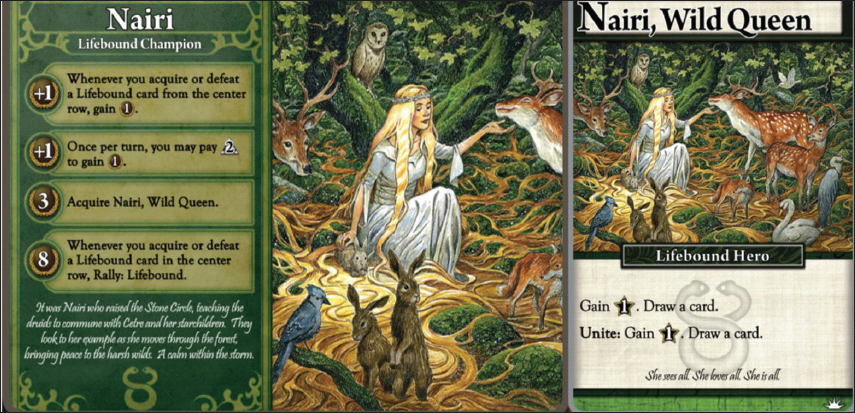
When it comes to the visual-narrative features on the Nairi card, the moniker Wild Queen stages her as a druidic ruler along the lines of popular fantasy women like Galadriel from Tolkien’s Lord of the Rings (1954). Nairi’s imperial status is expressed via markers of conventionally attractive white femininity, most notably her long, straight platinum hair which spreads out across the forest floor. This can be understood in a double sense as “rooting” Nairi to the forest, while simultaneously defining her as distinct from her nature surroundings. In fact, none of Nairi’s physical properties suggest that she is a member of “wildlife” to begin with. Her clean, long-flowing gown and her groomed hair are conventional markers of civilization, innocence and purity. Nairi resides on the latter end of the racist savage/civilized spectrum (Simpson 2007) and uses her body to envelop and tame wildlife. In particular, her hair forms an organic tapestry, and stretches her virtuous white hands into opposite directions to perform care work on differently gendered animals: Reaching upwards, Nairi’s left hand caresses the throat of a stag who clearly enjoys her attention. Her right hand points downwards to shelter a small rabbit, an animal traditionally associated with fertility and reproduction. An owl and other feral birds have gathered on Nairi’s hair carpet, confirming the success of her civilizing mission as a wild queen: a white savior of the wild.
The scene is framed by a flavour text in the bottom which claims that “She sees all, she loves all, she is all” (my Italics). Especially this last phrase underlines Nairi’s problematic positioning as simultaneously superior to and representative of a wilderness to be colonized, a trope derived from white women in colonial propaganda history (Figure 2). In British imperial propaganda illustrations from the 19th and early 20th century, the white female body is used to personify white colonies in Australia, Canada, New Zealand and South Africa (Alessio 1997). Often dressed in Greek togas and laurel crowns, invoking Britain's Greco-Roman heritage, these white women framed the imperial civilising mission in terms of stability, moral superiority and procreation. Nairi, too, is staged in a perfectly unsoiled, custom-tailored white dress which distinguishes her from her feral while performing her colonial gesture of white maternal care (Davin 1978).
The white woman in colonial propaganda and A: DOC. 1. Anson A. Gard (1907) The Last West, cover (Royal Commonwealth Collection, Cambridge University Library). 2. Cover of Auckland Industrial Agricultural and Mining Exhibition Catalog (1913) (Special Collections, Victoria University of Wellington Library). Source: Alessio (1997), 3. Nairi (2015). Source: Eric Sabee, Anton Kagounkin Magdalina, David Wyatt, Justin Gerard.
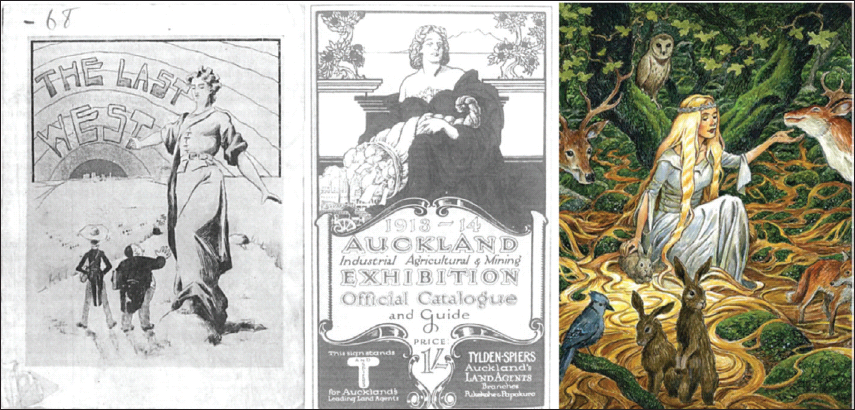
Davin highlights the role of white motherhood in the imperial project, both for sustaining the development of an imperial workforce, and for the eugenic fear of racial mixing in the colonies. Nairi’s relationship to this legacy is layered. On the one hand, she is established as the superior “white mother” of the Lifebound faction ruling over racial others. Especially her straight platinum hair fixes a “hairarchy” in which the whitest person sits on the upper end of the command line summoning non-white and animalistic characters by making the player draw a card. On the other hand, Nairi’s maternal mission is not to prevent “miscegenation” but to establish a diverse community across races and species. One problem with this diversity project is that Nairi’s queen status defines white femininity as the ruling power. This dynamic repeats a common problem of diversity in real world institutions: Diversity management “becomes a way of managing or containing conflict or dissent” (Ahmed 2012, 13). It “bypasses power as well as history to suggest harmonious empty pluralism” (Mohanty 2003, 193). In the Lifebound faction, the harmonious co-presence of racialised and beastly others cements Nairi’s power as white, benign ruler over the forest, offering a romanticised version of frictionless multiculturalism to the player.
Kor
Kor, Ironmind, is the male white-passing Champion of Mechana, a faction focused on manual labour and industrial work. Kor is added to the deck when the player has received four Reputation Points, and his base function is to generate two Runes and two Power Points. Additionally, the player draws a card if two or more Constructs cards are in play. Unlike Nairi, Kor’s hero ability defines him as a hard-working individual who contributes manual labour to the building of machines that assist him in slaying monsters and gaining power. His strength is positively affected by self-made technical progress, the successful building of machines. This ability, combined with his moniker Ironmind, affiliates Kor with the fantasy trope of the industrious Dwarf dating back to Norse Mythology, particularly in the creation myth of Thor’s hammer. This is adapted in Tolkien’s Lord of the Ring franchise where humans, dwarves, and elves are cast in positive roles with different innate moral and physical abilities, and dwarves are associated with “gathering their strength” (Young 2016, 356). Kor matches this trope in two ways. His base hero ability is to gather Runes and Power to invest in Constructs. Secondly, gathering these Constructs allows him to build a powerful complex of machines potentially more valuable than his opponents’.
Kor’s industrious dwarf identity is emphasised on the visual level through appearance as a white man with a beard riding a mechanical fire dragon (Figure 3). The brown and yellow colour palette and the cogwheel logo emphasise the theme of iron. Kor’s eyes, beaming through a pair of steam punk googles, are fixated on the head of the creature. Like the other Champions, he is depicted in motion, his hands in giant iron gloves protruding from his bare masculine torso to tame the mechanical beast. Paralleling Nairi’s civilising gesture, Kor stretches out his hand towards the untamed wilderness of technology, commanding it to come to life. However, in Kor’s civilising mission, control is mediated through sophisticated wearable technology.
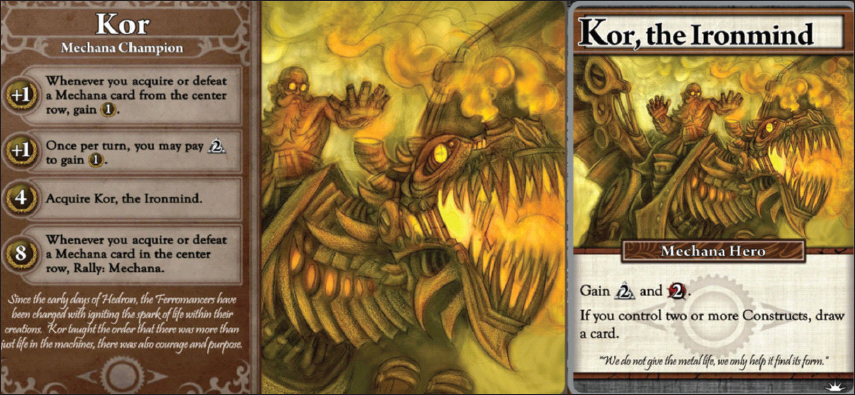
Source: Eric Sabee, Anton Kagounkin Magdalina, David Wyatt, Justin Gerard
The distinction between bare and clothed hands suggests a gendered divide in the imperial project of whiteness. Female hands are associated with tender care and emotional labour, while male hands belong to world leaders (Winship 1987). Furthermore, while Nairi performs her care work centre stage, presenting her body as available for the player gaze, Kor’s body all but disappears behind the giant machine. Despite his bare chest, Kor gets to be defined through his professional achievements rather than his looks. The giant hand, reaching towards the creature and the player a once suggests that it is his manual labour, not his body, which matters here. Secondly, while Nairi is surrounded by animals, Kor is on top of his creature, indicating his unchallenged dominance. It is a combination of physical domineering and remaining unseen which characterises his leadership style. Unlike Nairi’s unmistakable platinum hair, Kor’s straight beard and facial features only hint as his whiteness.
This enables a reading of Kor in terms of ‘colourblind’ white masculinity, in which power is derived from not being seen (Dyer 1997). Moreover, Kor’s portrayal on the mechanical and visual level, expresses a traditional notion of white masculinity as mediated through technology use and domination (Henrichsen 2000). This type of tech-mediated masculinity is framed as rational via the long-term planning and strategizing required to win with Kor. Kor embodies a masculinity which is focused on tools and the prospect of technical domination. There is also a class aspect in Kor’s portrayal as a hard-working industrial labourer capable of imagining and creating a better future. Unlike Nairi, whose femininity is associated with a lifestyle driven by diversity labour (drawing a card) and instant gratification (Honour points), Kor’s solid sense of investment is expressed through the indirect build-up of Honour through the slow amassing of high-value Constructs. To the player, then, this version of white masculinity is presented as a solid, long-term, and prestigious road to success.
Sadranis
Sadranis, Dark Savant, Champion of the Void, is represented as a Black man with tentacle arms protruding from under a purple ceremonial robe, holding a large spell book. Sadranis’ special hero power is to draw two cards, discard one and immediately allow the player to remove a discarded card from the game. This is indicative of the Void theme of abolishment and destruction of undesired ballast. Unlike Kor, whose unnamed ‘white’ strength is directly displayed via economic capital, Sadranis unfolds his powers in the unseen dimension of the player's deck. Generally, banishing weak cards from the deck is desirable since it speeds up the rotation of stronger cards. However, the more cards are banished, the less Sadranis is needed. This casts him in the role of a Champion who performs critical restructuring labour at the beginning of the game, but who becomes increasingly obsolete until he is forgotten.
Like Nairi, who depends on others to perform her “unite” function, Sadranis depends on problematic others (weak cards) to perform his banishing function. However, while Nairi can expand her power by growing an empire of Lifebound friends, the more Sadranis advances his invisible balancing work, the more irrelevant he becomes. On the symbolic level, this classifies Sadranis’s power as fundamentally (self-)destructive. On the visual-narrative level, this theme of destruction is directly tied to Blackness and marked as deviant in several ways.
First, Void cards portray brown bodies in conjunction with themes of aggression and death (e.g. Maniacal Crusher, Guide of Lost Souls). Sadranis’ nickname Dark Savant marks race as a defining characteristic of his identity. ‘Darkness’ modifies his status as a savant to suggest a certain kind of training; at once racialised and conspicuous. His abilities as an intellectual are compromised, and he cannot be trusted. This is confirmed on the lexical level of his hero card, which talks about Sadranis in the third person: “Dhartha assured them, "Not all who look into the darkness look to serve it. Just as we wield light, he wields darkness””. This flavour text others Sadranis in two ways. First, unlike all other hero cards, Sadranis is defined through the eyes of someone else. Despite holding the spellbook, the flavour text denies his ability to speak in human terms, framing him as subaltern (Mukherjee 2018). Secondly, in “advocating” for Sadranis, Dhartha creates a binary of “us” versus “him” representing “light” versus “darkness” evocative of racial logics. It is interesting that the game tasks the Asian Dhartha with ejecting Sadranis from the community of “lightness”, in which he is assumed to be included. This mirrors the Asian “model minority” myth (Kawai 2005, 110) which in US American society classifies Asian Americans as more assimilable, and therefore superior to e.g. African Americans.
That Sadranis is less than human is an argument repeated in the depiction of Sadranis’ body, half of which consists of cephalopod limbs (Figure 4). Not only does the protruding flesh of these tentacles define him as literally half-human, they also hold the spell book, the key to his powers. This intimate entanglement of alien tentacle horror and racial otherness is a common racist fantasy trope adapted from H.P. Lovecraft’s influential short story The Call of Cthulhu (Lovecraft 1928). Unlike the other Champions, Sadranis’ Black masculine body and intellect does not belong to this world. The phrase ”this world” can be understood in broad terms to refer to gaming as a cultural space. Especially the space of online gaming, where A: DOC is potentially played, is still a white space in which the presence of Black male gamers is made deviant through structural racism (Gray 2012). While the perpetuation of Lovecraft’s white supremacist logic in Sadranis might be unintended, it still offers a platform for white racist gamer tourists.
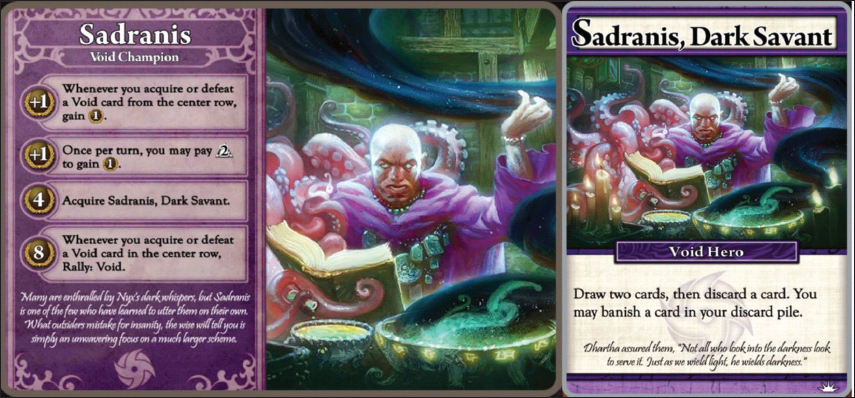
Source: Eric Sabee, Anton Kagounkin Magdalina, David Wyatt, Justin Gerard
Dhartha
Finally, Dhartha, Master of Sight, is the Champion of the Enlightened faction. Depicted as an old Asian man in a yogic posture (Figure 5), Dhartha personifies the stereotype of the oriental Indian mystique commonly repeated in popular culture (Nakamura 2002, 39; Mukherjee 2018, 515; Said 1978). On a mechanical level, Dhartha’s presence is framed in terms of a benevolent teacher whose help is granted when acquiring merely two Reputation Points. When he becomes part of the deck, his hero ability is to ‘train’ weak cards by turning them into slightly better cards. This is done by replacing a card from the player’s hand with a Mystic or Heavy Infantry card, the two constantly available Common card types generating Runes (Mystic) or Power (Infantry). This element of player choice is unique to Dhartha’s Champion power. It characterises the Champion as a wise guru who enables the player to grow in a direction of their own choosing.
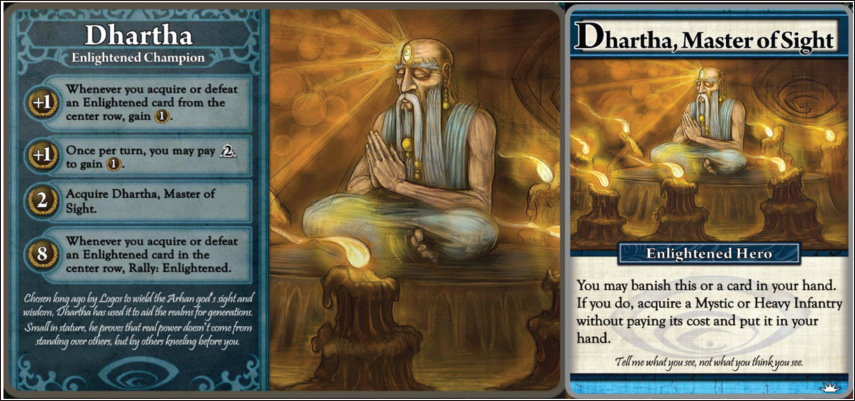
Source: Eric Sabee, Anton Kagounkin Magdalina, David Wyatt, Justin Gerard
On a thematic level, Master Dhartha is clearly aligned with orientalist stereotypes of the East (Said 1978), which in part serve western audiences to define what the occident and European civilization is (Mukherjee 2018). The same reduction of cultural complexity is at work in the character design of Dhartha, whose name, enlightenment theme, and purpose as a spiritual leader does not trouble western-imperial expectations about the Eastern guru. Loose associations to Hindi and Sanskrit words (Dhartha, Askara) as well as visual allusions to Hindu deities locate Dhartha as a pan-Indian sage whose “authentic” oriental whereabouts provide the backdrop for a western player’s imagined spiritual growth achieved through deck building.
Some effort is put into classifying Dhartha as unthreatening. Commenting directly on his physical characteristics, the flavour text on his Champion card describes him as “small in stature, (proving) that real power doesn't come from standing over others, but by others kneeling before you”. Unlike Sadranis’ body, which is staged as a monstrous spectacle, Dhartha’s racial otherness is marked as benign, passive, and humble. This affiliates Dhartha with the stereotype of the “Hollywood monk” which first emerged in the 1970s with the unexpected success of the Kung Fu TV series (Iwamura 2011). Iwamura describes the emergence of figures such as Master Po (Kung Fu), Mr. Miyagi (Karate Kid) and Yoda (Star Wars) as a response to the growing disillusionment with traditional values and a mode of spiritual seeking among US American audiences. Contrasting earlier Cold War representation of China as untrustworthy and evil, these characters reimagined Asian identities as “deferentially polite, humble, philosophically calm and wise, suitably passive, and respectful of their spiritual tradition” (Iwamura 2011, 149). Usually, this kind of idealised spiritual training happens inside a secluded temple, a “heaven on earth” (Iwamura 2011), such as depicted on the Enlightened Canopy of Sanctuary card.
Dhartha’s selflessness as an orientalist monk catering to imperial expectations is also expressed on the level of his hero ability. Like Sadranis, Dharta’s superpower structurally transforms the deck until all weak cards have been upgraded and Dhartha’s ability becomes obsolete. However, unlike Sadranis, whose presence remains in the deck to the potential detriment of a careless player, Dhartha will use his power to transform himself into a Mystic or Heavy Infantry card if the player so chooses. On a narrative level, Dharta is willing to erase himself upon command, making his existence dependent on the player’s strategic-rational considerations. Unlike Sadranis, whose uncomfortable presence cannot be removed, Dhartha can be forced to assimilate to become like the other cards he previously transformed. This difference is once again evocative of the previously discussed US American model minority stereotype, which “celebrates Asian Americans as the model minority group who, unlike other racial minority groups, move ahead only with their own effort” (Kawai 2005, 110). While Sadranis’ Black identity decreases in value as the player’s economy progresses, Dhartha’s model minority persona will “move ahead” by erasing, reducing, and assimilating himself on demand.
Overall, both Sadranis and Dhartha embody modes of non-white masculinity which cater to established white western scripts. While Sadranis’s Blackness is coded as a monstrous threat whose presence increasingly causes friction in the human world, Dhartha meets Orientalist expectations about monolithic pan-Asian masculinity (Said 1978). This is a masculinity which, unlike Kor’s and Sadranis’ expansive demand for space, is associated with wisdom and mental superiority. Like his Champion card states, Dhartha's leadership ambitions are realised through being accepted as spiritual authority, dominating others by making them kneel in awe.
Discussion and conclusion
When it comes to inhabiting identities, deck building games like A: DOC simulate racialised performances through the way they structure and illustrate repetitive actions. I suggest that acknowledging cybertypical component in deck building games provides a critical perspective on tabletop gaming, since it emphasizes how societal structures are perpetuated through seemingly apolitical strategic choices and “flavour” gameplay lore. Rather than remaining abstract fantasy, the suggestions made by the Lifebound, Mechana, Void, and Enlightened factions mobilise references to existing oppressive identity labels in the real world. For white players, this “phantasmatic policed imperial space” (Nakamura 2002) of A: DOC’s deckbuilding universe invites them to take an “identity vacation” tour by acting on behalf of their gendered, racialised leaders. Unlike player-made avatars in virtual worlds, tourist identities in A: DOC materialise through the constant investments in repetitive performances. This indicates that even casual representations of video game characters, intended as mere background illustrations of a strategy mechanic, become part of social reality via references to racial tropes of whiteness. For players of color, the complicity required to build racist identities can lead to conflict with their own positionality and value system (Johnson 2016). Player participation in a play ritual which enacts discrimination or race-based violence can feel like a “socially symbolic gesture of approval” causing inner conflict (Johnson 2016). In this case, rather than a “vacation”, the tourist experience might feel like a walk through pre-existing pain and trauma, supporting the assumption that diverse experiences are not welcome in tabletop gaming.
This ties into recent conversations around racism and tabletop gaming in online tabletop communities, like reddit, fueled by the 2020 Black Lives Matter protests. As a user on r/boardgames states in their post entitled Why aren’t we showing more support for our BIPOC gamers? “The BIPOC (Black Indigenous People of Color) community, the LGTBQIA+ community, women, and especially women of color are hardly accepted into the gaming community and that has been made inherently clear through the last week of posts and non-posts about the Black Lives Matter movement.” (buhlivia 2020). The user asserts that gamers’ complicity in structural racism and inequality is still vehemently denied by many, causing safety issues for BIPOC players, especially women of color. In the same thread, another user addresses the desire of white tabletop culture to “carefully isolate” societal issues from the game board. As they correctly point out, “Board games are a social hobby… The Table is not cut off from the rest of the world.” (ibid).
Cybertyping in deck building games affirms this community discourse by drawing attention to the close alignment of mechanical elements and social structure. Whether the players, and even designers of A:DOC and other deck building games see it or not, racial cybertypes are tangible results of the feasible survival strategies built into each Champion’s abilities. Even when perceived as mere background illustrations or “flavor” to the seemingly more important mechanical core, the stereotypical character traits still function as “usability” elements indicating beneficial investments. White femininity, for example, guides investment in a passive-defensive "Honour Point strategy, while Black masculinity promotes a more Power and destruction-oriented approach. For these dynamics to function as racial pedagogical zones, no conscious process of identification (e.g. Shaw 2013) with the Champion character is needed. It is enough for the players to quickly recognize common stereotypes and translate them into “plausible” gameplay rituals. Deck building cybertypes, then, emerge from the strategy-led investment in cards which fulfill a manifest destiny of a racialized identity which is “not cut off from the rest of the world” but rooted in white supremacist fantasy legacies. (Young 2015).
Finally, this suggests that video game designers have to make a conscious effort to break with conventions if they wish to contest the surreptitious white habits in deck building games. In the case of A:DOC, one simple intervention might be a skin swap between the Champion characters with the result of redistributing abilities in non-stereotypical ways. Moreover, as one of A:DOC’s designers points out on the online tabletop forum BoardGameGeek, there is always the possibility to add new custom-made Champions, thus introducing new dynamics and making the game accessible for more than four players (Huuuze 2019). In expanding the repertoire of deck building games as expressive medium, game designers can learn from previous critical design practices which have sought to actively counteract or present alternatives to “colonial fantasy” making in board games (Robinson 2014, LaPensée 2016). According to postcolonial game scholar Soraya Murray, it is necessary to confront the white structural bias of video games via what she calls acts of affirmative sabotage, a holistic rethinking of industry standards with the goal of a broader political intervention (Murray 2018). I suggest Murray’s plea can be constructively applied to game design practice and the challenge of anti-racist game development. It emphasises that resisting engrained cybertypes is a holistic project which requires attention to the affective dimension of player rituals in addition to visual-narrative presentation and mechanics.
Footnotes
Acknowledgments
I would like to thank Simon Nielsen for his extensive help with this research, the Ropecon event organisers for inviting an early version of this paper, the editorial team at Simulation & Gaming for their professional assistance during a difficult year, and the two anonymous reviewers for their thorough and helpful suggestions. This work was supported by the Academy of Finland funded Centre of Excellence in Game Culture Studies and the Game Design Department at Uppsala University, Sweden.
Declaration of Conflicting Interests
Funding
The author(s) received no financial support for the research, authorship, and/or publication of this article.

Author Biography
Contact: