




Abstract
Aim. Although
Method. OASISTAN was first designed in 1999 for use in Master’s courses on cross-cultural management at Delft University of Technology in the Netherlands, attracting 20-23 year old students with a Bachelor degree in engineering and from various cultural backgrounds. Since its first design the game has been played approximately 45 times at Delft University of Technology in the Netherlands and three times at Harbin Institute of Technology in China in the years 2006-2008. We reviewed their experiences designing and facilitating OASISTAN since 1999.
Results. The game has a no-tech role-play design and revolves around the geopolitically complex region of the Caspian Sea, specifically the fictional country of ‘Oasistan’. The game consists of students forming small teams of Oasistani, Western and non-Western public/private actors collaborating with each other to try and reach the common goal of oil exploration and production in this country. In total 15-30 students were involved. We found that OASISTAN allowed its players not only to intensely experience the difficulty and awkwardness of being confronted with cultural differences, but also to interpret and understand these differences through cultural dimensions. Students who played OASISTAN identified ten out of the 12 dimensions by Maleki and De Jong. The two dimensions that students were not able to identify are uncertainty avoidance and collaborativeness.
Conclusion. OASISTAN shows how a game design field (i.e., intercultural simulation gaming) can be reinvigorated in light of new or updated scientific theories pertaining to the field’s subject matter (i.e., cultural dimensions). Several opportunities for future research are identified.
Keywords
Among connoisseurs of the genre, BAFÁ BAFÁ is probably the best known intercultural simulation game. First designed by Robert Garry Shirts in 1971-1973, this game revolves around the two fictional cultures Alpha and Beta (Dukes, Fowler, & DeKoven, 2011). Players experience ‘the processes of culture shock, communication problems, value differences, the importance of observation skills, and the importance of learning language’ (Dukes et al., 2011, p. 565). As such the game is meant to be culture-general, making players aware of a ‘need to learn’ rather than letting them learn specific cultural differences (Dukes et al., 2011, p. 564). Generic cultural representations are often referred to as ‘synthetic cultures’ (G. J. Hofstede & Pedersen, 1999; Wiggins, 2011). These ‘are drawn from real cultures, but are not obviously linked to national, regional, or local cultures’ (Wiggins, 2011, p. 551). Applications in academia, the Peace Corps and ‘the corporate world’ followed soon after first applications in the U.S. Navy (Dukes et al., 2011, p. 565).
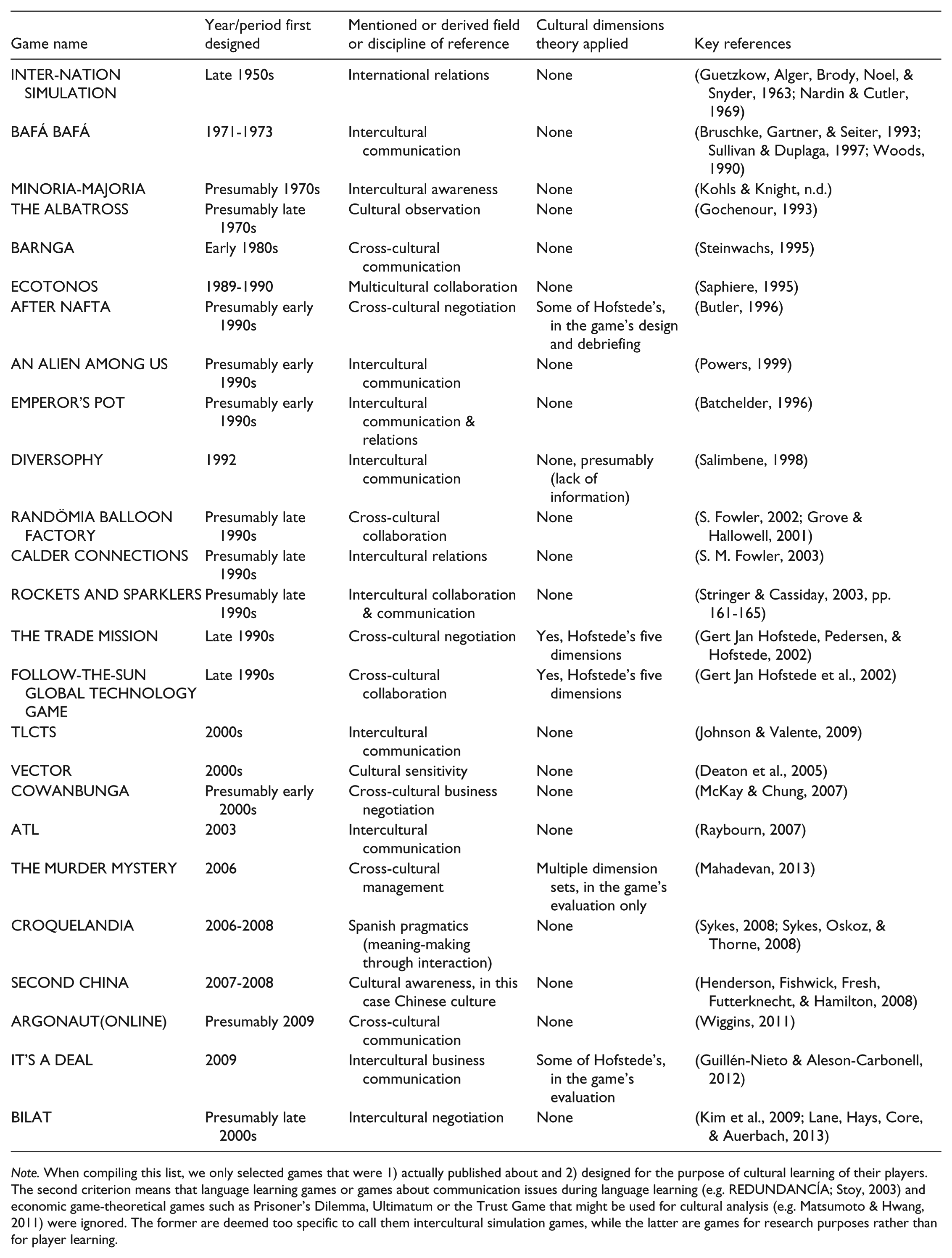
Since BAFÁ BAFÁ many more intercultural simulation games have been developed. Actually, the even older and well-known INTER-NATION SIMULATION by Guetzkow, is arguably also an intercultural simulation game, although it is commonly positioned in the field of international relations (Guetzkow, 1995; Guetzkow, Alger, Brody, Noel, & Snyder, 1963; Nardin & Cutler, 1969). Nevertheless, over the past decades many other games have been designed specifically to help people experience and deal with cultural differences. The Appendix of this article offers a chronological list of 25 intercultural simulation games. More recently, designed games are computer games, or computer-supported games, opposed to the more low-tech or no-tech games of the past.
When examining the design and application of these games, it is clear that they are all based on common definitions of culture (e.g. G. Hofstede, Hofstede, & Minkov, 2010, p. 8; Schneider & Barsoux, 1997, p. 19; Trompenaars & Hampden-Turner, 1997, p. 22) by focusing on the clearly observable aspects of culture (e.g. language, clothing, food, rituals) and the interpretable aspects that are behind them (e.g. norms, values, basic assumptions). They are also based on common notions of the skills and attitude required to be able to deal with cultural differences, e.g. cultural sensitivity, cultural empathy and a rapid acculturation ability (Schneider & Barsoux, 1997, pp. 163-167; Steers, Sanchez-Runde, & Nardon, 2010, p. 38). Finally, they tend to use cultural distinctions (notably communicational and behavioral in nature) that are easy to relate to, e.g. directness versus indirectness or time accuracy versus inaccuracy.
Yet not many of these games are based on a particularly topical strand of cultural research: cultural dimensions. Cultural dimensions are basically cultural distinctions on a sliding scale that could be formulated as the ones just mentioned (directness-indirectness, time accuracy-inaccuracy), only they are mostly based on extensive and often quantitative scientific research, rather than anecdotes, common sense, or purely personal experiences. The undoubtedly best-known dimensionalizer of culture is Geert Hofstede (1997), whose work has had a profound scientific and societal impact. Hofstede inspired a whole new sub-discipline of cultural research. Recently, Maleki and de Jong (2014) reviewed and clustered many dimensions into nine sets, notably those by Inglehart (2006), S. Schwartz (2006), and the GLOBE project (House, Javidan, Hanges, & Dorfman, 2002), besides those by Hofstede. The nine clusters they introduced each have their own pertinent reference scores, thus providing a useful synthesis of this new sub-discipline. The usefulness of cultural dimensions for intercultural simulation games is evident from five of the games reviewed in the Appendix of this article. Yet, as the Appendix also shows, the use of cultural dimensions in the design and/or application of an intercultural simulation game remains rare. In other words, very few games are explicitly based on cultural dimensions theory.
We therefore set out to explore the usefulness of simulation gaming for learning how to apply cultural dimensions. More specifically, we ask ourselves how a simulation game can help students grasp the nature and usefulness of cultural dimensions in their future work practice? This article answers this question by discussing the design of OASISTAN, a role-playing simulation game designed and applied at Delft University of Technology in the Netherlands and Harbin Institute of Technology in China. 1 We first provide an overview of the cultural dimensions at hand. Subsequently we review the design and application of OASISTAN, paying particular attention to the cultural dimensions players were able to identify in it.
Cultural Dimensions as a Framework
Maleki and de Jong (2014) provided a systematic overview of the various cultural dimensions in the literature and grouped those dimensions into nine clusters. We follow their clusters, but for the sake of convenience simply call them cultural dimensions. For the apparently most inclusive and variegated dimension, individualism vs. collectivism, we use several sub-dimensions derived from Trompenaars and Hampden-Turner (1997): individualism vs. collectivism, sequentiality vs. synchronicity, specificness vs. diffuseness and universalism vs. particularism. We realize that these are not statistically independent from each other. Nevertheless, conceptually they present different facets of the same dimension and are therefore useful for a good understanding of the various cultural aspects within the game. The neutrality vs. affectiveness dimension by Trompenaars and Hampden-Turner has not been included as a sub-dimension of individualism vs. collectivism, because we argue that its meaning is covered by the indulgence vs. restraint dimension, which is already derived from Minkov (2007) and G. Hofstede, Hofstede, and Minkov (2010). The same argument applies to the achievement-orientation vs. ascription-orientation dimension by Trompenaars and Hampden-Turner. The meaning of this dimension is covered by mastery vs. harmony, which is already derived from S. H. Schwartz (1999).
For more specific information on how exactly this selection and clustering of dimensions was developed, we refer the reader to Maleki and de Jong’s (2014) article. Divisions of culture into dimensions are always arbitrary, but according to us the selection below works well when it comes to recognizing dimensions in a role-play because of the distinctness, salience and potential visibility of each of the ones chosen.
This is the final list of dimensions we use in our analysis of the results of OASISTAN:
Individualism vs. collectivism: Level of interrelatedness among individuals.
Sequentiality vs. synchronicity: Level of discomfort with doing various things at one time.
Specificity vs. diffuseness: Level of compartmentalization of an individual’s societal roles.
Universalism vs. particularism: Level of prevalence rules have over relations.
Power distance: Level of acceptance of hierarchical and position-related roles.
Uncertainty avoidance: Level of discomfort with unknown and unstructured situations.
Mastery vs. harmony: Level of competitiveness and achievement-orientation.
Traditionalism vs. secularism: Level of adherence to religiosity and traditional moral values.
Indulgence vs. restraint: Level of free (vs. restrained) gratification of desires and feelings.
Assertiveness vs. tenderness: Level of aggressiveness (vs. softness) in social interaction.
Gender egalitarianism: Level of difference and discrimination in gender roles.
Collaborativeness: Level of interpersonal trust leading to a spirit of ‘team-work’.
In the sections below, we will first describe the game design and then come back to the question how, according to the students who played OASISTAN, these dimensions appeared during gameplay.
OASISTAN’s Design
The Basic Gameplay Design
OASISTAN was first designed for use in Master’s courses on cross-cultural management at Delft University of Technology in the Netherlands and at Harbin Institute of Technology in China. These courses attract engineering students enlisted in a program bridging the disciplines of engineering and public administration. 2 The game catered to students of 20-25 years old, with a bachelor’s degree in an engineering discipline and from various cultural backgrounds.
The primary goal of OASISTAN was to let these students have a physical experience of cultural differences as they could occur in their future work practice. By reading books and articles about cultural dimensions, students can get a theoretical sense of cultural differences within organizations or misunderstandings and conflicts in cross-cultural teams. However, often when actually experiencing cultural differences, the inbred reflexes from the culture where they grew up continue to prevail. The starting point of OASISTAN’s design was therefore that the game needed to encompass cultural differences that would catch participants by surprise, not always a pleasant one.
By asking the students to form small teams and collaborate with each other to reach a given task-oriented goal, we expected that they would tend to neglect cultural differences in their actions and go back to their ‘normal way of doing things’. We expected that this generates a somewhat shocking and frustrating culture clash between different teams in the game. We aimed for students thinking that if they already know about the various cultural dimensions in nations and regions of the world, why do they not seem capable of handling them properly? We felt this would convey a sense of urgency for further understanding how to actually apply cultural dimensions, specifically to the shocking and frustrating experience they just had.
In essence, the game consists of students collaborating with each other within small teams to try and reach a common goal. The goal and setting is somewhat realistic, to emphasize to the students that the game represents a possible future work practice. The goal is also grand to ensure that the students would need to confer with each other to find out how to reach it. The interests of the different teams are conflicting to ensure that the students need to negotiate. Overall, the basic design is meant to ensure extensive, goal-oriented interaction between the teams.
The basic design can best be summarized as a role-play design requiring no computer support or technology whatsoever. This is very similar to the role-playing games for theories and practice of international relations, negotiations and politics (Loggins, 2009; Tamai, Kondo, & Miyawaki, 2016). Role-playing games of this nature allow students actively to develop an understanding how ill-structured and complex international scenarios play out in practice in terms of communication, negotiation, collaboration and decision-making. Turning the game into a computer game would have made it much more difficult to instigate the confrontational culture shock experience we had in mind. Moreover, the flexibility of a physical game is at present still far higher than a game requiring a set of computers and all its associated technological infrastructure. Thus, as a game format, a more physical game where students play within the same room simply through their behavior and at most pen and paper was a logical choice. More importantly, a role-playing game affords students a lot of behavioral freedom. The format thus allows students to explore how they can portray the culture they should represent in terms of actual behavior and communication, while simultaneously trying to serve the interests of their role.
The Chosen Setting
Given all of the aforementioned considerations, the game needed to revolve around an engineering domain that many of the students could at least relate to, and should lend itself to the definition of a grand goal, multiple teams with conflicting interests, and the involvement of various cultures. We chose an evident engineering domain: oil exploration and production.
We subsequently set the game in a region from which we could easily convince the players that it would be geopolitically complex, the Caspian Sea. It is quite realistic to ask the students to represent a diverse set of actors and nonetheless try to collaborate on the joint goal of oil exploration and production in this region.
In this region the fictional country and thus synthetic culture of Oasistan was conceived and positioned as the actual focal point of the game. There were three main reasons for this choice. First, it limited the complexity of the game. Letting the game revolve around oil exploration and production in a specific country is a more concrete basis for gameplay than doing so in a larger region of countries. If we had subsequently chosen for an existing country, experiences and frames of references of said country from at least some of the students could have been used in the game. Moreover, it could let students focus on the geographical and engineering aspects of oil exploration and production. We wanted students to focus on interactions among themselves based on the information provided to them. We thus not only fictionalized the country, we also remained vague about the actual position of this country in the Caspian Sea region.
With Oasistan as their focal point, four main types of teams make up the game. ‘The Oasistani’ is an obvious first type, with several teams representing different public and private entities in the fictional country itself. ‘The West’ formed a second type of team, with several teams representing different public and private entities from several Western countries, though mostly European given Europe’s proximity to the Caspian Sea region. The combination of these two team types already allowed us to design cultural differences into the game within a setting that can be conveyed as realistic. The third type of team that was added to the game represented non-Western public and private entities of emerging countries looking to seize the opportunity of toppling the business and governmental collaborations of the past. This type involves e.g. Chinese, Brazilian or Russian oil venturing businesses backed by government. ‘Non-governmental organizations’ (NGOs) form a fourth and final type of team, which typically consists of only one team in which one student represents a local Oasistani NGO and works together with one student representing a global NGO. Together these NGOs represent typical public interests, i.e., the environment, social welfare and cultural expression. Culturally, the local NGO is of course another Oasistani team, while the global NGO is a Western team. This fourth type is represented and quickly perceived as an ‘underdog’ in the game, that can nevertheless be crucial in creating a tipping point during negotiations.
As the description of these four team types already suggests, OASISTAN has a somewhat modular design. Depending on the number of students we have to cater to, specific teams can be added or removed from the design, provided there is a balance in the four types, particularly the first three.
The Teams
When it comes to The West, the following teams are typically involved in the game:
European Commission representatives, one official Commissioner and a number of more specialized civil servants (3-4 people).
European Development Bank (EDB) representatives (2 people).
Royal Dutch Shell representatives (2-3 people).
World Trade Organisation (WTO) representatives (2 people).
When it comes to the Oasistani, the following teams are typically involved in the game:
Representatives from the Oasistani Royal family and its entourage, including the Prince of Oasistan, his sister and the Minister of Trade (3 people).
Oasi Energy businesspeople (2 people).
National Spice Association representatives (2 people).
When it comes to the non-Westerners, the following teams are typically involved in the game:
Russian governmental and business representatives, one representing Gazprom and one being a close associate of the Russian President (2 people).
Brazilian Petrobras and Chinese Sinopec representatives (2 people each).
Finally, when it comes to the NGOs, as explained typically only one team is involved:
Representatives of a local Islamic NGO focusing on national interest and religiousness rectitude and a global NGO aiming for worldwide justice established by politically motivated pop-star Bono (1 person each).
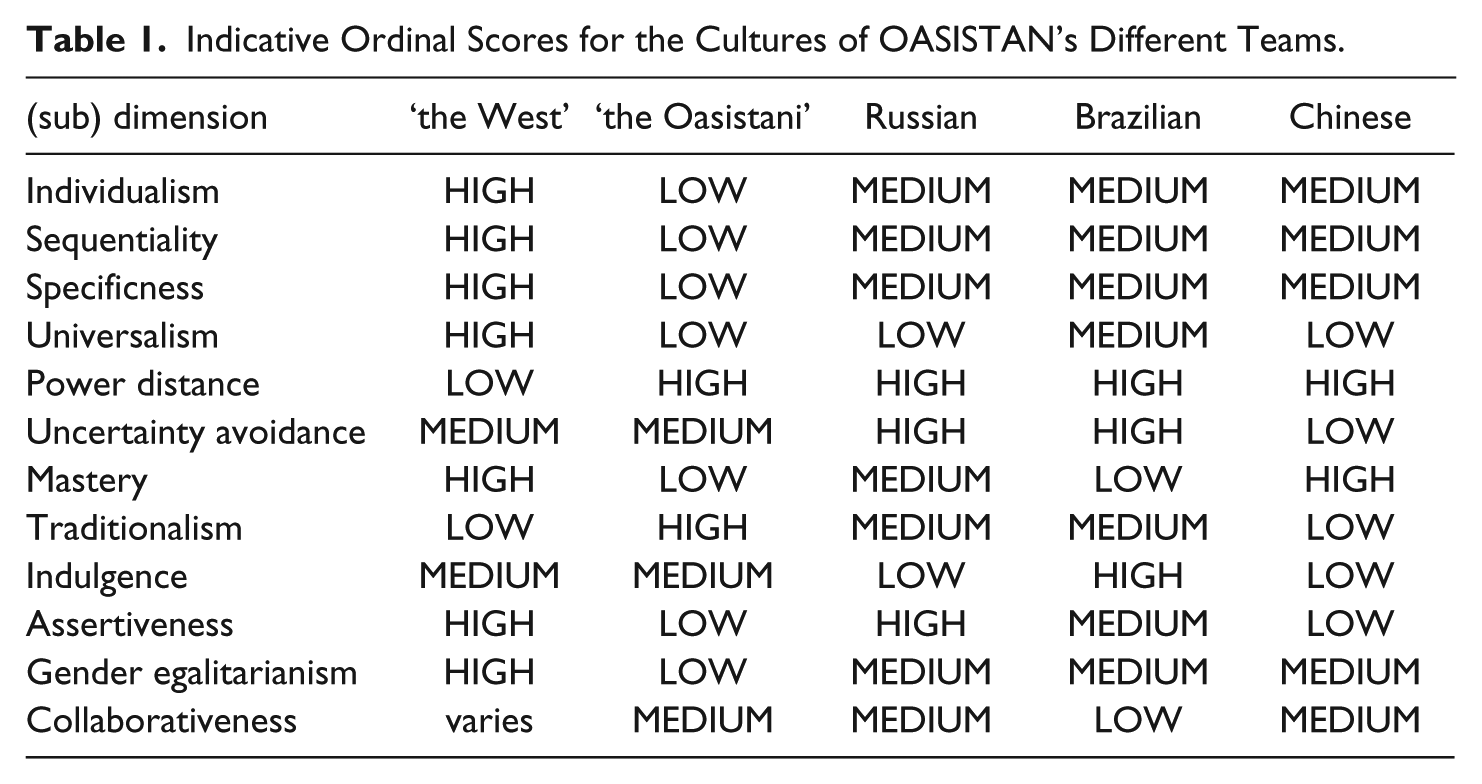
The table below gives indicative ordinal scores of the different team types and teams in the game (which were of course not shared with the students playing them). In the table the West includes the global NGO actor, and the Oasistani includes the local NGO actor. The ordinal scores are loosely based on Maleki and de Jong (2014), with the West representing mostly North America and Northern Europe and ‘Oasistani’ based on a broad-brush impression of Middle Eastern value patterns. As the table shows, with these scores in mind we embedded clear cultural differences in the game’s design on almost all 12 dimensions.
Indicative Ordinal Scores for the Cultures of OASISTAN’s Different Teams.
OASISTAN in Practice
The Plot
The plot involves several of the described actors and aims to create a tenuous and tense geopolitical situation at the very start of the game. Such a situation is useful for several reasons. First, it allows those students who might have a disregard for the educational potential of a role-playing game to realize that this is serious. There is an element of realism or recognition to the roles and starting point of the game that in our experience intrigues students. Second, it forces the issue. Students quickly realize that while there is a joint goal – oil exploration and production in Oasistani territory – there are also conflicting interests, many uncertainties, many unknowns, and thus many hurdles to overcome.
The plot of the game begins after a new WTO agreement has been signed between the European Union (EU), the United States of America and Japan aiming to eliminate trade barriers, import taxes and subsidies. As a sequel of this agreement, European member states are expected to give up the privileged trade status of their former colonies, which includes Oasistan. Many developing countries thus lose a good deal of their attractive trade to their former colonizing powers. Oasistan, a fresh-born developing nation in the Caucasus with strong ties to Great Britain had enjoyed such beneficial arrangements with the EU. It had been incorporated into the Soviet Union in 1941, but reacquired its independence in 1991.
The new WTO agreement specifically forbids lucrative spice trade between the EU and Oasistan other than at world prices. This change is expected to damage the still highly fragile Oasistani economy, and its government is deeply concerned that international free trade will impoverish its people, as its exports mainly consist of this industry. The King of Oasistan and his Minister of Trade have warned European leaders that free trade will destabilize the economy and give rise to strong anti-Western revolts compromising the position of the current liberal government.
EU leaders feel guilty about this and wish to mitigate the negative effects of free trade for Oasistan by developing an oil refinery program (large oil and gas reserves are suspected under Oasistani soil) to improve the country’s economic situation and pick lucrative fruits from it for itself. It has invited the Anglo-Dutch multinational Royal Dutch Shell to invest there. The European Commission is willing to free some extra loans for this program (on soft conditions), which should then be supervised by the EDB.
The European Commission has therefore invited Oasistani representatives to Brussels to discuss the development of this oil refinery. It has also invited representatives from the WTO to avoid diffidence on the part of the other signatories of the agreement regarding the implementation of the new trade agreement. The EDB was also requested to sit at the table to obtain a sound judgment on the economic viability of the Euro-Oasistani oil development program and to discuss its possible financial involvement. When at last the WTO understands that only Shell has been invited, it urges the EU also to invite Brazilian and Chinese competitors which are only able to send delegations at a very late stage. The Russian government has sent two representatives as watchdogs, although these were not invited. Finally, the local NGO and the global NGO were informed of the news that such a meeting would be held and the EU felt compelled to allow them in. 3
How the Game Starts
Having allowed the students to read the above plot description, the teacher distributes various roles to the individual students following their wishes, except for two: the Chair of the European Commission delegation, and the Prince of Oasistan. The former has to be a ‘strong woman’ (portraying high gender egalitarianism and assertiveness), the latter has to be a ‘talented male actor’. The EU chairwoman needs to have the skills to actually chair a meeting, notably the skill to keep to a reasonably clear meeting agenda and be flexible enough to deal with unexpected twists, misunderstandings and misjudgments (portraying sequentiality and mastery). The Oasistani Prince needs to be able to represent a dominant leader (portraying high power distance and low gender egalitarianism), ideally through dramaturgical techniques, such as adopting a booming tone of voice, and/or well-timed interruptions. The careful selection of these two roles in this manner allows us to kick-start the role-play and thus also the culture clash in the game.
All teams subsequently receive their secret individual role description and are sent out to prepare for the plenary meeting hosted by the European Commission due to begin 30 minutes later. The role descriptions are one-pagers consisting of four subsections: (1) Who are you, (2) What is your position, (3) According to what rules do you behave, and (4) What information do you have. Although (1), (2) and (4) were relevant for the goals in the game, it was obviously (3) that was culture-laden and therefore key for the game itself.
Behavioral instructions were generally explicit on what players could and could not do. In the case of Western-oriented players, such as the EU, the EDB, Shell and the WTO, aspects such as individual freedom of expression (portraying low power distance, universalism and individualism), efficient (sequential) agenda management and a professional separation of tasks and persons were mentioned. For the Oasistani, the relaxed use of time (portraying synchronicity), the hierarchical role of the Prince leading all others to speak only through Him or by His explicit consent, operating as a collective (portraying collectivism), separate role models and greeting modes for men and women (portraying low gender egalitarianism) and the importance of developing personal trust before engaging in business were emphasized. In addition, the Prince was handed a special scarf to wear, a dramaturgical instrument demonstrating his special position within the delegation. It had the additional positive effect of leading to some excitement among other delegations as soon as he entered the meeting room.
For the Russians, Brazilians and Chinese, behavioral instructions were added in accordance with their cultural patterns which at times held some middle ground between the Western and Oasistani cultures:
“You are not as hurried as Western people. You are OK with an agenda, you are also OK without one. You are adaptive, but not afraid to scream when this is necessary. Your main drivers are power and obedience to Putin. You are not afraid of threatening others if you feel this helps your cause and are well aware that Russia’s control of the oil and gas grid to Europe makes operations without your involvement very hard and costly.”
“You find professional agenda and time management very important, but know from previous occasions that this does not happen in all countries. You believe in going ahead with your plans in a friendly way. You are open to business dinners, but they should lead to substantial outcomes and work towards making new friends. Business requires good contracts, but good contacts with the other partners are handy and a prerequisite for doing business. You are very expressive in your emotions and comfortable with hugging and other forms of physical contact.”
“You do not often smile, since you have learned to control your emotions well and not reveal true feelings too easily. The less others know about you, the stronger you are. You should avoid making expansive gestures and using unusual facial expressions. Chinese do not use their hands when speaking, and may get annoyed with a speaker who does. Do not interrupt others when they speak. Serious friendship shows in loyalty and collaborative action, not in superficial gestures and smiles.”
All participants were told in advance that in and beyond these rules, there was ample room for personal interpretations and choices. When dealing with the female EU Chair, the male Prince of Oasistan could either talk and negotiate with her without looking her in the eyes too much or ignore her. When responding to the Prince’s challenges to her authority as a woman, the EU Chair could either confront him and force him to accept her as a delegation leader or delegate the chair position to one of her male collaborators. The same applied to all other players: the Russians could be more or less provocative and aggressive, the Brazilians more or less jovial and physical, and the Chinese more or less passive with their body language and tactical with their facial expressions and information exchange, depending on what they felt personally comfortable with.
Key Events
The official game description only mentions plenary meetings with a formal starting time and an official agenda. These meetings would often occur in rather chaotic fashion, since the Oasistani delegation would purposefully come in late and focus the debate on personal and family issues rather than the topics on the EC’s agenda. At best this conflict led to hilariousness, at worst to animosity and most often a gradual evolution from the former into the latter. This was reinforced by the fact that the Western players preferred contract over contact, the Oasistani preferred the exact opposite, and the rest of the players were in between. In practice, after a while of ineffective formal interaction, players invariably needed informal break-outs to smoothen relationships, exchange private information, conduct useful diplomacy, concoct alliances and negotiate deals.
To ensure that the various teams interpreted their roles and behavioral instructions as intended, the teachers/facilitators would clarify and/or vivify things when needed. For instance, the two players with the most prominent and responsible roles in the first round, the EU delegation chairing the meeting and responsible for the delicate diplomacy in the meeting and all Oasistani players together, were specifically taken aside.
The teacher/facilitator could also initiate a time-out halfway if the process ended up in deadlock or stalemate. This would allow students to provide their (culture-bound) yet out-of-character perspective on the events. The teacher/facilitator would explain the variety of perspectives existing in the game and the desirability of an informal break-out to come to a more personal entente and understanding among key players. Such time-outs serve a particular purpose when the players are only beginning to understand the cultural differences and know something was wrong, but are still unable to step out of their initial attitude. Moreover, they serve the purpose of reiterating that this is a role-playing game. We have merely set some boundary conditions. It is up to the students to explore what behavior and what decisions could be made within those boundaries.
Debriefing was standard procedure at the end of the meeting. The debriefing had to reach two objectives. First, the students needed to come out-of-character and blow off steam. This is necessary in order to reach the second objective, which concerns coming to grips with what had happened and why. Four main questions are a good guide for conducting the debriefing as a teacher/facilitator:
How do you feel? For example, how do you feel as the chairperson given the discussions you had with the Oasistani representatives?
What is the nature and are the sources of the tensions you experienced? For example, how would you describe and explain the tension between you as the chairperson of the meeting and the Oasistani Prince?
What do you think will be the outcome? For example, given what has occurred, what are the odds of a future oil exploration and production project succeeding or failing, from the perspective of your role?
What would you do differently next time? For example, what would you do differently as the chairperson, the actor who wants and needs to take the initiative in organizing and running this meeting?
The students could react to the above questions as a team and as individuals. The teacher/facilitator would then let other participants react and/or give his vision of the event. The closure of this initial debriefing would be the message that to know about cultural differences and how to deal with them was something else than to experience them.
The teacher-led, plenary debriefing ends there, after which the student-led, group-based debriefing starts. The student teams review their and the other teams’ actions using cultural dimensions as their framework. The main question they would ask themselves and present an answer to in a final presentation session later on in the course is: which cultural dimensions did you (not) identify during the game, and why?
Recognizing Cultural Dimensions
OASISTAN was first designed in 1999 and has since been played approximately 45 times at Delft University of Technology in the Netherlands, each year in three parallel groups. We also played three times at Harbin Institute of Technology in China in the years 2006-2008. Typically, we play OASISTAN with 20-25 students, with 15 as a minimum and 30 as a maximum. Since 2011, we filmed the events and asked students to review the videos to analyze their own behavior and that of others, and to compare the occurrences and outcomes in their own sessions with those in other sessions. The latter solution led to additional understanding. The observations given are based on all game runs, after which we specifically address differences spotted between what we saw in the Netherlands and in China.
Players’ first comments and complaints often revolved around the lack of respect experienced, the chaotic organization of the meeting and the frustration of not reaching a workable agreement. Indeed, in all but very few cases the formal agenda was successfully completed after an hour or two (the goal in the game), but understanding why did come much closer: such was the goal of the game.
In the various editions of the games, most of the cross-cultural zones of misunderstanding, disagreement and conflict between all the delegations usually centered around many of the twelve dimensions discerned earlier:
Conclusion
As an intercultural simulation game, OASISTAN allows its players not only to intensely experience the difficulty and awkwardness of being confronted with cultural differences, but also to interpret and understand these differences through cultural dimensions. Ten of the dimensions in our set were identified by the students who played OASISTAN. As such their learning experience was enormous, despite the fact that the official goal presented in the game itself was almost never reached. Two of the twelve dimensions are rarely identified: uncertainty avoidance and collaborativeness. This in itself is not an insurmountable problem, since it was never the goal of OASISTAN to have all dimensions of the twelve dimensions identified during the game; its complexity was high enough and the experience of the students pervasive enough. Nevertheless, for future application and research it is important to know which dimensions are typically more difficult to design for, given the type of game we choose.
It is also important to observe how some roles are heavier than others. The EU chairwoman and the Oasistani Prince play leading roles by respectively chairing the meeting and repeatedly trying to take over the meeting. Given the complexity of all the different roles and their conflicting goals, as well as the anxiety students generally feel just before they start role-playing together for the first time, having two leading roles is a defendable design choice. This requires the teacher/facilitator to quickly estimate which students could best fulfil them. This is challenging, but crucial in OASISTAN’s design.
Other design issues concern how students interpret and play out certain roles. As Hofstede would point out, nobody can escape his or her culture, including OASISTAN’s (Western) designers. By fictionalizing the Islamic country in question – ‘Oasistan’ – we tried to steer away from the suggestion that the game simulates a specific country and its cultures. It proved nonetheless important to accommodate at least two basic Islamic forces within the game – a moderate and an orthodox Islam – to allow for variety.
What makes OASISTAN’s design particularly complex is the fact that we ask students with very different cultural backgrounds to play a game that represents very different cultural backgrounds. We ask our students to role-play a culture based on a written description of it, which is already quite a heavy improvisational and dramaturgical challenge. By doing so, we effectively ask our students to try to set aside their own cultural background. This only adds to the already significant challenge. We noticed that Chinese students tend to find it difficult to fulfill the more expressively designed roles of e.g. the Oasistani Prince or Brazilian delegates, while West-European students tend to find more submissive roles difficult.
The game’s complexity makes filming gameplay important, as we have done since 2011. We were fortunate to have a teaching assistant taking charge of filming and editing, both the formal meeting and the informal interactions prior to it. The edited movie tended to be between 30 and 60 minutes in length, despite the fact that gameplay took between 2 and 3 hours. The edited movie provided ample material for the students to review at their own convenience, again and again, in order to identify cultural dimensions at play. This has clearly allowed students to deepen their analysis and therefore their real-life understanding of cultural dimensions.
We propose several next steps. First, OASISTAN’s design and application deserves further work. A more rigorous evaluation of OASISTAN using one or a combination of several theoretical frameworks (e.g. de Freitas, Rebolledo-Mendez, Liarokapis, Magoulas, & Poulovassilis, 2010; Kriz & Hense, 2006; Mayer et al., 2014) could help ascertain whether the game is indeed too complex, or whether the next design iteration should focus on some other deficiency. Finally, OASISTAN shows how a game’s design can be reinvigorated in light of new or updated scientific theories pertaining to the game’s subject matter. In this case, the scientific theory is that of cultural dimensions, and the relevant sub-discipline is intercultural simulation gaming. Future work in simulation gaming research can focus on other instances of design reinvigoration based on new or updated scientific theories.
Footnotes
Appendix
| Game name | Year/period first designed | Mentioned or derived field or discipline of reference | Cultural dimensions theory applied | Key references |
|---|---|---|---|---|
| INTER-NATION SIMULATION | Late 1950s | International relations | None | (Guetzkow, Alger, Brody, Noel, & Snyder, 1963; Nardin & Cutler, 1969) |
| BAFÁ BAFÁ | 1971-1973 | Intercultural communication | None | (Bruschke, Gartner, & Seiter, 1993; Sullivan & Duplaga, 1997; Woods, 1990) |
| MINORIA-MAJORIA | Presumably 1970s | Intercultural awareness | None | (Kohls & Knight, n.d.) |
| THE ALBATROSS | Presumably late 1970s | Cultural observation | None | (Gochenour, 1993) |
| BARNGA | Early 1980s | Cross-cultural communication | None | (Steinwachs, 1995) |
| ECOTONOS | 1989-1990 | Multicultural collaboration | None | (Saphiere, 1995) |
| AFTER NAFTA | Presumably early 1990s | Cross-cultural negotiation | Some of Hofstede’s, in the game’s design and debriefing | (Butler, 1996) |
| AN ALIEN AMONG US | Presumably early 1990s | Intercultural communication | None | (Powers, 1999) |
| EMPEROR’S POT | Presumably early 1990s | Intercultural communication & relations | None | (Batchelder, 1996) |
| DIVERSOPHY | 1992 | Intercultural communication | None, presumably (lack of information) | (Salimbene, 1998) |
| RANDÖMIA BALLOON FACTORY | Presumably late 1990s | Cross-cultural collaboration | None | (S. Fowler, 2002; Grove & Hallowell, 2001) |
| CALDER CONNECTIONS | Presumably late 1990s | Intercultural relations | None | (S. M. Fowler, 2003) |
| ROCKETS AND SPARKLERS | Presumably late 1990s | Intercultural collaboration & communication | None | (Stringer & Cassiday, 2003, pp. 161-165) |
| THE TRADE MISSION | Late 1990s | Cross-cultural negotiation | Yes, Hofstede’s five dimensions | (Gert Jan Hofstede, Pedersen, & Hofstede, 2002) |
| FOLLOW-THE-SUN GLOBAL TECHNOLOGY GAME | Late 1990s | Cross-cultural collaboration | Yes, Hofstede’s five dimensions | (Gert Jan Hofstede et al., 2002) |
| TLCTS | 2000s | Intercultural communication | None | (Johnson & Valente, 2009) |
| VECTOR | 2000s | Cultural sensitivity | None | (Deaton et al., 2005) |
| COWANBUNGA | Presumably early 2000s | Cross-cultural business negotiation | None | (McKay & Chung, 2007) |
| ATL | 2003 | Intercultural communication | None | (Raybourn, 2007) |
| THE MURDER MYSTERY | 2006 | Cross-cultural management | Multiple dimension sets, in the game’s evaluation only | (Mahadevan, 2013) |
| CROQUELANDIA | 2006-2008 | Spanish pragmatics (meaning-making through interaction) | None | (Sykes, 2008; Sykes, Oskoz, & Thorne, 2008) |
| SECOND CHINA | 2007-2008 | Cultural awareness, in this case Chinese culture | None | (Henderson, Fishwick, Fresh, Futterknecht, & Hamilton, 2008) |
| ARGONAUT(ONLINE) | Presumably 2009 | Cross-cultural communication | None | (Wiggins, 2011) |
| IT’S A DEAL | 2009 | Intercultural business communication | Some of Hofstede’s, in the game’s evaluation | (Guillén-Nieto & Aleson-Carbonell, 2012) |
| BILAT | Presumably late 2000s | Intercultural negotiation | None | (Kim et al., 2009; Lane, Hays, Core, & Auerbach, 2013) |
Note. When compiling this list, we only selected games that were 1) actually published about and 2) designed for the purpose of cultural learning of their players. The second criterion means that language learning games or games about communication issues during language learning (e.g. REDUNDANCÍA; Stoy, 2003) and economic game-theoretical games such as Prisoner’s Dilemma, Ultimatum or the Trust Game that might be used for cultural analysis (e.g. Matsumoto & Hwang, 2011) were ignored. The former are deemed too specific to call them intercultural simulation games, while the latter are games for research purposes rather than for player learning.
Declaration of Conflicting Interests
The author(s) declared no potential conflicts of interest with respect to the research, authorship, and/or publication of this article.
Funding
The author(s) received no financial support for the research, authorship, and/or publication of this article.
Notes
Author Biographies
Contact:
Contact: