




Abstract
Background.
Purpose. There is a lack of understanding of how civic engagement platforms should be gamified to sustain active engagement and assist in community building, while also fulfilling their operational objectives. This article aims to provide a theoretical framework and
Contribution. A
Introduction
By nature, humans are social beings (Aristotle, Politika. 328 BC/1944”). They are not expected to exist in complete isolation of one another; and for better or worse, they form and belong to societies and communities, be it large or small (Chen, 2016; Rothschild, 2016; Vinciarelli, 2009), virtual or physical (Bista, Nepal, Paris, & Colineau, 2014; Supendi & Prihatmanto, 2015; Vinciarelli et al., 2012). Governance of these communities emerged to manage conflicting interests, to ensure efficient allocation of limited resources, and to warrant the survival of the community and its individuals against external and internal threats (North, 1984; Williamson, 1996). Democracy evolved as a popular method of governance that ensures the well-being of communities through governance of the people, by the people and for the people (Burns, 1997; Epstein, 2011; Rothschild, 2016). Hence, democratic governance requires the involvement of those being governed in decision-making and community planning, regardless of the size and nature of the community being governed (Abdelghaffar & Sameer, 2013; Epstein, 2011; Fung & Wright, 2001; Rothschild, 2016; Sánchez-Nielsen & Lee, 2013; Supendi & Prihatmanto, 2015). Accordingly, one of the internal threats to democracy – as a form of human organization - is the lack of civic engagement.
Civic engagement is the active participation of citizens in the shaping of the life of their communities towards what the citizens perceive to be a better situation (Adler & Goggin, 2005; Rothschild, 2016). It is believed to improve community planning, reduce governance costs, and to increase the trust and perceived legitimacy of governments (Coronado Escobar & Vasquez Urriago, 2014; Macintosh, 2004). However, civic engagement is a practice that communities, non-governmental organizations and governments globally attempt to foster, but with inconsistent results (Alharbi, Kang, & Hawryszkiewycz, 2016; Bista et al., 2014; Cernuzzi & Pane, 2014; Coronado & Urriago, 2014; Dargan & Evequoz, 2015; Eränpalo, 2014; Jin, Zhou, Lee, & Cheung, 2013; Mendonca & Alawadhi, 2015; Rothschild, 2016; Supendi & Prihatmanto, 2015). Many modern technologies offer a wide variety of methods to facilitate general community building and civic engagement (Coronado Escobar & Vasquez Urriago, 2014; Lee & Kim, 2014), These technologies so far include (but are not limited to) forums and chat rooms (Komito, 2005; Lee & Kim, 2014; Phang & Kankanhalli, 2008), social networking technologies (Abdelghaffar & Sameer, 2013; Sameer & Abdelghaffar, 2015), and games (Bista et al., 2014; Kahne, Middaugh, & Evans, 2009; Mayer, 2009).
The administrative purposes behind the development of civic engagement platforms and the introduction of new technologies to enable two-way government-citizen communication vary (Abdelghaffar & Sameer, 2013; Gordon, Walter, & Suarez, 2014; Phang & Kankanhalli, 2008; Macintosh, 2004), but active participation (engagement) on civic engagement platforms is essential for the platforms to reach their operational and societal objectives (Coronado Escobar & Vasquez Urriago, 2014; Jin et al., 2013; Lee & Kim, 2014; Macintosh, 2004; Rothschild, 2016; Sánchez-Nielsen & Lee, 2013). Unfortunately, it is frequently reported that governments worldwide are struggling to maintain communities that are willing to actively engage with online civic participation channels (Alharbi et al., 2016; Bista et al., 2014; Cernuzzi & Pane, 2014; Coronado Escobar & Vasquez Urriago, 2014; Dargan & Evequoz, 2015; Eränpalo, 2014; Jin et al., 2013; Mendonca & Alawadhi, 2015). This is thought to be due to the difficulty of meeting the users’ needs for enjoyment when they use an IT-based artifact, and also the government’s need to introduce serious administrative applications (Dargan & Evequoz, 2015). Researchers have accordingly examined many variables that influence active civic engagement, including demographics and psychological factors. Only a few have investigated the role that technological design methodologies play in influencing participation and civic engagement (Alharbi et al., 2016; Lee & Kim, 2014), but it is thought that many of the newly available technologies and design methodologies could be used to increase active engagement in community building and civic participation on online civic platforms (Abdelghaffar & Sameer, 2013; Gordon et al., 2014; Komito, 2005; Mayer, 2009; Phang & Kankanhalli, 2008; Rothschild, 2016; Sánchez-Nielsen & Lee, 2013).
One such promise is provided by Gamification (Asquer, 2014; Bista et al., 2014; Coronado Escobar & Vasquez Urriago, 2014; Gordon et al., 2014; Landers, 2014; Nelson, 2012; Raphael, Bachen, Lynn, Baldwin-Philippi, & McKee, 2010; Stewart et al., 2013), however, there is very little research on how gamification can influence and sustain community building and civic engagement. Moreover, there is a lack of theoretical or practical frameworks as guidelines for the gamification of civic engagement platforms.
The gamification of civic engagement platforms should not be done randomly and requires special attention. As a design practice, gamification should be done thoughtfully to ensure that it leads to sustainable long-term results (Bartle, 1996; Coronado & Urriago, 2014; Deterding, 2012; Hamari, Koivisto, & Sarsa, 2014; Landers, 2014; Nicholson, 2015; Rigby, 2015; Zuckerman & Gal-Oz, 2014). Additionally, civic engagement platforms are governed by the rules of democratic deliberation as vital requirements to be fulfilled, in order for effective civic engagement to take place (Burkhalter, Gastil, & Kelshaw, 2002; Macintosh, 2004; Perote-Peña & Piggins, 2015; Phang & Kankanhalli, 2008; Sameer & Abdelghaffar, 2015). This duality complicates gamification design for civic engagement. It is therefore important to ensure that any gamification of civic engagement platforms is done meaningfully, and that democratic deliberations are functionally facilitated.
The aim of this article is to introduce a framework for community building and the gamification of civic engagement platforms. The article aims to provide guidelines as to how engagement and participation on civic engagement platforms platforms could be influenced, whilst still fulfilling their functional objectives. Specifically, this aim looks to answer the following question: “How can gamification influence engagement on civic engagement platforms?”
Firstly, this article provides an introduction to gamification, self-determination theory and the work of motivational researchers on the influences of behavior (engagement). It then offers an introduction to civic engagement, a brief presentation of the practical efforts that have been made to introduce gaming-based design to civic engagement, and why these efforts present a need for the development of the framework proposed by this study. Democratic deliberation theory is then discussed as the core theory concerned with online civic engagement and community building. This is followed by a presentation of the proposed conceptual framework, combining the discussed theories. To our understanding, this is the first time that these theories have been linked together in a comprehensive framework, in order to illustrate how the gamification of civic engagement platforms could influence user engagement, while still fulfilling the functional objectives of civic engagement platforms. We finish by offering our conclusions and recommendations for future research.
Gamification
Defining Gamification
Gamification is a popular method for influencing motivation and engagement (Broer & Poeppelbuss, 2013; Deterding, 2012; Deterding, Dixon, Khaled, & Nacke, 2011; Hamari, 2013; Hamari et al., 2014; Landers, 2014; Nicholson, 2015; Rigby, 2015; Zuckerman & Gal-Oz, 2014). It is perceived as the use of elements taken from video games in the design of non-gaming platforms, in order to increase user engagement and to enhance the user experience (Deterding et al., 2011). Gamification has also been conceptualized as a process of enhancing users’ value creation through the employment of affordances for a gameful experience (Huotari & Hamari, 2016). The definition of gamification proposed by Deterding et al. (2011) emphasizes the core role of game elements as the design–base of gamification however, there is no agreement in the literature on a defined set of game elements to be used in gamification. Deterding et al. (2011) themselves raised the same concern when defining gamification, suggesting limiting gamification to the use of “characteristic game elements”, while at the same time acknowledging that the word “characteristic” is hard to define.
Many characteristic game elements such as those presented in Table 1 have been widely adopted in the fields of communication (Farzan et al., 2008; Jung, Schneider, & Valacich, 2010), education (Hamari et al., 2016; Landers, 2014; Landers & Callan, 2011), and health management (Hamari & Koivisto, 2015; Jones, Madden, & Wengreen, 2014) amongst others as motivational affordances to improve user engagement and enjoyment.
Common Characteristic Game Elements Employed in Gamification.
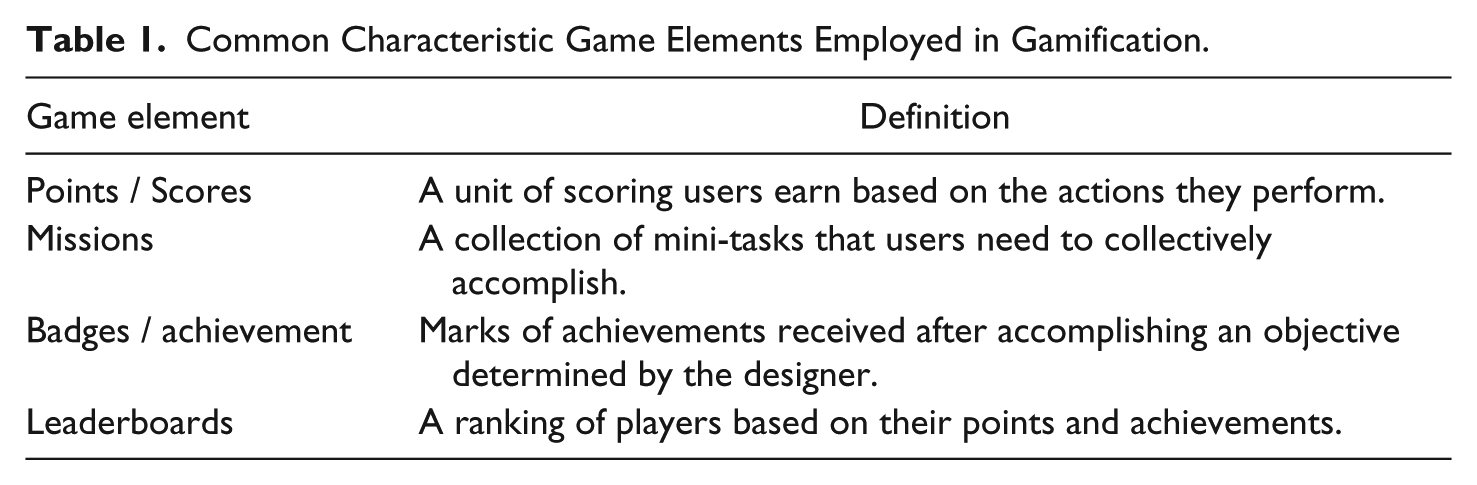
The superficial introduction of these game elements to system design has been criticized as merely providing an artificial add-on layer that is not always able to materialize hypothesized benefits of gamification such as user enjoyment, increased engagement and user retention (Bogost, 2015; Deterding, 2012; Hamari, 2013; Huotari & Hamari, 2016; Landers, 2014; Nicholson, 2012, 2015). It appears that using characteristic game elements in the design of gamified applications is not enough to reach successful gamification. For gamification to have a lasting effect on user behavior, motivation and value creation, it has to primarily engage the user in a meaningful gameful experience that the user perceives as value creating. For these reasons, in this study we adopt the definition of gamification offered by Huotari and Hamari (2016) since it emphasizes gamification as a process that provides a gameful experience above all, regardless of whether it is provided exclusively by game elements or by other motivational affordances for gameful design.
The gameful experience is however subjective, and determined by the player’s individual perspectives. Nonetheless, psychological theories have identified purpose, mastery, autonomy, relatedness, suspense and other variables as psychological mental states that facilitate the experience of gamefulness, and consequently behavioral change (Deterding et al., 2011; Huotari & Hamari, 2016; Nicholson, 2012, 2015; Rigby, 2015). Gamification is presented as a process in (Figure 1), and has three main consecutive steps (Hamari et al., 2014). It starts with motivational affordances; e.g. stimuli that affect the psychological states of users and motivate them to behave in intended ways. These affordances facilitate psychological experiences that in turn influence the behavioral outcomes of gamification.
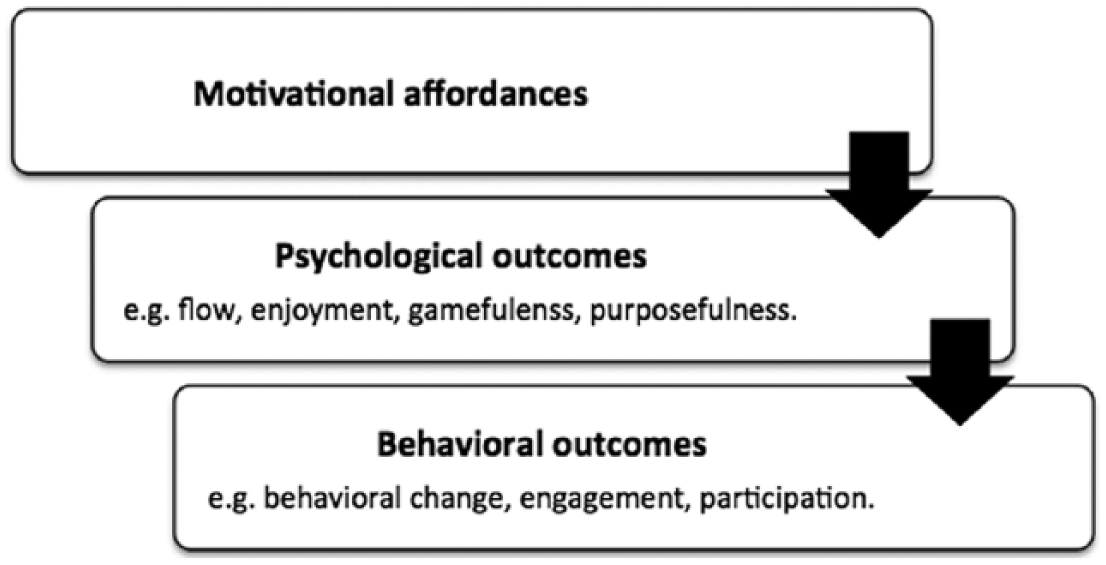
Process of gamification.
In the context of this article, it is additionally important to emphasize the differences between gamification, games and serious games (see Landers, 2014 for a detailed discussion). There is no single agreed upon understanding of what a game is, however, it is commonly described as a system where artificial challenges and related rules are presented, and desirable outcomes for meeting these challenges are pre-known (Broer & Poeppelbuss, 2013; Gordon et al., 2014). More universally, games have been introduced as the collective occurrence of a certain set of conditions (see Juul, 2010), which are required to occur for a game to be considered as a game. A serious game is thus a system for non-entertainment purposes, where all the criteria of full-fledged games are fulfilled (Deterding et al., 2011; Landers, 2014).
As previously discussed, gamification does not necessarily fulfill all the criteria of full-fledged games, but rather it adopts game thinking in the development of serious applications (Broer & Poeppelbuss, 2013; Deterding, 2012; Huotari & Hamari, 2016). As this article is concerned with gamification, an examination of the psychological variables that lead to the manifestation of engagement as illustrated by the process of gamification (Figure 1) is needed.
Gamification and Motivation
Engagement is a directional expression of motivation, and offers a behavioral clue as to what individuals are interested in and have the motivation to engage with (Rigby, 2015). The use of motivational affordances in the design of a service thus takes place with the intention of affecting intrinsic and extrinsic motivation of the service users, and in turn affecting the directional expression of this motivation in terms of any behavioral change or increased engagement with the service (Bista et al., 2014; Broer & Poeppelbuss, 2013; Coronado Escobar & Vasquez Urriago, 2014; Deterding, 2012; Deterding et al., 2011; Hamari & Koivisto, 2015; Hamari et al., 2014; Nicholson, 2015; Rigby, 2015; Zhang, 2008). Intrinsic motivation is an internal motivational drive to behave in a certain way for the sake of the behavior itself and the internal reward it provides. Extrinsic motivation on the other hand, is the pursuit of a behavior for some other extrinsic reason, conditional to the conduct of the behavior (Broer & Poeppelbuss, 2013; Deci & Ryan, 2004; Rigby, 2015; Zhang, 2008).
Gamification - through the use of stimuli and extrinsic rewards - has a direct influence on extrinsic motivation (Deterding et al., 2011; Farzan et al., 2008; Jin et al., 2013; Jones et al., 2014; Nicholson, 2012; Rigby, 2015; Zuckerman & Gal-Oz, 2014). Reward based gamification solely relies on the external provision of rewards to influence behavior, and thus behavioral change through this method tends to be conditional on the continuous provision of extrinsic rewards, unless the motivation for the behavioral change is internalized (Bogost, 2015; Nicholson, 2015). In situations where there is a lack of intrinsic motivation for a certain behavior, and the behavior does not require a tremendous amount of mental effort; reward-based gamification is expected to be motivationally sufficient. Thus, reward-based gamification is effective for quick, short termed behavioral change that lasts for as long as the rewards are available (Bogost, 2015; Jones et al., 2014; Nicholson, 2015; Rigby, 2015; Zuckerman & Gal-Oz, 2014).
However, organismic integration theory (Deci & Ryan, 2004) emphasizes the negative correlation between intrinsic and extrinsic motivations. Once gamification is introduced as a mechanism of reward or as an extrinsic motivator, then long-term levels of intrinsic motivation are adversely affected (Bogost, 2015; Broer & Poeppelbuss, 2013; Nicholson, 2015; Rigby, 2015; Zuckerman & Gal-Oz, 2014). If the target is a longer-term behavioral change, then reward-based gamification may be less effective as it would present a danger of replacing intrinsic rewards for behavior with an unsustainable and ever-increasing reliance on extrinsic rewards (Hamari et al., 2014; Nicholson, 2012; Zuckerman & Gal-Oz, 2014). In such situations, it is essential to employ a different gamification design that provides intrinsic psychological rewards to support the intended behavioral outcomes (Bartle, 1996; Deterding, 2012; Hamari et al., 2014; Nicholson, 2015; Rigby, 2015).
Self-determination (identification) theory is a cornerstone macro theory of motivation, exploring the psychological needs that intrinsically motivate people to behave the way they do (Baard, Deci, & Ryan, 2004; Deci & Ryan, 2004). The theory proposes that some of the core psychological needs behind intrinsically motivated behavior are: 1) The drive to learn new skills to the point of excellence (mastery); 2) Free choice and the potential to behave in accordance with one’s own personal wishes (autonomy); and 3) Feeling that one is part of a community (relatedness). Researchers believe that sustained engagement is a consequence of the fulfillment of these three basic needs (e.g. Baard et al., 2004; Nicholson, 2012; Rigby, 2015; Zhang, 2008; Zuckerman & Gal-Oz, 2014). Furthermore, the satisfaction of these needs within the first month of gamification is statistically predictive of user enjoyment, sustained engagement and motivation (Rigby, 2015).
One further intrinsic variable that influences motivation, engagement and behavioral change is purpose (Pink, 2009) as an expression of goal setting (Jung et al., 2010; Landers, Bauer, & Callan, 2015; Landers & Callan, 2011; Latham, 2003; Locke & Latham, 2002). Individuals have an innate need to know that they have a mission to accomplish, and it is this sense of being on a mission and accomplishing self-concurrent goals that works as an intrinsic drive of their motivation. It is believed that the combinations of autonomy and mastery in the sense of a users’ mastery of autonomously motivated goals, is the reason why games engage players for prolonged periods of time (Hamari, 2013).
Figure 2 provides a summary of this discussion of the possible influence of gamification on motivation, and its expression in engagement.
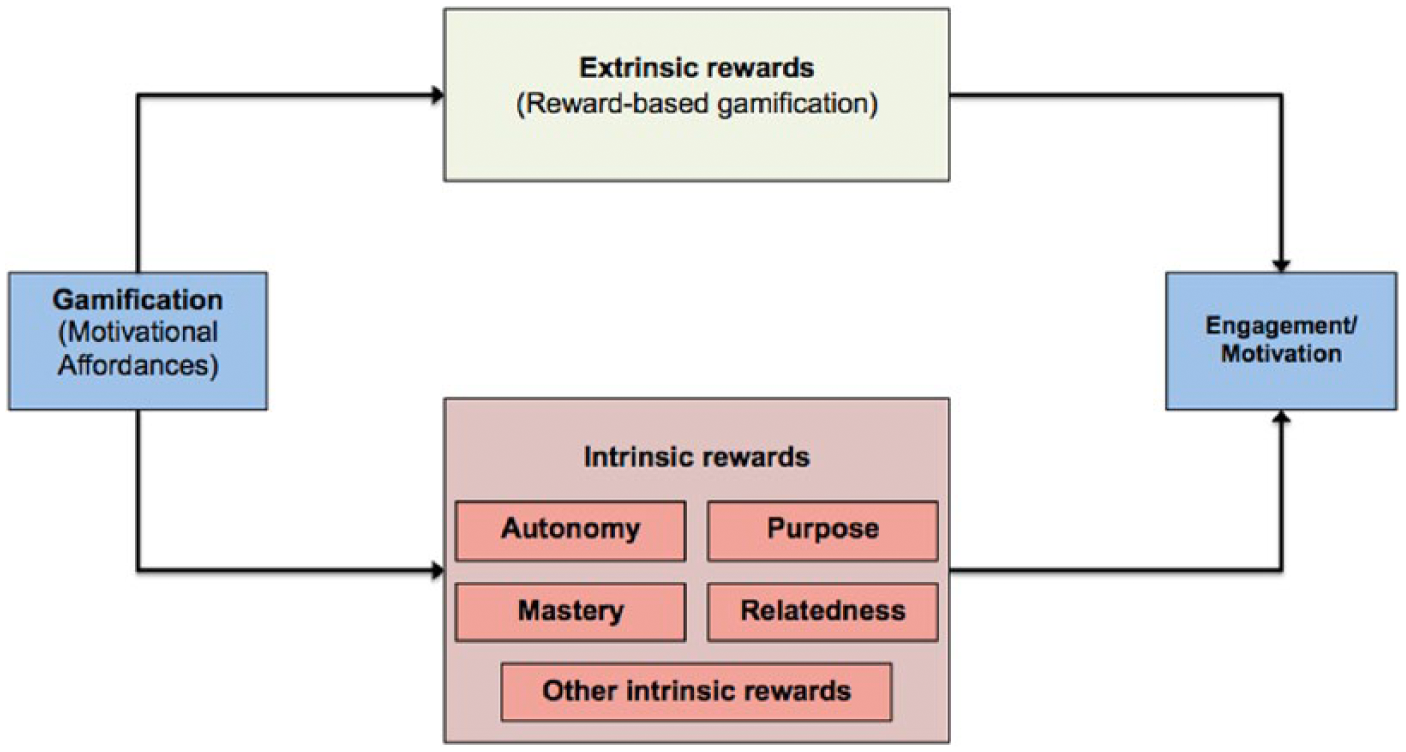
Influence of gamification on motivation and engagement.
Nonetheless, the perception of the psychological experiences provided by games and gamification that lead to intrinsic motivation remains subjective, and based on individual perceptions and personalities (Deterding et al., 2011; Huotari & Hamari, 2016; Landers & Callan, 2011; Nicholson, 2012, 2015; Rigby, 2015). One categorization of gamers’ personalities and what is of value to each personality type is provided by Bartle (1996), who identifies four major types of gamers: 1) Achievers who value accomplishments, purpose and mastery; 2) Explorers who value freedom and autonomy; 3) Socializers interested in social interactions and relatedness; and 4) Killers who value competition, mastery and purpose, but unlike achievers enjoy breaking the rules. It is probable that such a categorization of player’s personalities and other categorizations might not hold in all non-gaming contexts such as civic engagement as the focus of this article. It is also probably that the perception of value creation would differ for each of these groups in such a context. Thus, there is a need to study categorization of players in the context of civic engagement and what would specifically provide them a psychologically rewarding experience and intrinsically motivate them to be more civically active. Such a goal is however beyond the scope of this work.
Civic Engagement
Understanding Civic Engagement
The practice of introducing Information and Communication Technologies (ICTs) to civic life can be observed in most forms of governance that intend to improve democracy, and enhance its perceived legitimacy and improve the outcomes of its decision making (Alharbi et al., 2016; Coronado Escobar & Vasquez Urriago, 2014; Macintosh, 2004; Phang & Kankanhalli, 2008; Rothschild, 2016; Sameer & Abdelghaffar, 2015; Sanchez-Nielsen & Lee, 2013; Swezey et al. 2012; Supendi & Prihatmanto, 2015; Sánchez-Nielsen & Lee, 2013). Online and offline civic engagement platforms provide citizens with tools for interaction and collaboration amongst themselves, through which they are able to positively impact their community and its governance (Abdelghaffar & Sameer, 2013; Adler & Goggin, 2005; Lee & Kim, 2014; Sánchez-Nielsen & Lee, 2013; Sano et al., 2012; Swezey et al., 2012). The reasons online technologies were introduced to civic life were to keep up to speed with modern societies, and to increase the efficiency and speed of civic activities (Gordon et al., 2014; Macintosh, 2004; Phang & Kankanhalli, 2008; Sánchez-Nielsen & Lee, 2013; Supendi & Prihatmanto, 2015). Online tools further offer the advantage of transcending the physical limitations of classical means of civic engagement, thus reducing the costs of civic engagement initiatives, and extending governance inclusion to more people (Gordon et al., 2014; Phang & Kankanhalli, 2008; Sánchez-Nielsen & Lee, 2013).
Regardless of the administrative purpose or the technological design of civic engagement platforms, sufficient volunteer citizen contribution is essential for their survival and success in reaching their functional objectives (Coronado Escobar & Vasquez Urriago, 2014; Jin et al., 2013; Macintosh, 2004; Rothschild, 2016). However the ICTs we adopt to support civic engagement increasingly end up as having an adverse effect on the civic engagement they were intended to facilitate, thus highlighting the challenges of maintaining quality civic engagement through tools that are mostly speedy and impersonal, and which de-emphasize the value of human interaction (Gordon et al., 2014). Furthermore, online civic engagement platforms have a significant turnover rate, and it has been seen that people who initially make a contribution, rarely make another (Jin et al., 2013; Lee & Kim, 2014).
In spite of the worldwide increase in the number of people spending a large percentage of their time online (Lee & Kim, 2014), governments are struggling to maintain active participation on their civic engagement platforms (Alharbi et al., 2016; Cernuzzi & Pane, 2014). According to Ofcom (2015), internet users nowadays spend an average of 20 hours per week online - twice as much time as was seen 10 years ago. However, this online activity does not necessarily translate into a higher activity on civic engagement platforms. The introduction of serious games and gamification to these platforms might make them more engaging (Asquer, 2014; Bista et al., 2014; Gordon et al., 2014; Mayer, 2009; Nelson, 2012; Raphael et al., 2010; Supendi & Prihatmanto, 2015). The following sections provide a discussion of these possibilities.
Serious-Games and Civic Engagement
In the last 40 to 50 years, policy makers have indicated that board games, serious games, simulations and role-play have considerable benefits in terms of civic outcomes (Eränpalo, 2014; Mayer, 2009). Engagement games are an emerging form of serious games that facilitate civic learning, general civic engagement, and increase trust in government (Gordon et al., 2014). An early study by Kahne et al. (2009) found a positive correlation between teen’s playing of engagement games that simulate engagement in political processes, and their subsequent levels of civic opinion expression and political activity.
Raphael et al. (2010) argue that real-world simulations and collaborative group projects are some of the most effective tools for civic learning, and assist in knowledge building, skill development, opinion expression, civic problem solving, and influence governmental decision-making. CommunityPlanit is an example of a fully-fledged serious game that intends to positively impact civic engagement, developed and evaluated for local planning (Gordon et al., 2014). Through the game; citizens are firstly educated on matters related to their communities, then asked to deliberate the matters with each other, suggest solutions, and support (vote for) the solutions they most relate to, so that the solutions might be funded by the government. The game has been used in the city of Detroit, USA and in the republic of Moldova with great success.
Civic tools such as CommunityPlanit are considered as serious games when they fulfill pre-determined criteria as fully-fledged games (see previous discussion). However, fully-fledged games are not suitable for all contexts, and the turning of a civic participation platform or an e-government service into a serious game is subject to ethical debate, as not all such services can or should be gamified (Asquer, 2014; Bista et al., 2014; Nelson, 2012). Thus, practitioners should carefully identify services that could benefit from serious game design and those that would best benefit from gamification, and those that may be better off left as they are.
Influencing motivation and engagement are not the main objectives of serious games, however their goals are focused on the context they are used in; i.e. improving learning, increasing productivity, developing certain civic skills. On the other hand, the main goal of gamification is argued to be to increase motivation and engagement with a target behavior, e.g. learner engagement, worker motivation, civic engagement, etc. (Landers, 2014). Since the focus of civic engagement platforms is by definition on engagement, and the focus of this article is on developing a framework for influencing motivation and engagement on these platforms, we reemphasize the focus of this article on the gamification of civic engagement platforms and not serious games. Relatedly, we believe that serious games (in the context of civic engagement) have been studied relatively more than the gamification of such services, even though the later topic may be more suited to some services than serious games, and is therefore worthy of further attention.
Gamification and Civic Engagement
Some initiatives have been implemented to build gamified applications, aimed at improving civic engagement (Bista et al., 2014; Business Wire, 2015; Dargan & Evequoz, 2015; Mendonca & Alawadhi, 2015; Stewart et al., 2013; Supendi & Prihatmanto, 2015), although these types of initiatives are not always reported in scientific literature. A designer that intends to use reward-based gamification to influence civic engagement can build a platform that calculates a score for its users based on their activities, provides friendly inter-user competition, and rewards users for their interaction (Sánchez-Nielsen & Lee, 2013; Supendi & Prihatmanto, 2015). One of the few case studies available on the gamification of civic engagement platforms through this technique is provided by Bista et al. (2014). They developed a gamified community for welfare recipients who were encouraged to use it for a year to communicate with each other and with the government to facilitate their transition from one welfare system to another. The study reported very positive outcomes from the perspective of gamification, and recommended further investigations to be undertaken.
It is important to reemphasize that in certain contexts, merely adopting some game elements to gamify an online platform is not enough to effect long-term behavioral change, or change behaviors that require considerable mental work as gamification in such a situation may have adverse motivational effects that can lead to the failure of the gamification efforts (Asquer, 2014; Bogost, 2015; Deterding, 2012; Hamari, 2013; Huotari & Hamari, 2016; Landers, 2014; Mayer, 2009; Nicholson, 2012, 2015). Additionally, a recent experiment by Hamari (2013) on the gamification of a utilitarian peer-to-peer trading experiment concluded that considerations of context are essential for gamification success, and that not all services are equally suited to gamification. Thus, the effectiveness of the adopted motivational affordances depends on their application context, the purpose for which they are introduced, and their usage scenarios (Hamari, 2013; Zuckerman & Gal-Oz, 2014).
Several researchers believe that gamification in the context of civic engagement is a possible means to positively influence active participation on online civic platforms, enables the achievement of their functional objectives, and eliminates some of the discussed problems of ICT use in civic engagement (Asquer, 2014; Bista et al., 2014; Coronado Escobar & Vasquez Urriago, 2014; Deterding et al., 2011; Nelson, 2012). Asquer (2014) suggests that civic gamification designers should focus on understanding and influencing the psychology (intrinsic motivation) of the users, for gamification efforts to provide value. Unfortunately, gamification is still a relatively emergent area of scientific enquiry, and consequently there is a lack of understanding of how such goals could be materialized.
Deliberation Theory
One of the core theories of civic engagement is that of democratic deliberations, or deliberation theory in short. It posits that democratic, societal discussions of political matters are the preferred method to create informed individuals who actively participate in governance and political activism (Abdelghaffar & Sameer, 2013; Eränpalo, 2014; Fung & Wright, 2001; Min, 2007; Perote-Peña & Piggins, 2015; Sameer & Abdelghaffar, 2015; Schlosberg, Zavestoski, & Shulman, 2009). Deliberations are thus a crucial requirement for any civic engagement platform, without which it cannot be expected to achieve its core functional objectives or any of the positive outcomes for which civic engagement platforms are designed (Gordon et al., 2014; Sameer & Abdelghaffar, 2015; Sánchez-Nielsen & Lee, 2013; Swezey et al., 2012).
There are different deliberation models that illustrate how online deliberations should take place (see Burkhalter et al., 2002 and Perote-Peña & Piggins, 2015 for a review of these models), and also frameworks and studies that operationalize these models (see Macintosh, 2004 and Phang & Kankanhalli, 2008 for applications). It is therefore difficult to adopt any single deliberation model as a general guideline for civic engagement platform design (Abdelghaffar & Sameer, 2013; Perote-Peña & Piggins, 2015). However, the core features of these models are that citizens should be given enough information about the civic matters presented on the platform (information provision), they should be encouraged to interact with each other and to express their opinions whenever possible (interactivity), and the participants should reflect on their experience, learn from it and provide their final opinions either through means of a vote or other appropriate mechanism (reflection) (Burkhalter et al., 2002; Eränpalo, 2014; Min, 2007; Perote-Peña & Piggins, 2015; Sameer & Abdelghaffar, 2015; Swezey et al., 2012). A summary of these deliberation perquisites is presented in Figure (3).
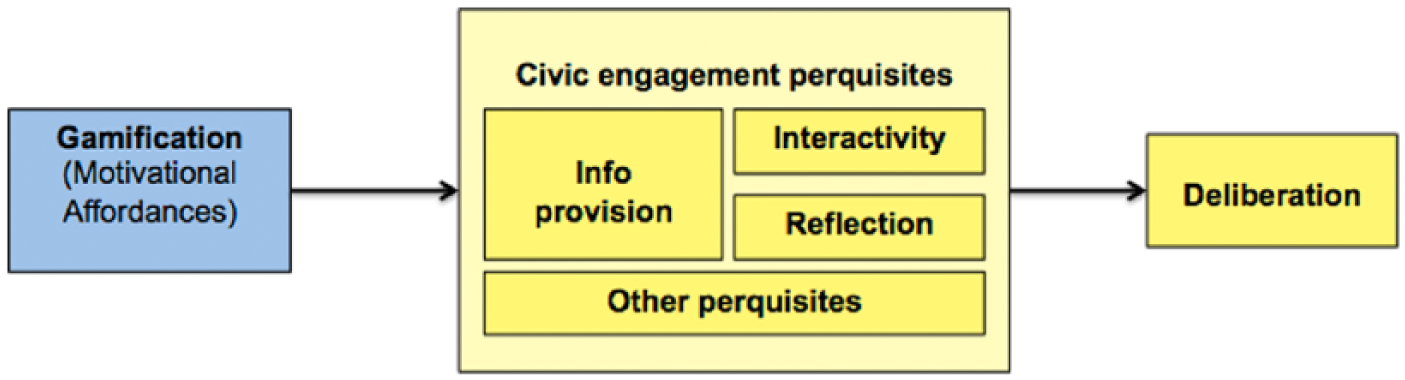
Summary of core concepts in deliberation models.
These three core perquisites of deliberation are also important for gamification design, but for different objectives. In gamification it is important to communicate to players/users why gamification is being used, and why there is a need for sustaining the behaviors reinforced by gamification (information provision). Interactivity is encouraged when needed to facilitate the engaging experiences of competition or collaboration, and players are encouraged to reflect on their experience of the gamified service to draw behavioral conclusions from it (Nicholson, 2012). While the core concepts might be important for both gamification and deliberation purposes, in the context of deliberation, these concepts are mainly concerned with the provision of information related to real life concerns, interactivity is encouraged for civic deliberation purposes, and reflections are encouraged on the contents (Burkhalter et al., 2002; Min, 2007; Sameer & Abdelghaffar, 2015), Thus we believe that the introduction of deliberations requirements to gamification design should expand the definitions of information provision, interactivity and reflection in civic engagement platform design, rather than be limited to the scope important for either deliberations or gamification in isolation of each other.
Discussion: A Theoretical Framework for the Gamification of Civic Engagement Platforms
Motivation is a keyword in gamification research, and there are several psychological theories that explain motivation drivers beyond the limited discussion space of this article. Nonetheless, the effects of gamification on motivation must be understood so as to allow it to be used effectively, and to positively influence the levels of civic engagement. We adopted self-determination theory, organismic integration theory and other motivational research in order to develop a theoretical framework that explores how gamified services could be designed to extrinsically and intrinsically motivate individuals to engage more in deliberations, which are according to deliberation theory, thought to form the core of civic engagement (Gordon et al., 2014; Min, 2007; Perote-Peña & Piggins, 2015; Sameer & Abdelghaffar, 2015; Schlosberg et al., 2009). The proposed theoretical framework presented in Figure 4 combines the elements previously shown in Figures 3 and 4. As such, this can also be understood as an expansion of the gamification process presented in Figure 1) and as an instrumentalization of the process in the new context of civic engagement.
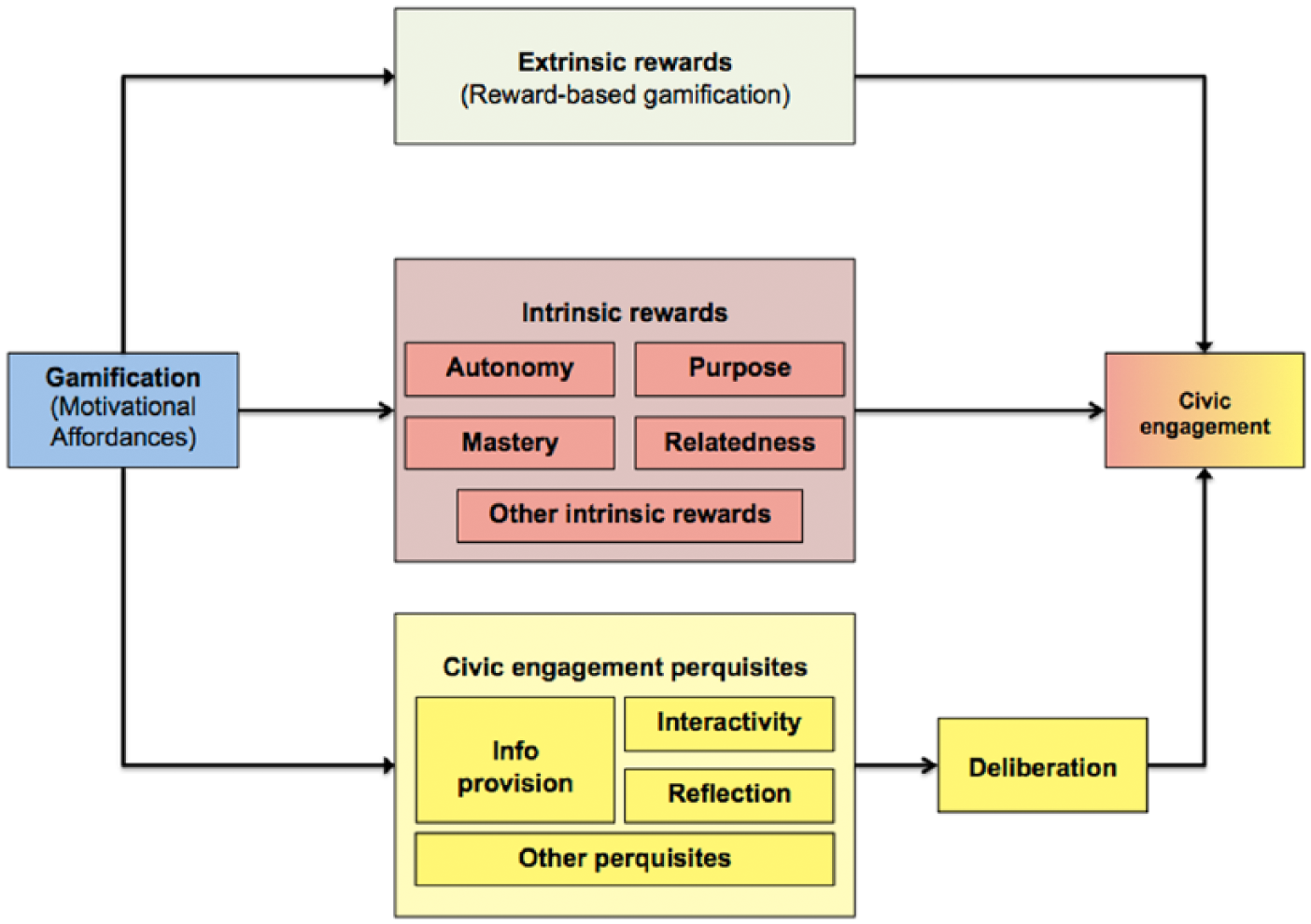
Proposed theoretical framework for the gamification of civic engagement platforms.
The proposed framework puts forward that motivational affordances can be used to provide a straightforward reward-based gamification, as a source of extrinsic motivation for users to actively use civic engagement platforms. Gamification through these motivational affordances could also be used to fuel intrinsic motivation and provide intrinsically rewarding gamification. Each of these gamification paths is important in the context of civic engagement, depending on the goal of gamification and the time frame in which results should be observed. Thus both paths should be given consideration.
The desired behavior (which in this case is civic engagement) should also be facilitated through deliberations. As previously discussed, there are many models and guidelines on how deliberations should be conducted. In this framework, we adopt the three most agreed upon guidelines for successful deliberations, in order to develop a framework that can be adapted to as many civic engagement contexts as possible. Researchers and practitioners should be able to expand upon these guidelines as needed, so as to suite the context in which they wish to operate. This importance of contextualization is emphasized by the allowance for the inclusion of “other perquisites” in the proposed framework (Figure 4).
We believe that gamification (as an influencer of motivation and engagement, and in combination with the facilitation of deliberations) would fulfill the functional requirements of civic engagement platforms, and so offer a remedy to the challenge of low levels of civic participation, and assist in community building. The achievement of such goals would allow governments to reap more benefit from their investments in civic engagement platforms, to increase the involvement of citizens in the governance of their communities, to increase governmental legitimacy, and help to improve governmental decision-making (Coronado Escobar & Vasquez Urriago, 2014; Macintosh, 2004; Sánchez-Nielsen & Lee, 2013; Swezey et al., 2012).
This initial understanding of the gamification of civic engagement needs to be expanded upon through empirical work that validates the proposed framework, and further explores gamification in the context of civic engagement platforms. An empirical understanding of how motivational affordances or gamification could be used to support deliberations (as a basic requirement of civic engagement) is much needed. Future researchers are therefore encouraged to conduct experimental work on different gamification designs (e.g. competitive design, collaborative design, etc.) of civic engagement platforms to identify those most suited for civic engagement and community building. Studies should also test different motivational affordances in isolation and specific combinations, in order to determine their influence on civic engagement and community building. Furthermore, both qualitative and quantitative empirical work is needed to understand the contextual motivational sources of civic engagement beyond those discussed in this article, and to identify how the individual characteristics and personality types of users influence gamification design in the context of civic engagement.
The design of successful governmental gamified platforms should also be studied, especially those which have been acknowledged for their innovative design (e.g. my.hawaii.gov: Business Wire, 2015). Longitudinal studies are also needed to examine the long-term effects of gamification on civic engagement, as researchers report that the positive effects of gamification are only temporary and tend to wear off once the application loses its novelty attraction (Asquer, 2014; Hamari & Koivisto, 2015; Hamari et al., 2014; Jones et al., 2014). It is therefore important to conduct studies that focus on the psychology of users, and the internalization of extrinsic motivation to autonomous acts that sustain motivation.
Conclusion
A variety of public services and applications can be enhanced through gamification (Asquer, 2014; Bista et al., 2014; Coronado Escobar & Vasquez Urriago, 2014; Gordon et al., 2014; Nelson, 2012; Raphael et al., 2010; Stewart et al., 2013). Motivational affordances can be used to provide either reward-based gamification or intrinsically rewarding gamification, depending on the aims from the introduction of the motivational affordance, and the context and methodology of their use (Asquer, 2014; Nicholson, 2012). However, it is unclear if and which motivational affordances can support civic engagement, or how they can facilitate information provision, interactivity and reflection as core facets of civic engagement. It is also unclear how the mere existence of motivational affordances in a civic engagement service would affect deliberations.
This lack of understanding of gamification in the context of civic engagement and community building emphasizes the importance of the framework contributed by this article. As such, the framework serves as an initial guideline as to how gamification and deliberations may be brought about in the context of civic engagement. In its discussions, the article identifies several research gaps and directions that researchers interested in gamification and civic engagement can address. However, it is clear that there is a need for more first hand data that evaluates gamification of civic engagement services, so that the behavioral outcomes of gamification may be better evaluated. There are far more governmental gamification initiatives than have been identified in this particular study, however these are not easily identifiable, and are seldom empirically evaluated and reported. As such, it is difficult to draw lessons from them. This calls for further examination of the online services provided by governments, in order to determine if gamification approaches have been utilized there, and what the effects they have.
The gamification of e-government services including civic engagement and community building platforms should be studied, keeping in mind that not all services can or should be gamified (Asquer, 2014; Bista et al., 2014; Nelson, 2012). The intermediating role of political will and other political variables should be considered in the gamification of civic engagement services, as they are assumed to have an impact on levels of engagement on online governmental services (Sameer & Abdelghaffar, 2015) and potentially their success and adoption.
Footnotes
Acknowledgements
The author would like to thank the editors and reviewers of Simulation & Gaming for their valuable comments that have significantly contributed to the improvement of this work. Special thanks are also due (in alphabetical order) to Bo-Christer Björk, Juho Hamari, J. Tuomas Harviainen, Päivi Huttuka, Mikael Laakso, and Lena Jungall for their feedback on this work during its compilation.
Declaration of Conflicting Interests
The author declared no potential conflicts of interest with respect to the research, authorship, and/or publication of this article.
Funding
The author disclosed receipt of the following financial support for the research, authorship, and/or publication of this article: This article was supported through a personal grant to the author from Hanken Support Foundation.
Author Biography
Contact: