



Abstract
Teams operating in high-risk environments, such emergency management, require constant coordination adaptations to manage dynamic task demands. However, training for such adaptations remains understudied. This study used sliding window entropy to analyse emergency medical teams’ coordination before and after training, distinguishing two restructuring phases: equilibrium (ordered coordination) and ataxia (disordered coordination). High-performing teams transitioned between phases more frequently and spent more time in equilibrium. During ataxia, they combined standardised behaviours with proactive speaking-up and monitoring. Low-performing teams showed less initiative. These findings underscore the need for both restructuring and orderly coordination, offering valuable insights for improving adaptive training approaches.
Introduction
The complex and uncertain environments in which some teams and multi-team systems operate, such as healthcare and emergency management, require rapid adaptation in the face of disruptions and fast-changing task demands. Lack of ability to adapt to the continuously changing circumstances of such environments can have major repercussions (e.g., David & Schraagen, 2018; Roth, 2018). Coordination, defined as managing task-related interdependencies to achieve shared objectives, enables teams to maintain control in fast-changing environments by adapting their coordination behaviours and harmonising actions towards unified objectives (Marks et al., 2001). In contrast, poor coordination can lead to redundant or conflicting actions, miscommunication, and task omissions, factors that can undermine performance and threaten goal attainment (David & Schraagen, 2018; Fernandez Castelao et al., 2013; van Eijndhoven et al., 2023). Understanding the process by which coordination may facilitate or hinder adaptability is thus an important step towards fostering adaptability in team training processes and enhancing resilience in volatile environments.
Prior research highlights that effective teamwork relies on a combination of stable and flexible temporal coordination patterns (Schad et al., 2016). In routine and predictable situations, teams often follow stable, orderly coordination protocols or standard operating procedures (Howard-Grenville, 2005). In contrast, when facing difficult or unforeseen circumstances, teams are required to adjust and reorganise coordination to respond effectively to shifting task requirements (Gorman & Cooke, 2010; Grote et al., 2018). By dynamically adjusting their coordination, such as shifting between implicit or explicit communication behaviours, teams can align their actions and maintain operations under fluctuating demands (David et al., 2024; Kolbe et al., 2014). In dynamic environments, restructuring coordination has been found to allow for temporary leadership shifts and expertise-based delegation, ensuring that the most relevant knowledge is accessible and actionable at the right time (Cooke et al., 2013; David et al., 2024). We therefore argue that coordination restructuring, referring to the dynamic development, emergence and adaptation of coordination patterns between teammates, is an important mechanism of team resilience (David et al., 2024): the capacity of teams to respond adaptively to external or internal stimuli and sustain performance throughout team activity (Hancock et al., 2022; Woods, 2018, 2019).
The current body of work in human factors, safety science, and complex systems literature strongly emphasises the importance of an in-depth understanding of team dynamics and performance to mitigate risks (Cooke et al., 2013; Summers et al., 2012). Within these fields, coordination has been recognised as a key enabler of critical team processes, such as collaborative sensemaking, where team members collectively interpret unfolding information to guide action (Albolino et al., 2007), and the development of shared mental models through ongoing alignment with the environment (Decuyper et al., 2010). However, while the critical role of coordination in shaping team processes and performance is well established, much of the existing literature has examined it as a relatively static construct, offering limited insight into its temporal dynamics or adaptability (Anderson et al., 2021; Burke et al., 2006; Fyhn et al., 2023). As a result, the dynamic nature of how coordination supports these processes remains underexamined.
For instance, it is still unclear at which moments throughout an event teams benefit most from tightly coupled, information-rich exchanges versus more loosely structured updates, or how the form and timing of these coordination shifts influence the effectiveness of collective interpretation of a constantly changing situation. To uncover the mechanisms that enable teams to adapt effectively despite volatile conditions, we need to temporally map and understand the nuances of this restructuring in coordination.
The extant literature that has attempted to capture more dynamic attributes of coordination has primarily focused on turn-taking patterns (David & Schraagen, 2018; Grimm et al., 2023; Van den Oever & Schraagen, 2021). However, this focus tends to overlook the implicit and explicit information and actions transmitted through those patterns, elements that are essential to coordination itself, since they determine what is actually being coordinated.
For example, research on turn-taking coordination patterns already highlights the positive effects of perturbation training on performance. Perturbation training involves exposure to unforeseen circumstances and disruptions throughout training that simulate the volatility of real life. Such training leads to better performance under novel task conditions compared to traditional, “procedural” training processes, where trainees are taught to follow a standardised procedure for each situation encountered (Gorman et al., 2010). Moreover, perturbations have been found to lead to reorganisation of team turn-taking patterns, with expert teams adapting faster than novice teams (Gorman et al., 2019). This research marks important progress in using temporal insights to understand coordination, suggesting that high-performing teams possess a repertoire of adaptive mechanisms that they can utilise to reorganise effectively.
However, our knowledge remains limited with regard to what this repertoire of adaptive mechanisms includes, or how exposure to training over time may affect the development of these mechanisms. While reorganisation is recognised to be important, coordination restructuring, in terms of which behavioural patterns change over time, or how they change remains poorly understood. Bridging this gap can facilitate the development of tailored team training programs and evaluation methods that target specific coordination restructuring processes, ultimately promoting coordination restructuring mechanisms that enhance team resilience.
In the current study, we aim to bridge this gap by unpacking the dynamic nature of coordination restructuring in detail, before and after simulation training. In doing so, we adopt a more holistic measurement of coordination by assessing all layers of actor speaking, message transmitted (i.e., action or information oriented), and mode of transmission (explicit or implicit) (David et al., 2024; Kolbe et al., 2013). By using a temporal analysis approach of information entropy, we examine both the composition of coordination restructuring, referring to the behavioural changes that occur in the coordination behaviours, as well as the rhythm of coordination restructuring, that is, the cycles of transitioning between order and disorder reflecting rigidity or flexibility (Bartunek & Woodman, 2015), These dimensions of coordination restructuring are explored before and after a series of training sessions for emergency management teams. By capturing the nuanced changes in coordination, we can develop a more comprehensive understanding of team resilience mechanisms, which is essential for informing the design of future training programs aimed at enhancing performance through adaptive training.
Coordination Restructuring and Team Resilience
Definitions of resilience vary greatly, with no single definition capturing all its facets (Woods, 2015). Within the context of action teams and high-stakes environments, there is a growing tendency to conceptualise resilience as a process (Ketelaars et al., 2024; Patriarca et al., 2018), referring to the capability to cope with challenging situations (Murphy et al., 2019; van der Kleij et al., 2011). We adopt the definition of Hancock et al. (2022), viewing resilience as “The capacity to change in response to conditions that push a system beyond the boundaries of its effective stability and to establish a new, normal state of operations beyond the initial operating parameters” (p. 256). Similar conceptualisations of resilience, such as the definition of resilience by Hollnagel (2022), underscore that resilience is not mere reactivity but requires continuous adaptation, whereby teams evolve through changing interactions to maintain performance in the phase of disruptions.
Such definitions imply that the process of resilience should be viewed as a dynamic temporal process of these adaptations, and the behavioural make-up of team interactions. However, most existing resilience models adopt a rigid view of how coordination dynamics can facilitate resilience. For example, while switching from directive to more reciprocal patterns of coordination is considered an important attribute of teams coordinating under uncertainty (Davison et al., 2012; Sherman & Keller, 2011), it remains unclear when during an event reciprocal patterns are most useful, or how patterns of coordination change throughout an uncertain, stressful situation. Although changes in coordination are considered important, the rhythm and timing of these changes remain underexplored.
We follow the view that coordination restructuring, encompassing changes in the rhythm and timing of coordination, is an important mechanism of team resilience. Nuanced changes in coordination patterns throughout team activity can reflect a team’s capacity to navigate through disorder and to reach a new state of stability according to the situational demands at play.
This perspective aligns with conceptualising teams as Complex Adaptive Systems (CAS), which is especially important for understanding resilience and coordination restructuring, as it provides a theoretically grounded way to explain how adaptive capacity emerges under dynamic and evolving conditions (Ramos-Villagrasa et al., 2018). CAS theory emphasises that collective team behaviours are not just the sum of individual behaviours and actions but should be viewed as the product of ongoing, reciprocal interactions among interdependent team members embedded within a broader environment. A core feature of CAS is that systems are characterised by nonlinearity, where a small change in one part of the system can trigger large effects elsewhere. CAS’s characterisation of teams as adaptive, but also complex and system-based, also adheres to the idea of multi-stability, which is crucial for teams in critical circumstances where teams can shift between multiple functional states depending on contextual demands (Pype et al., 2018). Such properties are especially relevant to resilience, which often requires moving the team from one stable state to another in response to disruptions (Hancock, 2023). Taking a CAS perspective, coordination restructuring is conceptualised as a non-linear, emergent, self-organising process where team members constantly modify patterns of interaction (Grote et al., 2018; Maynard et al., 2015). By framing teams as CAS, we place focus on the relevance and importance of understanding the non-linear, emergent, self-organising processes, such as coordination restructuring, that characterise these systems.
In addition to the importance of viewing teams as CAS, other streams of team literature have also shown that temporal coordination dynamics go hand-in-hand with changes in important temporal team processes (Manser et al., 2008; Marques-Quinteiro et al., 2019). Thus, the nuanced fluctuations in coordination between team members may serve as empirical markers of resilience as it unfolds in real time.
Building on this view, resilience is not only revealed in rare crises and extreme events, but also in the nuanced changes that reflect the small disruptions characterising normal work. In high-stakes environments such as emergency response management, disruptions are part of everyday operations: some are expected and form the routine content of work, while others are unexpected, defined as incongruent with expectations based on event probabilities and available information (Hancock et al., 2022). In these settings, teams must regularly adjust and realign their coordination rhythm, timing, and structure to sustain effective performance. Evidence shows that teams that face unexpected conditions in training adapt more effectively than those practising in simpler, more stable ones (Grote et al., 2018). Under such conditions, where “almost nothing happens” (Hollnagel et al., 2021), performance outcomes such as reduced time, fewer errors, and higher-quality work serve as indicators of how effectively disruptions are managed.
A gap remains in understanding the relation between coordination restructuring and performance outcomes, not only in terms of how they succeed or collapse but regarding “normal work” performance outcomes, such as error avoidance and overall quality of work.
Phases of Coordination Restructuring
To offer a temporal, comprehensive theoretical foundation of coordination restructuring, we first distinguish between two phases in team coordination: equilibrium and ataxia. Equilibrium 1 refers to states of orderly coordination patterns, while ataxia, derived from the Greek word for “lack of order,” denotes periods where new, less predictable behaviours emerge that do not develop into recurring patterns, marking these phases as dominated by disorder. Similar distinctions in the literature of organisational learning already point towards a dichotomy between exploration (i.e., search, variation, experimentation) and exploitation (i.e., implementation, execution) (March, 1991). Adaptive organisational systems are believed to navigate within the exploration-exploitation trade-off, where “systems that engage in exploitation to the exclusion of exploration are likely to find themselves trapped in suboptimal stable equilibria” (March, 1991, p. 71). Such theoretical conceptualisations, which still prevail in organisational literature (e.g., Berger-Tal et al., 2014; Coradi et al., 2015; Zhou et al., 2023), point to the importance of such phases and the need for empirical research to capture and understand how phase transitioning happens and what it actually means for performance.
Team research shows that during routine conditions, teams typically operate in equilibrium, relying on pre-established procedures and predictable interaction patterns (Howard-Grenville, 2005). Yet when operational demands change, such patterns may no longer suffice, requiring real-time restructuring (Gorman & Cooke, 2010; Grote et al., 2018). This often initiates a phase of ataxia, in which coordination becomes less predictable and chaotic. Ataxia phases represent pivotal moments where new behaviours are introduced and tested, an exploration required when facing uncertainty (Waller et al., 2004; Woolley, 2009), initiating adaptations toward a new equilibrium. Through this exploration, teams may, for instance, shift from an equilibrium of centralised to one of decentralised communication to accelerate information sharing (Barth et al., 2015) or reallocate roles to meet evolving needs (David et al., 2024). If, however, teams remain trapped in ataxia without progressing toward a new equilibrium, coordination may disintegrate altogether, sometimes with fatal consequences (David & Schraagen, 2018).
Coordination restructuring reflects the capacity to transition flexibly between equilibrium and ataxia, ensuring team resilience as defined by Hancock et al. (2022): extending beyond established operations into new spaces of action that align with situational demands. Prolonged equilibrium risks brittleness, as it impedes teams’ capacity to promptly address unexpected situations, limiting their ability to adapt beyond their familiar repertoire of coordination methods (Burke et al., 2006; Woods, 2018). Conversely, prolonged ataxia without stabilisation undermines recovery. Therefore, it is reasonable to assume that a rigid approach to coordination restructuring, indicating a lower rhythm of restructuring (i.e., decreased recurrence of phase transitioning), leads to decreased adaptability and increased risk of brittleness. Effective transitioning between the two phases is therefore necessary for team resilience. Figure 1 presents a conceptualisation of the two coordination restructuring phases.
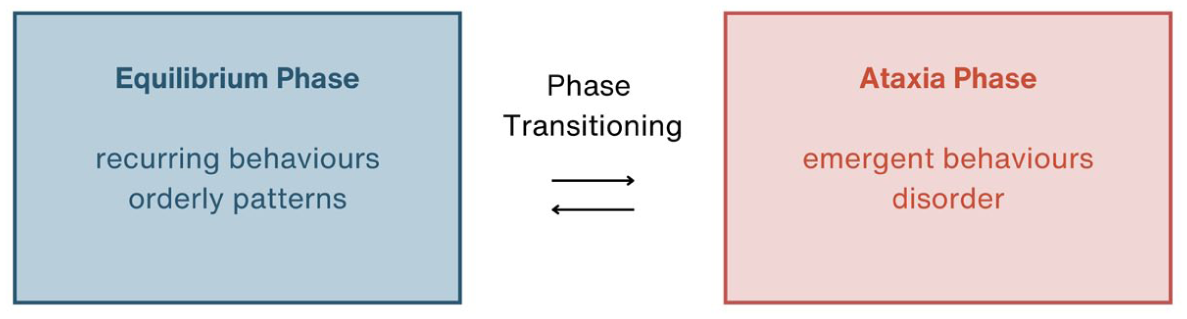
Phases of coordination restructuring.
Despite the importance of both phases, when studying the composition of team coordination, research has predominantly focused on orderly phases to understand team functioning, often neglecting ataxia phases or the examination of transitioning between equilibrium and ataxia (Grote et al., 2018). Also, empirical methodologies often reduce coordination changes to a single measure of overall team stability (e.g., Lyapunov λ exponent calculation, see Demir et al., 2019).
We aim to advance the understanding of coordination as a temporal mechanism by investigating the transitioning between equilibrium (order) and ataxia (disorder), measuring both the rhythm of restructuring (i.e., recurrence of restructuring), and the nature of each phase through capturing their behavioural composition (i.e., how restructuring is manifested in the behavioural make-up of the different phases). Understanding the behavioural make-up of each phase is particularly important as it enables us to capture the underlying patterns guiding restructuring, thus allowing for the conceptualisation of coordination restructuring as a mechanism of team resilience through tangible, real-life behavioural patterns. This approach links the theoretical concept of coordination restructuring to its continuous empirical measurement, addressing a longstanding gap in the team literature (Allen & Lehmann-Willenbrock, 2024; Kozlowski & Chao, 2018; Lehmann-Willenbrock & Hung, 2024).
Coordination Restructuring and Entropy
A promising analytic approach for modelling coordination restructuring is entropy, a nonlinear dynamic systems technique from physics and information theory that quantifies the degree of disorder or unpredictability in a system (Shannon, 1948). Low entropy reflects stability and constraint among system components, while high entropy signals variability and disorder (Guastello, 2010, 2017). Because coordination restructuring is inherently temporal, entropy is particularly suited to capturing shifts in team interaction over time. Unlike linear methods, which assume fixed relationships and overlook emergent processes (Gorman, 2014; Gorman et al., 2019), entropy is sensitive to heterogeneity, variability, and self-organisation, making it well aligned with investigating teams as CAS. Importantly, entropy offers a distinct advantage over other nonlinear approaches in its ability to detect phase transitions, marking shifts between equilibrium and ataxia. In particular, sliding-window entropy (described in detail in the methods section) enables mapping of these transitions in continuous time-series, identifying order-disorder shifts as they unfold in real interaction (Kelso, 1990, 2021).
As a dynamical system approaches a phase transition, constraints of the system begin to break down, exhibiting more disorder in its behaviour (i.e., higher entropy) (Stephen & Dixon, 2009; Wiltshire et al., 2018), by definition positioning entropy peaks (i.e., significantly higher entropy values in the time-series) as the means to identify phase transitions. Empirical evidence in cognitive and team science supports the robustness of using entropy peaks to identify phase transitions (Ricca et al., 2019; Stephen & Dixon, 2009; Wiltshire et al., 2018). For instance, peaks have been associated with transitions between problem-solving phases or the emergence of new communication patterns. However, prior work has largely examined specific problem-solving stages and did not directly address the process of coordination restructuring, transitioning between phases of equilibrium and ataxia.
By capturing time-sensitive changes as behaviours unfold throughout interaction, entropy allows for a nuanced understanding of how systems evolve and restructure coordination. It provides a bottom-up approach that avoids arbitrary phase segmentation, relying instead on actual, granular data of team interactions (Guastello, 2017). In the present study, entropy thus offers the means to empirically investigate and capture the complex conceptual nature of coordination restructuring.
Capturing Coordination Restructuring Through Coordination Behaviours
The outcomes of an entropy time-series heavily depend on the data being modelled. For example, research performed by Wiltshire et al. (2018) investigated the problem-solving phase transitioning (e.g., transitioning from a “team knowledge sharing” phase to a “team process and plan regulation” phase), by modelling problem-solving behaviours (e.g., “knowledge provision” or “situation request”) as these are exhibited in team interaction onto a time-series. Similarly, Uitdewilligen and Waller (2018) identified different phases of information-sharing and decision-making by modelling different information-related behaviours (e.g., “fact-sharing” and “communicating decisions,” and “commands”).
To effectively capture coordination restructuring, it is essential to adopt a comprehensive approach to modelling coordination behaviours. Therefore, we base our coding on the AMM Coordination Framework developed by David et al. (2024), which provides a holistic perspective by considering three key aspects: (a) actor, referring to who performs the behaviour, (b) message, the content being coordinated, such as instructing or requesting information, and (c) mode, the nature of the coordinative act, either being implicitly or explicitly. This framework enables us to capture coordination at multiple layers that interconnect and dynamically change altogether, thereby offering a nuanced understanding of coordination restructuring (see David et al., 2024, for literature review on each layer).
Aim of the Study
Our review of the literature has identified two key research gaps that we aim to address in this study. First, while research has identified that restructuring in coordination patterns occurs during team activity, how this restructuring occurs is yet to be understood. This limits our ability to fully comprehend the adaptive mechanisms that drive team resilience and lead to better performance outcomes. Second, the rhythm of coordination restructuring, referring to the recurrence of transitioning between order and disorder, remains unexplored.
This study aims to holistically explore coordination restructuring and its relation to performance following a temporal approach. We apply sliding window entropy to video-coded coordination behaviours (capturing all aspects of actors speaking, transmitted message, and mode of transmission) of emergency management teams undertaking an 8-week training course. As outlined in the methods section, the realistic environment in which our sample trained included all the technological equipment and stressors present in real-life scenarios. Each team interacted with advanced medical equipment and responded to dynamic, realistic triggers (e.g., unexpected influx of information about the patient), mirroring the complexities of real-life emergency situations, allowing us to investigate coordination restructuring over time, under “normal work” conditions of emergency management teams. In this way, we were able to capture coordination restructuring as a mechanism of team resilience and relate it to team performance outcomes in a context common for action teams that operate in high-stakes environments.
We aim to explore the rhythm of coordination restructuring and its relation to performance before and after training (RQ1), captured by the entropy peaks within the time-series. We also aim to examine the differences in the composition of coordination restructuring between high and low performing teams (RQ2) by delving into the coordination behaviours displayed during each phase.
Method
Participants and Design
The study was performed on a secondary dataset from a study at the University of Twente by Endedijk et al. (2018). It consisted of first-year MSc students who enrolled in the course “Advanced Life Support (ALS),” part of the master’s study program “Technical Medicine” at the University of Twente. Throughout the ALS course, students were taught to diagnose and address a patient in cardiac arrest. They also practised cardiopulmonary resuscitation (CPR), using an advanced human patient simulator and engaging in scenarios of different levels of complexity. The students were on average 22.4 years old (SD = 1.1), and 56% were female. The current analysis was performed on nine teams, each consisting of four students, matched to their performance scores and written informed consent for participation in the study. The study received ethical approval from the Ethics Committee of the University of Twente for both the first round and second round of data collection, including from the teachers involved in the ALS course.
Procedure
The ALS course lasted a total of 8 weeks, aiming to teach students how to proficiently conduct CPR. During the first lecture of the course, the students were informed about the study. The study included five practice rounds and a final assessment round. Each round lasted 20 min, during which the team was introduced to a resuscitation scenario and instructed to save the patient. The patient was a real-life dummy from CAE Healthcare (CAE HPS and MetiMan) that had to be treated in a Simulated Intensive Care unit. These simulated SICs are available for training in acute care. The rooms were equipped with state-of-the-art monitoring and ventilation equipment from Philips (MX 800, Respironics V680), which together with the mannequin, created realistic training scenarios in acute care for specialists and teams. For our analysis, we consider the first practice round (before training) and final assessment round (after training) to capture the effect before and after training. Students were divided in teams of four, and each student was randomly assigned one of four fixed roles: (a) team leader, tasked with overseeing task distribution, monitoring team performance, creating a situational overview, and managing patient handover; (b) medication nurse, in charge of drug administrations and connecting devices; and (c) two CPR administrators, handling chest compressions and airway management. Every student had the opportunity to practice each role at least once before the study started, ensuring they were familiar with the responsibilities and expectations of each role. Two teachers were present in every round. One teacher read out loud the scenario to the students, and the other teacher rated team performance throughout the scenario.
Materials
Scenarios
Teams were trained in simulated resuscitation scenarios of an emergency medical response team. Hunziker et al. (2011) outlined in their study on stress and team performance during simulated resuscitations that Advanced Life Support (ALS) scenarios typically follow a defined sequence. In line with their findings, the ALS scenarios began with a brief introduction to the patient’s history by an instructor (lasting up to 90 s), followed immediately by a resuscitation period where CPR was administered. The scenarios concluded with a handover of the patient to another team or specialist. However, unlike the Hunziker study, most scenarios in our study ended with the patient still in critical condition; the patient could breathe independently but lacked a stable pulse or sinus rhythm. This made the handover phase at the end particularly critical. On average, each scenario in the final assessment lasted 21.6 min (SD = 2.9). For the practice rounds, scenarios were shorter, with a mean duration of 13.3 min (SD = 2.7).
Simulators and CPR Equipment
The practice sessions took place in two rooms, a simulated Intensive Care Unit (ICU) and a simulated operating room (OR), both situated at the Experimental Centre for Technical Medicine (ECTM) at the University of Twente. Both rooms were equipped with either a Human Patient Simulator (ICU) or a mobile METIman Patient Simulator (OR), an Infinity patient monitor and a Philips defibrillator. The settings thus provided a realistic yet controlled training environment, facilitating the simulation of in-hospital cardiac arrest.
Recording Materials
The METIvision video and audio system was used for the recording of the sessions. This system featured three cameras and microphones strategically positioned on the ceiling of the simulation room to capture and document the entirety of the simulation events.
Team Performance Measure
To assess team performance, the validated Team Performance four-item scale by Gibson et al. (2009) was employed, which assessed the quantity and quality of teamwork outputs, in line with previous operationalisations of team performance (Cohen & Ledford, 1994; Stewart & Barrick, 2000). The scale includes items on consistency of quality, effectiveness, errors made and general performance. Items were rated by the two primary instructors of the course on a 7-point Likert scale ranging from 1 (very inaccurate) to 7 (very accurate). The scale’s Cronbach’s alpha was 0.86 (Gibson et al., 2009), marking it highly reliable for measuring team performance. Example items were “this team makes few mistakes” and “this team shows high-quality work.” The primary course instructor trained on using the scale and was given the definitions of each item and the scoring process.
Transcription and Coding
All videos were transcribed using the Atlas.ti software. Coding was performed following the coding scheme of the AMM Framework (David et al., 2024), thus denoting the actor speaking, the message transmitted and the mode of coordination. Specifically, the actor speaking was simplified to leader-follower to avoid over-complexification of the results, since the primary aim of this study was not to understand the specific roles of each of the team members but rather to capture the differences in overall actor relationships. This would also ensure robustness in the analysis (applying a four-actor x fourteen-behaviours codebook would lead to fifty-six possible codes, which would require a longer dataset for validity). For the message transmitted, we categorised behaviours as either information-oriented or action-oriented, and for the mode of coordination, we categorised them as either explicit or implicit. The adopted codebook is presented in Table 1, alongside definitions and example excerpts from the transcripts.
Codebook Adopted from David et al. (2024), with Adjusted Examples.
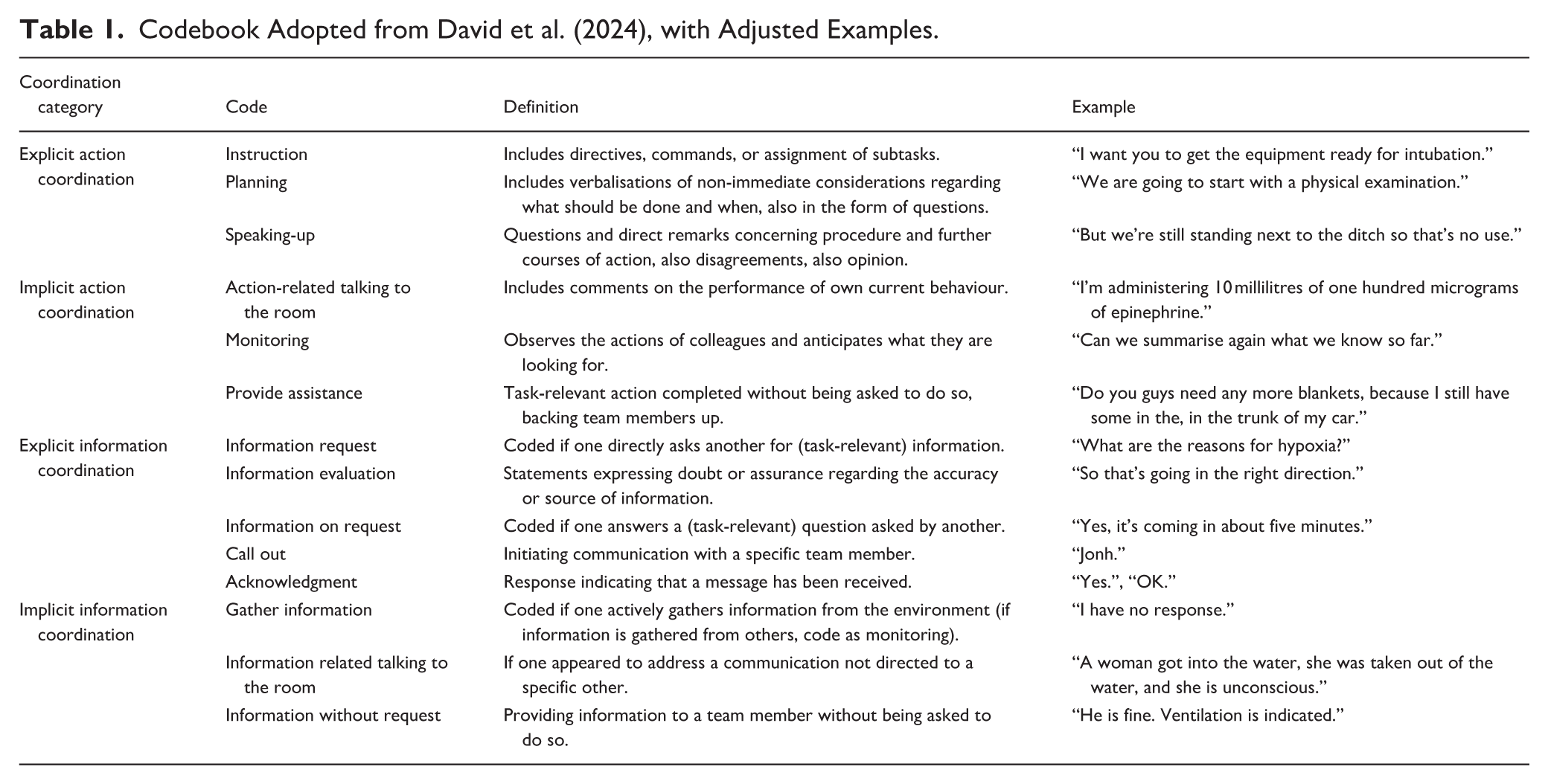
Coding was done using an Excel file, which included four columns with the team identification number, the actor speaking, the utterance spoken, and the assigned code. Utterances including two or more codes (e.g., an instruction followed by an information request) from the same actor were treated as different codes and placed in the sequential order in which they were presented in the transcript. To ensure inter-rater reliability, two researchers performed independent coding. One on the full dataset, and one on 50% of the data. The overall inter-rater agreement was good (Cohen’s kappa = 0.78; Cohen, 1960).
Data Analysis
Data Preparation
To perform the entropy analysis, each code first needed to be assigned an integer number. Code numbers ranged from 1 to 28, depending on whether the behaviour was exhibited by the leader of the team (assigned numbers 1 to 14, each number for each code of Table 1) or one of the follower members (assigned numbers 15 to 28, each number for each code of Table 1). Two Excel files were created, one for the First practice round and one for the Final assessment round. Both files included two columns, the Team ID (identifying the team number), and the Code ID, representing the behaviour exhibited by the team in a sequential order. Two analysis rounds were performed, one for before training and one for after training.
For the calculation of the entropy time-series and descriptive statistics, the software R was used (R Core Team, 2021), and we followed the procedure outlined by Wiltshire et al. (2018). The script was adjusted to the needs of the current research. All subsequent analyses were performed with IBM SPSS Statistics (Version 28; IBM Corp., 2021).
Sliding Window Entropy Analysis
Shannon information entropy is a measure of the order versus disorder exhibited by a system, based on a set of discrete states and associated probabilities for each state (Benslama & Mokhtari, 2017). The relative probability of a given coordination code, denoted as pi, indicates the occurrence likelihood of each code. Higher entropy signifies more disorder, while lower entropy corresponds to more order. The equation (1) for Shannon entropy is:

To capture fluctuations in the system’s state patterns over time, a sliding window calculation of entropy was employed, resulting in a continuous entropy time-series. The sliding window technique involved partitioning the communication data into consecutive segments of fixed length, referred to as the window size. Entropy values were then computed for each window to quantify the degree of uncertainty or randomness in communication patterns within that interval. By sliding the window along the time-series with a specified step size, we obtained a sequence of entropy values corresponding to different segments of the data.
Below are the main steps carried out in the analysis.
Determining a Window Size
To establish an optimal window size for our analysis, we employed the Average Mutual Information (AMI) metric across the time-series of each team. AMI serves to quantify the statistical interdependence between observations at various time lags, helping to quantify how much information about a team’s behaviour at a given time is provided by observing its behaviour at previous time points. The point where the AMI series exhibits its first local minimum signifies a decline in temporal dependency between observations, indicating that subsequent behaviours are less influenced by preceding actions.
Selecting this point as our window size allows us to capture pertinent temporal dynamics while mitigating the impact of past observations that offer diminishing informational value. By computing the AMI for each team’s data, we determined the lag corresponding to the first local minimum in each AMI series. Before training, the average lag for all teams was found to be 26 (SD = 20), indicating that a window size of 26 adequately captures relevant temporal patterns. After training, the average window size was 21 (SD = 10).
Entropy Calculation and Smoothing for Peak Identification
In the analysis before training, we applied a window size of 26 and step size of 1 to calculate entropy values for each team. Peak identification involved creating a binary time-series (1 = peak, 0 = no peak) based on criteria for a variable to be considered a peak: the current entropy value must be higher than the preceding (τ + 1) and lower than the following (τ − 1) entropy value (lead 1 and lag 1). For each team, a window of size 26 was slid across the sequence of datapoints with a step size of 1. In this way, the first entropy value was calculated for the first 26 datapoints, the next value for datapoints 2 to 27, and so on, up to the last possible window. Because the window size was 26, the last 25 time points did not have enough subsequent points to form a complete window. Thus, the length of the entropy time-series is reduced by 25, resulting in a final length of N-25. Appendix A (Figure A1) includes a simplified visual representation of sliding window entropy.
To enhance peak identification robustness, a moving average smoothing algorithm was applied to the entropy time-series, serving to reduce noise and highlight underlying trends by averaging out fluctuations within the data. After testing a variety of window sizes from 5 to 26, and noting how the average peak proportion changed, we applied the smoothing procedure with a window size of 7. The resulting continuous entropy time-series with an original window of 26 and step size of 1, and smoothing window 7, resulted in an entropy time-series of length N-31. The differences in entropy time-series before and after smoothing can be seen in Figure 2.
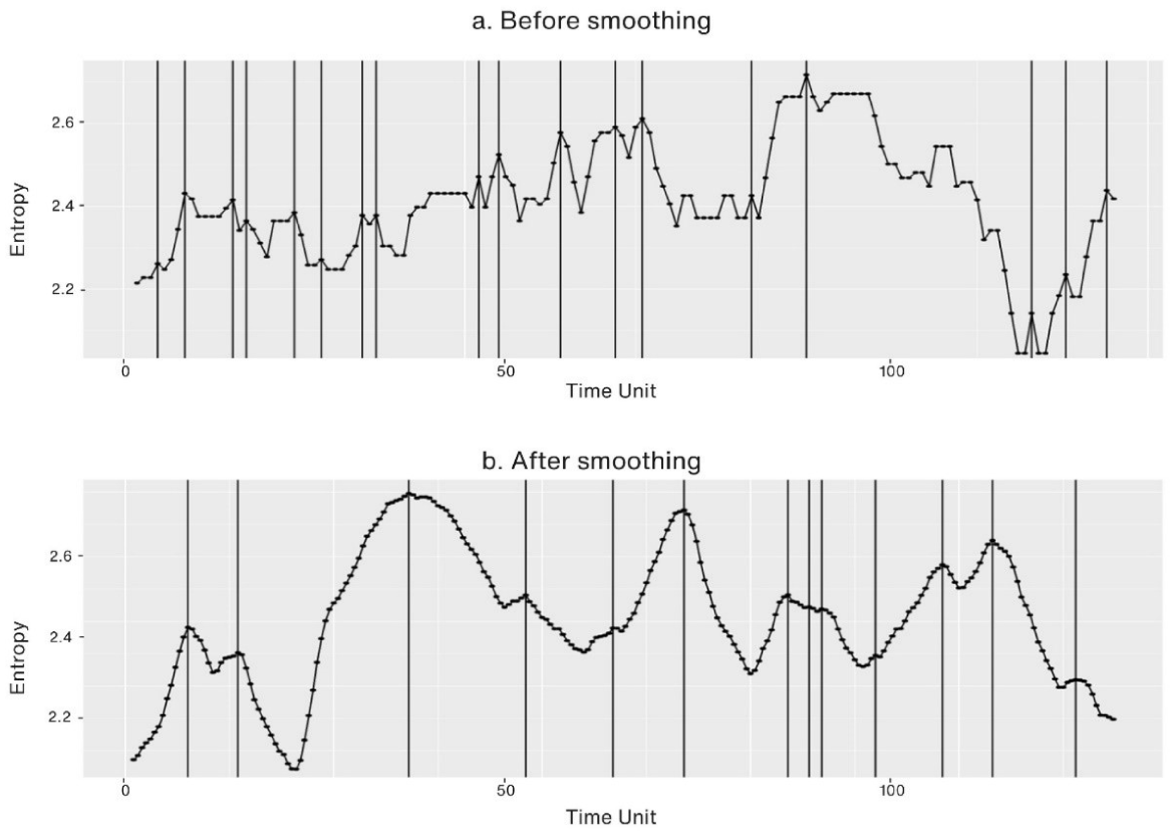
Entropy times series, example from single team. Vertical lines represent peak points: (a) original entropy time-series and (b) smoothed entropy time-series.
Note that after training, the same procedure was followed, with original window size 21, and moving window size of 11 for smoothing, resulting in entropy time-series of length N-30.
The periods in-between peaks that remained present after smoothing, each of varying length and entropy values, are referred to as epochs (Wiltshire et al., 2018).
Randomised Average Peak Point Entropy
We conducted a randomised average peak point entropy analysis to establish a baseline for comparison. This involved simulating expected entropy at peak points under random conditions. By comparing the observed average peak point entropy with its randomised counterpart, we assessed the significance of observed entropy values. In other words, the randomised average peak point entropy served as a reference point for evaluating the meaningfulness of the observed entropy patterns. We then conducted a paired samples t-test to verify that observed average peak point entropy values were lower than those of randomised average peak point entropy, validating the robustness of the peaks found.
Descriptive Statistics
We first calculated the median for team performance scores before training (Median = 2.5) and after training (Median = 5.25) to categorise teams as high-performing (equal to and above median) and low-performing (below median). For both sessions, four teams were classified as high-performing and five as low-performing.
Categorisation into Equilibrium and Ataxia Phases, Time-Series Plots and Behavioural Analysis
To explore the rhythm and composition of coordination restructuring before and after the training, we first categorised epochs into equilibrium and ataxia phases to be able to investigate how team shift between these two. We used two criteria for this categorisation: the length of the epoch and its entropy value. An epoch was considered an equilibrium phase if its length was greater than the team’s average epoch length and its entropy value was lower than the median entropy value in the observation period. Both criteria had to be met. For an epoch to be classified as an ataxia phase, its length had to be shorter than the average of all epochs. After our categorisation, we calculated the percentage of the time-series spent in equilibrium phases by adding up all the datapoints that constituted equilibrium phases in each time-series and dividing them by the total datapoints of the time-series.
For the rhythm of coordination restructuring, we explored the proportion of entropy peaks throughout the entropy-series, as these are indicators of phase transitioning (i.e., point of maximum unpredictability or complexity in the system and thus requiring the system to adapt; Kelso, 1990; Wiltshire et al., 2018). Note that peak proportions do not necessarily mean higher disorder in the time-series. On the contrary, it is indicative of the ability to restructure coordination from one phase to the next, as required by the environmental stressors, without this equating to remaining in ataxia for long.
As a first step in exploring the rhythm of coordination restructuring, we performed a visual analysis of the entropy-series for each team in a ranked order from highest to lowest performance score. Visual analysis is a necessary approach in phenomena that are highly complicated and highly variable (Kyndt & Aerts, 2022), such as coordination restructuring. Visual inspections of individual entropy time-series ensure that results are not only aggregated into unified wholes, and that all individual peculiarities are examined. The visual analysis enabled us to make some initial informed observations, which were followed by subsequent analysis.
In addition to the visual analysis, we ran a general linear model (GLM) with IBM SPSS Statistics (Version 28) to test the variable of peak proportion as a predictor of team performance before and after training. We should note that the GLM results should be interpreted with caution because of the low sample size.
To distinguish between peak proportion as a reflection of coordination restructuring and not of disorder, we also tested the relation between another variable and performance before and after training, that of the percentage of equilibrium (i.e., the percentage of the time-series that teammates spent in equilibrium phases). Equilibrium is an indicator of orderly coordination, where a higher percentage of time spent in equilibrium (i.e., time dominated by predictable ordered patterns) reflects increased order of team behaviours (i.e., predictable behaviour patterns). In other words, the higher the equilibrium percentage, the higher the orderly coordination. We also ran a GLM for the equilibrium percentage variable to test the predictive power of equilibrium percentage on performance before and after training.
To assess the composition of coordination restructuring, we calculated relative frequencies of coordination behaviours at play during the equilibrium and during the ataxia phases of high and low performing teams. We based the comparison of high and low-performing teams on the datasets of teams after training, since after completing training, the teams should have been sufficiently trained to demonstrate the necessary skills to adaptively manage the situation.
Results
The total number of data points before training was 1,720 (mean number of data points per observation period = 213) and after training 3,940 (mean number of data points per observation period = 452). The range of observed entropy values in the first round was 1.67 to 2.72 (Mean = 2.30, SD = 0.19) and for the final round 1.16 to 2.79 (Mean = 2.20, SD = 0.24). When examining the proportion of entropy peaks within the first found, 8.26% of the total number of data points was classified as peaks in entropy based on our criteria (prior to smoothing, the number of data points classified as peaks was 14.34%). For the final round, 5.54% of the total number of data points were classified as peaks in entropy (prior to smoothing, that was 11.84%). The proportion of peaks in the time-series ranged from 5.4% to 10.0% in the first round and 4.3% to 6.0% in the final round. These descriptive statistics indicate that each team exhibited robust peaks in their entropy time-series because: (a) a substantial portion of the data points exhibit peaks, indicating that peaks are not rare occurrences but are consistently present across the dataset, (b) despite some variation between teams, every team displays a notable proportion of peaks, indicating that their presence is a common characteristic across different teams, and (c) after smoothing, which reduces noise and decreases the number of detected peaks, around 6% to 8% of the data points was still classified as peaks, suggesting that the peaks are not merely noise but are meaningful features of the entropy time-series.
Rhythm of Coordination Restructuring and Performance, Before and After Training
Figure 3 presents the time-series data for all nine teams, rank ordered by their performance scores after training. Visual inspection of the final round reveals a higher rhythm of entropy peaks for the high-performing teams (above the median split) compared to the low-performing teams (below the median split). Additionally, these peaks are more evenly distributed throughout the observation period for the high-performing teams. In contrast, low-performing teams seem to exhibit longer-lasting equilibrium periods that are presented right next to one another, suggesting increased rigidity. Once teams enter ataxia, they either fail to reach equilibrium again (e.g., team 5) or take a prolonged period to enter equilibrium again (e.g., team 1, team 3). Notably, in the first round, the peaks for high-performing teams are denser at the beginning of the time-series, whereas for low-performing teams, the peaks are more evenly spaced throughout the period. This might indicate that experimentation with coordination processes at the beginning of interaction (through introducing ataxia) can help with developing better-suited team coordination throughout interaction.
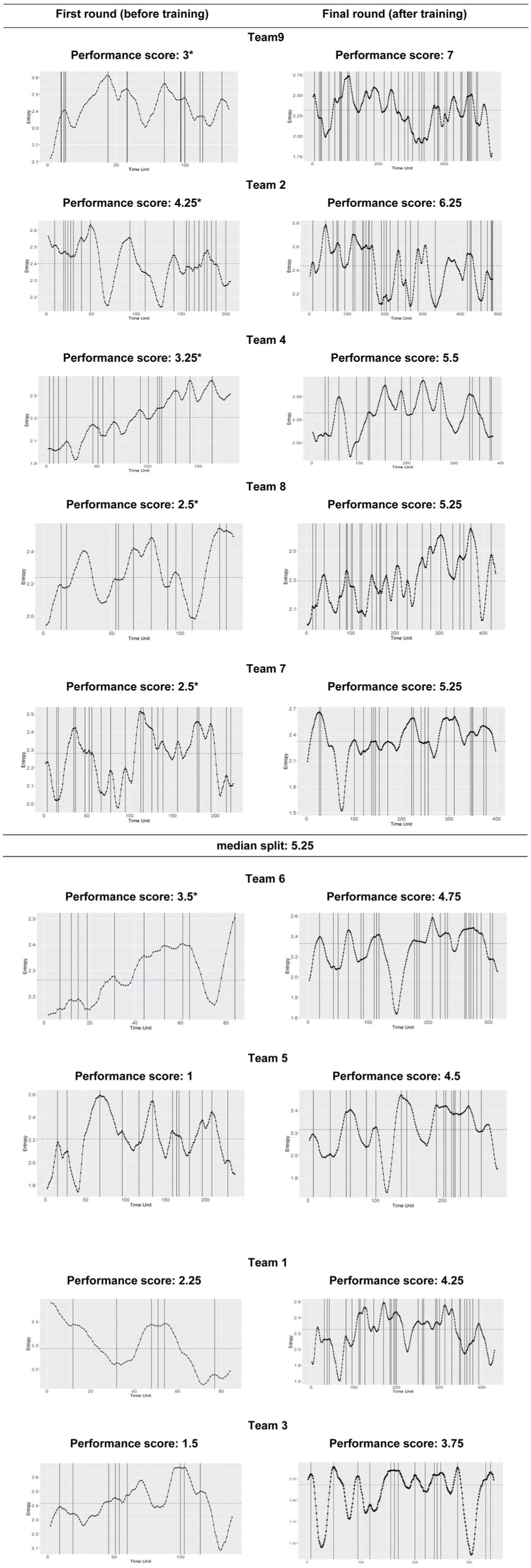
Time-series entropy of all teams, in rank-order based on their performance scores after training. x-axis represent entropy measures and y-axis represent the time-series datapoints.
To further explore the rhythm of coordination restructuring and its relation to performance, we illustrate their relationship using scatter plots. Figure 4 shows the relationship between peak proportion and team performance before and after training. We see here that in both rounds, the peak proportions positively correlate with the performance score. Teams that score higher tend to have a higher percentage of peak proportions relative to the observation period in their entropy time-series, and hence a heightened restructuring rhythm.
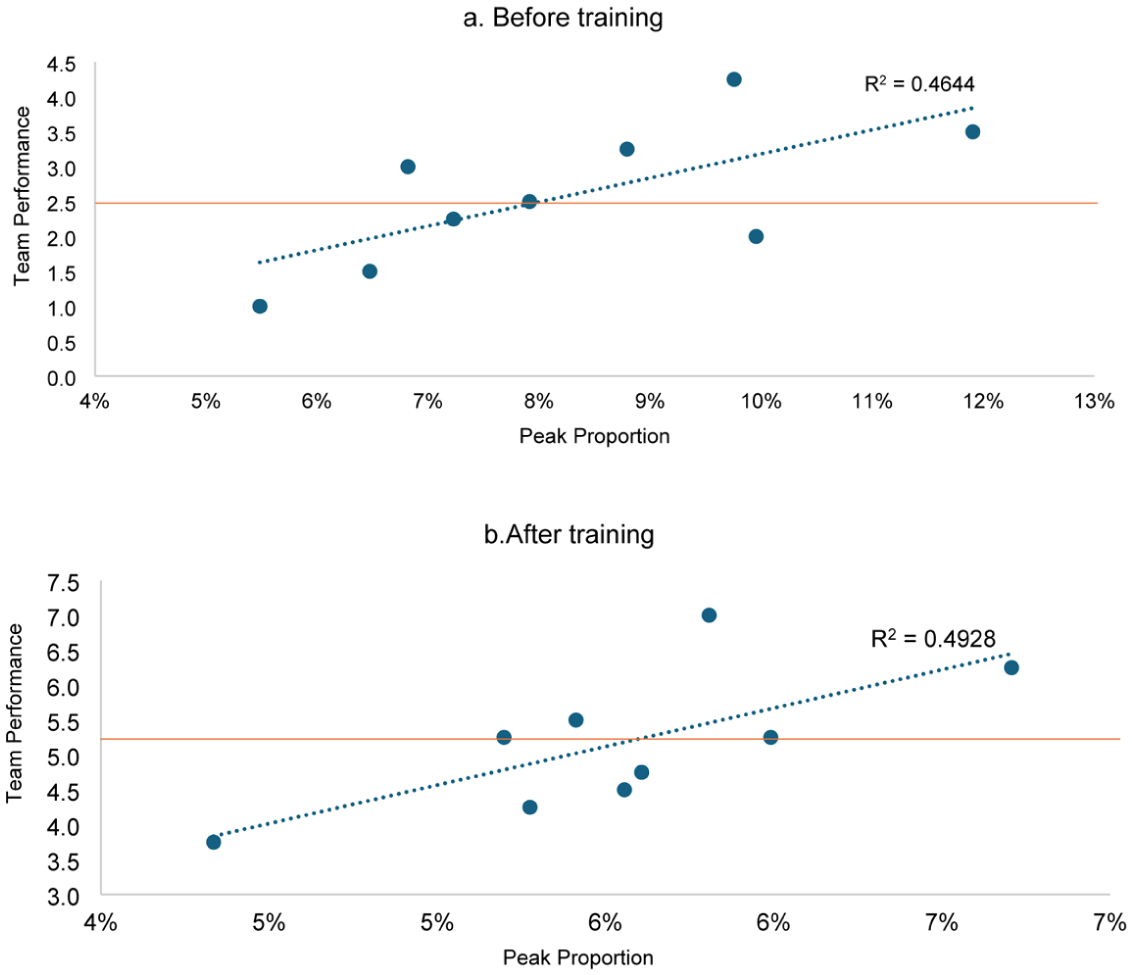
Relationship between peak proportion and performance score of every team: (a) before training and (b) after training.
The GLM analysis for peak proportion yielded significant results. Specifically, before training, the overall model was statistically significant (F(1, 7) = 6.07, p = .043, with an R2 = .464), indicating that 46.4% of the variance in team effectiveness was explained by the model. Peak proportion was a significant positive predictor of performance, b = 34.42, SE = 13.97, t(7) = 2.46, p = .043, partial η2 = .464. After training, peak proportion was also found to significantly predict performance. The overall model was significant (F(1, 7) = 6.80, p = .035, with an R2 = .493), indicating that the model accounted for 49.3% of the variance in team effectiveness. The regression coefficient for peak proportion was statistically significant b = 110.19, SE = 42.26, t(7) = 2.61, p = .035, partial η2 = .493.
Note that these results derive from a small sample size and should be interpreted with caution. The scatterplots and GLM results indicate that increased peak proportion leads to higher performance. This is also supported in the visual inspection, by the tendency of higher-performing teams to display increased number peaks throughout their time-series (and thus higher exploration). Interestingly, the variance explained before and after training does not change as much, indicating that increased peak proportion is as important of a predictor of higher performance levels before training as it is after training.
When testing for the equilibrium percentage variable (see Figure 5), before training, we see a slight negative relationship between equilibrium percentage and performance, although this finding is not significant. The effect of percentage spent in equilibrium on performance was not statistically significant (b = −0.29, SE = 0.14, t(7) = −2.04, p = .080, partial η2 = .213). After training, however, this relationship shifts, indicating a significant positive relationship between equilibrium phase percentage and performance. The overall model after training was significant (F(1, 7) = 4.17, p = .017 with R2 = .580), indicating that approximately 58% of the variance in performance was explained by the model. This suggests that an increased amount of orderly coordination leads to increased team performance. Equilibrium percentage was a significant positive predictor of performance (b = 0.29, SE = 0.14, t(7) = −2.04, p = .017, 95% partial η2 = .373).
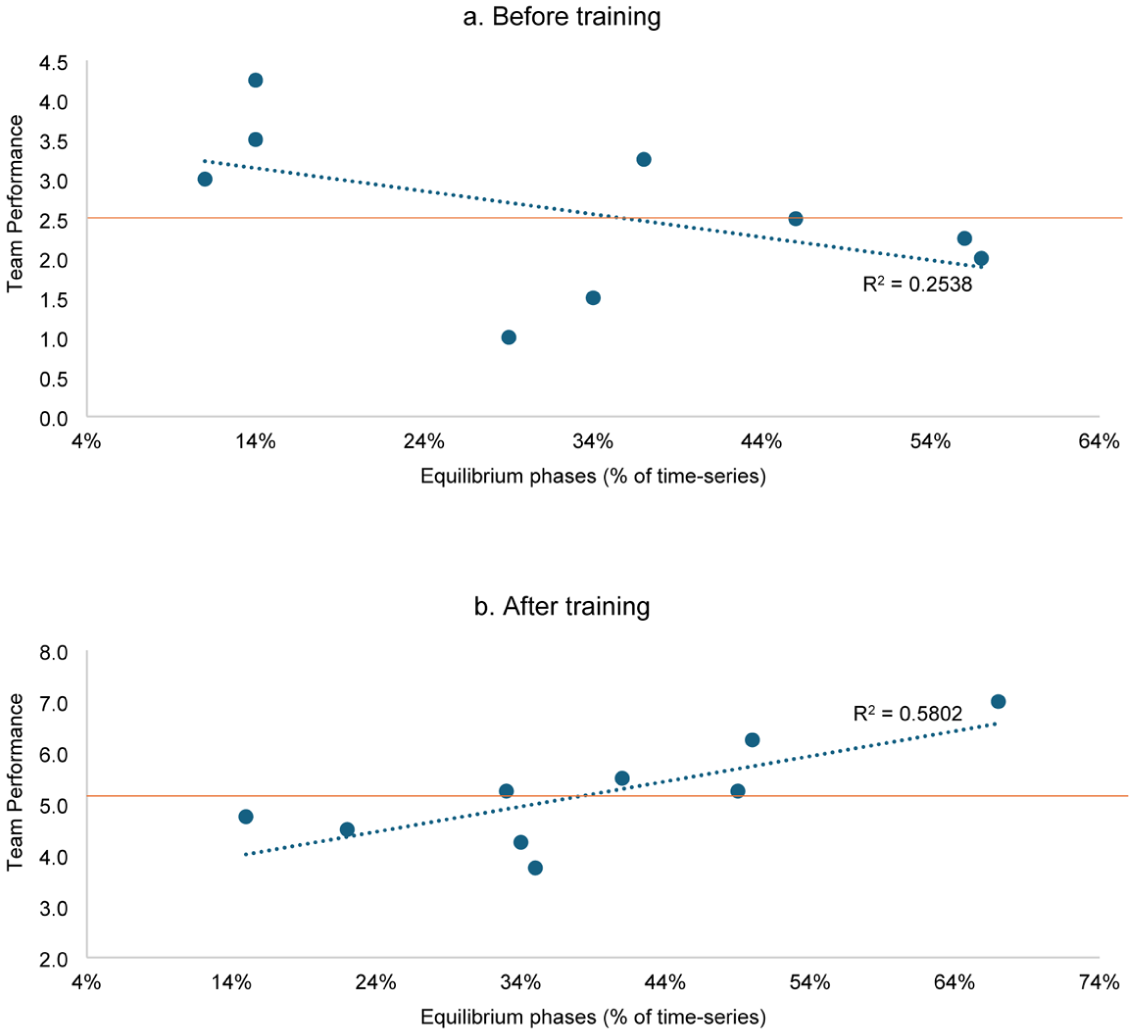
Relationship between equilibrium phases (% of the time-series) and performance score of every team: (a) before training and (b) after training.
Combining the findings from our two variables measured after training, an intriguing observation emerges: two seemingly contradictory trends coexist. On the one hand, a higher peak proportion, indicative of restructuring rhythm, is associated with better performance. On the other hand, a greater equilibrium percentage, reflecting orderly coordination, also correlates with improved performance. This suggests that coordination restructuring is far from being synonymous with disorder. Instead, heightened rhythm in coordination restructuring (i.e., transitioning and adapting coordination to task demands) enhances performance outcomes. At the same time, an elevated degree of order further boosts team performance, underscoring that effective restructuring is intrinsically linked to orderly coordination.
Comparing the results before and after training, it seems that while the rhythm of coordination restructuring (peak proportions) remains important before training, the amount of orderly coordination (equilibrium percentage) during the initial stages of training is not as important before training as it is after training.
Composition of Coordination Restructuring: Relative Frequencies of Coordination Behaviours of High and Low-Performing Teams
Regarding the composition of coordination restructuring, we compared high and low-performing teams in terms of the behavioural composition of their equilibrium and ataxia phases (see Figure 6). The first notable difference concerns the higher overall relational frequency in the behaviours of high-performing teams in both phases, suggesting that specific behaviours dominate the team activity more strongly than in low-performing teams, who display lower overall relational frequencies, indicating a more dispersed use of behaviours.
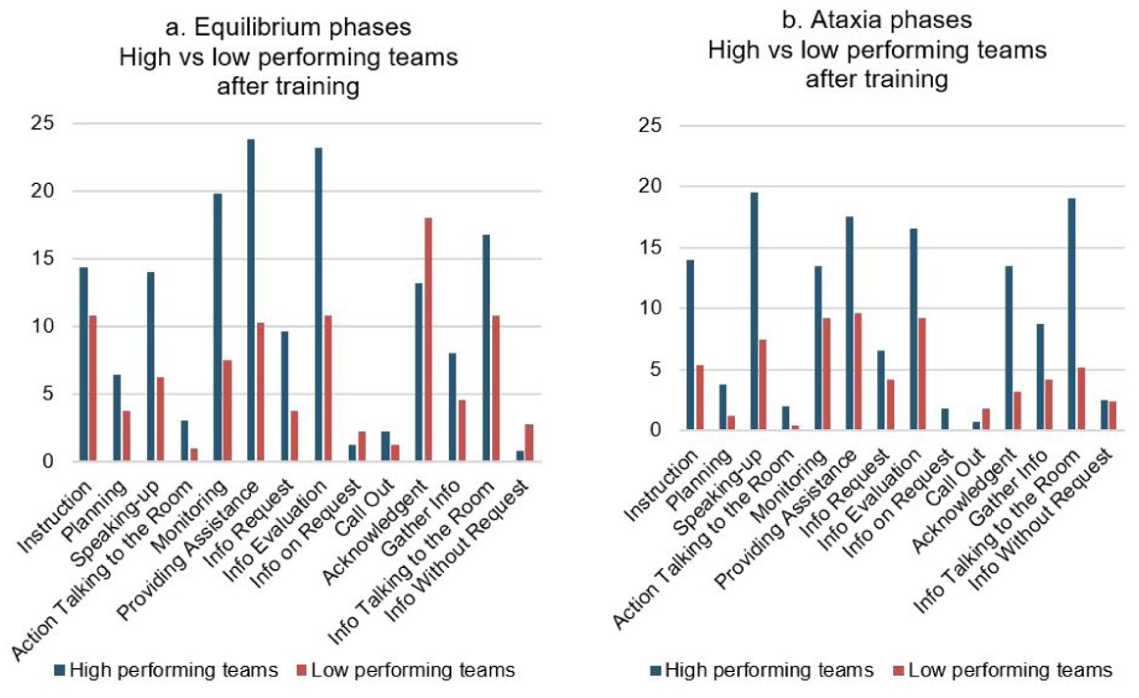
Behaviours (relative frequencies) of high-performing (blue) and low-performing teams (red), for (a) equilibrium phases and (b) ataxia phases.
Further, in equilibrium phases, high-performing teams display increased frequencies of implicit action coordination behaviours (e.g., monitoring, providing assistance) and explicit information coordination (e.g., information evaluation) as compared to the low-performing teams. For low-performing teams, acknowledgement seems to dominate, possibly revealing an over-reliance on leadership.
In ataxia phases, high-performing teams were found to maintain their use of acknowledgement, indicating a tendency to maintain a standardised coordination protocol even during periods of disorder, while low-performing teams dropped from 17% to only 3% of acknowledgement behaviours. Further, in ataxia, high-performing teams maintain high frequencies of giving instructions, as compared to the low-performing teams, where instruction behaviours drop to under 5%. This indicates that directive behaviours are important to navigating through disorder. Lack of dominant behaviours indicating initiative (e.g., speaking up, information talking to the room) in low-performing teams as compared to high-performing teams may suggest a decreased ability and willingness to use ataxia phases to explore, extend and reconstruct their repertoire of behaviours and understanding of the situation.
Discussion
This study aimed to explore coordination restructuring in high and low-performing teams before and after training by applying a sliding window entropy technique. A sample of medical emergency teams was followed over the course of an Advanced Life Support training for 8 weeks, enabling longitudinal comparison of how the teams altered their coordination restructuring during training, under “normal-work” in a high-risk environment. Specifically, we explored the rhythm of coordination restructuring and its relation to performance before and after training, and the differences in the composition of coordination restructuring between high and low-performing teams. Our findings revealed that high-performing teams exhibited a higher proportion of entropy peaks, indicating a greater rhythm of coordination restructuring, which was significantly correlated with better performance outcomes. This suggests that the more teams restructure, the better their performance. Additionally, the percentage of time teams spent in equilibrium phases, reflecting orderly coordination, showed a shift in its relationship with performance, from a slight negative correlation before training to a significant positive relationship afterwards. This finding highlights the dual necessity of both frequent dynamic coordination restructuring as well as overall maintenance of orderly coordination in fostering high team performance. In other words, while teams seem to benefit from their ability to frequently “break” existing stable coordination patterns and enter a phase of disorder and exploration, they also need to regain stability through entering a new equilibrium phase quickly. Such findings provide empirical support to notions that order and disorder, and stability and flexibility strengthen each other (Grote et al., 2018; Schraagen, 2011).
Furthermore, our analysis of the behavioural composition of equilibrium and ataxia phases showed that high-performing teams demonstrate a concentrated use of behaviours, particularly implicit action coordination and explicit information coordination during equilibrium phases, suggesting a more targeted and efficient approach to coordination than low-performing teams. In contrast, low-performing teams exhibited dispersed behaviours, reflecting uncertainty and lack of targeted behavioural coordination. Notably, during ataxia, high-performing teams sustained directive behaviours, like giving instructions and maintaining acknowledgement behaviours, underscoring their ability to adapt while adhering to standardised protocols (David et al., 2024; Schraagen, 2011; Van den Oever & Schraagen, 2021). They also show an increase in speaking-up, monitoring, and acknowledgement behaviours, indicating a strong effort to rebuild situational awareness and coordination (Sorensen & Stanton, 2015) and aligning with existing findings on the importance of exploratory coordination (Waller et al., 2004; Woolley, 2009). This contrasts with low-performing teams, whose limited initiative and directive actions may hinder their capacity for exploration and adaptation.
Theoretical Contributions
Our findings on the duality between increased rhythm of coordination restructuring and prevalence of orderly coordination as predictors of performance are in line with previous research suggesting that the interplay between stability and flexibility is crucial for adaptive coordination (Grote et al., 2018; Schraagen, 2011). This further aligns our empirical findings as a bridge to understanding long-standing theoretical constructs such as adaptive coordination (Kleinman & Serfaty, 1998) that have been criticised for rarely indicating what exactly adaptiveness consists of (Grote et al., 2018; Maynard et al., 2015). Our findings indicate that the rhythm of coordination restructuring is an important facet guiding team resilience in normal work conditions. Further, the results on the composition of coordination restructuring offer important insights into specific behavioural patterns that exist in equilibrium and ataxia phases, as well as how differences in these patterns relate to performance. These findings are crucial in clarifying the nature of adaptiveness within coordination restructuring, marking it an important mechanism of team resilience.
The utilisation of sliding window entropy measures to capture rhythm changes further suggest that entropy-based measures can provide deeper insights into team functioning and resilience mechanisms (Ricca et al., 2019; Wiltshire et al., 2018). Although recent research has begun applying sliding window entropy to study dynamic changes in team communication (Engome Tchupo & Macht, 2023; Ricca et al., 2019; Wiltshire et al., 2018), no study to our knowledge has utilised entropy time-series to capture rhythm of coordination restructuring as this is manifested in the recurrence of phase transitioning between equilibrium and ataxia.
Importantly, our findings align with CAS theory, which conceptualises teams as non-linear, multi-stable, and self-organising entities (Hancock, 2023; Pype et al., 2017; Ramos-Villagrasa et al., 2018). By examining how teams oscillate between equilibrium and ataxia, we demonstrate how CAS properties, such as emergent order, adaptation, and multi-stability, manifest in real-time coordination processes. High-performing teams’ frequent transitions between order and disorder, combined with purposeful behavioural patterns, illustrate how adaptive capacity emerges and self-organises from interdependent interactions rather than individual actions, reinforcing the CAS perspective. Low-performing teams, in contrast, exhibit less structured coordination and weaker behavioural alignment, reflecting reduced adaptive capacity and less effective self-organisation.
Our results also point out that while before training the rhythm of orderly coordination does not significantly correlate to performance, this changes after training. These findings suggest that utilising orderly coordination and transitioning between equilibrium and ataxia is learned through training, in line with previous findings supporting that perturbation training increases resilience (Gorman et al., 2019; Grimm et al., 2023). They further infer that training at its initial stages should reinforce ataxia phases, to offer chances for exploration, while training at later stages should promote increased orderly coordination as well as increased transitioning between equilibrium and ataxia.
Our findings align with the concept of metastability, used to define teams that oscillate between stable coordination patterns and periods of instability, and support previous views that such metastable coordination is optimal for team performance (Demir et al., 2019; Gorman et al., 2012; Summers et al., 2012; Uitdewilligen et al., 2018). Interestingly, beyond merely linking metastability to performance as previous literature has done, we demonstrated how this metastability manifests throughout the teams’ time-series, and how order (equilibrium) and disorder (ataxia) interconnect. By doing so, we integrated previous classifications of teams as metastable, rigid, or unstable (Demir et al., 2019) into the temporal mechanism of coordination restructuring, reflected in the phase transitions between equilibrium and ataxia.
Through this research, we aim to offer a stepping stone to resolving the paradox of “almost totally safe” systems (Amalberti, 2001; Reason, 2000). Literature on system robustness emphasises preparing for disturbances by modelling, understanding, and training for a wide range of possible scenarios (Alderson & Doyle, 2010; Carlson & Doyle, 2002; Woods, 2018). However, even with comprehensive modelling of numerous potential disturbances, the possibility of an unforeseen scenario leading to system collapse remains. Training teams for robustness by equipping them to handle only a handful of disturbances may inadvertently increase the system’s vulnerability to other types of events (Woods, 2015). Moving beyond merely modelling and training for a standardised set of possible event scenarios, as done in robust system design practices (Woods, 2015, 2018), our methodological approach views resilience as a process that is incorporated in normal work practices, informing future training to emphasise system design for resilience.
As evidenced in the current findings, oscillations between order and disorder reflect the process of shifting from an established repertoire of behaviours to a new one, based on the demands of the situation. This aligns with existing theoretical views on resilience (Amalberti, 2001; Christian et al., 2017; Hollnagel et al., 2021; Reason, 2000; Schraagen, 2011), and can further be used to support the conceptual framework of startle and surprise (Landman et al., 2017), which supports that training should involve the element of unexpectedness. Incorporation of unexpectedness in training helps avoid reflexive, startle responses that disrupt logical and ongoing thought and reaction processes. Rather, surprise is practised as a reaction, which involves the violation of expectations without blocking analytical cognitive processes. Therefore, teams learn to react more deliberately by assessing the surprising events and adjusting their behaviours accordingly. Sliding window entropy measures can be used to empirically measure startle and surprise responses, capturing the shifts in behavioural order and disorder that accompany such moments.
Designing for resilience could potentially involve focusing on the rhythm of transition between equilibrium and ataxia phases, and promoting the incorporation of particular behavioural patterns that support guided exploration and help bounce back to equilibrium after ataxia. We therefore move from an abstract reference to adaptive repertoire functions, to a measurable, specified mechanism that can facilitate team resilience: coordination restructuring.
Practical Implications
In line with current findings, designing for resilience may include training that focuses on helping teams navigate equilibrium and ataxia phases to enhance their adaptive responses, as this helps them to prepare for handling disruptions. This aligns with the theoretical assertion that training should not only build stable coordination skills but also foster the ability to dynamically adjust coordination processes in response to evolving challenges (Grote et al., 2018; Kolbe et al., 2014).
This dynamic adjustment is important because non-technical skills (NTS) training, such as leadership and communication of inquiry, information sharing, or evaluation of plans, has been found to improve CPR performance and can help teams navigate effectively through these phases (Farquharson et al., 2024). Randomised clinical trials have found that paying attention to such non-technical skills and focusing on human instead of technical errors resulted in the teams displaying more behaviours such as information sharing or evaluation of plans during simulated resuscitations (Thomas et al., 2007, 2010). However, NTS training interventions remain sub-optimal, while most resuscitation training typically emphasises adherence to standardised protocols and focuses primarily on individual roles and stepwise execution of resuscitation procedures (Hunziker et al., 2011). We suggest three key ways in which team training processes can be adjusted to introduce this flexibility in coordination:
Shifting Briefings from Checklists to Disruption Preparedness
Resilience-oriented training can begin even before teams enter the simulation environment of the emergency room, in pre-scenario briefings, by prioritising NTS and highlighting coordination flexibility. Framing teamwork as a collaborative, adaptive process rather than linear task execution helps teams anticipate the need for exploration, joint problem-solving, and continual adjustment under uncertainty (Klein et al., 2006; Kolbe et al., 2014). For instance, explicitly discussing how communication structures may shift during disruption, or how role boundaries might become temporarily blurred, primes teams to approach coordination with a mindset of collective adaptability.
Training interventions that incorporate such elements of adaptability and uncertainty preparedness have been associated with greater openness to feedback, increased team monitoring, and enhanced information exchange; all core NTS components that are essential in resuscitation contexts (Farquharson et al., 2024; Salas et al., 2008). Moreover, such briefing practices normalise temporary coordination breakdowns, reduce cognitive load associated with perceived failure, and facilitate rapid restructuring, enabling teams to balance equilibrium and ataxia as natural parts of complex work (Grote et al., 2018).
Incorporating Perturbations in Training Scenarios to Practice Flexible Coordination
To cultivate resilience and promote adaptive coordination processes, simulation-based training should deliberately introduce perturbations, that is, unexpected clinical changes, role ambiguity, conflicting goals, or communication failures, to challenge coordination structures (Gorman & Cooke, 2010; Grimm et al., 2023). These perturbations can force teams to engage in dynamic sensemaking and restructure their coordination patterns as needed. This approach aligns with the view that adaptive expertise is cultivated not by repetition of routine but by exposure to variability and uncertainty (Gorman et al., 2010; Woods & Hollnagel, 2006). Perturbations allow teams to recognise early signs of ataxia and engage in exploration behaviours (e.g., speaking up, adjusting communication) to restore and change their functional equilibrium, strengthening behavioural flexibility needed for resilience.
Evaluation, Feedback, and Debriefing using Coordination Metrics (Captured through Sliding Window Entropy
As seen in this study, entropy analysis allows for real-time mapping of coordination restructuring rhythm and quantification of time spent in equilibrium. These metrics can serve as specific, measurable feedback points following training, enabling instructors to highlight areas for improvement, such as raising teams’ awareness of their coordination rhythm and balance in equilibrium. Feedback could also address behaviours aiding transitions from ataxia to equilibrium, such as implicit actions (e.g., monitoring, providing assistance) and explicit information coordination (e.g., information evaluation), which correlate with better performance, or maintaining directive behaviours to navigate disorder and encourage dominant behaviours (e.g., speaking up, sharing information) to support exploration during ataxia phases.
Finally, effective NTS training requires evidence-based feedback and debriefing, by capturing and discussing observable behaviours rather than abstract items. For example, current NTS practices are evaluated based on abstract checklist items such as “Is everyone adjusting to meet the demands of the situation?” (Bearman et al., 2023). Based on our findings, evaluation metrics could include quantifiable elements such as rhythm of restructuring, proportion of entropy peaks, and time spent in equilibrium, allowing trainers to set specific targets and evaluate performance empirically. For the incorporation of such metrics, more research would be required to focus on specific entropy peak proportion “cut-offs” according to existing training procedures, or a range of desired amount of time to be spent in equilibrium.
We note that the training received by the teams in this study was not explicitly designed to support coordination restructuring as outlined in the suggestions above. Based on our analysis, we argue that incorporating these three adjustments in training processes could help all teams move beyond rigid patterns and develop a stronger rhythm of coordination restructuring as they mature, a developmental trend observed only in some of the teams in the current study.
Limitations and Future Research
Our study represents an initial effort to visualise the process of coordination restructuring as a mechanism of resilience. Although our methodology provides a way to study coordination restructuring, our research findings and quantitative results are drawn from a small sample of teams. To thoroughly deconstruct coordination restructuring and the composition of equilibrium and ataxia phases, data from a larger sample of teams is necessary. As our research outlines the methodological steps, we encourage future researchers to follow these steps to fully elucidate the rhythm and composition of coordination restructuring. Also, by utilising other digital tools (e.g., see David et al., 2022 for a review), researchers can apply the AMM framework to larger and more diverse samples to investigate coordination restructuring more comprehensively. More robust findings can more comprehensively inform design for resilience in training.
It is important to note that this study conceptualised coordination using the AMM framework, which focuses on communication behaviours involving the layers of actor, message, and mode of coordination. However, coordination can encompass a broader range of behaviours within these layers, including non-verbal communication, such as interaction with technological equipment (de Souza et al., 2024), as well as other actors, such as synthetic agents (Demir et al., 2019; Lematta et al., 2019). Moreover, the multidisciplinary nature and versatility of entropy make it a valuable analysis method applicable to a wide array of behaviours and actors. This makes entropy particularly useful for understanding complex human-human systems and human-autonomy teaming. We encourage research to use sliding window entropy to investigate coordination restructuring by incorporating additional units of analysis.
With regards to the nature of our analysis, we identify a limitation in capturing or mitigating the effects of other, potentially mediating variables. We understand that performance improvements are not the only result of coordination restructuring but may also be influenced by factors such as prior experience, individual skill development, team composition, or contextual conditions. While the current research adopted a team-level approach and analysis, we acknowledge the importance of individual-level aspects that might affect both training outcomes and team performance.
Conclusion
This study advances the theoretical understanding of coordination restructuring by emphasising the dual importance of rhythm in restructuring and maintaining orderly coordination. It challenges traditional views that equate rigid protocols with effective coordination, highlighting instead the importance of maintaining stability, while still utilising moments of exploration of different coordination patterns to meet changes in the task environment. Our study provided a strong conceptualisation of coordination restructuring as a temporal mechanism for resilience, bridging temporal notions of rhythm (Bartunek & Woodman, 2015; David et al., 2021) and changes in behavioural composition to its empirical investigation.
Footnotes
Appendix A

Ethical Considerations
The study was conducted in accordance with ethical standards and received approval from the Ethics Committee of the University of Twente for both the initial data collection and the use of the secondary dataset. Approval for use of the secondary dataset (Approval No. 201161) was granted in December 2020.
Consent to Participate
Written informed consent was obtained from participants during the initial data collection, explicitly acknowledging rights regarding data reuse, the anonymisation of data for publication, and compliance with GDPR regulations.
Funding
The authors received no financial support for the research, authorship, and/or publication of this article.
Declaration of Conflicting Interests
The authors declared no potential conflicts of interest with respect to the research, authorship, and/or publication of this article.
Data Availability Statement
The data supporting the findings of this study are not publicly available due to their sensitive nature. Specifically, the data consist of observational videos involving human research participants, which pose a risk of reidentification if shared openly. To protect participant privacy and ensure compliance with the General Data Protection Regulation (GDPR), the data are securely stored in an encrypted repository at the University of Twente. Access to the data is restricted and can only be granted upon reasonable request, subject to the approval of the University’s Ethics Committee and in accordance with GDPR requirements. Researchers seeking access must submit a detailed proposal outlining the purpose of data use. The request will then undergo an additional ethical review to ensure adherence to legal and ethical standards.