




Abstract
Framed in trait activation theory, we examine the influence of personality, psychological safety, and the mediating effect of speaking time on team member effectiveness ratings in team meetings with 21 student teams (110 individuals). Extraversion was positively related to speaking time and indirectly related to team member effectiveness via speaking time. Although psychological safety was not related to speaking time, it was positively related to team member effectiveness. No significant effects were found for emotional stability. This work provides theoretical rationale and empirical support for the traits and behavior in team meetings that influence ratings of team member effectiveness.
Meetings—prearranged gatherings of at least two people to discuss work-related topics (Rogelberg et al., 2006)—not only help teams make decisions, set goals, and share information, but also provide opportunities for team members to form impressions about one another while developing important work and interpersonal networks (Lehmann-Willenbrock et al., 2020).
These impressions are determinants of individual and team success (Kauffeld & Lehmann-Willenbrock, 2012; MacLaren et al., 2020) and when individuals actively engage and contribute during team meetings, other team members are more likely to view them favorably (Nikoleizig et al., 2021). For example, during a team meeting, some team members may frequently express their ideas and ask questions, leading others to see them as more competent (Li et al., 2019). However, not all team members engage equally during meetings. Some team members may remain quiet, either because they are naturally reserved or because they do not feel comfortable speaking up. This lack of participation may lead others to perceive them as disengaged or less capable, even if they are knowledgeable or invested in the meeting (Di Salvo et al., 1989; Li et al., 2019).
Drawing upon trait activation theory (Tett & Burnett, 2003) we investigate why some individuals engage more than others during team meetings and how that engagement shapes team member perceptions. Trait activation theory proposes that personality traits are latent potentials expressed (e.g., through active engagement in team meetings) when environmental cues activate situation-relevant traits. Grounded in this framework, we pursue answers to the following research questions: What are the individual and contextual antecedents of active engagement in team meetings, and how does this engagement affect the way team members are perceived?
The individual-level traits we examine are extraversion and emotional stability, as they have been found to positively relate to perceptions of team member contributions (Barrick & Mount, 2009; Bell et al., 2018; Liu et al., 2014). The environmental cues of interest in the current study are the project-related discussions among team members during team meetings, and particularly, individual team members’ perceptions of how psychologically safe they are in those meetings (i.e., how safe they are to take interpersonal risks; Edmondson, 1999). We focus on perceptions of psychological safety as a contextual variable because active engagement in teams has been found to be a function of team members’ perceptions of whether their ideas will be met with acceptance or derision (Sherf et al., 2021). Importantly, we not only consider the main effects of individuals’ personality traits and the context of psychological safety, but also their interaction. In other words, we examine whether individuals are more likely to express their traits (i.e., by speaking up) when the environment signals that it is safe to do so.
Our study focuses on student teams working on authentic open-ended complex projects as part of their coursework (i.e., authentic project-based learning; Beier et al., 2018). These teams comprised interdependent individuals working toward a common goal without an assigned leader (Sundstrom et al., 1990). Analyzing individuals within teams, we focus on whether perceptions of psychological safety are related to trait expression of extraversion and emotional stability by actively participating in meetings. As have others, we use speaking time during meetings as an objective measure of active engagement (Nikoleizig et al., 2021; Pentland, 2004).
The current study contributes to the literature in two important ways. First, despite research suggesting that perceptions of psychological safety may be differentially beneficial to individuals depending on personality traits (Sherf et al., 2021) and calls for research on the interaction of personality and psychological safety (Newman et al., 2017), research examining the interaction of personality traits and perceptions of psychological safety have been sparse (Edmondson & Mogelof, 2006). Therefore, understanding when psychological safety may influence trait expression can provide insight into when employees speak up or remain silent about important issues. By using trait activation theory as a framework, our study contributes to a body of research that examines the effects of traits, perceptions of the context of team meetings, and appropriate interactions on behavior within team meetings and peer ratings of team member effectiveness. Second, within the trait activation framework (Tett & Burnett, 2003), we use an objective assessment of individual team member activity and engagement (i.e., speaking time) in a field study. Although the use of speaking time to operationalize activity and engagement in team meetings is increasingly common (MacLaren et al., 2020; Nikoleizig et al., 2021), much of this work has captured team interactions in laboratory contexts using relatively circumscribed and artificial tasks. Although these studies are useful for understanding the validity of speaking time as a measure of activity, laboratory environments represent relatively strong situations that may not lend themselves to the study of individual differences (Weiss & Adler, 1984). The field-based nature of the current research—that is, teams working on an authentic, complex, and open-ended problem in teams over an extended period of time—permits us to better examine the effect of personality traits on activity and team-member effectiveness ratings in a more generalizable way.
Trait Activation Theory
Personality is an important predictor of an array of outcomes in organizational science, and it has been extensively studied at both the team and individual levels (Barrick & Mount, 1991; Bell et al., 2018). Similar to the development of the big five personality traits (Goldberg, 1992), most research on the relationship between personality and organizational outcomes has been atheoretical and empirical in nature, resulting in an inventory of which traits are related to which outcomes (e.g., conscientiousness is related to job performance across most jobs; extraversion is related to success in sales jobs; Barrick & Mount, 1991) without explanation of the mechanisms underlying these relationships. Trait activation theory provides a theoretical lens for understanding why certain personality traits are more or less relevant for predicting behavior depending on the potential of a situation to facilitate or constrain the expression of personality traits (Tett & Burnett, 2003).
According to trait activation theory, personality traits affect work behavior both directly, when an individual’s traits are relevant to job demands, and indirectly through cues for trait expression that are provided in the work context (Tett & Burnett, 2003). According to the theory, cues relevant to work contexts serve to facilitate or impede work-relevant behavior both directly, such as when situations are strong (e.g., a team meeting requires social interaction), and through an interaction with an individual’s personality traits (e.g., a team creates a safe meeting environment that facilitates activity from those who may be wary to participate).
We identified extraversion and emotional stability as the personality traits most relevant to the current study based on a review of the literature on personality traits and team behavior (Bell et al., 2018) that reported that extraversion (i.e., talkativeness and sociability), agreeableness (i.e., empathy and caring), and emotional stability (i.e., reversed neuroticism; Goldberg, 1992) were related to positive team interactions. This review also identified extraversion and agreeableness as related to information sharing within teams. In addition, agreeableness was independently related to team cohesion and positive affect within teams (Bell et al., 2018). Because team cohesion and positive affect were not focal constructs in the current study, and because agreeableness was essentially redundant with extraversion and emotional stability in its prediction of the outcomes in which we are interested (positive team interactions and information sharing), we chose to focus on extraversion and emotional stability to simplify our model. In particular, we were interested in how the team-meeting context provided cues for the trait expression of extraversion and emotional stability on team member engagement in team meetings (operationalized as speaking time), how perceptions of psychological safety moderated the effect of emotional stability on speaking time, the main effect of psychological safety on speaking time, and the main effects of psychological safety, speaking time, and personality on ratings of team member effectiveness (Figure 1).
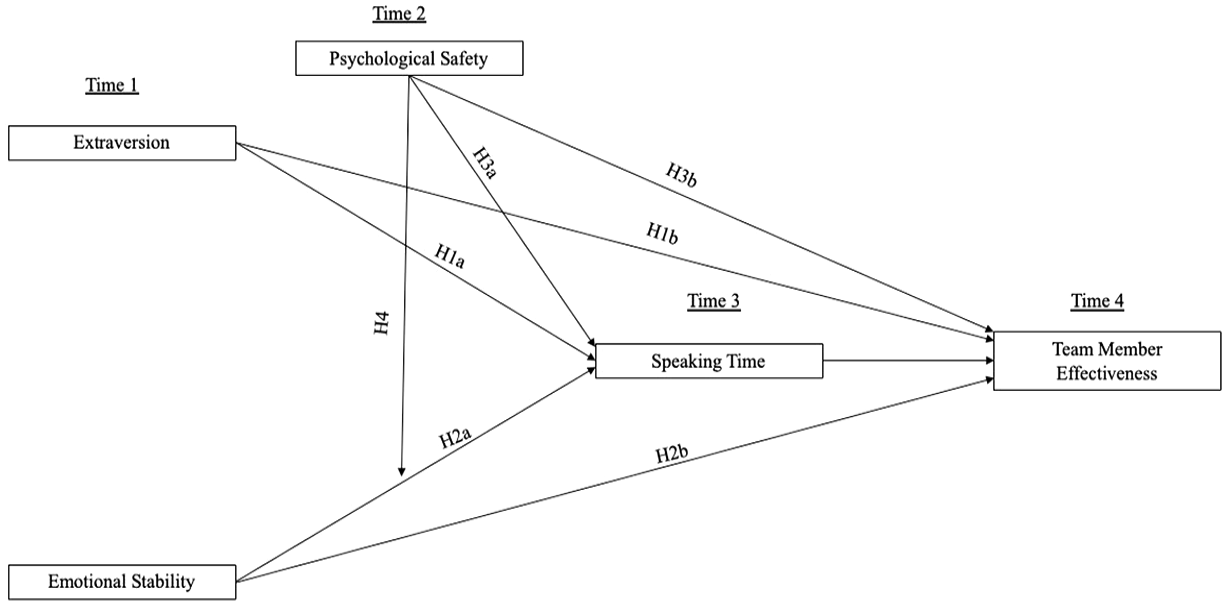
Conceptual model.
Speaking Time
The amount of time a person speaks can play an important role in impression formation (Bonaccio et al., 2016). For example, in an employment negotiation simulation study with graduate students, Curhan and Pentland (2007) found that speaking time within the first 50 min of the negotiation was positively related to how well students did in the exercise. Frauendorfer et al. (2014) also conducted a hiring simulation with a community sample and found that, controlling for age and gender, applicant speaking time was positively related to perceptions of hireability rated by professional recruiters. In teams, the quantity of communication during team meetings can signal a person’s level of interest and demonstrate engagement (Pentland, 2004), which is a key part of teamwork processes (Prewett et al., 2009). Specifically, research on problem-solving in student teams found that speaking time was positively related to leadership emergence and peer-rated performance even when controlling for task-related competence (MacLaren et al., 2020; Nikoleizig et al., 2021).
As a corollary to these findings, research also suggests that the lack of speaking time can lead to negative impressions. Using a qualitative critical incident technique to understand the experiences of employees across multiple private and public sectors in meetings, Di Salvo et al. (1989) found that other team members perceived the nonparticipation of one team member to be a volitional lack of effort, either stemming from personality differences or avoidance of responsibility, which was identified as one of the most frequently reported dysfunctions within groups (Di Salvo et al., 1989). Furthermore, when people perceive a lack of participation in team meetings by other team members, they are likely to be less satisfied with such meetings and perceive those meetings to be ineffective (Odermatt et al., 2018). Like Pentland (2004), the current study examines speaking time as an indicator of a team member’s level of activity in the team meetings and a reflection of their participation and engagement.
Team Member Effectiveness
Loughry et al.’s (2007) framework of team member effectiveness is comprised of five facets: contributing to the team’s work; interacting with teammates; keeping the team on track; expecting quality; and having relevant knowledge, skills, and abilities. Based on this framework, an effective team member possesses not only the relevant knowledge, skills, and abilities to accomplish the tasks at hand but also successfully interacts with teammates through coordination, cooperation, and communication with their teammates (Delice et al., 2019). When teams have effective members, they not only have better performance (Ohland et al., 2012) but higher levels of viability relative to teams with less effective team members, such that these team members would be more likely to want to work with their teammates in the future (Thomas et al., 2020). These findings suggest that the long-term success of a team is dependent upon the extent of the effectiveness of its team members. Unsurprisingly, developing teamwork competencies is a priority for today’s organizations (Lacerenza et al., 2018).
Fellow team members and peers are an important source of information about a team member’s effectiveness, and past researchers have called for investigations into the factors that predict how individuals are perceived by their teammates (Loignon et al., 2017; Thomas et al., 2020). Thomas et al. (2020) studied project dyads working toward a common goal and found that peer ratings of team member effectiveness were positively related to the extent to which project members would like to continue working with them. Lievens et al. (2008) surveyed workers across multiple professions and found that the relative importance assigned to how coworkers interacted with one another was especially important for peers, such that peers tend to ascribe more value to citizenship performance compared to task performance. Considering that an individual’s social behavior can influence how they are perceived by others (Ambady & Rosenthal, 1992), an individual’s communication behaviors during team meetings will affect peer perceptions of team member effectiveness.
Extraversion
Highly extraverted people enjoy establishing interpersonal connections with others (Wolff & Kim, 2012), tend to engage in socially-oriented behavior, are gregarious and assertive, and thrive in situations in which they may receive social attention (Ashton et al., 2002). LePine and Van Dyne’s (2001) laboratory study of team-based decision-making found that individual levels of extraversion were positively related to the frequency of cooperative behavior and change-oriented communication, suggesting that extraversion is positively related to both quantity and quality of communication. Moreover, data from research-and-development teams shows that highly extraverted team members are more likely to be perceived by their supervisors as being willing to voice concerns about practices that may be potentially harmful (Liu et al., 2014), factors that would contribute to team member ratings of the effectiveness.
In the current study, team meetings comprise task and social cues relevant to extraversion. We reason that extraversion will be activated by opportunities for social interaction and influencing others, such as in team meetings (Tett et al., 2021). Although past team-level research shows mixed results regarding the relationship between team extraversion and team performance (Barrick et al., 1998; Prewett et al., 2009), individual-level laboratory research shows a positive relationship between extraversion and speaking time in group discussions (Campbell & Rushton, 1978). Thus, highly extraverted teammates, who value opportunities to provide constructive suggestions and to engage with their teammates, respond to communication demands inherent in team meetings. Indeed, team member extraversion is positively related to other-rated perceived impact on the team via both socioemotional and task-related contributions to the team (Barry & Stewart, 1997). We expect extraversion to manifest as the amount of time that individuals speak in team meetings, and, based on past findings showing that extraversion is positively related to speaking up about important topics at work (Liu et al., 2014; Maynes & Podsakoff, 2014), we expect extraversion to be positively related to peer ratings of team member effectiveness.
Hypothesis 1: Extraversion will be positively directly related to (a) speaking time, (b) team member effectiveness ratings, and (c) will be indirectly related to team member effectiveness through its relationship with speaking time.
Emotional Stability
Emotional stability refers to a person’s propensity to be calm, self-confident, and composed. The negative pole of emotional stability is neuroticism, which refers to tendencies toward being anxious, apprehensive, and insecure (Costa & McCrae, 1992). Highly emotionally stable people are adaptable, adept at facilitating interpersonal relations, and skilled in coordinating and communicating with team members (Driskell et al., 2006). Additionally, emotionally stable people tend to speak up about difficult topics (Nikolaou et al., 2008) and are more likely to come to the aid of their teammates compared to those who are low in this trait (Porter et al., 2003). Finally, emotional stability has been identified as a key personality trait relevant to teamwork, as it is a consistent correlate of performance, motivation, and productivity (Barrick & Mount, 2009).
We expect that the demands related to working in a team will activate trait emotional stability. For example, the need to solve open-ended problems often involves a high level of uncertainty, thereby providing an opportunity for emotionally stable team members to be resilient in the face of stressful stimuli (Tett & Burnett, 2003). Beyond these interpersonal dynamics, the continual need to adapt to change, particularly in complex open-ended projects, may also prompt the expression of emotional stability such that more emotionally stable individuals will have increased communication in team meetings (Tett et al., 2021). As a result, we expect that individuals who are highly emotionally stable may be willing to speak up more often about difficult topics, respond positively to the dynamic challenges inherent in teamwork, and make meaningful contributions to the team, which will be positively related to team members’ perceptions of their effectiveness.
Hypothesis 2: Emotional stability will be positively directly related to (a) speaking time, (b) team member effectiveness, and will (c) be indirectly related to team member effectiveness through its relationship with speaking time.
Psychological Safety
Beyond the trait-activating demands of team meetings, trait activation theory acknowledges that features of situations may exert main effects on behavior (Tett et al., 2021). One contextual factor that is conducive to team performance by encouraging individuals to engage in communicative behavior is team psychological safety, which represents the perception that a team is a safe environment for taking various interpersonal risks, such as asking difficult questions, sharing knowledge, and admitting mistakes (Edmondson, 1999). Psychological safety in a team is essential for team learning and performance. When individuals perceive their environments to be psychologically safe, they believe that they will be given the benefit of the doubt and, as such, are more likely to share their knowledge (Siemsen et al., 2009; Zhang et al., 2010). When team members feel psychologically safe, they are also more willing to speak up about ways to improve team processes and to express their concerns about existing practices, behaviors that increase a team’s overall effectiveness (Chamberlin et al., 2017). Indeed, Edmondson’s (1999) seminal study found that team-level psychological safety was positively related to learning behaviors such as seeking feedback, sharing information, asking for help, and talking about errors.
Conversely, in a psychologically unsafe team, team members may experience negative consequences by engaging in interpersonally “risky” behaviors (i.e., being ostracized for challenging someone’s idea). As a result, people who feel psychologically unsafe tend to intentionally withhold important information at work (Brinsfield, 2013) and often have difficult relationships with their teammates (Schulte et al., 2012). By contrast, the more individuals perceive their teams to be psychologically safe, the more likely they are to go to their team members for advice and feel connected to their teammates (Schulte et al., 2012). Due to the interdependent nature of teamwork, team success is facilitated when individuals feel encouraged to engage in knowledge sharing, which leaves an impression on their peers by improving the team’s functioning and gaining social capital (van Emmerik et al., 2011). Therefore, when individuals feel psychologically safe in a team, they will be more likely to make meaningful contributions during team meetings.
Hypothesis 3: Psychological safety will be positively directly related to (a) speaking time, (b) team member effectiveness, and (c) will be indirectly related to team member effectiveness through its relationship with speaking time.
Beyond the main effects of personality and psychological safety, trait activation theory accounts for instances in which features of a situation may reduce or enhance the salience of personality traits (e.g., constraints, releasers, and facilitators; Tett & Burnett, 2003). Contrasted with releasers and facilitators, constraints tend to be ongoing and chronic, and they increase the salience of trait-related cues. That is, “a constraint negates the impact of a trait on work behavior by restricting cues for its expression” (Tett & Burnett, 2003, p. 505, emphasis in original). We posit that psychological safety thus acts as a constraint on the expression of emotional stability in team meetings.
Albeit minimal, research suggests that emotional stability may be particularly impacted by psychological safety in teams. Studying the relationships between psychological safety and personality in teams, Edmondson and Mogelof (2006) concluded that, of all the Big Five personality traits, people who are lower in emotional stability may particularly benefit from environments that are psychologically safe because psychologically safe environments provide a feeling of safety for expressing ideas. That is, low emotional stability may predispose people to withhold information due to concerns about the risks associated with speaking up, concerns which may be more positively impacted by individual perceptions of psychological safety (e.g., more willing to voice meaningful contributions). By contrast, psychologically safe environments would not have as much of an impact on those who are higher in emotional stability (Sherf et al., 2021). In fact, research suggests that highly emotionally stable people may fare well in psychologically unsafe environments in that they tend to thrive in jobs requiring social skills and dealing with unpleasant or angry people (Judge & Zapata, 2015). Thus, we posit that perceptions that a team is psychologically safe may constrain emotional stability, such that people who are low in emotional stability may exhibit increased participation (e.g., speaking time) in a team meeting, which will ultimately lead to higher ratings of team member effectiveness (see Figure 2).
Hypothesis 4: Psychological safety will moderate the indirect relationship between emotional stability and team member effectiveness, mediated by speaking time, such that the relationship will be stronger when psychological safety is low.
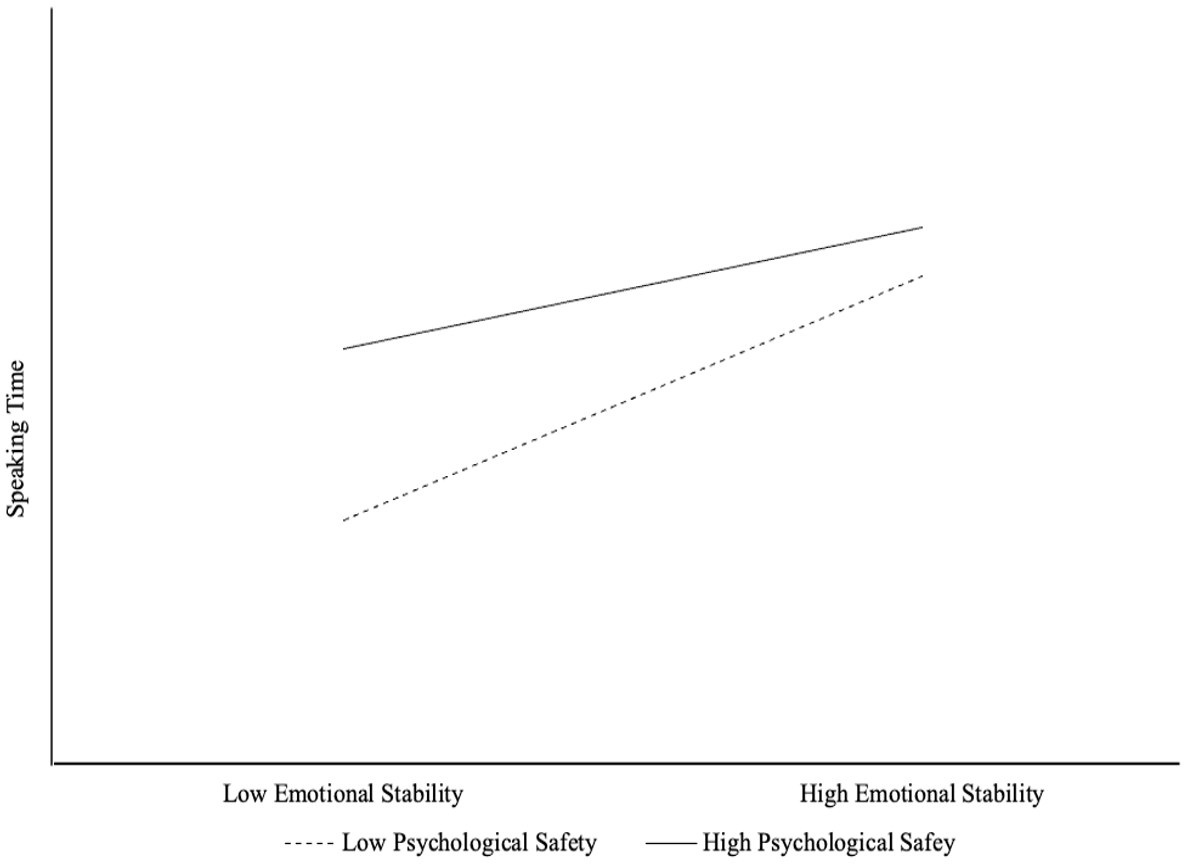
Expected interaction between emotional stability and psychological safety.
The Current Study
Data for the current study came from a larger research project, from which one paper has been published (O’Bryan et al., 2024). The goals of the published paper were to examine the psychometric properties of objective measures of team member communication behaviors (e.g., turn taking, silence breaking, and speaking time), including their relationship to team member effectiveness ratings. The current study’s goals are to examine the relationships among personality traits, psychological safety, speaking time, and team member effectiveness. The variables that overlap between studies are speaking time and ratings of team member effectiveness. The O’Bryan et al. (2024) study also hypothesized and established a positive relationship between those variables, and thus, we do not hypothesize it here.
In the current study, we examine speaking time in meetings of student project teams working on authentic, complex, and open-ended problems throughout a semester. We chose to start collecting data midway through the semester because there were relatively more—and more consistent—team meetings as the semester went along. Because we were primarily interested in the effects of personality, prior speaking time was not used as a control variable in our model. Moreover, we reasoned that the situational demands of the project later in the semester would act as cues for the expression of individual personality traits and thus provide a rich environment for studying the individual and contextual predictors of meeting communication and team member effectiveness. That is, teams generally need to engage and communicate more as project deadlines approach (compared to when teams are forming; Gersick, 1988; Jehn & Mannix, 2001; Larson et al., 2020).
Method
Procedure
Data were collected during the 2021 academic year at a private university in the Southern U.S. via self- and peer-report surveys and communication patterns, which were extracted from virtual meeting transcripts. Participants were at least 18 years old and members of teams of three or more members working on an open-ended design problem as part of a semester-long project. Teams were leaderless, self-managed teams (Schumann, 2019) working on authentic, complex, and open-ended design problems (Beier et al., 2018), meaning that outcomes were deliverables to a project sponsor, many of whom were industry partners in the fields of data science, bioengineering, mechanical engineering, and computer science. Projects included finding an engineering solution for a global health initiative, developing innovative medical products, and deploying advanced data science methods (e.g., machine learning) for organizational and product support. Due to the potentially sensitive and proprietary nature of the projects discussed, participants and industry partners were assured that our study would only assess communication patterns and would not include content analysis.
In order for a team to participate in the study, all team members were required to consent prior to participation. Participants received $10 for every survey completed, and if they completed all three surveys throughout the semester, they were compensated $50. To encourage full team participation throughout the semester, participants who were on teams in which all team members completed all the surveys received an additional $25. As such, the maximum compensation for any one participant was $75. All teams interacted via video conferencing technology (Zoom) due to the COVID-19 pandemic. Teams were instructed to use Zoom links provided by the researchers, which permitted us to automatically record meetings and produce transcripts.
Figure 3 depicts the data collection timeline as well as the number of meetings that took place at each time point. Participants completed the personality survey during Time 1 before they engaged in the rest of the study (between Weeks 1 and 8), followed by the Psychological Safety survey at Time 2 (between Weeks 9 and 12), which occurred roughly mid-semester. The timing was chosen with the intent of allowing the teams time to interact and work together, thereby informing individual perceptions of team dynamics. Speaking time was collected during Time 3 (between Weeks 12 and 13). We chose these weeks specifically for Time 3 to allow time separation between data collection time points, permitting us to assess mediation, and because this period represents the meetings that took place leading up to the final project deadlines at the end of the semester. As such, team meetings were relatively more plentiful and focused on project completion. Ratings of team member effectiveness were collected at the end of the semester (at Time 4 between Weeks 14 and 15) because we wanted effectiveness ratings to be informed by participants’ behavior throughout the semester.

Data collection timeline.
Participants
The final dataset contained 110 individuals (44% female; 56% male) across 21 teams and 105 Zoom recordings (between Weeks 12 and 13). The average team size was five members (SD = 1.7) and ranged from 3 to 11 members. Due to the range of team sizes, correlational analysis was conducted for all focal variables after removing teams larger than six members, revealing that the correlations did not greatly differ in magnitude or direction (see Appendix A). Approximately 11% of the students were in their first year of undergraduate studies, 4% were in their second year, 15% were in their third year, 59% were in their fourth year, and 11% were graduate students. Ten of the 21 teams were homogenous in terms of the year in school of the individual team members, and 19 of the 21 teams consisted of 3 to 6 team members (see Appendix B). Approximately 46% of the students reported their race as Asian, 28% White, 10% Latino, 4% Black, and 12% reported multiple racial identities.
Measures
Personality
Extraversion and emotional stability were measured at Time 1 using the 10-item scales from Goldberg’s (1992) 50-item Big-Five factor assessment in the International Personality Item Pool (IPIP). Participants were asked to rate the level of accuracy of each statement for describing themselves on a scale of 1 (very inaccurate) to 5 (very accurate). Examples from the extraversion scale are: “Feel comfortable around people” and “Start conversations” (α = .89) and examples from the emotional stability scale are: “Relaxed most of the time” and “Seldom feel blue” (α = .86).
Psychological Safety
Psychological Safety was measured at Time 2 via Edmondson’s (1999) scale. Seven items were rated on a scale of 1 (very inaccurate) to 7 (very accurate). Sample items include “Members of this team are able to bring up problems and tough issues” and “It is safe to take a risk on this team” (α = .70). Psychological safety has been examined at the individual, team, and organizational levels and has been measured as either individual or shared perceptions of psychological safety. This study assessed individual perceptions of team psychological safety. There is reason to believe that perceptions of psychological safety do not change much at different levels, however. For example, a meta-analysis by Frazier et al. (2017) demonstrated that the relationships between psychological safety and its antecedents and outcomes demonstrated identical homology (relationships across levels were identical in both magnitude and direction) based on Chen et al.’s (2005) typology of homology theory.
Speaking Time
Speaking time was calculated based on the average normalized speaking time of each individual team member (individual speaking time in proportion to the total meeting time). Individual normalized speaking time was calculated as the average proportion of speaking time to meeting time for each individual during Time 3. R code (R Core Team, 2022) was written to extract this information from the Zoom transcripts.
Team Member Effectiveness
Team member effectiveness was operationalized via the Comprehensive Assessment of Team Member Effectiveness behaviorally anchored rating scale (CATME-B; Ohland et al., 2012). This measure consists of five dimensions of teamwork rated on a scale of 1 (low) to 5 (high): Keeping the Team on Track; Contributing to the Teams’ Work; Interacting with Teammates; Having Relevant Knowledge, Skills, and Abilities; Expecting Quality (α = .90). Data were collected in round robin format (team members rated each other and themselves on each dimension) but self-ratings were not included in the analyses. A composite variable was calculated from these five items, which was then averaged for all raters and assigned to each individual ratee.
Data Analysis
Preliminary analyses were conducted to assess the Intraclass Correlations (ICC1; Bartko, 1966) to determine if between-team variance in the study variables should be accounted for in the hypothesis testing. Additionally, an unconditional means model, which was a mixed effects model, was compared against a fixed effects model to determine if the reduction in error was statistically significant. The results showed that 6% of the variance in teamwork competence scores, ~1% of the variance in speaking time, 0% of extraversion, 7% of emotional stability, and ~9% of the variance in psychological safety resided between groups. However, when compared against fixed effects null models, none of these ICC values showed a statistically significant reduction in model error (see Table 1 for a full list of the variables). These findings suggest that a multilevel modeling approach was likely not required and, consequently, all analyses were conducted at the individual level, with cluster-robust standard errors (McNeish et al., 2017).
Intraclass Correlation Coefficients and Null Model Tests of Significance.
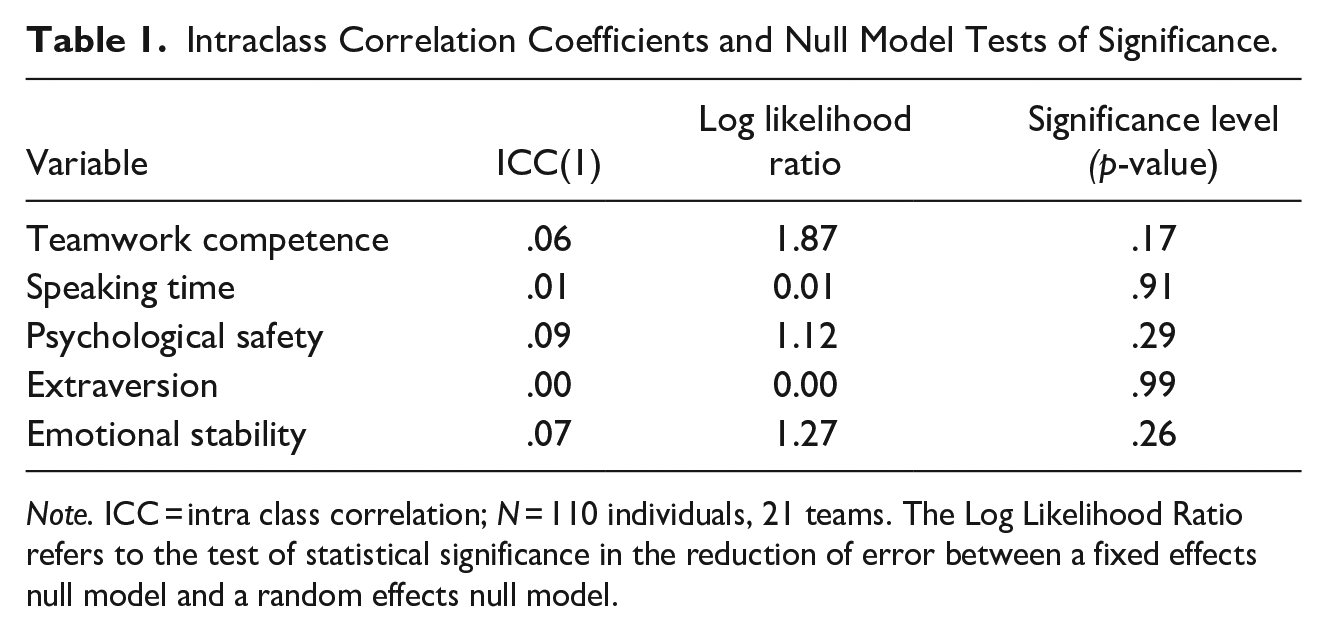
Note. ICC = intra class correlation; N = 110 individuals, 21 teams. The Log Likelihood Ratio refers to the test of statistical significance in the reduction of error between a fixed effects null model and a random effects null model.
Additionally, resources, such as time in team meetings, have been identified as a factor that may lead to negative non-independence, such that the more one person speaks, the less other people are able to speak (Kenny et al., 2002). To reduce the potential for this to impact our findings, we calculated speaking time as a proportion of the overall meeting time rather than a proportion of the total time spent talking by all meeting attendees. Moreover, the meetings in this dataset were naturally occurring such that teams had the autonomy to conduct these meetings at whatever date and time, as well as for whatever length, they deemed appropriate. Further, the average percentage of silence in meetings was 54.23%, suggesting that time was likely not a severely limited resource. We also calculated the intraclass correlation for speaking time as a final robustness check for negative non-independence (Kenny et al., 2002). The results of this analysis suggested that, if anything, members of the same team tended to be slightly more similar in speaking time compared to members of other teams (ICC = .15, F = 1.89, p = .045). Based on these analyses, we concluded that team members did not compete for speaking time within teams. Rather, we believe that team meetings provided ample time for everyone to contribute as much as they desired.
A path analysis was conducted using the lavaan package in R (Rosseel, 2012) to test the hypothesized models. Based on a relatively small amount of missing data (7% of the psychological safety data were missing, resulting in an overall missingness rate of 1.5%), combined with the acknowledgement that modern statistical procedures “do reasonably well in the face of moderate departures from MAR [missing at random] assumptions” (Loehlin & Beaujean, 2017, p. 82), the analyses were conducted with full information maximum likelihood (FIML) to account for missing data, based on the assumption that data are missing at random (MAR; Enders, 2022).
Results
Descriptive Statistics and Correlations
Table 2 displays descriptive statistics, correlations, and internal consistency reliability estimates of the study variables. As expected, extraversion was positively related to speaking time (r = .21, p = .024), and both psychological safety (r = .33, p = .001) and speaking time (r = .40, p < .000) were positively related to team member effectiveness. However, contrary to expectations, emotional stability was related neither to speaking time (r = −.04, p = .665) nor team member effectiveness (r = .04, p = .660), extraversion was not related to team member effectiveness (r = .01, p = .879), and psychological safety was not related to speaking time (r = .15, p = .142) but it was positively related to team member effectiveness (r = .33, p = .001).
Means, Standard Deviations, and Correlations with Confidence Intervals.
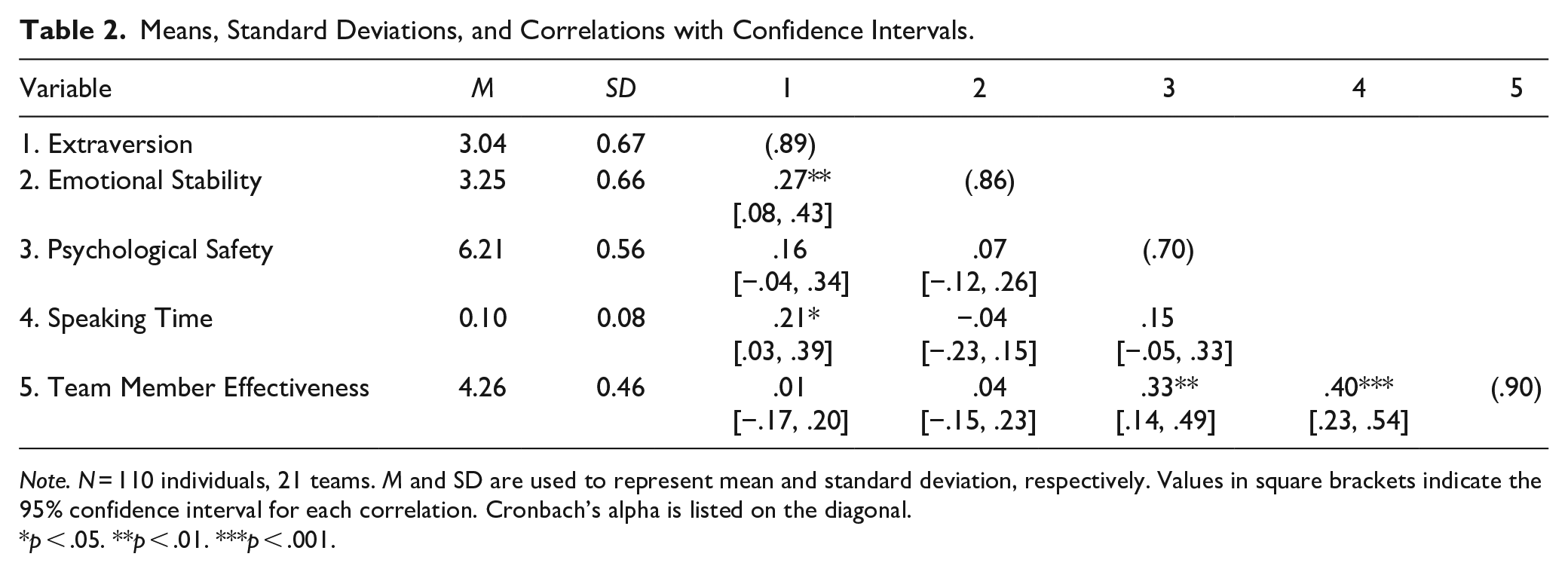
Note. N = 110 individuals, 21 teams. M and SD are used to represent mean and standard deviation, respectively. Values in square brackets indicate the 95% confidence interval for each correlation. Cronbach’s alpha is listed on the diagonal.
p < .05. **p < .01. ***p < .001.
Hypothesis Testing
Hypotheses were tested using path analysis (see Figure 4). The model was just identified with zero degrees of freedom, so fit statistics are not provided. When all variables were estimated simultaneously, extraversion was positively related to speaking time (β = .231, p = .006) but not team member effectiveness (β = −.132, p = .131), supporting Hypothesis 1a but failing to support Hypothesis 1b. Emotional stability was related to neither speaking time (β = −.116, p = .298) nor team member effectiveness (β = .057, p = .388), failing to support Hypotheses 2a and 2b. Psychological safety was not related to speaking time (β = .106, p = .158), failing to support Hypothesis 3a, but it was positively related to team member effectiveness (β = .352, p = .001), supporting Hypothesis 3b. Speaking time was positively related to team member effectiveness (β = .384, p = .005). Table 3 contains the parameter estimates of the model. This model explained 7% of the variance in speaking time (R2 = .068) and 29% of the variance in team member effectiveness (R2 = .290), indicating small-to-medium and large effect sizes, respectively (Cohen, 1988).
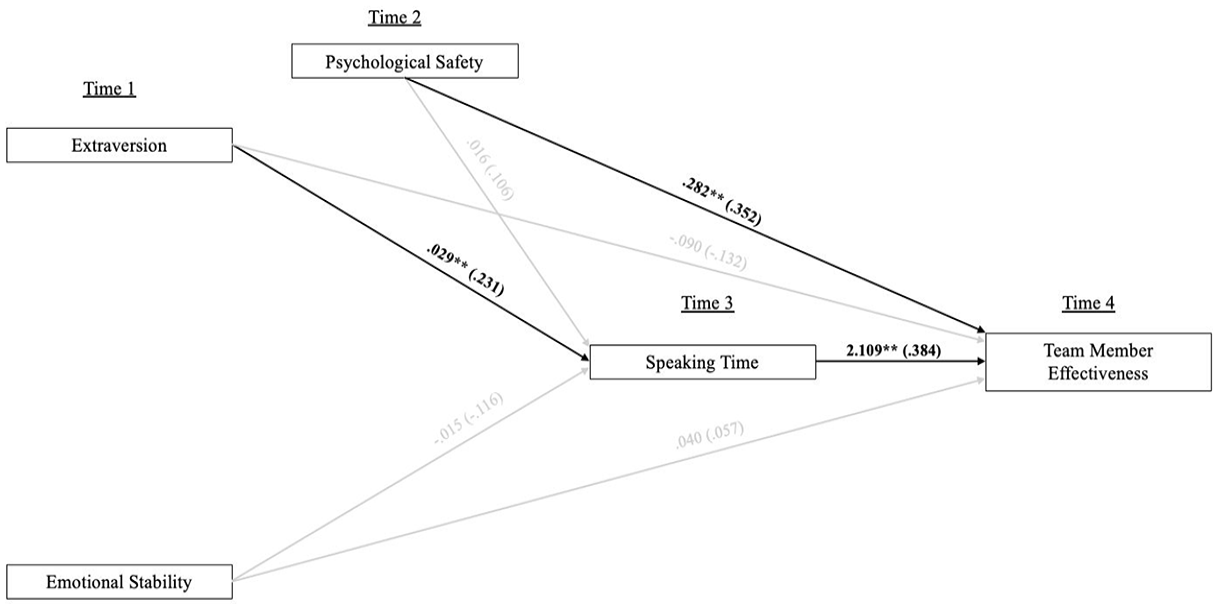
Path Analysis Results.
Path Analysis Regression Results.
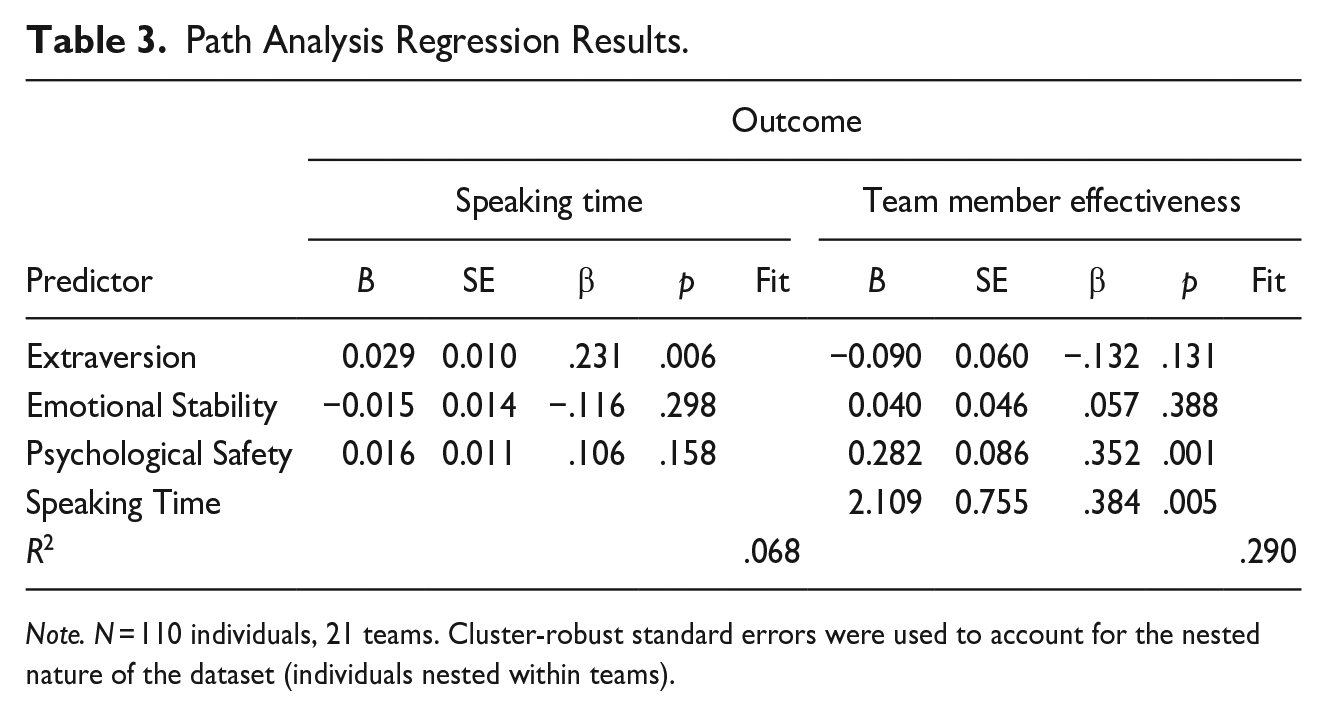
Note. N = 110 individuals, 21 teams. Cluster-robust standard errors were used to account for the nested nature of the dataset (individuals nested within teams).
To examine mediation, percentile bootstrapped confidence intervals (MacKinnon et al., 2004) were calculated for the indirect effects based on 10,000 runs. Three percent of the bootstrap runs did not converge, resulting in a final total of 9,744 runs. The results revealed a significant indirect effect for extraversion but not for emotional stability or psychological safety (see Table 4), supporting Hypothesis 1c but failing to support Hypotheses 2c and 3c. Finally, to test Hypothesis 4, that psychological safety would moderate the effect of emotional stability, psychological safety and emotional stability were grand mean-centered prior to creating an interaction term, which was then included in a reduced model with only speaking time as the outcome variable. We did not use bootstrapping for the moderated mediation hypothesis test because we received a non-positive definite matrix warning when modeling the interaction between psychological safety and emotional stability in the full model, which included both the first-stage outcome (speaking time) and the second-stage outcome (team member effectiveness). The interaction of emotional stability and psychological safety was not significant (β = .013, p = .889), failing to support Hypothesis 4 (see Table 5).
Indirect Effects on Team Member Effectiveness, via Speaking Time.
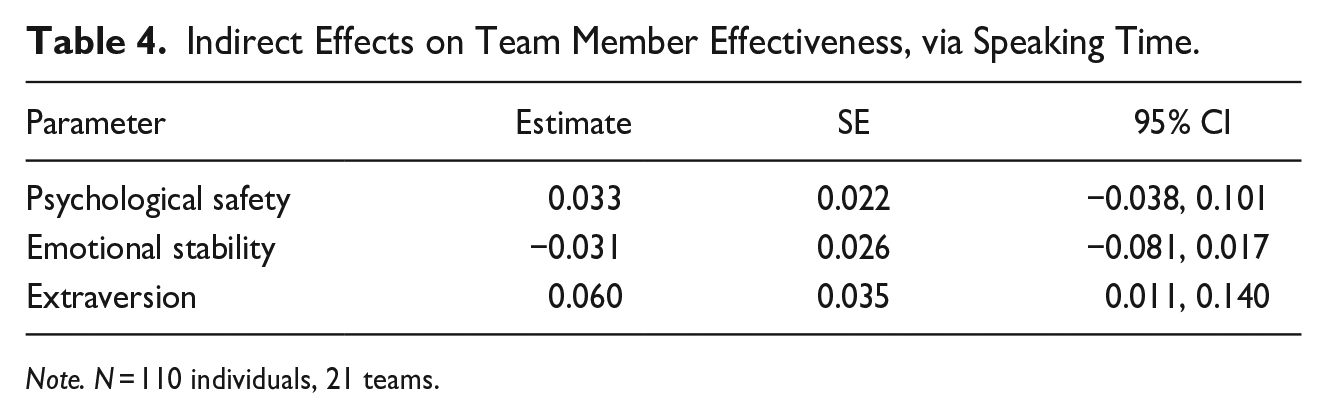
Note. N = 110 individuals, 21 teams.
Moderation Analysis Results.
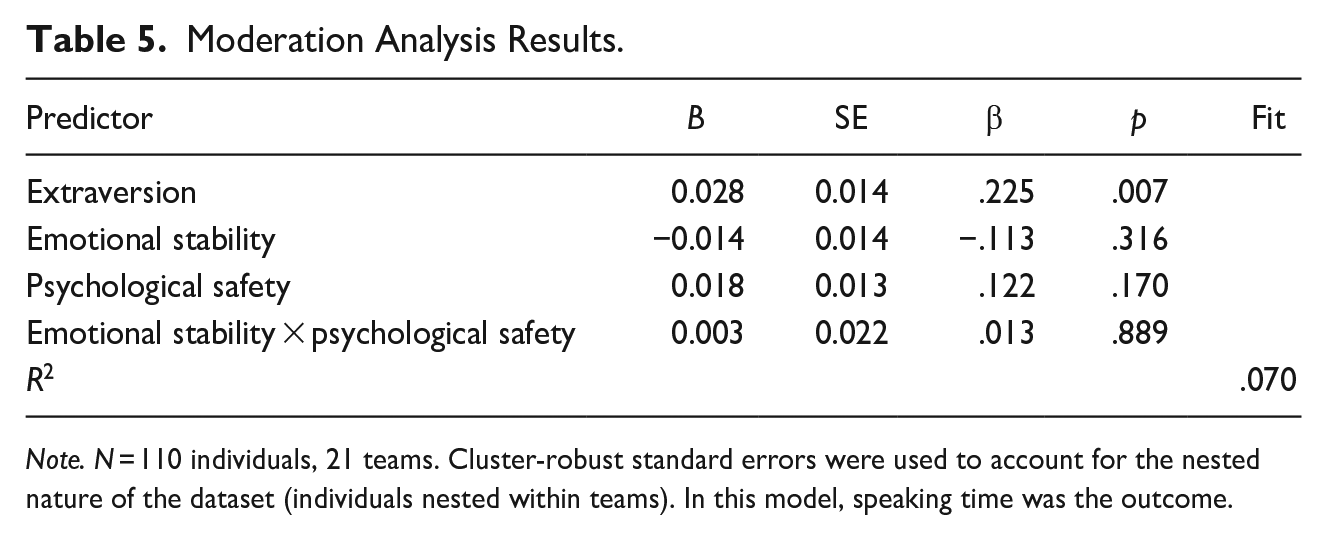
Note. N = 110 individuals, 21 teams. Cluster-robust standard errors were used to account for the nested nature of the dataset (individuals nested within teams). In this model, speaking time was the outcome.
Discussion
In this study, we set out to examine the individual (e.g., extraversion, emotional stability) and contextual (e.g., perceptions of psychological safety) factors in team meetings related to speaking time and peer ratings of team member effectiveness. Based on trait activation theory (Tett & Burnett, 2003), we expected that extraversion, emotional stability, and perceptions of psychological safety would be positively directly related to speaking time and both directly and indirectly related to team member effectiveness, via speaking time. Moreover, we expected that perceptions of psychological safety would moderate the effect of emotional stability. We found that extraversion was positively related to speaking time and was indirectly related to team member effectiveness via speaking time. Perceptions of psychological safety were positively related to team member effectiveness but were not related to the amount of time individuals spoke in team meetings. Additionally, we did not find a significant relationship between emotional stability and speaking time or between emotional stability and team member effectiveness. Finally, there was no evidence of a significant interaction between emotional stability and perceptions of psychological safety.
The activation of extraversion via speaking time found in this study is in alignment with past research regarding this trait (Tett et al., 2021). Building on past research, which shows that extraversion is positively associated with qualitative verbal contributions (Barry & Stewart, 1997; Chamberlin et al., 2017), we demonstrated that extraversion is related to active engagement in team meetings (speaking time) and indirectly related to peer ratings of team member effectiveness via speaking time. Thus, we found that one of the ways in which extraversion is related to peer perceptions of effectiveness is via the quantity of communication in which one engages.
In terms of emotional stability, we did not find the expected effects. When controlling for extraversion and perceptions of psychological safety, emotional stability was related neither to speaking time nor team member effectiveness, suggesting that this trait was not activated in these team meetings. Moreover, we did not find evidence for a moderating effect of perceptions of psychological safety on emotional stability for predicting speaking time. There are many potential reasons for this lack of effect. It may be attributable to the nature of the team interactions observed, where group-level interpersonal dynamics and established meeting norms potentially constrained the full expression of this trait. In support of this idea, the average level of perceptions of team psychological safety was rather high, considering the 7-point scale on which it was rated (M = 6.21, SD = 0.56). The range restriction in this variable may have inhibited expression of emotional stability in these teams. Hence, future research should examine the potential for the activation of emotional stability in team-based datasets that have a wider range of psychological safety.
This study also sheds light on the contextual factors, specifically perceptions of psychological safety, that may contribute to team member effectiveness. Although perceptions of psychological safety were not significantly related to speaking time, they did have a positive relationship with team member effectiveness, suggesting that when people feel psychologically safe, they are more likely to be seen as effective team members. This may be because when a team is perceived as psychologically safe, team members will feel encouraged to share their thoughts and ideas without the fear of backlash and thus will impress their team members as effective. Considering the absence of a relationship between perceptions of psychological safety and speaking time in our study, we conclude that positive impressions are not necessarily about the quantity of speech but perhaps more about the quality of what a person says. For example, recent research suggests that a person’s level of expertise may be a more reliable predictor of team member influence compared to the amount of time they speak (O’Bryan et al., 2025). Moreover, people who feel psychologically safe may ask tough and important questions, improve team outcomes by voicing their opinions, or help to facilitate accountability by acknowledging when they’ve made mistakes. Unfortunately, we are unable to use the current dataset to explore these possibilities.
Limitations and Future Research
The limitations of the study should be noted. First, the sample size—specifically as related to the number of teams—was small, limiting our ability to find significant effects, although we were able to examine individual-level relationships of interest. Based on various rules of thumb, minimum sample sizes range from 200 observations, 5 to 10 individuals per parameter estimated, or 3 to 6 individuals per variable (Wang & Rhemtulla, 2021). Although we tried to recruit as many teams as possible, we had limited control over the number of teams that participated in our field study. Laboratory research would have provided more control over the number of teams recruited. However, a laboratory approach would have necessitated the use of a contrived task in which teams were not invested and created a strong situation that would have made it difficult to examine the influence of individual differences like personality (Weiss & Adler, 1984). Thus, although the lack of power in our study may have limited our ability to find some of the effects we were looking for, our study does have strengths in its generalizability to teams in natural environments.
A related limitation is the use of student teams. Because the students were working on authentic, complex, and open-ended problems with concrete deliverables and implications beyond the classroom (Beier et al., 2018), we contend that the sample is reflective of teams working within organizations with similar deliverables. That said, we were not able to assess outcomes related to team performance (e.g., team grades were not made available to us). Therefore, future research may build upon these findings by studying teams in organizations and examining relationships between the variables in this study and team member performance.
Many of our findings were related to team member speaking time, which we conceptualize as a measure of team member activity and engagement within team meetings (Pentland, 2004). Speaking time does not capture specific contributions within teams, such as generating ideas (van Emmerik et al., 2011) and voice (i.e., speaking up about potential improvements to a project; Morrison, 2014), nor does it represent a team member’s influence in the team decisions. Without examining the content of speech, which we are, unfortunately, unable to do in this study, we cannot comment on whether speaking time reflects anything other than activity and participation within teams and highlight this as an important question for future research. Thus, future research may build upon these findings by conducting content analyses in conjunction with behavioral assessments.
Moreover, future research may build on these findings by examining non-linear effects of speaking time. Our study focused on the positive aspects of meeting participation and engagement in naturally occurring team meetings in which time was not a scarce resource. However, in more time-bound meetings, speaking time may exhibit a curvilinear effect such that a positive relationship with effectiveness exists only up to a certain point.
The significant effect of extraversion on speaking time found in this study is consistent with past research from in-person settings and highlights that activation of this trait can occur in technology-mediated settings. Indeed, according to media richness theory (Daft & Lengel, 1986), the amount and clarity of social signals may be diminished by the technological medium used for communication in replacement of in-person interactions; based on the results of our study, however, social cues for extraversion appear to be relatively robust in asynchronous videoconferencing, highlighting the advantages of extraversion in social settings such as team meetings (Wilmot et al., 2019). Nevertheless, our study did not assess the activation of extraversion in virtual team meetings compared to in-person meetings and, as such, future research should seek to further understand trait activation by manipulating the context (e.g., virtual vs. in-person).
Finally, one interesting aspect of this study was the virtual nature of the team meetings studied herein. As organizations adopt more remote and hybrid models of work, virtual team meetings are becoming increasingly common (Blanchard & Allen, 2022; Gallup, 2024) and it will be important to understand how the virtual nature of team meetings might affect team interaction. Although the cultivation of psychological safety in virtual teams is relatively unexplored (Feitosa & Salas, 2021), our findings suggest that organizations can benefit from investing in team psychological safety initiatives, as we found that psychological safety was related to ratings of team-member effectiveness for the virtual teams studied here. However, because we did not compare virtual teams with in-person or hybrid teams, we cannot comment on how the nature of the environment (in-person, hybrid, remote) would influence our results. Future research can examine whether the effect of psychological safety on team-member effectiveness and team performance varies based on whether the team is in-person, hybrid, or completely virtual. Similarly, future research could examine whether the virtual nature of team interactions affects any of the other relationships examined here, such as the expression of personality traits in team meetings.
Conclusion
As organizations increasingly rely on team-based work structures, understanding the factors that drive participation in meetings and influence team member effectiveness has become crucial. This study advances trait activation theory by employing a novel methodological approach that combines objective measures of communication behavior with self-report measures to assess both the main and interactive effects of personality traits and psychological safety in authentic team settings. This novel approach allowed us to examine interactions in naturalistic settings with teams working on projects that had real-world impacts, rather than in a controlled laboratory environment. Our findings reveal that extraversion positively relates to speaking time and indirectly influences perceptions of team member effectiveness, while perceptions of psychological safety directly enhance effectiveness ratings independent of speaking behavior. Contrary to our expectations, we did not find significant effects for emotional stability, which may be attributable to the nature of team interactions where group-level interpersonal dynamics potentially constrained the full expression of this trait. By highlighting both individual (personality) and contextual (perceptions of psychological safety) antecedents of team member effectiveness, this research provides actionable insights about the importance of psychological safety for organizations seeking to enhance team performance. Future research can build on these findings to examine additional pathways through which individuals may be recognized as effective team members, particularly in virtual collaboration contexts that have become increasingly prevalent in contemporary work environments.
Footnotes
Appendix A
Means, Standard Deviations, and Correlations with Confidence Intervals—Large Teams (Greater Than 6 Members) Removed.
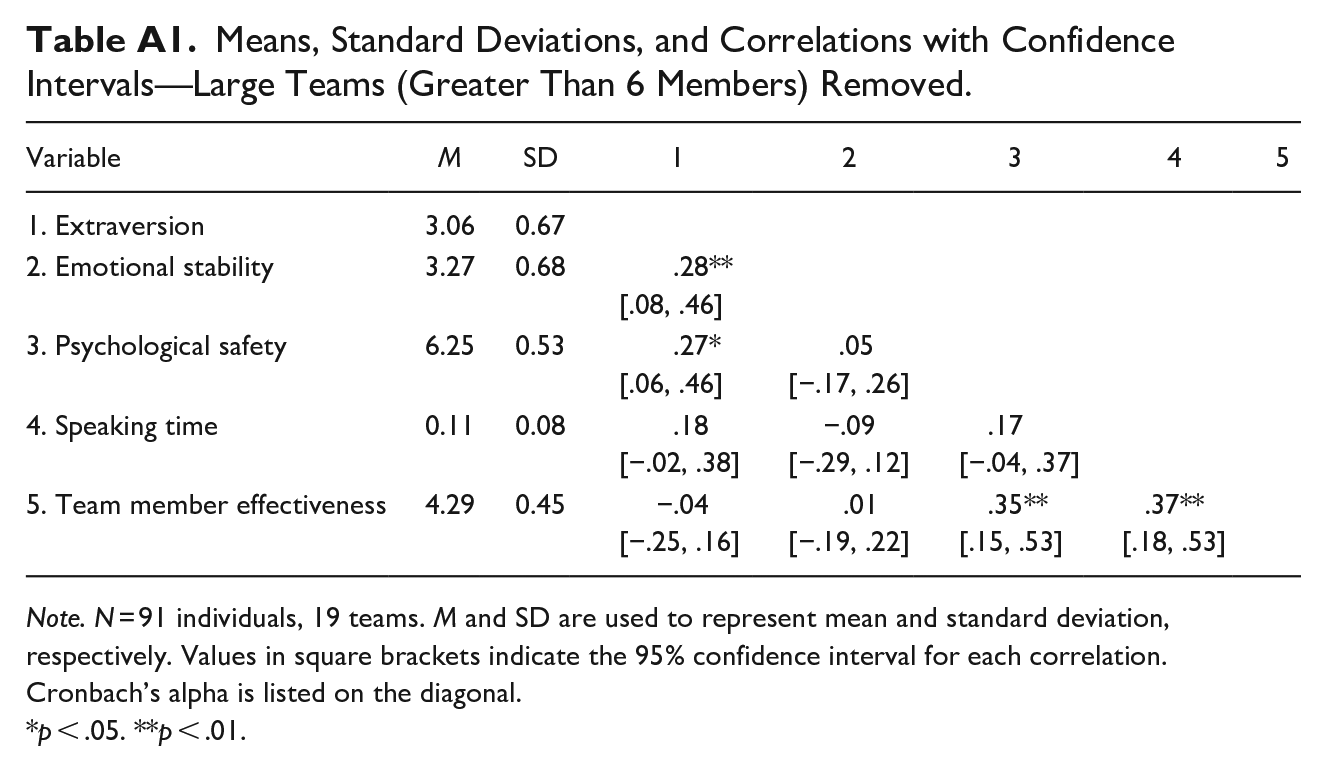
| Variable | M | SD | 1 | 2 | 3 | 4 | 5 |
|---|---|---|---|---|---|---|---|
| 1. Extraversion | 3.06 | 0.67 | |||||
| 2. Emotional stability | 3.27 | 0.68 | .28**
|
||||
| 3. Psychological safety | 6.25 | 0.53 | .27*
|
.05 |
|||
| 4. Speaking time | 0.11 | 0.08 | .18 |
−.09 |
.17 |
||
| 5. Team member effectiveness | 4.29 | 0.45 | −.04 |
.01 |
.35**
|
.37**
|
Note. N = 91 individuals, 19 teams. M and SD are used to represent mean and standard deviation, respectively. Values in square brackets indicate the 95% confidence interval for each correlation. Cronbach’s alpha is listed on the diagonal.
p < .05. **p < .01.
Appendix B
Team Membership.
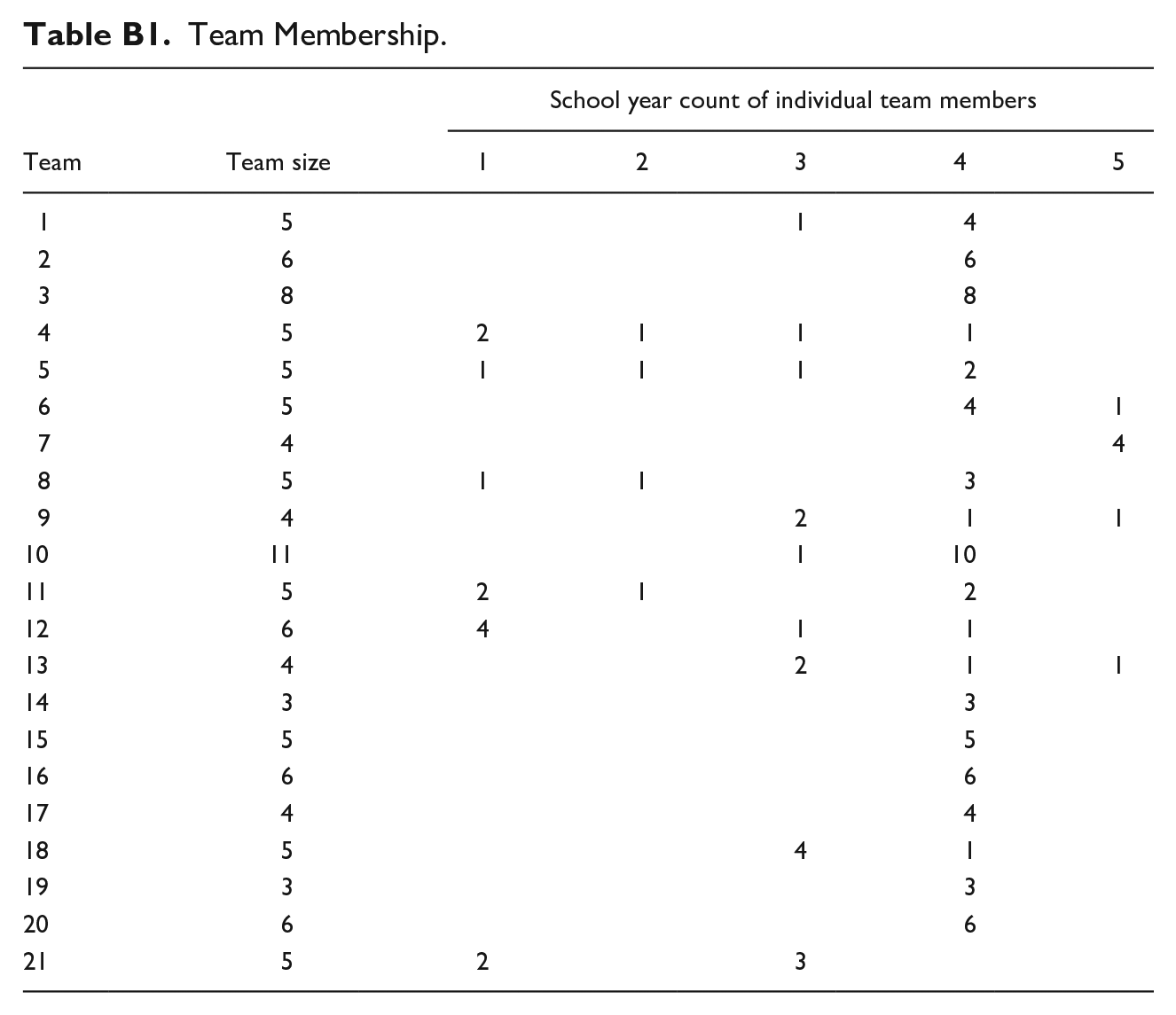
| School year count of individual team members | ||||||
|---|---|---|---|---|---|---|
| Team | Team size | 1 | 2 | 3 | 4 | 5 |
| 1 | 5 | 1 | 4 | |||
| 2 | 6 | 6 | ||||
| 3 | 8 | 8 | ||||
| 4 | 5 | 2 | 1 | 1 | 1 | |
| 5 | 5 | 1 | 1 | 1 | 2 | |
| 6 | 5 | 4 | 1 | |||
| 7 | 4 | 4 | ||||
| 8 | 5 | 1 | 1 | 3 | ||
| 9 | 4 | 2 | 1 | 1 | ||
| 10 | 11 | 1 | 10 | |||
| 11 | 5 | 2 | 1 | 2 | ||
| 12 | 6 | 4 | 1 | 1 | ||
| 13 | 4 | 2 | 1 | 1 | ||
| 14 | 3 | 3 | ||||
| 15 | 5 | 5 | ||||
| 16 | 6 | 6 | ||||
| 17 | 4 | 4 | ||||
| 18 | 5 | 4 | 1 | |||
| 19 | 3 | 3 | ||||
| 20 | 6 | 6 | ||||
| 21 | 5 | 2 | 3 | |||
Acknowledgements
The authors would like to thank the undergraduate research assistants in the Adult Skills and Knowledge Lab at Rice University for their assistance with this project.
Declaration of Conflicting Interests
The author(s) declared no potential conflicts of interest with respect to the research, authorship, and/or publication of this article.
Funding
The author(s) disclosed receipt of the following financial support for the research, authorship, and/or publication of this article: Funding for this study was provided by a Productivity Research Grant from Microsoft and the National Science Foundation (Award Number: 1910117), Margaret Beier, Principal Investigator.
