



Abstract
The tendency to experience positive and negative emotions can influence the relationships people form within small groups. The current study examined how affective reactivity predicts one’s sociometric centrality in small groups. We collected surveys from 267 members of 16 student clubs, including peer nominations of other club members regarding affiliation and status. Positive affective reactivity predicted centrality for affiliation (but not status) networks. In contrast, negative affective reactivity predicted centrality for status (but not affiliation) networks. The present findings demonstrate the importance of considering individuals’ affect to explain how people come to position themselves within small groups.
Affect is a defining feature when considering experiences groups and organizations relating to many spheres of life, including the workplace, during recreation, at school, and in the community. As described by Casciaro (2014) when considering workplace networks, affect is a fundamental engine of social action that determines social processes at the level of the group (e.g., who is conferred the highest status) as well as lower-level dyadic dynamics (e.g., who interacts with whom). Indeed, the positive and negative affect that group members tend to demonstrate has been posited as one of the core features that people evaluate when interacting with others. Bales (1950; Bales & Cohen, 1979), for instance, conducted early sociometric research focused on how personality relates systematically to role adoption in human social interaction and defined emotional expressiveness as one of three fundamental dimensions (i.e., termed by the authors as the positive-negative disposition). Positive affect serves as a key social signal to which people attend; individuals who experience more positive emotions (and fewer negative emotions) tend to establish affiliations and gain status in organizational networks (Barsade & Knight, 2015). Yet, how does this pattern apply to small group networks?
Despite research on the role of affect within large organizational networks (Fang et al., 2015), research with small groups is underrepresented. Compared to larger social settings like entire organizations, small groups differ with respect to the strategies that people use to gain status and attention (Piazza & Castellucci, 2014). Small team social networks also differ in structure relative to larger organizations. In larger organizations, for instance, people benefit from having many weak relationships (i.e., access to information and opportunities; Granovetter, 1983) and it is easier for positive attributes to go unnoticed unless they also capture others’ attention (Anderson et al., 2001). In smaller teams, interpersonal connections are dense, and this increases the influence of relational processes with all other members (Park et al., 2020). As small groups are widespread in many domains in life, research that identifies which members are likely to gain centrality in networks can inform applied efforts in many settings (e.g., enhancing work teams, promoting health behavior, bolstering sport performance). Overall, there are both conceptual and practical reasons to explore how individuals’ tendencies to experience positive and negative affect relates to their position within social networks in small groups.
In the current paper, we specifically sought to explore group members’ tendency to have certain emotional responses in relation to status (i.e., the vertical dimension of ‘getting ahead’) and affiliation (i.e., the horizontal dimension of ‘getting along’) within small groups. The distinction between these two dimensions is rooted in their underlying social functions. Status, as a vertical dimension, reflects individuals’ positioning relative to others based on the extent to which a person is afforded respect and admiration by others. In contrast, affiliation, as a horizontal dimension, refers to interpersonal connections and the extent to which individuals seek to bond and form mutual, peer-based relationships. We focus on these two dimensions because they are fundamental to how humans relate to one another—a point highlighted in an integrative review by Abele et al. (2021) that summarized insights from key theories of social evaluation (e.g., dual perspective model, stereotype content model, behavioral regulation model). These two dimensions focus on how we evaluate others in groups but also signify that group members must navigate social structures around affiliation and interpersonal connections while also seeking status. Through the current study, we adopted a network approach to examine how tendencies for certain emotional responses relate to positions within networks comprised of peer nominations for both affiliations and status in small groups.
Affectivity and Socialization
Affectivity refers to the predisposition or tendency to experience a particular range or type of affect (emotions or feelings). It is important to note that affect can refer to the immediate, conscious experience of emotions, which may fluctuate based on context or stimuli. In contrast, affectivity refers to the proportion of positive and negative affect that is stable over time and across situations, reflecting a consistent pattern of behavior, thoughts, and emotions (Watson & Tellegen, 1985). This distinction is important, as it helps clarify the interplay between stable dispositions and transient emotional experiences. Affective states can fluctuate based on situational factors, yet people’s tendency toward consistently positive and/or negative states has an enduring influence on interpersonal interactions and relationship dynamics.
Positive affectivity refers to the tendency to experience positive emotions and interact in a positive way with the environment. People with high positive affectivity are typically enthusiastic, energetic, confident, active, and alert (Watson & Naragon, 2009). This trait is positively correlated with extraversion, agreeableness, conscientiousness, and openness to experience, and negatively correlated with neuroticism (Watson & Naragon, 2009). Similarly, negative affectivity focuses on the tendency to experience negative emotions. Individuals with higher negative affectivity are prone to experiencing distress, anxiety, sadness, anger, guilt, and fear, as well as neuroticism (Watson & Clark, 1984).
One important observation is that negative and positive affectivity are independent dispositional aspects that—despite representing opposing valences—often are moderately and positively associated with one another. People can possess dispositions that are high, or low, on both forms (Diener & Emmons, 1984; Watson & Tellegen, 1985). Individuals with lower positive affectivity may exhibit less energetic or optimistic behavior, which could manifest interpersonally as reduced social engagement—appearing to teammates or colleagues as someone who is ‘dull’ (Cropanzano et al., 2003). Conversely, low negative affectivity may suggest a lesser likelihood of experiencing negative emotions such as distress or frustration, which may be associated with a more emotionally stable presence. Combining both of the above, low affectivity does not imply neutrality but rather a diminished propensity or intensity of experienced affective states.
Taking existing empirical research in aggregate, positive affectivity often prompts individuals to pursue novel friendships and maintain them over time. People with high positive affectivity notably perceive more expansive networks, tend to behave in a more prosocial manner, and develop stronger relationships. For instance, the presence of a positive mood in employees is associated with helpful workplace behaviors and extra-role actions (George, 1991) and leads to more substantive interactions when first meeting other people (Berry & Hansen, 1996). Negative affectivity also contributes independently to socialization (Berry & Hansen, 1996). For instance, some research reveals deleterious outcomes of negative emotional displays. Using leadership-followership as an example, negative emotions like anger can reduce followers’ willingness to engage in organizational citizenship behaviors, especially when anger is seen as inappropriate (Koning & Van Kleef, 2015). When people can adeptly manage their affective responses during interpersonal interactions, they are likely to navigate a wide range of social situations and learn from experiences (Diener et al., 2018).
Theory: Why Does Affectivity Influence Relationships?
When explaining how affectivity guides social interaction, theorists have surmised several mechanisms explaining the link between positive affectivity and position within small group social structures. When explaining the role of affectivity, we delineated three mechanisms or pathways, presented within Table 1. The three selected pathways represent conceptual frameworks that tend to be adopted across key literatures, including research involving status, social networks, and emotion or affect in social settings. These approaches were each originally intended to characterize a wider scope of members’ tendencies within groups, and we focus on their applications when understanding affectivity. While other frameworks could also be relevant, we selected these three because they offer dominant perspectives within their respective areas—status (motivational/volitional), networks (relational), and affectivity (emotions as social information, EASI)—and provide a strong conceptual foundation for understanding affectivity’s role in social positioning.
Contemporary Frameworks Explaining the Role of Affectivity in Small Group Relationships.
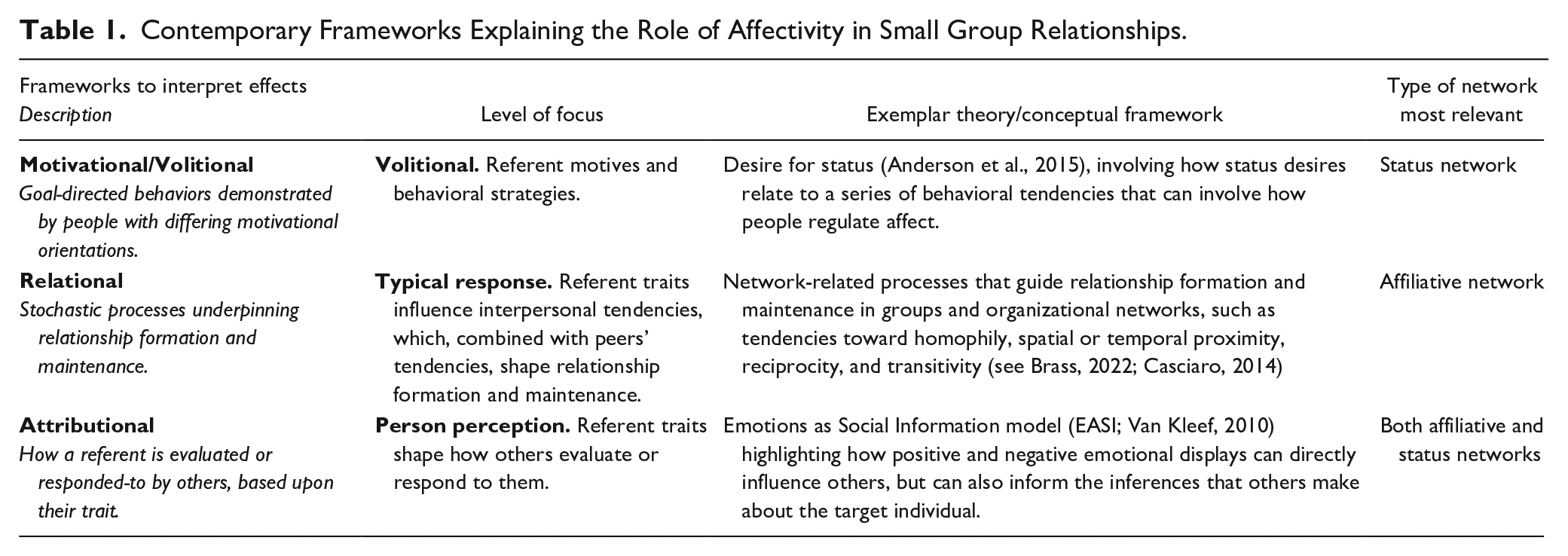
First are motivational or volitional approaches, which emphasize how affectivity influences social ties because it motivates people to act in certain ways (see Lin, 1999). For example, Anderson et al. (2015) argued that people differ in their motivation to gain status, with status being defined as the respect, admiration, and influence one holds in a group. From this perspective, affectivity may influence relationships in large part because of how affectivity is used in a motivated fashion to navigate relationships. Second are relational approaches, focusing on how typical behaviors (e.g., sociability) relate to stochastic processes that guide relationship formation and dissolution, regardless of motivation. Relational approaches are particularly evident when considering sociometric or social network accounts for the role of personality in groups. For instance, people who are high in extraversion quickly develop ties with others who are high in extraversion in networks, because they so readily form and change their ties with others (Feiler & Kleinbaum, 2015). Whereas volition-based views predict that individuals will form social connections based on the pursuit of specific goals, especially status attainment, relational accounts would emphasize how the formation and maintenance of social connections may be a ‘natural’ consequence of affectivity, independent of goals.
Compared to motivational/volitional and relational theoretical frameworks, an attributional approach focuses on how affectivity may shape the perceptions or attributions that others make. We specifically draw upon the EASI (Van Kleef, 2010), which articulates how a focal person’s emotions and generalized affect shape how people interpret and respond to their actions. Affective displays, from the stance of the EASI model, help people to understand interactions that would otherwise be ambiguous and help when determining what others think or intend. This theoretical framework is often leveraged in acute situations like negotiation scenarios but it also explains how affect may shape social structures in small groups (e.g., Bartels et al., 2022). Positive or negative affect perceived from other group members—such as another member being positive—triggers people to make inferences about aspects such as the others’ motives, the others’ beliefs about their own performance, and even the nature of the relationship. This framework especially informs understanding of person perception. For instance, high positive affect and low negative affect from a focal person may prompt others to develop positive beliefs about them (i.e., subjective competence or closeness) and generate similar affective states. Although EASI primarily focuses on displayed emotions, it remains relevant for understanding affectivity because dispositional affect can significantly shape the frequency and type of emotional displays during interactions, thereby influencing social dynamics within groups (Van Kleef, 2009).
In summary, the conceptual stances regarding mechanisms suggest that both positive and negative affectivity may relate to person perception and social interactions via a motivated pathway (i.e., people use affectivity to achieve social aims), a relational pathway (i.e., affectivity influences the general tendencies to form or maintain ties), and an attributional pathway (i.e., affectivity is information used to understand others’ actions). These three theoretical pathways are each different ways to considering influences on group member’s position within groups, relating to both status and affiliation. Recall that status refers to the respect, admiration, and influence a person holds within a group, whereas affiliation focuses on interpersonal bonds formed among members. These differences may mean that certain pathways are more important for status or affiliation. For instance, motivational mechanisms may be particularly relevant to status attainment as individuals strategically navigate social hierarchies, whereas relational mechanisms more directly account for the organic formation of affiliative ties. Attributional processes, on the other hand, may influence both status and affiliation by shaping how others interpret and respond to affective expressions within the group. Building on these theoretical perspectives, the subsequent section articulates the value of using a peer nomination as well as a network approach to examine affectivity in small groups.
Network Methods
Over the last quarter century, teams researchers have began adopting and implementing a social network approach to account for the dynamic nature of teams, investigate network structures, and infer potential meaning regarding one’s position within a social network (Park et al., 2020). Relationships in small groups are commonly organized as complex structures, where members’ social positions differ from one another and where members are expected to be most readily influenced by others who are most proximal to them (Graupensperger et al., 2020). Social network approaches involve data collection and subsequent analysis in which the relations (or ties) between people (or nodes) are studied in context. Network-related methods and theoretical perspectives aim to uncover patterns, structures, and dynamics that influence behavior, information flow, and influence diffusion.
Unlike traditional approaches to studying teams, a network approach involves unique requirements relating to the nature of data and places special meaning toward the structure of interpersonal ties. Researchers leverage networks to understand the position that an individual occupies within a group (Katz et al., 2004; Sahoo et al., 2024). Within the literature, centrality as an individual network variable has an important connection with personality (Krause et al., 2010). Centrality in network analysis refers to the measure of importance or prominence of a node (individual, entity, or unit) within a network. It helps in understanding which nodes are the most influential, pivotal, or critical in the network structure, depending on the type of tie from which it is derived as well as the mathematical approach from which it is calculated. For instance, centrality can be represented with indegree centrality: the raw sum of connections that one member possesses with others for a given type of relationship, focused on incoming nominations from others. Additionally, researchers also often calculate centrality in ways that account for network structure. For instance, eigenvector centrality assesses the prominence of a member in a network by considering not only the number of nominations they receive but also the centrality of those who nominate them. High eigenvector centrality indicates that a member is not only frequently nominated but also connected to other highly nominated members (Bonacich, 2007). While some researchers have shown that the straightforward measure of indegree centrality correlates with key variables (e.g., Sahoo et al., 2024), eigenvector centrality incorporates more comprehensive information about the network’s structure (Casciaro et al., 2015). This measure is particularly suited for identifying prominent or influential members within networks (Iacobucci et al., 2018), as it accounts for the influence of connected peers.
Beyond calculating centrality to denote individual position, researchers also use network-level variables that provide insights into the overall structure and characteristics of any given network. For instance, density measures the extent to which nodes in a network are connected to each other (i.e., number of observed connections, divided by the total number of possible connections among all nodes). A network with high density indicates that most nodes are connected to each other, forming a tightly interconnected structure, whereas low density suggests that only a small portion of possible connections are realized. As with centrality, the significance of density depends upon the type of tie of interest. Another example of a network-level variable is centralization: the extent to which the influence or control within a network is concentrated in a few central nodes. High centralization suggests that a few nodes exert a significant influence or control over the network, while the majority of nodes have relatively lower centrality. Conversely, low centralization indicates a more distributed or decentralized network structure, where influence or control is more evenly distributed among nodes. Use of such network-level indices is common within the network literature, and yet there is little to no empirical research on how affectivity relates to these network level indices.
Aims and Research Questions
The current study examines how one’s social network position within small group environments is predicted by their tendency to experience positive or negative affect. Numerous characteristics define small groups like shared structures, group norms, and individual roles (Kozlowski & Ilgen, 2006), and we particularly define small groups as contexts where members have the opportunity for direct interpersonal interaction with every other member. This focus on small groups distinguishes the current study from broader social network research by emphasizing the close-knit nature and frequent interpersonal interactions typical of such groups. Our research focuses on college student clubs as settings for which small group characteristics like social structure are highly evident, and as a setting that researchers have used to examine small group network processes (Graupensperger et al., 2020). To generate small group networks, we collected peer nominations of others with whom participants interact outside of the club (i.e., affiliative, relational) and nominations regarding individuals who are respected and admired (i.e., status, reputational; Anderson et al., 2015). We also used positive and negative affective reactivity as a specific way to consider affective tendencies, when focusing on intensity. Reactivity focuses on emotional responses to events and is captured by examining how individuals describe their tendency to respond to affectively-laden situations with respect to the intensity of positive and negative reactions. Other group members attend closely to the valence and intensity of affective reactions to stimuli, making reactivity especially relevant in small groups. For clarity, we henceforth refer to positive affectivity as positive affective reactivity and negative affectivity as negative affective reactivity.
The primary research question for this research was therefore: To what extent is positive and negative affective reactivity associated with centrality within small group status and affiliation networks. This research was cross-sectional and descriptive in nature. Particularly because we considered distinct nomination types, we considered differing operationalizations as well as contrasting conceptual foundations (i.e., attributional, relational, motivational/volitional) to inform expectations pertaining to why an association may be expected between disposition and network position. Below (and in our Online Supplemental Materials, Table S1) we articulate how each network was operationalized, identify the set of expectations pertaining to each research question, and identify links to the pathways identified in Table 1.
How Does Affective Reactivity Relate to Affiliative Ties?
We sought to examine how positive and negative affective reactivity predicted one’s centrality in an affiliative network derived from the ties between members. In the affiliative network, we used eigenvector centrality to reflect one’s structural embeddedness in the relationship structures in the group as it is derived from both the number of nominations one receives as well as the relative centrality of others nominating the self. While we did not initiate this research with hypotheses about the direction and relative significance of effects, both the attributional and relational perspectives provide support for a positive association between positive affective reactivity and centrality. For instance, the EASI perspective (George, 1991; Van Kleef, 2009) contends that positive affective reactivity is likely to be interpreted as a sign that others are affiliative in nature and to elicit positive social judgments from others. Relational perspectives would similarly argue that people with high positive affectivity will be gregarious—forming numerous affiliative ties—that by chance would lead them to also build ties with other similarly-embedded others. Conversely, existing theoretical approaches generally support the expectation that negative affective reactivity would be negatively associated with affiliation network eigenvector centrality (Watson & Clark, 1984). From an attributional perspective, frequent displays of negative affectivity, such as irritability or anxiety, could be perceived by others as signals of interpersonal unfriendliness or unreliability, reducing the likelihood of forming affiliative ties.
At a group level, the dynamics of positive and negative affective reactivity may shape the overall structure of the affiliative network. This is supported by evidence that suggest students high in extraversion—which is correlated with affectivity—produce not only larger peer networks but also more homogeneous peer networks focused on an orientation toward forming ties with similar peers (Feiler & Kleinbaum, 2015). To reflect affiliative ties at a network level, we used density to capture interpersonal connectedness in affiliative networks, with higher density indicating that a group had many peer nominations relative to its size (i.e., high integration among members).
How Does Affective Reactivity Relate to Status Perceptions?
Similar to above, we sought to examine how positive and negative affective reactivity predicted centrality in a status network derived from nominations of high-status members. The status network focused on respect, admiration, and voluntary deference group members afford to the focal individual. Whereas alternative centrality computations are optimal for tie-based constructs because they presume that the structure of ties is meaningful, status is an evaluation that can happen among any member and need not follow properties of a relational network. We therefore used indegree centrality involving the raw number of nominations as a high-status member. From a motivational/volitional perspective (Anderson et al., 2015), people who are oriented toward achieving status may use positive affective reactivity to foster impressions that align with the pursuit and attainment of respect and influence. Positive affectivity may signal the confidence and competence needed to climb the social hierarchy. This interpretation aligns with the EASI model (George, 1991; Van Kleef, 2009), which posits that displays of positive affect can be interpreted as markers of high motivation and competence, driving admiration and voluntary deference. Attributional approaches suggest that actions demonstrating negative affective states such as sadness and anxiety are likely to be interpreted as signs of low status potential, hindering one’s ability to garner respect and admiration (Steckler & Tracy, 2014). We do note that there are some cases where negative affect can increase perceived status potential, especially in the cases of acute expressions of anger that can facilitate status through attributions of dominance (Steckler & Tracy, 2014). Still, the general tendency to experience negative emotions is negatively associated with status-related outcomes (e.g., leader emergence, influence, respect; Grosz et al., 2024). Whereas some negative affective displays can align with status or leadership, there is basis to expect that negative affective reactivity is negatively associated with status indegree centrality.
Given the limited existing theory or empirical research linking affectivity with the structure of status hierarchies, we examined the relationship between group-level positive affective reactivity and network centralization as an exploratory objective.
Method
Participants
Participants were members from 16 university student clubs from a large university in Canada. Inclusion criteria for involvement primarily focused on the group level and aligned with common definitions of small groups focusing on group member interaction, social structure, and member interdependence (Kozlowski & Ilgen, 2006). Our specific criteria included: (a) a small to moderate club size, which permitted member interaction (i.e., no larger than 100 members), (b) occurrence of club activities, demanding at least biweekly member interaction, and (c) presence of goals or tasks necessitating task and outcome interdependence among members.
Clubs represented in this sample included: (a) hobby clubs, where members met weekly or biweekly within a structured environment to engage in key activities like snowboarding or dance (41% of participants), (b) club level sport teams where members practiced numerous times weekly and collectively participated in regional competitions (22%), (c) student clubs including an administrative team responsible for organizing events to unite students with shared professional interests or for philanthropic outcomes (9%), (d) clubs meeting monthly to organize events celebrating culture (19%), and (e) student government (9%). The mean group size was 33.40 members (SD = 22.23).
The final sample included 267 participants with an average age of 19.9 (SD = 1.88) and ranged in tenure within the university (i.e., 19% freshman, 28% sophomore, 29% junior, 17% senior, and 7% graduate student). Participation by many individuals in small group networks is an important feature of network-based approaches. We estimated by the proportion of nominated individuals who completed at least one network survey over those who were nominated but did not complete a survey, resulting in an 86% (SD = 7.0) participation rate amongst all the clubs.
Procedure
Club recruitment meetings took place during October and November, which represented the second or third month of membership for new club members. Therefore, data was collected at a timepoint in which membership had stabilized and when newcomers had opportunities to connect with other members. Clubs that showed interest were initially contacted and recruited as a group via email, and researchers attended in-person club meetings to invite members to take part in the study using electronic tablets or participants’ smart phones. As incentive for taking part, participants received a $5 gift card. All participants provided informed consent, and ethical approval was obtained from the authors’ institutional review board prior to recruitment.
Measures
Surveys included items for participants to report demographic information (e.g., age, sex) along with items regarding participants’ roles within clubs (e.g., president, treasurer, member). Beyond these descriptives, surveys included items to garner peer nominations and assess affective reactivity.
Peer Affiliative and Status Nominations
Participants’ nominations were measured to produce networks (see Online Supplemental Materials for full measure). Participants completed a name generator peer nomination item wherein they were asked to list up to 10 complete names of club members that they often spend time with outside of club activities, using the prompt: “In the spaces below, please list the names (max 10) of club members whom you have spent time with, outside of club activities, at least once in the past several months.” Critical to this measure is that it focuses on interpersonal affiliative ties. Although some researchers assess affiliations by directly asking participants people based on their perceived type of tie (e.g., identifying friends; Serdiouk et al., 2016), one potential downfall is that such measures often hinge upon members’ differing perceptions of what being a friend represents. One common alternative for nomination approaches is to focus on more tangible, concrete, actions, or types of exchange that are relevant and likely to be reported in a similar fashion across participants (Marsden et al., 2014). With regard to expressive affiliative ties, it is common to ask participants to characterize others with whom they interact to a greater extent—outside of a formal group setting—as evident in studies within schools (e.g., Espelage et al., 2007) and organizations (Dabos & Rousseau, 2013). Resulting variables included eigenvector centrality (i.e., number of times nominated by peers, weighted by nominator centrality) as well as density (i.e., total number of observed connections divided by total number of ties possible).
To create a peer status network, a similar methodology as above was applied, and participants were asked “In the spaces below, please list the names (max 5) of club members that you believe are respected, admired, and show competence when it comes to club activities.” Participants were provided space to list up to five individuals as we aimed to capture and focus on the top/most important individuals in the group. As status is typically more hierarchical in nature, a smaller number of nominations allows for identifying the most prominent individuals within the group (i.e., selecting high status members). This approach contrasted with the broader concept of affiliation, which allowed for up to 10 nominations to reflect a wider scope of social ties. This differentiation between the number of nominations between the two networks aligns with prior research distinguishing hierarchical and affiliative relationships in groups (e.g., Ibarra, 1993; Sparrowe & Liden, 1997). As characterized by Xu et al. (2023), this assessment of status represents a reputational peer nomination because respondents reported their sense for individuals’ status in the group as opposed to reporting their own relationship with peers.
Positive and Negative Affective Reactivity
Individual club members’ level of affective reactivity, both positive and negative, was measured using Ripper et al.’s (2018) emotional reactivity, intensity, and preservation (ERIPS) scale. We focused on the reactivity subscale due to its relative novelty and previous research demonstrating its validity (Nock et al., 2008; Ripper et al., 2018). The ERIPS differs from general measures of affect, such as the Positive and Negative Affect Schedule (PANAS), by specifically focusing on emotional responses to events rather than general emotional tendencies. The ERIPS allows for a more specific focus on emotional reactivity: how likely individuals are to respond to emotionally charged situations.
The ERIPS and subsequent reactivity subscale presented participants with 20 adjectives of the original PANAS scale alongside adaptations to the instructions asking participants to reflect on the relative likelihood that they experience given states: “When exposed to a situation that would make the ‘average’ person experience this feeling, how likely is it that you will experience this particular feeling?” (1 = not at all likely; 5 = extremely likely). In this context, the ‘feeling’ refers to the specific emotional state indicated by the presented adjectives (e.g., excited, upset). For example, participants might be asked to rate how likely they are to feel “excited” in a situation where the average person would feel this emotion, scoring it from 1 (not at all likely) to 5 (extremely likely). Affective reactivity is computed by averaging responses across all items within the positive and negative reactive affectivity subscales separately, resulting in two overall scores that reflect the individual’s general propensity to react to emotionally evocative situations. This interpretation aligns with the original PANAS but shifts the focus from momentary affect to the tendency to experience emotions relative to a normative reference point.
Analyses
Initial steps for analyses involved managing the peer nominations as networked data. This involved first managing missing data or incomplete responses, and coding responses to descriptive or categorical items. These initial steps were followed by network analyses and multilevel analyses. Network analyses entailed constructing the club-specific data structure to model participant networks based on peer nominations, and then extracting network-related variables. To create the data structure, an edge list with reported ties were created for each student club using MS Excel. The subsequent step involved using UCINET (Borgatti et al., 2002) to extract individual- and group-level network variables to be used within regression models.
To examine key associations, we conducted multilevel linear regression analyses using MPlus (Muthén & Muthén, 2017). Specifically, we constructed random-intercept models, which account for the nested structure of our data, with individuals nested within groups. Model 1 included control variables that were demographic or contextual (i.e., age, sex, ethnicity, authority position) and were chosen based on their potential relationship to how individuals interact with others in small groups. Following this, we included random-intercept models with the focal predictors (affective reactivity) at within- and between- levels (Model 2). A sensitivity analysis controlling for group size by including it in Model 2 as a between-level predictor was also done. When comparing the sensitivity analysis, including group size as a control, with our primary models, there were no differences in the predictors of centrality. Group size was subsequently not included for final models in the interest of parsimony.
Regarding variable preparation, individual-level variables (Level 1) were centered relative to the group mean, whereas group-level variables (Level 2) were centered relative to the grand mean, which represents the overall average of all data points across groups. Both affiliation and status network utilized maximum likelihood (ML) estimation, and we report unstandardized beta coefficients. The models differed, however, when specifying the distribution of the dependent variable. Specifically, even though ML estimation is often robust to non-normality, status nominations represented a count variable and demonstrated properties of a Poisson distribution (M = 1.6, SD = 3.5, Range 0–32) with skewness of 4.5 and kurtosis of 26.1. This nonnormal distribution can be explained by the binary, count nature of nominations, along with the unequal distribution of nominations among members. As such, for the status network we specified a Poisson distribution in Mplus (i.e., see relevant code within Online Supplemental Materials). We report the pseudo-R2 for the null and random-intercept models in the affiliative network but did not estimate variance predicted in the status models because of their Poisson distribution.
Results
Preliminary analyses involved characterizing the club networks in relation to: (a) the variability in size and nomination patterns, (b) patterns in missing nominations, and (c) illustrative visualizations of network structure. For affiliative ties, participants on average received nominations from 2.4 individuals (SD = 2.6) and gave out 3.4 nominations of their own (SD = 2.8). For the status prompt, participants received an average of 1.6 incoming nominations (SD = 3.5) and gave out 2.2 nominations (SD = 1.9) of their own. The maximum number of nominations received for participants was 14 for the affiliative network, and 32 for status nominations. The raw number of nominations received from others was moderately correlated across networks (r = .59), indicating that nominations relating to status and affiliation were similar but nevertheless distinct. Supplemental Figure S4 presents an illustrative visualization of one club network.
Descriptive Data
Initial analyses included efforts to examine missingness in non-network data, understand scale structure for validated scales, and examine the extent to which assumptions for proposed multilevel analyses were met. Little’s (1988) test of missing completely at random (MCAR) were conducted on self-report subscales—confirming missing data at random. The relative novelty of the reactivity subscale (i.e., Ripper et al., 2018) led us to evaluate exploratory structural equation models for the affective reactivity items. Specifying two factors, positive and negative affective reactivity, we found CFI of 0.91, TLI of 0.89, and RMSEA of 0.06; all of which suggest a good overall fit. In terms of reliability estimates for the subscales, Macdonald’s Omega values were acceptable for both positive affective reactivity (ω2 = .81) and negative affective reactivity (ω2 = .89). Omega is a coefficient that provides a more accurate estimate of internal consistency than the traditional Cronbach’s alpha, especially when item loadings vary.
Descriptive statistics and bivariate correlations are displayed in Table 2 and are useful for understanding the context for this study and associations between constructs. Initial intraclass correlations revealed that between-team variability accounted for 12% and 17% of the variance for eigenvector centrality and number of nominations received by an individual respectively. Furthermore, individual-level network variables were positively correlated with their group-level counterparts: eigenvector centrality in affiliative ties positively correlated with network density (r = .32, p < .001), whereas status indegree centrality positively correlated with centralization (r = .12, p < .001). Both positive and negative affective reactivity were positively correlated (r = .16, p < .001). For group-aggregated affective reactivity levels, both group-aggregated forms were found to be significantly positively correlated. Group positive affective reactivity did not correlate significantly with a club’s overall affiliation network density, but group positive affective reactivity significantly correlated with a club’s centralization for status networks.
Bivariate Correlations and Descriptive Statistics.
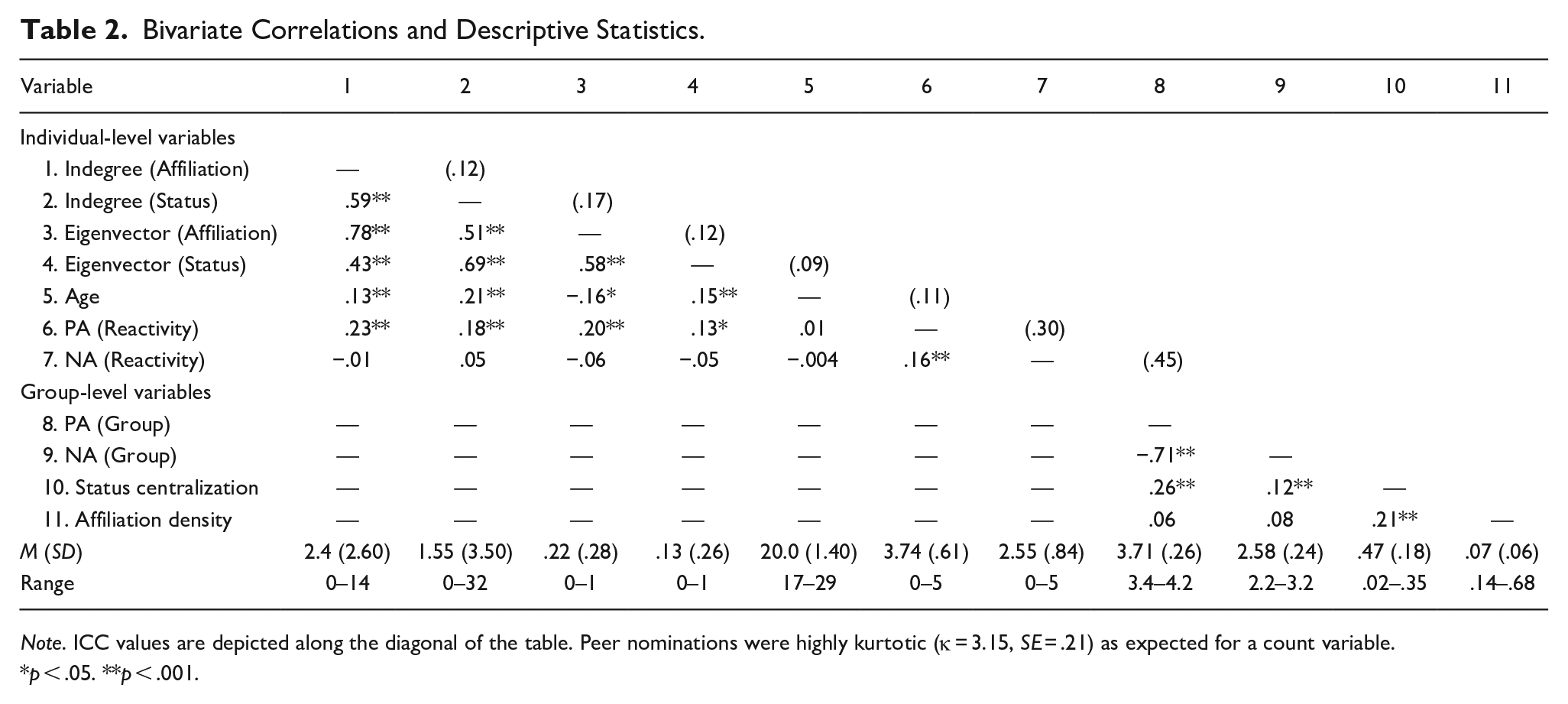
Note. ICC values are depicted along the diagonal of the table. Peer nominations were highly kurtotic (κ = 3.15, SE = .21) as expected for a count variable.
p < .05. **p < .001.
Multilevel Models
Full results of the affiliative network are depicted within Table 3, and results from the status network models are provided in Table 4. Across models, the combination of positive and negative affective reactivity explained a substantial amount of variance in both eigenvector centrality and number of status nominations, even after accounting for alongside network indices of group structure. The present data nevertheless also has a small k-level sample and heterogeneity across groups, resulting in relatively little variance accounted-for by group membership: ICCs ranged from .12 to .17, and low between-group residual variance. As such, the within-level effects were the primary results that we interpret from these models.
Multilevel Regression Models (w/ML) Predicting Eigenvector Centrality for Affiliative Nominations.
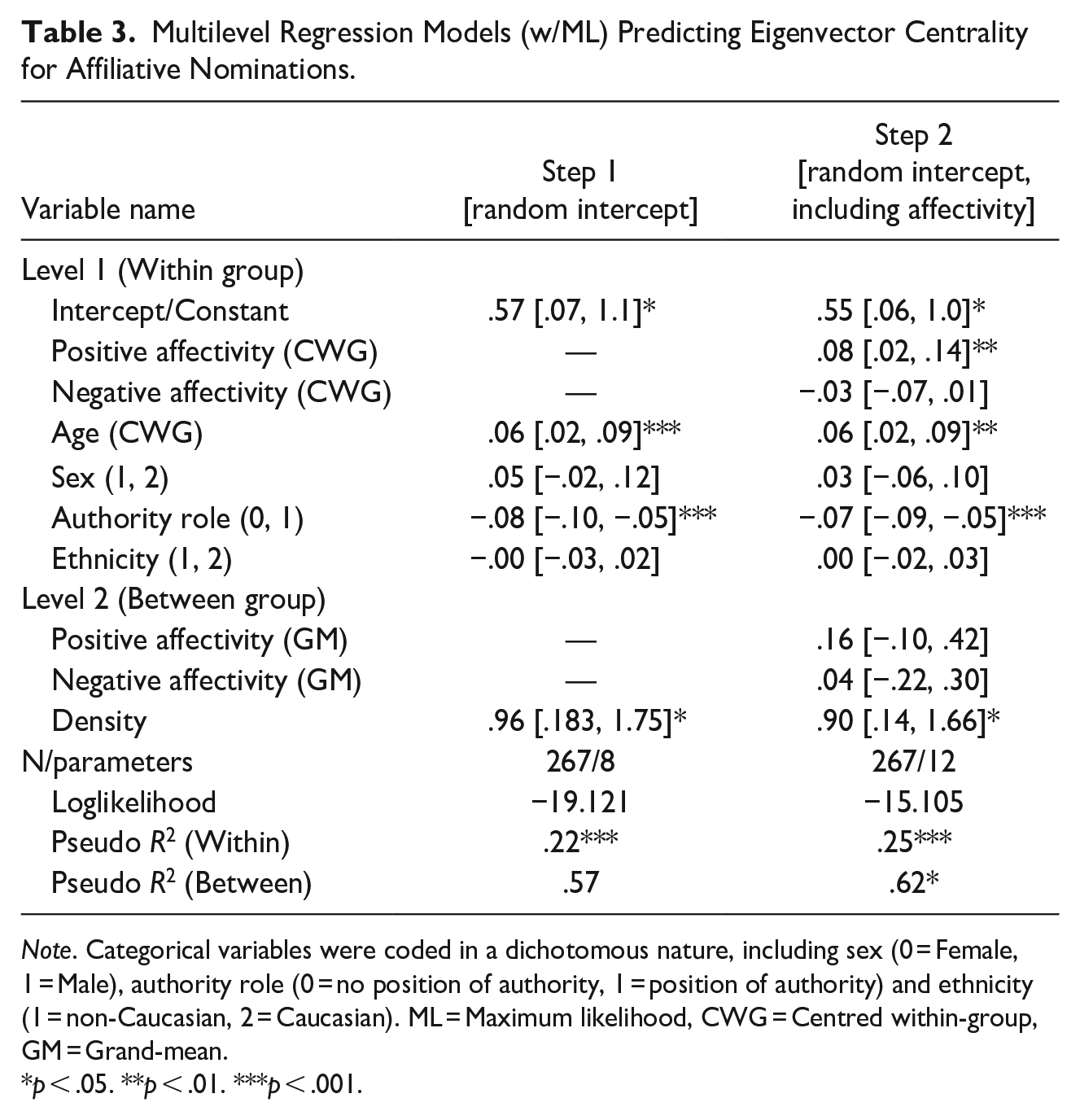
Note. Categorical variables were coded in a dichotomous nature, including sex (0 = Female, 1 = Male), authority role (0 = no position of authority, 1 = position of authority) and ethnicity (1 = non-Caucasian, 2 = Caucasian). ML = Maximum likelihood, CWG = Centred within-group, GM = Grand-mean.
p < .05. **p < .01. ***p < .001.
Multilevel Poisson Regression Models (w/ML) Predicting Indegree Centrality for Status Nomination.
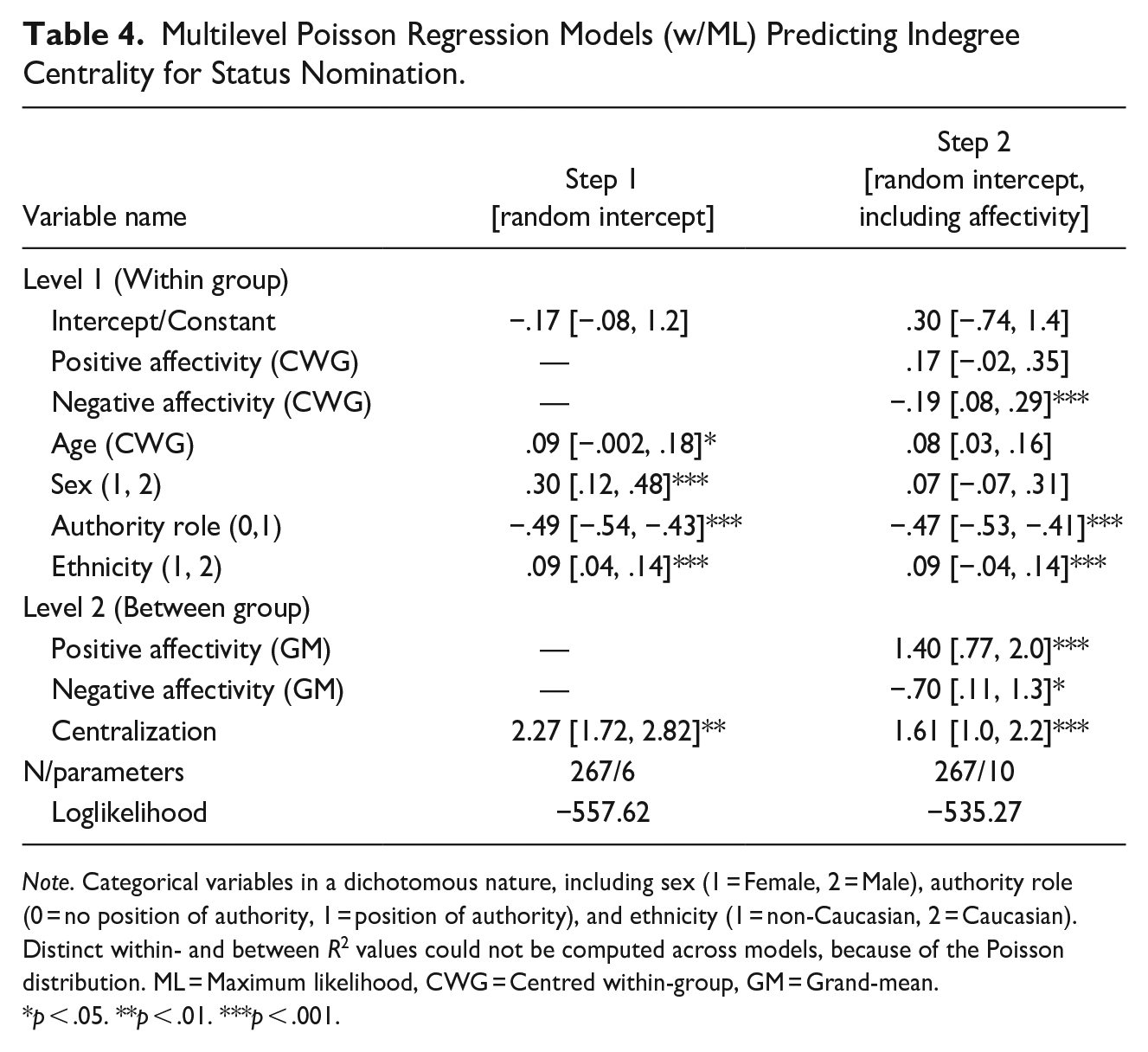
Note. Categorical variables in a dichotomous nature, including sex (1 = Female, 2 = Male), authority role (0 = no position of authority, 1 = position of authority), and ethnicity (1 = non-Caucasian, 2 = Caucasian). Distinct within- and between R2 values could not be computed across models, because of the Poisson distribution. ML = Maximum likelihood, CWG = Centred within-group, GM = Grand-mean.
p < .05. **p < .01. ***p < .001.
Affiliative Network Models
When predicting centrality within the affiliative network, participant age, sex, ethnicity, and position in club were entered in Model 1 at a within-group level. In addition, a club’s group density was entered at this stage as well as a between-group covariate. In Model 2, individual affective reactivity was added as a within-group predictor as well as a between-group predictor. For within-group covariates, age (B = 0.06, 95% CI [0.02, 0.09], p < .001) and position in a club (B = −0.07, 95% CI [−0.09, −0.05], p < .001) were found to significantly predict eigenvector centrality, whereas sex and ethnicity were not (B = 0.03, 95% CI [−0.06, 0.10], p = .51; B = −0.07, 95% CI [−0.09, 0.05], p = .95). Group density of a club was also a significant predictor (B = 0.96, 95% CI [0.18, 1.75], p < .05). Participants’ eigenvector centrality was higher when they were relatively older than other members, when they held an authority position in a club, and members in the club tended to nominate a larger number of others. At the within-group level, eigenvector centrality scores for affiliation were significantly and positively predicted by positive affective reactivity (B = 0.08, 95% CI [0.02, 0.14], p < .05), but not negative affective reactivity (B = −0.03, 95% CI [−0.07, 0.01], p = .16). At the between-group level, group-level eigenvector centrality (B = 0.16, 95% CI [−0.10, 0.42], p = .22; B = −0.04, 95% CI [−0.22, 0.30], p = .75) was not significantly predicted by group-mean scores for either positive and negative affective reactivity. Relating to pseudo-R2 values, 29% of variance in eigenvector affiliation network centrality was predicted.
Status Network Models
For the individual-level covariates, individuals received more status nominations when they were older (B = 0.08, 95% CI [0.03, 0.16], p < .05), held an authority position in the club (B = −0.47, 95% CI [−0.05, −0.41], p < .001), or were Caucasian (B = 0.09, 95% CI [0.04, 0.14], p < .01). Centralization also predicted the average number of nominations within a group (B = 1.61, 95% CI [1.0, 2.2], p < .001); this is in part characterized by the shared mathematical derivation for centralization and indegree centrality (i.e., groups with more nominations are more likely to be relatively more highly centralized). Indegree centrality of club members’ status was significantly predicted by negative affective reactivity (B = −0.19, 95% CI [0.08, 0.29], p < .05) but not positive affective reactivity (B = 0.17, 95% CI [−0.02, 0.35], p = .074). Participants with relatively higher negative affect tended to be ascribed with relatively less nominations. As for group-level aggregated affective reactivity, the average status nominations of members was positively predicted by positive affective reactivity (B = 1.40, 95% CI [0.77, 2.0], p < .01), and negatively predicted by negative affective reactivity (B = −0.70, 95% CI [0.11, 1.3], p < .05).
Discussion
Using social network analysis within a multilevel framework, we furthered the literature by examining how affective reactivity, coupled with group-level features, relates to the position an individual occupies within their small group. Individual levels of positive affective reactivity were significantly associated with eigenvector centrality in affiliative networks but showed no significant association with status nominations. Status-related models demonstrated contrasting effects: Negative affective reactivity was a significant factor. People with relatively lower levels of negative affective reactivity were more likely to receive a higher number of status nominations. This represents a differing pattern whereby people identifying as one who experiences strong and positive affective responses received many affiliative nominations (especially from key individuals), while it was having a low propensity to experience negative affect that predicted being seen by many individuals as a high-status member.
These effects were evident when (a) accounting for key covariates regarding both individuals and their groups, and (b) examining associations involving data from both participants (i.e., affective reactivity) and from their peers (i.e., network constructs). In regard to group composition, it was found that group-aggregated positive affective reactivity was not significantly associated with group density. We also found that group-aggregated positive affective reactivity was significantly linked to status centralization. When discussing these findings, we interpret the contrasting findings relating to affiliation and status networks and consider limitations of this work as well as future directions.
Interpreting Key Findings
The current study builds upon prior work on the role of disposition when considering centrality in organizational networks by leveraging intact small group networks comprised of affiliative interactions and status-related perceptions. An especially notable feature of the present individual-level effects is how they contrast with one another across affiliation networks (i.e., positive affective reactivity predictive) and status networks (i.e., negative affective reactivity predictive). Within the affiliation network, positive affective reactivity was found to significantly relate to their prominence within their group as well as the likelihood that they make connections with others of prominence. This finding was anticipated when viewed through both the relational and attributional approaches (e.g., Bartels et al., 2022; EASI model) and aligns with an expectation that positive affective reactivity will aid members in gaining embeddedness. For the status network, positive affective reactivity was not a significant factor of one’s ability in garnering status nominations. Instead, those with relatively higher negative affective reactivity tended to garner less status nominations from their peers even after accounting for individual-level covariates. This pattern of findings underscores one key conceptual insight. That is, researchers examining how affective reactivity (or other dispositions) predict position within groups must consider what dimension of social interaction is being considered, especially as it pertains to the fundamental affiliative/status distinctions made within groups (Abele et al., 2021).
Aside from the pattern of findings across networks, it is also important to interpret individual findings from this research, even though the present investigation was not suited to unpack specific mechanisms. Regarding the role of negative affective reactivity as a predictor of small group status, there is precedent within the status literature for the importance of negative affect even though these findings were not anticipated in the current study. Negative affective states, such as irritability or pessimism, may indeed signal to peers a lack of social adaptability or emotional stability; qualities that are often valued in status-conferring relationships (e.g., Chiu et al., 2017; Tiedens et al., 2000). When explaining the particular role when predicting status, we focus on two perspectives: (a) the extent that negative affect aligns or contrasts with expectations for high status members, and (b) the role of the student group context.
When explaining the significance of negative affective reactivity in how status was conferred, we focus on how people with a given personality are perceived by others and the degree of alignment with expectations. Even if we anticipate that people with high negative affective reactivity have a higher propensity toward negative or cold interactions with others, those negative interactions may carry greater weight for certain types of evaluations. Termed negative asymmetry, people give disproportionate weight and consideration to negative information and events in decision making and perception in certain contexts. These negative events dominate social judgment due to them contrasting heavily with the positivity that people typically experience (Labianca & Brass, 2006). This asymmetry may be especially relevant in our status network, where negative expressions could be perceived as a signal of dominance or competence, which are associated with higher-status individuals.
One interesting aspect is that negative affect is, at times, expected by leaders or high-status individuals, contrasting with our findings. For instance, Tiedens et al. (2000) found that the expression of negative emotions, such as anger, are often linked with higher status because they imply strength, control, or authority. Additionally, negative interactions may be particularly salient when determining status, as evidenced in studies focused on how negative ties at work are independent predictors of power and status in organizational networks (Chiu et al., 2017). Drawing upon accounts of asymmetry as well as contextual alignment with negative affective displays, we anticipate that negative affective reactivity (a) plays a critical role in how individuals are socially evaluated and (b) exerts considerable influence on judgments due to the clarity and intensity of negative interactions. However, not all negative emotions function similarly; for instance, anger may signal dominance and competence, while sadness may not align with these evaluative criteria. Therefore, it is plausible that specific negative affective displays could contribute positively to centrality in status networks.
Our second explanation for status findings is that the negative relationship between negative affective reactivity and status may be more pronounced in student clubs, which are affiliative contexts where interpersonal harmony is prioritized. As an example, from a similar context albeit focusing on a single larger group in each study, Anderson et al. (2001) examined status within undergraduate student housing context and found that self-reported neuroticism was negatively associated with status attainment. As noted above, people expect a degree of negative affect from high status members, particularly in work groups. Yet in settings like student clubs, a positive social climate is a central goal of membership so those with a propensity to experience negative emotions may struggle to cultivate status perceptions.
An alternative explanation for our findings is that incongruence or ambiguity may act as a key factor in shaping social evaluations. As Jacquart and Antonakis (2015) noted in relation to evaluations of leaders, ambiguous situations (i.e., when it is not clear exactly how well a leader is performing, objectively) result in members relying more on inference about the leader as well as on affective cues. Many peer evaluations in student clubs, like our context, entail high ambiguity. As such, it could be that people presenting positive affect present less ambiguity and accordingly gain embeddedness within the group’s interpersonal network while nevertheless being a low status member. Such variability in ambiguity when evaluating one’s relationships with others—as well as status—may explain differing roles of positive and negative affective reactivity.
The final set of findings to consider include those at the group level. The absence of significant effects for group-level affiliation networks may suggest that aggregated affective reactivity plays a less direct role in shaping general social bonding within groups than in more hierarchical relationships, such as status. One important note is that this study included the borderline number of groups for meaningful between-group analyses, and that there was heterogeneity in group size. These factors may have influenced the power to detect group-level effects. Additionally, the lack of significant findings for between-group centrality may reflect variations in the structural properties of different clubs that were not fully captured by affectivity measures. Furthermore, our models for affiliation networks were conservative because they included group-level density, which is a construct that is moderately correlated with group-level centrality because both are derived from the volume of nominations within groups. Nonetheless, regarding status networks, the significant associations found between group-level positive affective reactivity and centralization suggest that groups with higher positive affective reactivity tended to have fewer individuals occupying prominent positions. This aligns with research that examines how affect can shape hierarchical structures within groups. Specifically, Barsade and Knight (2015) emphasized that affective dynamics, particularly positive emotions, shape the distribution of influence and power within groups. In more centralized groups, positive emotional expressions may be especially visible for the subset of high-status members, enhancing their prominence while also limiting opportunities for others to gain central positions.
Although the positive correlation between positive and negative affective reactivity is consistent with previous work (Ripper et al., 2018), this finding may seem counter-intuitive and warrants elaboration. This correlation can be better understood through the lens of circumplex models of emotion, which suggests that emotions can be classified not only in terms of valence (positive or negative) but also in terms of arousal or activation (Russell, 1980). Individuals who are high in general arousal or activation may be more prone to experience both positive and negative emotions with greater intensity, regardless of their valence.
Implications
The findings illustrate that positive affective reactivity predicts prominence within affiliation networks, while negative affective reactivity plays a role in status-related perceptions, albeit in a complex manner. This pattern underscores the importance of distinguishing between affiliative and hierarchical relationships when examining the social consequences of affective reactivity. For instance, our results align with relational and attributional perspectives (e.g., Bartels et al., 2022; EASI model), suggesting that positive affective reactivity fosters embeddedness within affiliative networks by increasing the likelihood of forming connections with other prominent members. However, in status networks, negative affective reactivity appears to hinder status attainment, potentially due to negative asymmetry effects (Labianca & Brass, 2006), which amplify the salience of negative behaviors in social evaluations. This finding contrasts with some prior research on status conferral, where specific negative emotions, such as anger, have been linked to dominance and perceived competence (Chiu et al., 2017; Tiedens et al., 2000). The distinction highlights the need to consider both the type of negative affect and the context in which status is evaluated.
As such, the primary conceptual implication of these findings is the need for specificity when examining how affective reactivity relates to social positioning. Understanding the particular affective expressions, the relevant dimensions of social relationships (e.g., affiliation vs. status), and the broader social contexts is crucial. For example, while negative affective reactivity may align with high-status expectations in workplace settings, it appears to be a disadvantage in student clubs, where interpersonal harmony is prioritized. These findings emphasize the importance of contextualizing affective influences within different group environments.
Beyond these conceptual insights, our findings also underscore the need for greater clarity in how network constructs are measured and operationalized. Even though the current study did not aim to determine the specific mechanisms driving the contrasting effects across network types, the results highlight that gaining centrality in affiliative networks likely involves different processes than status conferral. This distinction has important implications for the measurement of networks and the precision required when defining key construct. Within the status literature alone, Xu et al. (2023) revealed vastly varying approaches to operationalize the concept of status in small groups. Some researchers operationalize status based on nominations about conferral of respect or admiration at an aggregated cluster-mean centered group level, similar to our approach (Antonakis et al., 2021). Other researchers operationalize status using a spectrum of approaches that are at times derived from affiliative relationships (e.g., how often someone is nominated as popular; one’s number of friends in a group). This is a problem because theorists emphasize substantial differences between status and affiliation. For instance, Djurdjevic et al. (2017), in their paper discussing the development of the Workplace Status Scale, acknowledged that although popularity and affiliation conceptually overlap with status, status is a distinct construct because individuals may have very high status but low affiliation with others. Peer nomination items and resulting network constructs should be clearly situated relative to key dimensions involving vertical or horizontal ties (i.e., status vs. affiliation; relationship vs. reputation). Thus, the current study contributes to the theoretical discussion by illustrating how conceptual ambiguity in operationalizing constructs related to affect, social networks, and group dynamics can obscure our understanding of social influence and network centrality.
Beyond theoretical contributions, this research also offers practical implications for how new employees might navigate team settings to position themselves advantageously. The findings challenge assumptions about the universality of behaviors such as positive affective reactivity in enhancing social capital. A related practical implication concerns how ‘positive’ members influence others. Research supports the idea that affective displays in interpersonal ties can serve as pathways for social influence (see Van Kleef, 2010). This influence is particularly clearly described through models of emotional contagion, where emotions are unconsciously shared or transferred among group members (Barsade, 2002; Hatfield et al., 1993). This process is a convergence of emotions as members respond to cues from other members with whom they interact—either through close interpersonal ties or through the actions of prominent members. Although this study did not directly test social influence within interaction networks, organizations may benefit from identifying employees with positive affective reactivity. These individuals are likely to occupy central positions within social groups, placing them in an optimal position to spread positive affect to others, which may influence group or individual outcomes.
Future Directions and Limitations
The current study has numerous strengths. We collected in-person data that included students embedded within small groups with significance in their lives and with clear interdependent group tasks. We also adopted a network-based nomination approach that reduces issues that arise with single-source data collection and produces constructs that are based upon group structure rather than the mere number of nominations. This study nevertheless has several limitations. The first limitation concerns our measurement of affective reactivity. The current study utilized the ERIPS, which asks participants about their general emotional experiences. Although effective at assessing an individual’s tendencies toward affective reactivity, it does not directly capture how it manifests in relation to the immediate group environment or how it may be perceived by others within the group. As Jones et al. (2021) highlighted, affective dynamics in small group interactions are often context-specific and may not be fully captured by general measures of affectivity. From this perspective, the ERIPS does not capture context-specific affective expressions that are relevant for group interactions. Future research could benefit from incorporating measures that directly assess context-specific affective reactivity, such as peer nominations of perceived positivity or negativity within the group. This would provide a more nuanced understanding of how individuals’ affect is experienced by their peers during group activities, potentially unique findings compared to general measures.
A second limitation involves the variability in size and type of club context with heterogeneity relating to differences in meeting frequency. This variability may shape how individuals come to interact with others and impact the network in terms of how groups come to structure themselves. Future research should attempt to reduce heterogeneity or develop adequate social context measures to examine between-group differences. Our models accounted for a significant amount of variance in the dependent variables, but a further limitation relates to how that variance was addressed: we extracted network variables to be used within a multilevel analysis framework. Multilevel analyses account for interdependence in data shared across members of a group but do not distinguish the unique variance shared within certain dyads. Multilevel approaches cannot account for variance shared by members linked via nomination, nor can they examine predictors or outcomes at the dyadic or network level. As such, there remains the question of whether dyadic relationships between members or network-level structures could account for this remaining variance. Given greater power and similarity in networks, scholars could consider the use of tools such as exponential random graph modeling to identify additional processes that may influence the creation of ties between individuals and how this can shape the global structure of a network (Hunter et al., 2008).
Conclusion
We examined the role that affective reactivity plays in how members are positioned relative to peers in university student clubs. We found that positive affective reactivity was associated with embeddedness within affiliative networks derived from nominations about whom interacts with whom outside of the club context. Negative affective reactivity was a significant factor in conferred status nominations from other peers for status networks whereby lower levels of negative affective reactivity likely led to more status nominations from peers. Moving forward, we encourage researchers to replicate the study in distinct contexts, while also considering different methodologies that incorporate network processes that explain the prominence of members or establish the causal effects.
Supplemental Material
sj-docx-1-sgr-10.1177_10464964251329219 – Supplemental material for Affective Reactivity and Its Role in Predicting Position in Small Group Networks
Supplemental material, sj-docx-1-sgr-10.1177_10464964251329219 for Affective Reactivity and Its Role in Predicting Position in Small Group Networks by Roy Hui, Alex J. Benson and M. Blair Evans in Small Group Research
Footnotes
Declaration of Conflicting Interests
The author(s) declared no potential conflicts of interest with respect to the research, authorship, and/or publication of this article.
Funding
The author(s) received no financial support for the research, authorship, and/or publication of this article.

Supplemental Material
Supplemental material for this article is available online.
Author Biographies
References
Supplementary Material
Please find the following supplemental material available below.
For Open Access articles published under a Creative Commons License, all supplemental material carries the same license as the article it is associated with.
For non-Open Access articles published, all supplemental material carries a non-exclusive license, and permission requests for re-use of supplemental material or any part of supplemental material shall be sent directly to the copyright owner as specified in the copyright notice associated with the article.
