




Abstract
Disruptive situations experienced in crises require significant initiative-taking among employees, particularly those in the service sector. Relying on the social information processing theory, this study expounds on how and when team cognitive diversity influences employee initiative-taking through work meaningfulness and perceived subgroup splits during a crisis. Data was collected from 232 hotel employees working within 58 work teams from two sources and in two waves. Results from a multilevel, dual-path parallel mediation data analysis did not support the hypothesized direct relationship between team cognitive diversity and personal initiative-taking or the indirect path through perceived subgroup split. This study’s analysis supported only the indirect path through work meaningfulness. Implications of the findings as well as avenues for further research and theory expansion are discussed.
Keywords
Employees’ initiative-taking is necessary for the hospitality sector, which thrives on offering high service quality to customers (Van Nguyen et al., 2021). Personal initiative-taking depicts an employee’s self-starting, proactive, and persistent work behavior (Bledow & Frese, 2009) regardless of challenges experienced during work process. This ability is particularly important in crisis situations such as a global pandemic, when service employees’ stress levels could be high and compounded by possibly ambiguous information about work process (Ikhide et al., 2022; López-Cabarcos et al., 2015). While progress has been made regarding how service organizations can sustain their operation in crises, the question of managing and utilizing employees’ initiative in those conditions poses a concern.
Further complicating the issue is that most hospitality employees (e.g., front desk attendants, housekeepers, chefs, managers, etc.) work within work groups/teams. A work group is comprised of at least two individual employees who perform work-related tasks, show interdependency in workflow, share work goals, and maintain team boundaries (Mathieu et al., 2019). Work groups usually exist within the larger organizational social context which could influence the work outcome of an individual employee (Salancik & Pfeffer, 1978). While personal initiative-taking could be context-specific and vary with different work groups, it can also enable employees to manage unexpected situations (Ikhide & Ogunmokun, 2022) by conferring on employees the ability to deviate from standard routine practices when necessary during a crisis. Employees can take initiative and prompt innovative actions that could guarantee service delivery to customers in such times (M. Yang et al., 2021).
Employee initiative-taking varies by individual and by teams, but one possibility is that teams with greater cognitive diversity also demonstrate more initiative taking. As the pressure increases for businesses and employees to continually innovate, rapidly salvage unfavorable situations, and deliver exceptional outcomes (Joshua et al., 2022; Qi et al., 2022), could diversity within work teams be the answer? (M. Yang et al., 2021). Team cognitive diversity describes the extent to which team members differ in perspective and thoughts about a situation (Nguyen et al., 2022). While personal initiative-taking has not been studied as an outcome of a cognitively diverse team in the literature (van Rijswijk et al., 2024), team cognitive diversity has the potential to enable innovative solutions and better problem-solving capability (van Rijswijk et al., 2024), suggesting it might also be connected to initiative-taking. In some cases, team cognitive diversity yields service improvement (Shemla et al., 2016), enhances the quality of decisions (Qi et al., 2022), and influences other work outcomes similar to personal initiative-taking (Reynolds & Lewis, 2017). However, some scholars have indicated that diverse teams are not as effective. For instance, dysfunctional dynamics in teams often engender undesirable outcomes such as conflicts (Nguyen et al., 2022). Notwithstanding, Shin et al. (2012) and Mitchell et al. (2017) added that the mixed findings or associated with team diversity may be understood by ascertaining its conceptual or contextual applicability, as well as its relevance to the outcome variables of interest (e.g., initiative-taking). This suggests that team cognitive diversity could be an appropriate predictor of personal initiative-taking during a crisis, since it could produce a rich repository of solutions and diverse ideas beneficial for taking initiative on the job.
While a direct relationship between team cognitive diversity and personal initiative-taking could exist, other factors such as context (e.g., employees task-, social-, or crisis-situation) should be considered when evaluating the direct relationship. Recent research highlighted the need to explore such factors, questioning the often simple, direct, and optimistic outlook of diversity on performance outcomes (van Rijswijk et al., 2024). Studies are urged to consider the “when and how” by which team cognitive diversity impacts performance metrics, for example, personal initiative-taking (Post et al., 2021; Qi et al., 2022). This study attends to this gap.
Well-developed theories in the field also acknowledge the inherent complexity of interaction in work groups. Salancik and Pfeffer’s (1978) social information processing theory illustrates that team members provide informational cues that influence individual employees’ perception of the quality of their work relationships, the work they do, and how they perceive its meaningfulness (F. Yang et al., 2018). In other words, interacting with colleagues is a critical antecedent of work meaningfulness and the hypothetical subgrouping and pattern in which employees organize around small workgroups (Bezrukova et al., 2009; Y. Peng, 2022; A. C. Peng et al., 2016; Robertson et al., 2020). Work meaningfulness describes the value given to a job and how an employee perceives it to be significant, engaging, and purposeful (Cohen-Meitar et al., 2009). In a crisis, it is an important job characteristic for employee’s well-being (A. C. Peng et al., 2016; Robertson et al., 2020). On the other hand, perceived subgroup split, which is conceivably experienced in work teams (Y. Chung et al., 2015), is the behavioral and psychological fragmentation of the team into different subgroups along perceived faultlines (Thatcher & Patel, 2012). While it is paramount to examine the mediating roles of work meaningfulness as a job-related characteristic and perceived subgroup split as an aspect of an employee’s social situation (Barrick et al., 2013), questions remain about how cues received in work groups enable an employee to perceive subgrouping and how they appraise their work as meaningful (Lysova et al., 2023). To benefit from a cognitively diverse team, Pratt and Ashforth (2003) and Holmes et al. (2021) supported the use of work meaningfulness as a mediating mechanism. Notwithstanding, comprehending the working mechanism of such a team is incomplete without the subgroup split element (Lau & Murnighan, 1998). Studies have shown that subgroup splits could explain more about how diversity affects employees and their behavior (Tiede et al., 2021). This is because it goes beyond task-related focus of work meaningfulness, to aspects that could enable social categorization and/or separation of employees at work into outgroup or ingroup members (Qi et al., 2022).
In line with Mathieu et al.’s (2019) input, mediating mechanisms, output (IMO) model, work meaningfulness and perceived subgroup split can be loosely categorized as mediating mechanism. They can be used to make sense of and account for the complex interactions of hospitality employees within their cognitively diverse team, which in turn could determine employees’ initiative-taking output in crisis. Since a cognitively diverse team has the potential to concurrently generate different outcomes, and its relationship with performance outcomes like initiative-taking does not always fit into an overly simplistic effect model, this study aims to respond to the gap in the literature by exploring how the cognitive diversity of a team could influence employees’ initiative-taking behavior through the mediating effect of work meaningfulness in the first indirect path, and perceived subgroup split in a second indirect path of a cross-level, dual-path mediation model.
Secondly, in examining the “when and how” cognitive diversity influences work outcomes through different mechanisms, the study responds to some calls in the literature (e.g., Post et al., 2021; Qi et al., 2022; Way et al., 2021) for studies to empirically examine team diversity and relevant outcomes during a crisis. The study uses social information processing theory to further shed light on the direct and indirect relationship between team cognitive diversity and personal initiative-taking behavior through work meaningfulness and perceived subgroup split which may vary depending on contexts.
Theoretical Framework and Study Context
Social information processing theory posits that employees develop their work behavior and perception from salient informational cues available to them in their immediate social environment (Salancik & Pfeffer, 1978). These cues typically originate from members of the employee’s work team with whom they interact (Salancik & Pfeffer, 1978). Since employees’ social context plays a major role in shaping individual perception and eventual behavior, the tenets of social information processing theory are frequently applied to make sense of intra/intergroup processes such as perception of subgroup splits, team faultlines, and animosity among group members (Yao & Liu, 2022; Yao et al., 2021), as well as perceptions about work meaningfulness (Montani et al., 2020; Salancik & Pfeffer, 1978). However, the theory does not clearly offer specific details about the characteristics a work context must possess to shape or influence an employee’s perception and eventual work outcome (Montani et al., 2020).
Through communication, employees obtain an interpretation of work events (Salancik & Pfeffer, 1978). This could include an observation of the workplace’s social or task context, that is, an apparent cohesion (or the lack thereof) among work groups or even a perceived meaningfulness of their work. According to Salancik and Pfeffer (1978), this interpretation affects subsequent work behavior. Thus, this study argues that a cognitively diverse team could provide an avenue for richer social information processing due to team members’ diverse knowledge bases, perspectives, or beliefs. This, in turn, could influence personal initiative-taking behavior outcomes. It is further hypothesized that understanding how and when personal initiative-taking develops among teammates within a cognitively diverse team during a crisis will depend on cues employees use to assess cognitive incompatibilities. Differences in opinion, ideas, and viewpoints could breed division among teammates and affect perceptions of the meaningfulness of their work as circulated among colleagues. Despite how essential personal initiative-taking behavior is in crisis (Ikhide et al., 2022), studies exploring whether an employee’s initiative during crises is associated with their engagement with their work team, rather than their individual disposition or needs, are limited (Nguyen et al., 2022; van Rijswijk et al., 2024).
Team Cognitive Diversity and Personal Initiative-Taking
Team cognitive diversity describes team members’ shared perception of the varying beliefs, knowledge, perspectives, and attitudes present among individual team members (Mello & Rentsch, 2015). The range of perspectives and knowledge base existing within a team highlights the value of such diversity (Shin et al., 2012). The value-in-diversity view states that diverse knowledge and opinions provide teams with a variety of relevant expertise to draw from, compared to homogeneous teams. However, a perceived incongruity of ideas creates an avenue where information/perspectives are exchanged and better elaborated on (Qi et al., 2022). While such incongruity may result in conflicting perspectives and difficulty reaching a consensus, the depth and scope of knowledge elaboration and discussion enable cognitively diverse teams to have larger resources for decision-making, problem-solving, and initiative-taking (Mitchell et al., 2010; Qi et al., 2022). However, the benefit of a cognitively diverse team for initiative-taking could be influenced by task-related contextual factors, such as task unpredictability, particularly in a crisis (Ali et al., 2021). In a crisis, team members are unable to forecast which work tasks must be executed and how. Thus, the abundance of ideas generated from elaborate discussions and varying perspectives by the cognitively diverse team may not be effective for taking initiative as the work process may be constantly changing.
With personal initiative, employees take self-starting and active approaches to work. Such employees engage in extra-role behavior, exceeding the responsibility required in a given role (Frese et al., 1997). Frese et al. (1997) described personal initiative-taking as consisting of these attributes: (a) persistent (overcoming barriers) (b) proactive (anticipating opportunities and problems), (c) self-starting (pursuing self-set goals), (d) pro-organization (consistent with employees’ organizational mission and goals), and (e) ability to modify the task environment. As a result, personal initiative could be influenced by organizational or task variables, as well as social factors in the work environment (Ikhide et al., 2022). Moreover, while team members as part of the social context could enforce or resound work expectations and directives, which in turn aids individual initiative-taking (Salancik & Pfeffer, 1978), a review of social information literature shows that information retrieved from the social context can equally be influenced by task-related factors in the work environment (Ali et al., 2021).
Workplace teams can be a breeding ground for personal initiative if team members are empowered to collaborate and share their diverse perspectives and knowledge bases. While collective sensemaking may enable the pooling of expertise in cognitively diverse teams (Carrington et al., 2019), exposure to a variety of ideas and perspectives in the team enhances individual members’ cognitive wealth which can be individually deployed to provide solutions to complex problems (Mitchell et al., 2019). Homogeneity within teams could be a source of rigidity, hindering the adaptation to change and the accomplishment of complex tasks (Qi et al., 2022). Individuals on teams lacking cognitive diversity may experience limitations in their ability to generate novel solutions, adapt to change, and think critically, which can hinder personal initiative (Carrington et al., 2019; Reynolds & Lewis, 2017). Thus we hypothesize that:
H1: Team cognitive diversity is positively related to employees’ personal initiative-taking.
The Mediating Role of Work Meaningfulness
The social information processing theory (Salancik & Pfeffer, 1978) provides the basis on which this research investigates whether team cognitive diversity indirectly influences personal initiative-taking through work meaningfulness. Work meaningfulness denotes the amount of significance and purposefulness one ascribes to work as well as the perception that one’s work makes a difference to others (Cohen-Meitar et al., 2009). Work teams are a strong source from whence employees develop cues they use to evaluate their work meaningfulness (Montani et al., 2020). In other words, employees draw on cues about the significance, impact, and value of their work from others within their team. The functionally isomorphic characteristics of the variable allow it to retain similar function and meaning regardless of being used at a team or individual level of analysis (Walumbwa et al., 2019). This makes it a suitable variable, according to Mello and Rentsch (2015), to develop an empirical model that can shed light on the complexity associated with the current team’s cognitive diversity literature and resulting outcomes. Studies have traditionally researched work meaningfulness from the perspective of job characteristics and design, exploring how jobs can impact employees’ inclination to invest effort and time in the effective performance of their roles (Lisak et al., 2022), especially in crisis.
Employees seek meaningfulness from the work they do. Work meaningfulness has not only been identified as a crucial work characteristics but also a fundamental human need (A. C. Peng et al., 2016; Pratt & Ashforth, 2003). It has been shown in the literature that employees’ perception of a lack of work meaningfulness can result in disengagement, apathy, and poor work performance. Citizenship behavior, commitment, and other positive performance outcomes have been associated with work meaningfulness (Lisak et al., 2022). Work teams and related socio-contextual factors could enhance motivational variables like work meaningfulness especially when they are informational (Walumbwa et al., 2019). As discussed earlier, this study argues that cognitively diverse teams serve as a direct informational tool since they provide employees with a platform for interaction, idea exchange, and information elaboration as well as cues regarding the purpose and value of individual work. The series of interactions and task interdependence between cognitively diverse teammates directly inform an employee through various perspectives about the details of their job and how relevant it is to the attainment of work outcomes.
Popular motivation principles further support the mediation relationship. Deci and Ryan (1985) posit that employees’ unsatisfied need for relational experience thwarts intrinsic motivation such as work meaningfulness, which in turn decreases employees’ well-being and work outcome, initiative-taking. In crisis situations, Kong et al.’s (2016) study in the hospitality industry argued that the degree to which employees’ work activities are deemed meaningful could boost their propensity for resolving problematic situations. When employees perceive work as meaningful, it gives importance and a sense of purpose that results in positive work behavior (Lisak et al., 2022; Montani et al., 2020). Likewise, when team members feel acknowledged for what they individually represent and contribute, they are likely to be more involved beyond what is required at work (Shin et al., 2012). As a result, regardless of challenging encounters during a crisis, an employee’s impetus to take initiative and act beyond what is required on the job is enhanced because they know their job has a far-reaching and significant impact (Ikhide et al., 2022). It therefore posits that meaningfulness is a potentially significant path that could help explain how cognitive diversity in teams translates into members’ initiative-taking. When employees know their job is meaningful, drawing on the strength of the team’s cognitive diversity, they could be willing to provide the adaptive, nonstandard, and creative performance required for initiative-taking.
To overcome the challenges posed by crisis, employees who perceive their work as meaningful could take the initiative to work beyond procedures the crisis might have rendered inadequate to provide transformative or therapeutic services to customers. That is, it is expected that high levels of work meaningfulness resulting from team cognitive diversity could help team members set their own service standards, and in so doing, provide self-starting performance during a crisis. Thus, it is hypothesized that:
H2: Work meaningfulness positively mediates the relationship between team cognitive diversity and personal initiative-taking.
The Mediating Role of Perceived Subgroup Split
Employees in a team develop shared perceptions and attitudes through information exchanges and social interaction which can be pivotal in affecting group dynamics (Montani et al., 2020; Salancik & Pfeffer, 1978). According to Lau and Murnighan (1998), the impact of social interaction on group split depends on the group’s interaction and composition. Perceived differences in cognitive processes or diversity concerning relatively unobservable attributes, backgrounds, or characteristics could be a basis for interpersonal and group differences in the workplace (Mello & Rentsch, 2015). Subgroup split literature examines the effect of employees’ attributes and their interrelations on the formation of subgroups within teams. Studies found that felt differences make individuals define themselves against others along hypothetical ingroup-outgroup faultlines (Way et al., 2021). According to Tiede et al. (2021), members with similar attributes are likely to cluster together. In literature, subgroups founded on demographics are commonly studied (Post et al., 2021; Thatcher & Patel, 2012). However, Spoelma and Ellis (2017) argued for studies that examine subgroups formed within teams along other configurations.
Perceived subgroup split is critical to analyzing the pattern of diverse teams’ effect on work outcomes and processes (Shemla et al., 2016). Rather than attempting to comprehensively capture the reality of work teams through a single diversity attribute (i.e., cognitive diversity in this study), which is an obvious limitation, the subgroup split variable is incorporated into the model for better comprehension (Lau & Murnighan, 1998; Shemla & Wegge, 2019; Tiede et al., 2021). According to Lau and Murnighan (1998) and Shemla and Wegge (2019), subgroup split is a different variable from diversity. It simultaneously captures the various forms of categorization that occur in work teams, as well as their impact on individual-level outcomes. For instance, consider a team of four male American hotel employees who all studied at the same institution. Two are in their early 20s while the other two are 50 years old. In a second group of four restaurant employees: One is a 20-year-old female college student from the United States; one is a 20-year-old male college student from Mexico; one is a 50-year-old female chef from Nigeria; and the other is an American 50-year-old male chef. Although both teams have the same level of age diversity, age separates the first team into two subgroups and not the second team. This makes it less likely that the second team will split into subgroups based on age because other characteristics could be the basis for a subgroup split.
Negative outcomes have generally been associated with subgroup splits (Tiede et al., 2021). This is because ingroup-outgroup categorization affects team dynamics, such that subgroups experience difficulty getting acceptance from one another (Lau & Murnighan, 1998). In teams where perceived subgroup splits exist, conflicts and clash of perspectives may become prevalent, leading to mistrust (Tiede et al., 2021) and reduced social integration, team cohesion, coordination, and cooperation (Shemla et al., 2016). Additionally, difficulties may be experienced in information sharing, knowledge exchange, and integration across subgroup boundaries (Shemla et al., 2016; Thatcher & Patel, 2012). Having explained in hypothesis 1 above how team cognitive diversity could enhance personal initiative-taking outcome because of an employee’s exposure to divergent outlooks, it is anticipated that a perception of subgroup split may be detrimental to such a relationship, bearing a negative impact on an employee’s initiative-taking behavior. However, Qi et al. (2022) argue that the extent to which subgroup split or ingroup-outgroup categorization affects the potential of cognitive diversity remains unknown. While Post et al. (2021) and Shemla et al. (2016) found outcomes (such as initiative-taking) of a cognitively diverse team to depend largely on subgroup splits, Greer and Jehn (2007) add that the perception of team composition determines the influence of diversity on an individual member work outcomes.
Based on the impact of subgroup split on employee performance, it is suggested that the same could hamper an employee’s motivation to share information and to maintain a closed mind towards outgroup members. Thus, affecting the potential benefits of a cognitively diverse team. Information fragmentation, knowledge hiding or communication barriers from the cognitively diverse group level to subgroup units could engender cold disagreement and stereotypes which has been associated with inefficiency in proffering solutions or taking initiative (Ogunmokun et al., 2020; Qi et al., 2022). Due to ingroup-outgroup categorization within the team, an employee may miss out on the resources and input available to the wider cognitive diverse team which could otherwise enable them to draw on the collective resources to enhance the quality of decision-making, detect and solve challenges (Lau & Murnighan, 1998), which is vital to personal initiative-taking. Although an employee with high initiative is pro-organizational and seeks new ways to contribute to the organizational goal and bottom line (Frese et al., 1997), the existence of a strong subgroup among work teams produces an unproductive disposition to work vision, goals, and the organization itself (M.-H. Chung et al., 2019). Particularly, in crisis, the different psychological perspectives of individuals could be a subject of division (Raza et al., 2020), with team members feeling loyalty towards in-group members rather than the greater good (Figure 1).
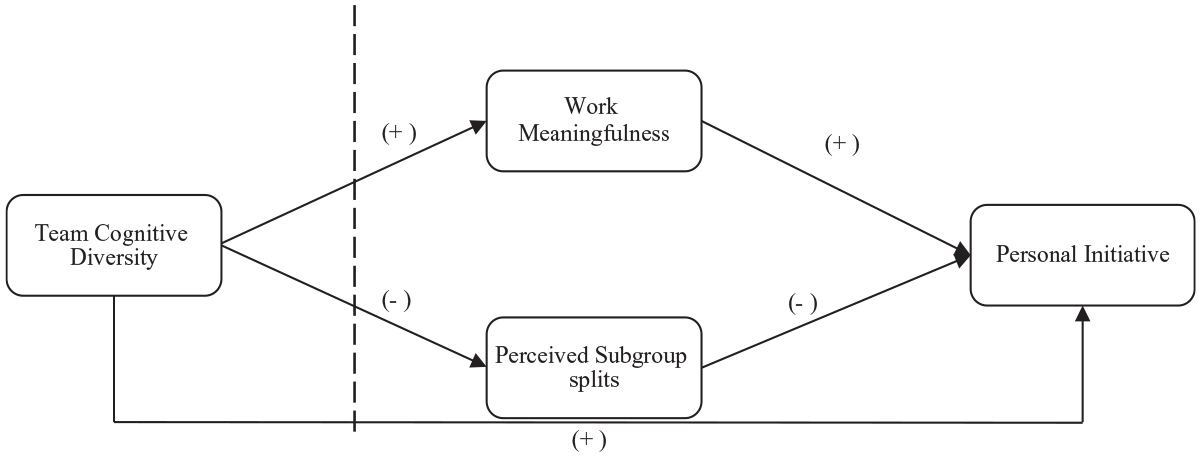
Illustrative summary of the study: conceptual framework.
Applying a subgroup lens to perceive team cognitive diversity is bound to aid the development of homegrown stereotypes towards own subgroup and negative stereotypes towards outgroups (Lau & Murnighan, 1998). As such, this could interfere with an employee’s ability to take initiative. Thus, it is hypothesized that:
H3: Perceived subgroup splits negatively mediate the relationship between team cognitive diversity and personal initiative-taking.
Method
Data Collection
Data were collected in two waves from members of work teams in a variety of small hotel establishments in the Chinese provinces of Zhejiang and Suzhou, in the spring of 2021. The respondents included front desk staff, maintenance personnel, waiters, housekeepers, cashiers, bartenders, chefs, kitchen attendants, hotel managers, etc. The questionnaires were designed in English. However, to ensure that the respondents understood and responded accurately to the questions, the questionnaires were translated into the Chinese language. Translations were done by professional translators and following Brislin’s (1980) recommendation, a back-translation was incorporated into the translation procedure. As a participation criterion, only teams with at least 3 employees working interdependently on tasks contributing to organizational objectives during the post-lockdown era were allowed to participate in the survey.
In the first wave, respondents’ demographics and team cognitive diversity were measured. After a five-week interval, which was deemed sufficient to allow for potential changes while still enabling the re-engagement of participants, the second phase of data collection was conducted with the same group of respondents. In the second wave, work meaningfulness, perceived subgroup splits, and personal initiative-taking were measured. Personal initiative-taking was peer-rated, as each respondent was requested to ask a colleague to complete that section of the survey on their behalf. Peer-rating of personal initiative is a practical source of assessment because peers’ observations might be more reliable and representative. In addition, the potential common method variance inherent in self-ratings is decreased. However, a shortcoming of peer-rating is that a friendly relationship with the respondent might lead to an over-rated or lenient assessment. To minimize this, peers were asked to respond to the questions honestly and provide an accurate rating. In addition, to guarantee that the respondents would not see the peers’ ratings, the questionnaires were submitted directly to the researcher by peers after completion. Peers were asked to think of situations related to the pandemic when answering the questions on personal initiative-taking.
A total of 232 responses from 58 teams were collected during this period, with a response rate of about 68% in the first wave and 77% in the second wave. 0.9% of respondents are between the ages of 18 to 27, 78.9% between the ages of 28 to 37, 18.5% between the ages of 38 to 47, and 1.7% are older than 48 years. 40.1% are male and 59.9% are female. 25.4% have less than a university degree, 68.1% have a university degree and 6.5% have a postgraduate degree.
Measures
The items were adapted to reflect the overarching context of the study. Team cognitive diversity measurement items were adapted from Van der Vegt and Janssen (2003), and participants were asked to indicate the degree to which members of their workgroup varied in skills and knowledge, way of thinking, in beliefs about what is wrong and right, and in how they viewed the world. The measurement of cognitive diversity items were rated by individuals and then aggregated to the team level; similar to previous studies that have examined the variable’s association and other individual outcome variables (e.g., Cui et al., 2022; Kim et al., 2020; Shin et al., 2012). Items were scored on 7-point Likert scales that ranged from “to a very large extent” (7) to “to a very small extent” (1). Work meaningfulness was measured using a three-item instrument adapted from A. C. Peng et al. (2016). The items contain “During the pandemic, my job activities are personally meaningful to me,” “The work I do is meaningful to me even during the pandemic,” and “During the pandemic, the work I do is still very important to me.” Perceived sub-group splits construct was measured using a three-item scale adopted from Tiede et al. (2021). Items include; “In the course of the pandemic, within my team, different subgroups have emerged, whose members get along with each other well,” “In the course of the pandemic, often, the same conversation groups form within my team,” and “In the course of the pandemic, team members who are similar to each other, consort with each other more often.” Personal initiative-taking was measured using a seven-item scale following Ikhide and Ogunmokun’s (2022) adaptation from Frese et al. (1997). Examples of peer-rated items include; “In the course of the pandemic, my colleague actively attacks problems,” “As we try to overcome the pandemic, whenever there is a chance to get actively involved, my colleague takes it,” and “My colleague uses opportunities quickly in order to attain firm’s goals even during the pandemic.”
Three constructs that could influence the study’s outcome were statistically controlled for by including them in the multilevel analysis following the recommendations of Bernerth and Aguinis (2016), including respondents’ education and tenure (individual level) as well as team size (team level). These constructs have been widely demonstrated to influence team processes and outcomes. For instance, team size was controlled for because in larger teams, the chances for subgroup splits are higher (Shaw, 2004). Heterogeneity in education and tenure was controlled for because teams with similar configurations might have different faultline strengths (Luan et al., 2019).
To avoid common method variance, certain prior considerations were taken. First, the data was collected at two different time points. Secondly, data was collected from more than one source. Finally, the CFA of the study’s hypothesized four-factor model was compared to alternative models. As shown in Table 1, the results revealed that the alternative models are inferior to the study’s hypothesized four-factor model, showing that common method bias seems not to be an issue in this study.
Alternative Model Comparison (CFA).
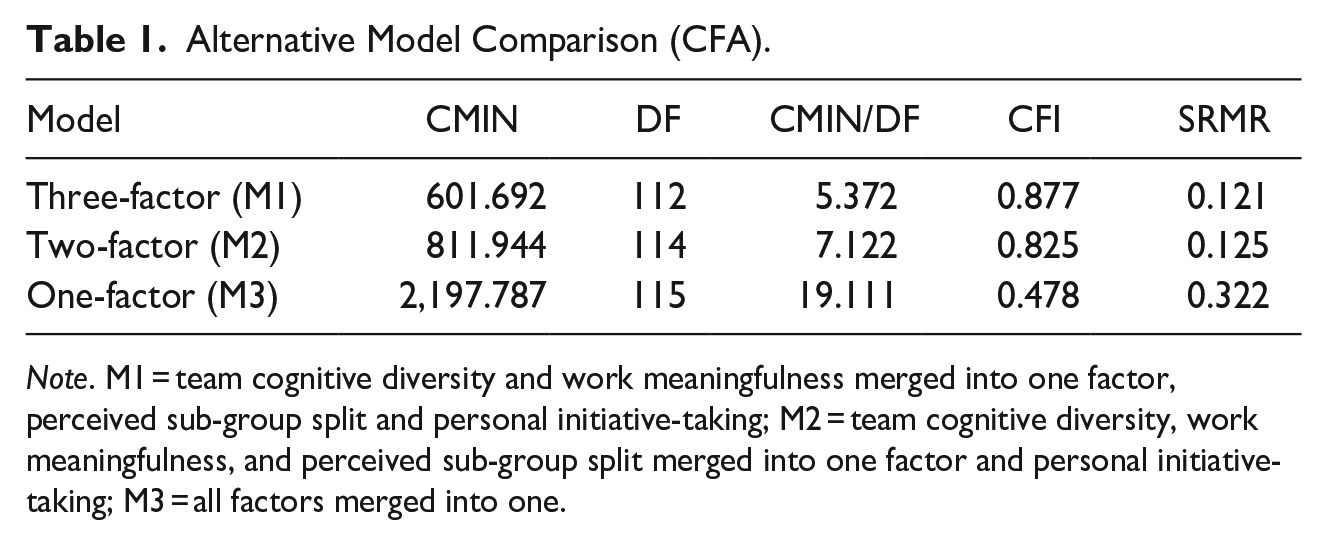
Note. M1 = team cognitive diversity and work meaningfulness merged into one factor, perceived sub-group split and personal initiative-taking; M2 = team cognitive diversity, work meaningfulness, and perceived sub-group split merged into one factor and personal initiative-taking; M3 = all factors merged into one.
Results
To ensure that the measures (i.e., team cognitive diversity, work meaningfulness, perceived sub-group split, and personal initiative-taking) captured distinctive constructs, a confirmatory factor analysis (CFA) was conducted using SPSS AMOS23. The study’s hypothesized four-factor model was specified by loading indicators on their respective latent variables. Further, correlations among the latent variables were estimated freely. Results revealed the four-factor model has a good fit with the data: χ2 [109] = 289.379; χ2/df = 2.66, Tucker–Lewis index (TLI) = 0.944, comparative fit index (CFI) = 0.955 and standardized root-mean-square residual (SRMR) = 0.051. Each indicator significantly loaded on respective latent factors with standardized loadings greater than .5 (see Table 2).
Loadings, Distributions, and Means.
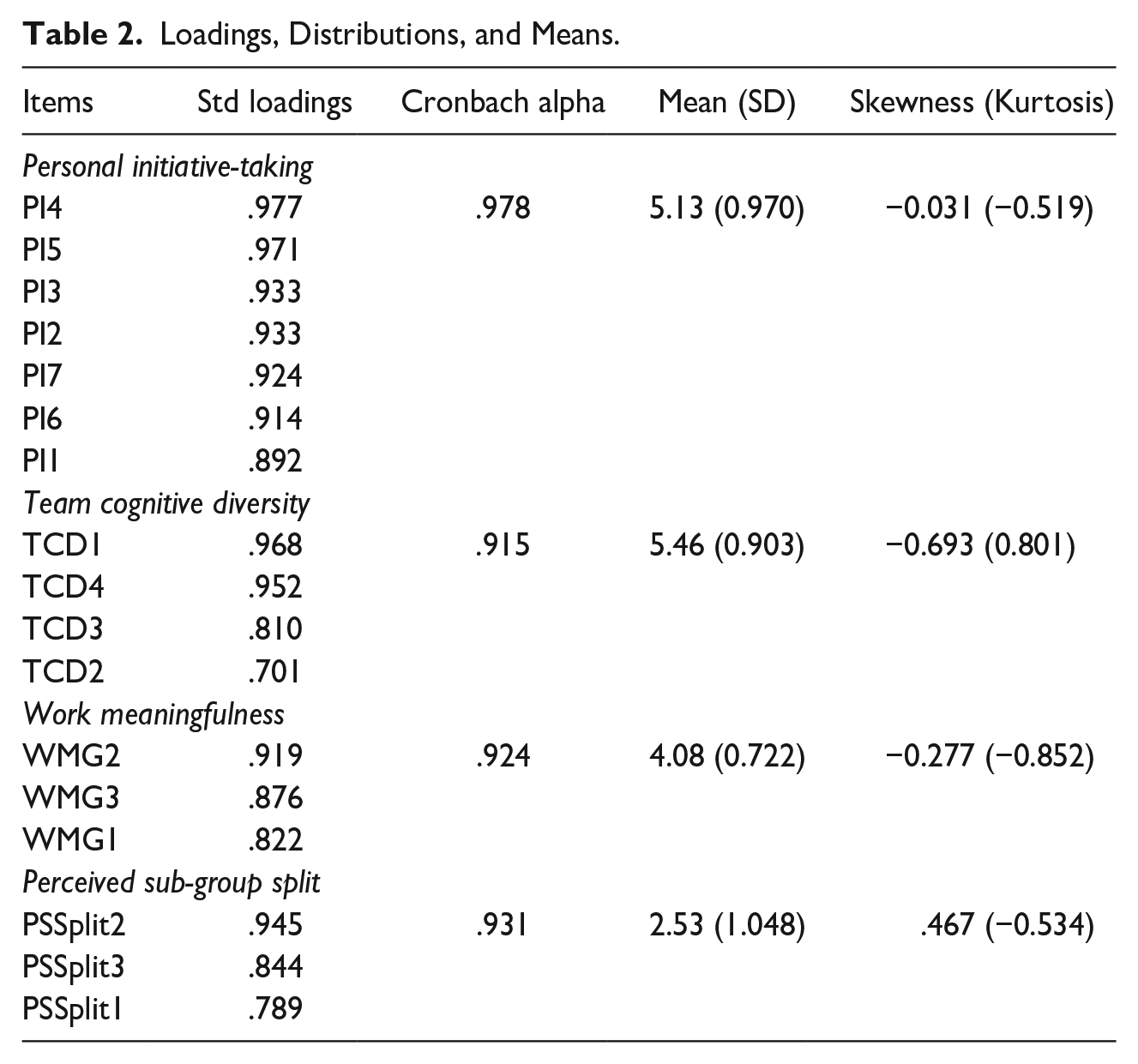
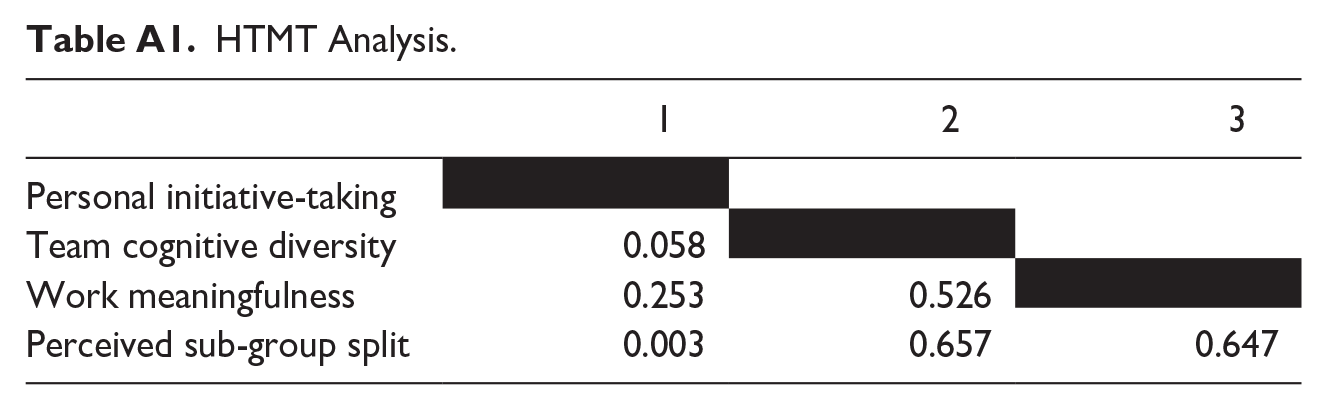
As shown in Table 3, the factors’ composite reliability values and average variance extracted (AVE) satisfied the Fornell and Larcker (1981) threshold of 0.7 and 0.5. The study’s model discriminant validity was also satisfactory as the square root of each factor’s AVE was greater than the inter-construct correlations (see Table 3). Considering that the Fornell and Larcker criterion has been criticized (for example, Hamid et al., 2017), a heterotrait-monotrait (HTMT) analysis was carried out and it also confirms the data’s discriminant validity (see Appendix 1, Table A1). Finally, as Table 2 above shows, the factors’ Cronbach alpha values surpassed the minimum .7 threshold (Nunally, 1978).
Correlations and Validities.
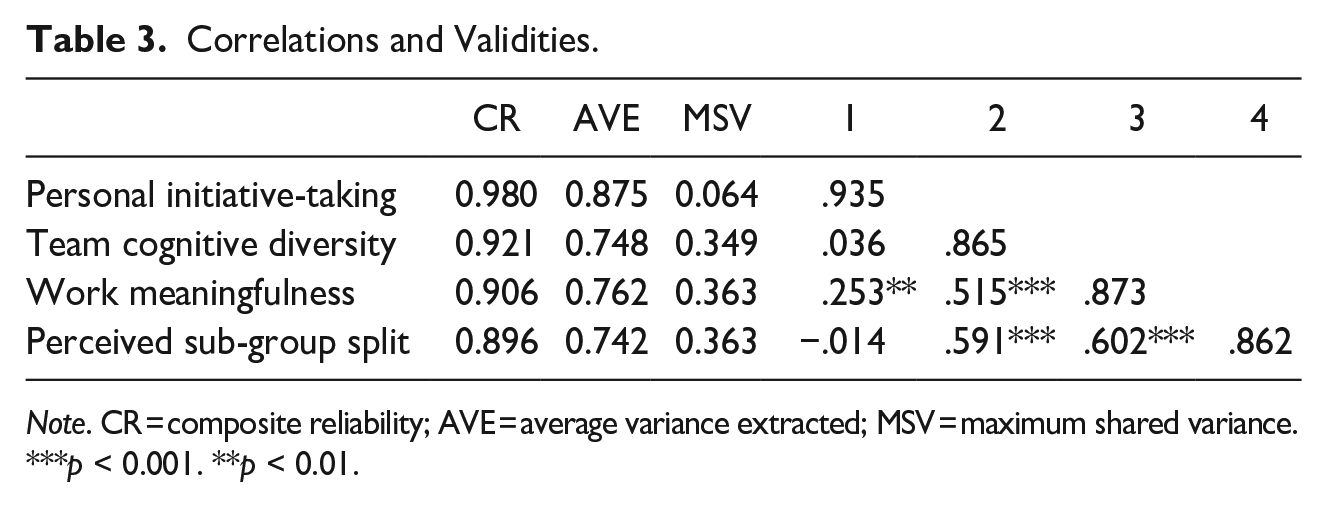
Note. CR = composite reliability; AVE = average variance extracted; MSV = maximum shared variance.
p < 0.001. **p < 0.01.
Aggregation of Data
Since individual responses of the study’s sample are nested within teams, a multilevel structural equation modelling (MSEM) approach is most appropriate for analysis. Intraclass correlation coefficient (ICC) and interrater agreement index (rwg) were used as standards for aggregating individuals’ ratings of team cognitive diversity into a team-level variable. According to Bliese (2000), when ICC (2) exceeds 0.60 and the rwg exceeds 0.70, there is justification to aggregate the data as it could yield a more reliable measure of the construct than ratings at the individual level. The rwg for team cognitive diversity was 0.921 and the ICC (2) was 0.919. These provide enough evidence of satisfactory within-team agreement to support the aggregation of individual-level data to the team level.
Hypotheses Testing
The study’s model follows a 2-(1-1)-1 design: the independent variable (team cognitive diversity) is a level 2 (team level) variable, while the mediator (perceived sub-group split and work meaningfulness) and the dependent variable (personal initiative-taking) are level 1 (employee level) variables. To test the study’s hypotheses, Rockwood’s (2017) Multilevel Mediation (MLMed) SPSS macro was employed. Compared to alternative programs such as R and MPlus, MLMed obtains similar results however with a better parsimonious estimation of the parameters being assessed (Rockwood, 2017). In addition, MLMed supports the concurrent estimation technique of testing indirect effects in mediation, which is preferable to piecemeal estimation methods (such as the hierarchical linear modelling) or the step-wise mediation testing procedures of Baron and Kenny (1986) that may potentially bias results because simultaneous estimation of all parameters is not allowed (Preacher & Hayes, 2004). Finally, MLMed estimates between-group effects using group means and within-group effects by within-group centering variables before the analysis (Rockwood & Hayes, 2017), making it the most appropriate option to accurately test for the study’s dual mediational effects in a multilevel model. Monte Carlo confidence intervals were estimated for indirect effects and indirect contextual effects.
First, the cross-level direct relationship between team cognitive diversity and personal initiative-taking was tested. The result of the multi-level regression revealed that our samples’ team cognitive diversity was not significantly related to their initiative-taking (β = −.0808; t = −0.6369; [−0.3348, 0.1732]). Thus, hypothesis 1 is not supported.
Then, the mediating role of employees’ work meaningfulness in the indirect relationship between team cognitive diversity and personal initiative-taking was tested. The result of the multilevel mediation analysis revealed that group-level team cognitive diversity was positively related to individual-level work meaningfulness (β = .256; t = 2.289; p < .05; [0.0321, 0.4800]); individual-level work meaningfulness in turn was positively related to personal initiative-taking (β = .5160; t = 5.619; p < .001; [0.3347, 0.6873]). The Monte Carlo confidence intervals do not contain zero, suggesting the presence of a between-group indirect effect (ab = 0.295; SE = 0.1366; Z = 2.158; [0.0421, 0.5683]). Thus, hypothesis 2 is supported.
Finally, the mediating role of employees’ perceived sub-group splits in the indirect relationship between group-level team cognitive diversity and personal initiative-taking was tested. Results of the multilevel mediation analysis revealed that group-level team cognitive diversity was negatively related to individual-level perceived sub-group splits (β = −.373; t = −2.033; p < .05; [−0.7405, −0.0058]) and individual-level perceived sub-group splits was similarly negatively related to personal initiative-taking (β = −.058; t = −0.851; p > .10; [−0.1938, 0.0771]). The Monte Carlo confidence intervals only marginally supported the presence of a between-group indirect effect (ab = −0.084; SE = 0.059; Z = −1.442; [−0.2271, 0.0007]). Thus, hypothesis 3 is not supported.
Hypotheses 2 and 3 above were analyzed in a multi-level parallel mediation model. The test for the difference in between-group indirect effects for the two paths is statistically significant. This gives credence to the study’s dual-path mediation model (Hayes, 2009). Perceived subgroup splits as mediator minus work meaningfulness as mediator = −0.3792; [−0.6985, −0.1019]. This supplementary analysis demonstrates that the specific indirect effect through work meaningfulness is significantly larger than the specific indirect effect through perceived sub-group splits.
Finally, the multilevel dual-path mediation is an indirect-only mediation; as the direct relationship between team cognitive diversity and personal initiative is insignificant, but the path through work meaningfulness is significant (Table 4). This suggests, according to Zhao et al. (2010), that the data largely supports the study’s “hypothesized mediation story” (p. 201) as “the mediators identified are consistent with the hypothesized framework” (p. 199).
Multilevel Dual-Path Mediation.
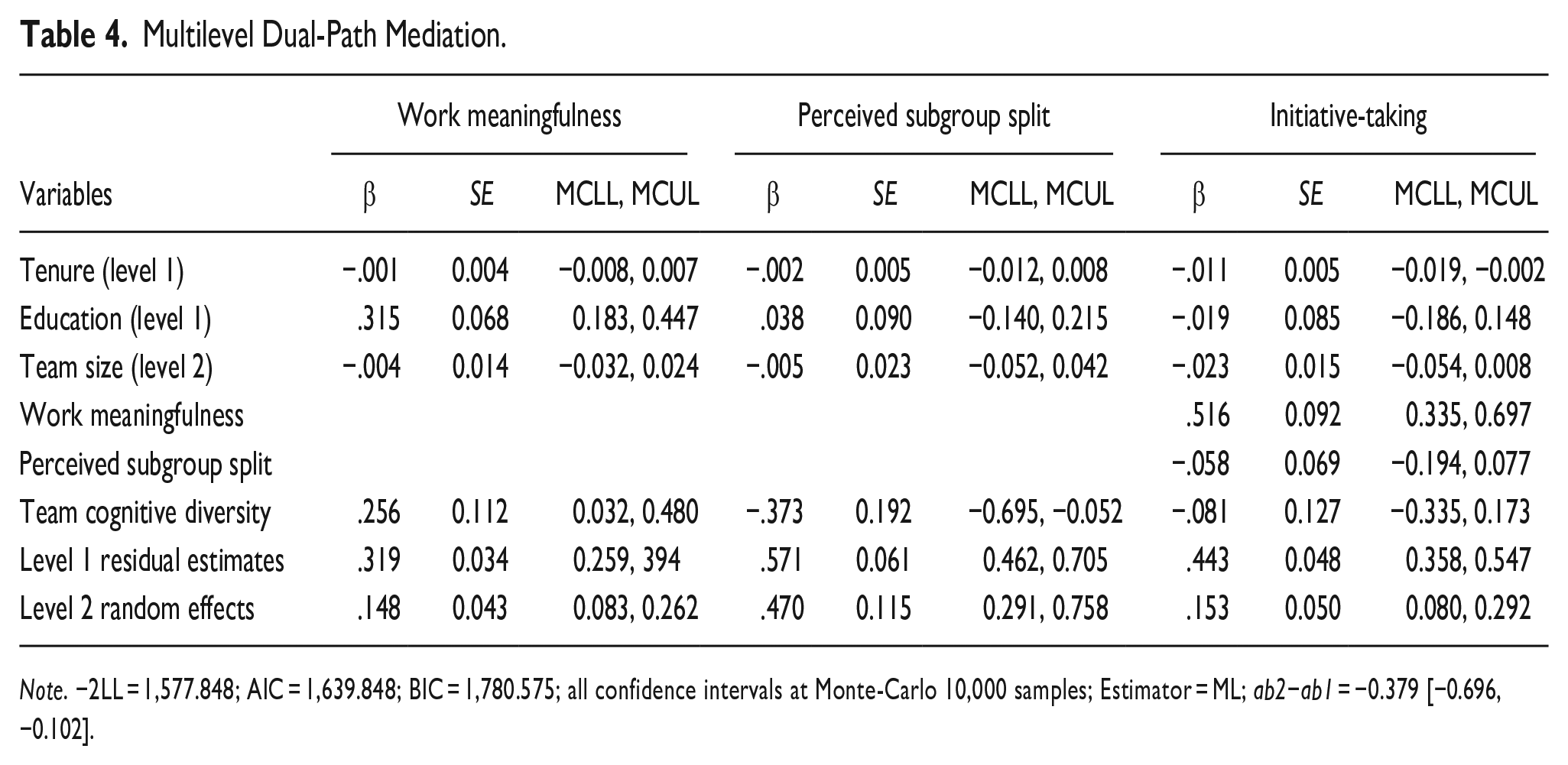
Note. −2LL = 1,577.848; AIC = 1,639.848; BIC = 1,780.575; all confidence intervals at Monte-Carlo 10,000 samples; Estimator = ML; ab2−ab1 = −0.379 [−0.696, −0.102].
Discussion
The current study investigated the crosslevel dual path parallel mediation between group-level team cognitive diversity and personal initiative-taking through work meaningfulness and perceived subgroup splits. Hypothesis 1 was not supported, as there was no statistically significant relationship between team cognitive diversity and personal initiative-taking. This may be because there is not enough evidence from this study’s data to support the hypothesized relationship (Visentin et al., 2019). However, these results are in line with those of several other similar studies reporting no statistically significant relationship between team cognitive diversity and individual creativity (Shin et al., 2012) or between cognitive style and creative performance (Meneely & Portillo, 2005). Neither Shin et al. (2012) nor Meneely and Portillo (2005) provided a clear explanation for their findings, but based on the current study, it is possible that there is no real relationship between a cognitively diverse team and a team member’s personal initiative-taking behavior in crisis (Visentin et al., 2019). Despite working within a cognitively diverse team, reasons beyond the scope of this study may have affected the direct relationship with employee’s personal initiative-taking in crisis. Additionally, work tasks may require deviations from standard practices or incorporation of new procedures, such as serving customers remotely. This could stifle initiative-taking especially if contact with customers is restricted, as largely experienced in the hospitality sector during the COVID-19 pandemic. Standard and routine work processes at the time may have changed, with employees still gaining familiarity with the newly adopted procedures.
Borrowing from social cognitive theory, Ali et al. (2021) explain that to fully comprehend the interplay between team cognitive diversity and initiative-behavior, it is essential to consider contextual environmental variables. Employees do not exist in a vacuum but in a social context captured by their cognitively diverse team, thus it is important, according to Montani et al. (2020), to look to other factors in an employee’s work context for explanations. Contextual factors such as the crisis situation, task structure, team member’s disposition, and their divergent job roles, for example, chefs, waiters, etc. may help explain the finding arrived at in Hypothesis 1. Mathieu et al. (2019) added that the outcome of a diverse team may be simple to discuss abstractly, however, the actual manifestation of the teams varies across settings and is influenced by its context.
The Hypothesis 1 finding could also be explained empirically. There can be a mediation effect even if the direct path between team cognitive diversity and personal initiative-taking is insignificant (Hayes, 2009). The identified “indirect only mediation” according to Zhao et al. (2010) does not require a significant direct effect. In other words, it could be that the effect of team cognitive diversity on personal initiative-taking can only be explained through mediating variable(s). While some theoretical and empirical explanations for the finding were provided above, this could also be an opportunity for further research, an avenue for theory expansion, or a reason to consider other relevant mediating variables.
In terms of mediation analysis, the results shows that team cognitive diversity positively enhances work meaningfulness, which in turn serves as a motivator for personal initiative-taking (Hypothesis 2). This finding supports Walumbwa et al.’s (2019) report which showed that the experience of work meaningfulness determines team members’ behavior, whether they are bound to engage in initiative-taking or not. Even in crisis, work meaningfulness is a task-related factor that influences how an employee feels and think about the importance of the job he/she does. Additionally, Dimitrov (2012) specifically examined hospitality employees to find the source of work meaningfulness. Despite the diversity of the respondents in Dimitrov’s (2012) study, it was found that hospitality employees’ ability to interact, share their opinions with teammates, and contribute towards the achievement of a common service-oriented goal was one of the major sources of work meaningfulness, which in turn facilitated service performance. Our study found that individual employees benefited from the interaction they had within their cognitively diverse work group. The team’s cognitive diversity provided employees with access to beneficial resources, diverse perspectives, evidence, or reinforcement to draw from regarding the significance of their work. A constant reminder of the importance of a teammate’s task could prompt that employee to take initiative, as each one works towards achieving the team’s goal. Irrespective of restrictions and difficulties experienced in a crisis, an employee may be well prepared to, for example, improve guests’ experiences, offer personalized recommendations, or find alternative solutions to their complaints. This is a result of receiving and comprehending informational cues from the team regarding the significance and value of their work in achieving the team’s outcome. Team members who perceive their work as meaningful are more inclined to feel less dissatisfied as well as more engaged, valuable, and useful, which in turn enhances their well-being and enables them to give themselves voluntarily over and above their job responsibilities (Deci & Ryan, 1985).
The third hypothesis, which states that perceived subgroup splits negatively mediate the relationship between team cognitive diversity and personal initiative-taking, was not supported. This finding corroborates other studies (Chen et al., 2017; Y. Chung et al., 2015; Gibson & Vermeulen, 2003; Thatcher et al., 2003), where a hypothesized relationship involving subgroup splits (or its variant) and outcome variables were not supported. The explanations given were associated with differences in study methodology (laboratory setting versus field setting) and research context (Thatcher & Patel, 2011). While this current study’s data did not support Hypothesis 3, the crisis and the field setting context of this study may provide some explanation. The crisis may have made the cognitively diverse teams focus on a collective effort that enabled team cohesion and bonding rather than subgroup differences and splits. Such team solidarity might have deactivated rather than activated subgroup splits. Moreover, van Knippenberg and Schippers (2007) reported a stronger mediating effect of perceived subgroup splits in the relationship between team cognitive diversity and performance among teams with a low level of team cohesion. A non-significant relationship between team cognitive diversity and personal initiative-taking through perceived subgroup split may depend on the team cohesion, which might have mattered more in the specific crisis situation and context.
A supplementary analysis showed that the mediating effect of perceived subgroup split was too small to be detected statistically. That is, perceived subgroup splits may have been insufficient or latent to make sense of how and when team cognitive diversity affected personal initiative-taking in a crisis (Visentin et al., 2019). Y. Chung et al. (2015, p. 15) explained that there is some latent subgroup split in any work team, but the split is not always activated enough to significantly influence employee work behavior. A similar explanation may apply to the current study, in that subgroup split may not have been activated, hence the non-significant effect. Y. Chung et al. (2015) and Thatcher and Patel (2011) also pointed out that empirical exploration of contextual factors that trigger subgroup split is in its infancy. Future research should explored what factors activate (or deactivate) subgroup splits in a context similar to this study.
Theoretical Implication
In the literature, team cognitive diversity varies in its association with outcome variables. Responding to calls by Post et al. (2021), Qi et al. (2022), and Way et al. (2021), this study’s findings extend the diversity literature by examining the mechanisms by which team cognitive diversity affects personal initiative through work meaningfulness and perceived subgroup splits experienced by hotel employees in a crisis situation. The result provides supportive evidence that team cognitive diversity indeed has the potential to provide different outcomes. While extant studies have often touted either the positive or negative effect of cognitive diversity on outcome variables, it was found in this study that the cognitive diversity of a work team in crisis had no direct effect on a hospitality employee’s initiative-taking behavior but was instead indirectly related through work meaningfulness, a task-related variable. It is noteworthy to add that personal initiative-taking is an essential employee behavior needed for service improvement, recovery, and organizational survival in times of crisis. Despite the relevance of initiative-taking behavior in crisis situations and it being a consequence of interaction with teammates (Ikhide et al., 2022, 2023), this is the first study to investigate initiative-taking as an outcome of team cognitive diversity. Neither has any inquiry been done into the mechanisms through which it comes about in a small group setting. This study extends the team cognitive diversity literature line of inquiry into the largely unexplored sphere of personal initiative-taking in crisis and in a work team setting.
Research has converged on the notion of teams being complex and dynamic entities (Mathieu et al., 2019; Mello & Rentsch, 2015; Shin et al., 2012). Supported by social information processing theory, this study finding has presented empirical and theoretical backing that shows that employees within a cognitively diverse team interact with each other and their interaction affects how a team member perceives the significance and meaningfulness of their work, which in turn enables initiative-taking behavior. Evidence is provided to demonstrate teams’ complexity which cannot be grasped from a cause-and-effect standpoint. This current study thus adds work meaningfulness variables to the list of previously known mediating variables relevant to the outcome of a cognitively diverse team. Compared to the insignificant effect of perceived subgroup split, work meaningfulness was found to be a significant mechanism in explaining the process through which team cognitive diversity influences personal initiative-taking in crisis.
While no significant effect was found in the indirect path through perceived subgroup splits, it is believed that subgroup split is a variable that requires careful exploration, especially concerning interaction among team members in crisis. This finding provides a resonding supports for Y. Chung et al.’s (2015) question: are all subgroup splits created equal? The response happens to be “No,” particularly in a crisis situation. This study is one of the few to provide empirical support that corroborates Thatcher and Patel’s (2011) proposition that context may influence the effect of subgroup split. In addition, the results provide support for the possible dormancy or inactivity of perceived subgroup split in every work team (Y. Chung et al., 2015; Visentin et al., 2019).
Lastly, this study utilizes social information theory to make sense of the direct and indirect relationship between the variables. Following the theory’s logic, it is suggested that employees interpret cues in their work environment specifically, through interactions within their cognitively diverse team. This informs how they assess the meaningfulness of their job, and it also provides them with signals regarding subgroup splits that may not be activated within the team in crisis. A considerable volume of research has examined the impact of team cognitive diversity on work outcomes using the faultline theory, categorization–elaboration model (CEM), and others (e.g., Chen et al., 2017; Y. Chung et al., 2015; Qi et al., 2022). Building this study’s arguments on social information processing theory contributes to providing a more integrated and comprehensive picture of the impact of team cognitive diversity on individual employee outcomes.
Practical Implications
Initiative-taking is important in crises. To foster such self-starting behavior among employees, there is a need to create a climate where employees are encouraged to freely reveal and deploy their different perspectives and knowledge bases. Organizations need to make it safe for employees to think, have different opinions, and contribute to decisions regarding the challenges a crisis imposes on their job and the specific industry. This study’s findings show that work meaningfulness has a relevant role to play in that regard. This demonstrates “others” as a source of work meaningfulness, a key job characteristic and now a significant path that links team cognitive diversity with personal initiative-taking. Practitioners can glean from the insight provided here to develop evidence-based interventions that address the “unhappy, disengaged or stressed” employee phenomenon. For instance, in terms of job design, work tasks can be designed in an interdependent manner. Allowing employees to work in a team with resource interdependence and frequent interaction with each other can enhance work meaningfulness and eventually initiative-taking. Working together towards a work goal can create a sense of purpose, belongingness, and relevance, especially in crisis. Each employee contributing their bit to a greater cause can be engaging and can produce a perceived sense of community and support that could enable work meaningfulness. However, if it is impossible to design team tasks to feed into each other (which is not the case in the hospitality sector), or if workflow interdependence or restricted contact limits interaction, as during a crisis, technology can be deployed to cultivate team spirit. Additionally, line managers who allocate and design job tasks can make it a habit to remind employees of the importance of the task they do and how it fits into the organization’s goal as well as recognize the work group’s input.
Limitations and Considerations for Future Studies
This study provides several avenues for further studies. Following the findings of this research, other studies are called to replicate this research in both a crisis and non-crisis situation so as to either dispel, confirm or extend the current study’s outcomes. These studies can either account for the outcome of the direct relationship between team cognitive diversity and personal initiative-taking or search for other mediating variables that could give a rounded understanding of the direct path. Secondly, this study was conducted in a field setting among hotel employees, thus findings may not be representative of teams in other sectors. Studies that specifically explore both the direct and indirect effect of team cognitive diversity on initiative-taking behavior through work meaningfulness and perceived subgroup splits among employees in other hospitality or service rending sectors is required. While other research can test this study’s hypothesis in a more controlled setting, the findings of both the laboratory and field settings can be followed up with other qualitative methods such as interviews. Interviews could provide clarification and insights from respondents about the relationship between variables in the study, including the unsupported hypothesis.
Thirdly, only the indirect path through work meaningfulness was supported in the dual path mediating model. The path through the perceived subgroup split was not. Studies need to further explore the perceived subgroup split variable which, according to Lau and Murnighan (1998), Shemla et al. (2016), and Tiede et al. (2021), is vital to fully comprehending the effect of diverse teams on team or individual employee work processes and outcome. Moreso, Y. Chung et al. (2015) and Thatcher and Patel (2011) also pointed out the need for studies that explore contextual factors that activate the effect of subgroup splits in hypothesized relationships. For instance, subgroup split was not activated in the crisis context of this study; other studies could also examine perceived subgroup split within a similar model and in both crisis and non-crisis situation.
Footnotes
Appendix 1
HTMT Analysis.
|
Acknowledgements
The authors express gratitude to the study’s survey participants for their time and effort. We also thank Jude B. Joshua in the School of Business Administration, Zhejiang Gongshang University, Hangzhou, China for his assistance in facilitating the data collection process.
Data Availability Statement
The data supporting this study’s findings are available from the corresponding author upon reasonable request.
Declaration of Conflicting Interests
The author(s) declared no potential conflicts of interest with respect to the research, authorship, and/or publication of this article.
Funding
The author(s) received no financial support for the research, authorship, and/or publication of this article.
