




Abstract
Understanding explanatory team processes and emergent states is crucial for facilitating potential benefits and hindering potential pitfalls of team diversity. This systematic review synthesizes research regarding the processes and states related to team diversity since the categorization-elaboration model’s (CEM) introduction, against which we evaluate the literature. According to the CEM, an interplay of social and informational processes shapes diverse teams’ effectiveness. We show that despite the wide recognition of this interplay logic, there is a misalignment between CEM’s theoretical propositions and the actual conceptualizations and measurements of processes and states in primary studies. This misalignment is accompanied by primarily static designs and conceptualizations. Our review expands scholarly understanding of the interplay between social and informational processes and states in diverse teams, advancing knowledge of the diversity–team effectiveness relationship. Finally, we delineate imperatives for future research, embracing the dynamic nature of team processes and states.
Keywords
Team diversity, defined as team members’ variation on any attribute, such as demographics, functional background, or personality (van Knippenberg & Schippers, 2007), can both benefit and impede team functioning (van Dijk et al., 2012). Understanding how diversity shapes team effectiveness has been core to team diversity research for decades (Milliken & Martins, 1996; K. Y. Williams & O’Reilly, 1998). According to the social categorization perspective, diversity can trigger processes and states that may divide teams (Turner et al., 1987), creating social tensions and diminishing their effectiveness (e.g., Mannix & Neale, 2005). These social processes and states, as we term them, relate to team members’ interpersonal interactions and relationships. By contrast, according to the information/decision-making perspective, the diversity that members bring to their team constitutes a resource for solving complex problems and developing innovative ideas. These informational processes and states, as we call them, are primarily concerned with task accomplishment.
Ambiguous findings regarding the relationship between diversity and team effectiveness have led to the assumption that an interplay of social and informational processes and states determines whether diversity has positive, negative, or no effects on team effectiveness (van Knippenberg & Schippers, 2007). The categorization-elaboration model (CEM; van Knippenberg et al., 2004) provided the first theoretical integration of the social-categorization and information/decision-making perspectives, which had previously been studied separately, to explain the diversity–team effectiveness relationship. Specifically, the CEM proposed that problematic intergroup attitudes and behaviors instigated by social categorization hinder information elaboration in diverse teams, impairing team effectiveness. By highlighting the interplay of social and informational processes and states, the CEM sheds light on why earlier research found inconsistent effects of diversity on team effectiveness (e.g., Bowers et al., 2000). The model also promised to increase the coherence of subsequent team diversity research.
However, the crucial role of the interplay between social and informational processes and states underlying the diversity–team effectiveness linkage has not been evident in subsequent team diversity research. Existing literature reviews have focused on specific diversity attributes (e.g., Mello & Rentsch, 2015; Schneid et al., 2016; Traylor et al., 2024; J. Wang et al., 2019), particular outcomes (e.g., Hundschell et al., 2022), certain team types (e.g., Bunderson & van der Vegt, 2018; Khatib et al., 2021), and contingencies (i.e., moderators; Guillaume et al., 2017) of the diversity–team effectiveness relationship. While these and other reviews are valuable in highlighting the complexity of the diversity–team effectiveness relationship from an input, output, and moderator/context perspective, no review has systematically synthesized knowledge of the (interplay of) processes and states that can explain this relationship. This oversight is striking, given the consensus that team processes and states are core to understanding team functioning and effectiveness (Ilgen et al., 2005; Kozlowski & Chao, 2018).
Reviewing the team diversity literature from the perspective of processes and states could illuminate the value of considering social and informational processes and states conjointly in explaining the effects of diversity on team effectiveness. Moreover, a focus on processes and states inherently speaks to the dynamics of team diversity effects. Whereas a focus on dynamics has been stressed in the team literature (Delice et al., 2019; Mathieu et al., 2014), illuminating the role of time in understanding the mechanisms underlying the diversity–team effectiveness link is needed.
Our systematic review provides a much-needed conceptual analysis and integration of prior findings regarding the role of processes and states in the diversity–team effectiveness relationship. We evaluate this comprehensive overview of the processes and states considered in team diversity research against the interplay logic articulated in the CEM (van Knippenberg et al., 2004). As such, our review makes the following contributions. First, it synthesizes knowledge of the (interplay of) processes and states underlying the diversity–team effectiveness linkage. We illuminate the theoretical focus adopted in primary studies and summarize how processes and states have been conceptualized and studied to untangle the complex web of mediating and moderating factors in the diversity–team effectiveness relationship. These insights uncover whether and how social and informational processes and states have been considered conjointly. Based on this we can evaluate the extent to which the CEM has advanced knowledge and identify possible other ways of conceptualizing and studying processes and states in diverse teams. Second, building on the synthesized knowledge of processes and states in diverse teams, we outline opportunities for future research that embrace the dynamic nature of team processes and states. Inspired by theory on team temporal processes (Kozlowski & Chao, 2018; Marks et al., 2001), our recommendations complement team diversity literature through a dynamic perspective that accounts for reciprocal interplays of social and informational processes and states over time.
Methodology
Scope and Inclusion Criteria
We conducted a systematic review of the team diversity literature. In line with the scope of our review and following conventional criteria for large-scale literature reviews (e.g., Hemshorn de Sanchez et al., 2021), we applied the following inclusion criteria: Studies had to be (a) published in English language in (b) peer-reviewed, quantitative empirical journal articles; (c) conducted with participants 18 years and older; and (d) published since 2004, the year the interplay of social and informational mechanisms was formally proposed (van Knippenberg et al., 2004).
To ensure the included studies address processes or states that underlie diverse teams’ effectiveness, studies also had to meet three other criteria. First, because potential social-categorization processes are limited in dyads (K. D. Williams, 2010), studies had to be conducted on a collective level, involving teams, groups, or departments with at least three members. Second, studies had to investigate the effects of perceived or objective team diversity or faultlines which are hypothetical dividing lines that can occur when multiple diversity attributes align to create relatively homogeneous subgroups (Lau & Murnighan, 1998). We also included studies in which diversity was conceptualized as the moderator instead of the independent variable, provided the interaction term could be reinterpreted to inform our research question (for a similar approach, see Guillaume et al., 2017).
Third, studies had to assess one or more team processes and/or states in relation to team diversity. We refer to team processes as team members’ interdependent acts that convert inputs to outputs to achieve common goals (Marks et al., 2001; Rapp et al., 2021). Considering processes as team members’ interdependent acts aligns with conceptual thinking about processes as explanatory mechanisms for relationships between psychological constructs (Kozlowski, 2022). Moreover, we acknowledge the importance of conceptually distinguishing team processes from team states. Processes refer to “the affective, behavioral, cognitive, and social processes enacted by actors” (Kuljanin et al., 2024, p. 2). In contrast, team emergent states, as described in earlier theoretical work by Marks et al. (2001), are typically considered mechanisms that “summarize the perceptions of thoughts, feelings, behaviors, and social relations of individuals across actors, time, and context” (Kuljanin et al., 2024, p. 2). Both team processes and states reflect mechanisms with the explanatory power for explaining variability in team effectiveness (Ilgen et al., 2005). Therefore, we included studies examining the role of team processes and/or states (e.g., as moderator or mediator) in the relationship between team diversity and effectiveness. To avoid systematically omitting studies, we also included studies in which team processes or states were conceptualized and studied as the dependent variable.
Literature Search
We followed the PRISMA guidelines to identify, screen, and select studies that met our inclusion criteria (Page et al., 2021). We systematically searched the PsycINFO and Business Source Premier (BSP) databases. To identify all relevant studies, we searched in titles, abstracts, and keywords using a rather “open” search string that combines the keywords “diversity” and “team” and their commonly used synonyms and variations, without limiting the search to certain processes, states, or effectiveness outcomes: (divers* OR dissimilar* OR faultline* OR homogen* OR heterogen* OR composition*) AND (team* OR group* OR unit*). In line with our inclusion criteria, we limited our search to publications in peer-reviewed journals in English language that were published since 2004. We conducted our initial search in September 2020 and updated our search in May 2023. To identify additional relevant studies, we manually scanned the latest publications of the top-tier management and applied psychology journals (e.g., Journal of Applied Psychology, Journal of Organizational Behavior, Small Group Research).
We consolidated all 105,497 identified hits in one data set. After eliminating duplicates, we excluded case studies, as these did not meet the inclusion criterion of being quantitative empirical journal articles. We also eliminated hits with ineligible classification codes (e.g., studies on civil rights, engineering, genetics) that were available for hits exported from PsycINFO only (American Psychological Association, 2024). Next, we manually screened the remaining records for relevance based on titles and abstracts. Given the extensive number of records identified, the first author and four trained research assistants conducted the title-based and abstract-based screening. The title-based screening resulted in a notable reduction of hits, as titles often disclose information that allow an evaluation against inclusion criteria. As such, we eliminated hits that were, for instance, clinical (Parkinson’s Disease; Kluger et al., 2020; Alzheimer’s Disease; Smith et al., 2020) or related to disciplines outside our scope, like livestock farming (e.g., group composition in Highland cattle; Sueur et al., 2018). The title-based screening left us with 4,011 relevant articles. Abstract-based screening led to the elimination of 3,002 articles, many of which assessed diversity in societies and neighborhoods instead of in teams. We double coded 20% of the abstracts and, in cases of discrepancy, decided on their relevance through in-depth discussion.
We assessed the eligibility of the remaining 1,009 articles based on the full text. The full-text screening led to the elimination of 846 articles that did not meet our inclusion criteria. For instance, 29% of the reviewed articles did not assess team processes or states, 15% were conceptual, and 9% were not conducted on the collective level. The final sample consisted of 163 articles that reported 172 independent studies. Figure 1 illustrates the identification and screening process in a PRISMA flow diagram (Page et al., 2021).
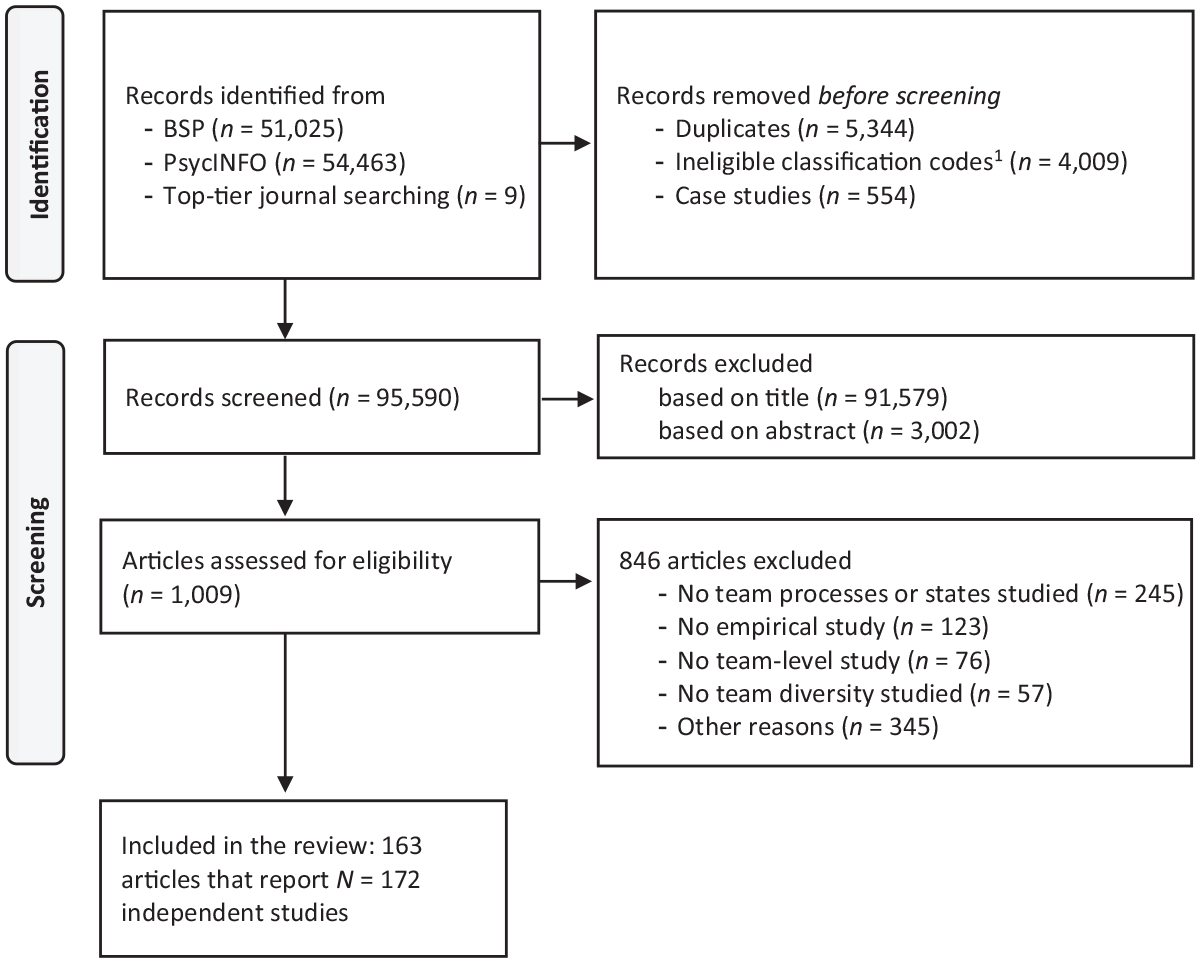
PRISMA flow diagram of the identification and screening process.
Data Extraction
The articles were coded by four trained research assistants and double coded by the first author. We extracted the following four types of information: (1) study characteristics, (2) information about the core variables, (3) the acknowledgment of an interplay of social and informational processes and states, and (4) the acknowledgment of time within studies. First, study characteristics included the sample size (i.e., number of teams), country of the studies, and study setting (business, education, healthcare, laboratory). We also coded the interaction mode, differentiating in-person from virtual interaction, and team compositional status in terms of intact versus ad hoc-composed teams. Table 1 summarizes the characteristics of the reviewed studies.
Characteristics of the Reviewed Studies.
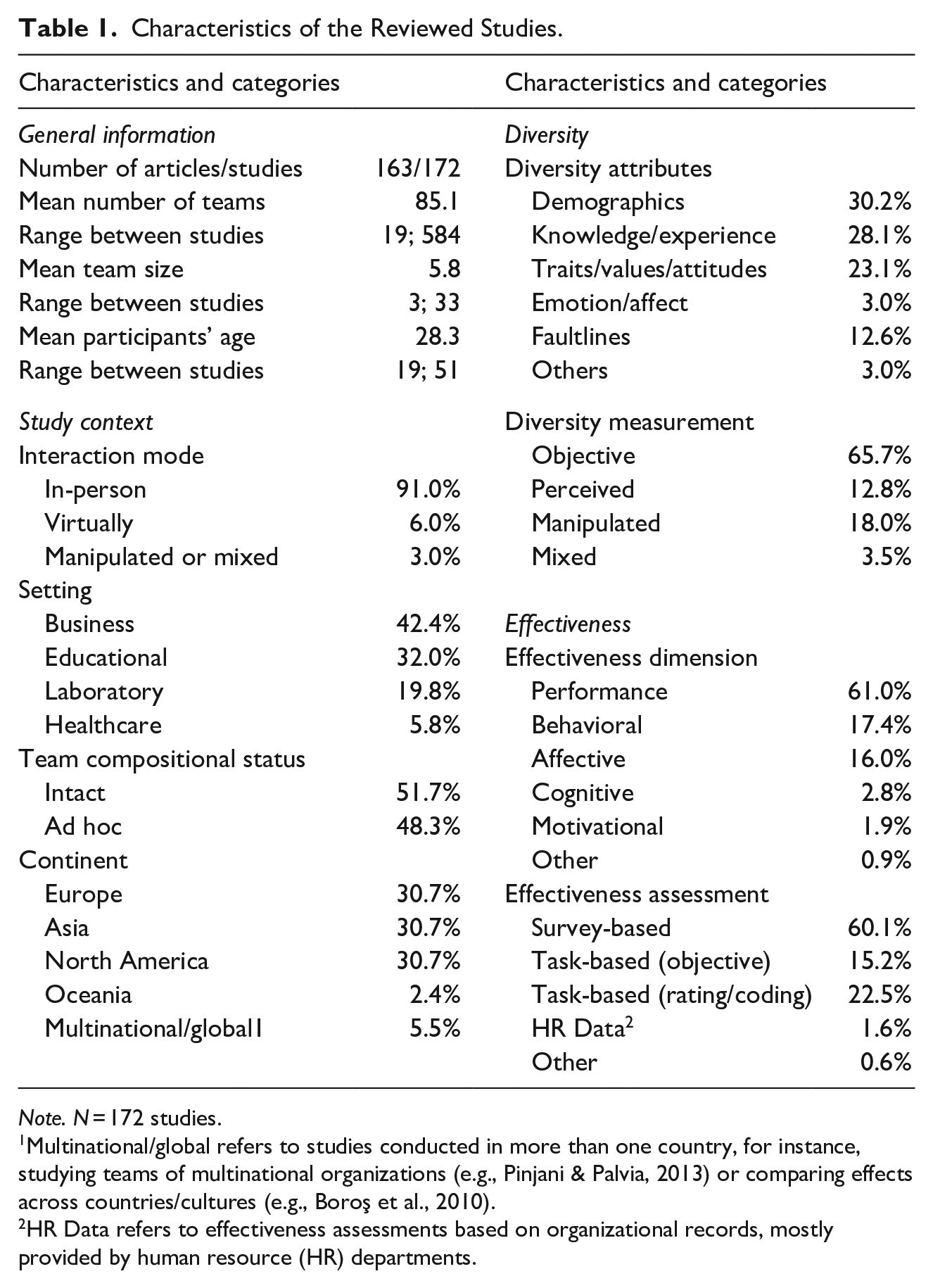
Note. N = 172 studies.
Multinational/global refers to studies conducted in more than one country, for instance, studying teams of multinational organizations (e.g., Pinjani & Palvia, 2013) or comparing effects across countries/cultures (e.g., Boroş et al., 2010).
HR Data refers to effectiveness assessments based on organizational records, mostly provided by human resource (HR) departments.
Second, we coded information about the independent variable (IV), dependent variable (DV), moderators, and/or mediators, extracting information about construct names, constructs’ conceptual role, and conceptual models. Regarding construct names, we noted the labels used by scholars. Regarding constructs representing team processes and states, we coded whether they reflect the social categorization (“social”) or information/decision-making (“informational”) perspective. We categorized constructs that represent aspects of task-related processes and states as informational, and constructs that represent interpersonal aspects as social. We based this categorization as informational or social on the definitions provided by primary article authors. When in doubt, we considered how the processes and states were measured—for instance, evaluating survey items. Some processes and states were not clearly reflective of the social or informational perspective, but conflated aspects of both perspectives (e.g., behavioral integration; withdrawal); for the sake of completeness, we still included them in our database. Further, we visualized how constructs were conceptually arranged (i.e., conceptual model). We based this abstraction of the relationships between constructs on the hypotheses and/or conceptual models provided in the primary studies. This coding resulted in a graphical representation of the conceptual model underlying each study, which we summarized and categorized across studies.
Third, we coded the extent to which an interplay of social and informational processes and/or states was acknowledged throughout each study’s (a) general introduction to the research topic (i.e., describing how an interplay of social and informational processes and states would generally determine effectiveness in diverse teams); (b) theorizing (i.e., specific theoretical arguments pertaining to the interplay to explain relationships between study constructs); (c) conceptual model (e.g., models proposing a serial mediation via social and informational processes or proposing social and informational states to interact to determine effectiveness in diverse teams); and (d) measurement (i.e., assessment of both types of processes and states, and statistical modeling of their assumed interplay).
As such, our understanding of the interplay logic expands the original proposition in the CEM, which specified social processes and states (which also arise from diversity) moderating the relationship between diversity and information elaboration (van Knippenberg et al., 2004). Of note, the CEM, with its eight propositions, goes beyond formulating an interplay logic—for instance, speaking to contingency factors that make one or the other process more likely to be activated in diverse teams. An exhaustive evaluation of the CEM and testing of its propositions is beyond the scope of this review and an important matter for future research (see also Traylor et al., 2024). As we aim to synthesize research on the processes and states considered and studied in team diversity research, the interplay of social and informational mechanisms, as proposed in the CEM, serves as our point of departure. In our coding, we distinguish studies as representing variants of an interplay (e.g., interactive, serial), as compared to those that focus on social or informational processes and states, or treat them in separation. For instance, when social and informational processes and/or states are conceptualized as separate mediators through which diversity affects team effectiveness, this was coded as “both perspectives in separation,” as no interplay is specified. We used the following categories to code the acknowledgement of social and/or informational processes and states: “interplay acknowledged,” “both perspectives in separation,” “social perspective focus,” “informational perspective focus,” “other perspective,” and “information missing.”
Finally, we coded the extent to which time was considered in studies’ general description, theorizing, conceptualization, and measurement. We used a binary code of “yes” versus “no” to code whether time was acknowledged in the different study sections. We coded time as acknowledged when time-related aspects were described, explained, conceptualized, or measured, which could be expressed in manifold ways. For instance, time-sensitive theorizing could be apparent in arguments related to teams’ life cycles (typically early vs. later phases of team interaction) or explanations of how processes or states evolve over time. We considered measurement as time-sensitive when constructs were assessed at different points in time or control variables were included that acknowledge the time teams had spent together (i.e., team tenure), among other aspects. Further, we coded the studies’ time span and the number of measurement points. We provide the final coding sheet of the 172 included studies via the Open Science Foundation (https://osf.io/zpwvc/).
Review Findings
We synthesize knowledge obtained from our systematic review, illustrating theoretical, conceptual, and methodological developments in team diversity research over the past two decades. Integrating insights across studies, we identify: (1) blurry definitions of processes and states in the diversity–team effectiveness relationship, (2) a fuzzy conceptualization of the interplay logic, and (3) limited consideration of time. We elaborate on each of these three main findings and their implications before deriving recommendations in the subsequent Discussion.
Blurry Definitions of Processes and States in the Diversity–Team Effectiveness Relationship
Our review highlights substantial heterogeneity regarding the processes and states that have been conceptualized in the diversity–team effectiveness relationship. Figure 2 depicts all processes and states identified in our database, grouped according to their conceptual role (i.e., moderator, mediator, DV) and perspective (social, informational, conflating). Our review reveals vague definitions of team processes and states, and lack of clarity about the conceptual role of certain team processes and states.
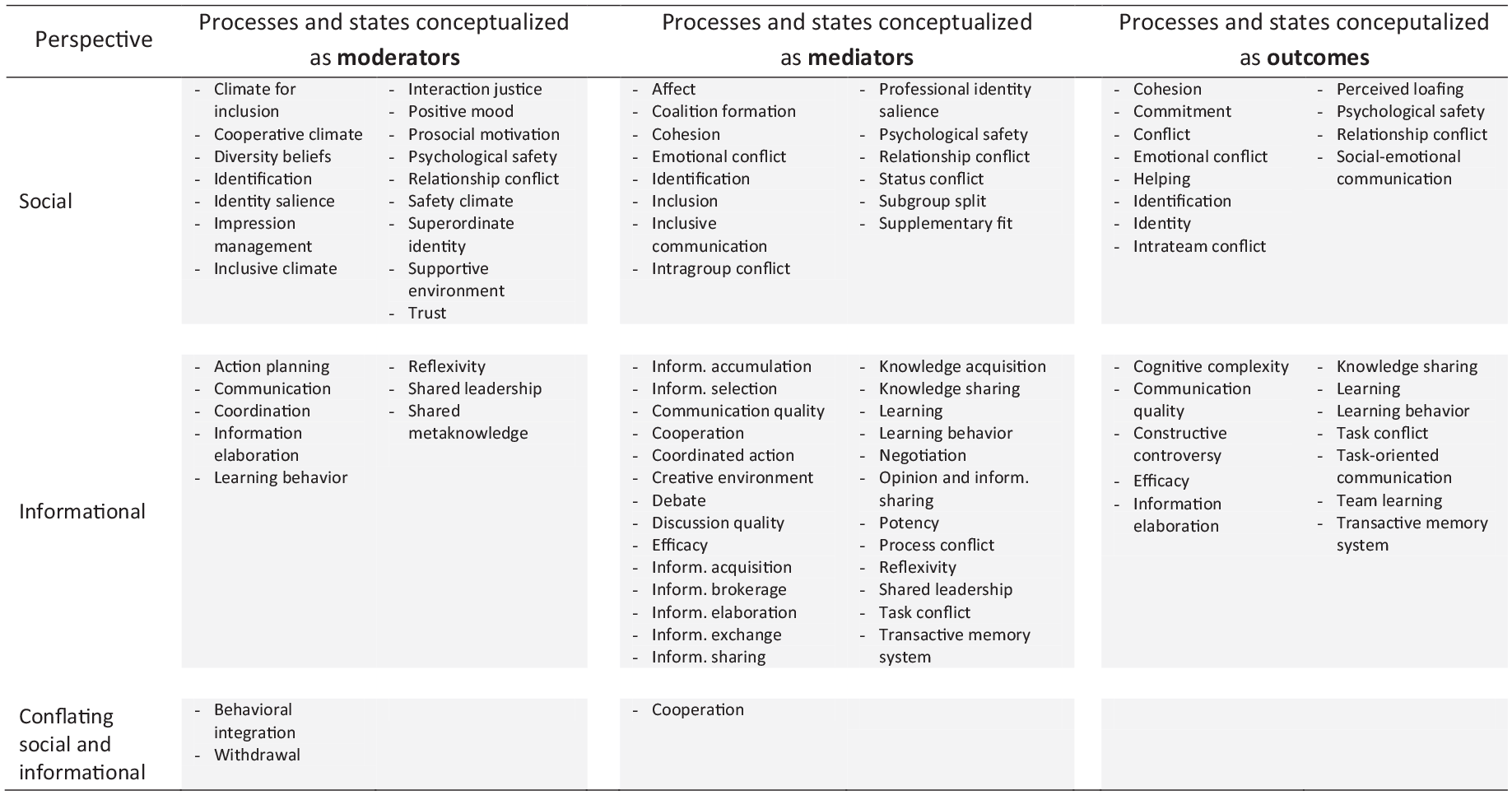
Exemplary overview of team processes and states as conceptualized in primary studies in the team diversity literature.
Definition and Specificity of Team Processes and States
Most of the team processes and states examined represent either the social categorization perspective or the information/decision-making perspective. Processes and states investigated in primary studies, as representative of the social perspective, are mainly different forms of interpersonal conflict (e.g., emotional conflict, status conflict) and affective (e.g., cohesion, identification, trust) and cognitive (e.g., inclusive climate, psychological safety) states. The studies focused on different types of climates and beliefs, such as inclusive climate, diversity beliefs, and psychological safety climate (for an in-depth review on the distinction of diversity ideologies, beliefs, and climates, see the integrative review by Leslie and Flynn [2024]). With respect to the informational perspective, behavioral processes concerned with team information exchange and cognitive (e.g., shared mental models) and motivational (e.g., team efficacy) states have primarily been studied. Further, we find a few constructs that conflate facets of the social and informational perspectives, such as behavioral integration, cooperation, and withdrawal (Kearney et al., 2022; Liang et al., 2015; Tekleab et al., 2016).
Interestingly, we observe different levels of specificity of processes and states across studies. This observation becomes particularly evident from the different informational processes that reflect a variant of team information exchange. The nuance associated with studying information exchange ranges from a highly detailed focus on single facets of task-related communication (e.g., information selection, Liao & Long, 2016; information brokerage, Zheng & Wei, 2018) to broader constructs, like information sharing (e.g., Jiping Li et al., 2018; Zellmer-Bruhn et al., 2008), information exchange (e.g., C.-R. Li et al., 2017), and information elaboration (e.g., Meyer & Schermuly, 2012; Rico et al., 2012).
Similarly, we noticed that similar yet distinct processes and states reflecting the social perspective have been used seemingly interchangeably. For instance, scholars seldom discuss the important nuances between team cohesion, collective team identification, and commitment (for an exception, see van der Vegt & Bunderson, 2005). Also, processes and states studied as representative of the social perspective range from positive (e.g., inclusion) to more negative (e.g., relationship conflict), with little discussion of the rationale of studying one or the other. Further, some studies introduce ostensibly new constructs that are theoretically or empirically very similar to existing ones (i.e., construct proliferation; Shaffer et al., 2016). For instance, “perceived proximity” is defined as social closeness among team members, which contains aspects of cohesion and psychological safety (Eisenberg et al., 2021). The varying degrees of specificity and breadth yield plenty of processes and states that may be relevant but hinder comparison between studies, thus limiting general conclusions about the role of certain processes and states.
Conceptual Role of Team Processes and States
Our review reveals inconsistency regarding processes’ and states’ conceptual roles. We find that the same processes and states have been conceptualized as mediators or moderators in different studies, leading to contradictory conclusions and divergent implications. Consider team reflexivity, the informational process of reflecting upon and communicating about objectives, strategies, and procedures (Schippers et al., 2015; West, 1996). Some studies propose team reflexivity as the mediator underlying the diversity–effectiveness relationship (Chen et al., 2019; Somech, 2006). These studies argue that diversity triggers team reflexivity, which elicits reflection on objectives, broadened scope of available ideas, and enhanced creative thinking, ultimately improving team effectiveness. In contrast, other studies treat team reflexivity as a moderator of the relationship between diversity and information elaboration or performance outcomes (Nederveen Pieterse et al., 2011).
A lack of clarity regarding the conceptual role of team processes and states leads to limited and occasionally contradictory conclusions across studies. For example, the argumentation of the process of team reflexivity as a mediator of the diversity–team effectiveness relationship indicates that reflecting upon and debating about objectives, strategies, and past experiences is an integral process in diverse teams. Following this reasoning, team reflexivity constitutes an informational process that endogenously stems from diversity and could explain why diverse teams can outperform homogeneous teams, because the latter would engage in fewer collective reflections (e.g., C.-R. Li et al., 2018; Mitchell et al., 2011). Conversely, the argumentation of team reflexivity as an exogenous moderator suggests that it is a prerequisite for teams to effectively exchange diverse perspectives and ideas. These two theoretically divergent argumentations of the same process yield contradictory conclusions: (a) either teams should be provided with the freedom and resources (e.g., time, support) needed to autonomously reflect upon tasks and objectives, or (b) task requirements should be specified or task strategies aligned among team members to trigger reflexivity (Nederveen Pieterse et al., 2011).
We find discrepancies regarding the conceptual role of several social and informational processes and states. For instance, information elaboration has been treated as a moderator (e.g., Y.-T. Chiu & Staples, 2013; S. Wang, 2015) and mediator (Kearney & Gebert, 2009; Kooij-de Bode et al., 2008) in different studies. Regarding processes and states reflective of the social perspective, team identification, defined as the “emotional significance that members [. . .] attach to their membership” in a team (van der Vegt & Bunderson, 2005, p. 533), is examined as a moderator (e.g., van Veelen & Ufkes, 2019) or mediator (e.g., Kearney et al., 2009). Some studies argue that diversity hampers team identification and, in so doing, reduces team members’ motivation and ability to collaborate. Other studies explain identification as an intervention that stimulates feelings of commonality between team members, which positively influences the relationship between diversity and team processes or team effectiveness. We find similar confusion for psychological safety, which is proposed as both a mediator and moderator of the diversity–team effectiveness relationship in different studies (Boyraz, 2019; Martins et al., 2013; Ostermeier et al., 2020; Stalmeijer et al., 2007).
In sum, our results suggest very active research on processes and states in relation to diversity and team effectiveness over the past 20 years. However, the wealth of available research comes with fuzzy theorizing and definitions, which hinder the accumulation of knowledge regarding the role of processes and states and limits progress in the literature on team diversity processes and states. Given our main aim of synthesizing knowledge on the interplay of social and informational processes and states, we now shift our focus to the interplay and its application in team diversity research.
Fuzzy Conceptualization of the Interplay of Social and Informational Processes and States
Our review reveals that team diversity research widely acknowledges the interplay of social and informational processes and states, as proposed in the CEM. Yet, this interplay logic has not been examined consistently within published studies and translates into very heterogeneous conceptual models across studies.
Misalignment in the Application of the Interplay Logic Within Studies
While most of the reviewed studies recognize an interplay between social and informational processes and states in some instances, only a small number consistently align their theorizing, conceptualization, and measurement with this logic (see Table 2). Around 43% of the studies refer to an interplay between informational and social processes or states in their general introductions. Authors typically state—in line with the CEM (van Knippenberg et al., 2004)—that diversity likely elicits dysfunctional social categorization that could disrupt effective information exchange, ultimately hampering diverse teams’ effectiveness.
Percentage of Reviewed Studies Acknowledging the Social and/or Informational Perspective in Different Sections of the Paper.
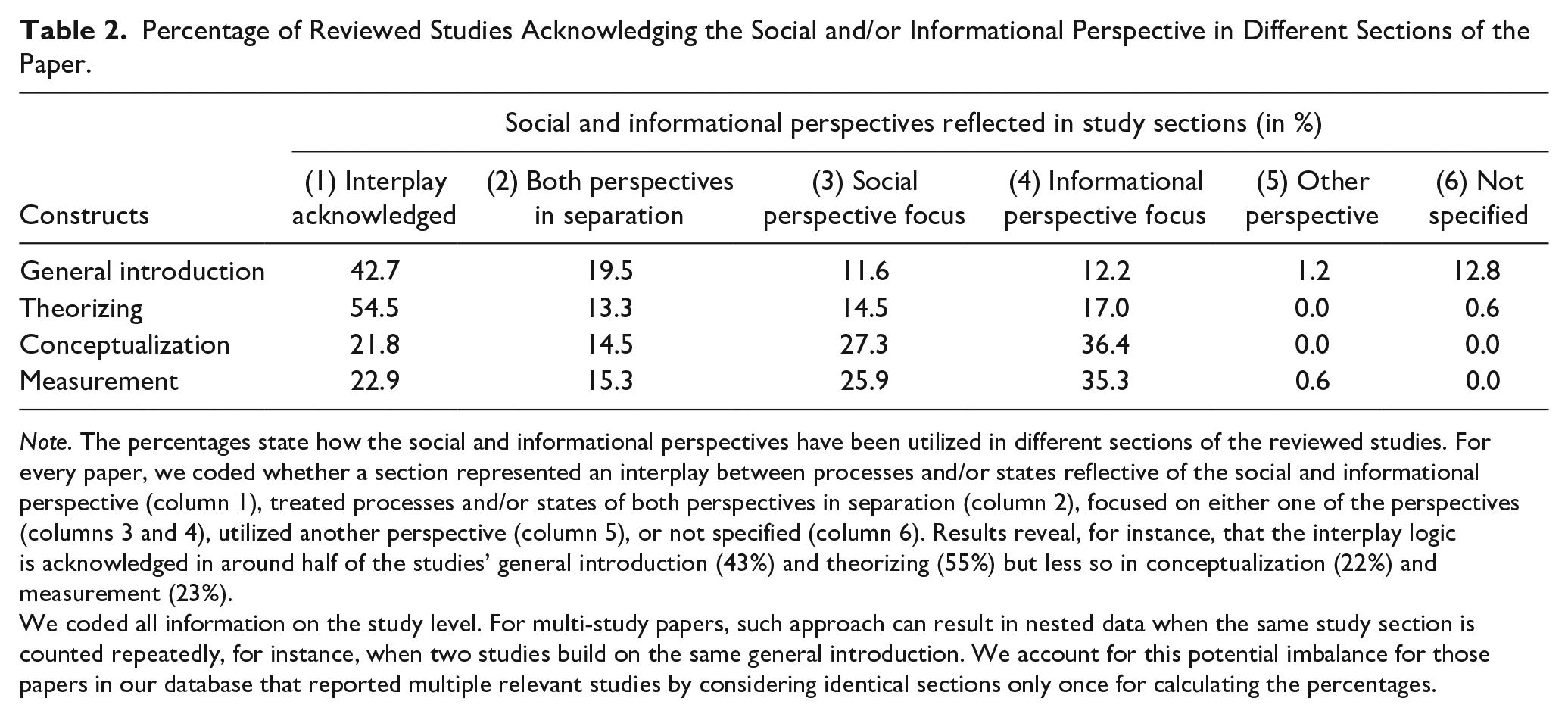
Note. The percentages state how the social and informational perspectives have been utilized in different sections of the reviewed studies. For every paper, we coded whether a section represented an interplay between processes and/or states reflective of the social and informational perspective (column 1), treated processes and/or states of both perspectives in separation (column 2), focused on either one of the perspectives (columns 3 and 4), utilized another perspective (column 5), or not specified (column 6). Results reveal, for instance, that the interplay logic is acknowledged in around half of the studies’ general introduction (43%) and theorizing (55%) but less so in conceptualization (22%) and measurement (23%).
We coded all information on the study level. For multi-study papers, such approach can result in nested data when the same study section is counted repeatedly, for instance, when two studies build on the same general introduction. We account for this potential imbalance for those papers in our database that reported multiple relevant studies by considering identical sections only once for calculating the percentages.
In their theory sections, more than half of the reviewed studies acknowledge an interplay logic, (implicitly) acknowledging the CEM. Authors have used various theoretical perspectives and arguments to explain how social and informational processes and states interplay to shape diverse teams’ effectiveness. Most invoke the social perspective—including social identity theory, social categorization theory, and the similarity attraction paradigm—and the information/decision-making perspective of diverse teams (e.g., Jehn & Bezrukova, 2010; Woehr et al., 2013). Other authors refer to theories and perspectives other than the CEM, such as status characteristics theory (e.g., Kim, 2017), the social network perspective (e.g., Curşeu et al., 2012), group cognition (e.g., Aggarwal & Woolley, 2019; Kirkman et al., 2004), or arguments related to justice, affect, mood, and motivation (Emich & Vincent, 2020; X.-H. Wang et al., 2016; L. Zhang & Guo, 2019). Despite the range of theories employed, the conclusion remains that social and informational processes and states influence each other, thereby determining innovation and decision-making outcomes. Consequently, one might expect that social and informational processes and states should be apparent in the conceptualization and measurement as well.
However, the argument that social and informational processes and states conjointly determine the effectiveness of diverse teams often does not translate into conceptualization and measurement. Among the studies that use an interplay argument in their theoretical background, many include processes or states of only the social or the informational perspective in their conceptual models (see Supplementary File A). Overall, less than a quarter of the studies proposes conceptual models that consider an interplay of social and informational processes and/or states in the linkage between diversity and team effectiveness, revealing substantial misalignment. Hence, application of the interplay logic across general introduction, theorizing, conceptualization, and measurement is misaligned in 87% of the primary studies. Consequently, the number of studies that formally test an interplay is limited. And, as discussed below, studies that propose and test an interplay do so in manifold ways, presenting ambiguous findings.
Heterogeneous Conceptualization of the Interplay Logic Across Studies
Figures 3 and 4 illustrate conceptual models that contain social and informational processes and states. Given that merely considering social and informational processes and states does not necessarily speak to their interplay, we differentiate conceptual models that treat both in separation (Figure 3) from those that propose some kind of interplay between social and informational processes and states (Figure 4). Regarding studies that conceptualize social and informational processes and states in separation, we find that around one-third of them treat team processes or states as their dependent variables (Separation Type A and Type B models), often proposing the linkage between diversity and the two team processes or states to be contingent upon contextual factors. These models have mainly been tested in experimental studies with ad hoc-composed student teams (e.g., Nam et al., 2009). The results suggest that diversity (often defined and operationalized as faultlines; Lau and Murnighan, 2005) not necessarily leads to detrimental effects when compositional factors exist that cross-cut subgroup identities (Homan et al., 2007a).
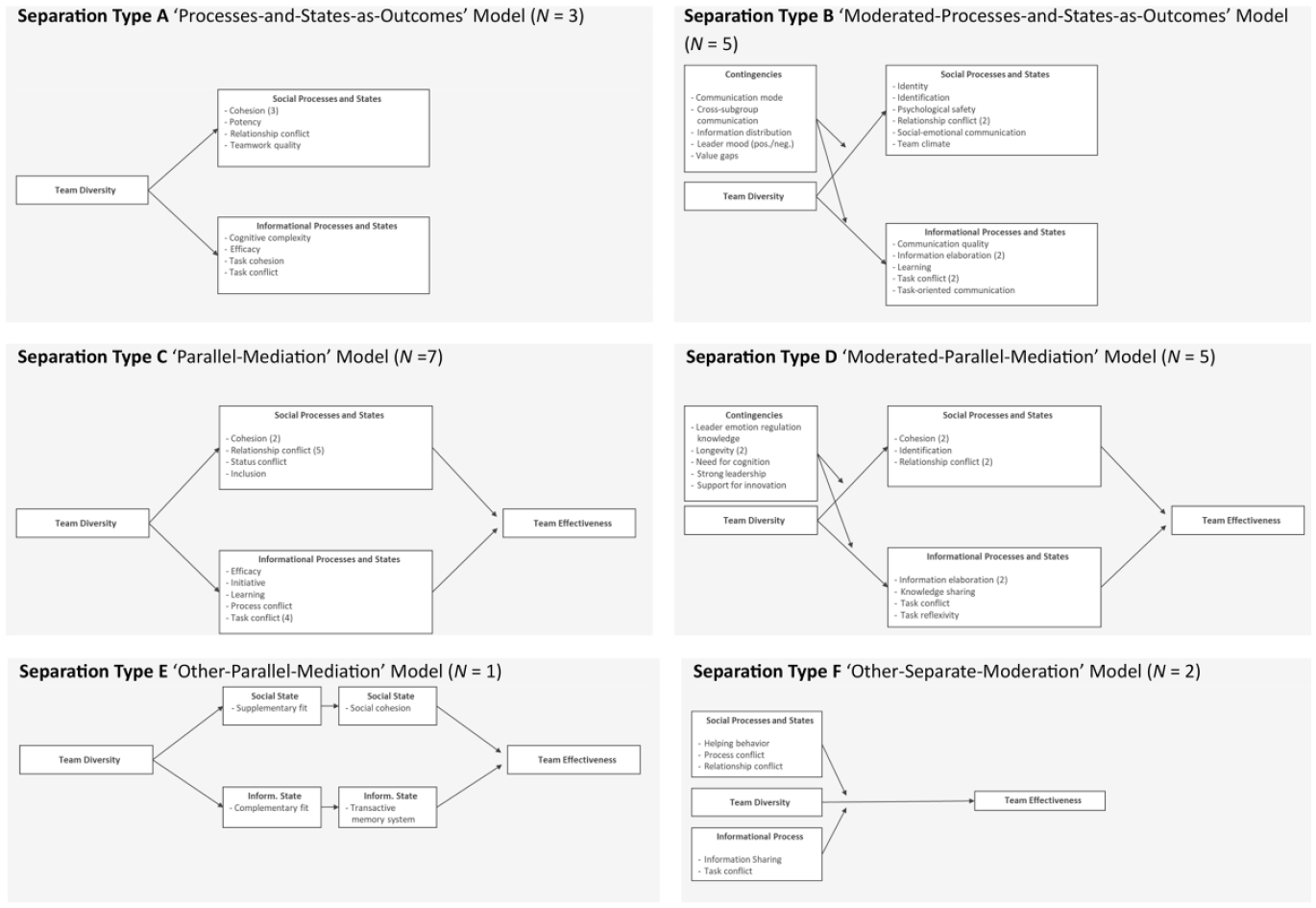
Overview of the generic conceptual models that consider processes and states reflective of the social and informational perspective in separation.
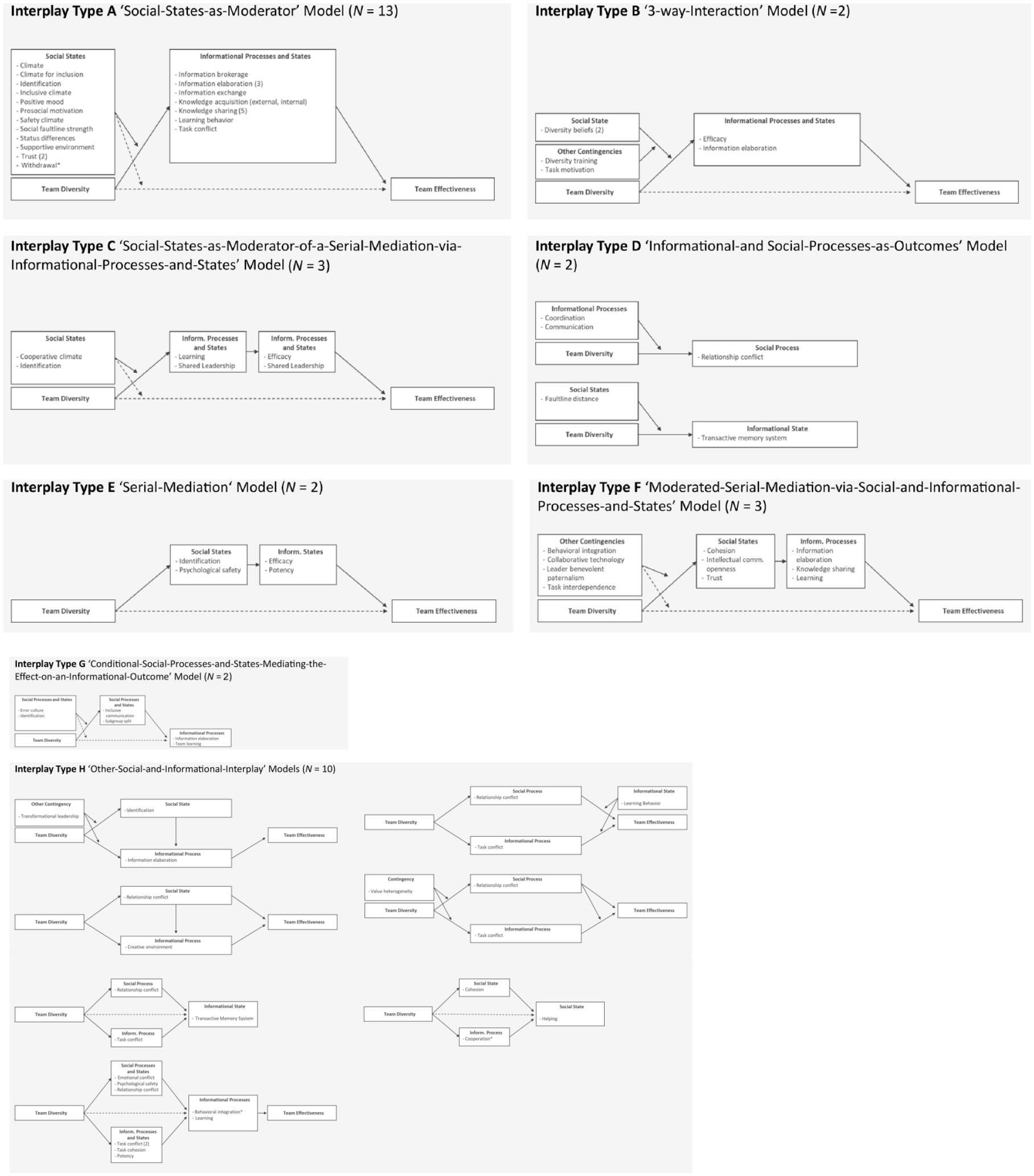
Overview of the generic conceptual models that consider an interplay of processes and states reflective of the social and informational perspective.
Further, we find several studies that propose (conditional) parallel mediation of the diversity–team effectiveness linkage via social and informational processes and states (Separation Type C and Type D models). These studies often consider different types of team conflict (e.g., task conflict, process conflict, emotional conflict) simultaneously, testing (conditional) indirect effects using survey-based studies with intact teams in organizational or educational settings (e.g., Urionabarrenetxea et al., 2021). These studies rather consistently report the effect of diversity on team effectiveness to be fully mediated (e.g., Choi & Sy, 2010; Vodosek, 2007; Y. Zhang & Hou, 2012). Statistically, these models reflect an “additive approach” by considering multiple parallel mediators in their conceptual models, often without explicitly testing the relative magnitude of the indirect effects that would allow conclusions about the relative importance of each mediator. Still, these studies hint at the relevance of both social and informational processes and states as highlighted in the CEM (van Knippenberg et al., 2004), but do not allow conclusions about their interplay.
Among the studies that represent some kind of interplay between social and informational processes and states, we find a wide variety in how this interplay is conceptualized. Scholars mostly assess Interplay Type A models (n = 13) that propose the effect of diversity on team effectiveness via an informational process, contingent upon a social state. These models account for the interplay logic proposed in the CEM in a very basic way, treating social states as context factors that interact with team diversity to predict informational processes, without allowing conclusion about the relationship between diversity and social states. Interplay Type A models have predominantly been tested in observational studies that rely on survey data of intact business teams to assess whether the indirect effect of team diversity on creativity (e.g., Tang & Naumann, 2016) or innovation (e.g., Cheung et al., 2016) via an informational process is contingent upon some kind of team climate (e.g., Bodla et al., 2018; C.-R. Li et al., 2017). More complex ways of conceptualizing the influence of social states on the linkage between diversity and informational processes are displayed in Interplay Type B and Type C models. In Interplay Type B models (n = 2), scholars propose three-way interactions among diversity, diversity beliefs, and contextual factors (task motivation, diversity training) on informational processes (Homan et al., 2015; Meyer & Schermuly, 2012). Interplay Type C models (n = 3) propose an indirect effect of diversity on team effectiveness through the serial mediation of informational processes, contingent upon a social state (e.g., cooperative climate, team identification) (e.g., Kukenberger & D’Innocenzo, 2020; van Veelen & Ufkes, 2019).
The results of Interplay Type A, Type B, and Type C models lead to the conclusion that the interplay proposed in the CEM seems useful, in the sense that after strong interpersonal relationships or supportive environments have been established, teams can use their diversity through effective information exchange (van Knippenberg et al., 2004). For instance, studies testing Interplay Type A models report that positive affective states (e.g., trust, Cheung et al., 2016; positive mood, Tang & Naumann, 2016) and supportive team climate (e.g., Bodla et al., 2018; C.-R. Li et al., 2017) strengthen the positive or mitigate the negative linkage between diversity and informational processes, predominantly finding support for the proposed conditional indirect effect of diversity on team effectiveness (e.g., Olson et al., 2007; Qu & Liu, 2017). Interestingly, however, these studies treat the high or low degrees of social states (i.e., moderators) as a given and remain silent about how such (lack of) beneficial social states evolve in diverse teams. This lack of clarity regarding the linkage between diversity and social states is also reflected methodologically. For instance, all but one Interplay Type A models have been tested with intact teams, which are characterized by a common history that potentially shaped good interpersonal relationships—an aspect outside of studies’ observation period. Taken together, many models recognize the importance of considering social states as influential in diverse teams and provide relevant insights from a diversity management perspective. Yet, as these models remain silent regarding the link between team diversity and social processes or states (i.e., diversity is not directly related to social processes or states), they fail to offer a formal test of the interplay as proposed in the CEM (van Knippenberg et al., 2004).
Another way of conceptualizing the interplay of social and informational processes and states is reflected in serial mediation models, according to which the diversity–team effectiveness relationship unfolds as a causal chain via social and informational processes and states. The two studies employing an Interplay Type E model propose that the effectiveness of diverse teams is explained by the effect of social states (e.g., psychological safety, identification) on team efficacy and team potency, constructs that reflect teams’ shared belief into the conjoint capabilities to be effective (Niler et al., 2020; Ostermeier et al., 2020). Supporting this reasoning, the results show that higher levels of team psychological safety and team identification are associated with beneficial informational states which positively relate to the effectiveness of diverse teams. Three studies propose an Interplay Type F model in which the serial mediation via social states and informational processes is expected to be contingent upon contextual factors. Results indicate positive associations between beneficial social states (e.g., cohesion, trust) and informational processes (e.g., knowledge sharing, learning), but testing the indirect effects via these mechanisms revealed mixed findings. One study found support for a serial mediation of diversity on team creativity via communication openness and information elaboration (without statistically accounting for the proposed context factor; Lu et al., 2018). Another found no conditional indirect effect of (squared) diversity on team performance via cohesion and learning (Tekleab et al., 2016). Even though Interplay Type E and Type F models provide only suggestive evidence for the causal chain of processes and states in diverse teams, they highlight the potential value of an alternative to the CEM’s interplay conceptualization, namely a sequential interplay of social states on informational processes. This sequence assumes a temporal order of beneficial social processes and states on informational processes and states, an aspect we will elaborate on further below.
Finally, we subsumed ten studies as Interplay Type H models that conceptualized the interplay between social and informational processes and states in manifold ways. In the first step of these models, diversity is expected to affect processes and states along with both the social and informational perspective. In a second step, these models propose some kind of interplay between social and informational processes and states. For instance, in one study, social states are proposed to partly mediate the effect of diversity on an informational process (with transformational leadership as a contingency; Kearney & Gebert, 2009), whereas another postulates an informational state as a moderator of the linkage between a social processes and team effectiveness (Yeh & Chou, 2005). According to Amason et al. (2018), diversity is expected to elicit relationship conflict and task conflict, which are proposed to interact to determine team effectiveness. Still other models consider social and informational processes and states to affect a third team process or state, thereby explaining team effectiveness; for instance, task and relationship conflict are proposed to mediate the effect of diversity on team learning behavior, which in turn determines team effectiveness (Stalmeijer et al., 2007). Regarding the study design, all Interplay Type H models build on survey-based studies, mostly with intact organizational teams.
The heterogeneous ways of conceptualizing an interplay between social and informational processes and states (see, for instance, Interplay Type G models) reveals little consensus about the understanding of the interplay and complicates comparisons between studies. For instance, the hypothesis that transformational leadership moderates the relationship of (age and educational, but not nationality) diversity with collective team identification, which, in turn, is positively associated with team information elaboration, is supported (Kearney & Gebert, 2009). Another study suggests that teams that share high collective identification are less likely to split into subgroups which explained better information elaboration (Shemla & Wegge, 2019). Studies that consider the mutual influence of different types of conflict suggest that relationship conflict and task conflict interact to predict team effectiveness, such that when relationship conflict is low, task conflict yields positive effects on team effectiveness (e.g., Amason et al., 2018). The link between diversity and behavioral disintegration is found to be fully mediated by emotional conflict (but not task conflict), which subsequently affected team effectiveness (Jiatao Li & Hambrick, 2005). In sum, these results provide suggestive evidence but do not allow meaningful conclusions regarding whether an interplay helps to explain additional variance in diverse teams’ effectiveness over and above treating both processes as independent. This observation raises the question of why many scholars refrain from testing the interplay logic in team diversity studies, a question we will elaborate on in the Discussion.
Limited Consideration of Time in Extant Team Diversity Research
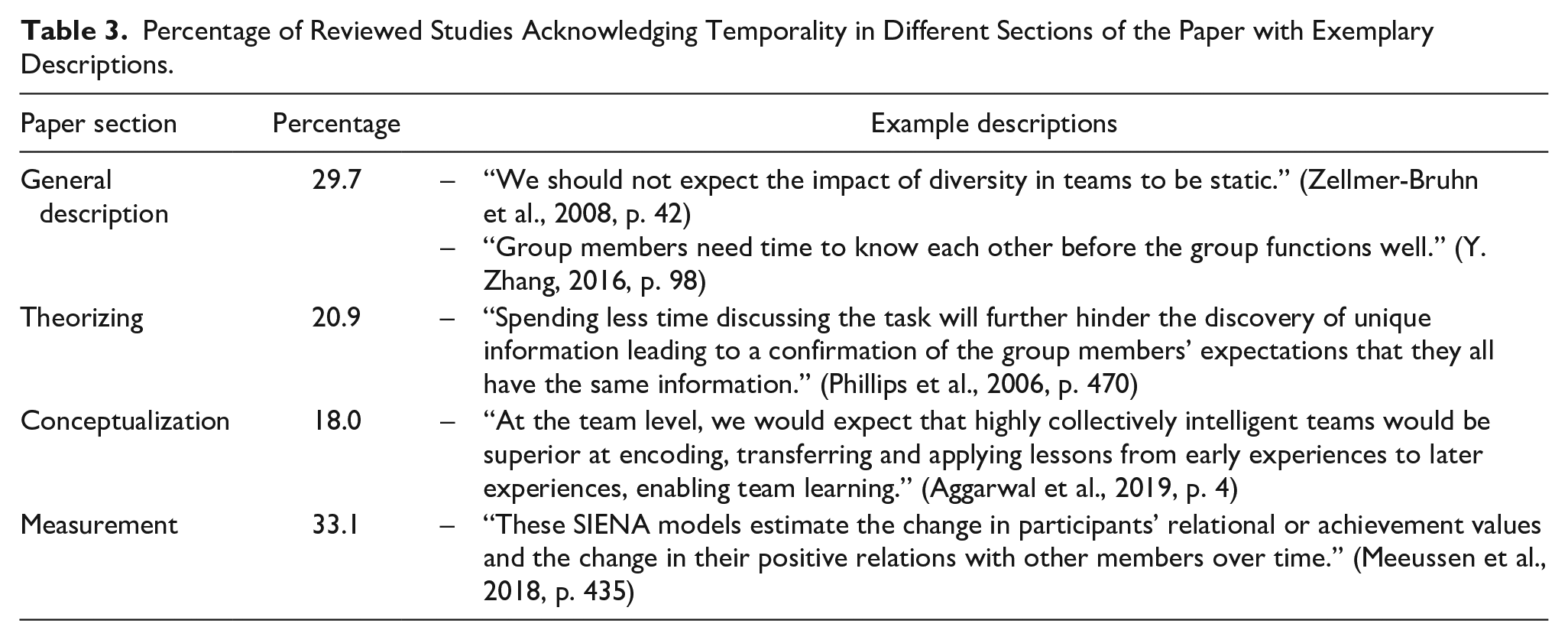
The notion of the diversity–team effectiveness relationship as “especially dynamic in nature” (Horwitz, 2005, p. 236) has been emphasized repeatedly (Joshi & Neely, 2018; Roberson, 2019). Calls to consider time in explaining and studying the effects of diversity on team effectiveness appear to have been noted, with nearly one-third of the studies including statements in their general introduction that acknowledge temporal aspects (see Table 3). More than one-fifth of the studies provide time-sensitive explanations in their theorizing. Yet, time plays only a relatively minor role in the studies’ conceptualizations (18%). Accordingly, only 15% of the reviewed studies were aligned with respect to incorporating time-related aspects across their general introduction, theorizing, conceptualization, and measurement. Still, those articles in our database that incorporated time-sensitive aspects provide insights into how time could be considered. These include a consideration of time as maturation, in the form of spirals, through the sequential order of team processes and states, and methodologically.
Percentage of Reviewed Studies Acknowledging Temporality in Different Sections of the Paper with Exemplary Descriptions.
First, some authors adopt a maturation perspective according to which team members become more familiar with each other through repeated interaction. Familiarity is supposed to affect the salience of surface-level and deep-level attributes (Allport, 1954; Harrison et al., 1998). Following this rationale, team members’ attention accordingly shifts from surface-level attributes to deep-level attributes over time (Acar, 2010). Studies that adopt this perspective tend to survey team members repeatedly, over several weeks or months. They largely converge on the finding that the importance of deep-level diversity for teamwork outcomes increases over time, whereas the role of surface-level diversity decreases. For instance, a study found that surface-level (demographic) diversity negatively relates to perceived similarity in early but not later phases of team interaction (Zellmer-Bruhn et al., 2008). Similarly, some findings suggest that surface-level diversity is associated with emotional conflict at initial team interaction, whereas this association is stronger for deep-level diversity attributes at a later point in time (Mohammed & Angell, 2004; Staples & Zhao, 2006).
Second, some scholars expect processes and states to unfold dynamically, in the form of trajectories or spirals. These studies differ regarding their conceptualization and methodological approaches. For instance, Ferguson and Peterson (2015) propose that diversity in propensity to trust elicits downward spirals due to negative social-categorization processes, which diminish performance. The authors collected survey data over one academic semester, testing the hypothesized serial mediation between team diversity and performance via lowered similarity perceptions and intragroup trust, and heightened relationship conflict as indicative of a downward spiral. Another study assessed how cognitive diversity affects teams’ implicit learning, measured as the rate of change over time, in a four-hour virtual coordination game (Aggarwal et al., 2019). These studies are excellent examples of how processes and states within diverse teams could be conceptualized and tested dynamically. Yet, as these few studies diverge on the studied processes and states (informational vs. social) and the included constructs, meaningful comparisons and comprehensive conclusions are difficult to make.
Third, in the reviewed literature, we identified the consideration of time through the order of team processes and states in conceptual models. Ordering processes and states conceptually, as by expecting the relationship between diversity and team effectiveness to be serially mediated via cohesion and learning (Tekleab et al., 2016), assumes that one process or state happens before the other. This way of considering time is often implicit, in that scholars typically do not elaborate on the time frame at which one process or state is expected to influence a second one.
Fourth, methodologically speaking, temporal aspects have been considered in one-third of the studies. This relatively frequent acknowledgment of time in study designs relative to time’s role in conceptualization is partly driven by using a time-related variable as a covariate. It is common to include team tenure—the time members have spent together as part of the same teams—as a control variable (e.g., Balkundi et al., 2007; Hentschel et al., 2013). Further, strong reliance on student teams, which afford the opportunity of longitudinal investigation of an academic semester, have contributed to this result. Most studies using student teams are longitudinal or time-lagged, with observation periods over one academic semester of 12 to 15 weeks. Data access may have played an important role in decisions about the observation period, as most authors do not explain their decision (e.g., Aggarwal et al., 2019; Jiping Li et al., 2018). Similarly, the decision to conduct research with intact or ad-hoc composed teams may not always be based on theoretical considerations. Intact teams are characterized by a common history that affects team members’ personal bonds, perspectives, and attitudes, and potentially influences how team diversity affects team effectiveness. Despite the influence team history may have on team processes, states, and effectiveness (see also the maturation perspective above), the choice of ad-hoc versus intact teams goes largely unexplained and likely is informed by feasibility, such as sample opportunities (e.g., Valls et al., 2016). Evidently, in experimental laboratory studies, teams are mostly composed ad-hoc, whereas field studies often use data from intact teams.
Overall, insights into the role of time in the diversity–team effectiveness link are scattered. We strongly stress the need for heightened time sensitivity in team diversity research. Our synthesis also reveals that, despite frequent calls to include temporality in team research in general (Salas et al., 2017) and team diversity research specifically (Joshi & Neely, 2018; Roberson et al., 2017), research on team processes and states in diverse teams is largely missing regarding the time points at which diversity effects unfold. This offers the potential to clarify how research on team diversity processes and states could be conceptualized and studied in a time-sensitive manner.
Discussion and Future Research Agenda
In this systematic conceptual review, we synthesized knowledge of the processes and states that are defined, theorized, conceptualized, and measured in the diversity–team effectiveness relationship. Summarizing the state of the field, we aimed to evaluate the utility of studying social and informational processes and states conjointly. Our review revealed that scholars acknowledge the importance of considering processes and/or states reflective of both the social and informational perspective to explain the diversity–team effectiveness relationship, typically building on the interplay logic proposed in the CEM (van Knippenberg et al., 2004). However, we found this acknowledgment did not often translate into conceptualization and measurement, as reflected in studies that assessed only social or informational mechanisms or examined them separately. Studies that consider both social and informational processes or states conceptualized the interplay in manifold ways, some of them diverging considerably from the interactive interplay proposed in the CEM. As we have explained, this heterogeneity limits comparability of results and thwarts conclusive evidence of the role of the interplay of social and informational processes and states in the diversity–team effectiveness relationship. This observation is accompanied by a limited consideration of time in extant research on processes and states in diverse teams.
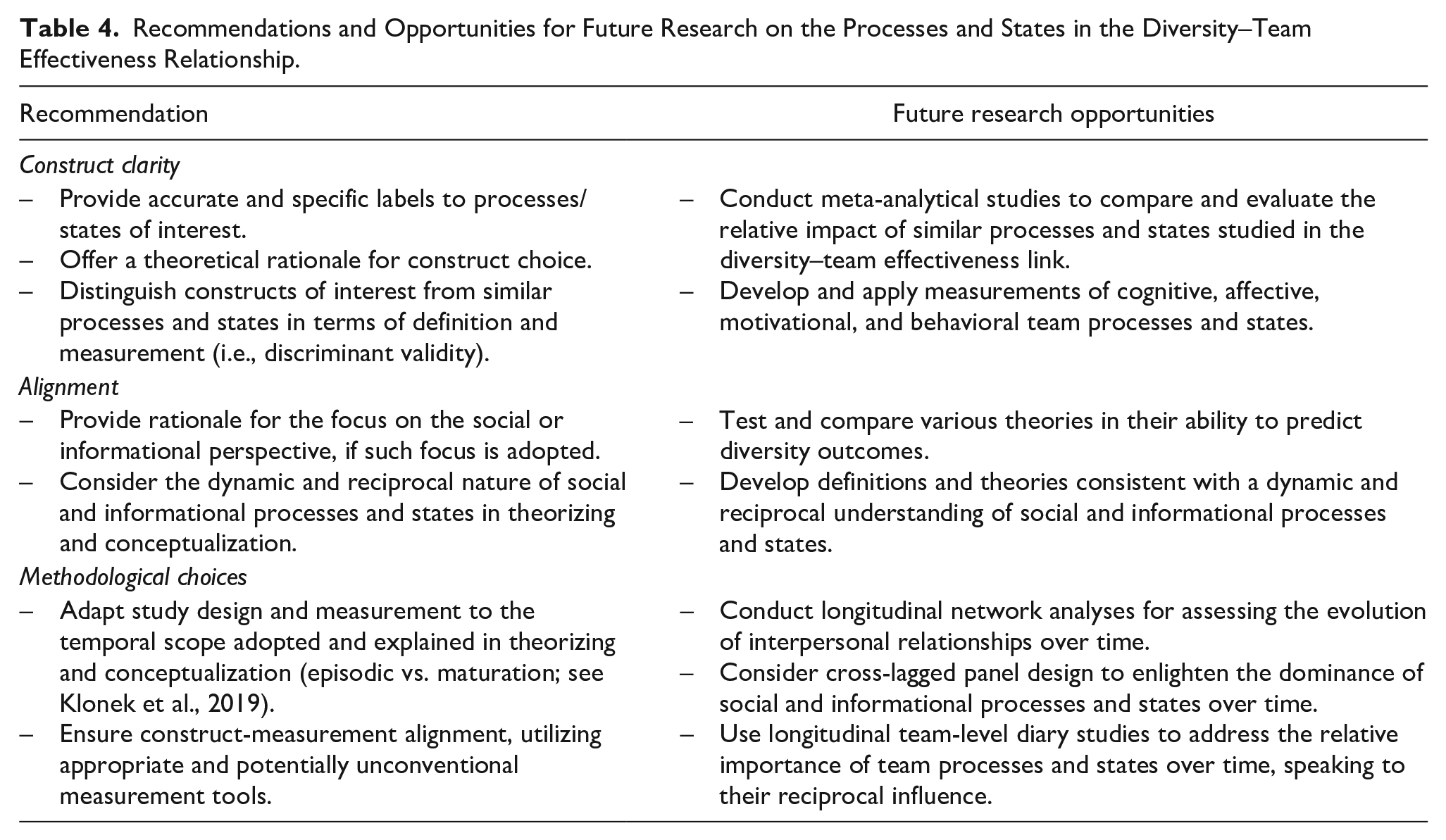
Here, we elaborate on potential causes that led diversity research to its current state and provide critical directives to guide future research. First, we discuss issues arising from a blurry definition of processes and states in diverse teams and derive recommendations to increase precision. Second, we elaborate on potential reasons for the observed misalignment of considering but not studying the interplay between social and informational processes and states. One important reason for misalignment is a static conceptualization of processes and states in extant team diversity research. Therefore, third, we propose that a dynamic understanding and study of the interplay logic is crucial to better predict how and when social and informational processes and states interplay, and what effects this has on diverse teams’ effectiveness. Finally, we discuss how study design and measurement features could account for such dynamic perspective. We summarize our recommendations in Table 4.
Recommendations and Opportunities for Future Research on the Processes and States in the Diversity–Team Effectiveness Relationship.
Processes and States in Diverse Teams: Toward Construct Clarity
As our review revealed, the processes and states defined, conceptualized, theorized, and measured as underlying the diversity–team effectiveness relationship exhibit varying degrees of specificity and breadth (Liao & Long, 2016; Zellmer-Bruhn et al., 2008). Our findings reveal inaccuracies, in that some processes and states introduced as new are theoretically indistinguishable from existing ones (e.g., Eisenberg et al., 2021), other processes or states conflate facets of the social and informational perspectives (e.g., behavioral integration; Mayo et al., 2020), and other constructs are not clearly identifiable as a process or state. This resulted in a rather disorganized landscape of processes and states studied in relation to team diversity research that has inhibited knowledge accumulation and theoretical advancement (see also Roberson et al., 2017). We propose several steps to counteract the blurriness of the processes and states conceptualized and studied in relation to team diversity.
First, we call for clarity regarding the nature of phenomena under investigation as being processes or states. As stated, processes are behavioral in that they capture interdependent interaction of team members, whereas states reflect cognitive, motivational, and affective properties that emerge in teams (Kuljanin et al., 2024; Marks et al., 2001). Clarity about the nature of phenomena is important, as this entails different theoretical considerations and influences study design choices and methodological decisions (Kozlowski, 2015).
Second, we call for clear distinctions of similar constructs, particularly for processes and states representative of the social perspective. Team identification and commitment, for instance, which have been studied frequently in team diversity research, are similar on the observational level (van der Vegt & Bunderson, 2005) but differ in their theoretical underpinning. Identification is concerned with the emotional attachment to the team, which may create a collective identity that could unite members from different subgroups (Gaertner et al., 2000; Homan et al., 2010). Commitment, meanwhile, refers to emotional bonds with other team members, with a stronger focus on dyadic relationships between team members. Such nuanced distinctions are often not discussed or even interfused in primary studies; this creates a problematic imprecision because, theoretically, there may be different mechanisms at work. Therefore, we recommend that future studies elaborate more on the theoretical rationale for focusing on specific processes and/or states, accompanied by more precise definitions and distinctions from similar yet distinct constructs.
Third, even though the informational constructs employed were generally well-defined, team diversity literature could benefit from disentangling the process of team information elaboration. Team diversity research often focuses on information elaboration (e.g., Homan & van Kleef, 2022; Kooij-de Bode et al., 2008) because it has been proposed as a core informational process explaining beneficial effects of diversity on team effectiveness (van Knippenberg et al., 2004). Information elaboration was initially defined as “the exchange of information and perspectives, individual-level processing of the information and perspectives, the process of feeding back the results of this individual-level processing into the group, and discussion and integration of its implications” (van Knippenberg et al., 2004, p. 1011). This definition contains team-level behavioral (i.e., information exchange, discussion, and integration) and individual-level cognitive (i.e., information processing) aspects. Including several theoretically distinct processes and states is a source of imprecision (Meyer et al., 2011). Yet, there are reasons to believe that both aspects are relevant. For instance, the individual information-processing facet captures the unique perspectives and ideas that individuals can contribute to team-level information exchange (Brodbeck et al., 2007; Traylor et al., 2024). Thus, distinguishing and measuring individual information processing next to the team-level process of information exchange could advance knowledge about the informational processes and states in the diversity–team effectiveness relationship.
Finally, to avoid conflation, we also call on future team diversity research to conceptualize and measure processes and states as purely social or informational. One example of a conflated process is behavioral integration. Behavioral (dis-)integration, considered in two studies in our database (Jiatao Li & Hambrick, 2005; Tekleab et al., 2016), refers to “a meta-construct, which includes the team’s information exchange, collaborative behavior, and joint decision making” (Tekleab et al., 2016, p. 3501). This definition and the survey items used to measure the concept reflect task-focused communication captured in “information exchange” (Tekleab et al., 2016, p. 3503) along the informational perspective, whereas openness toward others and sacrifices of “self-interest for the benefit of the team” (Tekleab et al., 2016, p. 3503) represent the social perspective. We recommend discerning conflated facets of the social and informational perspectives in conceptualization and measurement to provide the necessary insights to determine which specific processes or states (social or informational) drive the effect of diversity on team effectiveness.
In sum, we encourage team diversity research to strive for greater clarity regarding the processes and states conceptualized and studied. Such clarity requires specific and consistent labeling of the processes and states under investigation, as well as defining whether the respective process or state reflects the social or informational perspective. Explicitly classifying processes and states as behavioral, cognitive, affective, or motivational may offer additional nuance. These measures toward explicit classification will also facilitate theoretically distinguishing similar constructs. Optimally, such a theoretical distinction is also shown empirically, by means of a statistical validation of the constructs’ uniqueness (for an example, see Jehn et al., 2010), and to prevent problems with empirical overlap. In this regard, we acknowledge the challenge for scholars of avoiding construct proliferation on the one hand, without forcing them to fit observed and distinct phenomena into existing boxes on the other hand. Scholars’ understanding of team information elaboration, for instance, would benefit if its sub-facets (i.e., individual information processing, team-level information integration) were conceptually distinguished and tested. Therefore, we call for future research on processes and states related to team diversity to strive for an appropriate balance of increasing nuance in conceptualizing and measuring processes and states without reinventing existing constructs under new labels.
Conceptualizing Processes and States in Diverse Teams: Toward Alignment
An insight from our review concerns the fact that nearly 60% of the reviewed articles explicitly cite the CEM (van Knippenberg et al., 2004), which shows that the CEM is among the most influential models in team diversity research. As such, its value for developing and testing hypotheses on the role of social and/or informational processes and states in team diversity research has been proven. Hence, to the extent that both social and informational processes and states are considered for understanding how team diversity contributes to team effectiveness, referring to the CEM as a foundational framework seems a suitable choice. However, given the CEM’s prominence in the team diversity literature, it is surprising that a majority of the reviewed studies built their conceptual models without considering social and informational processes and states conjointly. Instead, many focused on either social (27%) or informational (36%) processes and/or states. Based on this finding and the inconsistent results from decades of research that focused on either social or informational perspective (e.g., Bell et al., 2011; Horwitz & Horwitz, 2007), we call on scholars to make considering and accounting for processes and states along both the social and informational perspectives a norm.
Yet, we acknowledge that a focus on either social or informational mechanisms within the team diversity—effectiveness link is not problematic, per se, and can still inform diversity research. Future research may, for instance, enrich our understanding of the complexity of social categorization in diverse teams by considering the salience of diversity, biases, and stereotypes in more detail (as proposed by van Dijk et al., 2017) even though informational mechanisms are not considered. At minimum, however, we advocate for transparency regarding the focus adopted in primary studies. There may also be empirical reasons for omitting one perspective. For instance, if in a given study, setting, or observation period, social processes and states may remain constant, considering their interplay with informational mechanisms would not provide meaningful results which would help justify an exclusive focus on processes and states along the informational perspective in the respective conceptual model. Scholars could reach transparency about the focus adopted by pre-registering their studies, following open science practices (for an overview and best practices, see Briker & Gerpott, 2023; Soderberg et al., 2021).
A second conclusion from our review concerns the misalignment between the theoretical arguments employed in primary papers consistent with the CEM versus the models conceptualized and tested. There may be several reasons why relatively few articles have conceptualized and tested an interplay argument in line with the model. One reason could be operational in nature: Scholars simply may not be able to study the proposed interplay or more complex interactions between social and informational processes and states and/or publish their findings. For instance, limited access to team-level (field) data, along with poor response rates, may prevent tests of complex conceptual models with appropriate statistical power (see Aguinis et al., 2005; Biemann & Kearney, 2010).
Another reason may be that the CEM offers only one potential way of conceptualizing an interplay between social and informational mechanisms. The model’s core proposition is that detrimental intergroup biases following social categorization interfere with information elaboration, making favorable informational processes a less likely consequence of team diversity (van Knippenberg et al., 2004). Conceptualizing the interactive interplay as proposed in the CEM would thus be reflected in models that first propose diversity to elicit social and informational mechanisms, and next propose social mechanisms to moderate the linkage between diversity and informational processes. In our review, studies employing Interplay Type H models (e.g., Pesch et al., 2015; Stalmeijer et al., 2007) most closely match the interplay logic as proposed by the CEM.
The CEM specifies an interactive interplay between social and informational mechanisms, leaving little room for alternative conceptualizations. Yet, uncertainty about how to best conceptualize this interplay logic seems to exist, as we identified a substantial misalignment in (not) pursuing an interplay argument in the extant team diversity literature. Our review reveals several other conceptualizations of an interplay between social and informational processes and states that deviate from the interplay logic proposed in the CEM and suggest various temporal orders of process mechanisms linking diversity to team effectiveness. Such conceptualizations assume that although informational processes have been established, social processes and states could potentially affect how those informational processes translate into team effectiveness. Scholars have proposed serial interplays, according to which social and informational processes and states build on a temporal sequence and appear in a specific order (e.g., Todorova, 2021). Other scholars expect social processes and states to influence the linkage between informational processes and team effectiveness (i.e., second-stage interactive interplay, e.g., Yeh & Chou, 2005; Amason et al., 2018). This heterogeneity of interplay conceptualizations from the CEM and the respective results suggests the static nature of the CEM as one potential reason for its inconsistent application. Alternative ways of conceptualizing an interplay of social and informational processes and states (implicitly) capture a time-sensitive reasoning that goes beyond the propositions formulated in the CEM (van Knippenberg et al., 2004) and other conceptual work (e.g., Carter & Phillips, 2017). Consequently, we conclude that a more dynamic perspective of mechanisms underlying team diversity-effectiveness linkages is needed.
Considering Time in Diverse Teams: Toward a Dynamic Understanding
Endorsing recent calls for dynamic perspectives on diverse teams (Joshi & Neely, 2018; Srikanth et al., 2016; Traylor et al., 2024), we propose a dynamic understanding of the interplay between social and informational processes and states in diverse teams. Such dynamic understanding allows more precise predictions regarding the effects of diversity on team effectiveness and presents an opportunity to address questions that current diversity research cannot answer. With this proposition, we emphasize the importance of delving deeper into the dynamic interplay of processes and states underlying the effects in diverse teams. Pressing theoretical questions pertain to (1) the relative importance of social and informational processes and/or states over time, including reciprocal influences; (2) the temporal order of social and informational processes and states, and varying temporal rates at which they may unfold; and (3) the role of contingencies.
First, with respect to the relative importance of social and informational processes and/or states, team diversity scholars can lean on recent conceptual work. The Leading Diversity (LeaD) model suggests that the dominance of social and informational processes and states varies over time with diverse teams typically being characterized by one predominant process or state at a given point in time (Homan et al., 2020). From a theoretical standpoint (Cronin & Vancouver, 2019), as well as a practical one, there are reasons to believe that throughout teams’ life and task cycles, the dominant processes and states alternate. Assuming that social categorization processes inevitably occur when individuals get to collaborate in teams, detrimental social processes and states, such as relational conflict or biases, are particularly important to consider in early phases of teamwork (see also van Dijk et al., 2017). As suggested by the contact hypothesis (Allport, 1954), such detrimental effects may diminish over time (e.g., Zellmer-Bruhn et al., 2008) and could turn into more beneficial social states (e.g., trust, cohesion). Regarding the informational perspective, it is likely that coordination-related processes dominate initial phases of collaboration (Maynard et al., 2012) followed by processes of in-depth elaboration after a common understanding of tasks and procedures has been established—at least if no coordination failures have occurred (Srikanth et al., 2016). Initial support for such effects is apparent in some of the reviewed studies (e.g., Antino et al., 2019) as well as in team research at large, as, for instance, Braun et al. (2020) found that for three-person teams working on a simulation task the relative importance of cohesion compared with coordination increased over the observed time span (approx. 90 min in the respective study).
Second, and relatedly, social and informational processes and/or states can unfold at different rates, which has implications for the order in which they should be considered conceptually. Some processes or states may need more time to evolve; for instance, repeated interaction helps team members get to know each other, which may strengthen interpersonal bonds (e.g., Seong et al., 2015), subsequently contributing to shared understanding of each other’s knowledge and of team goals (e.g., shared mental models or transactive memory systems) over time (e.g., Pinjani & Palvia, 2013). Other processes and states may occur relatively quickly (e.g., swift trust; Crisp & Jarvenpaa, 2013). By considering the team processes and states likely to occur in a given team along with their pertinent onsets and time spans (e.g., quick onset and meeting-long duration), more precise predictions and examinations of the effects of diversity on team effectiveness can be derived. For instance, in an ad hoc problem-solving team with distributed information meeting for one hour, members will likely engage in information exchange immediately and continue elaborating on the divergent information if unhindered by conflict. In an intact team collaborating over longer durations, open communication and information exchange may depend more on the social processes or states, which may take time to establish. In this regard, future research should investigate how and when social and informational processes and states buffer or intensify each other. For instance, relational conflict may lower the benefits of later-acquired cohesion in a diverse team, or earlier helpful knowledge exchange may facilitate reflexivity at later stages. Such mutual stimulation of social and informational processes and states over time could result in loss or gain spirals (see also Sonnentag & Meier, 2024) or other forms of trajectories (e.g., conflict contagion; Somaraju et al., 2024).
Third, contingency factors can impact the temporal dynamics of social and informational processes and states in the context of diversity and team effectiveness. The CEM also speaks to contingency factors that make one or the other path more likely to become activated in diverse teams (van Knippenberg et al., 2004). As a result, a mere focus on an interplay between the two perspectives without considering moderators that determine the occurrence of social and informational mechanisms may fall short. Indeed, our review revealed that supportive team climates play an important role in overcoming detrimental social categorization processes. In several studies (see Interplay Type A and Interplay Type C models), some kind of team climate was proposed and found to interact with team diversity to predict informational processes. Of note, the climate-related constructs were mainly treated as static as well. Team climates and beliefs are typically phenomena that evolve from team members’ interaction (see also Leslie & Flynn, 2024), and research increasingly shifts toward understanding how such internal contingencies emerge from team interaction dynamics (Klonek et al., 2019; Kozlowski & Chao, 2012). Hence, team diversity research could build on work from team research at large to enlighten the evolution of team climates and other states. Further, our review showed that contingencies were mostly expected to affect the link between diversity and a team process or state. Only very few studies proposed a second-stage moderation (e.g., Mitchell & Boyle, 2015; Yeh & Chou, 2005), arguing that activated detrimental social processes and states could be weakened when diverse teams are open-minded and willing to learn. This leads us to the research question of how the effects of already established processes and states could be pronounced or attenuated as diverse teams collaborate over time. Especially from a diversity management perspective, it would be theoretically and practically relevant to understand whether proactive or reactive interventions (e.g., leadership, training) are (more or less) effective in managing the processes and states in diverse teams (Homan et al., 2020).
Taken together, we conclude that the team diversity literature would benefit immensely from more time-sensitive research. Studying the dynamics of diversity processes and states requires suitable and aligned conceptualizations, study designs, and measurements capable of capturing how social and informational processes and states interplay over time. We highlight suitable methods in the following.
Study Design and Measurement: Toward Time-Sensitive Methods
Conceptual considerations of temporal dynamics and temporal scope have several implications, including questions surrounding the appropriate temporal scope and study design, measurement and analysis. The matter of which temporal scope to adopt to assess processes and states has been extensively discussed in team research at large (e.g., Delice et al., 2019) and in other domains (e.g., leadership, Burke et al., 2006). With respect to the temporal scope of the processes and states in diverse teams, we draw from work by Klonek et al. (2019) that distinguishes between a more short-term episodic and a more long-term maturation perspective.
Applying an episodic perspective to research on processes and states in diverse teams implies a more micro focus on actual task episodes and task accomplishment. This perspective is mostly concerned with behavioral processes and addresses questions about the sequence of interaction (Klonek et al., 2019). Thus far, there is little evidence of behavioral process sequences in diverse teams. We advocate the use of team interaction analysis (M. M. Chiu & Lehmann-Willenbrock, 2016; Klonek et al., 2016) to advance understanding of the sequences of social and informational interaction processes in diverse teams.
The maturation perspective adopts a long-term perspective that is concerned with the evolution of states over time. Future diversity research could zoom into the evolution of the salience of diversity over time (Harrison et al., 1998, 2002) and how this shapes processes and states (e.g., team cognition, in terms of team members’ knowledge of their teammate’s differences and perspectives) and their interplay with other processes and states (e.g., cohesion) over time. Another question with respect to the maturation perspective on diverse teams is how compositional changes to the team affect social and informational processes and states (Jia Li et al., 2018).
The importance of studying diversity processes and states over time requires methodological approaches that overcome the well-known limitations of cross-sectional survey methods. Among the reviewed studies, we found novel approaches to considering temporal aspects—for instance, through longitudinal network analysis (e.g., Xu et al., 2019). Future research could employ cross-lagged panel designs to investigate the evolution and relevance of social and informational processes and states in diverse teams over time (for an example, see De Jong & Dirks, 2012). Moreover, future research should examine the actual behavioral mechanisms at the core of temporal team processes and states (e.g., Lehmann-Willenbrock & Allen, 2018). For example, systematic behavioral patterns of diverse teams could be observed during regular workplace meetings to understand the interplay of social and informational processes and their impact on team effectiveness.
Verbal team-interaction processes ideally will be captured as behavioral dynamics to achieve construct-method alignment. Consider the example of information elaboration, an informational process in teams (van Knippenberg et al., 2004) that should accordingly be measured as actual communicative expressions observed during team interactions. These can be examined as summary ratings of information elaboration behavior (e.g., Homan et al., 2007b; Resick et al., 2014) or as video-based coding (e.g., Meyer & Schermuly, 2012). To better understand the temporal dynamics of information elaboration processes and how they unfold dynamically, scholars should examine communication behaviors within the temporal sequence of team interaction behavior (e.g., Uitdewilligen & Waller, 2018). This approach would also allow conclusions about sequences of social and informational processes and states.
Moreover, team processes and states at the core of diversity–team effectiveness linkages may also be accessible using unobtrusive measures. For example, with respect to social processes and states, wearable sensors or video recordings could provide insights into frequencies of social interactions, regardless of interaction content (Cook-Sather, 2018; Halgas et al., 2023). Other examples are social categorization processes that may be observable through team members’ spatial separation. In teams dominated by subgroup formation, for example, team members may stand or sit in ways that reflect existing subgroups. In contrast, collective identification may be expressed through physical closeness (e.g., Amodio & Devine, 2006). Recent developments in sensor-technology ease data gathering, which could inspire team diversity research (Sjøvold et al., 2022). Further insights could emerge from measuring real time cognition to disentangle cognitive states from interaction processes (for general methodological advice, see Gorman et al., 2020; for an example for audio-based rating of team climate, see Homan et al., 2007b).
As a final prerequisite for improved future research on the processes and states underlying diversity–effectiveness linkages, we call for transparency regarding the design choices made. This transparency should include a rationale on conducting research with ad-hoc composed vs. intact teams, the temporal perspective adopted, and a discussion of the processes and states that could be expected during the observation period (based on the teams’ history).
In conclusion, the expansive body of research exploring the processes and states in the diversity–team effectiveness linkage comes with fuzzy definitions, theorizing, conceptualizations, and measurements. We hope this review serves as a beacon that will guide researchers toward greater clarity and coherence by offering directives to resolve prevailing inconsistencies and uncertainties. Our aim is to ignite research that is more finely attuned to the alignment of theory, conceptualization, and methodological choices, and that embraces the dynamic and reciprocal interplay between social and informational processes and states in diverse teams. Such progress is necessary to derive more reliable evidence-based recommendations for leading and managing diverse teams.
Supplemental Material
sj-docx-1-sgr-10.1177_10464964241275748 – Supplemental material for Reviewing and Revisiting the Processes and Emergent States Underlying Team Diversity Effects
Supplemental material, sj-docx-1-sgr-10.1177_10464964241275748 for Reviewing and Revisiting the Processes and Emergent States Underlying Team Diversity Effects by Christoph Reinert, Claudia Buengeler, Nale Lehmann-Willenbrock and Astrid C. Homan in Small Group Research
Footnotes
Acknowledgements
We thank the research assistants Paula C. Maiwald, Henrike Peters, Rieke Vanini, and Annabelle Winand for their persistent engagement in screening and coding primary papers. Further, we thank Robert Petrossian for his support in manuscript preparation.
Declaration of Conflicting Interests
The author(s) declared no potential conflicts of interest with respect to the research, authorship, and/or publication of this article.
Funding
The author(s) received no financial support for the research, authorship, and/or publication of this article.

Supplemental Material
Supplemental material for this article is available online.
Author Biographies
References
Supplementary Material
Please find the following supplemental material available below.
For Open Access articles published under a Creative Commons License, all supplemental material carries the same license as the article it is associated with.
For non-Open Access articles published, all supplemental material carries a non-exclusive license, and permission requests for re-use of supplemental material or any part of supplemental material shall be sent directly to the copyright owner as specified in the copyright notice associated with the article.
