



Abstract
The metaverse offers new technological possibilities for conducting 3D immersive meetings with head-mounted displays that can enrich virtual teamwork. To conceptualize this new interaction space, we synthesize interdisciplinary findings from human-computer interaction literature, group research, and meeting science. We develop a conceptual framework of 3D immersive group meetings that integrates technological design characteristics, subjective attendee experiences, mediating mechanisms, and meeting outcomes. As a first empirical glimpse into this framework, we include a pilot study of group member’s self-reported experiences and observed group dynamics in the metaverse. Building on our framework and first empirical insights, we discuss implications for future investigations of group dynamics in the metaverse.
Due to the growing call for flexible working conditions on-site and virtually from home (i.e., hybrid work), virtual meetings have become an integral part of many organizations (e.g., Wigert & Argawal, 2022). Virtual group interactions enable fast and flexible implementation that facilitates low-threshold content exchange without requiring employees to be on-site (Dwivedi et al., 2020). However, challenges remain compared to face-to-face interaction (e.g., Karl et al., 2022; Storper & Venables, 2004). Virtual interactions are challenging group settings (e.g., Blanchard, 2021) that are poor in social cues and are prone to misunderstandings or conflict compared to face-to-face interactions (Kahlow et al., 2020). In particular, the communication setup in virtual meetings can hamper participants’ ability to convey as well as perceive social signals, such as receiving real-time feedback on affective responses (Storper & Venables, 2004). Further, a lack of pre-meeting socializing, multitasking during virtual meetings, and self-conscious concerns related to being in front of a camera are stressful for individuals as well as teams (e.g., Luebstorf et al., 2023; Shockley et al., 2021).
New technological developments could possibly alleviate some of these problems. Immersive extended reality (XR) meetings enable groups to represent, view, and interact with each other in a shared three-dimensional (3D) space. XR group meetings take place in the highly publicized “metaverse,” defined as a multi-user interaction space that merges the virtual world with the real world (e.g., Dwivedi et al., 2022). In this new interaction space, group members are able to experience more natural and intuitive communication through embodied avatars that are virtual and realistic representations of themselves (Han et al., 2023; Hennig-Thurau et al., 2023). Specifically, XR group meetings enable a unique sense of being with other participants (Han et al., 2023). The feeling of being in a realistic shared space, impossible to achieve with other communication technologies, is a unique aspect of the immersive environment. Unlike any other communication technology to date, XR replicates the physical interactions and rich multimodal exchanges of a face-to-face meeting. However, there is a dearth of evidence that connects virtual reality platforms with the fulfillment of various psychological needs of users in meetings. Since XR group meetings postulate a new object for group research, we need more conceptual guidance for future research to cross interdisciplinary bridges. To this end, we present an integrative conceptual framework that aims to make group dynamics in the metaverse accessible for group research. We integrate insights from the human-computer interaction (HCI) literature, previous research on group dynamics in face-to-face and virtual meetings (e.g., Blanchard et al., 2020; Kahlow et al., 2020), as well as meeting science. First, we consider unique aspects of XR that distinguish it from two-dimensional (2D) videoconferences (e.g., Zallio & Clarkson, 2022). Second, we introduce qualia, an emerging construct to explain a person’s subjective experience of being in a different world than the one in which they are physically located (Salti & Bergerbest, 2022). Third, we delineate mediating mechanisms for how people and the technology develop a social context for collaboration in the metaverse (e.g., Brown & Pehrson, 2019). In particular, we focus on the patterns of the interactions within the technology that increase members’ perceptions of being in a real group (i.e., engagement, entitativity, and interaction flow). Fourth, as the last group of constructs in our conceptual framework, we define meeting outcomes as the actual results and effects that arise following a meeting (e.g., Allen et al., 2018). Bridging HCI and psychology literature streams, we develop five research propositions in accordance with our integrative conceptual framework. Moreover, as a first glimpse on empirical implementations of our framework, we offer preliminary insights from a pilot study, focusing on entitativity (i.e., the individual’s perception that the meeting is a group; Blanchard et al., 2020; Campbell, 1958) as a key construct in the immersive meeting experience. We also explore group members’ behavioral engagement as well as the observable group interaction flow during XR meetings.
In sum, this paper offers the following contributions. First, we cross disciplinary bridges and combine previously disconnected literature streams by integrating research on HCI, mediating mechanisms, and workplace meetings into a conceptual framework of group effectiveness in XR group meetings. Our framework organizes the complex interaction space of immersive group meetings and offers guidance for future interdisciplinary group research in the metaverse. Second, the initial insights from our exploratory pilot study of XR group meetings highlight the empirical opportunities of the metaverse for group interaction research. Third, based on our conceptual framework and enriched by our pilot study insights, we derive implications for future research that can pave the way for more fruitful virtual collaboration practices and engaging XR group meetings in the metaverse.
Theoretical Background
Although virtual meetings are essential tools for remote group collaboration, traditional low-immersive 2D video conferencing platforms (e.g., when using Zoom or Microsoft Teams) often suffer from limitations in their ability to convey social, nonverbal and deictic cues (Blanchard, 2021; Karl et al., 2022). In fact, the naturally rich social exchange in meetings is typically challenged when groups interact virtually rather than meet face-to-face (Blanchard, 2021; Cao et al., 2021; Kahlow et al., 2020). Additionally, interacting virtual groups tend to experience challenges in facilitating shared knowledge about individual areas of expertise, backgrounds or skills (Rosen et al., 2007), as well as building trust (Cao et al., 2021). Similarly, multitasking and distractions lead to a stressful meeting environment that makes collaboration more difficult (Luebstorf et al., 2023; Shockley et al., 2021). As technology progresses, however, cutting-edge immersive technologies in the metaverse could leverage virtual group meetings into a more engaging and interactive experience that can replicate and even augment traditional face-to-face interactions (Aufegger & Elliott-Deflo, 2022; Han et al., 2023). In particular, XR may enhance participants’ perceptions that they are in a “real” group by replicating feelings of entitativity. Entitativity is essential for a group to actually be “a group.” For example, imagine people in a 2D Zoom group meeting with no videos turned on and only one person talking via a small tile. Now imagine those same people in an XR group meeting actively interacting, nodding to each other’s comments, and maintaining eye contact with each other. The people in the interactive 3D XR group meeting likely feel “groupier” (i.e., perceive more entitativity) than they would at the non-immersive 2D Zoom meeting. Notably, it is the outcomes of entitativity that make it so important (cf., Blanchard et al., 2020), such as group engagement. It is hard to imagine people in the Zoom group meeting are nearly as engaged as in the XR group meeting where people are enthusiastically participating. Engagement is likely higher because they can see each other in this interactive group. Immersive meetings in the metaverse may be more effective because they create entitativity more easily.
By wearing an XR headset that blocks off perception from their current physical environment, members in XR group meetings become immersed into a shared virtual environment (i.e., the metaverse). Group members have realistic avatars—virtual representations of themselves with 3D hands and torsos. When they move their hands in their physical environment, their avatars’ hands also move in the virtual environment. When they turn their heads in their physical environment, their heads turn in the virtual environment. Because the perceptions of their physical environment are eliminated, it is natural for them to “look” at their partners when they are talking in the immersive environment (e.g., Waltemate et al., 2018). These realistic embodied avatars are qualitatively different from 2D video interactions, such as Zoom (e.g., Hennig-Thurau et al., 2023). Immersive 3D meetings excel beyond conventional 2D virtual meetings by providing increased engagement through lifelike interactions and avatars that enable body language and movement, which is the closest approximation thus far to face-to-face interactions (Radianti et al., 2020). In particular, the sense of togetherness generated by virtual reality with multiple avatars in a shared space is unique, creating a new 3D interaction space (Aufegger & Elliott-Deflo, 2022). These XR group meetings incorporate advanced immersive technology, allowing participants to convey social cues and create a perception of being in another meeting venue (Han et al., 2023). In essence, the ability to customize virtual spaces in 3D XR group meetings enhances accessibility and inclusivity, leveraging them as a promising option for virtual collaboration at large (Besson & Gauttier, 2024).
Although immersive technologies have advanced greatly in recent years, it remains unclear how immersive experience improves group interactions. How does an immersive environment facilitate successful virtual group meetings? Insights from the HCI literature contribute first explanatory factors for XR group meetings in terms of the technological setup that can promote realistic interaction scenarios in the metaverse (e.g., Beck et al., 2013; Ens et al., 2019). However, previous studies suggest that we need a better understanding of how XR group meetings in the metaverse influence outcomes (e.g., Aufegger & Elliott-Deflo, 2022; Hamad & Jia, 2022). Likewise, scholars found indications for beneficial effects of immersion on satisfaction in group settings, but specific mechanisms of how better interaction outcomes can be achieved remain unclear (Hudson et al., 2019). As such, we need a conceptual integration of technological design factors, user experiences, group dynamics, and resulting outcomes of XR meetings in order to provide structure and guidance for future empirical work in this interdisciplinary area. To address this, we integrate psychological literature with current concepts of HCI research.
A Conceptual Framework of XR Group Meetings in the Metaverse: Linking Technological Design Characteristics, Qualia, Mediating Mechanisms, and XR Meeting Outcomes
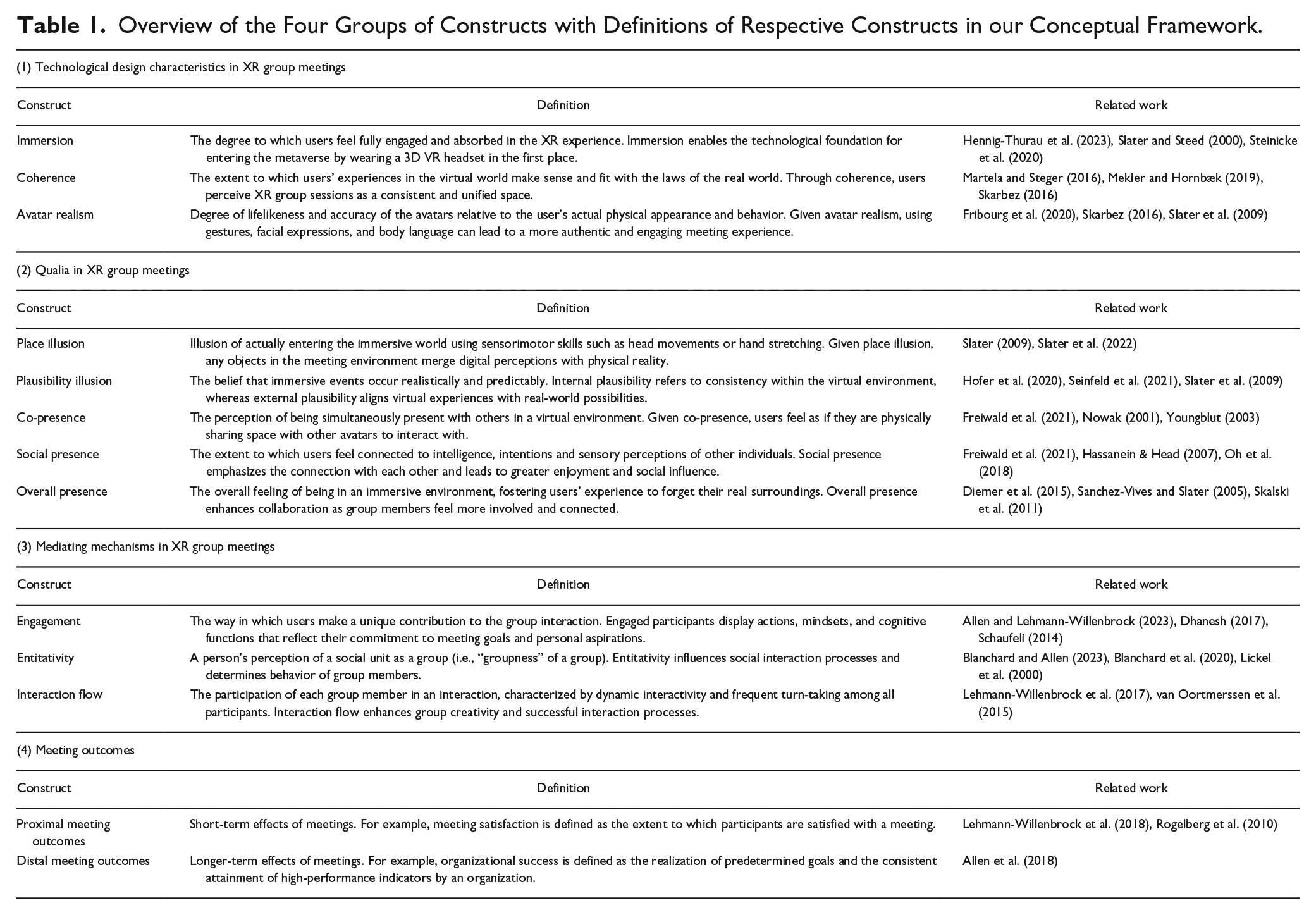
Our conceptual framework focuses on four components: (1) technological design characteristics, (2) qualia, (3) mediating mechanisms, and (4) meeting outcomes (see Figure 1). In selecting our constructs, we aimed to combine the state of the art in the group dynamics and HCI literature. First, technological design characteristics are the basis when investigating the metaverse (e.g., Zallio & Clarkson, 2022). Without immersion, coherence, and avatar realism as central factors in XR environments and initiated via VR headsets, the metaverse could not even be entered in the first place (Skarbez, 2016; Slater et al., 2022). Second, we refer to qualia in our conceptual framework to integrate state-of-the-art HCI literature into group dynamics research. Qualia offer the most accurate way to capture subjective experiences in XR group meetings (Latoschik & Wienrich, 2022; Skokowski, 2022). Third, we introduce mediating mechanisms as crucial factors for the success of XR group meetings in the metaverse. In comparison to other possible constructs, engagement, entitativity, and interaction flow have been identified as essential constructs that shape interaction settings at large (Allen & Lehmann-Willenbrock, 2023; Blanchard et al., 2023; van Oortmerssen et al., 2015). Fourth, meeting outcomes offer valuable insights into proximal and distal effects following the meeting (e.g., Allen et al., 2018). As a first glimpse into investigating meeting outcomes, we chose meeting satisfaction as a potential driver for job satisfaction and organizational commitment (Lehmann-Willenbrock et al., 2018; Rogelberg et al., 2010). Table 1 shows an overview of the individual groups of constructs and their respective definitions. The overarching assumption in our conceptual framework is that the synergetic interplay of technological design characteristics, with qualia on the one hand and mediating mechanisms on the other, can facilitate XR meetings outcomes. In the following, we develop our conceptual framework and derive testable research propositions regarding this interplay.
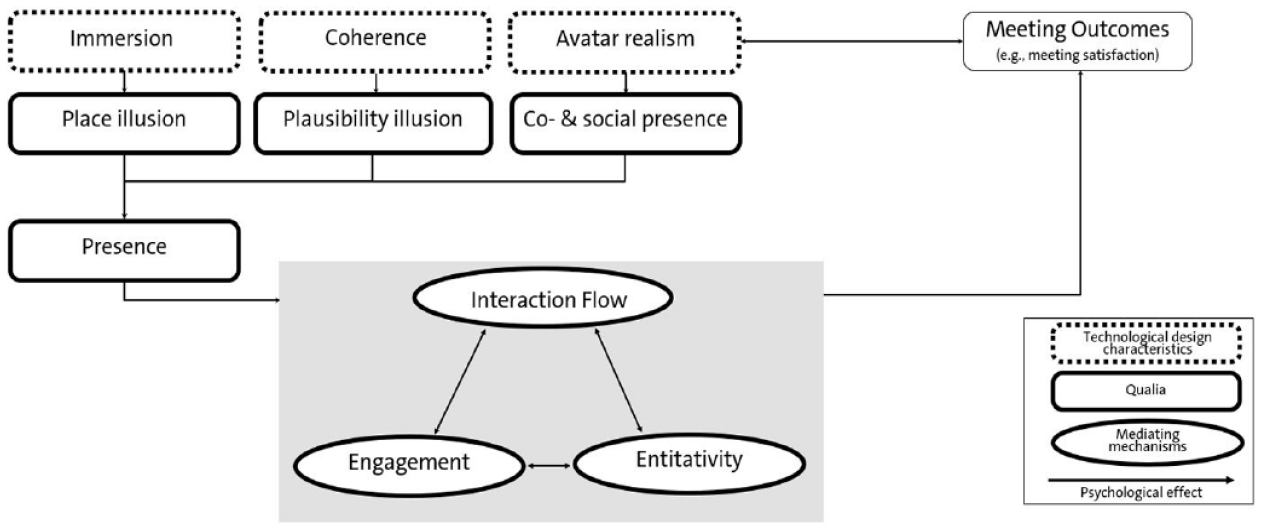
Proposed Conceptual Framework of XR Group Meetings in the Metaverse.
Overview of the Four Groups of Constructs with Definitions of Respective Constructs in our Conceptual Framework.
From Technological Design Characteristics to Qualia
The extant groups literature points to design factors as important inputs for successful group meetings. There are consistent findings that meeting design characteristics, such as careful meeting planning or room setup, provide antecedents for meeting effectiveness (for an overview, see Allen & Lehmann-Willenbrock, 2023). In XR group meetings, meeting design characteristics constitute the technological foundation of the meeting (e.g., Zallio & Clarkson, 2022). Technological design characteristics shape the feasibility of XR group meetings and determine the extent to which users fully immerse in the new interaction space (Seidel et al., 2022). With successful technological implementation, users can experience an immersive infrastructure that paves the way for a new form of group interaction (Zallio & Clarkson, 2022). For example, the XR headsets are figuratively a door to the metaverse. Thus, technological design characteristics specify how XR group meetings in the metaverse are implemented, including possibilities to customize the meeting room and to create one’s own avatars. As such, the metaverse provides a new venue with previously unknown 3D communication for XR group meetings. The implementation of technological design characteristics in XR meetings directly influences how meeting attendees subjectively experience various physiological stimuli. In current HCI literature, these subjective experiences are described as qualia, defined as mental states that occur in connection with triggering physiological stimuli (Latoschik & Wienrich, 2022). Qualia 1 are novel in group research and can be considered as the conceptual state of the art for research in 3D interaction spaces in the metaverse (Salti & Bergerbest, 2022; Skokowski, 2022; Slater & Sanchez-Vives, 2022).
When applying this notion to the context of XR group meetings in the metaverse, qualia can be seen as the result of the technical implementation of the meeting (i.e., qualia result from XR meeting technological design characteristics). For example, qualia may refer to the extent to which users have the subjective feeling of truly interacting in the metaverse (Chiang et al., 2022). Previous research indicates that qualia influence conscious perceptions in relation to the environmental setting of an individual (Latoschik & Wienrich, 2022). Following the current consensus in HCI research, we contend that the subjective perception of other avatars in the 3D interaction space—that is, qualia—represents a conscious experience. Further, they allow “perceivable objective representations corresponding to subjective perceptions” (Latoschik & Wienrich, 2022, p. 3). In other words, people perceive a 3D environment in XR that they do not see in other communication media. For a better overview of our technological design characteristics, namely immersion, coherence, and avatar realism as well as our set of qualia, namely place illusion, plausibility illusion, co-presence, social presence, and overall presence, see Table 1.
To understand how technological design characteristics affect subjective attendee experiences and the mediating mechanisms that unfold, we envision that qualia are based on a technical framework provided by immersion, coherence, and avatar realism. The core idea of immersive interactions in the metaverse is that users ultimately become immersed in the new interaction space. This experience will only be successful if users experience immersion, perceive the new interaction space as coherent, and recognize and realistically assess avatars as humans (Hofer et al., 2020; Skarbez et al., 2017; Slater et al., 2022). Recent theoretical papers emphasize the potential benefits of head-mounted displays to reinforce the perception of the new interaction setting as real (i.e., place illusion), allow users to experience immersive events as actually occurring (i.e., plausibility illusion), and enable being (i.e., co-presence) and interacting (i.e., social presence) with other avatars (e.g., Hennig-Thurau et al., 2023; Latoschik & Wienrich, 2022; Slater, et al., 2009). In particular, users need a setting that is as natural as possible to reap the benefits of an immersive platform (Shafer et al., 2011). In other words, immersion functions as a bridge to enter another world, enabling users to forget time and space (Hudson et al., 2019). Indeed, XR group meetings enable place illusion by creating a stronger sense of immersion in a virtual environment (e.g., Han et al., 2023). A growing number of research studies underscore the importance of technical implementation to pave the way for qualia, such as place illusion (e.g., Hofer et al., 2020; Skarbez et al., 2017). Notably, immersion can be seen as the overall key facet that results from the appropriate technical implementation to enter the XR meeting, carried out through the 3D head-mounted display (Hudson et al., 2019; Slater et al., 2022; Steinicke et al., 2020). Thus, we conclude:
Proposition 1a: Immersion fosters place illusion in XR group meetings.
Coherence in virtual environments allows the consistency of design, interactions, and presentation to be maintained (Mekler & Hornbæk, 2019), ensuring adherence to participants’ shared mental models of traceable interactions (i.e., plausibility illusion). Relatedly, coherent virtual environments pave the way for recognizing familiar patterns in a new context, the prerequisite for fruitful group interactions in the metaverse (Latoschik & Wienrich, 2022; Slater, 2009). By mitigating cognitive dissonance stemming from conflicting elements, coherence allows participants to concentrate on meeting content rather than being diverted by inconsistencies (Martela & Steger, 2016). When elements coalesce seamlessly, participants are more inclined to accept the virtual space as authentic for the duration of the meeting. Overall, coherence is pivotal in crafting compelling XR meeting experiences and cultivating plausibility illusion in the metaverse. We derive:
Proposition 1b: Coherence promotes plausibility illusion in XR group meetings.
Further, it is necessary to consider implications for avatar design choices to scientifically classify how avatar realism affects XR meetings. As meeting participants can join the XR meeting using embodied avatars, avatar realism is crucial to enabling a sense of being with other avatars (i.e., co-presence) and interacting with them properly (i.e., social presence; e.g., Latoschik & Wienrich, 2022). Specifically, self-avatars (i.e., realistic avatars that resemble users) are more beneficial for fostering a feeling of connectedness and realism compared to uniform avatars (Han et al., 2023). As such, Kim et al. (2023) showed that users’ familiarity with avatars moderated the serial mediation of avatar realism, psychological distance, social presence, and user-avatar relationship. This might help to explain why self-avatars are more beneficial than uniform avatars in XR meetings, as the degree of familiarity with self-avatars tends to be higher (Kim et al., 2023). Likewise, self-avatars are associated with a higher degree of ownership and higher levels of presence compared to uniform avatars (Waltemate et al., 2018). Notably, the degree of immersion increased the effects of avatar realism on presence only in the 3D condition, highlighting the advantage of 3D head-mounted displays over 2D computer-mediated alternatives to support co- and social presence (Waltemate et al., 2018). Previous findings underscore the anthropomorphic nature of self-avatars, the feeling of being with other avatars, and perceiving the interaction as human-like (Banks & Bowman, 2016; Hai et al., 2018). Moreover, there are increasing indications that avatar realism has the potential to increase social presence in XR meetings (Han et al., 2023; Hennig-Thurau et al., 2023; Nowak & Biocca, 2003). Taken together, we derive:
Proposition 1c: Avatar realism fosters co-presence as well as social presence in XR group meetings.
Overall Presence in the Metaverse
In addition to the linkage between technological design characteristics and qualia, we need to understand how qualia unfold and relate to each other in XR group meetings. Notably, we adhere to the current state of HCI research to identify place illusion, plausibility illusion, co-presence, and social presence as orthogonal components of overall presence (e.g., Skarbez et al., 2017; Slater, 2009). As illustrated in Figure 1, we propose that the three types of qualia, working together in concert, will contribute to the overall experience of presence in the metaverse. Indeed, the HCI literature suggests that overall presence enables successful group dynamics in the metaverse (e.g., Slater et al., 2022). Among several possible facets of illusion that may shape the nature of successful XR experiences, overall presence is crucial for interaction processes (Lombard et al., 2009). Notably, we follow the current HCI literature according to which qualia can be structured hierarchically (e.g., Latoschik & Wienrich, 2022). A review of the term presence in the HCI literature concluded that presence can be categorized as a superordinate quale; all other qualia (i.e., social presence, co-presence, place illusion or plausibility illusion) function as sub-facets and generate overall presence as an elementary factor of 3D mediated interaction (Skarbez et al., 2017).
Recent studies emphasized place and plausibility illusion as two different factors (Hofer et al., 2020). Importantly, when both plausibility illusion and place illusion are given, users tend to respond realistically to situations and events within virtual reality, even while cognizant that these are illusions and not reality (Slater et al., 2022). For example, a study that investigated a string quartet in the metaverse found that plausibility illusion significantly influences users’ perceptions of overall presence (Bergstrom et al., 2017). Cognitive investment seems to play a role in the perception of overall presence, after users have experienced place illusion (Lachlan & Krcmar, 2011). Co-presence and social presence also lead to the impression of overall presence in the metaverse through the perceived immersed interaction with other avatars (Latoschik & Wienrich, 2022; Skarbez et al., 2017).
Methodologically, the consideration of presence as a key feature of interactions in the metaverse in recent studies underpins our line of reasoning regarding overall presence as the overarching quale (Latoschik & Wienrich, 2022; Schwind et al., 2019). There is a variety of questionnaires operationalizing presence as the crucial quale, for instance the Slater-Usoh-Steed questionnaire (Usoh et al., 2000) or iGroup presence questionnaire (Schubert et al., 2001). Statistical factor analysis also contributes to our assumption that other facets of presence (i.e., co- and social presence) act together in shaping overall presence (e.g., Lombard et al., 2009; Schubert et al., 2001). Thus, we conclude that overall presence is the overarching quale that drives immersive group interactions, fostered by place and plausibility illusion as well as co- and social presence. We derive:
Proposition 2: Place illusion (2a), plausibility illusion (2b), as well as co- presence (2c) and social presence (2d) foster subjective experienced overall presence in XR group meetings.
These qualia shape the prerequisites for engaging XR group meetings in the metaverse; however, they are only one part of understanding successful group dynamics. In the following, we derive focal factors of behavioral group interaction in XR group meetings. Contrary to technological design characteristics and qualia, these mediating mechanisms are, by definition, not bound to the virtual reality setting and can be operationalized in various forms of group interaction (e.g., face-to-face or virtual 2D meetings).
From Overall Presence to Mediating Mechanisms
How do XR technology and a person’s experienced overall presence work together to affect meetings? In general, groups are composed of at least three individuals who interact with each other and share a common sense of social entity (e.g., Moreland, 2010). Group meetings are core interactional venues in organizations (e.g., Allen & Lehmann-Willenbrock, 2023) and rich interaction environments, in which group members exchange social signals, including verbal content as well as multimodal nonverbal behavior (e.g., Lehmann-Willenbrock & Hung, 2023; Vinciarelli et al., 2012). Indeed, the literature on group dynamics speaks to the complex behavioral interaction patterns that may unfold in virtual group meeting scenarios, as well as mediating mechanisms inside more or less immersive virtual meetings that contribute to effective group interactions (for an overview, see Allen & Lehmann-Willenbrock, 2023). Mediating mechanisms of particular interest for our conceptual framework include the various interplays, behavioral patterns, and dynamic elements that manifest when individuals congregate to establish a collective unit (e.g., Brown & Pehrson, 2019). These mediating mechanisms encompass a broad spectrum of socio-psychological phenomena that exert influence over the functioning, brainstorming, decision-making processes, and goal attainment of groups (Hogg et al., 2017). We introduce engagement, entitativity, and interaction flow as mediating mechanisms in our conceptual framework (see Table 1).
Overall presence leads directly to the mediating mechanisms of improved framework conditions in XR group meetings, namely entitativity, engagement, and interaction flow. However, questions remain regarding the behavioral processes that can increase these mediating mechanisms. While we know that the quality of interactions is more important than the quantity of interactions, it is relatively unknown what constitutes quality interactions (Blanchard et al., 2023). Previous research suggests that observing and participating in meaningful exchange of information and support through written communication are important for groups (cf., Blanchard et al., 2020). Further, the ability for individuals to be identified as important within the group is growing in its importance for fruitful interactions (Blanchard & Allen, 2023; Jans et al., 2011). Notably, communicating in synchronous 3D environments via embodied realistic avatars holds the potential for group members to be perceived as an important part of the group (e.g., Barreda-Ángeles & Hartmann, 2022; Han et al., 2023; Hennig-Thurau et al., 2023). If users feel “present” in the metaverse, the likelihood of identifying themselves as an important part of the group increases.
In general, the HCI literature assumes that the benefits of interaction and inclusion in the metaverse accrue from the feeling of being present in the XR group meeting (Zallio & Clarkson, 2022). For example, Barreda-Ángeles and Hartmann (2022) found that the subjective feeling of presence in XR was positively linked to relatedness, self-expansion, and enjoyment, which can be categorized as antecedents for overall engagement in group interactions (Deci & Ryan, 2012; Jost & Van der Toorn, 2012). Entering the metaverse and feeling present in XR group meetings fosters engagement and, therefore, could increase users’ positive cognitive, psychomotor, and affective skills (Radianti et al., 2020; Steinicke et al., 2020). Moreover, XR group meetings have the capacity to enhance both intrinsic and extrinsic motivation, further influencing creativity and innovation within groups (Barreda-Ángeles & Hartmann, 2022).
These human-like interactions, enabled by avatars through overall presence, are also discussed as a potential benefit for enhancing engagement at large. Thus, overall presence provides a foundation for social engagement, and, ultimately, social learning in XR group meetings (Scavarelli et al., 2021). Importantly, in contrast to 2D virtual meetings, 3D XR meetings shape social spaces through advanced contextualization (Hennig-Thurau et al., 2023; Scavarelli et al., 2021). Advanced contextualization can be seen as a result of overall presence, which in turn has a positive influence on the mediating mechanisms of XR interactions (Han et al., 2023; Scavarelli et al., 2021). Subsequently, the ultimate subjective perception of presence can reinforce group members’ identification in XR group meetings, which might facilitate entitativity, engagement, and interaction flow. In other words, presence in XR meetings offers the ability of being there, which in turn, paves the way for doing there (Sanchez-Vives & Slater, 2005). In this sense, the mediating mechanisms would hardly be feasible without the subjective sense of presence in the meeting. Taken together, the metaverse lowers the threshold for unified communication using embodied avatars in such a way that presence might enhance mediating mechanisms in XR group meetings. We conclude with the following proposition:
Proposition 3: Overall presence fosters (3a) engagement, (3b) entitativity and (3c) interaction flow in XR group meetings.
From Mediating Mechanisms to Meeting Outcomes
Meeting outcomes are the results and effects that arise following a meeting (Allen et al., 2018). These outcomes include both concrete and abstract consequences, encompassing decisions, knowledge modifications, shifts in attitudes, or changes in behavior that materialize as an outcome of a structured assembly of individuals (Allen et al., 2018). Scholars differentiate between proximal and distal meeting outcomes (e.g., Allen et al., 2018; Lehmann-Willenbrock et al., 2018; see Table 1). In the context of mediating mechanisms and meeting outcomes, actual engagement in the meeting plays a pivotal role (e.g., Allen & Lehmann-Willenbrock, 2023). The effort and attention a group member provides to the group’s activities may help them believe that they are important to the group. The feeling of being an important part of the group can mobilize each participant’s cognitive, emotional, and physical resources, which can have a positive impact on group dynamics (Schaufeli, 2014). When participants feel they have resources, this in turn can lower the threshold for engaging in group interaction. This can also foster the perception of a satisfying meeting experience (e.g., Blanchard et al., 2020).
Moreover, engagement of each group member contributes to the psychological working principles, namely affect and motivation (Salanova et al., 2011). Over time, these psychological working principles might also lead to distal meeting outcomes, such as efficacy beliefs. Salanova et al. (2011) found gain spirals describing the positive, reciprocal effects of engagement, efficacy beliefs, and positive affect. Scholars have repeatedly pointed out the importance of individual engagement for explaining meeting success (e.g., Allen et al., 2021). Likewise, the involvement of each meeting participant serves as a key factor for predicting perception of meeting success (Leach et al., 2009), which is an important antecedent for shaping employee attitudes beyond the meeting context (e.g., Lehmann-Willenbrock et al., 2016; Yoerger et al., 2015). Taken together, we conclude:
Proposition 4a: Engagement fosters meeting satisfaction in XR group meetings.
In addition to engagement, interaction flow also plays a decisive role in shaping meeting outcomes. Communicative patterns (i.e., overlap of conversational units, short turns, and wide distribution) are linked to the emergence of dynamic group interactions (van Oortmerssen et al., 2015). Previous work pointed out that meeting attendees tend to be more satisfied in meetings when they share certain communicative functions, such as communicating about procedures, than when these functions are performed by a single person (Lehmann-Willenbrock et al., 2013). Evenly distributed turn-taking has been linked to higher group effectiveness in tasks, such as puzzle solving and brainstorming, compared to groups with poorly distributed turn-taking (i.e., the conversation is dominated by few individuals; Woolley et al., 2010). Moreover, turn-taking behavior has been identified as a micro-level mechanism for facilitating positive group interaction patterns during face-to-face meetings (e.g., Lehmann-Willenbrock et al., 2017; Redlbacher et al., 2022). Likewise, Fu et al. (2017) highlighted that turn-taking communication increases performance and decision making in groups, emphasizing the essential function of interaction flow for meeting outcomes. Overall, interaction flow shapes meeting satisfaction by facilitating collaboration, brainstorming, decision-making, and the individual perception of fruitful interactions at large. Thus, we derive:
Proposition 4b: Interaction flow promotes meeting satisfaction in XR group meetings.
Further, entitativity might also link to XR meeting outcomes. Entitativity is associated with a meeting participant’s impression of group dynamics such as cohesion, group identification, and satisfaction (Blanchard et al., 2020). At the initiation of collaborative efforts, individuals face a cognitive dichotomy between self-concept and group identity. If an individual predominantly directs their cognitive focus toward the group entity, it instigates a cognitive process whereby the individual becomes susceptible to assimilating the collective positive attributes ascribed to the group (e.g., Blanchard et al., 2023). As successful meetings exert a substantial impact on the cognitive salience of group identity, entitativity emerges as an explanatory factor underpinning the efficacy of these groups. Thus, feelings of belongingness fostered through communication increase the likelihood of coordinated action (Blanchard et al., 2020; Han et al., 2022). The advantages of studying XR group meetings are that it is easier to see how group members translate or develop quality interactions (i.e., perceived meeting satisfaction) in XR, compared to 2D meetings. These interactions may be successful or may need to be tailored to XR. By focusing on these specific forms of XR interactions, we can develop a better understanding of how entitativity contributes to XR meeting outcomes. We theorize:
Proposition 4c: Entitativity fosters meeting satisfaction in XR group meetings.
From Technological Design Characteristics to Meeting Outcomes via Qualia and Mediating Mechanisms
Our final research proposition specifies how XR group meetings become effective through the interplay of the three types of constructs that unfold in sequence, namely technological design characteristics, qualia, and mediating mechanisms. These three paths are interconnected and operate in a serial manner. Previous findings point to the need to consider diverse linkages when examining how technological design characteristics and the resulting qualia relate to meeting outcomes in the metaverse. For example, Gunawardena and Zittle (1997) suggested that social presence predicts satisfaction in a text-based computer conference. Yi and Moon (2021) revealed a significant positive relationship between social presence and satisfaction with XR group interactions. Relatedly, avatar realism reinforces social presence over time in XR meetings (Han et al., 2023). However, to date, a conceptualization of how technological design characteristics, qualia, mediating mechanisms, and meeting outcomes are connected is missing. Importantly, we need to refine our understanding of what exactly contributes to the special proxemics of group dynamics in the metaverse. As illustrated in Figure 1, we propose that technological design characteristics foster qualia, which in turn promote mediating mechanisms. The emergence of presence in XR meetings through the interplay of technological design characteristics and qualia allows mediating mechanisms to unfold in previously unknown ways. These mediating mechanisms at the core of the meeting then promote XR meeting outcomes.
Proposition 5: The relationship between technological design characteristics and XR meeting outcomes is mediated in sequence by qualia and mediating mechanisms.
Next, we present findings from a pilot study of immersive student group meetings, with the aim to provide a glimpse into the empirical implementation of our conceptual framework. Notably, this pilot study does not provide a formal test of our full conceptual framework but serves as an initiative to explore behavioral group dynamics in the metaverse. It aims to gain initial insights into the interplay of immersive technological design characteristics, qualia, mediating mechanisms, and meeting outcomes. Given the exploratory approach of our pilot study, we only selected a few exemplary variables for each of the four groups of constructs (summarized in Figure 1). Thus, this study is an initial attempt to validate our conceptual framework.
A Pilot Study of Group Meetings in the Metaverse
Our pilot study was approved by the ethics committee at the first author’s institution. Participants were 20 (Female = 15) undergraduate psychology students who had no prior experience with interactions in the metaverse, with an average age of 26.6 years. Seven participants wore a vision correction. Participants were randomly assigned to six groups, each consisting of three to four individuals. We created embodied avatars for each participant using the Spatial.io platform (see Figure 2). Upon arrival, participants met in a waiting area for a briefing on the study procedure and informed consent. We had to deviate from individual rooms in the pilot study and opted for a physically co-located sitting arrangement in our university living lab, specifically designed for recording interactions (with seating positions corresponding to the positions in the metaverse). All participants joined the VR meeting in XR using an Oculus Quest 2 headset (VR goggles). We configured the VR glasses with a clearly defined radius to prevent participants from wandering around the room and ensure safety. The XR group meeting took place in a lifelike, standard Spatial.io meeting room with a round table and several chairs, white or wood-colored walls and a gray carpet. Instructions were displayed at the center of the table in view of the participants (see Figure 3).
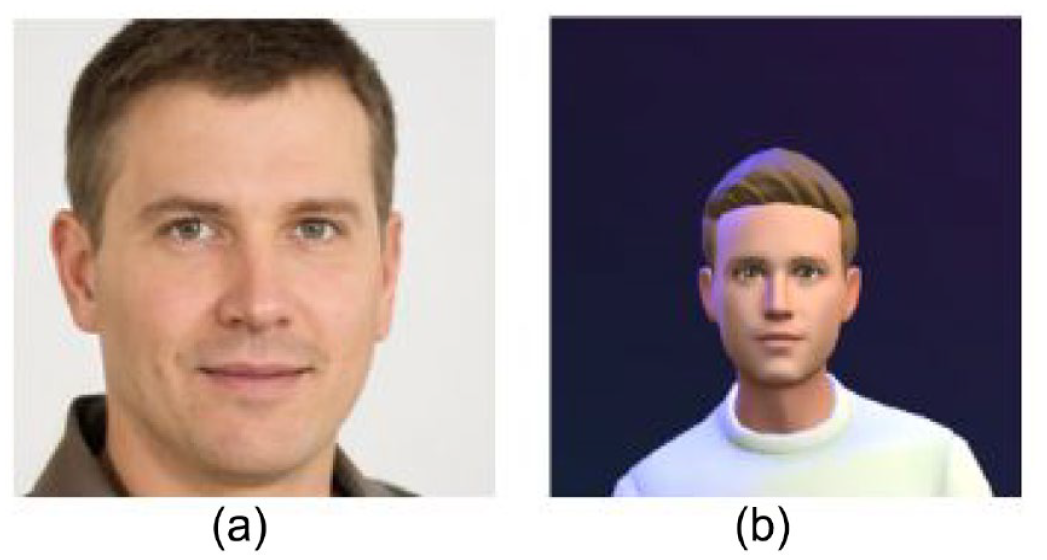
Spatial.io Avatars generated from Participants’ Input Images: (a) Input Face and (b) Output Avatar.
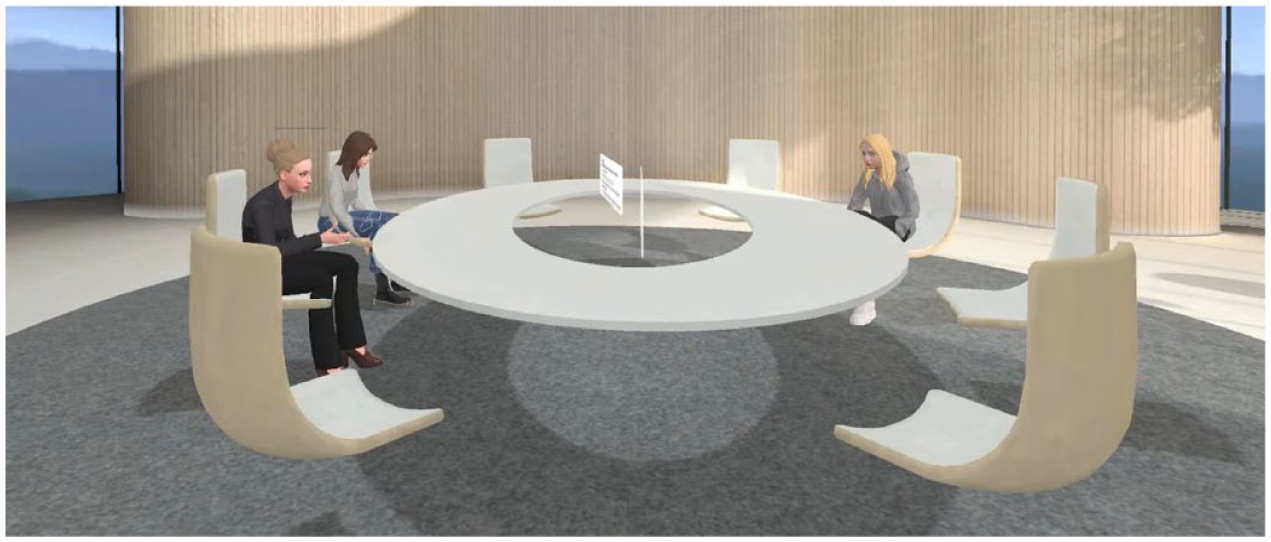
Screenshot of the Meeting Environment and Setup of an XR Group Meeting (Observer Perspective).
The groups collaborated over the course of one semester, not just for the purpose of the immersive meetings. Because of this prolonged collaboration, the groups can be expected to function as a recognizable unit (Blanchard et al., 2023). As part of our pilot study, each group went through two immersive meeting phases, with a 10-min break in between. In both phases, groups worked on a team task with a common goal that was related to their semester project. Phase One lasts 20 min and involves brainstorming the advantages and disadvantages of virtual teaching at the university. Phase Two lasts approximately 25 min and focuses on generating strategies to scientifically investigate immersive meetings. These instructions were given in written form before the start of both phases. After Phase Two, participants completed a comprehensive survey that included questions and items measuring the study variables. Meeting satisfaction was assessed twice: once after each phase. Moreover, each student group wrote a reflection on their meeting experience. Approximately a total of 270 min of meeting interactions were recorded.
Methods
In terms of technological design characteristics, we measured participants’ perceptions of avatar realism using the avatar godspeed scale (Bartneck et al., 2009). This measure was originally developed for studying the perception of robots, and we adapted two subscales relevant to our study: anthropomorphism and animacy (10 items total; Cronbach’s α = .81) on a 5-point Likert scale with two contrasting adjectives, ranging from 1 (agreeing with the first adjective) to 5 (agreeing with the contrasting adjective), with higher numbers indicating a higher level of anthropomorphism and animacy. For instance, students were asked to rate the avatar between “artificial (= 1) and lifelike (= 5)” and “mechanical (= 1) and organic (= 5),” regarding all avatars in the immersive meeting.
To measure qualia, we focused on co-presence and overall presence, similar to recent studies (Han et al., 2023; Hennig-Thurau et al., 2023). Co-presence was measured using a 3-item scale (Poeschl & Doering, 2015), for example, “I had the feeling of perceiving other people in the virtual space” (α = .76). Presence was measured using 21 items (α = .69) assessing perceptions of the presence of the immersive event using seven subscales (spatial presence, social presence [actor with medium], social presence [passive interpersonal], social presence [active interpersonal], mental immersion, social realism, and perceptual realism; Lombard et al., 2009). For feasibility reasons, we shortened the scales by only using three items from each subscale that had the highest factor loading according to previous factor analytical results from the original study (Lombard et al., 2009). One sample item is “The way in which the events I saw/heard occurred is a lot like the way they occur in the real world.”
Regarding interaction dynamics inside the XR meeting, we focused on entitativity, engagement, and interaction flow. We measured entitativity using a 21-item scale adapted from Blanchard et al. (2020), which includes six subscales: entitativity, similarity, interactivity, shared goals, boundaries, and history of interactions. Due to our specific course setting with randomly distributed zero-history groups, we did not measure the groups’ history of interactions and boundaries. Our entitativity measure included 12 items with a 7-point Likert scale ranging from 1 (strongly disagree) to 7 (strongly agree). Sample items included, “We are a group” for self-reported entitativity, or “The group responds to each other’s messages” for observer-reported entitativity ratings (α = .88). In line with Blanchard et al. (2020), students were also asked to rate entitativity as observers in an immersive meeting of one of their peer groups (both Phase One and Two). This allowed for the collection of averaged external ratings for the same group with respect to both phases of the immersive meeting (e.g., each student of Group 5 analyzed Group 6, which allowed for a comparison of self-reported and observational data for Group 6). An instructor trained the students and provided scale definitions to ensure proper external entitativity ratings (Blanchard et al., 2020). We measured engagement as individual conversation shares in the immersive meeting, calculated by dividing individual participation in seconds by the total length of the meeting in seconds. Further, we explored interaction flow based on van Oortmerssen et al. (2015). Using INTERACT software, we generated timeline graphs that illustrate the extent of turn-taking interaction dynamics including short turns, wide distribution, or occurring overlaps in speaker turns (Mangold, 2018). We only considered phase two (i.e., after the warm-up phase) for exploring these behavioral measures.
As a proximal meeting outcome, we measured meeting satisfaction using a 6-item scale (α = .75) adapted from Rogelberg et al. (2010). Participants rated their agreement with each item on a 5-point Likert scale ranging from 1 (strongly disagree) to 5 (strongly agree). A sample item is “This immersive meeting was enjoyable.” We also considered control variables. Simulator sickness can occur when using head-mounted displays, so we measured this using a 16-item scale (α = .87) ranging from 1 (no symptoms) to 4 (severe symptoms). Sample items include “difficulty focusing” and “eye strain” (Kennedy et al., 1993). Further, we measured task load using a 5-point Likert scale (α = .56) ranging from 1 (very low) to 5 (very high). An example item is “How physically demanding was the task?” (Hart, 2006). We also asked participants to rate their prior acquaintance and collaboration experience with their assigned group members on a scale from 1 (never; no history) to 5 (very often; confirmed group history). Moreover, as previous virtual reality experiences can influence habituation processes and the resulting experiences (Han et al., 2022), we measured participants’ prior virtual reality experience using a 5-point Likert scale from 1 (not at all) to 5 (very often).
Exploratory Findings
Bearing in mind the preliminary nature of our results, Table 2 shows the descriptive statistics for all self-reported measures as well as the observed behavioral engagement at the individual attendee level. Regarding technological design characteristics, subjectively experienced avatar godspeed was moderate (M = 1.84, SD = 0.52), while vitality (M = 2.2, SD = 0.83) and reactivity (M = 2.15, SD = 0.87) received the highest ratings. Regarding qualia, presence was rated moderate to high (M = 2.93, SD = 0.36), as was co-presence (M = 3.51, SD = 0.41). In particular, active interpersonal communication as part of social presence received the highest scores (M = 3.61, SD = 0.68), while imitation (M = 1.2, SD = 0.69) was rated low. Satisfaction with the immersive meeting was equally high across both meeting phases, t (19) = −0.26, p > .05. Regarding engagement, we observed a relatively even distribution of conversation shares, suggesting that all attendees were able to immerse themselves and contribute to the meeting. Only a few of the immersive meetings were dominated by particular individuals (for more details, see Appendix B).
Means, Standard Deviations, and Intercorrelations of Self-Reported Measures.
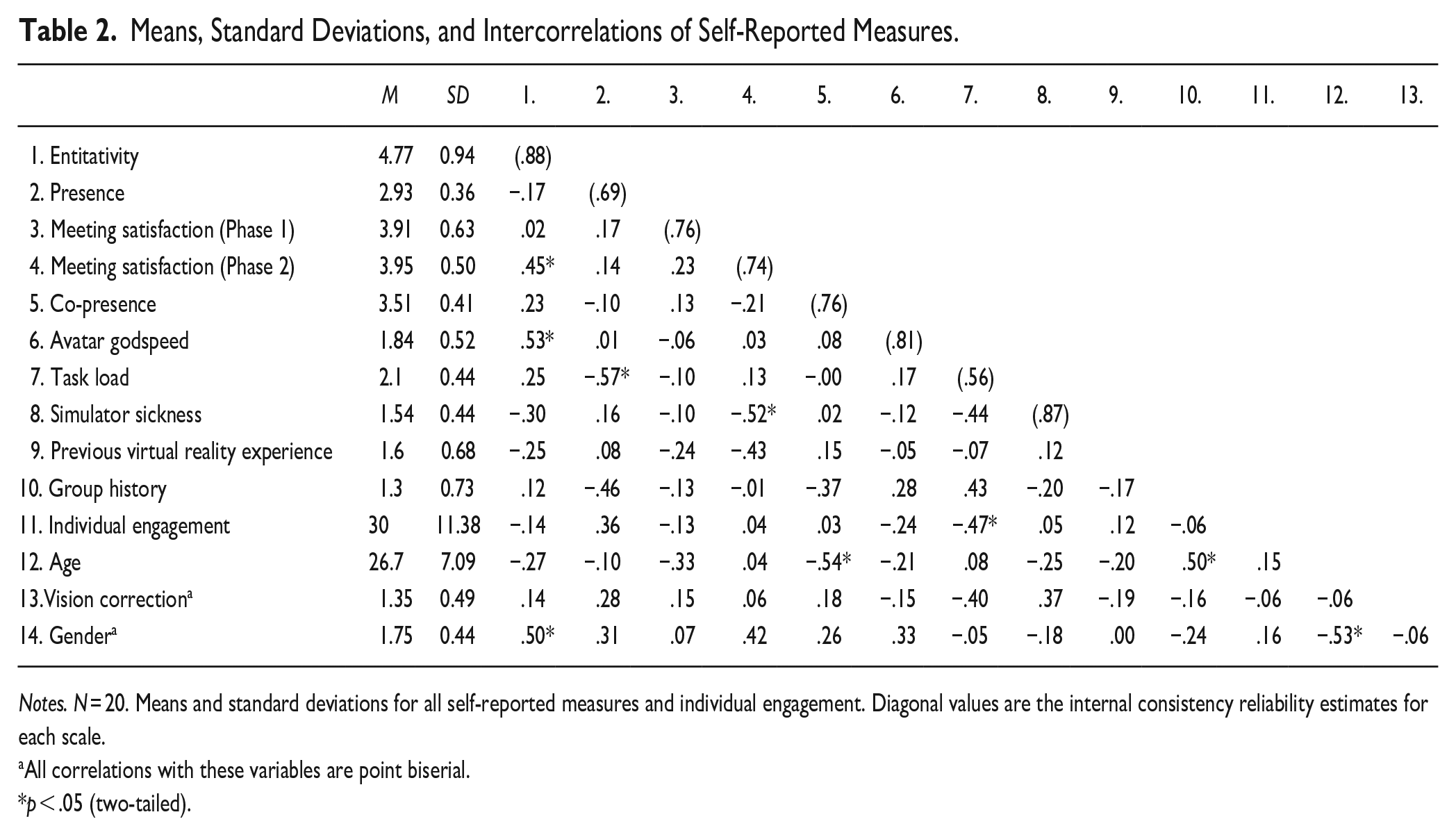
Notes. N = 20. Means and standard deviations for all self-reported measures and individual engagement. Diagonal values are the internal consistency reliability estimates for each scale.
All correlations with these variables are point biserial.
p < .05 (two-tailed).
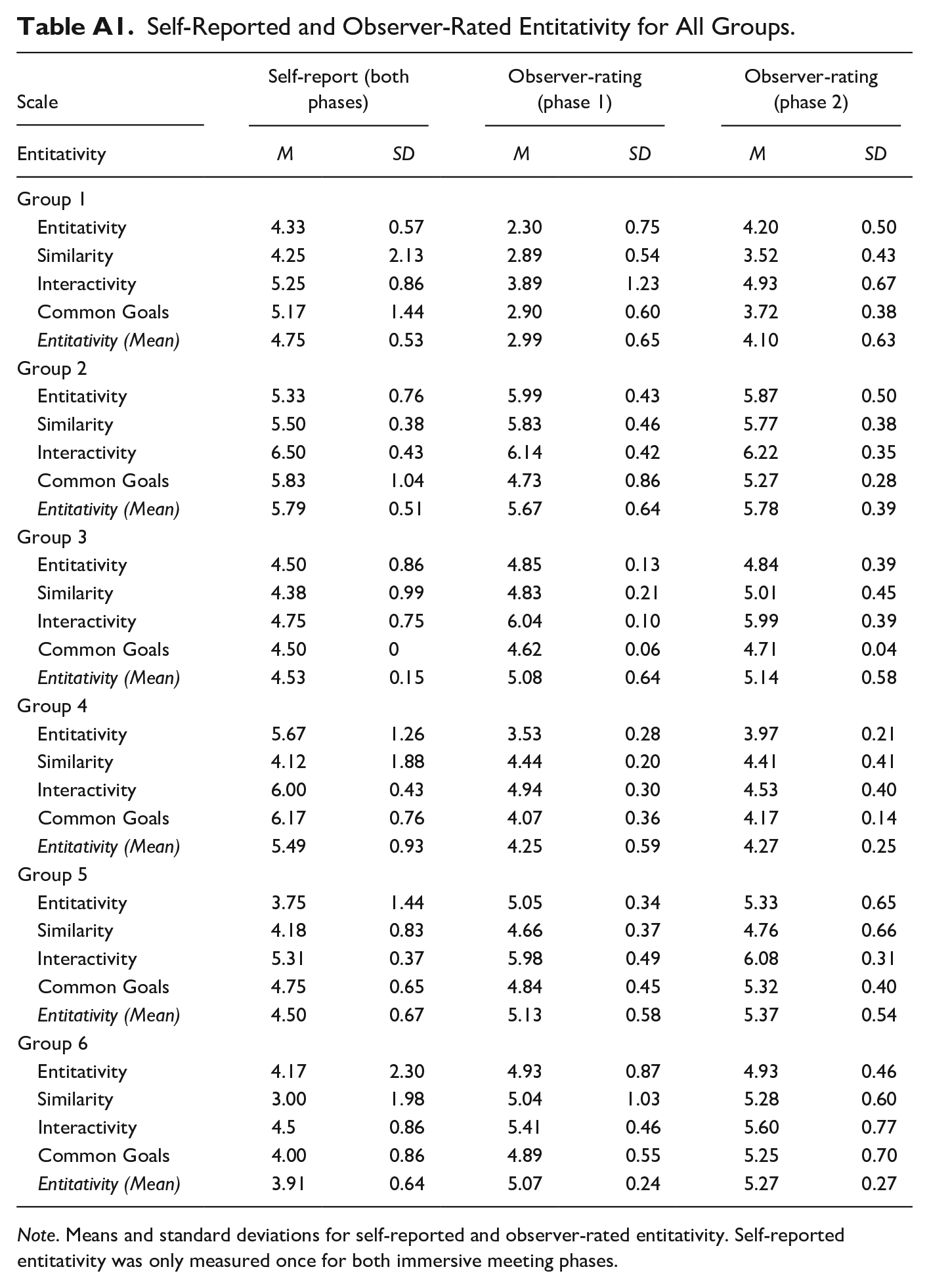
Participants self-reported moderate to high levels of entitativity overall (M = 4.77, SD = 0.94). As a comparison point for our findings, in face-to-face group settings, Blanchard et al. (2020) found average scores of entitativity ranging from 3.58 to 5.24 based on observational assessments and 4.29 to 5.9 for self-reported entitativity. We note, however, that subscale scores varied somewhat. Moreover, we found that women reported higher levels of entitativity (r = .53, p < .05). We also found that self-reported entitativity differed somewhat from observer ratings. Our descriptive findings indicate that in three groups, external ratings were higher than self-reported entitativity scores, while in three other groups, it was the opposite (see Appendix A). Notably, interactivity was rated highest across all groups and in both meeting phases (M = 5.48, SD = 0.75).
Moreover, we explored how the level of self-reported entitativity might reflect different characteristics of the immersive interaction flow. Specifically, zooming into the 5-min immersive meeting segments within our generated timeline graphs demonstrated an intensified interaction flow (i.e., dynamic turn-taking, overlap, and fewer monologs) when self-reported entitativity was high (see Figure 4). Conversely, we observed a decreased group interaction flow when self-reported entitativity was low (see Figure 5). In addition, the groups’ reflections on their experiences (see Appendix C for illustrative quotes) align with our descriptive data, showing that participants indeed felt they could immerse in the meeting and experienced the XR as a productive environment for group collaboration.

Increased Interaction Flow in a Meeting-Segment with High Self-Reported Entitativity .

Decreased Interaction Flow in a Meeting-Segment with Low Self-Reported Entitativity.
Discussion
The metaverse offers a novel and unique interaction environment that can address the challenges of virtual 2D communication by enabling users to “dive” into the meeting through specially created 3D virtual embodied avatars (e.g., Han et al., 2023; Hennig-Thurau et al., 2023). With its realistic representation, heightened adaptability, and superior user engagement in the metaverse, 3D technology provides new opportunities for XR group meetings and opens up new research venues in a socio-technically transformative field (Ens et al., 2019). As a complement to recent investigations of group interactions in the metaverse (e.g., Han et al., 2023; Hennig-Thurau et al., 2023), we derived an interdisciplinary conceptual framework of XR group meetings by combining psychological insights with HCI perspectives.
As a first glimpse into an empirical operationalization of this framework, results of our pilot study indicate that participants experienced satisfying immersive meetings with low to moderate task load and simulator sickness. This is a remarkable finding, as participants were technological novices with no relevant prior XR experience. We observed a slight increase in meeting satisfaction from one meeting phase to the next, which hints at relatively quick habituation in XR. Participation was evenly distributed in most of the observed immersive meetings. Further, our findings indicate possible linkages between group interaction flow, group entitativity, and overall meeting satisfaction. The observed interaction flow was positively related to group entitativity, in line with the participant’s self-reported reflections on their experiences with the metaverse. Though our pilot study findings remain preliminary, given our small sample size and the nascent stage of group research in the metaverse, we see several opportunities for more interdisciplinary work in this exciting area in the future.
Theoretical Implications
First, by integrating cutting-edge HCI literature and group research, we contribute conceptual insights into understanding group interactions in the new XR space (e.g., Latoschik & Wienrich, 2022; Skarbez et al., 2017; Slater et al., 2022). Recent theoretical papers have discussed the potential benefits of using head-mounted displays to foster presence in XR and increase positive group interaction patterns (Han et al., 2023; Hennig-Thurau et al., 2023). We extended these prior theoretical considerations by conceptually integrating technological design characteristics, qualia, mediating mechanisms, and meeting outcomes. Our conceptual framework and findings from our pilot study contribute to the growing literature on the metaverse as a new promising venue for XR group meetings and future research designs (e.g., Han et al., 2023). As a potential solution to the challenges of the typical 2D environments in virtual meetings (e.g., Karl et al., 2022), immersive meetings create new opportunities for groups to communicate independently beyond one shared screen and pave the way for engaging interactions. This study expands our conceptual and empirical understanding of immersive group meetings and related positive interaction outcomes (e.g., Sadeghi et al., 2021; Steinicke et al., 2020). Our pilot study findings suggest that the metaverse is an accessible and feasible group meeting venue, even for technological novices. This is important because one of the most consistent findings of online communication research is that technology novices are not trustworthy participants (Blanchard et al., 2023; Sproull & Kiesler, 1986). Nonetheless, individual experiences and participant behavior differed in our pilot study, suggesting that some meeting attendees may need more experience in order to feel more comfortable during XR group meetings in the metaverse.
Second, though more substantial empirical research is needed to formally test our hypotheses, our pilot study offers a glimpse into how overall presence might facilitate mediating mechanisms in XR meetings. In particular, entitativity is a core psychological mechanism for generating successful group interaction processes and outcomes not only in face-to-face but also virtual group settings (Blanchard et al., 2020). Importantly, the observed level of self-reported and observed entitativity in our immersive environment is comparable to entitativity levels in face-to-face environments (Blanchard et al., 2020). In fact, the observed increase of entitativity from phase one to phase two aligns with recent studies (Han et al., 2022, 2023). Furthermore, our findings align with the theoretical assumption that self-avatars (i.e., realistic avatars that resemble participants) are more beneficial for fostering a feeling of connectedness and realism compared to uniform avatars (Han et al., 2023; Kim et al., 2023; Waltemate et al., 2018).
Third, we illustrated how an exploration of participation rates and turn-taking behavior may offer insights into group interaction dynamics in the metaverse. Results of our pilot study point to the relevance of turn-taking dynamics in XR group meetings. Our finding that frequent turn-taking behavior coincides with higher reported group entitativity speaks to the value of group interaction flow (van Oortmerssen et al., 2015) and turn-taking communication (Fu et al., 2017; Lehmann-Willenbrock et al., 2017; Redlbacher et al., 2022) for shaping engaging XR group meetings in the metaverse. In addition, our finding that attendees reported high perceptions of interactivity aligns with recent studies, emphasizing beneficial effects of the metaverse in fostering presence, relatedness, and self-expansion among immersive group members (Barreda-Ángeles & Hartmann, 2022).
Practical Implications
Based on our conceptual framework and findings of our pilot study, we discuss practical implications for meeting leaders or people in charge of organizing immersive group meetings. First, novices to immersive technology, such as the participants in our study, can have engaging meeting experiences without suffering from task load or simulator sickness. This suggests that immersive meetings can be implemented as a feasible XR group meeting format at a larger scale. In addition, the use of self-created avatars resulted in improved integration, suggesting that the metaverse has the potential to improve the integration and inclusion of group members from diverse backgrounds.
Second, the metaverse offers several possibilities for designing future XR group meetings beyond the higher education context. Notably, we introduced a phase of free exploration and an ice-breaking activity before the actual immersive meetings. Our pilot study findings suggest an immersive learning curve that can be attributed to habituation in the new environment. For meeting leaders, this observation implies that they should consider scheduling an introductory session or warm-up activities in the metaverse to allow habituation to occur. In addition, the virtual reality environment can be customized to simulate any physical environment, and features can be incorporated into the space to improve its functionality. Moreover, given the preliminary link of avatar godspeed and perceived group entitativity, practitioners should consider the use of resembling avatars rather than uniform avatars.
Limitations and Future Research
In addition to the general lack of research on group dynamics in the metaverse and the limited sample size of our pilot study, the following limitations point to future research opportunities. First, technical circumstances are still challenging. One major limitation of our pilot study was our reliance on Spatial.io as a platform for immersive meetings. While this worked well during the preparation phase of the study, due to recent changes of Meta’s account policy, participants were required to set up their own accounts, which may have influenced their overall experience. Further, nonverbal signals (e.g., facial expressions) are not tracked and encoded particularly well. In addition, some participants experienced distorted audio due to server issues with Spatial.io. To address this issue, we opted to use the real voice in a co-located space, while ensuring participants were accurately positioned in the real and immersive space so they could hear each other’s positional cues. Related to technological design choices when creating the technological setup of XR group meetings, we envision that future research will consider the relative utility of proprietary software versus more adaptive, malleable technological setups using open-source software (e.g., Mozilla Hubs) with more control over recordings and tailored virtual environments. In addition, the VR headsets used in our study were relatively heavy, with some attendees reporting eye fatigue and difficulty focusing, which may have limited the amount of time participants could comfortably wear them. Participants’ reflections underlined the need for technological improvements in order to enhance comfortability and perceiving mimic and gestures. To improve XR group meetings for future research endeavors, the technical setup should be further refined to ensure a comfortable and enjoyable immersive experience (Nagendran et al., 2022).
Second, to obtain a more nuanced view on the interplay of qualia and mediating mechanisms in XR meetings, future research should examine different types of samples beyond the higher education group setting explored in our pilot study (e.g., laboratory experiments or regular team meetings in the field). Students might be more familiar with experiential learning approaches and may be more open to new technologies compared to organizational teams, which could be a challenge for engaging XR group meetings in the metaverse. Due to their openness to new technologies, younger samples might find it easier to generate a sense of presence, which could in turn have a positive effect on group dynamics (e.g., Han et al., 2023). Moreover, future research can evaluate to the extent to which the positive linkages between technological design characteristics, qualia, mediating mechanisms, and meeting outcomes exit across different cultural backgrounds (e.g., Köhler et al., 2023). Future research could also include intelligent virtual agents interacting with the participants, or artificial intelligence as an observer enriching the meeting experience by augmenting the environment and interaction (e.g., Makridakis et al., 2023). Given the wide range of XR applications, future research might also investigate comparisons between augmented reality and full immersive virtual reality, examining their different impacts on group interactions in the metaverse (Huang et al., 2019; Webber et al., 2019). The recently released Apple Vision Pro shows that new technical possibilities will emerge in this area in the future (Apple, 2024).
Third, beyond our preliminary insights into group interaction flow, future research should consider examining the conversational content of XR group meetings to gather a more nuanced understanding of the behavioral mechanisms underlying our conceptual framework. Along these lines, future research could leverage social signal processing approaches to automatically detect group behavioral patterns (e.g., Genz et al., 2022; Lehmann-Willenbrock & Hung, 2023). Current head-mounted displays, such as Meta quest pro (see Dempsey, 2023), can automatically track non-verbal behavior (e.g., tracking facial expressions or gaze patterns). Moreover, future research should investigate when and how habituation effects occur, and how it might accelerate positive group interaction dynamics in the metaverse. Further, future research can investigate leadership as a key factor contributing to functional within-meeting group processes and ultimately meeting outcomes (for an overview, see Allen & Lehmann-Willenbrock, 2023). Previous research has identified beneficial effects of meeting leader behaviors on group and meeting outcomes, such as satisfying attendees’ psychological needs (Schuleigh et al., 2019) or enhancing meeting participation (LeBlanc & Nosik, 2019). This can inform research questions such as how meeting leader behaviors interact with technological design characteristics to promote group interaction flow in XR group meetings.
Fourth, future research should also consider bidirectional associations between some constructs in our framework. For example, mediating mechanisms might influence qualia, such as when interaction flow (due to the perceived lively interaction) impacts the perception of social presence in the first place. Moreover, previous meeting outcomes might also affect the perception of qualia and the resulting mediating mechanisms in future XR group meeting interactions (cf. the notion of IMOI models; Ilgen et al., 2005). While we included demographics, previous VR experience, and vision correction as control variables in our pilot study, future research might also control for general wellbeing (Diener & Ryan, 2009) or self-esteem (Bachman et al., 2011), given their links to group interactions and meeting outcomes.
Finally, whereas we focused on the benefits of XR group meeting formats in this paper, we also acknowledge that the metaverse may not always present an ideal meeting scenario. In some scenarios, people might prefer 2D over 3D interfaces, particularly because 3D meeting interfaces require additional technology that may feel cumbersome (e.g., Aufegger & Elliott-Deflo, 2022). On the other hand, a group meeting format that approximates a face-to-face situation enables meeting participants to experience presence in the most natural way. Future research can develop a taxonomy under which users might prefer 2D over 3D formats, despite the potential of immersive meetings to create positive group dynamics.
Footnotes
Appendix A: Development of Self- and Other Rated Entitativity
Self-Reported and Observer-Rated Entitativity for All Groups.
| Scale | Self-report (both phases) | Observer-rating (phase 1) | Observer-rating (phase 2) | |||
|---|---|---|---|---|---|---|
| Entitativity | M | SD | M | SD | M | SD |
| Group 1 | ||||||
| Entitativity | 4.33 | 0.57 | 2.30 | 0.75 | 4.20 | 0.50 |
| Similarity | 4.25 | 2.13 | 2.89 | 0.54 | 3.52 | 0.43 |
| Interactivity | 5.25 | 0.86 | 3.89 | 1.23 | 4.93 | 0.67 |
| Common Goals | 5.17 | 1.44 | 2.90 | 0.60 | 3.72 | 0.38 |
| Entitativity (Mean) | 4.75 | 0.53 | 2.99 | 0.65 | 4.10 | 0.63 |
| Group 2 | ||||||
| Entitativity | 5.33 | 0.76 | 5.99 | 0.43 | 5.87 | 0.50 |
| Similarity | 5.50 | 0.38 | 5.83 | 0.46 | 5.77 | 0.38 |
| Interactivity | 6.50 | 0.43 | 6.14 | 0.42 | 6.22 | 0.35 |
| Common Goals | 5.83 | 1.04 | 4.73 | 0.86 | 5.27 | 0.28 |
| Entitativity (Mean) | 5.79 | 0.51 | 5.67 | 0.64 | 5.78 | 0.39 |
| Group 3 | ||||||
| Entitativity | 4.50 | 0.86 | 4.85 | 0.13 | 4.84 | 0.39 |
| Similarity | 4.38 | 0.99 | 4.83 | 0.21 | 5.01 | 0.45 |
| Interactivity | 4.75 | 0.75 | 6.04 | 0.10 | 5.99 | 0.39 |
| Common Goals | 4.50 | 0 | 4.62 | 0.06 | 4.71 | 0.04 |
| Entitativity (Mean) | 4.53 | 0.15 | 5.08 | 0.64 | 5.14 | 0.58 |
| Group 4 | ||||||
| Entitativity | 5.67 | 1.26 | 3.53 | 0.28 | 3.97 | 0.21 |
| Similarity | 4.12 | 1.88 | 4.44 | 0.20 | 4.41 | 0.41 |
| Interactivity | 6.00 | 0.43 | 4.94 | 0.30 | 4.53 | 0.40 |
| Common Goals | 6.17 | 0.76 | 4.07 | 0.36 | 4.17 | 0.14 |
| Entitativity (Mean) | 5.49 | 0.93 | 4.25 | 0.59 | 4.27 | 0.25 |
| Group 5 | ||||||
| Entitativity | 3.75 | 1.44 | 5.05 | 0.34 | 5.33 | 0.65 |
| Similarity | 4.18 | 0.83 | 4.66 | 0.37 | 4.76 | 0.66 |
| Interactivity | 5.31 | 0.37 | 5.98 | 0.49 | 6.08 | 0.31 |
| Common Goals | 4.75 | 0.65 | 4.84 | 0.45 | 5.32 | 0.40 |
| Entitativity (Mean) | 4.50 | 0.67 | 5.13 | 0.58 | 5.37 | 0.54 |
| Group 6 | ||||||
| Entitativity | 4.17 | 2.30 | 4.93 | 0.87 | 4.93 | 0.46 |
| Similarity | 3.00 | 1.98 | 5.04 | 1.03 | 5.28 | 0.60 |
| Interactivity | 4.5 | 0.86 | 5.41 | 0.46 | 5.60 | 0.77 |
| Common Goals | 4.00 | 0.86 | 4.89 | 0.55 | 5.25 | 0.70 |
| Entitativity (Mean) | 3.91 | 0.64 | 5.07 | 0.24 | 5.27 | 0.27 |
Note. Means and standard deviations for self-reported and observer-rated entitativity. Self-reported entitativity was only measured once for both immersive meeting phases.
Appendix B: Distribution of Engagement Across Groups
Figure B1 illustrates participants’ engagement in the observed meeting interactions, captured by individual conversation shares. In the second phase of the immersive meeting, participants in three-member groups (Groups 1–4) participated an average of 111 times, while participants in four-member groups (Groups 5–6) participated an average of 92 times. Each individual speaker had a conversation share of at least 10.7%, suggesting that each group member crossed a threshold to participate in the discussions.
Appendix C: Group Reflections
After all students had completed the immersive meeting, they worked as a team to develop an experience reflection summary (required length was about 800 words). Due to the limited scope, not all statements of the groups can be fully contextualized. Where possible, we provide context based on the students’ original formulations to better frame the statements.
Group 1 emphasized the accessibility of the immersive setting: “The environment in the meeting room was very attractively designed compared to university rooms. Additionally, all avatars were clearly identifiable.” Interestingly, they attributed this identification to the possibility that the avatar corresponded to their own image and could be customized. This observation is consistent with recent observations that self-avatars could be superior to uniformed avatars when it comes to fostering XR group interactions (e.g., Han et al., 2023).
Corresponding to findings from our pilot study, Group 2 acknowledged the feeling of being fully engaged in the metaverse: “Due to the fact that the immersive meeting was all that we could visually experience, we were really focused on our discussion topic and had an inner motivation to be active and contribute something to the discourse.” Notably, they also emphasized the advantage of being in a 3D environment, such that there was no room for distractions. Thus, the feeling of being immersed in this new interaction space might have facilitated their experienced focus. These statements can be transferred to the recent discussions on whether 2D meetings (e.g., Zoom meetings) are more prone to multitasking behaviors (e.g., Cao et al., 2021; Luebstorf et al., 2023; Sadeghi et al., 2021). Future studies should examine, building on these initial, preliminary indications, the extent to which XR meetings can help promote engagement in meetings as well as reduce multitasking.
Group 3 mentioned challenges due to limited facial expressions and gestures, which led to difficulties in anticipating turn-taking intentions: “It was difficult to recognize which person wanted to speak next.” Specifically, they argued “facial expressions and gestures were perceived as highly simplified and flattened.” or “the avatar sometimes sat several feet above the chair, which did not contribute to a realistic meeting environment.” These statements underpin the need for technical improvement, as qualia presence (i.e., feeling of actually being there) is essential for successful XR meetings (e.g., Slater et al., 2009). That said, assessments of avatar realism varied across teams. While some described the avatars as very real, others pointed to potential for improvement. Taken together, future studies need to investigate XR environments and avatar creation options to pave the way for fruitful group interactions in the metaverse.
Group 4′s experience hint at their subjective perceptions of the interaction flow in their immersive meeting, in line with our behavioral observations: “During the immersive meetings, we perceived a steady flow of communication, with only very few situations where none of us said anything for a short amount of time and other few situations where conversations between some group members overlapped.” They concluded, “We believe that the emergent group dynamics and contributions made by team members, at least in our case, would not have differed from a usual face-to-face meeting, and we therefore evaluate our immersive meeting as a realistic and productive setting.” This observation supports our proposition that group processes in XR meetings can foster meeting outcomes, as we proposed (see proposition 4b). Future studies should further test this approach to better classify interaction flow in the metaverse.
Finally, Group 6 had different experiences from Group 5. Group 5 rated an overall satisfying meeting experience: “The meeting went well and was successful in its execution. It worked well to let each other speak and to hear who would like to speak next.” As it was the case with Group 4, these experiences point to the positive conditions in the metaverse to foster steady communication (i.e., group interaction flow). On the contrary, Group 6 had somewhat a more ambivalent immersive experience: “Being fully immersed provided a realistic sensation of experience and perception, but in turn also meant a constricting feeling of being ‘at the mercy of the situation’, as the incoming stimuli could only be avoided by taking off the virtual reality goggle.” They also stated, “At times, this feeling transformed into stress. We can imagine that while these circumstances ensure that one cannot be unnecessarily distracted from the situation in a work context, this means that an excessive amount of concentration is required to work in VR for several hours on end. Additionally, half of our team suffered from headaches after 30 min of talking. It is not clear to us whether this was induced by the previously mentioned stimulus overload or possibly by the fixation of the head equipment.” Therefore, Group 6 shared an experience that can be seen as “the dark side of presence.” These preliminary experiences should be further explored in future studies to understand if, how, and when this phenomenon occurs in XR meetings.
Acknowledgements
We appreciate Maximilian Brosius’s research assistance and the students who contributed their time to this research.
Declaration of Conflicting Interests
The author(s) declared no potential conflicts of interest with respect to the research, authorship, and/or publication of this article.
Funding
The author(s) disclosed receipt of the following financial support for the research, authorship, and/or publication of this article: Funded by the Federal Ministry of Education and Research (BMBF) and the Free and Hanseatic City of Hamburg under the Excellence Strategy of the Federal Government and the Laender.
