




Abstract
Virtual collaboration is crucial nowadays, while shared attention plays a vital role in problem-solving. This study examines the relationship between blink synchronization, an index of shared attention, and problem-solving performance in a virtual setting. Thirty-seven dyadic teams completed a familiarization and problem-solving task. We hypothesized that blink synchronization would be established during familiarization, impacting performance. Additionally, we expected blink synchronization to increase over time. Results revealed that blink synchronization predicted teams’ problem-solving performance, and blink synchronization increased over time. Our findings shed light on the importance of blink synchronization for shared mental modeling and offer practical insights for virtual teamwork.
Keywords
Introduction
The global world and the increasing trend of interdisciplinary work make efficient collaboration more important than ever. Especially the aggravating conditions of virtual collaboration due to spatial separation and the pandemic during the last 2 years has given further emphasis on supporting tools (e.g., Fernandez, 2022; Kniffin et al., 2021). Videoconferencing has been shown to aggravate the generation of ideas as it directs individuals’ attention toward a screen, limiting their cognitive focus (Brucks & Levav, 2022). A key to successful collaboration is a shared understanding between team members of what they are working on. In other words, collaborators must synchronize in their sensemaking of the task they are collaborating on (Bezerianos et al., 2015; Hu et al., 2018; Sinha et al., 2016). Synchronous interactions are a cornerstone of human experience. Interpersonal synchrony, namely the concordance in behaviors, emotions, and physiological processes, occurs throughout life and is essential for social development (Feldman, 2017). Synchrony has been suggested as an evolutionary-based mechanism for facilitating social cohesion and cooperation between individuals (Cross et al., 2019; Launay et al., 2016). Greater neural synchronization between team members is further associated with improved team performance (Balconi & Vanutelli, 2018; Reinero et al., 2021; Szymanski et al., 2017), although, in a meta-analysis assessing the association between autonomic nervous system synchrony and group performance, Mayo et al. (2021) found a small effect size.
Physiological interpersonal synchrony is defined as the temporal coordination of physiological processes between two or more individuals. It has been studied in dyads of strangers (Palumbo et al., 2017) and in groups (Kazi et al., 2021). Despite the broad literature on physiological synchrony, an application in virtual settings and its effects on virtual team performance is yet missing. For measuring interpersonal physiological synchrony, many different methods have been applied, for example, measures of the sympathetic and parasympathetic nervous system, functional magnetic resonance imaging or electroencephalography (e.g., Reinero et al., 2021; Szymanski et al., 2017). However, the value of these findings can hardly be translated into practice because neural synchronization as measured with EEG or fMRI is unfeasible in real-world settings like virtual meetings to provide information about the effectiveness of collaboration. One study showed that there is an alignment of blink rate between real-life interaction partners while they talk to each other (Gupta et al., 2019). Thus, blink rate might serve as a behavioral index of synchronization in virtual teams (Koike et al., 2016). In the current study, we thus focus on blinking activity, that is, the temporal coordination of blink rate between two individuals as a marker for interpersonal synchrony. Moreover, we investigate its influence on problem-solving performance, which has only been investigated in in-person settings (Mayseless et al., 2019), but not virtual teams.
Building on this, the purpose of this study is to examine whether blink synchronization in a virtual setting would increase over time and predict problem-solving performance in teams. Our work therefore aims to contribute to research on synchronization in virtual teamwork and its impact on team performance. To elucidate this, we let teams of two complete a problem-solving task after familiarizing with each other via webcam. We tracked blink rate dually with two pairs of eye-tracking glasses, while the two team members were seeing each other only virtually.
Virtual Collaboration and Team Performance
Collaboration between individuals is a cornerstone of contemporary work life. Team performance has a direct effect on the success of an organization, which is why increasing teams’ effectiveness is important (Kauffeld & Lehmann-Willenbrock, 2012). Improving team performance not only saves time and money of organizations, but also leads to success and competitive advantage. A team is made up of two or more people, who firstly interact dynamically, interdependently, and adaptively toward a common goal, secondly have each been assigned specific roles or functions, and thirdly have a limited duration of team membership (Tannenbaum et al., 1992). The quality of communication has a major impact on the effectiveness of team decision making (e.g., Collins & Guetzkow, 1964; Gouran & Hirokawa, 1983; Harper & Askling, 1980; Hirokawa & Rost, 1992; Hirokawa & Salazar, 1999; Kuhn & Poole, 2000; Salazar et al., 1994). Verbal behavior during a team meeting significantly determines team efficiency (Innami, 1994). Decision-making performance in teams was shown to increase with the amount of reasoning made during discussions. Conversational language, for example, asking questions or inviting replies (Jeong, 2006), the use of humor and novel ideas (Lehmann-Willenbrock & Allen, 2014), or positive behavior (Lehmann-Willenbrock et al., 2017) led to increased team performance.
Computer-mediated communication has become an integral component in organizations, as it allows individuals to work in their teams without having to meet face-to-face, which saves a significant number of resources and time (Li, 2007). More and more organizations are thus conducting their teamwork virtually, especially with the use of virtually accessible documents and webcams. Even though virtual collaboration brings many advantages, there is a reason to be concerned about its impact on team performance. With the increased use of virtual teamwork in organizations, many studies have been conducted to examine the issue as to how virtual teamwork impacts performance and whether virtual teams are as effective as face-to-face teams (Adams et al., 2005; Baltes et al., 2002; Becker-Beck et al., 2005; Flanagin et al., 2004; Romeike et al., 2016). Performance is perceived to be better in face-to-face than in computer-mediated teams. In computer-mediated teams, there is a noticeable decrease in achievement-related and an increase in social-emotional communication. Moreover, when it comes to the resolution of conflict and tension, computer-mediated teams exhibit a greater level compared to face-to-face interactions (Becker-Beck et al., 2005).
For computer-mediated teams, increased familiarity among team members leads to decreased decision time and accuracy as well as increased satisfaction with team processes (Adams et al., 2005). Moreover, Brucks and Levav (2022) showed that videoconferencing inhibits the production of creative ideas. The virtual interaction between team members resulted in increased focus on their partner and reduced attention toward the surrounding room compared to in-person teams. Interestingly, the amount of time dedicated to observing the room was a reliable indicator of creative idea generation (Brucks & Levav, 2022). Until now, problem-solving performance has not been investigated in virtual teams.
Problem-Solving in Teams
One of the key elements to solving a problem is finding a good way of representing the problem (Dunbar, 2017). When a problem is represented, individuals focus on certain features of the problem and use them to choose what to do when searching a problem space. Different representations of a problem lead to varied solutions. A single problem can have multiple representations, and certain representations may be more advantageous for effective problem-solving than others. Individuals construct their representation based upon the problem-statement and features of the task environment, identifying relevant features of the problem and building a representation by applying those features.
Recently, researchers have started to investigate real-world problem-solving in teams (Hagemann & Kluge, 2017; Mayseless et al., 2019). Real-world problem-solving often takes place in teams, and teams help promote the generation of alternate representations of a problem. Thus, the exploration of various problem representations is possible, while also enabling the distribution of subtasks (Dama & Dunbar, 1996). Team decision making might be considered as a task to build a shared mental problem- and solution-model that aims to find the best solution to a problem (Hochbaum & Levin, 2006; Liu et al., 2019; Wallenius et al., 2008; Yager, 2002). To reach a decision, team members need to focus their attention toward the available information in order to achieve shared attention.
Synchronization and Shared Attention
Shared attention involves jointly directing attention to a common source (Pöysä-Tarhonen et al., 2021). This can be external information like visual or auditory input from the sensory environment or internal information like mental models construed in active memory (O’Madagain & Tomasello, 2021). In both cases, information about the attentional focus of the interaction partner is important for effective communication, which in turn forms the basis for collaboration (Pöysä-Tarhonen et al., 2021). Whereas mutual attention like eye-contact merely contains the communicative message that the interaction partners devote their attention to each other (Maran et al., 2021; Schilbach, 2015), the partner’s averted gaze movement serves as a cue, directing attention to a specific object, and it also aids in following the other person’s thought process (Schneider & Pea, 2015). Thus, interaction partners achieve a shared mental awareness about an object or mental representation (D’Angelo & Schneider, 2021), similar to when conversational partners share an attentional focus on a specific topic (O’Madagain & Tomasello, 2021). There are two types of shared attention: initiating shared attention and responding to shared attention following the initiator’s focus of attention (Koike et al., 2016). Not only does the coupling of eye-movements between a speaker and listener reflect the success of their communication (Richardson & Dale, 2005), but there is also an alignment of blink rate between interaction partners while they talk to each other (Gupta et al., 2019). Thus, blink rate might serve as a behavioral index of mental synchronization during problem-solving (Koike et al., 2016). Building on this evidence, we argue that the level of blink synchronization between team members predicts their problem-solving performance (e.g., Reinero et al., 2021; Szymanski et al., 2017). Therefore, we hypothesize that (1) the higher the blink rate synchronization between team members, the better their problem-solving performance. In addition, we took a closer look on the synchronization progress over time and predicted that blink synchronization increases over the course of collaboration (Koike et al., 2016; Reinero et al., 2021). Therefore, we hypothesize that (2) the more time team members spend working together, the greater their tendency for blink rate synchronization. To test these predictions, we applied dual mobile eye-tracking to investigate whether blink rate synchronization could predict problem-solving performance in virtual teams.
Methods
Sample and Design
A total of 76 subjects (Females = 48) with an average age of 23 years old (SD = 5.27) participated as teams of two in the study, resulting in a total of 38 teams. We recruited participants through public advertisements. Exclusion criteria for this study were a (non-compensatory) visual impairment such as color blindness or poor German or computer skills. All subjects fulfilled the criteria for participation in the study. Due to technical failures, two eye-tracking recordings were not recorded properly, resulting in a final sample of N = 74 for our statistical analyses. Participants were required to give their consent to the conditions of participation by signing the consent form. This study received approval by the Ethics Committee of the University of Innsbruck. Participants were randomly assigned to a team of two, where we investigated the effect of blink rate synchronization on performance in a problem-solving task. The duration of the experiment was approximately 1 hr.
According to a-priori power analysis using G*Power (Faul et al., 2009), to reach statistical power at .80, α = .05, with an anticipated medium effect size f = 0.53 (effect size from Koike et al., 2016: Cohen’s d = −1.058), the recommended total sample size is 32 teams. Thus, our sample size was sufficient. Prior to testing, any acquaintanceship between the subjects was eliminated, as it is a confounding factor that has potential impact on the results (cf. Dikker et al., 2021).
Team Tasks
All tasks were presented on two 13-inch Lenovo Thinkpad laptops with both subjects sitting at a distance of 50 cm from their respective screen. Both subjects sat in the same room with a partition placed between them to create a virtual work situation. The webcams were connected to each other’s laptops so that the image of the partner was displayed on the screen through the webcam. Tasks were presented with Open Sesame, which also controlled the mobile eye tracker (Tobii Glasses Py Suite; De Tommaso & Wykowska, 2019). The testing was conducted in a darkened room with the ceiling lights on to create comparable conditions for all subjects. We applied a chin rest to keep the distance between the subject and the screen stable and minimize head movements to ensure the quality of the recordings by the mobile eye tracker. The Tobii Pro Glasses recorded eye-movement and blink rate at 50 Hz (Tobii AB, Sweden). A calibration card was used to calibrate each pair of eye-tracking glasses.
Familiarization
To familiarize themselves with their partner, subjects were presented with the camera image of their partner on the screen and were given the freedom to choose their own discussion topics for a duration of 4 min.
Problem-Solving Task
After familiarizing themselves with each other, subjects were presented with a short scenario about a plane crash in winter (Winter Survival Task; see Reinero et al., 2021). The instruction was followed by a list of 15 items, each preceded by a placeholder. The task involved reaching a consensus on the ranking of item importance for surviving the crash in the given scenario. The objective optimal ranking of the items was previously evaluated by a group of experts (Reinero et al., 2021). In addition to the list, the camera image of the group partner was visible in the lower right corner of the screen. As soon as both team members agreed on the ranking of the items, they were instructed to say it aloud so that the experimenter could record the corresponding number (1–15) on a spreadsheet. This way, the progress could be tracked by both subjects, and this ensured the data quality of the eye-tracking recordings, as the subjects did not need to divert their attention from the screen to enter the desired numbers. The numbers could be changed at any point within the 10-min time limit.
Measures
Control Variables
Based on previous findings (e.g., Dikker et al., 2021; Hu et al., 2018; Zhang et al., 2021), we assessed possible influencing factors on synchronization, including empathy, personality factors, as well as perceived cooperation and sympathy. To control for the influence of empathy, we applied the Saarbrücker Personality Questionnaire (SPF-IRI, German version; Paulus, 2006), which contains 16 items with four items for each of the four subscales: perspective-taking, fantasy, empathic concern, and personal distress. The reliability of the entire questionnaire was satisfactory with a Cronbach’s Alpha of α = .73.
To assess personality traits, we applied the German version of the NEO-FFI-30 (Körner et al., 2008), which is composed of a total of 30 items, with five subscales neuroticism (α = .83), extraversion (α = .74), openness (α = .82), conscientiousness (α = .71), and agreeableness (α = .77). One item designed by the authors was used to measure perceived cooperation between the team members, “How cooperative did you feel you and your partner were.” Last, we assessed perceived sympathy toward the team partner by adapting the German version of the Reysen Likeability Scale (Reysen, 2005). This scale comprises 11 items with an α = .82. A 5-point Likert scale for all measures, ranging from 1 (does not apply at all/never) to 5 (applies completely/always). We also collected data on demographic information, including age, gender, education, and current occupation.
Further, since the natural blink rate varies between individuals and is also influenced by various factors, such as dryness or contact lenses, the baseline blink rate was collected and used as a control variable in data analysis (Thai et al., 2002). To collect baseline data, subjects were instructed to focus on a fixation cross in the middle of the black screen in front of them four 5 min.
Team Performance in the Problem-Solving Task
Team performance was evaluated by first calculating the difference between the ranking determined by the subjects during the problem-solving task and the objective ranking established by experts, and then subtracting the score from 112, which was the highest possible deviation (Reinero et al., 2021).
Blink Synchronization
First, we exported the recordings of the eye-tracking glasses via Tobii Pro Lab software as csv-files containing pupil size and validity of both eyes. We then removed the pauses within the tasks from all datasets and applied the noise-based blink detection algorithm (Hershman et al., 2018) to identify the blinks. The algorithm first identified the areas of missing data (classified as invalid). Based on this, the blink onset (last valid value before the invalid data areas) and the blink end (first valid value after the invalid data areas) could be set. The distance between the invalid areas was then combined into one invalid data area if the distance was 60 ms or less (Slagter et al., 2010, 2015). Invalid ranges that were too short or too long (less than 100 ms or greater than 500 ms) were not classified as blinks but were assessed as data failures based on the recommendation of Hershman et al. (2018). Finally, the blink areas between each blink onset and blink end could be coded as blinks (1) and the areas between blink end and blink onset as non-blinks (0).
To determine the baseline blink rate, the proportion of blinks (coded as 1) in the total length of the baseline data set was calculated and included as a control variable for subsequent analyses. For all other tasks, we calculated blink synchronization with Loreau and de Mazancourt’s ϕ (coefficient for group synchronization) between the two members of each team (Loreau & de Mazancourt, 2008). The coefficient represents the mean temporal relationship between two variables, with a range between 0 (asynchrony) and 1 (perfect synchrony). The coefficient can be used for all temporal variables, which is based on the non-parametric Spearman rank correlation (Gouhier & Guichard, 2014). We computed the ϕ for the whole data set, including blink and non-blink sequences.
Statistical Analyses
We analyzed our data with SPSS 25.0 and R (The R Foundation, n.d.). To test whether blink synchronization predicted problem-solving performance, we first calculated a Pearson product-moment correlation. We then computed a multiple linear regression model to check whether blink synchronization explained variance in problem-solving performance beyond baseline blink rate and control variables (Hypothesis 1). To reduce the influence of heteroskedasticity, we calculated robust standard errors using the heteroskedasticity consistent estimator 3 (HC3; Davidson & MacKinnon, 1993) in the RLM macro for SPSS (Darlington & Hayes, 2017); standardized coefficients are reported. For all variables included in our regression model, the tolerance values were above 0.1 and the VIF values were below 10, which showed no indication of multicollinearity.
To check whether blink synchronization increased over the course of the experimental session (Hypothesis 2), we computed a univariate ANOVA model with blink synchronization at different phases (i.e., familiarization, problem-solving). Partial eta squared indicates the effect size, reported p-values are two-tailed, and the alpha level was set at .05. Our full dataset as well as the tasks applied in this study are available on the Open Science Framework: https://osf.io/ce8t7/.
Results
In regard to Hypothesis 1, our correlation analysis revealed that, the higher the blink synchronization between the two team members, the better their performance in the problem-solving task, r(74) = .33, p < .01. We further conducted multiple linear regression analyses (see Table 1). Model 1 encompasses the baseline blink rate and does not predict team performance, ΔR2 = .00, F(1, 72) = 0.01, SE = 1.00, p = .92; Model 2 includes the control variables and does not predict team performance, either, ΔR2 = .13, F(9, 64) = 1.07, SE = 0.99, p = .40. When adding blink synchronization during the task in a Model 3, synchronization was able to explain a total 14% of the variance in team performance, ΔR2 = .12, F(10, 63) = 2.15, SE = 0.92, p < .01 (see Figure 1).
Regression Analysis Assessing Variance in Problem-Solving Performance Explained by the Inclusion of Blink Synchronization During the Task (Model 3) in Comparison to Models Containing Baseline Blink Rate (Model 1) and Personality Traits (Model 2) Only.
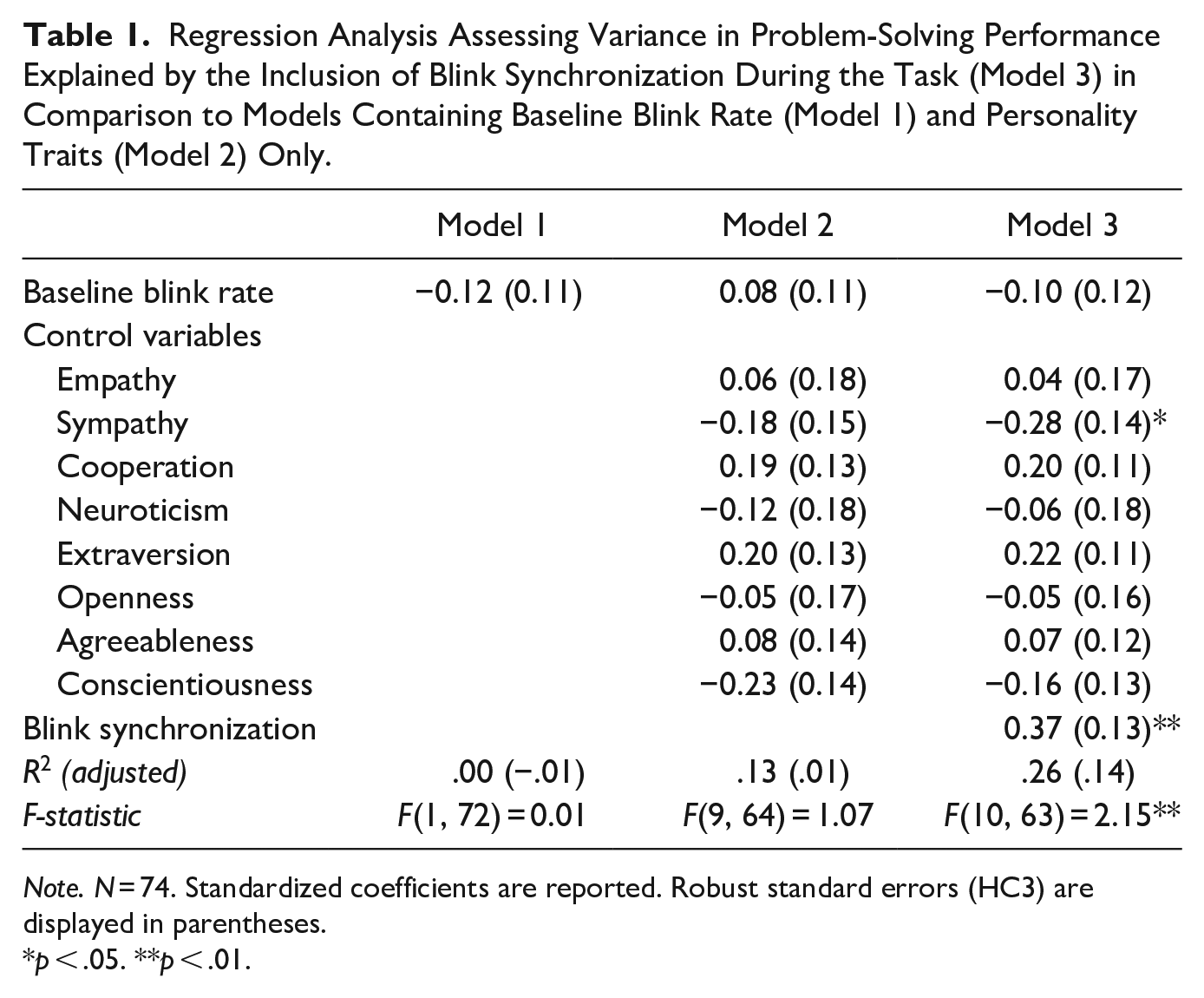
Note. N = 74. Standardized coefficients are reported. Robust standard errors (HC3) are displayed in parentheses.
p < .05. **p < .01.
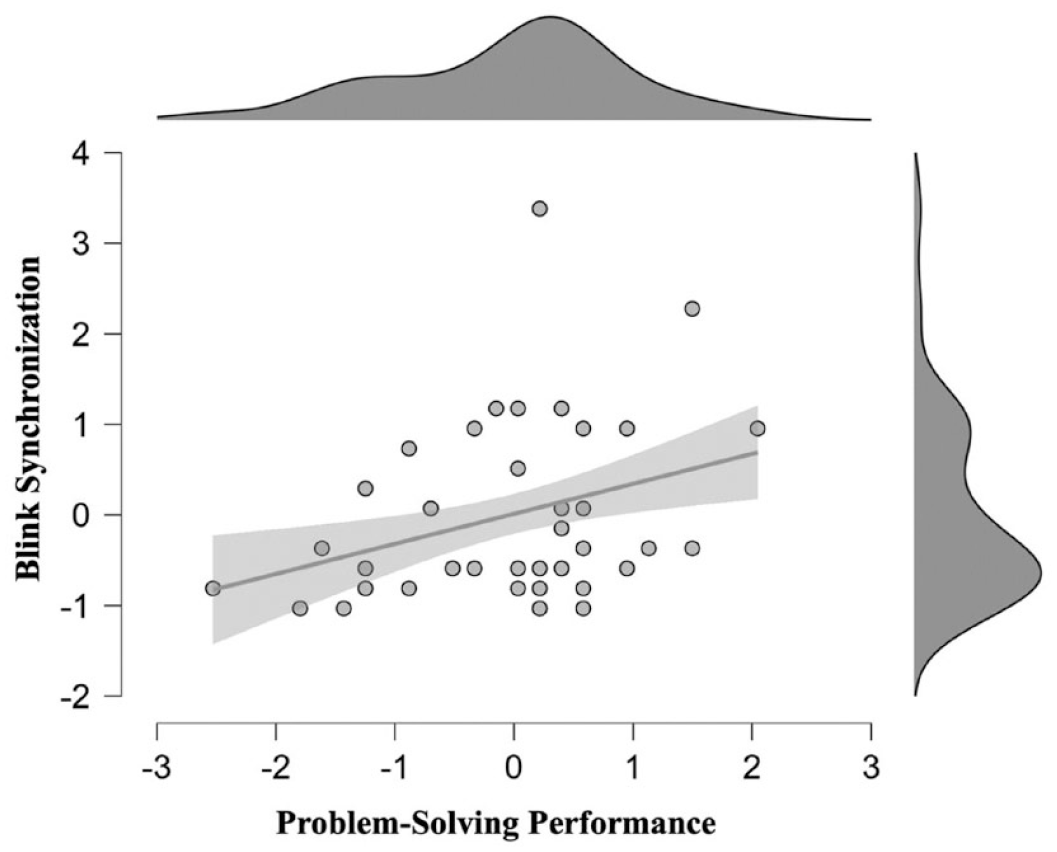
Association between problem-solving performance and blink synchronization.
As the distribution of our data resembles a bimodal structure (see Figure 1), we additionally computed a cusp catastrophe model, which allows the simultaneous modeling of back and forward change in the order parameter following different paths, and it covers both the continuous and discrete components of change. Results of this model were similar to our linear regression model (see Supplemental Material).
For Hypothesis 2, a univariate ANOVA revealed a significant difference between the two phases of the experiment, F(1, 73) = 10.10, p < .01, η² = .12. Blink synchronization during the problem-solving task (M = 0.54) was greater than during familiarization (M = 0.52; see Figure 2), thus showing an increase over the course of the virtual session.
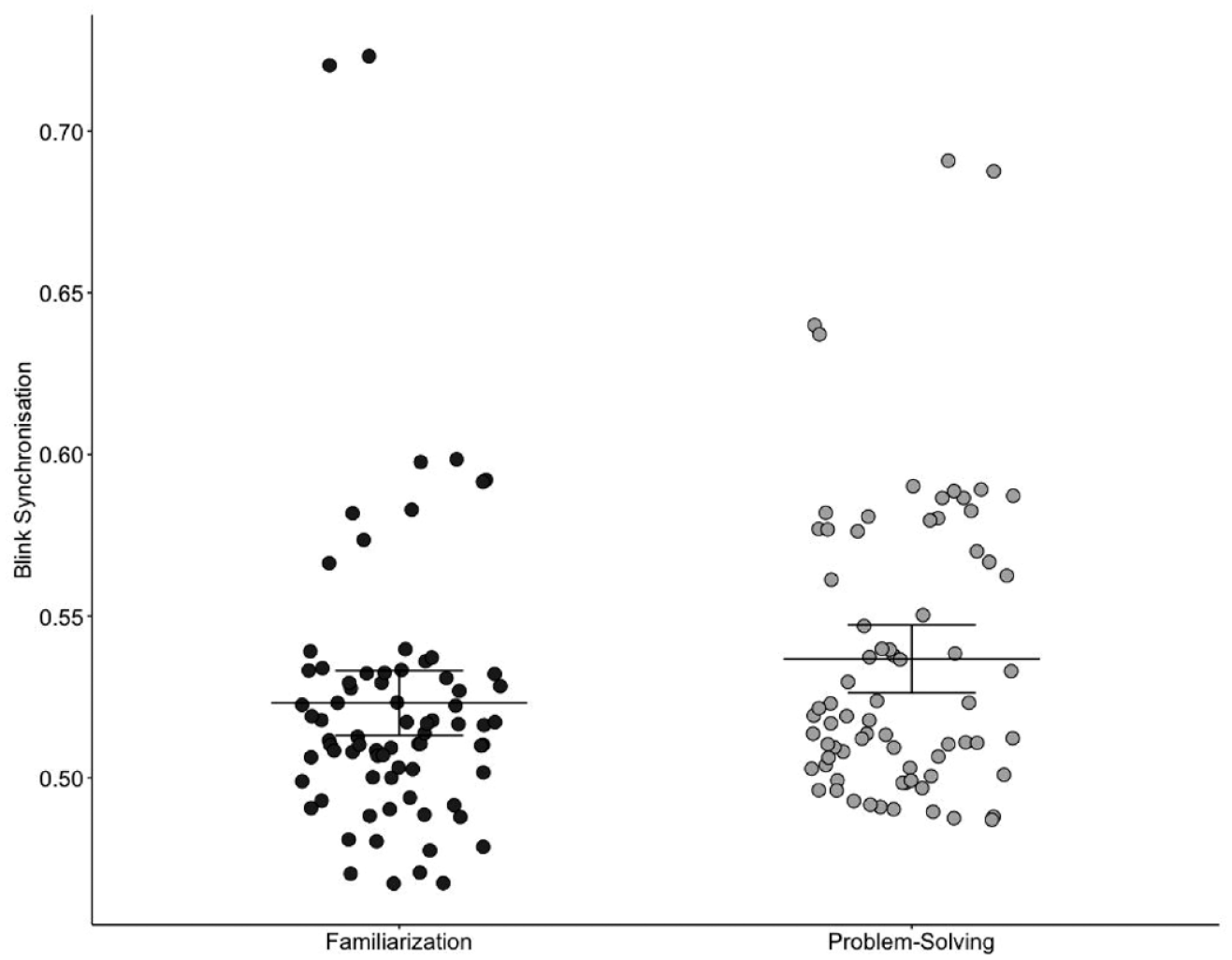
Change in blink synchronization across time.
Discussion
In our globalized working world, virtual collaboration between teams comprised of unfamiliar people has become a new standard, and efficient virtual teamwork has become more important than ever. To date, there are no reliable measures that inform us about the quality of collaboration in virtual teams. Blink rate offers insights into an individual’s mental activity while performing tasks, and our findings demonstrate that blink rate synchronization during collaborative task-solving also provides valuable information in this regard. Our results showed that teams with higher blink synchronization performed better in a problem-solving task (Hypothesis 1). After controlling for baseline blink rate, personality traits, and sympathy, we found that blink synchronization during the problem-solving task was a robust predictor for team performance. We further found that the strength of blink synchronization increased over the course of collaboration (Hypothesis 2).
To begin with, we found evidence that more blink synchronization was related to better problem-solving performance in virtual teams. Prior research has shown that team performance can be predicted by neural synchronization between team members (e.g., Szymanski et al., 2017). Specifically, those studies investigated the synchronization of electrical brain signals using EEG to predict team performance (e.g., Reinero et al., 2021). Our study provides evidence that measuring the synchronization of blink rate via eye-tracking is also suitable for predicting team performance. Furthermore, we extended this line of research to a virtual setting, departing from the traditional face-to-face context. Our findings indicated that team members with blink synchronization shared a common understanding of the problem space, developed mental models regarding the issue, and directed their attention collectively toward the visual input, namely the list of items to be ranked based on their importance for survival (O’Madagain & Tomasello, 2021; Pöysä-Tarhonen et al., 2021). By seeing their partner via webcam, it was possible for individuals to follow their partner’s stream of thought (Schneider & Pea, 2015) and thus achieve a shared mental model of the problem to solve (D’Angelo & Schneider, 2021).
Our results suggest that blink synchronization might serve as a behavioral index of mental synchronization during virtual collaboration (Koike et al., 2016) and in turn supports problem-solving performance in virtual teams. Existing literature suggests that the mechanism by which mental models have a positive effect on teamwork is not well understood. Interacting virtually may require teams to develop new types of mental models related to the applied communication tools, their capacities, and the appropriateness of their use of the tools for certain interactions. In a virtual environment, the ability of team members to synchronously communicate, resolve differences in their understanding, or increase awareness of others’ performance is limited. As the degree of virtuality increases, the association between the complexity of mental models and the effectiveness of mutual performance monitoring is reduced (Schmidtke & Cummings, 2017). Recent research suggests that shared behavioral dynamics during interpersonal interaction are indicative of interaction outcomes like performance success. For example, synchrony of skin conductance and electromyographic measures develops spontaneously among team members during a cooperative production task (Mønster et al., 2016). Moreover, high team synchrony was indicative of team cohesion, while low team synchrony was indicative of a teams’ decision to adopt new behavior (Mønster et al., 2016). Recent studies have further provided evidence of the importance of possessing a shared mental model within teams (e.g., Burke et al., 2006; Cannon-Bowers et al., 1993; Day et al., 2004; Klimoski & Mohammed, 1994; Marks et al., 2000). While shared mental models may not lead to performance improvements when teams complete independent tasks, they can lead to improved performance when individuals work on interdependent subtasks (Minionis et al., 1995). Therefore, research has shown that shared mental models are important for team effectiveness as well as performance (see Mathieu et al., 2000, 2005). When solving the task used in this present study, prior research showed that individuals shared a mental model concerning the optimal survival strategy during winter survival (Blickensderfer et al., 1997). Moreover, team monitoring, such as via webcam, has been suggested to improve coordination and feedback processes, consequently leading to improved team performance (Marks & Panzer, 2004). The webcam view could potentially serve as a valuable tool for monitoring team members’ task-related behaviors, which, in turn, could have a positive impact on team performance.
Over the time course of the virtual team session, we found an overall increase in blink synchronization. Similarly, teamwork has been found to lead to synchronization in heart rate and electrodermal activity; the highest synchronization could be measured after the completion of a cooperation task (Romero-Martínez et al., 2019). Virtual teamwork had not been investigated in terms of synchronization processes, however. Although computer-mediated communication has become an important tool in organizations (Li, 2007), it remains unclear what factors are most critical for achieving effective collaboration in virtual team settings. Some studies have examined how virtual teamwork impacts performance and whether virtual teams are as effective as face-to-face teams (Adams et al., 2005; Baltes et al., 2002; Becker-Beck et al., 2005; Flanagin et al., 2004). Group performance was subjectively rated better in face-to-face than in computer-mediated groups (Becker-Beck et al., 2005), while familiarity between team members played an important role for team performance and satisfaction in virtual settings (Adams et al., 2005). In addition, a meta-analysis found that computer-mediated communication led to decreases in group effectiveness as well as satisfaction, and an increase in time required to complete tasks, compared to face-to-face groups (Baltes et al., 2002). Our results add to this body of research as they shed light on what impacts team performance in the virtual context. As we intentionally paired individuals who were not acquainted beforehand, we can infer that the effect of synchronization likely persists regardless of the level of familiarity between people.
Limitations and Practical Implications
The main limitation to our study pertains to the sample size. Although power analysis was conducted before data collection, our sample of 38 teams is rather small. Further, the task employed in this study did not reflect typical everyday problems encountered in work settings. Future studies should explore the relationship between blink synchronization and team performance by investigating tasks that are more applicable to daily work life. Moreover, future research can investigate more realistic virtual work settings, such as collaboration between workers of different expertise, as well as between freelancers who collaborate on platforms like Fiverr. Further, it is important for future research to apply new methods that measure blink rate and facial expressions such as using built-in webcams (Kraft et al., 2022), as mobile eye-tracking is not exactly practical. Further research is necessary to obtain practical evidence regarding the potential value of a system that informs team members based on their blink synchronization. For example, investigating the effectiveness of a system that encourages increased communication among team members based on their blink synchronization might be beneficial. Research has shown that receiving feedback indicating a high level of physiological synchrony can increase perceived empathy (Okel, 2018), although conflicting evidence also indicates there is no effect of synchrony feedback on perceived empathy or team performance (van Laar, 2019). Our findings indicate that blink synchronization during problem-solving might predict powerful team constellations. The increase in blink synchronization over the course of the study showed that team members aligned with each other, indicating that longer sessions might lead to increased blink synchronization, and in turn improve team performance.
While our results demonstrated that blink synchronization predicts problem-solving performance in virtual teams, the question of how to enhance synchronization between individuals still remains. Familiarity plays a larger role in computer-mediated than in face-to-face teams, affecting performance and satisfaction (Adams et al., 2005). According to our findings, synchronization occurred during the familiarization phase, just before individuals commenced their task, and this synchronization persisted for approximately 4 min. Furthermore, synchronization notably increased during the 10-min problem-solving task in comparison to the familiarization phase. In our Supplemental Material, we present a comprehensive analysis of 1-min sequences, which demonstrates the stability of synchronization throughout both the familiarization and problem-solving phases. These results indicate that a duration between 10 and 15 min would be optimal to achieve synchronization. In our study, team members were constantly seeing and talking to each other, especially while solving the problem, which presumably facilitated the synchronization, indicating that visual and verbal interaction among individuals is an effective method to achieve synchronization. However, prior research has shown that, even when participants were positioned back-to-back and unable to see each other, they still achieved blink synchronization while engaging in conversation (Gupta et al., 2019), indicating that verbal interaction alone might be enough to achieve synchronization.
Conclusion
Our study contributes to research investigating physiological synchronization during virtual teamwork and its impact on team performance. Specifically, our results suggest that quantifying blink synchronization in teams is a suitable measure of the team members’ construal of their shared understanding of a problem and is associated with their problem-solving performance. Therefore, blink rate, and more specifically, blink synchronization among team members, acts as a promising proxy of how team members develop solutions to problems interactively. Given the increasing prevalence of virtual teamwork in recent years, this type of research is especially relevant and warrants closer investigation.
Supplemental Material
sj-docx-1-sgr-10.1177_10464964231195618 – Supplemental material for Blink Synchronization Increases Over Time and Predicts Problem-Solving Performance in Virtual Teams
Supplemental material, sj-docx-1-sgr-10.1177_10464964231195618 for Blink Synchronization Increases Over Time and Predicts Problem-Solving Performance in Virtual Teams by Alexandra Hoffmann, Anna-Maria Schellhorn, Marcel Ritter, Pierre Sachse and Thomas Maran in Small Group Research
Footnotes
Declaration of Conflicting Interests
The author(s) declared no potential conflicts of interest with respect to the research, authorship, and/or publication of this article.
Funding
The author(s) received no financial support for the research, authorship, and/or publication of this article.

Supplemental Material
Supplemental material for this article is available online.
Author Biographies
References
Supplementary Material
Please find the following supplemental material available below.
For Open Access articles published under a Creative Commons License, all supplemental material carries the same license as the article it is associated with.
For non-Open Access articles published, all supplemental material carries a non-exclusive license, and permission requests for re-use of supplemental material or any part of supplemental material shall be sent directly to the copyright owner as specified in the copyright notice associated with the article.
