




Abstract
We contribute to faultline research by identifying familiarity and cross-subgroup communication as potential moderators in the relationship between diversity faultline and team performance. We employ a novel experimental design utilizing escape rooms as a noninterventional social laboratory, enabling us to capture real-time interactions among 40 teams engaged in problem-solving activities. We find that team familiarity has a negative influence and a suppression effect on success. Faultline affects team success negatively when faultline-induced subgroups do not communicate enough with each other. Our work contributes to a better understanding of complex processes and interdependencies that lead to team success or failure.
Introduction
Most organizations fundamentally rely on teams (Cohen & Bailey, 1997; Harrison et al., 2003; Mcgrath, 1991; Sproull et al., 1991). Teamwork allows groups to exceed individual task-solving capabilities, potentially increasing effectiveness and productivity (Devine et al., 1999; Mathieu et al., 2017). Diversity is considered a key characteristic of teams in organizations (Harrison & Klein, 2007; Jackson et al., 2003), as it is a factor that can be easily manipulated to compose efficient teams or used to evaluate the fit of prospective team members (Reagans et al., 2004). As such, diversity is a central theme in organization research. Research on the effects of diversity on team outcomes has yielded inconsistent findings. Surpassing the either-or outcome approach, where diversity has either a positive (e.g., Cox & Blake, 1991; Easely, 2001) or a negative (e.g., Harrison & Klein, 2007; Turner, 1985) influence on team performance, more recently the focus has been shifted to more sophisticated models aiming to identify conditions under which diversity can be associated with certain outcomes (Thatcher & Patel, 2012). A promising endeavor is marked by the faultline theory, which argues that instead of investigating the extent of group-level homogeneity of different individual attributes, diversity research should consider the joint, cumulative effect of different dimensions of diversity to better understand its influence on team outcomes (Lau & Murnighan, 1998). Another notable development in this theme is the shift from linking certain types of diversities to specific team outcomes to identifying moderators in the diversity-performance relationship (van Knippenberg & Schippers, 2007).
While group faultlines have been investigated thoroughly in relation to various outcomes from team satisfaction (Cronin et al., 2011) through conflict and trust (Polzer et al., 2006) to performance (Bezrukova et al., 2016; Crucke & Knockaert, 2016; Georgakakis et al., 2017) and strategic change (Zhang et al., 2021), only a few studies have integrated faultline theory with the investigation of moderators in the faultline-outcome relationship (Bezrukova et al., 2009, 2010; Gibson & Vermeulen, 2003; Lau & Murnighan, 2005; van Knippenberg et al., 2011). According to Thatcher and Patel (2012), this area of diversity research remains underexplored yet rapidly evolving, as only a few moderators, such as superordinate identity or faultline distance, have been investigated to a certain extent (e.g., Bezrukova et al., 2009). Instead, the moderating role of faultline strengths has been brought to the fore and showed to have a negative impact in some aspects of the communication and performance nexus (Lau & Murnighan, 2005; Vora & Markóczy, 2012).
Diversity is inevitably and increasingly present in organizations due to demographic changes and growing specialization in the workforce coupled with the growing mobility of employees between workplaces (Barak & Travis, 2013; Jackson & Joshi, 2011; van Knippenberg & Mell, 2016). Therefore, investigating moderator and specifying conditions under which diversity affects team outcomes one way or another is crucial to understand how teams can deal with diversity faultlines as an asset rather than a burden. Accordingly, in this work, we join and extend faultline research in the following ways.
First, addressing the question of under which conditions diversity has a negative effect on team success, we test the moderating roles of two variables: the level of team familiarity and the ratio of cross-subgroup communication. Both the quality of intra-group bonds and collaboration are connected to crucial processes that make a team a unit. Thus, we examine how these group processes—presented as a new category of moderators—influence the relationship between diversity and team success.
Team familiarity has been found to have a direct positive impact on performance (Espinosa et al., 2007; Huckman et al., 2009; Reagans et al., 2005); however, its moderating effect in the diversity-performance relationship could only be detected in some cases depending on the nature of the observed diversity and task changes (Huckman & Staats, 2011). Here, we investigate the moderating role of team familiarity, specifically in the relationship of faultlines and performance. To quantify team familiarity, we measure the strength of intra-group relationships by looking at the duration of pre-existing social ties (Granovetter, 1973; Marsden & Campbell, 2012; Melamed & Simpson, 2016). In line with past research (Espinosa et al., 2007; Huckman et al., 2009; Reagans et al., 2005) we expect familiarity to have a substantial effect on performance, and to counteract the negative impact of faultline strength on team success.
The effect of communication has been investigated in relation to group faultlines (Lau & Murnighan, 2005; Vora & Markóczy, 2012), and, as noted above, the moderating effect of faultlines has also been analyzed in some depth (e.g., Bezrukova et al., 2010; Gibson & Vermeulen, 2003). At the same time, cross-subgroup communication as a potential moderator in the diversity-performance relationship has not been explored. In this work, we address this matter. We expect cross-subgroup communication, as a proxy for the level of team-wide collaboration, to have a positive influence on team success. Moreover, we assume that the negative influence of faultline strength can be mitigated by interactions that cross the boundaries of those faultlines. In addition, in the faultline-performance relationship, we operationalize communication, for the first time to the best of our knowledge, as real-time interactions during the problem-solving activity of small teams, as opposed to past research that almost exclusively rely on retrospective self-reported data. We employ survival models (also known as event-history models) that allows us to explicitly account for the time-varying nature of collaborative interactions during problem-solving.
Our second contribution is connected to the collection of the data on real-time interpersonal interactions. In this regard, we introduce escape rooms as non-interventional social laboratories. Using this observational laboratory setting, we collect data on the problem-solving activity of 40 project teams. As opposed to traditional laboratory experiments (e.g., Cummings & Cross, 2003; Lipman-Blumen & Leavitt, 2001; Sparrowe et al., 2001) that typically deal with ad hoc, zero-history groups, these teams are intact, non-manipulated groups that are not torn out of their embedded social context. By analyzing real-time, collaborative interactions in escape rooms, we also overcome a shortcoming of most of the field studies that rely on self-reported data. This kind of data on what happened in the team previously collected by retrospective questionnaires is likely to include biases such as highlighting the most salient event (e.g., interaction with a colleague) at the expense of all interactions (Cummings & Cross, 2003; Sparrowe et al., 2001). With our unique research design, we also aim to contribute to the increasingly rare studies of interacting groups that perform a practical task as opposed to just thinking about something. Exploiting this more objective and novel source of data on real-time group interactions also allows us to disentangle the structure of intra-group relationships (the level of team familiarity in this case) from those of real-time communication ties—two distinct concepts that are often used interchangeably under the notion of social interactions (Reagans & Zuckerman, 2001; Uzzi, 1996, 1999). Intra-group relationships are static and long-standing constructs tying members to one another (Forsyth, 2010), as opposed to actual interactions that are more dynamic and adaptive structures presenting a social means for effective task performance (Hirokawa & Salazar, 1999). In a theoretical sense, we adopt both the categorization-elaboration model (CEM; van Knippenberg & Schippers, 2007) and the network perspective to understand group processes that substantially influence the diversity-success relationship.
To fully comprehend teams as complex systems, it is crucial to consider both team familiarity and cross-subgroup interactions, as both variables account for core processes constituting complexity that makes teams more than simply the collection of individuals. We also address differences between team familiarity and cross-subgroup interactions, as they are distinct in their nature. Finally, our work answers to the calls for constructing and using more behavioral theory when studying operations (Gino & Pisano, 2008; Loch & Wu, 2007), and emphasizes the importance of considering structural configurations of team processes (e.g., subgrouping; Carton & Cummings, 2012; Crawford & LePine, 2013).
Our findings show that diversity and real-time collaborative communication as a crucial team process can only be understood in relation to each other. We demonstrate that diversity affects team success when the faultline-induced subgroups communicate with each other on a below-average frequency. Surprisingly, we also find that team familiarity has a direct, negative influence on performance. We believe that this research has the potential to help us to understand teams in their complexity, and thus, to provide insights into how teamwork can be improved.
Theoretical Background
Team diversity refers to the extent to which team members differ from one another (Jackson et al., 2003). Studies on team diversity typically focus on heterogeneity in gender, age, tenure, functional background, and ethnicity (Milliken & Martins, 1996; van Dijk et al., 2009; van Knippenberg et al., 2011) with the aim to understand how these dimensions of differentiation affect performance.
In this respect, social categorization considers diversity detrimental to performance (Turner, 1985), as it invites an automatic classification of people into categories by which the notion of “we” and “they” evolve immediately (van Knippenberg & Schippers, 2007; van Knippenberg et al., 2004; Williams & O'Reilly, 1998). In contrast, the information processing theory sees diversity as beneficial to team performance, as a greater amount of team diversity may be associated with a greater variety of cognitive resources (Bantel & Jackson, 1989; Cox et al., 1991; Østergaard et al., 2011). As plenty of evidence supports both outcomes of diversity (van Knippenberg & Schippers, 2007), research has been inconclusive in identifying unique and direct negative and positive effects of different diversity dimensions on performance (e.g., Bell et al., 2011; van Dijk et al., 2009).
In the quest to establish coherence, a stream of studies turned to investigate the joint effects of multiple types of diversity on team outcomes (Meyer et al., 2015; Thatcher & Patel, 2012). In contrast to the traditional approach focusing on single attributes (e.g., gender or age), this stream of research examines faultlines, which are “hypothetical dividing lines that may split a group into subgroups based on one or more attributes” (Lau & Murnighan, 1998, p. 328). Therefore, faultline research operates with the cumulative effects of attributes on team outcomes. The theoretical underpinnings of group faultlines lay in the social categorization theory (Turner, 1985), which claims a strong homophilic tendency of individuals. Individuals’ alignment with similar others based on demographic traits can result in subgroup formation that disrupts information exchange and performance.
Further explaining the mechanisms of diversity faultlines, the categorization-elaboration model (CEM) draws attention to the notion of comparative fit. Comparative fit refers to the extent to which the categorization of differences manifests in high intra-subgroup similarity coupled with high inter-subgroup dissimilarity. For example, when younger members of the team also tend to be women, we can say that these positions on the age and gender dimensions of diversity are correlated. The more these correlations are, the higher the comparative fit of categorization in these dimensions (age, gender—younger women, older men), and the more likely that it will induce strong faultlines that divide the team into subgroups. In other words, the presence of a strong faultline in the team accounts for subgroups that are induced along different dimensions of diversity, in a way that members of these subgroups are highly similar to each other (Team 2 in Figure 1) while highly different from members of the other subgroups. Thus, faultline strength expresses the quality of the split of teams into homogeneous subgroups (Thatcher & Patel, 2012). Strong faultlines explained by CEM were found to disrupt group processes and hinder success (e.g., Homan et al., 2007, 2008; Spoelma & Ellis, 2017; van Dijk et al., 2012; van Knippenberg et al., 2011). Based on the same logic, in a group with low faultline strength (Team 1 in Figure 1; Note, this figure is produced by Szabolcs Toth-Zs., 2021), group processes such as team-wide collaboration are expected to be more easily initiated due to the lower level of perceived differences between subgroups (lower comparative fit).
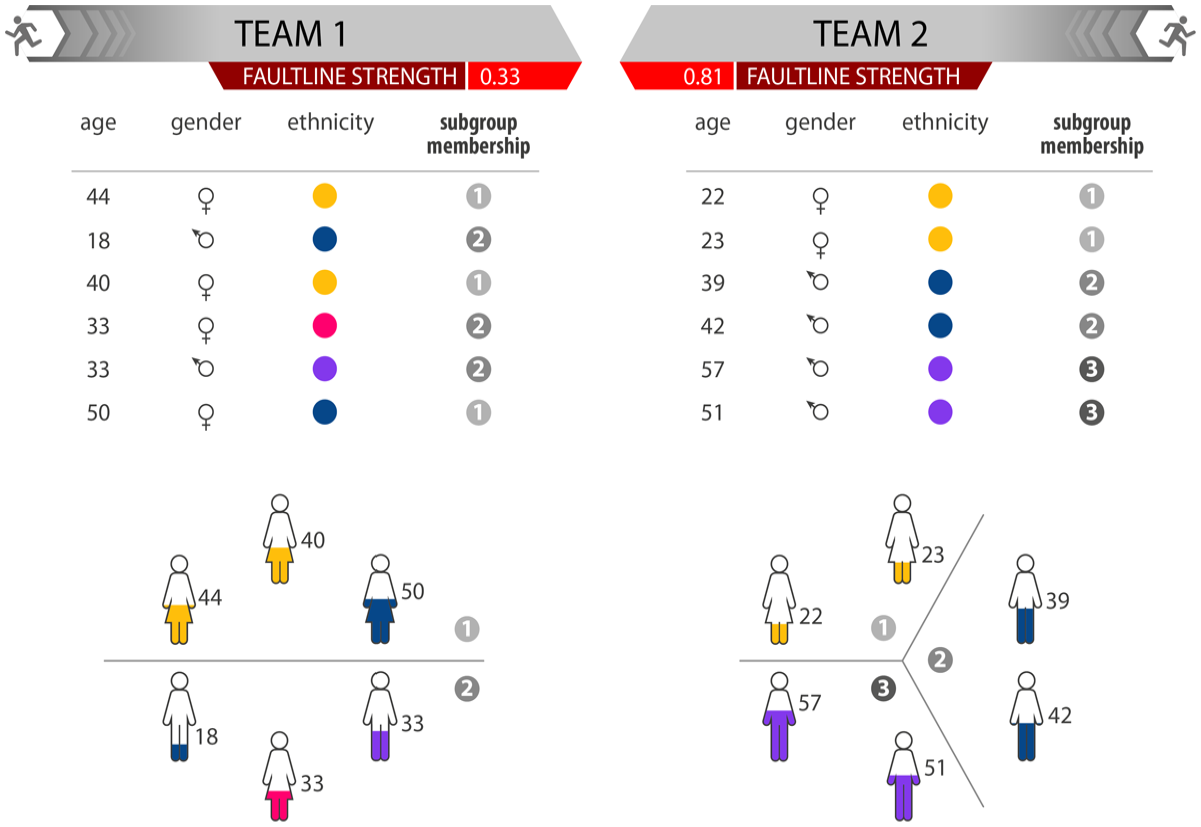
Illustration of faultline strength and subgroups.
More recently, the focus has also shifted to detecting moderators of the diversity-performance relationship (see Triana et al., 2021; van Knippenberg & Schippers, 2007). Aiming to understand under which conditions diversity faultlines imply certain outcomes, research has addressed the potential moderating influence of individual beliefs (e.g., Homan et al., 2010; Meyer et al., 2011; Schölmerich et al., 2017), group-level behaviors (e.g., Bezrukova et al., 2009, 2012; Cronin et al., 2011; van Knippenberg et al., 2011), environmental factors (Richard et al., 2019; Spoelma & Ellis, 2017), and team structural variables (e.g., Jehn & Bezrukova, 2010; Rico et al., 2012; Wei & Wu, 2013). These moderators were found to attenuate the negative influence of faultline diversity on performance. While these studies advanced our understanding and provided valuable knowledge, there is still little information about the complex relationship between team diversity and performance, especially if we consider groups as dynamic systems. To this end, although framing differently, both CEM (e.g., Mäs et al., 2013; Spoelma & Ellis, 2017) and the network perspective (e.g., Crawford & LePine, 2013; Reagans et al., 2004; Reagans & Zuckerman, 2001) suggest that influence of diversity can be understood via the examination of team processes. CEM lays emphasis on understanding the process of social categorization in association with the negative effect of diversity in order to both prevent the negative effects and provide the preconditions for the positive impact of diversity (van Knippenberg et al., 2004). On the other hand, the network perspective claims that different forms of social capital, which are often operationalized as ties of social interactions, regulate the strength of association between team diversity and productivity (Reagans & Zuckerman, 2001). The fundamental idea shared by these theoretical streams is that diversity is detrimental to performance because diversity can erode groups’ social cohesion and induce coordination problems, process losses, and insufficient information exchange via the process of social categorization. Instead, the information processing perspective (e.g., Kanter, 1996) draws attention to the positive influences of diverse knowledge and ideas within groups. Still, members’ diverse cognitive resources present a potential rather than a promise for successful problem-solving, as long as the group-level synthesis of individual assets is overlooked. Our study adopts and incorporates the perspectives from these theories, specifically by integrating the comprehensive and empirically well-supported CEM (Kearney & Gebert, 2009; Mäs et al., 2013; Spoelma & Ellis, 2017) and the faultline approach.
Team Familiarity and the Strength of Intra-Group Bonds
Faultlines induced by the alignment of team members’ demographic traits increase the likelihood of subgroup dynamics, and thus, threatens social integration (Lau & Murnighan, 1998). In other words, teams with strong faultlines are more exposed to the process of social categorization. However, the perceived importance of dissimilarities might be mitigated by time team members spend together and a shared history they accumulate (Harrison et al., 2002; Meister et al., 2020. Indeed, team-building adventure is a popular method by which organizations aim to create a sense of unity in their teams. Factors that promote familiarity such as proximity or (deep-level) similarity are often discovered through shared experiences and tasks to be solved, which enhances strong relationships among team members and thereby makes the team more cohesive (Forsyth, 2010).
These practices aim to create the unity that can make teams adaptive and efficient task-performing systems surpassing individual capabilities. This advantage of teams, specifically that teams are more than merely the collection of their members’ traits and capabilities, is rooted in their complexity (McGrath & Argote, 2001), such as the system of intra-group relations that fundamentally determines the group as one entity. The duration of relationships is one of the most reliable indicators and an essential dimension of relational strength (Granovetter, 1973; Marsden & Campbell, 2012; Melamed & Simpson, 2016). Long-term relationships indicate a great amount of knowledge about each other, which implies predictability and thereby helps build trust between members (DiMaggio & Louch, 1998; Kollock, 1994; Yamagishi et al., 1998). Team familiarity that is prior interpersonal knowledge about other members (Gruenfeld et al., 1996; Harrison et al., 2003) can reduce intra-group biases by changing members’ perception of group boundaries (“we” vs. “they”), and thereby help members to perceive themselves as part of a unit with a shared identity (Gaertner & Dovidio, 2014). Therefore, team familiarity enhances cohesion by decreasing the perceived importance of intra-group faultlines, and thus, it can foster the team’s collective processing of individual task-related ideas (Bezrukova et al., 2009). According to Huckman and Staats (2011), team familiarity helps members with diverse prior experiences to manage their differences; that is, to better understand each other and find a common ground. Thereby, team familiarity can lead to enhanced team performance, as it improves coordination and mitigates potential disruptions caused by the process of social categorization in diverse teams.
Regarding familiarity’s main effect on performance, a body of research (Espinosa et al., 2007; Huckman et al., 2009; Reagans et al., 2005) observed that team familiarity has a positive impact on team success, as it provides members with knowledge of who knows what, which helps them to locate expertise and operate in a common context. The existence of this knowledge and shared understanding is particularly important in project teams that face an innovative, complex, and non-routine task, as the lack of predictability of the task makes members highly interdependent and thereby resort to team familiarity (Espinosa et al., 2007). In other words, strong relationships defined as long-lasting social ties make members less dependent on their own knowledge and decrease uncertainties induced by social dilemmas and interdependencies. Team familiarity promotes a shared understanding of the work, facilitates the avoidance of interpersonal risks, and provides members with collective responsibility for the task. In an experimental study, Staats et al. (2010) found that team familiarity leads to the evolution of psychological safety in which members may incline to voice even their half-finished thoughts as they do not risk their reputation or being judged negatively (Edmondson, 1999). Such an environment was found to advance team learning, knowledge sharing, and inspire experimentation (Edmondson, 1999; Lee & Farh, 2004; Siemsen et al., 2009; Tucker et al., 2007). Navigating ambiguous and creative tasks, it is essential for project teams to feel safe enough to take risks and communicate honestly.
Based on the above reasoning, we assume that a strong web of (long-term acquaintanceship) relations accounting for a high level of team familiarity positively influences problem-solving. We also expect that mutually accustomed members perceive subgroup boundaries as less important as they had time to work through their initial differences potentially induced by the process of social categorization. Team familiarity implies a shared understanding, trust, and the feeling of unity, and thus, it is assumed to moderate the potentially negative impact of faultlines on task performance. We formulate our related hypotheses in the following way:
The Role of Team-Wide Interactions
Information sharing is at the heart of the collaborative problem-solving processes. Indeed, Earley and Mosakowski (2000) found that team communication reflecting the extent of information elaboration mediates the relationship between diversity and performance. However, although communication has been addressed in relation to faultlines and group learning (Lau & Murnighan, 2005; Vora & Markóczy, 2012), it has not been examined as a real process moderator in the faultline-performance relationship.
The direct role of communication in team performance has been extensively examined by researchers following a functional and network perspective to study small groups (Lazer & Katz, 2003). From a network perspective, a group can be considered as a network, where ties are interactions between members. Field studies concluded that actively communicating groups outperform groups with fewer ties (Baldwin et al., 1997; Mäs et al., 2013; Reagans & Zuckerman, 2001).
The exchange and integration of information is a particularly critical process to performance in the case of project teams dealing with non-routine tasks demanding close collaboration (e.g., Bui et al., 2019; Campbell & Gingrich, 1986). Due to the increased interdependence and the collaboration-demanding nature of the task, group members are compelled to engage in intense information exchange and discussion (Gaertner & Dovidio, 2014). Under these circumstances, and when sharing a common goal, even members who are reluctant to cooperate due to perceived intra-group differences become inclined to interact to achieve success (Campion et al., 1996; Cummings, 2004; Keller, 2001; Van Knippenberg et al., 2011). Consequently, research suggests that intense communication might be enough to overcome difficulties (e.g., conflicts, coordination problems, the lack of shared identity) related to the alignment of team members’ demographic attributes by attenuating the effect of diversity on team success. Applying these finding to the faultline-performance nexus invoking CEM, communication presents, strictly speaking, one of the most salient group processes that affects the relationship between diversity and team success.
At the same time, much research on collective action assumes that all team members communicate simultaneously with each other. However, even in the case of strategizing tasks when people sit around a table and discuss a strategy, this is often not true. Team members are typically linked to specific others via network ties (Levine & Smith, 2013). Moreover, the pace and distribution of these interactions are often highly asymmetric across time of task performance and group members. The need to address the inherently structural nature of teamwork is supported by the network approach and is not without precedent (e.g., Davison et al., 2012; LePine, 2005; Mäs et al., 2013).
Resonating to the notion of the structure of communication, the social categorization and social identity approach claims that group members prefer to interact with similar others. In strong faultline groups where members can be split into highly homogenous subgroups, team members will favor to communicate with members of their own subgroup, “us,” instead of “them,” the subgroup including members perceived as different. In this case, the elaboration of information does not manifest on the level of the team. In other words, the team as a unit fails to exploit the potential in its complexity, and as such, it cannot function efficiently. On the other hand, when teams manage to transcend subgroup boundaries and thereby induce an active, team-wide communication, we expect this process to mitigate the negative faultline effect on performance.
Based on the reasoning on the importance of communication both as a predictor and moderator, we expect a high level of cross-subgroup communication to have a beneficial impact on team success. Further, we also expect cross-subgroup communication to regulate the strength of the association between faultlines and performance, such that communication may counteract the negative effect of faultlines on performance when collaborative interactions transcend subgroup boundaries. On the other hand, in the absence of team-wide information exchange or group-level integration of task-related knowledge, faultlines affect performance negatively via social categorization. Consequently, the non-routine nature and high collaboration demand of the task might not be properly met, allowing both faultlines and within-subgroup communication to directly exert a detrimental influence on performance. We summarize our related hypotheses as follows:
Methods
Research Design
Most empirical studies attempting to integrate communication with the notions of diversity and performance obtain communication data from self-reports, where participants are asked to evaluate their group’s actions, interactions, and outcomes (e.g., Lau & Murnighan, 2005). Self-report data is likely to contain biases highlighting the most salient or recent event at the expense of all events (e.g., communication with a colleague; McGrath & Altermatt, 2001). Furthermore, interactions in this sense are the proxy of relational strength (Reagans & Zuckerman, 2001; Uzzi, 1996, 1999), rather than ties covering real interactions between team members—two types of relations we address in this work while considering the differences in their very nature (e.g., temporality and dynamics). In our work, we do not rely on retrospective questionnaire data of team members’ memory or likely biased perceptions but analyze real-time communication to understand the collaborative dynamics of team activity.
Observational Laboratory Setting and Data
We collected video records on the problem-solving activity of 40 project teams in two types of escape rooms. From a sociological perspective, escape rooms are social laboratories, as all group processes take place in the same, controlled environment for all participating groups. The game is executed in the following way: a group of people (e.g., colleagues for team building, families, friends, etc.) who wish to play register at the escape room company. After a short briefing about the rules, they get locked into a room, each themed differently. When selecting the type of room for our experiment, a crucial factor was ensuring that the gameplay closely resembled projects in organizational settings. Consequently, we opted for two rooms that simulate the complexity and non-linear nature typically encountered in team-based projects within organizations. In this study, we refer to these rooms as Sherlock and Godfather, aligning with the atmospheric and cultural themes present in the games.
While in the escape room, teams have to search for clues, solve puzzles, open locks, decipher codes, etc. None of the tasks requires prior preparation, specific knowledge, skills, or abilities. Therefore, all inexperienced escape room players can be considered equally competent in problem-solving. The goal is well-defined and understandable to every participant: they have to exit the place within a 1-hr time frame. No additional information describing or specifying the tasks in the room is given. Under these circumstances, groups behave as teams, with individual members becoming interdependent as they work toward a shared collective goal. In Sherlock and Godfather specifically, the tasks are non-linear as there is a hierarchy of subtasks that eventually lead to the final solution of escape. The essence of non-linearity in this sense is the fact that team members can work on different tasks in parallel, but occasionally have to combine solutions to move forward. Moreover, time pressure and the poorly structured, non-routine nature of the problem make the circumstances of team activity strongly analogous to that of project teams.
The escape rooms are accessible to two to six people, although they were originally designed for groups of four or five. For this reason, we limited our investigation to teams with this intermediate size to avoid excessive variation in the data and the potentially spurious effects of team size in our analysis. Our final sample includes 40 teams composed of 171 Hungarian participants with an average team size of 4.28. All participants were inexperienced, including first-timers and individuals who have had a maximum of one prior exposure to a different escape room in the past. Excluding teams with knowledgeable members in terms of escape rooms can ensure the homogeneity of the groups and their comparability. The game is suited to participants from the age of 12; however, such young players might lack associative capabilities and explorative skills compared to older ones. Young children are also likely to form a team with and overly rely upon their parents, which entails specific intra-group relations that is outside the scope of our study. Hence, our research sample covers groups with members who are not younger than 18 years old and assumed to be self-sufficient in problem-solving.
The operator of the room makes video records due to legal and business considerations (e.g., if someone starts destroying the place in the heat of the game). Besides the General Data Protection Regulation contract of the escape room (see Supplemental Appendix), we asked the participants to sign an additional consent form, in which they agreed that the video recording of their play will be analyzed in this research. Thus, we gain access to these routinely acquired records and do not intervene in team processes at all. Moreover, since the purpose of team members is to participate in the game, rather than to take part in the research, the teams are intact and non-manipulated, as opposed to traditional laboratory experiments conducted in an artificial environment or field studies where participants are in the same place as their observers. Automatically recorded data are thus less likely to elicit the perception of being watched, and thus, participants are less likely to act in a manner that aligns with researchers’ expectations—a phenomenon known as the Hawthorne effect (Adair, 1984), which is a common weakness of traditional laboratory experiments. Therefore, our research design minimizes the possibility of significantly influencing participants’ behavior, compared to other ethical, common methods for collecting observational data.
In addition to video recordings, we also developed a questionnaire that participants completed prior to the game, which gathered sociodemographic information such as age, gender, and highest level of education, as well as the length of their relationships and the source or context through which they became acquainted with each other.
Measures
Core Variables
Faultline
To calculate faultline strength, we used the average silhouette width (ASW) relying on a cluster-analytic process (Meyer & Glenz, 2013). ASW measures the same construct as the most widely used faultline measure, Fau (Thatcher & Patel, 2012), and based on a comprehensive empirical comparison by Meyer and Glenz (2013) and Meyer et al. (2014), it is the most robust method for detecting faultlines. ASW allows for the identification of multiple subgroups, even in small teams, addressing the need emphasized by faultline researchers to determine the appropriate number of subgroups in a group, as an excessive number of subgroups tends to decrease the strength of faultline measures (Meyer & Glenz, 2013).
ASW is the average of team members’ individual silhouette width, representing how well a group member i fits into cluster A compared to cluster B (Meyer & Glenz, 2013). Individual silhouette width is expressed by the following formula
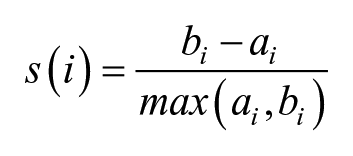
where ai is the average dissimilarity of i to all members of cluster A, and bi is the average dissimilarity of i to all members of cluster B. Dissimilarities are measured by the Euclidean distance between individuals. We calculated ASW scores across three commonly examined dimensions of diversity: age, gender, and education.
Team Success
The very essence of any teamwork is to cooperatively implement a task. In this study, team success is defined as successful problem-solving and is operationalized as follows: teams that did not manage to escape within an hour were considered unsuccessful, while those who did escape within the available time frame were labeled as successful teams.
The Level of Team Familiarity—Group Structure
Team familiarity as a structural factor is requisite for a favorable team environment and is hypothesized (H1) to moderate the effect of faultline strength and diversity on team success. Considering teams as organized systems of relationships, we focus on the strength of bonds connecting members to and in the group. To assess the level of group familiarity, we examine the strength of pre-existing social ties (Mannix & Neale, 2005); in particular, the length of acquaintanceship between team members (Granovetter, 1973; Marsden & Campbell, 2012; Melamed & Simpson, 2016). The level of familiarity was determined by calculating the mean duration of acquaintanceship among team members, expressed in years.
Interpersonal Interactions—The Ratio of Cross-Subgroup Communication
Interpersonal interaction data were extracted from the video recordings of the teams. We registered the minute-based total number and the total duration of the interactions together with their directions, namely from which person the interaction went to which other person(s). We identified the sender and receiver of a communication tie by analyzing the recordings captured by three cameras positioned at different angles, providing a comprehensive view of the scene. We used both verbal and non-verbal (e.g., nodding to answer a question, head movements, gestures, voices, and tones) interpersonal interactions of team members to determine who took part in the communication, including both problem-related and relationship-oriented communication such as jokes. We considered an interaction as one train of thought. Thus, if someone started talking but took a tiny break (max. 2 s, e.g., a deep breath) and then continued without being interrupted by other interactions, it was taken as one piece of interaction (i.e., one communication tie).
We focused on examining the interpersonal interactions among the subgroups that may arise due to faultlines. One of the advantages of using the ASW method to measure faultlines is that it includes member-to-subgroup association, providing us with information on the subgroup membership of each group member. We used this information to categorize each recorded communication tie in our edge list extracted from the video records as either cross-subgroup or within-subgroup communication. In each line showing the sender and the receiver of the given interaction, we add information on their subgroup membership and, based on this information, we determine whether the communication occurred within or between subgroups. Then, we calculated the ratio of cross-subgroup communication, which is the division of the cumulative sum of cross-subgroup interactions by all communication ties for each minute within a team. This measure shows how frequently group members break the faultlines in their communication.
The information we needed can only be extracted manually. Therefore, we recruited and trained transcriber assistants. In the transcribers’ recruitment process, all candidates received the same 5-min trial video to code, along with a guide. In this guide, we described all details about how to extract the needed parameters properly. The trial video was crucial for two reasons: First, we gained information about the applicant’s sense of precision and accuracy; and we could measure the inter-coder reliability by comparing the transcriptions of different candidates. Before data were fully analyzed, we quantified consistency among and within transcribers by the Krippendorff alpha test, which yielded acceptable values, ranging from 0.67 to 0.78. Second, the trial video was part of the selection process that enabled us to employ the most committed candidates.
Control Variables
Diversity
While acknowledging and leveraging the enhanced contribution of faultline theory compared to diversity, we follow the recommendation of Bezrukova et al. (2007, 2012) and Lau and Murnighan (2005) to include diversity effects in our analysis as distinct control variables. This allows us to isolate and compare the unique effects of faultlines with traditional diversity measures.
As we aimed to provide a comprehensive review of diversity’s influence on team success, we focused on the commonly studied social-category differences that hold relevance within our research context, including age, gender, and the level of education (Thatcher & Patel, 2012). While ethnicity is another commonly examined attribute in diversity research, it could not be incorporated in our analysis, given the relatively homogeneous ethnic background in Hungary and our sample. The country’s largest ethnicity, the Roma, comprises only 4% of the population according to the latest census (Hungarian Central Statistical Office, 2012). Thus, including ethnicity as a variable would not yield enough cases for meaningful analysis.
Gender was coded as a nominal predictor, with notation one representing men and two representing women. Level of education was measured on a 4-point ordinal scale, ranging from one denoting elementary to four indicating higher education (college/university degree). We do not expect an increasing/decreasing tendency between these categories, so we only consider the differences between the categories while disregarding their specific ordering. Therefore, parallel with other diversity research (Harrison & Klein, 2007; van Knippenberg et al., 2011), we treat both gender and education level as categorical levels and incorporated them in our analysis as nominal variables by employing Blau’s (1977) index. However, as level of education is inherently an ordinal variable, we performed a sensitivity analysis where education diversity was computed by the Blair and Lacy (2000) index (see Supplemental Appendix). Age was assessed in years, and the team’s standard deviation serves as the measure of diversity (Harrison & Klein, 2007; Van Knippenberg et al., 2011).
The Number of Subgroups
We also control for the number of subgroups yielded by the ASW to gain an accurate image about the faultline-communication-success relationship. More subgroups in a team may present opportunity for more cross-subgroup interactions and different group dynamics. Theoretically, when using the ASW measure, the smallest subgroup can consist of one member.
Team Type
As diversity can have different meanings depending on the type of relationships group members have with one another, we use a binary variables of team type as a control. It denotes the most frequent type of relationship between group members in each team which we infer from the answers given to the question: “Where do you know each other from?” Based on the distribution of the answers (see in the Supplemental Appendix), and considering variation and the relatively small sample size, we consolidated the data into two categories: work-related settings and other informal settings, which includes acquaintanceship via friends, relatives, and hobbies.
Type of the Escape Room
As our data come from two types of escape rooms, we also included the variable of the room identifier into the analysis to make sure that the results are not contingent upon which room the teams performed the task in. The identifiers of rooms Sherlock and Godfather were zero and one, respectively.
Table 1 provides descriptive statistics about the dependent variable, the predictors, and the control variables, as well as correlations between the variables. Our data is not perfectly balanced in the sense that we have more failed groups than successful ones and the majority of the teams played in the room Sherlock. Successful teams needed 57 min on average with small variations to escape either of the rooms. The average Blau’s index of gender within a team is 0.37 on average. The average Blau’s index of the highest level of education within teams is similar to that of gender, namely 0.32. These values suggest rather diverse teams in terms of gender and education background. The average age of the participants in our sample is 31 years old (SD = 4.5).
Correlations and Descriptive Statistics (Team-Level).
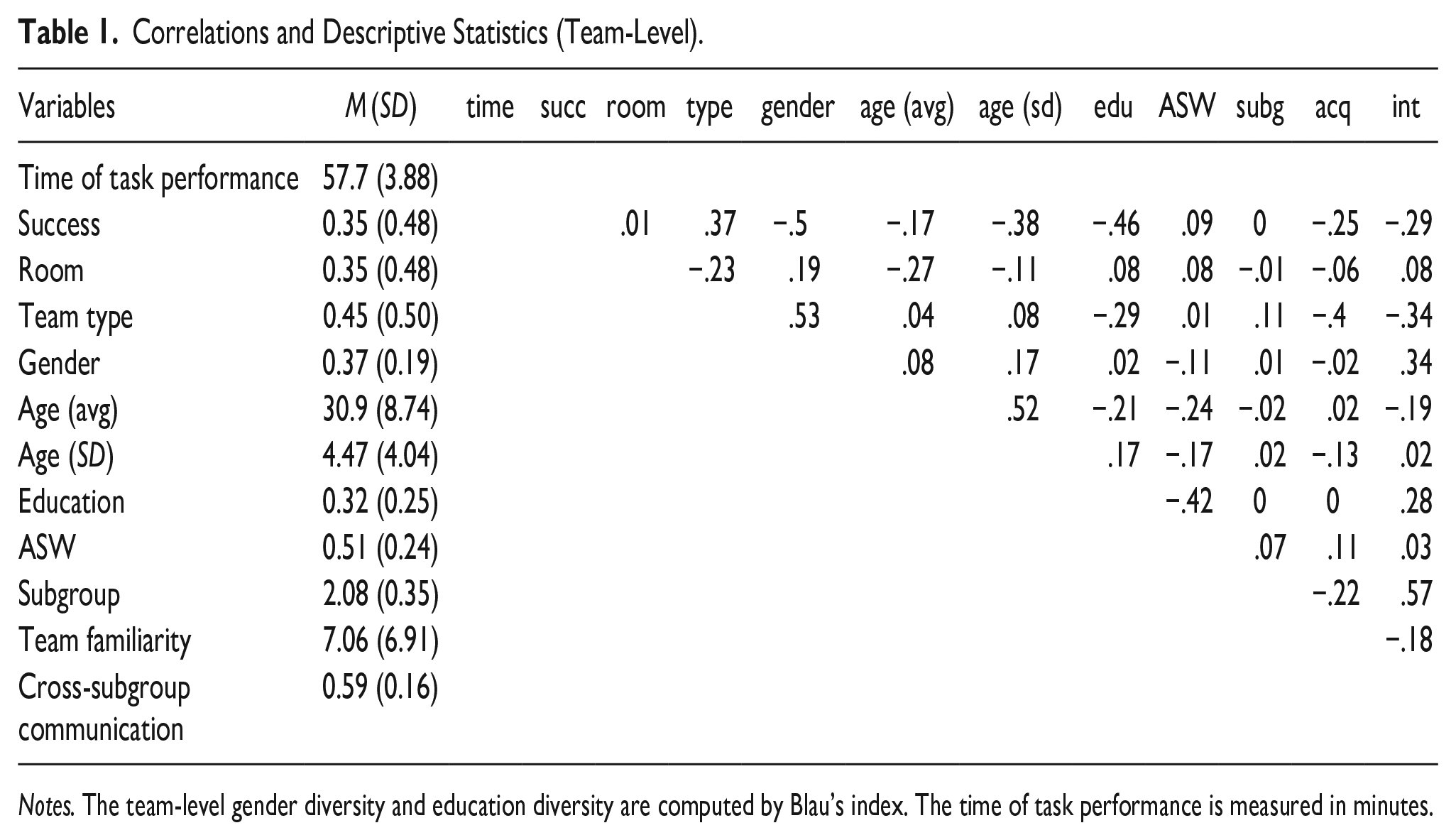
Notes. The team-level gender diversity and education diversity are computed by Blau’s index. The time of task performance is measured in minutes.
On average, team members have known each other well (approximately 7.06 years), although the variation of average acquaintanceship across teams is relatively high (6.91). The ASW values in our sample range from zero to one, where zero means no hypothetical dividing lines, while one represents strong faultlines (Meyer et al., 2015). The average ratio of cross-subgroup communication is 0.59, which indicates that, on average, around 60% of all collaborative communication occurs between the faultline-induced subgroup, with a variation of 0.16. Both ASW values and the ratio of cross-subgroup interactions are normally distributed. Most of the teams include two subgroups, while a few have three; and one group has no subgroups as its members are homogeneous along all the studied diversity dimensions (i.e., both faultline strength and cross-subgroup communication are zero in this team). Considering team type, we have a similar number of work-related and informal type of relationships, with slightly more groups in the latter category.
The number of subgroups and the ratio of cross-subgroup interactions strongly and positively correlate. Communication also has moderate and positive correlations with gender and education diversity, while success has a rather strong but negative relationship with all three diversity dimensions we use as controls. Success seems to be more frequent in groups where members have known each other by work. Gender diversity is lower in these work-related teams (compared to the other type), and members tend to know each other for less time. Faultline strength has a strong, negative correlation with education diversity. Heterogeneity in terms of age is also correlated with increased age of teams in our sample.
Analytical Method
We applied multivariate models in our analysis. We employed discrete-time survival (also called event-history) models (Allison, 2014) with both time-fixed and time-varying variables to investigate the direct and moderating effects of team familiarity and cross-subgroup communication. We used a time-team level data structure, where a team is present in the dataset in as many rows as many minutes they spent with problem-solving. The binary variable, success, has the value of zero in each minute the group performed the game, and one in the minute when the group successfully escaped the room. Time-fixed variables, including team-level diversity measures and controls, remain constant throughout each minute within the same group, while time-varying variables, such as the cumulative ratio of cross-subgroup communication, change over time within the group. By employing survival models, we could incorporate the dimension of time into our investigation by taking into account the time-varying nature of the process-related variables.
Results
First, we created the baseline model (Model 1) to examine the relationship between the minute-based problem-solving time and success. Then, in Model 2, we included faultline strength and diversity measures as controls. Model 3 contains the relational predictor (familiarity), while the most comprehensive model, Model 4, includes cross-subgroup communication. We summarized the results in Table 2.
Discrete-time Survival Models Predicting Team Success (Observations N = 2,255, SD in brackets).
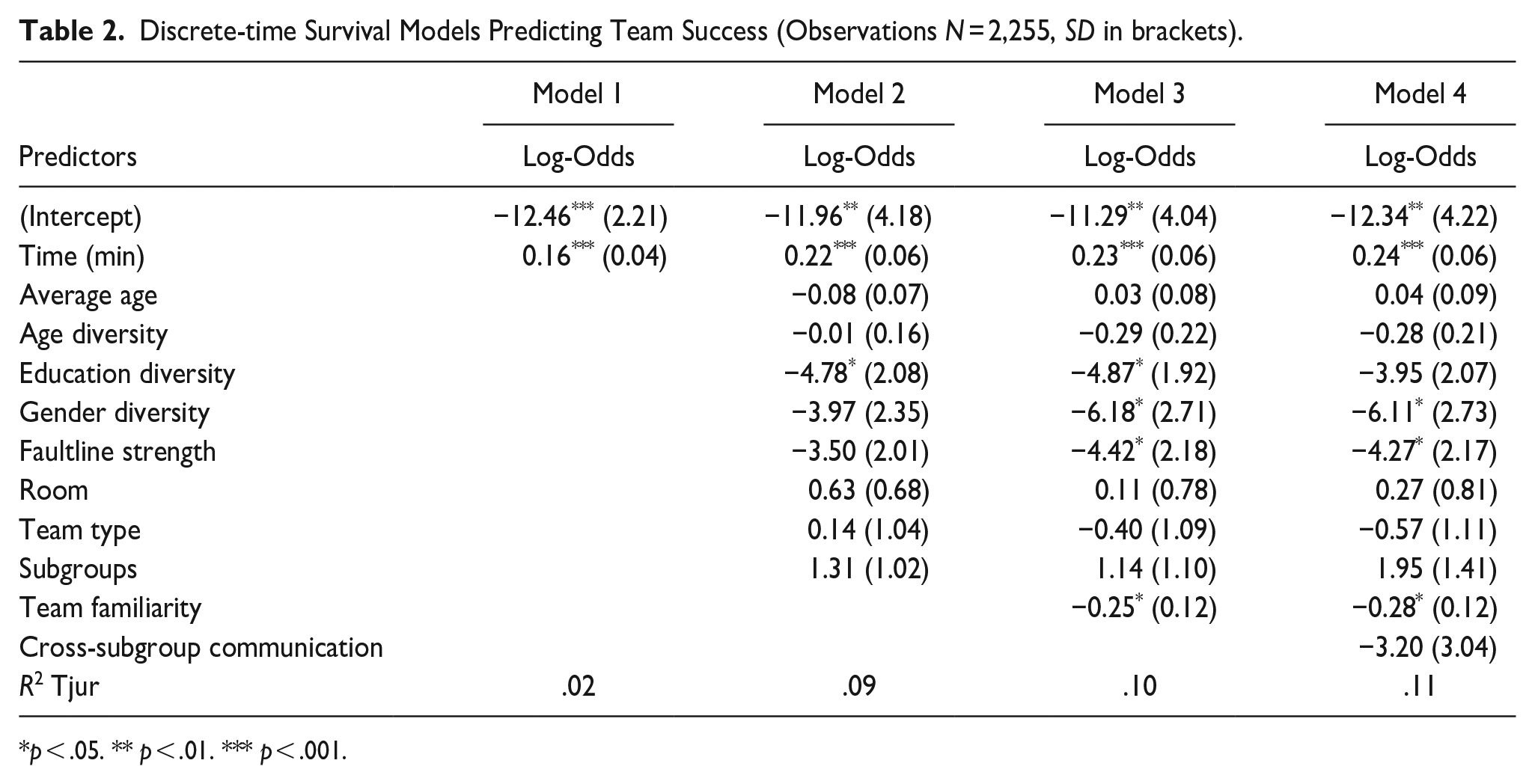
p < .05. ** p < .01. *** p < .001.
All four models are significant at a p < .001 significance level. As the complexity of the models increases from Model 1 to Model 4, their predictive power, as indicated by the Tjur R2, also increases within the range of .02–.11.
As the baseline model suggests, time spent in tasks is positively associated with the probability of success. Model 2 shows a significant and negative effect of education diversity on team performance. Model 3 showed that team familiarity has a negative impact on success. Moreover, team familiarity has a suppression effect, as its inclusion into the model induces the predictive power of both faultline strength and gender diversity. Thus, in those groups where the level of team familiarity is the same, teams with lower faultline strength and gender diversity are more prone to succeed. Similarly, in teams with the same level of gender and faultline strength, a lower level of familiarity is associated with team success. Therefore, we reject H1a, as Model 3 suggests that familiarity does not have a positive, but rather a negative effect on team success. In Model 4, we tested the direct effect of cross-subgroup interactions on team success (H2a), which turned out to be non-significant. Therefore, we also reject H2a, as cross-subgroup communication does not have a direct influence on team success. In sum, faultline strength is detected as a significant predictor of team success if team familiarity is also taken into account, and—counter to our expectations—it has a negative influence on team success.
To test the potential moderation effects of both relational and communication features on diversity and faultline measures (H1b, H2b), we added the interactions of team familiarity and communication to a final and most complex set of survival models.
First, we explored if the interactions between team familiarity and team composition faultlines have significant effects on success, and whether familiarity modifies the impacts of faultline strength on success (H1b). We did not find any significant interaction between familiarity and diversity faultlines (see Table A1 in Supplemental Appendix). The negative effects of faultlines, gender, and education diversity are present regardless of the duration of team members’ average acquaintance, thus rejecting H1b.
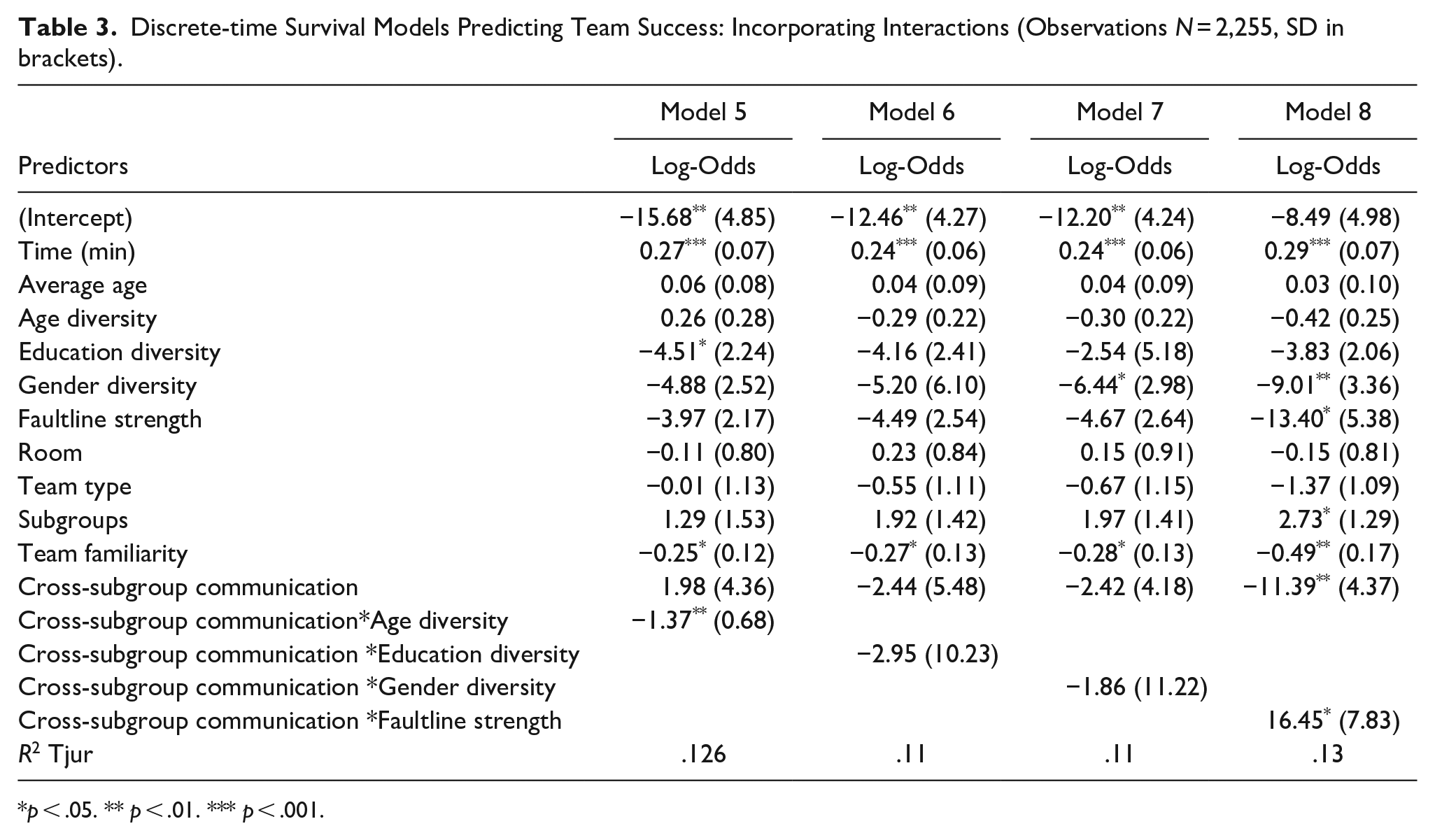
We built three additional models with interaction terms between diversity and communication, to test whether communication that bridges faultline-created subgroups have a moderating role in the diversity-success relationship. We summarized the results in Table 3.
Discrete-time Survival Models Predicting Team Success: Incorporating Interactions (Observations N = 2,255, SD in brackets).
p < .05. ** p < .01. *** p < .001.
We detected significant interactions between cross-subgroup communication and age diversity, as well as cross-subgroup communication and faultline strength. Model 5 contains the interaction term between cross-subgroup communication and age diversity, suggesting a cross-over effect between these predictors on success. Neither of the two predictors has a significant direct impact on success, unlike the interaction of the two, which, to our surprise, has a negative effect. Most importantly, Model 8 shows a positive interaction term of faultline strength and cross-subgroup communication. Although faultline strength influences team success negatively, its effect combined with team-wide communication has a significant and positive influence on group success. Figure 2 shows the average marginal effects of age diversity and faultline strength on team success, as well as the moderation effect of cross-subgroup communication.
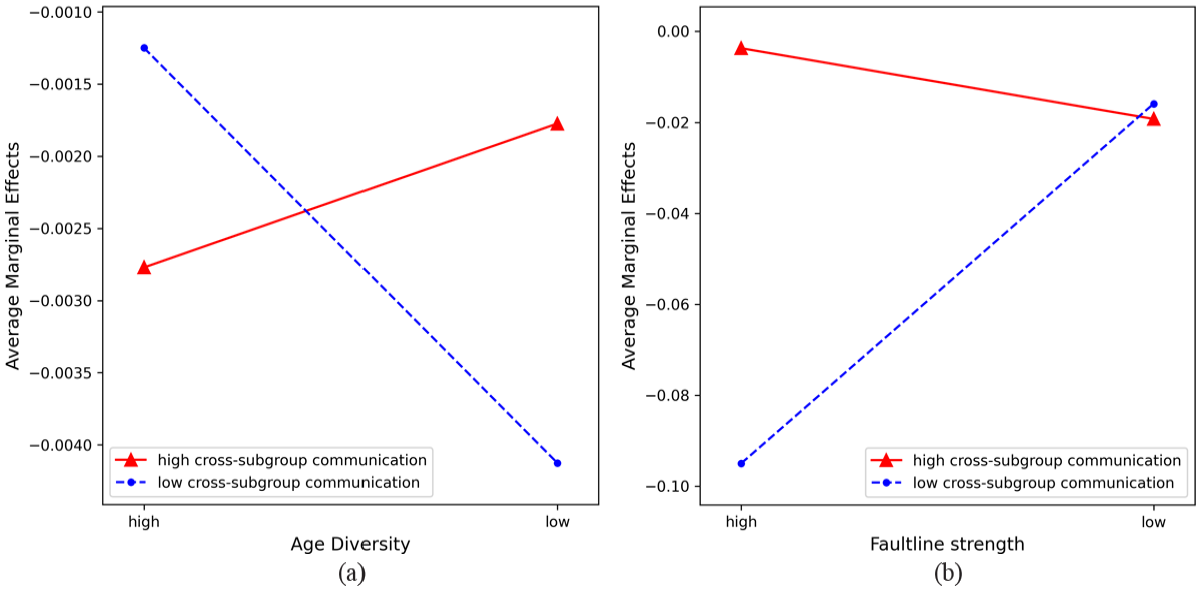
(a) Interaction plot on success by cross-subgroup communication and age and (b) interaction plot on success by cross-subgroup communication and faultline strength.
The negative effect of age diversity is stronger in homogeneous teams where members tend to initiate a small amount of communication across subgroups, compared to age-homogeneous teams with a high ratio of cross-subgroup communication (Figure 2a). In contrast, teams with high age diversity tend to perform better when they communicate within subgroups.
In the case of faultline strength (Figure 2b), the increase of cross-subgroup communication attenuates the negative faultline effect on team success, and it even eliminates the effect altogether in teams with particularly high cross-subgroup communication. The differences are particularly pronounced in teams with strong faultlines, while in groups with low faultlines, the negative effect does not change considerably by different levels of communication. In high-faultline groups, the negative effect of faultlines can be attenuated by a high ratio of communication across these faultline-induced subgroups. The worst-case scenario for performance is when teams with strongly correlated dimensions of diversity do not communicate enough across subgroups. In other words, high faultline strength worsens the chances for project teams to succeed when the subgroups induced by the faultline do not communicate on an above-average frequency with each other. It also implies that when teams manage to elaborate ideas and integrate knowledge on the group level by crossing subgroup boundaries with communication, it can counterbalance the negative faultline effect. Thus, we found support for H2b, as the analysis confirmed that intense communication across the subgroups moderates the negative effect of diversity on team success, and the results are robust when we control for the overall (cumulative) number of communication (see Tables A5–A7 in Supplemental Appendix,).
Discussion
Our study joins and contributes to faultline research by investigating the direct and moderating effects of team familiarity and cross-subgroup communication in the diversity faultline-success relationship. Building on the strength of both laboratory experiments and field studies while mitigating their respective drawbacks, we introduce escape rooms as minimally biased social laboratories that are devoid of the typical weaknesses of conventional experiments. Exploiting this innovative setting, we collected fine-grained data on the real-time communications of team members. In parallel, we explored the wider social embedding of individuals by collecting self-report data through a questionnaire to inform us about teams’ composition and social structure.
Relying on the CEM and network perspective, we predicted that a strong web of relationships might help to offset the detrimental effect of perceived biases on performance induced by subgroup formation. We measured relational strength by the length of acquaintanceship to determine the level of team familiarity. In line with previous studies, we first hypothesized that team familiarity positively influences success (H1a), and it attenuates the negative impact of faultline strength (H1b). Contrary to our expectations, survival model analyses indicated a negative influence of familiarity on performance. Moreover, the models revealed the suppression effect of familiarity, as its inclusion in the model activated the negative effect of faultline strength and gender diversity on team success.
A potential explanation for rejecting the familiarity-related hypotheses (H1a, b) lies in the operationalization of the concept. In this work, we considered prior interpersonal knowledge about other members (Gruenfeld et al., 1996; Harrison et al., 2003) as a proxy for team familiarity. This variable captures a general form of familiarity and does not distinguish between different dimensions, such as prior work experience with the same crew (Goodman & Leyden, 1991; Kanki & Foushee, 1989) or prior work experience with the same teammates in similar prior tasks (Hinds et al., 2000; Reagans et al., 2005). Given the non-routine nature of the escape room tasks, which are performed under time pressure in a dynamic environment, members must adapt to the varying demands of the task rapidly. In our study, familiar team members have known each other for years, presuming well-established communication channels based on strong relationships. In these circumstances, familiar team members may become stuck in routinized patterns of communication rooted in the strength of their close relationships, which impeded their ability to efficiently align their collaborative behavior with the dynamically changing demands of the task (Gokpinar et al., 2010; Okhuysen, 2001). Similarly, Katz and Allen (1982) found such negative effect of familiarity in an industrial setting among teams who have worked together for a longer time.
In line with the social categorization perspective, we detected the negative influence of faultline strength when we controlled for team familiarity. Specifically, in teams with a similar level of familiarity, diversity influences group success negatively. Incorporating cross-subgroup interactions into the analysis provided us with new insights. First, we identified a cross-over effect of age and the cross-subgroup interactions. The model suggested that, when cross-subgroup communication increases, the negative impact of age diversity also grows. More importantly, we found support for the attenuating power of cross-subgroup communication in the faultline-outcome relationship (H2b). We found that a high communication ratio across the faultline-induced subgroups mitigates the negative influence of diversity faultlines on success, and in the case of a particularly high ratio cross-subgroups communication, even omits it. On the other hand, when teams do not surpass the dividing lines via problem-solving interactions, they tend to fail. Therefore, faultline strength can negatively affect team outcomes when it obstructs team level communication and confines collaborative interactions within the faultline-induced subgroups.
Taken together, to understand collective outcomes in complex systems, including success in teams, we need to investigate processes that constitute the system’s complexity instead of merely studying the characteristics of its individual elements. Although we found that cross-subgroup communication alone does not predict success, we demonstrated its crucial role in the complex interdependencies that influence performance. Our finding on the specifying role of communication is consistent with prior research that investigated communication as a moderating factor in the gender diversity-performance relationship (Earley & Mosakowski, 2000). Moreover, to the best of our knowledge, the current study is the first to operationalize communication as real-time interactions during problem solving, thus providing a genuine process variable, and it also contributes to the literature by examining the influence of communication in the faultline-performance relationship. Furthermore, we accounted for the structure and time-varying nature of communication ties, recognizing that communication is not a static and homogeneous phenomenon, but it is often distributed across time and team members in an asymmetric manner.
Knowing when communication is critical for teams can be vital information for organizations that regularly rely on teamwork for success. In terms of team composition, a factor that can be easily manipulated by managers, a possible implication of faultline theory is to prevent teams from forming dividing lines. This could be achieved by composing rather homogeneous groups based on one or two diversity dimensions, such as gender or ethnicity, although this approach may perpetuate social inequalities, especially regarding access to job opportunities for minority groups. Furthermore, this may distort the supply-demand relations of the job market by determining selection criteria for specific positions where qualifications and competence of applicants would have less significant. Therefore, instead, a more realistic and desirable way is to understand the mechanisms by which faultlines influence team outcomes and manage them. From this perspective, our findings provide an important insight by showing that team-wide, real-time communication mitigates faultline effect, suggesting that managers should facilitate communication between the faultline-induced subgroups as much as possible to ensure efficient team functioning for tasks that require the synthetized knowledge of the whole team as a single unit. At the same time, diverse groups with low cross-subgroup communication might be assigned to tasks that can be easily divided and later integrated into their final forms by leaders or coordinators. There is a wide variety of groups in real life, and they can function efficiently, if we understand their core mechanisms and know how to build on the strength of these teams.
While this study makes important contributions, we exercise caution regarding the generalizability of our results. A clear limitation of our data is its small, although not unprecedentedly, sample size. This is primarily due to the time, effort, and resources required to collect real-time interaction data, although collecting data through escape rooms presents advantages in these regards, compared to laboratory experiments. In addition, we employed survival models to capture the temporal nature of communication, which allowed us to gather a large volume of data points at the time-group level. Although, the performed statistical analysis accounts for sample size, and thus, it does not discount the validity of our findings based on significant relationships, we should be careful with rejecting unsupported hypothesis.
Another limitation is the operationalization of education background. As the faultline package in R can only take nominal or numeric values, we treated education background as a nominal variable when constructing the ASW measure. For the sake of consistency, we also used education background as a nominal control variable. Thereby, we only consider the differences between education backgrounds but not the ordering. To assure that this treatment does not distort our results fundamentally, we performed a sensitivity analysis (see Supplemental Appendix), where we included education background in the models as an ordinal control variable. The analysis confirmed that our core result persists; the combined effect of faultline strength and cross-subgroup communication does have a positive impact on team success. Also in terms of technicalities related to faultlines, we note that the word “subgroup” can be misleading when considering the ASW measure, as a subgroup can consist of one person. Consequently, all (both incoming and outgoing) communication with an individual is identified as a cross-subgroup interaction.
Finally, although teams in escape rooms meet the definition of project teams in terms of the non-routine nature of the task, in reality, project teams are usually composed of members whose skills complement each other. To address this challenge, future research should implement a meticulous recruitment process and design the experiment rigorously, which, nevertheless, could lessen the advantages of the present data collection approach, including its non-interventional nature and the minimized Hawthorne effect. Further, in addition to obtaining a larger sample size, future research could also explore the information components of communication and structure of communication by differentiating between dyadic and group interactions. Moreover, different control variables could be incorporated, such as the potentially varying levels of task motivation or extraversion of team members—two individual-level characteristics that might influence the amount of cross-subgroup communication.
In short, our work contributes to faultline research by investigating team familiarity and communication between faultline-induced subgroups as predictors of team performance and moderators of the relationship between faultlines and team success. In line with the theoretical underpinnings of CEM and the network perspective, examining team processes is crucial to capture the diversity-performance relationship in its richness. Based on this idea and by relying on the innovative research setting of escape rooms, we incorporated real process variables into our analysis. We found that real-time communication (during a non-routine task) across the faultline-induced subgroups plays a crucial role to understand when diversity can affect success in collaborative problem-solving. We hope that our work encourages more research analyzing teams in their complexity.
Supplemental Material
sj-docx-1-sgr-10.1177_10464964231183456 – Supplemental material for Faultlines, Familiarity, Communication: Predictors and Moderators of Team Success in Escape Rooms
Supplemental material, sj-docx-1-sgr-10.1177_10464964231183456 for Faultlines, Familiarity, Communication: Predictors and Moderators of Team Success in Escape Rooms by Rebeka O. Szabó, Federico Battiston and Júlia Koltai in Small Group Research
Supplemental Material
sj-png-2-sgr-10.1177_10464964231183456 – Supplemental material for Faultlines, Familiarity, Communication: Predictors and Moderators of Team Success in Escape Rooms
Supplemental material, sj-png-2-sgr-10.1177_10464964231183456 for Faultlines, Familiarity, Communication: Predictors and Moderators of Team Success in Escape Rooms by Rebeka O. Szabó Federico Battiston and Júlia Koltai in Small Group Research
Footnotes
Acknowledgements
The authors thank Lászlő Lőrinc and Károly Takács for their valuable comments on earlier versions of the manuscript.
Declaration of Conflicting Interests
The author(s) declared no potential conflicts of interest with respect to the research, authorship, and/or publication of this article.
Funding
The author(s) disclosed receipt of the following financial support for the research, authorship, and/or publication of this article: Júlia Koltai acknowledges funding from the Lendület “Momentum“ Grant of the Hungarian Academy of Sciences.

Supplemental Material
Supplemental material for this article is available online.
Author Biographies
References
Supplementary Material
Please find the following supplemental material available below.
For Open Access articles published under a Creative Commons License, all supplemental material carries the same license as the article it is associated with.
For non-Open Access articles published, all supplemental material carries a non-exclusive license, and permission requests for re-use of supplemental material or any part of supplemental material shall be sent directly to the copyright owner as specified in the copyright notice associated with the article.

