




Abstract
Small teams’ decisions play a major role in shaping business and society. As political differences permeate our lives, their influence is increasingly being felt throughout organizations. Yet, little is known about how executives’ political differences influence the Top Management Team’s decision-making processes. We integrate literatures on executive diversity, political polarization, and small teams to develop a new construct, Top Management Team political polarization, and examine how this team characteristic influences two critical parts of the strategic decision-making process: comprehensiveness and speed. We also propose behavioral integration reduces polarization’s drawbacks, offering improvements to decision-making processes in these polarizing times.
The decisions small teams make can play a central role in shaping institutional-, organizational-, and individual-level outcomes. The US Supreme Court (Fiel & Zhang, 2019), Top Management Teams (TMTs) in organizations (Finkelstein, 1992), and hospital surgical teams (Maynard et al., 2021) are all examples of small teams that make decisions (e.g., repeal laws, pursue corporate social responsibility, administer anesthesia) that can shape society, business, and individuals. While small teams perform their work in diverse contexts, all are inherently deliberative, social, and frequently need to make speedy yet comprehensive decisions to complete their tasks effectively.
As a result, a large body of research focuses on better understanding how team member diversity influences small team decision-making. Such research is interdisciplinary and comes from fields including communication (e.g., Prahl et al., 2017; Scott et al., 2023; Van Swol & Carlson, 2017), management (e.g., Horwitz & Horwitz, 2007; Martins & Sohn, 2022), psychology (e.g., Van Knippenberg & Mell, 2016; Van Knippenberg et al., 2004), and strategic management (e.g., Carpenter, 2002; Dezsö & Ross, 2012; Miller et al., 2022). While this research has advanced our understanding, important gaps remain. First, although research highlights the importance of functional area (e.g., finance, marketing) or surface-level (e.g., gender, race) diversity for shaping team decisions, individuals’ dispositional characteristics, including their unique beliefs, preferences, and personality also play an important role in influencing how they approach decision-making (Way et al., 2022). Therefore, we need to better understand how deep-level diversity (e.g., abilities, personality, values; Bell & Berry, 2007; Miller et al., 2022) shapes small team decision-making processes. Second, recent research suggests diversity may negatively influence team decision-making (Miller et al., 2022; Prahl et al., 2017; Samba et al., 2018). Thus, we need to better understand how deep-level diversity leads to less desirable team outcomes during the team decision-making process.
To address these gaps, we focus on political ideology, a particularly important and unique type of deep-level diversity increasingly manifesting in small team decision-making across business and society in the United States. The United States has become increasingly divided on politics over the past several decades (Editorial Board, 2022), with this divide deepening in the aftermath of the COVID-19 pandemic, as a recent PEW Research Center poll found that 77% of respondents feel the country is now more polarized than before the pandemic (Dimock & Wike, 2021). This aligns with scholarly research that has found evidence of increasing polarization on policy issues (Abramowitz & Saunders, 2008; Webster & Abramowitz, 2017) and growing evidence of polarization related to party sorting behaviors—the extent to which the public affectively affiliates with a particular political party and its associated ideology (Fiorina & Abrams, 2008; Iyengar et al., 2019; Mason, 2015).
Political ideologies reflect a system of values that collectively reflect individuals’ preferences for “how society should be governed” (Jost et al., 2009, p. 309), which influence how people view the world and act within it (Gupta & Wowak, 2017; Jost, 2006). These deeply held values and preferences can uniquely impact how people make decisions and engage with others during the decision-making process (Hartman et al., 2022; Jost et al., 2009; Van Bavel & Pereira, 2018). Individuals differ in their political ideologies, such as conservative versus liberal (Chin et al., 2013), and economic conservative versus social conservative (Chin et al., 2021). This, in turn, can lead to positive affect toward those who share similar ideologies (Iyengar et al., 2019). Political ideology is unique from other types of deep-level diversity (e.g., personality types such as introvert vs. extrovert) because it can lead to animosity and, increasingly, perceptions that individuals with differing political ideologies are “stupid” (Hartman et al., 2022). Consequently, political ideologies can create polarization between individuals, which can lead to conflict, discrimination, withholding of opinions, and reduced information sharing (Iyengar & Westwood, 2015; Iyengar et al., 2019; Prahl et al., 2017), all of which are detrimental to team functioning.
In this study, we develop theory in the context of Top Management Teams (TMTs) because they are an extreme exemplar of team strategic decision-making (Eisenhardt & Graebner, 2007). As we discuss below, TMTs are highly salient small teams whose strategic decisions can simultaneously shape institutions, organizations, and individuals, and are influenced by political ideologies (Swigart et al., 2020). Integrating literature examining diversity among strategic leaders within organizations (Hambrick & Mason, 1984; Miller et al., 2022) with the political polarization (Abramowitz & Webster, 2016; Iyengar & Westwood, 2015; Iyengar et al., 2019) and small teams (Prahl et al., 2017) literatures, we introduce the concept of TMT political polarization: the strength of identification and degree of fragmentation within the TMT on policy issues and/or political party identification. We explain how TMT political polarization influences the strategic decision-making process by focusing on two critically important intermediary characteristics: decision comprehensiveness and decision speed (Kauppila et al., 2018; Post et al., 2022; Souitaris & Maestro, 2010). Then we theorize how the TMT’s behavioral integration can attenuate the negative influence of TMT political polarization on decision comprehensiveness and speed. In doing so, our theory makes important contributions to research examining the role of diversity in small teams and strategic decision- making in organizations. Finally, we discuss future research avenues for empirically testing and building upon our theoretical framework.
Team Diversity in Organizations
For some time, researchers have acknowledged that increasing heterogeneity among teams can influence their decision-making processes via one of two mechanisms. On the one hand, researchers espouse a Social Identity Theory perspective (SIT; Tajfel, 1982), arguing that people classify themselves and others into groups (e.g., Democrats, Women, Red Sox fans) and, as a result, derive part of their identity from the groups to which they belong. Because people prefer to interact with members of their own group (Byrne, 1971), when people work in teams comprised of in-group members (e.g., Republicans, Yankees fans), positive effects on team processes are expected. However, if placed with out-group members (e.g., Red Sox fan with Yankees fans, Democrat with Republicans), teams can anticipate process and/or performance losses due to individuals exhibiting increasing levels of favorable bias toward the social group they identify with while simultaneously displaying more animosity toward the out-group members. In contrast to this social perspective on team diversity, other researchers argue that diverse team members contribute unique types of information and novel perspectives which can increase the number of alternatives considered and result in an optimal decision (Cox & Blake, 1991; Jansen & Searle, 2021; Williams & O'Reilly, 1998). This perspective is referred to as the informational perspective (Martins & Sohn, 2022).
Within the informational perspective, Martins and Sohn (2022) distinguish between cognitive resources and cognitive structures for team diversity. Whereas cognitive resources (e.g., knowledge and abilities) increase the number of inputs each member brings to the team, cognitive structures (e.g., values and biases) serve as lenses through which teams view information, interactions, and tasks. In other words, cognitive resources can increase the amount of information available to a team, while cognitive structures have implications for how much a team learns from that information. Further, while cognitive resources are largely beneficial for team outcomes (e.g., innovation), cognitive structures can lead to positive or negative team outcomes depending on if they create conflict or other coordination problems among members (Martins & Sohn, 2022).
Broadly, research on team diversity tends to focus on either heterogeneity in surface- (e.g., sex) or deep-level (e.g., values) characteristics. Though both have been related to team outcomes, the field appears to be moving toward the latter, as these underlying characteristics have correlations with team functioning, such as the positive relationship between cognitive diversity and team innovation (Mello & Rentsch, 2015). An increasingly salient and unique type of deep-level diversity that has been shown to influence small teams’ functioning and decision-making is political ideology (Dimock & Wike, 2021; Jost et al., 2009; Swigart et al., 2020). Accordingly, next we turn to the literature on political ideology to understand the uniqueness of this type of deep-level diversity.
Political Ideology: A Unique Type of Deep-Level Diversity
Political ideology stands apart as a unique type of deep-level diversity for several reasons. First, biological and evolutionary perspectives suggest humans have a proclivity toward group membership and tribalism (Van Bavel & Pereira, 2018); affiliating with a political group satisfies basic psychological needs for group membership (Greene, 2004). Research has shown the human brain treats political affiliation like other types of social identities, which can affect a range of cognitive processes such as reasoning, perspective-taking, and information processing (Van Bavel & Pereira, 2018). Political issues stimulate “hot cognitions,” meaning that simply mentioning something political can arouse an immediate attitude or cognitive response before having any substantive information about the topic (Taber & Lodge, 2006). Importantly, hot cognitions form the foundation of selective information processing and biased reasoning (Taber & Lodge, 2006). Swigart et al. (2020) also note that political ideologies influence decision-making such that they allow individuals to arrive at the conclusions they prefer, not necessarily those that are more accurate. In other words, our political ideology can help justify the decisions we make.
Second, individuals often have a strong affective connection to their political ideology (Hartman et al., 2022). Individuals expend a significant amount of time and cognitive resources in the development of their political identity; thus, they are more likely to treat it like a personal possession and defend it vigorously (Taber & Lodge, 2006). As a result, individuals may feel animosity and open contempt toward others with divergent political ideologies (Hartman et al., 2022). Research has shown that individuals often have socioemotional connections to their political parties such that when the party is threatened or disparaged, the individual becomes upset and motivated to overcome the threat (Mason, 2015). Unlike polarization based on other types of diversity like education, ethnicity, gender, geographic location, race, or religious affiliation, the socioemotional connections people have to their political parties can create consternation (DiMaggio et al., 1996; Hartman et al., 2022; Iyengar & Westwood, 2015). For instance, in the United States, both Democrats (i.e., liberals) and Republicans (i.e., conservatives) perceive each other as more unintelligent (i.e., stupid) than themselves (Hartman et al., 2022).
Third, for most individuals, their political ideologies are developed early in life and endure through their lifetime (Iyengar et al., 2012), as “political campaigns – the formal occasions for expressing one’s partisan identity – recur frequently and last for many months (or even years) in the contemporary United States” (Iyengar et al., 2019, p. 130). Furthermore, there are a variety of ways for individuals to express their political ideologies, including party membership, activism, elections, and campaign contributions (Johnson & Roberto, 2018). Having such a variety of outlets to express one’s political ideology further distinguishes it from other types of deep-level diversity (Johnson & Roberto, 2018).
Taken together, political ideology satisfies basic evolutionary needs, reflects deeply-held values and beliefs that are developed early in life and seldom change, and are frequently—and publicly—reinforced. Further, the animosity toward and negative perceptions of others that have differing political ideologies distinguishes it from other types of deep-level diversity.
Political Polarization Within Organizations
As politics have become ever more noticeable in everyday life, the same is true within the organizations in which Americans work. In a 2017 survey by the American Psychological Association (APA), 54% of survey respondents stated they discussed politics at work (APA, 2017). Similarly, in a survey of employees conducted by the Society for Human Resource Management (SHRM), 60% noted that others within the organization had become more vocal about their political opinions and perspectives, leading to more politically laden discussions at work (SHRM, 2016). As an example, consider the recent case of the streaming giant Netflix, which faced backlash from employees when they decided to carry a controversial comedy special that some employees and external stakeholders found objectionable. Netflix was threatened with walkouts and demands that they add disclaimers to their content. In response, Netflix made the strategic decision to rebuff the demands. Instead, Netflix updated its work policies and negotiated to extend its relationship with the comedian at the center of the controversy. Decisions such as these are difficult for organizations as they face scrutiny from their employees, customers, shareholders, and the public. While politically laden discussions at work may have been rare in the past, the prevalence of these discussions now may not be all that surprising given the new social norm.
Existing research also suggests organizations can be an ideal context for substantive politically laden discussions because, in organizations, there is the potential for people to engage in meaningful conversation with a great number of others with diverse backgrounds and different experiences, opinions, and values (Mutz & Mondak, 2006). Through daily interaction, social categorization based on political party affiliation may occur at the workplace because people who work together would get a sense of their coworker’s political ideology from engaging in conversations with them or seeing what they share on their social media (Shin & Thorson, 2017). Because employees spend significant amounts of time together at work, this creates opportunities for substantive conversations around political (and other) differences. These discussions can stimulate greater awareness of others’ views which may result in more tolerance for coworkers’ opinions and a better understanding of their perspectives (Van Knippenberg & Mell, 2016). In turn, broadening of perspectives may help employees better understand their colleagues’ thought and decision-making processes, which ultimately can enhance organizational efficiency and effectiveness (Martins & Sohn, 2022).
On the other hand, according to the Information Perspective (e.g., Martins & Sohn, 2022), politically laden discussions within organizations can have a negative impact. For example, a SHRM poll in 2020 found that nearly 42% of employees reported having had a political disagreement at work (Milligan, 2020). Additionally, almost 40% of employees reported having experienced outcomes such as reduced productivity and work quality, increased stress, tension, and workplace hostility due to political discussions at work (APA, 2017). Further, approximately 24% of employees reported they avoid some of their coworkers because of their stance on political issues (APA, 2017), and 26% of employees reported they are left with a more negative view of their coworkers due to their coworker’s political activities. Taken together, the evidence points to a growing phenomenon of politics having permeated the workplace.
The combination of increasing politics in today’s workplace, individuals’ unique political ideologies (Chin et al., 2013, 2021), and the spirited defense against challenges to one’s ideology (Taber & Lodge, 2006), result in the potential for increased political polarization at work. Research has begun to distinguish the type of political polarization within teams. Specifically, scholars have conceptualized two types of political polarization: policy issue and affective. Policy issue polarization is based on policy-related issues and suggests individuals move away from moderate perspectives on specific policies (e.g., social security or gun safety) to instead adopt a more extreme position on that issue. In contrast, building on arguments from SIT (Tajfel, 1982), affective polarization is based on the increasing proportions of Americans affiliating with a political party. When affective polarization occurs, individuals more strongly identify with a political party (e.g., Democrat or Republican) and exhibit increasing levels of favorable bias toward that social group while simultaneously displaying more animosity toward the opposition group. Moreover, the two types of political polarization can manifest both between (i.e., inter) and within (i.e., intra) political parties (Iyengar & Westwood, 2015; Iyengar et al., 2019; PEW Research Center, 2021). In fact, sometimes intragroup polarization can be stronger than intergroup polarization because threats emanating from within a political party elicit stronger negativity toward the ingroup member(s) than those originating outside the group (Huddy & Mason, 2008).
Whether politically laden discussions lead to political polarization within organizations can be influenced by the tone set by the Top Management Team (TMT; Swigart et al., 2020). In other words, the TMT’s handling of its own polarization may serve as a template for other small teams within organizations. Therefore, we focus on TMTs within organizations.
Small Teams Within Organizations: The Case of TMTs
TMTs are the highly visible, small team of executives tasked with the strategic decision-making responsibility to lead and direct their organizations. Research focusing on TMTs and other top executives (e.g., Chief Executive Officers) began with work by Child (1972) and Hambrick and Mason (1984), both of whom questioned the prevailing assertion that companies are successful due in large part to the economic realities of the market niches they occupy. Instead, research should include a company’s executives, as they are given the responsibility to make strategic decisions, receive praise when the company is successful, and criticism when the company underperforms.
Specifically, Hambrick and Mason (1984) argued executives are worthy of study because of their pronounced influences on organizational actions and outcomes. According to the Upper Echelons Theory developed by Hambrick and Mason (1984), executives perceive “the situation” (i.e., environmental stimuli) through the lens of their unique experiences, values, cognitive frames, and so on. Thus, each executive perceives their environment differently and the differences between executives manifest in unique strategic decisions with the potential to influence not only their company and workforce, but also the broader institutions and environments of which they are a part.
In the ensuing decades, a growing body of research findings underscored the widespread influence of TMTs on a variety of company outcomes, including decision-making and performance. For example, Hambrick et al. (1996) found a company’s TMT impacted its competitive moves against rivals. Others have linked the TMT to international diversification (Tihanyi et al., 2000), strategic innovation (Talke et al., 2011), and company performance (Cannella et al., 2008; Carpenter, 2002; Certo et al., 2006; Goll et al., 2001; Nielsen & Nielsen, 2013; Rau, 2005; Van Dijk et al., 2012). Collectively, these studies underscore the importance of the TMT for meaningful organizational outcomes. Importantly, these articles considered the composition, or diversity, of the TMT as a main mechanism that influences decision-making.
Hambrick and Mason (1984) noted that observable (i.e., surface-level) characteristics could be used as proxies of executives’ “givens” (i.e., their cognitions and values; deep-level characteristics), leading to a veritable explosion of research, the majority of which considers surface-level diversity characteristics. However, due to the inherent limitations of such variables (see Priem et al., 1999), research has started to consider deep-level diversity characteristics such as cognitions (Wei & Wu, 2013) and personality (Boone & Hendriks, 2009). More recently, TMT research has begun focusing on political ideology (Chin et al., 2013, 2021; Gupta & Wowak, 2017).
Political Ideology in TMTs
Management scholars have increasingly examined how TMT members’ political ideologies influence strategic decisions (Swigart et al., 2020). This research indicates TMT members’ political ideology influences their positions on strategic decisions via behavioral channeling and motivated cognition (Gupta & Wowak, 2017; Hambrick & Mason, 1984). Behavioral channeling refers to the process through which an individual weighs available alternatives, facts, and probabilities, and selects a course of action that reflects their values. By contrast, motivated cognition refers to the perceptual filtering process whereby individuals selectively search for information that suits their values and then perceive and interpret information in a values-congruent way (Chin et al., 2013).
Aggregating to the level of the TMT, a team’s collective values are a salient factor that influences group decision-making. Research has long acknowledged that a group’s values can shape the social systems within which they operate (e.g., Ashforth & Mael, 1989; Elizur, 1984; Locke, 1976; Pennings, 1970). When TMT members collectively make decisions, their ideologies influence how they discuss, debate, and vote on a particular action (Chin & Semadeni, 2017; Chin et al., 2021; Gupta & Wowak, 2017). As such, a TMT’s final decision will reflect the aggregate ideological composition of its individual members. For instance, firms with more conservative executives took fewer risks, on average, than those with more liberal executives (Christensen et al., 2015). CEO and compensation committee liberalism is associated with reduced pay dispersion within the TMT because the team’s decision-making is influenced by liberals’ value of egalitarianism (Chin & Semadeni, 2017). Taken together, these studies show how TMT members’ political ideologies are associated with various strategic decisions.
More recently, an emerging literature stream demonstrates that TMT members’ political ideologies might lead to negative outcomes, such as when TMT members’ political ideologies do not align with others in the organization. For example, CEO political ideological misfit (i.e., when a CEO’s political ideology directly conflicts with the employees) affects employee outcomes (Brown et al., 2020). Specifically, CEO activism influences perceptions of ideological misfit for employees and affects employee turnover intentions, activism, and withdrawal (Brown et al., 2020).
While prior political ideology and TMT research has advanced our understanding of the various strategic and employee decisions influenced by TMT members’ political ideologies, two gaps remain. First, although research highlights the importance of TMT members’ political ideologies for influencing various strategic decisions, we still know relatively little about how TMT members’ political ideologies influence the process of strategic decision-making. Second, prior research overwhelmingly operationalizes TMT political ideology based on the dominant or majority party in the TMT, which obscures the influence that diversity in TMT members’ political ideologies has on strategic decisions. As a result, we lack an understanding of how potential TMT political polarization might positively or negatively shape strategic decisions. We aim to address these knowledge gaps by theorizing how TMT political polarization among team members influences the strategic decision-making process. To do so, we focus on two critically important intermediary characteristics of the strategic decision-making process: decision comprehensiveness and decision speed (Kauppila et al., 2018; Souitaris & Maestro, 2010). Next, we briefly discuss these key characteristics before developing our theoretical arguments.
Strategic Decision Processes
Strategic decision processes are an important determinant of a company’s performance and refer to the varied means by which the firm’s decision makers arrive at a decision (Rajagopalan et al., 1993). Traditionally, the strategic decision process can be explained by a multifaceted model including problem diagnosis and analysis, development of alternative courses of action, evaluation of alternatives culminating in a decision, and plan for implementation (Schwenk, 1995). Research has uncovered several characteristics associated with the strategic decision-making process (Rajagopalan et al., 1993), with the critical importance of decision speed and decision comprehensiveness being extensively supported (Carr et al., 2021; Kauppila et al., 2018; Meissner & Wulf, 2014; Souitaris & Maestro, 2010).
There is an increasing desire for TMTs to make speedy yet comprehensive strategic decisions. Regarding decision speed, in ever more industries, organizations are under mounting pressure to constantly adapt their strategies, processes, and capabilities to remain competitive and take advantage of emerging market opportunities because organizations are shifting from sustainable competitive advantages to the continuous pursuit of temporary competitive advantages (Dagnino et al., 2021; D’Aveni et al., 2010). More recently, the rapid onset of the COVID-19 pandemic further created widespread disruption across the business landscape, which in turn required TMTs to react quickly to adapt business models, make safety changes in their operating environments, and secure new production capabilities to survive (Fox et al., 2020). Regarding decision comprehensiveness, TMT members’ decision-making context is often complex and ambiguous, requiring them to gather information and consider different perspectives to make sense of their environment (Mohammed, 2001). With advances in digital technologies, the amount of information and tools executives have at their disposal has dramatically increased (George et al., 2014), further fueling the desire for comprehensive decision-making. Thus, the importance of decision comprehensiveness and decision speed are amplified in today’s business context.
TMT Political Polarization and Strategic Decision-Making
It is widely accepted that managers are limited in their ability to filter, collect, and process the vast amount of information they are faced with when making decisions about the firm’s strategic direction (Simon, 1947). An individual’s values are one filtering mechanism through which problems are framed, information is collected, alternatives are generated, and solutions are chosen; thus, an executive’s personal values impact the decision-making process as they filter information through their individual cognitive and value-laden lenses to overcome their bounded rationality. Specifically, according to the informational perspective on team diversity (e.g., Martins & Sohn, 2022), an executive’s political ideology may shape both the cognitive resources and structure of the team. Team diversity brought about by team members with different backgrounds and values is beneficial and can help teams overcome the limits of individual cognition (e.g., Martins & Sohn, 2022; Van Knippenberg & Mell, 2016; Van Swol & Carlson, 2017) and reduce groupthink and related phenomena that can result from having too little diversity on a team (Byrne, 1971). Yet, questions remain regarding how differences in executives’ value systems might lead to clashes or fragmentation within the TMT.
We introduce the concept of TMT political polarization to understand how value-laden differences among TMT members influence the TMT strategic decision-making process (see Figure 1). We define TMT political polarization as the strength of identification (e.g., I identify strongly as a Republican) and degree of fragmentation on policy issues and/or political party identification (e.g., number of distinct subgroups [Democrats, Libertarians, Republicans]) within the TMT. Thus, our conceptualization of TMT political polarization includes both a strength and fragmentation component. Given political ideology is not equally salient or impactful for all persons, the strength of identification is an important component in our definition of TMT political polarization. Further, the two components in our conceptualization of TMT political polarization provide a theoretical lens that moves away from the “two-pole myth” which, as Lewis and Lewis (2022) explain, assumes the left (i.e., liberals) and right (i.e., conservatives) are fixed positions and polarization only occurs between these fixed ideological poles. The two-pole approach to polarization is overly simplistic because polarization can stem from a multitude of issues and values, many of which cut between and within the traditional left-right dichotomy, and polarization can vary in terms of strength. Moving away from this myth provides the opportunity for TMT political polarization to occur both within and between identification with a traditional political party and stances on policy issues, and to vary in strength.
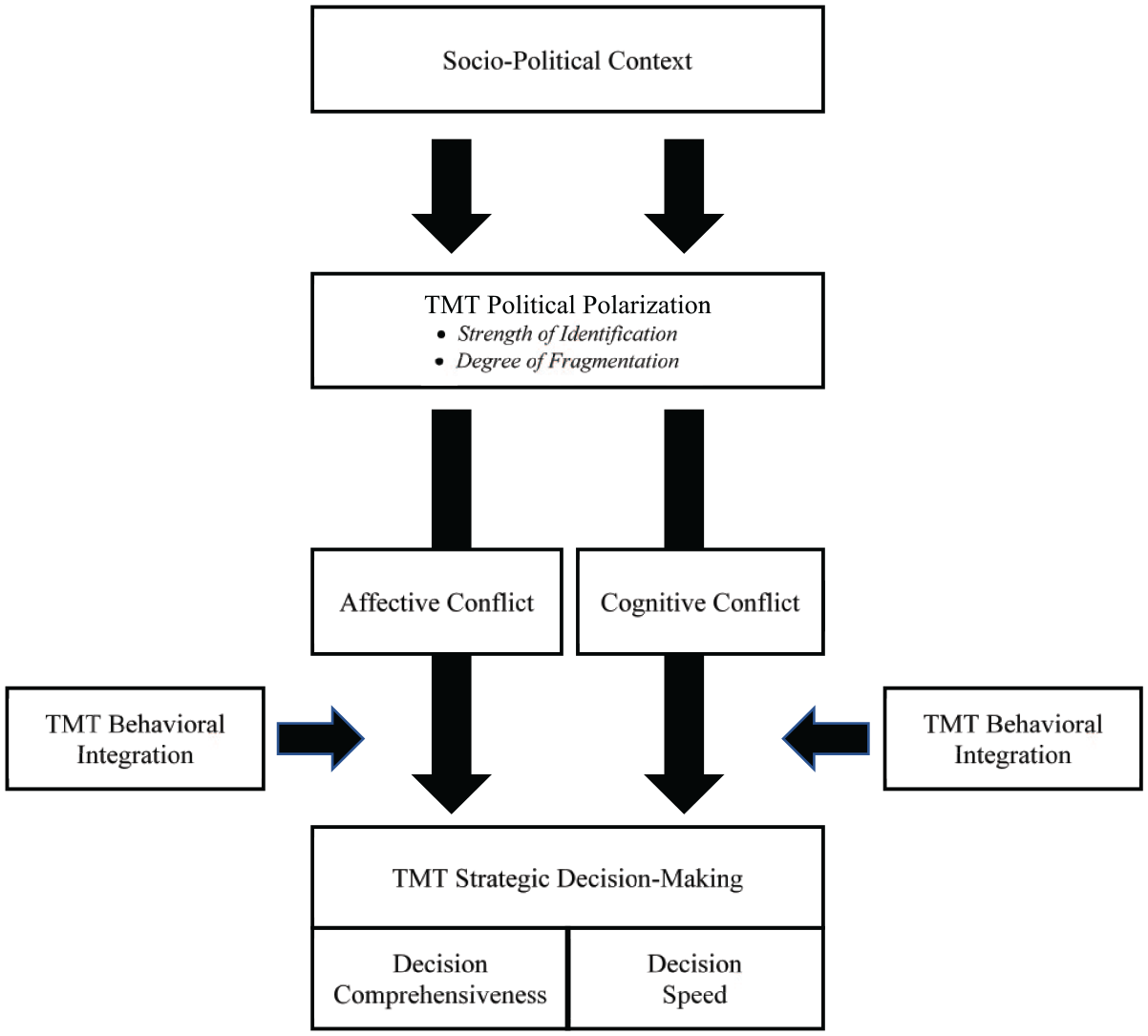
Theoretical model.
Executives’ political values become evident in the policy issues they support or oppose and the political parties with which they choose to identify. While some executives might be explicit about and transparent in the policies and parties they support, others can be more guarded, but regardless, executives’ political ideologies influence how they discuss, debate, and vote on organizational issues (Chin & Semadeni, 2017; Chin et al., 2021; Gupta & Wowak, 2017). This suggests that it is through interactions and discussions that TMT members become aware of fellow TMT members’ policy positions and political party identification. Considering TMT members tend to be powerful and successful individuals (Miller et al., 2022) and vigorously defend their political ideologies (e.g., Taber & Lodge, 2006), it is likely that TMT members will be less likely to compromise on their deeply held beliefs and values that aided their career success. Moreover, the broader sociopolitical context and popular rhetoric reinforce the importance of being authentic to one’s values and belief systems (Wang et al., 2019). As a result, we envision that TMT members will be champions of their own value-laden agendas and the value-laden agendas of the political groups they affiliate with, which have shaped part of their professional and personal identity over time. We argue TMT members will likely look favorably toward others who share similar political values and/or identify with the same political party, while looking less favorably upon others who identify with different political parties and/or hold divergent political values. Thus, as the number of executives with heterogenous political ideologies increases, it enhances the likelihood of values-based disagreements among TMT members, which, in turn, can lead to TMT political polarization.
TMT Political Polarization and Decision Comprehensiveness
Decision comprehensiveness is a rational, proactive process in which TMTs attempt to be exhaustive across different phases of the strategic decision process from analysis to implementation (Fredrickson & Mitchell, 1984; Kauppila et al., 2018). This suggests that a higher level of comprehensiveness means the TMTs gather more information from a larger array of sources, evaluate a greater number of decision alternatives, and formulate detailed plans for implementation that address integration across the corporation. Stated differently, TMTs with a higher level of decision comprehensiveness should have more robust caches of cognitive resources and better developed cognitive structures.
Research on decision processes has explored the impact of a variety of TMT-level characteristics, such as the collective values and beliefs a team holds, on decision comprehensiveness. Miller et al. (1998) found that cognitive diversity was negatively related to decision comprehensiveness, such that cognitive diversity was linked to disagreements over strongly held beliefs and preferences on which TMT members were unwilling to compromise, and cognitive diversity may result in impediments to effective communication between team members. Alternatively, Simons et al. (1999) found that job-related diversity coupled with debate could result in higher levels of comprehensiveness, as opposed to non-job-related diversity. Defining job-related diversity as functional background, level of education, and company tenure, the combination of job-related diversity and debate could result in more constructive discussion. Taken together, these studies suggest that decision comprehensiveness is affected by team dynamics, which are a function of team-level diversity. Further, value-based characteristics in the TMT affect the decision-making process by influencing team culture, such that when members of the TMT mutually preferred to engage in tasks simultaneously, as opposed to sequentially, the quality of information processed increased during decision-making and the quantity of information needed to make the decision decreased, resulting in lower levels of comprehensiveness (Souitaris & Maestro, 2010). A more recent study by Samba et al. (2018) found that the TMT’s greater levels of strategic dissent, defined as the divergence in beliefs concerning the future strategy of the organization, negatively affected interpersonal relationships and information elaboration in the decision-making process. Overall, extant research suggests that diversity in team cognition, values, and beliefs will affect decision comprehensiveness.
Further, motivated cognition, the way team members frame situations, has implications for information sharing and integration, which are important inputs to decision comprehensiveness (Sanner & Evans, 2019). For example, teams that framed situations as opportunities were more likely to engage in constructive discussion (e.g., ask questions, share information) than those having framed the situation as a threat (Sanner & Evans, 2019). Given that TMT members’ political ideologies may influence how they frame problems (e.g., opportunity vs. threat), search for and filter information, and identify possible courses of action, we propose TMT members will be influenced by their political ideologies when making decisions via motivated cognition (Chin et al., 2013; Gupta & Wowak, 2017; Kunda, 1990).
In cases of TMT political polarization, we expect moderate levels of polarization to improve decision comprehensiveness. When TMTs are characterized by low levels (i.e., one subgroup and/or weak party identification) of polarization—weaker fragmentation along political ideological bases—TMT members share similar political ideologies and/or weakly identify with a political party, which means they would consider each other in-group members and be less resistant to the perspectives expressed by other group members (Byrne, 1971), resulting in minimal conflict and potentially groupthink, because they might search for and interpret information in similar ways. However, as polarization increases to more moderate levels, as characterized by stronger fragmentation between ideologies (i.e., two or three distinct subgroups, strengthened party identification), executives have different political ideologies and, as a result, would search for, assimilate, and interpret information from unique sources. In short, as differing opinions surface and are more firmly held—resulting from political ideological differences—there is more information to consider, more alternatives to explore, and more debate around the evaluation of the alternatives. In this scenario, the TMT would have more cognitive resources and a more robust cognitive structure within which to consider them. Thus, decisions are more comprehensive.
However, as the TMT becomes increasingly polarized (i.e., more than three subgroups, strong party identification), what originally began as constructive, cognitive conflict runs the risk of devolving into affective conflict, as suggested by the affective polarization literature (e.g., Iyengar et al., 2012). Polarization leads to dysfunctional interpersonal relations as members cement their position to defend the information they have contributed as a function of their deeply held beliefs. In such a situation, most TMT members would consider each other an out-group member and would defend the political parties and policies that they strongly identify with, resulting in increased conflict and more process losses (Byrne, 1971). Along these lines, Li and Hambrick (2005), found that as differences grew larger between team factions, team performance suffered due to emotional and task-based conflicts. For disagreements to benefit the decision-making process, they must be expressed in productive ways (Schwenk & Cosier, 1993), which may be difficult in teams with high levels of polarization. While members in a politically polarized TMT may have access to diverse information and ideas, they may not express or share the information in a constructive manner due to enmity between members caused by their differences.
In summary, we argue that the influence of TMT political polarization on TMT decision comprehensiveness is not linear. At lower levels of TMT political polarization, because team members share a similar political ideology, decision comprehensiveness will suffer due to a lack of diversity in strongly held values and beliefs which, in turn, can result in groupthink rather than new perspectives. At moderate levels of TMT political polarization, there are multiple perspectives to consider that can lead to constructive cognitive conflict, which, in turn, will enhance TMT decision comprehensiveness. At high levels of TMT political polarization, however, decision comprehensiveness will suffer because TMT members will be engaged in affective conflict, which, in turn, will lead to subgroups within the TMT defending their political perspectives and values, rather than productively engaging with others to consider alternative perspectives. Therefore, we propose:
Proposition 1. The more political polarization on the TMT, the more comprehensive their decisions will be up to a point, after which decision comprehensiveness will suffer.
TMT Political Polarization and Decision Speed
Decision speed concerns the time it takes for the TMT to complete the strategic decision-making process, from beginning to end (Baum & Wally, 2003; Kauppila et al., 2018). Research on the TMT’s impact on decision speed has been sparse; however, there is reason to believe TMT characteristics will influence decision speed. For example, Nadkarni and Barr (2008) show that how the TMT cognitively framed the environment was related to the speed of the team’s responses to changes in both the macroeconomic and industry environments within the United States. Specifically, executives made speedier decisions for aspects of the environment on which they focused the most (Nadkarni & Barr, 2008). For example, when executives focused more on the macroeconomic environment (e.g., increasing tax rates in the U.S.), they made faster responses to relevant macroeconomic events and slower responses to the industry environment (e.g., a competitor’s new product offering; Nadkarni & Barr, 2008). Additional studies have shown TMT characteristics like TMT polychronicity (i.e., engaging in tasks simultaneously rather than one at a time; Souitaris & Maestro, 2010) and TMT potency, or the collective confidence of the TMT’s ability to be effective across tasks and context (Clark & Maggitti, 2012), were positively related to decision speed.
Due to the polarizing nature of politics, political ideology is likely a TMT characteristic that has the potential to create conflict in the decision-making process which, if not mitigated in a timely manner, may slow decision speed. According to research on behavioral channeling, TMT members favor choices consistent with their values (England, 1967). This may be especially relevant for decision speed where TMT members cannot reach a consensus to make a decision due to their different values. For example, politically liberal executives, because of their core focus on social welfare, egalitarianism, and new experiences (Gupta & Wowak, 2017; Jost et al., 2009; Tetlock, 2000), tend to favor choices that safeguard equality (Briscoe et al., 2014; Chin & Semadeni, 2017) and stakeholders (Chin et al., 2013; Gupta et al., 2019), are riskier (Christensen et al., 2015), and are more likely to deviate from the status quo (Jost, 2006) than do their conservative counterparts. Thus, it may take a TMT more time to make decisions when it is composed of both politically liberal and conservative members than when all or most members identify with the same political party.
Building on the above, we argue that TMT political polarization will influence the decision speed of the TMT for two reasons. First, increasing polarization indicates the presence of a growing number of political subgroups and/or strengthened party identification within the TMT, and thus an increased likelihood that team members’ preferences that are based on their political ideologies may conflict with those of the other members. As a result, as the number of decision alternatives increases, it takes longer to discuss and debate the merits of each, which will reduce speed. Second, as polarization increases, it could result in dysfunctional interpersonal conflicts (Byrne, 1971), as affective polarization (Iyengar et al., 2012) is associated with slower decision-making processes (Baum & Wally, 2003). Hence, we suggest the relationship between political polarization in the TMT and decision speed is linear, such that decision-making becomes slower as the level of polarization, and hence dysfunction, increases. Therefore, we propose:
Proposition 2. The more political polarization on the TMT, the more time it takes for the TMT to complete the strategic decision-making process.
The Moderating Role of Behavioral Integration
To this point, we have argued that TMT political polarization will influence critically important parts of the strategic decision-making process, under the premise that TMT functions as a team. In other words, how TMT political polarization influences decision speed and comprehensiveness depends on the extent of behavioral integration within the TMT (Shepherd et al., 2020).
Behavioral integration provides a perspective regarding the extent to which TMTs behave as teams (rather than as groups; Hambrick, 1994). Comprised of three elements—quantity and quality of information exchange, joint decision-making, and collaborative behavior—behavioral integration captures whether and to what degree TMTs engage in mutual and collective interaction to help guide their firms (Hambrick, 1994). In short, behaviorally integrated executives are said to be Top Management Teams, while the rest may be better characterized as Top Management Groups. This is an important distinction, as executive teams are more interdependent than executive groups, and interdependence amplifies the influence of team characteristics on both team and company performance (Barrick et al., 2007).
Each element of behavioral integration positions it to meaningfully influence the strategic decision-making process. First, behaviorally integrated teams have a higher quantity and quality of information exchange. Thus, whereas political polarization may increase conflict and tension among team members, the negative effect of political polarization would be attenuated in TMT with behaviorally integrated executives because they have established a framework for effectively sharing information and discussing ideas. Second, behaviorally integrated teams engage in joint decision-making and collaborative behavior. Even if executives share information appropriately, if each goes back to their respective department to make unilateral decisions, the firm’s overall strategic decision-making would be suboptimal. Because integrated teams make decisions jointly, they work together to incorporate rather than ignore different perspectives to make the best decision possible.
Team diversity scholars have found behavioral integration affects the relationships between different team inputs and team process variables. For example, behavioral integration may serve as a valuable moderator in group/team conflict, as it may increase trust and “reduce misattributions of task conflict and thus weaken the relation between task and relationship conflict” (de Wit et al., 2012, p. 375). Similarly, a dual focus on team goals and diversity characteristics can result in “optimal belonging,” or the point at which team members identify with the team and recognize the value each brings to team processes (Davis et al., 2022). Thus, behavioral integration may ensure political polarization encourages cognitive, rather than affective, conflict, thereby improving decision-making outcomes.
Similarly, strategic management scholars have examined how behavioral integration influences TMT processes and outcomes. For instance, behavioral integration weakened the relationship between TMT heterogeneity and both affective and cognitive conflict because it “encourages teams to avoid dysfunctional conflict and focus on the decision at hand” (Mooney & Sonnenfeld, 2001, p. 6). Additionally, behavioral integration was found to be positively related to strategic decision quality because behaviorally integrated teams exchange information more frequently and effectively, and because decisions are made collaboratively, there is more follow-through from executives (Carmeli & Schaubroeck, 2006). Thus, existing evidence indicates behaviorally integrated teams make speedy yet comprehensive strategic decisions. Further, behaviorally integrated TMTs can attenuate the negative effects of political behavior on decision quality (Shepherd et al., 2020).
Extending these arguments to the current study, we suggest behaviorally integrated TMTs have more effective decision-making processes in place that enable them to make quick and comprehensive strategic decisions despite their individual differences regarding political ideology. Previously, we acknowledged TMT political polarization may introduce dysfunctional conflict into the TMT’s decision-making process, particularly at high levels of polarization. This leads to a nonlinear relationship with decision comprehensiveness (Proposition 1) and a negative relationship with decision speed (Proposition 2). We suggest these relationships depend on the level of behavioral integration exhibited by the TMT. Because more integrated TMTs have more effective decision-making processes in place and use them more frequently, we expect behavioral integration will attenuate the dysfunction resulting from TMT political polarization and amplify the benefits of political polarization. Therefore, we propose:
Proposition 3a. Behavioral integration signals an effectively functioning TMT and reduces the negative influence of political polarization on decision comprehensiveness.
Proposition 3b. Behavioral integration signals an effectively functioning TMT and reduces the negative influence of political polarization on decision speed.
Discussion
This study aimed to explain how diversity in team members’ political ideologies influences values-based polarization within teams and its consequences for strategic decision-making processes (see Figure 1). We developed our theory in the context of TMTs because they offer an ideal example of team strategic decision-making. Building on prior research examining diversity within teams and political polarization, we develop the concept of TMT political polarization: the strength of identification and degree of fragmentation within the TMT on policy issues and/or political party identification. Then, we theorized how TMT political polarization influences two important characteristics of the strategic decision process: decision comprehensiveness and decision speed. Specifically, we argued that the influence of TMT political polarization on TMT decision comprehensiveness is not linear, such that decision comprehensiveness will suffer more at lower and higher levels relative to more moderate levels of TMT political polarization. We posited that as TMT political polarization increases, decision speed will be reduced as the need to consider more alternative options and the chances of dysfunctional interpersonal conflicts increase. We also suggest the negative influence of TMT political polarization on decision comprehensiveness and decision speed can be mitigated when the TMT is more behaviorally integrated, as these teams are more likely to have processes in place that allow for conflict to manifest in a positive way. Overall, our theory calls attention to the importance of examining team political polarization to better understand how deep-level diversity can either benefit or harm small teams’ decision-making processes.
Theoretical Contributions and Implications
Our model offers several theoretical implications. First, we contribute to scholarly discussions on the role of diversity within teams (e.g., Van Dijk et al., 2012; Van Knippenberg & Mell, 2016; Way et al., 2022) by theorizing the influence of an increasingly salient yet unique type of diversity: political ideology. We theorize how, unlike other types of diversity (e.g., education, gender, sex, personality), political ideology diversity may have a “dark side” due to the animosity and negative perceptions (e.g., perceiving an outgroup member as unintelligent) that individuals with differing political ideologies tend to hold for one another (Hartman et al., 2022), which, in turn, may have a detrimental influence on team processes. Specifically, we theorize how the degree of diversity on policy issues and/or political party identification (i.e., polarization) can have unique influences on different aspects of decision-making in small teams throughout organizations: at the same time, diversity in political values can be both beneficial (e.g., decision comprehensiveness) and detrimental (e.g., decision speed). Our theory implies that there is a fine line that small teams need to walk when integrating politically diverse members because too much diversity can negatively influence decision-making and may also lead to intractable conflict among partisan team members, but too little diversity can lead to groupthink and less comprehensive decisions.
Second, we contribute to the burgeoning literature focusing on executive political ideologies (Swigart et al., 2020) by developing a novel concept of TMT political polarization. By focusing on the strength of and fragmentation in political ideologies in small teams, we deepen understanding of the potential negative influence of values heterogeneity on decision comprehensiveness. More generally, our approach links the affective and policy polarization literatures, responding to recent calls to take a more holistic approach in conceptualizing ideological polarization (Iyengar et al., 2019).
Third, we extend research on TMT decision-making processes in organizations. Most existing research regarding decision comprehensiveness and decision speed has focused on the extent to which these characteristics are suited for certain types of environments and associated with specific types of firm outcomes such as innovation and performance (i.e., decision comprehensiveness and speed as inputs). However, a nascent area of research has focused on understanding how deep-level TMT characteristics can impact comprehensiveness and speed (i.e., decision comprehensiveness and speed as outputs). We contribute to this literature by establishing TMT political polarization as a key cognitive and affective mechanism influencing these important decision-making components (Miller et al., 2022).
Finally, we contribute to emerging discussions on mechanisms that attenuate the potentially negative influence of political values within TMTs (Shepherd et al., 2020). Prior research has demonstrated that more behaviorally integrated TMTs can dampen the effect of political behavior on decision quality (Shepherd et al., 2020), and we complement this research by theorizing how behavioral integration can weaken the negative effects of TMT political polarization on the decision-making process. According to our theory, behavioral integration may be the “key” to unlocking the generative aspects of political polarization within TMTs. Our reasoning is supported by empirical evidence that small teams throughout companies can become more behaviorally integrated and enjoy the benefits of integration, such as increased team harmony and cohesion (e.g., Tekleab et al., 2016), and more elaborate learning methods and creativity (e.g., Du et al., 2022).
Future Research and Limitations
We acknowledge that our model has limitations, each of which offers opportunities for future research. First, our model assumes both comprehensiveness and speed are important aspects of TMT’s decision-making, but it is possible that this depends upon the characteristics of a company’s industry. For example, in fast-cycle industries (e.g., software development), rapid decisions may be more valuable than slower ones that rely on extensive comprehensiveness, such as in stable industries (e.g., public utilities) where executives have fewer time pressures. As such, future research should explore how industry characteristics might alter the relative importance of decision comprehensiveness and speed in the strategic decision-making process.
Second, we make several assumptions regarding the contexts within which small teams are making decisions. We assume team members have nearly the same level of input and esteem during the decision-making process. However, team members, and especially TMT members, can have differing amounts of executive power (Finkelstein, 1992). Thus, we encourage future research to examine the distribution of decision-making power within the team in conjunction with political polarization and its impact on strategic decision-making. Further, while our model focuses on decision-making in a traditional face-to-face working environment, the COVID-19 pandemic has changed the definition of traditional working environments such that more is being done in a virtual context. Scholars should explore how political polarization operates in a team setting where members do not physically interface.
Another limitation of our theoretical argumentation related to the decision context is that we do not suggest TMT political polarization influences all TMT decisions equally. Instead, prior research indicates CEO and TMT political ideology appear most predictive in specific types of strategic decision contexts. For example, political ideology has been shown to be particularly relevant for decisions related to stakeholder strategies (e.g., Chin et al., 2013; Gupta et al., 2018), resource allocation strategies (e.g., Chin et al., 2013; Gupta et al., 2018), and risk-taking strategies (Christensen et al., 2015). Thus, our theory would seem to be most applicable to these strategic decision contexts. However, future research should consider the theoretical implications of political polarization for other strategic decision domains.
We also do not distinguish between inter- or intra-political party polarization. Given that prior research suggests that polarization can sometimes be stronger within parties (Huddy & Mason, 2008), it would be interesting for future research to explore how our model might change based on the nature of political polarization within small teams (e.g., inter, intra, or a combination). Finally, while we focus our theorizing on the United States, future research should explore whether our theoretical model applies to TMTs in other countries with diverse political systems.
Further, our theoretical model does not account for how to empirically measure polarization, and this presents a variety of avenues for future work. For example, prior work on polarization has considered using donations to political parties to measure political affiliation. Future studies can also analyze social media posts (e.g., statements via Twitter; Barberá et al., 2015; Colleoni et al., 2014) and public endorsements of platforms and/or candidates made by corporate executives to understand the extent to which a given executive supports one political ideology over another. Similarly, we encourage future research to use our theoretical model to empirically examine the political ideological makeup of small teams in organizations. More specifically, our definition of TMT political polarization focuses on the fragmentation of ideologies within TMTs. Based on this, future work should consider the different ideologies within the team, the proportion of team members ascribing to each, and the strength of their ideological identification. Blau’s heterogeneity index (Blau, 1977) could offer a useful starting point for developing an empirical measure of political polarization and is calculated as 1−Σpk, where pk refers to the proportion of team members in each group in terms of political ideology. Based on our theoretical model, we suggest altering Blau’s index to also account for the average strength of identification in each group by adding hk, which could be computed based on, for example, the frequency of political donations, public endorsements, statements, and social media posts within a specific time frame for each group member. The resulting formula, 1−Σ(pkhk), would return the sum of the proportion of group members in each ideological group, weighted by the group’s average strength of identification. Thus, a higher value would be indicative of a higher level of political polarization in the team.
Along these lines, we acknowledge that political polarization and its outcomes might manifest differently for teams that are evenly divided among political ideologies relative to those with a clear majority supporting one ideology over another. In the latter case, the presence of a majority might lead team members to suppress their minority opinions (i.e., self-censorship) because they may fear the negative consequences of speaking out (Detert & Edmondson, 2011; Editorial Board, 2022) or even lead to choice shift in minority team members’ decisions to acquiesce to the majority’s perspectives (Friedkin, 1999). In situations where speaking out is seen as a risk, team members may feel the need to remain silent (Sherf et al., 2021), thus contributing to a less comprehensive and suboptimal decision-making process (Martins & Sohn, 2022). On the other hand, if the team member strongly identifies with their ideology, even if they are the minority in the team, they may be less likely to remain silent, especially if they are top managers because they have characteristics different from their subordinates. For example, Hiller and Hambrick (2005) outline numerous reasons to believe that executives may have significantly higher levels of core self-evaluation, hubris, narcissism, and confidence than other individuals, which could result in them being more likely to voice their opinions when it comes to issues related to their deeply held values. As a result, future research would be well served to explore the extent to which self-censorship may occur in polarized TMTs and its impact on strategic decision processes.
Furthermore, while we have introduced the concept of TMT behavioral integration as a potential boundary condition for our theory, there are likely others that future research can explore. Similarly, while we argue that behavioral integration influences the relationship between TMT political polarization and aspects of the strategic decision-making process, it may also be the case behavioral integration is itself influenced by polarization. Thus, we encourage scholars to explore the interrelationships among the variables in our model.
Finally, while our focus is exclusively on decision-making outcomes of political polarization, we encourage additional research to explore other team outcomes. For example, executives in politically polarized TMTs may be more likely to exit the TMT and/or the company than those in non-polarized TMTs (e.g., Bermiss & McDonald, 2018), which can lead to a substantial cost to both the TMT and organization. Perhaps behavioral integration would prevent executive exit, though this remains open for exploration. Thus, we encourage future work to examine the influence of political polarization on other team and company outcomes.
Practical Implications
As we noted previously, political differences are becoming increasingly apparent within companies, including at the executive level. Because of this, it seems reasonable to conclude that team members would be aware of and must grapple with these differences. Our model offers important guidance for teams in general, and TMTs in particular, in these situations.
TMTs may benefit from increasing the team’s level of political polarization. While this may seem counterintuitive, as noted previously, at moderate levels polarization may increase decision comprehensiveness, which is relevant to decision quality. Stifling alternative opinions may lead to suboptimal (strategic) decisions and company performance. Teams can benefit from political polarization when they also engage in behavioral integration, which may occur by encouraging team members to share unique perspectives and information, requiring decisions to be made as a team, and/or creating additional projects that require team members to work together. To the extent behavioral integration can be improved, this should increase the team’s ability to harness the value in having moderate levels of political polarization. A team that is behaviorally integrated but is homogeneous may lack diverse opinions, hindering decision comprehensiveness. Thus, teams should search out alternative perspectives, as doing so can increase the amount and quality of information used during the decision-making process (i.e., decision comprehensiveness), thereby improving decision quality. At the same time, care must be taken to effectively leverage the new perspective, else the benefits of team diversity may be diminished.
Conclusion
Political polarization has grown stronger in the United States and found its way into small teams and the variety of contexts within which they operate. Increasingly, this effect is being felt in organizations and on the small teams of executives who lead them. As such, we join a growing number of researchers examining the complicated influence of political ideologies among TMT members (Simsek et al., 2018) on the TMT’s strategic decision-making process. Specifically, we theorize the influence of TMT political polarization on strategic decision-making processes and consider the beneficial properties of TMT behavioral integration for quelling the potential drawbacks of polarization, thereby offering further improvements to the strategic decision-making process. We hope our theory ignites future research examining how political polarization influences small team dynamics and outcomes.
Footnotes
Acknowledgements
We gratefully acknowledge the thoughtful feedback from Associate Editor Dr. Lyn van Swol and our two anonymous reviewers.
Declaration of Conflicting Interests
The author(s) declared no potential conflicts of interest with respect to the research, authorship, and/or publication of this article.
Funding
The author(s) received no financial support for the research, authorship, and/or publication of this article.
