




Abstract
Team member differences can be found in various characteristics and be seen as both perks and perils. But what makes one group focus on certain dimensions and differences’ positive implications, while another collective notices other aspects and sees trouble ahead? We address this question in the context of interorganizational teams’ first stages, when impressions are limited and valuations must be made promptly. Our findings from in-depth interviews offer a sensemaking perspective on perceived otherness and explicate when and why differences are interpreted as helping or hindering collaborative practices. Moreover, we illuminate how coorientation and representation dynamics shape otherness perceptions and valuations.
Keywords
Introduction
Recent years have witnessed a steady surge in collaborative arrangements between organizations. Organizations team up to face complexity, optimize resources, or tap into new knowledge (Drach-Zahavy, 2011; Majchrzak et al., 2015): They form collectives that bring together their different representatives, often in temporary-bound projects (Sydow & Braun, 2018). In many respects, it is otherness that unites these organizations and their professionals, pooling differences to provide for richer resources and broader ranges of expertise, experiences, and perspectives (Akkerman & Bakker, 2011; Majchrzak et al., 2015). However, this promising rationale is not always actualized—at least not fully—as otherness can as well cause separation and alienation, such as when differences obstruct shared understandings or stand in the way of productive exchange (Gray & Schruijer, 2010). There is often a fine line between when a difference constitutes a perk or a peril for collaborative practice (Huxham & Vangen, 2000, 2004).
Indeed, studies have revealed interorganizational teams’ great potential, but they have also described their intricate and often complicated workings (e.g., Sharma & Kearins, 2011; Yström & Agogué, 2020). Members are confronted with the challenge of navigating multiple distinctions that can both advance and undermine their collaboration. Collaborators need to learn about each other’s differences, but how do they form an understanding of their team’s otherness when just starting their joint work? What do they perceive as differences, and how do they make sense of these aspects as helping or hindering their collaboration?
We draw on in-depth interviews conducted in four interorganizational teams to answer these questions. Two main objectives motivate our inquiry. First, we seek to comprehend better which differences members perceive as meaningful in their interorganizational collectives, including the subjective valuations and interpretations they form about them. This contrasts research that has studied singular and/or researcher-determined differences or has centered on generating broader input-output knowledge or cause-and-effect patterns (e.g., Choi, 2007; Fay et al., 2006; Kearney et al., 2009; Tyran & Gibson, 2008). While such work has offered relevant insight into the general implications and caveats of certain attributes, it has to a great extent left unexplored professionals’ subjective and interpretative sensemaking of otherness (Weick, 1995; Weick et al., 2005). That is problematic, given that the workings of differences within workgroups greatly hinge upon individual perception, as research efforts increasingly demonstrate (for a comprehensive review, see Shemla et al., 2016). One could further question if this work has tapped into a sufficient breadth of differences because collaborators’ sensemaking is overlooked (Mannix & Neale, 2005; Oosterhof et al., 2009; Shemla et al., 2016; see also Trittin & Schoeneborn, 2017). For example, in the particular context of interorganizational collaboration, we find it somewhat puzzling that studies that explicitly talk about organizational distinctions in their front ends exclusively focus on individual differences in their research models or mix up various attributes into single variables (e.g., Backmann et al., 2015; Drach-Zahavy, 2011; Eriksson et al., 2016). Organizational differences (e.g., varying industries, corporate cultures, interests, or practices; Jørgensen et al., 2012; Majchrzak et al., 2015) are often not treated as distinct or relevant aspects in research set-ups.
Second, we explore the temporal dynamics of differences, specifically the very moment that collaborators form an initial idea of their otherness (van Dijk et al., 2017). Studies have so far tended to focus on teams’ later stages or considered differences as a static quality (e.g., Hentschel et al., 2013; Ilgen et al., 2005). In contrast, we understand professionals’ perceptions and valuations of otherness as situated and emergent (Marks et al., 2001; Zellmer-Bruhn et al., 2008) and focus on the first phase of collaboration. Especially in this phase, professionals need to learn about each other’s differences while reducing equivocality (Weick et al., 2005) to launch their collective efforts productively. Collaborators must promptly interpret their first impressions of each other to move forward the joint work, which is likely to lead to lingering consequences as the group progresses. This study contributes to the literature on differences in interorganizational collaboration in hopes of supporting teams in seizing the possibilities of their otherness rather than being impeded by them. Most importantly, we provide novel insight into collaborators’ subjective and interpretative sensemaking practices of the differences they perceive in their interorganizational collectives.
We begin with a global but brief review of the literature on member differences and subsequently sketch a way toward a more team-member-driven, interpretative, and temporally nuanced account in interorganizational teamwork. Our method section describes our empirical material (i.e., the in-depth interviews) and analytical steps. Findings illustrate the varied differences that interviewees noted and explicate the sensemaking practices and starting points that animated how differences were perceived, interpreted, and valued as helping or hindering collaborative practice. In the discussion section, we reflect on our sensemaking approach to perceived otherness, nuance the workings of coorientation and representation dynamics in interorganizational collectives (Koschmann, 2016), and connect our insights to the recently proposed concepts of differential and distinctive belonging (Davis et al., 2022).
Theoretical Background
Revisiting Member Differences: Surface-Level, Deep-Level, Actual, and Perceived Approaches
Research on member differences shows how professionals differ from others in their work settings. In theory, this includes any possible distinction between two or more individuals (van Knippenberg & Mell, 2016; van Knippenberg et al., 2004). People differ in how they look, act, think, behave, reason, work, speak, etc. Attributes that quickly come to mind include gender, age, or ethnicity—perhaps because they are omnipresent in the debates and discourses of today’s increasingly inclusion-focused society—but otherness can likewise emanate from distinctions in personalities, attitudes, or cognitive styles, and even from the contexts that we move through and work in day in day out.
The distinction that we are only starting to draw up here is one of the most prevalent ones in literature: Typically, differences are grouped into visible or “surface-level” (Harrison et al., 2002, p. 1029) characteristics (e.g., gender, age, or ethnicity; van Knippenberg & Schippers, 2007) and nonvisible, “deep-level” (Harrison et al., 2002, p. 1029) attributes (e.g., personalities, attitudes, or cognitive styles; van Knippenberg & Schippers, 2007). With that often comes a second, prominent categorization into ‘actual’ or ‘perceived.’ Studies of actual differences commonly seek to generate abstracted, group-level overviews of the amount and distribution of otherness present within a collective (Harrison & Klein, 2007), typically in terms of easily codifiable attributes, such as age, education, or tenure. The focal locus of actual attention is the attribute in question and whether—aggregated and summed up across individuals—this attribute makes for a diverse group or not.
In much contrast, studies of perceived differences start with individual awareness of a person’s characteristics (Shemla et al., 2016). Here, the focal locus of attention becomes the individual, with otherness perceptions primarily relying upon what one individual notes about another based on conversations, shared experiences, etc. Rather than producing indexes of how otherness is proportioned across a collective, studies interested in perceived differences thus aim for more individualized and textured accounts of those aspects that are salient to professionals themselves. Scholars have increasingly argued that differences must be perceived as meaningful if they are to impact work and that otherness is a more complex construct than just the aggregated sum of single parts (e.g., Edmondson & Harvey, 2018; Shemla & Wegge, 2019). A difference in age or tenure might technically exist on paper and might easily be accumulated into a group-level characteristic, but that does not imply that this attribute is equally meaningful to all members of a collective and an important factor in their work processes (Cunningham, 2007).
The objective of our study is to harness the rich and nuanced insights that a perceived difference approach can provide (Shemla et al., 2016) while moving beyond one single attribute and beyond awareness. We aim to map the breadth of salient distinctions and better comprehend the depth of professionals’ subjective and interpretative practices of making sense of the distinctions at the first stage of interorganizational collaboration.
Member Differences in Interorganizational Collaboration: Toward a Sensemaking Perspective When Teams Start
In interorganizational collaboration, professionals from diverse organizations come together to work on common challenges, exchange knowledge, or collectively learn and innovate (Majchrzak et al., 2015). Typically, the driving rationale for setting up interorganizational collectives is to capitalize on otherness. A troublesome problem approached from different angles might be more effectively solved than had it been considered from only one perspective. Similarly, a tortuous challenge might be better tackled when diverse skillsets are combined and organizations make productive use of complementary resources. Another essential motivation to bring together representatives of different organizations is the learning and innovation potential that resides in collaborating across distinctions (Akkerman & Bakker, 2011). People can benefit from engaging in conversations with others that do not share the same backgrounds, viewpoints, preferences, abilities, styles, opinions, etc.
However, capitalizing on otherness requires that differences are (a) salient and (b) valued and appreciated. Expert knowledge, for example, only becomes a helpful resource when perceived and recognized as valuable (Baumann & Bonner, 2013; Faraj & Sproull, 2000; Treem et al., 2021). Studies of perceived differences have convincingly shown that salience cannot be assumed (Shemla et al., 2016). Furthermore, ambivalent findings regarding workplace differences show that otherness can have both favorable and adverse consequences (Bunderson & Van der Vegt, 2018; van Knippenberg & Schippers, 2007; van Knippenberg et al., 2004). This is also the case in interorganizational collectives, where the potential to capitalize on differences is only seldom realized to their full extent (Sharma & Kearins, 2011; Yström & Agogué, 2020). Two questions that intuitively follow are: What are professionals perceiving as differences in their interorganizational collectives, and how are these aspects being made sense of?
These questions have not yet been satisfactorily answered to the best of our knowledge. While acknowledging perceived differences recognizes that people differ in which differences they notice and allows for more nuanced and subjective explorations, the preponderance of studies continues to use perceived otherness to investigate “very similar questions to those studied with objective measures” (Shemla et al., 2016, p. 101). Typically, studies keep mobilizing epitomized input-output models (Bodla et al., 2018; Meyer, 2017) in which team composition is considered a central input to outcomes such as creativity, performance, or decision-making. For instance, Backmann et al. (2015) study work style (dis)similarity and knowledge complementary on interorganizational teams’ absorptive capacity, Drach-Zahavy (2011) scrutinize the effects of informational diversity on team effectiveness, and Eriksson et al. (2016) research how members’ equivocality impacts interorganizational project performance.
Studies also continue to operate an “outsider perspective” (Oosterhof et al., 2009, p. 618) where researchers decide upfront which attributes are scrutinized (and by implication, which differences matter) rather than enabling professionals themselves to list the attributes they find most relevant (Mannix & Neale, 2005). Such an approach cannot map all aspects that may be salient and meaningful in a given context (Kearney & Voelpel, 2012; Shemla et al., 2016; Van der Vegt & Van de Vliert, 2005). Oosterhof et al.’s (2009) work provides a notable exception, though in intraorganizational teams. These researchers adopt an “insider approach” (p. 630) to capture the breadth of salient differences, which reveals the complex nature of perceived otherness: Participating professionals listed a total of 497 diversity attributes, grouped into five broader clusters (i.e., extraversion, work pose, approach-to-work, task-related expertise, seniority).
We seek to further exploit the plentiful possibilities of a perceived difference approach by adding a sensemaking angle (Weick, 1995; Weick et al., 2005). Specifically, our objectives are to comprehend which differences are noticed in interorganizational collectives and reveal how they are subjectively and interpretatively made sense of during the early stages of working together. In other words, we pose the following questions: Which differences do interorganizational team members perceive as meaningful when starting to collaborate, and how do they make sense of this otherness as helping or hindering their collaboration?
Method and an Outline of Findings
Empirical Context and Data Collection
We conducted our research in a Dutch interorganizational collaboration initiative. The initiative brought together 23 organizations that formed temporary interorganizational project teams. Participating organizations were mainly from the high-tech sector but differed on which products and services they offered and on characteristics such as size, maturity, or markets. These organizations were hoping to create synergies between their different interests, use complementary abilities, and foster their members’ learning and innovative strength. Thus, the interorganizational teams were formed to capitalize on otherness. This qualified the initiative as an appropriate context for our research objective of better comprehending perceived differences and, particularly, collaborators’ interpretations and sensemaking practices of the differences. The participating teams generally worked together for about 1 year and on highly diverse subjects: Topics ranged from blockchain to servitization to cooperation culture, to name only a few examples.
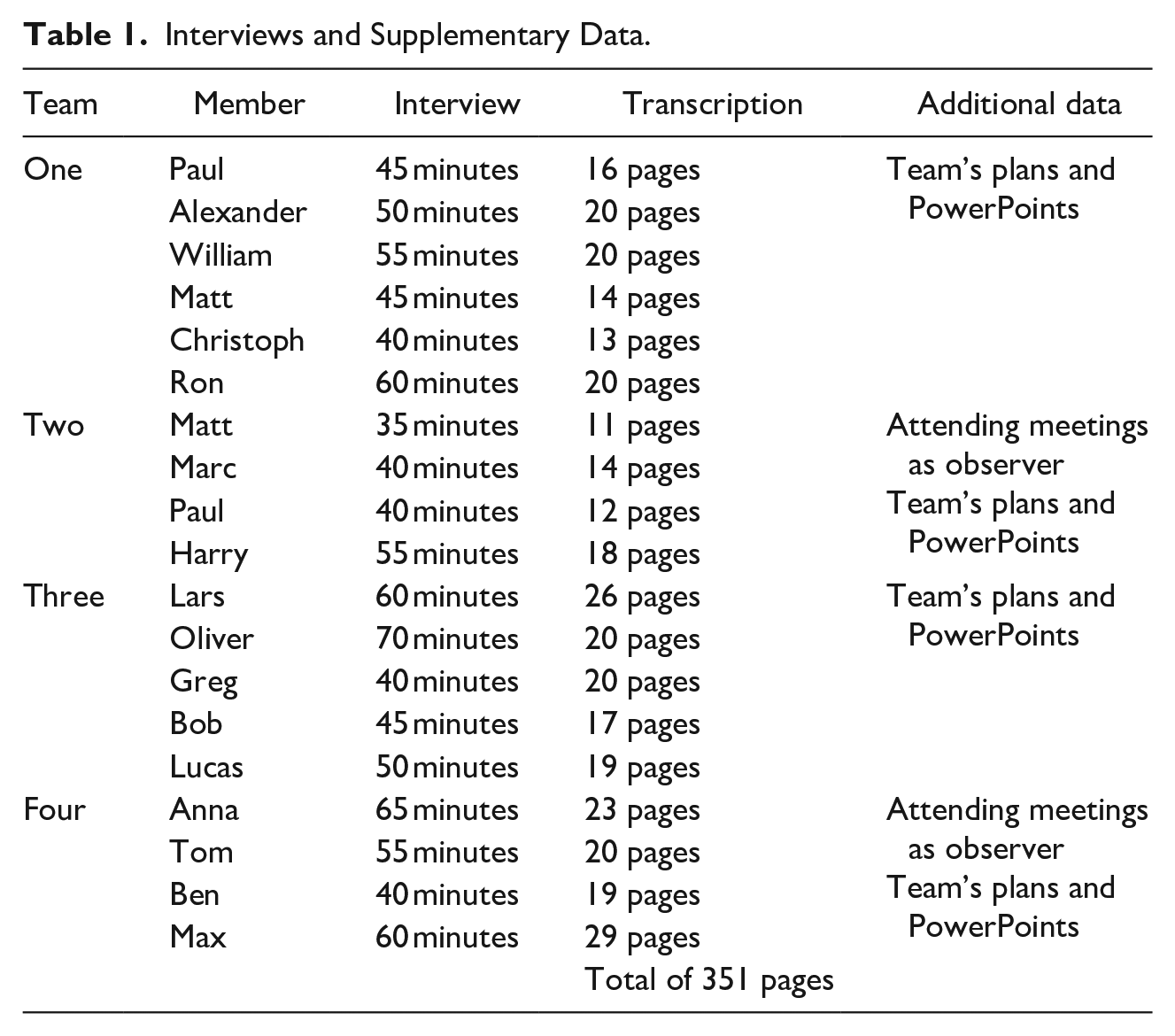
To learn about the differences that collaborators perceived as meaningful in the starting phase of their collaboration, in-depth interpretative interviews (Langley & Meziani, 2020) were conducted with all the members of four teams after their third team meeting. The four teams were selected for two reasons. First, these teams were still at the start of their collaboration when we gained access to the initiative. Second, we obtained consent from all members only in these four teams. Nineteen interviews were conducted, ranging from 35 to 70 minutes. They were audio-recorded and transcribed verbatim, totaling 351 pages of single-spaced transcription (Table 1). Further, we drew on team documents (collected from databases) and field notes from team meeting observations (allowed in two teams, made by the first author) as supplementary data sources (Table 1).
Interviews and Supplementary Data.
We used an ego-network adaption to elicit perceptions and interpretations regarding member differences. In this technique, an individual (‘ego’) maps focal others (‘alters’) around him or her (Crossley et al., 2015; Van Waes et al., 2016; Figures 1 and 2). For our interviews, we framed the network’s circles as reflecting the degree of otherness between the interviewee and his or her team members (the most outer ring representing the highest dissimilarity; whether otherness was seen as helping or hindering remained open at this point).

Sketch of a blank ego-network.
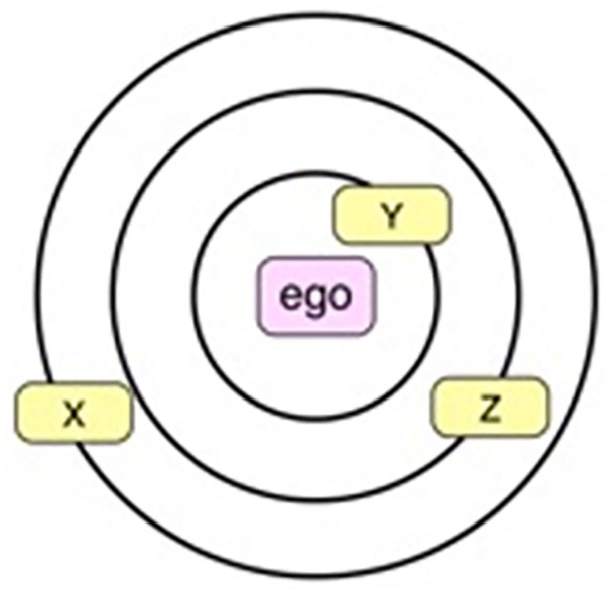
Sketch of a labeled ego-network.
All interviews were conducted by the first author. The interviewer explained the ego-network approach, asked interviewees to write down team members’ names on sticky notes (these names and organization or place names were later pseudonymized), and invited participants to place the labeled sticky notes onto a DINA3 printout of a blank ego-network. Alters’ positions were then examined along a semi-structured interview guide, which also included questions on teams’ general functioning, such as Can you explain to me why you have placed [person] in this position?, What differences come to your mind when thinking about [person]?, What do these differences mean for your team’s work and success or failure?, or How is your team doing in general? The interviewer ensured that conversations proceeded naturally and allowed room for exploring subjects as they were relevant to the interviewees. To ensure that the set-up was clear, we conducted three pilot interviews in teams that were part of the same initiative but not included in our actual data collection.
Data Analysis: A Phronetic, Iterative Approach
We used a phronetic, iterative approach (Tracy, 2020) to analyze our empirical material. This approach seeks to develop practically relevant knowledge by iterating (i.e., going back-and-forth) between research questions, empirical materials, and literature. Rather than generating universal or highly abstracted insights, this approach seeks to spur dialog and reflection between the practical phenomenon inquired, the data, and previous literature, eventually resulting in novel, relevant, and contextually grounded knowledge. In the following, we describe the main steps we took throughout our analysis.
Familiarization and thick descriptions of team characteristics
Analysis began with intense familiarization with the interview dataset. All transcripts were produced by the first author and repeatedly read within the author team. First impressions were shared and discussed. Besides a variety of differences mentioned by the interviewees, some interviewees talked about collective team goals while others only listed individual (organizational) objectives; some interviewees described their team as interdependent while others provided more independent depictions. Thus, we created a thick description for each team, delineating important team-level characteristics as they were expressed in the interview transcripts as well as in team documents and field notes (e.g., was there a team goal? How was the collaboration described? Were members enjoying the work?). The same task was given to a research assistant to control possible differences in understanding. Thick descriptions were compared afterward to check for inconsistencies, but no major ones were spotted.
Identifying perceived differences and unpacking members’ sensemaking
We then proceeded to our research questions: Which differences do interorganizational team members perceive as meaningful when starting to collaborate, and how do they make sense of this otherness as helping or hindering their collaboration?
We filed all interview transcripts into computer-aided qualitative analysis software (Atlas.ti) and marked every passage where a difference was mentioned. We used a bottom-up approach and in vivo coding (Saldaña, 2016) to examine differences, allowing us to stay close to interviewees’ subjective perceptions. Analysis and in vivo coding proceeded team by team, member by member (applying a total of 592 in vivo codes). Once a team was completed, we produced narrative accounts of the differences mentioned per member. These accounts included details on how differences were interpreted and valued.
The first author and the research assistant independently analyzed the narrative accounts and then crosschecked their understandings. It was found that otherness was perceived as either helping or hindering collaborative practice. For example, interviewees would describe a difference in experience as a helpful enrichment for their learning, while narrow expertise was assessed as a possible complication. To account for these valuations more systematically, we revisited all transcripts and coded differences as “enrichment/helping,” “complication/hindering,” or “neutral” (when no specific valuation was given).
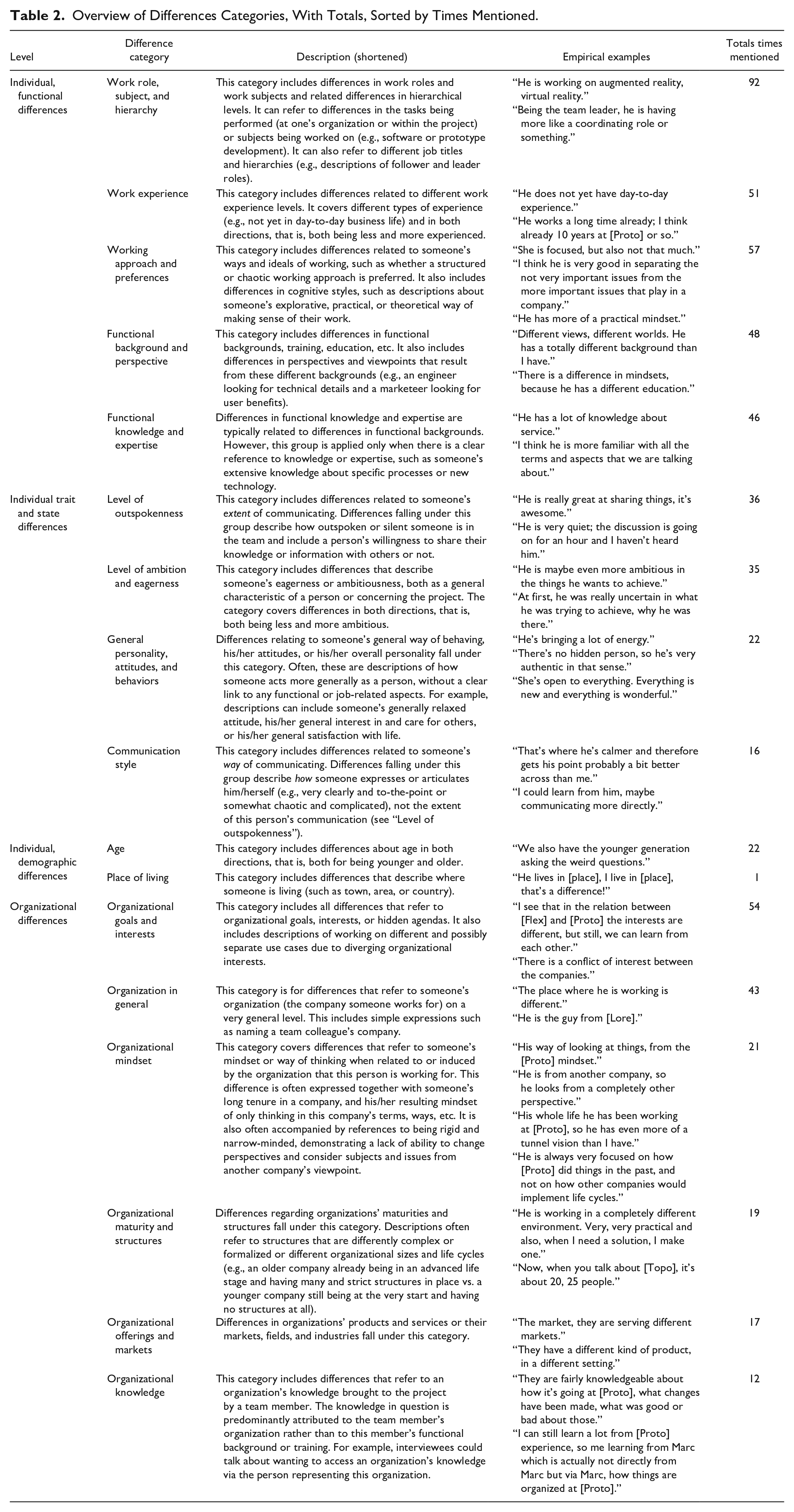
In our next step, we grouped similar or related differences. We began by semantically and thematically clustering in vivo coded differences (e.g., grouping “creative,” “creative mindset,” and “creative ideas”) and then abstracted broader categories. Abstracting was guided by literature and formerly established categories (e.g., Baumann and Bonner’s (2013) elaborations on expertise, Edmondson and Harvey’s (2018) conceptualization of knowledge diversity, Faraj and Sproull’s (2000) elaborations on knowledge and expertise, Jørgensen et al.’s (2012) writings on cultural, structural, and industry differences between organizations, Mannix and Neale’s (2005) groups of age, education, functional knowledge, and experience, Mohammed and Angell’s (2003) elaborations on personality heterogeneity, Oosterhof et al.’s (2009) clusters of seniority, extraversion, approach to work, and task-related expertise, van der Vegt and van de Vliert’s (2005) conception of skills dissimilarity, and Williams et al.’s (2007) work style dissimilarity). Moreover, abstracting was informed by conceptual connections that interviewees themselves made (e.g., distinctions in organizational markets or industries were typically named with product or service offerings) and confirmed by the interviewees. This resulted in a distilled set of 17 categories of differences (Table 2). For further overview, we sorted these 17 categories by their focal level into four second-level organizing groups: individual (split into functional, trait or state, 1 and demographic) and organizational.
Overview of Differences Categories, With Totals, Sorted by Times Mentioned.
To validate the logic of these 17 categories, we hired a second research assistant to assign 1 of the 17 categories to each passage that we marked as mentioning a difference (across all interview transcripts, supported by a codebook). We also asked the research assistant to code whether a difference was described as “enrichment/helping,” “complication/hindering,” or “neutral.” The assistant initially coded eight interview transcripts (two per team), resulting in a simple percentage agreement of 79.6 and a Krippendorff’s α of .672 (compiled in Atlas.ti). We discussed deviations afterward and refined the codebook. The assistant then coded the remaining 11 transcripts, resulting in a simple percentage agreement of 88.6 and a Krippendorff’s α of .820. Deviations were again discussed and resolved. Chi-square analyses were carried out to understand better what categories of differences were most often perceived as helping or hindering collaborative practice.
We then zoomed out from the member onto the team level. We produced four narrative descriptions (one per team), each with a list of the most salient difference categories as well as team members’ valuations and interpretations. To get a fuller grasp on why differences were valued as helping or hindering, we iterated back to the interview transcripts and our initial, member-based accounts to add details of members’ meaning-making practices around the differences they perceived. Thus, we increasingly turned toward the second part of our research question and more profound understandings of how members made sense of their teams’ otherness.
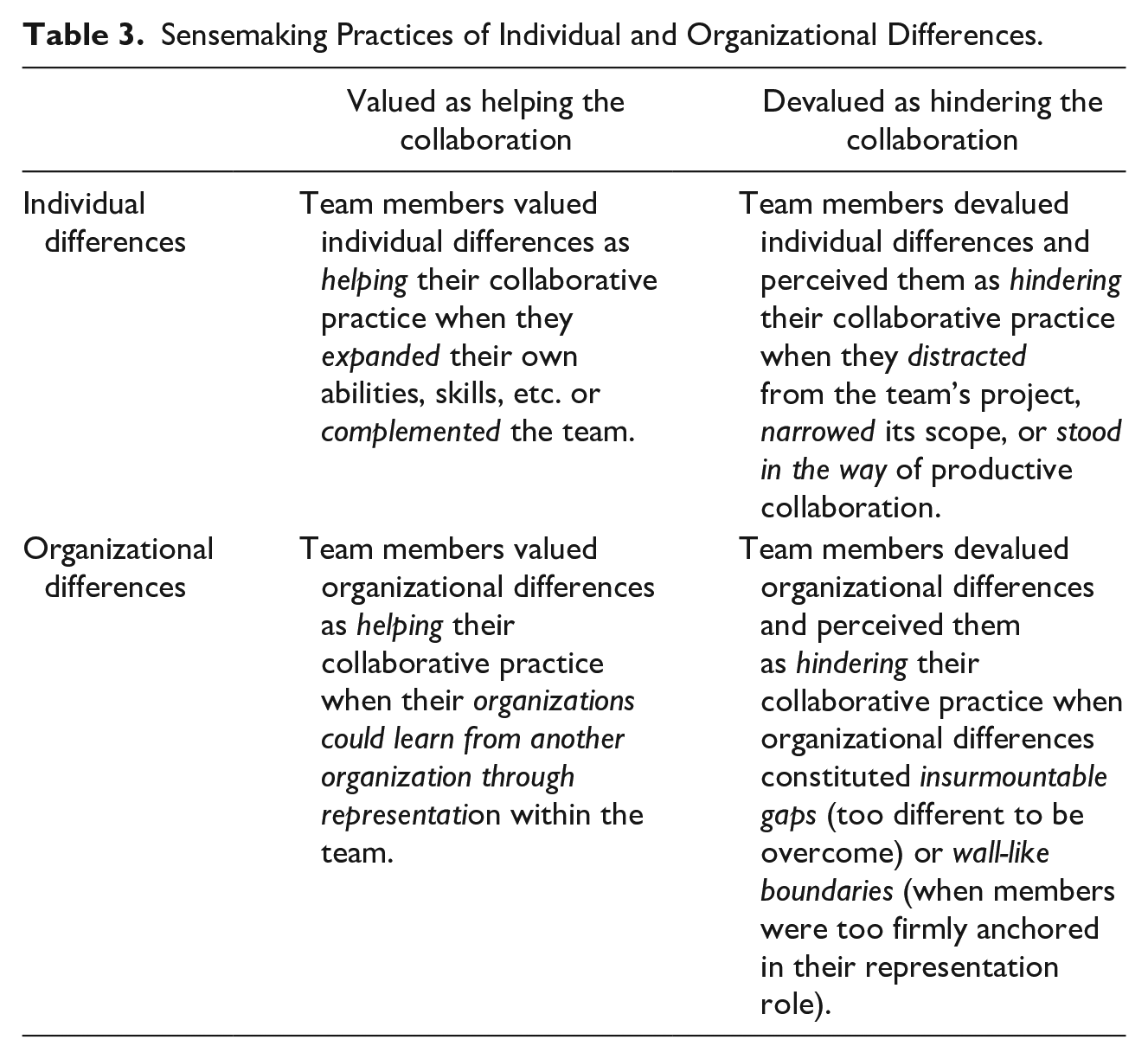
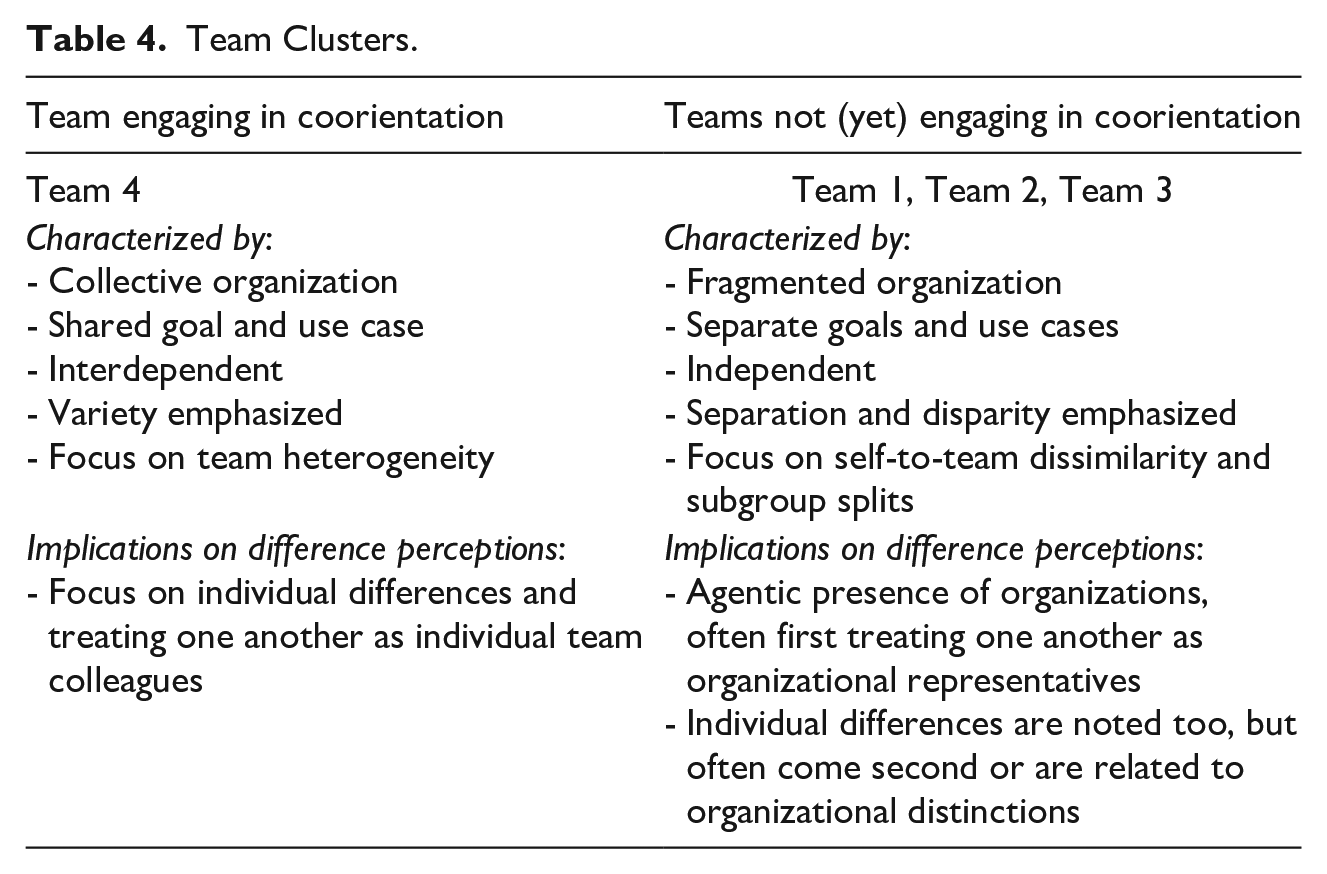
We expanded and refined the narrative descriptions until each description provided a rich and rigorous depiction of the perceived differences and team members’ interpretations. Through subsequent reflection and comparisons across the teams, we abstracted our insights into four primary sensemaking practices (Table 3). We further noticed that the narrative descriptions differed on whether “separation” or “variety” (Harrison & Klein, 2007, p. 1199) were foregrounded and on the focal point(s) that dominated the accounts (self-to-team dissimilarity, subgroup splits, or team heterogeneity; Shemla et al., 2016). Therefore, we returned to the team thick descriptions we created during data familiarization, this time examining them for commonalities and distinctions. We grouped the four teams into two clusters (Table 4) depending on whether they were described as or as not (yet) engaging in coorientation (i.e., the process of aligning actions to common objectives; Koschmann, 2016). In three teams (Team 1, 2, and 3), representation dynamics outweighed coorientation dynamics; members were first and foremost acting as organizational representatives and focused on their organizations’ pay-offs, with collective team objectives coming only second. Accordingly, differences were made sense of primarily from an organizational perspective. We identified only one team (Team 4) as coorienting; here, members prioritized their collective goals and considered one another predominantly as team colleagues rather than different organizational representatives. Hence, differences were perceived and interpreted from a more team-led perspective.
Sensemaking Practices of Individual and Organizational Differences.
Team Clusters.
The following section illustrates the many differences that became salient to team members early on in their interorganizational collectives. It also elaborates in more detail the sensemaking practices and team characteristics that animated members’ perceptions and interpretations of their groups’ otherness.
Findings: Illustrations and Elaborations
Overall, interviewees talked about a range of differences (see Table 5). They mention individual differences, with a large emphasis on functional dimensions (50%), but also refer to less job-related aspects in traits or states (18%). Demographic differences are named a few times (4%) but are generally described as not relevant to their collaboration. 2 The second-largest category of differences is organizational differences (28%).
Overview of Difference Categories, With Valuation and per Team (He = Helping; Hi = Hindering; N = Neutral), Sorted by Times Mentioned.
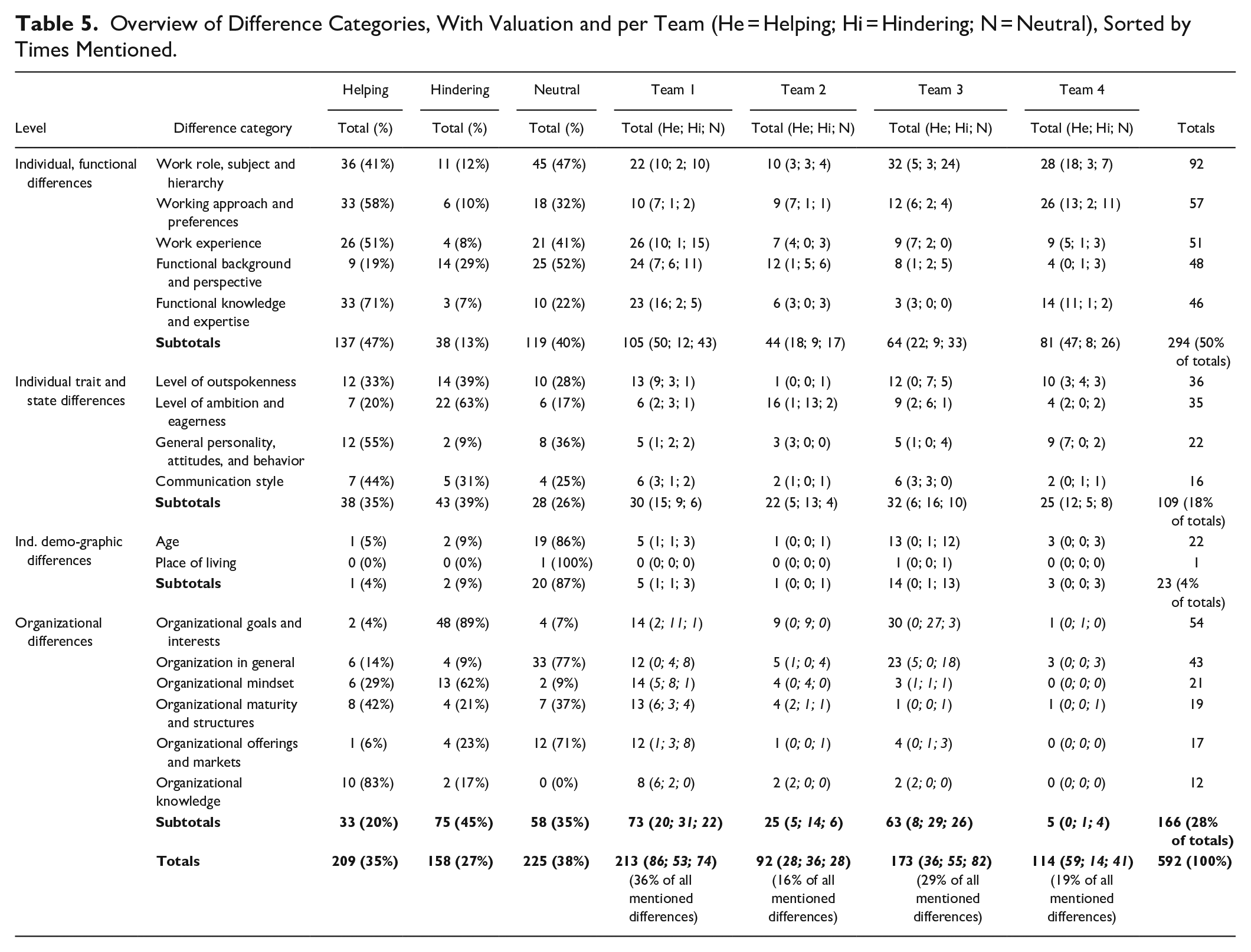
The differences diverge in how they are valued and interpreted, Χ2 (6, N = 592) = 99.37, p < .001 (see the left part of Table 5). Whereas individual functional differences are often seen as helping the collaboration (47%) and less often as hindering (13%), it is the opposite for organizational differences (45% as hindering compared to 20% as helping). We see a rather equal distribution for individual trait and state differences (39% as hindering and 35% as helping).
Individual Differences as Helping Collaborative Practice: When Otherness Expands or Complements
Individual differences are depicted as helping the collaboration when interpreted as expanding or complementing, either benefitting the individual (expanding abilities, etc. by learning from a colleague’s difference) or the team (differences complementing one another in productive ways). This is the case both for functional and trait- or state-related attributes. Further, the attributed valuations are related to specific difference categories, both for the functional differences, Χ2 (8, N = 294) = 38.02, p < .001, and for the trait- or-state-related differences, Χ2 (8, N = 109) = 17.36, p = .02. In other words, how individual differences are perceived appears to be dependent on the type of individual difference.
On broad lines, individual functional differences are often seen as helping (47%). Specifically, differences in functional knowledge and expertise are interpreted positively (71%), as well as differences in working approach and preferences (58%), experience (51%), and work role, subject and hierarchy (41%). In contrast, differences in functional background and perspective are described as helpful in only 9 out of 48 cases (19%).
For example, in Team 4, when talking about another team member’s expertise, Tom emphasized how he personally can “learn a lot from her [. . .] because [he] didn’t know anything about it before.” Similarly, in Team 1, Alexander described different levels of experience between him and his team member. Specifically, Alexander explained how he tried “to learn from guys like Paul,” using their “latest theory and different views on the world” also to keep himself “sharp.” In turn, Paul portrayed Alexander’s long experience and extensive knowledge as valuable resources for his own growth. In all three examples, the interviewees appeared to take their own abilities as a starting point and interpret their team colleagues’ differences as helpful when the differences help expand their abilities. It is further noteworthy that Paul grounded his perceptions and interpretations of the differences between him and Alexander in the team’s situated collaboration: He has lots of knowledge [. . .] I admire him for that; he is really great at sharing things; if you ask him any question, he most likely has an answer, and he can always back it up with research or a test he has performed.
Functional differences are also interpreted as helping when they complement each other in fruitful ways. The interviewees took their collective as a starting point for their sensemaking of differences: it is not about how one difference can expand one’s abilities but more about how a combination of differences strengthens and supports each other. For example, when talking about their functional backgrounds, Ron (Team 1) explains how his and Paul’s distinctions combined lead to rich input for their joint work. Specifically, Ron explained how Paul “has more of a business background,” “thinks differently on subjects,” and hence brings “ideas that I wouldn’t think of” to the group. Similarly, in Team 2, Oliver and Lars’ descriptions of one another emphasize the positive effects of their complementary roles within the team. Oliver expressed: We have different functions, focus points [. . .] he’s thinking about the current, I’m thinking about the future; so, I generalize [. . .] and he has the daily headache about all kinds of practical things which I like to forget.
Some interviewees focused on project-specific work roles. For instance, in Team 4, both Anna and Tom highlight Ben’s function within their group: Ben is “the planner, the scheduler, keeping track of what everyone does,” as Anna phrased it, or “the manager of the team [which] is very valuable,” as expressed by Tom. In contrast, Anna and Tom were more concerned with the project’s content. For example, when describing another team member, Max, Tom said, “He is very practical, so where Anna, Ben, and I are academical, he’s practical.” Tom emphasized again that their otherness is “additive” when he explained how Max’s practice-driven approach helped them not lose sight of the “day-to-day applicability” of ideas.
Interviewees also talked about individual trait or state differences. Specifically, distinctions in general personality, attitudes and behavior (55%), and communication style (44%) are valued as helping collaborative practice. For example, in Team 2, Marc remarked on Harry’s upbeat and energetic vibe, which helped make their work more dynamic and enjoyable: He is more positive than I am ((laughing)) a more energetic appearance; it’s always great to work with that sort of people.
Other interviewees mentioned their colleagues’ general openness, which helps their team stay creative and explorative. For example, in Team 1, when describing Paul’s personality traits, William said: “He is not bound by any boundaries, very free in how to think.” Similarly, in Team 4, Anna also appreciated Tom’s openness (“He is like, oh, that’s also possible, oh, I just picked that up; and it’s a really good thing”) and described a situation in which Tom could make sense of an Excel file that was “just a weird record of things” to her and the others thanks to his open and creative mindset.
Individual Differences as Hindering Collaborative Practice: When Otherness Narrows, Distracts, or Stands in the Way
Individual differences are depicted as hindering the collaboration when perceived as distracting other members from the project, strongly narrowing conversations, or standing in the way of productive collaboration. This is the case both for functional and trait- or state-related attributes.
One category of individual functional differences that is often perceived as hindering the joint work is functional background and perspective (interpreted negatively in 29% of all mentions). This is especially the case when team colleagues are unwilling to reason beyond their functional viewpoints, often leading to narrow and overly specific discussions. For example, in Team 2, both Marc and Harry explained how they experienced difficulties understanding Matt, who was firmly locked up in his functional domain. Marc described: He is very much driven by technology, his own interest [. . .] when I work with him, I need to be constantly aware of whether we are really talking about the same thing or if we mean something completely else.
Additional complications emerged from differences in work role, subject and hierarchy, or members’ working approach and preferences (assessed negatively in 12% respectively 10% of all cases). For instance, Harry expressed the following about Matt: What he is working on is so different, it is hard to get the point. Like, I think you mean that and then it’s, ah, no- no- no, that’s not the point, so it’s hard to get on the same page.
In addition to otherness narrowing the team’s perspective, sometimes it caused distraction. For example, in Team 3, Lars remarked that Greg’s complex reasoning distracted his colleagues from the main discussions by bringing up “one problem to the next problem and the next problem,” with Greg himself “drowning in his own problems.” Similarly, in Team 4, Ben explained how Tom’s “tendency to always think in a staggered way, to always explore everything which is around” led their team from one idea to the next. Ben’s negative interpretation of Tom’s openness and his explorative mindset contrasts Anna’s positive explanations (as described before). Thus, the same difference can be made sense of in opposing ways, showing the situated intricacy of working with differences.
Other aspects that complicated the collaboration concern individual trait- or state-related differences. Specifically, distinctions in level of ambition were interpreted as standing in the way of collaborative practice (assessed negatively in 63% of all cases). For example, in Team 2, Paul lamented that Marc “doesn’t seem to be investing much time into the project,” which he perceived as “just letting go.” Similarly, in Team 3, Oliver identified a lack of passion in Bob: With the others, you see that there is a form of initiative, of “I want to solve a problem.” And when I look at him, uhm, he doesn’t, he doesn’t want to.
In addition, lacking outspokenness (39%), differences in communication style (31%), or general personality, attitudes and behavior (9%) also complicated and hindered productive collaboration. For instance, when describing Bob, Oliver said: He is very quiet. The discussion goes on for an hour, and I haven’t heard him. What he tells are sensible things, maybe solutions, but it’s very limited [. . .] the relation is not that fruitful.
Another example is found in Team 1, where William and Alexander portrayed Ron as lacking social abilities, even though he contributed valuable content expertise. William described: Projects like this rely on social aspects, but he kind of struggles with that [. . .] when I want to ask him a quick question, it doesn’t work, I don’t know why, but it feels passive, kind of awkward, and that’s on a social level.
Alexander provided an interesting account when describing Ron’s lacking social skills, clearly illustrating the friction he perceived in the team: There are moments that he loses the connection with the meeting, with us [. . .] sometimes I think, okay, are you still here with us?
This, again, demonstrated how interviewees grounded their perceptions and interpretations of differences in the context of their shared interactions.
Organizational Differences as Helping Collaborative Practice: When Learning Happens Through Representing
Generally speaking, organizational differences are more often seen as hindering (45%) than helping (20%) collaborative practice, although implications depend on the category of differences, Χ2 (10, N = 166) = 129.62, p = <.001. For example, differences in organizational knowledge (83%) and organizational maturity and structures (42%) are often seen as assets for the team.
On broad lines, organizational differences appear to be valued favorably when organizations learn from one another through representation dynamics. Rather than combining complementary strengths for collective advancement, the advantage lies in improving the skills and abilities of one’s own organization. In Team 1, Alexander’s statement about his team colleague Ron and his organization’s more practical structures illustrates this dynamic: What I want to learn from him and from all the [Flex] people is, okay, they are in a very practical organization, how do they maneuver in such an organization, in relation to the very complicated and strict organization that we have. I want to learn from them, okay, how is it working in such a company? What can we learn from that?
In Alexander’s recount, the focus changed from talking about individuals (“what I want to learn from him”) to speaking about companies (“they are in a very practical organization [. . .] What can we learn from that?”). His statement describes how organizations can learn from one another in interorganizational collectives, and it also draws attention to the important representation dynamics present in such groups.
Similarly, in Team 2, Harry’s elaborations on Marc and the mature structures of Marc’s company also illustrate these learning-through-representing dynamics and demonstrate organizations’ preeminent presence. Like Alexander, Harry referred to his organization (“us,” “we”), showing that team members treat one another first and foremost as a means of organizational learning—learning occurs “via” the individuals that represent them: [Flex] can still learn a lot from [Proto], so me learning from Marc which is actually not directly from Marc but via Marc, how things are organized at [Proto] [. . .] it is us learning from [Proto], and [Proto] hopefully learning from our out-of-the-box ideas as we’re much younger.
Some interviewees explained that they participated in their team mainly to better understand other organizations’ languages, cultures, etc. For instance, in Team 1, Matt shared that he joined the team “so that there is someone within [Topo] to understand the language of other companies,” a rationale that is likewise present in Lucas’ account (Team 3): “For us, it is important to understand how companies like [Lore] think.” Members appeared to be seeking to generate knowledge about other organizations for their own company, as it also occurred in Team 2, indicated by Harry’s elaborations: Understanding how their company works, it’s really a small world in itself; we want to understand how that party, kind of like an animal, a political entity, how that is built up.
Organizational Differences as Hindering Collaborative Practice: When Distinctions Become Insurmountable Gaps or Wall-like Boundaries
Organizational differences complicate collaboration when individuals are only anchored in their representation roles (i.e., thinking exclusively from their organization’s perspective and not coorienting toward collective team goals) or when members do not perceive benefits from working with other organizations due to extensive otherness. Organizational differences are perceived as hindering when they either constitute wall-like boundaries or insurmountable gaps. This is relatively more often the case with differences in organizational goals and interests (89%) and differences in organizational mindsets (62%).
An example of how organizational differences can constitute wall-like boundaries is from Team 2, when Paul described Matt: He often starts speaking very much from what [Topo] does; sometimes it is difficult to follow (. . .) because he is in this software world, that’s such a different world, the whole company, the culture, his way of thinking, his starting points, that’s all simply completely different.
Paul described how Matt’s way of thinking was strongly driven by his organization, which impeded productive exchange. This is supported by another person on Team 2, Alexander, whose elaborations add further evidence to this friction when he explained how he had “completely no match” and “was lost within two minutes” when Matt pitched his company’s product, “only presenting tiny little details about this solution was built.”
Paul also depicted Marc as “very much locked up in his company” and taking “completely his perspective onto the things we discuss,” which caused “distraction in the communication.” Similarly, he described Christoph as “mostly talking about how things work at [Proto]” and as “having difficulties to change perspectives.” In particular, Paul invoked the analogies of “[Proto] glasses” and “eye patches” to convey the significant implications of how Christoph’s organization culture biased his point of view. Another example is demonstrated by Ron, in Team 2, when he spoke about Alexander’s “tunnel vision” and explained how Alexander matched the image of the “typical [Proto] guy”: He doesn’t look very objective or with a broad view, not really into how other companies, other people would approach things.
According to Ron, “a wall to what’s going on the rest of the world” emerged between Alexander’s organization and its surroundings, which also materialized in team meetings and activities. The following statement given by Paul powerfully summarizes the problematic consequences of an overly strong organizational mindset: Company culture, how things go, without you realizing that becomes some sort of automatism, and if the person next to you does not have this automatism, then things go wrong, quickly [. . .] but it’s difficult to say when you have this automatism or not, it’s such a fluid, intangible thing.
Besides constituting wall-like boundaries, organizational differences can also lead to insurmountable gaps—when organizations differ to such an extent that their representatives cannot find any common ground, and no basis for collaborating can emerge. For instance, in Team 1, Alexander vocalized his worry about possible frictions resulting from different levels of maturity: The main worry that I have is that [Flex] has just started a service department, [Topo] they don’t have such a department, and we are working for decades with such a department. That’s a main difference that we must be aware of.
Alexander’s recount is supported by Christoph’s elaborations, which also detailed the different levels of maturity and their implications, including the differences resulting in diverging organizational goals and interests. Both Alexander and Christoph acted as spokespersons for their organizations, arguing and making sense of the differences they perceived predominantly shaped by the perspectives of their organizations: All companies are at really different levels, like completely, the focus is completely different for each company. So, it’s really difficult to communicate; the focus that we have for [Proto] is really on third-party hardware and software, whereas that’s not really an issue for one of the other parties. You’re not really doing the same thing.
In Team 2, Marc and Harry talked about possible conflicts of interest between their organizations. Specifically, Marc stressed that the conflicts are solely organizational (“not personal ones, but from the organizations”), explaining that his and Harry’s organizations are pursuing incompatible goals, which is supported by Harry’s elaborations, where he essentially equated the organizations with their representatives: “There are differences in ambitions between [Flex] and [Proto], so me and Marc basically.”
The Big Difference? Coorientation Versus Representation Dynamics
Results of our analysis showed that team members brought up a breadth of differences at the early stage of their collaboration, including both individual and organizational differences. A closer examination of team characteristics reveals that the teams differ in what differences are mentioned, Χ2 (9, N = 592) = 62.15, p < .001, and in how the differences are assessed and valued, Χ2 (9, N = 592) = 43.48, p < .001. Organizational aspects were mentioned almost exclusively by members of teams that are not (yet) engaging in coorientation (Teams 1, 2, 3); that is, these teams were not (yet) seeking to align actions to shared goals (Koschmann, 2016). Representation dynamics dominated in these teams, explaining why organizational differences were highly salient, whereas individual attributes were relevant in both the coorienting team (Team 4)3 and the teams that were not (yet) coorienting.
When the team is coorienting: A focus on individual distinctions
Members of the coorienting team (Team 4) described their group as one collective, talked about a single, shared use case, and depicted their team roles as interdependent. For instance, Tom described the team as “very integrated, and we all have specialized roles,” while Ben explained how members “all have different kinds of competencies which contribute in different ways to the project.” Members enjoyed their joint activities. Max, for example, described their work as “professional fun” and emphasized how much he enjoyed working with his team colleagues. Anna’s descriptions overlapped with Max’s. In particular, she valued that “all people in the team think it’s interesting” and that they “all put in effort.”
In line with members’ coorientation efforts, members took their joint project as their vantage point when perceiving and making sense of member differences and predominantly focused on how individual skills, abilities, etc. can or cannot be combined for the team’s activities or their own development. In many ways, members were interested in and attentive toward how their team colleagues differed as individual professionals (in terms of skills, functional backgrounds, etc.) or on a personal level (regarding personalities, attitudes, etc.), interpreting the differences they perceived from the perspective of how the team, as a collective, can benefit the most. In much contrast, organizational attributes were paid less attention to and got mostly backstaged; members spoke as team members or individual professionals much more than as representatives of organizations, which influenced which differences they noticed and how they interpreted the differences.
When the team is not (yet) coorienting: Individual and organizational distinctions
The more loosely coupled teams (Team 1, 2, 3) were characterized by a more fragmented structure and set-up. Members pursued their own goals and thus developed separate use cases to work on, with little to no effort to form a collective team goal. For example, in Team 1, Ron described: Every company has its own goals [. . .] it is more like three different discussions, but not one thing, one goal.
In line with this loose set-up, team roles were generally described as independent; members “do not necessarily need each other to reach their goals,” as Lars (Team 3) put it, or “the team is vaguely formulated and loosely coupled,” as articulated by Oliver (Team 3). Some interviewees hence questioned whether their team “can really become one collective” (Paul, Team 2) or can “achieve its goals” (Greg, Team 3).
Overall, each team member’s organization came first in these teams; organizational interests dominated the team’s planned activities, organizational goals co-existed without being integrated, and often interviewees referred to their and others’ organizations instead of speaking about individual team colleagues (or talk as the representative of their organization, as we have shown before). This points at organizations’ preeminent and agentic effects. Much of members’ perception and sensemaking of their team’s otherness was driven by the organizations that figuratively stood behind them and biased their point of view. In particular, members put their own organizations first when forming initial understandings and interpretations of their team; thus, organizational characteristics became highly salient. Individual distinctions were noticed, too, but often only after organizational differences were mentioned or in combination with an organizational aspect, such as when a team member’s strict and rigid thinking is explicitly linked to corresponding organizational structures (e.g., “Greg has his own strict rules, but maybe also because [Proto] has stricter rules,” said Lars, Team 3). Members acted primarily as representatives of their organizations instead of as team members that organized around collective objectives, which shaped the differences members perceived and how they made sense of the differences, just as is the case with a focus on individual differences in the coorienting team.
Discussion
We examined and illustrated which differences are perceived as meaningful at the early stage of interorganizational teamwork, why and when they are interpreted as helping or hindering collaborative practice, and finally, how team coorientation or representation dynamics can influence these perceptions and interpretations. In the following, we delineate how a sensemaking perspective can complement current ambitions of studies on perceived otherness. Furthermore, we delve deeper into conversations on coorientation and representation dynamics (Koschmann, 2016) and link our work to the recently sketched concepts of distinctive and differential belonging (Davis et al., 2022). We end by outlining possibilities for future research and practical implications.
Making Sense of Member Differences
Our findings offer an insider view and sensemaking-inspired perspective on the differences that affect interorganizational collaboration, providing an understanding in greater breadth of the attributes that are salient and unpacking in more depth the value and meaning that collaborators attach to the differences. Together, this study provides novel insight into when and why otherness is interpreted as beneficial or disadvantageous—or as perk or peril.
Overall, members noted ample distinctions, including both job-related and non-job-related aspects, as well as both individual and organizational differences. Our work therewith corresponds with findings on the multiplex nature of perceived differences in teams (Oosterhof et al., 2009). Noteworthily, many of the specified aspects fall under the broader cluster of nonvisible or deep-level differences, even though teams were just commencing their collaboration. While Oosterhof et al. (2009) also found more nonvisible and deep-level differences than surface-level differences, they studied professionals with an average of 2.31 years of team tenure. Our findings extend their insights insofar as demonstrating team tenure is not relevant to how individuals perceive deep-level characteristics that cause differences. This also contradicts earlier research findings that visible characteristics are more prevalent than nonvisible ones during initial interaction stages (Harrison et al., 1998, 2002). Our findings show that tenure is not a determinant of whether people notice a vast breadth of differences between team members.
Our findings further extend previous work by accentuating organizational attributes as an essential category of distinctions. When making sense of their team’s otherness, collaborators did not only regard one another as individual team members but also as organizational representatives (Hardy et al., 2005; Lewis et al., 2010; Rockmann et al., 2007). This insight challenges the dominant method of categorizing otherness attributes and contextual dimensions as mutually exclusive variables. Our findings support the proposition that what a team member brings to the table is not solely their individual characteristics but contextual features of their daily routines also matter (Akkerman et al., 2006). In other words, environmental differences are meaningful and can be perceived as otherness (see also Trittin & Schoeneborn, 2017).
Hence, our findings underscore the necessity for research to move beyond visible or individual differences (Oosterhof et al., 2009; van Knippenberg & Schippers, 2007). We need more holistic studies of what is perceived as otherness, which means that deep-level attributes (both job-related and non-job-related) and broader environmental aspects must be considered. This is an increasingly relevant undertaking, with teams spanning various contexts (organizational, disciplinary, departmental, industrial, etc.) in a progressively complex, flat, and connected corporate world. Given the complexity of workplace diversity, it is important to understand better how the otherness that emanates from settings of diverse contexts plays into the functioning of our workgroups. With its firm grounding in real-world settings, situated enactments, and contextual (albeit extracted) cues (Weick, 1995; Weick et al., 2005), the sensemaking approach that this paper has taken offers future research a helpful apparatus and vocabulary in understanding otherness.
In addition, a sensemaking approach is also a useful framework for understanding ambivalent implications of workplace differences (e.g., Bunderson & Van der Vegt, 2018; van Knippenberg & Schippers, 2007; van Knippenberg et al., 2004). Inconclusive findings suggest that it is insufficient to only generalize main effects; we need insights into differences at the workplace that are richer, deeper, and more contextualized. Through sensemaking, we can identify a number of meaning-making practices to understand when and why otherness is (de)valued. Instead of developing practical recommendations based on categorizing a singular attribute as beneficial or hampering, a sensemaking perspective provides a better framework because it first maps the range of differences perceived by professionals themselves and subsequently apprehends their interpretations of how these differences matter. The sensemaking approach would also allow us to understand better when and why different persons perceive the same characteristic differently and to comprehend in more granularity to what extent differences are considered more or less helping or hindering—rather than binarily categorizing differences into either helping or hindering.
A sensemaking angle provides a novel approach to understanding how otherness is perceived subjectively when studying member differences. This approach expands insights beyond “noticing or perceiving cues” to the subsequential practices of “creating interpretations” (Maitlis & Christianson, 2014, p. 59); hence, it can thoroughly address “how people appropriate and enact their ‘realities’” (Brown et al., 2015, p. 265). Sensemaking is thus a promising research method in response to Shemla et al.’s (2016) call to start pursuing different questions and offering new answers when researching perceived otherness; it opens up new research opportunities, from charted indexes about what differences are noted to the richer and more textured understandings about how they are interpreted and made sense of.
Coorientation and Representation and Differential and Distinctive Belonging in Interorganizational Collaboration
Identity issues are a topic commonly seen in sensemaking research, given that identities can greatly influence how people interpret life experiences (Brown et al., 2015). Weick (1995) stipulated that sensemaking is typically grounded in selected cues only and rests on plausibility rather than accuracy. As our findings have shown, whether one identifies as an organizational representative or a team member can profoundly impact how they make sense of otherness: An individual acting as an organizational spokesperson and a member who identifies with their team will interpret otherness differently.
Specifically, our findings indicate an apparent tension between coorientation and representation dynamics within interorganizational collaboration. At one end, when teams seek to align their goals (i.e., when they engage in coorientation; Koschmann, 2016), collaborators are more likely to think and act primarily as team members, sufficiently distancing themselves from their organizations (Cartel et al., 2019). They pay attention mostly to individual differences and make organizational commitments and considerations a lower priority. At the other end, when team members are pursuing separate objectives rather than trying to align their actions, collaborators remain ‘anchored’ in their roles as organizational representatives (Cartel et al., 2019), organizational positions are prioritized over shared interests (Rockmann et al., 2007), and use cases are aggregated rather than integrated; thus, organizational differences are more prominent in these groups. While Koschmann’s (2016) work associates organizational differences with failure, with a more nuanced approach, our findings provide the insight that, even when organizational representation prevails, (inter)actions that are not genuinely collaborative can lead to beneficial outcomes instead of failures, such as when organizations learn from (through) one another.
In many ways, professionals working in heterogenous, difference-filled teams need to be able to unite, coordinate, and collaborate through their otherness (Farchi et al., 2022). Davis et al. (2022) have therefore argued that groups need to move from what they call “differential belonging” toward “distinctive belonging” (both p. 91). The former stresses becoming aware of differences, but it generally results in separation as it does not stretch beyond recognizing otherness. In contrast, distinctive belonging seeks to sensitize team members to the particular benefits of their differences, thereby spurring unity and collectiveness and making a group “more groupy” (Meneses et al., 2008, p. 496; italics in original). In the groups we studied, we saw a form of differential belonging in the three teams not (yet) engaging in coorientation and a form of distinctive belonging in the one team that cooriented. Echoing sensemaking’s expositions on identity and extracted cues (Weick, 1995; Weick et al., 2005), what a person perceives is often determined by what their goals are. This paper’s final section translates these premises and findings into a practical recommendation.
Future Research Directions
Multiple paths for future research can be derived from our work. For example, future research can study how perceptions and interpretations of differences develop over time, possibly mapping spill-over effects (i.e., how initial impressions influence later ones) or documenting more nuancedly when specific attributes decrease in salience while others become more relevant. For instance, while many deep-level attributes were brought up by our interviewees, attributes relating to culture or religious beliefs were not mentioned—future research can explore whether it is because our study examined the early collaboration phase or whether cultural and religious attributes in general are not relevant in work settings. 4 Moreover, future research can scrutinize the effects of surface-level differences such as age or gender in a more nuanced manner. While these differences were not brought up frequently in the present study, they might have contributed to the perception of other differences implicitly (Phillips & Loyd, 2006). The reason why surface-level differences were rarely mentioned is perhaps that interviewees perceived that these differences have minimal impact on collaborative practice. Another explanation as to why interviewees did not mention surface-level differences could be that they wanted to be politically correct and to appear unbiased, or because they considered these differences superficial and instead sought to demonstrate more thoughtfulness and reflection in their answers by bringing up deeper-level differences.
For future work, it would also be interesting to study salient differences through a network perspective to understand how they are associated with each other. For example, what differences are regularly brought up together? How precisely are they nested, connected, or interrelated? To tap into unconscious bias, researchers should also explore how differences such as age or gender are implicitly mentioned. Future research can also examine both differences and similarities (Phillips et al., 2006; van Emmerik & Brenninkmeijer, 2009) through a network perspective. For example, how does the presence of one or multiple similarities influence the interpretations of certain differences? Can frictions that emerge from differences be reduced by similarities?
A sensemaking approach could furthermore help researchers explore the exact ways through which otherness comes into play in actual interactions. Our findings indicate that, similar to team member roles, perceptions and interpretations of differences are grounded in situated conversations and what was happening at the moment (Lehmann-Willenbrock et al., 2016). Further examining how perceptions and interpretations of differences occur in these conversations could potentially lead to much richer accounts of what kind of differences are salient, why, and how significant. In addition, the implications of differences could be observed as they transpire in real-time, which could greatly complement prospective or retrospective sensemaking accounts. Eventually, this might enable researchers to point to the performative effects of differences as interactions unfold, which could open up a promising new line of inquiry: How can we spot otherness in interactions? What are the actual (not just expected or recounted) effects of differences? Could we, in fact, observe how differences narrow or distract conversations, how they stand in the way of collaboration, or how they complement or expand one another? Is it possible to observe it when organizational distinctions form wall-like boundaries?
Kourti et al.’s (2018) idea of positioning could be a helpful springboard when answering these questions. Whether a professional is positioned from a perspective of their organization, their profession, etc. could be traced as team members converse, which potentially enables a first grip on how otherness attributes materialize in unfolding interactions. If we focus on actual interactions, the implications of differences could also be scrutinized with more granularity. Eventually, researchers would not need to rely on self-reported reflections but could observe differences’ workings as they transpire in real-time. We consider this a promising approach for moving beyond categorizing differences as either helping or hindering and toward a more gradual account of when and why they are more or less helpful or hindering.
Finally, the insights that this article provides and its conclusions are based on only a limited number of interviews conducted in a singular setting. While this fitted our explorative ambitions of gaining in-depth and context-bound knowledge, future work can cross-check our findings in both similar and different settings (e.g., in collectives that structurally resemble the teams and setting in this study, but also in ones that have more fluid and dynamic membership, or collaborators that work together without a collaboration end date). Future endeavors can also use a larger sample size to increase generalizability. In response to the call for an active engagement approach (e.g., Sharma & Bansal, 2020), another promising path is to integrate team members more actively into research, such as asking them to review interview transcriptions, or even working with them to collect and analyze data. This can bring research forward toward more relevance and impact because it reconsiders the positions researchers grant to those they study. 5
Practical Implications
Collaborators need to wear a number of different hats, especially in interorganizational teams. A team member’s education, professional background, the department that they work at, their organization, etc. are important factors that influence how they interact with others (Gray & Schruijer, 2010; Hardy et al., 2005; Sydow & Braun, 2018). Depending on which role or perspective they prioritize, team members might perceive different attributes as important and think and act differently. Our work illustrates the variety of otherness attributes that can impact collaboration processes favorably and adversely. The knowledge of the functions of various types of otherness can potentially aid practitioners in noting a broader range of differences and in better spotting possible red flags, such as when a colleague only talks in the name of their organization instead of coorienting with the team. Knowing the important role differences play in affecting the team might help collaborators make constructive sense of their joint work and the otherness between them that they perceive. This article underscores the need to look beyond individual attributes and consider the broader, contextual aspects that professionals bring to their workgroups. Collaborators must switch back and forth between these aspects (plus other distinctions) and their collective work so that they can connect and relate based on the differences they bring together in their group. In working together, instead of thinking that differences should be blended so they are no longer distinctly identifiable, echoing Davis et al. (2022) appeal for distinctive belonging, the right mindset is that it is beneficial for differences to be salient and upheld, with solid connections established between them.
Footnotes
Acknowledgements
The authors wish to thank Monique Docter and Prof. Dr. Ton de Jong for their helpful feedback. They also wish to thank their editor Dr. Bret Bradley and the two anonymous reviewers for their great guidance, as well as the professionals they interviewed and observed for allowing them this rich insight into their work.
Declaration of Conflicting Interests
The author(s) declared no potential conflicts of interest with respect to the research, authorship, and/or publication of this article.
Funding
The author(s) disclosed receipt of the following financial support for the research, authorship, and/or publication of this article: This research was partially funded by the European Funds for Regional Development (EFRO) under Project Number PROJ-00729.
