




Abstract
Investigating the team adaptation process in two laboratory experiments (N = 144 teams, n = 504 participants), we found no benefits for teams with team adaptation experience (vs. without) nor for teams with external team adaptation experience (vs. with internal experience). Collective experience under routine and nonroutine conditions seems to provide teams with the resources to adapt. We further found that executing the team adaptation process did not always lead to high team performance; different team performance requirements might explain these findings. We discuss how our experimental findings can extend our understanding of team adaptation toward new boundary conditions.
Introduction
One of the most important challenges that teams face across different contexts, such as those of flight crews, police teams, healthcare, and organizational teams, is the need to adapt to nonroutine conditions. Now, more than ever, team adaptation is an essential aspect of successful teamwork (Rico et al., 2020). Teams must be able to react quickly and accurately to nonroutine conditions, such as unforeseen budget cuts, the sudden departure of a team member, or unexpected technological failure. The undoubted importance of team adaptation for team and organizational success is also evident in the substantial growth of empirical studies on team adaptation (for a meta-analytic review, see Christian et al., 2017). To summarize this research, Maynard et al. (2015) presented a team adaptation framework and pinpointed the relationship between the inputs, mediators, and outcomes of team adaptation, leveraging the input-mediator-outcome (IMO) team effectiveness framework (Ilgen et al., 2005). While inputs represent the starting conditions of a team before adapting, mediators include team processes or dynamic interactions among team members as they adapt together. Finally, outcomes reflect the task and non-task consequences of a team’s response, which can cycle back and influence team inputs or mediators. Rico et al. (2020) recently extended this team adaptation framework, incorporating conditions that may alter the way teams adapt.
Despite the importance of team adaptation, two questions remain largely unanswered: Why do some teams adapt more successfully than others? What factors and conditions influence how teams adjust their team processes and, in turn, their performance? To provide some answers, we use the team adaptation framework of Maynard et al. (2015) and empirically extend our understanding of the team adaptation process toward its inputs and outcomes. Furthermore, we investigate conditions under which the relationship between team adaptation and team performance might change. To do so, we run two laboratory experiments. In the first experiment, we examine whether the team adaptation process is influenced by team adaptation experience and whether the team adaptation process, in turn, impacts team performance. In the second experiment, we explore whether the type of team adaptation experience alters the relationship between the team adaptation process and team performance. In doing so, we examine theoretical questions that have not been addressed before and investigate whether the team adaptation process is related to inputs, outputs, and boundary conditions in the expected directions. Specifically, we aim to explore how the team adaptation process is executed and provide first insights into team behaviors under changing conditions and their relationship with other variables. Due to the fact that the team adaptation process is never isolated in the real world, we chose the laboratory setting in order to capture and investigate it. We consider this method appropriate as previous work suggests that the relationship between the team adaptation process (self-reported) and team performance does not differ between field vs. laboratory studies (Christian et al., 2017) and laboratory findings seem to generalize fairly well across different psychological domains (Anderson et al., 1999). In an effort to provide more insights into team adaptation, the present work contributes to team adaptation research in two ways. First, we take a process perspective and shed light on the team adaptation process itself, which is underrepresented in extant research (Rico et al., 2021). Using behavioral indicators, as recently called for (Rico et al., 2020), we examine how teams respond to nonroutine conditions in an experimental setting, thereby moving beyond prior studies that have simply inferred that team adaptation occurred due to post-change team performance (Maynard et al., 2015). In line with team adaptation process theory (Burke et al., 2006; Rosen et al., 2011), we investigate the team adaptation process as a whole, which comprises four phases (i.e., situation assessment, plan formulation, plan execution, and team learning). Despite theoretical (e.g., Maynard et al., 2015) and empirical work (Christian et al., 2017) highlighting the importance of this complete team adaptation process to reaching high outcomes, so far only two studies have examined more than one of its phases (Georganta et al., 2021; Ramos-Villagrasa et al., 2019). This has led to an incomplete understanding of the way teams adapt to nonroutine conditions and how the team adaptation process is related to its antecedents and consequences (Rico et al., 2020).
Second, we acknowledge the importance of team experience as an input factor for understanding variations in team processes and outcomes (Huckman et al., 2009) and apply it to the team adaptation context. Specifically, we explore whether the level of prior team adaptation (i.e., team adaptation experience) facilitates team adaptation to future nonroutine conditions. Building on the fact that future team actions depend on a team’s previous state (Matusik et al., 2019) and that teams learn by doing (Brodbeck & Greitemeyer, 2000), we investigate not only whether teams learn while adapting (i.e., the fourth phase of the team adaptation process) but also whether they learn to adapt more effectively to future nonroutine conditions. Furthermore, in line with previous suggestions (Georganta & Brodbeck, 2020; Maynard et al., 2015), we investigate whether the relationship between the team adaptation process and team performance changes depending on the type of prior team adaptation (external vs. internal). We do not focus on the type of nonroutine condition that teams face while adapting (Rico et al., 2021), and instead focus on how the type of prior team adaptation experience shapes future team adaptation, recognizing the recurring nature of team adaptation (Rosen et al., 2011).
In summary, our research expands on earlier research on team adaptation by taking a process perspective in studying team adaptation, as called for earlier (Rico et al., 2020; Rosen et al., 2011). This allows us to clearly distinguish between the team adaptation process and team performance, overcoming the common conceptualization confusion in team adaptation research (Christian et al., 2017). Investigating behavior and outcome separately, as well as the conditions that may alter their relationship under controlled conditions, allows us to explore whether and when adjusting team processes leads to high team performance (Frick et al., 2018). From a practical stance, such evidence-based insight can increase team members’ awareness regarding why and when having experience in responding to nonroutine conditions leads to effective team adaptation. This information is of great relevance for both team and organizational success in a changing and unpredictable work environment.
Theoretical Background and Hypotheses
The Impact of the Team Adaptation Process on Team Performance
The way teams adapt is critical to their success in turbulent times and rapidly changing environments. Thereby, the team adaptation process describes the “adjustments to relevant team processes (i.e., action, interpersonal, and transition) in response to the disruption or trigger giving rise to the need for adaptation” (Maynard et al., 2015, p. 5). While empirical evidence on the team adaptation process itself is limited, theoretical models have described how teams should adapt to nonroutine conditions (Burke et al., 2006; Kozlowski & Bell, 2008). One of the most established models is the model presented by Rosen et al. (2011). The authors propose that the team adaptation process includes four subsequent phases that teams execute in the face of nonroutine conditions: situation assessment, plan formulation, plan execution, and team learning. According to the model, each phase comprises specific team processes, such as cue recognition (during situation assessment), strategy formulation (during plan formulation), coordination (during plan execution), and team reflection (during team learning). It is through these team processes in each adaptation phase that teams detect relevant changes in their environment, learn about the requirements of the situation, improve their collective understanding, adjust their roles and responsibilities, plan and execute actions, and finally learn from their mistakes and successes (Burke et al., 2006).
Importantly, theory proposes that a complete team adaptation process, with all four phases, is needed to deal successfully with nonroutine conditions (Rosen et al., 2011). However, research has mainly investigated the role of single phases—or even only parts of them—for team performance (for metanalytic review, see Christian et al., 2017). Specifically, situation assessment, such as the time to assess a nonroutine event (Waller, 1999) and being aware of the team’s situation (Ellwart et al., 2015), was shown to contribute to high team performance under nonroutine conditions. Research has also supported the importance of plan formulation, showing that teams who adjust their plans according to nonroutine conditions and develop a course of action perform better than teams who do not exhibit similar planning activities (Christian et al., 2014; DeChurch & Haas, 2008; LePine et al., 2008). Furthermore, evidence suggests that processes incorporated in the plan execution phase, such as implicit and explicit coordination (Burtscher et al., 2010; Marques-Quinteiro et al., 2013) and task-oriented activities (Uitdewilligen et al., 2018), are positively related to team performance when facing nonroutine conditions. Finally, many studies have demonstrated the relevance of the team-learning phase. For instance, Santos et al. (2016) found that teams who engaged in team learning achieved high levels of performance under nonroutine circumstances. Similarly, Konradt et al. (2015) showed that reflecting on ongoing actions and mistakes helped teams to adapt.
Nevertheless, focusing only on one part of the team adaptation process and how it is related to team performance is problematic because it can result in a limited understanding of how teams react to nonroutine conditions, with understanding being limited for both academics and the teams themselves. Even after successfully assessing the meaning of a nonroutine condition (i.e., effective execution of situation assessment), teams might still perform poorly because they fail to reflect on their actions and repeat the same mistakes (i.e., poor execution of team learning). Relatedly, even after neglecting to distribute clear tasks and responsibilities (i.e., poor execution of plan formulation), teams might still perform to a moderate extent because they manage to coordinate impromptu actions effectively (i.e., effective execution of plan execution). Focusing on some aspects of team adaptation, either by investigating them or by executing them, results in an incomplete picture of why sometimes some teams adapt more successfully than others. As theoretical work highlights (Burke et al., 2006; Rosen et al., 2011), in order to perform highly under nonroutine conditions, teams need (1) to understand the changing situation, (2) formulate a plan, (3) coordinate and execute the assigned tasks, and (4) reflect on their actions, as well as learn from their mistakes. Nevertheless, so far, only two studies have empirically investigated the team adaptation process as consisting of different team adaptation phases. Specifically, Georganta et al. (2021) showed that the four team adaptation phases are positively related to each other, while Ramos-Villagrasa et al. (2019) found that the team adaptation process, incorporating plan formulation, plan execution, and team learning, contributes to high team performance. However, these studies have neither investigated the complete team adaptation process (Rosen et al., 2011) and its relationship to team performance nor measured team behaviors; therefore, the way teams actually adapt to nonroutine conditions has so far not been fully captured (Rico et al., 2020).
Acknowledging the multiphasic nature of the team adaptation process and building on previous findings, we investigate whether executing the team adaptation process as a whole supports team performance under nonroutine conditions. Capturing team behaviors and opening the “black box” of team adaptation (Maynard et al., 2015), we examine the consequences of executing the team adaptation process under controlled conditions and propose the following:
Hypothesis 1: The more effective the execution of the team adaptation process is, the higher the team’s performance.
Team Adaptation Experience, Team Adaptation Process, and Team Performance
Facing a new, nonroutine condition triggers the team adaptation process and requires new situation assessment, planning, adjustment of strategies and behaviors, and critical reflection (Burke et al., 2006). Hence, team adaptation experience—that is, prior experience in adapting collectively to nonroutine conditions—can help teams to adapt to future nonroutine conditions, that is, successfully executing the team adaptation process and ultimately reaching high team performance (Burke et al., 2006; Maynard et al., 2015). This is because re-executing the team adaptation process should enable teams to diagnose and interpret the situation at hand (i.e., situation assessment), formulate plans and distribute roles (i.e., plan formulation), coordinate and monitor progress (i.e., plan execution), and reflect on strengths and weaknesses while adapting (i.e., team learning) in a more effective way. Indeed, related research has shown that teams perform better with increasing experience in working together (Lee et al., 2007) and that they learn by doing (Allen et al., 2018).
Moreover, teams with team adaptation experience should be able to recognize similarities across situations (e.g., the same underlying goal, dependencies among members, and roles) and transfer their knowledge and lessons learned to a future nonroutine condition. Similar situations are assimilated into a single “script” that describes “an appropriate sequence of events in a particular context” (Schank & Abelson, 1977, p. 41). Such scripts help teams to navigate similar nonroutine conditions, implement previously successful strategies in new situations, and adapt successfully. Relatedly, prior work has illustrated the importance of team experience under routine conditions (Huckman et al., 2009) and of knowledge transfer from one problem to another (Gentner et al., 2003). However, until now, no study has examined how team adaptation experience impacts team adaptation toward future nonroutine conditions (see also the call by Rico et al., 2020).
In summary, we argue that team adaptation experience helps teams improve how the team adaptation process as a whole is executed. Teams with team adaptation experience improve the way they adapt, transfer their “adaptation knowledge” to a new nonroutine condition and, thereby, execute the team adaptation process more effectively than teams without team adaptation experience. Specifically, we propose the following:
Hypothesis 2: Team adaptation experience leads to a more effective execution of the team adaptation process.
The team adaptation process describes a team reaction to a nonroutine condition that is driven by team inputs, such as team adaptation experience, and that supports team outcomes, such as team performance (Rico et al., 2020). Thus, we argue that, with team adaptation experience, teams adjust their processes and activities more effectively, thereby improving the way they perform in a future nonroutine condition. On the contrary, having no team adaptation experience has been shown to result in difficulties modifying existing patterns and team processes in the face of nonroutine conditions, resulting in low team performance (Kozlowski et al., 2009). Overall, we propose that team adaptation experience helps teams to execute the team adaptation process more effectively and, in turn, perform highly when facing a nonroutine condition. Hence, we propose the following hypothesis.
Hypothesis 3: The team adaptation process mediates the relationship between team adaptation experience and team performance such that teams with team adaptation experience execute the team adaptation process more effectively and, in turn, reach higher team performance than teams without team adaptation experience.
Type of Team Adaptation Experience, Team Adaptation Process, and Team Performance
Team adaptation reflects a recursive cycle, with the ending state of prior team adaptation being the point of departure for future team adaptation (Burke et al., 2006). As a result, when adapting collectively, the knowledge and lessons learned that emerge and the remaining resources available shape the way teams respond to future nonroutine conditions (Rico et al., 2020). However, these lessons learned and available resources differ depending on the nonroutine conditions that teams have previously faced (Maynard et al., 2015); in turn, these nonroutine conditions change how team adaptation behaviors impact the way teams perform. Building on studies showing that nonroutine conditions can be either external or internal (Georganta et al., 2019), we propose two different types of team adaptation experience that may alter the relationship between the execution of the team adaptation process and team performance: external and internal team adaptation experience.
External team adaptation experience describes the experience of adapting collectively to external nonroutine conditions, which reflect changes “in the collective task environment, including changes in situational contingencies and the occurrence of nonroutine events” (Christian et al., 2017, p. 65). Internal team adaptation experience describes the experience of adapting collectively to internal nonroutine conditions, which are changes “in roles, membership, rewards, or structural form of the team” (Christian et al., 2017, p. 65). Teams with external team adaptation experience, such as experience in adapting to cutting expenses, remain internally intact (e.g., with regard to their roles and task distribution) and thereby intensify their internal capacities (e.g., quality of interpersonal relationships) and processes (e.g., coordination). Internal capacities allow teams to build more resources that can be transformed into future team outputs (Stoverink et al., 2020). On the contrary, teams with internal team adaptation experience, such as experience in adapting to a team member’s departure, have less organized internal structures and relatively new internal processes and arrangements. This internal instability leaves fewer resources to be used when adapting to future nonroutine conditions (Hartmann et al., 2020). Related meta-analytic findings have shown that adapting to an internal nonroutine condition is more challenging than adapting to an external nonroutine condition (Christian et al., 2017). Hence, we argue that teams with external team adaptation experience have more resources available that help them better direct their team adaptation process toward team performance in future nonroutine conditions, such as more stable information flow, communication patterns, and social and emotional relationships, compared to teams with internal adaptation experience (see also Kennedy et al., 2016).
Therefore, we expect the positive impact on team performance of the execution of the team adaptation process to be stronger for teams with external team adaptation experience than for teams with internal team adaptation experience. External team adaptation experience does not disturb a team’s internal structure and resources, thus giving the flexibility and confidence to perceive a nonroutine condition as an opportunity for growth (Tugade & Fredrickson, 2004). These positive factors and the resources available support the execution of the team adaptation process as a whole and its positive relationship with team performance (Meneghel et al., 2016). Having more resources allows teams to remain flexible (Carmeli et al., 2013), to understand more deeply the meaning of new challenges, and to assess more accurately where the team stands, maintaining a high level of performance (Wilson et al., 2005). Having more resources also helps to clarify roles and responsibilities and determine actions to be taken according to the nonroutine conditions being faced (Weick et al., 2005). Furthermore, resources enable teams to buffer the negative effects of a nonroutine condition and to focus on action, such as coordination, monitoring, and team members providing each other with backup (Stoverink et al., 2020). Finally, resources enable teams to reflect on their actions while adapting and deriving lessons learned from mistakes and successes (Alliger et al., 2015).
On the contrary, internal team adaptation experience reduces internal resources, leading teams to perceive future nonroutine conditions as more harmful. These negative perceptions and the fewer resources available lead to disengagement and difficulties in adjusting team processes while adapting (Pearsall et al., 2009; Podsakoff et al., 2007). This, in turn, has an impact on the relationship between the execution of the team adaptation process and team performance. Therefore, we propose the following:
Hypothesis 4: The type of team adaptation experience moderates the positive relationship between the execution of the team adaptation process and team performance, such that it is stronger for teams with external team adaptation experience than for teams with internal team adaptation experience.
To investigate our hypotheses, similar to the majority of studies in team adaptation research (Maynard et al., 2015), we conducted two experiments using a laboratory setting. We believe that laboratory research is an appropriate first step for understanding team adaptation, especially given that the relationship between the team adaptation process and team performance does not seem to change depending on the research strategy (field vs. laboratory; Christian et al., 2017). Furthermore, the laboratory context enabled us to observe team behavior under nonroutine conditions, similar to those that organizational teams might face (e.g., limited resources, team members leaving, or changes in the initial situation), and to control for extraneous effects. Specifically, it allowed us to directly assess the team adaptation process as called for (Rico et al., 2020) and to discover its theoretical relations with other variables, which cannot be investigated in an isolated manner in the real world. Consequently, the laboratory setting allowed us to obtain a more complete and explicit picture of the team adaptation process, including its inputs, outputs, and operating conditions.
In the first experiment, we focused on the relationship between team adaptation experience, team adaptation process, and team performance. Specifically, we explored whether teams with team adaptation experience execute the team adaptation process more effectively and thereby perform better than teams without team adaptation experience. In the second experiment, we focused on the way the type of prior team adaptation experience affects the relationship between the execution of the team adaptation process and the performance of the team. We investigated whether teams with external team adaptation experience profit more from effectively executing the team adaptation process in terms of their team performance than teams with internal team adaptation experience. In both studies, teams operated face to face, moving beyond prior studies in which computer games or simulations were used (e.g., Randall et al., 2011; Santos et al., 2015). Figure 1 illustrates the investigated relationships.
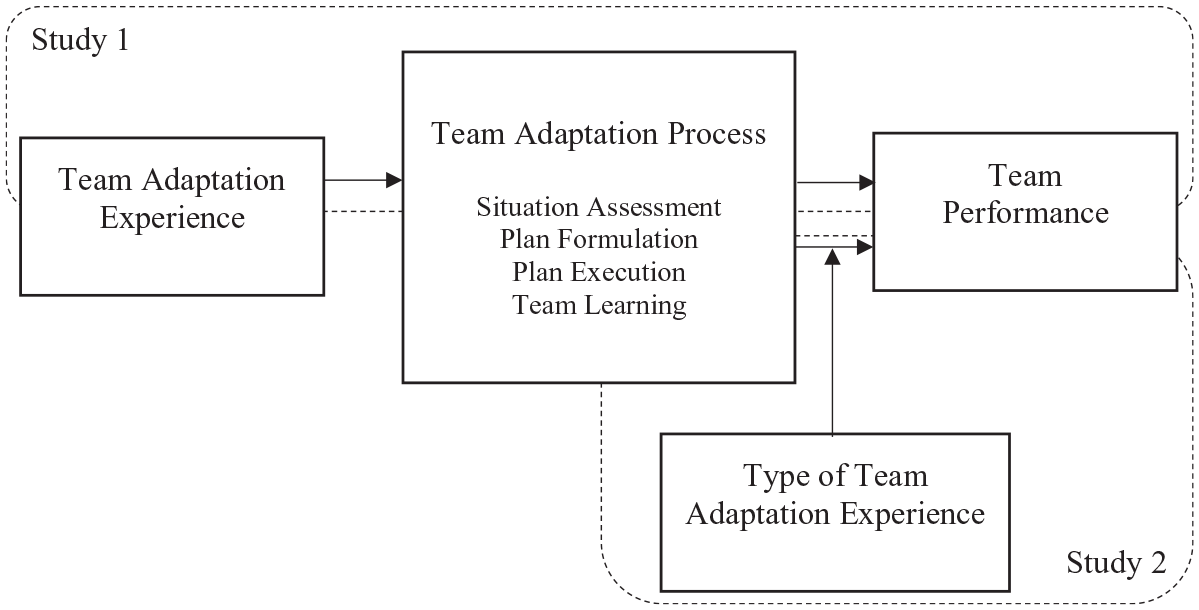
Investigated relationships within each experimental study.
Study 1
Methods
The goal of Study 1 was to investigate whether the execution of the team adaptation process impacts team performance (Hypothesis 1), whether it is impacted by team adaptation experience (Hypothesis 2), and whether it mediates the relationship between team adaptation experience and team performance (Hypothesis 3). To this end, we manipulated the team adaptation experience by using a between-subjects design and building two groups. Both groups performed the same team task five times (one trial and four performance rounds). In the first three performance rounds, Group A faced different nonroutine conditions while executing the team task (team adaptation experience), while Group B performed the team task without facing any nonroutine conditions (no team adaptation experience). In the fourth and final performance task rounds, both groups faced the same nonroutine condition (different from the nonroutine conditions that Group A faced earlier).
Sample
A priori power analysis using G*Power (version 3.1.9.2; Faul & Erdfelder, 1992) with a power level of 0.95, an alpha-error level of 0.05, and an assumed medium-to-large effect size between the team variables (Resick et al., 2010) revealed that a sample size of 36 teams for each of the two conditions (Group A and Group B) would be sufficient (Faul et al., 2007). Participants were recruited from a participant panel of a laboratory at a German university. Our sample consisted of 288 volunteers, who were randomly assigned to 72 four-member teams. The majority of the participants (female 55%) were students (92%) with an average age of 25.74 years (SD = 7.36). Participants were compensated for their participation with 4€ per person and could earn up to 20€ per person based on their team’s performance.
Team task
All 72 teams performed a space-themed team task that was developed based on the board game Space Alert (Chvátil, 2008). We simplified the original version so that the participants could understand the task within a short amount of time. 1 The goal was to defend the team spaceship and destroy the external enemy as quickly as possible. Teams had up to 7 1-minute phases to eliminate the enemy. At least three 1-minute phases were needed for the successful completion of the task. During each phase, team members were allowed to make one move each (i.e., attack, move, navigate, or load energy). At the same time, the enemy was moving toward the spaceship, attacking the spaceship’s guns and/or the spaceship’s resources (first reducing the team’s energy and then destroying it). If the enemy was not destroyed until the seventh 1-minute phase, the team lost. The task required team members to be highly interdependent, to coordinate with each other, and to perform under time constraints. All teams performed the task five times: one trial round (t0) and four performance rounds (t1, t2, t3, and t4).
Procedure and study design
We ran 72 experimental sessions, with one of the authors being the instructor 2 across all sessions. After signing the participation form (anonymity and voluntariness were ensured), the participants were randomly assigned to a four-person team and to one of two groups (Group A or Group B). At the beginning of the experiment, all the teams watched a short video explaining the rules of the task. To familiarize themselves with the task, all teams completed a trial round (t0). Afterward, both groups executed four more task rounds (t1, t2, t3, and t4). At t1, t2, and t3, Group A faced nonroutine conditions 3 while executing the team task. These conditions were considered nonroutine, as they differed from the conditions presented in the video and experienced during the trial round. The nonroutine conditions were different for each round (i.e., reduction of resources, loss of team members, and a different way to operate the spaceship’s guns) and required teams to adjust strategies and actions. Still, even given the nonroutine conditions, teams could complete their tasks successfully in three 1-minute phases and potentially reach the highest team performance score. The order of the nonroutine conditions was counterbalanced. Group B performed the first three rounds without facing any nonroutine conditions. At t4, both groups faced the same nonroutine condition (stronger enemy attacking the spaceship).
After each round (t0, t1, t2, t3, and t4), we objectively measured team performance (i.e., based on the number of 1-minute phases needed to complete the task starting from the third 1-minute phase). Demographic questions were measured after t4. All teams were video-and audio-recorded to capture the execution of the team adaptation process.
At the end of the study, the team members were thanked for their participation and compensated by payment based on their team performance. In total, on average, the experiment lasted about 1 hour. Figure 2 illustrates the design of the study.
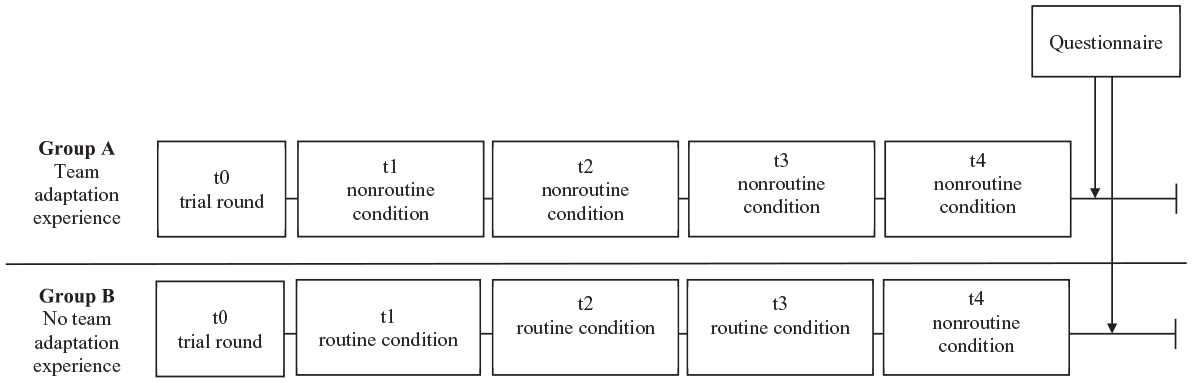
Design of Study 1.
Measures
Team adaptation process
The team adaptation process as a whole, consisting of four phases (i.e., situation assessment, plan formulation, plan execution, and team learning), was measured using Georganta and Brodbeck’s (2020) Behaviorally Anchored Rating Scales (BARS). The reason for using BARS was three-fold. First, BARS includes behavioral examples that allowed us to cover the entire spectrum of each phase of the team adaptation process (e.g., for team learning, we captured different behaviors such as reflecting on results, discussing and learning from successes, and errors and/or unexpected outcomes). Second, we were able to differentiate between effective (e.g., when, based on the available resources and the movements of the enemy, teams recognized that they would successfully complete the task with their next attack, which we coded as “The team recognizes its own achievements.”), moderate (e.g., when team members lost a round because they went in the wrong direction and used the wrong spaceship guns, but were only aware of one of these two errors, which we coded as “Team members are only partially aware of the mistakes in their actions.”), and ineffective team behaviors (e.g., when team members repeated actions without recognizing that the same strategies were not successful in previous rounds, which we coded as “Team members do not learn from their mistakes.”). Third, BARS enabled us to capture behaviors on the team-level (e.g., “The team determines a sequence of multiple actions.”), instead of the individual level. To capture the team adaptation process as a whole, each phase was rated using a 5-point scale ranging from 1 (poor illustration of phase) to 5 (very good illustration of phase), with behavioral examples of low, medium, and high anchors placed next to the one-, three-, and five-scale points, respectively.
Two raters (one of the authors and one uninvolved rater with experience in team research and behavioral coding) used audio and video recordings to assess the team adaptation process. 4 The raters first independently coded the team adaptation process (i.e., the four team adaptation phases) of six teams. Disagreements were discussed until the two raters achieved a common understanding. Then, each rater coded data from 33 teams. In case one of the two raters was uncertain about a team’s coding, the team was coded by both raters, and a common understanding was achieved. In Group A, the team adaptation process was measured for t1, t2, t3, and t4. In Group B, the team adaptation process was measured only for t4.
Team performance
Team performance was objectively measured. Teams reached the highest team performance score (i.e., 4) when they completed the task in the third 1-minute phase of the task. For every additional 1-minute phase that a team needed for task completion, one point was deducted from the team performance score. Team performance scores ranged on a scale from 4 (i.e., 3 out of 7 phases needed to complete the task) to 0 (i.e., 7 out of 7 phases needed to complete the task, or not completing the task at all).
Data Analysis
We calculated the means, standard deviations, and correlations between the study variables (see Table 1) using SPSS (IBM, 2019). Hypothesis testing was completed based on data collected at t4 in order to compare teams with (Group A) and without (Group B) team adaptation experience when adapting to nonroutine conditions. To analyze our hypotheses, we performed SEM in lavaan (Rosseel et al., 2022). Specifically, we estimated a full mediation model in which we modeled the team adaptation process as a first-order factor consisting of the four phases: situation assessment, plan formulation, plan execution, and team learning. In doing so, we performed 5,000 bootstraps to derive 95% confidence intervals belonging to the indirect effect or product term (i.e., “ab”; Preacher & Hayes, 2008). We explored the goodness of fit of the model with
Means, Standard Deviations, Reliability Estimates, and Intercorrelations for Variables of Study 1 at t4.
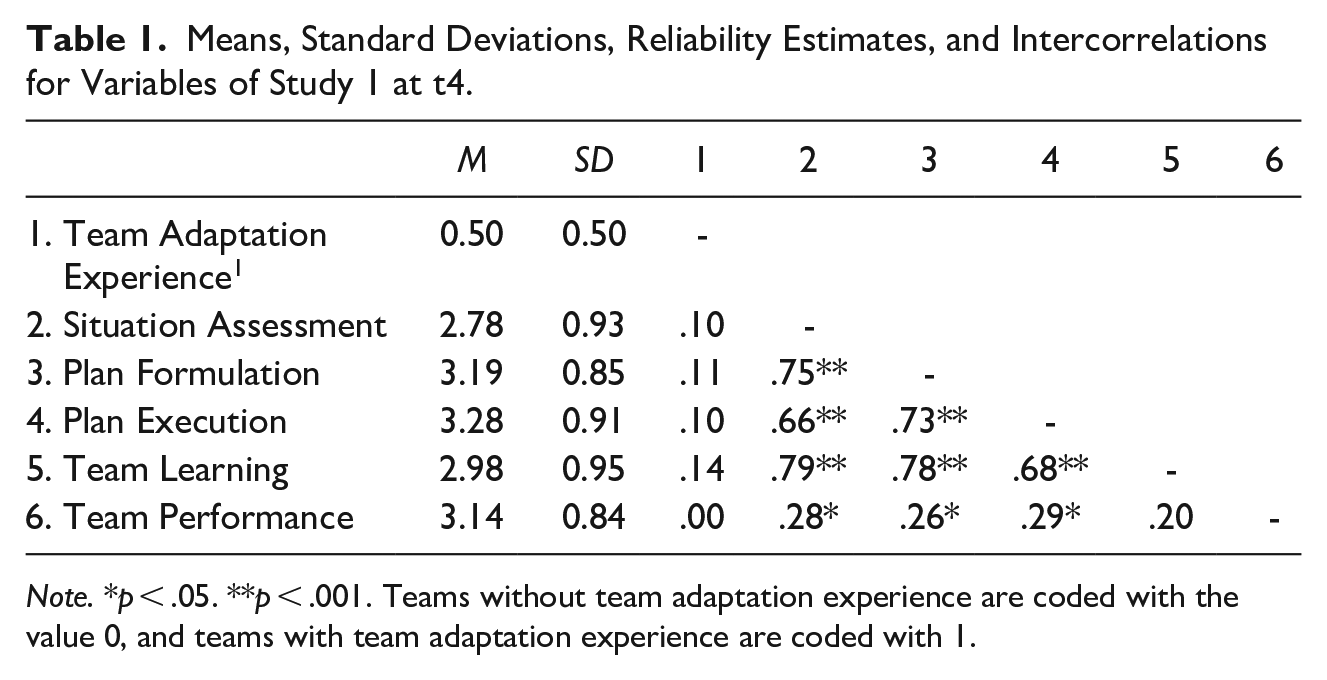
Note. *p < .05. **p < .001. Teams without team adaptation experience are coded with the value 0, and teams with team adaptation experience are coded with 1.
Results
The fit indices of the assumed mediation model, with team adaptation experience as the predictor, the execution of the team adaptation process as the mediator, and team performance as the outcome, yielded excellent results:
With regard to the impact of executing the team adaptation process on team performance (Hypothesis 1), the results supported our expectations. The data showed that the more effectively the team adaptation process was executed, the higher team performance was (ß = .30, p = .024). With regard to the influence of team adaptation experience on the execution of the team adaptation process (Hypothesis 2), the results did not support our assumptions. Teams with team-adaptation experience did not execute the team-adaptation process more effectively than teams without team-adaptation experience (ß = .28, p = .136). With regard to the mediating role of the team adaptation process in the relationship between team adaptation experience and team performance (Hypothesis 3), the findings contradicted our expectations. The indirect effect (β = .04) was not significant, with the 95%-confidence intervals ranging from −0.06 to 0.22. When looking at the direct relationship between team adaptation experience and team performance, the results showed no differences in team performance between teams with team adaptation experience and those without (ß = −0.04, p = .717).
Discussion of Study 1
The purpose of Study 1 was to contribute to a better understanding of team adaptation by investigating whether the execution of the team adaptation process is influenced by team adaptation experience and whether it impacts team performance under controlled conditions. Moving beyond prior studies that have neglected the multiphasic nature of the team adaptation process (e.g., Marques-Quinteiro et al., 2013), our findings showed that the more effective the team adaptation process—and each of its four phases—is executed, the higher the team performance. In line with Rosen et al. (2011), our results highlight the importance of the team adaptation process as a whole for reaching high team outcomes. Isolating and capturing team behavior allowed us to provide first insights into how teams adapt to nonroutine conditions (Maynard et al., 2015).
While we expected that teams with team adaptation experience would benefit from their experience when adapting to future nonroutine conditions, our findings did not support this assumption: No differences between teams with team adaptation experience and teams without team adaptation experience were found in terms of how effective the team adaptation process was executed and how well teams performed. It might be possible that all teams learned to perform in an effective and coordinated way—either by adapting to multiple nonroutine conditions during task execution or by performing the same routine task multiple times (Gorman et al., 2006). Meta-analytic evidence has shown that prior team performance under routine conditions can support future team processes and team performance under nonroutine conditions (Christian et al., 2017). Similarly, prior work has found no differences in developing innovative solutions or in improving team processes between teams with routine task experience and teams with nonroutine task experience (Rousseau & Aubé, 2010). It seems that teams without team adaptation experience develop certain characteristics while working under routine conditions that help them respond to a nonroutine condition. For instance, they might develop team efficacy (i.e., the perception of task-specific team capability), which would have an impact on team members’ actions and support flexible responses and team performance (Karaduman et al., 2021). Our experimental findings indicate that collecting experience in working together—under either nonroutine or routine conditions—can directly support the effective execution of the team adaptation process and team performance.
Another possible explanation is that teams with team adaptation experience did not have enough resources left to adapt effectively to the fourth and last nonroutine condition (Muraven & Baumeister, 2000). Related evidence has shown that individuals have enough resources to learn and adapt to up to three consecutive tasks (Converse & DeShon, 2009). Other researchers have also argued that teams who adapt for extended periods of time are more susceptible to cognitive overload (Louis & Sutton, 1991). Consequently, teams with team adaptation experience might have perceived the last situation as more challenging or exhausting than those faced before, subsequently influencing how they adapted and performed. For example, in the medical setting, at the end of the night shift and after adapting to multiple unexpected conditions, the team on call might have less cognitive and physical resources (e.g., due to sleep deprivation) to adapt to one more unexpected situation and therefore might perform poorly. Similarly, in the organizational setting, although teams might adapt successfully to various nonroutine conditions during the pandemic (e.g., virtual meetings, home office), after some months, they might have less physical or affective resources (e.g., due to low motivation and faith that the situation will improve) to respond effectively to new nonroutine conditions. Indeed, overly challenging situations can prevent positive outcomes (Cavanaugh et al., 2000; O’Brien & Beehr, 2019).
In summary, it seems that having experience adapting to nonroutine conditions does not guarantee effective team adaptation in the future. It is possible that the type of prior team adaptation experience might impact a team’s ability to adapt. Building on this idea and in line with the categorization of nonroutine conditions as either external or internal (Georganta et al., 2019), we now move on to investigate whether different types of team adaptation experience (external vs. internal team adaptation experience) shape the way teams respond to nonroutine conditions and the outcomes they achieve in a controlled environment (i.e., lab).
Study 2
Methods
The goal of Study 2 was to investigate whether the effective execution of the team adaptation process leads to higher team performance (Hypothesis 1), and whether this relationship changes depending on the type of team adaptation experience (Hypothesis 4). To this end, we manipulated the type of team adaptation experience using a between-subjects design and building two groups. In the first task round, Group A faced an external nonroutine condition (external team adaptation experience), while Group B faced an internal nonroutine condition (internal team adaptation experience). In the second task round, both groups faced a different nonroutine condition (internal nonroutine condition for Group A, external nonroutine condition for Group B).
Sample
As in Study 1, we performed a power analysis with G*Power (version 3.1.9.2; Faul et al., 2007) before running the experiment. We assumed a medium-to-large effect size (with
Team task
As a background story, all 72 teams were told that they were working for the product-development department of a smartphone company. Their task was to prepare two creative marketing posters, one after another, to promote a smartphone for seniors. Each poster was targeted at a different group—either the company board or seniors—with the goal of convincing them to either launch or buy the smartphone. To control for order effects, half of the teams started with the poster for the company board, while the other half started with the poster for seniors.
In all teams, each team member was assigned a different role and expertise 6 (i.e., demographics, finance, or marketing expertise), and detailed descriptions of the roles were provided. In the role descriptions, each team member also received two unique arguments for each target group—one argument was printed in bold to emphasize its importance while the other was not.
For each poster, teams were provided with a tool box, a flipchart, and six arguments (12 in total for both target groups). Their task was to select three most important arguments out of the six for each target group and use the tools to prepare a creative poster. Teams had to share information and coordinate with each other to perform the task successfully. To complete their task, the teams had 14 minutes.
Procedure and study design
We ran 72 experimental sessions, with two of the authors being the instructors 7 of the sessions. After signing the participation form (anonymity and voluntariness were ensured), the participants were randomly assigned to a three-person team and to one of two groups (Group A or Group B). All teams completed three parts (t0, t1, and t2). First, they watched a short video explaining the team task. Then, they were asked to read their individual role description and, in 2 minutes each, present the most relevant information to the rest of the team (t0). Second, they prepared the first poster for one of the two target groups (t1). Third, they prepared the second poster for the other target group (t2).
At t1 and t2, both groups faced nonroutine conditions. The nonroutine condition was either external or internal. When the nonroutine condition was external, the resources, specifically the toolbox and the arguments, were unexpectedly removed. The teams were informed that another team at the company urgently needed the resources. When the nonroutine condition was internal, one of the team members 8 was unexpectedly removed, receiving the information that another important task had to be completed. 9 After 6 minutes, the resources and the team members returned to the team, leaving them with the remaining time to complete their posters. At t1, Group A faced an external nonroutine condition (external team adaptation experience) and Group B faced an internal nonroutine condition (internal team adaptation experience). At t2, Group A faced an internal nonroutine condition, and Group B faced an external nonroutine condition.
After t2, we assessed, via an online questionnaire, demographics and whether the nonroutine conditions were experienced as such (i.e., manipulation check, see additional measures below). At t1 and t2, we also collected video and audio data to behaviorally assess the team adaptation process and objectively measure team performance (argument selection and poster creativity; see measures for details).
At the end of the study, the team members were thanked for their participation and compensated by payment based on their team performance. In total, on average, the experiment lasted about 1 hour. Figure 3 illustrates the design of the study.
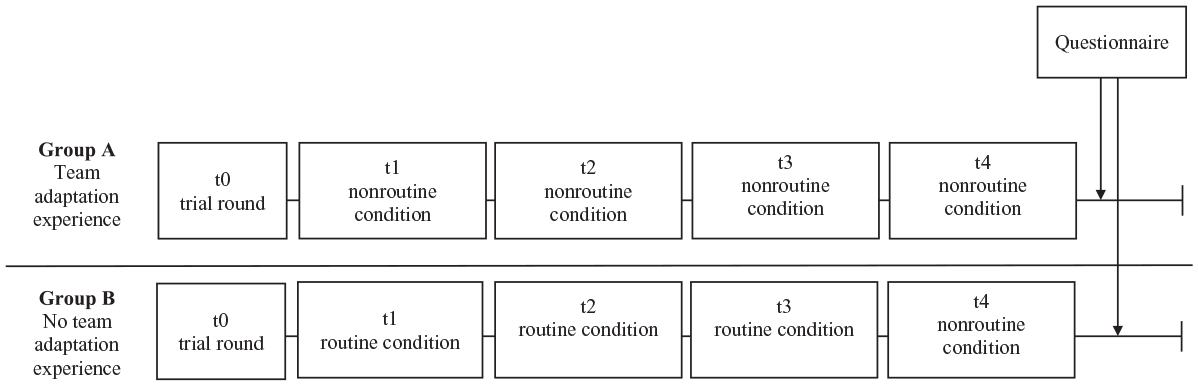
Design of Study 2.
Measures
Team adaptation process
The team adaptation process was measured at t1 and t2 for both Group A and Group B, as in Study 1. Two raters (two of the authors who were blind to the condition) independently coded the team adaptation process (i.e., four team adaptation phases) of six teams. After discussing disagreements and achieving a common understanding, each rater coded the team adaptation process of 33 teams.
Team performance
We measured team performance using two indicators: argument selection and poster creativity. Argument selection reflects the extent to which team members were able to share and integrate information derived from their role’s expertise. Poster creativity reflects the extent to which team members were able to develop new ideas and implement them using the tools available. Argument selection was based on the arguments that teams collectively selected for each marketing poster in order to convince each of the two target groups (i.e., company board and seniors). Teams could earn zero (i.e., when they did not choose any of the three very important arguments) to five points (i.e., when they chose all three very important arguments) for each task round. To assess poster creativity, two raters independently assessed each poster using one item (“The poster contains notable creative elements”) on a 5-point Likert scale ranging from 1 (totally disagree) to 5 (totally agree). In line with definitions of creativity (Sarkar & Chakrabarti, 2011), elements were defined as creative when teams used available resources (e.g., a lace) to create new elements (e.g., a heart) in order to fulfill a purpose (e.g., to enable seniors to communicate their loved ones by using the smartphone). First, the two raters independently assessed the poster creativity of six teams. After discussing disagreements and achieving a common understanding, each rater independently coded the poster creativity of the remaining 66 teams. The interrater agreement was excellent (Krippendorff’s α = .70 for t1; Krippendorff’s α = .76 for t2; Cicchetti, 1994).
Additional measures
At t2, we measured demographics (age, gender, nationality, and weekly working hours). We also asked participants to answer four items for each of the two nonroutine conditions using a 5-point Likert scale ranging from 1 (totally disagree) to 5 (totally agree; α = .74 for external nonroutine condition; α = .94 for internal nonroutine conditions). The items were: “Due to the team member loss/loss of resources, we had to adjust our goals.”; “Due to the team member loss/loss of resources we had to adjust our processes”; “Due to the team member loss/loss of resources we had to repeat some of our steps”; and “Due to the team member loss/loss of resources we had to adjust the way we executed our task.” The average of the four items was moderate for both the external (M = 3.34, SD = 0.88) and the internal (M = 3.33, SD = 1.60) nonroutine conditions, showing that both were perceived as conditions that triggered team adaptation.
Data analysis
Means, standard deviations, and correlations between the study variables were calculated with SPSS (IBM, 2019) and are presented in Table 2. Hypothesis testing was completed based on data collected at t2 to compare teams with external team adaptation experience (Group A) and teams with internal team adaptation experience (Group B) when adapting to a future nonroutine condition. The analyses for hypothesis testing were conducted using SEM in lavaan (Rosseel et al., 2022). As in Study 1, this allowed us to model the team adaptation process as a first-order latent factor consisting of the four phases of situation assessment, plan formulation, plan execution, and team learning. The predictor variable was the execution of the team adaptation process, the moderator variable was the type of team adaptation experience, and the outcome variable was team performance measured with two indicators (argument selection and poster creativity). We estimated a moderation model for each team performance indicator and drew 5,000 bootstraps to derive 95% confidence intervals for the interaction term. The single team adaptation phases were grand-mean centered (Little et al., 2006) and the interaction terms were built using the indProd function in the semTools package (Jorgensen et al., 2022).
Means, Standard Deviations, Reliability Estimates, and Intercorrelations for Variables of Study 2 at t2.
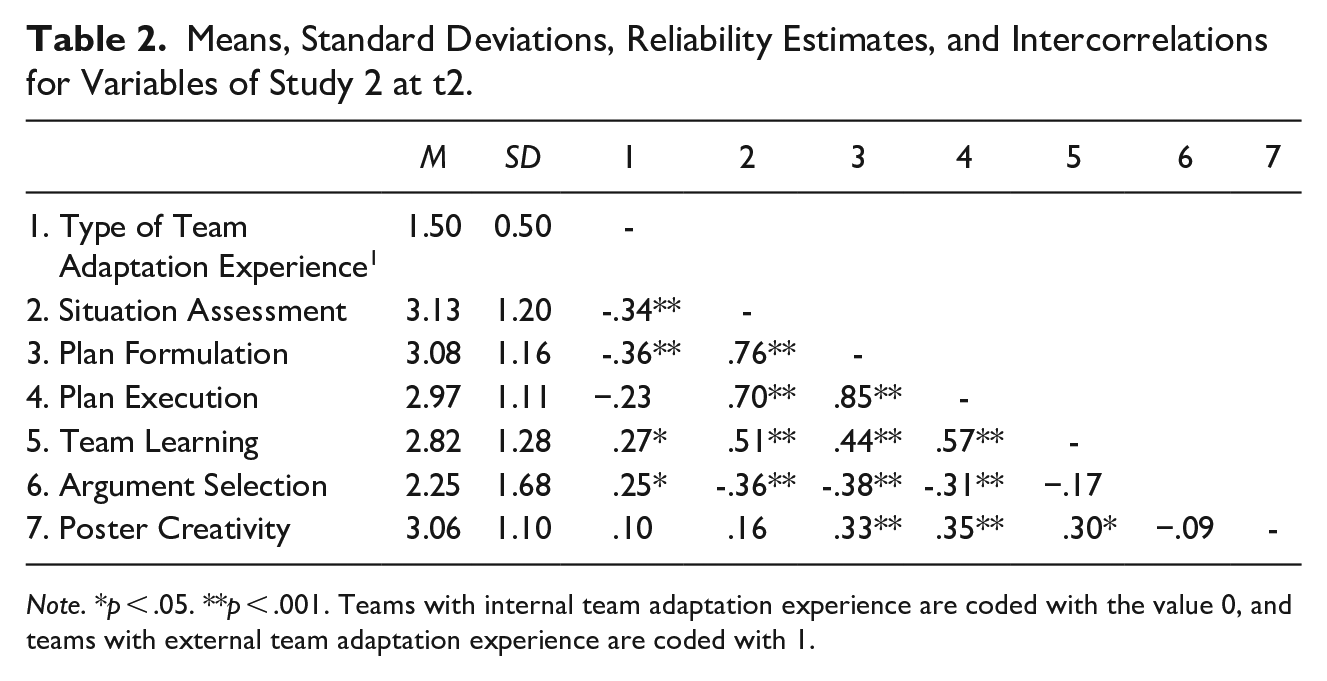
Note. *p < .05. **p < .001. Teams with internal team adaptation experience are coded with the value 0, and teams with external team adaptation experience are coded with 1.
Results
The assumed moderation model, with argument selection as the first team performance indicator, was not satisfactory (
The moderation model with the team adaptation process as a first-order latent factor consisting only of situation assessment, plan formulation, and plan execution yielded acceptable fit for both argument selection (
With regard to the relationship between executing the team adaptation process and team performance, the results showed that the effective execution of the team adaptation process was related to worse argument selection (ß = −.40, p = .002). However, the effective execution of the team adaptation process was related to higher poster creativity (ß = .30, p = .032). With regard to the moderating role of the type of team adaptation experience in the relationship between executing the team adaptation process and argument selection, we found no significant interaction (ß = −.14, 95% C.I. [−1.75. 0.50], p = .359). However, we found a significant interaction when examining poster creativity as the outcome (ß = −.27, 95% C.I. [−1.46, −0.097], p = .042). Specifically, the results showed that teams with internal team adaptation experience reached higher poster creativity when the team adaptation process was effectively executed (conditional effect = .57, 95% C.I. [0.36, 1.22], p = .001); for teams with external team adaptation experience, the relationship between executing the team adaptation process and poster creativity was not significant (conditional effect = .03, 95% C.I. [−0.51, 0.56]. p = .978).
Given the importance of team learning when teams adapt to nonroutine conditions (Christian et al., 2017), we also ran the moderation model only with team learning as the predictor, using the lm function in R. The model explained 12.5% of the variance in argument selection, F(3,68) = 3.24, p = .027, and 12.2% of the variance in poster creativity, F(3,68) = 3.15, p = .030. With regard to the influence of team learning on team performance, we found a negative relationship between demonstrating effective team learning behaviors and argument selection (ß = −.26, p = .032) and a positive relationship between effective team learning behaviors and poster creativity (ß = .29, p = .019). With regard to the moderating role of the type of team adaptation experience in the relationship between team learning and team performance, we found no significant interaction for argument selection (ß = −.04, p = .727) or poster creativity (ß = −.02, p = .127).
Discussion of Study 2
The goal of Study 2 was to assess whether effectively executing the four-phase team adaptation process leads to higher team performance and, further, to investigate whether the type of team adaptation experience (external vs. internal team adaptation experience) shapes the process-performance relationship in the laboratory setting. Our findings did not confirm the four-phasic nature of the team adaptation process. Therefore, we could not test our assumptions with regard to the team adaptation process as a whole. Instead, our results indicated that adapting collectively to a nonroutine condition may consist of two different team adaptation process components: how teams respond to a nonroutine condition (team adaptation situation assessment, plan formulation, and plan execution) and how teams learn while responding (team learning). Team learning while adapting is more focused on expanding team behaviors in the future (Burke et al., 2006), which is why previous research has suggested distinguishing team adaptation and team learning (Oertel & Antoni, 2014). Empirical work has also supported this suggestion, showing that team adaptation and team learning, specifically team reflection, reflect two distinct components of a higher-order process when teams adapt to nonroutine conditions (Wiedow & Konradt, 2011). Team learning may not necessarily be a piece of the team adaptation process itself, as theory highlights (Rosen et al., 2011), but it does reflect an essential component for team adaptation. Building on this notion, we performed exploratory analysis and investigated whether team performance is influenced by executing the three-phase team adaptation process (consisting of situation assessment, plan formulation, and plan execution) and by demonstrating team learning behaviors. Finally, we explored whether the type of team adaptation experience moderated these relationships under controlled conditions.
Our results showed that executing the three-phase team adaptation process and demonstrating team learning behaviors led to mixed outcomes. While argument selection (first team performance indicator) worsened, poster creativity (second team performance indicator) improved. Our findings question the assumption that successful execution of the team adaptation process always leads to higher team performance (Burke et al., 2006; Rosen et al., 2011). Rather, they implied that the team adaptation process, as well as team learning, were detrimental for a cognitive and knowledge-related performance requirement (argument selection) but beneficial for a creative and executional performance requirement (poster creativity). This suggests that the impact of team adaptation behaviors may depend on the type of team performance requirement. For some types of performance requirements, teams may benefit from the team adaptation process and team learning, while for others, they may not. For example, when adapting to an unexpected equipment failure (i.e., cognitive performance requirement), using the existing knowledge of the team members and applying a more outdated technique might more effectively allow a firefighter team to highly perform than finding ways to fix or replace the equipment (i.e., adapt and learn). On the contrary, when adapting to a sudden budget cut (i.e., creative performance requirement), an innovation team might find it beneficial to focus on finding new ways to use its existing equipment because adapting and learning can result in thinking outside of the box and achieving high team performance.
Another possible explanation is that the required content of the three-phase team adaptation process and of team learning might have differed depending on the task requirement (e.g., the assessment of knowledge available to plan, execute, and learn for a knowledge-related requirement compared to the assessment of available tools to plan, execute, and learn for an operational performance requirement). Teams might not have been able to execute effective team adaptation behaviors targeted at both types of performance requirements. Consequently, teams may have focused only on one performance requirement when adapting and not on both. Recent literature suggests that team adaptation does not necessarily lead to positive team outcomes (Rico et al., 2020). It is also possible that an executional compared to a knowledge-related performance requirement is more notable under nonroutine conditions, and therefore, teams might adapt their behavior primarily focusing on that performance requirement. For example, when adapting to an unexpected team member absence, a consulting team might focus only on distributing the extra tasks instead of also thinking about how to substitute the missing knowledge and expertise, for example by advising another expert. When the task environment is too complex and there is a need to adapt, teams may not be able to achieve the expected results (Landon et al., 2016). We suggest future research to investigate the exact performance requirements and the number of performance requirements that can be executed at once to further elucidate the relationship between the three-phase team adaptation process, team learning, and team performance. This would also respond to a call for more research on the dark side of adaptation and maladaptive outcomes, which has just begun to be explored (Maynard et al., 2015).
Furthermore, our findings mostly demonstrated that the impact of the three-phase team adaptation process and of team learning on team performance did not differ between teams with external team adaptation experience and teams with internal team adaptation experience in the lab. It seems that both types of team adaptation experiences provided teams with resources that enabled them to perform analogous to their executed team adaptation behaviors. On the one hand, teams with external team adaptation experience may have had a strong core and stable internal capacity to face a nonroutine condition, due to initially remaining internally intact (e.g., with regard to roles or task distribution). On the other hand, teams with internal team adaptation experience may have felt more empowered and confident to face a nonroutine condition, having had initially experienced disorganized internal structures and processes. Facing internal nonroutine conditions might initially be more challenging, but it can enable teams to adapt more flexibly in the future (Kennedy & Maynard, 2017. This is even more prominent in our findings that show that only teams with internal team adaptation experience benefited (with regard to poster creativity) from effectively executing the team adaptation process of situation assessment, plan formulation, and plan execution. Related work has shown that if a team’s beliefs are effective and enable them to overcome obstacles, this helps the team to think outside of the box and produce highly creative outcomes (Quttainah, 2015). Not having a stable internal structure might have been an initial obstacle for these teams, but it later turned into a resource, enabling them to think beyond fixed structures and become flexible and innovative. As previous research has shown, setbacks can leverage future team processes (Rauter et al., 2018; Shepherd et al., 2011; Singh et al., 2007). We propose future research to explore whether different types of team adaptation experience result in different resources that may alter the way teams adapt and the outcomes they reach.
Overall Discussion
The goal of the present work was to provide novel insights into the team adaptation process that teams execute when facing nonroutine conditions, acknowledging the multiphasic nature of the process, as postulated by theory (Rosen et al., 2011). In two experimental studies, we captured behaviors that teams demonstrate when adapting (Rico et al., 2020) and investigated inputs (team adaptation experience) and outcomes (team performance) of the team adaptation process, as well as conditions (type of team adaptation experience) that may alter the relationship of executing the team adaptation process with team performance. We considered the laboratory setting to be appropriate for our goal, as our concern was less about estimating the precise strengths of the relationships and more about whether they existed in the expected directions.
With our work, we contribute to a better understanding of the team adaptation process itself—that is, the core of team adaptation, which has been underrepresented in extant research (Rico et al., 2020). Moving beyond studies that have captured either single aspects of the team adaptation process or measured it retrospectively (Georganta & Brodbeck, 2020), we directly assessed how it was behaviorally executed when teams are facing nonroutine conditions while controlling for other factors. However, our findings did not fully support the four-phasic nature of the team adaptation process (situation assessment, plan formulation, plan execution, and team learning) as theory proposes (Rosen et al., 2011). Although we showed that the team adaptation process consisted of different phases (either as a four-phase or as a three-phase process), team learning was not always a part of the team adaptation process itself; instead, it sometimes reflected a different team adaptation process component. This is in line with prior suggestions to distinguish between team adaptation—how teams actually respond—and team learning—how teams learn while responding (Oertel & Antoni, 2014; Wiedow & Konradt, 2011). It is possible that the operationalization of learning behaviors defined whether team learning reflected the fourth part of the team adaptation process (e.g., team reflection and lessons learned were focused on immediate actions for facing the nonroutine condition) or a separate process component (e.g., team reflection and lessons learned were focused on long-term actions for future nonroutine conditions). We propose future research to investigate whether the operationalization of team learning behaviors (short- or long-term focus) might be a condition that alters the role of team learning in team adaptation.
Furthermore, we clearly differentiated between the team adaptation process and team performance, overcoming a common issue in the literature (Christian et al., 2017), and presented empirical evidence of their relationship under controlled conditions. In contrast to theoretical propositions (Burke et al., 2006; Rosen et al., 2011) and previous studies focusing on single team adaptation process components (Christian et al., 2017), our work questions the assumption that effective execution of the team adaptation process always leads to high team performance. It seems that under some circumstances, such as executing a creative task, the team adaptation process can have a positive impact on team performance, while under others, such as executing a task that requires bringing knowledge together, it might not. When adapting collectively to nonroutine conditions, it is also possible that the number of performance requirements may alter the relationship between the team adaptation process and team performance; teams might be able to focus only on one performance requirement at a time, and therefore, when they are faced with multiple requirements, both positive and negative outcomes might result. Research needs to acknowledge more fully that teams may adapt poorly and that some conditions may hinder their ability to adapt (Rico et al., 2020). To this end, Frick et al. (2018) recently proposed four possible sources of team maladaptation: (1) lack of meaningful adscription of cues signaling the need to adapt, (2) failure to develop a plan to respond, (3) inability to act and execute the plan, and (4) disregard for the need to reflect and derive learnings for future adaptation. Depending on the type of task demands and the number of performance requirements, these conditions for maladaptation might be more likely to occur, resulting in poor performance. We propose future research to investigate the boundary conditions (e.g., type and number of performance requirements) that may shape whether team behaviors result in adaptation or maladaptation in order to enrich our understanding of both sides of team adaptation.
In our work, we also acknowledged that team adaptation is recursive, with the ending state of prior team adaptation being the point of departure for future team adaptation (Burke et al., 2006). To this end, we investigated team adaptation experience as an input factor in the team adaptation process in a laboratory setting. Contradicting our expectations, we found no differences between teams with and without team adaptation experience. It seems that having collective experience—either by adapting to nonroutine conditions or by performing routine tasks—can provide teams with the necessary resources to respond to future nonroutine conditions. Collective work can result in effective team properties, such as a shared understanding of who knows what and how team members can benefit from everyone’s knowledge when facing nonroutine conditions. Experience in working together enables new cognitive elements to be added, or existing ones revised, thereby allowing teams to remain flexible (Lewis & Herndon, 2011; Rico et al., 2019).
It is also possible that these groups (with vs. without nonroutine experience) had different resources available that helped them adapt. This could be an explanation for finding no differences between teams with external team adaptation experience and teams with internal team adaptation experience. Although we assumed that the type of nonroutine condition previously faced would influence the team’s availability of the same resources (i.e., stability of internal structure; Rico et al., 2020), it seems that both groups had resources—probably just different ones—that enabled them to adapt. While teams with external team adaptation experience might have had a strong internal structure, teams with internal team adaptation experience might have had a strong belief in their capabilities. The latter might also have developed a more flexible mindset to think outside the box, a possible reason for showing higher poster creativity when the team adaptation process was effectively executed. Future research should explore whether different resources emerge based on the experience that teams collect together (routine task experience, and external and internal team adaptation experience) and whether the importance of these resources might change depending on the performance requirements.
In the present experimental research, our goal was to open the black box of team adaptation as called for by Maynard et al. (2015) and provide empirical insight into the factors and conditions that shape the way teams adapt and perform when facing nonroutine conditions. Although we achieved this goal, we did not find clear answers to our questions. What became clear is that the current state of theoretical and empirical work on team adaptation does not fully capture the complexity of the way teams respond to nonroutine conditions. Future theoretical and empirical work should attempt to extend our understanding of team adaptation toward additional boundary factors, such as the focus of team learning behaviors, the type and number of team performance requirements, and the team properties and resources emerging from collective experience.
Limitations and Suggestions for Future Research and Practice
Although we are confident regarding the design of both our studies and therefore the informative value of our results, our studies do have some limitations that lead to suggestions on how to move forward in future research. First, due to the experimental nature of our work, the external validity of our findings can be questioned. Furthermore, our findings reflect how teams adapt only under controlled conditions, at an early team developmental stage, and how for a one-time project, which are factors that can influence a team’s response to nonroutine conditions (Kennedy et al., 2016). Although the experimental design of our studies can make valuable contributions to the study of teams (Driskell & Salas, 1992; Weaver et al., 1995), as a next step, we suggest future research to examine the relationship between the investigated variables in field settings and with more established teams. For instance, future research can capture team adaptation behavior under nonroutine conditions over a longer period of time by using smartwatches that record team communication of consulting teams during time-framed projects and also objectively assess their performance (e.g., customer’s satisfaction).
Furthermore, we suggest that future research not only captures the execution of the team adaptation process but also analyzes its content to gain a clearer picture of the process and its phases. In our work, we focused only on how effectively the team adaptation process was executed and thereby neglected its content. It is possible that depending on the type of team experience (routine vs. adaptation; external vs. internal adaptation), the information discussed and the actions planned differed in content, resulting in different actions and outcomes. For instance, research suggests that team performance can differ depending on the type of team planning (DeChurch & Haas, 2008). Similarly, team learning behaviors can have a different impact on team outcomes when they focus either on the “here and now” or on future actions (Schmutz et al., 2018). Moreover, it is suggested that future research should measure both explicit and implicit team processes when teams adapt. Due to our observational measure, we only captured explicit team behaviors and neglected implicit team processes, which may have also shaped the way teams adapted and performed. For example, there is evidence that teams also learn implicitly through their activities (Argote, 1993). Knowledge derived from implicit learning can be extremely helpful under challenging circumstances (Reber, 1989).
Finally, we suggest that future research consider the severity of the nonroutine conditions when planning new studies and assess them directly in order to explore their impact on the way teams adapt. For the purpose of this work, we did not consider whether the severity of the nonroutine conditions that teams faced had a direct impact on the way the teams adapted. As Maynard et al. (2015) have argued, the severity of the nonroutine condition can influence the execution of the team adaptation process and team performance. In Study 1, it is possible that the last nonroutine condition was perceived as more severe compared to the prior conditions, which could be why teams with prior adaptation experience did not perform better than teams without adaptation experience (Pearsall et al., 2009; Podsakoff et al., 2007). In Study 2, the fact that teams with external team adaptation experience and teams with internal team adaptation experience faced different nonroutine conditions in the first round may have influenced how severe the nonroutine conditions in the second round were perceived. Depending on the severity of the nonroutine condition (e.g., permanent vs. temporary equipment failure), the resources that organizational teams need in order to adapt can differ (e.g., budget and time spent for a new vs. the existing equipment), impacting the way they will respond. When nonroutine conditions are severe, it is very likely that some resources (e.g. skills, knowledge, motivation, capacity) might be missing, making it more difficult to adapt effectively and highly perform.
Our research also has practical implications. Based on our findings, we encourage teams to constantly evaluate whether the execution of the team adaptation process is needed in the face of nonroutine conditions, and if so, how this should be completed. Specifically, we propose to focus on the execution of the team adaptation process, considering the task and performance requirements at hand. Given that experience in working together—under either routine or nonroutine conditions—can be helpful when adapting, we propose to build teams for a longer period of time while facilitating constant reflection and evaluation to allow resources for effective team adaptation to be built in the future.
Conclusion
In an attempt to advance the field of team adaptation research, we conducted two experimental studies in which we investigated the execution of the team adaptation process, its potential inputs (team adaptation experience), outputs (team performance), and boundary conditions (type of team adaptation experience). We provided insight into the multiphasic nature of the team adaptation process, either as a one-component process consisting of four phases or as a two-component process (i.e., a three-phase process and team learning). Furthermore, we showed that executing the team adaptation process does not always lead to high team performance; the type and number of team performance requirements might reflect possible boundary conditions. Finally, we found no differences in terms of effective execution of the team adaptation and, in turn, of team performance between teams with and teams without team adaptation experience; similarly, the type of team adaptation experience (external vs. internal) did not alter the relationship between team adaptation process and team performance. Collective experience under either routine or nonroutine conditions (external and internal) seems to provide the resources needed for teams to adapt successfully. Overall, we have discussed how future work could more fully capture the complexity of the way teams adapt by incorporating additional boundary conditions, such as the type of performance requirements and the resources emerging from prior collective experience. We hope that the present experimental studies can serve as a guide that helps to shed more light on team adaptation in the future.
Footnotes
Declaration of Conflicting Interests
The author(s) declared no potential conflicts of interest with respect to the research, authorship, and/or publication of this article.
Funding
The author(s) disclosed receipt of the following financial support for the research, authorship, and/or publication of this article: This research was supported by a research grant from the German Research Foundation (SFB 768) awarded to the Chair of Economic and Organisational Psychology (Prof. Felix C. Brodbeck) of the Ludwig-Maximilians-Universitaet Muenchen.
