




Abstract
Researchers are increasingly interested in how employee relational processes affect virtual team outcomes. Applying attachment theory and the Job Demands–Resources model, we examined the relationship between employee attachment orientations and work engagement, and the mediating role of collaborative job crafting. In a three-wave longitudinal panel study of 1,178 employees in 225 virtual teams, autoregressive and multilevel structural equation modeling showed direct negative effects of (anxious and avoidant) attachment on work engagement. Indirectly, however, attachment positively influenced engagement, partially mediated by collaborative job crafting. Implications for attachment inclusive practices that support collaborative job crafting and work engagement are discussed.
Keywords
Virtual teams comprise physically dispersed individuals who coordinate their work using information and communication technologies, sometimes spanning different time zones (Peters & Manz, 2007). Virtual teams increase organizational agility and reduce the need for employees to travel between sites, minimizing the associated costs of time, money, and stress (Orlikowski, 2002). However, the lack of a shared social context may hinder team member working relationships (Jarvenpaa & Leidner, 1999) and contribute to increased anxiety (Lee-Kelley, 2006). The exact contribution of relational processes in virtual teams to individual well-being is poorly understood, yet it is an important and timely issue given the anticipated increase in remote work in the post-pandemic era (Office for National Statistics, 2021). To address this gap, we examine the relationship between employee attachment orientations and work engagement in virtual teams, and the mediating role of collaborative job crafting.
In virtual teams, employees cannot rely on informal socializing to build and maintain good relations (e.g., “water-cooler” chats; Cordery & Soo, 2008). Attachment orientations, which shape how individuals’ think, feel, and behave in relationships (Mikulincer & Shaver, 2007), may exacerbate any relational difficulties. Attachment anxiety is characterized by low self-worth and seeking others’ approval to gain emotional security, while attachment avoidance represents more positive self-views, but dismissal of the need for relationship closeness and difficulty trusting others (Bartholomew, 1990). From the perspective of the Job Demands–Resources model (JD–R; Demerouti et al., 2001), we consider attachment orientations to be personal demands—“the requirements that individuals set for their own performance and behaviour that force them to invest effort in their work and are therefore associated with physical and psychological costs” (Barbier et al., 2013, p. 751). Individual characteristics such as being self-demanding or workaholic have been considered as personal demands within the JD–R framework (Bakker & Demerouti, 2017). In the present study, we focus on attachment at the “global” level of representation, which is one’s attachment anxiety and avoidance in relationships with important others in general (Fraley, 2007). That is, we examine the over-arching attachment orientation held by a virtual team member in relation to the key people in their social world (e.g., family, friends, team leader, and work colleagues).
Work engagement is an important indicator of employee well-being: a “positive and fulfilling work-related state of mind, which is characterised by vigour, dedication and absorption” (Schaufeli et al., 2002, p. 74). Prior research indicates that job demands associated with virtual teamwork (e.g., limited social interaction, working across time zones, and intercultural communication) can adversely affect members’ work engagement (Cordery & Soo, 2008; Douthitt & Aiello, 2001). Attachment orientations (i.e., anxious and avoidant) are consistently negatively associated with a range of work-related attitudinal and behavioral outcomes including job satisfaction, employee performance, and citizenship behaviors (Harms, 2011). Hence, we also anticipate a negative relationship between the personal demands of virtual team members’ attachment orientations and their work engagement.
Additionally, we examine indirect effects of attachment on work engagement through collaborative job crafting. Job crafting is an action-focused approach in which employees proactively shape their work (Morrison & Phelps, 1999) to make it more meaningful and engaging (Demerouti, 2014). Specifically, our focus is collaborative job crafting—that is, collectively altering work processes to meet shared goals. Collaborative job crafting is the main focus in the present study because existing evidence indicates it is more beneficial than individual job crafting in environments with high task interdependence, such as virtual teams (Leana et al., 2009). Based on the JD–R model, we propose that the high demands associated with working in virtual teams (Lee-Kelley, 2006) may be experienced as especially stressful by individuals who are more anxiously or avoidantly attached (Mikulincer & Florian, 1995) and consequently, to secure job resources, they may proactively undertake collaborative job crafting behaviors, which in turn have beneficial consequences for their work engagement.
We use a longitudinal design, collecting data at three time points over 9 months, with a 12-week interval between each time point. Our contributions are three-fold. First, we extend attachment theory to the virtual team context and address calls to examine mediating mechanisms that link employees’ attachment orientations and work-related outcomes (Yip et al., 2018). Second, we advance research on the JD–R model by incorporating attachment orientations as personal demands and a potential antecedent of collaborative job crafting (Vîrgă et al., 2019). Third, although numerous studies on attachment orientations at the workplace demonstrate negative effects on work-related outcomes (Harms, 2011; Yip et al., 2018), our study explores the positive effects of collaborative job crafting in assisting employees with (anxious and avoidant) attachment orientations to meet their relational goals and reduce job demands.
Theory and Hypotheses
Even before the COVID-19 pandemic, due to globalization, collaboration between employees across time and distance through virtual teams had become a new dimension of work in many businesses (Krumm et al., 2016). However, limited attention has been paid to the importance of social relationships in virtual teamwork as interactions are primarily driven by technology usage (Henttonen & Blomqvist, 2005). Nonetheless, challenges such as the lack of direct social interaction and reduced rapport in a virtual team environment are acknowledged as barriers to developing effective working relationships with colleagues (Martins et al., 2004).
Attachment theory concerns human beings’ innate tendency to seek and develop affective bonds (Bowlby, 1969). According to the theory, human social behavior is shaped by enduring individual differences in attachment orientations (anxious and avoidant), which are effectively working models (i.e., mental schema) representing beliefs and expectations about the self and others in relationships (Mikulincer & Shaver, 2007). The “self-model” represents one’s belief or self-worth in receiving support, while the “other-model” represents beliefs concerning the availability of others in times of need (Mikulincer & Shaver, 2007; Yip et al., 2018). There is a growing literature documenting the relationship between attachment orientations and work outcomes (Harms, 2011).
Attachment and work engagement
Anxiously attached (i.e., higher attachment anxiety) individuals hold a negative view of themselves and are heavily dependent on others (Mikulincer & Shaver, 2007). Attachment anxiety leads individuals to become clingy, needy, demanding, and controlling in an attempt to create a sense of security in relationships (Mikulincer & Shaver, 2005). Given this obsession with relationships and in-built fear, anxiously attached individuals are likely to suffer distraction at work and lack the ability to express themselves (Byrne et al., 2017). Additionally, such individuals anticipate negative peer evaluations and question their own competence at work (Hazan & Shaver, 1990). Perceiving a lack of physical, emotional, and cognitive resources results in hyperactivation of negative emotions; and too much distress and over-reliance on rumination leaves fewer of the resources necessary to produce feelings of physical strength, emotional energy, and cognitive resources (Little et al., 2011). As a result, we expect that in a virtual team environment, employees with higher attachment anxiety may experience less vigor, dedication, and absorption—that is, lower levels of work engagement.
Avoidantly attached (i.e., higher attachment avoidance) individuals hold negative views of others, perceiving them as unresponsive or unavailable, and they find it difficult to trust others completely (Mikulincer & Shaver, 2007). Avoidantly attached individuals refuse to seek emotional or instrumental support from others and suppress their emotional expression at work (Mikulincer & Shaver, 2005; Richards & Schat, 2011). The in-built avoidance of social interactions likely leads to fewer interactions, which prevent developing connections at work (Byrne et al., 2017). Positive connections with others facilitate work engagement, as team work requires a level of trust in the organization and team members (Kahn, 1990). In a virtual team environment, suppression of emotions and minimal interactions among employees with higher attachment avoidance may lead to reduced feelings of vigor, dedication, and absorption—that is, poor work engagement. Hence, we propose: Hypothesis 1a: Higher attachment anxiety at Time 1 is negatively associated with work engagement at Time 3. Hypothesis 1b: Higher attachment avoidance at Time 1 is negatively associated with work engagement at Time 3.
The mediating role of collaborative job crafting: A JD–R perspective
The JD–R model can help us understand the relationship between job and individual characteristics, and employee well-being (Vîrgă et al., 2019). The JD–R theory states that every job is characterized by a set of job demands and job resources (Demerouti et al., 2001). Job demands require sustained physical and/or psychological efforts or skills, whereas job resources enable individuals to achieve work goals, reduce job demands, or stimulate personal growth (Bakker & Demerouti, 2007). In addition, personal aspects are also related to employee well-being. Personal resources refer to an individual’s perceptions of his/her ability to control or influence the environment, whereas personal demands refer to internal pressures that are dependent upon the values and needs of an individual (Mackay & Cooper, 1987). Personal demands such as high self-expectations and emotional instability (Lorente Prieto et al., 2008), but also high-performance expectations (Barbier et al., 2013) have a significant effect on an employee’s well-being.
In line with JD–R theory, attachment can be considered a personal characteristic that may serve as a demand, depending on the extent of investment of effort in the work required by the respective attachment orientation (Vîrgă et al., 2019). Both attachment anxiety and avoidance can be considered personal demands, as they tend to rely on intra- and interpersonal strategies in an effort to cope with threats (Cassidy & Kobak, 1988). For example, attachment anxiety is associated with hyperactivation strategies involving an in-built fear of interpersonal rejection, and attachment avoidance is associated with deactivating strategies involving suppression of emotions (Mikulincer & Shaver, 2005; Vîrgă et al., 2019).
Attachment theory has been extended to group dynamics (Rom & Mikulincer, 2003), whereby anxiously and avoidantly attached individuals differ in their goals in social interactions. Individuals who score higher on attachment anxiety find it difficult to use emotion-based coping strategies when faced with extremely stressful situations, and individuals who score higher on attachment avoidance report less support-seeking behaviors (Harms, 2011; Mikulincer & Florian, 1995). Thus, both anxiously and avoidantly attached individuals may perceive jobs as stressful because, albeit for differing reasons, they have fewer resources to deal with work demands.
Individuals who experience their jobs as being less resourceful and more challenging tend to question the meaning of work and work identity (Lam et al., 2016). Research has shown employees craft their jobs in response to challenging work situations (Petrou et al., 2012; Solberg & Wong, 2016; Tims et al., 2012). Individuals with an avoidance temperament craft their jobs in ways that reduce hindering demands (Bipp & Demerouti, 2015), and those high in neuroticism engage in job crafting as a way to manage their emotional weakness (Bell & Njoli, 2016). These studies focus on individual job crafting; that is, a behavior which is initiated by oneself without agreement or involvement of other team members. This can have a negative impact on others, particularly when working in teams (Wrzesniewski & Dutton, 2001). In the present study, we focus on collaborative job crafting, which involves working with others to find mutual gains and ensuring that everyone’s needs are taken into consideration.
In virtual teams, individuals are dispersed and use technology as a means to collaborate to complete group tasks. In such settings, team members will be expected to share ideas and knowledge when making decisions regarding the team’s task (LePine et al., 1997) and this interdependence has consequences for individuals’ actions at work. When task performance of an individual is dependent on the task performance of team members, crafting one’s own job will impact other team members (Wrzesniewski & Dutton, 2001). In these cases of high task interdependence, collaborative job crafting (e.g., collectively changing skills, adjusting tasks or changing the variety of work tasks) is more likely to occur than individual job crafting (Leana et al., 2009). For example, if virtual team members were using Skype as a technology to interact with each other, they may decide to switch to Zoom for improved communication and ease of sharing files.
Since the work of Tims and Bakker (2010), job crafting has been included as a key explanatory mechanism in the JD–R model (Bakker & Demerouti, 2017). In particular, job crafting is placed as a mediator between job/personal characteristics and motivational aspects such as work engagement, commitment, or flourishing, among others (Robledo et al., 2019; Tims et al., 2015).
Building on the notion of personal demands in the JD–R model, we posit that collaborative job crafting may assist anxiously and avoidantly attached employees to seek out job resources. It is anticipated that employees scoring higher on attachment anxiety are more prone to worrying about their relationships at work and feel underappreciated and misunderstood, whereas employees scoring higher on attachment avoidance are more prone to experience burnout in the workplace because of their inability to disengage from negative emotions (Harms, 2011; Hazan & Shaver, 1990). As a result, such employees will be more motivated to craft their work to seek out job resources, and by doing so, will achieve more positive meaning from their work and work identity (Wang et al., 2018; Wrzesniewski et al., 2013). Studies have shown that collaborative job crafting is associated with higher work engagement (McClelland et al., 2014; Tims et al., 2013). Based on this, we anticipate that collaborative job crafting could be an explanatory mechanism linking both anxious and avoidant attachment, and work engagement, leading to the following hypotheses: Hypothesis 2a: Collaborative job crafting at Time 2 mediates at least part of the relationship between higher attachment anxiety at Time 1 and work engagement at Time 3. Hypothesis 2b: Collaborative job crafting at Time 2 mediates at least part of the relationship between higher attachment avoidance at Time 1 and work engagement at Time 3.
Method
Research Design
This study was conducted in the context of the information technology (IT) sector. Many organizations employ virtual teams to accomplish work projects in the IT sector (RW3 CultureWizard, 2018). As such, the survey respondents were recruited from multinational IT organizations in India. Data were collected before the COVID-19 outbreak at three time points over 9 months, with a 12-week interval between each time point. The longitudinal design enabled us to estimate the magnitude of the causal effects between the variables (Selig & Preacher, 2009). There are many longitudinal studies with short time lags within the field of job crafting, such as a time lag of 1 month (e.g., Tims et al., 2015) and 3 months (e.g., Vogt et al., 2016). This indicates that individual job crafting is a phenomenon that may evolve in a relatively short period of time. We prefer 3 months rather than 1 month because collaborative job crafting may require more time to occur, as it involves collaboration among several individuals. Twelve weeks after the initial online survey, the second online survey was administered to the respondents who participated in the first survey. Finally, after a further 12-week interval, the third online survey was administered to the respondents who completed the second survey.
Procedure and Sample
A formal invitation letter explained the purpose of the research. Fifteen multinational IT organizations were directly contacted, out of which 10 organizations agreed to participate in the present study. The organizations were asked to facilitate access to virtual teams according to the following inclusion criteria: all members of the team worked at a geographically dispersed location operating full-time from a home office or remote site; employees considered themselves as members of the team working on a specific project; and the projects were long-term (exceeding 6 months). The human resources staff in each organization assisted in distributing the online survey links to relevant participants, but they had no way of knowing who completed the survey, thus assuring participant anonymity. Team members were tracked during each phase of the questionnaire using an identification code that consisted of the first letter of the participant’s mother’s first name, followed by the first letter of the participant’s father’s first name that was followed by the first letter of the participant’s surname and the month of their date of birth. This unique identification code enabled us to allocate members to respective teams and organizations.
A total of 1,178 participants from 225 virtual teams participated and these team members were consistent across all three time points (a strength of the present study). At the start of data collection, 250 virtual teams were contacted, and 232 virtual teams responded, resulting in an initial response rate of 93%. During the second phase, surveys were sent to 232 virtual teams, and 229 virtual teams completed the survey. Finally, during the third phase of data collection, 225 virtual teams returned completed surveys. The remaining teams were excluded because of missing data. Therefore, the overall response rate was 90%.
Of the respondents, 56% were men. The average age of the participants was 43 years, with 25% of the sample aged between 41 and 45 years. Team sizes ranged from five to twelve members. The mean job qualification was a bachelor’s degree, while the mean job experience was 15.73 years (SD = 0.73). The mean number of hours worked by a virtual team member was 36.12 hours per week (SD = 4.91). The participants had varied responsibilities in their virtual teams, including IT (21%), programing (17%), finance (12%), marketing (9%), business analysis (7%), database development (3%), business management (2%), and web design (2%).
Measures
Attachment
Attachment orientations were measured with two subscales from the Experiences in Close Relationships–Relationship Structures Questionnaire-Revised (ECR–RS; Fraley et al., 2011): avoidance (six items including four reverse scored items; for example, “I usually discuss my problems and concerns with others”) and anxiety (three items; e.g., “I often worry that other people do not really care for me”). The ECR–RS was used to assess the general or global attachment orientations with statements that described the feelings of participants in their relationships with significant others in general (Fraley et al., 2015). Participants were instructed to “rate the extent to which you believe each statement best describes your feelings about close relationships in general.” Items were scored on a 7-point Likert scale ranging from 1 (strongly disagree) to 7 (strongly agree). The Cronbach’s alphas for attachment anxiety and attachment avoidance measured at Time 1 were .88 and .94 respectively.
Collaborative job crafting
McClelland et al.’s (2014) three-item measure of team-level job crafting behavior was adopted for this study. Participants were asked to “rate the extent their team (without supervisory input) involve in the following behavior: (1) change the skills it uses to make the work more interesting, (2) adjust the tasks it undertakes to make the job more fulfilling and (3) change the variety of work tasks it performs to make the work more meaningful.” A 5-point Likert scale was used, ranging from 1 (not at all) to 5 (a great deal). Cronbach’s alpha for collaborative job crafting scale measured at Time 2 was .85.
Work engagement
Work engagement was assessed using the 9-item Utrecht Work Engagement Scale (Schaufeli et al., 2006), with three items for each dimension: vigor (e.g., “At my work, I feel bursting with energy”), dedication (e.g., “I am enthusiastic about my job”), and absorption (e.g., “I am immersed in my work”). Participants indicated how often they felt about the following statements using a 7-point Likert scale ranging from 0 (never) to 6 (always). The Cronbach’s alphas measured in Time 1 and Time 3 were .91 at both time points.
Analytical strategy
Owing to the nested nature of our data, multilevel structural equation modeling was employed as the data represented 1,178 virtual employees at level one, nested in 225 virtual teams at level two, and involved latent factors or unobserved variables (Hox & Bechger, 1999). With multilevel data, the dependence between team members can be considered. Work engagement was measured at Time 1 and Time 3. Autoregressive effects were included to control for the baseline levels of work engagement.
The analysis was performed in R using the lavaan package, and the parameters of the model were estimated using maximum likelihood estimation with robust standard errors (Rosseel, 2012). Full information maximum likelihood was used, which allowed the use of all observations in the dataset to estimate the parameters without the need to impute the data (Enders & Peugh, 2004).
Results
Preliminary Analysis
Data aggregation
Attachment anxiety, attachment avoidance, and work engagement were used at level one (virtual employee). Collaborative job crafting was aggregated at the team level. We calculated various statistics to evaluate the appropriateness of this aggregation. A within-group agreement was justified for collaborative job crafting, as it assessed shared perceptions of virtual team members through the referent-shift consensus model (Chan, 1998) and reflected group behavior (Klein & Kozlowski, 2000). Agreement among team members was calculated using the rwg statistic (Bliese, 2000), whereby a value greater than 0.70 is generally accepted (LeBreton & Senter, 2008). The average rwg value for collaborative job crafting was 0.82. In addition, ICC(1) was calculated to indicate the amount of variance explained by group membership and ICC(2) for team-level reliability in our sample. An ICC(1) value of as low as 0.05 suggests meaningful variation at the group level, while an ICC(2) value of 0.70 or higher are acceptable based on common practice (LeBreton & Senter, 2008). The ICC(1) value for collaborative job crafting (0.49) was above the 0.05 threshold, and the ICC(2) value (0.92) was above the 0.70 threshold. Therefore, these statistics generally support the aggregation of collaborative job crafting at the team level. Data aggregation in the present study indicates the team’s sentiments regarding collaborative job crafting as all members from the participated teams responded to the surveys.
Multilevel confirmatory factor analysis and measurement invariance
To ensure discriminant validity, a multilevel confirmatory factor analysis was conducted. We conducted one-factor, two-factor, three-factor, and four-factor models that all showed a poor fit. Finally, the hypothesized model of five factors was assessed, which showed a good fit, x2 (df) = 1,122.25 (947), CFI = 0.99, TLI = 0.99, RMSEA = 0.01, SRMR (within) = 0.03, SRMR (between) = 0.02.
As work engagement was measured at Time 1 and Time 3, we also tested a configural, metric, and scalar invariance model for construct distinctiveness. The results indicated ∆x2/df = 46.54 (24), p < .05, using a chi-square difference test (Meredith, 1993). Therefore, we conclude that work engagement showed measurement invariance over time (see Table 1).
Measurement Invariance Models.
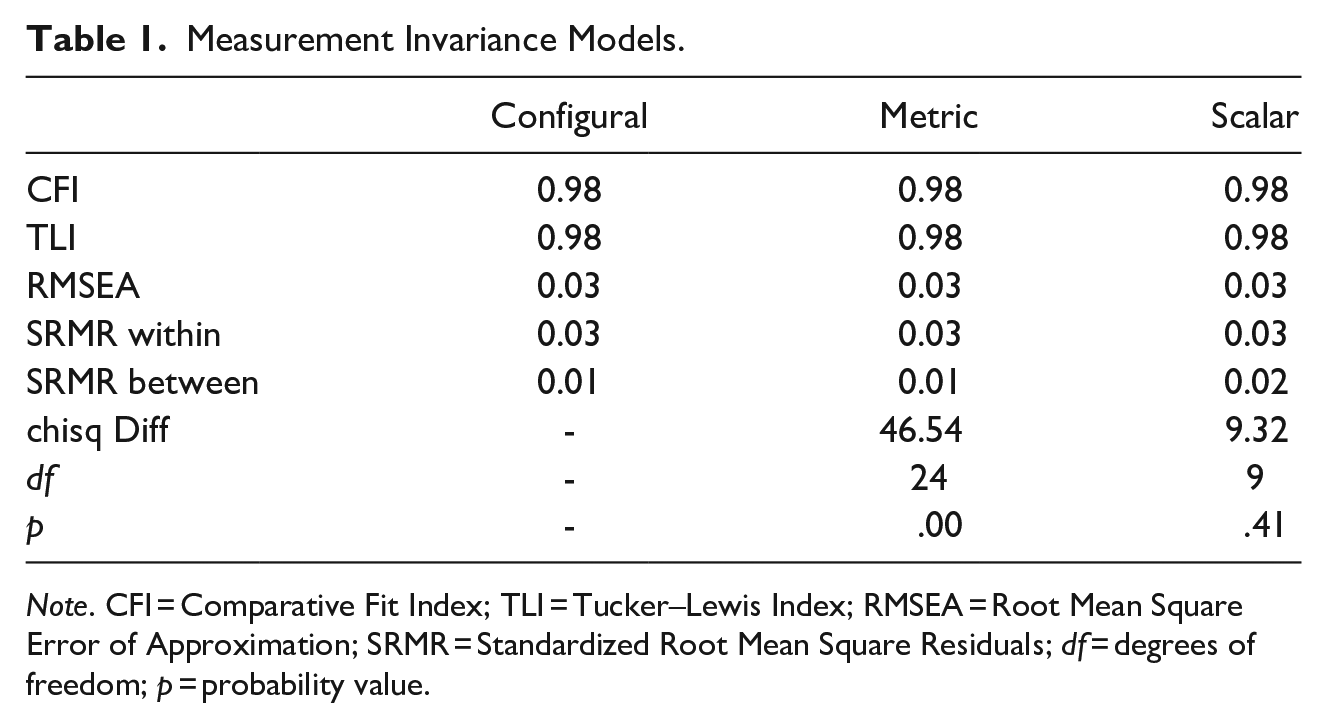
Note. CFI = Comparative Fit Index; TLI = Tucker–Lewis Index; RMSEA = Root Mean Square Error of Approximation; SRMR = Standardized Root Mean Square Residuals; df = degrees of freedom; p = probability value.
Descriptive statistics
The descriptive statistics, including means, standard deviations, and correlations among variables at the within and between levels are presented in Table 2.
Correlation Matrix.
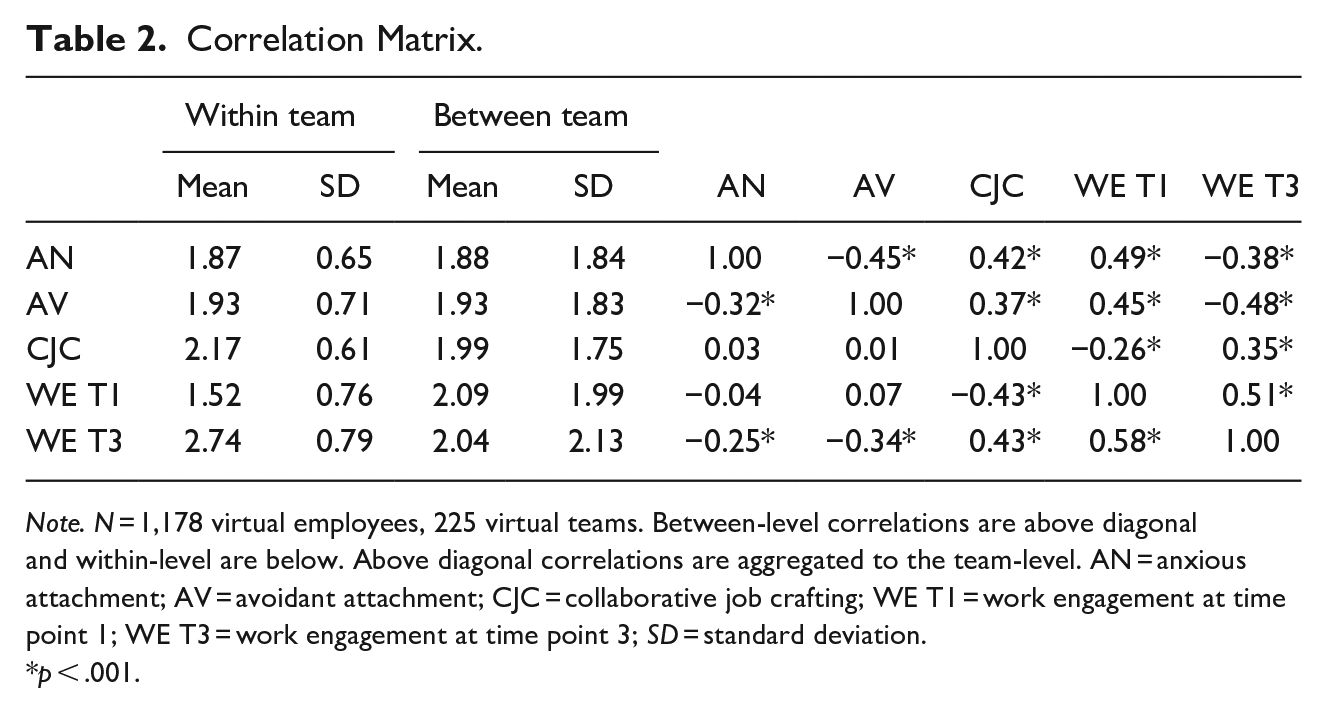
Note. N = 1,178 virtual employees, 225 virtual teams. Between-level correlations are above diagonal and within-level are below. Above diagonal correlations are aggregated to the team-level. AN = anxious attachment; AV = avoidant attachment; CJC = collaborative job crafting; WE T1 = work engagement at time point 1; WE T3 = work engagement at time point 3; SD = standard deviation.
p < .001.
Hypothesis testing
All hypotheses were examined simultaneously. Hypotheses 1a and 1b examined whether higher attachment anxiety (1a) and higher attachment avoidance (1b) at Time 1 are negatively associated with work engagement at Time 3. As expected, there was a significant negative relationship between both higher attachment anxiety and work engagement (α = −1.28, p < .001) and higher attachment avoidance and work engagement (α = −1.98, p < .001), while controlling for work engagement changing from Time 1 to Time 3 (α = 1.03, p < .001). Therefore, Hypotheses 1a and 1b were fully supported.
Hypotheses 2a and 2b predicted that collaborative job crafting at Time 2 mediates at least part of the relationship between higher attachment anxiety at Time 1 and work engagement at Time 3 (2a); and collaborative job crafting at Time 2 mediates at least part of the relationship between higher attachment avoidance at Time 1 and work engagement at Time 3 (2b). The results demonstrated that, while controlling for work engagement changing from Time 1 to Time 3 (β = 1.03, p < .001), there were significant positive mediation effects in the relationship between higher attachment anxiety and work engagement (β = .85, p < .01), and higher attachment avoidance and work engagement (β = .83, p < .01) through collaborative job crafting. These results provide initial support for Hypotheses 2a and 2b.
To establish the type of mediation, the principle that only the indirect effect (path ab) has to be significant to confirm mediation (Zhao et al., 2010) was followed. Furthermore, we tested the indirect effects using the mediation package in R with a quasi-Bayesian Monte Carlo approximation (MacKinnon et al., 2004), which is appropriate for multilevel mediation models (Bauer et al., 2006). The effects were computed for each of the 10,000 bootstrapped samples, and 95% confidence intervals were calculated by determining the effects at the 2.5th and 97.5th percentiles. The results indicated that the confidence intervals for the mediating effects of collaborative job crafting between attachment anxiety and work engagement (estimate = 0.85; CI = 0.18, 1.53) and between attachment avoidance and work engagement (estimate = 0.83; CI = 0.17, 1.49) were significant. Therefore, Hypotheses 2a and 2b were fully supported. Our final model with the estimates is represented in Figure 1.
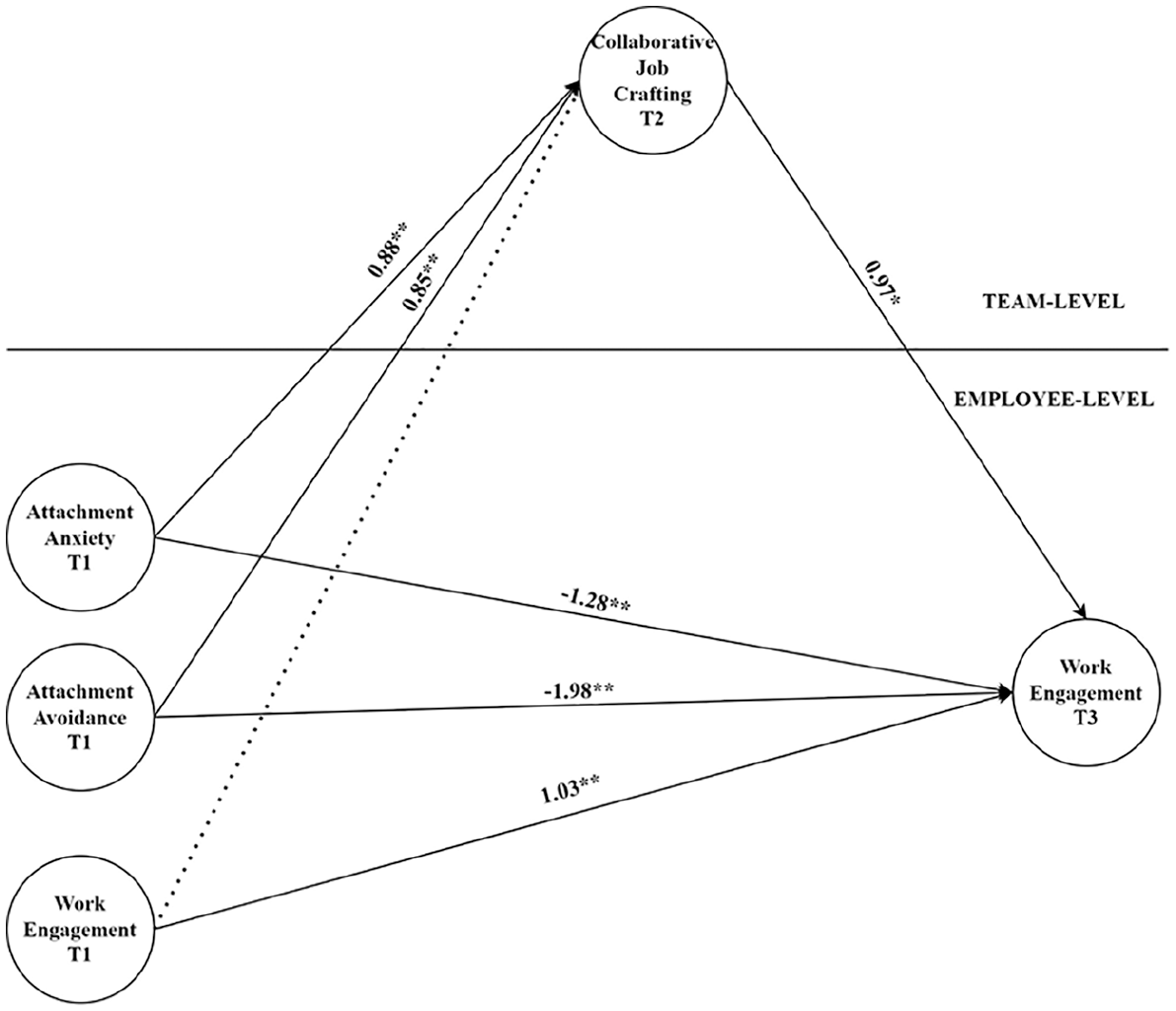
Final model.
Discussion
In this study, we set out to investigate how virtual team members’ attachment orientations contribute to their level of work engagement, and whether this relationship might be positively influenced by participation in collaborative job crafting. Drawing on attachment theory and the JD–R model, the results of our study support the predicted direct relationship between attachment and work engagement, and an indirect relationship through collaborative job crafting. Previous studies have demonstrated a negative relationship between attachment (anxious and avoidant) and work engagement in traditional face-to-face settings (Byrne et al., 2017; Littman-Ovadia et al., 2013). Our study is the first to demonstrate that both attachment anxiety and attachment avoidance also result in reduced work engagement among employees working in non-traditional, virtual work contexts. The present study extends attachment theory in the context of virtual teams by establishing that anxiously and avoidantly attached employees demonstrate poor work engagement, with each orientation having theoretically unique and distinct relationships.
Individuals scoring higher on attachment avoidance perceive others as untrustworthy and maintain emotional distance from others (Mikulincer & Shaver, 2005). In a virtual team environment, this may result in such individuals refraining from seeking support from team members and may further prevent them from developing connections with others in the team (Byrne et al., 2017). Positive connections facilitate work engagement, as engagement is about the full investment of employees’ selves in their work role (Kahn, 1990).
Meanwhile, individuals with higher attachment anxiety hold a negative model of the self, which is further characterized by hyperactivation strategies that rely on excessive attempts to achieve support (Mikulincer & Shaver, 2005). However, in a virtual team environment, individuals typically have no prior personal relationships; this makes team members more task-oriented and less likely to exchange social–emotional information, leading to further depletion of social interactions (Martins et al., 2004). Due to lack of support, anxiously attached individuals may perceive even mild events as challenging, and they may overly ruminate on the slightest of circumstances (Albert et al., 2015). Thus, both anxiously and avoidantly attached virtual employees experience less vigor, dedication, and absorption—that is, poor work engagement.
An unexpected finding was that attachment anxiety and attachment avoidance had a negligible association with within-level work engagement at Time 1 (see Table 2). A possible reason for this could be that, in the initial stages of virtual projects, team members may have had more interactions, whereby some employees with higher attachment anxiety required more support and feedback, and some employees with higher attachment avoidance took control of their work by avoiding interactions in comparison to others. This may have unpredictably affected the relationship between attachment orientations and work engagement at Time 1.
Overall, our findings advance attachment theory by enhancing our understanding of how attachment anxiety and attachment avoidance affect employees’ well-being (i.e., work engagement) in a virtual team context. Furthermore, this study is, to the best of our knowledge, the first to examine the role of collaborative job crafting as a mediator between attachment and work engagement, addressing calls to examine mechanisms that link employees’ attachment orientations and work-related outcomes (Yip et al., 2018). We found that collaborative job crafting partially mediates the relationship between attachment anxiety and work engagement, as well as attachment avoidance and work engagement in virtual teams.
Extending the JD–R model, we found support for considering attachment anxiety and avoidance as a form of personal job demand (Vîrgă et al., 2019), which can be regarded as an individual factor prompting virtual employees to craft their jobs collectively to gain resources. Existing evidence indicates that team members’ self-efficacy and daily affect at the individual level are positively associated with team job crafting behavior (Mäkikangas et al., 2017). We contribute to the literature on collaborative job crafting by finding that, not only personal resources but also personal demands, such as attachment orientations, can be a key factor stimulating employees to craft their work proactively at the team level.
Individuals with higher attachment anxiety have a negative view of themselves, whereas individuals with higher attachment avoidance have a negative view of others (Leiter et al., 2015; Richards & Schat, 2011). In both cases employees are motivated to craft their job to achieve positive meaning from work and work identity, since they perceive their jobs as being more demanding (Wang et al., 2018; Wrzesniewski et al., 2013). Employees who collectively craft their jobs and shape their work environments acquire new job resources that allow them to cope better with job demands which, in turn has a positive effect on outcomes such as work engagement (Mäkikangas et al., 2017; Tims et al., 2013). Previous researchers have explored team-level job crafting in various contexts such as childcare facilities, call centers, high schools, and health service companies (Leana et al., 2009; Lin et al., 2017; McClelland et al., 2014; Tims et al., 2013). We extended the virtual team literature by examining the role of collaborative job crafting in distributed, virtual team settings.
Finally, it is noteworthy that existing workplace studies portray a generally negative picture of attachment anxiety and avoidance, which appears to consign an employee to negative outcomes both for themselves and their organizations (e.g., less instrumental helping behaviors and reduced organizational citizenship behaviors; Geller & Bamberger, 2009; Little et al., 2011). However, we suggest that the present study sheds light on how collaborative job crafting behavior may assist anxiously and avoidantly attached employees to craft their jobs with team members in ways that help them achieve their relational goals and hence reduce an aspect of the job demands that would otherwise be experienced as stressful.
Practical Implications
This study advances our knowledge of individual’s personal characteristics as job demands, highlighting the potentially negative impact of both higher anxious and avoidant attachment on work engagement in virtual teams. Our findings suggest that the detrimental effects of attachment orientations may, to some extent, be reduced when collaborative job crafting is practiced within the team. Virtual organizations could benefit from considering an employee’s attachment orientations and from fostering an environment that is inclusive and supportive of attachment relational diversity (Byrne et al., 2017; Vîrgă et al., 2019) where collaborative job crafting is encouraged. More broadly, given that relational models are activated in times of stress (Albert et al., 2015), training could help managers acknowledge the potentially negative effects of higher attachment anxiety and avoidance in team member relationships and equip them to provide emotional security and protection by being responsive to virtual employees (Littman-Ovadia et al., 2013). Furthermore, organizational strategies that promote stress management and occupational health to virtual employees may be beneficial (Byrne et al., 2017).
As the work engagement of both anxiously and avoidantly attached employees is positively influenced by collaborative job crafting, our findings suggest that virtual team leaders should assist employees to craft their jobs jointly in ways that align with both organizational goals (Leana et al., 2009) and individual relational goals. Some ways to achieve this are by integrating collaborative job crafting in formal job descriptions, helping virtual employees and leaders to engage in regular developmental discussions, and seeking agreement on what belongs to the domain of an employee’s work and how work should be understood (Kira et al., 2010). These approaches provide additional resources to employees scoring higher on attachment anxiety or avoidance, which can help them cope with any perceived relational demands and assist them in improving their organizational outcomes.
Limitations and Future Research
Our study has limitations. First, as in most studies, an important limitation is the generalizability of our results across different industries or countries. The study was conducted with a sample consisting of multinational IT organizations that use virtual teams to manage their businesses in India and overseas. The findings may differ across sectors and countries. To broaden the applicability of our findings, future research can replicate this study in other sectors. Additionally, researchers could investigate whether our findings are replicable in “traditional” organizations that have adopted remote or hybrid work designs during the COVID-19 pandemic.
Second, we modeled work engagement at two time points only (Time 1 & 3), which offered an insight into the change from one time point to another. Future research should consider measuring work engagement on more than two occasions to improve knowledge of the change in the outcome. Having more repeated outcome variables will enhance the understanding of whether work engagement increases or decreases after collaborative job crafting.
Third, we relied on self-report data, which increased the risk of common method bias (Podsakoff et al., 2003). However, we reduced common method bias by collecting data across three time points. Additionally, the outcome variable, work engagement, was measured twice, which may have further diminished the possibility of common method bias (Doty & Glick, 1998). Future research should verify our findings using data from other sources such as work engagement ratings from co-workers.
Fourth, partial mediation raises the possibility of an omitted mediator in the direct path between attachment orientations and work engagement (Zhao et al., 2010). Future research should consider investigating other potential mediators, such as individual job crafting, to see if it works in the same way as collaborative job crafting or if it is less helpful among teams, as found by Leana et al. (2009).
Fifth, although both anxiously and avoidantly attached virtual team members engaged in collaborative job crafting behavior, their motivation and the nature of the team job crafting is theoretically different. For example, when implementing a new tool for collaboration in a virtual team, anxiously attached individuals may seek support and feedback from others, whereas avoidantly attached individuals may look for control and autonomy with their work. The focus of the present study was to ascertain the overall relationships between attachment and collaborative job crafting; however, there may be important underlying differences, which future research should investigate.
Sixth, our study focuses on individual-level of attachment that leads to a particular form of job crafting (i.e., team job crafting) in virtual teams. Another interesting avenue would be to explore the team-level measure of attachment with different profiles (e.g., most members with anxiety or avoidance orientations in a virtual team) and its effect on work engagement through collaborative job crafting. Additionally, in line with most contemporary research, this study operationalized attachment as two dimensions—anxious and avoidant—as it is more robust psychometrically (Brennan et al., 1998; Shaver & Mikulincer, 2002). Theoretically, a low score on both dimensions—anxious and avoidant—relates to “secure” attachment, which in JD–R terms may serve as a resource. Future researchers could also examine the implications of secure attachment for collaborative job crafting.
Finally, virtual teams that formed part of our sample were in the initial stages of their respective projects. However, we could not ascertain whether team members were newly working together or had some prior experience of virtual working and/or knowledge of each other. This may have influenced the accuracy of work engagement at Time 1 and collaborative job crafting at Time 2 in our study. A more detailed analysis will be required to determine the implications of virtual teamwork experience and co-worker familiarity.
Conclusion
This study extended knowledge concerning the effects of attachment orientations on work engagement in virtual teams and demonstrated the role of collaborative job crafting in mediating this relationship. Our results suggest that virtual employees who are anxiously or avoidantly attached can attain higher levels of work engagement by collectively redesigning work processes through collaborative job crafting. In the future, organizations and virtual team leaders may benefit by understanding employees’ attachment orientations and by supporting team job crafting to enhance employee well-being.
Footnotes
Acknowledgements
We thank the participants of the study for their cooperation.
Author’s Note
Rahul Goel is now affiliated to Sheffield Hallam University, Sheffield, UK.
Declaration of Conflicting Interests
The author(s) declared no potential conflicts of interest with respect to the research, authorship, and/or publication of this article.
Funding
The author(s) received no financial support for the research, authorship, and/or publication of this article.
