




Abstract
We investigated collective efficacy as a key predictor of team effectiveness (i.e., satisfaction and performance) and examined three behavioral team process dimensions (i.e., transition, action, and interpersonal processes) as novel mediators. Based on survey data from 160 project teams, we found a positive linear relation between collective efficacy and team effectiveness. In addition, we found that a higher frequency of action and interpersonal processes partially explains the positive benefits of collective efficacy on team effectiveness. Our study has unique practical and theoretical implications as it provides empirical evidence for distinct mechanisms of the collective efficacy-team effectiveness relation.
With teams now ubiquitous in organizations (Kozlowski & Bell, 2013), it is imperative to understand what makes a team effective. Team effectiveness encompasses both team satisfaction and team performance (Mathieu et al., 2008; McGrath, 1964). A number of factors can positively impact team effectiveness, but a key driver of team effectiveness is collective efficacy, a team members’ shared belief in their team’s ability to successfully accomplish a task (Bandura, 1997). Collective efficacy influences the amount of effort the team will expend, their motivation, and the interpersonal environment (Bandura, 1997; Rapp et al., 2021).
Given the relevance of collective efficacy to team effectiveness, it is surprising that researchers do not better understand the relationship between collective efficacy and team effectiveness. For example, the only empirical examination of collective efficacy and team satisfaction was conducted in a gaming context, and it found a direct relationship between collective efficacy and team satisfaction (Luu & Narayan, 2017). Although researchers have suggested that collective efficacy can positively influence the emotions of team members and that this may impact the members’ feelings of satisfaction (Bandura, 1997; DeRue et al., 2010), researchers have yet to empirically examine possible mediators of the relationship between collective efficacy and team satisfaction.
More research has examined the relationship between collective efficacy and team performance, but findings have been conflicting. Meta-analytic research evidence indicates that collective efficacy is positively related to team performance (see Gully et al., 2002; Stajkovic et al., 2009). However, emerging evidence has alluded to a more complex relationship between collective efficacy and team performance, with research suggesting greater efficacy may not always be beneficial to performance (Rapp et al., 2014). Yet, other studies have found no relation, a negative relation, and even a curvilinear relation between efficacy and performance (e.g., Chen & Lee, 2007; Goncalo et al., 2010; Katz-Navon & Erez, 2005; Park et al., 2017; Rapp et al., 2014). These conflicting findings indicate a gap in our understanding of the relation between collective efficacy and team performance, limiting the conclusions drawn. Guidance for practitioners to understand and predict how teams perform has also been restricted due to conflicting findings. Given the ubiquity of teams in organizations today and the impact of collective efficacy on relevant team outcomes, it is important to further investigate the nature of this relationship.
In this study, we examine the mechanisms that underlie the observed relationship between collective efficacy and team effectiveness to provide a more nuanced understanding of the nature of this relationship. We propose that collective efficacy impacts the behavioral processes teams engage in, which subsequently impacts team effectiveness. Team processes are the interdependent acts team members engage in that organize their efforts to achieve team goals (Marks et al., 2001). Meta-analytic research supports the positive influence of team processes on team effectiveness (LePine et al., 2008). Further, collective efficacy has been empirically linked to several team process behaviors (i.e., DeRue et al., 2010; Ilgen et al., 2005; Tasa & Whyte, 2005). However, the nature of the relation between collective efficacy and the different processes may differ. This difference may account for the conflicting findings in the literature regarding efficacy and team performance. Thus, extending previous research, we examine team processes as the mechanism by which collective efficacy influences team satisfaction and team performance.
The aim of our research is to better understand the relation between collective efficacy and team effectiveness. In addressing this research aim, we contribute to the teamwork literature in several ways. First, we investigate the relation between collective efficacy and team satisfaction, a promising yet understudied relation in the literature. Second, we examine the relation between collective efficacy and team performance. Some recent findings have suggested that too much collective efficacy can hinder team performance (e.g., Park et al., 2017; Rapp et al., 2014). Teams with very high collective efficacy may engage in fewer team processes, resulting in lower team performance (e.g., Rapp et al., 2014; Tasa & Whyte, 2005). Finally, and perhaps most notably, we try to gain a deeper understanding of the relation between collective efficacy and team effectiveness by using a multidimensional measure of team processes to examine whether team processes explain the influence of collective efficacy on team satisfaction and team performance.
Collective Efficacy and Team Effectiveness
Social cognitive theory provides a framework for understanding how people form beliefs regarding their ability to complete a task successfully. These beliefs form one’s perceived self-efficacy for the task (Bandura, 1982, 1997). Self-efficacy is an individual-level construct; however, Bandura (1997) extended this concept to the group level. Collective efficacy is defined as “a group’s belief in their conjoint capabilities to organize and execute the courses of action required to produce given level of attainments” (Bandura, 1997, p. 477). Collective efficacy is solely focused on the team’s capabilities. It is not measured by how confident an individual is in themselves or another team member but rather every member’s confidence in the whole group. Collective efficacy is a motivational team emergent state and helps guide a team’s efforts to accomplish a task (Rapp et al., 2021).
Collective Efficacy and Team Satisfaction
As noted earlier, some research suggests a small positive relationship between collective efficacy and team satisfaction (Luu & Narayan, 2017). Greater collective efficacy may lead to more positive emotions, greater trust, and bonding among team members (Bandura, 1997; DeRue et al., 2010). These positive emotions and stronger relationships may subsequently bolster feelings of team satisfaction. Conversely, teams lower in collective efficacy elicit more negative emotions and have a collective feeling of helplessness (Bandura, 1997; DeRue et al., 2010; Ilgen et al., 2005). These adverse feelings associated with the team may reduce team members’ feelings of satisfaction. Thus, the level of collective efficacy in a team may influence the team’s satisfaction level.
Collective Efficacy and Team Performance
Unlike the efficacy-satisfaction relationship, the association between collective efficacy and team performance is not straightforward. Collective efficacy ultimately contributes to team performance (Goncalo et al., 2010) because it motivates members and provides direction for effort (Fuller et al., 2007). If the team members believe in the team’s ability to execute tasks effectively, the team will work harder and collaborate more as a team (Bandura, 1997; Lindsley et al., 1995). Meta-analytic evidence indicates a moderate positive relationship between collective efficacy and team performance (Gully et al., 2002; Stajkovic et al., 2009).
However, findings in some studies are inconsistent with the positive meta-analytic results, showing no relationship or a negative relationship between collective efficacy and team performance (e.g., Chen & Lee, 2007; Goncalo et al., 2010; Katz-Navon & Erez, 2005). While these findings appear counterintuitive to the argument that higher collective efficacy is beneficial and indicate that collective efficacy may not impact or may even harm team performance under some circumstances, it also suggests there may be underlying complexities to the relationship between collective efficacy and team performance. Researchers have theorized that too much collective efficacy may hinder performance, as teams may become overconfident and fail to engage in vital team processes or take inapt risks (Audia et al., 2000; Gist, 1987; Knight et al., 2001; Lindsley et al., 1995; Whyte, 1998).
In response to concerns surrounding the possible ill-effects of too much collective efficacy, some researchers have proposed that collective efficacy may have a curvilinear relationship with beneficial team outcomes (e.g., Rapp et al., 2014; Tasa & Whyte, 2005). An empirical laboratory study found support for a curvilinear relationship between collective efficacy and vigilant problem-solving in teams (Tasa & Whyte, 2005). Teams with higher levels of collective efficacy made lower quality decisions than teams with moderate levels of collective efficacy. Subsequent studies have found empirical support for a curvilinear relationship between collective efficacy and team performance, showing that collective efficacy was advantageous until a certain point, after which greater efficacy led to detrimental effects for team performance (Park et al., 2017; Rapp et al., 2014). Therefore, we hypothesize:
Although we believe the direct relation between collective efficacy and performance will be a negative curvilinear relation, the previous mixed findings indicate that this relation is likely more complex than what is revealed by just examining the direct relationship between these variables. Thus, it is imperative to examine potential mediators which may be perpetuating the mixed findings.
Input Mediator Output Input (IMOI) Model
A way to explore the mixed findings concerning the relationship between collective efficacy and team outcomes is to investigate the mechanism through which collective efficacy impacts team effectiveness. To examine the mechanism, we use the Input Mediator Output Input (IMOI) model (Ilgen et al., 2005). The IMOI model provides a framework to understand how inputs and mediators (including processes) relate to team outputs, which can subsequently impact inputs. Inputs, mediators, and outputs are all team-level variables. Inputs can be psychosocial traits or emergent states, such as collective efficacy or cohesion (McGrath, 1984; Steiner, 1972). Inputs influence mediators, which can be behavioral or cognitive processes or even cognitive or affective states (Ilgen et al., 2005). Mediators explain the relationship between inputs and outputs. Outputs, as the outcome of the input and mediators, are often measured as team satisfaction or performance (McGrath, 1984; Steiner, 1972). Outputs can, in turn, become inputs by influencing future team processes (Ilgen et al., 2005). In summary, inputs affect mediators, which subsequently affect outputs (which can become inputs over time). In this study, we use the IMOI model to examine how the input of collective efficacy impacts behavioral team processes, which then ultimately influence team effectiveness (i.e., team satisfaction and team performance).
Team Processes
In past research, the relationship between efficacy and performance has been explained by the motivation behind collective efficacy (Bandura, 1997). However, motivation does not elucidate the specific behaviors and processes engaged in by teams. Therefore, it is important to examine what processes teams are engaged in and how these processes impact team effectiveness. Team processes are defined as “members’ interdependent acts that convert inputs to outcomes through cognitive, verbal, and behavioral activities, directed toward organizing task work to achieve collective goals” (Marks et al., 2001, p. 357). Marks et al. (2001) categorize team processes into three dimensions: transition, action, and interpersonal processes. Transition processes are processes that take place at the beginning of a project when teams are formulating how they will accomplish the task and include behaviors such as specifying team goals, forming strategies, and evaluating the task, resources, and environment for the given situation (Marks et al., 2001). Action processes are focused on the methods that a team uses to achieve their goal and include goal monitoring, assessing resources, supporting team members, and organizing the team’s efforts and actions to achieve goals (Marks et al., 2001). Interpersonal processes are centered on the interactions between team members, including managing conflict, motivating team members, building confidence in team members, and regulating team members’ emotions while working to accomplish the task (Marks et al., 2001).
Collective Efficacy’s Impact on Team Processes
Teams higher in collective efficacy may be engaging in more team processes, thus explaining past findings of a positive linear relation between collective efficacy and team effectiveness (Gully et al., 2002; Stajkovic et al., 2009). Higher efficacy leads to healthy confidence that translates into positive emotional interactions within the team and increased engagement (DeRue et al., 2010). Higher efficacy can lead to adaptability and adeptness at planning, structuring, and setting appropriate goals (DeRue et al., 2010). Thus, the higher collective efficacy a team has, the more likely they will engage in team processes.
Conversely, lower collective efficacy leads to an evocation of negative emotions and less engagement, thus reducing the likelihood of team members trusting and bonding with each other (Bandura, 1997; Ilgen et al., 2005). Consequently, members in teams with lower collective efficacy may be less likely to engage in behaviors that could benefit the team, such as devising a plan, formulating a strategy, and monitoring behavior (Bandura, 1997; DeRue et al., 2010; Ilgen et al., 2005). Teams lower in collective efficacy may engage in fewer team processes, such as affect management, motivation, and confidence building because members may feel powerless and that failure is inevitable (Tasa & Whyte, 2005). The team does not feel capable of achieving a desired level of performance and thus believes there is no reason to engage in effective processes to complete the task. Therefore, the lower collective efficacy a team has, the less likely they will engage in team processes.
However, evidence also suggests that teams with high collective efficacy may not be performing as well as teams with moderate-high levels of efficacy (Rapp et al., 2014; Park et al., 2017). Teams high in collective efficacy may be overconfident, and the overconfidence may translate to complacency and lack of motivation to engage in team processes, particularly transition and action processes, which are both integral to team performance (LePine et al., 2008). Regarding transition processes, teams with very high collective efficacy may be less likely to set goals, consider alternative approaches, or engage in risk management (Tasa & Whyte, 2005). High collective efficacy may also impede action processes. Specifically, teams with high collective efficacy may have reduced responsiveness to feedback and lack adaptability (Silver et al., 1995). When teams engage in fewer team processes, it may negatively impact their performance, such as the team’s decision-making and problem-solving ability (Miller, 1994; Tasa & Whyte, 2005). Based on research findings that a curvilinear relationship may more accurately describe the relationship between collective efficacy and both transition and action processes, we propose the following hypotheses.
Given the nature of interpersonal processes, it is unlikely that too much efficacy would negatively impact them. Interpersonal processes include behaviors such as conflict management, motivating team members, and regulating members’ emotions (Marks et al., 2001). Since interpersonal processes focus on managing interpersonal relationships and maintaining social harmony, whereas transition and action processes focus on goal accomplishment (Marks et al., 2001), the motivation to engage in interpersonal processes may differ from the motivation to engage in transition and action processes. Thus, collective efficacy may impact interpersonal processes differently. For example, team members may still engage in conflict management even if there is high collective efficacy because conflict management is a prosocial behavior that teams would use to maintain social harmony.
The Mediating Role of Team Processes
Using the IMOI model as a guide to establish the mechanism through which collective efficacy impacts effectiveness, we aim to clarify this relation and better understand how team emergent states can impact outcomes. According to the IMOI model, team processes should affect team outcomes. Emergent states (inputs) such as collective efficacy impact team processes (mediators), and then team processes influence team outcomes (outputs) such as satisfaction or performance (Marks et al., 2001). In the literature, team processes have been positively related to team effectiveness (e.g., Kozlowski & Ilgen, 2006; LePine et al., 2008). A comprehensive meta-analysis positively linked all three team process dimensions (i.e., transition, action, and interpersonal processes) to team performance and member satisfaction (LePine et al., 2008). Thus, there is strong evidence that the processes teams engage in influence team outcomes. We propose that team processes explain the relationship between collective efficacy and team effectiveness. Collective efficacy may influence the type and number of team processes engaged in and consequently impact team effectiveness. This aligns with the IMOI model as collective efficacy is an emergent state (Bandura, 1997) that is the input in the model. Collective efficacy then informs team processes, which mediates the relationship between efficacy and effectiveness.
Specifically, we propose that all three team processes mediate the relation between collective efficacy and team satisfaction as well as collective efficacy and team performance. Evidence suggests that collective efficacy can impact transition and action processes (Miller, 1994; Silver et al., 1995; Tasa & Whyte, 2005). There is also support for efficacy impacting interpersonal processes. Feeling confident in one’s team can increase the positive emotions that team members feel and create a positive team environment (Bandura, 1997; DeRue et al., 2010). Thus, collective efficacy may be impacting team satisfaction and performance through the behaviors of team members.
As an exploratory research question, we want to investigate if interpersonal processes are the most potent mediator of the efficacy-satisfaction relationship. Given the strong focus of interpersonal processes on managing interpersonal relationships within a team (Marks et al., 2001), we expect the indirect relation between efficacy and satisfaction via interpersonal processes has the largest effect size compared to the indirect relation via transition and action processes. Interpersonal processes involve behaviors such as conflict and affect management, and motivating others (Marks et al., 2001). We expect that collective efficacy helps foster these positive interpersonal behaviors, and subsequently, these positive interpersonal behaviors have an especially large impact on satisfaction.
Methods
Participants
Participants were recruited from an undergraduate course at a Southwestern Ontario University. The course was team-based, requiring students to complete a team project together. Those who participated in the study received 4% toward their final grade in the course as compensation for their time. At the beginning of the semester, the instructor assigned students to teams that worked together throughout the semester to complete the assignment. The assignment required task interdependence, as the course required students to work together on smaller tasks to create the larger final product.
There were 524 participants and 160 teams after data cleaning and aggregation. The teams ranged in size from two to four students. 1 The average age of participants was 20.23 (SD = 2.18), and 83% of the participants were female, 15% male, and 2% identified another or no gender.
Procedure
A week after students were given their first assignment, they were asked to fill out an adapted Collective Efficacy measure (Riggs & Knight, 1994). The week interim allowed the students time to interact with their team and helped form their initial collective efficacy beliefs. Once the students handed in their assignments, team processes, team satisfaction, and team performance were measured. Team processes were measured at this time point to ensure all processes teams engaged in throughout the project were captured. Students then completed a team satisfaction measure that assessed members’ level of satisfaction with their team on this project and a performance measure that assessed how they perceived their team performed on this project. To reduce any memory errors, these measures were evaluated simultaneously (i.e., 1 day after the project was due).
Measures
Collective efficacy, team processes, team performance, and team satisfaction were all measured at the individual level and aggregated to the team level based on acceptable rwg and Average Deviation (AD) index values, as well as ICC values. We used individual-level measures for these variables to reduce any bias and discomfort that may have arisen from team discussion of the main variables. The analyses were all conducted at the team level.
Collective efficacy
The Riggs and Knight (1994) seven-item Collective Efficacy Beliefs Scale measured each team’s collective efficacy. Some items from the original scale were amended to reflect the participants’ context (e.g., changed the referent from “department” to “team”). Participants rated how much they agreed with statements such as “The team I work with has above average ability” (Riggs & Knight, 1994). Each item was rated using a 7-point Likert scale that ranged from strongly disagree to strongly agree. The measure of collective efficacy had a Cronbach’s alpha of .88. The ICC values (ICC1 = .23 and ICC2 = .45) were also assessed.
Team processes
Team processes were assessed using the 30-item condensed version of the Marks et al. (2001) Team Processes scale. The team processes scale consisted of three subscales pertaining to the three team process dimensions (Mathieu et al., 2020). Participants rated the extent to which their team engaged in team processes throughout the project on a 5-point Likert scale, ranging from not at all to to a very great extent. The measure of team processes had a Cronbach’s alpha of .91. The overall team processes ICC values (ICC1 = .26 and ICC2 = .50) were assessed as well as the ICC values for the transition (ICC1 = .21 and ICC2 = .43), action (ICC1 = .26 and ICC2 = .50), and interpersonal (ICC1 = .24 and ICC2 = .48) subscales.
Team performance
Team performance was measured with three-items adapted from Killumets et al.’s (2015) original team effectiveness measure. Participants rated the extent to which each statement applied to their team on a 7-point Likert scale, ranging from strongly disagree to strongly agree. An example item is, “This team delivers high-quality work.” The measure of team performance had a Cronbach’s alpha of .90. The ICC values (ICC1 = .20 and ICC2 = .41) were also assessed.
Team satisfaction
Team satisfaction was measured with three-items adapted from Cammann et al.’s (1983) job satisfaction measure. We changed the measure referent from “my job” to “my team”. Participants rated the extent to which each statement applied to their team on a 7-point Likert scale, ranging from strongly disagree to strongly agree. An example item is, “All in all, everyone in the team is satisfied with the team.” The measure of satisfaction had a Cronbach’s alpha of .88. The ICC values (ICC1 = .31 and ICC2 = .56) were also assessed.
Analytical Strategy
To ensure high-quality data, before data analyses, we excluded any participants who did not pass two attention check items. Additionally, any participants who did not complete at least one of the surveys were eliminated. Finally, any teams who did not reach acceptable levels of agreement with the main variables were removed from the sample, which we explain in the next section.
Team aggregation
To justify aggregation, we used both agreement and reliability indices. Firstly, we assessed team agreement using rwg values and the Average Deviation (AD) index. The rwg values for collective efficacy (median r*wg (j) = .77), team processes (median r*wg (j) = .72), team satisfaction (median r*wg (j) = .89), and team performance (median r*wg (j) = .89) indicated support for aggregation (James et al., 1984; Lindell & Brandt, 1999). We further tested the AD index, which is similar to other team agreement indices but is not influenced by group size, unlike other agreement indices such as rwg values (Bliese, 2016). AD values assess the within-group agreement based on the average deviation from the mean (Burke et al., 1999). Acceptable levels of agreement are seen when the average for the group is less than the number of response options when divided by six (Dunlap et al., 2003). Overall, 26 teams did not reach acceptable levels of agreement and were removed from the sample.
Team reliability was also assessed using intraclass correlation coefficients (ICC). ICC1s assess the amount of variance in a participant’s response that can be attributed to group-level properties (Bryk & Raudenbush, 1992). ICC2s assess group mean reliability; however, this index is influenced by team size, such that the correlations can be underestimated for smaller groups (Bliese, 1998). The ICC1s of the predictor and outcome variables were all above the recommended .12 cut-off (James et al., 1984). The ICC2s of the variables were above the minimum threshold of .40 but were still relatively low compared to commonly accepted values of .70 or higher (Cicchetti, 1994; Klein et al., 2000). The lower ICC2 values could be the result of a few factors. Since the teams in our sample ranged from two to four participants, the smaller group size may have contributed to lower ICC2 values because the ICC2 index can be underestimated for smaller groups (Bliese, 1998). Further, due to the homogeneity of the sample and the range restriction, it is expected that there would be a lack of group influence on the individual level responses and lower variability between groups, thereby producing lower ICC values. Researchers assert that taking a holistic view and contextualizing ICC values is vital and that it may still be acceptable to aggregate to the team level despite lower ICC values (Dixon & Cunningham, 2006; Klein et al., 2000). Therefore, the decision to aggregate the teams despite the lower ICC values was made, based on a holistic view of the sample, the within team agreement, and the use of the team as the referent in the variable measures.
Confirmatory factor analyses
We ran a confirmatory factor analysis (CFA) to assess the factor structure of the team processes scale. Previous research has found support for a three-factor model of team processes which consolidate under a general team process factor (LePine et al., 2008). Our CFA results indicated that a three-factor model (RMSEA = 0.07, CFI = 0.87, SRMR = 0.05) fit the data better than the one-factor model (RMSEA = 0.09, CFI = 0.82, SRMR = 0.06).
We then ran three CFAs to assess the distinctiveness of the mediators and outcome variables (i.e., all three team processes, performance, and satisfaction). We ran a CFA with all items loading onto one factor, a three-factor model (performance, satisfaction, and a single team process factor), and a five-factor model (performance, satisfaction, and team processes as three factors). The one-factor model did not fit the data well, with most indices showing poor fit (RMSEA = 0.09, CFI = 0.79, SRMR = 0.06). The three-factor model had better model fit than the one-factor model (RMSEA = 0.08, CFI = 0.85, SRMR = 0.06). The five-factor model with the team processes separated into three factors fit best with most indices indicating adequate fit (RMSEA = 0.07, CFI = 0.89, SRMR = 0.05), supporting the distinctiveness of the scales.
Common latent factor testing
We measured collective efficacy at the beginning of the project; however, given that we measured team processes, satisfaction, and performance cross-sectionally, there is the risk of common method bias (Podsakoff et al., 2003). We tried to minimize the risk of this bias by varying response formats throughout the survey for the variables: the team process variable was measured with a 5-point “to what extent” scale, whereas satisfaction and performance were measured on a 7-point agreement scale. To minimize common method bias, Podsakoff et al. (2012) suggest including an unrelated marker variable, which we could not measure, given the time restrictions involved in this field study and to balance the potential risks to external validity. However, we compared results of CFA analyses with a six-factor CLF model that loaded team processes, satisfaction, and performance with a latent variance factor, as per Podsakoff et al. (2003) recommendations. The analysis of the structural parameters suggests that the common latent factor did not affect the loading on the satisfaction or performance measure. The effect of the common latent factor was only on the loading to the team processes factor, particularly affecting items that tap into group harmony and cohesion, which would not bias our hypothesis testing.
Results
Table 1 presents the descriptive statistics and correlations among the variables at the team level. All hypothesis testing analyses were conducted using R 4.0.2. Regressions were used to test hypotheses 1, 2, 3(a), 3(b), and 3(c), which proposed relationships between collective efficacy and team processes, satisfaction, and performance. When testing for curvilinear relations, a collective efficacy quadratic term was added to the linear equation. Using the Lavaan package v0.6-9 in R, we tested hypotheses 4(a), 4(b), 4(c), 5(a), 5(b), and 5(c) using structural equation modeling (SEM; Rosseel, 2012). We ran a parallel mediation model with satisfaction and performance specified as outcome variables and controlled for age (see Figure 1 for SEM results). Bootstrapping of 5,000 samples was used to test for the indirect effects in the mediation model. The full mediation model indicated acceptable fit: χ2 = 5.12(3), CFI = 0.99, TLI = 0.98, RMSEA = 0.07. Moreover, the R2 suggests that this is a substantive model as it explains 70% of the variance in team satisfaction and 68% of the variance in team performance. Collective efficacy was also shown to explain 19% of the variance in transition processes, 23% of the variance in action processes, and 37% of the variance in interpersonal processes within our model.
Means, Standard Deviations, and Correlations With Confidence Intervals.
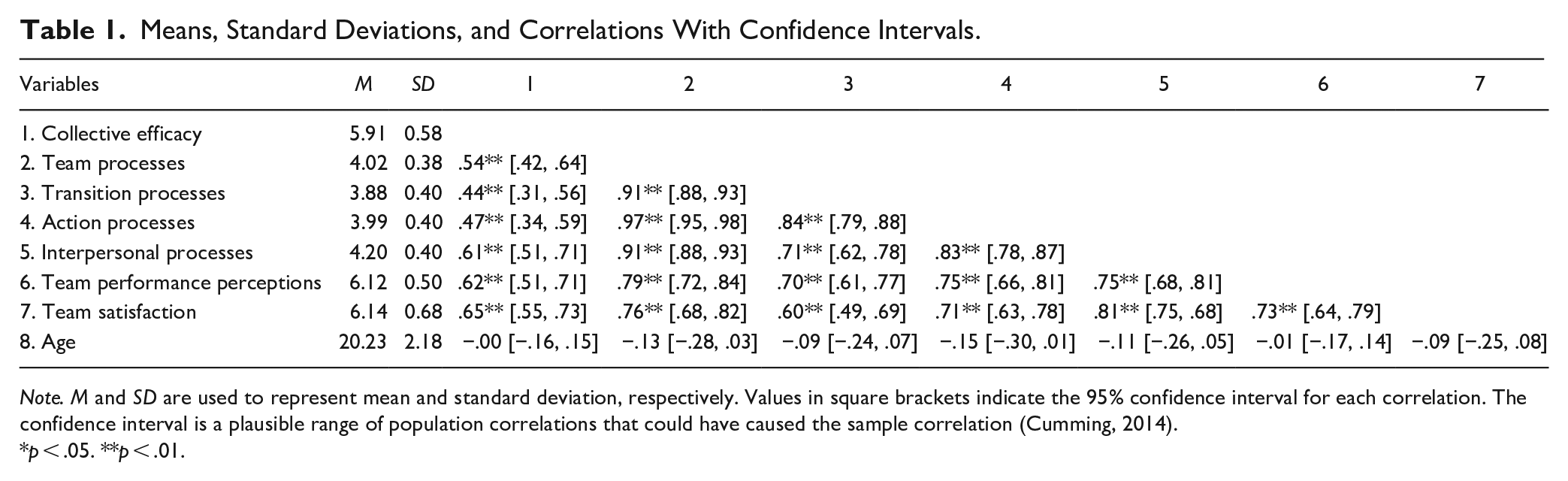
Note. M and SD are used to represent mean and standard deviation, respectively. Values in square brackets indicate the 95% confidence interval for each correlation. The confidence interval is a plausible range of population correlations that could have caused the sample correlation (Cumming, 2014).
p < .05. **p < .01.
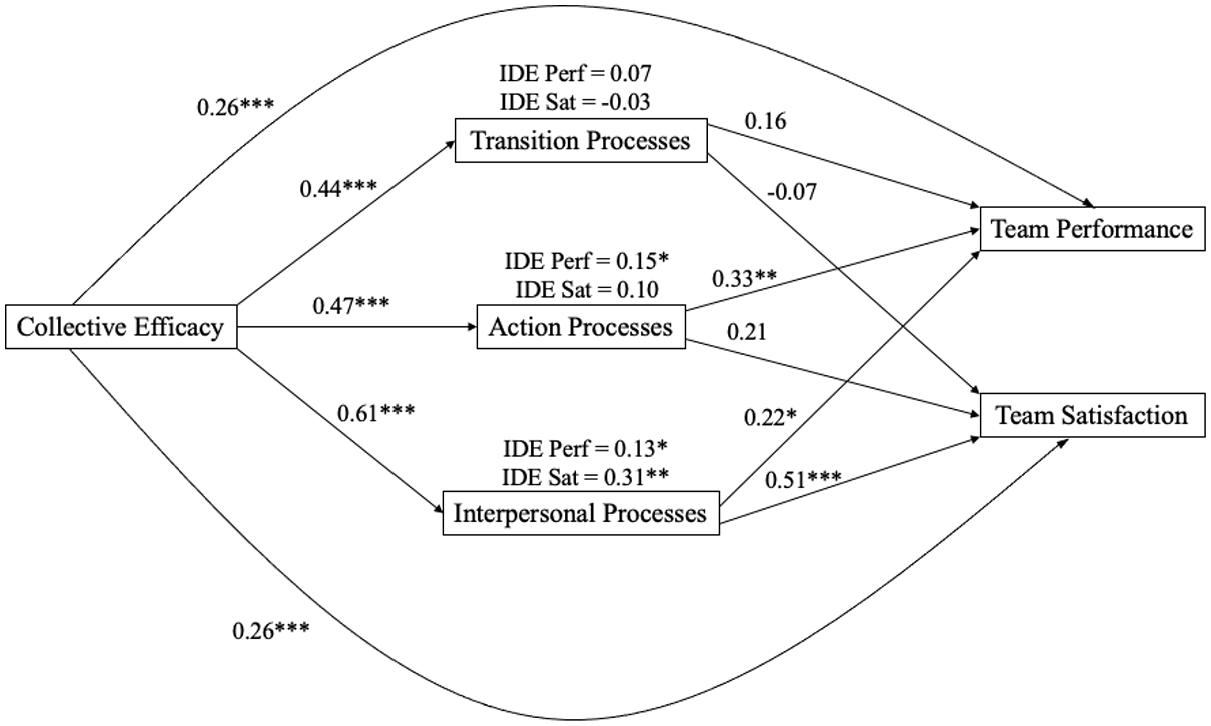
Results of the structural equation model.
We found a positive significant relation between collective efficacy and team satisfaction, β = .26, 95% CI [0.15, 0.37], p < .001, F(5, 154) = 71.95, providing support for hypothesis 1.
When testing for a quadratic relation, as we were with Hypothesis 2, 3(a), and 3(b), one must account for the linear trend. We found a significant, positive linear trend between collective efficacy and team performance, β = .26, 95% CI [0.14, 0.37], p < .001, F(5, 154) = 65.95. However, we found that the quadratic collective efficacy term did not significantly predict team performance, β = −.13, 95% CI [−1.43, 1.18], p < .85, F(6, 153) = 54.62. Since only a positive linear relation was found between collective efficacy and team performance, hypothesis 2 was not supported.
We found a significant, positive linear trend between collective efficacy and transition processes, β = .44, 95% CI [0.30, 0.58], p < .001, F(1,158) = 38.00. However, the quadratic collective efficacy term did not significantly predict transition processes, β = 1.33, 95% CI [−0.67, 3.32], p = .19, F(2, 157) = 19.96. Thus, hypothesis 3(a) was not supported, as there was only a positive linear trend between collective efficacy and transition processes. We found a significant linear trend between collective efficacy and action processes, β = .47, 95% CI [0.34, 0.61], p < .001, F(1, 158) = 45.78. When the quadratic term was added, the linear trend became non-significant, β = −1.71, 95% CI [−3.64, 0.23], p = .08, F(2, 157) = 25.95, and there was a significant positive quadratic trend between collective efficacy and action processes, β = 2.19, 95% CI [0.25, 4.12], p = .03, F(2, 157) = 25.95. This relation was half U-shaped with only high efficacy teams engaging in many action processes and low and moderate efficacy teams engaging in few action processes. Since the quadratic relation was opposite to the hypothesized negative quadratic trend, hypothesis 3(b) was not supported. We found a significant, positive linear trend between collective efficacy and interpersonal processes, β = .61, 95% CI [0.49, 0.74], p < .001, F(1, 158) = 94.52. Therefore, hypothesis 3(c) was supported.
Next, we examined whether team processes mediate the relation between collective efficacy and satisfaction. Transition processes were not significantly related to team satisfaction β = −.07, 95% CI [−0.23, 0.10], p = .43, F(5, 154) = 71.95, and the indirect relation between efficacy and satisfaction via transition processes was non-significant, p = .44, 95% CI [−0.15, 0.04], indicating a lack of support for hypothesis 4(a). Action processes were significantly related to team satisfaction, β = .21, 95% CI [0.01, 0.42], p = .04, F(5, 154) = 71.95, but the p-value for the indirect relation between efficacy and satisfaction via action processes was non-significant, p = .09, 95% CI [0.01, 0.30]. Although the confidence interval values for this indirect effect do not include 0, when examining the effect size (β = .10), the data indicates that the indirect effect of action processes is not substantive. Thus, we found no support for hypothesis 4(b). In support of hypothesis 4(c), interpersonal processes were significantly positively related to team satisfaction, β = .51, 95% CI [0.34, 0.69], p < .001, F(5, 154) = 71.95 and the relation between collective efficacy and team satisfaction was mediated by interpersonal processes, β = .31, p = .001, 95% CI [0.17, 0.62]. Thus, hypothesis 4(c) was supported.
To answer our exploratory research question, the indirect effect of interpersonal processes (β = .31) was larger than the indirect effects of transition (β = −.03) and action processes (β = .10), indicating that interpersonal processes are a more substantial mediator of the efficacy-satisfaction relation than transition and action processes.
Next, we examined whether team processes mediate the relation between collective efficacy and performance. Transition processes were not significantly related to team performance, β = .16, 95% CI [−0.01, 0.32], p = .06, F(5, 154) = 65.95, and the indirect effect of transition processes when using bootstrapping was non-significant, p = .17, 95% CI [−0.02, 0.16], indicating no support for hypothesis 5(a) that transition processes mediate the efficacy-performance relation. Action processes were significantly positively related to team performance, β = .33, 95% CI [0.11, 0.54], p = .003, F(5, 154) = 65.95 and results using bootstrapping showed support for hypothesis 5(b) with a significant indirect effect, β = .15, p = .01, 95% CI [0.02, 0.25]. Consistent with hypothesis 5(c), interpersonal processes were significantly positively related to team performance, β = .22, 95% CI [0.04, 0.40], p = .02, F(5, 154) = 65.95 and when using bootstrapping, the indirect effect was significant, β = .13, p = .02, 95% CI [0.02, 0.22]. Thus, hypothesis 5(a) was not supported, and hypotheses 5(b) and 5(c) were supported.
Discussion
Our primary goal was to clarify the nature of the relationship between collective efficacy and team effectiveness by examining team processes as a mediator. We found that collective efficacy positively correlated with team satisfaction and team performance. We found support for interpersonal processes as a mediator of the relationship between collective efficacy and team satisfaction. In addition, we found that action and interpersonal processes mediated the relation between collective efficacy and team performance. However, transition processes did not explain the relation between collective efficacy and performance or collective efficacy and satisfaction. Overall, our findings suggest that higher levels of collective efficacy can lead teams to engage in more team processes, leading to greater team effectiveness.
Theoretical Implications
Collective efficacy-team satisfaction relation
This study contributes to the existing literature on collective efficacy in work teams as it presents empirical evidence for a relationship between collective efficacy and team satisfaction. Researchers have rarely examined satisfaction as an outcome of collective efficacy despite its clear connection to efficacy and its implications for both employees and organizations. Team satisfaction is imperative to team members’ health and well-being (Sonnentag, 1996; Sundstrom et al., 1990). Further, satisfaction can reduce turnover intentions and influence team development (J. R. Hackman, 1987; Hom & Griffeth, 1995). Our finding that collective efficacy has a beneficial impact on satisfaction indicates the importance of collective efficacy as a key ingredient to team member satisfaction that organizations should recognize and understand to help improve team members’ overall well-being.
Our results indicated teams with higher efficacy engaged in more interpersonal processes and had greater team satisfaction. When looking at interpersonal processes more closely, it makes sense why collective efficacy would positively influence a team’s processes. Interpersonal processes focus on conflict management, confidence building, and affect management (Marks et al., 2001). If a team is highly efficacious, they may have lower or less conflict because members may feel empowered to bolster social harmony through interpersonal processes, compared to a team with lower efficacy, as the lower efficacy team is facing uncertainty and unease about their success. This aligns with researchers’ assertions that the more confidence members have in their team’s ability, the more likely they will be to trust and bond with one another (Bandura, 1997; Ilgen et al., 2005). Confidence building would also be easier for teams higher in efficacy as members believe in their ability to complete tasks successfully. Further, since collective efficacy can lead to more positive interactions (DeRue et al., 2010), teams with higher efficacy are more likely to engage in greater affect management and have a positive team experience. Taken together, our results and previous research indicate that interpersonal processes can heighten team member satisfaction (LePine et al., 2008) because members in teams with higher efficacy are motivated to engage in processes that make them feel successful and supported.
Unlike interpersonal processes, action and transition processes did not mediate the efficacy-satisfaction relation. Action and transition processes are focused on goal accomplishment (Marks et al., 2001), which may be why these processes did not strongly influence satisfaction, since satisfaction is associated with team interpersonal dynamics or the social environment. In fact, some specific action and transition processes, such as monitoring team members’ progress, may have even hindered team satisfaction because they may have a negative impact on team environment.
Collective efficacy-team performance relation
The latest research on collective efficacy has alluded to a complex relationship between collective efficacy and team performance (Chen & Lee, 2007; Goncalo et al., 2010; Katz-Navon & Erez, 2005, Rapp et al., 2014). Theory on efficacy-performance spirals posits that higher levels of team efficacy may lead to declines in team performance due to complacency or overconfidence (Lindsley et al., 1995). However, our findings do not align with this theory and instead suggest that teams higher in efficacy engage in more action and interpersonal processes that positively impact their performance. Our results support social cognitive theory, which asserts that more collective efficacy leads to higher performance, as collective efficacy instills motivation essential to completing tasks successfully (Bandura, 1997).
Our study found that collective efficacy has a consistent and positive impact on transition process engagement even at very high levels of efficacy but that transition processes had no impact on performance. One reason we did not find a relation between transition processes and team performance is that the project may not have been complex enough to require participants in this study to engage in many transition processes. Further, teams may have engaged in these processes, but the quality of these processes may not have been sufficient to positively impact performance. We also only found a positive linear relation between collective efficacy and transition processes. This indicates that, the more confidence teams had in completing the task, the more transition process behaviors they engaged in, such as identifying key challenges and contingency planning. Thus, unlike our prediction that there would be a negative quadratic trend between collective efficacy and transition processes, teams high in collective efficacy were still motivated to engage in transition processes, possibly because teams with confidence in their abilities are more enthused to plan and set goals.
Our results showed that action processes positively impacted team performance, aligning with previous meta-analytic research linking action processes to higher team performance (LePine et al., 2008). We also found support for a curvilinear relation between collective efficacy and action processes, but it was the opposite direction of what we proposed. As we expected there was not a positive linear relation between collective efficacy and action processes, but there was a positive curvilinear relation, which was characterized by a steep curve upward in action processes for higher levels of efficacy (i.e., a half U-shaped relation). The teams in the low and moderate range of efficacy did not perform as many action processes and only those higher in efficacy performed many more action processes. The undergraduate sample in our study might explain this unexpected finding. Action processes consist of behaviors such as monitoring team goals, seeking feedback, and developing team standards, which may have been too advanced for our undergraduate sample, especially since the project they completed may not have required these skills. However, teams high in efficacy may know how to implement action processes effectively, possibly because they felt confident in their ability to succeed and thus were motivated to ensure success was inevitable by engaging in action processes, and their greater proficiency in action processes may have also reinforced their higher confidence. Thus, efficacy positively influences action processes for only those very high in efficacy, indicating that lower and moderate efficacy teams may not be motivated or capable of engaging in these processes.
Finally, we found that interpersonal processes explained the relation between collective efficacy and team performance. Teams higher in efficacy were more likely to engage in interpersonal processes, which positively contributed to team performance. Marks et al. (2001) stated that interpersonal processes “lay the foundation for the effectiveness of other processes” (p. 368). Interpersonal processes are effectively the gateway to transition and action processes, and a lack of these processes can derail even the most organized team (Marks et al., 2001). This indicates that engaging in interpersonal processes is particularly important to team success, and collective efficacy is one way to enable these processes.
Team processes as mediators of the collective efficacy-team effectiveness relation
This study presents empirical evidence for action and interpersonal processes as explanatory mechanisms between collective efficacy and team outcomes. To our knowledge, these are novel mediators explored between collective efficacy and team effectiveness. Determining mediators of the efficacy-effectiveness relation helps expand knowledge and literature on collective efficacy and teams. It allows researchers to better understand how efficacy impacts satisfaction and performance and examine additional influencing variables.
Finally, our study is one of the few to examine the three process dimensions and find evidence of differential effects on team effectiveness. Previous research has found a positive relationship between all three team process dimensions and team satisfaction and performance (LePine et al., 2008). Our results indicated that interpersonal processes impacted satisfaction and performance, and action processes impacted performance. We believe this could be explained by the team processes framework (Marks et al., 2001). Marks et al. (2001) asserted that, while action processes may have been more integral to the specific team project, interpersonal processes could help or hinder team processes, indicating that interpersonal processes may play a more critical role than action or transition processes in determining team outcomes.
Strengths and Limitations
One of the strengths of our study is that we examined teams who had not previously worked together. The collective efficacy of teams in the study was not influenced by feedback from previous projects. Thus, the present study provided empirical support for the impact of collective efficacy on processes and team effectiveness within newly formed working teams. Another strength is that our study used project teams who worked together for 1 to 2 months on a project requiring interdependence. In contrast, previous laboratory studies examined teams working together for only a short time, such as an hour (i.e., Tasa & Whyte, 2005). The longer tenure of our teams in this study is more consistent with organizational teams that tend to work together for more extended periods of time (i.e., weeks, months) and often require members to work interdependently to accomplish projects. Therefore, the amount of time participants spent working together aligns better with a typical organizational team. However, one limitation of our sample is that the participants were students who had less work experience than many full-time employees working in organizations, and the sample was relatively homogeneous.
Another strength of the current research was the temporal separation of collecting the collective efficacy measure and the team effectiveness measure based on a meaningful time increment that strengthened the robustness of our findings. Collective efficacy was measured early to not be influenced by team processes or any team feedback. However, a limitation was that team processes and team effectiveness were measured concurrently. Although we conducted statistical analyses that provided evidence of the distinctiveness of each of the scales and that a common latent factor did not bias the hypothesis testing, given that the mediators and outcomes were collected concurrently, the causal flow of our model should be interpreted with caution.
Another limitation of the current research was that the performance measure was subjective and relied on the team members’ self-assessment. Team members may not have the most accurate perceptions of how successfully their team performed on the task. That said, research has demonstrated that subjective performance measures are often related to objective measures of performance (Bommer et al., 1995).
Future Directions
Future research should further explore the impact of collective efficacy on team member satisfaction as well as moderators and boundary conditions of this relation. While early findings have indicated that greater collective efficacy is related to higher team satisfaction (Luu & Narayan, 2017), only a handful of empirical studies have investigated the relation between collective efficacy and team satisfaction. Future research could replicate and build on our results by examining moderating variables, such as task interdependence. Higher task interdependence could strengthen the relation between collective efficacy and satisfaction as interdependence increases interpersonal interactions and could make the team environment more salient (DeRue et al., 2010). Understanding this relation further could help researchers make informed recommendations to foster team satisfaction in the workplace.
Furthermore, the dispersion of collective efficacy within teams should be examined in future research. Team efficacy scores are typically the aggregation of team member scores, under the premise that team members agree with each other. However, researchers posit that there are different forms of efficacy dispersion and that how team members vary in their efficacy beliefs can be meaningful (DeRue et al., 2010). For example, teams could have shared efficacy beliefs in which all team members agree on the level of collective efficacy, or teams could have fragmented efficacy beliefs in which all team members disagree on the level of collective efficacy. DeRue et al. (2010) asserted that these distinct forms of efficacy beliefs could have different impacts on team performance, such as lower efficacy agreement leading to lower performance and vice versa. Thus, future research could examine how and why different types of efficacy dispersion in teams affect team effectiveness.
In our study, we included dyads as well as groups of three or more. We did find that our results were very similar whether we analyzed our data with or without the inclusion of dyads. However, only a small number of our teams were dyads and thus, it was not possible for us to examine whether collective efficacy operates the same way in dyads as it does in groups of three or more. Organizational researchers have previously debated the viability of including dyads in group and team research (i.e., Moreland, 2010; Moreland et al., 1994; Williams, 2010). Some researchers have argued that dyads are not groups, as certain group phenomena, such as coalition formation and majority influence, cannot operate in dyads (Moreland, 2010). There is also evidence that team size can impact member satisfaction, with dyads being more likely to be satisfied (J. T. Hackman & Vidar, 1970). Future researchers could examine whether our findings could be replicated with dyads.
Lastly, future research could examine the longitudinal impact of collective efficacy on team effectiveness. The IMOI model asserts that outputs could become inputs over time (Ilgen et al., 2005). Thus, team satisfaction and performance could influence a team’s future efficacy or processes. Due to methodological constraints, we could not measure this feedback loop in our study. However, future research could examine how collective efficacy and effectiveness change over multiple projects and after receiving performance feedback. Given that collective efficacy is a perception of ability, a team’s efficacy beliefs may not necessarily align with the team’s actual capabilities and could be an over-or underestimation of actual team capability (Goddard et al., 2004). Performance feedback may help to align a team’s efficacy beliefs with their actual capabilities. Research on performance feedback would improve our understanding of how the relationship between collective efficacy and effectiveness evolves and provide more knowledge about the effects of feedback loops within teams.
Practical Implications
Our study illustrates the benefits of higher collective efficacy in teams and how higher efficacy impacts team processes. Our findings may be helpful to practitioners interested in increasing team satisfaction and optimizing team performance, as our study indicates where they can intervene and influence team outcomes. Specifically, practitioners can create interventions to bolster collective efficacy. Practitioners can also intervene using a behavioral approach and teach teams how to use team processes effectively. For instance, practitioners could teach team members how to engage in action processes, such as team coordination and backup behavior, to ensure tasks are orchestrated proficiently. Practitioners could also guide teams in effectively implementing interpersonal processes, such as conflict and affect management, to ensure teams resolve conflict appropriately.
Conclusion
Overall, our results align with and extend previous research indicating that collective efficacy positively impacts team effectiveness (Gully et al., 2002; Stajkovic et al., 2009). Teams with greater collective efficacy had more engagement in team processes, which led to more satisfied and better performing teams. In conclusion, practitioners and researchers should continue to explore ways to foster higher collective efficacy within their work teams to reap the positive benefits for employees and organizations.
Footnotes
Declaration of Conflicting Interests
The author(s) declared no potential conflicts of interest with respect to the research, authorship, and/or publication of this article.
Funding
The author(s) received no financial support for the research, authorship, and/or publication of this article.
