




Abstract
Team members may vary in the degree to which they are self-motivating, diligent, and organized, but effects of such conscientiousness diversity are poorly understood. We propose that conscientiousness diversity effects depend on the team leader’s knowledge about managing negative affective responses—that is emotion regulation knowledge. Data of two time-lagged team studies show that for teams with leaders with lower emotion-regulation knowledge, conscientiousness diversity was negatively associated with team satisfaction (Study 1 and 2), team cohesion and information elaboration (Study 2), which in turn influenced team performance (Study 2). These negative relationships reversed in teams with leaders with higher emotion-regulation knowledge.
Keywords
Conscientiousness is the personality trait that is most strongly linked to job performance in virtually all jobs (Hurtz & Donovan, 2000; Poropat, 2009). Moreover, it is reliably associated with higher satisfaction and well-being, and with reduced turnover intentions and workplace deviance (Barrick & Mount, 1991; Judge, Heller et al., 2002). On the basis of such findings, it has been argued that teams should be composed of members with high conscientiousness, and that diversity on this trait should be avoided (Bell, 2007; Colbert et al., 2014; Humphrey et al., 2007), because conscientiousness diversity is believed to instigate negative team processes and outcomes such as resentment, misunderstandings, and reduced satisfaction and performance (Barrick et al., 1998; Peeters et al., 2006). Past research, however, does not clearly support this notion. Meta-analyses found no overall relationship between conscientiousness diversity and team outcomes (Barry & Stewart, 1997; Prewett et al., 2009), and individual studies yielded positive as well as negative effects. This suggests that the effects of conscientiousness diversity are subject to moderating influences. We propose that the functioning of teams that are high on conscientiousness diversity hinges upon the adequate management of affective team processes. Specifically, we develop and test the idea that team leaders with high levels of emotion-regulation knowledge (ERK) aptly manage affective processes in teams so as to stimulate the potential benefits of conscientiousness diversity and limit its potential detriments.
In studying the role of leader ERK, this research makes a number of contributions. First, previous work on team personality composition has overwhelmingly taken a main effects approach to examining the effects of team conscientiousness diversity (Anderson, 2009; Barrick et al., 1998; Humphrey et al., 2007). The inconsistent meta-analytic results suggest that critical yet hitherto undiscovered moderators might determine whether conscientiousness diversity has negative effects, no effects, or positive effects. A few studies have found limited evidence that stable contextual variables such as task type, team type, and tenure moderate the effects of team personality diversity (including conscientiousness diversity; Harrison et al., 1998; Mohammed & Angell, 2003; Peeters et al., 2006). However, these factors are inherently difficult to change, and thus it remains unclear what leaders can do to achieve the potential benefits of conscientiousness diversity (Homan et al., 2020). This research aims to enhance understanding of how conscientiousness diversity can be managed through a potentially trainable skill, namely leader ERK.
Second, given that studies have linked ERK to the management of interpersonal processes in teams (Ayoko & Konrad, 2012; Farh et al., 2012; Hopkins & Yonker, 2015), it is surprising that little attention has been given to the potential role of leader ERK in managing the consequences of diversity (Ashkanasy et al., 2002). Team diversity has the potential to instigate emotional clashes, frictions, and frustration (Ayoko & Härtel, 2006; Shin et al., 2012), and diverse teams thus provide a fertile setting for leader ERK to make a difference (Homan et al., 2020). As such, we follow researchers who have proposed that ERK (and other components of emotional intelligence) can improve organizational outcomes (Côté et al., 2011; Salovey & Mayer, 1990), and test the differential effectiveness of leader’s ERK in teams composed of members with different levels of conscientiousness.
Theoretical Background
Conscientiousness Diversity
Conscientious individuals are described as self-motivating, dependable, and organized (Barrick & Mount, 1991; Costa & McCrae, 1992). Given the predictive value of conscientiousness at the individual level, researchers have argued that it might also facilitate team performance. In previous team research, personality has been examined as a composition or configural variable (Klein & Kozlowski, 2000) to understand the link between team-level personality composition and team outcomes (Barry & Stewart, 1997; Bell, 2007; Peeters et al., 2006). It was initially argued that homogeneously high levels of conscientiousness in teams could aid organization and planning, quick and effective goal attainment, and positive interpersonal processes in teams (Bell, 2007; Colbert et al., 2014; Lin & Rababah, 2014). Conversely, heterogeneity—operationalized as the standard deviation of conscientiousness on the team level—was thought to damage intragroup relations by eliciting negative emotional responses such as resentment and bitterness between members who are dependable and organized, and members who are not (Anderson, 2009; Halfhill et al., 2005; Humphrey et al., 2007).
The aforementioned meta-analytical findings, however, do not support the intuitions that conscientiousness diversity is necessarily damaging to teams. The presence of some maladaptive aspects of conscientiousness (Judge & LePine, 2007) might explain the more complicated relationship between team conscientiousness composition and team functioning. Teams in which members score uniformly high on conscientiousness might focus too much on dependability and details, as reflected in rigidity, anxiety, and fastidiousness (LePine, 2003; Moon, 2001; Smith et al., 2018), and a tendency to overlook more important job goals (Le et al., 2011; Moscoso & Salgado, 2004; Mount et al., 2008). The maladaptive aspects of conscientiousness could constrain effective team interactions by hindering spontaneous thinking and inhibiting learning of new knowledge and skills (Ferguson et al., 2014; Judge & LePine, 2007; Martocchio & Judge, 1997). This might lead members of homogenously high conscientious teams to hold back information, and pressure those with deviant opinions or ideas to get back in line (LePine, 2003; LePine et al., 2000; Martocchio & Judge, 1997). However, the presence of diversity in conscientiousness might counter these maladaptive processes by bringing together the different mindsets and working styles associated with lower and higher conscientiousness. Diversity in conscientiousness might thus balance out the adaptive and maladaptive sides of conscientiousness—combining diligence, orderliness, and dependability with flexibility, adaptability, and spontaneity, and as such stimulate effective information exchange and processing within teams. However, we argue that whether or not conscientiousness diversity has such positive effects depends on how it is managed (Galinsky et al., 2015; van Knippenberg et al., 2004).
Conscientiousness diversity might, like all other types of diversity, act like a double-edged sword, sometimes boosting and sometimes harming team functioning (van Knippenberg & Schippers, 2007). According to the Categorization-Elaboration Model (CEM) of team diversity (van Knippenberg et al., 2004), team diversity effects are subject to moderating influences. Diversity is associated with social and task-related team processes through which diversity can negatively or positively influence team performance. On the one hand, diversity can harm team members’ social and affective connection to the team because people prefer to work with similar rather than dissimilar others (van Knippenberg et al., 2004). Indeed, it has been argued that conscientiousness diversity can negatively influence intragroup processes by engendering “personality clashes” that are characterized by resentment, bitterness, and negativity (Barrick et al., 1998; Gevers & Peeters, 2009).
On the other hand, diversity can stimulate information elaboration—information exchange and processing (Dahlin et al., 2005; van Knippenberg et al., 2004). We suggest that conscientiousness diversity can stimulate the exchange and processing of task-relevant information by bringing together the dependability and diligence of team members who are relatively more conscientious with the flexibility and spontaneity of team members who are relatively less conscientious (Judge & LePine, 2007; Martocchio & Judge, 1997). A mix of relatively more and relatively less conscientious team members may counter rigidity, undue focus on detail, and conformity pressure that may be associated with homogenously high-conscientious teams, as well as offset sloppiness, social loafing, and disorganized (non-task-related) behaviors that may be associated with homogenously low-conscientious teams. This combination could help the team focus on the task at hand, and at the same time create open communication channels and effective dissemination of information (Carter et al., 2014; LePine, 2003; Le et al., 2011).
In sum, we propose that conscientiousness diversity has the potential to hamper as well as stimulate team functioning. This means that how conscientiousness diversity is its managed is key to understanding which consequences will be observed (Homan et al., 2020; van Knippenberg et al., 2004). In order to bring about positive effects of conscientiousness diversity by spurring information elaboration, negative intragroup processes should be minimized (Ancona & Caldwell, 1992). If team members experience conflicts and negative feelings toward each other, they are not motivated to discuss information among each other (Hewstone et al., 2002). We propose that leaders with higher emotion-regulation knowledge are able to manage these negative interpersonal processes and as such unlock the positive effects of conscientiousness diversity.
Leader Emotion-Regulation Knowledge
It has been argued that one of the main responsibilities of leaders involves managing both their own and their subordinates’ emotions (Ashkanasy & Daus, 2002; George, 2000; Kaplan et al., 2014). Past research has shown that managing emotions plays an important role in shaping relational processes at work (Gooty et al., 2010; Jordan & Troth, 2002; Joseph & Newman, 2010). In this perspective, emotion management is an important ingredient of effective leadership (Hur et al., 2011; Little et al., 2016; Rubin et al., 2005). Indeed, leader emotional intelligence has been found to be associated with better team processes and team functioning (Schraub et al., 2014; Wilderom et al., 2015; Zampetakis & Moustakis, 2011).
Working in teams—and especially diverse teams—can be a highly emotional experience (Kaplan et al., 2014). Conscientiousness diversity can be a source of bitterness and resentment between team members (Humphrey et al., 2007; Peeters et al., 2006), and these emotions can have far-reaching consequences for a variety of affective and task-related outcomes such as job satisfaction and team performance (Barsade & Gibson, 2007; Elfenbein, 2007). Managing these negative processes in diverse teams is crucial for the effective management of team diversity, and therefore leaders who have greater social perceptiveness in noting and addressing negative emotions in the teams should be more effective in managing team diversity (Homan et al., 2020). The degree to which leaders are likely to possess such skills depends on their emotional intelligence (Mayer et al., 2008; Salovey & Mayer, 1990).
One emotional intelligence capability that might be particularly helpful for leaders in managing negative emotions in diverse teams is emotion-regulation knowledge (ERK), the awareness of the most effective strategies to modify and maintain emotions, among all of the strategies that are available in a particular situation (Côté, 2014; Salovey & Mayer, 1990). We propose that the relationship between conscientiousness diversity and team outcomes varies depending on the leader’s ERK. Higher ERK allows leaders to manage the emotional responses of team members to conscientiousness diversity. Successful regulation of negative emotions such as resentment can improve interpersonal relationships and bonding within the team. In addition, leaders with higher ERK might enhance positive feelings of group identity and refocus team members’ attention to task-related goals and issues, which should stimulate effective information exchange and processing, and build positive relationships among the team members (Ayoko & Konrad, 2012; Wilderom et al., 2015; Williams, 2007). Thus, we theorize that team leaders with higher levels of ERK help counter the potentially detrimental effects of conscientiousness diversity by adequately managing affective team processes, thereby allowing the potential benefits of conscientiousness diversity to surface.
In contrast, leaders with low levels of ERK are less likely to effectively manage the negative emotions that can result from conscientiousness diversity. The potential frictions that arise from having to work with others who have a different approach to the task in terms of their diligence, organization, and spontaneity, could, when not adequately managed, lead to conflict escalation and a lack of collaboration within the team (Homan et al., 2020; Montoya-Weiss et al., 2001). Thus, we predict that when team leaders have lower levels of ERK, higher conscientiousness diversity is associated with worse team outcomes because negative emotions impede team processes and subsequent team performance.
The Present Research and Hypotheses
In two time-lagged team studies, we tested the overarching idea that conscientiousness diversity in teams is positively associated with favorable team outcomes when the leader has higher ERK, but is negatively associated with these outcomes when the leader has lower ERK. Conscientiousness diversity can provide different outlooks and perspectives on how to approach team tasks (Ferguson et al., 2014; Martocchio & Judge, 1997). These different outlooks can potentially be beneficial for team functioning, as these can instigate more deep-level discussions which are conducive to team performance (van Knippenberg et al., 2004). Especially in teams, in which information processing between team members is crucial (De Dreu et al., 2008), it is important for team members to consider a variety of perspectives, think deeply about the task at hand, and collectively integrate ideas. As such, information processing in teams requires both flexibility and adaptability as well as diligence and orderliness, which is present in teams composed of members with different levels of conscientiousness. However, we propose that this potential in conscientiousness diversity can only be obtained if the team members move beyond possible irritations and frictions associated with having such different mindsets. We argue that leader ERK, by solving these frictions and creating a collaborative team setting, facilitates the potential of conscientiousness diversity to stimulate team functioning by enhancing positive affective processes and outcomes, information exchange and processing, and subsequent performance.
In both studies, we focused on team satisfaction, a core facet of team effectiveness defined as the team members’ affective response toward the team (Gladstein, 1984; Marks et al., 2001). We chose team satisfaction because conscientiousness diversity has the potential to negatively influence team members’ affective linkage to the team (due to personality clashes; de Wit et al., 2012; Gevers & Peeters, 2009) as well as stimulate positive affective responses due to creating a constructive group task experience (De Dreu et al., 2008; LePine, 2003). Given that the effective management of these processes can reduce conflict and create a more positive experience with the team (De Dreu & Weingart, 2003; Foo et al., 2006), we predicted that leaders with higher levels of ERK stimulate positive effects of conscientiousness diversity on team satisfaction:
Hypothesis 1: Team conscientiousness diversity and leader ERK interact to predict team satisfaction, such that the relationship between team conscientiousness diversity and team satisfaction is negative when leader ERK is relatively low, but positive when leader ERK is relatively high.
In a second study, we move beyond affective responses alone and build on the categorization-elaboration model (van Knippenberg et al., 2004) to test how leader ERK shapes the two broad pathways—categorization and information elaboration—through which conscientiousness diversity influences team performance. Concerning the first path, we focus on cohesion—intragroup feelings of solidarity, harmony, and pride in carrying out the group’s task (Beal et al., 2003)—, which is negatively associated with subgroup categorization and concomitant intergroup bias in teams (Harrison et al., 1998; Hewstone et al., 2002; van Knippenberg et al., 2004). Conscientiousness diversity can undermine cohesion in teams when it is inadequately managed, and a lack of cohesion can undermine team performance (Evans & Dion, 1991; Mullen & Copper, 1994). Conversely, conscientiousness diversity can also result in a more effective team experience due to a more effective use of individual team members’ perspectives (De Dreu et al., 2008; LePine, 2003). We theorize that by effectively regulating emotions, leader ERK can help diverse teams become more cohesive (Côté et al., 2011; Tee et al., 2013; Wilderom et al., 2015).
Concerning the second path, it has been found that information elaboration is positively related to team performance (Homan et al., 2007, 2008; Kearney & Gebert, 2009). We argue that conscientiousness diversity, when adequately managed, can stimulate open communication, flexible thinking, and information processing due to the mix of structure and diligence with adaptability and spontaneity (De Dreu et al., 2008; Judge & LePine, 2007; Martocchio & Judge, 1997). By managing negative emotional responses, higher leader ERK can inspire the effective and goal-directed exchange and processing of different attitudes, goals, and perspectives among team members that vary in their degree of conscientiousness (Lloyd & Härtel, 2010; Wang, 2015; Wilderom et al., 2015). Both cohesion and information elaboration should in turn positively influence team performance. These considerations result in the following hypotheses:
Hypothesis 2: Team conscientiousness diversity and leader ERK interact to predict (a) cohesion and (b) information elaboration, such that the relationship between team conscientiousness diversity and both processes is negative when leader ERK is relatively low, but positive when leader ERK is relatively high.
Hypothesis 3: The interaction of conscientiousness diversity and leader ERK has downstream consequences for team performance via (a) cohesion and (b) information elaboration, such that conscientiousness diversity relates positively to team performance via greater cohesion and information elaboration under higher levels of leader ERK, and relates negatively to team performance via lower cohesion and information processing under lower levels of leader ERK.
Study 1
Data (N = 90 participants) for this study was collected as part of a larger data collection that occurred for teaching purposes (data and materials for both studies can be obtained from the first author). Three- and four-person student teams (N = 29 teams; three teams had four members) participated in an 8-week undergraduate course on working in groups (Mage = 22.09, SD = 1.71; 63.33% female). The students were randomly assigned to teams. The sample size was determined by the number of students who participated in the course. We deleted one team which consisted only of two members (the third team member left halfway through the course). All students voluntarily participated for additional course credits.
Study 1 Method
The course ran for 7 weeks, with an individual exam in week 8. Students filled out two self-report questionnaires that were separated by 5 weeks. The first questionnaire was administered during the first week of the course and included measures of personality and ERK. The second questionnaire was administered during the sixth week and included measures of team satisfaction and leader emergence. Students were randomly assigned to teams in the second week. Teams worked on different team tasks throughout the course, which were graded with a pass or fail (in the end, all teams passed).
The teams worked on four team tasks which were all linked to a cooking assignment, for which the teams had to prepare a three- or four-course dinner (i.e., starter(s), main, dessert; number of courses depended on the number of team members) for themselves and one dinner guest. One creative ingredient had to be used in all of the courses (this could not be water, salt, or pepper; e.g., beer, walnuts, pineapple, garlic). Assignment 1 was a “get to know each other” assignment, for which they had to find an ice-breaker task online and come up with a name for their team. Assignment 2 consisted of determining the menu for the dinner, including the recurring ingredient. Assignment 3 involved cooking the dinner as a team and taking pictures of the interaction to use in a presentation. Finally, in assignment 4 teams wrote a reflection report about the interaction in their team, describing what went well within their team and what could have gone better, using team-related theories to explain why. All assignments required the teams to use theories that had been discussed in class up till that point, and had to be submitted to the instructor in weeks 2, 3, 5, and 7, respectively.
Emotion-regulation knowledge (week 1)
Participants took the 30-item version of the Situational Test of Emotion Management (STEM; McCann & Roberts, 2008; M = 139.61; SD = 5.03). Each item of the STEM depicts an emotional situation. Participants are asked to choose the most effective response to manage the emotions the person is feeling and the problems they face in that specific situation, among four response options. The optimal ways to manage emotions in these situations were identified by clinicians (McCann & Roberts, 2008). An example item is “A demanding client takes up a lot of Jill’s time and then asks to speak to Jill’s boss about her performance. Although Jill’s boss assures her that her performance is fine, Jill feels upset. What action would be the most effective for Jill?: (a) Talk to her friends or workmates about it; (b) Ignore the incident and move on to her next task; (c) Calm down by taking deep breaths or going for a short walk; (d) Think that she has been successful in the past and this client being difficult is not her fault.” The best answer for this item is d. Total scores on the STEM can theoretically range from 63.80 (if all responses match the lowest expert weights) to 151 (if all responses match the highest expert weights).
To assign a STEM score to the leader of the team, we asked all team members in week 6 to indicate who they perceived to be the informal leader of the team by writing down the name of one of the team members. Participants were allowed to name themselves. This forced-choice question was preceded by three Likert scale questions (using a round-robin approach) about each fellow team member’s informal leadership behaviors (“Did this person assume the leadership role?”; “Did this person lead the group conversations/meetings?”; and “Did this person influence the group goals and decisions?”). In this way, we primed the participants with the type of leadership behaviors that are seen as relevant in teams (Zaccaro et al., 2001). We used a majority rule to determine who was the leader of each team. In 27 teams there was a clear majority vote for the same leader. In two teams there was no majority that picked the same person as leader. In these cases, we used the mean score on three additional influence questions to determine who was perceived to influence the team the most. 1 This person’s STEM score was used as the leader’s ERK variable. This approach resulted in 19 teams with a female leader and 10 teams with a male leader, reflecting the overall gender distribution in the sample. There was no difference in ERK scores between male (M = 139.66, SD = 6.44) and female leaders (M = 139.73, SD = 4.92), F(1, 27) = 0.001, p = .976, ηp2 < .001, and no correlation between leader age and leader ERK, r = −.13, p = .495. Leaders (M = 139.70, SD = 5.38) did not score higher on ERK than non-leaders (M = 139.42, SD = 4.99), F(1, 88) = 0.059, p = .808, ηp2 = .001.
Conscientiousness diversity (week 1)
We measured the conscientiousness of the team members (α = .76; M = 3.62, SD = 0.50) using the NEO personality inventory-short form (Costa & McCrae, 1992; McCrae & Costa, 1987). 2 We calculated the team’s standard deviation on conscientiousness as our operationalization of team conscientiousness diversity (Harrison & Klein, 2007; M = 0.46, SD = 0.22). We controlled for the mean level of conscientiousness in all analyses (Klein & Kozlowski, 2000). The results were virtually the same when we omitted this control.
Team satisfaction (week 6)
Satisfaction with the team was measured with one item (“In general I’m satisfied with my team”; M = 5.63, SD = 1.24). Agreement statistics for team satisfaction, ICC(1) = 0.20, F(28, 61) = 1.77, p = .032, ηp2 = .45, ICC(2) = 0.43, and mean rwg = 0.69, warranted aggregation of individual scores to the team level (Bliese, 2000).
Control variables
The week 6 questionnaire included two questions assessing the degree to which team members were familiar with each other before the course (“I already knew [some of] my team members before working together for this course” and “I was already friends with some of my team members before working together for this course”), r = .33, p = .002 (M = 2.98, SD = 1.41), ICC(1) = 0.34, F(28, 61) = 2.54, p = .001, ηp2 = .539, ICC(2) = .61, and mean rwg = 0.48, because previous interactions can influence effects of team diversity (Harrison et al., 1998). Controlling for familiarity did not change the results. We therefore report the results without this control variable.
There is some evidence that team-level ERK might be beneficial for diverse teams (Kim et al., 2013; Wang, 2015). Given that all students filled out the STEM in week 1, we could check whether the ERK of the leader predicted job satisfaction over and above the mean level of ERK of the team members. The results showed that controlling for team-level ERK did not change the results, so we report the results without this control variable. Moreover, there was no main effect for team-level ERK and no interaction between team-level ERK and conscientious diversity on team satisfaction.
Study 1 Results
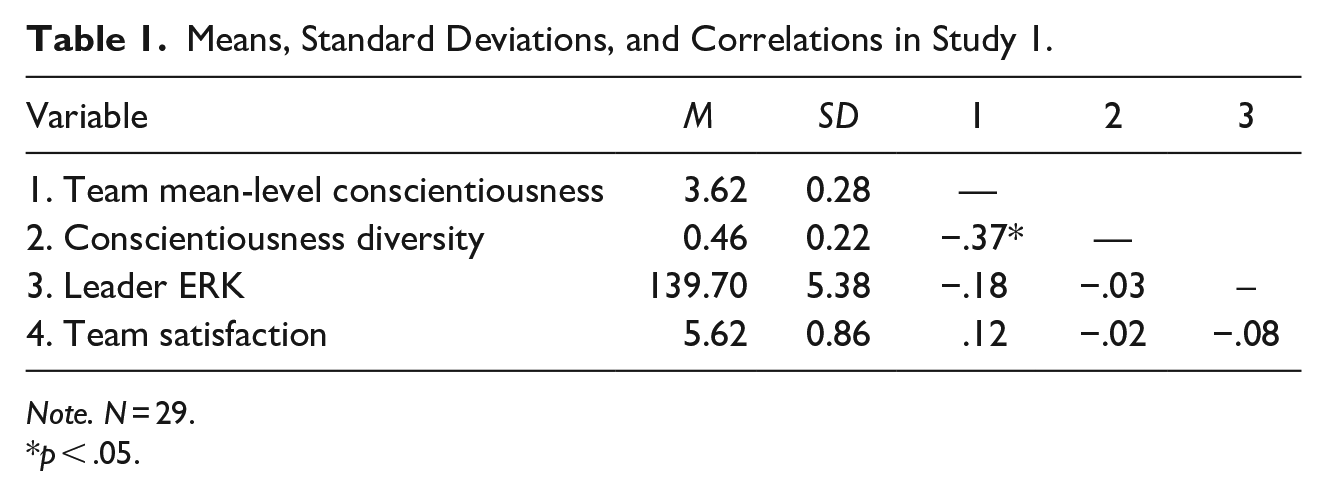
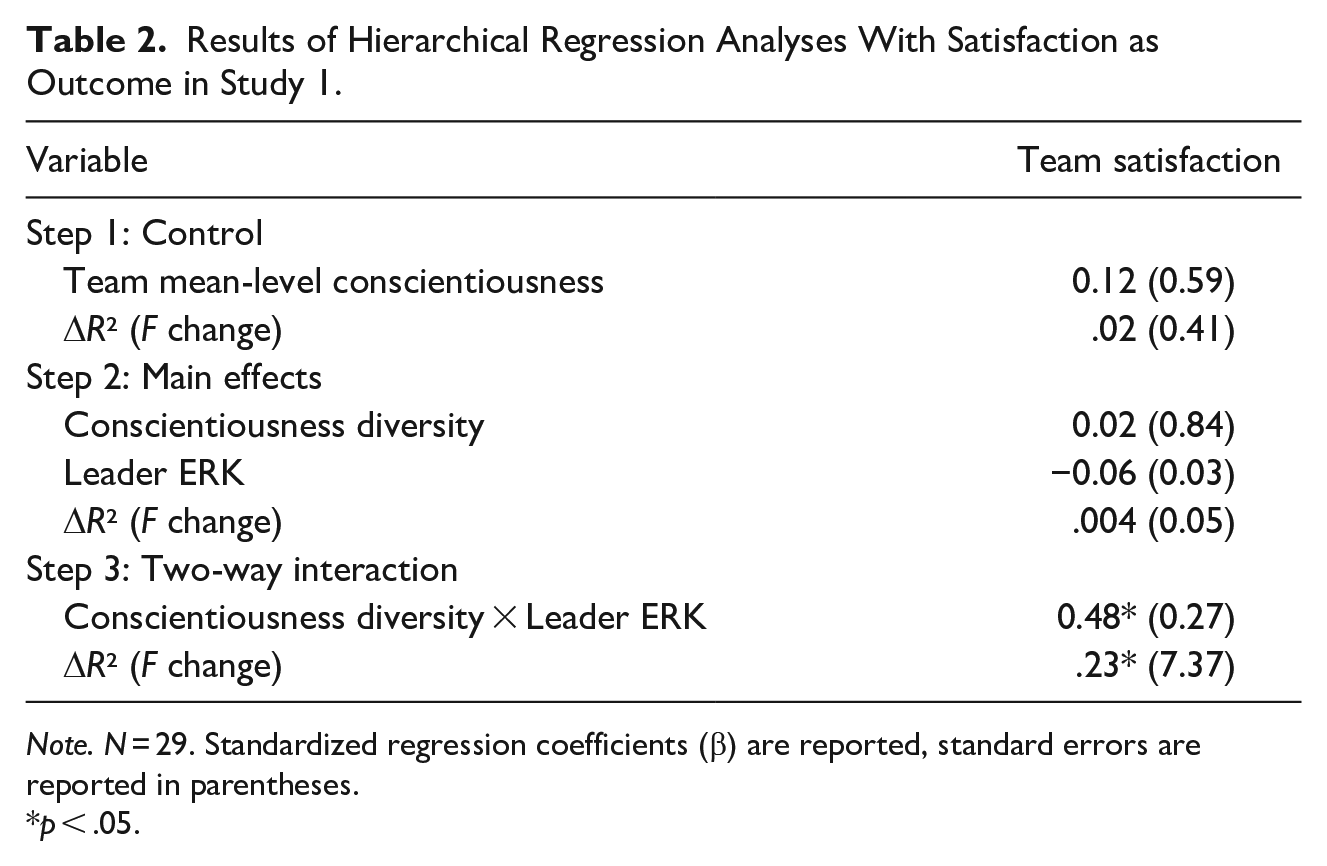
Correlations between the variables of interest can be found in Table 1. Table 2 displays the hierarchical regression analyses results for team satisfaction. We hypothesized that the relationship between conscientiousness diversity and team satisfaction is moderated by leader ERK, so that this relationship is negative when leader ERK is low, and is positive when leader ERK is high. To test this interaction, we used regression analysis and the bootstrap approach in PROCESS (model 1, 5,000 reiterations; Hayes, 2013). 3 There were no significant main effects of conscientiousness diversity and leader ERK, |ts| (25) < 0.28, ps > .788. The interaction between conscientiousness diversity and leader ERK was significant, t(24) = 2.72, p = .012, 95% CI [0.1744, 1.2807], ΔR2 = .23 (see Figure 1). In line with Hypothesis 1, when leader ERK was relatively low (−1 SD), conscientiousness diversity was negatively related to team satisfaction, B = −3.8939, SE = 1.6468, t(24) = −2.37, p = .026, 95% CI [−7.2928, −0.4950]. By contrast, when leader ERK was relatively high (+1 SD), conscientiousness diversity was positively related to team satisfaction, B = 3.9337, SE = 1.5992, t(24) = 2.47, p = .021, 95% CI [0.6331, 7.2343]. 4
Means, Standard Deviations, and Correlations in Study 1.
Note. N = 29.
p < .05.
Results of Hierarchical Regression Analyses With Satisfaction as Outcome in Study 1.
Note. N = 29. Standardized regression coefficients (β) are reported, standard errors are reported in parentheses.
p < .05.
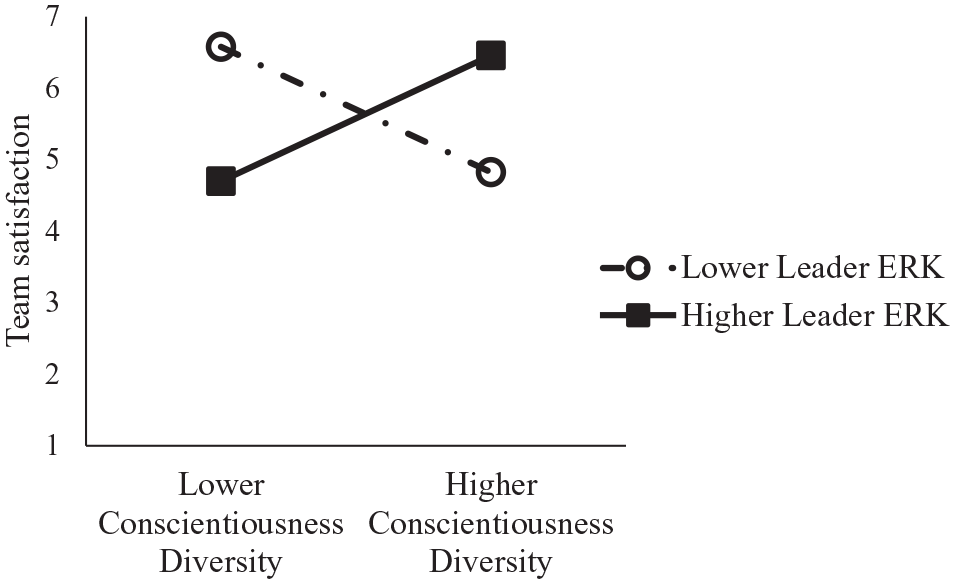
The interaction between conscientiousness diversity and leader ERK on team satisfaction in Study 1.
Study 1 Discussion
The findings of Study 1 provide preliminary evidence that the relationship between conscientiousness diversity and team functioning varies depending on the leader’s ERK. Teams that were more diverse in their levels of conscientiousness reported lower satisfaction when their leader had relatively low ERK. Conversely, conscientiousness diversity was positively related to satisfaction when the leader had relatively high ERK.
A strength of this study is that we obtained support for our model based on time-lagged measures across two waves of data collection. A potential weakness is that we used team members’ own impressions of which team member was most influential within the team, which we could logically only obtain several weeks into the team process. In Study 2, we again used a time-lagged approach, but aimed for a more controlled test of our hypotheses by assigning leaders to teams based on their ERK scores at the onset of the team project.
Study 2
In Study 2, we extended our focus beyond team satisfaction and tested whether the relationship between conscientiousness diversity and team processes that are conducive to team performance (i.e., cohesion and information elaboration) are also moderated by the leader’s ERK.
Study 2 Method
The setup of this study was similar to Study 1, but involved a quasi-experimental manipulation of leader ERK. The sample consisted of 30 three-person teams (N = 90 individuals) participating in an 8-week undergraduate course on working in groups (Mage = 22.06, SD = 2.24; 71.11% female). The sample size was again determined by enrollment in the class. All undergraduate students voluntarily participated for additional course credits. During the course, students worked on the same (pass/fail) group assignments as reported in Study 1, but the group reflection report (Assignment 4) was now graded by the teacher (see Appendix A for full description of the assignment).
Students filled out self-report questionnaires throughout the course. The first questionnaire was administered in week 1 and included measures of conscientiousness and ERK. The second questionnaire was administered in week 5 and included a measure of team satisfaction. The third questionnaire was administered in week 6 and included measures of cohesion and information elaboration. Leaders were selected based on emotion management scores obtained in week 1, and the remaining students were assigned to teams in week 2 by the course instructor using block randomization. The leaders were instructed to be the spokesperson of the team in all communication with the course instructors, to keep the team on track with regards to planning and task progress, make the final decision in case of indecision and disagreements, and motivate their team members (Zaccaro et al., 2001). In week 7 of the course, we obtained measures of team performance on a team paper assignment.
Leader emotion-regulation knowledge (week 1)
We administered the short version of the STEM (30 items; McCann & Roberts, 2008; M = 138.98; SD = 6.01). Based on the scores, we determined the 15 highest (M = 145.11; SD = 1.35; 95% CI [143.23, 146.98]) and 15 lowest scorers on the STEM (M = 128.28; SD = 4.83; 95% CI [126.41, 130.16]). As evident from the non-overlapping confidence intervals, the difference in ERK scores between these groups was significant, F(1, 28) = 168.93, p < .001, ηp2 = .86. These 30 students (Mage = 22.44, SD = 2.67; 20 females) were assigned as leader of one of 30 three-person teams. We then created a dichotomous variable with −1 indicating low leader ERK (N = 15 teams) and +1 indicating high leader ERK (N = 15 teams). 5 ERK condition was not associated with gender, χ2 = 2.40, p = .121, or age, F(1, 28) = 1.59, p = .218, ηp2 = .05. We used block randomization to assign the remainder of the students to these 30 leaders, distributing other individual characteristics (e.g., gender) as evenly as possible.
Conscientiousness diversity (week 2)
We measured the personality of the team members in terms of conscientiousness using the NEO personality inventory-short form (α = .80, M = 3.64, SD = 0.49; Costa & McCrae, 1992; McCrae & Costa, 1987). Again the standard deviation of conscientiousness was used as operationalization of team conscientiousness diversity (Harrison & Klein, 2007). We controlled for the mean level of conscientiousness in all analyses (Klein & Kozlowski, 2000). As in Study 1 the results were virtually the same when the analyses were repeated without this control variable.
Satisfaction (week 5)
Satisfaction was assessed with the same item as reported in Study 1, and aggregation statistics again supported aggregation to the team level, ICC(1) = 0.26, F(29, 60) = 2.04, p = .010, ηp2 = .66, ICC(2) = 0.51, mean rwg = 0.81.
Cohesion (week 6)
We measured cohesion with nine items based on the conceptual framework by Carron et al. (1985) that captures the individual and group aspects of cohesion (α = .91, M = 4.58, SD = 1.06; see also Mullen & Copper, 1994). Sample items include “I am pleased to be a member of this group” and “There is a sense of unity within this team” (Carless & De Paola, 2000). Agreement statistics for cohesion, ICC(1) = 0.33, F(29, 60) = 2.50, p = .001, ηp2 = .55, ICC(2) = 0.60, mean rwg = 0.81, supported aggregation to the team level (Bliese, 2000).
Information elaboration (week 6)
Information elaboration was measured using the six-item scale developed by Homan et al. (2008; e.g., “During group-tasks, we try to use all available information”). The six items formed a reliable scale (α = .82, M = 5.10, SD = 0.58). Agreement statistics supported aggregation of individual scores to the team level, ICC(1) = 0.37, F(29, 60) = 2.78, p < .001, ηp2 = .57, ICC(2) = 0.64, mean rwg = 0.91.
Team performance (week 7)
The grade obtained on the final team assignment, which was handed in at the beginning of week 7, constituted the team performance measure. The assignment entailed writing a reflection paper using the course literature, applied to their own team interaction throughout the course. The assignment was graded on a 10-point scale (M = 7.26, SD = 0.80) by the course teacher who was blind to “condition.” Higher scores represent a better grade.
Study 2 Results
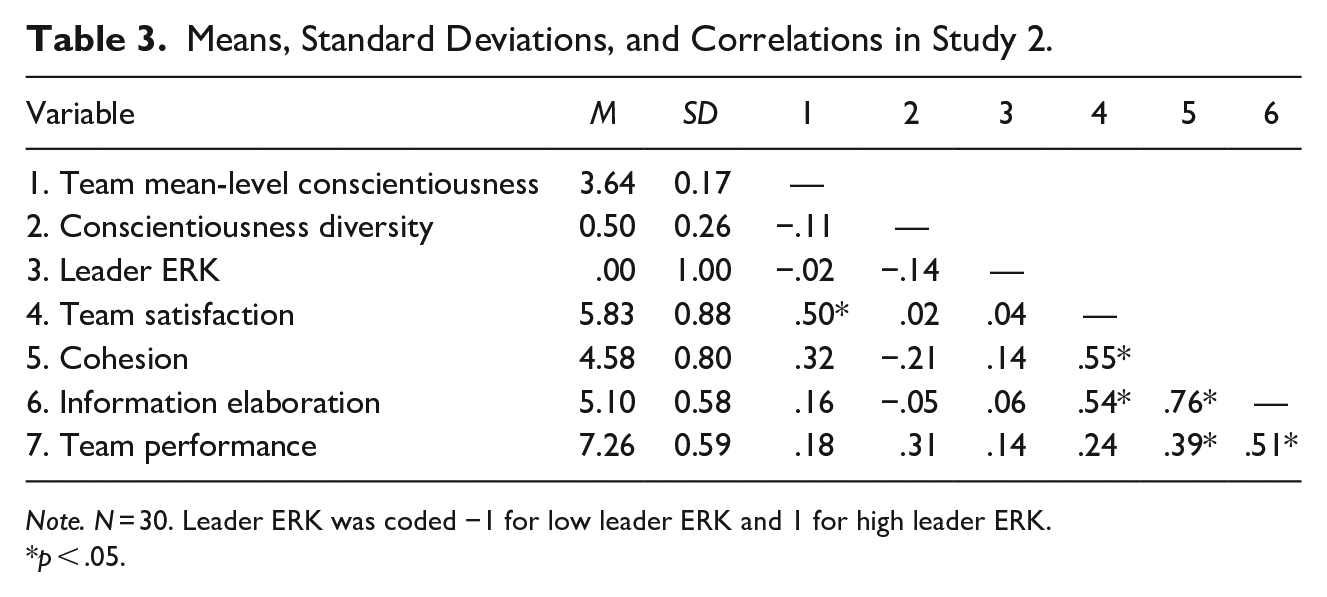
Correlations between the variables of interest can be found in Table 3. Table 4 displays the hierarchical regression analyses results for team satisfaction, cohesion, information elaboration, and team performance. First, we used regression analysis and the bootstrap approach in PROCESS (model 1, 5,000 reiterations; Hayes, 2013) to test Hypotheses 1 and 2. These analyses showed no main effects of our predictors on the dependent variables, ts(26) < 0.87, ps > .395. In line with Hypothesis 1, we again found a significant interaction between conscientiousness diversity and Leader ERK on satisfaction, t(25) = 2.34, p = .028, 95% CI [0.2946, 4.6647], ΔR2 = .13. Even though the pattern of the interaction was consistent with our prediction, both slopes were not significant. The simple slope representing low leader ERK was negative but not significant, B = −0.9360, SE = 0.7456, t(25) = −1.2553, p = .221, 95% CI [−2.4717, 0.5997]; the simple slope representing high leader ERK was positive but not significant, B = 1.5436, SE = 0.7561, t(25) = 2.0414, p = .052, 95% CI [−0.0173, 3.1009].
Means, Standard Deviations, and Correlations in Study 2.
Note. N = 30. Leader ERK was coded −1 for low leader ERK and 1 for high leader ERK.
p < .05.
Results of Hierarchical Regression Analyses with Satisfaction, Cohesion, Information Elaboration, and Performance as Outcome in Study 2.
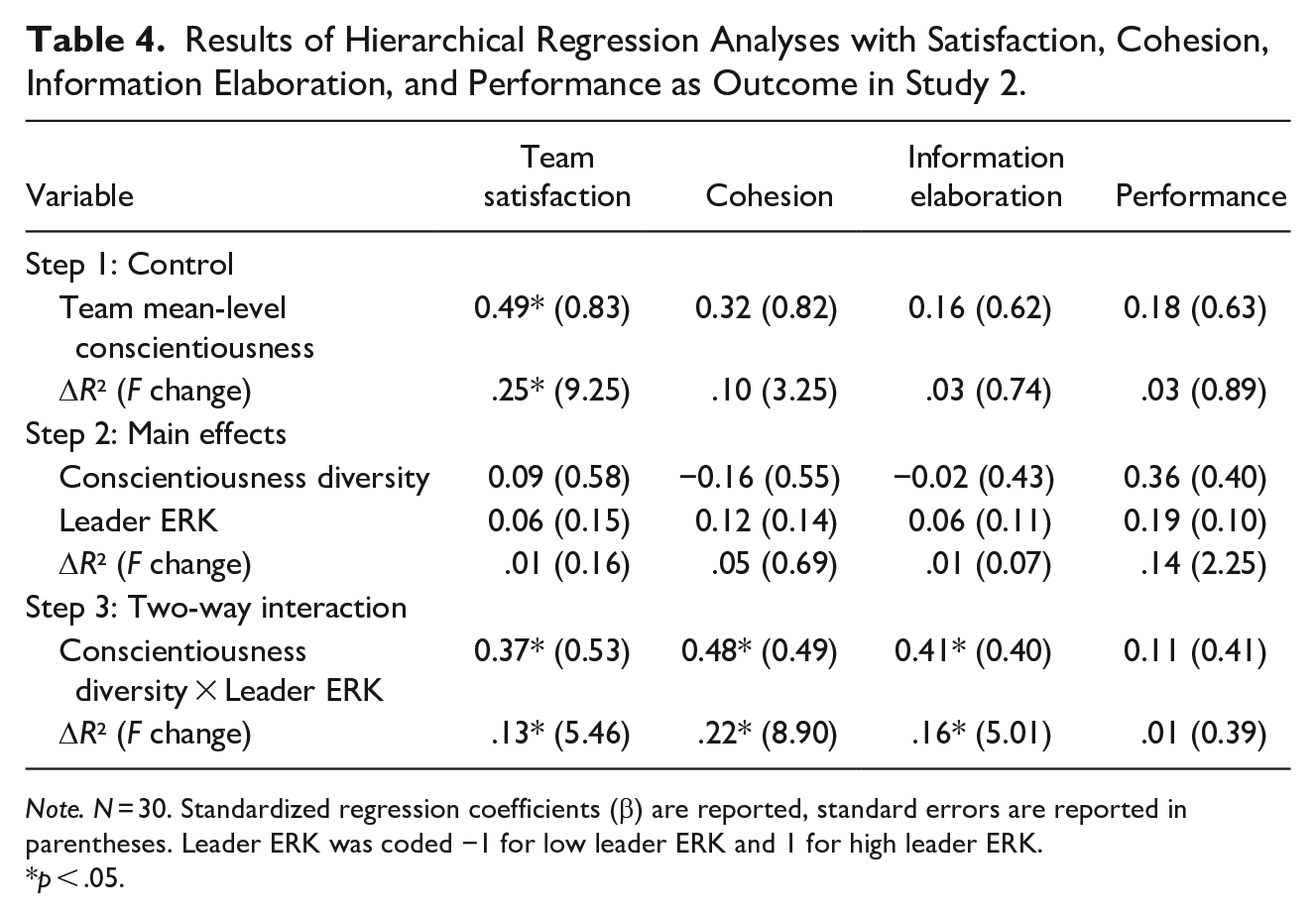
Note. N = 30. Standardized regression coefficients (β) are reported, standard errors are reported in parentheses. Leader ERK was coded −1 for low leader ERK and 1 for high leader ERK.
p < .05.
In line with Hypothesis 2a, we found a significant interaction between conscientiousness diversity and leader ERK on cohesion, t(25) = 2.98, p = .006, 95% CI [0.8951, 4.8899], ΔR2 = .22. The pattern of the interaction was partially consistent with our prediction (see Figure 2, upper panel). The negative simple slope representing low leader ERK was significant, B = −1.9062, SE = 0.6816, t(25) = −2.7967, p = .010, 95% CI [−3.3100, −0.5024]; the positive simple slope representing high leader ERK did not reach significance, B = 0.9863, SE = 0.6912, t(25) = 1.4269, p = .166, 95% CI [−0.4373, 2.4098].
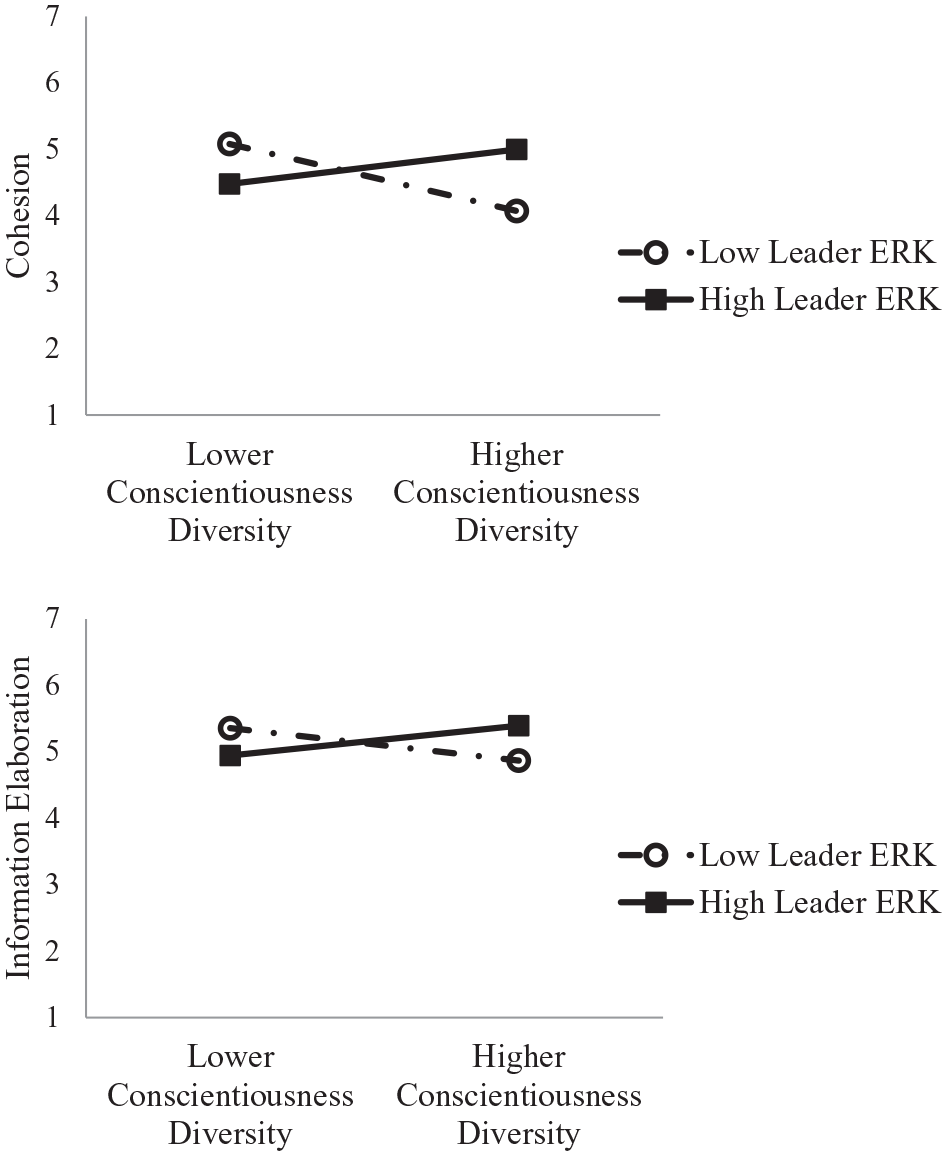
The interaction between conscientiousness diversity and leader ERK on team cohesion (upper panel) and information elaboration (lower panel) in Study 2.
Moreover, supporting Hypothesis 2b, the interaction between conscientiousness diversity and leader ERK on information elaboration was significant, t(25) = 2.24, p = .034, 95% CI [0.1422, 3.4155], ΔR2 = .16. The pattern of the interaction was descriptively consistent with our prediction (see Figure 2, lower panel), but the simple slopes did not reach significance (for low leader ERK: B = −0.9251, SE = 0.5585, t(25) = −1.6564, p = .110, 95% CI [−2.0754, 0.2252]; for high leader ERK: B = 0.8537, SE = 0.5664, t(25) = 1.5074, p = .144, 95% CI [−0.3128, 2.0202]).
Finally, we tested Hypothesis 3 using the bootstrap approach in PROCESS (model 7, 5,000 reiterations; Hayes, 2013). Supporting Hypothesis 3a, we found a significant conditional indirect effect of team diversity on team performance via cohesion, B = 0.9770; SE = 0.3942; 95% BCa CI [0.3907, 2.0317]. For low ERK leaders, conscientiousness diversity was negatively associated with cohesion and, in turn, team performance (B = −.6439, SE = 0.2967; 95% BCa CI [−1.3894, −0.1517]); for high ERK leaders, conscientiousness diversity was positively associated with cohesion and, in turn, performance (B = 0.3331; SE = 0.2344; 95% BCa CI [0.0025, 0.9465]).
Similarly, supporting Hypothesis 3b, we found a significant conditional indirect association between conscientiousness diversity and team performance via information elaboration, B = 0.9281; SE = 0.3917; 95% BCa CI [0.2981, 1.8831]. For low ERK leaders, there was a negative indirect path from conscientiousness diversity to (reduced) information elaboration and, in turn, (reduced) team performance, B = −0.4827, SE = 0.2853; 95% BCa CI [−1.1813, −0.0032]. Conversely, for high ERK leaders, there was a positive indirect path from conscientiousness diversity to (enhanced) information elaboration and, in turn, (enhanced) team performance, B = 0.4454; SE = 0.2374; 95% BCa CI [0.0513, 0.9805].
Study 2 Discussion
Study 2 replicates the interaction between team conscientiousness diversity and leader ERK on team satisfaction (although the slopes were not significant). Moreover, the results indicate that in teams with low ERK leaders, conscientiousness diversity was indirectly negatively associated with team performance via reduced cohesion and information elaboration. By contrast, in teams with high ERK leaders, conscientiousness diversity was indirectly positively associated with team performance via enhanced cohesion and information elaboration. 6
General Discussion
Speaking against the notion that conscientiousness diversity in teams is inherently detrimental and should be avoided, our findings indicate that when leaders have high levels of emotion-regulation knowledge, conscientiousness diversity is not detrimental to teams, and might promote effective team functioning instead. Although conscientiousness diversity can trigger negative affective processes in teams when dependable and organized people need to collaborate with people who are undependable and disorganized, our findings suggest that emotionally skilled leaders can address these problems. Moreover, the balance between convergence, diligence, and dependability with divergence, flexibility, and adaptability in teams with conscientiousness diversity seems to have potential in stimulating team functioning, provided that team processes are properly managed. In particular, our results indicate that high ERK leaders can improve member satisfaction and indirectly boost team performance via increased cohesion and information elaboration in teams that are composed of both highly conscientious members and members with lower levels of this trait.
Our findings contribute to the team personality composition literature, which has generally focused on main effects of team personality composition on outcome criteria (Barry & Stewart, 1997; Bell, 2007; Peeters et al., 2006). The importance of this previous research notwithstanding, our results illustrate that it might be fruitful to investigate moderators in research on team personality composition. In line with research focusing on leader characteristics as moderators of diversity effects (Homan et al., 2020; Lloyd & Härtel, 2010; Rosenauer et al., 2016), we obtained evidence that the effects of personality diversity are moderated by leader ERK, an ability that allows leaders to effectively address the negative affective team processes that can be instigated by personality diversity. Our findings also provide broader evidence for the role of the leader in managing team diversity. More specifically, the data support the proposition that leader abilities are crucial in managing team diversity (Homan et al., 2020). Leaders who have better knowledge of emotion management seem to be able to positively shape the influence of personality diversity on team functioning.
A more specific contribution to the team personality composition literature comes from our theorizing and finding that conscientiousness diversity can be positively related to team functioning, provided that it is managed well. Previous results concerning the effects of conscientiousness diversity in teams were inconsistent (Barry & Stewart, 1997; Mohammed & Angell, 2003; Peeters et al., 2006). Notwithstanding these inconsistent findings, the general conclusion seemed to be that conscientiousness diversity should be avoided (Humphrey et al., 2007). However, next to the fact that conscientiousness diversity is difficult to avoid, our findings suggest that working with team members with different levels of conscientiousness might aid team functioning. By providing a combination of work styles and task approaches and balancing diligence and dependability with flexibility and adaptability (Ferguson et al., 2014; Martocchio & Judge, 1997), conscientiousness diversity can stimulate the task-focused exchange and processing of information within teams, which is conducive to team functioning.
A related contribution concerns our focus on team processes and states as underlying team personality composition effects (LePine et al., 2011; Prewett et al., 2009). The current research is one of the first to show that conscientiousness diversity is associated with important processes in teams, which have downstream consequences for team performance. Interestingly, the fact that the interaction between conscientiousness diversity and leader ERK related to team performance (only) indirectly through cohesion and information elaboration aligns with the conclusions of LePine et al. (2011) and Prewett et al. (2009) that results-oriented outcomes (like performance) are more distal to personality composition, and that personality composition shapes performance indirectly via team behaviors and processes. Importantly, however, our data also illustrate that the utility of a focus on main effects of team personality diversity on team processes is limited, and that one should incorporate moderators that govern the relationship between diversity and team criteria. The incorporation of theoretically relevant moderators is becoming common practice in research on demographic and informational diversity (Guillaume et al., 2017; van Dijk et al., 2012; van Knippenberg & Schippers, 2007), but is still largely lacking in research on team personality composition in general and personality diversity specifically.
Our findings also contribute to the literature on the importance of leader ERK in managing teams by demonstrating that leader ERK might be particularly important in situations that require the management of negative emotional responses within teams, such as high conscientiousness diversity. Even though researchers have proposed that leader ERK can stimulate team functioning (Côté et al., 2011), our findings tentatively suggest that these benefits of leader ERK are contingent upon the composition of the team (see Footnote 4 and 6). That is, in both studies leader ERK had more (positive) effects on team processes and outcomes when conscientiousness diversity was higher rather than lower. This suggests that leader ERK is less consequential under conditions that require less attention to interpersonal emotion regulation, such as when members are more homogeneous on conscientiousness. Given that leader ERK thus appears to be particularly relevant when teams are likely to experience negative intragroup processes, future research could examine the role of leader ERK in other situations that are associated with such negative team processes, ranging from other team diversity characteristics (e.g., demographics) to crisis and unforeseen changes in the team’s environment.
A strength of the current set of studies is that we employed cross-lagged designs with teams working on actual assignments. Moreover, we employed both a continuous measure as well as a quasi-experimental manipulation of leader ERK, and these different approaches yielded convergent support for our theoretical model. Nevertheless, we note that it is possible that ERK correlates with other attributes that may be (partly) responsible for the observed relationships. Arguably the most theoretically plausible candidate is extraversion, given that previous work has demonstrated associations between extraversion and emotion regulation (Dawda & Hart, 2000) and between extraversion and leader emergence (Judge, Bono et al., 2002). Because we administered the Big Five personality inventory to measure conscientiousness, we could address this possibility empirically. Additional analyses revealed that controlling for leader extraversion (or any other Big Five trait) did not alter the results, in both studies. Even though this result strengthens confidence in our conclusions, we cannot rule out the potential influence of other, unmeasured, third variables. Replication in future studies including additional control variables could further bolster our conclusions.
We further acknowledge that we used student samples and that the sample sizes of both studies are relatively small. Our interest in following teams over the course of 8 weeks, combined with the need to administer the rather laborious ERK measure (which takes around 30 to 45 minutes to complete), made data collection for research purposes in organizational teams infeasible. We therefore relied on student project teams, who did work together on various interactive team assignments. Sample sizes were constrained by the availability of such teams. Although the convergent support for our model across two studies increases confidence in the findings, the robustness of the patterns we obtained should be examined in future research with larger numbers of teams and members. In addition, future research is needed to confirm that leader emotion-regulation knowledge plays a similar role in teams composed of full-time workers.
Finally, even though we find that leader emotion-regulation knowledge was helpful for conscientiousness diverse teams, we have no insight in the specific behaviors that ERK-leaders displayed in such teams. Future research could examine conflict management behaviors or reappraisal as potential underlying mechanisms. A related issue is associated with the specific measurement of ERK that asked participants to indicate what the most effective response would be in various situations, rather than measuring what participants would actually do themselves when confronted with such situations. As such, the STEM measures knowledge of emotion management rather than actual emotion management strategies. As such, it would be insightful to examine whether ERK is actually related to better emotion management behaviors in actual teams.
In conclusion, our research suggests that conscientiousness diversity can both harm and help team functioning. Whether conscientiousness diversity has favorable or unfavorable consequences for team functioning depends on whether team leaders have the emotional skills needed to effectively manage conscientiousness diversity. Under leaders with considerable knowledge of how to manage emotions, conscientiousness diversity can stimulate satisfaction, cohesion, information elaboration, and subsequent performance, but under leaders who have less emotion regulation knowledge conscientiousness diversity can harm such processes and outcomes. This implies that rather than trying to avoid conscientiousness diversity in teams, it should instead be properly managed by emotionally skilled leaders.
Footnotes
Appendix A
Acknowledgements
The general study ideas were approved by the ethics board of the psychology department of the University of Amsterdam (2014-WOP-3326). We like to thank Riëtte Swart and Anna Bogo for their help with the data collection and Stéphane Côté for his valuable comments on the manuscript.
Declaration of Conflicting Interests
The author(s) declared no potential conflicts of interest with respect to the research, authorship, and/or publication of this article.
Funding
The author(s) received no financial support for the research, authorship, and/or publication of this article.
