




Abstract
Self-managing teams are popular but they can only benefit team performance if their members are competent to navigate within self-managing systems. Based on a systematic literature search on self-managing, self-directing, and self-leading teams, we reviewed 84 studies related to KSAOs and traits in self-managing teams. Grounded on existing models of team effectiveness and individual KSAOs, we integrated all findings into one KSAO model and showed the relations of single KSAOs with team performance. The results resembled other KSAO frameworks but were more comprehensive and provided practical application and future research guidance, for example, studying team compositions of individual KSAOs.
Increasingly volatile, complex markets, employees’ changing requirements, and the growth of knowledge-based work have fostered interest in less hierarchical organizational structures (Bernstein et al., 2016; Lee & Edmondson, 2017). Reducing hierarchy implies transferring decision-making authority from upper toward lower organizational levels and thus decentralizing decision authority. Although most organizations develop their customized model of flat hierarchies, one common essential element among them is teams with responsibility for specific issues, high autonomy in their decisions, and high self-management. Previous research has referred to such teams as, among other things, self-managing, self-directing, self-leading, self-designing, or self-governing teams (Hackman, 1986; Stewart et al., 2011). We subsume all such labels under self-managing teams (SMTs) in the remainder of this paper.
SMT setups have been proven to benefit team performance, for example, productivity improvement or cost savings, and higher employee satisfaction (Cohen & Ledford, 1994; Cohen et al., 1996). Already in 1996, 17% of non-managerial employees worked, according to the American National Employer Survey, in teams that decided by themselves how to complete their tasks (Cappelli & Neumark, 2001). Recently, organizational culture trends such as agility, New Work, and empowerment have pushed SMTs by increasing the number of SMTs and the extent of self-management within teams (Petermann & Zacher, 2020). Consequently, practitioners ask more and more often what working in SMTs requires of their members and what individual characteristics are relevant to high SMT performance (Breidenbach & Rollow, 2020; Gloger & Rösner, 2014). Accordingly, previous research on team effectiveness or person–environment fit has proved the relevance of the individual characteristics for the success of the entire team and the surrounding system (Boyatzis, 1982; Kristof-Brown et al., 2005; Mathieu et al., 2008, 2014). SMTs have been the subject of scientific study over the last four decades (Hackman, 1986; Stewart et al., 2011), but until now there has been no comprehensive, sufficiently detailed picture of the individual knowledge, skills, abilities, and other characteristics (KSAOs) required for SMTs to function successfully or even how these factors are related. Indeed, Magpili and Pazos’s (2018) seminal review provides a good overview of the multilevel factors that influence the performance of SMTs. However, due to its limited scope, the review provided only a rough overview of six factors and three types of relevant individual skills for SMT performance. This approach is too vague for application to training or selection of team members (Krumm et al., 2012). To understand SMT success better, it is therefore necessary to focus on the individual factors and comprehend not only the relations between individual KSAOs and SMT performance outcomes but, because of their mutual interdependence, also the relationship between KSAOs with performance behaviors and team members’ affect and viability (Mathieu et al., 2008). Performance behaviors lead to goal achievement (e.g., leadership, team learning), whereas performance outcomes (e.g., objective KPIs of the team’s work) are the result of performance behaviors. Furthermore, the interactions of the team members’ KSAOs are also relevant for team composition. Besides, as the influence of KSAOs varies over time (Mathieu et al., 2014), a separate focus on the initial phase of SMTs is important to understand successful SMT introduction and initiation. Consequently, a more detailed approach is necessary to further promote SMTs and their success by selecting and supporting team members adequately. Furthermore, several general competency models have been developed, for example, Bartram (2005). However, besides not being developed for self-managing teams, these models relate their competencies only to individual outcome performance and do not include other relevant variables for team performance, for instance, performance behavior or affective and health outcomes (Mathieu et al., 2008). Hence, the current paper also aims to expand the relevant theory and advance existing models by considering a broader perspective and including further relevant outcome variables. Additionally, this paper adds competencies that are specific for SMTs to the existing theory. Accordingly, after introducing relevant theoretical concepts, this paper constructs a comprehensive picture of the relations of individual KSAOs not only with respect to performance outcomes but also performance behaviors, team member’s affective and health outcomes, and successful SMT initiation.
Individual KSAOs and Performance of SMTs
Implications of Empowered Teams and Self-Management at Team Level for the Individual
Structural empowerment, implying that teams hold extensive decision-making authority, requires self-leadership at the team level. According to Stewart et al. (2011), this is understood best as a continuum, and different degrees of self-leadership translate into different decisions to be made at the team level. While externally managed teams do not influence the what, how, and why of work, self-managing teams decide on the how aspect and self-leading teams decide on all the aspects. For instance, self-leading teams are responsible for budget, personnel decisions, and product quality. To reduce complexity, we use the SMT concept for all teams that at least control the how of work (as suggested by Stewart et al., 2011).
Structural empowerment predicts work-unit performance and organizational cost-effectiveness as well as individual performance and satisfaction (Cappelli & Neumark, 2001; Seibert et al., 2004; Spence Laschinger et al., 2001). In contrast, Stewart et al. (2011) reported mixed impacts of structural team-level empowerment on important outcomes, such as team productivity, satisfaction, organizational commitment, or absenteeism. Negative relations were probably caused due to a lack of psychological empowerment; it is a compound of perceived job meaningfulness, self-determination, impact, and competence, and was found to be the mediator of the positive effects of structural empowerment in other studies (Seibert et al., 2004, 2011; Spence Laschinger et al., 2001; Spreitzer, 1995). We focus here on the aspect of competence, as for experiencing competence adequate KSAOs are necessary and SMTs demand different KSAOs from their members compared to other settings (Hackman, 1986, 2002). As the efficacy of KSAOs is always context dependent (Kristof-Brown et al., 2005), a specific exploration of KSAOs with respect to SMTs is necessary.
The Role of Individual Competencies and Characteristics in SMTs’ Success
According to classic input-process-output models and more complex input-mediator-output-input models, individual-level factors are also significant for team processes and team performance (Ilgen et al., 2005; Mathieu et al., 2008; McGrath et al., 2000). Individual-level factors include individual characteristics such as KSAOs but also performance, motivation, or commitment, which in turn are outcomes related to adequate KSAOs (Kristof-Brown et al., 2005; Mathieu et al., 2014). Traditional personnel-position fit models focused especially on position- or task-specific KSAOs (Mathieu et al., 2014). However, as SMTs require different KSAOs from their members, we are interested in a personnel model with a team and, specifically, SMT focus (as suggested by Mathieu et al., 2014). Previous research has already developed specific competency models for teamwork in general but not for SMTs (Cannon-Bowers et al., 1995; Salas et al., 2005; Stevens & Campion, 1994). As SMTs additionally assume managerial tasks, the members need broader competencies. Therefore, we have developed a competency model based on past SMT research, which is specific to members of SMTs.
KSAOs or competency can be used interchangeably (Krumm et al., 2012) and were conceptualized in various ways, taking either a characteristic-based or a behavior-based approach. Characteristic-based approaches define competencies as the personal characteristics or disposition necessary for good performance in the relevant context (e.g., Campion et al., 2011; Spencer et al., 1994), whereas behaviorally oriented approaches focus on the necessary types of behaviors (e.g., Bartram, 2005). To build a competency model for SMTs, we rely on Bartram’s (2005) competency model for general job performance, which is the intersection of various existing standalone models. The model consists of 20 specific behavioral competencies and 120 subcompetencies categorized into eight clusters (see Table 1). Bartram suggested that although single (sub-)competencies must be modified, every competency model for any specific job could be categorized into the model’s eight clusters. The model’s empirical base, universality, and behavior-oriented character make it especially useful for scientific and applied purposes (Krumm et al., 2012) and thus also an adequate framework for our work.
Competency Model for General Job Performance (Bartram, 2005).
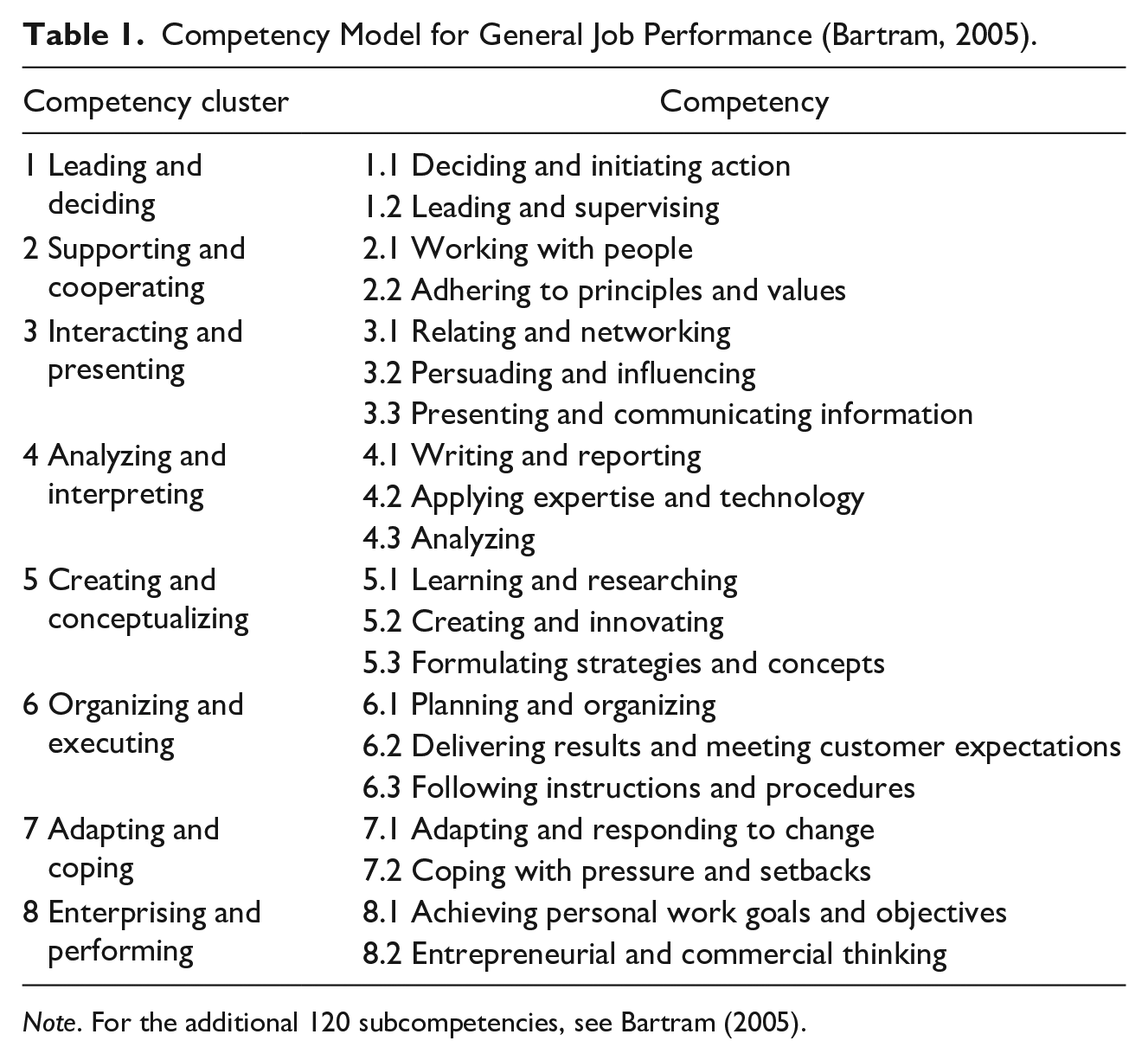
Note. For the additional 120 subcompetencies, see Bartram (2005).
An Individual Competency Model for SMT Performance
To build our model, we relied on findings regarding individual KSAOs and their relations to the team and individual-level outcomes, as empirical research and theory have shown the influence of individual outcomes on team outcomes. Besides, the aforementioned input-process-output models, which include individual satisfaction, motivation, and performance, were taken as additional input for team processes (Ilgen et al., 2005; Mathieu et al., 2008; McGrath et al., 2000), as empirical study has shown the positive effects of, for example, individual satisfaction or engagement on the team and organizational performance (Glew, 2009; Koys, 2001; Taris & Schreurs, 2009; Uddin et al., 2019). We are aware that a personnel model with team focus cannot account for the complex team interactions that a team model focused on relative contributions could account for. However, findings from previous research were not sufficient to fully adopt such a perspective. Therefore, this paper focuses on the relationship between individual KSAOs and team outcomes and considers the effect of team age. Furthermore, it discusses the findings on relative contributions and interactions after the sections on individual KSAOs.
Previous SMT research has dealt with work and student teams. Although our research question is especially relevant for work teams, findings on student teams are also valuable, as student teams also possess relevant SMT characteristics. Student teams are non-hierarchical, they lead themselves as a group, they work toward a common goal, and decide at least on the how of their work. Indeed, work teams on average exist longer than student teams, which often exist only for 4 to 6 months. However, short- or fixed-term teams devoted to specific projects are also relevant in business contexts, and therefore they could also learn from short-term student teams. Accordingly, the literature review includes employee and student teams.
The increasingly demanding work in SMTs requires other KSAOs of employees compared with traditionally managed teams (Bernstein et al., 2016; Hackman, 1986; Petermann & Zacher, 2020). Moreover, besides establishing empowering structures, adequate KSAOs at the employee level are decisive in ensuring that empowerment benefits team performance in the short and long terms. Previous research on SMTs has provided insights into the associations of different individual KSAOs or behaviors with outcomes such as performance or satisfaction. However, the findings are essentially scattered, and an integrated, detailed view is still missing. Therefore, we build a comprehensive picture of these requirements in the present work to provide a base for further research and practical applications. Using the approach of a systematic literature review, the framework of input-process-output models (Mathieu et al., 2008), and the existing model for general job performance (Bartram, 2005), we develop a competency model for individual and team performance behavior, performance outcomes, and affective and health outcomes, as well as SMT initiation, as detailed in the following paragraphs.
Method
First, we identified relevant keywords for our systematic literature search (see Table 2). Our multiple database search in November 2019 yielded 329 empirical, peer-reviewed study papers. The comprehensive search included the following databases: Web of Science, Emerald, Science Direct, EconLit, APA PsycArticles, APA PsycInfo, SocINDEX, and PSYNDEX. The findings were published between 1971 and 2020. The articles originated from a broad range of disciplines, including industrial and organizational psychology, management, engineering, software development, and nursing and health care research. We screened the studies’ abstracts with respect to the following inclusion criteria: (a) English as the publication language; (b) original research paper published in a peer-reviewed journal; (c) research on SMTs; (d) research on individual, internally determined factors—such as behaviors, attitudes, or personality traits—measured on the individual as well as team levels; (e) empirical approach using a qualitative, quantitative, or mixed methods approach. We included teams that at least controlled the how of their work. The second step, abstract screening, yielded 76 potentially relevant studies. In the third step, the detailed analysis of the content, we excluded another 19 studies because they did not fulfill every inclusion criterion; this resulted in 57 relevant studies. In the final step, we screened the references of the review papers resulting from the initial search, and later in the writing process, we additionally searched for studies on SMT composition to make the review more comprehensive. We extracted 27 additional articles, resulting in a final list of 84 studies as reported in the following section (for details, see Table 3).
Search Terms Used for Database Search.
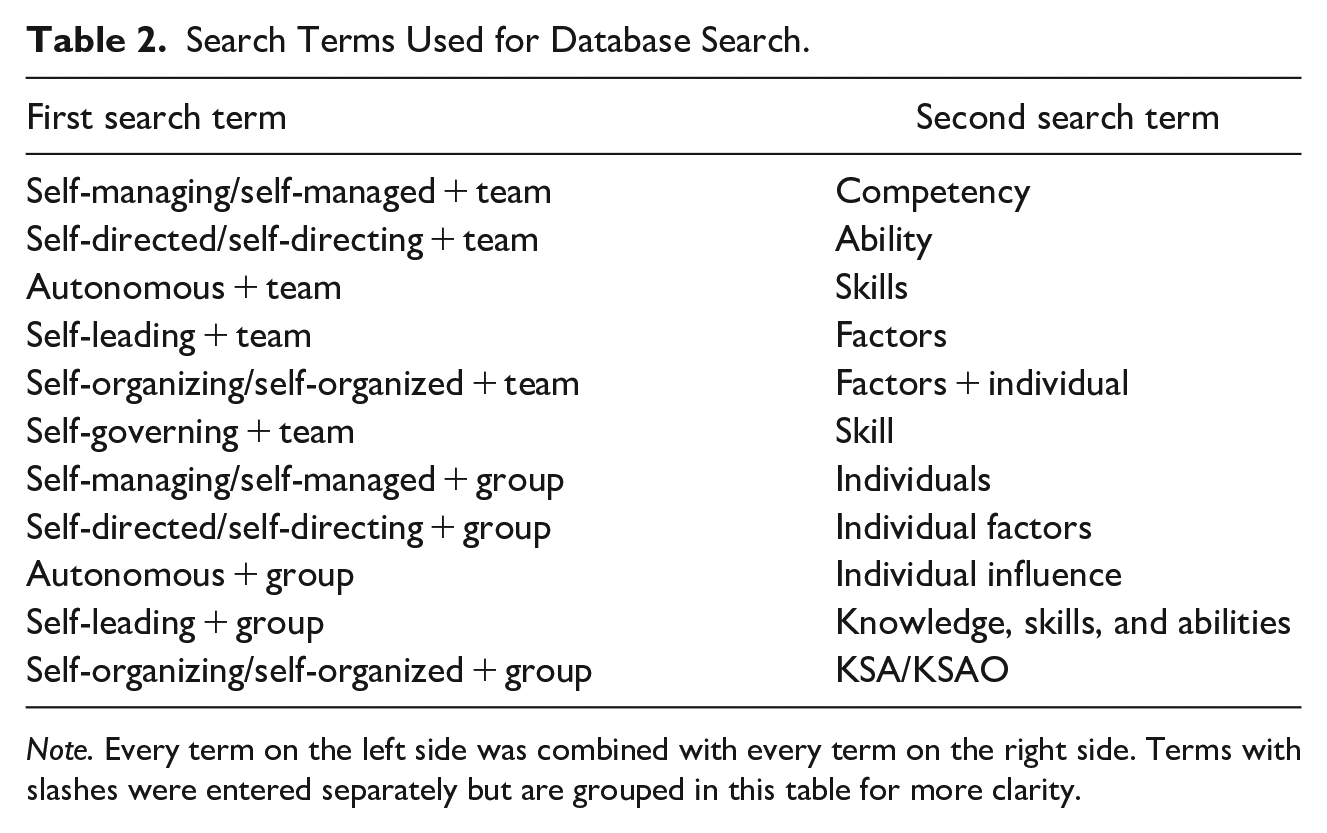
Note. Every term on the left side was combined with every term on the right side. Terms with slashes were entered separately but are grouped in this table for more clarity.
Studies and Descriptive Characteristics.
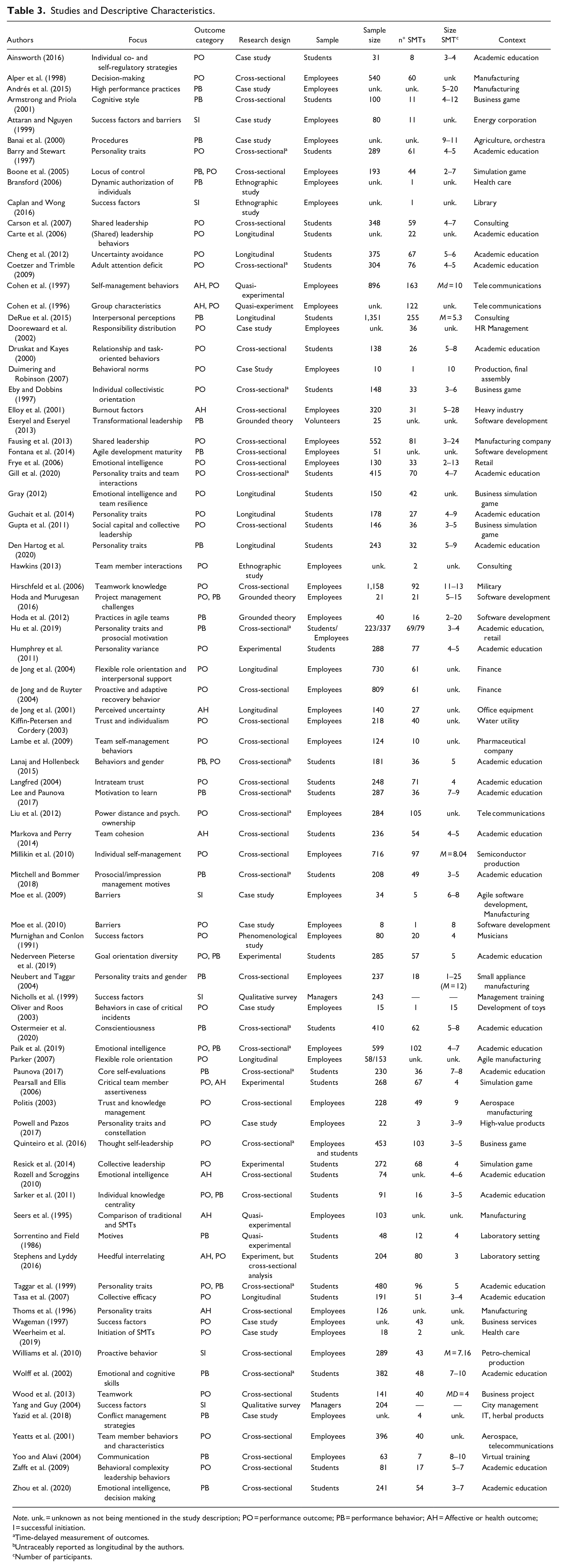
Note. unk. = unknown as not being mentioned in the study description; PO = performance outcome; PB = performance behavior; AH = Affective or health outcome; I = successful initiation.
Time-delayed measurement of outcomes.
Untraceably reported as longitudinal by the authors.
Number of participants.
A comprehensive picture of individual KSAOs for SMT performance
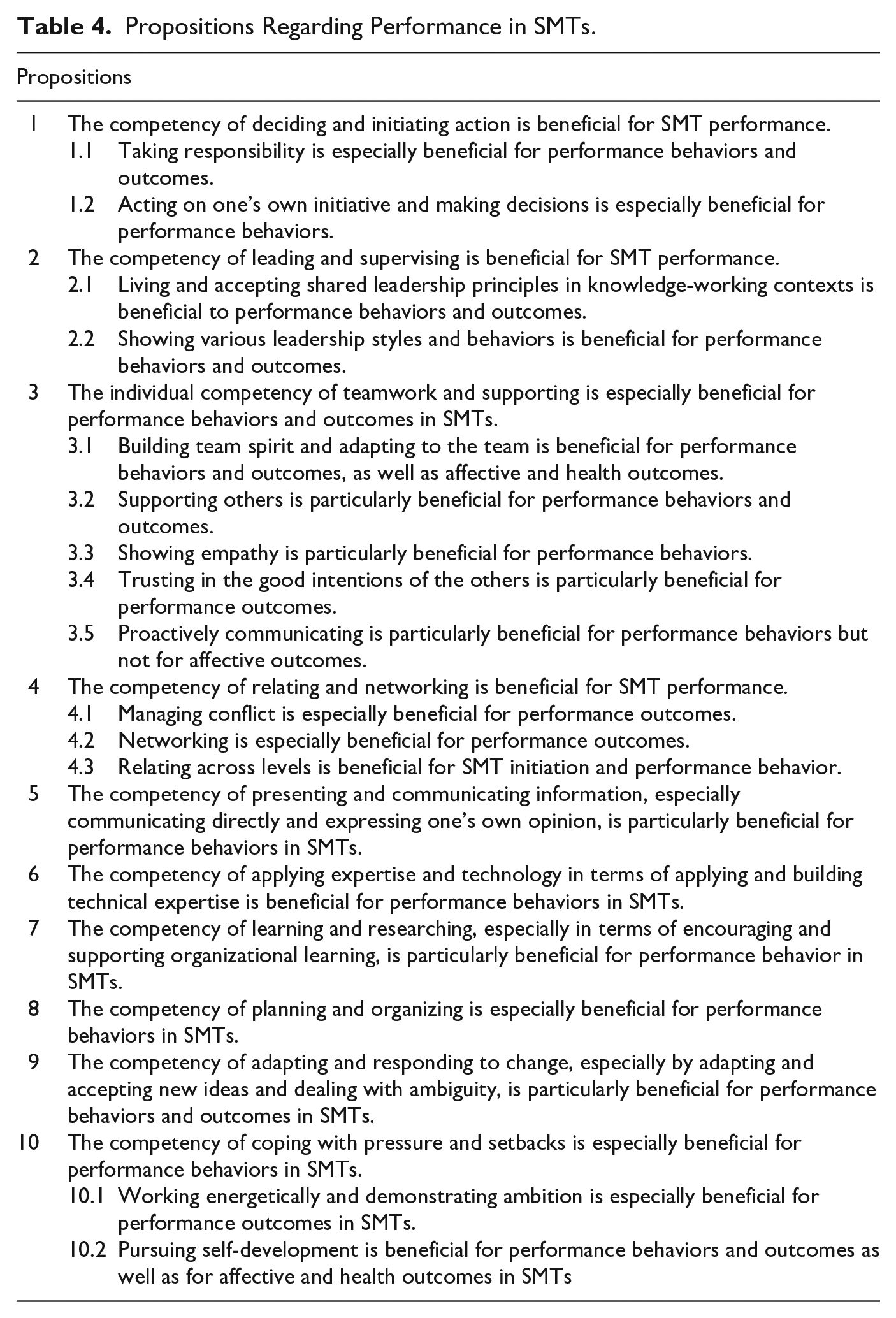
In the following sections, we develop an individual competency model for SMT performance based on the empirical findings for SMTs and the theoretical framework of Bartram (2005). We integrate the findings with individual-level and team-level outcomes, as both contribute to team performance (as discussed previously). To provide a comprehensive overview of the findings, we also graphically report the relations of the KSAOs to the different outcomes: performance outcome (Figure 1), performance behaviors (Figure 2), affective and health outcomes (Figure 3), and SMT initiation success (Figure 4). Additionally, we have developed some propositions regarding the benefit of each KSAO cluster for SMT performance (see Table 4).
Propositions Regarding Performance in SMTs.
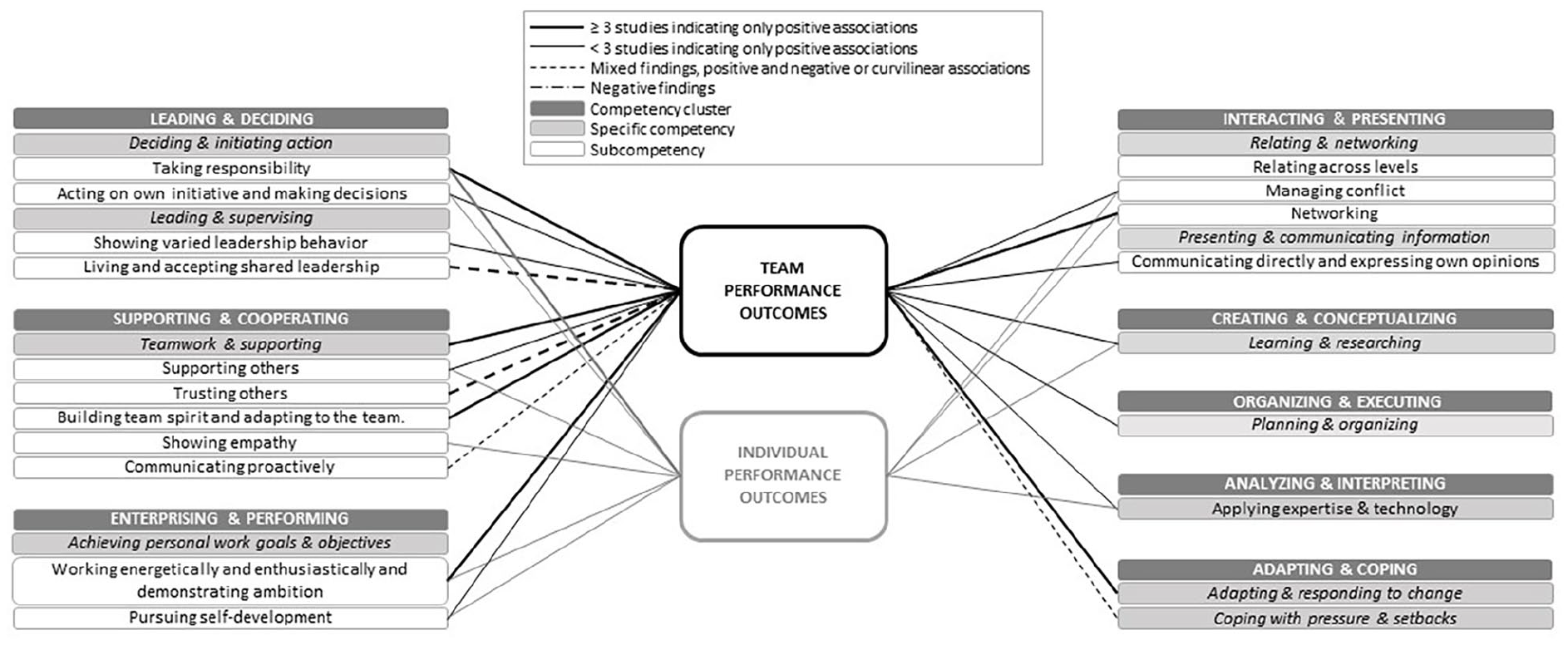
The relations of individual competencies to individual and team performance outcomes.
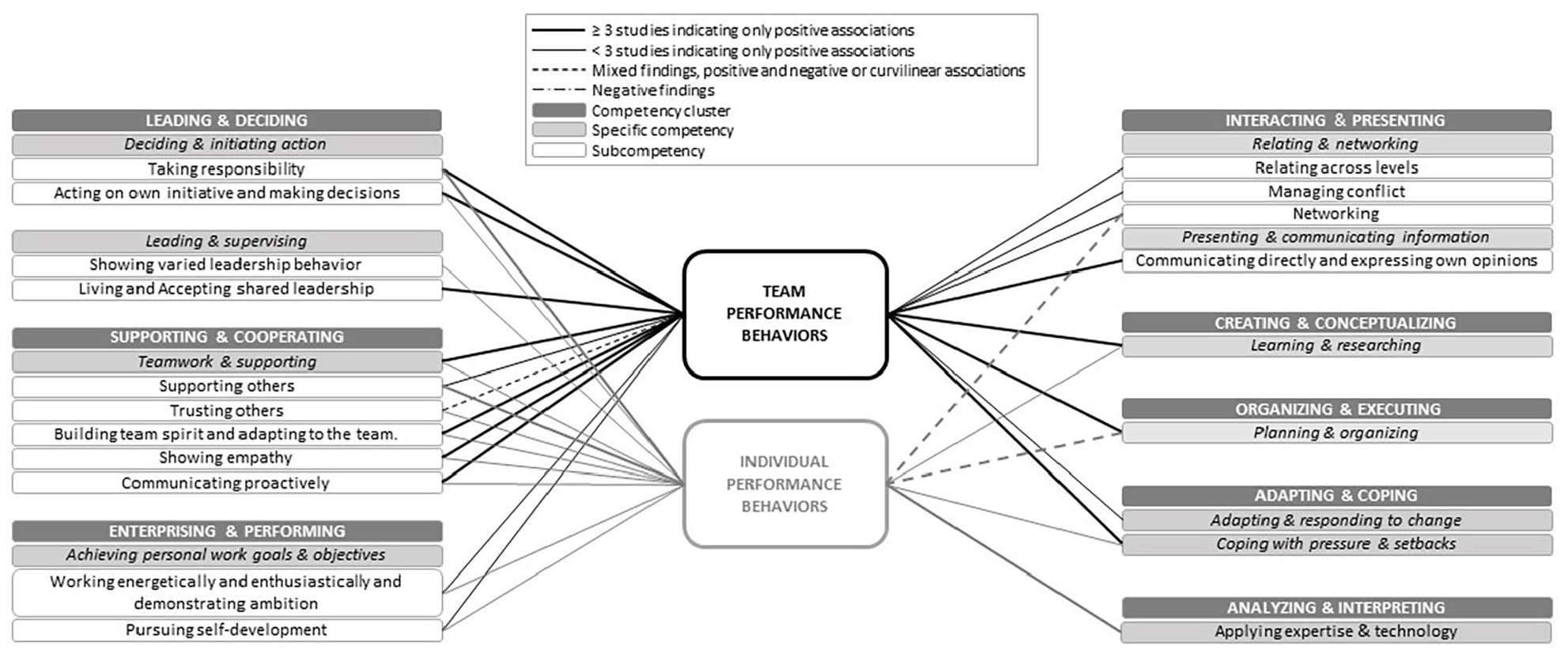
The relations of individual competencies to individual and team performance behaviors.
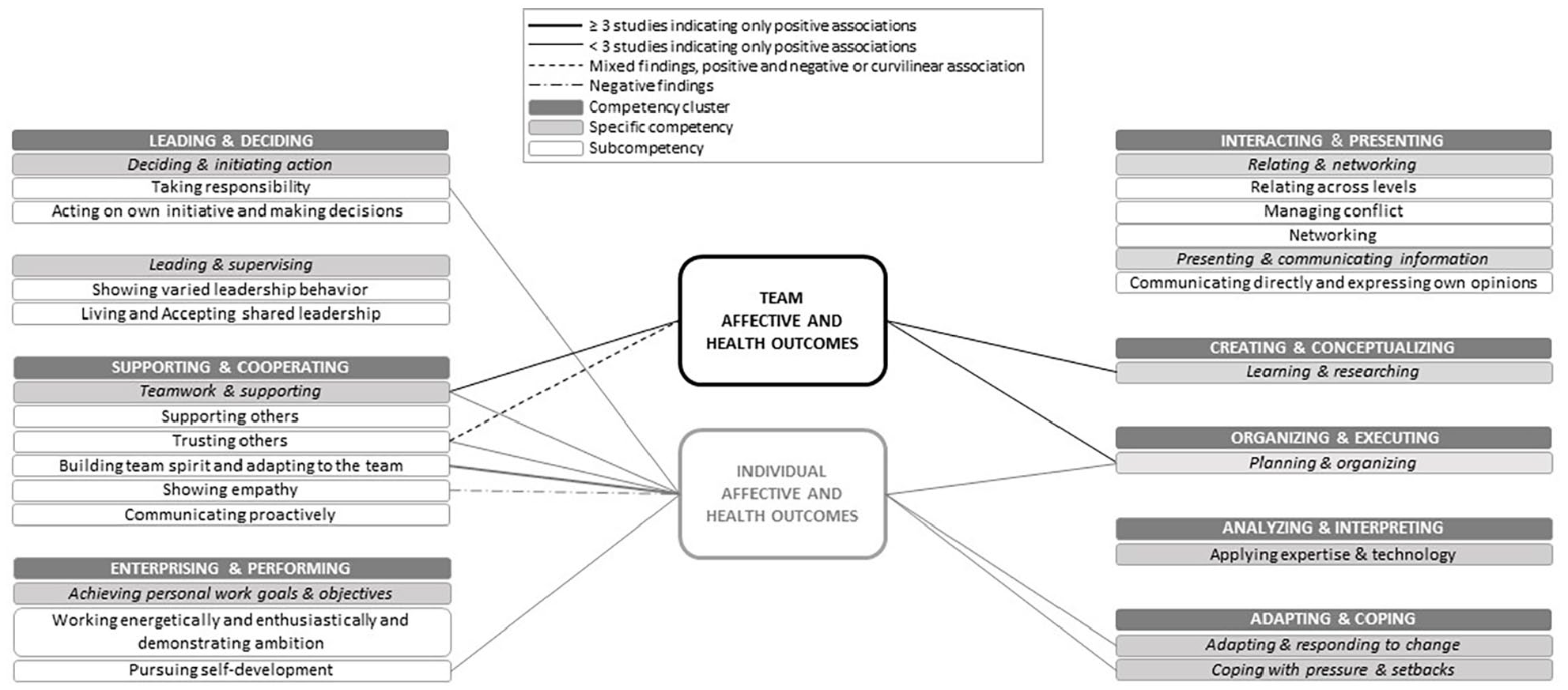
The relations of individual competencies to individual and team affective and health outcomes.
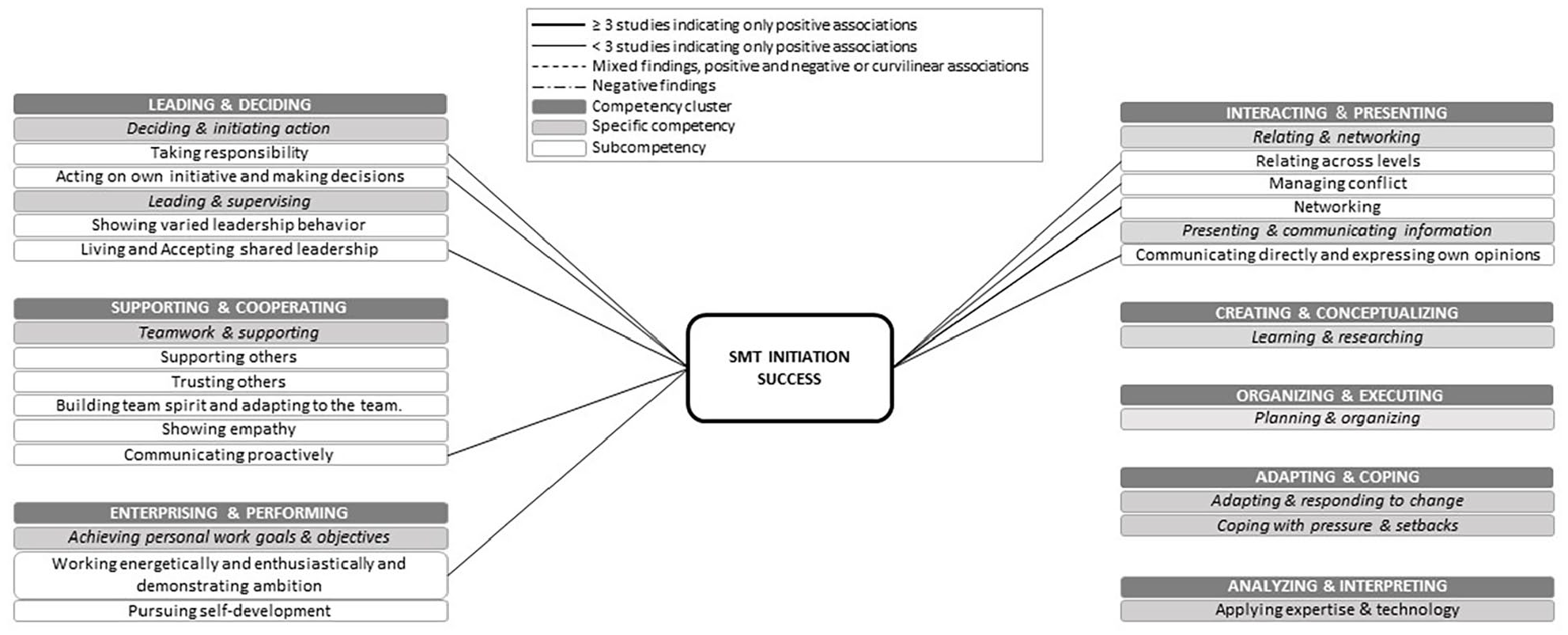
The relations of individual competencies to SMT initiation.
Individual Competencies for SMT Performance
The reviewed studies indicate the relevance of all eight competency clusters (see Figures 1–4). For further structuring, we oriented toward the specific competencies and subcompetencies of Bartram’s framework (see Table 1). In the following paragraphs, we show the findings for each competency cluster and their relationship to the team- and individual-level outcomes. We start with a summary and then go into the details for each cluster, including team and individual level findings.
Leading and Deciding
The literature review revealed that within the cluster of leading and deciding, leading and supervising and deciding and initiating action were relevant. Particularly, the reviewed literature provided evidence for the subcompetencies taking responsibility, acting on own initiative, making decisions, showing a broad range of leadership behaviors, and living shared leadership principles.
Deciding and initiating action
Taking responsibility
This subcompetency includes two aspects: taking responsibility for a specific task as well as for oneself. It refers to being the director and taking accountability for a task or for one’s own behavior. Quantitative studies have shown that members of high-performing teams more often took responsibility for team tasks and also encouraged others to do so (Carte et al., 2006; Zafft et al., 2009). Similarly, high-performing SMT members stood out by proactively taking responsibility for additional tasks and leadership roles (Ainsworth, 2016). Case studies have also shown that taking responsibility and initiative were essential to counterbalance the high degree of freedom in SMTs and were a major requirement of any role within self-managing organizations (Andrés et al., 2015; Banai et al., 2000; Duimering & Robinson, 2007; Hoda & Murugesan, 2016; Hoda et al., 2012). In contrast, blaming individual team members who made decisions with the intent of solving a conflict, instead of taking responsibility as a team, impeded constructive conflict management (Yazid et al., 2018). In turn, according to a detailed multiple case study, responsibility sharing within the team was positively associated with team performance and personal development (Doorewaard et al., 2002). Additionally, training in the area of participation, responsibility, empowerment, and involvement facilitated successful initiation of SMTs (Attaran & Nguyen, 1999).
Concerning the facilitators for taking responsibility, some research has focused on flexible role orientation, which implies a rather broad definition of one’s work role and enables individuals to take responsibility for goals, proactively define their roles, and perceive the responsibility to anticipate and prevent problems (Parker, 2007). In her seminal, longitudinal study with high external validity through two separate samples, Parker (2007) found that flexible role orientation predicted moderately higher performance. It even had an incremental value in addition to other important factors such as job satisfaction or self-efficacy. Specifically, showing collaborative, team-oriented behaviors in addition to those required by one’s actual role was related to team and individual performance and leadership emergence 1 (de Jong et al., 2004; Lee & Paunova, 2017).
Acting on own initiative and making decisions
This subcompetency refers to taking action in anticipation of challenges and opportunities without others’ stimulation. It also includes making decisions instead of waiting for more information or delegating the task to others and thus probably accepting calculated risks. Previous research has identified that being proactive and proactively engaging in problem-solving activities are relevant for team strategic thinking, learning, and performance (Ainsworth, 2016; Druskat & Kayes, 2000; Wageman, 1997). Furthermore, a proactive personality was found significant for successful SMT initiation and proactive team behavior (Williams et al., 2010). Besides, a simulation study with students found individual decision quality to be predictive of team decision performance (Zhou et al., 2020). Intuitiveness, which refers to a cognitive style characterized by a preference for a broad perspective and non-conformist and open-ended approaches to problem-solving and decision-making (Armstrong & Priola, 2001), has been found to facilitate proactivity. Based on interaction analyses over 5 months, Armstrong and Priola (2001) found that individuals with an intuitive action style initiated moderately more socio-emotional and slightly more task-oriented behaviors than analytic individuals. Furthermore, formal leaders showed an intuitive style significantly more often than other team members, which is meaningful, as the team members had elected their leaders. Besides, moderate levels of assertiveness, referring to dominant and decisive behaviors focusing on getting along, predicted higher levels of advice-seeking by one’s peers (Hu et al., 2019).
Leading and supervising
Living and accepting the principles of shared leadership
Shared leadership refers to all team members being “involved in the process of leading one another toward productive ends” (Pearce et al., 2014, p. 277). This consequently requires the ability to lead and follow the leader (DeRue & Ashford, 2010). Banai et al. (2000) identified the ability to lead and follow the leader as a success factor for self-managing organizations. In turn, a major, manager-reported challenge for the initiation of SMTs was establishing leadership among team members (Nicholls et al., 1999). Carte et al. (2006) verified the relevance of leadership behavior longitudinally: better performing teams showed more shared and concentrated leadership behaviors than worse performing teams. Especially in the early stages of team formation, shared monitoring leadership behaviors were relevant, and collective leadership (Hiller et al., 2006) was a positive predictor for team information elaboration and performance (Resick et al., 2014).
However, considering an SMT’s type of work, Fausing et al. (2013) found through regression analysis that shared leadership predicted higher team performance only for knowledge workers, though not for manufacturing teams, for whom it predicted even poorer performance. Besides, Markova and Perry (2014) found that intragroup disagreement regarding leadership roles was negatively associated with group cohesion. Unfortunately, the study did not consider the alternative of shared leadership, which limits its informative value as shown by Taggar et al. (1999). Based on a large sample, they showed that besides central leadership, the leadership behaviors of all team members were decisive for team performance; even to the extent that when these were weak, the central leadership’s effect disappeared. DeRue et al. (2015) demonstrated that team members’ agreement with shared leadership predicted higher leadership density and lower leadership centrality at the team level.
Showing various leadership styles and behaviors
Leadership can have different styles and corresponding roles, for example, directive leadership including coordinating roles or participative leadership including mentoring behaviors (Carte et al., 2006; Quinn, 1984). One individual can perform various leadership roles, which is called behavioral complexity, and this for instance was related to the managers’ effectiveness in traditional teams (Denison et al., 1995). Considering leadership roles in SMTs, Zafft et al. (2009) found that here, too, behavioral complexity was clearly associated with higher team performance. Studies analyzing the leadership type found positive associations of behaviors focused on producing results, managing processes, and leading change with team performance (Carte et al., 2006). Besides, action-embedded transformational leadership behaviors were relevant for individual leadership emergence (Eseryel & Eseryel, 2013).
Supporting and Cooperating
Regarding the cluster supporting and cooperating, teamwork and supporting were especially relevant. Specifically, we found evidence for several subcompetencies, for example, supporting others, trusting others, and building team spirit.
Teamworking and supporting
Teamwork refers to a “set of interrelated thoughts, actions, and feelings of each team member that are needed to function as a team and that combine to facilitate coordinated, adaptive performance and task objectives resulting in value-added outcomes” (Salas et al., 2005, p. 562). Based on a literature review of research on all types of groups, Stevens and Campion (1994) identified conflict resolution, collaborative problem-solving, communication, goal setting, and performance management, as well as planning and task coordination behaviors as essential for teamwork. Several studies on SMTs have investigated the broad concepts of teamwork or collaboration. Tasa et al.’s (2007) comprehensive longitudinal study revealed that the teamwork behaviors identified by Stevens and Campion (1994) predicted higher team performance through increased collective efficacy within newly established teams. Furthermore, based on an SEM, Hirschfeld et al. (2006) found that the mere knowledge of these teamwork behaviors predicted moderately higher performance and teamwork effectiveness. Additionally, perceived team cooperation predicted moderately higher team performance, motivation, and openness to change (Eby & Dobbins, 1997; Yeatts et al., 2001).
Besides, qualitative research found cooperation essential for team performance and effectiveness in agile software development, and traced problems regarding task coordination, shared decision-making, and mutual support back to a lack of teamwork competence (Fontana et al., 2014; Moe et al., 2010; Wood et al., 2013). Ethnographic research on shared leadership in SMTs identified collaboration as a prerequisite for the team members’ mutual understanding of the current and changing authority distributions (Bransford, 2006). Furthermore, agreeableness, characterized by cooperativeness, courteousness, soft-heartedness, trustfulness, tolerance, and flexibility (Barrick & Mount, 1991; Sheese & Graziano, 2004) positively correlated with teamwork behaviors as well as self-efficacy for participating in SMTs (Powell & Pazos, 2017; Thoms et al., 1996). Powell and Pazos’s (2017) case study showed that agreeable team members cooperated more, for example, by exchanging task-related information with other members, giving and accepting feedback, providing backup behaviors, and engaging in problem-solving. Additionally, teams’ average agreeableness predicted moderately stronger team cognition over time (Guchait et al., 2014). Besides the research on the broad construct of teamwork, several studies have also investigated individual facets of teamwork, which allows us to further distinguish subcompetencies in the following paragraphs.
Supporting others
Supporting others refers to providing material and intangible resources to help another person reach a specific goal or a desired mental state. Based on an SEM, Wolff et al. (2002) found that behaviors to support and develop others predicted higher team task coordination, which in turn predicted individual leadership emergence. Accordingly, two robust studies showed that team colleagues perceived as supporting and advising were attributed informal leadership roles (especially male colleagues) and performed substantially better (Gill et al., 2020; Neubert & Taggar, 2004). Furthermore, intrateam and interteam support predicted higher team performance, and proactive and adaptive behavior (de Jong & de Ruyter, 2004; de Jong et al., 2004). Additionally, Hu et al. (2019) identified the moderating effect of prosocial motivation, which refers to being motivated by helping and benefiting others. In principle, moderate degrees of assertiveness or warmth predicted the highest levels of popularity and advising role, but high prosocial motivation increased the levels of warmth and assertiveness that were still beneficial. Hence, prosocial motivation seems to make warmth and assertiveness more accepted, probably because it increases authenticity. Additionally, using multilevel modeling, Mitchell and Bommer (2018) found that prosocial motivation predicted slightly higher leadership emergence.
Trusting others
Trusting others in terms of believing in the trustworthiness and honesty of others but also believing in the capabilities of others is an aspect investigated in various studies on SMTs. Kiffin-Petersen and Cordery (2003) showed a positive association between dispositional trust (the general propensity to trust others) and situational forms, such as trust in coworkers or management, with a preference for teamwork. Moreover, individual trusting relationships predicted knowledge transfer (Sarker et al., 2011). However, trust in SMTs was not exclusively positive; managers’ perceptions of intrateam trust predicted only the perception that these SMTs achieved a lower cost reduction but not quality improvement or employee satisfaction (Yang & Guy, 2004). Furthermore, based on an SEM, Politis (2003) found a non-significant effect of interpersonal trust on performance and differential effects on knowledge acquisition, predicting a moderate to high increase in some dimensions but a decrease in others. Interestingly, the dimensions of interpersonal trust also varied in their effects; while trust in the capabilities of others was positively related to communication and problem solving, it was negatively related to preparing and presenting ideas to others, leading and managing projects, and possessing good domain knowledge.
Conversely, faith in the trustworthiness of others was positively related to presenting ideas to others, leading and managing projects, as well as communication and problem-solving. However, although the fit indices of the model were good, these findings must be interpreted with care as the sample size was marginal (N = 49 teams) and too small for the applied method of parameter estimation. 2 Gupta et al. (2011) found a non-significant correlation between trust in terms of the other’s trustworthiness and team performance, but the small sample (N = 36 teams) probably impeded statistical significance in this case as well. Langfred (2004) investigated trust at the team level, individual autonomy, and team performance in student SMTs. He found a negative nonlinear relationship between intrateam trust and monitoring, such that with increasing trust, intrateam monitoring decreased. Teams with high individual autonomy performed worse in the case of high intrateam trust and low intrateam monitoring, while teams with low individual autonomy performed better in the case of high trust. However, although Langfred’s (2004) findings resulted from sound statistical analyses, they seem to be of limited generalizability, as the sample comprised temporarily existing student teams in which trust was at least at a moderate level. As the effect proved to be nonlinear, it probably differs for lower levels of trust.
To conclude, while trust in the good intentions of others seemed to foster knowledge acquisition and collaboration processes, probably by providing a safe environment, specific facets of interpersonal trust, such as trust in the capabilities of others, appeared to have adverse effects on performance. These adverse effects might stem from other background processes such as social loafing (Latané et al., 1979) or interactions with potentially confounding variables, for example, conscientiousness or power distance (for details, see the sections on interacting and presenting and organizing and executing).
Building team spirit and adapting to the team
This subcompetency refers to behaviors that strengthen team cohesion and team identity and contribute to the success as one team (Silva et al., 2014). It also includes behaviors for adapting to the team (e.g., deprioritizing one’s own needs or goals in favor of team goals and cohesion). The perception of goals as collaborative instead of competitive correlated with engaging in constructive controversy (Alper et al., 1998). Based on an SEM, de Jong et al. (2001) found that perceived team commitment to the common goal predicted distinctly higher job satisfaction, slightly lower intention to leave, and a reduced negative effect of uncertainties within the team’s context. Qualitative findings showed similar patterns: Prioritizing team goals and individual commitment were relevant for successful team self-management (Moe et al., 2009, 2010; Murnighan & Conlon, 1991; Oliver & Roos, 2003). Additionally, in quantitative studies, individualism in terms of the cultural dimension of collectivism–individualism 3 (Hofstede, 1980) was negatively related to teamwork preference and trust in the coworkers (Kiffin-Petersen & Cordery, 2003). Besides, qualitative research showed that individualism impeded transparency and knowledge transfer (Moe et al., 2010). In turn, a higher proportion of collectivist-oriented team members predicted moderately higher perceived team cooperation (Eby & Dobbins, 1997). Besides, relationship orientation (femininity in terms of Hofstede, 1980) was important for team performance at later stages of student teams (Cheng et al., 2012), probably to ensure long-term team stability. Murnighan and Conlon (1991) and Oliver and Roos (2003) identified the integration and appreciation of all team members’ skills and diverse contributions as benefiting SMT performance. Interpersonal emotional intelligence, including demonstrating oneself as a cooperative group member and establishing mutual interpersonal relationships (Bar-On et al., 2000), predicted higher focus on team tasks and intrateam cooperation (Frye et al., 2006). However, these results may be biased by gender, as the same was not balanced in the sample or statistically controlled.
Teamwork efficacy, the perceived capability to successfully perform specific tasks as a team, was positively related to individual teamwork behavior and team cohesion (Markova & Perry, 2014; Tasa et al., 2007). Specifically, based on a robust SEM, Tasa et al. (2007) found that teamwork efficacy predicted considerably higher team performance and slightly higher individual teamwork behavior. Similarly, confidence in effective intrateam interactions correlated positively with self- and supervisor-rated performance (Alper et al., 1998). Moreover, high group cohesion, comprising perceived friendliness, trust, and loyalty among coworkers, was decisive for the positive effect of high individual self-management with respect to team performance (Millikin et al., 2010). Furthermore, group cohesiveness and identity correlated positively with individual well-being and satisfaction (Markova & Perry, 2014; Seers et al., 1995), thereby demonstrating the significant role of team spirit.
Showing empathy
Showing empathy refers to behaviors enabling experiencing, understanding, and sharing another person’s emotions while still recognizing that these emotions are not one’s own (Cuff et al., 2016). Wolff et al.’s (2002) quantitative study of student SMTs based on behavior measurement by critical incidents identified showing empathy as a predictor of slightly higher information synthesis, pattern identification within loose information, and perspective-taking. Both predicted slightly more supporting and developing of others and indirectly higher group task coordination and leadership emergence. Additionally, empathy was associated with more constructive conflict management, task orientation, and intrateam cooperation (Frye et al., 2006; Murnighan & Conlon, 1991).
Emotional intelligence, closely related to empathy, and which includes perceiving emotions, facilitating thought, understanding, and managing emotions (Mayer & Salovey, 1997), was also investigated in the context of SMTs. Zhou et al. (2020) found that individual and team-level emotional intelligence predicted psychological safety and team decision performance. Based on hierarchical linear modeling, Paik et al. (2019) found in their detailed investigation that the skills to perceive and understand certain emotions predicted higher individual performance, while the skills to use and manage emotions were irrelevant. This highlights the relevance of the empathy-related aspects of emotional intelligence. Generally, high emotional intelligence predicted slightly higher individual performance in the aspects of leadership and teamwork. The effect was stronger in bigger and in more diverse teams (diverse regarding age, ethnicity, and Big Five personality traits). However, the effect disappeared in the case of high team average emotional intelligence. Applying the same questionnaire as Paik et al. (2019), Rozell and Scroggins (2010) found that the understanding of emotions was related to negative feelings regarding group member relationships and group cohesion, both being dimensions of group satisfaction. The authors explained this phenomenon stating that this is because a better understanding of the team colleagues’ emotions allows the perception of tensions that other colleagues could not even sense. Hence, the evaluation of group cohesion may be worse. On the other hand, the operationalization of SMTs in Rozell and Scroggins’s study was critical; members of the participating teams had to apply for the team leadership, were selected by the researchers, and then the leader held a task-assignment power. Such a procedure is uncommon for student teams and may have caused irritation and limited generalizability. However, satisfaction with the group differs from job satisfaction and could also function as an incentive to improve conditions, thereby increasing performance and leadership. This aligns with the previously mentioned findings of Paik et al. (2019).
Communicating proactively
Communicating proactively refers to expressing own needs, wishes, and possible disagreements regarding cooperation toward one’s colleagues at an early stage. The inability to address critical issues in the relationship with others was an impeding factor for team learning and self-management (Moe et al., 2009). Earlier, Druskat and Kayes (2000) had shown that confronting members who break the norms strongly correlated with higher team learning. Besides, while the correlation with team performance was null, the authors found a negative effect through regression analysis. However, the inferential statistics’ reliability is questionable, being based on a minimal sample size (N = 26). Additionally, clarifying each member’s necessary work contribution was related to SMT strategic thinking and performance (Wageman, 1997). Furthermore, research on SMTs also investigated impression management, the motivation to control the outside perception of oneself and intentionally construct a desirable image (Leary & Kowalski, 1990), which counteracts the proactive communication of one’s needs or the perceived tensions. Using the painstaking approach of multilevel linear modeling, Mitchell and Bommer (2018) found that in temporary teams a member’s impression management motive predicted lower leadership emergence when the team colleagues perceived them as showing few task coordination behaviors. However, in the case of perceived high task coordination, impression management motives did not affect leadership emergence. Similarly, case studies of permanent SMTs identified impression management as hindering the initiation of self-management (Moe et al., 2009, 2010).
Interacting and Presenting
Within the cluster interacting and presenting, the reviewed literature showed the relevance of relating and networking, as well as presenting and communicating information. Particularly, we found evidence for the subcompetencies relating across levels, managing conflict, networking, communicating directly, and expressing own opinions.
Relating and networking
Relating across levels
Relating across levels refers to building good relationships with persons of different hierarchy levels and different subject areas. Managers who experimented with SMTs reported in a qualitative survey that culture-contingent high power distance, which refers to the individual acceptance of unequal power distribution in organizations (Hofstede, 1980), impeded the initiation of SMTs (Nicholls et al., 1999). According to the managers, high power distance employees struggled to assume leadership roles and be led by peers. More precisely, Liu et al.’s (2012) sound study identified power distance as a prerequisite for the effectiveness of empowering work conditions. Only in the case of low individual power distance did participative decision-making and SMT climate result in higher organization-based self-esteem, which was mediated by higher psychological ownership concerning the organization. Analogously, only with low individual power distance did participative decision-making and SMT climate predict higher affective commitment and organizational citizenship behavior. Additionally, direct communication to the customer was relevant for agile team maturity (Fontana et al., 2014). The communication between customers and developers includes bringing together different subject areas and hierarchy levels, which shows the importance of building relationships across levels.
Managing conflict
Managing conflict refers to actively handling and resolving conflict among team members in a constructive, solution-oriented way. Constructive controversy, including seeking a mutually beneficial solution, taking each other’s perspective, discussing opposing views directly and openly, and integrating them for the best solution predicted moderately to strongly higher confidence in the team and its effectiveness (Alper et al., 1998). Similarly, qualitative research reported mediating behaviors and democratic conflict-resolution strategies as standout attributes of successful SMTs or team members (Ainsworth, 2016; Murnighan & Conlon, 1991). Furthermore, the training in conflict resolution skills eased the initiation of SMTs, with compromise and reconciliation being especially important in the initial phases (Attaran & Nguyen, 1999). In contrast, conflict avoidance strategies let teams become dependent on external leadership (Yazid et al., 2018). Although the qualitative evidence is unequivocal, seminal quantitative evidence for the competency of managing conflict is still lacking.
Networking
Networking refers to building and actively maintaining relationships with others and thereby gaining relevant information and support for one’s goals (Gibson et al., 2014). Gill et al.’s (2020) exhaustive study based on network analysis and multilevel modeling showed that individual popularity among the teammates (expressive tie centrality) predicted moderately higher performance. Interestingly, in gender homogenous teams, one’s expressive tie centrality could even mitigate the negative effect of one’s low instrumental contributions on leadership emergence. The authors hypothesize expressive tie centrality as being a compensator for the lack of instrumental contribution. It enhances emotional resources, such as psychological safety and team openness, which is especially effective in gender homogenous teams due to the similarity-attraction paradigm (Byrne, 1961). Additionally, Hu et al. (2019) found in their detailed study that moderate levels of warmth, as reflected in being affectionate and friendly in social interactions, predicted higher levels of advice seeking and peer liking. In turn, advice seeking and peer liking were positively related to leadership emergence (Hu et al., 2019). These findings seem to have good external validity, considering they were from two independent samples, one including temporary student teams and the other permanent teams of professionals. DeRue et al. (2015), on the other hand, relied on a large sample and found that the perceived warmth of an individual was negatively related to leadership behavior and leadership emergence. However, they did not check for nonlinear relations, as seen in Hu et al. (2019), which could have provided another insight. Nonetheless, one’s perception of the team’s warmth predicted one’s leadership behavior mediated by identification with the group (DeRue et al., 2015).
Moreover, Sorrentino and Field’s (1986) quasi-experimental study showed that affiliation motivation, which is the motivation to perform for social rewards, such as establishing good relations or gaining approval, was associated with socio-emotional and task leadership emergence, higher perceived contribution, competence, confidence, and more task-relevant interactions. Unfortunately, the authors did not report effect sizes or standard deviations, which inhibited conclusions regarding practical significance. Generally, good relationships were found relevant for SMT success (Sarker et al., 2011; Weerheim et al., 2019). One quasi-experimental study showed 3 months after an intervention to reinstall SMTs higher quality of team member exchange and cohesiveness in the SMTs than in the traditional teams (Seers et al., 1995). Team member exchange in turn correlated with increased team efficiency, although these results must be interpreted carefully as the sample size at the team level was only N = 5. Furthermore, building relationships with other teams and interpersonal understanding were moderately to strongly associated with higher team learning (Druskat & Kayes, 2000). In women, boundary-spanning behavior, the coordination with people outside the team to acquire resources, was linked to increased leadership emergence but not effectiveness, whereas it was linked to slightly decreased leadership emergence and effectiveness for men (Lanaj & Hollenbeck, 2015).
Presenting and communicating information
Communicating directly and expressing own opinions
This subcompetency includes sharing information in a direct way and expressing one’s own opinions while fitting them well into the context. Generally, good team communication was found relevant for agile team maturity (Fontana et al., 2014). Case studies reported direct communication as essential for handling critical incidents, the enhancement of communication skills as facilitating the initiation of SMTs, and lack of communication as the root cause of problems in newly formed SMTs (Attaran & Nguyen, 1999; Moe et al., 2010; Oliver & Roos, 2003). Furthermore, case studies of self-managing organizations reported as essential the free flow of intrateam communication and expressing own opinions effectively and honestly, specifically toward the management (Andrés et al., 2015; Banai et al., 2000). Yang and Guy (2004) substantiated the role of communication quantitatively by showing the positive relationship between managers’ perceptions of intrateam communication and product quality. However, we found no quantitative research that studied the role of communication from a self-reported team member’s perspective. Using interaction analysis, Stephens and Lyddy (2016) investigated the mechanisms of communicative contributions in SMTs and, in particular, heedful interrelating, which refers to the individual awareness of how one’s own contributions purposefully add to the team goal. Teams with more responsive communication patterns, including overlapping or linking own statements to that of colleagues, showed moderately higher team performance and a stronger perception of the team as a whole, which is one facet of team cohesion.
Analyzing and Interpreting
So far, only a few studies have dealt with the cluster analyzing and interpreting in the context of SMTs. Findings are limited to the field of applying expertise and technology, which refers to using one’s technical knowledge and skills or certain specific technologies. This contrasts with building interdisciplinary skills. Tasa et al.’s (2007) robust quantitative study identified task-relevant knowledge as a predictor for moderately higher individual teamwork behavior, which again predicted moderately higher team performance through higher collective efficacy. Based on network analysis, Sarker et al. (2011) found for task-relevant knowledge only a positive association with performance, but showed that knowledge transfer, which was independent of actual knowledge, additionally predicted leadership emergence. Similarly, DeRue et al. (2015) identified peer-rated individual knowledge as a predictor for leadership emergence. Andrés et al. (2015) reported that in self-managing organizations, every employee was required and trained to possess knowledge about financials to enable them to own decision-making. Consequently, although mere knowledge application might not always be sufficient, it is nonetheless necessary for SMT performance.
Creating and Conceptualizing
The literature review showed that within the cluster creating and conceptualizing, the competency learning and researching especially was relevant. However, we could not distinguish further subcompetencies. Learning and researching includes individual knowledge acquisition by an active, self-directed search for relevant information and the support of team and organizational learning by fostering knowledge transfer and information sharing. Based on a network approach, Sarker et al. (2011) found through regression analysis that higher knowledge transfer to others predicted higher individual leadership emergence and performance. Besides, Ainsworth’s (2016) case study showed that high-performing individuals shared their research and knowledge with others and gave constructive criticism. In turn, low-performing SMT members lacked strategies to ask for clarification and ensure understanding. Based on an SEM, though relying on a small sample, Politis (2003) found that knowledge acquisition predicted slightly to moderately higher team performance. Furthermore, retaining lessons learned was relevant for agile team maturity (Fontana et al., 2014). Looking for best practices and experimenting with new ways to work more effectively were essential for SMTs’ strategic thinking and performance (Wageman, 1997). Team cognition, the intrateam mental organization, representation, and distribution of knowledge necessary for team functioning, was essential for organizational learning and was associated with team performance, team satisfaction, and team cohesion (Guchait et al., 2014). Specifically, transactive memory systems predicted distinctly higher team performance and team satisfaction, while team task understanding predicted distinctly higher team cohesion (Guchait et al., 2014). Transactive memory systems refer to individual memory systems and the interpersonal communication process to create a shared awareness of who knows what (Kozlowski & Ilgen, 2006; Wegner, 1987). Andrés et al. (2015) also reported team cognition as being crucial in self-managing organizations, where information transparency and information accessibility to all employees was a leading principle.
Organizing and Executing
Regarding the cluster organizing and executing, previous research has provided evidence for the specific competency planning and organizing. It includes behaviors to anticipate, identify, and schedule tasks and corresponding actions, and coordinating actions and other people. Team-level self-management behaviors, such as joint goal setting, joint planning, coordination, and collaboration, predicted slightly to moderately higher team performance (Lambe et al., 2009). Furthermore, Cohen et al.’s (1997) influential quasi-experimental study with a large, diverse sample showed that SMT members reported the requirements of self-goal-setting and self-criticism more frequently than members of managed teams. In turn, self-goal-setting and self-criticism positively correlated with organizational commitment and satisfaction. Relatedly, case studies reported strengthening time management skills as beneficial, but unrealistic planning as impeding self-management (Attaran & Nguyen, 1999; Moe et al., 2009). Besides, sending coordinating and task-oriented messages was a distinguishing behavior of emerging leaders (Yoo & Alavi, 2004). Oliver and Roos (2003) identified prioritization and a clear product vision as facilitating the handling of critical incidents. Besides, Moe et al. (2009) found that unclear completion criteria for tasks and goals impeded team goal commitment, and hence planning the goal completion is important. The personality trait conscientiousness, which includes behaviors to act carefully, thoroughly, in a goal-directed, organized way (Barrick & Mount, 1991; Roberts et al., 2009), correlated with more positive attitudes regarding SMTs and an advising role within the team (Gill et al., 2020; Thoms et al., 1996). Taggar et al. (1999) found in a considerable student sample a general positive effect of conscientiousness on leadership emergence, whereas Neubert and Taggar (2004) found it only for men in a sample of employees, while for women the effect was reverse. At the team level, high conscientiousness predicted strong team cognition, which in turn was relevant for team performance (Guchait et al., 2014). Interestingly, conscientiousness was especially important in the initial team phases and became less relevant over the team lifecycle (Guchait et al., 2014).
Adapting and coping
The literature review showed that within the cluster adapting and coping, the specific competencies adapting and responding to change and coping with pressure and setbacks were relevant. However, the findings did not allow a further distinction of subcompetencies.
Adapting and responding to change
Adapting and responding to change includes adapting to new conditions, accepting and welcoming new ideas, but also dealing with the ambiguity arising from anticipated changes. One case study showed that, in critical situations, effective SMTs first tried to modify the external conditions, but soon realized and accepted the given conditions and instead adapted themselves to the situation (Oliver & Roos, 2003). Additionally, Yeatts et al. (2001) found that openness to experience correlated moderately with higher team performance. Adding quantitative evidence, de Jong and de Ruyter’s (2004) influential study based on multilevel analyses showed that the adaptive recovery behavior at the team level correlated positively with team performance. Quickly reacting to changing conditions improves performance outcomes. On the other hand, qualitative research showed that recognizing and managing ambiguity and tolerating high uncertainty were positively associated with team performance outcomes, especially in critical situations (Murnighan & Conlon, 1991; Oliver & Roos, 2003). Interestingly, Cheng et al. (2012) found a positive relationship between low uncertainty avoidance of student SMTs and team performance only in early team phases. This time effect may exist because in the early project phases, when little is known, more decisions must be made under more uncertain conditions. In such cases, being unable to make decisions under uncertainty will thus impede performance. Besides, Elloy et al.’s (2001) thorough SEM-based study showed that perceived role conflict and uncertainty about one’s organizational position were associated with moderate increases in burnout factors, such as emotional exhaustion, depersonalization, and feelings of low personal accomplishment. Although not directly measured, these findings underpin the relevance of coping with ambiguity and uncertainty, considering that dynamic role definition and distribution are characteristic of SMTs (Lee & Edmondson, 2017).
Coping with pressure and setbacks
This subcompetency refers to handling pressure and setbacks well by regulating the own emotions efficiently but also maintaining a positive outlook despite potential difficulties. Quinteiro et al. (2016) found that thought self-leadership, referring to fostering constructive thoughts by applying mental imagery, (positive) self-dialogue, and evaluation of (dysfunctional) beliefs and assumptions, predicted team performance and viability, mediated through team collective efficacy. Emotional stability, the tendency of feeling confident, secure, and steady (Barrick & Mount, 1991), was found to predict slightly higher leadership emergence in Taggar et al.’s (1999) detailed study. Furthermore, Thoms et al. (1996) found, although based on a predominantly male sample, that low emotional stability not only predicted slightly lower self-efficacy for participating in SMTs, but also correlated negatively with attitude toward SMTs.
Gray (2012) showed that team resilience predicted higher team performance over time. Interestingly, he also found that perceiving and managing own emotions had a weak negative association with team performance but weak to moderate positive associations with team resilience. Overly focusing on dealing with emotions might trap one and impede performance. We propose that moderate levels might be more beneficial to performance, but curvilinear relationships were not investigated. Unfortunately, the findings are of limited validity due to variance restriction and a tiny sample (team level aggregation), as well as using a simulation game to gather data, which limited the external validity. On the other hand, qualitative research identified calmness and focus under pressure as decisive for dealing with critical incidents and essential for constructive conflict resolution (Murnighan & Conlon, 1991; Oliver & Roos, 2003).
Enterprising and Performing
Within the cluster enterprising and performing, the reviewed literature showed the relevance of the competency achieving personal work goals and objectives. Specifically, the subcompetencies working energetically and enthusiastically and demonstrating ambition, and pursuing self-development were relevant.
Achieving personal work goals and objectives
Working energetically and enthusiastically and demonstrating ambition
This subcompetency includes putting effort and desire into one’s actions and showing determination to perform and reach goals. Research has identified as relevant making extra efforts to show commitment to the team and its goals, being proactive, and engaging proactively in problem-solving activities (Ainsworth, 2016; Druskat & Kayes, 2000; Hawkins, 2013; Moe et al., 2009; Weerheim et al., 2019). Specifically, personal and task commitment and perseverance were positively related to team performance and agile team maturity (Fontana et al., 2014; Gray, 2012). Furthermore, qualitative and quantitative research found self-regulatory strategies for working autonomously and with focus, which are necessary to keep on track with one’s goals, important for individual and team performance (Ainsworth, 2016; Coetzer & Trimble, 2009). Investigating individual motives in a quasi-experimental approach, Sorrentino and Field (1986) identified individual achievement motivation, which refers to taking pride in accomplishments—as a predictor for socio-emotional and task leadership emergence. Achievement orientation helps individuals to work toward their goals energetically. Consequently, more achievement-oriented individuals showed more task-relevant interactions and their peers rated their contribution, competence, and confidence higher (Sorrentino & Field, 1986). Unfortunately, the authors hardly explored the longitudinal effects, although the design would have allowed it.
Pursuing self-development
Pursuing self-development refers to seeking out and engaging in activities or behaviors that help one’s skills, knowledge, and personality evolve further, and also increase one’s level of experience. Based on a thorough SEM, Lee and Paunova (2017) found that individuals who set their goals in terms of competence development instead of mere ability demonstration (learning goal orientation) felt safer in their SMTs. Besides, these individuals showed more collaborative, team-oriented behaviors, beyond the actual requirements of their roles. Mediated by felt safety, learning goal orientation predicted moderately higher leadership emergence. Furthermore, lack of team member interest in engaging in tasks outside one’s specialization area threatened cross-functionality and team performance (Hoda & Murugesan, 2016). Research on this topic is in general still sparse, though findings regarding agility and organizational learning have suggested that individual behaviors to pursue self-development are important as well (Sherehiy & Karwowski, 2014).
Model of KSAOs for SMT Performance
Based on previous research findings, the present paper provides a model of individual KSAOs and traits beneficial to SMT performance. It gives details on the relations of individual KSAOs not only with the three performance aspects (performance outcomes, performance behaviors, and affective and health outcomes), but also with SMT initiation success. Besides the team-level performance perspective, the paper also offers a perspective on individual-level performance, as individual performance is also predictive of team performance (Figure 1 through Figure 4). The model is oriented toward the Bartram (2005) competencies for general job performance to cover all aspects regarding SMT performance, for example, not merely teamwork, but also managerial aspects. Our findings have much in common with the specific research on teamwork KSAOs by Stevens and Campion (1994), which also included managed teams (cf. section on teamwork). We found studies reporting the compound or single teamwork KSAOs as relevant in the field of SMTs (e.g., Hirschfeld et al., 2006; Tasa et al., 2007), and we derived similar competencies from the data. However, despite the commonalities, we found additional KSAOs that are not part of Stevens and Campion’s (1994) model, especially regarding deciding and initiating action or adapting and coping. Therefore, like other authors (e.g., Williams et al., 2010), we think that to understand the individual KSAOs related to SMT performance, general teamwork KSAOs are not sufficient. The range of required activities in SMTs is even broader (i.e., they include more managerial aspects or more uncertainty), as there is no external leader providing safety and direction. Consequently, self-managing team KSAOs are better covered by a derivate of Bartram’s (2005) model for general job performance.
Relation to Team Level Competency and Process Models
The present paper focuses on individual-level KSAOs and their relationship to team performance. Other authors have developed models for team-level KSAOs and processes. Marks et al. (2001) identified mission analysis, goal specification, strategy formulation and planning, monitoring progress toward goals, systems monitoring, team monitoring and backup, coordination, conflict management, motivating and confidence building, and affect management as relevant team processes. Similarly, but in lesser detail, Salas et al. (2005) reported team leadership, mutual performance monitoring, backup behavior, adaptability, team orientation, shared mental models, mutual trust, and closed-loop communication as the most relevant aspects at the team level for teamwork performance. The KSAOs of the present paper are substantially in accordance with these team models and correspond to the individual requirements to contribute to the identified team processes and emergent states. For instance, the team process of conflict management requires, among other things, the individual competency of managing conflict. Still, the individual KSAO perspective adds value through its higher level of detail, as some team processes require several KSAOs. Besides, providing individual starting points makes it functional for practitioners.
The Interplay of Team Members’ KSAOs Within SMTs
Despite the upside of relating individual KSAOs to team performance, we obviously cannot confine ourselves to observing team members in isolation. Team performance is always a result of team processes and interaction effects within the team, and therefore team-based perspectives must not be neglected (Mathieu et al., 2014). The question of how competencies and traits will play out if several team members show them is crucial. However, only a few studies so far have addressed the effects of diversity, curvilinear composition effects, fault lines, and KSAO centralization or density.
Research on team composition showed that a higher proportion of collectivist-oriented team members predicted moderately higher perceived team cooperation (Eby & Dobbins, 1997). Besides, Den Hartog et al. (2020) found a positive association of less variance in extraversion and conscientiousness with team innovation over time. The combination of minimal conscientiousness variance and maximized extraversion variance predicted the best short-term and long-term performance (Humphrey et al., 2011). Similarly, Ostermeier et al. (2020) found that too many highly conscientious members predicted less psychological safety, which in turn was related to lower performance. However, the authors did not report the optimal share of conscientious members. Diversity regarding openness was unrelated to team innovation, although, interestingly, low variance in agreeableness was associated with lesser team innovation over time (Den Hartog et al., 2020). Team diversity in proactive behavior predicted worse teamwork behavior, and consequently less team proactive performance (Williams et al., 2010). This effect was mediated by worse interpersonal treatment in the case of high team diversity regarding proactive behavior, as the more proactive colleagues may complain about the less proactive colleagues. However, as previously mentioned, there was a clear positive main effect of proactivity on performance. Besides, divergence in goal orientation (learning vs. performance) was related to worse performance and information elaboration in SMTs, while in externally led teams the relations were reversed (Nederveen Pieterse et al., 2019). This shows that in SMTs goals have a leadership function, emphasizing the importance of setting and orienting toward goals. A moderate degree of team diversity regarding uncertainty avoidance was related to best performance (Cheng et al., 2012), probably because, on the one hand, too little uncertainty avoidance could promote too risky decisions and thus increase mistakes. On the other hand, too much uncertainty avoidance could impede necessary decisions and thus hinder the project’s progress. The diversity probably enables the team to regulate itself and take the right amount of risk.
Similarly, moderate variance levels of relationship orientation were associated with the highest team performance. Relationship orientation variance may be beneficial because the team is diverse enough to regulate itself regarding task- and relationship focus, without entering into disputes due to too great differences. Diversity of expert skills and functional backgrounds was relevant for SMT and organizational performance in several studies, confirming the claim for cross-functional teams in agile work environments (e.g., Cohen et al., 1996; Hoda & Murugesan, 2016; Wageman, 1997). Depending on the type and amount of diversity, as well as its context, therefore, team diversity can either benefit or hinder SMT performance. This is in line with the inconsistent findings reported by Mathieu et al. (2014), who additionally pointed out possible interaction effects of diversity with time or the nature of the teams’ tasks.
The relevance of characteristics that only one team member displayed was the subject of only a few studies. Paik et al. (2019) showed that individual emotional intelligence was especially effective when the team average emotional intelligence was low. Similarly, the assertiveness of the team members holding critical roles was predictive of high team performance and satisfaction (Pearsall & Ellis, 2006). In their longitudinal study, Volmer and Sonnentag (2011) found that having expert members for single tasks or team functions predicted higher performance, beyond the team’s average expertise level. However, the paper did not clarify the level of self-management of the observed software development teams. Comparative research on shared and central leadership has substantiated the significance of intrateam leadership density for team performance: In the case of low shared leadership, the positive effect of central leadership disappeared (Carte et al., 2006; Taggar et al., 1999).
Evidently, we need more research on interactions of the levels of one specific KSAO, but also between different KSAOs at the team level. A mere main effect approach, for instance, may overlook the effect of specific competencies that benefit the team only when they are centralized, for example, questioning the status quo (Belbin, 1993; Mathieu et al., 2014). Nonetheless, we think that the identified compound of KSAOs already includes some KSAOs that facilitate positive interaction effects between the individual KSAOs of team members. For instance, adapting to the team or showing empathy presumably supports team members to show the situationally adequate type and dose of behaviors.
Critical Appraisal of the Reviewed Studies
The studies under review relied on quantitative and qualitative methodology, including longitudinal, cross-sectional, experimental, phenomenological, ethnographic, or case study-based approaches. Most studies relied on samples of either permanently installed SMTs in work contexts or newly formed SMTs in academic contexts. The missing shared past of newly formed teams may reduce the results’ validity, but otherwise it can give insights into the varying influence of one factor over the team’s lifecycle (e.g., Guchait et al., 2014). Notably, most studies relied on real-life academic teams; therefore, differences are not merely explicable by a laboratory study character (as is frequently the case in other areas). However, an extrapolation of findings for student samples to other samples is not always possible, for example, the correlation of conscientiousness with leadership differed between samples of students and employees (Neubert & Taggar, 2004; Taggar et al., 1999). Findings indicate that additional moderating factors such as gender or team age were causal for the differences (Guchait et al., 2014; Neubert & Taggar, 2004). Consequently, multi-sample approaches (e.g., Hu et al., 2019) and the consideration of team age or gender are especially valuable. Indeed, several studies controlled for sociodemographic moderators such as gender (e.g., Gill et al., 2020; Lanaj & Hollenbeck, 2015; Neubert & Taggar, 2004), whereas others did not, which biased findings in the case of unbalanced samples (e.g., Kiffin-Petersen & Cordery, 2003; Politis, 2003; Thoms et al., 1996). Sample size was a recurring challenge of the reviewed studies. Unfortunately, many studies lost statistical power and informative value by exclusively using team-level aggregated data instead of applying a method of multilevel analysis to cover individual and team level simultaneously (e.g., linear mixed models) and thus increase explanatory power (Baayen et al., 2008). We mainly identified positive competencies from the literature search (Figures 1–4). The quantitative literature in particular revealed primarily positive or neutral relations and only a few negative ones. Negative associations were integrated as opposite poles or discussed as contradictory findings. Furthermore, in some areas the dose or type was decisive (e.g., trust), marked in the figures as mixed findings. Overall, only a few studies reported analyses of curvilinear relations, which thus should be of greater interest for future research.
Limitations
As Stewart et al. (2011) suggested, we defined SMT to include the continuum from self-managing to self-governed teams. We took this approach since a more detailed scaling was impossible for most studies, not only because of missing information and too unspecific definitions but also due to the very fragmented results. However, this trade-off blurred the line between manager-led and self-leading teams and probably fostered the similarities to previous findings for teamwork in general. On the other hand, as SMTs are a specific form of teams, and therefore share many attributes, the high similarity is also plausible. Additionally, we included student SMTs, which made up a significant part (37 of 84) of the studies. This may limit applicability for employee teams, but otherwise, it also offers incremental value by including the perspective of short-term teams, which are also relevant for business but indeed have been less studied. Furthermore, the investigated SMTs’ size in some cases varied substantially between and within studies (see Table 3). As group size can affect interrelations (e.g., Barry & Stewart, 1997) our findings may have limited relevance. Lastly, we could not make any statements about the relative and absolute relevance of the single competencies because the data did not allow such conclusions; nevertheless, this is relevant for practice. Similarly, we could not address exhaustively the crucial factors of time and team age (Marks et al., 2001; Mathieu et al., 2014), as only a few studies included a temporal component; where available, though, we reported it.
Implications for Practice, Theory, and Future Research
The present paper advances theory and practice by integrating current knowledge on individual KSAOs in SMTs and showing their relations to the different indicators and dimensions of team performance and effectiveness (Mathieu et al., 2008, 2014). The review expands the knowledge beyond Magpili and Pazos’s (2018) previous review of multilevel input factors of SMTs, by deep-diving into the individual factors and connecting the findings to a broader set of outcome variables. This extension is essential, as Magpili and Pazos’s work did not provide exhaustive details for organizational practice.
Implications for Practice
The developed KSAO model can guide different HR practices, including personnel recruitment, selection, and development, but also organizational culture development. In general, the adaption of an established model such as the Bartram model facilitates using existing HR tools. Relatively stable and therefore hard to train subcompetencies such as working energetically and enthusiastically and demonstrating ambition serve as selection criteria for personnel recruitment in addition to the specialist requirements. Furthermore, the model provides indications to find adequate candidates not only by their technical knowledge but also by their prior job profiles. For instance, candidates whose previous tasks already required them to bear responsibility due to the nature of the task may fit better into SMTs. Besides, to develop high-performing SMTs and foster value-adding team processes, well-trainable subcompetencies, such as managing conflict and communicating proactively, should be addressed in training curricula. Hence, the model is helpful for operative and strategic personnel and team development. Besides, it serves also as a basis for developing the organizational culture. Knowing appropriate behaviors for high SMT performance, the organization can build an organizational climate and leadership culture that facilitates and encourages these behaviors. For instance, the subcompetency trusting others can be encouraged by structurally providing transparency, building a safe space, or role modeling of the management.
Implications for Theory and Research
Advancing theory and research, the review relates individual competency research to team effectiveness research. The derived propositions serve as testable hypotheses and the identified competencies as behavioral factors in quantitative research. Furthermore, this paper has expanded the existing model of general job performance (Bartram, 2005); it identified specific competencies for SMTs and enhanced the findings by including further relevant outcome variables, like performance behavior and affective and health outcomes (Mathieu et al., 2008). Besides, the review shed light on the mechanisms of team performance reporting the specific relationships of individual KSAOs with the different outcomes relevant to team performance. The results allow identifying white spots to focus on in future research; for instance competencies, with which only a few studies so far have dealt, for example, coping with pressure and setbacks, or relations between specific clusters and outcomes, for example, enterprising and performing and affective/health outcomes. For some subcompetencies, the review also showed controversial findings, such as trusting others. A further exploration of moderating and mediating effects helps to understand the underlying relations better and draw conclusions for practice.
Addressing the team perspective, the review gives some insights into the interplay of individual KSAOs among team members, shows the significance of team member composition, and identifies the lack of research in this field. It serves as starting point for the valuable further investigation of interactions of individual KSAOs with other team members’ same or different KSAOs, the interaction with team age, the effect of fault lines, the role of detrimental ceiling effects, or diversity (c.f. Mathieu et al., 2014).
At the intra-individual level, the identified competencies are partly counteractive, at least in their maximum expression, but curvilinear effects have rarely been explored. Here, the present paper offers a starting point for a quantitative investigation that simultaneously considers all relevant variables to understand the intra-individual interplay of KSAOs. Besides, the review has identified various potentially confounding variables, for example, gender, which future studies on team performance should control.
The review also brings up future research questions. A broad range of qualitative studies has identified aspects, for which additional quantitative research should advance knowledge on effect sizes and relative influences. We have identified more and less trainable KSAOs, but there has so far been hardly any quantitative experimental training study to clarify causal relations, practical relevance, or application possibilities in the field of SMTs. Furthermore, as already mentioned, many studies used only moderately self-leading teams. To expand the knowledge on the effects of high self-leadership, a more substantial consideration of highly self-leading teams is required. Moreover, the majority of findings resulted from SMTs embedded in rather traditional organizational contexts. Considering that more and more organizations are applying self-management principles organization wide, it is promising to explore the transferability of SMT findings to such settings, and any consequent differences.
Conclusion
Based on a systematic review of the empirical literature on SMTs of the last four decades, we have created a comprehensive picture of the individual competencies related to different performance and success indicators of SMTs. The review showed that individual KSAOs in SMTs differ from those of teams in general and are significant for team performance in various ways. The current review advances theory by offering starting points to identify interdependencies of single factors or white spots, and by providing a starting point for studying team composition regarding individual KSAOs. Also, the results can serve to enhance the quality of personnel and organizational development and personnel selection in SMTs.
Footnotes
Declaration of Conflicting Interests
The author declared no potential conflicts of interest with respect to the research, authorship, and/or publication of this article.
Funding
The author received no financial support for the research, authorship, and/or publication of this article.
