




Abstract
Extending past research showing that sequences of low cognitions (low-level processing of information) and high cognitions (high-level processing of information through questions and elaborations) influence the likelihoods of subsequent high and low cognitions, this study examines whether sequences of cognitions are related to group performance over time; 54 primary school students (18 triads) discussed and wrote an essay about living in another country (32,375 turns of talk). Content analysis and statistical discourse analysis showed that within each lesson, groups with more low cognitions or more sequences of low cognition followed by high cognition added more essay words. Groups with more high cognitions, sequences of low cognition followed by low cognition, or sequences of high cognition followed by an action followed by low cognition, showed different words and sequences, suggestive of new ideas. The links between cognition sequences and group performance over time can inform facilitation and assessment of student discussions.
Students who orchestrate their collaborative learning efforts more effectively often learn more (Dillenbourg, 1999; Weinberger & Fischer, 2006). Collaborative learning is a dynamic process; group members adjust their cognitions to the learning task and to other group members’ knowledge and skills (Sugiman, 1998). Yet, we know little about the group dynamics involved in sequences of cognitions and their relations to group outcomes (Molenaar, 2014; Volet, Vauras, & Salonen, 2009).
During collaborative learning, students support one another’s learning as they discuss, elaborate, argue, confirm, and regulate one another’s actions. Cognitions (such as reading out, processing information, questioning, and elaboration) contribute significantly to students’ learning performance (Molenaar, Chiu, Sleegers, & van Boxtel, 2011). Moreover, common sequences of specific cognitions, metacognitions, and relational activities affected the likelihood of a subsequent cognition (Molenaar & Chiu, 2014). For example, after a student monitored another student’s action, they were more likely to engage in low cognitions such as reading aloud or processing of information. Molenaar and Chiu (2014) showed that cognitive actions were linked to individual student performances on a subsequent test (knowledge of their chosen country). In contrast, this study examines the link between the sequences of cognitions and group performance.
Therefore, in this exploratory study of 54 primary school students (18 triads), we test whether sequences of students’ cognitions are related to drafts of their group essay (assessed for both quality and quantity) after each of four lessons. Our results can help us understand how multiple group performances are related to recent instances and sequences of cognitions. These insights can inform our instructional practices, such as scaffolding with intelligent tutors or teacher practices, to support collaborative learners (Greene & Azevedo, 2010; Molenaar & Chiu, 2014).
Theoretical Framework
We begin by discussing the need for understanding microtemporal attributes of collaborative learning processes, followed by our current understanding of cognitions, sequences of cognitions, and their relations with group performance.
Cognitions and Group Performance
When students collaborate, they can help one another learn by reading information, connecting new knowledge to existing knowledge, asking questions, sharing old ideas, creating new ideas, evaluating ideas, elaborating them, and integrating them (Barron, 2003; Chi, 2009; Fung & Howe, 2014; Van Boxtel, 2004; Vygotsky, 1978). Furthermore, these actions can enhance their group performance (Weinberger & Fischer, 2006). In early information-processing approaches (Craik & Lockhart, 1972) and applied collaborative learning research (Cohen, 1994; Kempler & Linnenbrink, 2006), scholars distinguished between lower- and higher-level cognitive processes. This distinction resembles the one that Bloom made in his learning objectives taxonomy between higher-order learning (e.g., to create new understanding beyond the given information) and basic levels of learning (e.g., to remember factual information; Bloom, Englehart, Furst, & Hill, 1956).
On the one hand, processes involved in understanding information given are low cognition (A. King, 2002; Volet, Summers, & Thurman, 2009). Low cognition includes reading aloud and processing information from external sources (e.g., write key parts of task instructions). For example, Eva reads aloud from the computer screen, “Families in Nigeria have an average of 5.2 children.” Eva’s reading (low cognition) highlights specific information and encourages others to attend to it. Ann (Eva’s group member) paraphrases it and writes a new sentence in the groups’ essay (processing) “Families in Nigeria have many children.” In both examples, low cognition entails simple processing from external sources. Reading aloud and processing facilitates shared understanding among group members, which might support effective collaboration (Volet, Summers, & Thurman, 2009).
On the other hand, processes that aid construction of meaning are high cognition (A. King, 2002; Volet, Summers, & Thurman, 2009). Unlike low cognition, high cognition aims to create new understanding beyond the given information. High cognition includes asking on-task questions (do families have fewer children in most countries?), generating new ideas (Dutch families have fewer children), elaborating them (Nigerian families have three times as many children as Dutch families), and critiquing other’s ideas (doesn’t the number of children in a family vary a lot within a country?). Groups that show more instances of high cognition show higher group performance (Van Boxtel, 2004; Volet, Summers, & Thurman, 2009). We extend this line of cognition research by examining the impact of their sequences on group performance.
Sequences of Cognitions and Group Performance
Existing theoretical approaches offer limited information about how sequences of cognitions are related to group performance (Reimann, 2009). We begin with sequences of repeated actions (low cognition → low cognition; high cognition → high cognition) and then examine sequences with different actions (low cognition → high cognition; high cognition → low cognition).
Groups often persist in the same type of behavior for both cognitive and social reasons (Wise & Chiu, 2011). For example, after Eva read from the computer screen, her groupmates likely interpreted her words and thought of related ideas. From a neurocognitive perspective, reception and interpretation of other’s words can activate related words in the brain’s semantic network (a process called spreading activation), activate new ideas, and induce actions related to the previous action (Nijstad, Diehl, & Stroebe, 2003). Grounded in mirror neurons, humans prefer to interact with and befriend those with similar behaviors, ideas, and attributes (homophily bias, Brechwald & Prinstein, 2011); as a result, they spontaneously reciprocate positive emotion displays and eye contact, mirror group members’ behaviors, and repeat shared information to create common ground and solidarity (Cook, Bird, Catmur, Press, & Heyes, 2014).
For example, low cognition is often followed by low cognition (Molenaar & Chiu, 2014). Consider the following sequence:

After Eva reads a fact from the computer screen (“most families in Nigeria have over 5 children”), Juan’s judgment of it using his own, different words (“a lot of kids in a house”) suggests that they share some understanding about the number of children in families in Nigeria. Unlike a single, low cognition that encourages other group members to attend to specific information, group members can share related information during a sequence of consecutive low cognitions, which can foster and maintain greater mutual understanding (common ground or grounding; Clark & Brennan, 1991). Hence, sequences of low cognitions can help foster and display a perceived shared foundation of knowledge that facilitates subsequent communication, reduce group members’ misunderstandings, and enhance evaluation of related ideas, including new ideas (Volet, Summers, & Thurman, 2009). All of these processes can help group members understand and integrate useful information into their group product (Dillenbourg, 1999).
Likewise, high cognition is often followed by high cognition (Molenaar & Chiu, 2014). Consider the following example:

After Eva and Juan discuss family size in Nigeria, Ana considers the number of children in families in her own country (“about two kids”) and notes their smaller size (“much smaller”). Using this information, Lyn estimates the ratio of children in each country (“more than two times as many”). The information about family size in Nigeria activates related information stored in Ana’s brain about her own country (spreading activation), and she explicitly compares them (elaboration). Ana’s elaboration sparks Lyn’s elaboration, as Lyn estimates the ratios of children, thereby developing a more detailed understanding of families in both countries.
Unlike an isolated high cognition, a sequence of consecutive high cognitions can build on one another to improve the group product. After a single high cognition, groupmates might ignore it, which limits its value. Or, they can build on it with further high cognitions—indeed, past studies showed that questions and elaborations spark additional high cognitions (Chen, Chiu, & Wang, 2012; Molenaar & Chiu, 2014; Salomon, 1993). In a chain reaction of high cognitions, group members elaborate, discuss, or criticize/repair each other’s thinking to improve their conceptual understanding of complex ideas and to create new ideas (deLeeuw & Chi, 2003; Nussbaum, 2008). This co-constructed network of related ideas can form the basis for improving the group product or for solving a problem (Weinberger & Fischer, 2006). Teasley’s (1997) qualitative analyses of conversations suggest that groups in which members operate on one another’s reasoning during their discussions (transactivity) show more complex understanding, generate this understanding more quickly, and have better group performance.
Sequences With Low and High Cognitions
Cognitions may elicit not only further cognitions of the same type but also different types of cognitions. For example, a low cognition might ignite a high cognition; group members can build on another’s low-level processing of information to develop new ideas (Janssen, Erkens, Kirschner, & Kanselaar, 2010; Volet, Summers, & Thurman, 2009). For example, Juan’s above low cognition is followed by Ana’s high cognition.

Juan’s above judgment about the many children in Nigerian families ignites Ana’s thinking about the comparatively few children in her own country’s families. Hence, low cognition can highlight information that activates a group member’s related ideas; she can then use them to construct elaborations or critiques (low cognition → high cognition; Molenaar & Chiu, 2014). Furthermore, a group’s accumulation of multiple pieces of information in a sequence of low cognitions can spark group members to consider them together to create new meaning by identifying patterns of similarities, differences, and other relationships (low cognition → low cognition → high cognition sequences; Molenaar & Chiu, 2014).
Unlike isolated high cognitions, a low cognition → high cognition sequence can ground a new idea (Clark & Brennan, 1991), increasing its likelihood of being understood by others, of being fairly evaluated, of serving as the basis for further cognition, and of contributing to the group’s eventual group product. As a result, a low cognition → high cognition sequence might be more likely than an isolated high cognition to be used by the group to complete the task successfully. Hence, group discussions with proportionately more low cognition → high cognition sequences might yield better group outcomes.
Conversely, high cognition might be followed by low cognition. Consider the following example:
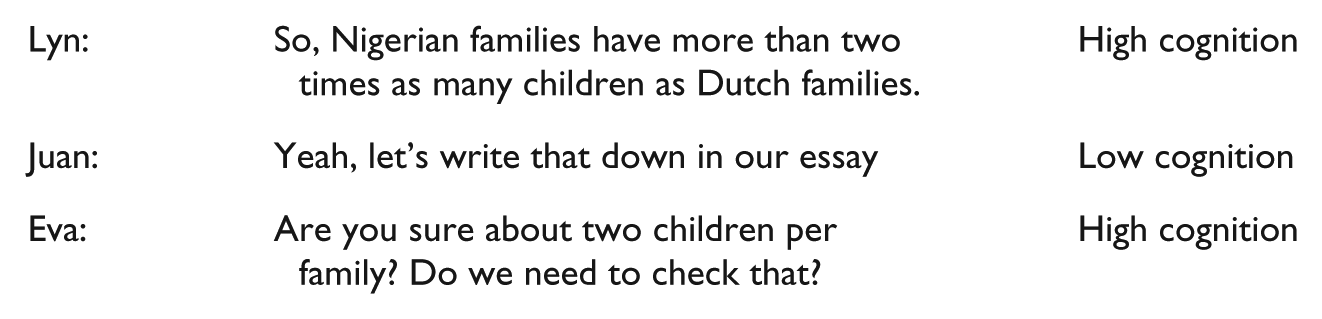
After Lyn calculates the children ratio, Juan shows his appreciation of the idea and suggests that their group writes it down (as part of their essay). Juan’s low cognition indicates his understanding and affirmation of Lyn’s idea, as he tries to build a consensus to include it in their group product. However, Eva questions whether the specific number of two children per Dutch family is accurate and whether they need to confirm it. Hence, her high cognition suggests the need to gather further information, thereby eliciting further reading out aloud or low-level processing actions (high cognition → low cognition).
Hence, a high cognition → low cognition sequence might help build consensus or check the validity of proposed ideas, both of which can improve group outcomes. By helping to build consensus, a high cognition → low cognition sequence helps group members create mutual understanding. This shared understanding can facilitate subsequent communication, understanding, and evaluation of related information (Volet, Summers, & Thurman, 2009), which can improve group outcomes. Specifically, additional information is likely to be added which can influence the quantity of the group product. Furthermore, checking the validity of an idea can identify flaws or elicit justifications that buttress it, both of which can enhance the likelihood of better group outcomes. In this case, the idea is more likely to be added to the group product, which can improve its quality.
This study tests whether cognitions and their sequences are related to group performance over time. Specifically, we hypothesize the following:
Method
To examine the relationships among cognitions, their sequences, and group performance, we analyzed triads of elementary school students’ discussions and their group essays about living in another country. We examined this relationship with content analysis and statistical discourse analysis (SDA; Chiu, 2008; Chiu & Khoo, 2005), illustrating its findings with conversation and essay excerpts.
Participants
We used secondary data, a subsample from an earlier study (Molenaar, 2011). In the larger study in the Netherlands, 156 students collaborated face-to-face in 52 triads in a computer learning environment and we investigated how scaffolds influenced group and individual learning. The primary school students were in Grades 4, 5, or 6, and their ages ranged from 10 to 12. Teachers rated students as low, middle, or high achievers based on their reading, writing, and computer abilities. Then, they created triads with one low-, one middle-, and one high achiever, with at least one boy and one girl. We randomly assigned triads within each class to one of the three scaffolding conditions: (a) none, (b) structuring, and (c) problematizing.
We randomly drew a smaller sample of 18 triads (one in each scaffolding condition from each class) for this study. These 54 students (23 boys and 31 girls) were from six classes in three elementary schools: 9 fourth graders, 27 fifth graders, and 18 sixth graders. The three schools were comparable, all in suburban areas with a White, middle-class population. Each triad worked together for 6 hr, for a total of 108 hr and 32,375 turns of talk.
Materials
Virtual learning environment and assignment
The e-learning environment in this study, Ontdeknet (Molenaar, 2003), supports students in their virtual collaboration with experts. The experts, in this case, inhabitants of the countries studied, shared information about their country with students. The Ontdeknet editor edited their contributions and placed them in the special information pages of each expert. Given access to these pages, students could read the information and ask additional questions that the experts would answer. In the e-learning environment, students worked on the assignment to write an essay about the country that they studied, and teachers monitored their progress (see Figure 1). Students collaborated at two levels: (a) with an expert in a virtual environment, and (b) with one another in small groups working together face-to-face on one computer.
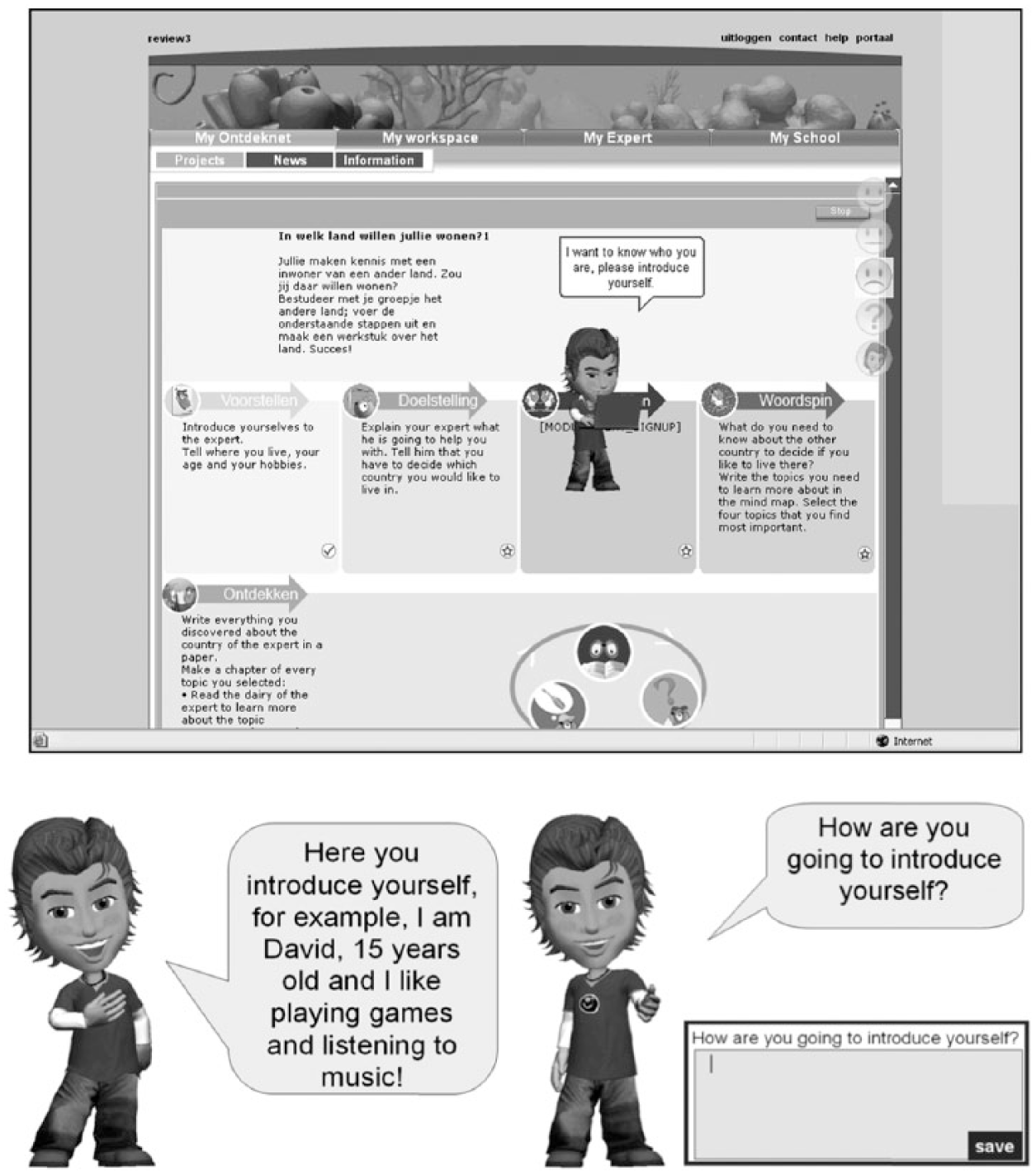
Example of Ontdeknet and structuring (left) and problematizing (right) scaffolds.
The study consisted of eight lessons, each lasting 1 hr. In the first lesson, the students completed a pretest (regarding knowledge about the country to be studied; Cronbach’s alphas for the two pretests were .88 for the Iceland test, and 0.92 for the New Zealand test; Molenaar, van Boxtel, & Sleegers, 2011). Then, students received instructions about the assignment and the virtual environment. In the last lesson, students completed two posttests, a metacognitive knowledge test and the country knowledge test (same as the pretest). During the middle six lessons, the triads worked on an assignment, “Would you like to live abroad?” Each triad chose a country (New Zealand or Iceland), learned about it, wrote an essay on their findings, and decided if they would like to live there. Each triad worked on one computer, consulted their country expert’s information pages, and asked questions. The experts answered these questions in their dedicated expert pages. Before writing an essay about the selected country, the students completed four subtasks: (a) introduce themselves to the expert, (b) write a goal statement, (c) select a country, and (d) specify topics of interest on a concept/mind map. These topics were used by the expert as subjects for their information pages.
All tasks were integrated into the virtual workspace of the triads, including their writing of the essay. All clicks and edits in the e-learning environment were stored. All lessons were supervised by one of the authors, who did not participate in the lessons.
Scaffolding system and conditions
In a computer environment, scaffolds are messages that support a student on a task that he or she cannot accomplish alone (Wood, Bruner, & Ross, 1976). For students in the structuring scaffold or problematizing scaffold conditions, the computer environment analyzed the students’ attention focus, behavior, and progress on the task (Molenaar, van Boxtel, Sleegers, & Roda, 2011). Using this information, the system dynamically determined when metacognitive actions should occur during each group’s discussion and showed scaffolds to the students. Students in each of the scaffolding conditions received at least 12 scaffolds (see Figure 1).
The triads in the structuring condition received direct support for their metacognitive actions. For example, the computer avatar David showed the students an exemplary plan of a task in a textbox for the students to read: “The expert would like to know what you want to learn. Please write all the topics about New Zealand that you would like to learn more about in this mind map.” Students could respond by creating and elaborating their plans.
The triads in the problematizing condition received scaffolds designed to elicit students’ metacognitive actions and explanations. For example, the computer avatar David asks, “How are you going to make a mind map?” The triads in the problematizing condition were obliged to answer the avatar’s questions in an answer box on the screen. For example, students could construct a plan to make a mind map.
For students in the control group, the avatar David occasionally asked how they were feeling, but did not show any metacognitive scaffolds. The avatar’s mere presence could influence the students’ actions, so the control group addresses the potential for a Hawthorne effect (Franke & Kaul, 1978).
The scaffolds elicited metacognition actions from students to aid their planning and monitoring (Molenaar, van Boxtel, & Sleegers, 2011). Past studies showed that these scaffolds did not affect group performance and did not affect cognition sequences (Molenaar & Chiu, 2014; Molenaar, van Boxtel, & Sleegers, 2011).
Analysis
We analyzed the learning actions with content analysis (Krippendorff, 2012) and SDA (Chiu, 2008; Chiu & Khoo, 2005), illustrating the results with specific cases. Content analysis yielded codes for each turn of talk. Then, we used SDA to model low cognition, high cognition, the turns of talk that preceded them, and the relations between these turns/sequences and group performance. Last, we examined representative excerpts to explicate the relations among the turns of talk and group essays.
Content analysis
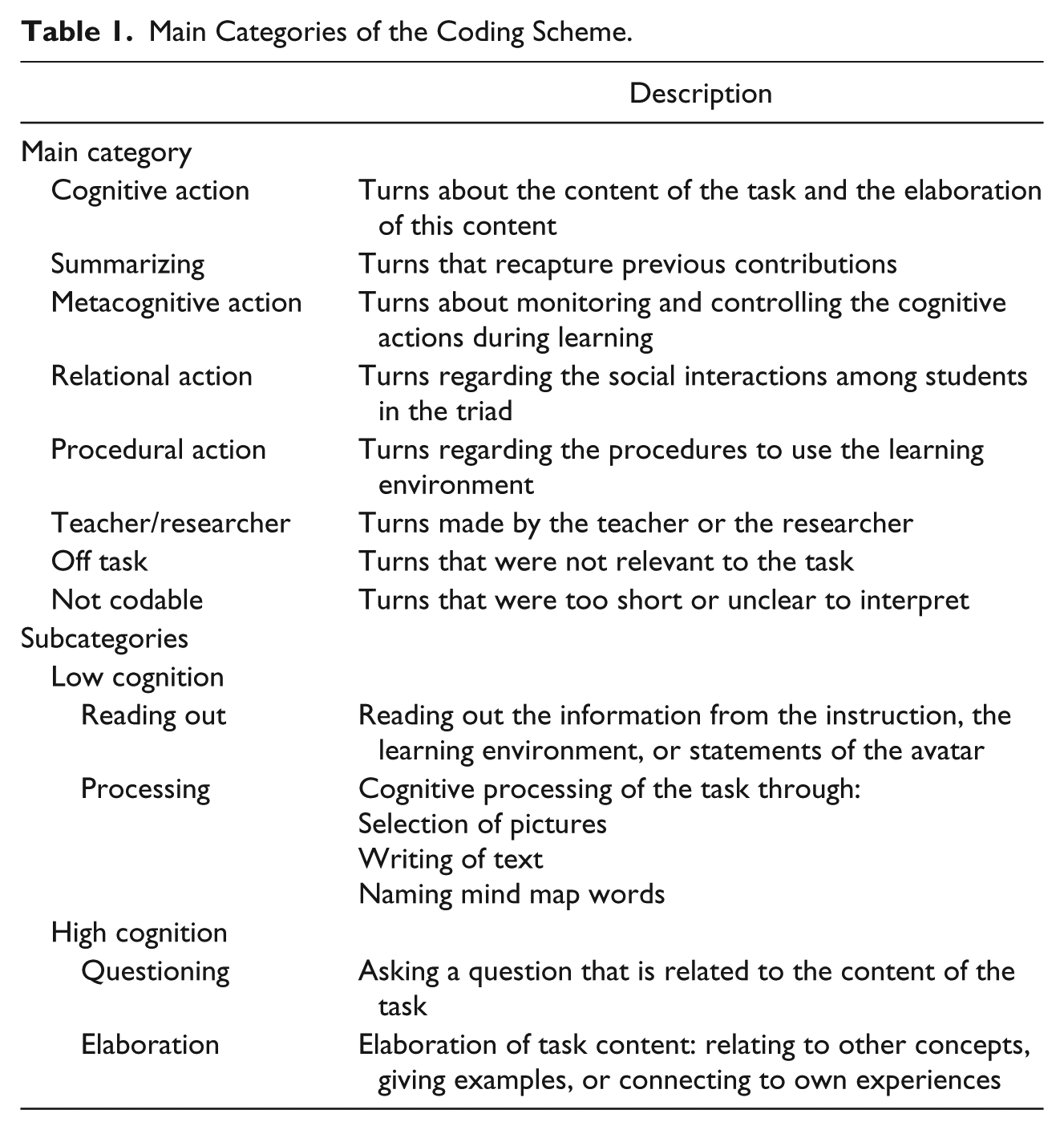
The conversations within each triad of students were audio-taped with voice-recorders, and the first author and research assistants coded the transcribed protocols of each lesson. The unit of analysis was a speaker’s turn of talk. Each conversation turn was coded with one main category code (see Table 1 for an overview) and one subcategory code (see Table 2, based on Veldhuis-Diermanse, 2002). All main categories were mutually exclusive and exhaustive categories, as were all subcategories within a main category.
Main Categories of the Coding Scheme.
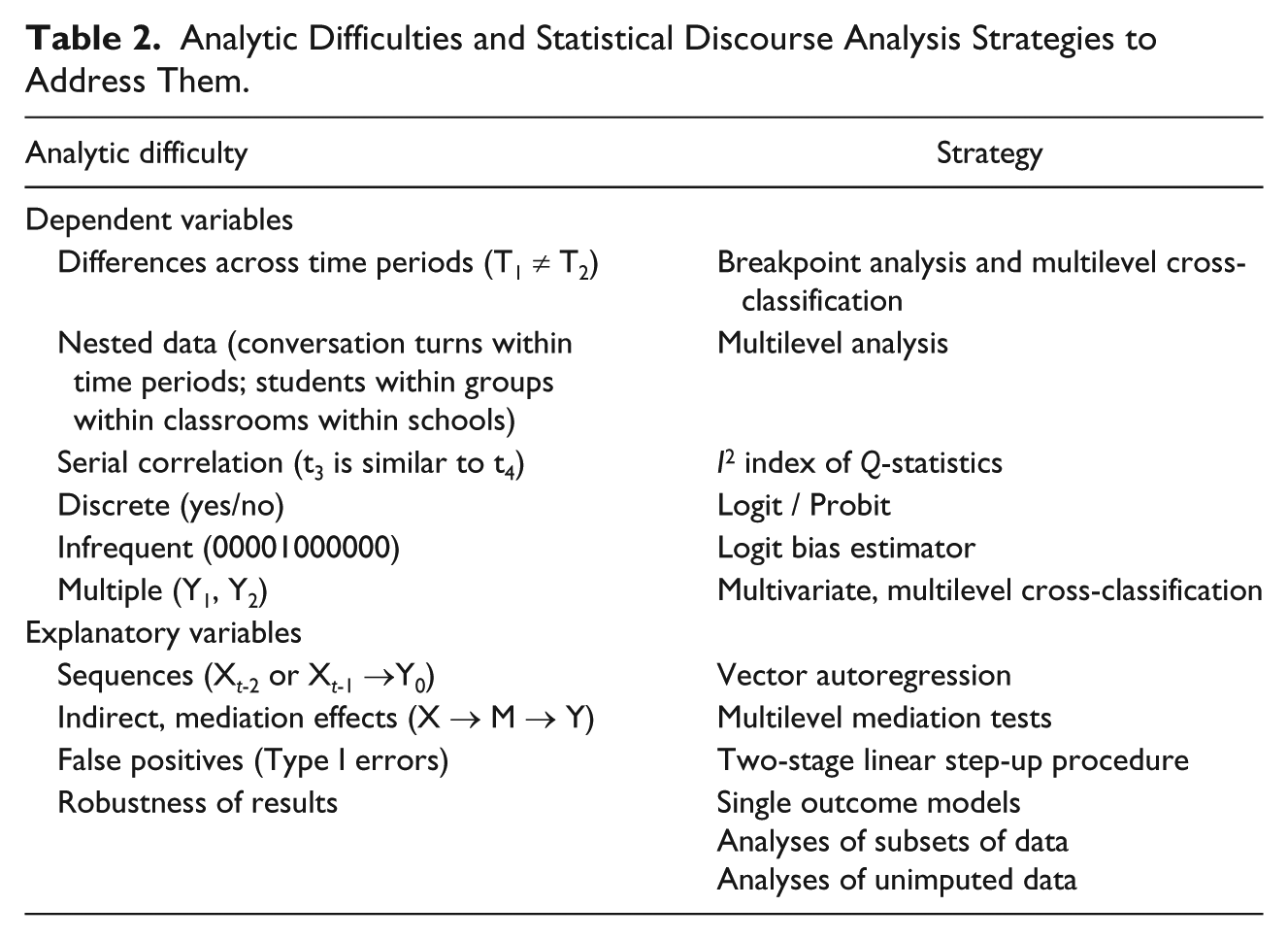
Analytic Difficulties and Statistical Discourse Analysis Strategies to Address Them.
In this analysis, we focus on cognitions, controlling for other actions. The cognition category concerns the content of the task and elaboration of this content (e.g., reading the material, asking a question about the domain, discussing the learning task, elaborating specific issues, and summarizing previous contributions of group members, see Table 2). Low cognition includes processes that are related to knowledge acquisition such as reading and processing, whereas high cognition refers to processes that can induce new ideas and make meaning, including asking questions and elaborating (A. King, 2002; Volet, Summers, & Thurman, 2009).
Two raters independently coded two randomly selected protocols (2,500 turns) and showed excellent agreement for the main categories (Fleiss, 1981): Cohen’s kappa = 0.92. The kappas for low and high cognition were K = 0.87 and K = 0.89, respectively. The kappa was highest for the metacognitive actions, K = 0.94, and lowest for the noncodable category, K = 0.82.
Group Performance
Essays can differ in their quantity and quality, and cognitions or sequences linked to one outcome might not be linked to the other outcome; thus, group performance was measured via the quantity and quality of each group’s essay after each lesson. Both indicators were calculated at the end of each 1-hr lesson, leading to four quantity indicators and four quality indicators that reflect the development of each group’s essay over time.
Quantity was measured by the number of new or changed words in an essay compared to its version from the previous lesson (if any). Specifically, it was computed by the total number of words in the current lesson’s essay draft minus the number of words in the previous lesson’s draft (if any) plus words that were changed between the two drafts (if any).
Quality was measured by the percentage of newly created content based on a score determined by the software Wincopyfind 2.6 (http://wcopyfind.findmysoft.com/). Wincopyfind calculated a copy score, the proportion of sequences of six or more words in the original text (in the learning environment) that match those in the students’ written text. A high copy score indicates that students largely reused the provided sentences and did not engage in further processing this information into their own words. In contrast, a low copy score shows that students used different words and word sequences, suggesting advanced processing of the provided information such as addition of different ideas (Dumais, 2004). The percentage of newly created content is computed as 100% – copy score.
Analytical Difficulties
Statistically analyzing social interaction processes requires addressing difficulties regarding the outcomes and explanatory variables (see Table 2). Difficulties involving outcomes include time, nested data, discrete outcomes, infrequent outcomes, and multiple outcomes. As outcomes can differ across time, they require identification and modeling of time period differences (Chiu & Khoo, 2005). Ignoring similarities in adjacent turns of talk (serial correlation) or in turns within each time period can underestimate the standard errors (Kennedy, 2008). As the data are nested (turns within time periods and individuals within groups within classrooms within schools), ignoring similarities across actions from the same person, group, classroom, or school can bias the results (Goldstein, 2011). For dichotomous outcomes (e.g., presence vs. absence of high cognition in a turn), ordinary least squares regressions can bias the standard errors. Furthermore, infrequent outcomes (<25% occurrence) can bias Logit regression results (G. King & Zeng, 2001). Last, multiple outcomes can have correlated residuals that underestimate standard errors (Goldstein, 2011).
Explanatory variable difficulties include sequences, indirect effects, false positives, and robustness. As preceding turns might influence the current turn, the analysis must model them (Kennedy, 2008). Using single-level mediation tests on nested (multilevel) data to detect indirect effects (X → M → Y) can bias results. Also, testing many hypotheses also increases the risk of false positives (Benjamini, Krieger, & Yekutieli, 2006). Last, results from one analysis are not necessarily robust.
SDA
SDA (Chiu, 2008; Chiu & Khoo, 2005) addresses the above difficulties (see Table 2). To address the outcome issues (time, nested data, discrete, infrequent, multiple outcomes), SDA uses breakpoint analysis, Q-statistics, multilevel cross-classification, Logit, Logit bias estimation, and a multivariate outcome model. SDA statistically identifies breakpoints that distinguish time periods of high versus low frequencies of outcomes (Chiu & Khoo, 2005). Q-statistics test all groups for serial correlation of residuals in adjacent turns (Ljung & Box, 1979). If there is serial correlation for an outcome (e.g., high cognition), adding its lagged variable in the previous turn (high cognition [−1]) as an explanatory variable may remove the serial correlation (Chiu & Khoo, 2005). SDA models nested data across time with a multilevel, cross-classification (Goldstein, 2011). To model dichotomous outcomes, we use a Logit regression (Kennedy, 2008). For infrequent outcomes, we estimate the Logit bias and remove it (King & Zeng, 2001). To model multiple outcomes, we use a multivariate outcome, multilevel, cross-classification (Goldstein, 2011).
SDA addresses the explanatory variable issues (sequences, indirect effects, false positives, robustness) with a vector autoregression (VAR), multilevel M-tests, a two-stage linear step-up procedure, and multiple specification models. A VAR (Kennedy, 2008) tests whether attributes of sequences of recent turns (e.g., low cognition [−1]) influence the current turn (e.g., high cognition). To test for indirect effects, SDA uses multilevel M-tests (MacKinnon, Lockwood, & Williams, 2004). Also, the two-stage linear step-up procedure reduces false positives more effectively than 13 other methods in computer simulations (Benjamini et al., 2006). To test the consistency of the results (robustness), we (a) run a single outcome model for each outcome variable, and (b) analyze subsets of the data.
Statistical Analysis
We modeled students’ cognition with SDA (Chiu, 2008: Chiu & Khoo, 2005). After identifying the time periods, we tested explanatory models of students’ high cognition and low cognition.
Identifying time periods
Students might show fewer high cognition actions at the start (when they know less about the problem) than at the end (when they know more). Hence, identifying breakpoints that divide the data into time periods with more versus fewer high cognitions captures their distribution across time and enables testing of whether relations between independent and dependent variables differ across time.
For each triad, we statistically identified its breakpoints (and time periods). We begin with a base model with no breakpoints (one time period), a simple univariate time-series model of autoregressive order 1.

The value of the dependent variable High_Cognition at turn t is a function of a constant C0, High_Cognition at the previous turn (t-1) with β as its regression coefficient, and the unexplained component ϵ t (residual). Adding breakpoints yields

The potential breakpoints (i) range from 1 to p, with corresponding dummy variables (di) and regression coefficients (C i ). The value of di is zero before turn t (i < t) and one otherwise (i ≥ t). We used a computer program to test every combination of 0-6 breakpoints (at 7 breakpoints, the exponential computation process would take over a year). The best model of breakpoint(s) has the lowest Bayesian information criterion (BIC; Kennedy, 2008), explaining the most differences in High_Cognition (goodness of fit) with the fewest breakpoints and time periods (parsimony). These breakpoints divided the data into distinct time periods, which were used as a level of analysis in the multilevel analysis. We also applied this procedure for Low_Cognition.
Explanatory model
We modeled high cognition and low cognition with a multivariate, multilevel, cross-classification (Goldstein, 2011).

The probability that the outcome y (low cognition or high cognition) occurs at turn i in time period j by student k in group l is the expected value of
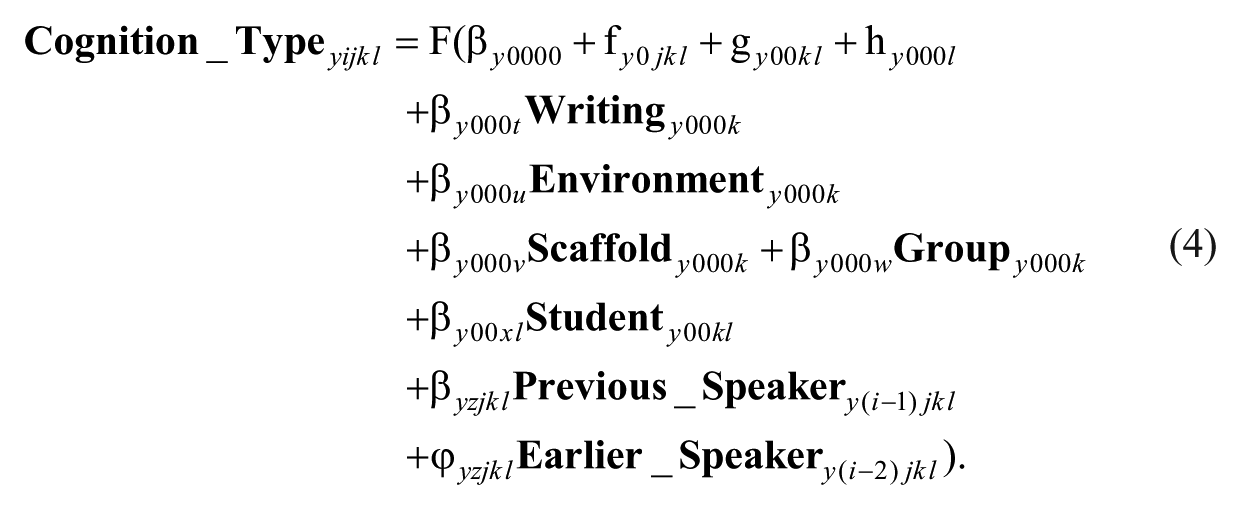
First, we entered a vector of t writing performance variables: words added in essay and created percentage in essay (Writing). As a regression does not dictate the direction of causality, an independent variable (e.g., writing assessment) need not occur before a dependent variable (e.g., high cognition). Wald tests (Kennedy, 2008) identify significant effects at the .05 level, and the two-stage linear step-up procedure controls for false positives (Benjamini et al., 2006). Nonsignificant variables were removed.
Next, we entered environment variables: grade and school (
As recent actions might have stronger effects than earlier actions (Slavin, 2005), we added previous turn variables in reverse chronological order into a VAR (Kennedy, 2008), first at the previous turn (aka Lag 1 or −1): low cognition(−1), high cognition(−1), summarize(−1), evaluate(−1), deny(−1), monitor(−1), confirm(−1), plan(−1), reflect(−1), motivate(−1), engage(−1), and orient(−1) (
Finally, we test for interactions of
Results
Summary Statistics
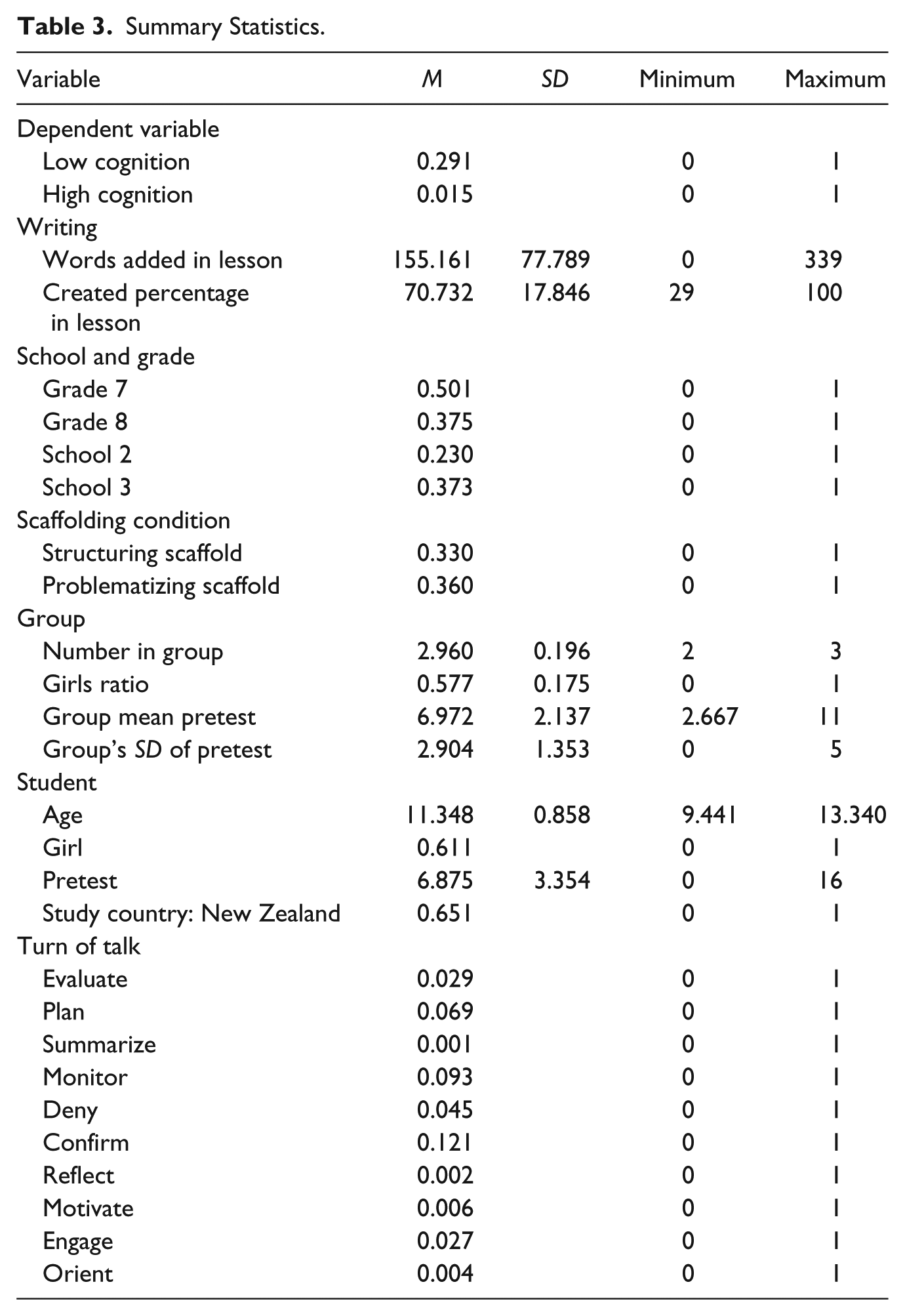
The 54 students (in 18 triads) produced 32,375 conversation turns. Eleven triads (33 students) studied New Zealand, and seven triads (21 students) studied Iceland. In each lesson, each group of students, on average, added 155 words (SD = 78, see Figure 2) and created 71% new content (SD = 18, see Figure 3). The students showed few high cognitions (in only 2% of the turns) and many low cognitions (29%). See Table 3.
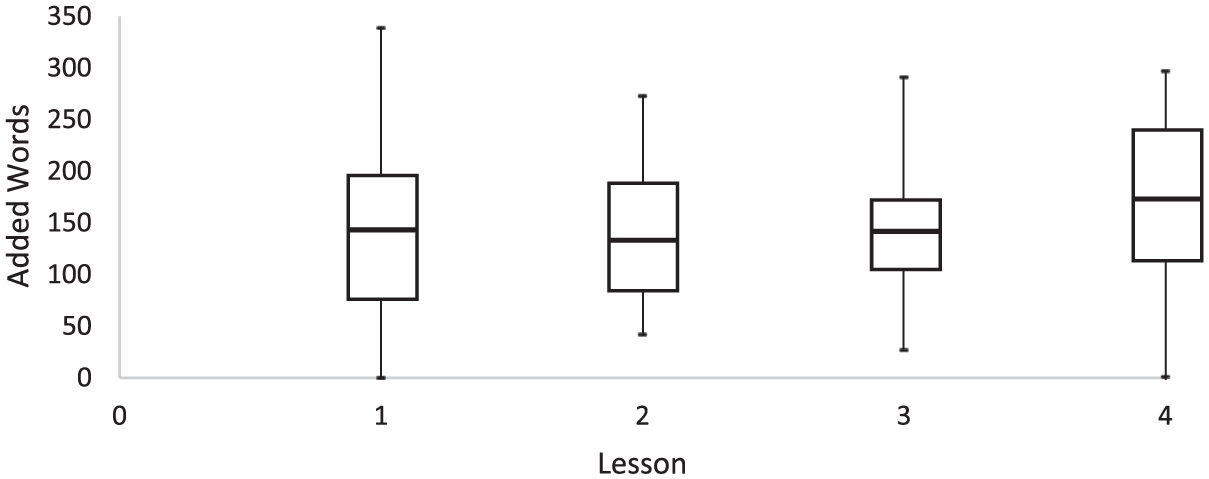
Groups’ added words for each lesson.
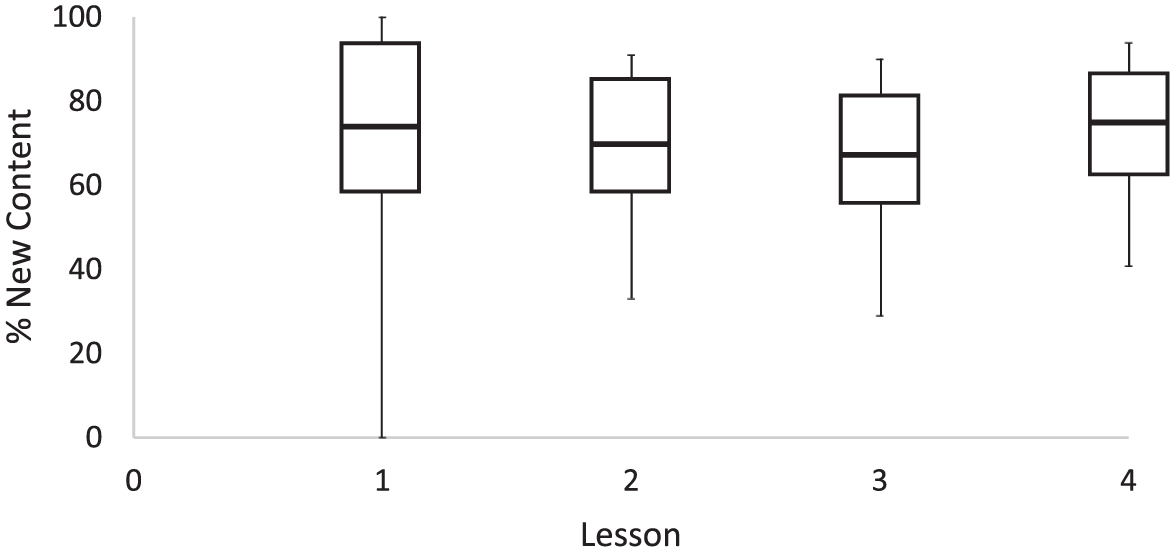
Groups’ % created content for each lesson.
Summary Statistics.
Path diagram of final, standardized two-level model of high cognition.
Path diagram of final, standardized three-level model of low cognition.
Explanatory Model
The distribution of high cognitions and low cognitions differed mostly across turns of talk within students (93% and 96% respectively) rather than across students (0% and 2%), groups (7% and 2%), or time periods (0% and 0%; see Tables 4 and 5, left column, second, third, and fourth rows from the bottom). High cognition did not differ significantly across students. Neither low cognition nor high cognition differed significantly across time periods. All results discussed below describe first entry into the regression, controlling for all previously included variables.
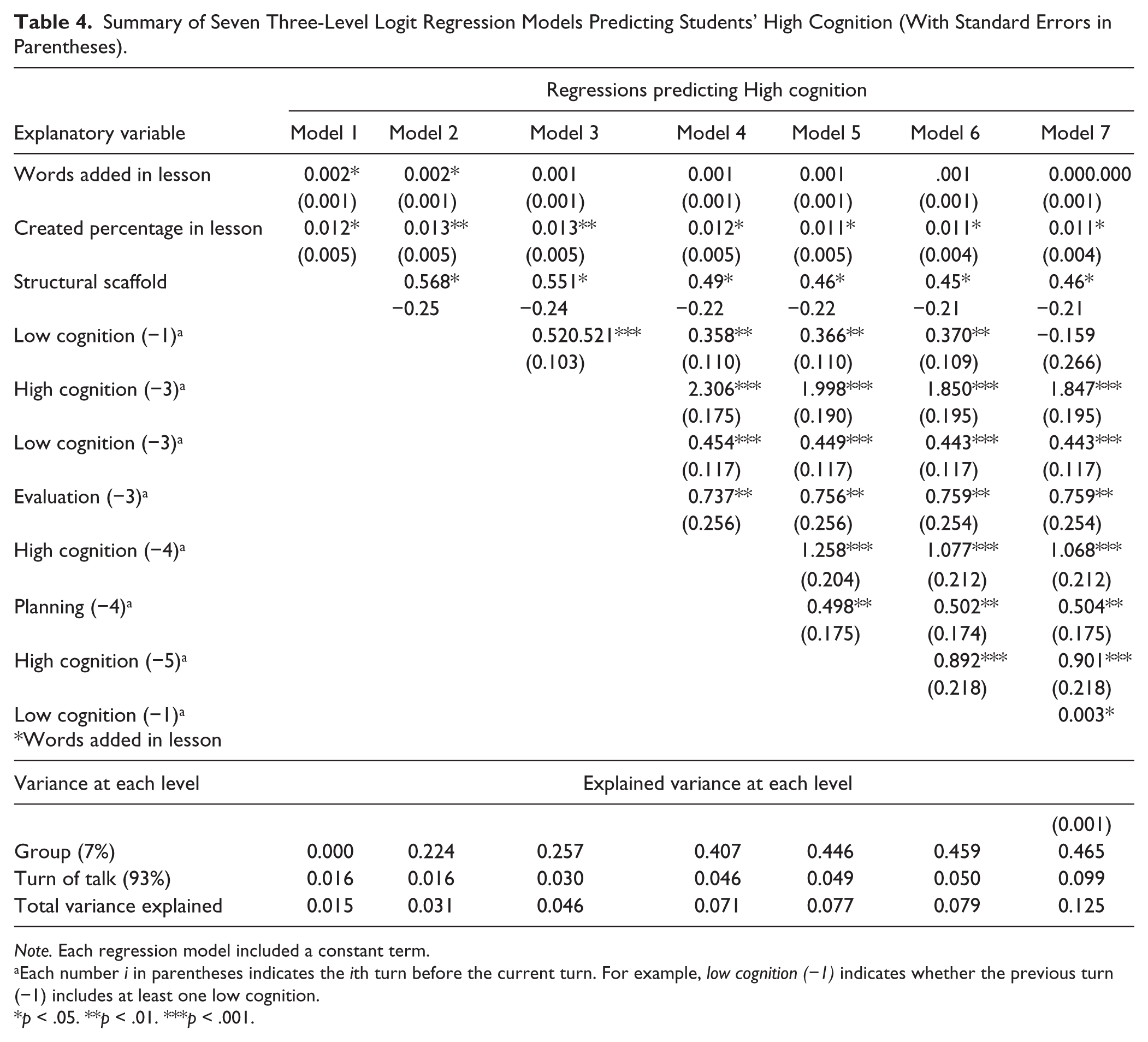
Summary of Seven Three-Level Logit Regression Models Predicting Students’ High Cognition (With Standard Errors in Parentheses).
Note. Each regression model included a constant term.
Each number i in parentheses indicates the ith turn before the current turn. For example, low cognition (−1) indicates whether the previous turn (−1) includes at least one low cognition.
p < .05. **p < .01. ***p < .001.
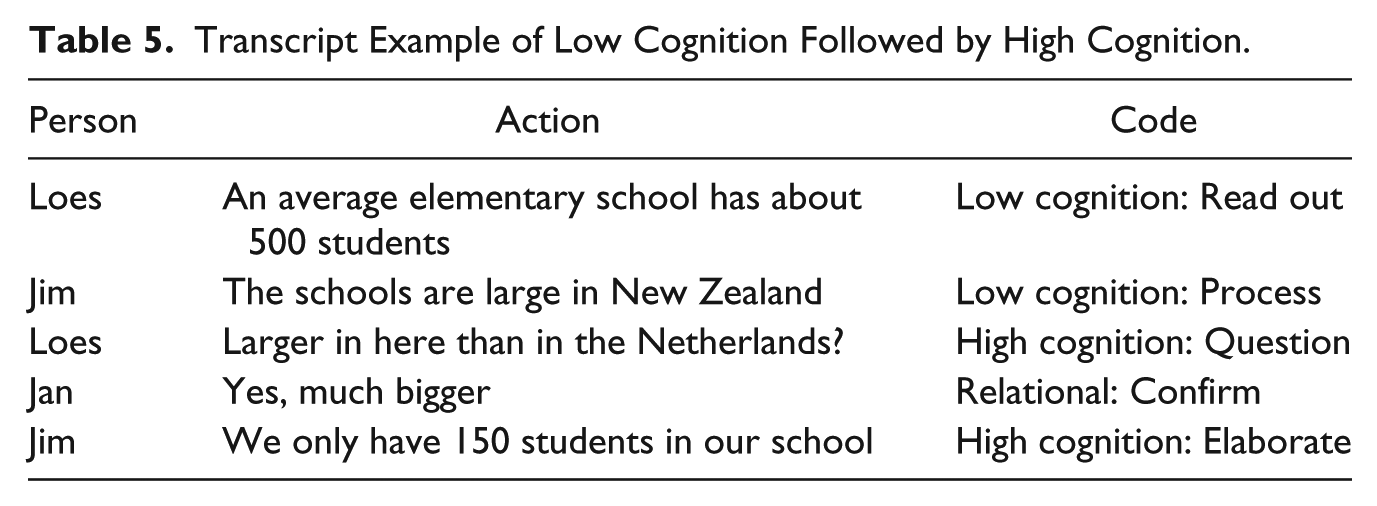
Transcript Example of Low Cognition Followed by High Cognition.
High cognition
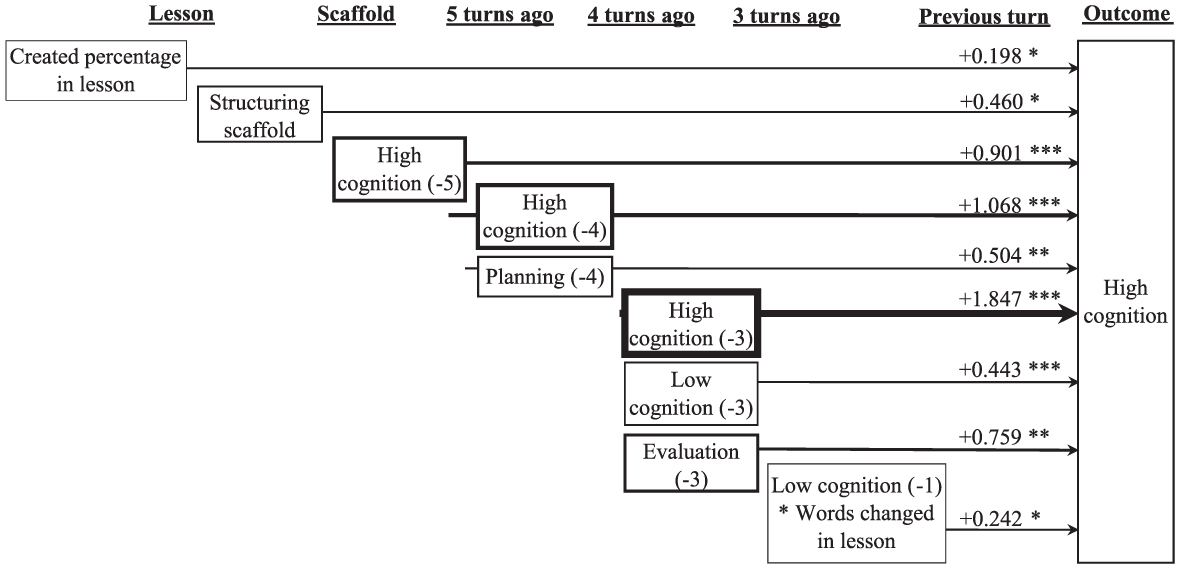
Attributes of prior conversation turns and group outcomes (essay quality) were significantly linked to students’ high cognition (see figure 4). For each lesson, groups with more created content had more instances of high cognition on average, supporting H2. For example, a group with 18% more created content than the mean (89% > 71%; one standard deviation [SD] more) had 14% more high cognition (see Table 4, Model 1). Writing process accounted for 2% of the differences in high cognition.
Low cognition was often followed by high cognition, especially in groups that added more words in a lesson (Table 4, Model 7). A low cognition was 1% more likely than other actions to be followed by a high cognition (Table 4, Model 3). As groups averaged 87 low cognitions in each lesson, the cumulative impact of these low cognitions is a 58% greater likelihood of at least one more high cognition in a lesson (+58% is computed from unions of 87 probabilities of 1%). Low cognition accounted for another 2% of the variance in high cognition.
For groups whose new words in a lesson exceed the mean by one standard deviation, low cognition in previous turns had slightly larger effect sizes for high cognition in the current turn (+0.2% per turn; +16% greater likelihood of at least one more high cognition in each lesson). Groups with more new words in a lesson were more likely to have low cognition → high cognition sequences, supporting H5. Such sequences often include more detailed development of an idea by building on a base of given information (or its low-level processing) with a question or an elaboration, as shown in the following transcript excerpt (see Table 6).
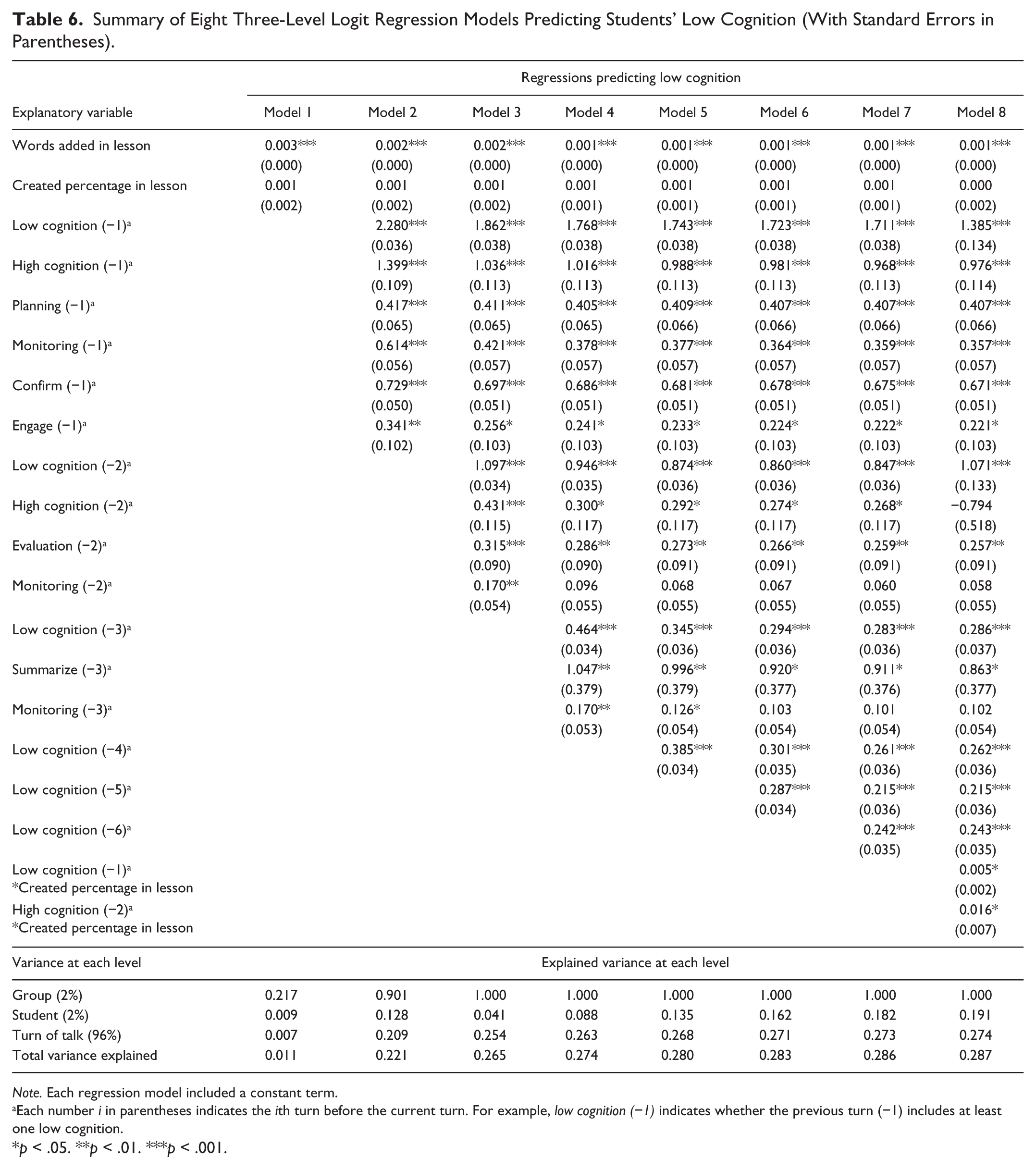
Summary of Eight Three-Level Logit Regression Models Predicting Students’ Low Cognition (With Standard Errors in Parentheses).
Note. Each regression model included a constant term.
Each number i in parentheses indicates the ith turn before the current turn. For example, low cognition (−1) indicates whether the previous turn (−1) includes at least one low cognition.
p < .05. **p < .01. ***p < .001.
Loes reads the New Zealand text out loud (“An average elementary school has about 500 students”). Then, Jim highlights the size of their schools (“The schools are large in New Zealand,” low cognition), which triggers Loes’s high cognition, a question about the relative size of schools in the Netherlands (“Larger in here than in the Netherlands?” After Jan confirms, “Yes, much bigger,” Jim elaborates, “We only have 150 students in our school” (high cognition)). The low cognition → high cognition sequence connected the many students in New Zealand schools with the fewer students in Dutch schools, eventually yielding a more descriptive and detailed comparison of schools in each country. This group of students wrote the following sentences about schools in New Zealand in their essay (adding many new words): Children are brought to school by bus. Children go to school at the age of 5. Schools are large in New Zealand.
Other explanatory variables were also related to high cognition. Groups with structural scaffolds had more high cognition than other groups. After a student’s high cognition, high cognition was more likely, three, four, and five turns later. Also, a planning turn of talk was more likely to be followed by high cognition four turns later. After a student’s low cognition or evaluation, high cognition was more likely three turns later.
Low cognition
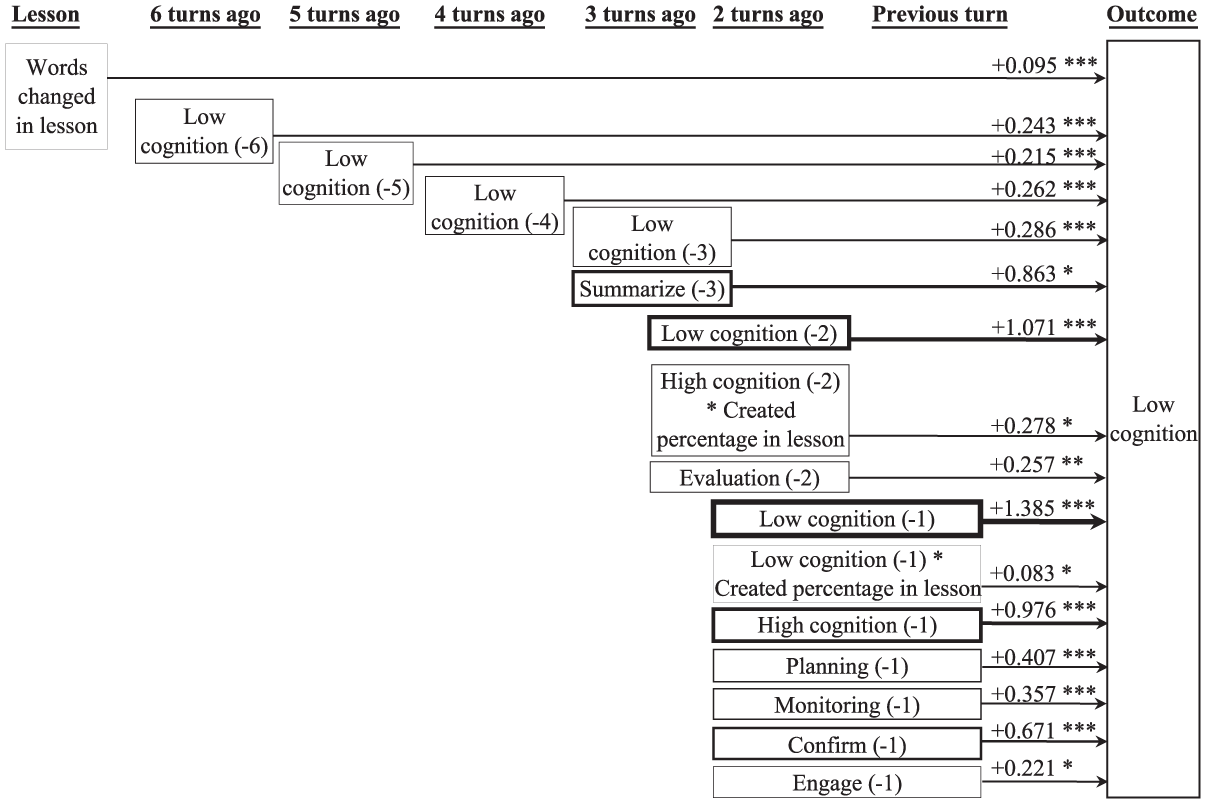
Attributes of prior conversation turns and group outcome (essay quantity) were linked to low cognition (see figure 5). Groups that added more words to their essays had more low cognition than other groups, supporting H1. For example, groups that added 78 more words than the mean in a lesson (232 > 155; one SD higher than the mean) had 4% more low cognition than other groups (Table 5, Model 1). Writing process accounted for 22% of the variance in low cognition across groups and 2% of its total variance.
Attributes of previous turns were also linked to low cognition. Low cognition was more likely to be followed by another low cognition (+46% per turn; nearly 100% greater likelihood of at least one extra low cognition per lesson; Table 6, Model 2). High cognition was more likely to be followed two turns later by low cognition (+5% per turn; +21% likelihood of at least one extra low cognition per lesson; Table 6, Model 3). Cognition in previous turns accounted for another 58% of the variance in low cognition across groups and another 3% of its total variance.
Groups whose writing showed more created content had more low cognition → low cognition and high cognition → action → low cognition sequences (supporting H3 and H6; Table 6, Model 8). For each lesson, groups with 18% more created content than the mean (89% > 71%; one SD higher than the mean) were more likely to follow a low cognition with another low cognition (+2% per turn; +83% likelihood of at least one more low cognition per lesson) and to follow a high cognition with a low cognition two turns later (+5% per turn; +21% likelihood of at least one more low cognition per lesson). Consider the following transcript which exemplifies both sets of relationships, see Tables 7 and 8.
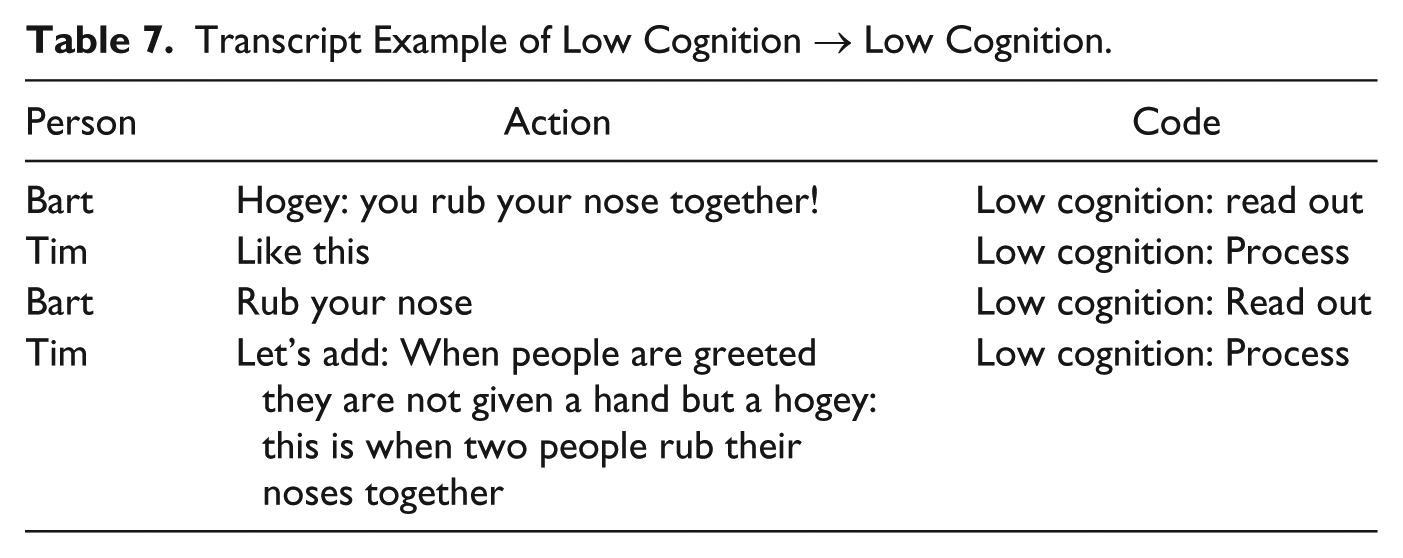
Transcript Example of Low Cognition → Low Cognition.
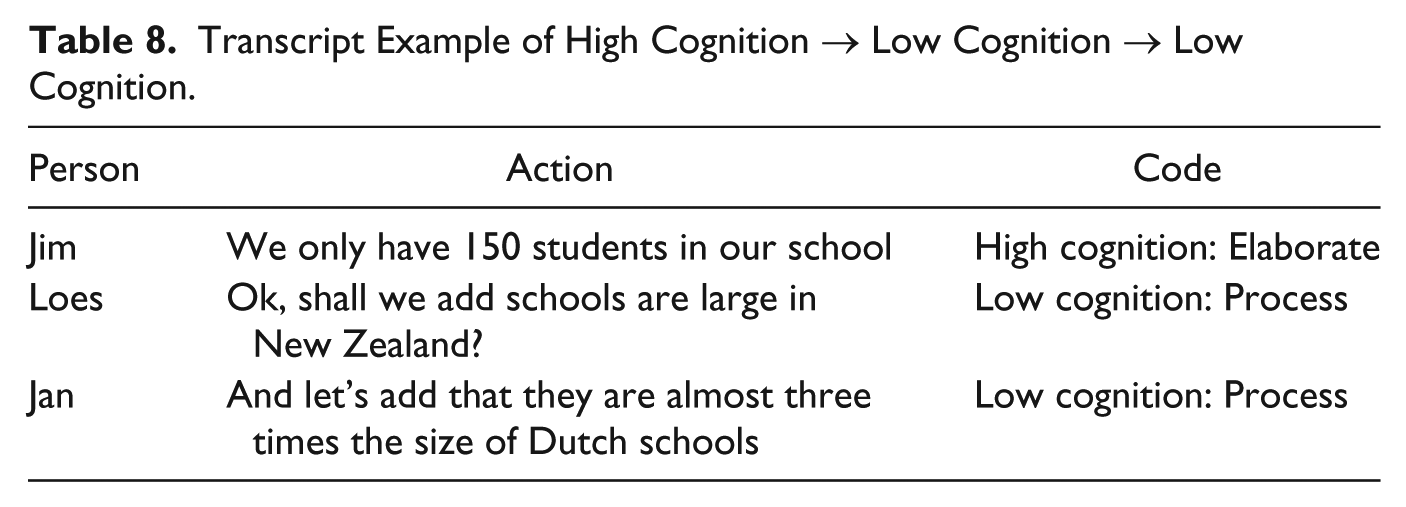
Transcript Example of High Cognition → Low Cognition → Low Cognition.
Sequences of low cognition → low cognition support more created content. For example, Bart reads information about Hogey (“Hogey: you rub your noses together!” low cognition). Tim processes this information by showing how it is done (“like this,” low cognition). Then Bart rereads the provided information emphasizing the word rub (“rub your noses,” low cognition). Tim then writes a new sentence for their essay: When people are greeting, they are not given a hand but a hogey: this is when two people rub then noses together.
After Jim said, “We only have 150 students in our school” (high cognition), Loes suggests adding the size of New Zealand schools to their essay (“shall we add schools are large in New Zealand?” low cognition). Jan agrees and suggests that they also add Jim’s idea about Netherlands’ schools, “And let’s add that they are almost three times the size of Dutch schools” (low cognition). In their essay, they wrote the following sentences (with newly created content): The schools are almost three times the size of Dutch schools. Even though outside of the large cities, there are much fewer children as in the Netherlands.
In this example, the students return to and repeat both the given information and their previous elaboration to add to their essay. When multiple students supported a new idea related to the given information, the group was more likely to include it in their writing, unlike ideas unrelated to the given information championed by only one person.
Other variables were also linked to students’ low cognition. After a low cognition, another low cognition was more likely in each of the following six turns. Also, after a high cognition, planning, monitoring, confirmation, or engagement, low cognition was more likely. After monitoring or an evaluation, low cognition was more likely two turns later. Last, after a summary or monitoring, low cognition was more likely three turns later.
Other variables, sequences, or interactions were not significant. Notably, sequences of high cognition followed by high cognition were not significantly linked to greater group performance (no support for H4), possibly due to multicollinearity caused by the substantial correlation between high cognition action and high cognition → high cognition sequence (r = .5). Robustness tests showed similar, consistent results.
Discussion
Building on past research showing that groups with more high cognitions show better group performance than other groups (Molenaar & Chiu, 2014; Teasley, 1997; Van Boxtel, 2004; Volet, Summers, & Thurman, 2009), this study shows that sequences of cognitions are also related to group performance. In their essays after each lesson, group discussions with more low cognitions had more new words, and those with more high cognitions had more created content, compared with other group discussions. Controlling for these cognitions, groups with more low cognition → low cognition or high cognition → action → low cognition sequences had more created content in their essays. Also, groups with more low cognition → high cognition sequences had more new words in their essays.
Low and High Cognitions
Low cognitions were linked to essay quantity, while high cognitions were related to essay quality. A group discussion with proportionally more low cognitions than other group discussions yielded an essay with more new words than other essays. This result is consistent with the view that group members use low cognitions to draw other group members’ attentions to specific information and build a common foundation of shared knowledge (Clark & Brennan, 1991; Volet, Summers, & Thurman, 2009), which is then more likely to be added to the group essay; hence, more low cognitions during a discussion yield greater quantity of information in the group product.
Also, high cognitions were linked to essay quality. A group discussion with proportionally more high cognitions than other group discussions yielded an essay with more created content than other essays. This result is consistent with the view that a group’s high cognitions (on-task questions, new ideas, elaborations, and critiques) are related to its meaning-making and creation of new ideas, as suggested in past collaborative learning research (Weinberger & Fischer, 2006; Molenaar, van Boxtel, & Sleegers, 2014; Van Boxtel, 2004; Volet, Summers, & Thurman, 2009).
Cognition Sequences
In addition to the high cognitions emphasized by past studies (e.g., Van Boxtel, 2004; Volet, Summers, & Thurman, 2009), this study shows the important roles of low cognition. While isolated low cognitions do not increase essay quality, their sequences with other low cognitions and with high cognition were linked to higher essay quality.
A group discussion with more low cognition → low cognition sequences than other discussions yielded an essay with more created content than other essays. This result supports the view that low cognition sequences help build a foundation for subsequent cognitions and their uses. Specifically, low cognition sequences can share information, aid greater shared understanding (Clark & Brennan, 1991), facilitate communication, and enhance evaluation of related ideas, especially useful, new additions to their shared information (Volet, Summers, & Thurman, 2009)—all of which facilitates their integration into a superior group essay (Dillenbourg, 1999) as shown in Table 7.
Furthermore, group discussions with more high cognition → action → low cognition sequences also yielded essays with more created content. Examining the transcripts in greater detail showed that shared understanding and consensus were common in such sequences. Students confirmed their ideas by returning to the given information or repeating new ideas. When multiple students support a new idea, the group is more likely to include it in their essay, whereas isolated new ideas voiced by only one student are often not included in the group essay. Hence, as shown in Table 8, high cognitions followed by subsequent low cognitions often indicate shared understanding of new ideas that are more likely to be integrated into a group’s essay, thereby enhancing its quality.
Meanwhile, low cognition → high cognition sequences were linked to essay quantity. A group discussion with more low cognition → high cognition sequences than other discussions yielded an essay with more new words than other essays. Qualitative analyses of our data suggest two possible paths to greater essay quantity. First, a given information → new idea sequence (low cognition → high cognition) can ground a new idea based on existing information, help groupmates understand and appreciate the information and the idea, and then incorporate both into their essay (see Table 7); doing so adds more words than an isolated high cognition would. Second, a read → question sequence (low cognition → high cognition) asks for confirmation of existing knowledge that might serve as a useful, building block (see Table 6); this emphasis on the content of the low cognition also increases its likelihood of inclusion in the group’s essay. Hence, at least two types of low cognition → high cognition sequences (given information → new idea; read → question) can increase essay quantity.
Surprisingly, high cognition → high cognition sequences were not linked to essay quality. At least two explanations are possible. First, a high cognition → high cognition sequence might not contribute much more than two isolated high cognitions to essay quality. Second, a substantial correlation between a high cognition action and a high cognition → high cognition sequence might reflect multicollinearity that hides the latter’s link to essay quality. Hence, further studies of different data are needed to test these two explanations.
Implications
This exploratory study’s results, if replicated in subsequent studies, can inform our instructional practices, notably the importance of high cognitions, low cognition → low cognition sequences, and high cognition → low cognition sequences. First, groups with more high cognitions (on-task questions, new ideas, elaborations, or critiques) wrote essays with more created content. Consistent with past studies, this result suggests that teachers and instructional software can model uses of high cognitions and scaffold groups’ construction of high cognitions to improve their essays.
Second, high cognitions that are followed by subsequent low cognitions were more likely than isolated high cognitions to be valued as important and thus, included in an essay to enhance its quality. This result highlights the importance of evaluating sequences in addition to specific actions. Specifically, it suggests that teachers and instructional software evaluate not only whether a group member produces a high cognition but also whether other group members use it. Teachers and instructional software can model uptake of others’ high cognitions to show students how to do so. If groups produce many isolated high cognitions, the teacher or instructional software might intervene with scaffolds asking for and supporting group uptake of these high cognitions.
Third, group discussions with more low cognition → low cognition sequences were linked to essay quality. This result suggests that teachers or instructional software that model, encourage, or support groups of students’ low cognition sequences can help them highlight existing knowledge, build common ground for ideas, and integrate them into longer and better essays. Together, these insights from this study can inform our instructional practices (via teachers or intelligent tutors) to support collaborative learning.
Last, teachers who emphasized only high cognitions and ignore the value of low cognitions might not be adequately preparing their students to collaborate effectively with other students. Listening for low cognitions in sequences is more difficult than identifying isolated high cognitions, and scaffolding sequences with low cognition is more difficult than fostering isolated cognitions. However, failure to help students create sequences with low cognitions can hinder their collaborative efforts. In short, the results of this study suggest detailed, new information on microlevel interactions that can support students during group learning activities.
Limitations and Future Research
This exploratory study’s limitations of few participants, limited focus on cognitions, and simple group essay evaluations can be addressed in future work. This study’s small sample of 18 triads and 54 students limits its statistical power, which can be addressed by larger, future studies. In addition to cognitions, groups also produced many other actions (e.g., metacognitive, relational, procedural) whose links to cognitions, essay quality, and essay quantity can be examined in future studies. Also, this study evaluated group essays with minimal, objective measures that do not distinguish between simple paraphrases and creative new ideas. Future studies can evaluate essay content in greater depth and examine how group discussions affect individual essays.
Conclusion
This study takes a step toward exploring how cognitions and their sequences during group discussions are linked to group performance over time. These findings show that sequences of low and high cognitions were linked to group performance, even after accounting for the prevalence of high cognition and low cognition. Insights into such relations between sequences of learning actions and learning performance can help build a foundation for a microtemporal understanding of cognition in collaborative learning.
Footnotes
Declaration of Conflicting Interests
The author(s) declared no potential conflicts of interest with respect to the research, authorship, and/or publication of this article.
Funding
The author(s) received no financial support for the research, authorship, and/or publication of this article.