




Abstract
The foundation of current AI systems lies in computers that implement learning and inference procedures sequentially, resulting in learning latency, elevated power consumption, and diminished adapbility to unforeseen environmental changes. We overcome these issues by presenting a brain-inspired synaptic resistor (synstor) circuit, enabling concurrent real-time learning and inference. AI systems utilizing synstor circuits, such as those in drones and morphing wings, achieve significantly faster learning, better performance, greater energy efficiency, and improved adaptability compared to computer-based AI systems. Synstor circuits offer a promising path for AI systems to excel in dynamic and unpredictable real-world environments.
1. Introduction
The prevailing method for building artificial intelligence (AI) systems centers on digital computers based on the Turing model (Turing, 1936). Digital computers (Merolla et al., 2014; Silver et al., 2016) and existing neuromorphic circuits (Hu et al., 2017) can accurately implement pre-determined inference algorithms derived from prior learning. A key drawback of these computational approaches is their inherent inflexibility: they cannot alter their explicitly defined algorithms in real-time to adapt to evolving environments. The computationally demanding learning process usually takes place offline on large, energy-intensive computers, and the resulting AI algorithms are then deployed on power-limited edge computing circuits. While achieving superhuman performance within their training domians, AI systems such as autonomous vehicles (Yang et al., 2024), drones (O’Connell et al., 2022), and large language models (Kalla and Smith, 2023) lack the adaptive capacity of human intelligence and falter in unpredictable scenarios outside their learned boundaries. Attempting to extend their training domians using “big data” from dynamic environments proves expensive, inefficient, and ultimately restrictive (Bailey, 2022), as the resulting static AI algorithms cannot fully cope with the boundless complexity of the real world.
2. Synstor circuits for real-time concurrent inference and learning
We developed a synaptic resistor (synstor) designed to mimic a biological synapse (Chen 2022; Danesh et al., 2019; Gao et al., 2023). This three-terminal device was fabricated by vertically integrating a heterojunction with a Si channel, SiO2 dielectric, Hf0.5Zr0.5O2 ferroelectric memory layer, and a WO2.8 reference electrode. Lateral Schottky contacts were formed between the Si channel and TiSi0.9/Ti input/output electrodes (Lee et al., 2025). Figure 1(a) illustrates a synstor circuit inspired by neural networks. Input voltage pulses (
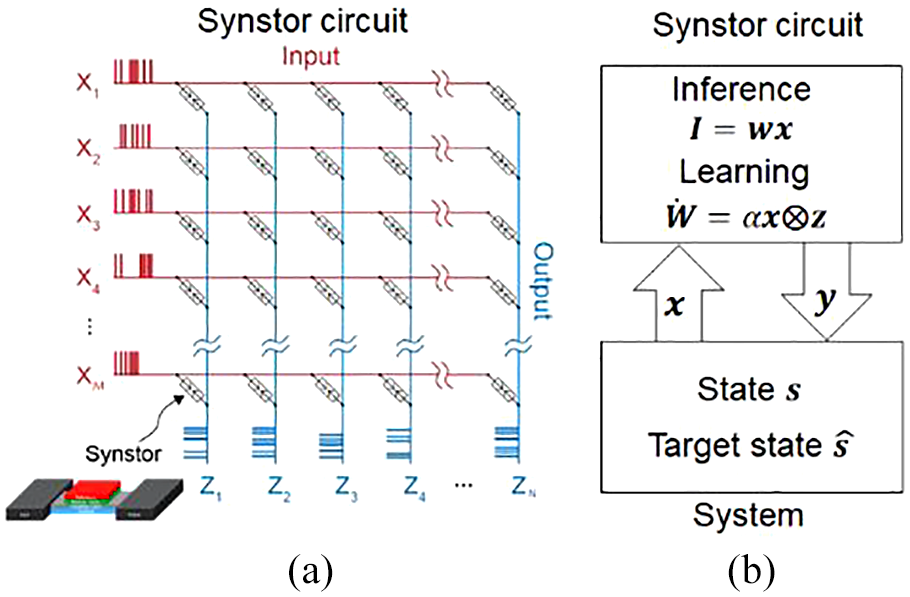
(a) Schematic of a crossbar synstor circuit with synstors connecting
3. Adaptive AI systems based on synstor circuits
We conducted experiments on drone navigation in complex, time-varying simulated aerodynamic environments (Gao et al., 2023; Shenoy et al., 2022) and morphing wing control in a turbulent wind tunnel (Nathan et al., 2022; Shaffer et al., 2021) to compare a synstor circuit, human operators, and a computer-based artificial neural network (ANN). During the drone navigation with strong winds and obstacles, the ANN repeatedly failed and collided, whereas the synstor circuit, and most human operators successfully reached the target by avoiding collisions. In the morphing wing control to minimize drag-to-lift force ratio, the synstor circuit effectively optimized the wing shape and recovered the wing from the stall, whereas the ANN failed in the complex aerodynamic environment. The synstor circuit and human operators learned four orders of magnitude faster than the ANN in the experiments. The ability of the synstor circuit to concurrently perform real-time inference and learning by dynamically adjusting its conductance matrix (
Scaling down synstors promises further improvements in energy and area efficiency, potentially leading to an ultra-low power, highly adaptable brain-inspired AI computing platform.
4. Conclusion
AI systems employing scalable synstor circuits, exemplified by applications in drones and morphing wings, demonstrate significantly faster learning, enhanced performance, greater energy efficiency, and improved adaptability compared to computer-based AI. These circuits offer a promising pathway for AI systems to excel in dynamic and unpredictable real-world environments.
Footnotes
Declaration of conflicting interests
The author declared no potential conflicts of interest with respect to the research, authorship, and/or publication of this article.
Funding
The author disclosed receipt of the following financial support for the research, authorship, and/or publication of this article: The authors acknowledge the support of this work by the Air Force Office of Scientific Research (AFOSR) under the programs, “Brain Inspired Networks for Multifunctional Intelligent Systems in Aerial Vehicles (FA9550-19-0213),” and “Center of Neuromorphic Computing under Extreme Environments (FA9550-24-1-0322).”

Data availability statement
Data sharing not applicable to this article as no datasets were generated or analyzed during the current study.