



Abstract
This work provides an overview of the progress made in the emerging field of mechanical neural networks (MNNs). Inspired by the mathematical layout of artificial neural networks (ANNs), MNNs consist of a physical network of tunable beams that learn the desired behaviors and properties of their interconnected lattice. As such they constitute artificial-intelligent (AI) mechanical metamaterials, that is, architected materials, that can autonomously acquire new abilities with increased exposure to ambient loading conditions. These lattices have been demonstrated with a variety of tunable beam designs on the macro scale and are currently being fabricated to demonstrate their learning capabilities on the micro scale. This paper reviews the specific advances that have been published in this area to date.
Keywords
1. Introduction
The mathematics underlying artificial neural networks (ANNs; LeCun et al., 2015) enabled computational systems to learn similar to how living organisms learn. Inspired by biological brains, their equations are diagramed as interconnected networks of lines, which represent scalar weights, that pass through different layers of neurons. ANNs are trained by tuning their weights to match data inputs to known outputs so that they match other desired inputs to unknown outputs more accurately as additional data is provided, and thus, ANNs, mimic learning.
Physical versions of the mathematical structure of ANNs have been proposed to explore the process of learning via a variety of different media including electricity (Prezioso et al., 2015), light (Shen et al., 2017), and acoustics (Hermans et al., 2015). The notion of a mechanical neural network (MNN) as a mechanical metamaterial of interconnected tunable beams that can learn its behaviors and properties was, however, proposed in 2022 (Lee et al., 2022). Such MNNs are a direct mechanical analog to the mathematical structure of ANNs in that MNNs tune the stiffness values of their physical interconnected beams to learn, whereas ANNs tune the scalar weights of their theoretical interconnected lines to learn.
This paper summarizes and discusses the progress made toward advancing the idea of MNNs as proposed by Lee et al. (2022). Other related efforts that pertain to tunable beam concepts that could be pursued as future MNNs are also provided and discussed.
2. Mechanical neural network (MNN) advances
The first MNN demonstrated (Lee et al., 2022) used only 21 tunable macro-sized beams (each 6 inches long) arranged within a triangular planar lattice as shown in Figure 1(a). The beams of this lattice used voice-coil actuators and strain-gauge sensors to tune their axial stiffness to exhibit any value between an upper and lower limit via closed-loop control. The beams were tuned using optimization algorithms to find a combination of axial stiffness values that enabled the lattice to achieve multiple shape morphing behaviors simultaneously. Six different optimization algorithms (i.e. genetic algorithm, full pattern search, partial pattern search, interior point, sequential quadratic progression, and Nelder-Mead) were simulated and experimentally demonstrated on the MNN of Figure 1(a) to determine which algorithm is most favorable for MNN learning in a different study (Lee et al., 2023). It was determined that Nelder-Mead learned behaviors with the most desirable accuracy and speed combination. Another study simulated the learning capability of static and dynamic behaviors within MNNs using back propagation (Chen et al., 2024). A different kind of MNN was proposed in 2023, as shown in Figure 1(b) (Hopkins et al., 2023), that consisted of binary-stiffness beams (Kuppens et al., 2021a), which only achieve two discrete states of axial stiffness (i.e. low and high) via a bistable switch that leverages the principle of stiffness cancelation to achieve a near-zero stiffness when triggered. It was determined via simulation that although the beams within the lattice only achieve two discrete states of stiffness, the MNN can still learn behaviors so long as the difference between these stiffness values is sufficiently large and that there is a sufficiently large number of beams within the lattice.
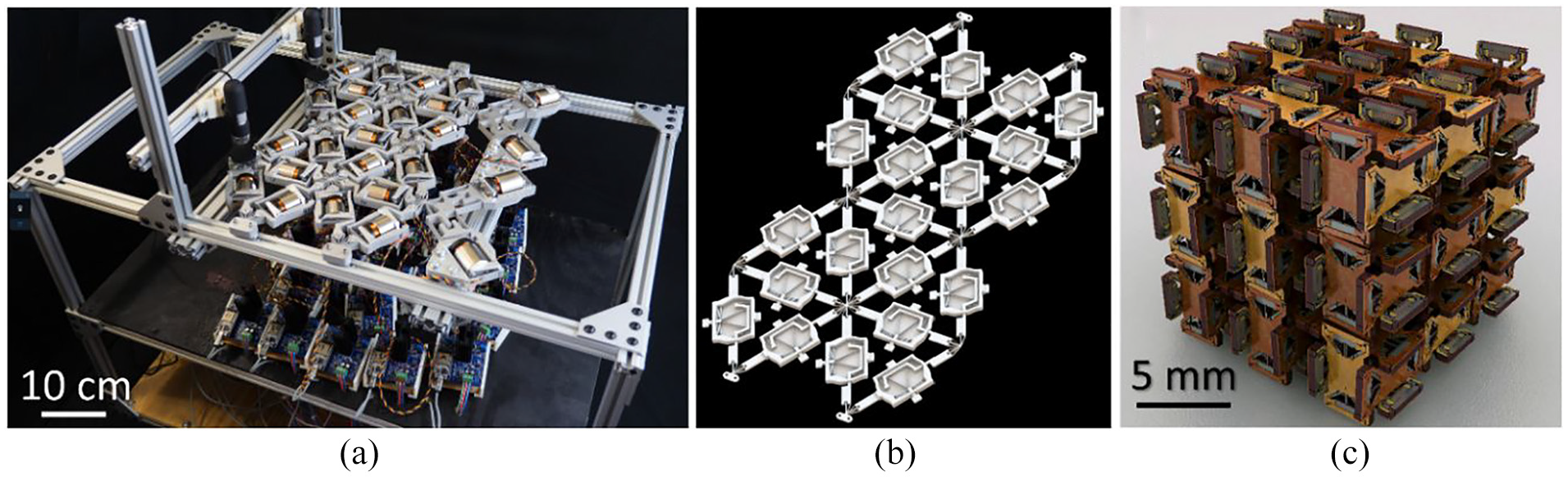
(a) The first mechanical neural network (MNN) that demonstrated the ability to learn desired behaviors via continuously tunable beams (Lee et al., 2022), (b) A MNN that utilizes binary stiffness beams to learn behaviors via discrete stiffness values (Hopkins et al., 2023), (c) A MNN that consists of 5-mm-long continuously tunable beams with micro/nano-sized features (Luo et al., 2020).
Spatial (i.e. three-dimensional) versions of MNNs with meso-sized tunable beams have also been proposed as practical metamaterials that learn. Beams as small as 5 mm in size have been fabricated (Luo et al., 2020) with thermal actuators and nano-sized strain-gauge sensors that successfully achieve continuously tunable stiffness values between a maximum and minimum value via closed-loop control (Luo et al., 2023). These beams can be packed within a cube-like configuration surrounding an integrated-circuit (IC) chip, which can be tessellated within a metamaterial that can achieve programmable properties as shown in the photo of Figure 1(c). Although it has yet to be demonstrated, this lattice could be used as a practical MNN for learning mechanical behaviors. Other efforts are currently underway to improve the design and demonstrate learning on a small scale.
Additional research has been conducted toward determining alternative approaches for tuning the stiffness of constituent beams for enabling MNN learning. In addition to designing the beam of Figure 1(b) (Kuppens et al., 2021a), Kuppens designed a different binary-stiffness beam design that also leverages negative stiffness to achieve low stiffness (Kuppens et al., 2021b). These concepts were extrapolated to produce other mechanisms that achieve discrete states of stiffness along multiple directions using either a single bistable switch (Shimohara et al., 2023), as shown in Figure 2(a), or multiple decoupled ones (Vazzoler et al., 2025), as shown in Figure 2(b). Another concept was proposed (Yan et al., 2024) that leverages rigid conical beads threaded by cords that when tensioned, assemble and tune the stiffness of the resulting beams as shown in Figure 2(c). A different approach used gallium that changed phase from its solid to liquid state within a compliant water-balloon-like silicone shell to dramatically reduce stiffness as shown in the lattice of Figure 2(d) (Poon and Hopkins, 2019). The gallium was melted on demand by flowing electricity through wires that pass through the cores of the lattice’s spheres to selectively heat them.
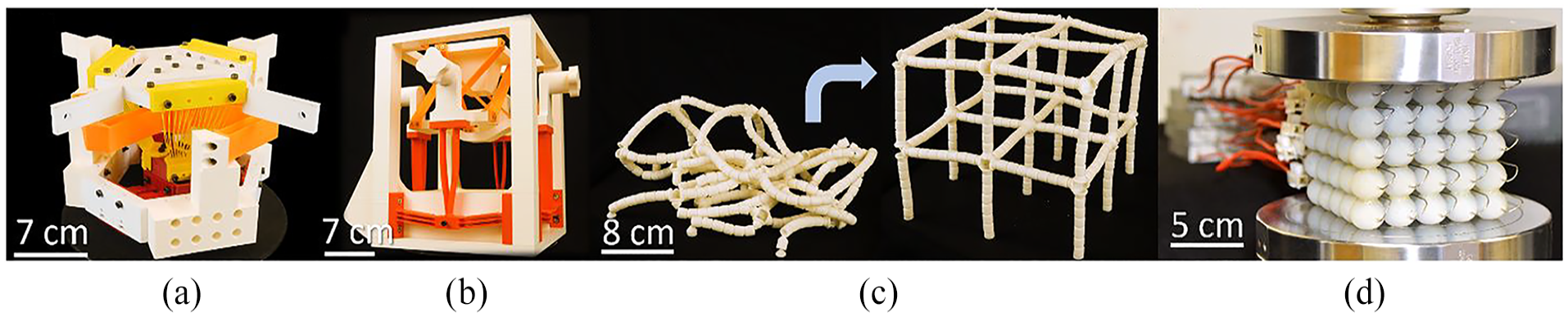
Compliant mechanisms that achieve discrete stiffness values along multiple axes using (a) a single bistable switch (Shimohara et al., 2023) or (b) multiple bistable switches (Vazzoler et al., 2025). (c) Rigid beads threaded by cords that when tensioned assemble into a lattice with beams that can be stiffened as desired (Yan et al., 2024). (d) A metamaterial made of silicone shells with gallium cores that melt when electricity is driven through wires inside to tune the lattice’s stiffness (Poon and Hopkins, 2019).
3. Conclusions and discussion
A variety of advances have been made in the area of MNNs since their publication in 2022. The primary goals have been to create simple ways to change the stiffness of beams in multiple directions over larger ranges in ways that enable them to be fabricated at smaller scales and packaged within spatial lattices that behave as practical metamaterials and can learn desired behaviors more quickly and accurately. The advances reviewed in this manuscript are only those that are currently published but many others are currently underway toward achieving the stated goals.
Footnotes
Acknowledgements
AFOSR program officer, Byung “Les” Lee, is gratefully acknowledged for his generous support.
Declaration of conflicting interests
The author declared no potential conflicts of interest with respect to the research, authorship, and/or publication of this article.
Funding
The author disclosed receipt of the following financial support for the research, authorship, and/or publication of this article: The research reported in this paper was supported by the Air Force Office of Scientific Research (FA9550-18-1-0459 and FA9550-22-1-0008).

Data availability statement
Data sharing not applicable to this article as no datasets were generated or analyzed during the current study.