



Abstract
In this paper, a curve-shaped based doubly clamped piezoelectric energy harvester (CD-PEH) is explored for improving the energy harvesting performance. The harvester consists of a composed beam constructed with two arc-shaped structures and a flat beam, as well as two proof masses. A method based on chained beam constraint model theory (CBCM) is first applied to build the nonlinear restoring force model of the CD-PEH, the developed analytical model is validated by the finite element analysis (FEA). Then the electromechanically coupled model for the CD-PEH is built to investigate the effect of excitation amplitudes, geometric parameters and load resistance on the output characteristics. Due to the geometric nonlinearity caused by the arc-shaped configuration, the CD-PEH orderly exhibits quasi-linear, softening nonlinear and mixed hardening & softening nonlinearity behavior with the increasing of excitation level, which could effectively extend the frequency bandwidth of the system. For the excitation of A = 8 m/s2, the effective working bandwidth of the CD-PEH is increased by 633% compared with the effective bandwidth in the case of A = 2 m/s2. Moreover, comparison experiments demonstrate that the output voltage and the effective bandwidth are increased by 225 and 450%, respectively, compared with the typical doubly-clamped piezoelectric energy harvester (T-PEH) under the same excitation amplitude. Overall, this study provides a new way and theoretical framework for the design of high-efficiency doubly clamped piezoelectric energy harvester.
1. Introduction
Over the past few years, the fusion of sensing and wireless communication has led to the rapid growth of Wireless Sensor Networks (WSN), which have been applied to wearable instrumentation, environmental or military monitoring devices, health monitoring and intelligent positioning, and so on (Al-Turjman et al., 2020; Zhou et al., 2022). At present, these electronic devices are generally powered by traditional batteries, whose limited energy capacity and tedious replacement restrict their application, especially in harsh environments or the place away from conventional power sources (Aabid et al., 2021; Huang et al., 2022). To overcome the energy issue of traditional chemical batteries, researchers have proposed many methods to solve the above problems, among which vibration-based energy harvesting technique is one of the feasible solutions (Huang et al., 2021; Sharma et al., 2022). Commonly used vibration energy harvesters include piezoelectric (Berdy et al., 2012), electrostatic (Lai et al., 2021), electromagnetic (Miao et al., 2022; Wang et al., 2022), and triboelectric energy harvesters (Li et al., 2022; Perez et al., 2017). Piezoelectric energy harvesters (PEHs) have been extensively studied due to the advantages of simple structure, high output voltage, and high energy density (Liu et al., 2022; Toprak and Tigli, 2014).
A cantilever-type harvester with a tip mass is proposed as a typical structure for energy harvesting since it has lower resonant frequency and can bear large deformation (Mei et al., 2018). Initially, these harvesters are usually based on linear resonance, which operate effectively only in a very narrow frequency range near their resonant frequencies (Erturk et al., 2009). To broaden the operational bandwidth, many solutions like the nonlinear spring, array structure and multi-stable structure (Ma et al., 2022; Zhou and Zuo, 2018a) have been used, thus improving their energy harvesting performance. In addition to the cantilever beam, the doubly–clamped piezoelectric beam can withstand higher impulse or load than the cantilever-type beam due to its high rigidity, enabling it applicable in a wide range of acceleration level and protect the piezoelectric element from cracking caused by the possible strong vibration (Liang et al., 2015), thus receiving researchers’ attention. Nowadays, doubly-clamped beam structures have been widely used in the field of nonlinear vibration energy harvesting (Paul et al., 2021). Masana and Daqaq (2011) developed a nonlinear PEH consisting of an axially loaded buckled clamped–clamped beam, their research demonstrated that the monostable configuration can outperform the bi-stable one under low acceleration. Wang et al (2020) proposed a clamped–clamped piezoelectric energy harvesters with variable curvature to further broaden application scenarios, they developed a distributed-parameter electromechanical coupling model for the proposed structure and validated the theoretical results. Leadenham and Erturk (2015) proposed a doubly-clamped M-shaped PEH, their results showed that the device can offers a 660% increase in the half-power bandwidth as compared to the linear system. Meanwhile, the M-shaped beam configuration can exhibit limited maximum deflections to protect piezoelectric laminates compared with the cantilever-type harvester. By introducing nonlinear magnetic force, Shih and Su (2018) proposed a nonlinear doubly-clamped U-shaped bidirectional piezoelectric harvester, their research validated the capability of bi-directional harvesting and improved performance with the aid of nonlinear magnetic force. Zhou et al. (2016) designed and analyzed a doubly-clamped nonlinear hybrid energy harvester with magnetic coupling, they revealed that introducing nonlinear magnet force will improve the output power significantly. Jin et al. (2020) investigated two kinds of doubly-clamped PEH with different width shapes, they observed that the width shapes of the beams have a significant effect on the power output of the devices. Wu and Xu (2022) developed a bridge-type bistable PEH using doubly-clamped mechanism, their results indicated that the proposed device can yield more output power than the existing designs. However, the proof mass of the PEH cannot be flexibly selected, otherwise, the bistability will disappear and the performance will drop dramatically. Chen et al. (2021a) explored the nonlinear behavior of an innovative doubly-clamped piezoelectric beam subjected to multi-directional excitation, the experimental results showed that the harvester could realize tri-directional and broad bandwidth energy harvesting. However, the device has a larger volume than the common beam-based PEHs. Wang et al (2021) designed a woodpecker-mimic two-layer band energy harvester using a piezoelectric array to achieve energy autonomy for wrist-worn wearables, they validated that the bionic harvester is capable of continuously powering a watch or a screen when walking at a normal pace or hand tapping.
According to current literature, it has been demonstrated that doubly-clamped PEHs can outperform their cantilever-type counterparts due to more uniform stress distribution (Cao et al., 2020; Zhou et al., 2018b). The majority of aforementioned doubly-clamped PEHs are generally composed of a conventional straight beam with piezoelectric materials bonded on its surface. As we know, the beam shape has a vital effect on the output performance of the PEH. It greatly influences the effective stress distribution in the piezoelectric element, and determines the equivalent stiffness. Recently, the curve-shaped structure is chosen as energy transducing element to improve the harvesting performance in cantilever-type energy harvester due to its relatively evenly-distributed stress and small stiffness (Chen et al., 2021b; Yang et al., 2017; Zhou et al., 2021). It is worthwhile to improve the output performance of the piezoelectric energy harvester by changing piezoelectric vibration beam shape.
Motivated by the above discussions, combining the advantage of the geometric nonlinearity and more uniform stress distribution on the arc-shaped surface, we originally presented a novel arc-shaped doubly-clamped piezoelectric energy harvester in this paper. The nonlinearity of the presented design is generated by resorting to the geometric nonlinearity, rather than to subject the system to any magnetic force effects or preloading force, which simplifies the mechanism design and effectively extend the bandwidth of the energy harvester. Meanwhile, due to relatively evenly-distributed stress on the surface of the arc-shaped configurations (Chen et al., 2021b; Yang et al., 2017), the CD-PEH has much better power output performance compared with the conventional doubly-clamped PEH.
The rest of the paper is organized as follows. In Section 2, the structure and working principle of the proposed CD-PEH are presented. In Section 3, the nonlinear restoring force with FEA verification is calculated, and the electromechanically coupled model for the CD-PEH is built. The fabricated prototype and the experimental setup are outlined in Section 4. In Section 5, the effects of both excitation level and the geometric parameters on the output performance are studied numerically, and corresponding experiments are conducted to prove the theoretical analysis. The conclusion of the paper is given in Section 6.
2. Design and working principle
The schematic diagram of the proposed curve-shaped piezoelectric energy harvester is shown in Figure 1, where the system is composed of a main beam, two proof masses and two piezoelectric patches (PVDF). The main beam is symmetric to the vertical centerline, and both ends of the structure are fixed on the base. According to the previous studies (Chen et al., 2021b; Yang et al., 2017), two piezoelectric patches are only attached on the arc-shaped surfaces to improve power generation. Different from the reported designs where the main beam is built of conventional straight beam, the main beam explored in this work consists of two arc-shaped configurations and a flat configuration. The nonlinearity of the presented design is generated by resorting to the geometric nonlinearity, rather than to subject the system to any magnetic force effects, they are analyzed for the subsequent section.
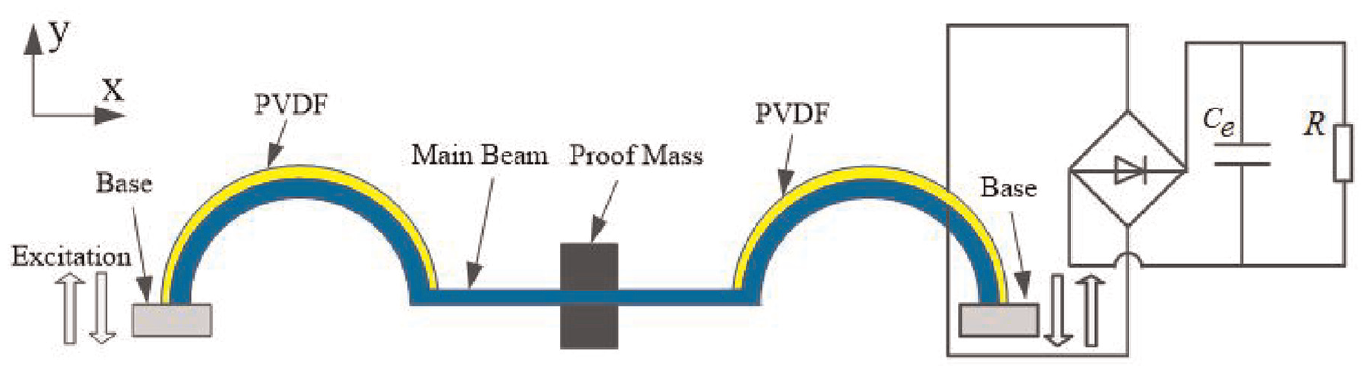
The schematic diagram of the proposed CD-PEH.
Dynamic vibration of the structure causes strains on the piezoelectric layers when the external excitation along y direction acts on the base, which can yield an alternating voltage via direct piezoelectric effect. It is then connected to an AC-DC rectifier followed by a filtering capacitance
3. Theoretical analysis
This section derives the analytical models of nonlinear restoring force and the nonlinear electromechanical lumped parameter model for evaluating the property of the proposed CD-PEH. Figure 2 shows the simplified model of the CD-PEH.
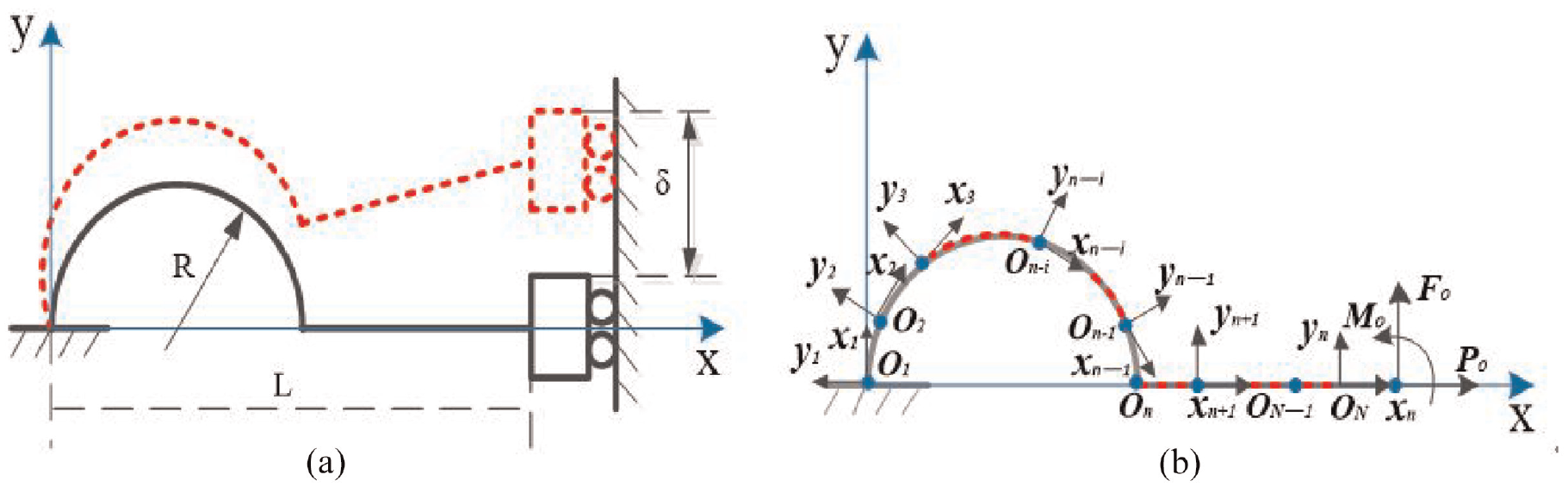
(a) Schematic of half of the harvester and (b) discretization of the harvester at its undeflected position.
3.1 The nonlinear restoring force model
The restoring force of the structure is nonlinear due to the existence of the curved configuration. This nonlinearity significantly influences the frequency bandwidth of the harvester in vertical direction. In order to investigate the influence of the relevant parameters on the restoring force, a parametric approach, CBCM (Chen et al., 2019), is used to determine the relationship between displacement and restoring force in vertical direction.
Considering the symmetry of the loading and geometry, we just need to model half of the harvester to simplify structure and reduce calculation. The schematic of half of the harvester is shown in Figure 2(a). As shown in Figure 2(a), R and L denote the arc-shaped radius and the length of half of the harvester along x-axis, respectively. δ represents the displacement of the proof mass along y-axis.
Figure 2(b) shows discretization of the harvester at its undeflected position. The whole structure is discretized into N elements according to the CBCM, the arc-shaped beam is equally divided into n elements, so the flat beam consists of N-n elements. One should note that we need divide the whole beam into N elements with approximately equal lengths to ensure the accuracy of the CBCM, and interested readers should refer to (Awtar and Sen, 2010a; Chen et al., 2019) for detailed information about CBCM. The first element is fixed to the ground at node
For the ith element shown in Figure 3, its local coordinate frame (

where
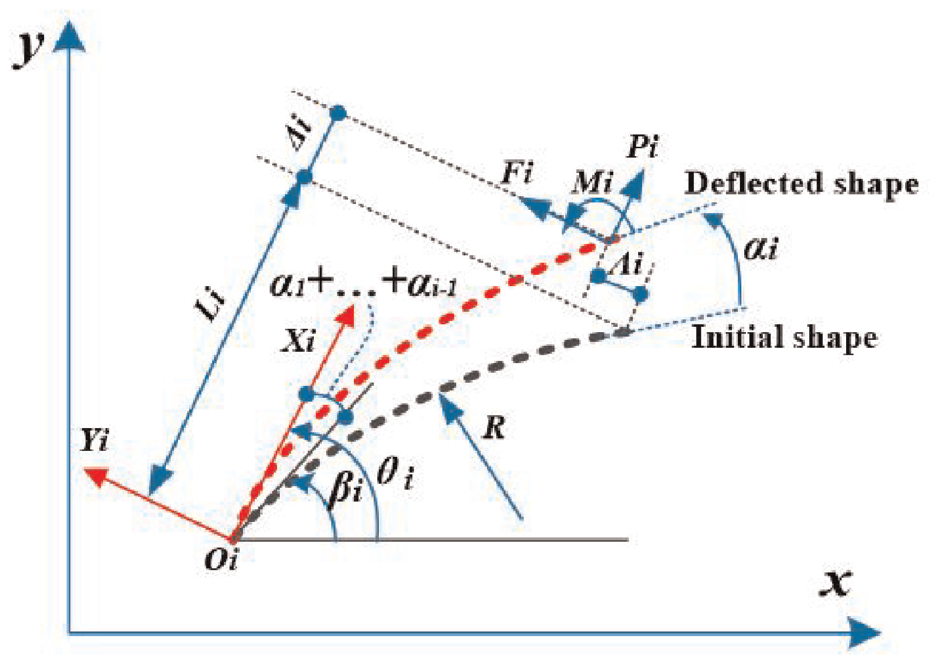
The ith element at its deflection position.
The length of each curved element along its Xi-axis can be calculated by:

All of the parameters of the ith element are normalized with respect to
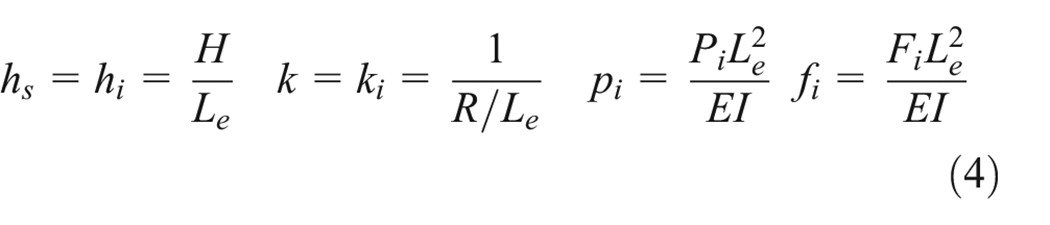

where
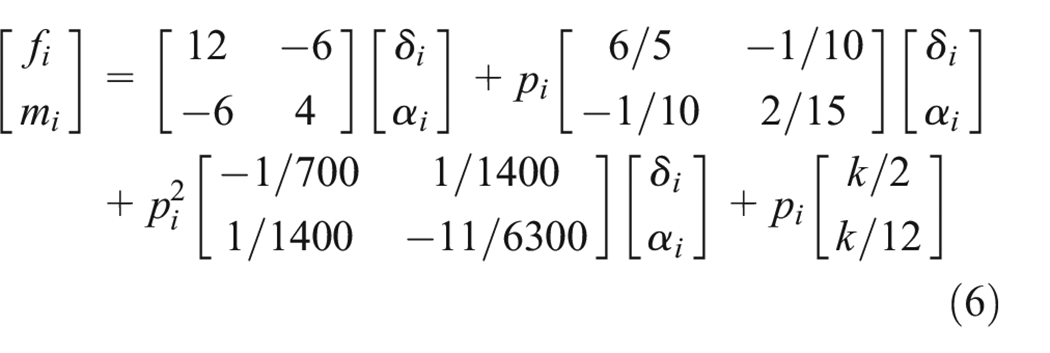
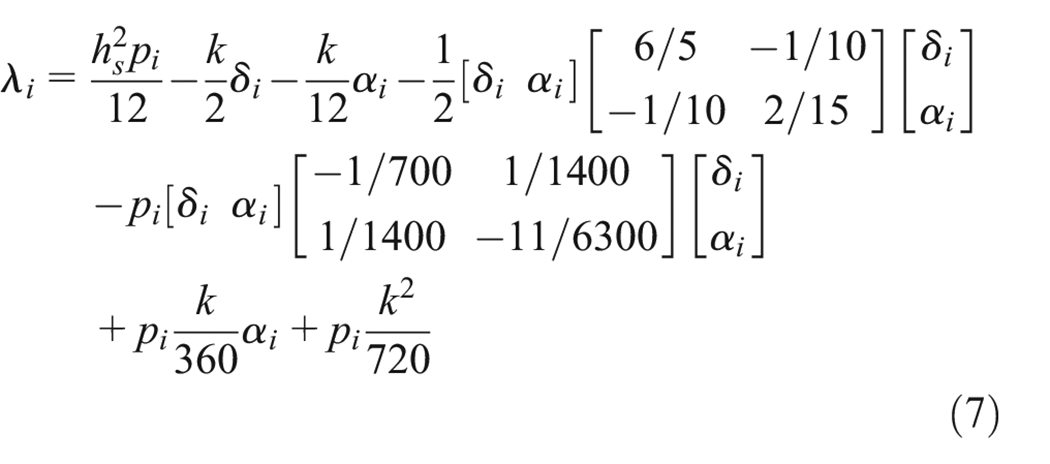
Static equilibrium between the first element and beam tip is expressed as (3N equations):

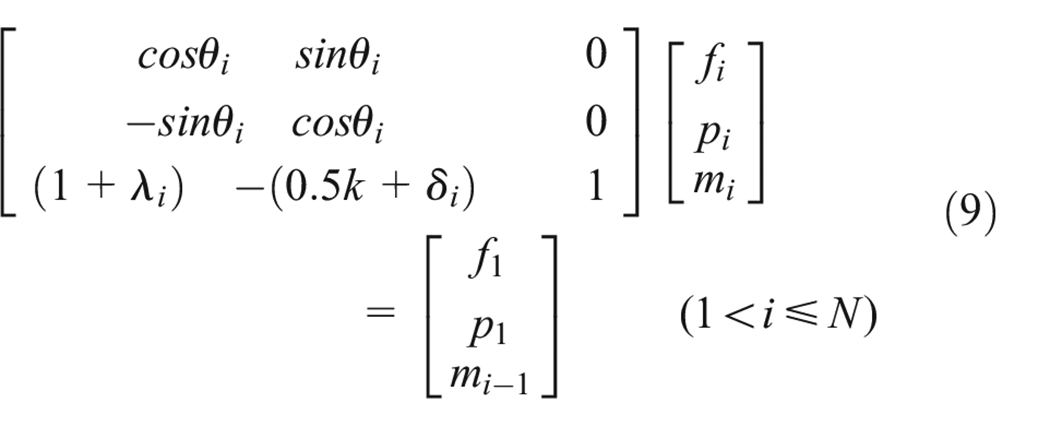
Geometric constraint equations are expressed as follows (three equations):
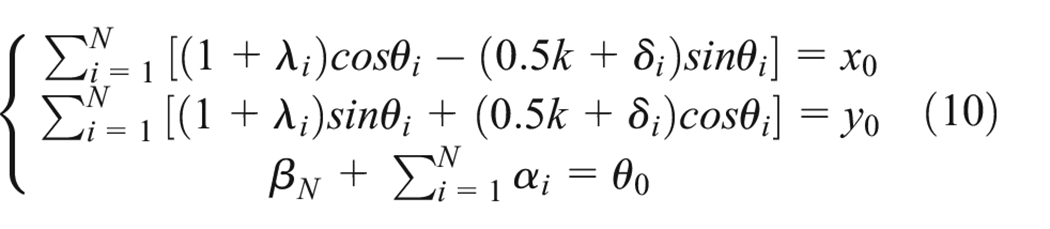
Equations (6) to (10) constitute the CBCM equations (totally (6N + 3) equations) for the beam. For a given specific geometric parameters (T, L, θ, R, and W) of the structure and displacement δ of the proof mass, based on the boundary condition of the structure in Figure 2(a), the corresponding tip coordinates and slope are expressed as:

Then
To verify the analytical model of the CBCM, a static structural analysis including geometric nonlinearity is conducted based on finite element analysis (FEA) by using COMSOL 5.6 software. The FEA model and deformation contour from the finite element analysis of the CD-PEH is shown in Figure 4. Note that the piezoelectric material is ignored in FEA simulation, since the Young’s modulus of the substrate layer is much higher than the piezoelectric material, the approximation is acceptable.
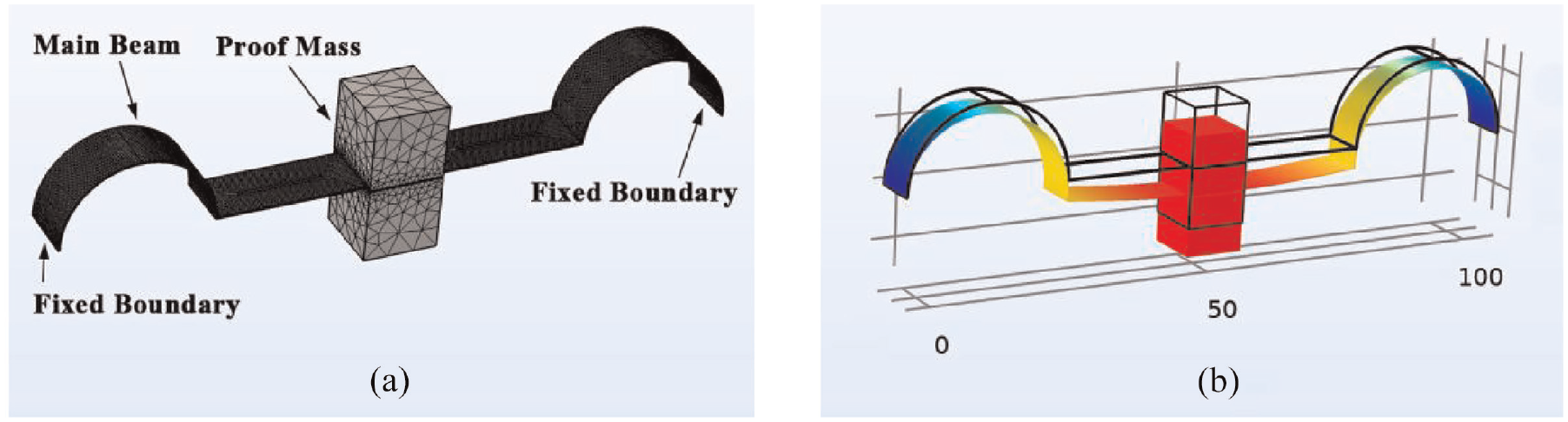
The FEA of the proposed CD-PEH: (a) FEA model and (b) deformation contour from the FEA of the CD-PEH, the initial position is shown in the translucent state.
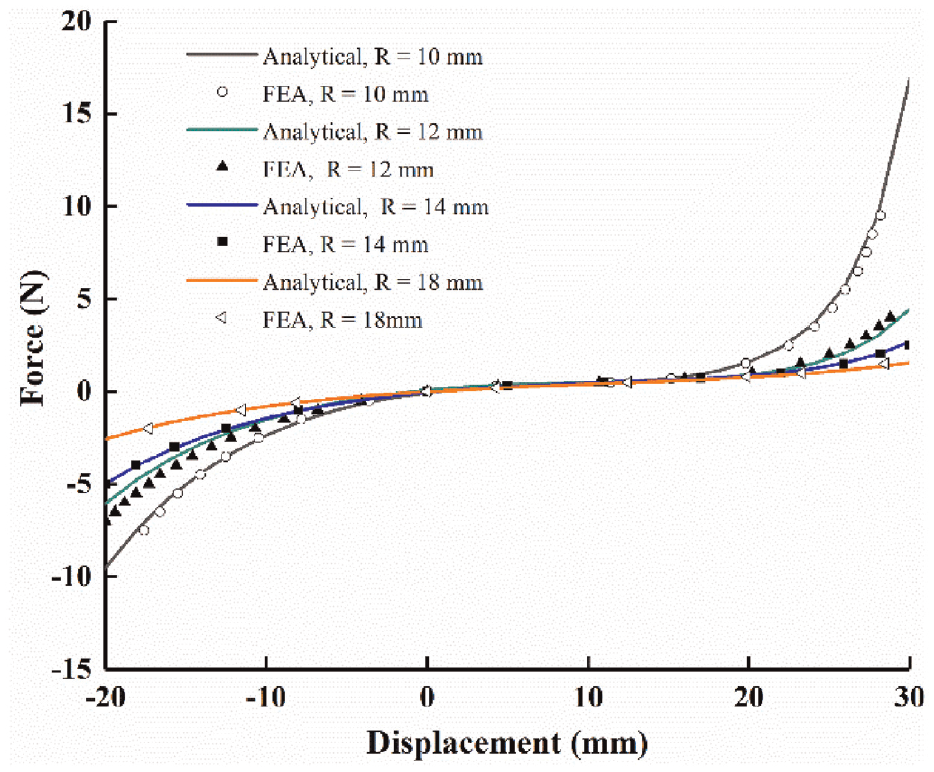
The total length L is remained unchanged in the analysis. As shown in Figure 5, the FEA simulation shows a good agreement with CBCM results of the proposed structure with different arc-shaped radius, which proves the CBCM could accurately estimate the nonlinear restoring force of the system.
Equivalent spring force as a function of the center displacement.
It is found from Figure 5 that the restoring force of the proposed CD-PEH exhibits a curve, which is due to the fact that the radius of curvature for the arc-shaped configuration is continuously varied in the process of the CD-PEH vibration, thus leading to asymmetric nonlinear restoring force. The restoring force curve becomes flat in the given displacement range as the radius of curvature increases, as shown in Figure 5. Meanwhile, the stiffness becomes small with the increase of arc-shaped radius. Therefore, we can adjust the system’s stiffness by changing the radius of curvature, which provides a new idea for tuning the resonant frequency compared with the traditional straight beam. In addition, appropriately reducing the radius of curvature helps to obtain strong nonlinearity, a nonlinear restoring force can be obtained by designing the different arc-shaped radius for the vibration energy harvesters without using complicated structures of multiple springs or magnets.
Due to the complexity of CBCM expressions, the relationship between the resorting force and tip displacements can be fit to a polynomial, as follows:

where
3.2 The nonlinear CD-PEH model
The basic structure of the proposed CD-PEH is shown in Figure 1. Considering the symmetry of the vibration structure of CD-PEH, we still model half of the harvester to simplify structure and reduce calculation. The equivalent lumped parameter model of half of the CD-PEH structure is shown in Figure 6.
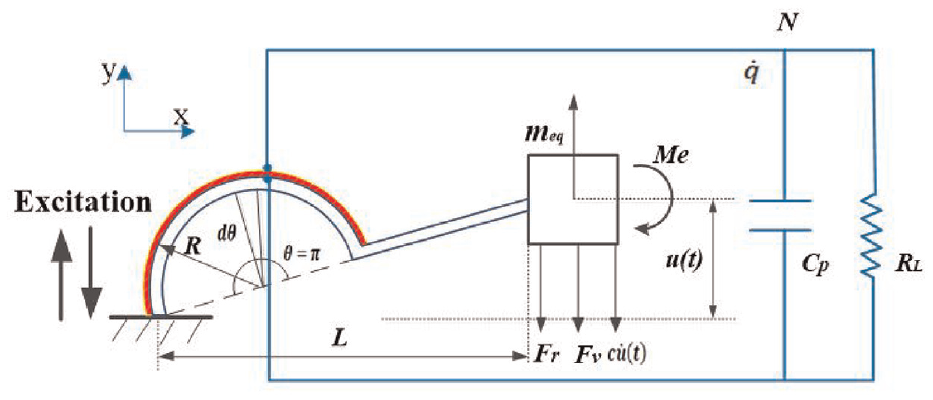
Equivalent lumped parameter model of half of the CD-PEH structure.
According to Newton’s second law, the lumped parameter single-degree-of-freedom (SDOF) model can be expressed as (Dutoit et al., 2005)

where the correction factor of the amplitude is negligible due to the large mass ratio of the tip mass to the beam. In addition, according to the Kirchhoff’s current law, a second differential equation can be formulated at Node N in the electrical domain in Figure 6 (Roundy et al., 2004).

Equations (13) and (14) constitute the lumped parameter model for the CD-PEH structure. Where
In order to solve the system of differential equations obtained above (equations (13) and (14)), the electromechanical coupling force
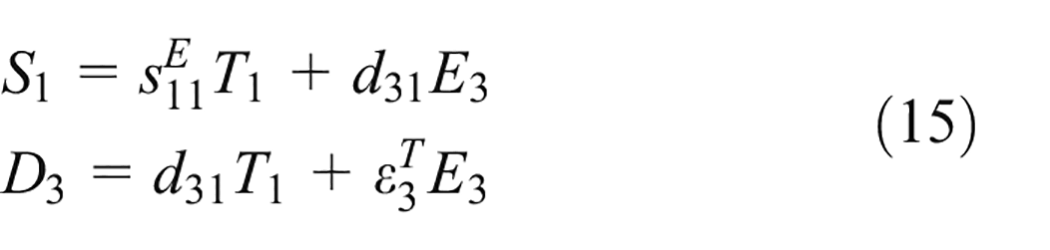
where
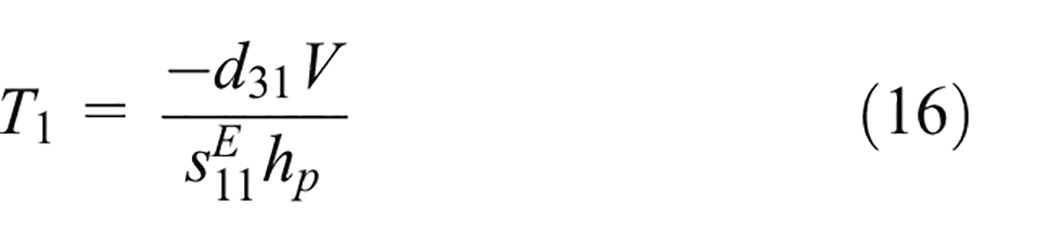
where

where

The equilibrium torque


For a single-layer curved beam, the neutral axis approximately coincides with the centroid. The parameter
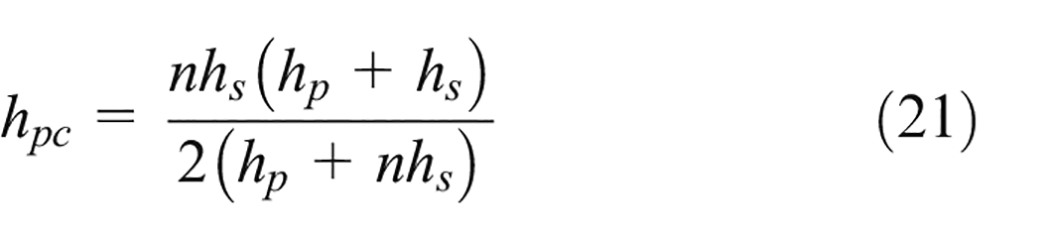
Combining equations (16) and (19), we have

where
The free charge is equal to the total charge generated by the stressed piezoelectric material. And the short circuit condition is considered to simplify the equation, since the electrodes are shorted, the total electric field is equal to zero, and the equation (15) reduces to the following equation

The instantaneous short circuit current flowing across the electrodes is simply the time derivative of the total free charge and can be given by (Sun and Cao, 2012)

Employing the small deflection beam-bending theory and the linear coupling again, the effective spring constant k need to be resolved to relate the displacement

Finally, substituting equations (12), (22), (25) into equations (13) and (14), respectively, the electromechanically coupled ordinary differential equation for the CD-PEH system can be obtain as follow
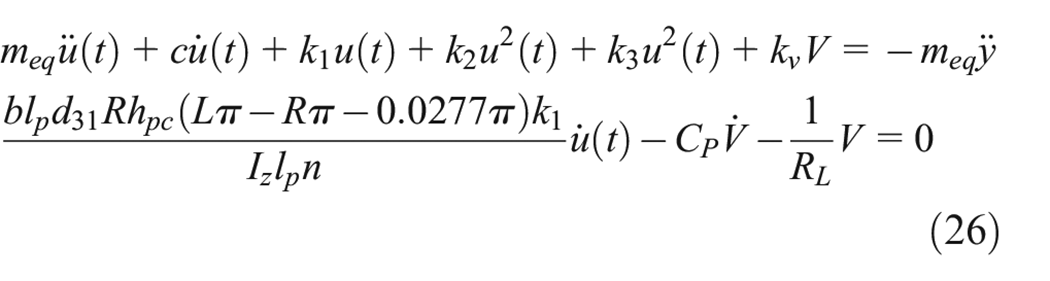
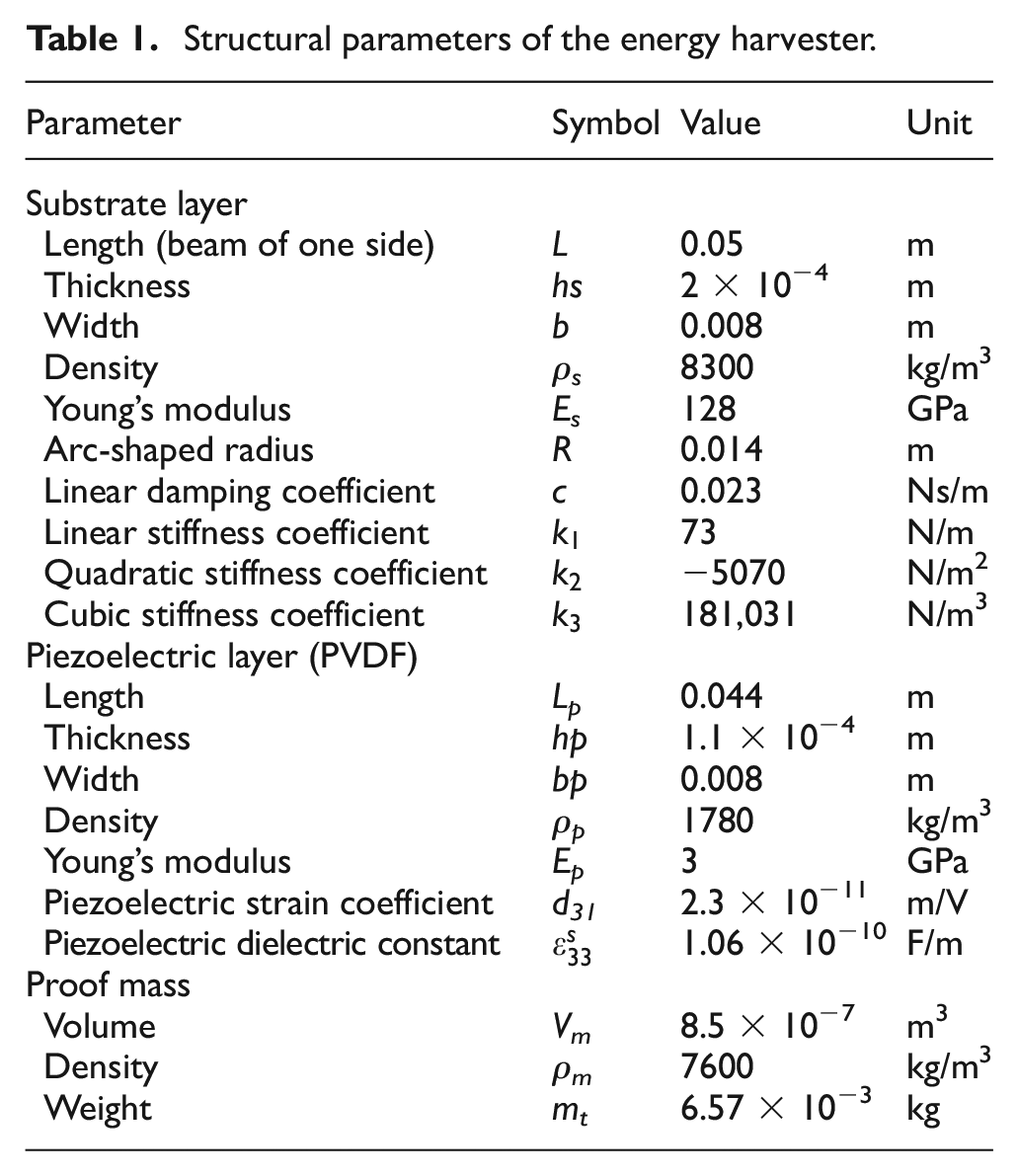
This set of equations can be transformed into the state-space form and solved to investigate the system performances with ode45 method. The system and material parameters used in simulation are listed in Table 1.
Structural parameters of the energy harvester.
4. Experiments
This section depicts the fabricated prototype and the experimental setup developed to characterize the performance of the CD-PEH.
The structural parameters used here were the same as those in simulation. The experimental setup was shown in Figure 7(a). It mainly included the computer, the digital oscilloscope (DSOX3024T), the vibration controller (VT-9008), the power amplifier (VSA-L1000A), the exciter (LT-50-ST), and the CD-PEH.
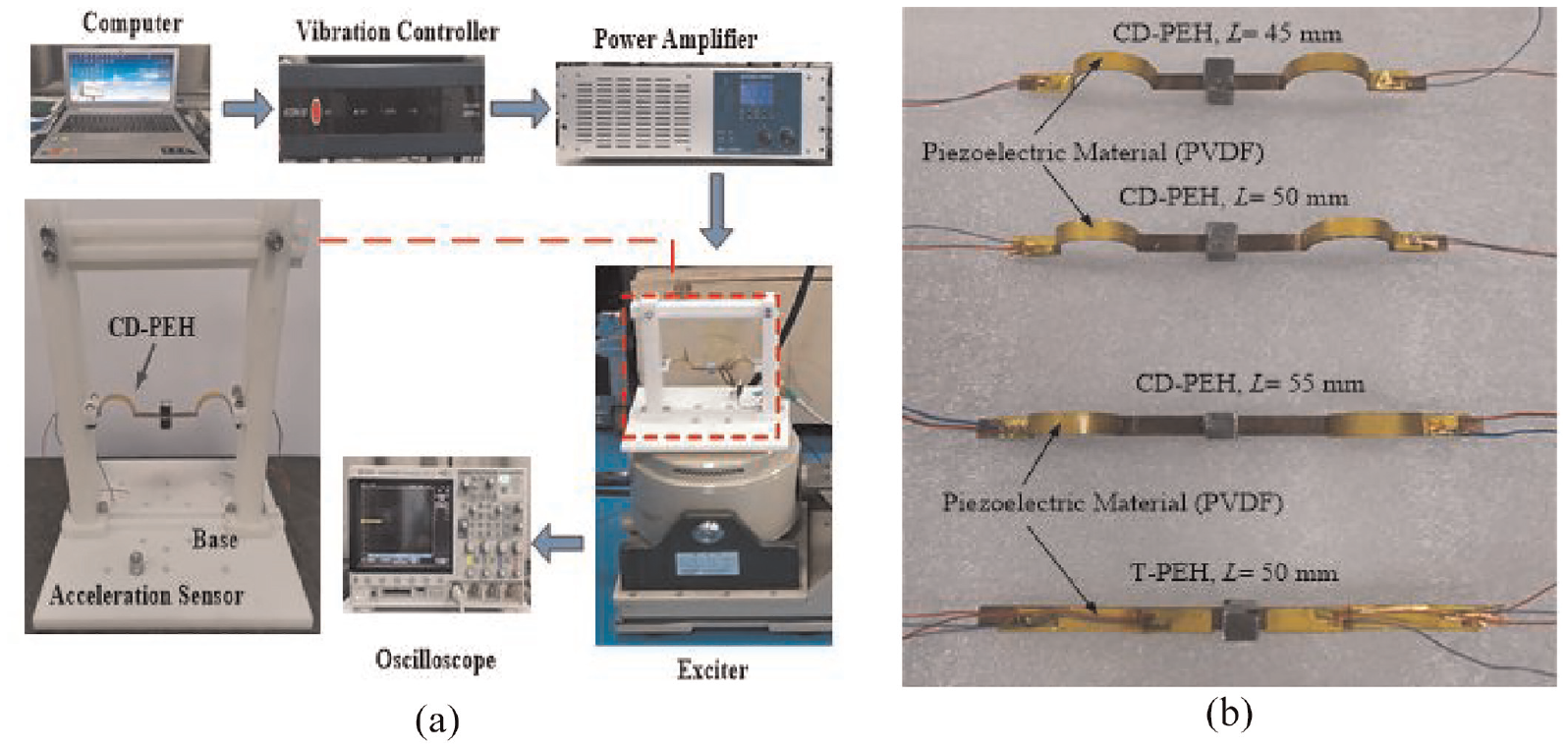
Experiment platform: (a) The experiment setup and (b) The fabricated prototype.
The substrate layer of the CD-PEH was made of beryllium bronze, the material of the piezoelectric layer was PVDF, and the fabricated prototype was shown in Figure 7(b). In the experiment, The CD-PEH was mounted vertically on an electromagnetic exciter that supplies a harmonic excitation while operating, the sinusoidal signal was set on the computer and sent out by the vibration controller. Then the signal is amplified by power amplifier and transferred to the exciter to control the vibration of the CD-PEH mounted on the base. An acceleration sensor attached on the base was used to measure the acceleration and provide feedback to computer. The digital oscilloscope was used to record output voltages of piezoelectric element of the CD-PEH.
Additionally, we utilized a T-PEH as the counterpart to compare power generation performance with the CD-PEH. The T-PEH prototype was also shown in Figure 7(b), which had the identical length along x-axis, thickness, width and proof mass as the CD-PEH. To ensure a fair comparison, two identical piezoelectric materials (PVDF) are bonded to the surface of the T-PEH and the CD-PEH, respectively, and each PVDF laminate had dimensions of 44 × 8 × 0.11 mm3. Note that the PVDF was only attached along the arched part for the CD-PEH. For the T-PEH, the segmented electrodes were chosen to prevent voltage cancellation caused by the strain node according to the mode shape in the C-PEH, then the two piezoelectric plates are connected in series to compare with the CD-PEH, as shown in Figure 7(b).
5. Results and discussions
In this section, a parametric study is performed based on the developed analytical models. The electrical characteristics of the CD-PEH are examined, then we analyze the results from the simulations and experiments. The performance of the CD-PEH prototype is also compared with the T-PEH to verify its superiority over its.
5.1 Influences of excitation amplitude
The excitation amplitudes have a considerable influence on the system’s performance. Firstly, we choose different excitation amplitudes (A = 2 m/s2, 5 m/s2, 8 m/s2) to explore the characteristics of the nonlinear energy harvesting, the sweeping frequency ranges from 10 to 20 Hz and the external resistance is 10 MΩ. The half-power bandwidth method is used to evaluate the effective bandwidth of the energy harvester.
For a comparison, the experimentally obtained voltage and simulation results are plotted in Figure 8, respectively. According to the experimental results in Figure 8(a) and (b), for given 2 m/s2 excitation amplitude, the response curve is slightly bent to the lower frequency direction. The response displacement is relatively small due to low excitation level. Although it is a nonlinear system, the stiffness of the system is dominated by the linear stiffness under weak excitation, so the system exhibits quasi-linear behavior. The CD-PEH reaches the resonant peak around 16.1 Hz with a maximum voltage output 7.8 V, and the effective bandwidth of the system is about 0.3 Hz.
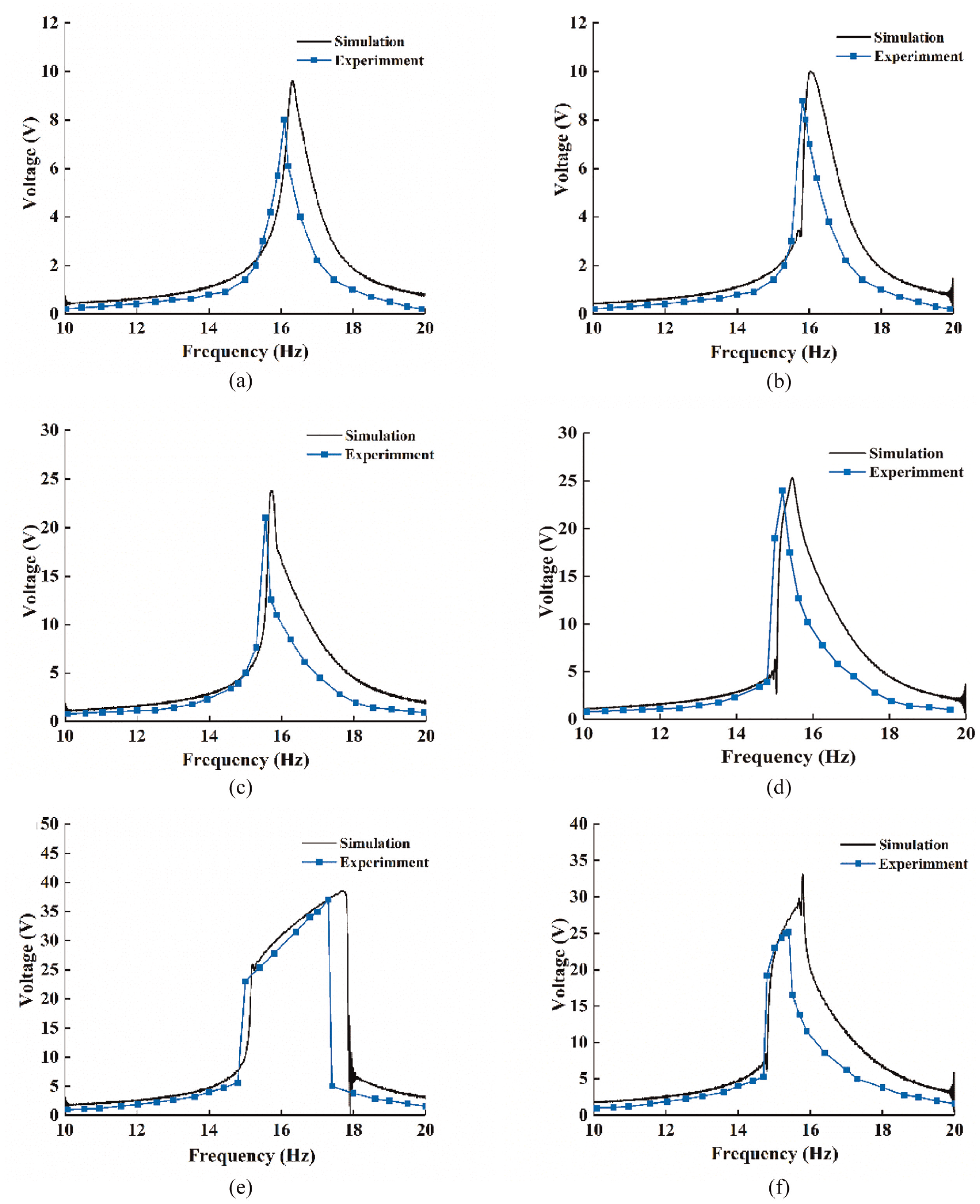
Nonlinear frequency responses of the CD-PEH: voltage at 2 m/s2 acceleration in (a) up-sweep and (b) down-sweep; voltage at 5 m/s2 acceleration in (c) up-sweep and (d) down-sweep; voltage at 8 m/s2 acceleration in (e) up-sweep and (f) down-sweep.
The voltage response curve is obviously bent to the lower frequency direction and shows a typical softening behavior as the excitation amplitude increases to 5 m/s2, which is because that the response displacement becomes relatively large with increasing excitation level, the stiffness dominated by the linear stiffness is modulated by the nonlinear stiffness, and softening nonlinearity dominates the system. The response characteristics of the system change accordingly, so it shows softening hardening behavior, as shown in Figure 8(c) and (d), and the maximum voltage is 21.0 V in the upward frequency sweeping.
With the still further increase of excitation amplitude to 8 m/s2, the peak frequency drifts upward and builds another region of multiple solutions in the higher frequency range. There are two jump points in the upward frequency response, one appears at 14.8 Hz, the other appears at 17.3 Hz, and the corresponding voltage are 24 and 36 V respectively, as shown in Figure 8(e). It can be observed from Figure 8(e) that a distinct mixture of the hardening and softening behavior with obvious jump phenomena emerges, which is due to that both negative quadratic term and positive cubic term coexist in the system due to the existence of the curved configuration, and they together stimulate complex dynamic behavior, thus bringing about different dynamic characteristics from the traditional nonlinear system. The mixture nonlinear characteristic effectively extends the frequency bandwidth of the system. The effective working bandwidth of the CD-PEH is near 2.2 Hz, which is 633% larger than the quasi-linear one (0.3 Hz).
It is concluded from the results that the system demonstrates a strong nonlinearity which stems from the curve-shaped based doubly clamped configuration. When the excitation level reaches a certain level, the system could exhibit a mixture nonlinear behavior with two jump points, and the gap between the upward and downward jumping points could significantly extend bandwidth.
Comparing the experimental results with those of simulations, we find that the experimental voltages are always lower than simulation results at all frequency ranges. Although there exist discrepancies and frequency drifts between the simulation and experimental results, and the tendency show a good agreement with the experimental results. The main reason is that, one is due to the imperfect adhesion of the piezoelectric layer and manufacturing precision of the curve-shaped structure, thus resulting in a small voltage output. In addition, the clamp is set a little away from the arc-shaped end to protect the piezoelectric layer, and the distance is set as 2 mm in the experiments. This clamping condition is a little different from that used in the analytical model, which also have an impact on eigenfrequency and system’s performance.
5.2 Influences of length of the elastic beam
Apart from the excitation level, geometric parameters also play a vital role in system response. Here we mainly analyze the effect of the length of the elastic beam on the proposed energy harvester, and they greatly influence the equivalent stiffness coefficients and output performance.
We retain the arc-shaped radius of the CD-PEH unchanged, and choose different lengths (L = 45 mm, 50 mm, 55 mm) to examine the effect of the length of the elastic beam on the performance. An experiment is performed and the results are also shown in Figure 9.
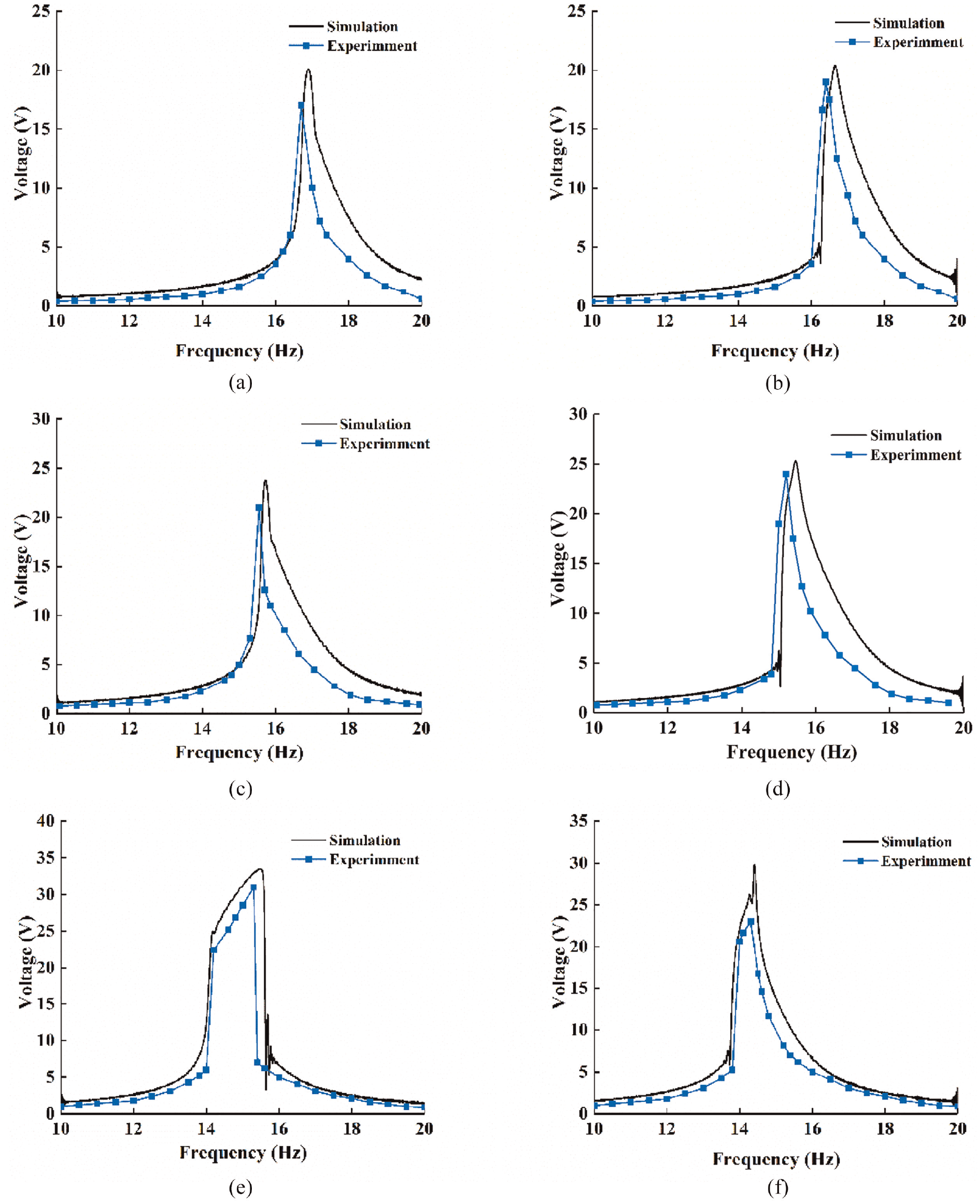
Nonlinear frequency responses of the CD-PEH with different length at 5 m/s2 acceleration: voltage for L = 45 mm in (a) up-sweep and (b) down-sweep; voltage for L = 50 mm in (c) up-sweep and (d) down-sweep; voltage for L = 55 mm in (e) up-sweep and (f) down-sweep.
It can be seen from Figure 9(a) and (c) that the voltage response curves are obviously bent to the lower frequency direction, respectively. As discussed above, both negative quadratic term and positive cubic term coexist in the system due to the existence of the curved configuration. The quadratic nonlinear stiffness term which distorts the hardening response curve is evoked at low excitations, leading to a softening behavior. Consequently, the system exhibits the softening nonlinearity in the case of L = 45 and 50 mm, the maximum voltage are 17.5 and 21.2 V in the upward frequency sweeping, respectively. Meanwhile, the beam stiffness decreases as the length of the beam increases, so we can see from Figure 9(a) and (c) that the resonant frequency shifts from 16.7 to 15.6 Hz with the increasing of the length of the beam.
It is noted that the frequency curve has two jump points in the case of L = 55 mm, the upward jump point appears at 14 Hz while the downward one is near 15.2 Hz, as shown in Figure 9(e). The corresponding voltages are 21.8 and 31.3 V, respectively, and the system exhibits an obvious mixture of the hardening and softening behavior which is different from the former two. Meanwhile, the effective working bandwidth is extended from 0.3 Hz in the case of L = 45 mm to 1.2 Hz. This phenomenon can be explained by the tunable nonlinear stiffness. Theoretically, changing the length of the flat beam can not only affect the linear stiffness but also the nonlinear stiffness including the quadratic and cubic stiffness of the CD-PEH. The influence of quadratic nonlinearity on the characteristic of the system could be enhanced or weakened by changing the length of the flat beam. When lengthening or shortening the length of the flat beam, there are also equilibrium states where both hardening and softening nonlinearities emerge (Yang et al., 2016), then the system could display typical properties of both softening and hardening nonlinearities under low excitation levels.
The length of the flat beams can not only affect the electrical output but also the resonant region of the CD-PEH. Therefore, geometric parameters need to be optimized carefully based on the excitation conditions, geometric constraints, and power requirements of the applications.
It can be seen from Figure 9(a) to (f) that the calculating result shows similar tendency of the output voltage with experiment for increasing length. Even though the agreement with experiment is not good, the analytical prediction could reflect the influence mechanism of the length of the proposed harvester on systems’ performance, which is of great interest for further investigation.
5.3 Optimal load
The load resistance of the CD-PEH could significantly affect the maximum power when the system is connected with an external load, so the optimal load needed to be determined to achieve maximum output power. The output performances, including both RMS voltage and average power versus external load resistance ranging from 1 to 16 MΩ at the resonant frequency, are shown in Figure 10. From the experiment results, it can be seen that the output voltage increases with the increase of the load resistance, while the average power of the CD-PEH first increases from 1 to 12.0 MΩ, and then decreases from 12.0 to 16 MΩ. The maximum output power of 23.2 µW can be achieved in the experiment, which corresponds to a 12.0 MΩ load resistance. Comparing the results of simulation with those of experiments, the corresponding output power and optimal load are 24.5 µW and 10.8 MΩ, respectively. Meanwhile, it is observed that the simulation results are always greater than the results obtained by experiment. This discrepancy may be caused by the mismatch of piezoelectric material property and the size measurement between the ideal simulation condition and actual experiment situation.
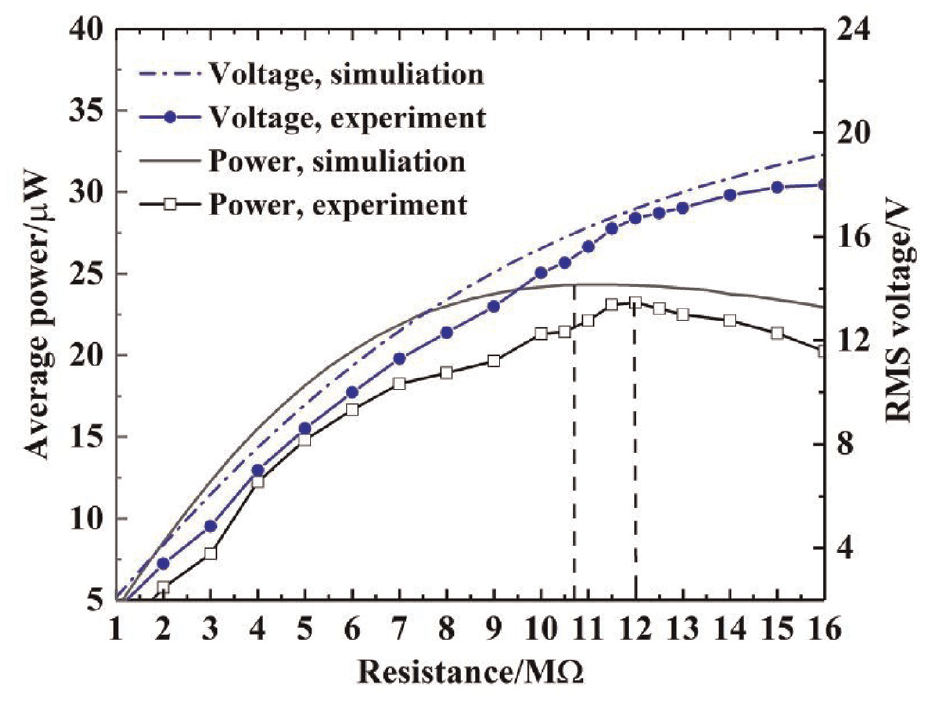
Average power and RMS voltage response for different load resistance.
5.4 Performance comparison
It is not straightforward to perform a fair performance comparison on energy harvesters of different configuration, material and size. The difficulty exist in the lack of universal figures of merit for assessing harvester performance, meanwhile, the detailed parameters of most harvesters including size, power, frequency, are not clearly documented.
Consequently, we have experimentally compared the performance of the CD-PEH with that of the fabricated T-PEH. Firstly, the frequency sweep experiments were carried out to obtain their resonant frequency, respectively. Since the peaks also denote the locations of the first-order resonance, then they were oscillated at their resonance to further compare energy harvesting performance of the CD-PEH with that of the T-PEH under different excitation levels. The input acceleration was adjusted to 2, 4, 6, and 8 m/s2, respectively. Finally, the corresponding voltage of the CD-PEH and the T-PEH under the same load resistance (10 MΩ) were recorded in terms of the root mean square (RMS) value, and the average power was calculate based on RMS voltage, which were shown in Figure 11(a) respectively. Meanwhile, the half-power bandwidth was also plotted in Figure 11(b) for performance comparison.
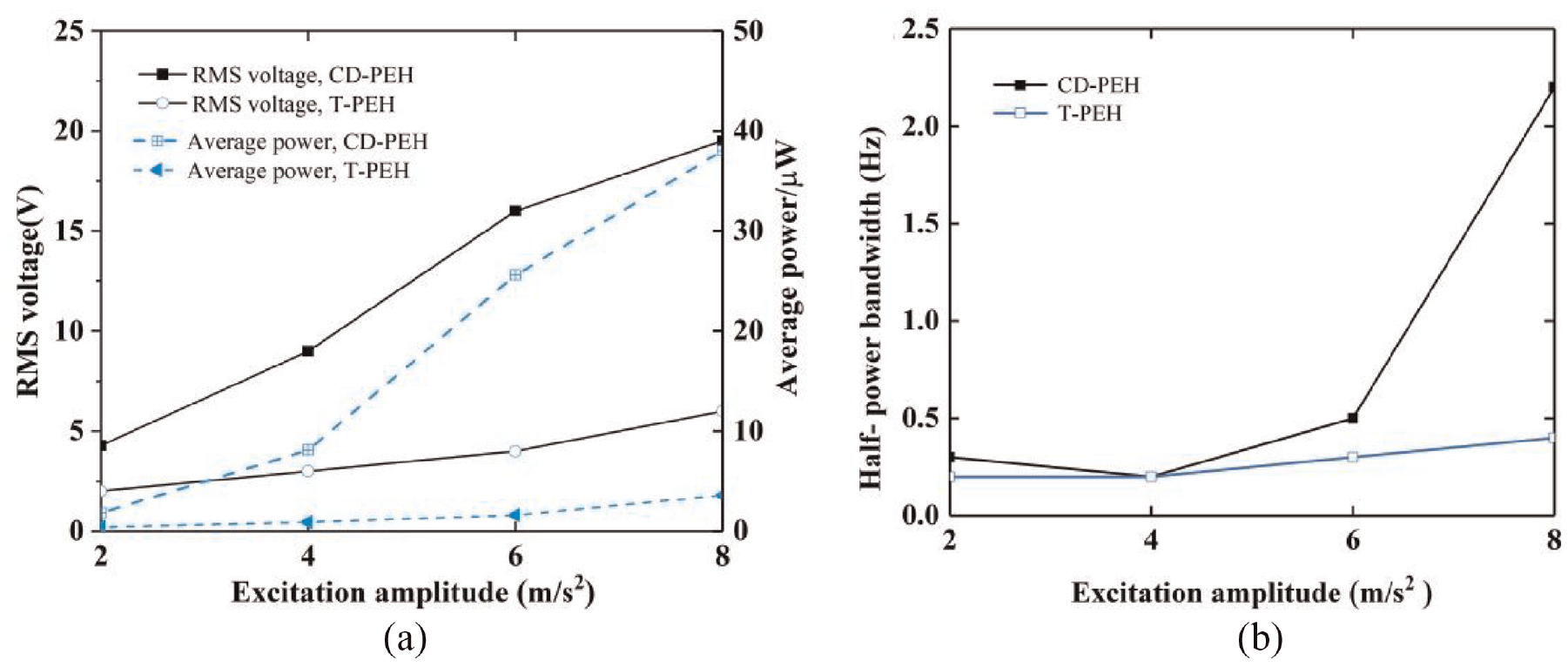
Performance comparison between the CD-PEH and the T-PEH: (a) RMS voltage and average power and (b) half-power bandwidth.
It is found from Figure 11(a) that the output voltage of the two types of configuration increased with increasing the excitation level. However, the output voltage of the CD-PEH was always higher than that of the T-PEH under all the excitation levels, which validated that the proposed harvester could generate more electric energy than the T-PEH under the same excitation amplitude. Specially, the maximum RMS voltage of the T-PEH occurred under 8 m/s2 acceleration, and the corresponding voltage and average power were 6 V and 3.6 μW, respectively. However, the CD-PEH generated a maximum voltage of 19.5 V, the output voltage is increased by 225%. The average power of the CD-PEH reaches 38 μW, 10.5 times as high as that of the T-PEH case.
More importantly, due to the inherent geometric nonlinearity, the CD-PEH could provide wider effective bandwidth than the T-PEH for energy harvesting without using complicated structures of multiple springs or magnets, as shown in Figure 10(b). Especially, for the excitation of A = 8 m/s2, the effective working bandwidths of the T-PEH and the CD-PEH are 0.4 and 2.2 Hz, respectively. Compared with the T-PEH, the effective working bandwidth is increased by 450%, which verifies its superiority over the T-PEHs’. From these viewpoints, it is indicated that the proposed CD-PEH is more effective to convert vibration energy compared with the traditional design.
6. Summary
In this paper, a curve-shaped based doubly clamped piezoelectric energy harvester is proposed. A parametric approach, CBCM, is developed to establish nonlinear restoring force model. Then the electromechanically coupled model for the CD-PEH is built to investigate the effect of the excitation amplitudes, the geometric parameters and the load resistance on the output characteristics. Finally, experiments are conducted to validate the theoretical results. The following conclusions can be drawn:
For the first time the nonlinear restoring force model of the curve-shaped construction has been derived by using CBCM approach. The modeling process presented can be easily extended for curved beam with variable curvatures and other beams such as L-shaped, U-shaped beam.
As the excitation amplitude is increased, the CD-PEH orderly exhibits quasi-linear, softening nonlinear and mixed hardening & softening nonlinearity behavior due to the existence of the curved configuration, which can significantly broaden the working bandwidth. For the excitation amplitude A = 8 m/s2, the effective bandwidth of the energy harvester reaches 2.2 Hz, which is increased by 633% compared with the effective bandwidth in the case of A = 2 m/s2.
Finally, Experimental results reveal that the proposed CD-PEH could generate higher output power than that of the T-PEH under same conditions. More importantly, due to the inherent geometric nonlinearity, compared with the T-PEH, the CD-PEH could provide wider effective bandwidth for energy harvesting without using complicated structures of multiple springs or magnets.
Footnotes
Declaration of conflicting interests
The authors declared no potential conflicts of interest with respect to the research, authorship, and/or publication of this article.
Funding
The authors disclosed receipt of the following financial support for the research, authorship, and/or publication of this article: This research was funded by the National Natural Science Founds of China (Grant No.51974228 and No.51834006), the National Green Manufacturing System Integration Project (Grant No.2017-327), Shaanxi Innovative Talent Plan Project (Grant No.2018TD-032), and Key R&D project in Shaanxi (Grant No.2018ZDCXL-GY-06-04).
