




Abstract
This reflexive autoethnography explores my experience of learning about myself as I experienced painting with watercolors. The focus of this research is understanding the interaction of identity, emotion, and belonging within the context of my own adult learning experience. The central emphasis seeks to offer contributing factors to adult learning in a context outside of formal learning opportunities, such as in university or school-based learning. I employed the reflexive process of autoethnography through journal entries, photographic documentation, and recalling to examine my own experience of learning in a non-academic setting. Various theories of self-identity, participation, and learning were explored to frame my own learning experience. This methodological approach allowed the pursuit of adult learning to emerge as something deeply intertwined with an individual’s understanding of their identity, affective experiences, and sense of belonging. These considerations have capacity to further current conceptualizations of the process of adult learning experiences. Implications for facilitators of adult learning are offered.
“As I engage as a novice in watercolor painting throughout the course of 4 months, how is my learning experience characterized by self-identity, affective experience, and belonging?”
Introduction
In the name of transparency, you must understand one vital thing about me: I am not artistic. At least, that is what I have told myself for my entire life. With one older sister being a talented painter and another having a keen eye for decorating, crafts, and visual displays, my meager drawings never measured up to anything worth noting. Being unable to create like others did, I decided at an early age that “artistic” is something that I would never be.
This paper is the result of an autoethnographic exploration (or rather, experiment) that I engaged in over the course of 4 months, during which I intended to examine the process of my own learning within an informal and voluntary context.
Autoethnography “acknowledges and accommodates subjectivity, emotionality, and the researcher’s influence on research, rather than hiding from these matters or assuming they don’t exist” (Ellis et al., 2011, p. 274). As such, throughout this learning experiment, I closely examined my own experience of learning how to paint in terms of my own history and how that influenced the emotions I encountered and the changes that I experienced throughout the process. This report on my learning experiment focuses on how identity, emotion, and belonging were key factors in my experience of learning to paint with watercolors.
Theoretical Framework
Several theories of learning, identity, and participation influenced how I characterized my learning experiment. Each of the theories shared in the following section influenced how I engaged in and made sense of my experience of learning about myself as I experienced painting with watercolors.
What Counts as Learning?
Broadly speaking, at the root of a learning experience often lies a newfound knowledge or understanding that has in some way been acquired (Sfard, 1998). This is especially true in structured learning environments, where there are defined curricula, learning goals, and teacher–learner role dynamics. Even within recent and notable scholarly discussions about andragogy, knowledge is often positioned as something that is transferable, transactional, and nearly tangible (Brion, 2022; Roumell, 2019). It is something that we acquire from somebody or something that possesses it.
However, in many cases of adult learning, this unidimensional framing of learning is an incomplete representation and could rob one of less defined, but richer and longer-lasting learning experiences. In making sense of my own learning experience, I take up Anna Sfard’s (1998) participation metaphor for learning, which suggests that learning is more about becoming a different person than it is about acquiring knowledge. Viewing learning as participation helps us expand our understanding of what learning is, can be, and does for a person, for “learning transforms who we are and what we can do, it is an experience of identity” (Wenger, 1998, p. 215). Though I did develop several tangible skills throughout my own experience of learning how to paint with watercolors (such as the best angle at which to hold the paintbrush, how to adjust water-pigment ratios for different visual effects, or blending colors on paper to make a sunset), the most profound learning that I experienced can certainly be characterized as such “an experience of identity,” wherein my learning was deeply rooted within ways of being, participating, feeling, and belonging.
Positioning learning in terms of participation results in a sense of belonging within a community. Though not expressly tied to identity work, Sfard’s (1998) participation metaphor for learning provides a space wherein learning becomes not just about increasing skills, understandings, or capabilities, but becomes a way of being within a space. This participation metaphor of learning suggests that an individual’s sense of identity and belonging within a context is inseparably a part of, and not apart from, their learning experience.
Identity
One’s identity is constantly revised throughout the life span (Dien, 2000), and this paper shares my own renegotiation of one aspect of my identity in relation to being artistic. Throughout, I take up a Vygostkian framing of identity, considering it in terms of “how persons construct their personal versions of the social identities that mediate their behavior and interpretations of the world” (Holland & Lachicotte, 2007, p. 109). This framing of identity primarily aligns with the constructs of self-identity theory (Stets & Burke, 2000), which examines “how social structures affect the structure of self and how structure of self influences social behavior” (Stryker & Burke, 2000, p. 285).
For much of my life, I restricted my engagement in social artistic activities because I had self-identified as “non-artistic.” However, this learning experiment caused me to challenge that self-identification, thus influencing my behaviors and engagement with artistic social activities. As such, my identity development throughout this learning experience was focused on my perceptions, interpretations, and beliefs as I experienced them, and how those perceptions later informed my own engagement with personal and social practices.
Participation
Throughout my experiment with learning to paint with watercolors, I often turned to the frameworks of peripheral (Lave & Wenger, 1991), guided (Rogoff, 1995), and intent participation (Rogoff et al., 2003) to inform how I interacted with my painting session’s teacher, which was usually a YouTube video. Whereas intent participation occurs through observation and listening to others as to contribute to the community (Rogoff et al., 2003), guided participation allows for both observation and hands-on participation. In guided participation, “‘guidance’ [is] referred to… the direction offered by cultural and social values, as well as social partners; ‘participation’... refers to observation, as well as hands-on involvement in an activity.” (Rogoff, 1995, p. 142). The interaction between self and “social others” in guided participation loosely occurred as I observed, followed, and participated with various YouTube videos that acted as my digital co-participants as I painted.
The ultimate purpose of guided and intent participation, however, is to help an individual learn enough to contribute back to their larger learning community. As I often painted by myself and had no opportunities to give back to the community of practice within which I was engaging, my participation in watercolor painting was not perfectly suited to interpretation within a framework of these types of communities of practice (Lave & Wenger, 1991). Rather, throughout my learning experiment, I took up these frameworks (guided and intent participation) in modified ways to inform my own intentional engagement as I attempted to learn how to paint with watercolors.
Methods
My goal at the beginning of the experience was to paint about once each week throughout the following four months, though the true frequency was realized to be closer to three times per month. When I first began, I would use a tutorial on YouTube to guide me through the process each time I painted. At first these videos were broad and general, usually using search terms such as “watercolor painting 101” or “easy watercolor painting for beginners” (see Nianiani, 2020; Rainey, 2020). As time went on, my searches became more specific and based on my goal for that day, such as practicing landscapes (Makoccino, 2019), painting a daylily (Ellen Crimi-Trent, 2020), or simple lettering with palm fronds (Ehlke Art, 2020).
These YouTube videos were essential in helping me first enter the watercolor painting community, as they allowed a way for me to engage in peripheral participation (Lave & Wenger, 1991). When I observed, listened to, watched, and followed along as skilled artists explained their process while painting, the opportunity came for me to not only practice painting, but also start feeling like I belonged with others who painted. When I read about intent participation (Rogoff et al., 2003), I tried to apply intent participation to my own practice of using YouTube videos to instruct and inform my learning-to-paint experience.
Informed by the constructs of guided participation (Rogoff, 1995), I chose to intentionally position myself as an intent and focused observer while watching these YouTube videos. To do this, I established a pattern of watching a video (or video segment) at least one time before picking up my brush, with my full attention to how the artist in the video painted each section and spoke about each step. This focused viewing of each video before I painted allowed me to preplan my own painting techniques, brushes, and color mixtures.
There were times when I painted with others, but more often, I painted by myself. I strove to paint at least once each week throughout the 4 months, and the purpose of each painting session was determined by who I was with, what I wanted to paint, and whether I had a specific outcome in mind. As I first began painting, I tried to do so with other friends who were new to watercolor, thus allowing me to engage with other novice painters. On one occasion I painted with two other friends; another time with one friend. During these times, we would select a YouTube video together and paint along with the artist, encouraging each other along the way.
As I became more comfortable with watercolor painting and confident in my abilities, I began to paint with more purpose, creating bookmarks and cards to give to family and friends. I would always use something to reference as I painted, whether that was a YouTube video, image from the internet, or photo that I had taken (see Figures 1 and 2). Reference photograph, taken on personal device. Watercolor landscape painted from reference photographs.
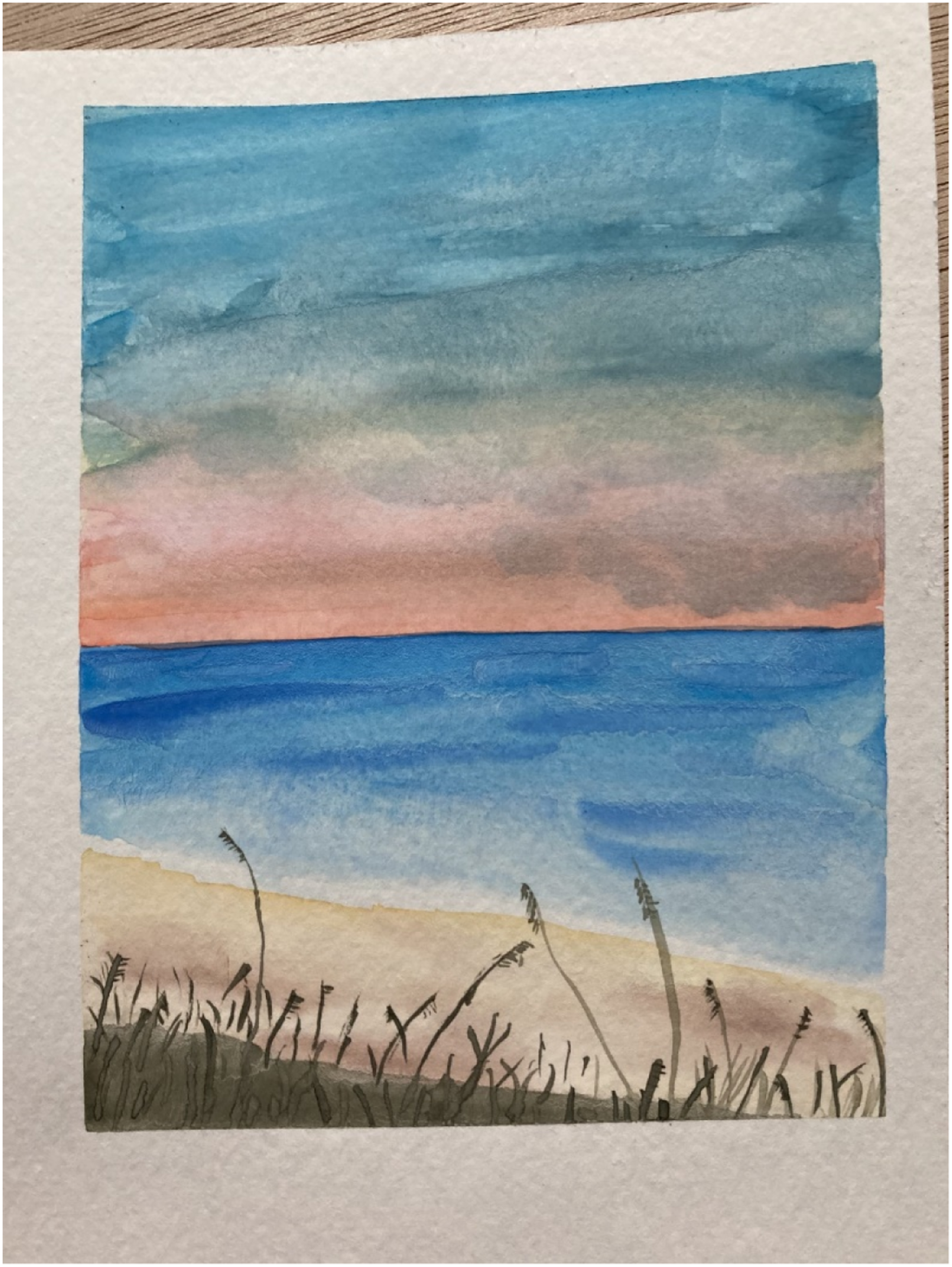
Most of the time after I finished a painting, I took a picture of it and uploaded it into a reflection journal, wherein I would record logistics such as what video I watched or who I painted with. As I engaged in both recalling the experience as well as observing and analyzing myself (Chang, 2016), these entries included the emotions I felt, the motivations surrounding the painting, how my experience compared with previous painting experiences, and the ways I felt myself making progress. These entries varied in length from a few sentences to multiple paragraphs and served as spaces for me to record whatever elements of that day’s painting experience felt salient to my learning journey. Though these reflections were always recorded after a painting session, they were reports of emotions, thoughts, and motivations that I had mindfully been aware of throughout the entire process. This intentional mindfulness as I painted contributed to an ongoing and in-depth exploration of my learning experience before, during, and after each painting session.
Findings
Considering the guiding question of this paper, I now consider the nature of my learning experience through the intertwined concepts of identity, affect, and belonging. As autoethnographic writing “is based upon and emerges from relationship and context” (Anderson & Glass-Coffin, 2016, p. 57), the following discussion of identity explores how personal acceptance, belonging, and affective experiences all worked together to create and reinforce a newly formed identity in myself as a watercolor painter. Affect is explored specifically in terms of comfort, confidence, and competence, as well as motivation and authority.
Accepting a Developing Identity
Before I could even begin learning to paint, I first had to look deeply within myself and choose to challenge one aspect of my identity to which I had tightly held for decades: that I was not artistic. This identification had served me well for years, as it had provided an easy excuse for me to painlessly reject many opportunities to paint, draw, and create with others. However, when I chose to learn how to paint with watercolors, I had to confront that stubbornly held non-artistic identity and actively choose to dismantle it in order to allow myself the chance to engage in an artistic endeavor. As I continued with learning to paint, my newly reconstructed identity was reinforced through my own acceptance and social recognition as I engaged in watercolor painting across the 4 months.
Acceptance
Lave and Wenger (1991) suggest that one manifestation of learning in a community of practice is a new identity; an identity that was socially constructed and reinforced in community. One of the anticipated outcomes of engaging in watercolor painting throughout the semester would be a reinforced sense of creativity as an identity that I more readily take up. Consistent with my subconscious need to seek recognition from others to confirm my identity as a watercolor painter was the conscious need for myself to also recognize, confirm, and reinforce that identity. Observe the deep-rooted identity tensions I grappled with before I ever even picked up a paintbrush: I still have a voice in my head that shames me away from attempting visual arts. Drawing/painting/etc. is something that I’ve never invested a lot of time into, and I’ve always defaulted to simply saying that I’m no good at drawing. For my entire life, that voice that automatically pops up has kept me from really trying. Where I have to dedicate myself to this for an entire semester so I can study my learning process over time, I countered that internal voice by saying that for once, I’m actually going to give myself time to improve at this skill—because drawing is a skill that can be learned, not just a talent. -Personal notes, 8/23/2022
After a lifetime of not allowing myself to adopt any creativity related identities, I knew from the beginning of my learning experience that it would be crucially important for me to allow myself to fail without that failure compromising my budding identity as a painter.
Though it was particularly important for me to allow myself to accept this new identity even as a novice, that does not mean I told myself that I was talented and capable from the beginning. Rather, I tried to approach each painting experience as an opportunity to learn a new skill and improve myself as a painter because I readily acknowledged my position as a novice watercolor painter, and still ignorant of the art form in many ways. Specification of my own ignorance (Wineburg, 1998) facilitated my intent participation (Rogoff et al., 2003) in many ways, because it helped me to position myself as a novice and remain willing to ask questions, rewind videos to rewatch a segment, and paint the same thing multiple times while not jeopardizing my newly forming identity simply because I was new to the practice. As I sought to actively internalize my own identity as a painter, I became increasingly capable of controlling my own responses and behavior while painting (Holland & Lachicotte, 2007).
Recognition
“Identity and learning are intertwined, such that when identities are accepted and aligned in learning settings, opportunities to learn open up, and when key identities are rejected, opportunities for learning are shut down” (Nasir et al., 2021, p. 560). Recognition is a crucial ingredient in identity formation (Avraamidou, 2019; Bullough, 2005), and this remained true in my experience with watercolor painting. Before I ever picked up a paintbrush, I ensured that I would receive recognition for my painting efforts by sharing my intention to paint with multiple close family members. Each time I painted something, I always took a picture and sent it to at least two people, who would respond with encouragement to what I was doing. Reflecting on these behaviors, I realize now that I needed those trusted friends to recognize my efforts to reinforce my own emerging identity as a novice watercolor painter.
Affective Presence
Emotion and affect always accompany learning experiences (Jaber & Hammer, 2016; Vea, 2018), particularly when those experiences involve “processes of becoming which are associated with visions of self, goals, aspirations, beliefs, and enculturation in specific social, historical, and geopolitical contexts” (Avraamidou, 2019, p. 337). Each time I journaled after painting, I reflected on the emotions I felt as I painted and considered how those emotions compared to each of my previous experiences. Growing feelings of confidence and comfort were consistently present throughout my journey with learning how to paint with watercolors. Additionally, I discovered that when I was painting with a purpose, I experienced greater levels of motivation towards what I was painting. With increased motivation, I found myself being more deliberate and confident in what I was painting.
Comfort
Throughout the semester, I was aware of my levels of (dis)comfort each time I engaged in this fresh territory of watercolor painting. In fact, prior to even getting the materials I needed to paint, I researched several sources online to learn what materials I would need as a beginner with watercolor. I had to do this before I could even feel comfortable with committing myself to painting with watercolors for my learning project.
In relaying the case study of one particularly engaged science student, Jaber and Hammer (2016) share that as she became familiar with the feelings involved when doing science, she was able to “recognize a kind of activity that she enjoyed” (p. 190). Part of my own affective journey throughout this learning experience has been (1) recognizing and pushing past my own fears and insecurities, then (2) becoming familiar with the feelings involved for me in watercolor painting. As this familiarity with the feelings involved in painting increased, I became less stressed about the product, more joyful throughout the process, and more appreciative of not just what I produced, but what others around me painted as well.
Motivation and Authority
I discovered early on in my learning-to-paint experience that when painting with a purpose, I took more time to experiment, practice, and analyze my work. This first became apparent to me when I chose to paint daylilies on cards in which I could send flower seeds to three of my sisters (see Figure 3). This was the first time I had a specific product in my mind, as well as a defined audience for my paintings. I had authority over my own directed learning process (Engle & Conant, 2010), and I was learning to paint a yellow lily because I wanted to paint that flower specifically. When I was painting with a purpose, I found that I took more authority over the product because I felt higher accountability towards my sisters, who were the recipients of the cards. As I became more comfortable with watercolor painting, I discovered that I was highly motivated to paint when making small gifts for others, especially for family members, as reflected in a journal entry that states, “I’m realizing that I really feel the joy and satisfaction in watercolor painting when the end result has a purpose” (Personal notes, 10/10/22). Daylily cards painted for sisters.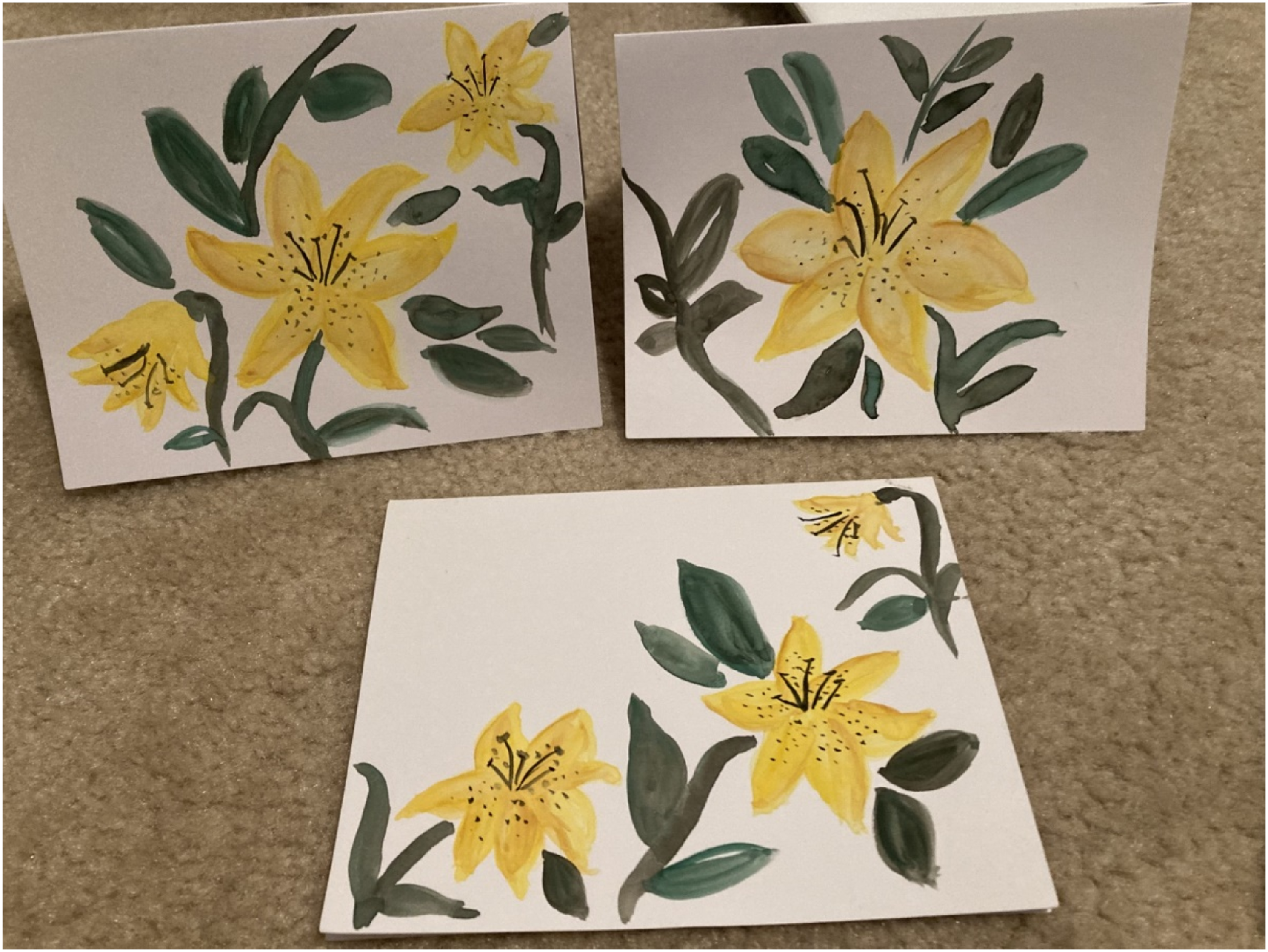
I intentionally position this characterization of my learning in terms of motivation rather than agency, following Gresalfi et al. (2009) argument that agency is something inherently and innately present, while motivation is something that a person “has” or “lacks.” In speaking of motivation, Ryan and Deci (2016) posit that “intrinsic motivation is… strongly influenced by contexts” (p. 100), and for me, the motivating context for painting was creating something that I could give to people that I love.
Confidence in Competence
Competence, considered simply as the ability to do something successfully, has long been considered an important part of engagement in an activity (see, e.g., Ryan & Deci, 2016). I consider competence to be an important facet of my own affective journey because it was closely connected to the feelings of stress, confidence, and pride that I experienced as I learned to paint with watercolors. The connection between competence and confidence was particularly apparent throughout my learning experience, as evidenced in a journal entry after painting individualized bookmarks for a brother and his family (see Figure 4): Two months ago, I never would have attempted any of these bookmarks because I didn’t believe myself competent. However, I have become more familiar with the tools and how they interact with each other and my motor skills, so I feel more competent. -Personal notes, 10/23/2022 Painted bookmarks.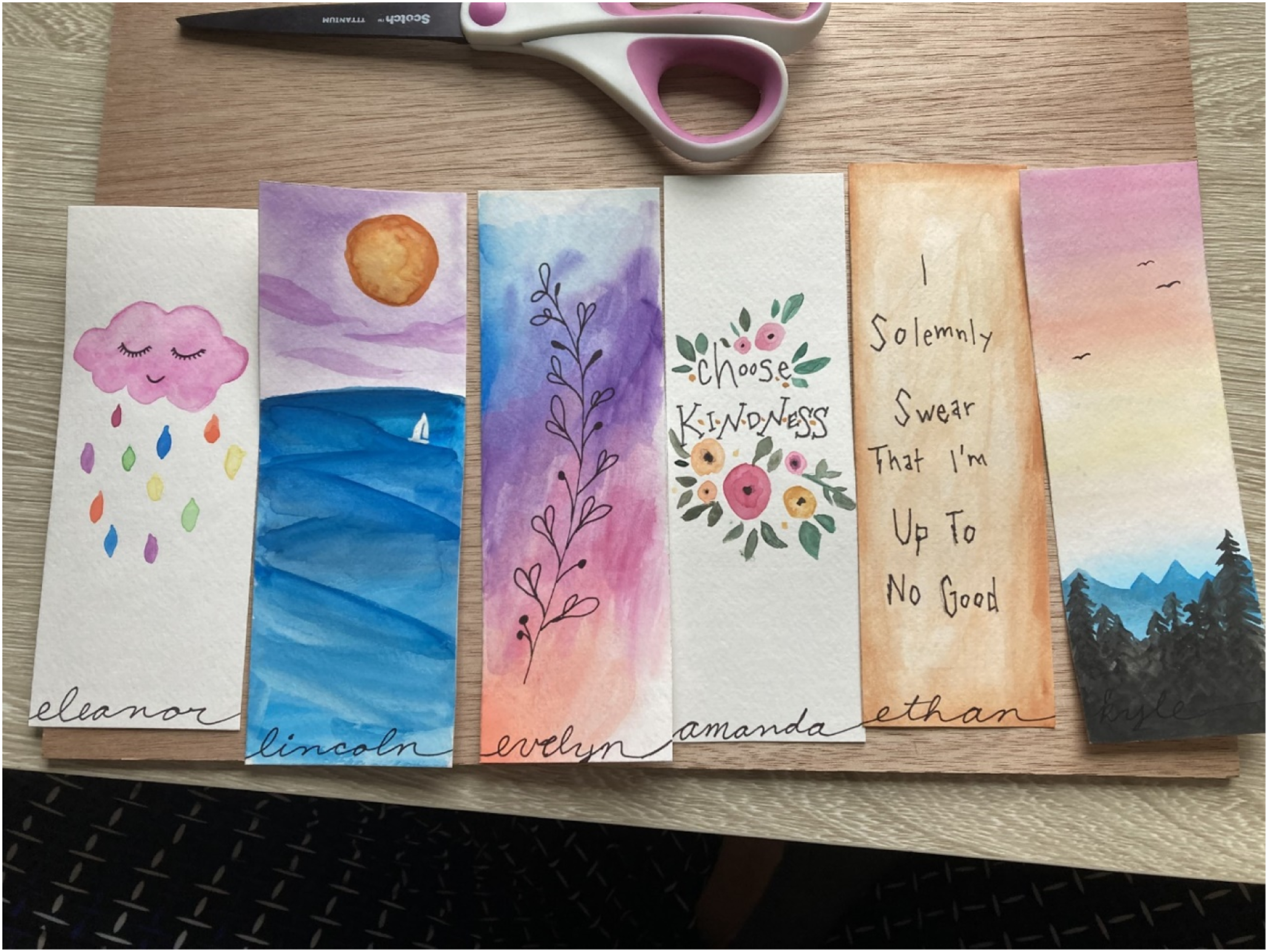
As I felt more capable of using the tools to paint, my confidence in myself increased. This increased confidence encouraged me to try new things that I had previously prevented myself from attempting.
Engagement in hobbies is strengthened when multiple personal interests converge (Azevedo, 2012). This happened for me when I discovered that I could use watercolor painting to create small gifts for others, such as cards, notes, or bookmarks. The engaged and motivated participation I experienced was indeed “co-constructed between the opportunities in the environment and the individual’s participation with those practices” (Danish & Gresalfi, 2018). As I discovered opportunities to use my participation in watercolor painting to create gifts for others, I felt more highly motivated to paint.
Belonging
One of the most beautiful and rewarding outcomes of my identity development as a watercolor painter was completely unanticipated. As I attended a family reunion after a few months of painting, one of the ongoing activities was a table with watercolor supplies. (For context, I am the eighth of 10 children in my family, with several siblings much older than myself. Consequently, I have 27 nieces and nephews that span in age from toddler to young adult.) At several points during the reunion, I joined whatever gathering of people was currently around the painting table and joined them in painting something. With various paper sizes and supplemental art materials (stencils, markers, stickers, etc.) at our fingertips, the only expectation of those at the art table was to be as creative as one’s heart desired.
I have participated in similar art-involved situations in the past at similar family gatherings, but always before, my participation has been overshadowed by an intense sense of self-consciousness and impostor syndrome. This time, however, I was able to participate without any sense of pseudo-belonging. I genuinely enjoyed myself, not just because I was with others and enjoyed exclaiming over the beautiful creations everybody else made, but also because for once, I felt like I belonged in a space where I was painting with others.
At one point during the reunion, I painted a simple sunrise landscape, and was overjoyed when I later saw a 5 year-old niece painting her own sunrise landscape, using my own as her reference image. My participation in that little painting community had provided the opportunity for another’s delighted participation. Her act of engaging with my painting reinforced in me a sense of belonging, happiness, and self-assurance that where I was in that moment in my emerging identity as a novice painter was enough. Though I failed to take a picture of her finished masterpiece, the moment was burned into my mind and my heart, never to be forgotten.
Avraamidou (2019) states that the process of becoming “is fundamentally a negotiation between our desired identities and the ones assigned by others” (p. 340), but I would extend that to say that the process of becoming is also a negotiation of what we allow ourselves to become. In this sense, truly learning through becoming is personally allowed through acceptance, inherently affective in nature, and communally reinforced through belonging.
Implications for Adult Learning
Too often we situate learning within formal contexts, and we forget that learning can also be characterized as a way of becoming part of a community. Adult learners should be invited to share the richness of their life experiences within the context of a learning environment by letting their voices be heard in staff meetings, classrooms, or professional development workshops. In so doing, belonging will be fostered as participants’ identities are recognized and accepted within the learning community.
Identity must be considered as part of any learning experience. Those facilitating adult learning experiences need to allow space and time for adult learners to reflect on and understand themselves as cultural (Brion, 2022), emotional (Karami-Akkary et al., 2019), social (Beijaard et al., 2004), and at times, imperfect and broken (Carpenter, 2022; Housel, 2019) beings. Allowing adult learners to bring their whole selves to a learning experience will open the door for longer lasting, more meaningful changes to take place.
Learning, participating, and changing from an experience is often an affective process for adult learners. It is important for facilitators of adult learning to acknowledge that feelings of discomfort, amotivation, or diffidence can often be present throughout a learning experience. Throughout my own experience of learning to paint, feelings of comfort, confidence, and motivation emerged over time and accompanied my own process of learning and change.
Conclusion
Throughout my learning experiment with watercolor painting, I have benefitted in unexpected ways from conscious shifts to my identity, an increased sense of belonging with others, and several emotions, including feeling more confident in and comfortable with myself. While my learning in the past has often been quantified by syllabi, learning outcomes, and end-of-semester projects, the removal of such prescribed expectations for my learning allowed me to have a rich, rewarding, and life-changing experience.
“Creation brings deep satisfaction and fulfillment. We develop ourselves and others when we take unorganized matter into our hands and mold it into something of beauty” (Uchtdorf, 2008, p. 119). While adopting “artistic” as an identity may not have been the outcome of this autoethnographic learning experiment, I have worked with conscious intentionality to allow “creative” to be an acceptable identifier for myself. More important for my identity journey, though, has been the more pertinent realization that engaging in creativity is a joyful and meaningful process. Even if I never become exceptional or even proficient at watercolor painting, I have found joy, purpose, and meaning in pushing myself outside of my comfort zone to learn something new.
We prevent ourselves from experiencing the richness of learning opportunities because we prescribe learning to be something that must include measurable expectations, assessments, and knowledgeable others to teach us. While learning certainly does occur in such structured environments, I fear that too many adults falsely believe that the ongoing and vague quest of “lifelong learning” ahead of them is out of their control and will largely be administered through “the school of hard knocks.” With a little bit of humility, bravery, and hope, I pushed myself to challenge a self-imposed and oppressive non-identity by learning how to paint with watercolors.
There may not be a way to quantify what or how I learned over my first four months of painting. However, I am not sure that any amount of quantifying or assessing would truly capture the change that I have experienced in myself; a change that has shown me a new way to bring beauty, joy, love, and purpose in my life. I have allowed myself to take on a new identity. I have experienced (dis)comfort and motivation. I have felt community, belonging, and connection.
I have learned.
Footnotes
Declaration of Conflicting Interests
The author(s) declared no potential conflicts of interest with respect to the research, authorship, and/or publication of this article.
Funding
The author(s) received no financial support for the research, authorship, and/or publication of this article.
