




Abstract
This qualitative study examines student learning experiences toward a student-developed case study activity for online discussion guided by a three-tier case method model. Forty-five students were recruited from four online adult education courses. Analysis of students’ feedback shows that this activity leads to students’ positive learning experiences, including provoking critical thinking towards the discussion topic and providing unique resources for adult educators. The student-developed case study activity also helps establish a supportive peer relationship and engages students through analyzing a variety of student-developed cases, as well as interacting with the instructor and exchanging ideas with peers. This study furthermore indicates the potential usefulness of the proposed model as a guide for case study activities in the field of adult education and beyond.
“The different case topics, meanwhile, prepare students for the real teaching world through identifying problems and thinking professionally, putting them in a role as adult educators.”
Introduction
Adult learners accumulate a growing reservoir of experience, which becomes a resource for their learning (Knowles, 1984; Ross-Gordon et al., 2016). Thus, adult learners typically value authentic experiential learning and problem-posing strategies (Ross-Gordon et al., 2017). The case study model described here is considered a practical and effective activity for adult learners because it combines prior knowledge and past experiences with new learning concepts and skills to solve practical issues (Lyons & Bandura, 2020). Most previous studies of case study method integrate this learning activity into discussions that are individual, small-group, or whole-class focused (Herried, 2011). In this study, students develop a case study activity that evolves by incorporating it into all three methods or tiers of discussion. Based on four online adult education course offerings, this study investigates students’ learning experiences and outcomes with this student-driven, three-tier discussion model for case study creation. The research question directing the present study includes: How does the student-developed case study activity influence students’ learning experiences in online discussion?
Literature Review
A case study (also called a case method, or a case study method) is defined as a description of a real situation that involves decisions, challenges, opportunities, problems, and issues that are encountered by individuals (Leenders et al., 2001). Although some limitations of case studies have been discussed, such as the facts that developing cases is time-consuming and may be challenging and difficult (Queirós et al., 2017), case studies bring multiple benefits to student learning. For instance, the case method provokes students’ critical thinking and encourages them to use theoretical concepts to solve a practical issue (Allen & Toth-Cohen, 2019). Specifically, case study activities can motivate students’ problem-based learning (PBL) by applying the learning materials to a problem (Ktoridou et al., 2018), further linking the theory and practice in authentic situations (Mesthrige et al., 2021). From 101 faculty members’ perspectives, Yadav et al. (2007) reported that case studies could lead to stronger critical thinking skills, an increased ability to make connections across multiple content areas, and deeper understanding of concepts. This study indicated that students who engage in case study activities are better able to view an issue from different perspectives, and they are also more engaged in class during the case-based learning activity.
The case study is identified as an active learning technique, which is superior to the lecture method by putting learning into a context that is memorable (Alani, 2020). Ktoridou et al. (2018) noted that the case method can increase students’ problem-solving skills, helping them identify problems, teaching professional thinking, providing emotional preparation for the real world, and helping students understand complicated issues. Similarly, Popil (2011) summarized several features of the case method by stating “cases are based on real-life scenarios, they provide supporting data and documents to be analyzed, and an open-ended question or problem is presented for possible solution” (p. 205). Lastly, the case study can promote students’ engagement in class because the case method has a positive relationship with students’ emotional engagement, which would further promote their learning (Raza et al., 2020).
Three case methods were identified by Herreid (2011) to be used effectively in the case study activity: whole class, individual, and small-group discussion methods. When using the whole class discussion method, a case is given by the instructor to the class. The instructor calls on students to discuss the case, and students share thoughts about the case through different formats such as debates, symposia, trials, and public hearings. The small-group method is an approach that groups students into teams as they work on a case given by the instructor. PBL and intimate debate methods belong to this approach. The small-group method is considered to effectively promote “diversity of opinions and respect for divergent views and for improving the expression of ideas” (Herreid, 2011, p. 31). On the other hand, individual cases indicate that most of the work is done by the individual student, such as the dialogue case method (Herreid, 2007) in which the instructor asks students to write a dialogue between two well-versed individuals on a controversial topic. Then, the two students exchange claims multiple times and finally declare their now position on the topic and reasons for it. As suggested by Harried (2011), the discussion method is an effective approach to engage students in class. However, only a few students would be engaged with the instructor while the rest of the class is passively involved when using this method in a large class. The individual method is a “hands-on independent student learning” (Herreid, 2011, p. 36), such as the dialogue case method in which students research a topic and write their claims. Although most of the work is individual, general discussion or role-playing components are involved in this approach. Lastly, Harried considered the small-group case method as the optimum approach for teaching. This method would generate a great amount of interaction between participants, especially when students are teaching their peers. The team-based learning combined with PBL for the small-group method would motivate collaboration and critical thinking.
A Three-Tier Case Method Model
Guided by constructivism theory, a three-tire case method model (see Figure 1) consisted of the whole class, individual, and small-group discussion methods is proposed to instruct a case study activity in four graduate-level adult education online courses. Constructivism theory indicates learners explore and reframe their understanding by reflecting on their experience and incorporating new ideas with their prior knowledge. A constructivist learning community involves learners’ experience, collaborative discourse, and reflection to assist them in confront their own learning needs (Brooks & Brooks, 1999). Three key assumptions characterize a constructivist philosophical view (Akbulut & Hill, 2020; Savery & Duffy, 1996): 1) knowledge is constructed from learners’ experiences; what learners understand derives from their interactions with the content and the context; 2) cognitive dissonance is the catalyst for meaning construction and determines the organization and nature of what is learned; 3) learners are active in their learning process and produce knowledge based on their beliefs and experiences in situations, which differ from individual to individual (Schunk, 2008). With these features, the case study method is supported by constructivism (Hartfield, 2010). Three-tier case method model.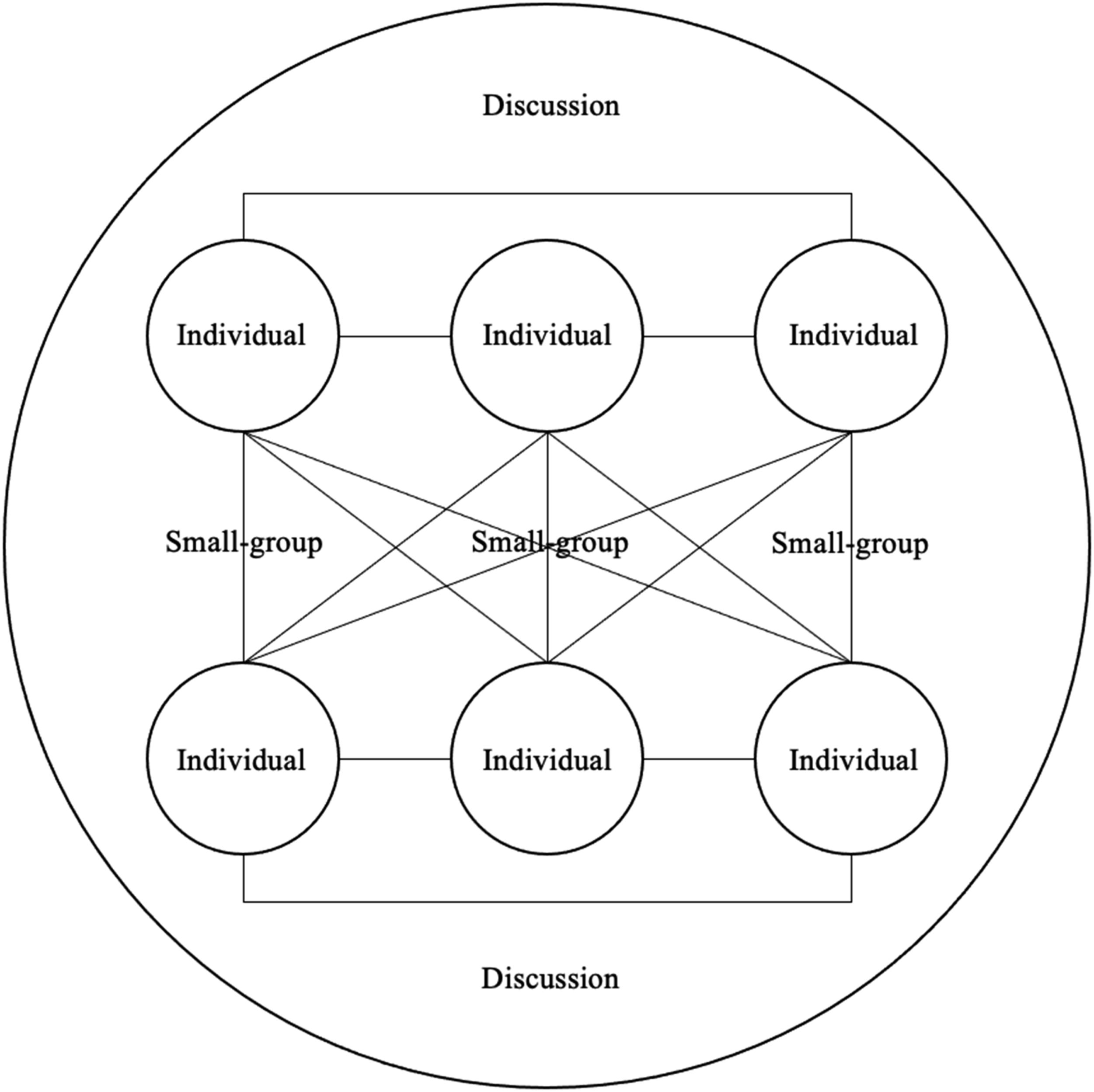
The three most effective case methods (Harried, 2011) are utilized in the model. In the first tier (i.e., whole class discussion), a discussion topic—dealing with challenging adult learners—is assigned as the weekly discussion. All students are required to participate in the discussion board on this topic. The instructor provides detailed guidelines on how to develop a case and what should be included in the case. An example scenario is provided by the instructor. Multiple questions are listed to help students analyze the case (e.g., what are the problems? How are you going to help this student?). Other requirements include a specific deadline for posting original thoughts and responding to at least two classmates.
In the second tier (i.e., individual discussion), students are required to work alone by creating their own cases and analyzing others’ cases. First, students need to develop one scenario related to working with challenging adult learners, including various elements (e.g., settings, characters, plot) when drafting their cases. They must include the conflict and issues in the scenario for learners to analyze and resolve. Second, each student must read and analyze their peers’ cases by referring to questions posted by the instructor. This is a stage where students work on their scenarios and analyze others’ cases independently. They could also relate to their own learning and teaching experiences when developing and analyzing cases.
In the third tier (i.e., small-group discussion), students provide optimal solutions to resolve the issues indicated in the case developed by their class members. They are encouraged to conduct follow-up conversations with their peers. In this process, students are teaching their peers by linking prior teaching to learning experiences. Meanwhile, they are learning from their peers by reading a variety of opinions and strategies that are given for the same scenario.
The instructor reads students’ cases and comments during the activity to develop further conversation. By the end of the week, the instructor makes a conclusion based on all the discussion posts on the weekly discussion topic—dealing with challenging adult learners. Issues and strategies are organized and shared with the whole class. This process echoes back to the first tier (i.e., discussion) under the leadership of the instructor, all students participate in a class-wide discussion to exchange views while analyzing different cases toward the same discussion topic.
Based on constructivism, applying case studies guided by the proposed model may enhance students’ reasoning capacities and problem-solving abilities, which especially benefits adult learners (Dewey, 1916). The model additionally requires learners to develop a case using their prior knowledge as a foundation, building on it with new information or learned knowledge (Abdal-Haqq, 1998). Analyzing others’ cases furthermore encourages students’ critical reflection that can facilitate adult learning (Brookfield, 1995). Thus, guided by this model, the case study activity works to create an environment to motivate learners’ interaction with their peers, the instructor, and the learning context (Johnson & Thomas, 1994; Vygotsky, 1978).
Method
Activity Design
The student-developed case study activity is integrated into one discussion board during the third week of two 5-week summer semesters in four graduate-level adult education online courses taught by the same instructor. This fully asynchronous online course provides an overview of the major issues in adult and higher education along with strategies for teaching adults by offering conceptual understanding and experiential skills in planning, implementing, and evaluating college instruction. Through this course, students develop their critical thinking skills, practice teaching techniques, and prepare a teaching philosophy. The topic of this week’s online discussion is dealing with challenging adult learners (Figure 2). The three-tier case method workflow.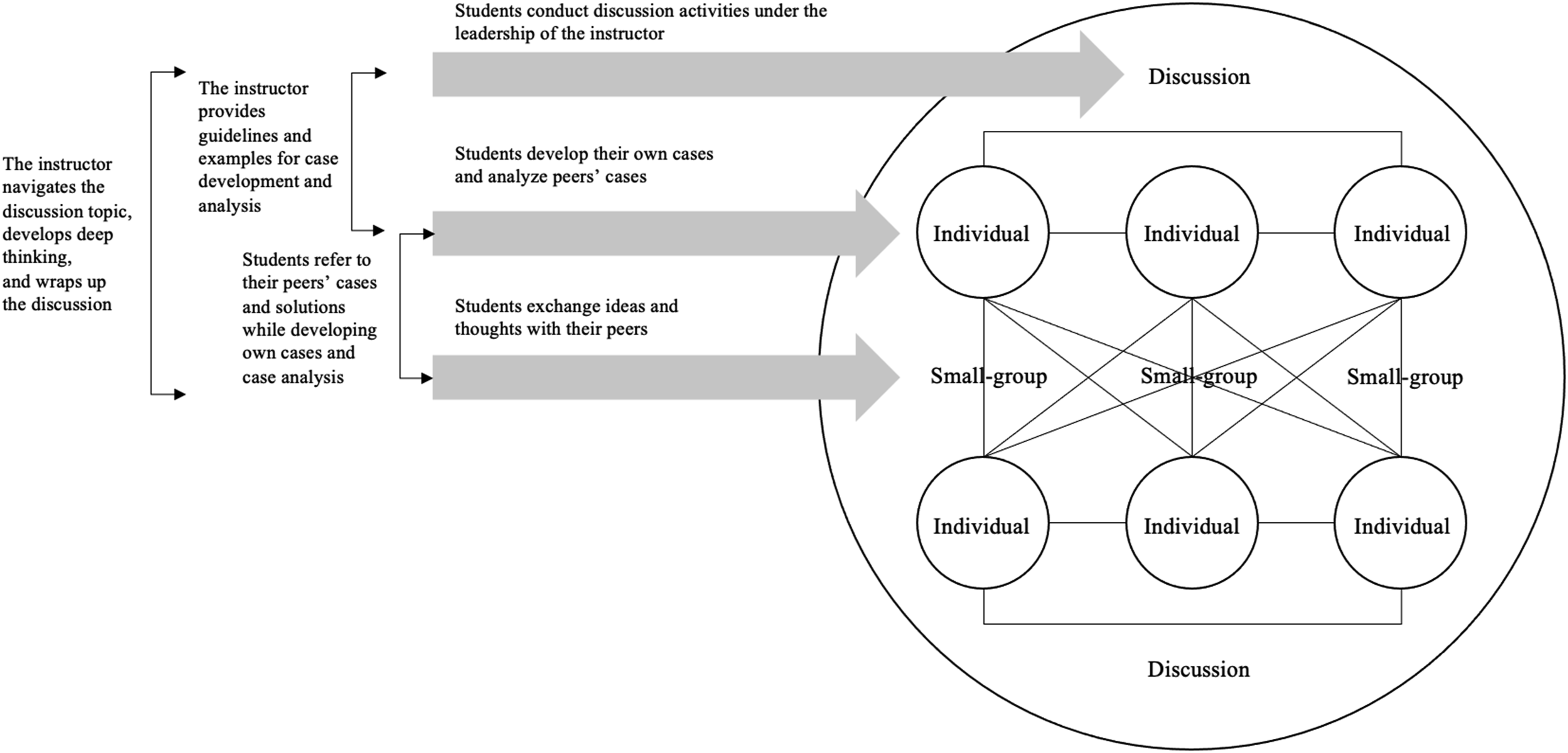
When conducting the activity, the instructor provides examples of challenging students, such as attention seekers, discussion dominators, and unprepared learners. When developing the scenario, students are required to include particular elements: settings (i.e., class size, level of the course, online, distance, hybrid, etc.), characters (i.e., the protagonist of the scenario, other additional characters, etc.), and plot (i.e., the story of the scenarios and the conflict/issues in the scenario). The instructor provides an example case and prepared questions while monitoring the discussion board. Based on the instructor’s suggestions included in the case, class members self-develops one scenario related to working with challenging adult learners, reviewing and analyzing at least two peers’ cases and providing possible solutions (see Appendix A).
Guided by the three-tire case model, the three discussion approaches occur at the same time and impact each other. Specifically, during the discussion process, the instructor provides guidelines and examples for students to follow. The instructor also comments on students’ posts to answer questions. During the individual process, each student develops their own scenarios and analyzes classmates’ cases. They refer to their peers’ scenarios and solutions to problems if they are having difficulties. Students could also refer to the instructor’s comments and suggestions while creating scenarios and solutions. During the small-group process, students share their thoughts (teaching others) and learn from others (being taught by others). In this stage, students can get a better awareness of critical issues in a case, which in return inspires the development and revision of their own scenarios and analyses of others’ cases. Lastly, they could join the discussion for a specific case (or cases) in which the instructor made comments and suggestions. Additionally, the conclusion of the different cases and strategies from the instructor by the end of the one-week unit could provoke students to think further about the discussion topic.
Participants and Instruments
Forty-five students who participated in the study were recruited from four sections of the same fully online course taught by the same professor in 2021 and 2022 summer semesters. According to the self-introduction discussion, most of the students in these courses had teaching experiences in various fields, including K12 education, adult and higher education, workforce training and development, and medical education. Most of the students were adult learners as they work full-time and/or have caring responsibilities. Students’ responses were collected from a weekly anonymous end-of-module survey, which aimed to understand their perspectives on the student-developed case study activity. IRB approved this study.
The end-of-module survey was adopted from Stephen Brookfield’s Critical Incident Questionnaire (CIQ) (1995, 2006), consisting of five open-ended questions aiming to help instructors see the classrooms through their students’ eyes. It has been widely applied to adult and higher education as an alternative for learners to share “what’s working and what’s misfiring” (Brookfield, 2015, p. 34). In this study, the open-ended questions were modified to fit this specific course aiming to motivate students to share complete information, feedback, and ideas toward using the student-developed case study activity in their own voices. Questions include, “At what moment in this week’s student-developed case study discussion did you feel most engaged with what was happening?” “At what moment in this week’s student-developed case study discussion did you feel most distanced from what was happening?” “What action did anyone (instructor or fellow student) take in this week’s discussion did you find most affirming and helpful?” “What action did anyone (whether instructor or fellow student) take in this week’s discussion did you find most puzzling or confusing?” “What about this week’s case analysis discussion surprised you the most?”
Data Analysis
Using thematic analysis (Braun & Clarke, 2006) with the multi-case approach, the author examined feedback from 45 students. The first phase of coding was based on each participant’s responses, developing a codebook. For the second round, the author used inductive open coding analysis while reading and re-reading the codes to identify major themes. Lastly, the author finalized emerged themes for the final write-up (Thornberg & Charmaz, 2014) to ensure the study’s robust and compelling results (Yin, 2014). Figure 3 presents the rationale and progress of the case design and data analysis. Multiple-case study coding steps.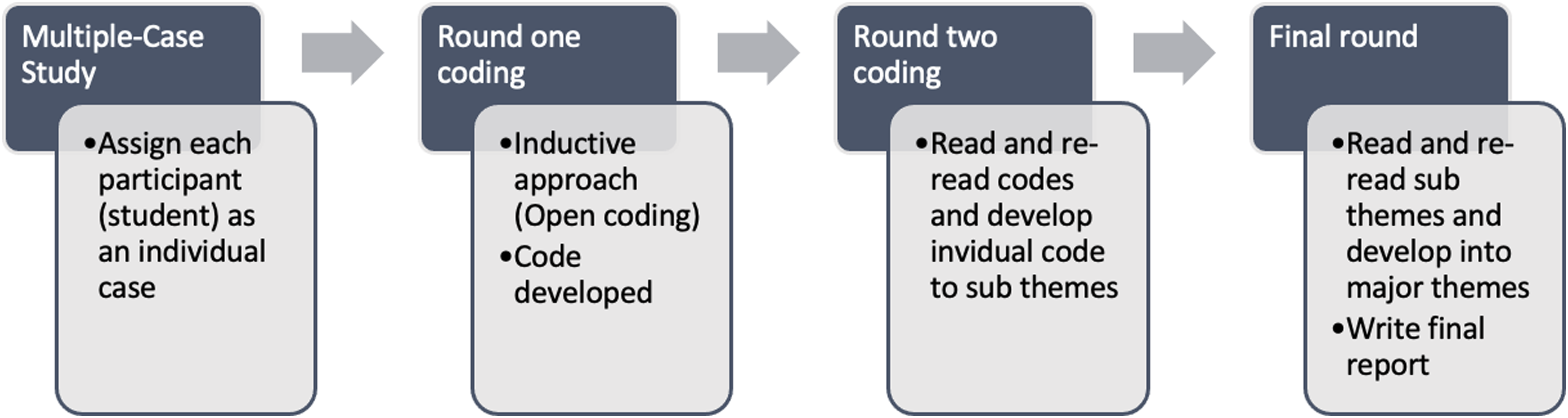
Results
Analysis of students’ feedback generates six themes, presenting their experiences of participating in the student-developed case study activity.
Provoking Critical Thinking
One major theme shows that the student-developed case study activity can provoke students’ critical thinking. First, students believed reading their peers’ cases and comments to be enlightening, with comments like, “I really enjoyed reading my classmates' responses to the different cases. I’m a very pragmatic person so I found it very interesting to see how others would respond in a hypothetical (but realistic) situation.” By exchanging a variety of ideas with their peers while analyzing cases, they found this case study activity allowed them to learn from their peers by analyzing cases from different perspectives. For instance, one student reported “the varying responses to the case studies and different perspectives on the same cases were extremely helpful in seeing things from a different way that you might not have thought of on your own.” Students also enjoyed reading different approaches shared by their peers in terms of managing different scenarios, as one stated, I felt the most engaged during the case analysis discussion when I read my peers’ scenarios and replies. I thought the scenarios given were insightful and realistic examples of student issues that might occur in college settings…I again learned from my peers in practical solutions for student issues in the classroom.
Their peers’ cases helped students to develop their scenarios. One student noted that her classmates’ cases helped her create her own scenario while other students referred to peers’ comments when developing their analysis. For instance, one student mentioned, “I liked how [name] went point by point to address our peers’ scenarios. His replies were focused and organized. I followed his lead in formatting my replies.” Furthermore, peer learning was stimulated as several students highlighted that they gained perspective by comparing how they would handle a situation with how their classmates manage the case.
Additionally, students engaged in deep learning of the study materials via this activity. Specifically, one student noted that reading the different cases increased her overall knowledge of the adult learners in a higher education setting. Another student mentioned that by analyzing cases, she could dig into the material and other resources to help the students that were being described in the cases. In sum, the student-developed case study activity could provoke students’ critical thinking. As concluded by one student, “I felt that the case analysis was most helpful in requiring me to critically think about what I would do in certain situations also backed by empirical studies.”
Providing Unique Resources for Adult Educators
The developed cases were related to dealing with challenging adult learners. The multiple scenarios discussing issues involving this student population in the discussion board becomes a valuable reservoir, as one student expressed, “…the different scenarios of how to handle adult learners were unique to adult learners and educators.” Further, students were impressed by the various types of challenging adult learners in the different scenarios, including “prison example,” “adult learners with ADHD and disabilities,” and “ESL adult learners.” The diverse cases also motivated students to relate the cases to their own teaching experiences as adult educators. For example, one student wrote I was surprised by how each person seemed to recognize a student or scenario they had dealt with in many of the other case studies presented. I think this shows that classrooms, however, they differ in make-up and topic, do have some reoccurring issues with students.
They also intended to take their peers’ strategies and use them for their own teaching because they had students with similar situations in their classes. As one student mentioned, When my peers were creating or referring to their own situations in dealing with “challenging students,” I could visually picture a student in my class. It was nice to hear how my peers would respond to a situation and compare it to how I handled it. A lot of times they were similar, but in an instance that they weren’t, it was nice to get suggestions that I can implement next time.
The solutions to the different cases additionally stimulated students to think about ways to teach adult learners with different backgrounds broadly. As one learner said, Several classmates had good recommendations to help some of the characters in the cases needed. It was affirming to me that those of us in adult education classes really do want good for people, and us sharing ideas on how to provide that can only be positive.
Lastly, the student-generated case study activity altered some students’ views of adult learners and better prepared them to become adult educators. For instance, one participant commented that she “used to blindly think that adult learners came without baggage,” but the scenarios showed her the variety of possible situations she had to deal with as an adult instructor.
Developing a Supportive Peer Relationship
While engaging in the student-developed case study activity, students found peer feedback, especially comments concerning their cases, helpful. Some reported reading their classmates’ solutions affirmed their own instincts towards managing the cases, and they also found that their peers’ responses to their own cases help them see different ways to handle certain case topics. Meanwhile, students appreciated the time their peers spent on their cases, as one said, “Another student’s comments on my post showed they took a lot of time to think about the case study and gave thoughtful and helpful responses to the situation.”
Additionally, students believed the overall discussion was supportive and demonstrated positive intent. Specifically, they felt affirmed when their peers agreed with their comments, as two students noted that receiving positive peer feedback on their case solutions was encouraging and could increase their confidence in case analysis. Similarly, some found it affirming and helpful when they worked with their peers to “clarify ambiguities/assumptions in a supportive space, and in a respectful manner.” In short, participants believed that the student-developed case study activity “created an open-ended discussion created by students and taught by students.” The affirming comments can help build a supportive relationship between students.
Instructor’s Involvement in the Activity Engages Students
The instructor played an important role in the discussion board, including sharing guidelines and interacting with students. Specifically, students found the example scenario provided by the instructor helpful in creating their own cases as one said the example case clearly explained what the instructor was looking for. The guiding questions suggested by the instructor were also useful as these questions help them respond to each other’s case studies thoroughly. Additionally, students appreciated the instructor’s participation in the discussion board. For instance, one student expressed, “it was helpful to read the professor’s responses to some of the scenarios. I was able to see if I was on the right track.” Meanwhile, they enjoyed interacting with the instructor because they felt affirmed by reading the instructor’s comments and suggestions. One student reported, “I was appreciative of the professor jumping into the conversations to add to the tips being offered by students.” Another student shared that she valued the instructor taking time to respond to the case studies and providing suggestions. The instructor’s participation in the discussion board could also motivate students’ engagement because the instructor was passionate, enthusiastic, and interested in engaging students would stimulate student engagement (Arghode et al., 2017). As one participant explained, “I like that the instructor comments on our discussion posts. Makes it seems that you are as engaged as we are.”
Creating and Analyzing Cases Was Fun and Engaging
Students found the student-developed case study activity was fun and engaging. For instance, students noted, “…the case analysis discussion was more fun than I thought it would be,” and “I found the student-developed case scenario assignment more engaging than I anticipated.” One reason such analysis was engaging was because it allowed students to think as an instructor as they created their own cases and analyzing others’. As one said, “…it [case study activity] allows me to put myself in the role of a professor.” Students also commented that the various cases were compelling, and they were willing to put a great amount of reflection into their consideration of their peer’s scenarios. Moreover, participants expressed that they were engaged while discussing and collaborating on solutions to the case analysis with their peers. Furthermore, some were surprised that many of the case topics were based on actual situations that had happened to students. In sum, this activity could be helpful to their careers. As one discussed, “There are going to be times in our career as an educator that we are going to need these tools to help us in these types of situations.”
Creating and Analyzing Cases May Be Overwhelming and Difficult
Some difficulties were mentioned related to this activity. Students felt hesitant and anxious at the beginning of the assignment, especially when developing the case. Some of them commented that they were unsure of what kind of instance the scenarios were describing as they ended up making up a type of student who was different from their initial thoughts. Students additionally found some scenarios difficult to solve because they lacked knowledge in specific fields. In fact, students in these online courses came from different majors (e.g., nursing, consulting education, library science). They usually developed their own cases based on their experiences in specific fields. Thus, other students who lacked relevant expertise would find it difficult to come up with a firm solution when analyzing those cases. As one expressed, One student replied to my case but in a different way than I expected. She identified the problem differently than I did. I think maybe my case wasn’t totally clear so when I thought about it, her reply made sense, but I was hoping for help with the problem and didn’t get that.
The knowledge gap among students would further leads to another issue—lack of comments from peers on the discussion board—which was discussed by one student who additionally felt some distance when her scenario was not well understood by her peers.
Discussion
Overall, the student-developed case study activity guided by the three-tier case method model leads to positive student learning experiences. First, echoing with previous conclusions (Allen & Toth-Cohen, 2019; Mesthrige et al., 2021), the present study affirms that the case study could provoke students’ critical thinking and encourage them to view an issue, seek solutions from various perspectives by exchanging ideas with their peers. The process of developing answers also motivates students to dig further into the learning content, reflecting Yadav et al.’s (2007) statement that case studies usually improve students’ abilities to make links across different content areas along with a deeper understanding of concepts. Second, instead of the instructor giving a case to the class, students develop their own scenarios combining their own experiences, contributing to a broader view with different types of challenging adult learners. Thus, another major benefit of this activity is that the various student-developed scenarios and strategies for resolving the problems provide unique resources for students as adult instructors. They could use the variety of methods proposed by their peers when teaching their own classes. The different case topics, meanwhile, prepare students for the real teaching world through identifying problems and thinking professionally, putting them in a role as adult educators.
Additionally, the variety of cases leads to students’ engagement in class. Students enjoy developing their scenarios and analyzing others’ cases through discussion and collaboration. Furthermore, receiving positive feedback and useful suggestions from peers helps establish a supportive online community. Students feel affirmed when they find their peers sharing similar strategies toward a case. A sense of resonance also arises when they read comments showing that their peers have experienced same problems being instructors. Along with their peers, the interaction with the instructor leads to students’ engagement in class. These findings mirror previous conclusions that the case study could promote students’ class engagement as this approach has a positive relationship with students’ emotional engagement, further enhancing learning (Raza et al., 2020). Yet, some students expressed that creating their own cases can be overwhelming, and some find it difficult to analyze their peers’ cases especially if they lack relevant knowledge.
Therefore, when applying the student-developed case study activity in adult education online courses, the instructor should anticipate and plan for the difficulties of this activity. As aforementioned, confusion about a case may emerge if there is a knowledge gap between case developers and case analysts. The difficulties that students encounter to develop solutions would make the result less active interactive. Therefore, the instructor should ask students to provide explanations or concepts of professional terms if they plan to develop scenarios in their fields. Another teaching strategy involves asking students to create cases in general settings or backgrounds. In addition, the instructor needs to encourage students to check the discussion board regularly to answer questions thus motivating class interaction and navigate the discussion topic if any confusions emerge. Although this activity was conducted in adult education online courses, it can also be adjusted to meet the requirements of specific subjects.
One innovation this study offers is using the three-tire approach method to guide the case study activity. The case study method is not new to educators and learners, while instructors usually conduct case study using whole class discussion, small-group, or individual methods independently (Herreid, 2011; Roshni & Rahim, 2020). Some may combine two or three of these methods but in a linear approach, meaning that students have to complete one type of case discussion method (e.g., small-group) and then move to another (e.g., whole class) (Trespalacios, 2017). Different than previous case methods, the proposed three-tire approach method is circulated via implementing all three case discussion strategies at the same time without a restricted sequence of conducting the case study. Thus, students could flexibility work on cases back and forth while interacting with their peers and the instructor, as well as gaining information to enlighten their own case development and analysis in fully asynchronous online learning environments. In short, using the student-developed case study activity guided by this model, students could work on their own scenarios and analysis of others’ cases. Students, at the same time, exchange thoughts with their classmates on their case development and analysis. Meanwhile, students are inspired when creating their scenarios and solutions under the leadership of the instructor during the entire activity. A unit conclusion by the instructor furthermore reinforces students’ understanding of the weekly discussion topic.
Conclusions
This study examines student learning experiences using a student-developed case study activity for online discussion, which is guided by a three-tier case method model. Findings demonstrate that this activity leads to positive learning experiences. Specifically, this activity stimulates critical thinking towards the discussion topic, motivates students’ deep learning of the study materials, and provides unique resources for students being adult educators. It also helps establish a supportive online community and engage students through analyzing the various cases and interacting with the instructor and peers. Additionally, this study shows that the proposed model—integrating the discussion, individual, and small-group methods—could effectively guide the case study activity for online discussion. It connects students’ independent learning with peer learning, while both types of learning are surrounded by instructor-led learning.
One limitation of this study is that the three-tire approach may be confusing and overwhelming for students. Thus, guidance should be presented clearly by the instructor. Another limitation is that the CIQ only captures moments or actions in class and indicates student judgments of the class activities as they learn. Therefore, further interviews (e.g., one-on-one or focus group) should be conducted to specifically explore students’ online learning experiences toward this case study activity. Additionally, the proposed model is used in adult education online courses. Future studies should examine the effectiveness of this model by applying the case study to other subjects. Moreover, participants in this study are adult learners who have years of working experience. Many of them pull from their teaching or training experiences when developing their own scenarios and analyzing others’ cases. It is unknown whether students who lack relevant working experiences could create as meaningful of cases and provide practical suggestions. Therefore, it is necessary to test the effectiveness of the model among different student populations. Lastly, quantitative studies should be conducted to examine the usefulness of this model so that to support or argue with the present conclusions.
In sum, this study uses a case study activity for online discussion guided by a three-tier case method model. Positive student learning experiences are generated, indicating the potential effectiveness of using the model as a guide. Thus, it is expected that this model could be applied by educational professionals and practitioners to instruct case study activities for online discussion in the field of adult education and beyond.
Footnotes
Declaration of Conflicting Interests
The author(s) declared no potential conflicts of interest with respect to the research, authorship, and/or publication of this article.
Funding
The author(s) received no financial support for the research, authorship, and/or publication of this article.
Case Analysis Discussion Board Assignment
Author Biography
